Wednesday, 17 December 2008

Soup (Σούπα)

Soup was one of my favorite meals in New Zealand. My mother often made chicken and rice soup with the stock water of a boiled chicken, adding egg-and-lemon sauce to it, along with some rice, salt and pepper. To make it more savoury, she would add a sachet of Maggi chicken-noodle soup. The colder climate - Wellington was often wet and windy - made soup a necessity, with the added advantage that it was a simple meal to prepare, especially for a woman who ran a shop every day of the week (the chicken was saved for another meal, usually a roast). Another favorite soup of my father's was tomato soup made from a Maggi sachet, made in a similar way to chicken soup (without the egg and lemon). At university, some health-conscious classmates of mine drank hot soup made with Cup-a-soup instant mixes and hot water boiled in a ZIP heater.

Soup is what gave us the word 'restaurant': "The modern restaurant industry is said to be based on soup. Restoratifs (wheron the word "restaurant" comes) were the first items served in public restaurants in 18th century Paris." Restoratifs - restaurers - were a kind of soup.


Although we have Greek fish soup every now and then during the winter, I cannot say that the Cretan soups I was introduced to when I first came to the island made any lasting impression on me, except to loathe them even more than I did when I first started having them. As I recall (and eventually learnt to make myself), fish soup was made with fish, carrots, potatoes, courgettes, celery, onions, some tomato and rice, and the only difference between meat soup and fish soup was that chunks of beef were used instead of fish. I was probably discouraged by the similarity of the ingredients, and the whole idea of eating in essence the same recipe put me off making these soups. To top it all off, the fish was smelly, and the beef was tough (as Greek beef usually is), not a good combination to interest children in eating this kind of meal. I still prefer to eat the fish and vegetables a a raw salad rather than the psarosoupa made out from the stock.

My present soup-making exploits reflect my own tastes in soup, which are closer to other European cuisines. I have always loved thick and chunky minestrone-type soups, where all the ingredients are added to the soup in small visible pieces. If you like onion, leeks and garlic as much as I do, then a good French onion soup can't be beat. Finally, there's the creamy type of soup (like leek and potato potage) made with whatever is lurking in your fridge or freezer, boiled down to a pulp and heated before being served. These soups are mainly vegetarian, but the best versions of all these soups, in my humble opinion, are made with a meat-based stock.

Recipes for good stock abound on the internet. My only problem with those recipes is that they make large quantities of stock which then needs to be frozen and re-used. This is all very well, but my deep freeze is usually well stocked, and cannot handle liquid containers whose contents still need to be cooked into a meal. Freezing bits and pieces of vegetables to make them into stock also seems pointless, since vegetables can be found everywhere you look in Crete. Therefore, it is a waste of space and energy to freeze this sort of thing in a Cretan kitchen. I have my own way to make good stock, largely based on the kind of meat cuts we buy in Crete.
meat
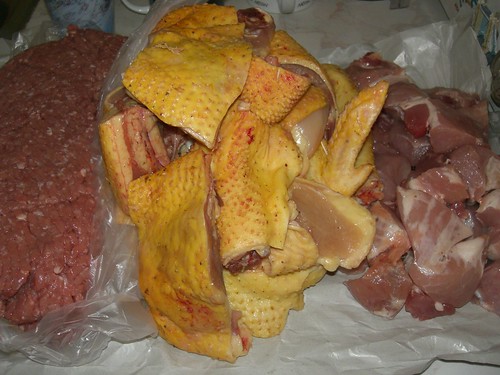
Mixed beef and pork mince, fatty yellow free-range chicken, pork chunks

We don't buy meat often for our household, so we don't eat a lot of meat in general. But meat is an integral part of the weekly diet, and it is always eaten at the weekend. When we make our meat purchases, it is nearly always from our local butcher, who is often supplied by local farmers. The kind of chicken we buy is free-range, fed on corn, grass and vegetable peelings. To buy this kind of chicken (I always ask for it to be chopped into smaller pieces), you need to ask for 'horiatiko', similar to the word used to mean 'Greek salad', meaning 'village-style'. It contains large deposits of fat. This is exactly why I buy it - one small piece of this (with the skin) will make enough soup for six hungry people.
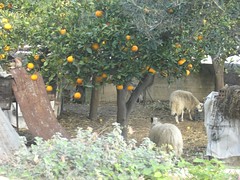
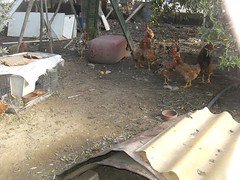
free range sheep free range hens
Animals reared free range; scenes from my uncles' farm: sheep in a pen surrounded by orange trees and diktamo bushes, hens in a coop,

Picking out ready-to-discard vegetables (all the vegetables in the fridge that you just know will go to the bin if you don't use them soon) and adding just one small piece of fatty meat has now become my favorite soup-making technique; there is always one main ingredient (to give the soup a name), but everything else depends entirely on whatever is at hand. Everything is allowed to boil away to make a rich creamy soup. These kinds of recipes remind me of one of my favorite anecdotal folk tales: one-nail soup (or stone soup, in some cultures).

The last time I made pumpkin soup pumpkin soup, this is what I added to the basic recipe:
1 lonely leek, all parts, roughly chopped, including green part
2 tomatos, at the onset stage of attack from garden pests, from my early December harvest
the scraggly neckbone of a chicken - very tasty, but too bony to be enjoyed properly
5-6 rocket leaves that had lost their crispiness and would not have been eaten raw
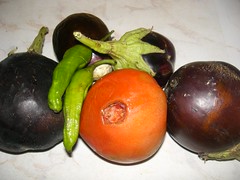
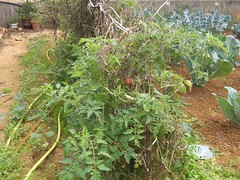
garden harvest early december hania chania tomato plants december hania chania
December garden harvest; I'm looking forward to getting rid of the eggplants.
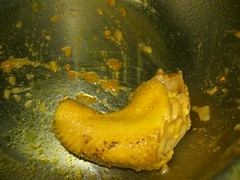
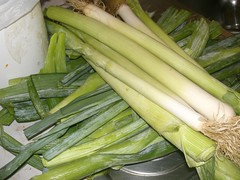
One of my favorite winter vegetables is the humble leek. Leeks are not often used in Cretan cooking. Wild leeks do grow in Crete, and are often mixed into wild greens (and sold as a mixture in this way), but they are never sold on their own. The local supermarket chain in Hania sells imported leeks from Holland, a country that has few good land resources, meaning that most of its exported fresh produce is most likely grown hydroponically using soilless culture. An Athenian-based supermarket chain that operates in Hania sells locally grown leeks; why it wasn't the other way around doesn't surprise me, as leeks are nota commonly found ingredient in Cretan food. Leeks are bought mainly by foreigners (like myself!) and tourist residents, whereas locals will only buy one or two leeks, maybe to add as a flavouring to a meal.

chicken neck bone pumpkin soup
Pumpkin soup: the chicken meat (without the skin) can also be pureed into the soup.

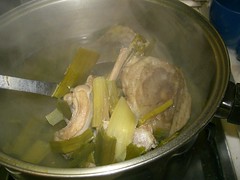
During a visit to the supermarket, I was lucky to bump into another woman also buying leeks. While we were waiting for our produce to be weighed, I noticed that she knew where to look on the assistant's worktop to find a knife. She cut off the dark green parts of the leeks, the parts of the vegetable that recipes always tell you to discard, like the tough outer leaves of a cabbage. Just when I thought she was going to throw them away (and hence not throw away her good money in the weighing process), I noticed her putting them back into the plastic bag. I asked her what she intended to do with them. "Soup," she said, adding that this part of the leek is not as tough as people make out; it simply needs a long boiling time to soften it, enhancing the flavour of the soup stock.
leeks hania chania one nail soup
Locally grown leeks are more slender than the hydroponic Dutch imports; they resemble very tall spring onions. The meat from the sole lamb chop that was used for the stock was minced into the soup for a richer stock flavour, as it contained no fat to make a thick stock.
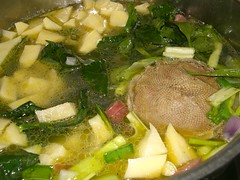
old potatoes potato and leek potage
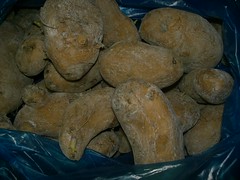
My uncles gave me some potatoes in June when they harvested them from their field. About a month ago, they asked me if I wanted some more; I wasn't prepared for these straggly looking tubers. They told me that, despite their age, these potatos taste better than new potatos which may be harvested when they are too green to be eaten; the white dust is chalky lime, used to keep away insects. It doesn't affect the taste of the peeled potato.

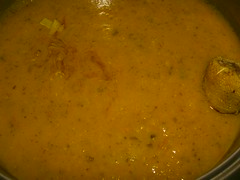
In my latest leek and potato soup, I let an escaped lean lambchop (found lurking in the freezer drawer) and a thin spicy sausage boil away in a large pot of water with about 5 whole leeks, roughly chopped, 2 unattractive old potatos, peeled and cubed, and one large artichoke, frozen since the end of last spring, now too brown to be visually appealing.


The first sign of snow on Lefka Ori - 9 December 2008.

Winter has finally arrived in Hania. A few nights ago, after the freezing cold temperatures - we finally turned on the heating - I heard a a shower of rain falling in the early hours. It woke me up and my mind went to the washing I had hung out to dry. In the morning, I saw an uplifting sight - snow, SNOW on our mountains, LEFKA ORI! The overnight rain acted like an automatic sprinkler system, with very little interruption to our life (apart from my wet laundry), watering my spinach and carrots and radishes, so I expect a good bounty. The snow on Lefka Ori means that, despite the likely lack of tourists next year, there'll be plenty of water for us to keep ourselves clean, drink, water our gardens, wash our horta, and keep our sewers clean.
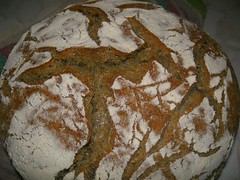
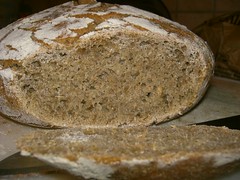
bread bread
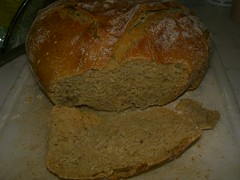
home made white bread

And in this cold weather, coupled with the serious unrest my country finds itself in, these soups make the best meal imaginable, along with a loaf of home-baked bread, like the one Aris told me to make. Such meals are made for sharing, so as Phivos rightly points out, κοπιάστε! (kopiaste!) You're all welcome!

©All Rights Reserved/Organically cooked. No part of this blog may be reproduced and/or copied by any means without prior consent from Maria Verivaki.

Monday, 15 December 2008

Whatever takes your fancy ('Οτι σου γουστάρει)

The recent events in the past week in Greece have destroyed any sense of Christmas spirit that might have been flickering before the moment that tarnished my country's laid-back image once and forever. The waves of outcry after the events surrounding Alexis' death reached out into Europe and even as far as South America; for once in the modern history of the country, Greece became a leader and not a follower. Despite the death of a 15-year-old boy by a police officer that had earned the nickname 'Rambo', and the destruction of the city centre of Athens through vandalism, arson and looting, Greeks have to carry on with their lives. The burnt Christmas tree in Athens will be replaced and Christmas will still 'take place'.

For most Greek people this year, Christmas will be a time of reflection. They're going to have to think about what went wrong and why things got out of control. As to who or what is to blame, if Greek people could just start by pointing the finger at themselves, maybe we'll find an answer. It's not an easy thing to do, because people don't like to blame themselves for anything bad that happens. It's always the government's fault, they say to you, no matter which party is in power. When teenagers are rioting on the streets, surely it's not just the government's fault - maybe it's the parents' fault too. For Greece to find some peace, we're going to have to re-think our priorities in life.

There's definitely something wrong with our society. Our youth has been messed up. But I insist: EVERYTHING starts in the home. Here's what happened, exactly as my husband related the events to me, just two nights ago (Saturday) at about 8pm, in the beautiful old Venetian port of Hania, where he was taking a walk to clear his mind:

fountain lighthouse hania chania

Five college kids (all boys) are hanging around in the main square of the old port, near the fountain area, close to the chains that separate the square from the road. A car pulls up alongside the chains, and the driver looks out of the window.
"Ay," scowls the tallest of the boys, "whatcha looking at me for?"
The driver hesitated for a moment.
"I'm not looking at you," he replied. "I think you're looking at me."
The boy's friends showed support for him and aversion towards the driver, someone who they did not know, and had possibly never met before. The tall boy spoke again.
"So, what are you going to do, aim a gun at me and shoot me?" His friends cheered and jeered appropriately, as in a well-rehearsed act. At this point, the driver took off.

If I were there, I would have too, because there was no way out of this fracas, apart from an showdown of some sort, the situation having reached an impasse, as Polivolon writes.

If you are providing your children with pocket money to go out with their friends on a cold wintery Saturday night, do you not have the right to demand to know where they are going, who they are going out with, what they are doing, and whether they are safe? If you can't answer all these questions, then you need to reset your priorities; otherwise, you are allowing anarchy to rule. Half the high schools in the country are being locked up by students, who do not allow the teachers to enter. We worry about being attacked by terrorists, but are we the ones raising the terrorists? I do not want to be terrorised by anyone, let alone my own children. In five years time, my son will be a teenager. I, the parent, have a major role to play in my children's upbringing. I know the Greek education system sucks, but Greece was never an easy country to live in, and it's not getting any easier to live here, but it still all starts in the home.

Here's a piece of writing from one of my students (Serbian). This week's topic was “Who are the better teachers: parents or professors?” and here is her answer (as she typed it online; hand-written compositions are almost a thing of the past...):

By the age of the six every child has already had the first contact with the education school system. For the most of them this is the very stressful period and without the support of their parents, they usually have difficult time of adaptation. Every parent expects from the school teachers to give their children the best education and to help them with learning process next fifteen years. Some of them expect from teachers much more, sometimes to do their job of being parent. Can parents be teachers, also? If they can, are they better than trained professionals?

My opinion is that the parents are the best teachers and they have natural obligation to be the first tutor in child’s life. The law of nature organizes the learning process between parents and children. For example, young bird in the nest learns how to flight from parent bird, not from flight instructor. Baby penguin learns how to swim and how to catch the fish from the parents, again. The little monkey watches its society group and then imitates the parent’s behavior.

The human baby is listening mother’s voice during the nine month period in the stomach and reacts on every change, especially of voice intensities. Laugh, cry, music, noise and all other sounds from external surrounding, effect on baby’s development. The baby creates the picture and gathers knowledge about the whole world on this way. So, the first teacher is baby’s mother.

Coming to the world is not so difficult for the child, as it is for parents. They must consciously learn to live with that new creature and follow the demands of new member of their family. But on the other hand, they are teaching unknowingly this young, pure soul every single moment how to live. The child imitates mimicry of parents, sounds and body moves. Everything what baby does is simple copy of behavior of parents.

Forasmuch as the years passing by, the lessons are more complicated. To be a good parent means to be a good teacher. The school is only one of the necessary paths of education. Parents don’t need to do teachers job, but they have to prepare the children for capability of learning and personal evolution. They should create new stabile person, with good ability to adjust in the whole social background. The best teacher for this is a parent, naturally.

The main goal of a good parent is to become the best teacher of its own child. If the parent is able to hand over all its knowledge and wisdom, than it is the biggest success in human’s life. Every good parent is trying to triumph in this challenge. If parent manages in this, then that will be the best lesson in the whole world.

So, in conclusion I agree that no one can be better teacher than parent for its own child.

My job was not to comment on her opinion - I simply corrected her grammar errors...

*** *** ***
It's not an easy time to write about food, but in my house, we are still cooking and eating (we have to if we want to survive), and trying to find some pleasure in it. My trips to the supermarket are not so frequent; the garrish colours and superficial decorations for the festive season do not cover my deep regret with the way the events of the past week unfolded. The supermarket, for all its positive features as purveyor of the human right to variety and desire, also plays a role in the spread of the instant gratification malaise, prevalent among the Greek youth; armed with worthless degrees, lowly jobs and the minimum wage, they realise how powerless they are in a consumer society where they can't afford what they want, while an elite and wealthy group have a lion's share of the market (the same people own most of the flashy shopping centres that go by wide-ranging names such as The Mall, Golden Hall and Attica Centre), but they, the common people, can only gaze in awe at the material world from a shop window.

The supermarket is a form of escapism. When you enter the store, there are no windows, no natural light (apart from the glass doors at the entrance), no clock to remind you that you've spent too long inside its consumer society surroundings: soft music, vibrant colours, plastic wrapping, special offers, free gifts when you buy something, something you probably don't need but thought you did when you entered the store, all mask the purpose of entering the supermarket. My first stop is usually the bread counter...

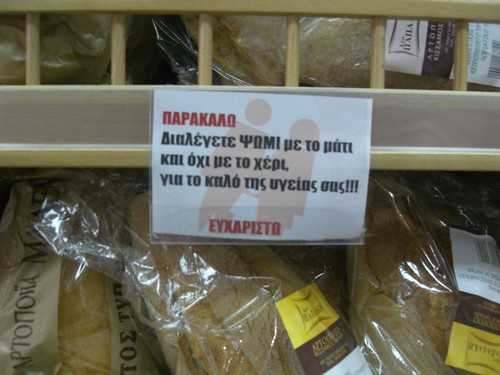
bread notice
Greeks still need to be told: "PLEASE - Choose bread with the eye, and not with the hand, for your health's sake!!! THANKS" Obviously, some people are taking the loaves out of the bags...

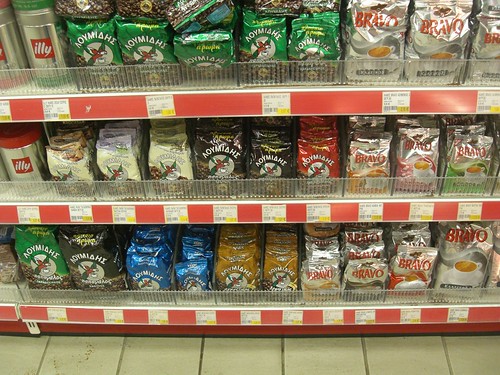
We'd also run out of Greek coffee...

coffee varieties
All the Greek coffee your heart could possibly desire. The trend of scenting coffee with various flavours, as practised in the West, has caught on in Greece: now you can have ouzo, cinammon, rose, mastich or cardamon scented Greek coffee, whatever takes your fancy...

This sight reminded me of another homeland...

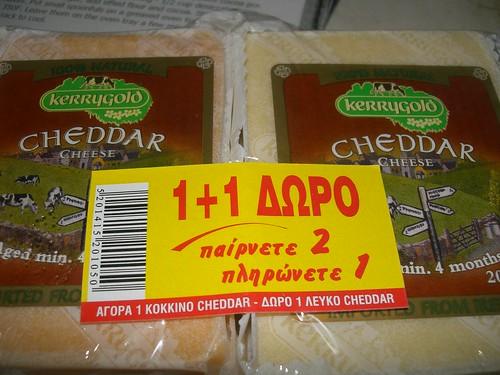
cheddar
Thanks to our tourist residents, cheddar cheese - virtually unheard of and only available in the special (and expensive) cheese section of the deli counter - has now become so commonplace that the Irish Kerrygold brand is being sold as a 2-for-the-price-of-1 special.

... while this one reminded me of the madness that exists in the Western world when it comes to feeding oneself. Some people want to eat what they want, when they want, no questions asked.

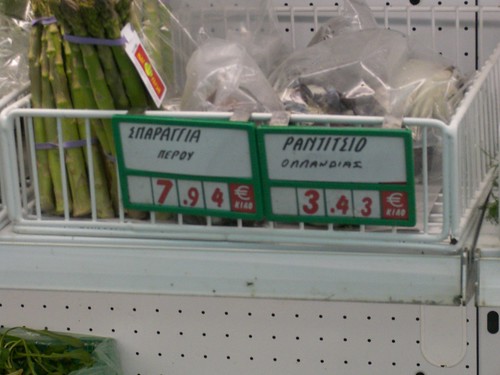
imported products in hania chania supermarket
Asparagus (from Peru) at nearly 8 euro a kilo? Radicchio (from Holland) for 3.5 euro a kilo? You must be pretty desperate if you feel the need to buy these in a Cretan supermarket...

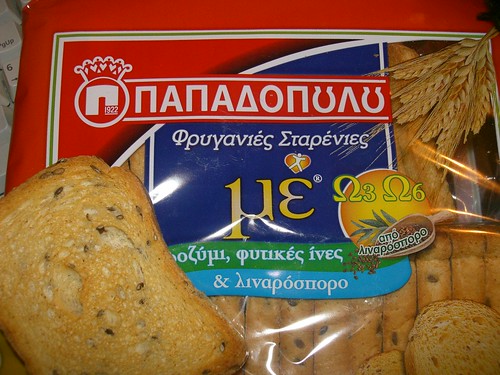
I decided to treat myself after all, to some of that cheddar cheese, and a newfangled version of the classic Greek frigania, a baked oven-dried toast-like crisp cracker used like a bread slice, mainly eaten for breakfast or as a snack, added to yoghurt and milk or spread with butter, cheese or marmalade:

linseed friganies
One for the ladies: linseed is believed to relieve menopausal symptoms, as well as being of benefit in the health of the aged. Recommendations from health studies are often being incorporated in the processed food industry in Greece. Friganies are now available with the addition of linseed.

I bought these crackers on the pretext that I am doing something positive towards my health. But I cannot escape the truth: I was trying to forget the crisis my country is now facing without any solution in near sight.

©All Rights Reserved/Organically cooked. No part of this blog may be reproduced and/or copied by any means without prior consent from Maria Verivaki.
Friday, 12 December 2008

Greek language lessons: askrolimbi and broad beans (Ασκρολίμποι με κουκιά)

You came to Greece on holiday, had a whale of a time, ate a whale of everything, and now that you're back home, you want to check out all those weird and wonderful things you experienced in Greece, so you look them up on the internet. To your dismay, what you're looking for doesn't seem to exist, or there are extremely few sites that link to it. (In fact, these days, the main reference to Greece on the web is all riot-related.) The whole process is time-costly and frustrating. Maybe you did find some sites, but expected to come across different ones. To exasperate you even further, you couldn't work out the transliterated spelling of a Greek word and it threw your search off-track completely. Don't worry, you are not alone; this happens to Greek speakers and non-Greeks alike.

sea urchin
Caretta Caretta taverna in the summer; sea-urchin salad

Here's an example. You had a delicious seafood hors d'oeuvre at a Greek taverna and wanted to find out more about it, so you carefully jot down the name of the dish as it appeared in the English translation of the menu card: ahini. You google it, but you don't get a single food rerference. So you try the images; in vain, as none of them contain food. You remember that as the waiter brought you the dish, he mentioned another word as he lay it on your table: ahinous. You try that one (although how you picked the spelling is a trial and error exercise), but still get very few links (the only image I got for this one was for a plate of fried plantain). So you start experimenting with spelling and come up with ahinoos ('ou' could be pronounced in the same way in Greek as 'oo'), achinous, achinoos (the 'h' xound is often transliterated to 'ch' in English) and whatever else takes your fancy, in your attempt to enter the Greek psyche and try to work out a creative orthographical transliteration of the Greek word you heard or saw written. Maybe you also noted the Greek spelling itself: αχινοί, which looks a little like axinoi. EUREKA! Now you know what you were eating: sea urchins, whose Latin species names (echinodermata, echinozoa, echninoidea) all sound a bit like ahinos; and now you also know how the saying "it's all Greek to me" was born...

askolibri
(Askrolimbi in the nominative, askrolimbrous in the accusative, ascolibri in the village...)

I had the same problem as I was writing this post. I want to tell you what I'm cooking, but I can't find a suitable English spelling of the Greek word 'ασκρολίμποι'. I tried askrolimbi (no results), then I tried askrolimbous (just as useless). I then tried the same words spelt with 'c' instead of 'k', but still found nothing of special interest. Then I thought about where this food item is found (villages and fields), so I tried some dialectal versions of the word. Many villagers pronounce it without the 'm' or the first 'r', which gave me a whole range of 'ascrolibri', 'ascrolibrous', 'askolibri', 'askolimbrous', 'ascolibri', 'ascolibrous', 'askolibri', 'askolimbrous', and so on, ad nauseum. EUREKA! It was in amongst these variants that I had some success. But the joke isn't over yet - of the half-a-dozen various spellings that referred me to what I was looking for, they all directed me to COMPLETELY DIFFERENT SITES!!!

So why do Greek words change spelling all the time? Are Greeks as random in their word choice as they are in their driving skills? How do Greek children learn all those different word endings? I won't be able to teach you Greek in one day, but I can assure you that there is a reason. Let's take the very word in question: ascolimbros (ασκολίμπρος), to throw a spanner in the works, because I didn't include it in the above list. Greek words for names, people and things (nouns) are declined, meaning that they change in form, according to the use of the word in a sentence: ascolimbros can take seven different spelling forms (two below are the same), each one with a slightly different meaning when translated into English. Each form is known as a grammatical case. The examples below will take you back to your days of learning Latin:

NOMINATIVE: ο ασκολίμπρος - οι ασκολίμπροι
The ascolimbros is a root vegetable with thorny leaves - ο ασκολίμπρος.
Ascolimbri (the plural of ascolimbros) are difficult to harvest due to their thorny leaves - οι ασκολίμπροι.

GENITIVE: του ασκολίμπρου - των ασκολίμπρων
The leaves and roots of the ascolimbros are edible - του ασκολίμπρου.
The habitat of ascolimbri is usually on high mountain plains - των ασκολίμπρων.

ACCUSATIVE: τον ασκολίμπρο - τους ασκολίμπρους
I found an ascolimbros in my car; it must have fallen out of the bag - τον ασκολίμπρο.
We ate the ascolimbri our mother bought from the market - τους ασκολίμπρους.

VOCATIVE: (Ω!) ασκολίμπρε! - ασκολίμπροι!
Hey, ascolimbros face! Get a move on! - ασκολίμπρε!
Men, women and ascolimbri! We are gathered here today... - ασκολίμπροι!
(No, we probably wouldn't use these forms of ascolimbros, but in a spelling bee, children would still be expected to be able to produce the right form and spell them correctly...)

In an older form of Greek known as katharevousa (when I was learning Greek in New Zealand, my Greek school books were written in katharevousa), now used only by the church (and some patriotic citizens who see Modern Greek as a bastardised version of their language), there was even a DATIVE form for each word, meaning even more forms for ascolimbros: τώ ασκολίμπρω - τοις ασκολίμπροις.

Children don't get confused with the endings at all, which is why they can use the VOCATIVE case of ascolimbros if they need to. They pick up the linguistic nuances of each word's family from the day they are born, as they hear and speak the language. As they begin to read, they discover how each form of each word is spelt, and their spelling homework includes the declension of nouns.

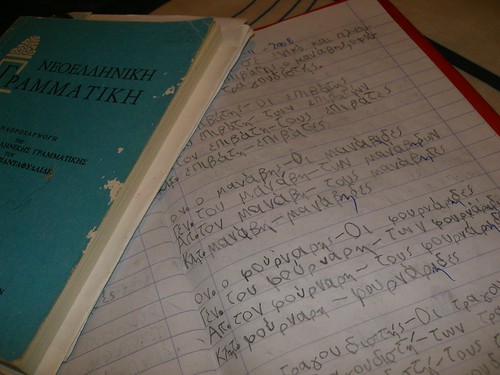
declining greek nouns
(my son's school grammar lessons: declining 'passenger', 'greengrocer', 'baker', 'singer')

Just for the record, Greek isn't the only language to behave like this: the German language has very similar grammar to Greek, with similar things happening to the endings of words.

*** *** ***
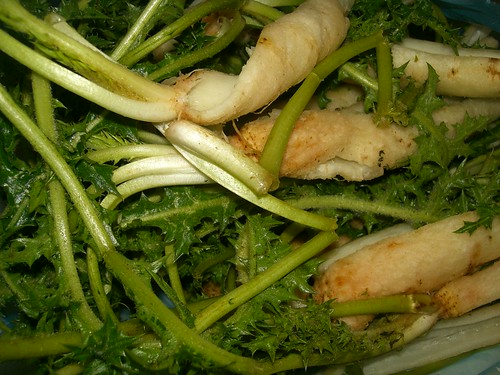
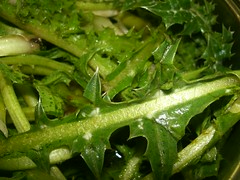
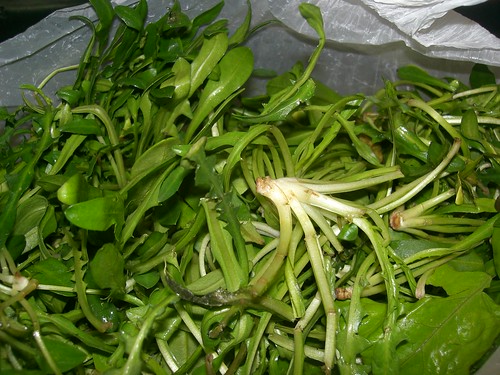
Stamnagathi is selling very cheaply at the moment. Ascolimbri greens (Scolymus hispanicus) have always sold more expensively, despite looking rather off-putting. Now with the economic crisis, stamnagathi has gone down in price (as has the price of petrol), while ascolimbri are selling at the price that stamnagathi was selling for before the economic crisis, around 8 euro a kilo. As the root system is also edible, they are more difficult to harvest, which is why they are more expensive. These days, they are most likely cultivated, whereas in the past, like stamnagathi (which is also harvested in amongst woody thistles, in this case inedible and therefore removed), it was found growing wild only in remote areas of Crete.

askolimbri ascrolimbri
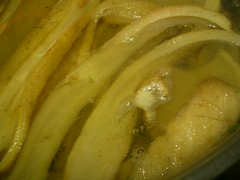
The roots and leaves are separated and cooked separately, as they may need different cooking times.

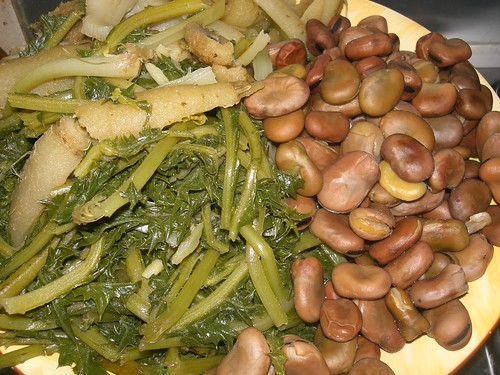
I have never had ascolibri greens before, probably because I was put off by their cactus-like prickles, and the rather dull colour of their white root, which is also edible. I decided to buy some during my last visit at the laiki market, where ascolimbri greens have always featured alongside stamnagathi when in season. I didn't know what a pleasant taste I had been missing for so long. Ascolibri (both the root and the leaves) are boiled and eaten as a warm salad, together with broad beans (what the French call feves), or added to a meat stew, enhancing their unique flavour: the roots taste of peanuts, while the leaves are sweet and milky. The spiny thistles on the leaves do not need to be pruned off before cooking; like nettles, they soften during the cooking process and do not cause any discomfort.

ascolimbi
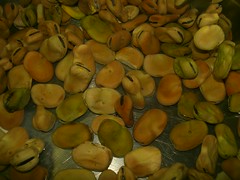
The broad beans were dry, which meant that, before eating, they needed to be soaked overnight and boiled the next day. The black 'eye' is cut away and the bean slips out like a slinky body in a silky blouse. The roots of the askrolimbri were so soft, that they were disintegrating at the merest touch.

As Crete is an island, eating ascolibri could be said to be an endemic habit of Crete, a bit like eating stifno and avronies, some more nasty looking, possibly toxic greens that Cretans like to add to their seasonal diet. But this is not the case at all; our Eastern neighbours on the Turkish coast have been eating this wild green for as long as we have. Ascolibri are a Mediterranean wild green, and only those lucky enough to know how delicious they are can benefit from their healthy properties. Ascolibri "are valuable sources not only of vitamins and antioxidants, but also of monounsaturated and essential fatty acids, thus playing an important role in health promotion and disease prevention in those who adhere to the traditional diet of Crete," according to a 2005 study of 48 wild Cretan greens: they contain vitamin K (it helps in normal blod clotting), vitamin C (good for fighting disease), lutein (it contains anti-oxidant properties, a factor involved in longevity), β-carotene (it protects you from heart disease), α-tocopherol (it protects you from infertility) and γ-tocopherol (a form of Vitamin E), with a total polyphenol content (having antioxidant characteristics which reduce the risk of cardiovascular disease and cancer) of 58mg/100g.

broad beans fish
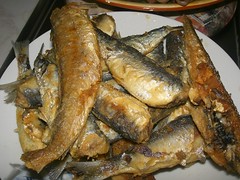
Dry broad beans and fish (small hake and sardines) fried in olive oil

Combine ascolibri with broad beans and fish, and I don't think you can eat a healthier meal. The fish were fried in olive oil, while olive oil, lemon and salt dress the greens and beans. Don't forget the sourdough bread (unless you're on the Atkins diet, pretty much the opposite of the Mediterranean diet) and a glass of locally brewed village wine (another integral part of the Mediterranean diet). I don't know whether I will achieve longevity, but this kind of attitude to our meal plans just might help.

©All Rights Reserved/Organically cooked. No part of this blog may be reproduced and/or copied by any means without prior consent from Maria Verivaki.
Tuesday, 9 December 2008

Chickpeas - garbanzo beans (Ρεβύθια, ρεβυθοκεφτέδες και χούμους)

Dear Meg,

Greetings from Crete, whose 300 days of sunshine have been overshadowed by the recent tragic events of the past weekend.

How are you feeling these days after the reconstruction surgery for your leg? Weren't you a lucky lass to have Colleen bring you a macrobiotic lasagne? I was reading about it while I had a 500g packet (in their dry state) of soaked chickpeas boiling away on the stove top, and I thought how much you would enjoy a Greek-inspired meal cooked using these chickpeas - I know how much you love them. That's when I thought of you sitting in my little Cretan kitchen, and I wondered what I would cook for you if you were to visit me. It's a little hard for me to cook for someone who has never cooked according to the modern culinary fashions that go by the names of gluten-free, macrobiotic, non-lactose and all those other food-related words that never seem to get mentioned in the Cretan diet, even though most of our meals are based on such principles, when eaten in combination with the fasting periods of the Greek Orthodox Church.

But I know why you eat macrobiotically, and I know I should make an effort to do so, too, if only I could get the whole family thinking along these lines meal-wise; after all, my mother suffered from breast cancer too, so I carry the weight of her medical history in my genes, which have also been passed on to my children, one of whom is a girl. I think my husband may take a bit more convincing: no meat, no eggs, no cheese or milk - it'll never work...

Anyway, as the chickpeas were boiling away, and I was watching your lovely friend holding that huge baking tin of lasagne, I thought I could at least give it a try today, chickpeas being so macrobiotic-friendly. And 500g of dry chickpeas really can go a long way; while my lovely Moldavian cleaning lady was here putting a bit of order to our house as she does every fortnight, I could focus more clearly on what I was throwing into the pot today...

I still had that newspaper supplement on beans lying on my desk. The 50-page booklet mentioned novel ways of cooking one of the most popular staples in the Cretan-Mediterranean cuisine, with recipes by Vaggelis Driskas, a big name in the world of modern Greek cuisine. It mentioned recipes for fasoles, gigantes, mavromatika, fava, lentils, and last but not least, the humble chickpea, which is most often eaten here in Crete as a soup in either a light tomato or lemon sauce (the latter being slightly thickened with some flour), with a little rice added to soften the taste of the chickpeas, which can be a bit heavy on the stomach.

revithada chickpea soup
(Chickpeas cooked in a light tomato sauce with rice, by my mother-in-law; the tomato could easily have been omitted, with lemon juice taking its place, thickened with a little flour .)

Chickpeas are also a little bit of a nuisance to cook (in the same way as yigantes), because they need overnight soaking before they can be cooked, unlike all the other beans in the Cretan culinary repertoire. So you really need to plan ahead if you want to use them. They should never be salted during cooking time, because they'll toughen and won't cook so easily; you should only salt them at the end of the cooking time.

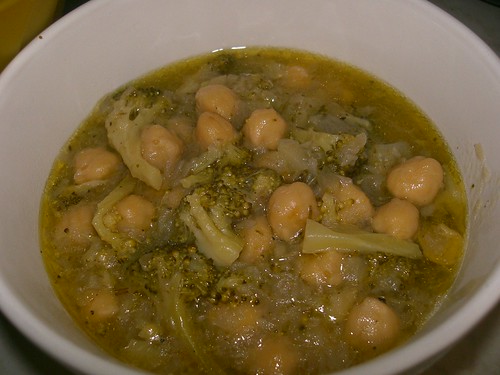
I had a head of broccoli in the fridge, which I knew had to be cooked soon. How convenient that I found a recipe in the booklet for a chickpea and broccoli salad; how inconvenient that I knew my husband was expecting a soupy chickpea dish, like the one he has been raised on by his mother, and he would not entertain the idea of a bean salad for his lunch. I decided to improvise on Driskas' recipe, using the same ingredients, but changing the cooking technique.

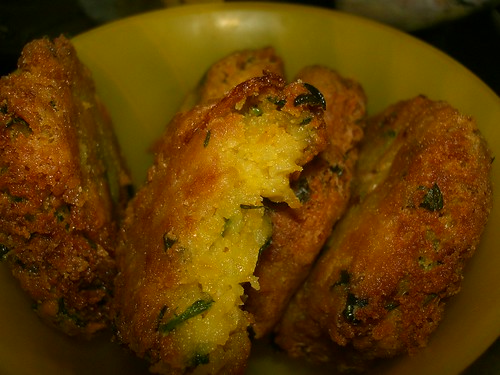
After making this wonderful dish, I still had a whole lot of chickpeas left over. It wasn't hard to find some other creative Greek recipes to use them up. I made some vegan chickpeas patties, which we call revithokeftedes in Greek; these unfortunately do need frying, and I know that this isn't part of the macrobiotic or breast cancer avoidance diet, but at least I'm using olive oil produced only ten kilometres away from my home to fry these delicious rissoles.

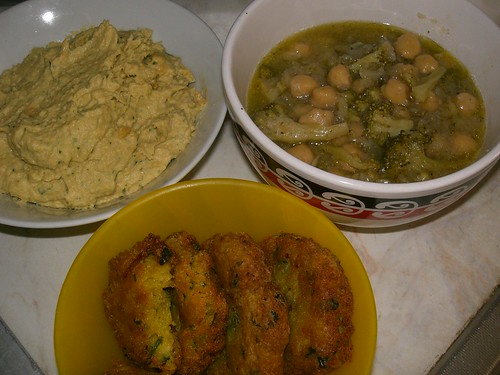
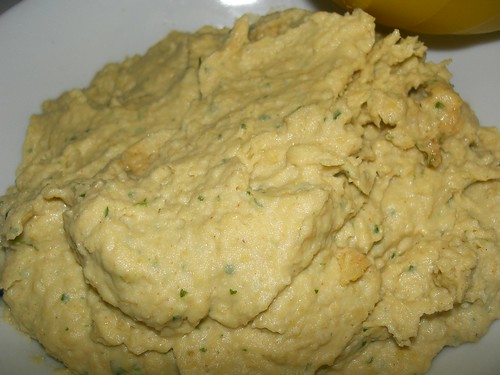
Believe it or not, there were still some chickpeas left over, so I turned those into a hummus dip, which I know you'd love. And if you serve this trio with some toasted sourdough bread slices, black and green olives picked from your very own trees and some feta cheese drizzled with olive oil (although I know you don't do much dairy), this humble meal consisting primarily of chickpeas becomes a meal that not even royalty gets the opportunity to savour. Can you imagine it being served in Buckingham Palace? I don't think they can pronounce the word revithokeftedes! The whole preparation and cooking process made me feel whole again, an especially rewarding experience after a week of working in an office environment and driving around town like a yo-yo getting errands done.

The whole meal looked so healthy and wholesome that I set it out on the table, even though it wasn't lunch time yet. I pictured you sitting at the table with a look of wonder on your face as you tried to work out which of the dishes you would indulge in first. Just then, my husband walked through the door, looking a little cold, frazzled and tired. He saw everything laid out in front of his usual place at the table, and smiled.

chickpea garbanzo bean revithia

"Is that my lunch, honey?" he asked me.

"All set," I replied.

*** *** ***

To make the broccoli and chickpea soup, you need:
250g dry chickpeas, which have been soaked overnight and then boiled for an hour till tender
1/2 cup olive oil
1 large onion, chopped finely
1 large potato, finely grated
a few sprigs of parsley, finely chopped (optional)
a pinch of dried thyme
125g broccoli florets, blanched 3-4 minutes
1 tablespoon of flour (or tahini, if you have access to it)
the juice of a lemon
salt and pepper
more olive oil

chickpea and broccoli stew revithada

Boil the soaked chickpeas for an hour, so that they become soft, then drain them and set aside. In a pot, heat up the oil and add the onion and potatoes. Let them soften a little, then add the broccoli and chickpeas, turning everything over to be coated in oil. Because we like our vegetables well-softened, I let them stew away in the pot with enough water to maintain the desired consistency of the soup (I needed about three cups of water). Towards the end of the cooking time, add the lemon juice, flour, thyme, parsley, salt and pepper, and a little more olive oil, depending on how oily you like your soup (and in Crete, we like our food very oily). This soup can be cooked in less time if you like your vegetables to by more crispy than tender.

To make the chickpea rissoles, you need:
150g dry chickpeas, which have been soaked overnight and then boiled for an hour till tender
1 large onion, finely chopped
2 cloves of garlic, finely grated
a few sprigs of parsley, finely chopped
1/2 teaspoon of cumin
1/2 teaspoon of turmeric
1/2 cup of flour
a pinch of baking powder
salt and pepper
olive oil for frying

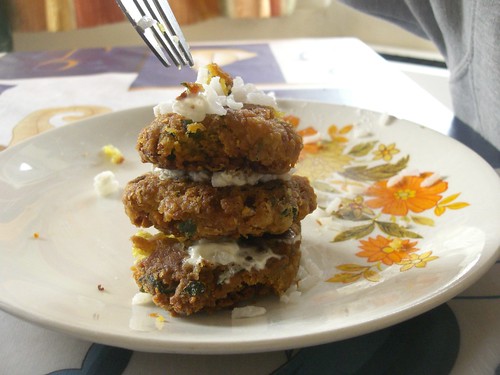
revithokeftedes chickpea patties

Mash the chickpeas to a pulp (a food processor or mini-mixer can do all the work for you here). Add all the other ingredients and mix well together; the mixture should feel damp, but at the same it must be able to form small patties that do not break up. Shape the mixture into rissoles - you may need to wash your hands after making a few and start the process all over again. Place the balls on a tray in the fridge to harden before frying. When ready to cook them, heat up the olive oil, dredge the patties in flour, place them carefully into the pan and let them cook till they are golden brown, then turn them over and let that side cook too. If you overcook them, they will turn out like crispy batter (not so healthy). Drain the cooked patties on kitchen paper.

To make the hummus, you need:
100g dry chickpeas, which have been soaked overnight and then boiled for an hour till tender
2 cloves of garlic, finely grated
2 tablespoons of tahini (if you have it available; otherwise, use more olive oil)
the juice of a lemon
1 teaspoon of cumin
1/2 cup of olive oil
1/2 teaspoon of paprika
a few sprigs of parsley, finely chopped
salt

hummus

Mash the chickpeas to a pulp (a food processor or mini-mixer can do all the work for you here). Add all the other ingredients and mix well together. This dip is usually served smooth and creamy; if your mixture is too dry, add more oil and lemon juice to achieve this. You can also adjust the seasonings to make the dip more spicy, according to how you prefer it.

revithokeftedes chickpea patties

When serving this chickpea trio, don't forget the olives, feta cheese and sourdough bread. This meal will tantalise even the least vegetarian inclined in your family. Poor Buckingham Palace; they really have no idea what they're missing out on. And as Christmas draws nearer, my son can see even see it in his food; he layered the patties with some rice and yoghurt and turned them into a Christmas tree.

This is my entry for this week's Weekend Herb Blogging, The hosted this week by Chriesi of Almond Corner.

©All Rights Reserved/Organically cooked. No part of this blog may be reproduced and/or copied by any means without prior consent from Maria Verivaki.
Sunday, 7 December 2008

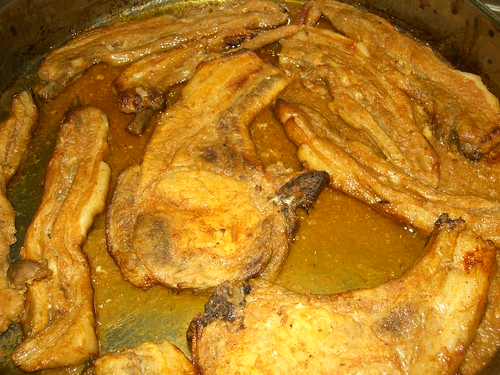
Marinated pork chops (Πικάντικες χοιρινές μπριτζόλες)

The little laughing olive tree
came to Crete and cooked for me.
While I went about my weekend chores,
she rampaged on my kitchen floors.

pork chops ala little laughing olive tree

When I asked her 'Whatcha cookin?'
She exclaimed: 'It's what you're lookin'.
"I just wondered if you please,
will my husband eat any of these?"

Come dinner time the kitchen smelt
as if a fire had been put out,
with mustard and some Worcestershire sauce,
a bit of onion chopped up coarse.

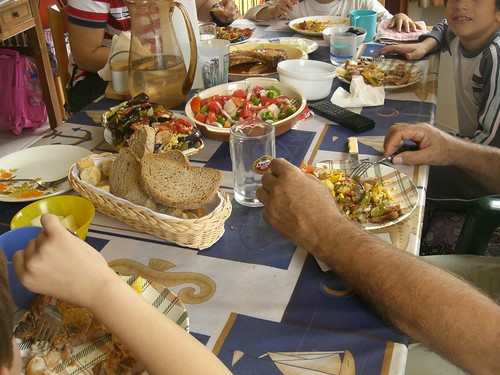
little laughing olive tree lunch

"What's for salad?' she insisted.
"I't's cooking now," I promptly answered.
She doesn't know my eggplant pizza,
but now she's here, I'm gonna teach 'er.

I picked the last tomatoes growing
and some peppers green as string beans,
and with the omelette that was leftover,
that made our lunch one of the best ever.

©All Rights Reserved/Organically cooked. No part of this blog may be reproduced and/or copied by any means without prior consent from Maria Verivaki.
Friday, 5 December 2008

Urban garden (Αστικός κήπος)

There's a serious economic crisis reigning in Greece, invisibly infiltrating the town of hania, visible only the those who read between the lines. People want to work, but are either denied the right to do so, or can't find enough of it. The state has always made a show of their provision of free health care to their protegees, the privileged public servants of Greece. But it has recently been revealed that this free care was at the expense of private businesses and promises that the owners would be paid; the chemists' union has stopped providing drugs to state-insured citizens, and doctors have stopped treating state-insured patients for free. Boutiques and specialised stores are void of customers. The only businesses doing well in Greece are the banks - they're always full of people, people paying off their debts, people withdrawing cash, people taking out loans, people transferring their debts from one bank to another; in general, people needing money.

The economic crisis has hit food sales. In Hania, stamnagathi is a prized green, usually selling for at least 7 euro a kilo; in the heart of winter, I've paid more than 8 euro a kilo, which in some cases is more than the price of meat per kilo. Stamnagathi is a fortnightly staple in our house, alternating with other more conventional greens such as cabbage and brocolli. So you can imagine how thrilled I was to find it selling at less than 5 euro a kilo last week. At that price, I should have bought the whole crate and washed, boiled and frozen it to last me until the end of winter.

stamnagathi

As with any cheap product, I was worried about buying low quality: price is nearly always associated with quality, even if this supposition is only in the mind. I decided to ask the shopkeeper why the price of stamnagathi had dropped dramatically. The price of petrol has fallen dramatically, but here's what the shopkeeper had to say:

"This year, stamnagathi has had a slow start because it hasn't rained so much. There has been a sterady supply of it, but it hasn't had that lush green look it used to have at this time of year last year. (I had bought some at this time, and it was rather tasteless and dry.) Now that it's been raining more, it has started to grow more profusely. I was selling it last week at just under 7 euro a kilo, but it wasn't selling. Stamnagathi has always sold at constant levels right throughout the winter. I think it's got to do with the economic crisis. Now stamnagathi is being brought in to us sorted into two types (that's never happened before): the large thick glossy type which sells at a higher price, and the small thin type which sells at a lower price. It gives people a choice price-wise, but it's really the same thing."

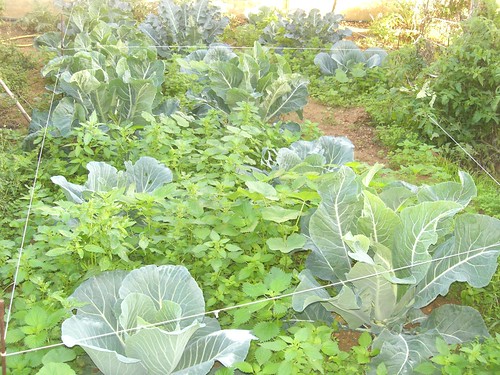
This discussion made me feel very guilty about spending my hard-earned income on a bag of spinach, since the garden is full of nettles, and nettles really do taste like spinach in a spanakopita. I was too lazy to bother harvesting them.

nettles cabbage cauliflower broccoli

The economic crisis was made more obvious to me recently by an amazing discovery I made while getting some chores done in the town centre. I was to meet up with someone while I was there, and we arranged a meeting place. I was the first to arrive at the shopping mall - the only one in Hania - so I wandered around it until my friend arrived.

shopping centre hania chania
The shopping centre reminds me of other shopping precincts around the world, the kind I used to go to in New Zealand, where the shops were always crammed with colourful wares, while the street kids hung around on the benches in the middle of the squares, sniffing glue to while away the time; all that glitters is not gold.

The shopping complex on Boniali street in Hania was modelled around typical shopping malls in large cities, in the hope that it will attract an atmosphere of shoppers that come to view the place as an events arena. People could window shop, try out new things, have a bite to eat from one of the eateries, maybe even food-court style, and entertain their kids. One look at the mall now, and you will think that the economic crisis has had a serious impact in Hania; most of the shop windows are dusty and the units empty. The ones that are being used are divided into two categories: the street-facing units are used as shops selling consumer items (they are all being used), while the offices tucked away in the large marble corridors of the complex, invisible at street level, are being used as offices for private businesses such as engineering and graphics firms. There are many unused compartments, turning the wide corridors into unattractive alleyways that look unsafe. There is underground parking available, but it is expensive; the suers of the car park are usually people who run businesses in the shopping mall and its environs rather than shoppers.

The shopping centre has not been affected by the economic crisis; it was simply never a success. The local community does not do their shopping according to the laws of a shopping mall culture. People use stores referred to them by contacts, or on their own judgment; they love walking down the main shopping streets checking out the windows. If it isn't at street level, then it's invisible. Even food shopping is specialised: if it isn't general supplies which you can pick up from your one-stop shop, the supermarket, it's mizithra, xinohondro, and hand-made filo pastry, sold in stores that have a long established tradition of selling the same product in the same location. Why would anyone want to buy their mizithra from a specialty store located in a modern building with no history? The shops in the mall that opened up and shut down, one after the other, represented markets that were affected by recessions and booms in the economy, as well as seasonal differences, mainly knick-knack articles which made suitable Christmas gifts or interesting artistic additions to the household furnishings - when one could afford it.

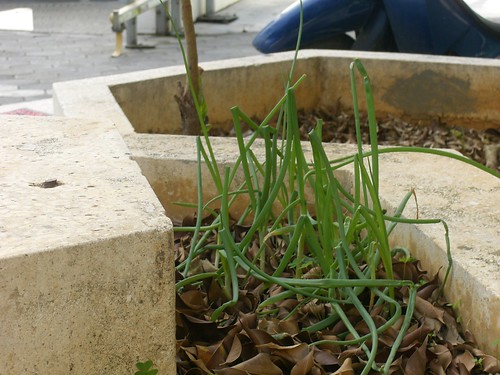
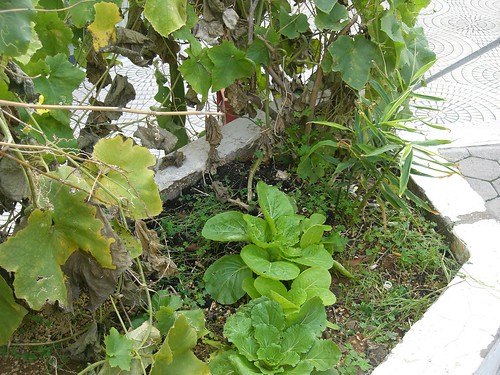
Life in Hania does not centre around a shopping mall. Events in a small Mediteranean town have never centred on a commercial enterprise. People have their own private circle of friends; either that, or they organise a get-together with their families, entertaining in their own homes, or going out to cafes where they would be seen, as well as being able to people-watch themselves. This plush clean modern complex, comprised of three different buildings with offices located at the higher levels, became a lunar wasteground with a clinically clean white appearance. Its flower boxes, surrounded by benches for visitors' comfort, are void of colour, filled mainly with weeded earth, save a few sturdy yucca shrubs, planted at a time when there was some hope that the shopping centre would be more successful. But if someone cared to look more closely, they would also have found something else growing in the flower boxes, which would probably seem preposterous in another town:

some spring onions, ...
shopping centre hania chania spring onion lower bed

... a few lettuce plants with a climbing pumpkin creeper and grapevine in the background...
shopping centre hania chania lettuce flower bed

... and some coriander.
shopping centre hania chania coriander flower bed

Someone's using these useless flower boxes as their garden. Maybe it's one of the more organically-minded store owners in the mall, maybe it's someone who lives in one of the boxy little apartments in the inner-city, maybe it's someone who simply doesn't have a garden, but wants to eat fresh greens that they have planted themselves. Could it be someone who's feeling the economic pinch, trying to feed a family? It was the coriander that got me wondering: maybe it's an economic migrant that wants a taste of his (or her) homeland. Coriander is never sold at the fresh produce section of our supermarkets. Although I've started growing coriander at home, this herb is too pungent for my family's tastebuds; it's already starting to seed before I had the chance to use it.

Behind the facade of the big flash cars that don't fit onto our narrow roads, the flashy Christmas decorations in the shop windows and the expensive price tags in the high fashion boutiques, a cloud of insecurity hangs over Hania, a fair distance away from our senses so as to seem intangible.

©All Rights Reserved/Organically cooked. No part of this blog may be reproduced and/or copied by any means without prior consent from Maria Verivaki.
Wednesday, 3 December 2008

Self-crusting spanakopita (Πισπιλιτα - πλαστό)

Mariana from History of Greek Food recently wrote:
"Forty years ago, a typical woman from Greek rural area spent all day cleaning the house, preparing meals, baking, sewing, milking, making butter and cheese, raising poultry, rabbits, sheeps, goats, pigs, gathering olives, harvesting greens and fruits, cultivating small vegetable gardens, preserving food for year- round consumption…. being wife, mother, guardian of her children’s health and moral purity. In the beginning of 20th century the situation was even worse. Food preparation was labor intensive and time consuming as based on cooking over an open fire or on wood stove or in wood fire oven. Since few houses had indoor plumbing, water for cooking and cleaning was carried in from outside."

Mariana then provides a recipe for a wild-greens pie which doesn't need a lot of time to be spent on spreading the dough, making it an easy recipe for those busy women of yesteryear. Not that the average modern Greek housewife of today has fewer jobs; she simply enjoys more conveniences. Here's what her typical day is like:
"First, she wakes up the children, prepares their breakfast, drops them off to school, makes a quick dash to the supermarket, takes the shopping back home, then goes to work. During the day, she has the mobile phone close at hand just in case a child is taken ill and the teachers want to inform her about the child's condition. At the end of a working day, either she picks up the kids from school (or someone else may do that for her because she may finish work much later than the children finish school), goes home, sets the table, heats up the meal she cooked last night, has lunch (with or without the family), then clears the table. While she's doing the dishes, putting on a load of laundry, hanging out or bringing in clothes on the washing line, ironing and/or cooking the next day's meal (if there are no leftovers), she's helping the kids with their school homework. As soon as they're done, she's done too. While the unwatched pot boils away, she then starts her taxi-driver yo-yo rounds: fencing, tennis, chess, football, language lesson, dropping one child off the minute the other child has to be somewhere else. While the children are at an after-hours lesson, she will either stay in the car, remain in the foyer, or nip into the supermarket to pick up more last minute supplies she ran out of. After picking up the children from the last of their activities and going home, she'll carry on where she left off from the activities after lunch, not forgetting to prepare tomorrow's school lunches."

The moral of the story is that a woman's work is never done, which is why I can't live without a deep freeze full of frozen summer meals prepared from garden fresh produce, and at least one day in the week when we eat leftovers.

pispilita plasto pispilita plasto

Pies with leafy greens have become a staple in my family all year round. We have them for snacks, they go into the children's school lunches, they make a great midday meal, they smell beautiful, their aroma wafts in the air and makes everyone hungry. I make hortopites on a regular basis, and since I don't have the time to make and roll out my own pastry, I found this method of making a pie perfectly paired with my lifestyle. A large pie will last at least two days, and will be used at various meals.

pispilita plasto

Another first in my cooking is to use cornmeal as the only flour in my pie pastry. Cornmeal is very different to flour, in that it soaks up moisture very easily, without leaving a sticky mess like regular wheat flour. It also make an unusual crispy dough; the combination of its texture and flavour makes the crust quite unique in this self-crusting pie for a leafy greens filling. Although cornmeal is well known all over the world, in my town, it is not used as much as in other places, given the fact that I couldn't find it in one of the supermarkets I went to; in the other, there were only two different packagings available, while the range was much wider for ordinary flour.

The recipe for this pie - called pispilta - is on Mariana's site. It appealed to me because it uses ingredients that I could easily find in my local stores and my own garden. Mariana uses very unusual greens to make her one: sorrel, nettles and beet leaves. I had spinach on hand, and was saved the trouble of harvesting the nettles from our garden, which has been slightly overrun by them. Laurie also makes this kind of pie under a different name, plasto; each region of Greece has its own dialectal name for their own special version of this easy-to-make pie. I preferred Mariana's pie because the pastry pulp used very few ingredients, but both are as tasty as each other. To see how much TLC goes into making such a pie, check out Elly's yiayia making it. It will make you realise just how important it is to have a yiayia like hers.

xinohondro wheat and milk rusk

Spinach and leafy greens, combined with creamy mizithra (a ricotta type cheese), sometimes make a squidgy filling that may retain too much moisture in the pie, which is why flour, semolina, and even rice are added to the filling to soak up the excess liquids. I used the crumbs from a locally produced dried milk-wheat rusk called xinohondro. It enhanced the pie flavour by taking away the sweetness of the spinach and mizithra cheese, making it more savoury.

If I had to name one food that I would miss sorely in the world, it would have to be a pie made with wild leafy greens.

This is my entry for this week's Weekend herb Blogging, hosted by Ivy from Kopiaste to Greek Hospitality.

©All Rights Reserved/Organically cooked. No part of this blog may be reproduced and/or copied by any means without prior consent from Maria Verivaki.
Monday, 1 December 2008

Happy Anniversary Crete!

Σαν σήμερα ενώθηκε η Κρήτη με την Ελλάδα το 1913...
unification of crete with greece

Read more about the unification of Crete with Greece.
(NB: This day is not celebrated as a public holiday)

Better than Tiffany's (Πρωινό στο ΜΑΙΧ)

I was brought up on the 1970s societal belief that it is important to have a good breakfast before going about one's daily business. Breakfast gives you energy, we were informed, through school leaflets, television advertisements for cornflakes, well-meaning teachers and the like. Breakfast helps you endure a busy morning until lunch, traditionally the time for a sandwich and a piece of fruit, after which you would go home for 'tea', a cooked evening meal. These are my fond memories of an organised Kiwi lifestyle that has probably died out with the advent of the open-all-hours culture, a Kiwi lifestyle that used to be modelled on English patterns until more recently when New Zealand began to take a keener interest in their neighbours, breaking from tradition with their historical links from the past. All this, despite the fact that an English breakfast may have been symbolic of the class system: the upper class English supposedly started having large cooked breakfasts to get them through a day of hunting, fishing and enjoying the English countryside.

When I came to Greece and started working crazy evening hours in the classroom, I had to re-learn meal times. Breakfast had to be transferred to a later time in the morning; it simply wasn't feasible to wake up early after finishing work so late in the evening. The main meal of the day had to be ready by one o'clock in the afternoon, as I finished work at half past ten at night. Lunch became dinner, and dinner usually turned into a midnight feast by the time I got back home. Breakfast became a morning cup of coffee, drunk while enduring the boredom of having very little to do in the morning, before travelling for work in the middle of the day. I was never an 'evening' person. This nightly work routine destroyed my day, with detrimental effects on my meals and eating times.

maich hania chania
MAICh - the tall white building in the distance shows the student dormitories.

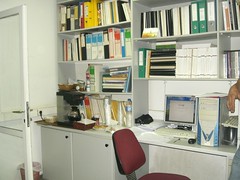
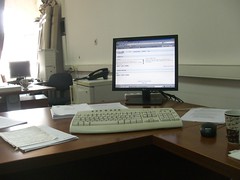
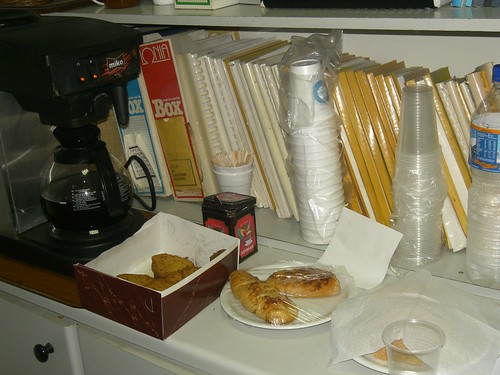
In the sedentary lifestyle of the new millenium, a large breakfast seems unwarranted. Offices in all the developed world always have a kitchenette, equipped with a coffee machine and all the paraphernalia associated with the ritual of drinking warm beverages, including a small fridge, a biscuit box and other nibbles. At my workplace, there is much more food available in the office environment than in other workplaces, as we have students living on campus, and there is a whole restaurant working morning, lunch and evening serving them food, as well as the cafe bar where they can buy sodas, frappe, as well as other hot and cold drinks and snacks (toasted sandwiches, rolls and cheese pies) during the day. MAICh is involved in agricultural research, seed growth, crops, harvesting and storage, and both GMO and sustainable agriculture are integral parts of the study programmes at MAICh. Food is everywhere at MAICh, not a desirable feature of the sedentary office environment.

office environment food office environment
The sedentary lifestyle of Organically Cooked; the office environment, equipped with Organically Cooked's pumpkin bread and cheese pies made the restaurant chef.office environment food

A typical breakfast in our house starts with milk. There are three types of milk sold in Greece: canned non-sweetened evaporated milk, UHT milk and fresh pasteurised milk, the only one needing refrigeration. We use only fresh milk; anyone who has tasted the canned variety will tell you that it does not taste like real milk and is clearly discernible in a milk-based drink.Every day, we need, on average, a litre of milk among the four of us. Greece has the most expensive price tag for milk in the European Union. We need to spend more than one euro a day on our fresh milk needs; in a country where most people do not make much more than 1000 euro, this is a lot of money.

I used to have some of that milk in my cup of coffee in the mornings when I wasn't working. A sit-down breakfast was out of the question: cooking for the whole family means I am always sampling the meals, so I am always eating something most of the day. Now that I am in an office environment twenty hours a week, I realised I'd be drinking coffee all day if I had one at home; as for needing energy during my working hours, most of the time I am sitting down in an office with plenty of food available, in a food-based environment. So I don't have breakfast at home any more; I simply make it for the children.

*** *** ***

Recently, I had to go into work quite early, to drop off a student's thesis which I had proof-read, so that they could submit it on time before their deadline. I caught the students in their breakfast hour before lessons began. It was the first time in a long while that I was able to enjoy a proper sit-down full breakfast, not prepared by myself. It was the most enjoyable breakfast I had had in a long time.

maich breakfast

MAICh students are graduates from all over the Mediterranean region: this includes Europe, the Middle East and North Africa. There has been an increase in the number of students coming from the rest of Europe, especially since the European expansion. They stay at MAICh on full scholarships, sponsored by CIHAEM, a European organisation involved in agriculture. They stay in accommodation provided on campus and the restaurant provides meal for them for breakfast, lunch and dinner. In a summer resort town where foreigners are viewed in two groups (either they are economic migrants, or they are summer tourists), MAICh provides a rare opportunity for the local community to see foreign people as part of an organised international community.

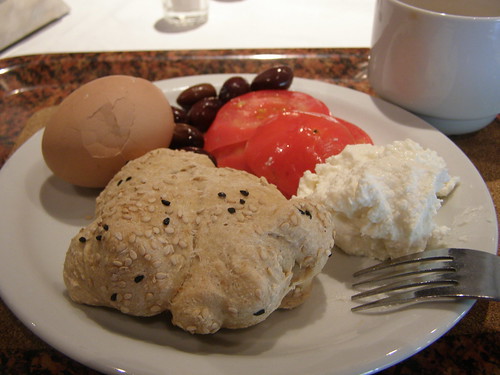
Breakfast offers a huge variety of both traditional and local specialties. Various types of cereals, a range of jams and spreads, fresh bread baked on the premises, tea and coffee, as well as milk and orange juice, compose classic breakfast favorites all over the world, standard hotel fare, also found at MAICh. But the best part of a breakfast at MAICh is the Cretan breakfast menu: bread baked on the premises, olives, fresh tomato slices, boiled eggs, soft curd cheese (mizithra), yoghurt, mountain tea, fresh fruit, honey and rusks. What more could a student want? Better than Tiffany's, if you ask me.

©All Rights Reserved/Organically cooked. No part of this blog may be reproduced and/or copied by any means without prior consent from Maria Verivaki.