Showing posts with label BANANA. Show all posts

Tuesday, 18 August 2009

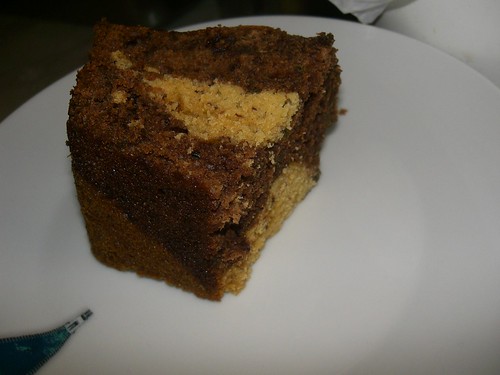
Fruit and vegetable marble cake (Kέϊκ υγειας)

Remember those multi-coloured cakes that looked pretty but tasted bland? Here's a marble cake that will be remembered not just for its appearance, but also for its taste. It's based on my 2009 version of my improved chocolate-zucchini cake.


marble cake

In a large bowl, mix together 2 eggs, 1 1/2 cups sugar, 1/2 teaspoon baking powder, 1/2 teaspoon baking soda, 1 vial vanilla powder, 2/3 cup olive oil , 1 ripe banana mashed and the juice of 1 medium orange.

Pour out half the mixture into another bowl. To the second bowl, add 1/2 teaspoon of instant coffee powder, 3 tablespoons cocoa powder and 1 cup of grated strained zucchini. Mix well.

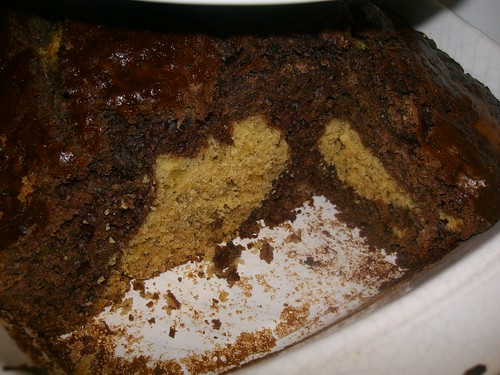
marble cake

Add 1-1/2 cups plain flour to each mixture, enough to make a thick batter in each bowl, the consistency of sludgy mud. Pour spoonfuls into a prepared baking tin or a bundt (I grease mine with margarine), and cook till done.

You can also be more adventurous with the colours by dividing the initial batter into three equal parts, and adding some grenadine to one of the bowls to colour it pink. Whether you make it bi- or tri-coloured, you can't find a more healthy cake than this one.

©All Rights Reserved/Organically cooked. No part of this blog may be reproduced and/or copied by any means without prior consent from Maria Verivaki.

Wednesday, 5 March 2008

Snacks from New Zealand and Crete (Μικροφαγητά)

There are a couple of days in the week, when I am away from home all day. It's important on these days for everyone to find something to eat when they get home. You might say that cooking is not necessarily a woman's job alone. Given the forthcoming global Woman's Day (March 8), I may agree with you, but only for argument's sake. Ask a man to work all day, pick up the children from school, help them with their homework, and cook a meal on top of that; he'll probably cook eggs and chips or plain pasta with grated cheese on a daily basis. There are very few kalofagas types in Crete in the true sense; those who have found one should be very grateful, for they are few and far between. Women's rights activists may not like what I'm saying, but hearing the truth about an issue isn't always easy to digest. I don't actually work many hours outside the home, so it's only natural that the family expects me to provide the meals. I don't mind being expected to do this, I love working with food.

But today is going to be a rather difficult one. After dropping off the children at school, I have to run a couple of errands in town, which is close to my first teaching hour for the day (which starts at 11.30am): a private English lesson at a student's home. He is studying at university, and didn't manage to obtain an English proficiency certificate while he was a school student, so now, in his free time, he is preparing to take an English proficiency test, which he will use in conjunction with his computer engineering degree to make him more marketable for future employment. After that, I have a couple of hours to kill, before my next lesson is due: a three-hour advanced English skills class, with Masters' students from all over the Mediterranean at a European-funded research institute in Hania. These classes are held once or twice a week as a method to improve the students' writing skills, as they must write their Masters' thesis in English at the end of their studies. There will be hour to kill before the final pitstop: another three hours of English proficiency test preparation to high school students at a private language institute for children of all ages. Learning English is compulsory formt he third year of primary school in Greece. Only the basics are taught through the state system, and most children attend a private language institute to gain greater proficiency in the language. Fortunately, in Hania, English is regarded as a vital skill, due to tourism playing a central role in the survival of the island's economy. Without knowledge of a second (and all too often nowadays), third language, one's employment opportunities are greatly reduced.

Luckily, each lesson is located within 5-10 driving minutes away from the previous one, so I don't have to worry about road rage. I suppose you've been counting the number of hours I'll be working, and how many I'll be killing on the road or in an office waiting for my next lesson: I come home at 10.15pm.

In any case, my freezer is always well-stocked for these difficult days, but there are also some other alternatives to deal with this mini-crisis:
  1. Cook a meal on the previous night (which I have no recollection of; either I was too tired, or I was blogging...),
  2. Give them leftovers (the leftover pastitsio went into the children's school lunch; I doubt they would want to eat a third serving of pastitsio over a period of three days this week),
  3. Warn everyone that they have to provide their own meals today, and get them to promise to clean up afterwards (which of course will induce them to order home-delivered pizza or take-out souvlaki).
Neither one of these options suits me today; if anyone would like to enjoy some junk food, I should be entitled to enjoy it with them. Which leads me to the last option:
  • Prepare some healthy snacks for them to peck on all day.
I like this one best because I love snacks myself. Snack food is often associated with bad eating habits, hardly surprising since most snack food these days is bought, mass-produced, fatty, high-calorie junk food. On Monday night (my other long working day), in relation to an article on obesity, I held a discussion with the school students about their eating habits, and here's what I discovered about the group of ten children in the class:
  • only 1 eats crunchy raw vegetables,
  • only 1 student's parents refuse to provide other food if some members of the family are fussy eaters and refuse to eat the main meal provided,
  • 1 child sneaks out to the mini-market in his area to buy chips and chocolates when his parents are having a midday snooze,
  • 1 prefers to eat meat on a daily basis if she can get it,
  • most children said that they never ate fish or beans,
  • a few children refuse to eat any vegetables whatsoever.
On the day I conducted this little survey, not one of the the children in the evening classes had beans for lunch. A few had salads with mainly a spaghetti meal; only one ate green vegetables for lunch. There was a major football match on television that night; most said that they would be eating pizza, souvlaki or pasta for dinner. It is said that Crete is where the Mediterranean diet originated from, but it's obvious that it won't be survived by the Cretans themselves at this rate. It will have the same fate as the Olympic Games; they started and ended in Greece, whereas it took a foreigner's foresight to revive them outside of Greece.

Even though I make a conscious effort to practice what I preach, this is not to say that junk food does not come into our house at all: we keep a few cans of soft drink in the house for visitors (we usually use them past their sell-by date); there are also a couple of packets of potato chips in the pantry (I notice that I bring them out when I'm experiencing a psychological 'downer'; crisps really do make you feel better); we do have chocolate in the house (which I keep away from the sight range of the children, in the highest drawer of the fridge - chocolate melts easily in a sunny Cretan kitchen). When I go to the organic food shop in Hania (GAIA), as I pass the counter to pay for my purchases, I must necessarily pass the chocolate bars, muesli bars, biscuits, cakes, etc by the cash register. If the children are shopping with me, they always ask me if they are allowed to take one. Most times, I let them because they don't get this 'junk' (no matter how organic it may be, it is still junk food).


Today's' snacks are the traditional Cretan dakos salad and a New Zealand teatime favorite: corn fritters. They represent my ambivalent feelings towards cooking and providing meals for the family, a mix of traditional and liberal attitudes prevailing in this household concerning food and lifestyle. These snacks were prepared in a very quick amount of time. They may be kept at room temperature if they are going to be eaten on the same day. They'll be left out on the kitchen benchtop with a cloth covering to keep away UFO's, both animate and inanimate. The benchtop is the most obvious place for snacks, especially the area close to the biscuit tin. Next to the fresh cooked snacks, I will also leave a couple of apples and bananas, a bag of oranges from our trees in the village, and some dried fruits (raisins, almonds and banana chips). That's plenty for everyone to snack on throughout the afternoon. They may not even remember to ask for a glass of warm milk before bedtime, which they like to dunk semi-sweet cheap shop-bought biscuits. The children will be sleeping by the time I come home. If I'm lucky, there'll be some snacks left over for me to eat while I watch the third series of Desperate Housewives...

(9 hours later - 10.15pm)
When I arrive back home, I find that all the fruit has been remained untouched, exactly where I had left it. Next to it, there's an open packet of crisps, and I find another (empty) one in the rubbish bin, along with the packaging from a chocolate bar. A couple of paximadia and corn fritters are missing from the trays; there are also two shot glasses in the sink.
"Where did the chips come from?" I asked my husband.
"Nikos came round to prune the grapevines," he replied.
Oh well, more leftovers.

And if you can't get hold of Cretan rusk to make dakos, here's another healthy alternative: the good old cheese (Cretan gruyere - graviera) and crackers, a favorite of Wallace and Gromit, who we watch a lot of in my house; had we not encountered them on DVD, we wouldn't have given a toss for this old favorite. Now my children love them, too.

©All Rights Reserved/Organically cooked. No part of this blog may be reproduced and/or copied by any means without prior consent from Maria Verivaki.


MORE HEALTHY SNACKS:
Banana cake muffins
Banana lassi
Apple cake
Carrot cake muffins
Chocolate walnut pancakes
Kalitsounia
Ladenia pizza
Marathopites
Prasopita
Fruit crumble
Sfakianes pites
Spanakopita
Tiropitakia

Friday, 12 October 2007

Banana cake muffins (Κέικ μπανάνας)

Banana cake is my favorite NZ tea-and-coffee accompaniment. Sadly, we never made it at home; my mother used to bake all the staple Greek sweets that my own family now enjoys in my own home, but she never made true NZ banana cake. She once made a Greek cake, to which she added bananas, but it still tasted like Greek cake, rather than the moist banana bread the Edmonds cookbook recipe turns into. We used to buy some as an occassional treat when we were in town. I remember a day when I was wearing my school uniform (a teal colour; most people would not know what the word 'teal' meant, let alone be able to visualise it as a colour), doing some shopping with my mother in James Smiths, or maybe Farmers, or was it Woolworths? It can't have been anywhere else, because they were my mother's favorite stores; you could find anything you wanted in them. If you wanted to buy someone a wedding gift, you went to James Smiths', if you wanted good quality moderately priced household goods, you went to Farmers, and if you wanted to buy lollies, you went to Woolworths. To get there, we had to pass the Dixon St deli where we used to buy salami and olives once the Italian grocery near our house closed down due to a sharp decline in trade when Wellingtonians began to take delight in visiting the new supermarkets and shopping malls that were sprouting up in the suburbs. We never did indulge in such activities as a trip to New World in Newtown, or Pak'n'Save in Kilbirnie. We lived just above Kent Terrace; we didn't need to go to Newtown or Kilbirnie. We had it all on Courtenay Place and Manners St.

I must have asked her then if we could buy some of the banana cake I was looking at in the window of a cake shop; I don't think it would have been on her shopping list. She bought two huge slices of it - each slice could have been cut into three decent portions. The aroma permeated our shopping bags. It smelt and felt like the cake my schoolmates bought in their lunchboxes. I was so happy when the shop assistant gave her the brown paper bag containing the cake. I couldn't wait to go home and have it with---

Before I had thought about how it would look in our banana-cake-less house, and how we were going to enjoy it as part of our tea, my mother suggested we could eat it by the Cuba St bucket fountain a few metres away from the deli. I hadn't expected this; without thinking, I just said 'OK'. She was treating me to some banana cake, so I felt I must reciprocate by taking her up on her offer. Mother and daughter sat silently, back to back (the outdoor seating was to blame) in the pedestrian zone, our shopping bags beside us, devouring the XL slices of banana cake by ourselves. I had a sudden panic attack, the feeling that I was in the wrong place. Two plump olive-skinned sheilas among a majority of paler faces, eating inappropriately oversized portions of a light dainty sweet,disregarding the ettiquette involved with eating banana cake. As I was sitting there with my mother gorging on my piece, the thought came to me that she never made this cake at home because she didn't know what to do with it. I wanted to tell her that we should have been sitting indoors, not outdoors, having a hot drink, stirring sugar cubes in a cup of tea sitting primly on a saucer, not scoffing it down in the middle of the street. I wanted to tell her that she didn't have to feel a stranger in NZ any longer, that she was a part of the melting pot culture that composed the genetic make-up of the average Kiwi, that there were plenty of other foreigners like her who were happy to be called a Kiwi, and they let their children be Kiwis just like the pale-faced lot. She had been in New Zealand for nearly 20 years at that point. By virtue of her years in the country, she had more claim to being a New Zealander than I did. I was tired of being a stranger in my own country, doing everything differently at home from what I did at shcool. We could make banana cake at home too, and eat it like the other girls did at school.

But we never did. So we sat there silently, not really knowing what to do with it now that we had it, so we did whatever came naturally to us. We were sitting there by chance, partaking in an experience that we did not want to be a part of. I wasn't being a fair dinkum Kiwi; instead I felt like a fraud, masquerading as a local in a Wellington Girls' uniform, hiding my true self. At the same time, I had a sense that I wasn't the good Greek girl I was supposed to be, either, because I was eating a huge piece of cake that I should have shared with the people who were passing by, especially the ones that smiled to us, mainly the Maori. They seemed to understand us better than the pale-faced lot. They looked more like us too with their dark features. Maybe just the lips; theirs were fuller than ours, but the shades of skin, hair and eyes were the same.

When I moved to Greece, the first cookbook that I bought on my first return visit to NZ was the Edmonds cookbook. I bought myself a loaf tin, and made banana cake regularly. I kept it in an old biscuit box with a Victorian scene on the lid. I ate it in small slices. I lived on my own, so I had no one to share it with. I had to eat it by myself. I ate it for breakfast, lunch and dinner, three slices a day. I may as well have eaten a slice as big as the Dixon St deli's and got it over and done with all at once. When I got married, I made it for my husband. He didn't like it. "Why don't you try making a Greek cake, Maria?" I knew what he'd say next: "Now that you don't live in Greece, you can't expect to cook like a New Zealander, like you did back home." Alas, how could he know that my late mother only cooked Greek food? Now that I was in Greece, I couldn't cook Greek food, because all I wanted to eat was Kiwi food. I had severed my past in so many ways, but I could not sever my taste buds completely from Kiwi kai. I never felt I belonged anywhere.

I was adamant that someone would eat my favorite cake with me. It had to be someone who had no past experience of what constituted Greek food or Kiwi food, someone who couldn't compare one cooking style to another. Finally my banana cake companions came along: my children. And to make sure that they feel at ease about eating banana cake, I muffinise all my cakes now, simply because muffins make decent-sized servings that do not lead to obesity, as well as leaving no crumbs. They also make for easier lunch box packing. Here's the genuine dinkum Kiwi cake recipe of choice from the bible of Kiwi cooking, the New Zealand Edmonds cookbook, altered for my Greek kitchen and supplemented by an extra addition of healthy goodness with locally collected walnuts. The mixture makes 18 medium-sized muffins, something between the giant sized ones you buy from 'health' shops (just think how healthy it is to over-eat), and the mini-sized ones that may be served as hors d'oeuvres (kids would need at least two of those for their morning break).


You need:

a muffin tin lined with paper-cases (or a greased or lined loaf tin)
2 bananas
2 eggs
1 teaspoon vanilla essence
3/4 cup sugar
125g margarine
1/4 cup milk
1 teaspoon bi-carb soda
200g self-raising flour
2/3 cup finely ground walnuts

In a bowl, blend (or whisk) together the bananas, eggs, vanilla, sugar and margarine. In a cup, mix together the soda with the milk. When it is frothy, pour it into the banana mixture. Mix in the flour to make a batter which isn't runny. Mix in the walnuts and spoon the mixture into the paper cases. If you fill them to the top, they will rise into mini-cakes when cooked; otherwise, fill them 2/3 of the way up, so that they remain as big as the paper case. Cook in a medium-hot oven till the cakes are done (test them with a toothpick). Let them cool before you serve them. To keep them for a week, store them in an air-tight tin. They can also be frozen; they defrost well in a child's schoolbag, so that by break-time, they are ready to eat.

Coincdentally, there is no mention of banana cake in the fifth edition of Edmonds cookbook which came out in 1914, not forgetting that the first edition of the Edmonds cookbook came out in 1907. How on earth d'ja know that, you might be wondering. It is in my possession, among other bits of New Zealand trivia that I could not bear to part with as I've already discussed in my afghan recipe). My edition with the banana cake recipe was published in 1983, but I've seen similar recipes on the internet for banana bread, all using the same ingredients, more or less. When were bananas readily available in New Zealand? The British must have known them since they discovered the Carribean, but when did they become readily avaialble in New Zealand? There's a tricky one for all of us to think about. MissJilly also mentions a nice simple banana cake recipe which could be used alternatively.

©All Rights Reserved/Organically cooked. No part of this blog may be reproduced and/or copied by any means without prior consent from Maria Verivaki.

MORE CAKES:
Apple pie
Chocolate cake
Simple cake
Carrot cake muffins
Chocolate muffins

Vasilopita
Walnut cake
Apple cake
Halva
Tsoureki


Sunday, 30 September 2007

Banana chocolate lassi (Ρόφημα με μπανάνα)

I loved milkshakes when I was young, like my kids do now. I had no idea what went into them, but they sounded healthy because they had the word 'milk' in them. I stopped drinking milk for breakfast form a very young age, so I though I was doing myself a favour to have a milk-based drink; good for my bones, I would get myself to believe. We all know what lured me to them: they contain generous amounts of sugar and fat-based products, so that their taste is nothing like milk, and more like high-calorie addictive junk food. Do strawberry milkshakes really contain strawberries? If it's winter, strawberries will have to be imported (and therefore increase CO2 omissions), so it's going to be expensive, not to mention wasteful, to make. What about a banana milkshake? If it comes particularly yellow in colour, then it doesn't contain banana - banana flesh is creamy white, not yellow.

So what does go into a milkshake? For a start, the invention of milkshakes goes hand-in-hand with the progress in technology; no matter how hard or long you beat milk, cream, butter or ice-cream, you'll never get the lump-free smooth creamy consistency of a milkshake unless you use some kind of machine to do it. So milkshakes, unlike their name suggests, are an artificial drink. Milkshakes always contain a thickening agent like flour. The addition of (high amounts of) sugar also thickens liquids. Ice-cream is an easy option for making milkshakes, because it contains all the ingredients needed to make one: sugar and dairy products (not necessarily milk or cream), plenty of sugar and thickening agents like fat and flour. Worst of all, think how many scoops you need to fill a tall glass, as milkshakes are traditionally served in. Wouldn't you have been better off having one scoop of your favorite ice-cream rather than one milkshake? Although they had always been a treat in my youth - I don't think I have had more than a couple of dozen of them in my whole life - I stopped having them permanently once I became highly weight-conscious. My 5-year-old's having his second chocolate milkshake in his life so far.

Talking about milkshakes, why not try the lassi version instead? The Indian lassi drink is very popular these days. It's so much more trendy to say you're having a lassi than a milkshake. But it's the same thing, really, it's a milk-based shake. We've all heard of mango lassi. It was invented in a third world country, it is not a technology-based food item, and mango was the first fruit to be associated with it. But let's face it, we don't all live in countries where mangos are widely grown. Our mango tree produced just two this year, so I couldn't expect to make mango lassi the whole summer long. So why not try making lassi - or smoothie, call it what you like - with any readily avaialble fruit with a thick consistency similar to that of mango? A cheap and common alternative, despite its undesirably high level of carbon footprints required to get it to our fruit baskets, is the humble banana. I had a couple of over-ripe bananas in the house, the type that grow black spots on their skin, despite having no blemishes in their flesh. Beauty is only skin deep, but my children are too young to understand that, whereas my husband is too childish to believe it; he also scoffs at black-spotted bananas. Here's what I made with one. I did use a blender, because it makes life easier. But if the banana is really ripe, you can mash it up using a fork (I suppose).

You need:
a ripe banana
1/2 cup low-fat milk
1/3 cup thick yoghurt (of course I used Greek strained yoghurt, but if you can't get that, try using more yoghurt than milk to get the right consistency)
1 teaspoon of honey (or more if you have a sweet tooth)
2 teaspoons cocoa (or children's chocolate milk powder - this is optional; I add it to make a more child-friendly version of a milkshake)
Make sure the banana, milk and yoghurt are very cold. Put all the ingredients into the blender. Blend till the banana leaves no lumps in the mixture. Pour into a tall glass. A straw helps.

©All Rights Reserved/Organically cooked. No part of this blog may be reproduced and/or copied by any means without prior consent from Maria Verivaki.

MORE HEALTHY SNACKS:
Banana cake muffins
Apple cake
Carrot cake muffins
Chocolate walnut pancakes
Kalitsounia
Ladenia pizza
Marathopites
Prasopita
Fruit crumble
Sfakianes pites
Spanakopita
Tiropitakia
Dakos rusk
Corn fritters