Showing posts with label cooking can sometimes be mundane. Show all posts

Thursday, 7 August 2014

The happy immigrants of London (Οι χαρούμενοι μετανάστες του Λονδίνου)

I just read a very interesting article written in Greek by Eirini Dermitzaki, a director and writer born in 1982, in Sitia, which is located in Eastern Crete. She studied Acting and Filmmaking. She currently lives in London. You can find out more about Eirini on her website. I thought it summarised the situation of London's immigrant workers very well. With Eirini's permission, I have translated it here.

multicultural london 

"We are the happy immigrants. With tremendous joy, we wake up in the morning. We love the alarm clock that lets us wake up at six. We love the soiled carpet as we step on it to go to the bathroom. That carpet has been stepped on by other good immigrants like us from all over the world. Then we pour water on our face, one shot of ice, one shot of heat. It is said that English taps are deliberately constructed in this way. A different one for the cold water, a different one for the hot, so we can easily get used to the changes.

"We migrant workers are such worthy people, that we stack ourselves on the train every morning to get to work. There, we meet others like ourselves. It doesn’t matter if you wear a nurse’s uniform, overalls or a suit, because we are all the same and we are so much in love with each other that we don’t mind getting stuck all over each other, so if anyone ever fainted from fatigue or sleeplessness, we will catch him in time. To pass the time on the train we talk on our cell phones or play with our tablets. It is very significant to be engaged in this way because we don’t need to make the effort to think.

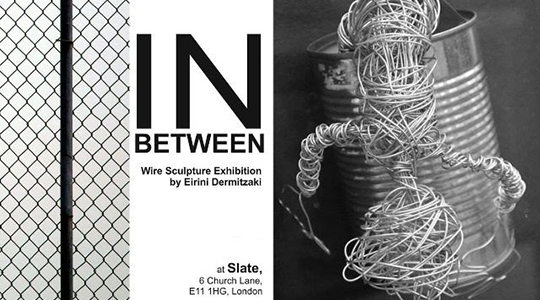
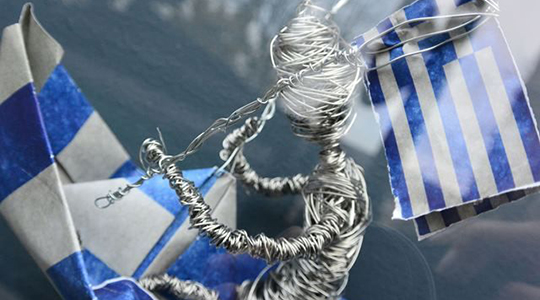
Eirini Dermitzaki exhibited her work last year at the Slate Gallery in London.
"We drink coffee before we get to work. A beautiful Fairtrade coffee from African plantations. We love coffee because it was created with loving care by the hands of other immigrants. All of us, of course, are dreaming of the day when we will all drink only tea.

"At work, time passes pleasantly whether our boss is British or an immigrant. Because both of them hide in us the hope that one day we too will become masters of immigrants, or better still, of the English. During the break we are pleased to be sitting side by side with immigrants. Our colleagues Ahmed, Pedro and Sonja smile cordially. We are all pleased that we are all immigrants with all our equal rights, and we feel like healthy members of society, and we are grateful that we are not like the others, unemployed migrants, or even worse, undocumented illegals.


"Once our work is done for the day, we drink our beer in the neighbouring pub to celebrate that we worked today. We laugh and drink and shout out loud, so that we forget what we really wanted to talk about.

"We immigrants, before going home, stop at the supermarket. We no longer look for products from our country on the shelves, because packaged food in plastic wrap is very cheap and we eat it all. We do not care if the vegetables are tasteless and the meat smells like carrion, because we feel safe when we carry our full bags home. At the exit, we greet our friend, our immigrant neighbour, who is carrying his own shopping bags, and feels the same pride that we do, that he can feed himself and his family.

"Back home, we share the living room with other immigrants. The kitchen cabinets, the refrigerator shelves, and the toilet paper. To have a bath, or to do our laundry, we arrange shifts. And it's very important that everything is in order and organized. Our house is like a small state. With rules and boundaries. With limits. We immigrants like that kind of stuff. It fills us with feelings of security that people who speak other languages or believe in another God can observe the same laws.

"The days pass, and so do the months, we get paid, we take our leave, we pay the bills, the rent. Everything is expensive and many times we do not have many enough money but we do not worry. The bank takes care of us immigrants with a bunch of loans and credit cards. At night we lie in our beds and we do not feel our legs from fatigue. Others do not feel their back or their head. Others do not feel any emotions. No thoughts before we sleep, because we do not miss our country at all. We feel fortunate that we are immigrants and we know that those who stayed behind are jealous of us. But we do not think about them. Because that is how we immigrants are. Since we became immigrants, we have forgotten who we were before that. So we sleep soundly like birds, and this is very important. It’s beautiful to sleep so deeply. You don’t even remember what dreams you saw. Anyway, what can one do with one’s dreams? We immigrants have a tomorrow. A next day, the same as yesterday, awaits us."

Immigration is not all it's cracked up to be.

©All Rights Reserved/Organically cooked. No part of this blog may be reproduced and/or copied by any means without prior consent from Maria Verivaki.
Tuesday, 24 December 2013

Dinner in half an hour

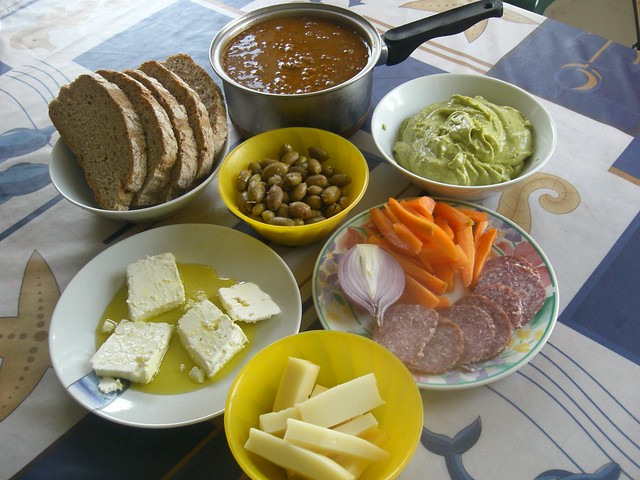
The freezer was stocked full. So was the pantry. The fridge was a little bare. Xanthipi had run out of time that afternoon, so she hadn't gone to the supermarket. There was hardly any sliced ham; even if there were, she found only four slices of bread in the bread bin, which would have to be left for breakfast the next day, so making sandwiches for dinner was out of the question. There was a small block of feta cheese, some carrots, olives, and a few other bits and pieces which would not constitute a meal if they were left in their cold raw state. So the real problem was not a lack of food in the house, but a lack of immediately edible food. Kosmas was due back home from soccer practice, Nafsika had just returned from volleyball, and Omiros was chopping the wood from a fallen tree trunk that he had picked up in the local park (he happened to see it before anyone else got their hands on it).

Xanthipi had only just walked into the house herself, after a late afternoon lesson with one of her students, the son of one of a colleague. He had not done his homework, he had failed the English examinations twice already, and the worst part was that the child seemed completely lost. He was not one for self-study, and his parents were not in the position to teach him study habits. Nor were they in the position to pay for private lessons. Xanthipi felt cornered when she accepted to help him. How can anyone charge a reasonable price for this kind of work in this day and age? It was also not possible to do this work for free - no one has that luxury in this day and age, either. So she offered to help the boy for the next few days, until his examinations, and did not ask for a specific price. "Whatever you wish to pay, it's fine by me," she had told her colleague.

Xanthipi was now getting stressed over what to cook for the evening. She had found an empty pot of what had earlier contained fasolada, so there were no leftovers. The family would all be starving as they slowly began pouring into the house at the end of day, all at the same time, walking into the kitchen every five minutes, wondering what there was to eat.  Xanthipi picked up the menu card of the local souvlatzidiko tucked neatly away behind the spice jars. She didn't open it to see the menu; she just looked at its cover where the phone number of the business was written: 81818, she memorised. Then she rummaged in her handbag to find her mobile phone and came up with her wallet instead. That's when she remembered that it held a ten-euro note that had been there for a long time: it was supposed to be there "in case of emergencies".

Plastic money covered all her needs these days, so she rarely needed to go to the ATMs. Cash was only really useful for a styrofoam coffee or to buy a loaf of bread from the bakery. The former is not an emergency, while the latter may sometimes be. But now that she was nowhere near a bakery, she could not even use it on that. She debated in her mind whether souvlaki constituted an emergency on that night and decided against it. There was no choice but to cook.

From the freezer, she took out a packet of boneless chicken pieces (8 pieces - she had bought half a dozen of those packets when they were on special at the supermarket) and placed it in the microwave to defrost. Then she cleaned and chopped some onion and garlic; while doing this, she thought about what she would make. How about some chicken in red sauce? But where are the carbs? And where are the veges for that matter? She opened the food cupboard where she found half a packet of orzo pasta. Another look in the freezer and she found half a packet of peas that had become such a tight ball of ice that she had to smash the packet against the floor to ascertain the volume of its contents. She set to work, turning all that dry and frozen food into a dinner in half an hour.
~ . ~ . ~ 

"Are you eating too, Mum?" Nafsika had asked when Xanthipi told her to set the table.

"Of course!" Xanthipi replied, although she knew she would not be eating much at the table. It was a common joke in the family that mother never ate at the table, even though she always set a plate for herself. While Xanthipi was pan-frying the chicken, she had nipped a bit off here and there to make sure it was cooked right through and the taste was right. While she was cooking the pasta, just before she thought the pea and orzo dish was ready, she had scooped up a spoonful with the mixing spoon and checked its taste too, burning her tongue in the process. While cooking, she had nibbled on a bit of crumbled feta from the remaining block and dipped a piece of bread that had not been cleared from the table after lunch into the oil on the plate containing the feta. She topped each bite off with an olive. And while everything was simmering, she also wondered what meal she could prepare for next day's lunch, but decided it was impossible to cook another meal that night. She was too tired, more mentally than psychologically.

Now everyone was sitting at the table. Although it was still quite early in the evening, it felt late since it got dark so early. She let everyone dish out their own portions, stealing glances at their plates to ensure that they were helping themselves to ample portions.

"Come on folks, eat up!" She urged them to take second helpings when she noticed only three pieces of chicken gone from the pan. Was there something wrong with the taste, perhaps? "There's plenty for everyone!"

"Aren't you going to eat any, mum?" Kosmas asked her.

"You know I've already eaten," she reminded him. "I always eat while I'm cooking."And this was true. Her hunger had been satiated for the evening with the feta and bread and oil and olives, and she did not hanker for the taste of chicken. Besides, she was the only one in the family keeping warm and cosy by the stove, while everyone else had been outside expending energy in the cold outdoors. Her only concern was about the smell coming from this cheap chicken. While she was cooking it, she detected an eggy scent, so she sprinkled various spice powders over it, in an attempt to mask the off-putting smell. This seemed to do the trick, given that no one was complaining about the taste of the chicken, and she knew that they all liked pan-fried chicken - but why weren't they serving themselves second helpings?

By the end of the meal, there were two pieces of chicken left, and a good serving of pea and orzo leftovers, just enough for the next day. She was glad to see this, as she now felt more confident about the next day's lunch, which was usually cooked on the previous night and warmed up the next day. If they needed to add a bit to the meal before she came home after work, they could always open a can of tuna to go with the orzo. And for an evening meal the next day, it would definitely be souvlaki, just as long as she rememebred to get to an ATM before coming home. At any rate, she needn't feel rushed the next day, as she had no extra lesson that night after work. The evening ended warmly with a bit of TV-watching near the hearth. She always fell asleep within five minutes of the programme starting, and often woke up after everyone had gone to bed, after which she staggered off the couch and got herself tucked in too. Her conspiracy theory was that Omiros got to bed before her so he could fall asleep before she started snoring; now, she had to put up with his.

~ . ~ . ~ 

On coming home from work the next day with the supermarket shopping, Xanthipi noticed that most of the orzo pasta had been eaten, save one serving; just enough for her in other words, since she had not tasted her creation when it was freshly cooked, apart from a teaspoonful. She left the shopping on the floor and placed the orzo in a bowl. She had used a small jar of her own home-made pepper sauce to make it, prepared from the previous summer's harvests, and now that she was heating it for herself, after allowing the flavours of the dish to blend better overnight, the scent of summer was exuding from the microwave, and wafting into the dining room.

She opened the fridge, where she found the two leftover pieces of chicken sitting on a small plate, looking quite unwanted. Why on earth had they not been eaten, she wondered. Was no one hungry?

"Nafiska," she called to her daughter, "why didn't you eat the chicken?"

"I ate nothing, mum, I was feeling very bloated after all those crisps. We were at the theatre today, remember?" Xanthipi had forgotten about that. When the children were on a school outing, she let them take a packet of crisps and store-bought biscuits instead of a proper lunch, in order to avoid oily leaks and bruised fruit while moving about.

"How about you, Kosmas?"

"Oh, two of the other kids in my class were celebrating their nameday, and they'd bought a whole lot of cakes to share with us." It's St Nicholas' feastday, Xanthippi suddenly remembered. She had phone calls to make in the afternoon to her Nikos and Nikis.

"Besides, mum, I didn't really feel hungry," Kosmas added. "I thought Dad might've wanted to eat the chicken."

"Well, what on earth did your dad eat, then?" She called out to Omiros who was in the yard, piling the chopped logs from the previous day on top of the tidy heap that he had created against the wired fence. As a long-term unemployed male, with few prospects of getting work now that constrcution, and hence carpentry, his trae, was on the decline, he had learnt to pace himself, working slowly enough to never be left with nothing to do to take up his time during the day. In this way, he avoided boredom.

"I opened a can of tuna and had that with the remaining orzo," he informed her. "Which reminds me," he started, and Nafsika knew what was coming. "Don't buy that cheap tuna brand again, because it tastes off." Not that he knew how much the tuna had cost, but he knew that Nafsika always bought the chepaest brand.

"Yeah," chimed Nafsika, "the tuna stank up the whole house! Can't you smell the tin in the bin?" Nafsika had a sensitive nose, just like her dad.

"Well," Xanthippi was flabbergasted, "why didn't you just eat the chicken instead of opening a can of tuna?"

"I thought you might be hungry after work," Omiros replied. "Did they leave you anything?"

Xanthippi then sat down to eat the leftovers, thankful that everyone was safe and sound at home, and no one was hungry. Tonight was Friday, and there was no need to cook a meal for the next day. The family could have a souvlaki in the evening. And just like she did on most souvlaki nights, she'd just nip off a bite from Omiros' souvlaki to satisfy her hunger. And if anyone asked her to have some more, she'd remind them that she didn't really like souvlaki.

"Well, what you would like instead?" Kosmas had once asked her.

"Chinese," she answered. For now, this was not possible, and they all knew it, so she could not complain if they called her fussy.

*** *** ***
"The magi, as you know, were wise men – wonderfully wise men – who brought gifts to the new-born King of the Jews in the manger. They invented the art of giving Christmas presents. Being wise, their gifts were no doubt wise ones, possibly bearing the privilege of exchange in case of duplication. And here I have lamely related to you the uneventful chronicle of two foolish children in a flat who most unwisely sacrificed for each other the greatest treasures of their house. But in a last word to the wise of these days let it be said that of all who give gifts these two were the wisest. Of all who give and receive gifts, such as they are wisest. Everywhere they are wisest. They are the Magi."
Gift of the Magi, by O'Henry, 1905
Merry Christmas, everyone. I'm taking a break over the holidays, to recharge my batteries.

©All Rights Reserved/Organically cooked. No part of this blog may be reproduced and/or copied by any means without prior consent from Maria Verivaki.

Friday, 29 November 2013

Cold (Κρύο)

I wouldn't say we put it off - the house simply didn't feel that cold to us all this time. Last night, despite the warm clothes we were wearing and the fleece blankets we covered ourselves with, we still felt cold. It's the damp air that remains in the atmosphere which causes this sensation, and it doesn't go away without turning on some form of heating; insulating your house well doesn't mean that you will never need to use heating.
Winter's arrival in our house was a cause for celebration We even got our souvlaki delivered. Lighting a fire keeps the family together. We have all created our own little corner in the living room, so's we don't tread on each other's toes as we huddle together in the warmest part of the house. Even the location of the Christmas tree has been planned for; that's Greece for you: completely seasonal (as we await Persephone's arrival once again, να μας τα κάνει όλα καλοκαιρινά πάλι). 
Having not felt the full brunt of the cold so far this winter in our house, I asked my colleagues at work this morning if they had started using any form of heating in their homes so far. They were surprised to hear that we had only started heating our home so late in November.

I am slightly relieved to hear this. Climate change may play some role in experiencing delayed winter weather, but so does good insulation.

©All Rights Reserved/Organically cooked. No part of this blog may be reproduced and/or copied by any means without prior consent from Maria Verivaki.

Friday, 15 November 2013

Spanakopita (Σπανακόπιτα)

Making a Greek pita is, for me, a mindless task. Rolling out pastry is not a mental chore, it's a physical one. So while I'm rolling out my pastry, I have much time to think and organise my thoughts. To make the task more challenging for me, I try to invent a new design to score the pastry.

Apart from a design I learnt from a youtube video...

and the classic square-shaped pieces...

I also do one of my own designs, which I call 'marigold':


Cooking can sometimes be mundane, but you can make it more exciting in your own way.  However I decide to score the pastry, I don't worry about it breaking - it still sits nicely on the top of the pie, and it was going to break anyway once it is served. 
I make a pita every week in the winter. This week's pita contained spinach and soft white cheese. It was made in a square-shaped baking vessel - for a change. I always make layered pastry pies - so my filling is never one layer - it's usually 2-3 layers, with pastry in between. Square pies are easier to deal with when you use store-bought pastry.

You need: a
500-600g finely cut spinach (I used spinach frozen from last spring to make the pita in the photo)
1 large onion, finely chopped
2-3 sprigs of finely minced fresh mint (or a teaspoon of dried mint)
500g Cretan mizithra or crumbled feta (I use mizithra because it's cheaper and possibly tastier)
1 egg
3-4 tablespoons of breadcrumbs (to ensure that any moisture in the filling is soaked up and won't make the pastry soggy)
salt and pepper (don't use too much salt if you use feta cheese)
10 sheets of filo pastry (I make my own filo pastry, which is a little thicker, therefore I use fewer sheets, about 8)
olive oil for brushing over the pastry

Thaw your pastry first (if you are using store-bought pastry). Mix all the filling ingredients together. (If you are making your own pastry, you should have the filling ingredients ready first. Then roll out one sheet at a time and use it immediately.) Turn on your oven to pre-heat to 200C.
Layer 1: Grease the bottom of a baking vessel (pyrex or tin). Place one sheet of pastry on it. (This piece of pastry should hang slightly over the sides of the baking vessel so that it will seal the pie at the end. In my photo, you will see that I didn't do this perfectly, but I use my own home-made filo pastry which is sturdier than store-bought pastry.) Grease the pastry and lay another sheet over it (do this twice). Dot a third of the filling evenly over the pastry. 
Layer 2: Lay another sheet of pastry over the filling. Press it down to make the filling spread evenly below the pastry. Grease the pastry and lay another sheet over it. Dot another third of the filling over the pastry. 
Layer 3: Repeat the instructions for Layer 2. Grease the pastry and lay another sheet over it (do this twice). Brush the final layer of pastry with olive oil, then turn the pastry hanging over the sides of the baking vessel over the top layer of the pie. Brush those with olive oil too. Then score the pastry with a knife, making cuts right down to the bottom of the baking tray, to make the cuts you want when you finally serve the pie.
You can see each layer of filling and the pastry layers.
Place the pie on the lowest shelf of your oven. Turn on the 'fan' function, which circulates the air all around oven. Turn down the temperature to 180C. Cook the pie for 40-50 minutes, depending on how golden you want the pastry. The fan function is important, so that you do not get soggy pastry at the bottom of the pie. If you do not have a fan function in your oven, cook it at 200C for at least an hour. Some ovens also have a function that allows them to cook using only the bottom heating elements. You can use this at high heat for 10 minutes or so, at the end of baking time. Allow the pie to cool for 10 minutes outside the oven before serving - you will need to cut again wth the knife to ensure that each piece comes out separately.

©All Rights Reserved/Organically cooked. No part of this blog may be reproduced and/or copied by any means without prior consent from Maria Verivaki.

Tuesday, 3 September 2013

Harmonisation (Aρμονισμός)

It's easy for me to say that I don't need to go away on a summer holiday because I live on a summer holiday island. I can sleep at the cheapest hotel (my home), eat at a good restaurant (my kitchen) and swim at the best beaches (we live close to them) without paying much. I guess one could say that we have discovered the key to a balanced life. But as a very precious friend recently pointed out to me, balancing is all about teeter-tottering; there is the constant risk that the scales will not stay in the same position, and without even expecting it, you might fall over - because you lost your balance.

This very pretty beach is close to my home. I can go whenever I like, even in the winter. But do I do this often? No, because there are other priorities to attend to after work. 

The truth is that the scales never do stay in the same position, except when nothing changes on either side. In the real world, this is not possible - everything changes by the minute, especially in the rapidly changing Greece of our times. So the scales are teeter-tottering all the time. Life can become very unbalanced by just one minor incident, something as mundane as checking the mailbox or hearing the tyres of a car screech outside your house.

September is when the grapes start tasting like wine if you don't harvest them quickly enough.

So our balanced life is not really quite as balanced as we like to believe: by staying at home for the summer holidays, even when we go to the seaside in the afternoon, or even a short day trip away from our home base, in essence, we do not stop working or thinking about work. We continue to work at our paid day jobs, we keep in mind our unpaid jobs (the garden, the fields, food processing/preservation), and we still have to do the dishes after each meal. What's more, we continue to see the same view from our windows, which is not an ugly one at all, but it's only natural to stop appreciating it at some time due to the boredom factor - we want to see something new.

The sea of olive trees that forms our view from our balconies is interspersed with various low buildings, mainly houses; it remains the same throughout the year, as olive trees are evergreens. The greatest change that may take place here is that I will see some snow on the mountaintops. 

What most people do to get away from the stress of the daily routine is to completely disconnect, leaving auto-messages in their email and letting their inbox fill with messages. My friend told me that she returned to the office to find 1400 emails waiting to be answered; so her disconnection could have created new stress on her return. But she has foreseen this situation too: what you really need to do, as my friend explained, is not to balance your life, but to harmonise it, to make it agree with the continuous barrage of new situations that we find ourselves confronted with on a daily basis. Life never moves backwards; it carries on in a forward direction, and to maintain a balance, we need to harmonise our present with our perpetually changing future.

Tsigariasto (slow-cooked lamb in the pot, stewed in olive oil and wine) - it is often served with fried potatoes. This is pretty much what it looks like when served at a restaurant. This formed our Sunday meal, cooked the previous evening, to allow us to spend the morning at the beach. 

So tonight, we're going to start packing our suitcases, gathering together some picnic supplies and filling up our beach bags, in an attempt to leave behind our regular schedule, just before the new school term begins. That way, when we return home and when people ask us where we went for our holidays, we can say that we left our home for 3-4 days to take a break from routine. Even if our holiday destination does not take us beyond the borders of our island, some time away from home feels like a proper holiday; the feeling of sleeping in a different bed and eating something I didn't prepare or cook myself (and not clearing the table and doing the dishes) give us all a sense of being on holiday even if the destination was close to home. At any rate, there is wi-fi everywhere these days, so I don't suppose I'll stay disconnected for long.

©All Rights Reserved/Organically cooked. No part of this blog may be reproduced and/or copied by any means without prior consent from Maria Verivaki.

Thursday, 29 August 2013

Chilling out

We all need to take time to disconnect in some way. Here's where I go to do that, when I can't physically leave my home.


All the photos were taken in the last two weeks at Koum Kapi, an inner-city beach and seaside cafe area in Hania.

©All Rights Reserved/Organically cooked. No part of this blog may be reproduced and/or copied by any means without prior consent from Maria Verivaki.

Thursday, 1 August 2013

Omelette for one (Ομελέτα ατομική)

My kids want the instructions for how we made omelettes recently.

You need:
2-3 eggs
a little bit of sausage (or ham), green pepper, onion, zucchini, aubergine, etc
grated cheese
olive oil
some bowls
2 medium-sized frying pans

1. Prepare your omelette fillings first: Peel and cut a potato into chips. Fry them in olive oil in a medium-sized frying pan on high heat till they are completely cooked (there is nothing worse than an underdone potato). They will need at least 15 minutes. When they are done, take them out of the frying pan with a slotted spoon and place them in a bowl.

2. Next, chop some mushrooms, green peppers, sausage, onion, zucchini, aubergines, etc (whatever you like) into small cubes - you will need only a little bit of each item. Fry them in a little olive oil on medium-to-high heat in another medium-sized frying pan till they are just cooked through. You can do this at the same time while the potatoes are cooking. This will need about 3-8 minutes. When they are ready, take them out of the frying pan and place them in another bowl.

3. Have some grated cheese ready in another bowl. You will need 2-3 tablespoons per omelette.
4. Break 2 eggs (or 3, if you are very hungry) in another bowl and add 3-4 tablespoons of water. Beat well. (If you have 3 eggs in an omelette, you shouldn't eat any more eggs - fried or boiled - in that week because it may be bad for your health - there are other foods to eat in the world apart from eggs.)

5. Heat some olive oil in a frying pan (the same one you used to cook the vegetables/meat). When it is hot, pour the egg mixture into it. Shake the pan a little to make sure the egg runs everywhere so that it will cook everywhere. Use a knife to lift up the omelette to let the runny egg go to the bottom of the pan. But DO NOT break the omelette - let it cook like a pancake.

6. When all the egg is cooked and not runny, place some of your fillings on top of the omelette on ONE SIDE ONLY. Then place the greated cheese over the fillings. Then fold the other side of the omelette over the fillings. Then slide the omelette onto a plate.

7. Place the remaining fillings and the fried potatoes around the omelette.

Enjoy your omelette hot.

©All Rights Reserved/Organically cooked. No part of this blog may be reproduced and/or copied by any means without prior consent from Maria Verivaki.

Saturday, 20 July 2013

Frugal living

That fridge looks rather bare, I thought, as I opened it up to find something to nibble on. It wasn't really empty, but I wanted something 'fast' and 'tasty' - and there really was nothing  in there that I could just grab on the spot and eat as is. Most of what was in my fridge last Tuesday (the day I was contacted by the BBC4 Food Programme to discuss frugal food) was unprocessed fresh food grown in our or another person's garden. If I wanted to eat anything from there, I'd have to process it - eg clean, peel, cut the fruit or veg. It wasn't quick enough for me at that moment.

The contents of my fridge, 17/7/2013 - I was surprised at how little processed food the shelves contained (the door shelves always contain more processed food, mainly in the form of my Asian bottled sauces).
Taking the shelves from the bottom upwards, there were:
1)  a range of different kinds of garden-grown peppers, and cucumbers (gherkins and Asian cucumbers which are popularly grown in Crete, known as atzouri)
2) some leftover vegetables, home-made tomato sauce, the last of my home-cured olives, an unopened pottle of yoghurt, some mizithra cheese and some home-made spoon sweets - bitter orange (made by my mother-in-law from our own fruit supply) and kumquat (which I made from a gift from a freind)
3) eggs - loads of them, due to generous friends whose chickens are laying in great profusion at the moment due to the breezy summer weather (free-range chickens don't like very cold and very hot weather, when they stop production), a bottle of water, 2 cartons of milk, and some dark chocolate flavoured with orange bits (I could have scoffed that, but it is not my favorite taste, so I just left it)
4) some melons and watermelon (more gifts from someone else's over-producing garden), and finally
5) a few bottles of beer, some corn husks (I have a craving to make tamales one day, so I saved the husks from our garden-grown corn), some butter spread, my home-pickled capers, a couple of cartons of cream, and some more jars of bitter orange spoon sweets (to last us to next season).

I may not have found exactly what I was looking for, but I was still quite amazed to find so much food in my fridge that was grown by us or someone we know, so much fresh, unprocessed food. (There were also some zucchini and eggplant waiting to be stored on the kitchen worktop.) In other words, most of that food came free - I did not have to spend money on it. But that only tells half the story. To procure that food, I spent a lot time. It didn't cover all my wants, just most of my needs. We sometimes lack variety when eating mainly in this way (using a lot of local fresh seasonal food), so our wants also show signs of lacking. I didn't have what I wanted to eat ready for me to eat it, so I had to make it myself.

By careful substitution, using some frozen and fresh vegetables, and the addition of some leftover meat from a feast we had attended, I made these delisious dumplings (I also made the wonton wrappers myself - recipe to follow). One dozen dumplings cost me not much more than €1.
Most people I speak to about food issues don't believe that it's feasible to rely on home-grown food, and they think I don't do my sums properly when I passionately describe the savings that can be made if food could be sourced as cheaply as possible. They insist that the quantities of such cheaply sourced food would not be enough to feed a family nutritiously. I can proudly tell myself now that what these people say is actually a good excuse for NOT making the effort required to source their food cheaply in whatever way they can. I live in the countryside, hence I have cheap sources of fruit and veg. Urban people will not have these cheap sources of food (I won't say 'free' - nothing is free in this world, it all comes with some kind of effort). My very cheap sources of food allow me to save a lot of money by using a limited variety of foods whcih are turned into an endless variety of dishes. My cheap food saves me a lot of money, because I can process it and make it good for eating at a later date too; I don't waste or throw it away, or spend money on food items that would render my cheap sources unnecessary. Most importantly, the food I have in my fridge at the moment keeps my family very healthy, and it keeps me in pocket.

The day after the BBC interview, I did a big shop at the supermarket and stocked up on things we don't produce ourselves, which complement our fruit and veg food. Kids want a ham and cheese sandwich every now and then, a bit of grated cheese is a nice way to round off a weekly pasta dish, and some ready-to-eat meat (in the form of smoked pork steak) is a good addition to a quick stir-fry, home-made souvlaki or any other meal where just a little bit of meat makes a mainly vegetarian meal so much more exciting. These cheap cured meat cuts go a long way - most will be frozen for later use. I know which supermarkets offer which specials, so I plan my shopping trips accordingly. On this shopping trip, I was accompanied by my husband, who snuck a packet of feta cheese into the shopping basket while I wasn't watching; I could have bought this feta more cheaply from another supermarket - he was obviously not prepared for the wait. 

Another thing those people say (the ones who think that cheap food sources are not easy to find) is that it is time-consuming processing food to make it edible, and then cooking from scratch. I won't contradict them - they are right, it does take a lot of time. But when that is all you have, and you don't make it a habit to buy processed food whose contents you cannot trust or do not know, then you need to do this - you need to think creatively, spend some time looking out for quality cheap ingredients, process them appropriately and find some interesting recipes to turn that food into delicious meals that your family will remember. It doesn't make a difference where you live - there is cheap food to be had. For example, I came across some 100% Greek fatless pork with very little bone for €3.05/kg - I picked up 5 kilos and stored it appropriately in the freezer in meal-sized parcels. That's all you need - you'll be able to save a lot of money by freezing bits and pieces here and there.

 I was a little annoyed with myself for not buying any chocolate on my last shopping trip; I think that;s what I was craving. Then again, the fewer chocolate bars in the house, the less chance there is of their disappearing as soon as they enter the house. To make up for the lack of chocolate in the house, I made the family's favorite chocolate cake instead, to use up some of the eggs. 

During the BBC interview, I was asked if I thought it was indeed possible to eat very frugally. And of course, I said it was. I did keep in mind that I live in a rural area (which helps), and I know I have a keen gardener in my family (which is also useful), but I also mentioned one more thing that is true for anyone who suddenly finds themselves with less money in their pockets and greater financial responsibilities: you have to change your way of thinking. You can no longer continue to live like you did in the recent past, no matter where you live, and you have to make new sacrifices that you thought you would never have to make. If you can't do that, then no matter where you live, you will eventually find yourself in difficulty, whether it's related to money or to your own sanity.

Living frugally - food- or otherwise - is possible ony if you want to make it happen. It's a matter of balancing my wants with my needs. If I can keep my needs down, I can choose which of my wants I can have. One thing I know for sure is that I cannot have everything.

©All Rights Reserved/Organically cooked. No part of this blog may be reproduced and/or copied by any means without prior consent from Maria Verivaki.

Sunday, 7 July 2013

Cafe bar (Καφέ-μπαρ)

When we arrived at the cafe bar, we couldn't see our friends. We looked around at the tables located near the children's play area, where we had once sat the last time we had come to this 'poly-entertainment' centre, so that we could watch them playing on the trampolines. But our friends weren't there. Then we realised that there was much more to the cafe bar than just the children's play area: we discovered seating areas at different levels, indoors and outdoors. The space near the bowling parlour was empty, understandably; the weather was too good to stay inside.

We found them sitting at a large table, chatting with people we did not know. We live in a small town, and yet we don't know everyone in it. We do not even bump into each other occasionally; some of us are neatly tucked away in our own little corners of our own little world.. We only know a certain section of the population, and naturally, we keep company with people who are similar to us; it was instantly obvious that this group of people were not like us.

For a start, they seemed very comfortable sitting around a table at a cafe bar, and not just any cafe bar, but specifically this one. They could not be imagined sitting at the crassier places near the tourist area close to our house. It would be the wrong stratum, despite the fact the our friend's BFF lived on the other side of town, close to us: "Well, I already had a house, " she meowed, "and my mother lives there too, on the ground floor," - purr, purr - "so I couldn't bear the thought of moving up here, even though it is where my husband would prefer to live," she explained.

"MARIA MOU!" my host was screeching (she is well known for her very loud voice), "come and meet Ev-do-XI-a!" There was no need for me and my husband to come and meet Evdoxia; Evdoxia had already been placed before us whether she wanted to meet us or not. Our host had moved to a different table, pulling aside only Evdoxia from the previous one. She came to sit with us, as only a good business person would. Being well versed in public relations, she did not look uncomfortable sitting with the hoi polloi.

Evdoxia had long peroxide hair, which she had had styled in the shape of a 60s bouffant beehive hair-do. Her teeth had been whitened professionally and she wore a long tapered white sundress over her waif-like figure. Around her neck hung a large diamond sea-blue pendant on a silver chain. Her short calculated steps were taken in high-heeled cork platform shoes, which completed the coordinated 60s look. It was like seeing Twiggy sitting before me. I not only felt under-dressed; I knew I was badly dressed. My Primark jeans had that cheap functional look to them, and my crinkly Indian cotton gold-embroidered top looked unironed (it looks unironed even when I do iron it, so I don't usually bother to iron it in the first place). But my outfit choice matched Evdoxia's in that we were dressed in similar period costume.With my flower-power hippie look, straggly split ends to match, we were from opposite ends of the same spectrum.

"I've known this little girl since she was knee-high!" our host proclained as she smothered Evdoxia in her busty embrace. Indeed, Evdoxia still looked like a little girl, not a day older than 25. I couldn't work out what she'd botoxed, as it was done quite discreetly. Evdoxia smiled widely and laughed softly the whole time she sat with us. She showed interest in our names and what my husband did for a living. She did not ask what I did for a living, presumably because she thought I did what she did, which was nothing except to look pretty. (Since I wasn't doing a good job of it, she avoided me the embarrassment of asking.) But she could probably tell that I did my own housework and cooking, which she probably doesn't do, presumably because she has one of the few Filipino maids still working in hania (they're so much less demanding than Albanians, I've been told), her mother lives downstairs, and she is probably spending an awful lot of time preening herself.

I imagined Evdoxia's kitchen to be very clean because waifs don't eat, and if they do, it's probably salad or something from Gwyneth Paltrow's cookbook, not the puff pastry delights her husband's multi-million-euro business was producing. But being a high-profile businessman's wife, she probably did have kids - she can't have gotten away with that one - and she was sure to be much older than 25, as our host was 55 herself, and she'd known Evdoxia since she was a teenager. I presumed that her children were bouncing away on the trampolines on the other side of the complex. They would no doubt eventually appear at the table by her side, perhaps when they wanted some granita, ice-cream, crisps, pasta, tourta or soda. Or simply some more money for the games.

Evdoxia politely sat with us for long enough to show solidarity towards the lower classes, after which she got up slowly, shaking my husband's hand (not mine) and bidding us a good evening. She went back to her παρεούλα, right above where we were sitting. The up-theres were now drinking aperitifs in long glasses with multiple straws in various colours and psychedelic umbrellas. We ordered our ice-creams and drinks at the same time that I noticed a large platter of mezedakia making its way to Evdoxia's table. This time, Evdoxia was sucking at a cigarette, and letting out the smoke in an upwards motion by tilting her head back towards us. She now looked in her element - less formal and more open - leaning over the table to have a heart-to-heart chat with another female member of her troupe.

Eventually the troupe's children arrived at the table. The girls were all wearing BFF T-shirts. A chubby early-teen wearing black leggings sat by Evdoxia's side. She looked very much like her mother; her mousy brown hair told of what colour her mother's peroxide roots were. She weighed more than her mother, presumably because she was eating her dad's puff pastry delights.

Just as we were finishing off our ice-creams, a plate of something that looked like a deconstructed ekmek arrived at our table. The shredded pastry rounds were delicately filled with walnuts and very lightly doused in syrup. The arrangement was plated beautifully with little balls of ice-cream around it, chocolate sauce drizzled over it in fancy patterns, and puffs of whipped cream in the corners of the plate.

"Κερασμένο από την κα. Ευδοξία," the waiter said, and we all looked in the direction of Evdoxia's table. Our host picked up her coffee glass and swung it high in the air in Evdoxia's direction. But Evdoxia didn't notice, as she was obviously engrossed in the conversation taking place at her own table. She was sitting right behind us, so she had her back to us and couldn't have seen the arrival of her κέρασμα. The desert looked and felt just like Evdoxia - light and fluffy, airy and breezy. As it melted in our mouths, it left behind the rather heavy feeling you get when you've had too much of a good thing. We were having ice-cream followed by ice-cream. There is definitely a moment when it actually feels too much.

I am so annoyed I forgot to take a photo of the ekmek ice cream dessert. You will have to be content with my description; at the same time, you need to use your imagination.  

PS: Time for a blogging break (because I am really really busy with 'real' work). See you later...

©All Rights Reserved/Organically cooked. No part of this blog may be reproduced and/or copied by any means without prior consent from Maria Verivaki.

Tuesday, 25 June 2013

Lentil stew (Φακές)

If you read Joanna Kakissis' recent views of Greece, you will find that Greece is on the brink of collapse:
"The postcard image of modern Greek pride is a rich, full table of grilled lamb, sharp cheeses, eggplant casseroles, olive oil-drenched tomato salads, and honeyed desserts -- of happy families toasting each other. It's not people fighting over free cabbage, staring into bare refrigerators, or gathering throwaway oranges at open-air produce markets. It's not free lentil stew. The future, all of a sudden, has started to look a lot like the past."
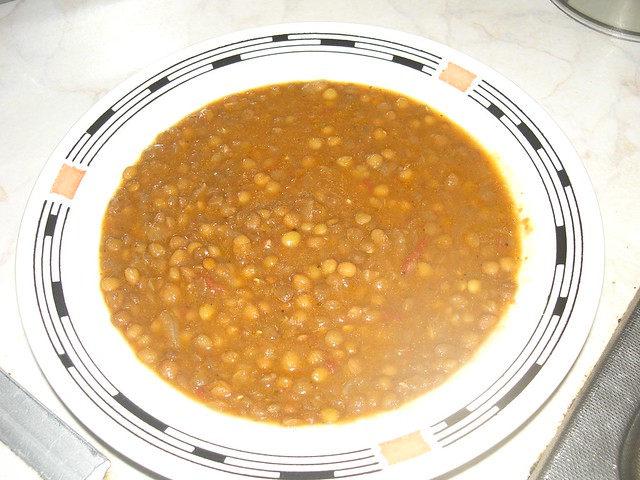
old soup plate

But cabbages are now out of season now, and you will be hard pressed to find them in your local λαϊκή (street market), as I discovered when I took a friend to the Saturday market in Hania recently. The article continues with some tired old cliches of Greek life in recession and there are also some other inconsistencies in this article, which are annoying to read, from the well-informed Greek food blogger's point of view:
"Those who still have their jobs, even if they've seen their incomes plunge by a third or more, consider themselves lucky. But they no longer stock up on pork chops and imported Gouda cheese, as they did in better times. They eat out less too... There's also a bestselling cookbook, Starvation Recipes, based on tips from Greeks who survived the famine of World War II. (Sample: Save bread crumbs from the table in a jar to eat later.)"
Stocking up on pork chops was never really the norm in Greece. Most Greeks have never needed to do this because few own freezers large enough to do it. Besides, fresh meat, heads, tails, gizzards and all, is always readily available in the fresh meat counter of almost all supermarkets. Greeks are generally not the stock-it-in-the-freezer-and-cook-with-it-for-the-next-month-or-so kind of race.

And what about this 'imported Gouda cheese' business? Forgive me for my mean thoughts right this minute, but does Ms Kakissis realise that 'imported Gouda cheese' is actually the cheapest cheese on the market? It's HALF THE PRICE of the well-known Cretan graviera (for example), which is made locally in my case! I actually buy it for kids' sandwiches and pizzas - it costs LESS than the most common cheese in our house, which is mizithra!

Kakissis mentions that Greeks eat out less now. Isn't that what happens in most other places when a crisis hits home? It's nothing new, nor is it a very Greek-crisis concept. Even our summer tourists are doing this at their hotels, or on the beach: they buy so much sliced bread, ham and cheese (the imported stuff, of course) at the supermarket, that the shelves need to be restocked constantly. The book she mentions made a bit of noise when it first came out, but few would believe it was being used, as might be insinuated by Kakissis' article, as a base for Greek home cooking. It's just an interesting book, as are Jamie's and Nigella's - they make great coffee table books.

nothing less will do

The opening discussion of Kakissis' article serves to remind me that there is a crisis in Greece which I can't see because I don't live in Athens. The only thing that Kakissis' article deals with properly (which is actually the main theme of her article) is lentil stew (φακές). They are a Greek favorite, eaten all year round, very simple and cheap to make, and always enjoyed by both Greeks and non-Greeks who try them at a Greek's home. And this is generally the only place where you will find them, because few tourists know about φακές. It is rarely available at restaurants because, as Kakissis writes in the title of her article, lentils are associated with austerity, aka poverty.

I made lentil stew yesterday, on request. My husband was tired of eating his garden-grown goodies: zucchini, eggplant and peppers. "Too much fresh food, Maria" he complained, "my stomach is growing stems". So I made φακές which we had with some mizithra cheese, raw onion, some left over kolokithokeftedes (zucchini patties) and the ubiquitous fresh bakery bread, without which my husband cannot sit down at any meal time.

Now that is a sure sign of hard times: when there was not enough to eat, and bread acted as the main part of a meal, which was served with a meagre portion of a saucy dish. The bread soaked up literally everything on the dish to the point that the dish was wiped so clean that it was hard to tell if it had been used. Not that my husband is poor, but he knows what it feels like to have just bread and oil to eat.

My version of lentil stew uses just salt, pepper and oregano to flavour it: this is because we make it with my home-made tomato sauce, which gives it a very strong flavour. This is quite different to my mother's φακές which contained bay leaf and dried orange peel, possibly because tomato was less easy to procure - she came from a mountain village, 500m above sea level. I once made this kind of φακές for the family, but I got a good telling off. I don't mix and match too many flavours or change the combination of my family's meals because I know they will notice: some things are meant to be (more on that in another post). And as I mentioned in another recent post:
“When you watch the news abroad you get the impression that a revolution could break out at any minute... But when you come to Greece you see that it is all happening in one small part of Athens. We know that the crisis is real and that people are suffering, but this is not a country on the brink of collapse.”
©All Rights Reserved/Organically cooked. No part of this blog may be reproduced and/or copied by any means without prior consent from Maria Verivaki.

Tuesday, 23 April 2013

Renovations

It's kind of like spring cleaning time in my house at the moment - I had anticipated this to happen throughout the year, as we talked about it in winter (a very short and not so cold one), so I didn't do any dusting at all in the house. I knew it would become a bombsite in just one hour.

The best time get rid of mouldy walls is spring. Once you renovate them, they can be given time to dry out over the summer, before being painted. The stucco has to come down, which means a good deal of dust being created.


It's not much fun living in the house while it's being renovated, but most Greeks don't have much choice about this. It's also the cheaper way to get the job done. You usually ask a friend to help you knock the stucco off your walls, you clear the mess up yourself, and you also help in putting the concrete back up.


It's a nightmare working in a kitchen like this, but I'm grateful that at least we will have a clean (but unpainted) kitchen in time for Easter.


Cooking continues: a made a spanakopita last night. The worst part was trying to work out where the least dusty site in the kitchen was. This scene is tiring me out. I'm already waiting for the weekend. And perhaps an outdoor, al fresco kitchen to avoid messing up the only kitchen we have.

©All Rights Reserved/Organically cooked. No part of this blog may be reproduced and/or copied by any means without prior consent from Maria Verivaki.

Wednesday, 3 April 2013

Bad hair day

Just a quickie before I start thinking about the horrible day I'm bound to have tomorrow, after the sultry weather, high southerly winds, air as thick as dust, car covered in red rain, sneezing my head off allergically, hair looking like Marie Osmond's (in the 80s), mid-20s temperatures (degrees Celsius) while the indoor temperature still feels like winter because the cement and brickwork haven't yet warmed up, feeling listless and bothered (though I don't know by whom), making the preparation of a meal out of the question, it doesn't help that I lost three hours of hard work this morning due to Linux-Windows incompatibility, and I know it's going to be a horrible day like yesterday because the day before was just as bad as yesterday, and I know I won't get the work done that I was supposed to have started on Monday and still haven't done anything about (it got screwed in cyberland, anyway), and this bad stuff is bound to come in threes, so I even bought a LIDL lasagne to 'cook' tomorrow (it said 'pork' on the packet - I thought lasagne was made with 'beef'), so wish me luck, because if you ask me if it could get worse, I'd say yes, because I haven't been fired yet, but at least I own hair tongs, so I won't have to go out looking like a shaggy dog that has just had its hair blow-dried after a shampoo and set.


©All Rights Reserved/Organically cooked. No part of this blog may be reproduced and/or copied by any means without prior consent from Maria Verivaki.

Wednesday, 17 October 2012

Greek statistics

The title of the e-newspaper report I read yesterday sounded rather shocking:
"Δύο στους δέκα έλληνες σε διατροφικό κίνδυνο! Στην Ελλάδα 439.000 παιδιά ζουν πλέον κάτω από το όριο της φτώχειας"
which translates to: "Two in ten Greeks in nutritional danger! In Greece 439,000 children now live below the poverty line." The figures have been taken from the latest report by the Greek committee of the United Nations in combination with figures released by another study conducted by the Hellenic Nutritionists Society, during June-September 2012, in Athens, Thessaloniki, Katerini, Ioannina, Corinthia, Crete and Cephallonia.

The article starts off with a discussion of Greeks' recent adoption of fast food which damaged their health, especially that of their children; this is nothing new of course, since it is also a common trait in Western/developed nations. A return to the classic Greek diet has been proposed as a solution, but this is viewed as "prohibitive" for most Greeks, given the "present circumstances". The latter phrase is not explained, but I take it to mean that we are all too busy to cook bean stews, or that it may be too expensive to do so.

An attempt was made to measure how "Greekly" people ate. From a sample of 798 adults aged 18-73, it was found that half the group showed relatively good nutritional habits, whole the other half that didn't admitted that they did know better but did not follow a healthy diet. Women were better at keeping to a healthy diet, but at the same time, half the sample did not adopt the Mediterranean diet and lifestyle. The report also states that more than 1.5 million Greeks suffer from high blood pressure, while 40% of the Greek population also suffer from high cholesterol, and 15-16,000 Greeks per year have a heart attack. Diabetes in Greece is as common as in other European countries (4%) while the risk of obesity has increased to 40%.

The figures are quite damning, but they should also be viewed with caution. If Greece has a high rate of unemployment, then there should be more time available to people to cook a Mediterranean meal, something like bean stew.  It is also reported in the popular press that fresh products are being sold at very competitive prices at the street stalls (λαϊκή), while discount supermarkets sell pantry staples at low prices; the cost of food isn't always as expensive as the cost of living is made to sound in the mass media. To my mind, the research sounds counter-intuitive.

The figure of 439,000 children living below the poverty line is a worrying one; the number was presumably calculated from statistics for income and household size including number of children. Such figures do not take into account the stories that come to light every day about people who declare an extremely low annual income to the state while at the same holding Swiss (or other) bank accounts with more than half a million euros.

According to Greek statistics, there is poverty and hunger in Greece. But poverty levels are often cited according to international standards, always using mainly income as the basis. Different lifestyles are not always taken into account, eg the high reliance on one own's food resources, something Greeks revere and take on like a national sport. I'm sorry but I don't buy those figures.

There's a fasolada lying in my fridge today, leftover from Monday because I didn't have time to prepare a meal last night for the next day's lunch. There are also some tomatoes and peppers from the garden, and there's a 2kg-block of some of the best graviera I have ever tasted, which was given to us (as is done every year) as payment in kind, by a farmer who uses some of our land for grazing his flock. My children's lunch box today contains the last pieces of turkey meat, another gift from a relative, supplemented by some pasta. Poor man's food? Give me a break. Even our pet dog and cat eat home-cooked food: there's some leftover pilafi rice for both of them from Sunday's lunch that no one wants to touch now.

©All Rights Reserved/Organically cooked. No part of this blog may be reproduced and/or copied by any means without prior consent from Maria Verivaki.

Thursday, 4 October 2012

Bric-a-brac (Ψιλικά)

The simplest people, with their down-to-earth ways, are often the most honest people. 

Last Saturday, I found myself in the port town of Souda, close to the Athens ferry terminal. For such a significant port of call, which has been frequented by enormous cruise ships throughout the spring and summer, the town of Souda remains chaotically undeveloped. It is not uncommon to find uncultivated fields covered in thorny gorse, while the port itself is modestly unassuming, despite its being the gateway to Hania for those who choose to come to the island by sea.

The Athens-to-Hania ferry boat (above) fits in the photo, but cruise liners (bottom) do not!

The main road of Souda contains the usual array of shops and service offices commonly found in any Greek town, which provide all the facilities needed to make it a hub zone for the surrounding region: baker, zaharoplasteio, chemist, greengrocer's,post office, bookshop, toyshop, glassware, horticultural supplier, DIY store, kiosk, souvlatzidiko, snack bar, kafeneio and modern fast-food outlet, being the main ones, along with at least one omnipresent multi-national supermarket chain. The side-street leading off the main road to the ships is lined with ticket agencies and flashy cafes, as if it is an entertainment centre that everyone would want to stop off at as soon as they land on the island.


Now that I'm making kefir on a daily basis, I found that I needed to buy some new kitchen equipment. Metal tools are best avoided with kefir, so I needed to buy a small plastic strainer with a handle as I only had metal ones at home. Avoiding the supermarket due to my aversion of the mainly imported foods it stocks, rather than their Greek (and slightly pricier) equivalents, I looked out for one of those 'general stores' that stock all sorts of bric-a-brac, from small electronic kitchen gadgets (eg mini-mixers, mini-vacuum cleaners, etc), to possible gifts (eg ceramic Made-in-China picture frames), incandescent light bulbs and even Christmas decorations, which are often moved to the darkest corners of the shelves until their time comes to be displayed more prominently.

Sure enough, there was one of those shops. It looked as tired and dusty as its owner, a largish woman wearing a flowery housecoat, who was jabbering away with another customer when I entered. "Zesti, zesti! Kaikame oloi!" she complained, wiping her brow, which was dripping with sweat even so early in the morning, as we were in the middle of an autumn heatwave which saw temperatures soaring to the mid-30s and no sign of waning. She paid no attention to me, as she undividingly splattered it over the other customer. This was a cue as to how she would treat me when it was my turn to get her undivided attention: each customer is of utmost priority.


So I waited my turn, rummaging through the bric-a-brac on display, carefully avoiding any objects covered in dust, when I found some small plastic airtight containers which looked perfect for my kids' lunchboxes. Last week, they complained that I put yemista in their lunch, without a small pot of yoghurt to accompany the rice, which we usually have at home. My son returned the yemista untouched; when I scolded him, he told me he would reheat his meal and eat it with yoghurt now that he had come home, prompting me to find less deceptive ways to stave off their hunger while they were at school.

"Do you have one more of these plastic containers?" I asked the woman, explaining that I need two of them.

"Just a minute, dear," she replied, "I think I'm still asleep - this weather's gonna kill us off!" she said, as she tried to count some change she was handing to the previous customer. The container was found on a portable rack of 'seasonal' items which included children's drink bottles, it being the start of the school year, and there would be a need for such things. While she was finishing off with the previous customer (they still had some gossip to catch up on), I looked around for a plastic strainer, but to no avail, as there didn't seem to be any order in the shelves which I could make sense of.


"Right, love, what can I do for you?" I asked her about a plastic strainer. "Middle aisle, right at the end, on your right," she answered, pinpointing me to the exact location where I found a number of strainers in different sizes and colours. I found exactly what I was looking for, and brought it back to the counter.

"Anything else, dearie?" she asked me, just as a fat black and white cat walked into the store, meowing softly. I showed her the plastic container and explained that I wanted another one in the same size. She promptly went to search the same places in the store that I had already searched.

"I've looked there already, and I don't seem to have found anything," I tried to offer helpfully, but she wasn't listening because she was too involved in what she was doing, knowing better than I did the nooks and crannies of her haberdashery cornucopia.


"I know where I've got them," she suddenly announced, "I'll just look out the back in the store room where I keep other tupperware along the same lines. You just take a seat and make yourself comfy," she said, pointing to a chair near the cashier's desk, in front of which was an old TV set that looked remarkably similar to one I have in the kitchen. It's so old (more than 25 years) that I keep wondering why it hasn't broken down yet, and I've often cursed it as it is the protagonist of many arguments over eating times in our house, when somebody wants to watch something, while somebody else wants to watch something else, leading me to remove the aerial plug so that everyone ends up watching nothing.

"Yes, puss, I know you're hungry, and I'm going to feed you soon, just be a little more patient, sweetie." She was humming as spoke to the cat, as if trying to placate it by pretending to be looking after its needs when she was actually looking after mine. She disappeared round the back of the shop, allowing me to snap a few photos without any bother. After a few moments, she reappeared with a mountain of tupper boxes, which all looked quite inappropriate, but she had a smile on her face which gave me the impression that she was going to find exactly what I was looking for. By this point, another customer had entered the shop.

"I hope you don't mind if it's not the same shape," she apologised, "but it will be the same capacity," she emphasised. Sure enough, when she opened the boxes, which had other boxes nestled inside them like a Russian matryoshka doll, the last box she opened contained the box that I wanted. She looked very pleased with herself; I thanked her for taking so much trouble to find it for me, and asked her how much my wares cost.
"That's 50 cents for each container, and... what does that strainer say on the side?" She scrutinised it carefully. "€1, so that's  €2 altogether." She took out a plastic bag and placed my bric-a-brac into it and then ran up a receipt on the till.

"Are you still handing out receipts?" asked the next customer. "They won't count towards anything you know," she said looking at me. "The only ones that will be needed are for doctors, restaurants and cabs," she said knowingly. Printing out a receipt is now standard practice in most stores, and there has been a severe clampdown in tax evasion of this petty kind, but 'freelancers' (of the type mentioned by the woman) still pose a problem.

"Well, I'd better collect as many as I can, because my husband's a cabbie," I let her know.

"Oh, in that case, here's a few more," the store owner said to me, pointing to the pile of uncollected receipts that some of her customers left behind. "Not everyone needs them for filing their tax forms, so they leave them here." I picked up a couple more, thanking her once again, and wishing her a good day as I made my way out of the shop.

"See you again soon, κοπέλα μου," she said, and I told her that most likely I will.

©All Rights Reserved/Organically cooked. No part of this blog may be reproduced and/or copied by any means without prior consent from Maria Verivaki.

Tuesday, 29 May 2012

From scratch

I still can't get used to eating heat-n-eats. It has to be a really bad day for me to produce a meal like that. It simply feels strange opening packages to create a meal, without cleaning and chopping, frying or boiling, and possibly roasting anything, especially when I know I can prepare the same food with fresh ingredients. This pre-supposes that I have the fresh ingredients needed to cook with, and at the right price, which not everyone has access to, which of course I do. This has come at a personal price - we sacrifice our spare time by spending it on planting a garden, maintaining fruit orchards and foraging, not to mention the preparation and cooking of all our natural food.

I've made it easier on myself by preparing food overnight for the next day's meals, given that we are all working or studying. I also prepare some meals in large batches, where appropriate, so that the meal lasts two days. Many people shy away from leftovers, feeling that they may not be edible after more than a day, but I've never found that with my home-made meals, as long as they are stored appropriately (eg in the refrigerator); some meals even improve in flavour as they age (eg stews).

Chicken jalfreyzi, asparagus spears, curry balls, oven fries - they all came from heat'n'eat packets. Only the rice was prepared 'from scratch'.

Over a heat'n'eat dinner in London, I joked with the UK side of my family, telling them that they don't really know what's in their food if they keep eating whatever comes out of a packet. It's rare for anyone in our house to simply open a packet, place the contents on a plate, heat it up in a microwave and say: "Lunch is ready!" I'm sometimes scolded by very busy people for believing that cooking is easy, but being a very busy person myself, throughout my blog, I don't think I've ever shown anything that is too complicated to be prepared by a novice. But as I mentioned above, the fresh ingredients have to be available at a decent price, and I've noticed that this is not the case everywhere.

©All Rights Reserved/Organically cooked. No part of this blog may be reproduced and/or copied by any means without prior consent from Maria Verivaki.