Showing posts sorted by relevance for query avgolemono. Sort by date Show all posts

Monday, 21 December 2009

Egg and lemon soup (Σούπα αυγολέμονο)

Five minutes: that's about the amount of time I would say I spend washing my hands and face, brushing my hair and teeth, and applying a dab of perfume and maybe some lip balm on a cold morning, before going to work. That's after I've spent 10 minutes toasting bread, warming up milk and serving it all up for the kids' breakfast. So Xanthe Clay is way ahead of me when she makes the classic Greek soup, avgolemono, in just five precious minutes:

(Thanks for link, Peter)

Is chicken stock really truly that kind of brown colour? Is pre-cooked rice an ingredient or a fast food? Maybe this is the way soup is served in a fast food restaurant; it needs five minutes to cook, and if not eaten in the next five minutes, it will go off. To cook such a soup from scratch, admittedly, it would not take 5 minutes to make, but whoever heard of a whole meal being cooked in 5 minutes, except in fast food restaurants?

This kind of video is supposedly an attempt to get people cooking some kind of 'real food', which is all the rage these days, judging by discussions among 'top chefs' like Alice Waters and Anthony Bourdain:


(Thanks for the link, Elissa)

And I congratulate Xanthe's effort in this direction. But let's not forget, as Alice Waters says: where did each of Xanthe's ready-to-eat ingredients come from and how easy is it to actually cook the same food from scratch without wasting, beg your pardon, spending too much time in the kitchen? Xanthe's version of avgolemono soup serves 2 people and can be made in just 5 minutes. She probably needed a longer time buying her ingredients from the supermarket; in how much of a rush can 2 diners possibly be?

My mum used to make avgolemono soup very often on cold winter nights in New Zealand, especially after she came home with my father and her children from the fish and chip shop my parents owned and operated. It would be 7.30 at night, and she'd go into the kitchen as soon as we came home. She'd tell us to take our baths or finish our school homework, while during this time, she'd whip up the evening meal. Even though convenience foods were widely available in 1980s New Zealand, she hardly ever used them. Nearly everything she cooked was related to the food she remembered from Crete, and it was cooked from scratch.

I can still remember how she made avgolemono soup. As I write this, I remember our house in Wellington, the kitchen table, the cutlery and crockery; most of the time, I used to help her mix the hot stock with the egg and lemon sauce. "Pour it in drop by drop!" she'd tell me. "Wait till I've blended it in well!" she'd ask me. "Don't let the egg cook!" she'd warn me.
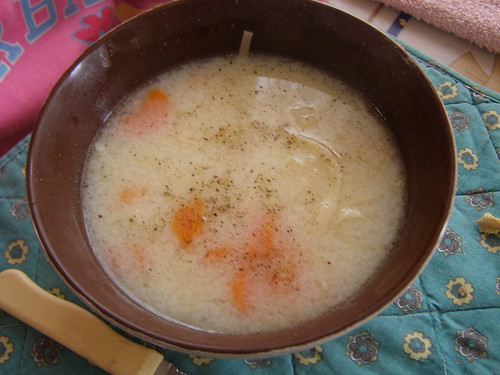
kid-friendly egg and lemon soup
This soup took longer than five minutes to cook; by planning ahead, it is never a toilsome soup to make.

Here's my version of quick and easy avgolemono soup, using Xanthe's ingredients list as a base, which you can make for dinner after you've come home from work, to feed your family a nourishing winter warmer in the cold days that are ahead of us - and making use of all the fresh ingredients available around you. Making chicken stock does not require the luxury of time; you can make it in the 15-20 minutes it took Xanthe to buy her ready-to-gloop ingredients from the supermarket (and if time really is a hassle, then make your stock 1-3 days before: it keeps this long in the fridge).

For a family of 4, you need:
2 fresh chicken drumsticks (We usually buy whole chickens - I reserve the wings and neck to make really good stock, but you won't get much meat out of them if you intend to add bits of chicken to the soup)
the juice of 1-2 lemons, depending on how tangy you want it to be, placed in a medium sized bowl
2 eggs (we like our avgolemono less eggy and more lemony)
a fistful of raw rice (I am using Asian egg noodles today instead, for a more kid-friendly meal)
salt and pepper (you can add some chopped parsley as a garnish, like Xanthe did, but this is definitely not what the average working wife and mother who lacks time would feel the need to do when serving up a nutritious meal right after she's been at work...)

Place the chicken parts in a medium-sized pot and cover with cold water. Let the water boil away for about 15 minutes. Depending on the kind of chicken used (ie how the chicken is reared), it may require more or less cooking time (which is why I prefer to use chicken wings and necks for stock making). Strain the stock into another pot. If the use of too many pots in the kitchen perturbs you, then it's best to make your stock the night before so you can maintain control over the dirty dishes; my urbanised friends always freak out when they see the detritus of my kitchen - that's before they've tasted the food of course, after which they've forgotten about the kitchen chaos. Maybe they realised it was worth the effort. But they probably wouldn't invite me to cook in their kitchen.


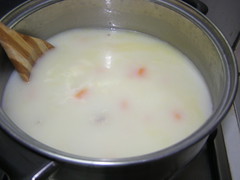
My chicken stock always comes out golden, never brown, in colour. I only ever watched my mother make chicken stock in New Zealand, and her Kiwi chicken also gave her golden, never brown, liquid. The stock in the above photos looks fatty, but you can skim the fat off before you use it, like I did for this soup. This pot produced 4 servings of hearty chicken soup.
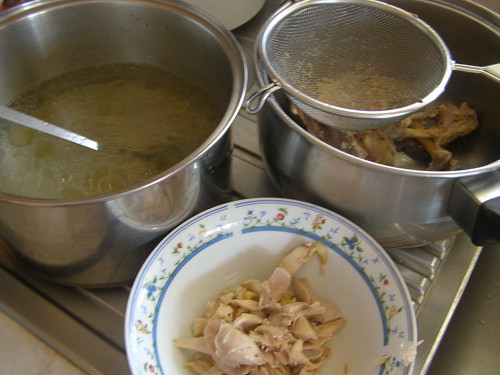
making chicken stock


Make sure your chicken stock is very hot, then add the washed rice (or noodles). Let it boil away, without stirring (which will make the rice go mushy), for as long as it takes to cook the rice/noodles. At this point, start making the egg and lemon sauce. Break the eggs into the bowl containing the lemon juice, add some salt, and use a fork, whisk or hand-mixer to blend everything together. Remove the meat in small bits from the chicken and set aside. Switch off the stock pot.
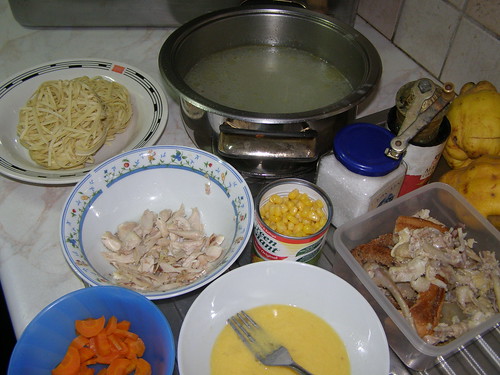
soup making
Making a hearty chicken egg and lemon soup; even the dog gets her share today (bottom right-hand corner: the tub contains the chicken bones and skin).
avgolemono soup avgolemono soup

Now comes the tricky bit. Stir a shotglass-full of the hot stock (clear liquid is preferable - strain away the rice) into your egg and lemon sauce and whisk it in really well. Keep doing this until at least a third of the stock liquid has been added to the egg and lemon sauce, which should be cool rather than hot at all times. Now turn up the heat for the soup pot to very low, tip the egg and stock mixture back into the soup pot and stir it gently but constantly, so that the egg does not 'cook'. Add the chicken meat and stir till the soup has warmed up, and has a thick soupy texture, but don't let it boil because the egg may start to cook, and that's highly undesirable.
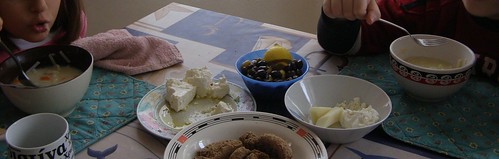
kid-friendly egg and lemon soup
Avgolemono soup with all the trimmings: a selection of cheeses, two different kinds of olives, extra lemon for tanginess, and paximadi (Cretan dry rusks) for dunking.

Serve hot, ladled into soup bowls, and sprinkle (read: garnish) with pepper. I had also added a carrot to the chicken as it was boiling, so I could make this soup more nourishing; the carrot was sliced into thin rounds, and added at the same time as the chicken pieces (along with some tinned corn - remember, we're making this soup kid-friendly).

Real food, for real people.

©All Rights Reserved/Organically cooked. No part of this blog may be reproduced and/or copied by any means without prior consent from Maria Verivaki.

Sunday, 26 October 2008

Youvarlakia (Γιουβαρλάκια)

Dear Ms Verivaki,

I must congratulate you on your magnificent prose and excellent cooking skills. I am a regular follower of your Hania blogs (I read them both every day), and there has never been a moment that I have been disappointed by the food you present and the stories you write. I have fond memories of spending summers in my youth in Crete, and I feel as though I am right there with you when you describe village life, the beach, the weather, and daily life in that splendid Mediterranean town where you live.

Over the past year that I have been following your blog, I notice you have been cooking everything the way my dearly departed grandmother cooked (she was from Kambi); the same meals, the same ingredients, the same method. Your family must revere you for the feasts you conjure up in your kitchen. The photos seem to jump out of the screen, screaming "That's my grandmama!" to me.

There is one recipe that I haven't yet seen on your blog, and that's youvarlakia. It's my favorite Greek dish, the one that my mother makes for me and sends it from California via courier to my apartment in Connecticut where I'm studying IT, in a tupperware container which she has frozen. When I receive it, I simply warm it up in the microwave and eat it on the same night that I received the packet, saving one serving for the next day. It tastes so good, and it always makes me feel homesick.

Here is my mom's yourvalakia recipe. It took me a few times making it before I turned out a batch that I was even satisfied with. In my mind, my mom's yourvalakia are always smaller and lighter than mine, and the avgolemono is always fluffier and more nicely balanced in flavor, but I continue to practice, and some day I hope that it'll be good enough that I can serve it to my mom and she'll be proud of it.

I thought that it would eventually turn up in your recipe list, but it's been over a year, and I understand that you cook according to a strict cyclical repertoire of recipes. Maybe your family doesn't like youvarlakia? Well, all people are different, aren't they?

I have never felt closer to my second home than through your stories. I'm looking forward to being comforted by more of them this winter.

Your loyal reader...
*** *** ***


Kambi, 1919
Nikolas had heard the word 'Ameriki' mentioned many times in the village. Ameriki was the land of a poor man's wildest dream, something akin to utopia, where everyone is happy, employed and rich, like his brother, who sent one single postcard to his family since he left Kambi.
When Nikolas' older brother Grigori returned to the village from Ameriki, he had enough money on him to buy 90 acres of land in the village, and live happily ever after. After working in the restaurant trade for five years in New York, being the patriot that he was, Grigori decided to return to the mother country to buy the land his family could not afford to give him and to complete his Greek military service, at a time when Greece was under attack from an enemy.
"In Ameriki, people are prepared to fight for their freedom. How can I stand and watch when my country is in danger?" he replied to his family when they pleaded with him not to leave so soon after his arrival. His betrothal to a blooming village girl arranged (as befitted his financial position), he had no sooner invested his money in buying land than he left again, this time to Thesaloniki where his knowledge of English earned him the rank of officer. He managed to survive the Battle of Skra, only to die from malaria two months before the end of the campaign, having never set foot on the land that he had worked five years on foreign soil to buy. It was shared unevenly among his siblings: his four sisters received a large share each as a dowry, making them attractively eligible for marriage, while Grigori's brother ended up with the remainder, a mere pittance of the original amount.
Nikolas received 10 acres of the land that had been bought with his brother's money from Ameriki, along with the beautiful bride his brother never married. He married her out of pity; even though her engagement did not constitute a marriage (there was no marriage to consummate in the first place), she would have a hard time finding another husband after being betrothed once already. Word would have spread that she was engaged to be married; her fate had already been decided. Who knows when the next offer would come? Nikolas also felt that she had partly inherited his brother's fortune, so that she deserved to be in on his good fortune.
Aggeliki, for all her outward qualities, was not the most useful woman around the house. She had been raised in the 'mimou aptou' way, as if her beauty did not permit her to cook, wash and clean the way a less attractive woman might conduct herself with respect to these duties, lest by applying herself to such tasks, her beauty may deteriorate, fade away, disappear, as if age could never play a part in this demeaning process, and it was all to do with how often one's hands touched the soil on the ground or how much sunlight shone on a woman's face.
Nikolas' land was fruitful, especially once he had cleared most of it from the thyme and dictamo bushes, after which he set about planting it with olive trees. He hunted hares and wild birds, plentiful in his own fields, but the cook was wonting in culinary skills; the rumour spread all over the village, with its population of 500, that Aggeliki was a hopeless cook. Nikolas didn't know who to feel sorry for more: himself for earning such fate, or the oven-charred or water-sodden carcasses that came out of the kitchen, sometimes sporting their fur or plumage. When he sat at the kafeneio with other men from the village, and listened to their chatter about how their own wives conducted themselves at home, his gut tightened.
"Give her time, Nikola, you're not even into a year of married life," the others would comfort him. But he neglected to tell them that Aggeliki entered the marriage in this way right from the start, and that his clothing was now almost ragged and Aggeliki showed no sign of replacing them for him before they had become tatters. He felt that the land - and possibly Angela's inviting appearance - had cursed him into the misfortune of a loveless marriage.
*** *** ***
When Aggeliki became engaged to Grigori, she had hopes of leaving the village for good. She knew that Grigori had made a lot of money, but she didn't realise that he had invested it in the mountainous territory that made up the village of Kambi. She expected that, once he had finished his military duty, he would move to lower ground - as most villagers who prospered did - and build a suitable dwelling for them to live in. After all, this is what he must have been accustomed to living in in Ameriki; everyone there apparently lived in fully furnished houses and had their clothes made for them by tailors and seamstresses. They did not need to shear sheep, spin yarn, or weave cloth on the argalio, which would eventually be turned into bedsheets and men's shirts; like cooking, sewing was not Aggeliki's forte. So it was to her greatest disappointment that Grigori did not return from Thesaloniki. She knew what fate had in store for her.
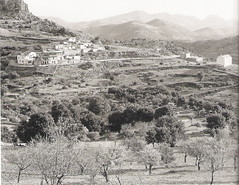
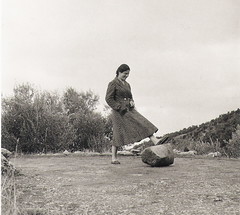
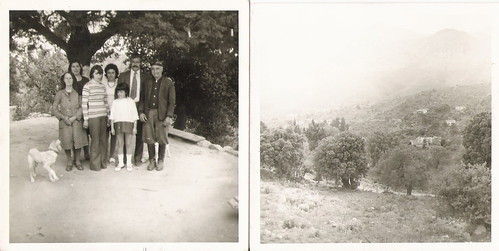
family 1960 village 1960 woman rolling stone on roof young woman 1960
(Crete in the 1960s, four decades after Aggeliki and Nikolas emigrated; the photos come from CRETE 1960, by John Donat, Crete University Press)


Aggeliki had not wanted to marry her fiance's brother, but there was no question of that now that Grigori was dead. Had she been married to Grigori before he had left for Thesaloniki, she would have inherited his land, a mixed blessing if ever there was one. She would have become a rich woman, highly ineligible for marriage; what man in the village would have been able to match her wealth? As it was, she suffered the cruel fate of being labelled a widow after Grigori's death anyway, even though she had never married; such was the nature of life in the impenetrable snow-capped mountains of Kambi, at the foothills of the Lefka Ori.
She looked around the house Grigori had built in roughshod style a short while before they were married: two simple stone-built rooms with openings for windows, blocked by wooden shutters to stop the winter cold from entering. There was an outhouse a little way from the house and an earth oven built next to one of them rooms. This was not the Ameriki she had dreamed of, nor was it the town of Hania that she had hoped to move to after her marriage. It was true that she had never known better than the village life she was born into, but no one could stop her from dreaming, which is what she did most of the day when Nikolas was away, clearing scrubland, planting olive trees, hunting hares and grazing sheep.
*** *** ***
Kambi, 1921
Nikolas was sitting at the kafeneio. He usually sat on his own these days, as he had little to share with the locals. It was almost three years since he married Aggeliki and still no children. He had by now grown accustomed to the way the kafeneio chatter died down when he entered the shop, and the compassionate smiles of the other men sitting in groups around the tables. He picked up one of the newspapers that had been left on the fireplace, to be used for kindling a flame. Although he had not finished primary school, his reading was at a reasonable level. He did not write anything apart from his name; there was no one to write to, in any case, and no one interested in reading anything that he wrote.
He had not grown tired of working the village land. What tired him most of all - and he seemed to have aged a decade since his wedding day - was that he was working with no future in mind. So what if he had thousands of olive trees; so what if his coffers were filled with olive oil. There was no one to eat it, and no one to sell it to; people were too poor in the village to buy more as their own stocks ran out, so they simply used it more sparingly. The economy of the country was still engaged in a new war effort; there was no interest in trading olive oil. So much effort for very little reward; produce-rich but lacking currency.
Every morning started off the same, as every evening finished. Routine after routine, with very little variation. Nikolas saddled the donkey, which lived in a makeshift shelter next to the main house, along with a group of six goats and sheep which Aggeliki milked each morning, and left for the hills. The land he had inherited had never before been touched by human hands. He worked most of the day with some paid labourers clearing the land of the scrub wood and rocks, digging it up, tilling it, and planting it with olive trees. Aggeliki had filled a woven bag with bread, some olives, a chunk of graviera and a carafe of wine for Nikolas to curb his hunger, before he came back home at midday. It was usually too hot to work after that; the sun did not rest even in winter. The midday meal was a very silent affair, one that always heightened the void between the couple. They could not fill the space between them with their presence. They had little to say to each other; their world had become static.

Without offspring, there was no one to work for but himself, and his wife, of course, who, at times, seemed to live in her own reticent world. Apart from his requests for better food and clean clothes to wear, he had very little to say to her. Yesterday, she had cooked youvarlakia in a tomato sauce, using the anidres tomatoes he had hung on the rafters of the house to dry for the winter, while the lemon tree was bulging from its own weight, laden with fruit. Hadn't she ever had youvarlakia? Didn't she know how to make an avgolemono sauce?
"What were you thinking, using the tomatoes I was saving for the winter? Where are we going to find them when we need them, woman!" He could hear the rumble in his own voice as he shouted at her. Usually the house was so quiet. He wasn't used to hearing himself speak like this. He left the house feeling more angry with himself than his wife.
kambous 1974
(Kambi village, 1974)
Things were not looking good in Smyrna: according to the front page, war was imminent. His mind immediately conjured up the image of his brother leaving the village to fight against the Bulgarians. What was it that his brother had said? "In Ameriki, people are prepared to fight for their freedom. How can I stand and watch when my country is in danger?" Did he understand what he was fighting for? Had he thought about whether the cause was worth fighting for? Did he know how close the war was to the end when he lay sick and dying? Nikolas did not share his brother's patriotism. He did not want to fight a war that he hadn't started. He did not wish to be one of the victims of war like his brother. Now seemed a good time to leave the village, maybe even the island, and why not the country if it got to that stage. The shame of childlessness could be avoided if he simply lived elsewhere, far away from anyone who knew him. Nikolas put it in his mind to seek a passage to Ameriki.
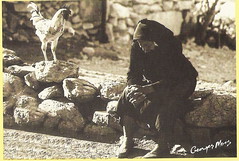
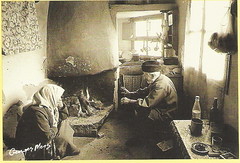
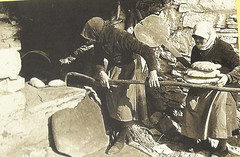
old woman and rooster george meis riding a donkey george meis old kitchen george meis baking bread george meis
(The kind of Crete Nikolas and Aggeliki left when they decided to emigrate to Ameriki
; these photos are more recent than the first set above. The photographs are works by George Meis, taken from a souvenir calendar of Crete)

(END OF PART ONE)

*** *** ***


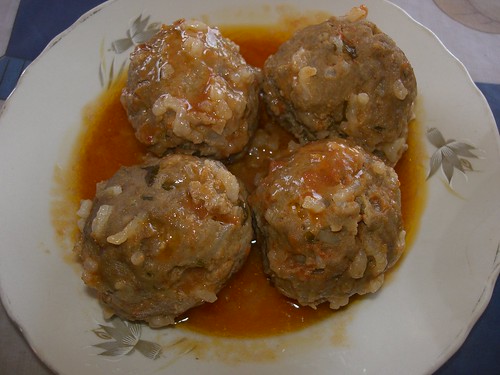
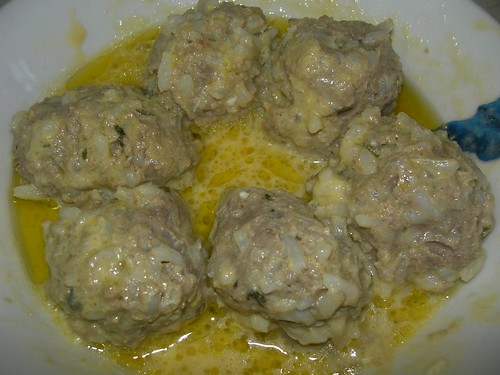
Aggeliki may not have been too far wrong when she made youvarlakia with a tomato-based sauce. (In any case, her cooking improved once she went to Ameriki.) Youvarlakia is a meatball dish, in which the meatballs are made with rice, and cooked in an egg-and-lemon sauce, which turns them into a light main meal. My aunt in New Zealand used to make them, but not my mum; they simply didn't become a favorite in our house, along with, funnily enough, pastitsio, an all-time favorite Greek pasta dish.

youvarlakia youvarlakia cooking

The next time I had youvarlakia was in a hospital in Iraklio where my new-born son was under observation for an extremely rare blood disorder: at the age of two months, we discovered that he wasn't producing enough blood to supply his body with, which did thankfully clear up on its own when he was ten months old. He had six blood tranfusions in between this period. The hospital youvarlakia were cooked in the tradtional egg-and-lemon sauce, which my husband was never a great fan of. I enjoyed them, despite the hospital atmosphere.

My husband laughed them off : "They forgot the tomato," he said.

"But youvarlakia aren't cooked in tomato," I replied.

youvarlakia cooked in tomato
(My mother-in-law still cooks youvarlakia in tomato sauce.)

"Yes, they are," he said as we looked at each other wondering whether we were from different planets.

youvarlakia cookingyouvarlakia in avgolemono sauce

When life became a little more normal in our house after the hospital episodes, I cooked youvarlakia with the tomato sauce my husband liked, which, of course, was the way he had been brought up to eat them. I didn't really like them, but then I've never been a fan of tomato-based sauces. I'd rather eat garbanzo beans (chickpeas) than fasolada; I prefer a carbonara to a makaronada; give me a lettuce salad rather than the traditional Greek horiatiki. This is the reason why I prefer an avgolemono meat dish to my regular tomato-stew meat dishes, and believe me, youvarlakia in avgolemono are delicious. I have found one recipe (in Chrissa Paradissis' Greek Cookery, 1983 edition) that insists on using tomato AND egg-and-lemon sauce together to make youvarlakia, but mixing tomato and lemon is a rarity.

Aggeliki's cooking probably got better once she went to Ameriki, because life simply became less mundane and the tasks she performed in Crete on a daily basis probably became automated in Ameriki. Her kitchen would have been more well-fitted, her food did not have to be sourced straight from the fields, her house probably never resembled a mud-hut. And Nikolas was probably a happier man once he moved to Ameriki, because he would have found better working conditions and an appropriate salary. But the food they ate together wherever they set up home would still have been traditional Greek food, even if the ingredients weren't easily available.


(The video shows how Cretan families from Kambi were living in California in 1948; Crete at that time was extremely poor, while Greece was in the midst of a civil war. To the average Cretan, this picture would have seemed like a scene from paradise; poverty remains the main reason why, up to the late 1970s, Greek people emigrated to the New Worlds.)

Galatia in California makes her youvarlakia in the traditional Greek way. I got the recipe straight from her son Nick, who could well have been Nikolas' grandson. The recipe is exactly as he related it to me, with a couple of exceptions. I added a large onion (I am a great fan of all Allium species: onion, garlic, and leek), I used only two eggs, and I added olive oil to the pot after cooking the recipe according to Nick's instructions. The reason why is a simple Cretan one: we cannot do without our olive oil. It may add to the calories, but it will also add to the flavour; it also removes the eggy taste that my family isn't used to in their sauces. The original recipe before adding the olive oil - Galatia's youvarlakia are just so good with that extra dose of garlic - reminded me of the way my mother cooked Greek food in New Zealand. When you don't have access to cheap, high-quality olive oil (as we do in Crete), you go without. Tough luck.

youvarlakia and fried potatoes

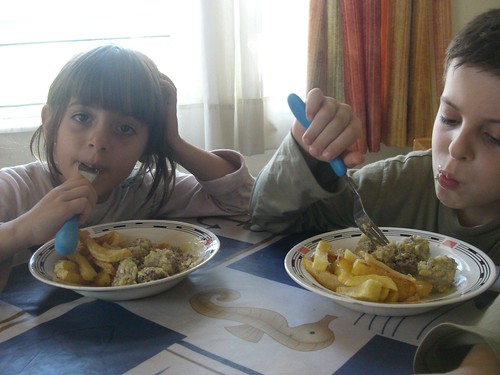
Since we don't eat youvarlakia often, you may be wondering if my fussy eaters actually ate this. As it was the first time I made this meal, I decided to soften it a little with a side dish of fried potatoes. I called the youvarlakia by another familiar name for mince balls, biftekia, which use the same ingredients, except that the rice is replaced with breadcrumbs. Next time I serve it, it won't be with potatoes, but with extra sauce to mop up with bread. After that, I might even call them by their real name, youvarlakia, and turn the sauce into a soup like Peter's. Evelyn also added a few chunky vegetables to it and turned it into a hearty meal for a cold day.

I know that, like leek and potato potage, first introduced to me by Ioanna, youvarlakia are going to become a firm family favorite. When I served up the youvarlakia for lunch, I had left the pot on the table. My husband asked me to take it away because "I could eat right out of it and not stop till I get to the bottom of the pan."
For the meatballs, you need:
1 pound of ground beef (about 450-500 grams)
1/2 onion, grated
4 to 5 garlic cloves (minced or grated)
1/2 cup rice (we use "Barba Ben's" long-grain)
1 egg
2 tablespoons chopped parsley
salt & pepper to taste
a little olive oil

For the sauce, you need: some butter, 3 eggs and 1/2 cup lemon juice

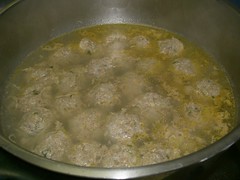
Mix the meatballs ingredients together well, and then make into small balls (about the size of walnuts). The one thing I always keep in mind is to keep the meatballs themselves small, more of a walnut size than a golfball. It took me a while to remember that the rice will cook and puff up in size.
Melt the butter in a large pot and place the meatballs in a single layer on the bottom (if you've made more meatballs than can fit in your pot, you can stack up a second layer). Cover the meatballs with water, going about 1/2 inch above the top layer of meatballs. Bring to a boil and let them cook at a low boil/high simmer for 20 to 25 minutes (until the rice has cooked, but keeping careful not to let all the water evaporate - you need the cooking liquid for the avgolemono).
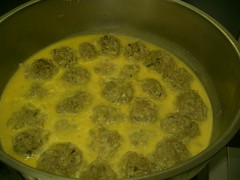
Mix the eggs with 1/2 cup lemon juice and beat until frothy. Slowly add in the liquid from the meatballs and continue beating. Pour the avgolemono mixture back on top of the meatballs. If the avgolemono is too runny, or if the meatballs have sat around for a while (which is fine, and I should add that the meatballs, even without the avgolemono, are delicious) you can heat the whole mixture back on the stovetop, either to thicken the avgolemono, or to bring it back to a warm temperature, or both.

youvarlakia in avgolemono sauce

This post is dedicated to all the Cretans from Kambi, my mother's village, living in Modesto and Manteca, California, where very many of them congregated. It doesn't matter where they were born, whether it was in Crete or America, or whether they continue to speak Greek or not; they are still Greek at heart, and they know it. Thanks are due to Galatia Aretakis and her son Nick, because without their participation in this post, I would never have made youvarlakia.

©All Rights Reserved/Organically cooked. No part of this blog may be reproduced and/or copied by any means without prior consent from Maria Verivaki.
Saturday, 23 April 2011

Easter 2011 (Πάσχα)

When calendar Easter and Orthodox Easter both fall on the same day, it's always busy in Crete. Both Greeks and non-Greeks converge on the island at the same time, but for different reasons: Greeks from the mainland get together with their families at Easter, while our non-Greek tourists usually come because of their preference for the milder weather as opposed to our scorching summer climate.

These three items unify Greeks at Easter, wherever they come from or live: koulourakia (Greek Easter biscuits), tsoureki (Greek Easter sweet bread) and dyed 'red' eggs (which are 'cracked' on Easter Day). Nowadays the busy Greek home can enjoy these traditions without having to make them themselves. Apart from the store-bought cheat's versions shown above, there are also women's cooperatives that make them, so they come out looking as if they were made at home; those that operate in rural areas often use ingredients from home-grown or home-raised produce.

Easter is the most important religious festival in Greece (unlike Christmas in Greece, which is pretty much quiet). The action all takes place at the midnight service on Saturday night. In the past, everything used to stay closed on Sunday but this has changed dramatically - when Easter falls during the tourist period in Crete (as it invariably does), most places will be open to serve the needs of tourists. If you're here on holiday on Easter Sunday and you'd like to take part in a cultural experience today, those of you who have hired a car will be in a better position: wander off the motorway, drive around the countryside, and use your nose to guide you. Although Easter is a family holiday, and most locals will spend it at home in family groups, most (if not all) tavernas will be open today, catering for our tourists and visitors.

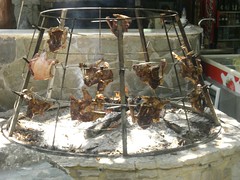
Lamb on the spit, being cooked at a Greek festival in Anchorage, Alaska (courtesy of Laurie Constantino). I recall a few of my NZ Greek friends cooking lamb on the spit, but it still felt foreign to me even when I lived in NZ, because it wasn't part of my own home's tradition at Easter. My Cretan mother would be making lettuce avgolemono lamb stew (top right), kalitsounia (bottom left) and Cretan meat pie (bottom right) instead. And right to this day, that's what I make, too.
 

Most Greeks will tell you that lamb on the spit is traditional on Easter Sunday. Yes, it is... but not exactly. Whole lamb on the spit is actually a Northern/Central Greek tradition, not a Cretan tradition. In a sense, it's an imported tradition from the mainland to Crete. We see the equipment used to cook it being sold here too, because lamb on the spit has now passed into the general Greek tradition, but if you speak to older Cretans, they will tell you that they remember seeing lamb on the spit for the first time in Northern Greece, among 'other' Greeks, and in the army, like for example my husband. He first remembers seeing it while he was doing his military service: by then, he was in his early twenties. On Easter Day, it was (and I suppose it still is) a tradition to roast lamb on the spit at the barracks. A row of spits would be set up by the soldiers, each one holding a lamb, and the villagers in the area where the barracks were located were all invited to join in the festivities. 

Cooking lamb on the spit involves a lot of work (although electric spits now help to ease the burden of turning it) and it also involves a lot of eaters - if you have a small family, then this is not a feasible way to cook it. This is the main reason why my own family has never celebrated Easter in this way: in fact, the only time I have celebrated Easter with lamb on the spit is once in Athens and another time in Hania when a friend from Thessaloniki organised the event. Most people in and around Hania cook Easter lamb in the oven, in avgolemono sauce, on the BBQ, and in a traditional Cretan meat pie. Restaurants and tavernas probably won't offer lamb on the spit in Crete on Easter Day for two reasons: Easter is a family celebration, so most people will get together in each other's house for this feast, and tourists may not be familiar with the tradition themselves, so they won't be looking to order lamb on the spit. 


antikristo upright bbq argiroupoli hania-rethimno fragma taverna antikristo
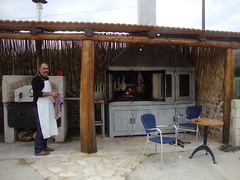
Antikristo: a tradition of Eastern Crete; lamb on the bone is cooked on an upright grill. It needs to be turned to cook evenly, which is why the electrified version (on the right) is simpler to use. These photos were taken in villages in Rethimno.

The Cretan tradition in roasting meat over an open fire is known as 'antikristO' (with the emphasis on the 'O'). This unusual kind of BBQ consists of an upright grill, surrounding an open charcoal fire in the middle. An electrified version of this also exists, where the meat turn around in a circular fashion, like a clock; this is different to the lamb on the spit, where the lamb goes round and round like a ferris wheel. To add to the confusion, antikristo is a tradition of Eastern Crete, which explains why you'll probably never see it in Hania (you will see it in Rethimnno and Iraklio).

*** *** ***

If you're offered a chance to participate, make sure you know what to say to your hosts. Greek 'Happy Easter' wishes follow the timeline of the events of the first Easter 2000 years ago:
As Easter approaches, people farewelling each other may wish their friends Καλό Πάσχα (ka-lO pAs-ha): "I wish you a good Easter" (NB: they only say this before Easter).
During the Holy Week, as Easter Day approaches, they may say Καλή Ανάσταση (ka-lI anAstasi): "I wish you a good Resurrection" (to remind us of the reasoning behind Easter).
After the midnight Easter Saturday service, they will then greet each other with Χριστός Ανέστη! (hristOs anEsti!): "Christ has Risen!" This greeting is used the first time you see someone after Easter for the next 50 days, until Pentecost, instead of the usual 'Hello' (Γειά σας) .

And finally, to reply to someone who has just said told you that Χριστός Ανέστη, you answer: Αληθώς Ανέστη! (alithOs anEsti!): Truly He has Risen!, which originated as a way to distinguish the believers from the non-believers. 

If it's all confusing for you to remember each of the different greetings, then there's also the generic 'umbrella' greeting: Χρόνια Πολλά! ((hrOnia pollA), which covers just about any happy event, and you can say it pretty much throughout the Easter period.


For all of us, whether we are religiously inclined or not, may Easter be a happy one, wherever you are. 

©All Rights Reserved/Organically cooked. No part of this blog may be reproduced and/or copied by any means without prior consent from Maria Verivaki.
Monday, 13 July 2009

Gardoumia - Koilidakia (Γαρδούμια - Κοιλιδάκια)

This story is a continuation of Bootcamp. You don't need to read the first one in order to understand the sequel (just like J.K. Rowling said about the Harry Potter series), but it might help.

After three years of rigorous, structured tasks in the army where I completed my military duty to my country, I finally came back home, back to the farmer's slow-paced no-hurry routine I had been used to before I left my family. It felt good to be able to wake up any time I liked, help out my parents and brother on the farm, wash in a clean bathroom without the wimpy city boys' clothes lying around the shower box (as if they expected a maid to come and pick up after them), eat my mother's home cooked meals meals and sleep in my own warm bed with clean white sheets, my days of smelly grey bedspreads being well and truly over. It felt good, all right, but it did not pay. After spending three years becoming an andra, I had also lost three years of my working life. As a high school graduate with no specific skills, I was unemployed and unemployable. A year after returning home, I decided to further my knowledge by studying tourism management - in London.

In the last week before I left the village, all my aunts, uncles and cousins invited me to their house for lunch or dinner. Every single day, I ate two feasts, one at midday and one in the evening, and no dish resembled any other that I had eaten on another day. Everyone cooked with my tastes in mind, and all my relatives conjured up sumptuous meals, often killing one of their animals especially for the occasion.

"You've seen them when they come here, Nikita," my Aunt Marika said to me, "all skin and bone, but no meat. Make sure you eat well before you leave the village, they might not have any food in Agglia," she joked.

"They probably cook a lot of lahanorizo," my brother replied, and we both burst out laughing at our private joke.

"Lahanorizo? Who cooks that these days?" she asked. Aunt Marika had no idea what it meant to be force-fed lahanorizo twice a day twice a week.

On Monday, I had avgolemono stew for lunch at her house, and stifado for dinner at her son's house, my cousin and best friend, if you can call your cousin your best friend. Upon finishing junior high school, Manolis had stayed with his parents helping them out on the farm and the olive trees. When he turned eighteen, he began his military duty in the navy. He preferred his own island to his base at Poros, he hated the petroleum-smelling cabins that the cadets slept in, he hated everything about his time there. When he finally came back to the village, he vowed never to leave the place, marrying a girl from a neighbouring village and setting up home here for good. He lived in a house which he had built himself, room by room, over his parents' stone-built rustic dwelling. He was only thirty years old, and had three children under five; his wife was expecting again.

"The hardest work is over," he said to me over dinner. "We might as well go for the jackpot and become politekni."

"But what if they're twins, Manolis?"

"They are," he replied. "What's the problem? I've got 200 stremmata - there's plenty there for all of them."

The menu for the rest of the week continued pretty much on the same meaty basis that it had started. I had never eaten so much meat before in that week alone, not to mention my mother's traditional Sunday roast prior to that. And no one dared to bring out a plate of horta or olives to the table. They were reserved for 'poorer', more 'sombre' days, while I had become an overnight cause celebre. What I particularly craved was a simple plate of stamnagathi, but when I asked my hosts once if they had any left over from one of their own meals, they looked at me as if I had no sense of taste.

"Horta? Mipos nisteveis? It's not the time to be fasting, Nikita," my Aunt Kriti scolded me. Her godfather had been a Venizelos supporter, who believed in the dream of a free independent Cretan republic. Custom dictated that the godparent choose the name of the child, and not the parents. No one could override the choice of name when the godparent chose it. He could choose it right at the last moment, before the child was being dipped into the baptismal font. And when the priest said:


everyone waited expectantly to hear what name my aunt's godfather had chosen.

"Κρήτη!" cried the godfather triumphantly.

"Κρήτη," repeated the priest, "εις το όνομα του Πατρός και του Υιού και του Αγίου Πνεύματος, Αμήν."

And Kriti she was, taking the name of the island where she would live her whole life. Her sister completed the picture when her godfather named her Laokratia.

*** *** ***

The Saturday before my departure was to be a special one. It would be spent at home in the company of my closest relatives. My father was going to kill a lamb and my mother would make one of my favorite meals, usually reserved for Easter. It was still warm in the middle of September, warm enough to sit outdoors under a verandah to keep away the chill of the evening as autumn approached the Mediterranean. Christmas was only a few months away, but the distance between London and Crete made it feel longer. Since I was embarking on a strange journey into unknown territory, Easter would have to come twice this year.

gardoumia gardoumia
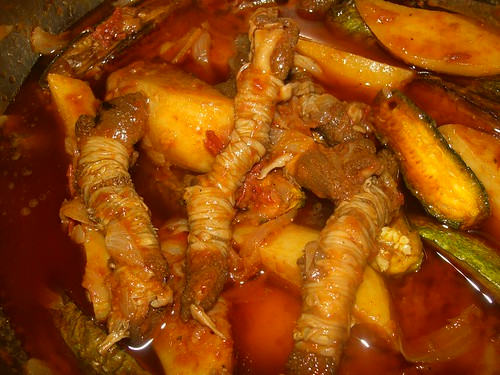
This is the second time in my life that I have made these on my own; I used the cleaning method my own mother used (having committed it to memory) when she made the same food in New Zealand, except that the size of each part of the animal there was twice the size of the spring goat I was using.

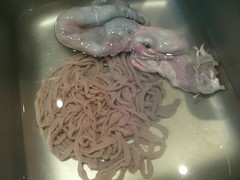
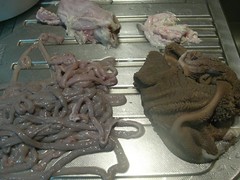
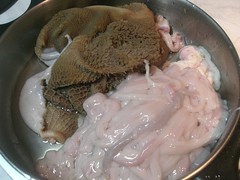
Just after the lamb was killed, my father brought a foul-smelling bucket into the kitchen and my mother set to work on it. Gardoumia could only be made freshly. She began to meticulously clean every item in the bucket: the stomach, the spleen, the intestines and the fat, taking care not to break them up too much. She let a running tap of water flow through the guts, which swelled up like a sausage balloon, the kind gypsies sell in the shape of a dog.

She then went out into the garden and brought back a thin twig from an olive tree. This was the tool she used to turn the intestines inside out to clean them thoroughly, so that all traces of scum had been cleared. As she cleaned all the inner parts of the animal, she washed her hands with plain water, so as not to taint the meat with the smell of soap. Then she smelled her hands; when she was satisfied that she couldn't smell dung, she knew that the guts were clean.

gardoumia gardoumia
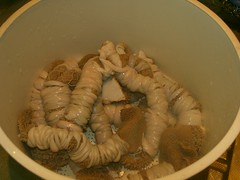
Cleaning the intestines is of utmost importance before they are wound round the animal's stomach to make gardoumia (also called 'kilidakia'). Compare the colour of the intestines in the left hand photo with those in the previous photos.

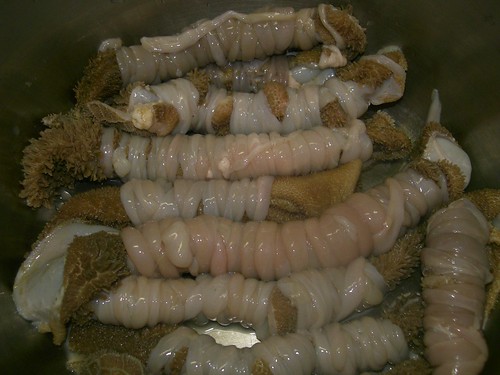
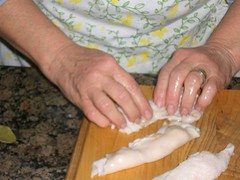
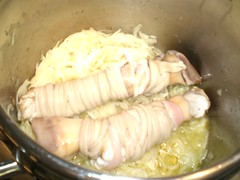
Then she called me over to help her cut the round spleen into one long thin strip of blood red meat. This she used to stuff the large intestine, so that it looked like a thin warped stiff sausage. She cut off uniform sizes of the tripe and fat. Tucking a little bit of fat into the tripe, she carefully rolled the intestines very tightly round it, fastening them off with a knot at the end, and snipping them off to repeat the process for the next gardoumi. When she had finished making them, she gave everything one last wash and placed them on a clean plate in the fridge.

gardoumia
The large intestine which holds the spleen is called the 'splinogardoumo'; unfortunately, it was either destroyed or not passed on to us when we ordered the kid at Easter, possibly due to EC regulations which demand that it be disposed of hygienically and not eaten to avoid the risk of transmissible spongiform encephalopathies (TSE), despite the fact that Greeks have been using these parts of the animal as human food since ancient times.

As it was the tail-end of summer, she picked the last zucchini crop from the garden and chopped them lengthwise into thick rods. These were fried in olive oil, strained on absorbent paper and set aside. Then she got the potatoes ready, chopping them in a similar way without cooking them. Tomatoes are still in plentiful supply at the beginning of autumn; she grated the reddest softest fruit into a bowl. Everything was ready for the gardoumia, which she knew I preferred to eat in a red sauce rather than the traditional way we ate them at Easter, in avgolemono sauce.

gardoumia
I had prepared the koilidakia just before Easter, but didn't want to cook them at that time, so I plunged them in boiling water for five minutes to kill off any contaminants. After letting them drain well, I froze them and cooked them in the summer with the new zucchini crop.
gardoumia
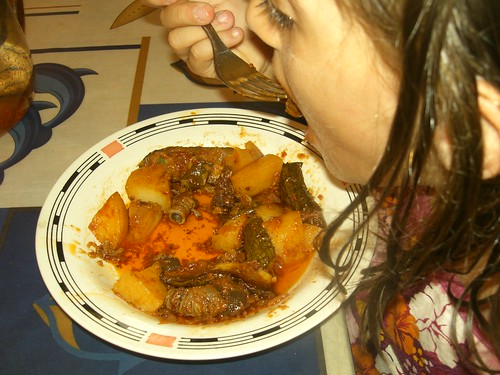
"Mmm, tastes rather like snails, doesn't it, Mum," exclaimed my 'good' eater, who has developed a refined sense of taste, recognising the same ingredients used in my summer snails recipe. My son turned down his portion. I know I'm spoiling them - how will they survive when they leave the family nest?

And that meal constituted the last one I was to eat in Crete for a long time. It was one of the biggest family celebrations I had ever been a part of in my life. I was the first person in my family to go to university, and to set foot in a foreign land. No one, not even myself, knew what to expect in the place I was setting out for...

Let's hope it won't be like what happened to that poor chap in North London...

*** *** ***
Although it's highly unlikely that you will make gardoumia yourself, here's the recipe for it.

You need:
the intestines of a lamb or goat, along with the animal's stomach and some fat lining the stomach, cleaned meticulously and prepared in the manner described in the story (these sausage-like rolls are called gardoumia)
1/2 cup to 1 cup of olive oil (this depends on how oily you like your food; this kind of meal tastes better in a lot of olive oil)
1-2 large onions chopped roughly
2 cloves of garlic minced finely
a cup of water
half a wineglass of red wine
4 zucchini cut into thick slices lengthwise, fried till golden, and drained on absorbent paper
3-4 potatoes cut into thick slices lengthwise
4 ripened tomatoes, pureed
1 tablespoon of tomato paste
salt and pepper

Heat the oil and saute the onion and garlic in it till translucent (do not let it burn). Add the gardoumia and coat them well in the oil. Add the tomato puree and tomato paste, along with the water, and mix well. Cover the pot with a lid and let the gardoumia cook for an hour. Then add the wine and cover the pot again, cooking for another 30 minutes. Add the potatoes and seasonings, cover the pot again and let the potatoes cook till nearly soft. Add more water if necessary (eg if you think there is not enough liquid in the pot and the food looks as though it is about to stick to the pan). Add the fried courgettes and let everything cook together for the last 15-20 minutes for the flavours to blend.

gardoumia constantinople gardoumia constantinople

The gardoumia can be made with an avgolemono sauce instead of a red sauce. This dish is also cooked with lamb's legs - the intestines are wound round them instead of the tripe. Although it's made all over the country with regional differences, gardoumia is especially associated with Crete and island cultures. It is one of the culinary customs that Ibrahim's grandparents took with them when they left Crete in the 1920s and settled in Turkey, and taught their children (you can see Ibrahim's mother in Constantinople making them with trotters in the photo) to make them too, so that their grandchildren (like Ibrahim) could enjoy them nearly a century later.

©All Rights Reserved/Organically cooked. No part of this blog may be reproduced and/or copied by any means without prior consent from Maria Verivaki.

Wednesday, 27 February 2008

Artichokes in a lemon sauce (Αγκινάρες α λα πολίτα)

Margaret from Bulgaria has been living in Greece for five years now. She decided to leave her native land in search of work elsewhere, as work was (and still is) hard to find in the former communist nation, now one of the latest additions to the European Union. Life was good during the communist regime, she reports; the problems came when it fell. Communism was a kind of insurance against unemployment, illness and famine - everyone had jobs to go to no matter how mundane, doctors attended to all the sick regardless of status, and food was distributed fairly. But when that all ended, goods started disappearing from the shelves in the stores. She remembers not being able to get hold coffee and sugar for a long time. Now she's never without a cup of coffee in her hands; she clutches the mug as if it's one of her most precious possessions, the outcome of the do-without syndrome in her past.

Margaret is my mother-in-law's live-in 24/7 carer. She cooks for her, helps her to eat, changes her clothes, and generally looks after her. On Sundays, she goes to stay with her son who is also working in Hania. When I first met her, I let her know that she could cook separate meals for herself if she didn't like the bland diet my mother-in-law preferred. "Oh no", she said, "I must be an extremely picky eater if I won't have what she's having." After the first three days of orzo rice for lunch and dinner, she asked me if I could just treat her as my third child, because that orzo rice stuff was now giving her diarrhoea. She preferred not to cook meals for herself; "waste of time and money", she said, as if remembering the harder times in her native country. Greeks have a lot to learn about economising from the new immigrants to the country.

Margaret opened up a new avenue for my cooking ventures. She loves vegetable dishes cooked in white sauces, something my very Cretan husband is not at all fond of - it's got to be tomato cerise red for him. She also likes artichokes, which my husband only eats raw in salads, cleared of furry thistles, cut into segments and dipped in lemon. When the artichoke plant is fully mature, it makes an attractive centrepiece in a vase as a flower. This is how my Kiwi friends viewed the artichoke, with its green plumage and purple fur (at which point the artichoke is not edible, so you will never be able to appreciate its beauty at our house, as they are all eaten). They couldn't imagine any other use for it. How human beings conceived the idea that the artichoke, with its thistled flowers, furry centre and thorny leaves, could possibly be an edible plant, I can only imagine - probably by watching animals eat it, or maybe during a famine. Once you try artichoke - either cooked or raw - you will be persuaded into growing it as a hedgerow round your house. Thanks to Margaret, I have the chance to enjoy my favorite Greek vegetable medley: artichokes in a lemon sauce (αγκινάρες α λα πολίτα; αγκινάρα = artichoke in the singular).

This dish has its origins in Constantinople, during the time when people referred to it as the 'Poli', meaning the City, the one and only important city in Byzantine times, inhabited by many people of Greek origin (among other nationalities). It is the most well known dish of the former Greek community whose numbers began to dwindle after the siege of Smyrna in 1922. The culinary flair of the ex-patriates left a legacy that lives on in Greece, and includes other famous dishes like soutzoukakia, with its spicy taste, colourful appearance and piquant flavor. This dish accentuates the arrival of spring with its vibrant colours. It is also often used in advertising campaigns promoting artichokes.

Although most people know what an artichoke looks like, I bet they don't know how to clean one. Where on earth is the edible part of the artichoke hiding? Cleaning artichokes is about as much fun as cleaning aubergines. The thorns prick you, your fingers turn black, and there is much waste. Our garden is bordered by artichokes, but they are not in season yet (they will be ready for picking at the end of March), so I've used frozen artichoke hearts, which are always tender and never stringy and fibrous. Artichokes are not cheap; fresh ones cost almost 1 euro each in the beginning of the season (when they are at their most tender), whereas a 400g packet of frozen artichoke hearts costs 6 euro for 7 large artichoke hearts cleared of all debris. I made a salad out of the fresh ones (to go with the packaged lasagne for my pickier eaters) and used the frozen ones in the stew. To make the dish more substantial, some humble (and cheap) peas are added. They suit the dish well in terms of colours and taste.


Some web pages show the cleaning process for artichokes step-by-step. I've included my own version here. Once the 'heart' is exposed, it must be dipped into lemon juice to stop the artichokes form browning, so you need to have a bowl of squeezed lemon juice handy before you start cleaning them. This is very important to maintain an attractive appearance, but the browning does not detract from their taste. The leaves are pulled away, and any other tough or purple-coloured parts are removed from the crop. If the leaves are tender (they will feel soft and have an open yellow-green colour), they are edible. The fur is cut away (and then scraped) with a knife. I always cut the hearts in half to scrape away the furry centre more easily. Care must be taken not to cut into the heart and waste any precious flesh! And if your fingers do become grubby, don't worry - make sure you have the squeezed lemon juice ready at hand to dip the artichokes in, and then rub your fingers and hands with squeezed lemon halves. Your hands will never have looked cleaner, and your skin shinier!


As you expose the artichoke heart, dip it into the lemon juice. When you have cleaned it completely, leave it in the lemon juice until you are ready to use it raw in a salad or cooked in a stew. Artichoke (like eggplant) flesh browns very fast. And once you've done all that, you will probably understand better why artichokes are not cheap...

This dish uses artichokes and roughly chopped vegetables that keep their shape when cooked. I added peas to the basic recipe; Nancy added chunks of celery to hers. I added leeks.
Y
ou need:
8 artichoke hearts, cut into segments (frozen or fresh; don't even think of using tinned ones)
1 cup of olive oil
4 spring onions, sliced (ordinary onions can be used; a mixture is even better - I added some leftover leeks to use them up, but that is a deviation from the traditional recipe)
5 carrots, sliced into rounds
1/2 kilo potatoes, roughly chopped (preferably baby potatoes that can be cooked whole)
200g peas
a bunch of fresh dill, finely chopped (very commonly found in Greece)
juice from 2-3 lemons
salt and pepper to taste


Sauté the (spring) onions in a saucepan with the oil. Add the carrots and mix till they are coated in oil. Then add the artichokes, potatoes, dill, lemon juice, salt, pepper and enough water to cover them. Allow the vegetables to cook, stirring occasionally, for 1 hour before adding the peas, which don't need a long cooking time if they are frozen. It's that easy. The sauce can be thickened with a tablespoon of flour, but I prefer my sauces transparent. In any case, the starch from the potato thickens it nicely enough. This meal is so filling, that you only need a glass of wine (and maybe that ubiquitous feta cheese and sourdough bread) to accompany it. Meat will just spoil the taste of the artichokes. This meal can also be cooked in an egg-and-lemon (avgolemono) sauce, instead of just lemon (or flour).

©All Rights Reserved/Organically cooked. No part of this blog may be reproduced and/or copied by any means without prior consent from Maria Verivaki.
MORE LEMON RECIPES:
Dolmades
Poached salt cod
Lemon cake
Potatoes lemonates
Shrimp cooked in lemon
Meat in avgolemono sauce