Showing posts with label OKRA. Show all posts

Sunday, 14 July 2013

Okra hotpot (Μπάμιες στην κατσαρόλα)

Here's a very simple seasonal hotpot for the summer, using one of those vegetables that people either love or hate. When fresh okra isn't prepared properly, it can be very slimy and unpalatable, rather like snails, when they aren't prepared properly. But if you know how to prepare them, then they are simply a dream.

My mother loved the taste of okra in tomato sauce; but in New Zealand, she could only get them canned (in tomato sauce), as they were never sold fresh in pre-1990s Wellington. These days, they, like most unusual fruit and vegetables, such as pomegranate, another exotic species that I knew all about in theory, but had never seen, let alone touched in its fresh form until I came to Greece, are readily available in Asian markets. My mother would add the canned okra to finish off a chicken pot roast just as the chicken was nearly done.

Okra can be roasted with meat, or braised on the stovetop, with or without meat. I generally prefer to cook meat separately from my vegetarian dishes, so here's how I cooked okra today in the pot. My recipe is based on the classic Greek recipe for braised okra. A word of warning: this dish will only taste as good as the quality of your okra.

You need:
a bag of prepared okra (you can find them in the freezer section of the supermarket; if you have bought them fresh, you need to prepare them first, as I do here, apparently the best way to do it, according to many happy readers)
a large onion, finely sliced
1-2 cloves garlic, finely chopped
a can of pureed tomatoes (I use my own home-made tomato sauce)
a wineglass of olive oil
some water
some wine (optional)
3-4 slim small zucchini, cut in half lenghthways (optional)
2-3 small potatoes, cut in quarters (optional)
oregano, salt and pepper

Heat the oil in a medium saucepan, and saute the onion and garlic. Add the okra and coat well in oil. Let cook for 5 minutes. If  using potatoes and zucchini, add them now and coat them well in olive oil too. Now add the tomato, oregano, salt and pepper. Shake the pot around so that the tomato spreads out. Don't stir with a spoon too much because the okra is liable to break (and become gooey). Then add the wine (which you don't need to add if you prepared your okra fresh, using wine to soak them), and shake the pot around again. You may need water to bring the liquids up to just cover the vegetables. Close the pot with a lid, and let the okra cook away for an hour or so on the lowest heat setting.

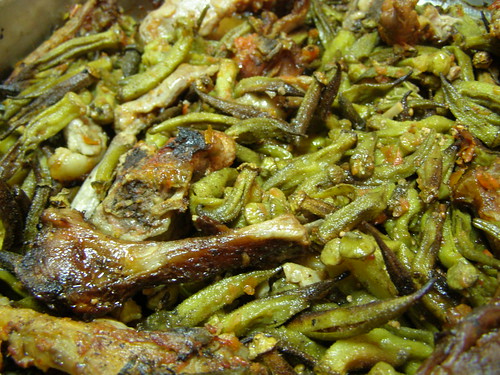
For additional taste, pour the ready okra over some grilled meat in a roasting dish and cook for 20 minutes in the oven in moderate heat. The okra will become crunchy.

©All Rights Reserved/Organically cooked. No part of this blog may be reproduced and/or copied by any means without prior consent from Maria Verivaki.

Monday, 25 August 2008

Okra - bamies (Μπάμιες στο φούρνο)

When he left the family nest, he didn't realise that he had just eaten his last cooked meal and had left home cooking behind for life. No more Sunday roasts, no more pastitsio, no more T-bone steaks marinated in those Cretan herbs his parents had carried in seed form in their coat pockets on the aeroplane, a reminder of their holidays back to the homeland, to make their way into the lawn of their Wellington garden. It took him a long time to recall those home-brewed smells and tastes because the food he was now eating in London was quite satisfactory: exotic tastes, covered in colourful gloopy sauces, nothing of which resembled his mother's home cooking, but at least it was cheap and edible.

He was now picturing her in the kitchen of the family home, opening the back door to go into the garden. He watched her in his mind, climbing the stairs to enter the raised garden bed. Her first stop would be the greenhouse, a roughly constructed shed made with the old doors and windows of their renovated house. She'd pokes in its undergrowth for any sign of a tomato, maybe a cucumber, or some parsley, being careful not to disturb the overgrown zucchini that was left to seed. Around the greenhouse grew all the horta - weeds to the average Joe Bloggs - which she used for spanakopita fillings and yemista herbs. How he missed those garden fresh salads oozing with the olive oil she drizzled over them from a metal canister.

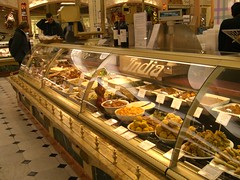
harrods food hallsupermarket

He once tried to make a Greek salad in his flat at Clapham Junction. While shopping at the ASDA across the road, trying to decide if he should buy the 2-for-the-price-of-1 packaged beef mince or the heat-and-serve meat patties, he came across the fresh produce section and spotted some firm red tomatoes. They looked as though they had just been picked off the tree. He placed a 4-pack in his basket. Everything seemed to be packaged using this number, the magic number for the perfect family, the perfect number of flatmates sharing a house, the perfect number of meal portions: 'serves 4'.

clap junc

Back at home, as he began to prepare the salad, he noticed that the label on the tomato packet stated that they were grown in the Canary Islands; not that it made a difference to him if they were from Kenya or Spain, but he couldn't picture in his mind where the Canary Islands fell on the map, despite having travelled extensively. It annoyed him that he didn't know where his food came from any more.

The salad was a disaster. There was only sunflower oil in the house, so the dressing didn't even look right. Olive oil had a green tinge to it, not like the sunflower oil on his plate which resembled children's cough medicine. The tomatoes were overly-firm; despite their red exterior, their innards were still green and seedy, and they contained no juice, which is what gives a Greek salad its flavour. Worst of all, they were completely tasteless. He could have been eating unripe apples, such was the sensation in his mouth; the tomato felt like sandpaper. There was not a hint of sun-kissed flesh, the kind of smell a tomato emits as it is sliced. Only the feta cheese seemed to have any decent taste to it. His girlfriend had bought it at a gourmet cheese store at Notting Hill on one of their recent Sunday strolls there. He regretted crumbling it into the salad, and tried to fish out the chunkier pieces so that it would not go to waste. This was one of the reasons he had stopped cooking at home; the whole exercise seemed pointless when the fresh products lacked taste.

It was much more enjoyable to eat out, since he could savour a different culture's cuisine every night of the week at a reasonable price. He now had a list of a dozen of his favorite restaurants and would rotationally frequent each of them on a fortnightly basis. One day it was Chinese, the next Pakistani, the following gourmet hamburgers, and so on. He was spoiled for choice in his dining habits, never ordering the same meal twice.

Now that he was on vacation in Crete, his appetite had swelled. His uncles and aunts always asked him what he would like to eat, and cooked whatever took his fancy. He felt as though he was being doted on, but never said no to a second helping, whether it was oven-roasted meat or aubergine cooked in tomato sauce. Everything tasted like he remembered it in his mother's kitchen. As his aunt Antonia would say: "Eat it now that you've got it in front of you, because you never know when you'll get the chance to try this again."

As he entered his cousin's house (she had invited him for Sunday lunch), memories of his childhood home kept flashing in his mind. She was setting the kitchen table. "Hey, these plates look familiar. I think we had the same ones."

"They were Dad's," she replied, as she opened the oven to check the roast. He noticed that some of the plates were chipped, but he could sense the sentimentality that his cousin felt for them now that her own parents had passed away.

A familiar scent caught his nose. His cousin had lived across the street from him in Wellington, and both their mothers cooked roughly the same kind of food. He was sure of it, but could not see any pots simmering on the stove.

"Are you cooking bamies?"

okra freshokra sundried
(fresh okra - shaven sundried okra; click here for the recipe)
"Yeah, but don't worry," she began to explain, "I've made plenty of roast potatoes if you don't like them."

"No!!!" he shook his head wildly. "I love bamies! Mum cooks them with chicken."

"Oh, I remember," she said, like the expert cook her mother was. She was beginning to look like her now, short and bulky in a matronly way, busying her way deftly around her kitchen, bringing out the cutlery, glasses and paper napkins to lay the table. This was what eating was like in his family home, a ritual associated with the appropriate equipment, with every item taking its place ceremoniously on the dining room table. He could not recall the last time he saw a table in London high enough to sit at on a chair, or large enough to seat a family. Although he had been working for many years in London, he still could not afford to rent a flat of his own. He and most of his acquaintances lived in digs, tiny bedsits barely large enough to house a bed and chair, if a writing desk could be fitted in somewhere, then the room was considered 'large'. Apart from the usual arguments over the phone bill and the cleaning arrangements, cooking a meal in the communal kitchen also created feelings of distrust: should it be shared? if so, how much money should each flatter fork out to cover the meal? who cleans up afterwards? does the meal cater for everyone's taste, needs, idiosyncracies? low-calorie, carb-free, kosher, gluten-free, vegetarian, vegan, environmentally friendly, politically correct?

"Bamies from a tin, right?" she asked.

He looked at her somewhat confused. "Yeah... canned in tomato sauce."

She started laughing. "I couldn't understand how our parents even liked the stuff, it all came out like goo."

"But you used to eat it, too, didn't you?" She ate everything, and it showed.

"Yes, I did," she replied regretfully. "But now I know how much they missed the real thing. Now that we eat them here fresh. They grow on gigantic tree-like shrubs and they're covered in prickly fur, so they aren't easy to pick."

"You picked these yourself?"

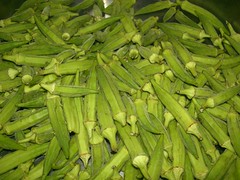
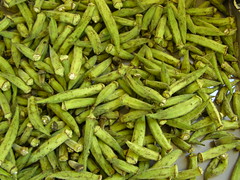
"No, I bought them at a fresh produce market in the Agora. But I've seen the trees. Okra looks fresh when the pod is firm and bright green. You have to shave them a little on the top and let them dry in the sun for a couple of days so that they don't turn into goo..."

He had no idea what she was talking about now. The discussion about food was getting too technical. He couldn't remember if he had ever seen fresh okra on sale at the supermarket. He made a mental note of going to Brixton market when he got back to London to see if he could find them. Not that he was planning to buy them himself; for a start, where was he going to find any sunlight in London to let them dry? When he left Gatwick airport, it was pouring heavily and the temperature was 14 degrees Celsius: all this is mid-August.

roast okra bamies

"... we like them in a lamb roast with potatoes," she was still talking. "They go crispy, like french fries, but with a meaty taste, kind of like that jerky meat Australians like to eat. We never eat them mushy, and I don't think our parents ate them mushy when they cooked them here in Crete. They just weren't available fresh in New Zealand. They're kind of an acquired taste."

An acquired taste. What Londoners would say of potted shrimp pate, boar terrine layered with chestnuts, olive oil infused with black truffles, whisky-flavoured seville marmalade. When asked to give their opinion of okra, most wouldn't know what it was, let alone have tasted it. If they were shown what it was in a photo, they might think of it as a 'native's' choice of vegetable, associated with a community whose skin was dark. They probably couldn't place it in any of the mongrelised versions of international dishes in the average Londoner's repertoire.

roast okra bamies

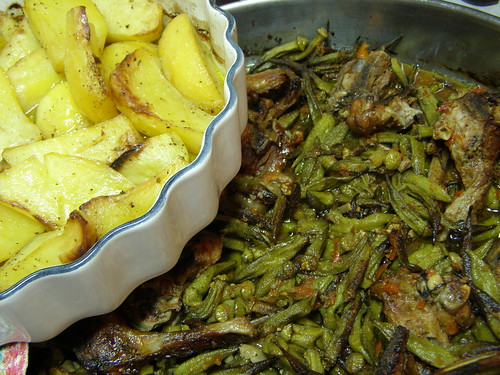
Roast okra - made all the more delectable with garden fresh tomato pulp and virgin olive oil. He had one serving, with tender-cooked lamb and roast skin-blackened potatoes. The okra was firm, chewy and juicy. His cousin asked him if he would like a second helping, which he obliged to. Then she asked if anyone wanted the last scrapings off the tin. He took those too. Like his aunt, he wondered when he would get another chance to savour a meal like this one.

This is my entry for Weekend Herb Blogging, this week hosted by Katie from Thyme for Cooking.

(Dedicated to PH, who licked the tin clean)

©All Rights Reserved/Organically cooked. No part of this blog may be reproduced and/or copied by any means without prior consent from Maria Verivaki.

Sunday, 16 September 2007

Bamies (Μπάμιες με ψητό στο φούρνο - lady's fingers, okra)

Okra are an old-fashioned summer vegetable with an acquired taste that not many people are interested in eating these days, unless they have tasted them before and know how delicious they are when cooked properly. The preparation of these vegetables takes a long time, their texture is a little slimy, and their taste leaves much to be desired if they are not treated appropriately before being cooked. They are considered a specialty vegetable in African, Indian and Carribean cuisine. In Greece, they are eaten as a stew in a tomato sauce, or put into the roasting pan or a casserole with potatoes and meat. My mother used to buy tinned okra in New Zealand from an Italian grocer's on Pirie St. We would always have that revolting gooey seedy slime in a chicken casserole. It just made no sense to eat it in New Zealand when there was a plethora of other fresh vegetables available for roasting with meat, which my parents seemed hesistant to try themselves: kumara, pumpkin, baby squash. I had never seen fresh okra until I came to Greece, and only then could I appreciate why some people call it the king of summer vegetables. It has a unique chewy taste; when added to a roast, it tastes like jerky.

Okra need to be sun-dried before they are used, otherwise they will excrete an off-putting slimy juice. They also have a further preparation ritual: once the okra have been dried, you need to cut off the stalky top without slicing it off (be careful - their hairy texture can cause a slight rash), then they need to be "shaved" right around the cap where the stalk was cut off, but the cap must not be sliced off, otherwise they will become slimy once again. As if that's not enough, they also need to be soaked for about an hour in some wine or vinegar to remove the slime and bitterness. Here's what touregypt says about preparing okra: "Okra must be cooked so that its slimy texture is eliminated. The Greeks have the best technique - applause, applause! - for achieving this. Trim the conical tops with a sharp knife, then soak the okra in red wine vinegar for 30 minutes, allowing 1/2 cup wine per pound. Drain, rinse and dry the okra."

A friend of ours grows okra in his garden. When we visited him, he let us pick our own (we itched for hours afterwards). We're having them today in the traditional Sunday roast. There are no set amounts of ingredients in a roast: it always depends on the number of people eating. I used the famous Greek 'tapsi' - a large roasting pan used for making roasts and pies.

You need to:
Wash the pieces of lamb well to get rid of bone shards.
Peel and cut some potatoes in large quarter-moon chunks.
Puree some fresh tomatos in the blender (you can skin and de-seed them if you have time, but I never bother; without the seeds and skin, the sauce is thinner)
Arrange the meat and potatoes in the roasting dish, season with salt and pepper, pour over some olive oil and the the tomatos. Let them cook for half an hour before adding the prepared okra, as well as half a cup of water. Cook in medium heat until the meat and potatoes are tender. Okra don't need much cooking time, so make sure you don't add them at the beginning of the cooking time, otherwise they may burn. I cover the roasting dish with aluminium foil so that the food doesn't brown too quickly, and take it off half an hour before the end of the cooking time, raising the heat to give the roast a BBQ look.

For an alternative to the same dish, try this post.

©All Rights Reserved/Organically cooked. No part of this blog may be reproduced and/or copied by any means without prior consent from Maria Verivaki.

Saturday, 18 August 2007

String beans stewed in tomato (Φασολάκια γιαχνί - yiahni)

Fresh string beans are the summer alternative to winter bean soups. If you grow your own string beans, you can use them in this recipe. There's a happy reason why I prefer the frozen variety: they are easier to deal with in terms of preparation. I tend not to buy them from fresh markets, because the farmer may have used too much fertiliser, and the beans become tough and fibrous, whereas frozen ones (despite the cultivation method used) always cook to tenderness, and don't need cleaning. To prepare fresh string beans, you need to top and tail each one separately, taking care to pull away any stringy fibre from each side. If they are very long, chop them in half. You can also use okra (lady's fingers), otherwise known as bamies in Greek cooking, instead of fasolakia to make this dish. Another popular way to eat them is to brown some chicken pieces in olive oil, and when they are half-cooked through, to add the remaining ingredients of this recipe. Green beans go especially well with meat stewed in tomato. I also add barbounes beans - they look like white haricot beans with a streaky red mesh design on their skin), to suit the different tastes of my family: someone wants green beans, someone else wants white beans.

You need:
1/2 cup olive oil
2 onions, chopped small
2 cloves garlic, finely chopped
1 500g packet of frozen green string beans
1 250g packet of frozen white beans
5 small potatoes, peeled and qaurtered
3 courgettes, cut into chunks (only in summer; I never buy greenhouse grown zucchini in the winter)
1 large carrot, peeled and sliced into medium-sized rounds
400g tinned tomatos
a bunch of parsley
salt and pepper

Brown the onion and garlic in the oil in a large pot. Then add, in layers, the string beans, carrots, courgettes (topped and tailed), white beans and potatoes. Pour the pureed tomato over everything, and add enough water to just cover the pot. Season with salt and pepper, sprinkle with the chopped parsley, cover the pot and cook until the potatoes are done, about 35-45 minutes. Serve the beans with leftover roast meat, boiled egg, cheese or just as they are.

©All Rights Reserved/Organically cooked. No part of this blog may be reproduced and/or copied by any means without prior consent from Maria Verivaki.