Showing posts with label SAUCE. Show all posts

Monday, 14 October 2013

Red, blue and purple food: berry sauce for meat and fish

A freind of mine recently asked me where I found the berries I used to make chocllate berry pots. She likes red, blue and black berries, like me, but they are not easy to find in Crete; we can only find wild-growing blackberries, which are a great pain to harvest because they grow on very wild thorny plants. What's more, these berries are never sold on the market as local products - you can sometimes fidn them imported from Mexico or Holland, but they are also sold at ridiculous prices, as are out-of-season strawberries imported from Holland - let's not mention the number of miles they have done to get to my location: was it really worth the effort int he first place?!
 When I decided to put my mind to experimenting with red foods, I was surprised to find so many in the house: apart from standard Greek items like tomato, pomegranate, beetroot, grapes and red wine, we can now also get goji berries, dried blueberries, caramelised hibiscus flowers )all pictured below), cranberries and frozen berries, all at very reasonable prices. Most of these fruits can (and in some places, are, for the specialty market) be grown in Greece - 'watch this space'...
Red foods are often known as superfoods due to their high antioxidant content and their anti-bacterial properties; some red/blue/purple foods have been investigated for their special properties, eg blueberry is now considered as helping against eye disease. Berries are now more readily available in Hania, mainly imported, but at very affordable prices: LIDL for example sells frozen berries (raspberries, blackberries and fruit of the wood mixtures) at very reasonable prices. What was once considered exotic and expensive is now common and cheap. This could be considered a crisis aftermath, but the reality is that this was probably the way the Greek world was heading in anyway.

Incorporating berries into Greek cooking is really difficult. We simply don't use such food in our regular cuisine, as do other cultures eg in Sweden, lingon berry is served with meatballs. Apart from fresh, and in sweets, berries can also be used in savoury sauces. I recall being served lamb with raspberry sauce in New Zealand and I loved it. But I admit it's an acquired taste in Crete to pair fruit with meat. Apart from quince with pork, I can't think of anything particularly fruity in savoury dishes, which are commonly cooked by home cooks. Such dishes are often associated with modern meals made for special occassions, although adding pomegranate and walnuts to salads is now very common. Pomegranate 
In my first attempt at making this sauce (which I used with tsigariasto lamb), I added grated tomato which made the sauce too savoury and disguised berry flavours. I also added goji berries as a garnish, which didn't really seem to bring out any special taste to the sauce. In my second attempt, I omitted the tomato and added pomegranate - the sauce tasted good, but the pomegranate seeds didn't excite me much either. The additions were to sweeten the taste, as these berries can taste rather sour. 

Now that berries are easy and cheap to get hold of in frozen form, I decided to experiment with them ot make a saucy topping for meat and fish. A sauce of this type should be thick enough to stick on the meat, as well as be just enough runny to 'dip' and 'swirl' the meat around it on the plate, to catch its flavour. And above all, it needs to be tasty. To create an appropriate flavour with the use of berries, I thought about how I make tomato sauce for pasta and meat dishes. It took me three attempts to get the flavour I wanted. 

 For approximately a cup of sauce, you need: 
1-2 cloves of garlic, finely minced
2-3 tablespoons of extra virgin olive oil 
3/4 cup of frozen mixed berries (you could experiment with just one berry type, but this was the easiest option in my case)
1-2 tablespoons of red wine
1-2 tablespoons of balsamic vinegar
1 tablespoon of demerara sugar
a pinch of salt
1 tablespoon of finely minced mint (this is the magic ingredient that added the right flavour to the sauce)
1 tablespoon of cornflour
3-6 tablespoons of water
some berries and/or mint leaves, for garnish
The sauce here is a little thick, but it can be thinned by adding liquids to it eg, water or even beetroot juice for an added colour effect. Maybe I used too many berries for garnish, but I admit to being enamoured with berries. The sauce was just under perfect for taste (too many berries made it sour, which may be too sour for some people's taste. 

Heat the oil and add the garlic over medium heat. Cook lightly, being careful not to burn it. Add the berries, and let them soften over medium heat. Mash them lightly, leaving some chunkier, for the texture effect. Mix in the wine, vinegar, sugar, mint and salt. Add just enough cornflour to bind the sauce, ie just to thicken it. Add the mint. Let cook for 5 minutes or so, for the flavours to blend. Add just enough to water to get the consistency you prefer. 
In this version, the sauce is runnier (served with roast chicken). A clever way to get the most out of the addition of superfood is to add more of them to a salad, eg pomegranate with lettuce salad, served with the meat and berry sauce.  The final texture of the sauce is just visible in the bowl next to the plate.

The first time I used this sauce, it was freshly made, served on a fillet of salmon, decorating the plate with more red food items for added antioxidant content, as well as some greenery for colour contrast. When I heated the sauce the next day to use it over roast chicken, I found that it had congealed, and I mixed in some more water to make it runny. That was the perfect texture for me - thick, but with a soft flow over the meat. I would be tempted to try this sauce again with the addition of a small square of chocolate to replace the sugar, allowed to melt into the hot sauce...

I've created this dish for the TGI Fridays recipe competition, which you can find out more about on the Greek Food Blogs site.

©All Rights Reserved/Organically cooked. No part of this blog may be reproduced and/or copied by any means without prior consent from Maria Verivaki.

Wednesday, 1 May 2013

May Day

Looking back to last year's blog at this time on Holy Wednesday, I was discussing how terribly betrayed Greek people felt about what had been happening in the country, with all those revelations of benefit fraud, state mishandling of funds and no punishment for those had aided and abetted this situation.

This year, Greece saw a clean-up of the benefits system, there are now no more funds to be mishandled (they are doled out by our creditors under immesne scrutiny), and we all know what happened to a former defence minister and mayor.
May Day lunch - spicy prawns in tomato chili pasta  sauce, with artichokes for salad.
I think I can safely celebrate my optimism today for a better and more mature Greece.

Καλό μήνα, everyone.

©All Rights Reserved/Organically cooked. No part of this blog may be reproduced and/or copied by any means without prior consent from Maria Verivaki.

Thursday, 26 July 2012

Doing it like TGI Friday's

Greek Food Blogs is organising a Greek food bloggers' cooking event, in conjunction with TGI Friday's Greece. The challenge is to create a recipe for TGI Friday's Greece that will be used in its main menu if chosen by the judges. TGI Friday's menu is based on American recipes and cooking techniques, which are radically different to my own cooking style.

Before you submit your recipe, you have to learn to cook in the style of TGI Friday's. By looking through the TGI Friday's Greece menu, I notice a heavy emphasis on meat-based dishes that are accompanied by a range of colourful salads and toppings. Most importantly, the meats are usually served with some kind of spicy sauce or piquante dip. That's quite different to what I cook in my kitchen on a daily basis, which is usually based on seasonal local food, not very much meat and what our garden supplies. But I liked the idea of a foodistic challenge, especially now that the garden is so full of high quality fresh produce.


Upon request, a mini cookbook based on TGI Friday's Greece menu was sent to me, containing recipes for TGI Friday menu staples such as wings, ribs and fajitas. My biggest worry about cooking American food in my Mediterranean kitchen was that I would not have the right ingredients at hand. When trying out a new recipe, I often look to replace unusual ingredients with local seasonal products, and prefer not to spend money on imported non-Greek food. However, there are some items that are always found in my kitchen (eg soya sauce) because I use them often, but there are a number of items that I don't stock at all (eg cider vinegar), while a number of items (eg fresh coriander) are difficult to source where I live. I knew I wouldn't be able to source all the ingredients in the recipes supplied to me, so I decided to adapt the recipes to suit my Mediterranean kitchen supplies.

I also set myself an additional facet to the challenge: can I cook a new recipe, learn a new cooking technique, use whatever is in my kitchen, cook the meal after work with no previous preparation and keep the meal frugal, without compromising on taste and quality? I printed out the recipe (on my new printer-scanner, after being dutifully served by my former eight-year-old model) as soon as I got home from work just after 3pm, and checked the ingredients and method. (Then I whipped up a boureki and a batch of tomato sauce, drove off to our fields to pick a crate of oranges and fill up our empties with ice-cold spring water, and then returned home to take the kids to the beach, while the boureki in the oven and the tomato sauce on the element were cooking at the lowest possible point, all part of a typical lazy Greek's summer routine.)

I began cooking the meal at about 8pm. I decided to cook the wings recipe, replacing the wings (a cheap commodity in Crete) with some tasty German sausages that I had in my fridge, whose expiry date was due very soon. This meant that I could cheat on time, because the wings needed special preparation and a longer cooking time. The sausages were simply drained and dry-fried on a pan, so that they became crispy-burnt on some parts.
The recipe then called for a pico de gallo, which sounded very exotic, but it was actually a fresh colourful salad, consisting of tomato, peppers and onions of all colours. It just so happened that on the previous day, I had harvested a number of coloured peppers from our garden - how convenient was THAT?! While the sausages were cooking, I set about chopping up the salad ingredients into little cubes. All they needed was to soak in a little lemon juice, before being strained when the time came to use them. The recipe also called for fresh pineapple pieces as part of the salad, something which we never buy: fresh fruit is never missing in our house in the form of oranges, apricots, melon and watermelon (we don;t grow the last two). I omitted this step, but made up for the colour (maybe not the sweet taste) with the brilliant yellow pepper.


The recipe also called for a spicy meat glaze made with whiskey. This was the most daunting part for me: I've never made such a sauce before. The ingredients for the sauce included tabasco sauce, soya sauce, onion, cayenne pepper, brown sugar, whiskey, cider vinegar and beef stock. The cider vinegar was replaced with a light home-made red wine vinegar, and the beef stock was omitted (I simply added water). The point was to make a sauce as thick as syrup, which would be used both as a sauce and a topping. The ingredients needed about 20 minutes to reduce to a syrup.

The final look of the plate involved skwering the chicken wings (so I skewered the sausages),cooking them in some of the syrupy sauce, plating them with more sauce and topping them with the salad. This all looked good, but the plate looked a little empty, as I was serving this dish as a main evening meal and not an appetiser. I had some mini-pita bread rounds in the freezer, which I toasted lightly int he same pan I cooked the sausages. I also have a lot of eggplant in the garden at the moment, so I sliced a small one and fried it. (The aubergines were sitting on the kitchen worktop for three days, and had shrivelled slightly, which makes cooking them much easier, as they did not need to be salted and drained - Cretan garden-grown aubergines re much sweeter than commercially grown aubergine).  


Just after 9pm, the dish was completed, and the plate looked full. It was very tasty, as judged by my eaters, who asked me if I could make it more often. Yes, I suppose I could, although I wasn't happy about the addition of sugar in our main meals. I wonder if I could make the same sauce with honey as a healthy alternative.

Post-script: My husband particularly enjoyed this meal, and I was very glad I to have been able to offer it to him - he'd been stuck on the roof of our house all morning under a fiercely hot sun (we're renovating, and in Crete, renovating usually entails the house owner taking an active part in the work), and was too hot and tired to eat at lunch time (which consisted of a leftover meal - not very enticing if you are too tired to eat). After leaving for work in the afternoon, he realised that he would either crash the car or fall asleep at the wheel if he continued working, and he was surprised to find this meal ready and waiting for him. Just another day in the life of another lazy Greek.

©All Rights Reserved/Organically cooked. No part of this blog may be reproduced and/or copied by any means without prior consent from Maria Verivaki.

Monday, 31 January 2011

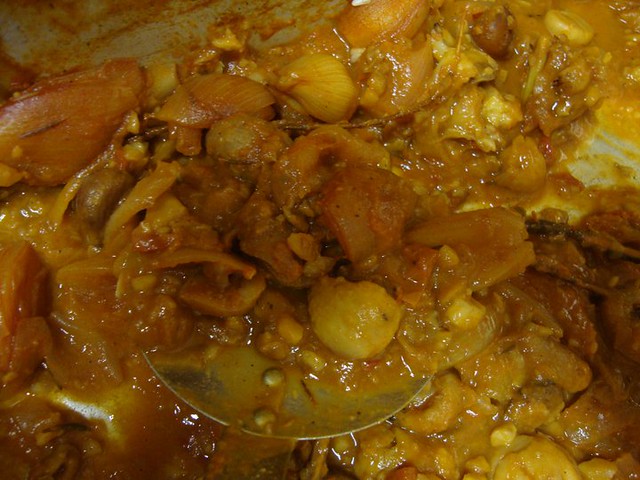
Chestnut stew (Κάστανα στιφάδο)

Upon hearing the word στιφάδο (stifado), Greek people generally conjure up an image in their mind of a rich red stew of hare or rabbit, chicken, beef or pork, cooked with a large quantity of onions. It constitutes staple winter fare in most parts of Greece, replacing the Sunday roast during the colder months of the year. But with the rising interest in healthy food and a move away from meat, many people nowadays crave a vegetarian version of the same kind of dish. The creative chef at MAICh, Yiani Apostolaki, has once again used his love and knowledge of Cretan cuisine to create a meatless stifado, which has many variations, and can only be termed a masterpiece. Yiani's chestnut stifado is often on the menu during the chestnut season at MAICh, where it is enjoyed by the resident students and staff of the institute.

chestnutstifado

After having this for lunch at work one day, I decided that I had to make it at home as soon as I could for the whole family to enjoy. My own version of chestnut stifado reflects my family's preferences in spice tastes.

You need:
a few tablespoons of olive oil
1 large onion, chopped finely
2-3 cloves of garlic, chopped finely
500g chestnuts, shelled (to do this, follow the advice in this post; Cretan chestnuts peel easily - not so those from other regions, as I have discovered, when I wanted to buy some bigger and 'better-looking' chestnuts!)
500g whole small stewing onions (large ones don't cook evenly; make a small cross on top of the cleaned onions, as described in this post)
a can of pureed tinned tomatoes (I use my own home-made tomato sauce)
1 teaspoon of tomato paste (for a thicker sauce - this is optional)
1 small wineglass of wine
1 stick of cinammon
6-10 carnation cloves
2 bay leaves
freshly ground pepper
sea salt

In a wide pot, heat the oil and sautee the chopped onion and garlic till translucent. Add the whole onions and mix till they are coated in oil. Add the seasonings and wine, and leave the pot to simmer for a few minutes. Now add the pureed tomatos and tomato paste. If the mixture is too thick, you can add some water to the pot at this stage, but don't add too much: this will depend on the size of the onions. The topmost level of the liquids should be about 1cm below the topmost surface of the onions. Place a lid on the pot, and let the onions simmer at the lowest heat for 30 minutes. Now add the chestnuts, which will have been partly cooked when they were boiled (or roasted) to be cleaned,and cover the pot again. Allow the chestnuts enough time to soften. This depends on the desired texture; if you prefer the nuts to crunchy, then the stew doesn't need a lot of cooking time.

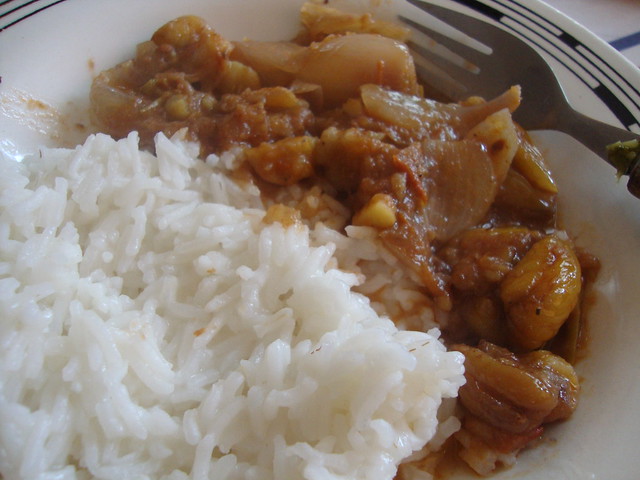
chestnut stifado with pilafi

The meat version of this same stew (ie using meat chunks instead of chestnuts) will fill you up very quickly. But the vegetarian versions are so much lighter, that you will find yourself eating more than one serving, or a very large one at that, and you won't have that bloated stuffed feeling that eating such a rich meal usually gives!

Not only that, but the same technique, sauce and spices can also be used in vegetarian stifado using other ingredients; any firm vegetables will work, eg carrots, potatoes, eggplant, mushrooms and pumpkin (which Yiani also adds to his chestnut stifado), as long as they can retain their shape while cooking. Such vegetables have the same fullness as meat, while being exclusively vegetarian products. The tomato-based sauce hints at the taste of umami, a taste inherent in meat that people often crave, even when they are vegetarians, thus satisfying their tastebuds. Only the cooking times for each vegetable will change, according to the desired texture of the finished dish.

The traditional way to serve stifado in Greece is with fried potatoes or thick pasta, but any carbohydrate will do. I served mine with pilafi rice made with a very light chicken stock. Using aromatic basmati rice provides even more umami taste, if you want to keep the meal completely vegan. This dish also needs a very fresh green salad to accompany it, and very little else.

UPDATE 8-12-2011: Due to the recent popularity of this post, here are two variations of chestnut stew: one uses potatoes (served at a mountain village food festival) and the other with mushrooms (served in a popular restaurant in Hania). 


©All Rights Reserved/Organically cooked. No part of this blog may be reproduced and/or copied by any means without prior consent from Maria Verivaki.

Wednesday, 30 April 2008

Staka dip with eggs (Στάκα με αυγά μάτια)

Here's a special meal that will be difficult to make in any place in the world except of course Crete. Not even my fellow Greek food bloggers can make this in Athens - they still have to substitute the ingredients for more generic products, which of course don't retain the original taste. Some regional produce (like cheese) doesn't travel well; it's also highly sought-after, with demand being greater than the available supplies. This dish is also one of those acquired tastes - not many people these days would be terribly interested in eating cholesterol-filled fried food. In fact, the only time we allow ourselves a dish like this is when we buy spring-fresh produce before Easter.

*** *** ***
read the poem
*** *** ***

Staka is a kind of buttery cream. It looks like curd cheese, but melts upon touch. You cannot pick it up and lead it to your mouth without it melting in your hands. Once it melts, it looks very much like butter. Once it has melted over medium heat, it is thickened with a little milk and flour (seasoned with salt), and the result is a thick non-congealing dip. The longer it cooks, the thicker the dip, and the more separated the oil becomes from the dip. It can be eaten as it is, the way it's normally done in restaurants, served as a side dish for a main meal.

As we were enjoying this dip at home (I had bought some staka to make a lovely traditional Cretan Easter meat pie), we were more indulgent. We added one more ingredient to it: two eggs, cooked in the oil which collected on one side of the saucepan, after I had spooned away the dip. The oil slid towards one edge of the saucepan, into which I broke the eggs. The result was that instead of eating gigandes, oops sorry, elephantes makedonias, as they are now called (since gaining protected-origin status) with leftover Easter lamb as our main meal, we ended up eating them as a side dish...

©All Rights Reserved/Organically cooked. No part of this blog may be reproduced and/or copied by any means without prior consent from Maria Verivaki.

CRETAN PRODUCE:
Xinohondro (hondro)
Stamnagathi
Marathopites
Avronies (wild asparagus)
Wedding pilafi
Orange juice
Lagos stifado
Sorrel
Silverbeet
Bougatsa Iordanis
Black mustard greens
Malotira
Cheese
Sfakianes pites
Olives tsakistes - pastes
Olive oil

Saturday, 1 March 2008

Goat and cooked lettuce in egg-and-lemon sauce (Κατσίκι φρικασέ - αυγολέμονο)


Spring is so much in the air these days in Hania. I just spent the whole morning in town and the whole afternoon in Platanias, a seaside village, at a hotel which was hosting the regional inter-school chess competition for Western Crete. A splendid time was had by all, despite the fact that the children and their parents spent five hours in an exposed section of a summer resort hotel, with long wait times in the strong cold wind that prevailed. These hotels abound in Hania, but remain closed during the off-season, when there are no European chartered flights available, and hence no tourism. Living in Hania, I don't get the chance to view these buildings from the inside; I only see their façade as I drive past. Therefore, it was a bit of an eye-opener entering this marvellous edifice which simply screamed summer everywhere you looked, with its bamboo deckchairs, mosaic-tile swimming pools (not in operation at this time of year) and umbrella light fixtures. The apartments looked like miniature villas with marble staircases and terracotta pottery gracing the gardens which were full of expensive greenery. The hotel must have been specially opened for the weekend's event, but all hotels will gradually start getting ready to greet this year's tourists when the season opens up at the end of the month. Seeing the hotel from up close, I felt very thankful to have a home in Hania close by to the places where people spend a few weeks of their annual pay to stay at for a couple of weeks a year.


The event was free, but not without its problems. It ran over the time expected, and no food or drinks were provided. 400 schoolchildren had registered for the event. I learnt my lesson: tomorrow morning (the second half of the event), I shall make sure to bring along some water and a few edibles, because I don't want to pay a euro per half litre of water and 2 euro per toasted ham and cheese sandwich; a right rip-off. There were also some pricey but filling brown bread rolls (the one I ate contained lettuce, feta cheese and olive paste), and the usual refreshments. But the rest of the food available was clearly junk - chips, chocolates and sweets.

There will be no time to cook tomorrow's Sunday lunch, the only time we eat meat in our house. Not that I don't like meat, but there's just so much healthier food available, so why overdose on cholesterol? We are getting ready to plough up the garden to make it ready for the coming spring months. Time to find a way to eat up the Cos lettuce my mother-in-law planted in winter. Cos lettuce is the main lettuce variety grown in Hania. It's something I couldn't get used to when I first came to Greece, as I could only dream of the curly iceberg lettuce we used to eat in New Zealand. But I slowly learnt to like coarser stiffer Cos (sometimes called Romaine) lettuce, and I have to laugh at the sign above the iceberg lettuce sold in the foreign produce section of the supermarket: it's often named 'salata'. Aren't all salads called 'salata'?

After arriving home at 8pm, we ate our evening meal as a family (spanakorizo) which I had managed to cook in between the trip to Hania and the chess competition (tired and hungry children will eat anything, even if it does look very green). When everyone had had their fill, they went off to doze in front of the television while I cleared away the kitchen table and started cooking tomorrow's Sunday lunch: φρικασέ (fricasse). This is not a difficult dish to cook, as long as you have prepared the meat and vegetables. Lettuce is an unusual ingredient in a stew; the lettuce is cooked with the meat. Other leafy greens can also be used in the same dish - spinach, stamnagathi (spiny chicory) and swiss chard, among others - with an alteration in the flavour. My mum used to cook this meal for the midnight feast after the first Easter Sunday service (ie the one that starts on Saturday night and finishes in the wee small hours of Sunday morning). She'd cook the meat with the vegetables, and when she came home from church, she'd make and add the egg-and-lemon sauce. In this way, I'll be able to enjoy another day at the posh hotel, and still get a decent meal on the table in a reasonable amount of time.

Fricasee in Greece basically means meat cooked in a white sauce, which isn't necessarily creamy. Egg-and-lemon sauce is the classic Greek white sauce, also used to make chicken soup. It is a perfect sauce for spring dishes; its creamy yellow colour goes well with green vegetables. Lamb or goat meat is the meat commonly used in fricasse dishes in Hania, and today I've preferred kid meat, because it is very tender and less fatty than spring lamb.


For the stew, you need
:
1.5 kg of tender goat meat, preferably kid (or spring lamb), chopped into large chunks
a dozen spring onions, chopped small - I prefer a mixture of red onions, leeks and spring onions
2 large heads of Cos lettuce (but any lettuce will do, and many cooks in Hania use different kinds of horta, stamnagathi - spiny chicory - being the most popular), torn into large pieces
1 cup of olive oil
a few sprigs of dill, chopped finely
1/2 glass of wine
salt and pepper to taste


Prepare the meat by boiling it to skim off any impurities. If the animal was very young, you don't need to do this. Drain it well if you do. Heat the oil in a pot and brown the meat all over. When it is done, add the onions and let them wilt in the juices of the meat. Add the salt, pepper and wine. Cover the pot and let the stew simmer for half an hour. When you take off the lid, if you used a mixture of onions, your nose will be smitten with the most wonderful springtime aroma, reminiscent of green hills covered with wild flowers, with frolicking young animals (like the one you're cooking) gamboling over them.


Now add the dill and lettuce, and mix them in well. The stiff leaves of Cos lettuce need to wilt before they will fit snugly into the pot, so let the stew cook over a high heat and turn the ingredients over in the pot so that they will cook more quickly. Once the lettuce has reduced, reduce the heat to simmering point, cover the pot and cook for at least an hour, or longer, until the meat is practically falling off the bone, and the cooked lettuce melts in your mouth. There is no set time for this; it all depends on the meat. Now you can switch off the heat, and either continue on to making the egg-and-lemon sauce, or wait till you are ready to serve the dish and prepare the sauce later. And if you really like your food light, skip the sauce altogether, add some lemon juice, stir it around, and enjoy this meal as it is (my personal preference). If you do decide to postpone the addition of the sauce, you need to heat up the stew so that the liquid is warm enough to cook the egg-based sauce; adding cold stewing liquid to an egg sauce means that the egg won't cook.


For the egg and lemon sauce, you need:
2-3 eggs, separated
juice of 2-3 lemons
If you prefer a thicker sauce, add more eggs. I add more lemon than eggs, for a lighter, tangier taste. Whisk the egg whites until they are frothy (not stiff). Now add the yolks and lemon juice. Add large spoons of liquid (at least two soup ladles full) from the stew into the egg mixture, and stir vigorously to blend the liquids. This is not a tricky sauce to make if the liquid from the stew has cooled down, but it can be quite a challenge if the liquid has not cooled down enough. Raw egg will cook in hot liquid, so beware when mixing the raw egg sauce into the stew's hot liquid. The sauce should not have cooked egg bits in it!


Once the egg and stew liquids have been blended, slowly pour it into the pot, over all the meat. Stir it in very gently, shaking the pot form side to side to distribute it. Let it set a few minutes before serving. This dish does not need many accompaniments. It contains everything required for a balanced meal. A few fried potatoes go well with it. For the healthiest option, just have some village bread handy for mopping up the juices.

©All Rights Reserved/Organically cooked. No part of this blog may be reproduced and/or copied by any means without prior consent from Maria Verivaki.

MORE LEMON(-AND-EGG) RECIPES:
Artichokes in a lemon sauce
Dolmades
Poached salt cod
Lemon cake
Potatoes lemonates
Shrimp cooked in lemon

Friday, 4 January 2008

Soutzoukakia (Σουτζουκάκια Σμυρνέικα)


One of my husband's all-time favorite meals is a spicy homemade meatball shaped into a sausage and cooked in a spicy red sauce. My mother-in-law would make it often for her favorite child (she has no other). Soutzoukakia have their origins in Smyrna, a predomninantly Greek-inhabited city in Asia Minor, now called Izmir and part of modern-day Turkey. They have now become a staple part of the Greek menu, but they are still considered a taste sensation, because of their infamous historical link with the old city whose food art has been immortalised as the "cuisine of the City" (meaning the former Constantinople). I decided to make them today because they are a 'fussy' dish - these rissoles need frying, then they need stewing, and finally they need fried potatoes as an accompaniment - and I now have the time to make them as I am still on holiday break from school.


Therefore, I have had enough time to do some research on them, and compare cooking techniques from various sources. I have many recipe books which I usually browse through for ingredients rather than cooking instructions, but invariably, I turn to the web for all my recipes these days. Why do I do this? Because it's convenient, and maybe because it shows how truly contemporary I am. Maybe I should be more interested in my past, and before presenting the recipe for Smyrna sausages, I should go into a detailed account of the plight of the Smyrnaen people (as some fellow food bloggers have done) who fled their burning city in 1922, ending up in various parts of the world, and shaping the history of modern Greece; my mother-in-law obtained her recipe from one of those immigrants. I'd rather not make Smyrna a discussion point on my blog, but NOT because I want to forget the past. As a linguist, I cannot do that; I know that the word for 'soutzoukakia' is derived from the Turkish 'soutzouk'; the Greeks and Turks are connected with each other in a way that is too close for comfort.

What I'd rather do instead is to discuss the modern Greek psyche in terms of our latest political scandal: why did a good-looking, highly-educated 35-year-old female employee in the Ministry of Culture, who came from a poor background, was first in class in her high school years, earned a university scholarship and spoke four languages, have an affair with the Undersecretary to the Minister, her boss (currently in the intensive care ward after a suicide attempt), end up in jail after being accused of blackmailing him with a video recording of their illicit affair, thereby forcing him into resigning from his post (bestowed to him by the Prime Minister himself, a personal friend of the poor man), and is now cawaiting trial under the charge of being an accessory to his suicide, all for the sake of securing a permanent high-flying post in the said Ministry? This shows the values upheld dearly by modern Greeks: the class struggle (I may be poor, but I can improve myself), educational achievement (I want a university degree because I want a good job), the desire for a permanent appointment in a government position (I want a financially secure job, with full health and pension benefits, from which I can never be fired). Somewhere down the line, though, the mysterious young lady went to unacceptable lengths to secure the great Greek dream; it drove her to the point that she ruined her reputation and destroyed all her chances of achieving success in modern Greek terms, a modern Christine Keeler. What drove this woman to have sex with a dirty old man 20 years her senior? What was she expecting to procure from such a relationship? while the government is embroiled in this scandal, at the same time, it poses questions concerning the Greek personality. A minority (only, I believe) do not share these same ideals for themselves or their children. Does that make those of us who deviate from this line as exceptions to the rule? Are we less Greek than those who adhere to these priniciples? Now that could be a good lesson in modern Greek history - the story of a typical Greek who could be the key to bringing down the government.

From the Spicy Saucy Steamy political Scandal, let's get back to the Spicy Saucy Steamy Smyrnean Sausages. I chose Evelyn's recipe for soutzoukakia because of the richly spiced sauce she describes, using fresh, as opposed to tinned, tomato; this recipe uses more herbs and spices than the other recipes I looked at. The skinless sausages are made with wine, garlic, onion, parsley, cheese, oregano, cumin, salt and pepper, while the sauce contains vinegar, garlic, bay leaf, sugar, cinnamon and cloves. Not for the faint-hearted! I doubled the recipe, because, as this is a fiddly dish, it is worth making it with fresh ingredients, and then freezing half of it for a meal another day. But I didn't follow her cooking technique to the letter. I can't imagine frying 20 rissoles in 2 tablespoons of oil, let alone straining the same said amount after use and using it to make a sauce!


For the meatballs, you need:
2 slices thick dense bread (crusts removed)
1/2 cup dry wine
Soak the bread in the wine for about 5 minutes, or until thoroughly softened. Then, squeeze out excess wine. In a large bowl, add:
1 lb ground lean meat (beef or veal)
1/2 cup finely chopped onions
2 garlic cloves, crushed
1 egg
2 tablespoons chopped parsley
2 tablespoons grated spicy cheese like the Greek kefalograviera (parmesan makes an excellent substitute)
1/2 teaspoon oregano
1/2 teaspoon ground cumin
salt and pepper

Combine the ingredients until thoroughly blended. Cover and chill for 1 to 2 hours. Dampen your hands, pinch off small portions of meat mixture and shape into approximately oval rolls (looks more like a short fat sausage than a meatball or meat pattie). At this stage, you can freeze them for later use. If you are going to cook them, dredge them in flour and fry them in a little olive oil until they are well browned and cooked all over.


For the sauce, you need:
some of the oil you fried the meatballs with
2 lbs fresh tomatoes (we still have some growing in the garden - in January, you exclaim? the last of summer's crops) - add a teaspoon of tomato puree if you haven't got enough fresh tomato
2 tablespoons of dry wine
1 tablespoon vinegar
1 garlic clove, chopped
1 bay leaf
3/4 teaspoon sugar
1/2 teaspoon ground cinnamon
1/4 teaspoon ground cloves

Strain the oil you fried the meatballs in through a fine sieve and pour some of it into a shallow frying pan. I didn't add too much oil, because the meatballs had enough in them. Add all the sauce ingredients, bring to the boil and simmer until the sauce is thick. Drop in the meatballs, stir to cover all over with the sauce, and simmer covered for 15 minutes.

When you've done all this, treat yourself to a glass of wine - you must be pooped! I'm just about to make myself a cup of coffee and help myslef to some melomakarona. I noticed that the Christmas tree is being taken down in Trafalgar Square, but here in Greece, Christmas holidays aren't over until after St John's (7th January).

Serve the soutzoukakia hot with rice, french fries, or mashed potatoes, a mixed salad and some peasant sourdough bread to mop up the juices. If you want to use the frozen soutzoukakia, you need to defrost them thoroughly before dredging them in flour, because they won't cook properly otherwise. Then you proceed with the frying and sauce as the recipe states.

©All Rights Reserved/Organically cooked. No part of this blog may be reproduced and/or copied by any means without prior consent from Maria Verivaki.

MORE MINCE RECIPES:
Biftekia
Chili con carne
Dolmades
Makaronada
Moussaka
Cottage pie
Papoutsakia
Pastitsio