Showing posts with label BISCUIT. Show all posts

Sunday, 20 December 2015

Melomakarona (Μελομακάρονα)

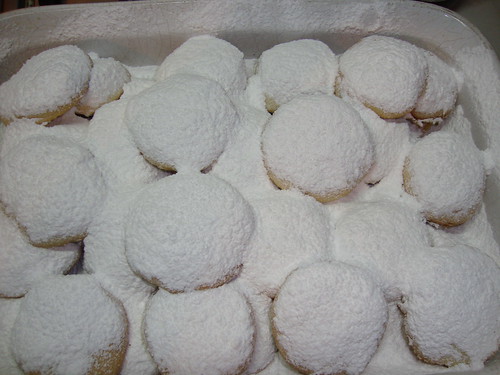
What kind of Greek food blog is one that does not include a recipe for the traditional Greek Christmas shortbread known as melomakarona? An incomplete one for sure. As my sister is the melomakarona maker in this family, here is her recipe, which I made this year.

This recipe makes a lot of melomakarona - I halved it, and got this plate, as well as another half plate. It is a simple recipe, and an easy one to make in one afternoon. For modern eaters, this recipe is vegan (and can be made gluten-free by adding gluten free all purpose flour).


The olive oil, orange juice, honey and walnuts are all local products, all produced just 10-30 kilometres away from my home. Without being biased, these melomakarona are truly delicious: they taste like a whiff of Crete in every bite.

1 litre olive oil
1 ¾ kilos all purpose flour
1 cup sugar
1 cup orange juice, freshly squeezed (not from a packet/carton - the final product won't taste right)
some ground cinnamon  and cloves
2 teaspoons baking powder
1 teaspoon baking soda
2 tablespoons semolina
Mix everything together, leaving the flour till last.

Bake at 180C till golden brown, about 30-40 minutes. When cool, dip lightly in syrup (recipe below):
1 cup honey
2 cups sugar
3 cups water
Boil everything together, till the syrup sets slightly (about 20 minutes on a rolling boil).

Either the biscuits must be hot and the syrup cold, or the biscuits must be cold and the syrup hot (I do the latter - it's easier to warm up the syrup after making the biscuits).

Dip the biscuits in the syrup and allow them to soak in the syrup for up to a minute, turning them over once. As you pull them out of the syrup, coat them in ground walnuts.

©All Rights Reserved/Organically cooked. No part of this blog may be reproduced and/or copied by any means without prior consent from Maria Verivaki.

Thursday, 19 December 2013

Cinammon orange biscuits with chocolate glaze (Χριστουγεννιάτικα μπισκοττάκια)

A colleague recently bought some biscuits into work which her children had made. The combination of orange, cinammon and chocolate created a very tasty flavour. I asked her for the recipe, which comes from an advertisement by a Greek flour and confectionery company (ΓΙΩΤΗΣ), published in one of the latest issues of Gastronomos, a Greek gourmet magazine.

I'm loking forward to making these biscuits at the weekend. In the meantime, here's the reicpe (it makes approximately 50 biscuits).
Crafted by children - in Greece, Christmas time is generally all about them and ultimately for them.
You need:
200g self-raising flour
1 teaspoon baking powder
1 cup butter (my friend used a mixture of butter and olive oil)
1 1/2 cups blanched ground almonds
1 large egg
80g icing sugar
1 1/2 teaspoons of cinammon
Grated zest of 1 orange
Grated zest of 1/2 lemon
1 shot of cognac (most Greek cooks keep a bottle of Metaxas in the house)
125g cooking chocolate
1/2 cup cream
1 tablespoon cinammon flavoured liqueur (my friend didn't use this)

Beat the butter and sugar till well combined. Add almonds and egg and beat till well blended. Add cinammon, zest and cognac and beat well. Sift flour and baking powder, and fold it into the mixture, beating just as much as needed.  Cover with plastic wrap and place in the fridge for 2 hours.

Heat oven to 160C and grease two baking trays. Divide dough into four pieces. Roll out each piece on a floured surface to just under 1cm. Use cutters to make Christmas shapes, place on baking tray 2cm apart from each other, and cook each tray 10-15 minutes till golden. Remove from oven and allow to cool 10 minuted before removing them from the tray onto a cooling grill.

Melt the chocolate in a double boiler, and gradually add the cream and liqueur. Allow to blend without boiling. Dip the biscuits into the chocolate, allow excess chocolate to drip off, then place biscuits on greaseproof paper. Allow the chocolate to set before placing biscuits on a serving plate.

©All Rights Reserved/Organically cooked. No part of this blog may be reproduced and/or copied by any means without prior consent from Maria Verivaki.

Thursday, 25 April 2013

Koulourakia (Κουλουράκια)

In my youth, I remember my mum making tubfuls of koulourakia before Easter. They would last for a long time in airtight containers, and when they ran out, we'd make some more. The most important implement in making koulourakia was koulourakia maker.


My mother never shaped her koulourakia by hand, like I do. The koulourakia maker was very important in our home, as it was in other Greek homes, both in Greece and abroad. It remains a popular tool in the homes of older cooks.


Another thing my mother also used a lot was baking parchment, again something I hardly ever use (olive oil does an excellent cheap and very clean job).


Making koulourakia in large batches is still done these days, but because of a greater emphasis on health and more women working, the idea of many women coming together to produce koulourakia is usually relegated to women's cooperatives and charity organisations. It remains a way for women to connect, both in urban and rural contexts, by being involved in activities that women generally like doing. Cooking, baking, and providing hospitality for others is not necessarily a woman's domain, but it is still something women do more successfully than men.


Koulourakia making can also be a way to show off your artistic talent. Shaping koulourakia is a favorite pasttime of children of all ages. Shaping cookies is popular all over the world among children but making traditional Greek Easter koulourakia has one advantage over making Western-style cookies: koulourakia are a completely natural product that do not need artificial flavourings or colours.


You can find the basic recipe for koulourakia here, which happens to be one of the most popular recipes on my blog. It's easy to produce in a small batch, and you can multiply the recipe as you see fit.


These koulourakia were made for the Special High School of Hania (Ειδικό Γυμνάσιο Χανίων) for children with special needs in the suburb of Mournies, along with Easter candles (lambada) which were also being made here.
The women who made the koulourakia are those being cared for at an old person's home (who have not lost their mobility), together with their daughters and the caregivers at the home (which is called ΚΗΦΗ - Κέντρο Ημερίσιας Φροτίδας Ηλικιωμένων - Centre for the Daily Care of the Elderly). This centre belongs to the local council of Eleftherios Venizelou in Mournies (Δημοτική Ενότητα Ελευθερίου Βενιζέλου), run by ΚΕΠΠΕΔΗΧ-ΚΑΜ (ΚΟΙΝΩΦΕΛΗΣ ΕΠΙΧΕΙΡΗΣΗ ΠΟΛΙΤΙΣΜΟΥ - ΠΕΡΙΒΑΛΛΟΝΤΟΣ ΔΗΜΟΥ ΧΑΝΙΩΝ - ΚΕΝΤΡΟ ΑΡΧΙΤΕΚΤΟΝΙΚΗΣ ΤΗΣ ΜΕΣΟΓΕΙΟΥ). These ladies are all experienced koulourakia makers, as they have all grown up with the tradition in their own home, in the same way as myself. The koulourakia were distributed to the children just before schools break up for Greek Orthodox Easter.

Thanks again to Eirini for supplying me with the photos.

©All Rights Reserved/Organically cooked. No part of this blog may be reproduced and/or copied by any means without prior consent from Maria Verivaki.

Tuesday, 12 March 2013

Love cookies (Κουλουράκια της αγάπης)

On the eve of the feast day of the Forty Saints, Άγιοι Σαράντα (Ayii Saranta) as they are known in Greek, the parish of the Forty Saints church in Nerokourou held a celebratory mass. The 9th of March is dedicated to the forty martyrs of Sebasteia who died in battle for their love of Christ.


At the end of the service, apart from the regular sweet offerings, a basket of love cookies was being handed out to the congregation. The cookies were made the children attending Sunday School in the area.

"Please take one!" the little girl said. "It has the recipe my mother wrote!" 
The icons came with a cookie, the recipe and a matchstick with cotton dipped in oil from a candle.


Not being a church goer, I missed out on gettingmy share, but my friend managed to get one, which came along with the recipe. Love cookies are made with ingredients not commonly found in the supermarket.


You need:
3 water glasses of peaceful conscience (when the sea is calm, we say it looks like olive oil)
2 water glasses of honest heart (like the purity of sweet sugar)
1 wine glass of laughter (which you can find in the form of tsikoudia, the Cretan firewater)
1 wine glass of good will (which you have in the juice of freshly squeezed orange)
1 water glass of love (in the smell of toasted sesame seed)
1 sachet of bubbly joy (a sachet of baking powder will do)
1 teaspoon of insistence (baking soda will be fine)
1 teaspoon of inspiration (ammonia can be used, although I usually don't add this, as I find my inspiration in other ways)
communication and a happy countenance as you embark on the task (try some ground cinnamon and cloves)
as much work as is needed (keep adding flour till you can knead the dough easily)


To make the love cookies:
Pour the peaceful conscience of your inner world into a bowl, together with your honest heart. Work very hard at it constantly and add the love, some communication and your happy countenance. Our mixture takes on a ruddy cheek colour. To this we add the joy and laughter. We must be careful here, because sulkiness might spoil our mixture! Then we add the hard work. We mould our cookies onto the tray of our soul, we warm up the oven with our good will, and bake the cookies at 170 degrees Celsius of patience for 30 minutes. 


Whoever eats these cookies ascertains that the main charcateristic of their taste is the tranquility of the soul! 

The preparation time is as long as life itself. And there is no caloric value.  

Thanks to Eirini for the photos.

©All Rights Reserved/Organically cooked. No part of this blog may be reproduced and/or copied by any means without prior consent from Maria Verivaki.

Monday, 4 March 2013

Best cookies (Μπισκότα)

After a sunny warm February, we are back to cold wet weather. As we say in Greek, Μάρτης, γδάρτης,  a pair of rhyming words, meaning "March strips your skin bare". When it's cold, cooking comes more easily, as you feel like eating more food and more often. It's a perfect time to bake biscuits to fill the cookie tins.

Sweet treats in our house have to be easy to make because I use up so much energy cooking other meals. I've found that the best easy-to-make biscuits are all eggless. This suited me yesterday when the weather was very cold and wet, making it a good day for using the oven over a long period.

The simplest recipe I use for making cookies is based on the traditional Greek Christmas (and in some places wedding) sugar cookie, kourambiedes. It is made with just flour, icing sugar and butter. Flavourings are not necessary if you use high quality butter; at any rate, they contain chopped blanched toasted almonds for added flavour. 

DSC02277
Best cookies: kourambiedes are made with a basic butter-icing sugar-flour dough with chopped almonds. Icing sugar is sprinkled over them when they have cooled. 

I recently used this basic butter-sugar-flour recipe to make a delicious white-chocolate-cranberry biscuit. The recipe was originally from the web, but I noticed how similar it was to kourambiedes in its most basic form. 

 
Best cookies: butter-icing sugar-flour, white chocolate chips and craisins; butter-demerara sugar-flour, with ginger powder and golden syrup.

The most famous chocolate chip cookies recipe includes eggs, two varieties of sugar and baking agents. But the best chocolate chip cookies I've ever made have been eggless, with no raising agents and only one kind of sugar (and not much of the latter, either). The basic kourambiedes recipe can also be used to make a wide range of biscuits, yielding a light crisp cookie which can be flavoured in a variety of ways, by adding cocoa or spice powder, chocolate chips and/or nuts.

Best cookies: butter-soft brown sugar-flour, milk chocolate chips, grated coconut and walnuts chopped small.

Although olive oil can also be used to make similar cookies, I find that using it requires extra flavouring to mask the taste of the olive oil. Although I use olive oil instead of butter in all recipes, except for kourambiedes, recently I've resorted to using it more often when making biscuits. Olive oil cookies don't use eggs, but they do need a raising agent, otherwise they will feel and taste rather heavy. But they are also included in my 'best cookies' range because they are very filling, aromatic and tasty - the perfect Greek sweet for dunking in tea or coffee.

Best cookies: ladokouloura (olive oil biscuits) rely on my own supplies of olive oil and oranges, which makes them a very economical biscuit for daily use.  

For my basic butter-sugar-flour cookie recipe, you need:
250g butter at room temperature
1/2 cup sugar - depending on the type of cookie you want to make, you need to use the appropriate variety of sugar:
     - icing sugar gives a soft white dough
     - soft brown sugar gives cookies a golden colour
     - soft brown sugar creates a burnt-sugar taste in cookies
     - demerara (crystal beige-coloured sugar) makes slightly cookies crunchy
enough plain flour to make a soft dough that is pliable and easy to knead - it all depends on what you add to the basic dough, which changes the quantities of the flour:
     - chocolate chips (~1/2 cup)
     - grated coconut (~4 tbsp)
     - chopped nuts (~1/2 cup)
     - raisins and other dried fruit (~1/2 cup)
     - cocoa powder (~4 tbsp)

Place the butter and sugar in a bowl. If you are using grated coconut and/or cocoa powder, mix it in with the sugar. Blend them together to a paste with your fingers. Now add the flour, again mixing it in with your fingers. If you are using chocolate chips, nuts or dried fruit, mix it into the dough at this stage.  Break off knobs of dough the size of ping-pong balls. Flatten slightly, and place on a greased baking tray. Place about 15-20 on a tray, leaving some space between them. Bake in a moderate oven (180-200C) for 15-20 minutes. Allow them to cool for five minutes before removing from the tray.


Best cookies: butter-soft brown sugar-flour, milk chocolate chips, grated coconut and walnuts chopped small - and some cocoa for added chocolate flavour. Yours won't burn like mine did; I cooked them in the wood-fired oven - never again, for cookies!

These frugal cookies keep well in an airtight tin. I try to make at least two batches of cookies per baking session, because they are eaten too quickly. Although they are easy to make, you don't end up doing much else other than baking cookies if you make only a small batch. Although it's not a great crime to eat more than one cookie at one sitting, I like to remind the kids that we should try not to eat them too quickly. Am I mean?

©All Rights Reserved/Organically cooked. No part of this blog may be reproduced and/or copied by any means without prior consent from Maria Verivaki.

Sunday, 6 January 2013

Afghan pastitsakia

From a sun-filled Christmas, we went to a rain-filled New Year, and Epiphany saw our first real storm for this winter, making all other bouts of bad weather this winter look tame. The priest was very brave to some out in this weather. After the church service, the priest passed through our neighbourhood and sprinkled holy water in our house, even as the rain bet down onto our roofs diagonally, so that as we opened the door, the rain doused us before the wet sprig of basil in his hands. The last Christmas holy day turned out to be a day spent indoors; in this weather, with the whole day's temperatures being in the single figures, there was not much left to do except stay warm and dry, and cook and eat.

We had a big dinner at a friend's place the previous evening consisting of bbq pork steaks and chicken in their fireplace. Their home felt like a cold stone house. It is nothing less than a villa in magnitude - but it was freezing. The radiators were not working due to the cost of heating fuel, and the only thing we had to keep us warm in this gigantic open-plan house by the sea was an ornamental fireplace. Heating a home with wood will cost half the price of heating it with liquid fuel - but all it heats is the corner of the room where the fireplace is located. If your back isn't covered by an armchair, you end up feeling very chilled. Fireplaces look good in a villa, but they don't so much for keeping you warm in one. I had to borrow a jacket at one point.

Heating is the main issue of this Greek winter. Just when smog-choked Athens had stabilised to decent levels in urban pollution, the city is now being reported as being smoke-clogged, with people gasping for breath outdoors, and a yellow toxic cloud hanging over the city. Although winter was much colder last year, people's supplies of heating fuel lasted them through that particular winter before they began feeling the pinch in their purse. The government didn't expect that the consumption of liquid heating fuel in Crete (for example) would drop by 85%. Liquid fuel for heating has risen to the same level as running a diesel car - only 2-3 years ago, it was priced at half the cost.

This is a major embarassment for the government who thought that Greeks would simply continue to keep paying the steep tax-filled prices for heating fuel that the government imposed, at a time when Greeks have also seen their savings completely milked away from them. The state thought that the newly introduced taxes for heating fuel would fill its treasury coffers, but it clearly seriously misjudged the average Greek citizen. Not enough money for heating fuel? No problem: just chop down a few trees and use another form of heating. The same thing happened with the 2013 road tax fees. Not enough money for the high road tax imposed on luxury cars? No problem: just turn in the licence plates and you won't have to pay any road tax at all. The state's plans did not show any foresight, and worst of all, they didn't take into account the Greek identity trait of lateral thinking and an adamance not to let the state take away funds without a struggle.

Since there was no cooking needed to be done on Sunday due to last night's hefty meal, this gave me a chance to do some creative baking. Use of the oven serves a dual purpose these days: it provides us with food and it heats up the kitchen. I make sure to use the oven when I need both food and heat, otherwise it seems a waste to use so much energy.


It's been a while since I made my mother's pastitsakia, something I call a biscuit cupcake. The dough is baked in a cupcake case but it comes out firm like a biscuit, not soft like a cake. This year's pastitsakia were made with olive oil instead of butter, with the addition of some grated orange zest to flavour the dough. After baking 30 on one tray, I decided to add some cocoa powder and some crushed cornflakes to the remaining dough. This turned the biscuits into a cross between pastitsakia and afghans, which I filled in the centre in the same way as the pastitsakia with almond meringue (afghans are normally topped with chocolate icing).

Life in Greece is all a question of home economics these days. To keep your house and family in order, you need to keep in mind some basic issues of domestic science, in order to cope not just with the financial hardships you will have to face, but also the social problems that will arise in the family unit due to the money issues. If anything is keeping me sane at the moment, it's my will to view life in very basic terms.

©All Rights Reserved/Organically cooked. No part of this blog may be reproduced and/or copied by any means without prior consent from Maria Verivaki.

Wednesday, 2 May 2012

Ginger (Πιπερόριζα)

Gingernuts hold special memories for me. They are one of the few recipes I am prepared to buy special ingredients for which I never use to make anything else, only gingernuts. Honey and cinnamon don't have quite the same effect as golden syrup and powdered ginger. Both ingredients are difficult to find in Hania; neither are stocked on a regular basis in the supermarket, not even the top-end ones.


I still use Delia Smith's recipe, with a couple of adjustments: olive oil (of course), and the last time I made them was in our wood-fired oven, which is why some of them got a bit 'over-browned'. To ensure that they didn't burn on the bottom of the very hot oven, I placed an old baking tin with some water in it and then placed the baking sheet with the biscuits on top of that.

Ginger isn't part of the Greek cuisine taste spectrum, although fresh ginger is now widely available in all supermarkets in fresh form. I keep it as a pantry staple in my kitchen, but I never use it in my Greek dishes. It's always used in my Asian cooking. Ginger's first appearance in Greece came in the form of ginger beer made in Corfu, following British influence (they still play cricket there too), but it is a heavily regionalised taste in Greece: ginger beer is not available in Crete.

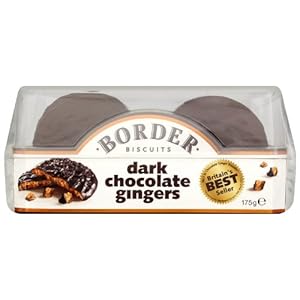
Dark Chocolate Ginger Sticks From The Chocolate CafeBorder Biscuits The Legendary Dark Chocolate Ginger 175 G (pack Of 6)While holidaying in London last month with my family, I got a chance to taste a variety of ginger-chocolate treats that no one in my family likes, which meant that I was able to eat the whole packet all by myself, like chocolate-coated ginger-flavoured Border Biscuits and chocolate-coated crystallised ginger sticks. The concept of a ginger-flavoured sweet treat combined with chocolate is definitely an acquired taste: either you are taken to it, or you don't want to go near it. Crystallised ginger is quite beyond the taste acceptability levels of the average Greek. The only time I've seen it here is in the possession of US Army officers: it is shipped into the Cretan US naval base which is stationed in Souda Bay in Hania along with all sorts of other items which I've never seen in the supermarkets (like vanilla essence, ribs, maple syrup and all sorts of other US staples that I'm not really familiar with).

If only these sweets were easy for me to reproduce, as they are definitely my kind of sweets. Maybe it's better that they aren't that easy to reproduce because I can imagine eating them all too regularly.

©All Rights Reserved/Organically cooked. No part of this blog may be reproduced and/or copied by any means without prior consent from Maria Verivaki.

Saturday, 24 December 2011

Merry Christmas! (Καλά Χριστούγεννα!)

To all my blog's readers:

 Καλά Χριστούγεννα! 
Merry Christmas!
Some interesting Greek Christmas trivia: 

* Christmas in Greece is never celebrated with the same fanfare as it is in the Western world; Easter is considered a more important feast than Christmas. 

 
This tree has been made with firewood pieces. 

* The traditional Christmas decoration in Greece is not the tree - it is the boat. The tree has also been adopted for Christmas due to its widespread global use. 

christmas boat hania chania
Every year, the city council of Hania erects this boat in the main square of the town. 

* The Christmas period in Greece is not a one-day event: it lasts from the first time the Christmas carols are sung (24th December) to the third time the carols are sung (Epiphany - the second time the carols are sung is New Year's Eve). At each different carol-singing period, a different carol is sung.

* Although kourambiedes are most often made at Christmas time in Greece, these sugar cookies are also popular as wedding biscuits, and are made year-round in other parts of Greece as the traditional biscuit of choice.
* Another traditional Greek Christmas biscuit in Greece is malomakarona, orange butter cookies that are soaked in syrup and topped with nuts. And in Crete, they are often called 'finikia': the term comes from the Asia Minor refugees who introduced it to the locals.

*Christmas is seen as more of a children's celebration. New Year's is a more significant day of celebration than Christmas: this is the traditional day for giving children their presents.

Store window in Skalidi St, Hania

Greece can't stay stuck to her past if she wants to forge ahead into the future. Sometimes it's hard to marry the traditional old with the modern new - but it has to be done.

The central market of Hania (Agora), decorated for Christmas.

See you again on New Year's Eve.

©All Rights Reserved/Organically cooked. No part of this blog may be reproduced and/or copied by any means without prior consent from Maria Verivaki. 

Monday, 12 December 2011

Olive oil cookies (Λαδομπισκοτάκια)

Every weekend, I check which of my newly-acquired cookie jars is emptying the quickest, and by Sunday evening, it will be filled with something freshly baked. My home-made ladokouloura are much cheaper than any kind of good-for-dunking medium-quality semi-sweet store-bought biscuit (unless you buy the generic LIDL or EUROSHOPPER label, where you end up with lots of broken cookies as well as many crumbs - good for making a cheesecake base, if only cheesecake were part of the traditional Greek culinary repertoire).

http://www.cookingforengineers.com/pics2/640/DSC_2767_crop.jpg
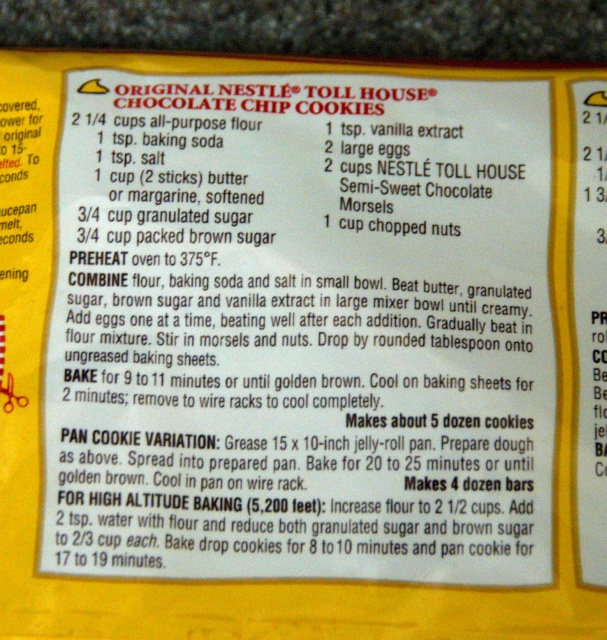
I was looking for a new idea for a good biscuit with which to fill my newly-acquired cookie jars, when I chanced on this grandmother's blog. She put up a different cookie recipe for a whole year. In her first post, there was no photograph to accompany the first recipe, where she gives her version of Nestle's famous chocolate chip toll-house cookies:
"My next cookie memory would be the ever famous, possibly all-time favorite, the chocolate chip cookie. There is nothing better than to bite into a round circle of baked dough sprinkled with gooey melt-in-your-mouth chocolate. A chocolate chip cookie can dry tears, heal broken hearts, mend scraped knees and elbows and solve sibling arguments. Most of the problems in the world could likely be solved by a properly baked, right out of the oven, chocolate chip cookie. The power of a cookie is underestimated."
I feel the same way when I see my children dipping their hands into one of the cookie jars.

Toll house cookies are expensive to make in Hania, where neither high-quality butter or chocolate are cheap, so I've adapted the basic recipe by replacing the butter with our own supply of olive oil. It works very well. Chocolate chips are available in Hania only as cooking chocolate drops by Samouri and Jotis (except possibly in the wholesale trade to bakers, confectioners, etc); they didn't melt when cooked. I got get cheap, tasty, nice-looking cookies that everyone really liked.

Toll house cookies are a kind of 'drop' cookie - the soft batter falls off a teaspoon onto the cooking tray. From previous experience, I prefer to bake chocolate chip cookies so that they are firm all over. Greeks don't like chewy soft cookies (that's just part of their food identity), so I use more flour than the original cookie recipe. For me (and most Greeks, I'd say), a chocolate chip cookie needn't be eaten immediately, because Greeks don't eat hot biscuits (another food identity element). Greek cookies always need sitting time when they come out of the oven. At any rate, the batter can be prepared in different ways: as a cookie, slice or even from refrigerated dough. 

The best aspect of the original recipe is that it is very versatile. You can add nuts (whole, chopped or ground), dried fruit, grated coconut, dark or white chocolate, spices and cocoa to the basic recipe and get a whole host of cookie variations, not only in taste but also in appearance. That way, no one gets bored of eating your home-made cookies. It's amusing watching the kids rummaging through the cookie jar to reach their favorite one before anyone else gets it, especially if it's the last in the jar.

For the basic cookie recipe (yields 70-75 pieces), you need:
3-4 cups all-purpose flour (~ 70 cents; I used soft, ie low-gluten flour)
1 teaspoon of baking powder (minimal cost)
1 cup olive oil (our own supplies)
3/4 cup white sugar (~15 cents)
3/4 cup soft brown sugar (~20 cents)
(or just use 1.5 cups of soft brown sugar)
1/2 teaspoon vanilla extract (~15 cents)
3 eggs (30 cents)
(The basic recipe also includes a teaspoon of salt - I don't use it)

Start off by combining all the ingredients EXCEPT the flour in a bowl and mix well. The oil needs to be beaten into the mixture till it emulsifies, as it often sits on the top because of its light weight. Then beat in the flour gradually, to get the right consistency for firm cookies. The amount depends on your location and the temperature, as the original recipe (see top photo, right) correctly notes. The mixture will look like a firm batter, or a loose dough. It's the effect of the olive oil. Don't let that put you off.


Classic dark chocolate chip cookies and snowdrop cookies (cocoa powder and white chocolate) 

Now comes the fun part: you can divide your batter/dough (depending on how much flour you added to the mixture) to make different cookie flavours. I usually divide it into two lots, to make two different cookie flavours. For a start, you can add 1 cup of ground walnuts, almonds or coconut for extra texture. Or, you could make any of the following combinations noted in the photograph caption below. I was able to make them with just half a batch of cookie dough, being extra careful to keep the cookies a regular shape and texture, in order to cook evenly. None stuck to the bottom of the baking tray (it was greased with olive oil).

If Bertie Bott (from Harry Potter fame) produced 'every flavour cookies', this is what an assortment pack might look like: choco-mint, quince spoon sweet, halva, choco-halva, coconut, chocolate chip, chocolate chocolate chip, orange, jaffa, walnut, coco-walnut, choco-nut, fig newton, ginger-walnut, and a couple more whose precise contents I don't remember.

Once you've made up your batter, drop your cookies with a teaspoon onto a baking tray. The dough can also be rolled in balls in your hand (as with my 'assorted flavours' cookies), which you can press down a little, to make the cookies spread out evenly. I can get about 20 cookies on one sheet, with enough space to spread. Bake the cookies in a moderate oven (about 180C) for 15 minutes for firm cookies, the way Greeks like them.

Happiness is... full cookie jars, and a weekly bundt cake for school lunches.

These cookies look almost festive for me, with their many colours, textures and flavours. The festive season is upon us and it came quite soon to Hania this year: winter set in early, following our early autumn's footsteps. By the middle of October, it was cold; by the beginning of November, we were using the heating system. Compare that to last year: in early December, we were thinking that we might be enjoying an outdoor barbecue on Christmas Day.

Cost per medium-sized cookie: about 5 euro-cents, if you have your own olive oil supplies.

©All Rights Reserved/Organically cooked. No part of this blog may be reproduced and/or copied by any means without prior consent from Maria Verivaki.