Showing posts with label stolen food. Show all posts

Wednesday, 4 January 2012

Stolen heritage (Κλεμμένη κληρονομιά)

"A news story has revealed that four out of every five bottles of Italian oil has been adulterated with olive oil imported from other countries. However, countries such as Greece, which export their oil to Italy, have long known of the practice." Indeed, Greece has long known about this practice. In fact, Greece (as a country) prefers things to be this way:
"Italian oil is mixed with cheaper oils that do not yield as many euros from the olive press, due to the smaller import demand of high quality virgin oils from other nations such as Greece, which is less adept at marketing its own oil. Greek olive oil is bought by unscrupulous Italian producers and mixed with their own. Greek presses are notable for only pressing the olives once and exporting the residue."
Greece (not Italy) produces the best olive oil in the world. Italy (never Greece) needs to import quantities of the product she exports. As soon as Greece produces the best olive oil in the world, she quickly finds a buyer for it (her neighbour, the third largest economy in Europe and the 8th largest in the world). Pocketing the money, she pats herself on the back and then rests until the following olive season, when the process is repeated. So it's a Greek problem too; the way Greece rests on her laurels without searching for new ways to continue to market or brand herself, as Peter Economides says, has actually helped the situation. 

Picture: Peter Economides
Through my proof-reading work at Mediterranean Agronomic Institute of  Chania (MAICh), I've been reading papers/reports/Master's theses for the last ten years showing the extent of olive oil adulteration, the adulteration that takes place in the olive oil industry with other oils from other countries, and the most recent laboratory tests for olive oil adulteration. The latter takes two forms: checking whether olive oil has been adulterated with other oils (eg mixing olive oil with hazelnut oil which has virtually the same DNA), and checking if olive oil has been mixed with lower quality olive oils (eg mixing Italian olive oil with Greek olive oil). Tests are being created to detect not just the olive species, but also the location of the tree. These tests have all grown out of the new demand for PDO labels (Protected Destination of Origin), which are all big business in the food industry: it's not enough to eat well, but you are willing to pay for the status of the food. 

It must sound strange to the ears of the ignorant, but it is absolutely true - exported Italian olive oil is hardly ever just Italian olive oil. The next time you buy bulk olive oil bottled in Italy, you can be sure that a large amount of the oil in that bottle is actually from Greece. Here's an extract from a pre-crisis study by MAICh (2008):
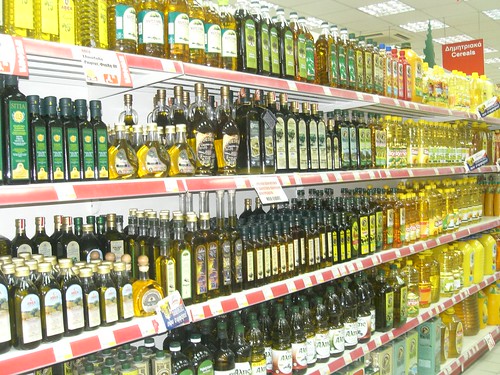
olive oil INKA supermarket
INKA supermarket
"Greece devotes 60% of its cultivated land to olive-growing. It is the world's top producer of black olives and boasts more varieties of olives than any other country. Greece holds third place in world olive production with more than 132 million trees, which produce approximately 350,000 tons of olive oil annually, of which 75% is extra-virgin. This makes Greece the world's biggest producer of extra-virgin olive oil, topping Italy (where only 40-45% of olive oil produced is extra virgin) and Spain (where only 25-30% of olive oil produced is extra virgin). About half of the annual Greek olive oil production is exported, while only 5% of this quantity reflects the origin of the bottled product. In other words, only 5% of the Greek olive oil is exported as a trade mark and the rest is exported as a raw material while being processed and bottled in different countries, mainly Italy. Greek exports primarily target European Union countries, the main recipient being Italy, which receives about three-quarters of total exports."
My Italian friend in the US was shocked when she read this, as she'd been buying Italian olive oil for many years:  
"As soon as I read this post, I went and got my bottle of olive oil to read the label. Sure enough, even though it says 'product of Italy' on it, when I read the fine print (with a magnifying glass -- no kidding), it reads that 'this product contains select high quality oils from Italy, GREECE, Spain, and Tunisia.'"

When Paula next went to her Oregon supermarket, she bought extra-virgin olive oil from Hania.
Since then, the heat is on to find the most foolproof way of detecting olive oil adulteration. Such advances in knowledge and technology have led to greater success in the fight against the adulteration of olive oil. Progress in DNA technology can now detect whether olive oil is purely from one region as well as being able to identify purely extra-virgin olive oil and adulterated oil mixtures (ie olive and non-olive oil mixes):
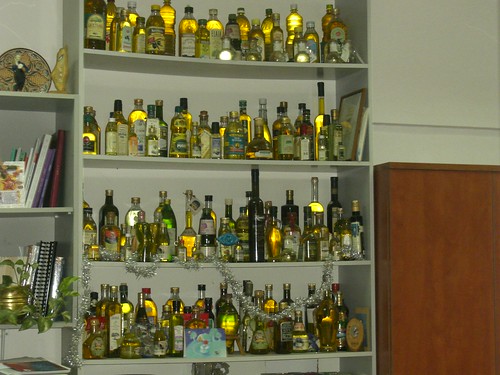
olive oil MAICh
Collection of olive oil at MAICh
"The authenticity of products labeled as olive oil has become an important subject from both commercial and health aspects. Olive oil has recently gained in popularity because of its quality, potential health benefits, and its strict purity control. From a commercial point of view, olive oil commands high market prices because of its production costs and an increasing consumer demand. Price is a determinant factor in a permanent problem of adulteration, which is found in the case of olive oil (Harwood, J. and Aparicio, R. eds. 2000. Handbook of olive oil, analysis and proprieties. Gaithersburg Maryland: Aspen Publ. Inc; cf Meriem Aoun, 2011, Study on the limit of detection and the storage effect of DNA-based methods for the authentication of olive oil, M.Sc. thesis, MAICh.)
Just last month, I read a new report on olive oil and fruit & vegetable marketing principles. The findings of this report uncovered a host of EU anomalies, giving me quite a few chuckles as I proof-read it. As my boss says, "You're really lucky to get to read so much newly published work. Who else gets the chance to have first access to so much new information?" It's time I shared this in a blog post, with a sprinkling of Organically Cooked humour (in red). 

- The world's biggest olive oil producing nations: "Spain, Italy, Greece, Turkey, Tunisia and Syria, in descending order, are the biggest olive oil producers in the Mediterranean region and also the world, since they concentrate 88,5% of world production, with Spain alone providing almost half. Surprisingly, it is the two largest producers, Italy and Spain, which have the greatest olive oil imports, in part because they re-export the imported oil." Conclusion: Spain and Italy, the world's greatest olive oil exporters, can't produce enough oil for their needs (even though they consume only half the amount per capita as Greece who is a non-importer), so they import it from other countries.

- Exporters of olive oil: "Although during the period 2009-2010, Germany imported only about 7.1% of the world’s imports of olive oil (the majority of olive oil in the German market is imported from Italy, followed by Greece and Spain) and consumed about 2.1% of the world consumption, it is considered to be a very dynamic market. Germany also exports virgin olive oil, in small amounts to Austria and the Netherlands." Conclusion: Instead of buying straight from the producer, Northern European countries sell and re-sell olive oil to each other.

- Importers of olive oil: "Olive oil import activity in the Netherlands is mostly in the hands of big multinationals which have developed similar activities in the global market. ‘Bertolli’ (mentioned in the hazelnut olive oil swindle) is an Italian-based 100% daughter of the Anglo-Dutch Unilever-Bestfoods. In 2008, Unilever sold its Bertolli olive oil and vinegar business to Grupo SOS, Spain's second largest food group. Although ‘Bertolli’ is marketed through promoting its Italian origin and lifestyle, the raw product (olive oil) is imported from Spain, Greece and North African countries." Conclusion: Italian olive oil is made in other countries.

bild
LIDL's Prima Donna olive oil
- Labeling of olive oil: "Labeling of olive oil on German packaging contains information on the category of the oil (eg 'extra virgin'), filling quantity, expiry date, address of the producer, bottler or trader and regional origin in the case of oil with PDO or PGI. But most German olive oil is labelled 'extra virgin', even bottles of supermarket private-label olive oil (eg LIDL, ALDI), which suggests 'high quality' to the German consumer. Since consumers are generally not able to distinguish between the different qualities within the category of 'extra virgin' olive oil, most of them are not willing to pay more for the same perceived quality." Conclusion: Germans think they are buying 'extra virgin olive oil' when they shop for it at cheap supermarkets like LIDL.

Gamma olii
Bertolli olive oil
* Wording on the label: "Olive oil exporters, traders, wholesalers and other olive oil suppliers  sometimes use carefully selected wording to create a higher product image which in reality it is not, so as to increase the market value of that particular product, while if rules were kept stricter and terminology had been constrained to commonly accepted official terms (IOOC terminology), such misleading wording would have been avoided. The misleading labels that are commonly used are: imported from Italy, bottled in Italy, product of Italy, 100% pure olive oil, light (or lite) olive oil, from hand-picked olives, cold pressed or first press." Conclusion: As long as a word is being used in a technical (but not necessarily literal) sense, then it's legal (even if misleading).

http://www.masdesbories.com/assets/images/DerFeinFraudP1B.jpg
- Extra virgin olive oil: The magazine “Der Feinschmecker” tested eight different extra virgin olive oils. Four were being sold under the private label of cheap supermarkets and the other four belonged to expensive producer brands. Using the state-of-the-art Serani analysis (Greece has been using this since 2001), it was proven that in the case of the four supermarket brands, the 'extra virgin' labelling was misused. Two different labs found that heat treatment had been used in the four cheaper olive oils (LIDL's and ALDI's were among them), which should therefore not be marketed as extra virgin, but as refined olive oils. But using traditional analytical methods, all eight olive oils were legitimately classified as extra virgin olive oil. Conclusion: Cheap supermarkets are technically able to sell cheap 'extra virgin' olive oil.

What does all this amount to? Unfair practices and unfair competition. Worst of all, the most significant marketable commodity, a vital element of the identity of Greece, is bring robbed from its rightful owners. 100% Greek olive oil is still being sold in small 'boutique'-style bottles instead of the bulk quantities, which is how most Mediterraneans buy their olive oil outside producer countries. Only Spanish and Italian olive oil is sold in this way, seaking of which, it probably isn't 100% Spanish or Italian olive oil in the first place. All these oils are inferior to Greek olive oil which is produced at the extra-virgin quality 80% of the time

The problem of Greece's marketing strategies is slowly being rectified... albeit very slowly. But her extended EU family have to show some φιλότιμο and not constantly sell out her image. In all the scientific reports that I've had the work-related pleasure of reading about olive oil, only Greek olive oil is lauded to any extent. No other country in the Mediterranean produces the amount of extra virgin olive oil as Greece does, no other country produces so many different varieties of olive and no other country in the world does not import olive oil. Only Greece, with the highest per capita consumption rate of olive oil in the world*, twice that of Italy and Spain, has these privileges. In the transparent world we live in, it's only a matter of time that this will become more widely known; the good thing about the internet is that time is not a factor any more - with web-based information dissemination, the word spreads very fast. Of course, you don't have to eat olive oil to live a long healthy life (the Okinawans' longevity rate probably has little to nothing to do with olive oil), but it might help.

To learn more about the fraudulent practices of the Italian olive oil industry, you may be interested to read Tom Mueller's book about it.


Coincidentally, the Guardian published an article on Italian olive oil fraud on the same day I posted this.

*In our home, we go through approx. 120-150kg of olive oil per year - divide that among 5 people.

©All Rights Reserved/Organically cooked. No part of this blog may be reproduced and/or copied by any means without prior consent from Maria Verivaki.

Friday, 1 April 2011

Myths and legends associated with Greek cuisine (Mύθοι και θρύλοι)

The 1st of April is the day that people around the world generally recognise as a day when it is permissible to lie, so today I will present some myths concerning the subject of Greek food. I recently came across a chunk of web text, whose every idea I dispute: 

"Since most Greeks don't barbecue at home (this applies to urban/apartment dwellers; non-urban/single-dwelling Greek houses always have some sort of BBQ installed in their yard), Tsiknopempti is one of the busiest restaurant days of the year (this may be true in Athens, but August 15th is far busier in most other parts of Greece - this day falls in the middle of summer, when Athenians are usually away from home, on holiday, somewhere in rural/island Greece). Most Carnival specialties are made during the final week (highly unlikely; in Crete, at any rate, they're made throughout the year!), when cheese and dairy are embraced (as they are all year!!) in preparation for the 40 days (it's NOT 40 days!!!) of Lenten abstention -- many Greeks still observe the period's traditional rigorous fast (this statement does not take into account the modern meaning of fasting in the Greek context).

This is how myths are born: by perpetuation. And there are plenty of way to perpetuate myths, the common modern one being the internet.

Let's start with feta cheese.

The most popular cheese in my house is feta: it is produced in Central Greece.
Wikipedia tells us that the first recorded instance of this kind of cheese was found in Crete: "Feta cheese is first recorded in the Byzantine Empire under the name πρόσφατος (prósphatos, "recent", i.e. fresh), and was associated specifically with Crete. An Italian visitor to Candia in 1494 describes its storage in brine clearly." While this is the oldest reference to white brine-preserved cheese (like feta), the entry also tells us that the name of the cheese (φέτα: feta = 'slice') came into use in the 17th century, even though the 1494 cheese reference is the precursor to feta. Nowhere does the wiki entry for feta mention the importance of this cheese in Northern Greece today, while it has never been associated with Cretan cheesemaking in modern times (a very few dairy stations on the island make their own local non-PDO with their limited supplies of sheep and goat's milk). Yes, I know that wikipee can be edited by any Tom, Dick or Harry, Maria included, but I'm still waiting for the expert on feta cheese to do this, and that's not me.

Moving on now to souvlaki.

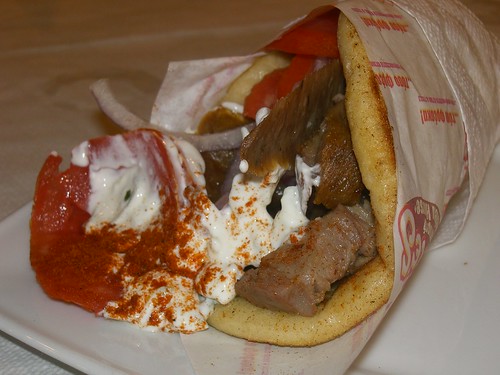
souvlaki
A Greek favorite right around the country

We find more wiki pee under the entry of 'gyros', what most Greeks will call chopped meat wrapped in pita bread (as opposed to skewered meat - that's also termed 'souvlaki' in Greece): "There are several stories regarding gyros' origin: One says that the first "gyrádiko" was "Giorgos" who brought gyros to Thessaloniki in 1970; another story says that döner was first introduced in the 1950s in Piraeus by a cook from Constantinople." Hang on! My husband remembers eating gyros in Hania nearly 50 years ago! History of Greek Food tells me that an Armenian (Isaak Anispikian) probably opened the first souvlaki-kebab shop in Nikaia (a suburb of Athens) in 1924 - note that this was after the population exchange between Turkey and Greece in 1922. And let's not forget the actual origins of gyros: souvlaki comes from οβελίσκος (oveliskos), meaning the spit used to roast meat, from Ancient Greece. 

Still on the subject of souvlaki, what kind of meat does a typical souvlaki contain: lamb, pork or beef?

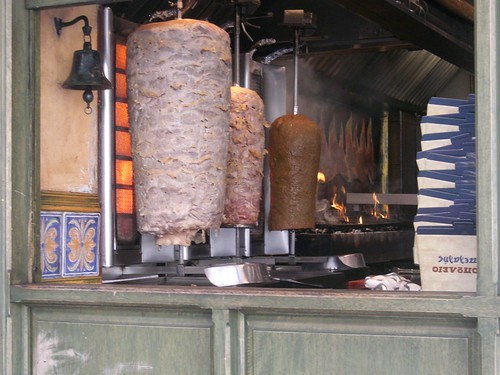
doner kebab thessaloniki
A souvlatzidiko in Thessaloniki, offering both pork (the first two meats) and beef (the smaller round) souvlaki

This one causes the most confusion abroad. The precursor of  the modern 'souvlaki' was the 'doner kebab', which was made with beef. Beef continued to be a meat choice in Greek souvlaki, but pork also made inroads in this sector. For a start, it was cheaper than beef, and Greeks don't have a religious reason not to eat pork, as did the Muslim Ottomans where the idea of the doner kebab started. Souvlaki is still generally a pork dish in Greece; it's only in the last 4-5 years in Crete that beef has suddenly reappeared in the souvlaki trade (still only available in the larger souvlaki shops). In any case, it is never made with lamb, as it is in the souvlaki shops of many Greek communities abroad, notably those of Australia. The different meats used in each different country to make souvlaki often reflect the cuisine of that country, rather than the origins of souvlaki. In the last 15 years, chicken is also offered in Greece, as a healthier alternative to pork.

Here's a good one: did you know that hummus is a Greek food?


"Of course hummus is Greek, Maria," you reproach me, "it's on every single menu card in Greek restaurants" - in America, the UK, et alia, right? It's never actually found on a Greek taverna menu in Greece. As Mariana Kavroulaki rightfully pointed out to me through my facebook page, no Greek yiayia living in Greece will know how to make hummus; it's eaten all over the Mediterranean and the Middle East (Cyprus included) - but not in Greece. Ask the average Greek what χούμος (hummus) is, and I'm sure they'll say 'soil'. The only aspects of Greek life that Athenos actually got right in their series of three advertising spots for hummus were the Greek yiayia's clothes and the Greek landscape. The word 'yiayia' is pronounced incorrectly (it should be yiaYIA, not YIAyia), and the average Greek yiayia - at least from Crete - would never accuse a well-dressed young girl of being a prostitute, nor would she tell her that she will go to hell if she is unmarried and living with her partner. The ad with the house-husband will simply be dismissed as a case of the impossible: few Greek couples can afford to live in relationships where only one partner works.

Can Greek yoghurt only be made in Greece?

If you want your Greek yoghurt to be 'Greek', you need to make sure that the milk used to make it was also produced in Greece; wording like this ('from 100% Greek milk') makes economic sense.

Unlike feta cheese which has a PDO status and can only be made in certain places in Greece, Greek yoghurt does not, which is why Greek yoghurt is found all over the world. Coincidentally, we never say 'Greek yoghurt' in Greece; we call it σταγγισμένο (στραγγιστό), straggismeno/straggisto, meaning 'strained'. The phrase 'Greek yoghurt' has now become synonymous all over the world with strained (ie Greek-style) yoghurt. Strained yoghurt in Greece isn't always made with milk originating in Greece (a well-known yoghurt manufacturer in Greece uses a mixture of cow's milk imported from Germany (50%), France (25%), Holland (22%) and Italy (3%). But this isn't necessarily a bad thing; there are worse ways to produce yoghurt; the more informed you are, the more informed choices you will make.

Misunderstandings occur both ways. For example, what is the average Greek person's idea about 'toast'?

DSC02991
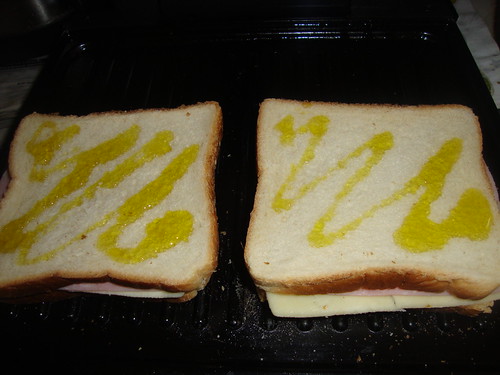
My children still think of this as a 'toast': cheese and ham toasted sandwich (drizzled with olive oil).

Just as many people misunderstand Greek food and confuse it with similar kinds of food served abroad that are passed off as Greek, most Greeks living in Greece are horrified when they eventually find out that the English word 'toast' consists simply of a toasted slice of bread from a square loaf. What Greeks think of as toast (they call is 'tost') is in fact a toasted sandwich.

And now for the icing on the cake. A US reader recently asked me: "We've been to Greece four times in the past five years, and every time we eat at a taverna, my mom asks the owner if the bread they serve is truly Greek bread. My mom is convinced that she read somewhere that Greece imports its bread from African now and no longer has bakeries that make the bread on the premises. She insists she read that somewhere back in the 80s. Do you know anything about this? Could this be true?"

Yes, of course the bread Greeks eat comes from Africa. Greece no longer has bakeries. Happy April Fool's Day. (Χαλασμένα τηλέφωνα* all round...)

*** *** ***
There is a lot of misinformation out there in the web world, where anyone can write anything they want, without making any reference to previous research, without providing any evidence or empirical observations. Opinions are often understood as generalisations, and untested hypotheses are taken as facts. Students, scholars and laypeople are all taught to embrace the web to get access to the latest information instantly, but few people are taught to scrutinise the information they access. A lot of what is believed about Greek food in wider 'foodistic' circles is often based on generalisations and/or biased sources as well as cases of misreporting. Current food trends in Greece are not being taken into account in the wider web-based literature on Greek cuisine, possibly due to the language barrier: Greeks generally read in Greek, so they are unaware of the dissemination of misinformation, while non-Greeks usually look for their sources in another language (mainly English), hence the mix-up.

This short video will introduce you to a number of Greek food blogs available on the web. More will have been added since it was produced. To find one of the websites, note the name and look it up as a search string. 

The urban/rural differences of Greek citizens, the different approaches to Greek cuisine taken by the Greek diaspora, the regional differences inherent in Greek cuisine due to the geography of the country, and the recent economic turmoil that the country is facing do not help to avoid the rise of a very generalised view of what Greek food is all about. The worst consequence deriving from this confusion is the misunderstood nature of the Greek identity itself.

To find out what is really truly happening in the Greek food scene in Greece and abroad, the blogosphere is the place to go. Restaurants and tavernas may sound like good places to check out the scene, but that's going to work out to be more expensive for your pocket: turning on your computer is much easier and more satisfying, as the array of food porn begins to jump out of the screen! More importantly, Greek food blogs are generally not commercially slanted, which means that the writers are genuinely interested in passing on a food-related message or recipe to the reader. By looking up Greek food blogs on the web, you will get a feel for what is genuinely being cooked in Greek homes around the world.

Vicky Koumantou, representing GreekFoodBlogs, recently appeared on Greek TV spotlighted the growing Greek food bloggers' movement. Among the many good points that Vicky makes, I've chosen to highlight the following
'There is now no excuse not to know how to cook', 
'You can continue to cook your mum's traditional meals without referring to your mum', 
'Greek food blogs show the direction that Greek home cooks are heading towards, whether they cook with different ingredients to those of the past, or if they use international recipes',
'A blog recipe index is like a cookbook', 
'A food blogger's work leaves behind food memories that children may have grown up with',  
'Later generations will cook and eat more consciously: our mistakes will remain lessons for them'
And finally, the most environmentally-friendly but controversial in marketing terms:
 'Why write a cookbook when you can write a blog more easily, making it instantly accessible instead of worrying about distribution?'

When I first started writing my own blog nearly four years ago, there were already a number of Greek food blogs being written. The English-language Greek food blogs were mainly written by Greek food bloggers outside Greece. Numbers have now grown to around 200 Greek food blogs, 30 of which are written in English. Vicky Koumantou, representing GreekFoodBlogs, says: "The culinary Greek tradition is reflected through Greek food blogs, as it passes from one generation to the other, from grandmother to mother to daughter. It's humble cooks like those who have kept the hearth lit in Greek homes; they're the ones that lay the table at home every day for their families, providing love through food."

Greek food bloggers have their very own portal, GreekFoodBlogs, which unites all Greek food bloggers around the world on one site. The first Greek food bloggers' camp took place in Athens on 16th October, 2010, which gave Greek food bloggers a chance to meet each other and share ideas. Greek food blogs are growing in number, and this should come as no surprise: a) Lonely Planet listed Greek cuisine as one of the best in the world for travellers, b) the Mediterranean diet, often associated with Greece and in particular Crete, is propounded by health specialists as one of the healthiest diets in the world, and c) Greeks have one of the greatest rates of longevity in the world, mainly attributed to their diet, among other factors.

So what are you waiting for? Cook Greek - you have no excuse not to!

*Chinese whispers: lit. 'broken telephones', said when the original meaning of a message is lost through widespread misreporting.

©All Rights Reserved/Organically cooked. No part of this blog may be reproduced and/or copied by any means without prior consent from Maria Verivaki.
Monday, 10 January 2011

Fusion (Σύντηξη)

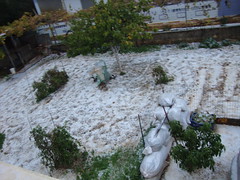
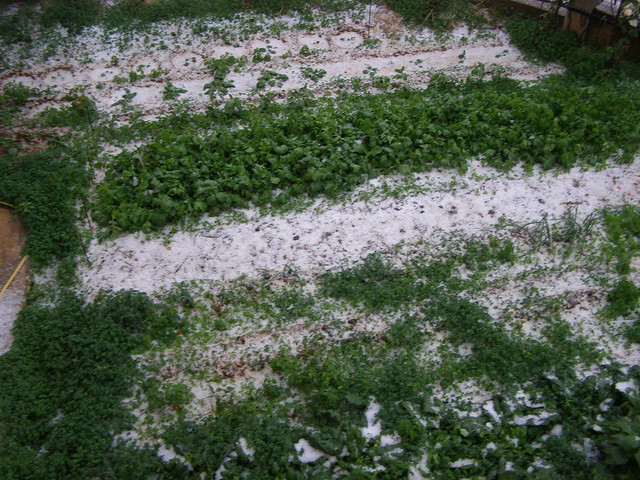
A month ago, on December 10, 2010, to be exact, all of a sudden, one heavy hailstorm left its mark on our garden...
DSC02329 DSC02352
 My husband has just managed to spread discarded post-harvest olive leaves over the garden when the rain started; by the early afternoon, the rain had turned into snow.
 
... in such a way that all that precious organic spinach growing in the garden was in danger of suffering severe frostbite.

PC110020
Our snow-covered garden

Snow is fun to look at, but it's very damaging to vegetable gardens in the Mediterranean. We began pouring water with a hose over all the crops so that the frost damage could be minimised. But alas, the water was so cold and icy, that the snow on the crops just kept crystallising. The other alternative was to pull out the spinach, which was ready to pick in any case, and process it in any way we could.

DSC02364
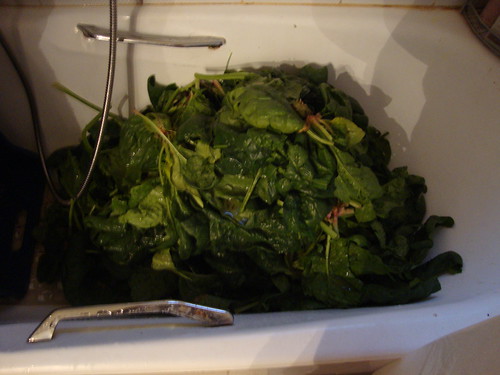
After bringing it into the house, we put it in the bath tub to warm it up and wash it - there was no other space large enough to accommodate it!

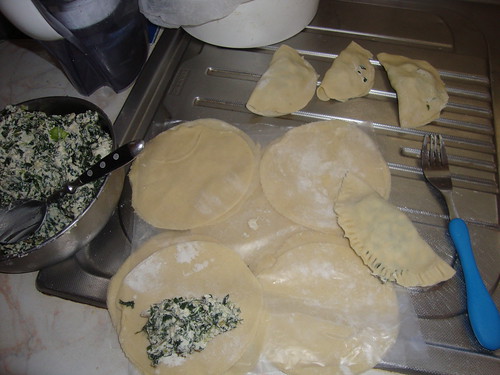
Such high-quality fresh produce, raised purely on natural fertiliser, must be used wisely. Organically grown pesticide-free produce, grown with natural fertilisers and rainwater, without the use of any kind of chemicals, costing only the personal labour invested, is very hard to come by these days, and it's a shame to let it go to waste. After making some spinach-mizithra kalitsounia with some home-made pastry...

DSC02029
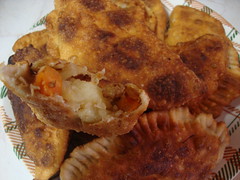
I always make kalitsounia in large batches because they freeze well, and they require a lot of work. Mine never really come out looking very pretty, but in home cooking, taste matters more.

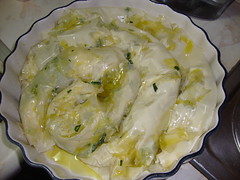
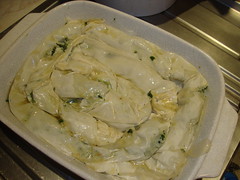
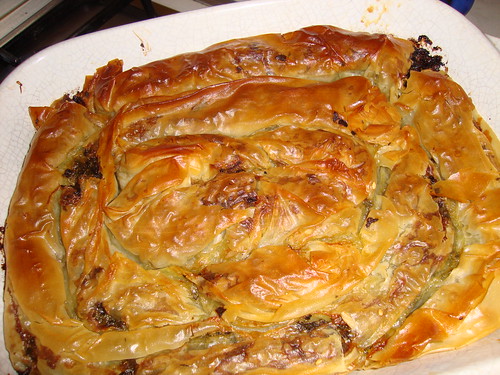
... I was still left with some spinach-and-cheese mixture. Just the idea of kneading and rolling out more home-made pastry made my hands hurt. Spinach-cheese filling lasts for a couple of days in the fridge, so I waited till after the weekend to buy some filo pastry and made some strifti (twisted) pies, which freeze well.

Working with filo pastry can be a nuisance because the filo is very fragile - but this has no effect on the end result...
DSC02284 DSC02286
... which is always delicious.
DSC02287 

In this way, I managed to use up the spinach-mizithra filling, but not all the store-bought filo pastry. This is a persistent dilemma in my kitchen: either there is too much pastry, or too much filling left over! Filo pastry stored appropriately (keep it away from moisture, don't leave it unwrapped as it dries out and cracks) lasts for up to ten days in the fridge.

DSC02290

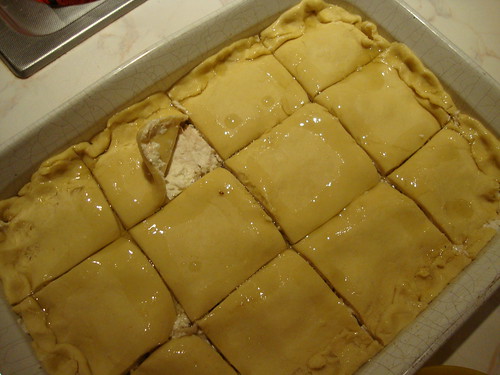
The following week's menu contained chicken pie, prepared in a similar way to the meat pie often made in Crete at Easter. This pie uses a yeast-based dough made with the stock from the boiled chicken, whose meat is then used to fill the pie, along with a variety of cheeses. The pie was a resounding success, but once again, I ended up with leftovers: instead of extra pastry, this time I was left with some extra chicken-and-cheese filling.

DSC02311
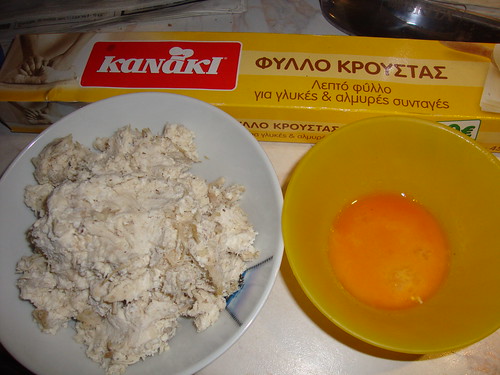
Leftovers from two different pie-making rounds (the beaten egg did not end up being used in my fusion creations).

I could have baked another chicken pie using the remaining filo pastry, but that would mean cooking the same meal again, and a little too quickly after the last time I had served it. The more you have something, the more boring and common it becomes, even if it is made from fresh high-quality ingredients. My most interesting home cooking usually involves thinking up of ways to use leftover ingredients. Wontons - I haven't had those in ages - came to my mind: crisply fried bite-sized pastry filled with just about any filling that takes your fancy, made with anything at hand, and dipped in a hot sauce. With a bit of advice from Facebook friends and a whole host of graphic ideas from the internet, it wasn't too difficult to fuse a variety of culinary ideas and create an original Asian-inspired meal out of my leftovers.  

DSC02313 DSC02314
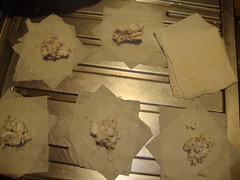
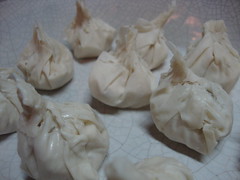
The filo pastry was cut into squares: one square was laid on top of another, as filo pastry is thinner than wonton pastry, and it would not have been strong enough to withstand the weight and density of the filling.
DSC02338
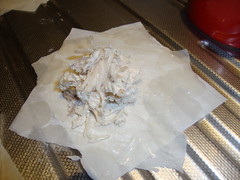
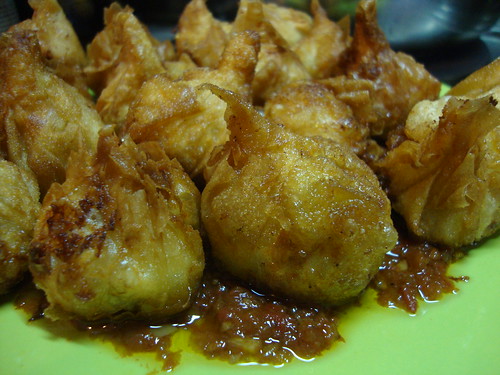
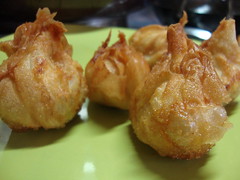
A teaspoon of filling was placed in the centre of each square, which was then sealed like a 'pouch'. This formed a sturdy packet when deep-fried. The cooked wontons were then placed on a bed of spicy tomato sauce. When I presented these photos on my Facebook page, my favorite comment was from a Greek-Chinese Facebook friend: "These look SO Chinese!"
DSC02316 DSC02337

I often find myself fusing local ingredients with various culinary techniques because this is the closest I can get to my favorite tastes, the kind of food that I once used to order from a take-out before I lived in Greece. Leftovers also work very well in Asian-Mediterranean fusion meals, as in my spring roll kalitsounia and pad Thai creations. Possibly due to the wide variety of fresh food grown on the island, such meals aren't difficult to recreate in a Mediterranean kitchen or adapt them to Cretan cuisine; most herbs and spices from all cuisines are available in various forms, and local herbs and spices can also replace them, giving a more homely taste to a new culinary creation.

samosa samosa
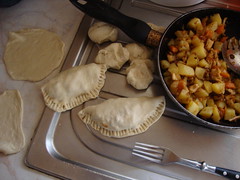
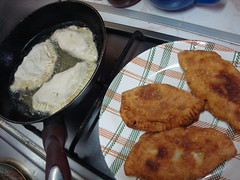
The Indian samosa is generally a spicy vegetarian filled fried pastry triangle. Due to time constraints, I decided to stick to my regular half-moon shapes when I made mine (rather than learn a new way to filling pastry). I made my Indian-flavoured pasty pie using leftover boiled chicken, with cubed par-boiled potato, chopped onions, crushed garlic, and a mixture of appropriate spices (crushed fennel seeds, crushed cardamon seeds, chili pepper, cumin, fresh ginger). Samosa dough is not much different to Cretan pastry; a firmer (and darker) dough is made by adding vinegar and wholemeal flour. Although not strictly a samosa, my Indian-flavoured kalitsouni (or Cretan samosa, or even Indian-flavoured Cornish pasty) creation could be used as the basis for a Greek-style samosa by changing the spices. 
samosa samosa
On a funnier note, my son (whose culinary preferences are very limited) grabbed one of my samosas without a second thought: he had no idea of the contents, but the shape, to him, was unmistakeable! I knew what would happen after he tasted it: and it did happen - can you blame him?!

My Mediterrasian creations are a bit of a tease for my eaters: To the average Greek, such offerings are difficult to place for one of two reasons: at first sight, their appearance may look quite different to the way Greek food is usually presented, but the aromas and flavours are recognisable, as in the case of my wontons; or vice-versa - the food may 'look' Greek, but on the first bite, the difference in taste will be pronounced, as in the case of my Asian-flavoured souvlaki, or my samosa-flavoured kalitsounia. I suspect that my own versions of pad Thai and spring rolls will look enticingly recognisable to Asians, but I wonder what they will think when they taste them.

*** *** ***

The idea behind fusion in cuisine is, generally speaking, the combination of the culinary traditions and ingredients of two or more cuisines to create a novel dish rather than a whole new cuisine, with its own set of rules. Wisegeek and Wikipedia both define the term just as loosely as the creations that often come out of fusion cuisine. My own examples of fusion cuisine are founded in Wikipedia's third definition: foods with a form based on one cuisine, but prepared using ingredients and flavors inherent to another cuisine. The most important aspect of successful fusion cuisine is that it is based on cultural groupings of cuisine, and not just the whims and fancies of a creative chef: the latter is often jokingly referred to as 'con-fusion cuisine', which to my mind is a good term to describe some crazy recipes that use a mish-mash of ingredients and techniques that do not seem to blend together. Food bloggers are the biggest culprits of this kind of creative cuisine: since when did white wine, saffron, whipping cream, Greek yoghurt, harissa, fennel seeds, paprika, cocoa powder and mastic gum ever come together to form a chicken mole served with fettuccine*?!

Permanent fusion cuisine is more likely to take place when different cultural groups are in constant contact with each other. An inter-racial marriage can unknowingly become an instigator of a more successful fusion of cuisines, possibly out of a desire to please a spouse, by marrying the cooking skills one possesses with the availability (or not) of ingredients. Such cuisines do not always become documented if they stay in the home at a personal level, and the home is where they may stay. Just like the most fluent bilinguals, the most fluent 'bi-cuisinals' will probably have been immersed in the two (or more) cuisines that they work fluently in and out of. That's basically why I'm not bi-cuisinal in New Zealand and Greek cuisine. I grew up in a household that used the food products grown and imported by one country, which were prepared and cooked in the manner of another culture. I haven't a clue how to make gravy. Why should I? My mother never made it, I probably ate it less than half a dozen times in my life, and I don't think my family feels the need to discover it.

fusion?
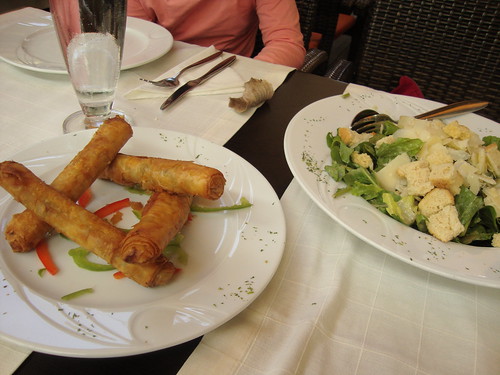
I found these Mediterranean-filled spring rolls on the menu of a local pizza-pasta restaurant, the kind of place one would expect to see fusion/global food trends; we all take delight in seeing something new in our food when we eat out.  

Fusion cuisine is not actually a new idea; it has been happening since time immemorial as groups of people invaded new territories and discovered new ingredients as well as picking up new cooking techniques. The fusion of culinary regimes is probably how various modern-day cuisines developed, even though they are never called 'fusion' cuisines; for political purposes, we like to name our cuisines according to the name of the country or race we associate ourselves with. Cuisine fusions have continued right up to the more peaceful contemporary times with migration. Hawaiian local food sounds like a good example of a harmonious form of fusion cuisine. But the development of new cuisines is now increasingly disappearing, with the inevitable move towards global eating habits: as the world develops, there are few places left where people can't generally eat anything, anywhere and at any time these days.

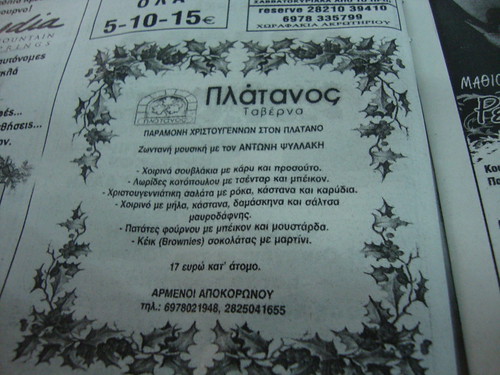
christmas menu
The Christmas menu at this taverna (located in an area where there are many resident Brits) represents a fusion of Greek cuisine with foreign ingredients, veering towards global eating trends, presented in the style of a French menu: curry pork souvlaki, chicken strips cooked with cheddar and bacon, pork and apple cooked with prunes, roast potatoes with mustard and bacon, brownies and martini for dessert; this menu is specifically geared towards the foreigners living in the area, but it may even be an enjoyable experience for the locals that attended with them.

Various internet sources will tell you that the fashion in fusion cuisine began with the blending of European (Western) and Asian cuisine, two radically different cuisines in taste, technique and texture, whose common ground is based on the wealth of fresh ingredients used in their traditional food. Modern Greek restaurant cuisine as the West knows it (as opposed to the personal kitchens of the modern-day Greeks) is probably a fusion development of some kind between Mediterranean and Asian-Minor cuisine; neither are purely European or Western cuisines in the first place, and they were both originally developed from their own roots and conquerers. One of the more interesting and more recent fusions I've heard about is the Chinese-Indonesian restaurant tradition in Holland, due to the occupation of Indonesia by the Dutch, which has altered Chinese restaurant food in the Netherlands, giving rise to novel dishes like Chinese kebabs with peanut sauce. It's easy to argue that this kind of cuisine is more like a 'dialectal' version of the original cuisines used in the fusion, rather than a new whole cuisine, but that depends on the way the words 'fusion' and 'cuisine' are understood. Some would even argue that there is no such thing as cuisine, in the same way that they may argue that there is no such thing as a separate Greek cuisine, claiming instead that it is Turkish/Ottoman in its origins.

Fusion works well with the kalitsouni, what we call our small pies (pasties) here in Crete. All over the world, pastry (made from the ground grain of choice, mixed with water, maybe a small amount of fat and salt/seasonings) can be rolled out into any thickness, moulded into any shape, and filled with any available ingredients. There are few cultures in the world that do not have some kind of small filled fried (or baked) pastry dish. Call it a samosa, call it a kalitsouni, call it a pasty: it's one of the most secure ways of sealing your food without too much excess weight and undesirable waste, as all parts of a pasty are eaten. What would street food be like without it?

*I have purposely omitted the link here.


©All Rights Reserved/Organically cooked. No part of this blog may be reproduced and/or copied by any means without prior consent from Maria Verivaki.
Sunday, 21 February 2010

War (Πόλεμος)

I'm looking forward to visiting London's Imperial War Museum to see the Ministry of Food exhibition about food rationing and 'digging for victory' in Britain during the Second World War; here's a brief account of my mother-in-law's experiences in Crete of food shortages at that time. She turns 86 this year.

"Food coupons? No, we didn't have any of those where we were. I have heard something about them being used in Athens where they had no food, but in the villages where we could grow or raise something of our own, we never had such coupons. When the Germans came, they took all our food away from us. From one day to the next, we were thrown into the depths of poverty. Our food supplies were confiscated for the use of the German army*, we were told, and there was a war on, so we had no say in the business. In those days, you did as you were told, there was no discussion or thought about the matter, you just did as you were told and that was that. They took away all our animals, so we had no milk, no eggs, no meat, for a long time. We could go and pick the fruits off our trees in our orchards, but if the Germans saw us on the road carrying them back to our house, they'd confiscate them. We used to buy our grain, rice, sugar and other staples that we didn't grow ourselves from Hania, by trading our orchard produce, but when the Germans came, if they saw us riding our donkeys loaded with oranges in the koffinia**, they'd stop us on the road and take it. Our food was now the property of the German Army. So we couldn't bake bread; all the grain was confiscated, so we had no flour. We couldn't even make a pita. Every now and then, when my brother received a work order from the Germans, he was given a loaf of bread as payment. He would be asked to help carry something or build something or clear road, anything the soldiers told him to do. That's when we saw any bread in our house...

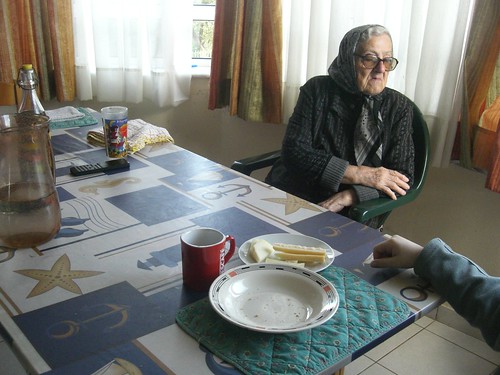
grandmother
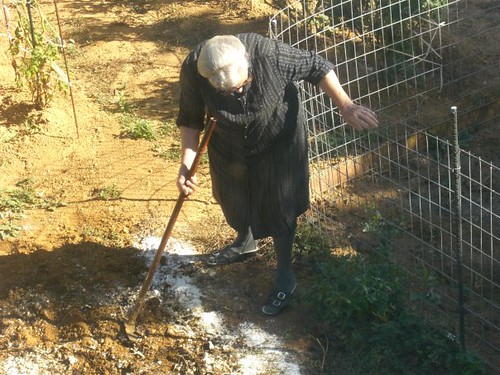
When she isn't gardening, she does crosswords or rolls her own filo pastry for kalitsounia.

"Hunger was very real in those days. We ate what we could forage, which was mainly snails and horta, whatever was seasonal at the time. The Germans never stopped us from foraging for greens. We'd walk in small groups, all girls, from our village (Fournes) to the neighbouring village of Ayia, where there were many open fields, and fill up the sacks we were carrying with us with snails and horta, nettles, wild artichokes, amaranth, nightshade, sowthistle, dock, dandelion, stuff like that. We picked whatever we could carry, and then walk back to the village carrying a huge sack on our back. Then we'd sit for hours cleaning the horta. If we were allowed to grow our own crops on our land, we wouldn't have had to do this so often.


"We could also pick seasonal fruit when we could get it, like wild pears and koumara. For sweets, we'd munch on carob pods. If my brother could trap a hare or bird, we would have some meat. We had to be creative in our use of food to make it last longer or to stop us from getting bored of eating the same things over and over again. I remember we often ate orange salad - orange segments dressed in olive oil and sprinkled with salt. I think that oranges with olive oil would sound very strange to most people these days.

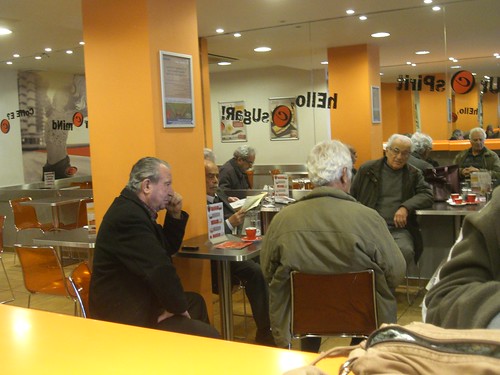
pensioners
I spotted this group of five old-age pensioners sitting in a modern takeaway bar in the town centre and surreptitiously took a photograph of them by looking at the mirror. They all look old enough to remember the war years. Each one will have their own story of the hunger they endured in their food-rich homeland.
"On one of those days after we'd been foraging and were walking back to the village, I saw a man's foot on the road, he seemed to have fallen over into the ditch. I was the only one to have noticed, so I went to investigate. I found two brothers, my neighbours, lying dead, killed by gunshots. Then I had to tell everyone else what I saw and it was a very sad time. My father had already been killed by firing squad in front of my mother, and one of my brothers was shot in the back when he was sitting in the kafeneion, in civilian clothing. There was no inquiry into their deaths, they were killed and that was that, because there was a war on, and we couldn't ask for any further clarification. My father had seen death so many times by then anyway. he'd spent 12 years as a soldier in Constantinople, coming back home every two years. I was born after his release in 1922, when the Greeks left the city forever. He'd tell us stories of his time there. During the fighting, when night fell, he and other soldiers would carry the dead and lay them in rows, and lie them on them, to get some rest before the next day's fighting began. And they never had enough water to drink. They'd lay rags in the corners of the shacks where they lived in the city - I have a photograph of him standing outside Ayia Sofia - and gather any moisture that dripped onto them from the rain, and they'd suck on the rags to keep themselves from dehydrating. He came back home after fighting a war, and died again in a war. I hardly had the chance to get to know him...
"I had hurt my leg, I can't remember how it had happened, I must have fallen and the wound never healed. It got bigger and bigger, and my leg began to hurt me. I thought I had gangrene. A German soldier saw my leg, and before I knew it, a whole lot of them were coming towards me. They had to hold me down because I was frightened, I didn't know what they were going to do to me. They cleaned the wound and applied some medication to it, and eventually I got better. They never bothered me again...

yiayia
"Eventually we were allowed to go back to tending our fields and could keep a few chickens which gave us a fresh egg here and there and a bit of meat on special days. But it was very very hard work looking after the land, what with our menfolk gone or dead, the physical labour required to carry out the work on the fields made a man out of a woman.

"I suppose a food rationing system would have been useful, to make sure everyone had something to eat, because we really didn't have a lot to eat in those days, apart from horta, but where was the food going to come from if we didn't have any to start with? People were starving, they had little food to feed their children with, and they were starving too. Even if people had money, they couldn't buy anything with it because there was nothing available to buy. Money was worthless paper to all of us at the time, because what we wanted to buy was food, and there simply wasn't any food...

"When the confiscations stopped and we were able to start buying, growing and eating whatever we wanted, there was a shortage of flour since there had been no wheat planted. Some flour was brought into the villages from the food distribution schemes that began to operate after the Germans left. The grain was packed in large sacks with the letters:

Η.Π.Α.
(which stands for: Ηνωμένες Πολιτείες Αμερικής - U.S.A)

written on it. We didn't know what the letters stood for, and when we asked some of the village officials to explain it to us, they were dumbfounded too. So we just made up a phrase for it:


'Ηρθε Πάλι Αλεύρι
(literal meaning: came-again-flour: "Flour has returned")

because we had to make sense of it in some way, and this sounded logical to us.

One would think that she was dead tired of eating snails and horta after those hard years when that was all they had to eat. "No," she shakes her head, "we may have eaten a lot of them back then, but we always ate a lot of them anyway. We always liked our horta. The difference was that we had other foods to accompany them whereas during the war, horta was all we had. I don't know if it would have been better if we could just have been confined in our houses and had some bread and oil. That would sustain you for a long time and keep your stomach full, but horta, well, no matter how much you ate, you still felt hungry."

snail feeding maich greens

She still potters around in the garden as often as the weather and her old-age mobility problems let her. "I've always enjoyed gardening, and I've always liked vegetables in my meals, it depends on what you're used to eating, how you've been raised, your financial situation. Salads and greens are always tasty, especially if you know that the place where they were grown is free of pesticides and chemicals, but that's the thing these days: you want to eat something healthy, but you don't know who or what's been at it before you. Nothing grows these days without pesticides..."

*** *** ***

During World War II, the whole world was thrown into a real food crisis - there was a shortage of food everywhere, though at different rates and for different commodities, depending on where a person resided. Many people died during the Second World War as a result of hunger, especially those who lived in urban centres, since they relied mainly on food sources that were transported into their regions. People living in rural regions (like my mother-in-law) fared better because they were able to forage for food. The villages in the mountain areas of Crete (such as my mother's) were less affected, since the Nazis could not penetrate every nook and cranny of the rugged countryside, so that mountain residents would still be able to grow some grain, keep animals and produce cheese.

In Greece, the worst hit famine area was, naturally, Athens, mainly due to the imposition of a blockade of food distribution by Britain (who feared that the Nazis would view such movements as a military advantage), which was eventually lifted after pressure from the United States:

"Shortly after the Nazi invasion, the Greek nation began to live in difficult times due to lack of food. The food was all confiscated by the German occupiers and the entire rail network of Greece was destroyed so that food could not be transported. The people of Athens began to receive food with food coupons, while the black market "flourished". In the autumn of 1941 the first deaths from starvation were recorded in some poor neighborhoods of Athens."


(Photo included in: Hionidou, Violeta (2006) Famine and Death in Occupied Greece, 1941-1944 Cambridge University Press)
Initially, food coupons (δελτία τροφίμων - this is the only Greek phrase for the concept of 'food rationing') were issued to family groups in order for food to be distributed as fairly as possible. In 1941, they were changed to individual food coupons for each citizen, while only children and the invalid were entitled to milk rations; but when there was no food available, coupons were useless and so was money. At one point, people were not just hungry; they were starving, a situation which forces the victim to turn his back on civilised behaviour and resort to any means just to stay alive:
"Neither national nor local statistics on mortality are very reliable. The numbers reported by the neighborhood councils were more dutifully collected than that those for the whole country, but all statistics tend to understate - it is unknown to what extent - the actual mortality rate, since many deaths were not announced to the authorities. The relatives of the dead hid their bodies in public cemeteries at night, in order to maintain their food rations. Sometimes they buried them in hastily dug unmarked graves. Eventually the municipal services collected hundreds of anonymous corpses, so that these do not appear in official data."
People dropped dead in the street. Their corpses were shovelled onto trucks and buried in unmarked graves. Families did not report their dead, not even of their children, who were dying at the rate of up to 500 a day - if they did so, they would have had to hand in their ration books. If they died at the hospital, they did not go to pick up their bodies for the same reason - they needed to hang on to their ration books in order that they themselves may have a better chance to survive:
"The Hospital has a problem with the burial of the dead children. Initially, the dead children are transported from the Penteli Hospital in Athens. The parents, although informed by the Police Department, find a variety of ways to avoid their release, apparently because the ration books of the deceased child are vital for other family members. Thus, the dead children remain for some time unburied. Later in the summer of 1941, when there was no petrol for the hearse, the problem worsened. It was decided, therefore, to bury them in Penteli, after advising the father of the day and time of burial, unless the father wanted to receive and bury his deceased offspring himself. The risk, however, of the fallen angels being dug out by the hungry stray dogs was very real. To the staff of the hospital is added a new job, that of the cemetery shift, for those deceased young patients."
Greece suffered hunger and starvation during WWII because her food supplies were cut off. Hionidou (2006) argues that the lifting of the blockade was the most decisive step away from the famine. To die of starvation in Greece is almost impossible in a food-rich society, unless someone is taking your food away from you deliberately. Before World War II, Greece was producing two thirds of the food supply needed to support the population, which is quite a feat (while Britain was only producing a third of its food supply at the same period), considering that the population had doubled in less than two decades before the Greek famine struck, due to the arrival of the Asia minor refugees after their forced expulsion from Turkey.

Famine caused by deliberate withholding of food resources did not occur only in Greece during WWII. Northern continental Europe was also severely affected in a similar way, especially during the cold heavy winters when the land was covered with snow and no foraging was possible. The Dutch Famine resulted in long-term health problems of not just those affected by hunger, but even of their descendants, proving that hunger can have permanent effects that may be evidenced in future generations who did not suffer hunger.

Notes:
1. It would be a lie to tell you that I asked my mother-in-law to tell me about her life during the second world war; this is not the kind of conversation that she enjoys having. The above account is what I have gleaned from the few times that the topic of war arises in our house; there are some things that cannot be talked about easily. The story about the flour was told to me by my late father, who was five years old when his father (my grandfather) was killed on the second day of the Battle of Crete in 1941.
2. The word 'Germans' has been used to denote the Nazi soldiers, not the German people. This is the word that is used by the older population of Crete in reference to the period of time in question.
3. Because of Greece's (former??) peculiar state handout system, civil servants were (but I don't know if they still are) entitled to food coupons in modern times, because their permanent, you-can-never-fire-me, stable-hours, high-pension, full-health-care monthly-salary, five-days-a-week, holiday-and sick-leave-taken-care-of and overtime-well-paid jobs are (or should that be 'were'??) regarded by the government as lowly paid...


*The Germans confiscated everything, even the supply of the food necessary for survival such as bread, oil, flour, etc. The situation became desperate. Inflation annihilated everything, hunger plagued and decimated the skeletal people of all ages who died from starvation and malnutrition. The distribution of food was handled through coupons, and the shortages resulted in the black market, ie the prices of all food were so high, to the point that the people were forced to to exist by selling all their belongings, even items of large value, for just a few grams of bread or flour. Most of the starved dead lay on the roads and were transferred to cemeteries in carriages, but their relatives did not declare their death to the registrar so as not to have their rations cut. To survive, many people stole food from the Germans at the risk of arrest and execution.
** koffinia κοφίνια (plural of koffini κοφίνι): traditional large baskets that were loaded onto donkeys, one on each side, used to transport food products from the village to sell in the town.

Useful references:
Grace, Patricia (2009) Ned & Katina Penguin Publishers, Auckland (thanks to John Petris for this gift)
Hionidou, Violeta (2006) Famine and Death in Occupied Greece, 1941-1944 Cambridge University Press
League of Nations (1946) Food, Famine and Relief, 1940-1946 Series of League Of Nations Publications, Geneva
Mazower, Mark (2001) Inside Hitler's Greece: The Experience of Occupation, 1941-1944 Yale University Press
Norman, Jill (2007) Eating for Victory Michael O'Mara Books Ltd, London
The Imperial War Museum, London (for answering all my queries and providing me with extra information)


©All Rights Reserved/Organically cooked. No part of this blog may be reproduced and/or copied by any means without prior consent from Maria Verivaki.