Showing posts with label DIP. Show all posts

Tuesday, 16 August 2016

Athens 2016: Aigina

An Athens holiday is not compete without a bit of Greek island hopping. The island of Aigina is the closest to the capital, making the island one of the most popular island-hopping destinations on a Greek holiday as well as a favorite weekend outing for Athenians all year round, some of whom own holiday homes here. I did a bit of island hopping in my early Greek days, but living so far away from the mainland - on an island for that matter - has somewhat curtailed such experiences. I decided to try an island experience during my recent trip to Athens to get away from the heat of the concrete.

Only an hour or so away by ferry from Athens' main port in Pireas, Aigina can also be reached more quickly by hovercraft, small but very fast catamaran-style boats, lessening the travel time considerably. The island is only about 20km wide and 30km long, with a permanent population of 14,000. It overlooks the Peloponnese and Salamina island where the Battle of Salamis took place.

 The marina in the town of Aigina town, the synonymous port on the island, overlooking the Peloponnese    

A view from the town beach of Aigina, overlooking the small island of Agistri with a permanent population of about 1000 people.

Historically, Aigina is known for many things: an important marine power with greater significance than Athens before it went into decline, the first known mint in the western world leading to the hypothesis that Aigina introduced coins to Europe, the ancient ruins of Aphea which consist of a well preserved Parthenon-like temple, and in modern times, the first saint of the Greek Orthodox church - St Nektarios, who founded a monastery on the island - to be photographed. But if you ask today's Greeks what they know about Aigina, they will all unanimously tell you about the thriving pistachio industry on the island: about 10,000 tonnes of pistachio are produced there every year.

Pistachio tree on Aigina, overlooking the island of Salamina in the background

Beach at Ayia Marina, a coastal village in eastern Aigina

The ruins of the Temple of Aphaia, built in the Doric style

The reasons concerning how such a high-end product came to be the main crop on such a small Greek island are a lesson in sustainability. The island was never really self-sufficient, and this is still an issue in modern times. Aegina relies on the mainland for most of her supplies, including her water needs. Towards the end of the 19th century, the pistachio pioneer Nikolaos Peroglou realised that the nut was a low-demand crop, which survived easily on bad soil, meaning that it would yield a high price with few costs. Peroglou gave away pistachio saplings as presents which people planted in their gardens, usually among their grapevines and olive trees, the more traditional crops of Greece.

Looking out towards Salamina island, from the northeast of Aigina

The misery of WWII saw Aigina suffering the greatest percentage of death by starvation in the whole country, surpassing Athens. After the war, the island's grapevines were attacked by the fatal phylloxera blight. Local farmers often replaced each dying vine with a pistachio sapling so that they could continue to trade in a product. This basically led to the rise in pistachio cultivation on the island. Aigina pistachio has enjoyed PDO status for the last two decades.

Pistachio products in sale in a stall near the port of Aigina

Visiting the island from Athens, the visitor will see the importance of the pistachio from the first instance as they stop onto the island's main port, also called Aegina. Pistachio producers set up stalls there, selling a multitude of products which all contain pistachio: salted and unsalted pistachios, with or without the shell, pistachio sweets and savouries, crackers and pastes, ice-cream and liqueurs. Pistachio trees are also seen in the gardens of the local people's homes.

Olive trees in Aigina produce olive oil mainly for personal home - the island imports nearly everything, with production concentrated in the pistachio industry

Aigina is mountainous but it is also very green, with pine forests, olive groves and pistachio orchards.

Approaching Aigina by ferry boat felt like I was visiting a miniature version of Crete. In the north, the island is very green and evenly inhabited. The port area constitutes the main town, which resembles the average small Greek coastal town - a seaport with a marina, faced by cafes and restaurants, and surrounded by narrow alleys full of small shops. The south is mainly mountainous, barren and not inhabited. The main problem Aigina faces is the lack of water sources on the island - all water is transported to the island from the mainland. Without enough water, you cannot sustain life, so most of Aigina's food needs will come from the mainland too. Being the closest island to Athens, the high number of annual visitors adds to the burden. It was only last month that the much discussed pipeline on the seabed for water supply from Athens to Aigina was finally agreed upon, which will be operating in three years' time. So the water supply problem may soon be resolved.

Walking from the Aphaia temple to the beach at Ayia Marina on the northeast, you pass through a road that is lined with tavernas, rooms for rent, and other tourist facilities. They are nearly all closed and from the appearance of the buildings, it is likely that they have not operated for a long time, a sure sign of how the various Greek crises of the last few years have affected Aigina's business sector. It has now become too expensive for the average Athenian to take a short carefree jaunt to the island on a regular basis. Most foreign tourists visit for the day, and they may be on the island for a very short period if they are doing the highly popular one-day cruise (where they also visit other islands near Aigina, notably Poros and Hydra). Aigina is small enough to drive through it in the space of one whole day - cars can be taken on the ferry boats to facilitate visitors to this end. During the summer, ferry boats arrive from and leave for Athens on a regular basis throughout the day, so you can get there very early and leave quite late just before evening sets in.. If it weren't for the uncomfortably hot early July weather we expoerienced this year, we might have stayed longer ourselves. We caught a late afternoon boat back to Athens, and arrived home before evening set in.

*** *** ***
Pistachio is harvested in summer when the shell splits open. The nut is then used in its raw state or roasted with lemon juice (and salt, optionally), to preserve it in a chemical-free way. In Greece, pistachio is commonly eaten as a nut, nearly always served in its shell, as a side dish to some fiery alcohol. having to open the shells and remove them from their casing is a way to lengthen the time it takes to eat the pistachio! In cooking, pistachio is used in pastry sweets, giving baklava-style desserts their characteristic green colour. It is often sprinkled as a crumbed topping on cakes and biscuits. Pistachios are also added to honey, chocolate and, notably in the Mediterranean, Turkish delight. Pistachios keep well for a long time in an airtight container. Apart from shelling and crushing, they do not require much more processing to make them ready for consumption.

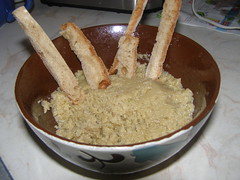
Pistachio cream on melba toast, pistachio crackers and pistachio nuts

Pistachios keep well for a long time in an airtight container. Apart from shelling and crushing, they do not require much more processing to make them ready for consumption. Pistachio paste, a gluten-free vegan condiment, is easy to make at home with a food processor. It makes a tasty topping on bread and can be used as a creamy filling or topping in cakes and biscuits. Just whizz a cup (or two) of shelled pistachio nuts with a teaspoon of olive oil, a tablespoon of butter, and a teaspoon of honey. Keep whizzing until you get the desired consistency - the more you whizz, the creamier it becomes. For a more interesting texture, add some finely crushed pistachio to the cream, for a mixed consistency. Place the spread in a jar and keep it in the fridge; it will keep for more than a month - if it doesn't get eaten sooner!

©All Rights Reserved/Organically cooked. No part of this blog may be reproduced and/or copied by any means without prior consent from Maria Verivaki.

Wednesday, 30 November 2011

Cheap and frugal (Φθηνό και οικονομικό)

The concept of frugal food recently gripped the food-related sections of the mass media. In the UK, scientists (not cooks or nutritionists!) recently resurrected the toast sandwich, which is supposedly a very cheap nutritious meal, providing you with enough calories to fortify yourself without it being too fattening (as long as you don't eat more than one of these), made with just three slices of bread - a slice of toasted bread, buttered and seasoned, tucked into two slices of untoasted bread. Apparently, it costs 7.5p and yields 300 calories - very cheap* and very filling - but wholly unappealing.

The whole concept has been borne out of the global economic climate. It's nothing new: bread (not necessarily with marg) is often what sustains the poor all over Europe, but should be viewed with caution, as George Orwell's experiences tell us, in Paris...:
You discover what it is like to be hungry. With bread and margarine in your belly, you go out and look into the shop windows. Everywhere there is food insulting you in huge, wasteful piles; whole dead pigs, baskets of hot loaves, great yellow blocks of butter, strings of sausages, mountains of potatoes, vast Gruyere cheeses like grindstones... You discover that a man who has gone even a week on bread and margarine is not a man any longer, only a belly with a few accessory organs... Have you noticed how bread tastes when you have been hungry for a long time? Cold, wet, doughy—like putty almost. (George Orwell, 1933, Down and Out in Paris and London)

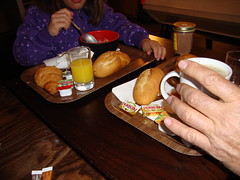
breakfast in paris breakfast in london
The budget traveller's hotel breakfast doesn't change much from London to Paris - except in the freshness and shape of the bread served. No need to tell you which photograph represents which city.

... and London:
... men... slightly underfed, but kept going by the tea-and-two-slices which the Londoner swallows every two hours... his cheeks had lanked and had that greyish, dirty in the grain look that comes of a bread and margarine diet... two years of bread and margarine had lowered his standards hopelessly. He had lived on this filthy imitation of food till his own mind and body were compounded of inferior stuff. It was malnutrition and not any native vice that had destroyed his manhood... Food, to him, had come to mean simply bread and margarine—the eternal tea-and-two-slices, which will cheat hunger for an hour or two... a ration which is probably not even meant to be sufficient... The result is that nearly every tramp is rotted by malnutrition; for proof of which one need only look at the men lining up outside any casual ward. (George Orwell, 1933, Down and Out in Paris and London)
bread slice
Freshly baked bread and olive oil make a hearty Greek snack any time of the day. My kids like this kind of snack in the evening. They toast thick country-style bread and pour olive oil over it, sprinkled with a little oregano and a little lemon juice. The bread is dense, crunchy on the outside, soft inside. This kind of bread meal probably won't be considered cheap in Northern European countries, where freshly baked bread is regarded as a 'gourmet', 'artisanal' product and olive oil is an expensive import. Pre-sliced bread is unsuitable for this kind of snack.

That Toast SandwichBread and oil are considered staples in Greece, but not in the same form as presented in the bread-and-marg meal: in Greece, spongey square mass-produced slices of bread are only considered edible in the form of a toasted sandwich filled with ham and cheese (at the very least). If this were ever to be presented to someone in Greece with the ham and cheese replaced by bread (and I wouldn't want to be the one to do it), the recipient would probably (and rightly) think of their host as completely lacking in social graces. Even the poorest Greeks right at this moment would laugh at the thought of such food being dubbed a meal. Moreover, Greeks do not resort to other commonly regarded cheap meals in the UK, such as tinned baked beans (~12p per 200g serving) or Chinese bowl noodles (~11p per packet). Again, these cost (much) more to buy in Greece, because, like the sliced-bread lunch, such convenience food has never been regarded as a real meal. (I bet many/most Greeks wouldn't know what to do with the tin/packet int he first place.) In the Greek price comparison sites, they aren't even listed, which shows that they aren't considered a common shopping item in Greece.

 
Above: Frugal meals in our house are very common because they make use of whatever is growing in the garden, which is what a lot of our meals are based on, supplemented by cheap store-bought carbohydrates like pasta and rice. Rice parcels can be made throughout the year with different seasonal leaves and herbs. Right: summer - zucchini flowers, vine leaves and tomatoes. Left: winter - squash flowers, wild-growing sorrel and chinese leaves from our garden (the seeds were a present from a friend). Nothing is truly 'free', but it can be considered as very economical.
Below: Lemon-cured olives collected from local trees, garden-fresh radishes and roasted peppers in olive oil, slow-roasted pork (the cheapest meat on the Greek market - Greeks generally eat less meat now) with freshly harvested potatoes from a friend's garden - a typical Sunday meat meal in our house. It is both frugal and sumptuous.

Frugal food means different things to different people, according to where they live and what their situation is. Urban dwellers' meal choices could theoretically be the ones containing the most variety because of the choices made available to the masses, but to have such variety on their table, they need to pay for it: they are in that difficult position of, generally speaking, needing to buy all their food needs, so their idea of frugal food is no doubt ruled by the contents of their wallets. Discount supermarkets are preferred to the corner store, with people using the street market (in Greece this is known as 'laiki' - λαϊκή) more often. In rural areas, frugal meal choices often combine great variety with high quality, depending on what's growing in the garden, the trees and the fields. There is an element of truth when they say "Το φαγητό είναι το λιγότερo"** in conjunction with the crisis. Their only restriction is that they must produce it themselves - for rural people, this comes naturally.

Despite Asian fare being considered the cheapest kind of restaurant meal in other European countries, in Greece, this kind of meal costs much more than a cheap taverna meal. But with the abundance of fresh ingredients available to the rural Cretan, even international cuisine can become standard fare at a miminum cost. Left: onion bhaji, garden-fresh sauteed chinese leaves (the seeds were a treasured present from a friend) with Greek cured meat (lountza - a kind of Greek bacon: a little goes a long way), and eggplant fried rice. Right: boiled rice, stir-fry chicken with black beans, and sauteed chinese leaves. Frugal daily meals consist of some kind of bean dish twice a week - but it's only cooked once: the second time we eat it, it will be a leftover from the same cooking session. Frugal meals mean being economical from many aspects: money, energy and time all count. 
pulses ospria beans

Greeks now earn less money and are required to pay more special taxes, often with little warning given, under the threat of having the power disconnected if they don't cough up. What we often took for granted has now come under heavy scrutiny. In the past, fruit fell off the trees and onto the ground - this rarely happens now (it's harvested before it falls). The four most oft-discussed topics we hear being talked about concern what heating fuel we use (this one tops the list), which system heats our water supply (ie do we have solar panels, and is our water heater connected to the central heating system), what's growing in our garden these days and whether the latest tax bill has come yet. 

 Heating fuel has now become very expensive, so most people in Hania are now investing in fireplaces or indoor wood-burning ovens/heaters. This is our pile of firewood - the heater will be purchased soon.

We also hear stories about food insecurity, as they apply to other people: Άλλοι πεινάνε - καλά είμαστε εδώ***. This pretty much sums up city life for me: it was never really sustainable. Frugality is nothing new to most rural dwellers. They've been living in crisis mode most of their lives, well before the global economic crisis even hit the news. They've never thought of any part of their income as 'disposable' - to them, that part was always called 'savings'.


A meal out is definitely out for now (pun not intended) - when we eat 'out', it's usually a cheap and tasty souvlaki every now and then: YA! near the Hania town hall sells them at 2 euro per pork gyro and 2.20 euro for chicken, beef or kebab.

Πενία τέχνας κατεργάζεται: "the need for survival (ie hunger) creates ways of survival", the Greek form of the proverb 'make, do and mend'.

*The same meal in Hania costs about 18 euro-cents (twice the price of its British variant): LIDL sliced bread costs E1.19/20 slices and E1.59/28 slices (the same bread could possibly be bought more cheaply from another supermarket).
**"Food is the least of our worries." 
***"Others are hungry - we're fine here." 

*** *** *** 

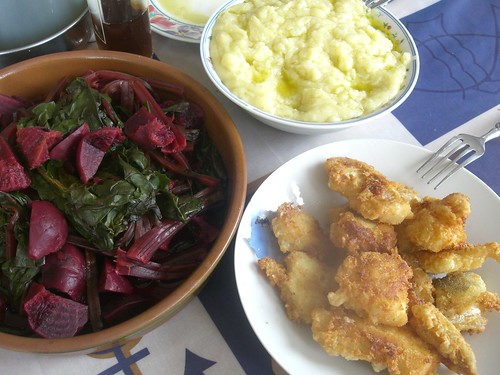
bread based skorthalia dipbakaliarosStale bread is never thrown out in our house (and probably not in other Greeks' houses now, either). Apart from warming it up (it softens this way) and spreading it with oil or butter, it is used in the mixture for biftekia (meat patties) and skordalia, a garlicky dip. The crusts are removed from stale slices of traditional bakery bread (it can be made with stale mass-produced bread too), which are soaked just a little so as to soften them and make them easy to blend with garlic, salt, vinegar and oil. I used a mixed-grain bread to make mine (pictured, above right), and left the crusts for dipping. This cheap and frugal bread dish is simple to make, and forms a staple part of a lenten meal, especially on Palm Sunday. The dip can also be made with boiled potato (pictured, above left) when there's no stale bread at hand. 

It may sound like the Greeks are eating bread with bread in this way - but again, skorthalia is never served on its own: in fact, it's traditionally accompanied by boiled beetroot and fried fish. It's all a matter of identity, not just a case of a more refined cuisine: you eat what you are.


©All Rights Reserved/Organically cooked. No part of this blog may be reproduced and/or copied by any means without prior consent from Maria Verivaki.
Thursday, 27 October 2011

Vegan tzatziki (Tζατζίκι νηστίσιμο)

71 years ago, on the 28th of October, 1940, the Prime Minister of Greece, Ioannis Metaxas, said NO to the Italian ambassador to Greece when he delivered a message to him which asked that the Italian army be allowed to pass through the country in order to secure strategic positions.

 
Flags like this are used to decorate schools on days national events are commemorates.

Today, the Prime Minister of Greece, George Papandreou, said YES to Germany and France, when he accepted to pay for a haircut with Greece's sovereignty.

It had to happen some time. The sad truth is that Greece was never able to make any objective decisions that would benefit the whole country. Most (I personally believe all) the decisions taken in Greece for the last three decades benefited only certain groups of people; there were few decisions that actually worked in the interests of all people. Greece had been allowed to govern herself subjectively for many years in this highly discriminating manner, and somebody had to pull the plug on that.  

 
On the eve of a the commemoration of a nationally important historical event, it is a Greek custom for children to recite poems and sing songs that re-enact the event.

It couldn't be a Greek him/herself that could have done it. It had to be a foreigner. George Papandreou is often regarded as a foreigner by a lot of Greeks because (like me) he was born and educated outside Greece. But when national issues are at stake, Greeks will remind people like us that we aren't foreigners and they will expect us to behave 'like a Greek', which means that we mustn't punish people in power, we must turn a blind eye to the corrupting practices of our peers, and we must keep handing out political favours. We can't shake that one off, no matter what we do; hence, sovereignty is meaningless - the privilege Greece enjoyed for so long was abused at the highest level. 

 
The children sang this song with oblivious enjoyment yesterday at the γιορτή while their parents and teachers looked on with sombre faces as they took in the meaning of the lyrics (you can find them here). Nikos Xilouris sings it with a Cretan accent, which is why he says οχτροί and not εχθροί ('ehthri' = enemies); the rest can be translated online.

But today, George Papandreou's glowing; in the end, he got his way: Rogue EU member Greece borrowed lots of money, which she doesn't have to pay back in full, without being thrown out of the EU club or the eurozone. "Ναι!" he probably said, "take our sovereignty, just give us a haircut."

 
This little girl got stage-fright during her turn to recite the poem which she had learnt off by heart. Her teacher (with the blond hair) coaxed her as much as she could, but to no avail. But when her grandmother came to the stage and held her hand (she had probably helped the child to learn the verse), the girl obliged and said her poem. 
Don't criticise Greeks for being too close to their family clique; the Greek state has consistently failed them, so they only have family to fall back on.

With the smaller Greek debt, the more taxes and the consequent loss of sovereignty, I hope that my children won't have to put up with as much nepotism as their father had to tolerate. He often reminds me that even though he was a good student at school, he never got the end-of-year prizes because they were given to the 'right' students (ie the children of the local dignitaries). He also never had toys, not even those that were given away freely to poor children; they were only given to the children of people who belonged to some workers' union (eg public servants). He wasn't given a position in the cycling team either, even though he had bought his own mountain bike and was one of the better members of the team he exercised with: there were other 'more important' members of society who had to be attended to. And finally, he never got a job based on his skills and qualifications, because he didn't know the 'right' people. No wonder he found it easier to take over his father's taxi. It seemed so much simpler than making promises that he didn't want to make in the first place, and what's more, there was money in his pocket. 

With the final link of the μέσον shackles broken, maybe there is some hope for his children that they will live in a fairer society.


*** *** ***

So, fewer debts, but no sovereignty. Hey, there's no such thing as a free lunch, is there? It's getting much harder to get something for nothing. Here's a very frugal/vegan/lenten tzatziki for those harsh times to come, but take note: it's only frugal in blessed places like Crete, where tasty 100% Greek strained yoghurt costs more to acquire than a fresh avocado. Avocados are available almost all year round in Crete, like oranges, due to the different varieties that ripen at different times in the year.


You need
2-4 ripe avocados (if you live in Hania, don't buy them; ask your friends/neighbours if they can procure some from their village fields)
the juice of one lemon (ditto)
2-3 cloves of garlic (this is usually imported from China, as there is not enough being grown)
a few drops of olive oil (our own production, of course)
a dash of sea salt (we are lucky to be given salt every year which a friend harvests from rocks)
a sprinkling of red pepper
1 large cucumber, peeled and grated (we have half a dozen left over from the summer garden)

If you use an electric blender, you will get a smoother puree; my vegan tzatziki is extra-frugal because I didn't use electricity.

Chop the garlic as finely as possible. Cut open the avocado and scrape the flesh out of the skin. Add all the ingredients (EXCEPT the grated cucumber) in a bowl and mash well with a fork till well blended. Then add the grated cucumber and mix that in very well. Allow to rest in the refrigerator to give the flavours time to blend.

This vegan tzatziki can be served during lenten periods, when normal yoghurt-based tzatziki isn't on the menu.


©All Rights Reserved/Organically cooked. No part of this blog may be reproduced and/or copied by any means without prior consent from Maria Verivaki.
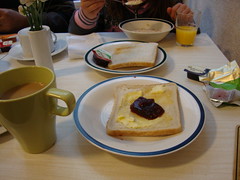
Sunday, 18 April 2010

Colourful dips (Χρωματιστά ντιπ)

I can generally do without meat, but I find it very hard to go without cheese and milk. Hence, I never fast in the strictest sense during Greek orthodox lenten periods, because I just find it too difficult to do so. How on earth I managed to do it in the past, even for a week or two is beyond me. Dairy products are part of my family's life nearly every day.

Since our summer holidays in Northern Greece, we've been slightly overindulging in Greek dips made with cheese or yoghurt. Here are some of our discoveries of good Greek cheese and milky dips. They are perfect during the warmer weather for a light lunch, and especially now that summer is near us.

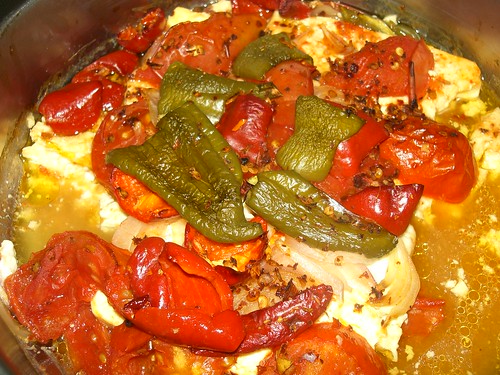
Bouyiourdi
- feta cheese, tomatos and peppers, cooked till melting consistency, and topped with chili flakes.

CIMG8787

Galotiri - a mild milky dip from Central Greece with a taste resembling cottage cheese, using both cheese and yoghurt, sometimes also called pseftotiri (= fake cheese), as it is a quickly made cheat's version of a kind of curd cheese, also called galotiri, made in Central Greece.

galotiri

Htipiti - a Northern Greek hot feta cheese dip using roasted red peppers and chili peppers; htipiti (lit.: beaten) is also known as tirokafteri (lit.: hot cheese) or kopanisti (another word for 'beaten') in various parts of Greece.

pans and grills ladadika thessaloniki htipiti dolmadakia ladokolla
Tirokafteri (left) and tzatziki (right) served with dolmadakia

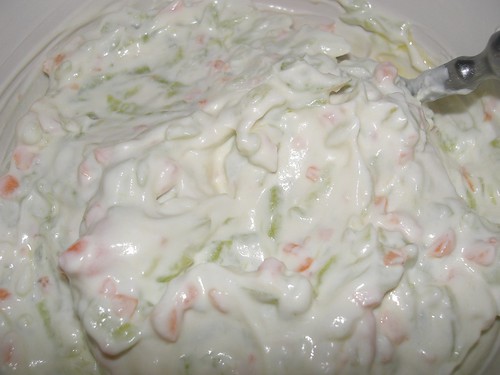
Tzatziki - the all-time taverna classic, hinting at reminisces of a summer spent in Greece.

tzatziki with carrot

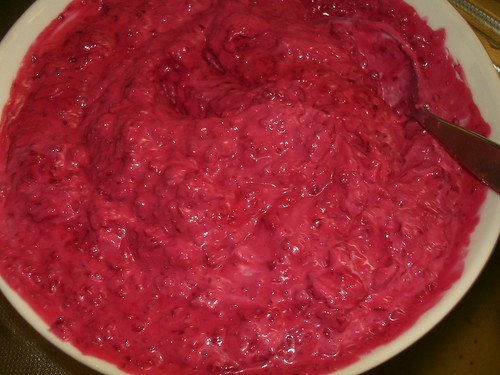
Beetroot yoghurt dip - this is a very refreshing dip similar to tzatziki; instead of cucumber, it contains beetroot, which gives it its intense pink colour. It goes really well with seafood.

beetroot yoghurt dip

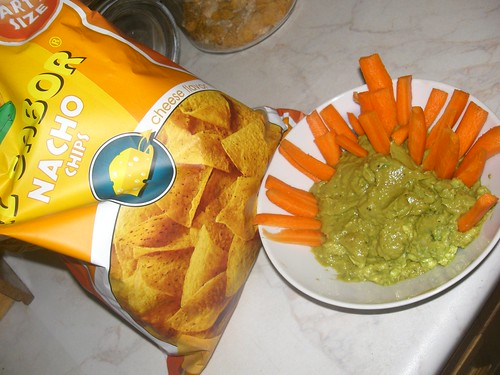
Guacomole isn't traditionally made with yoghurt, but it is another great dip that can take on a Mediterranean flavour with a dairy addition, turning it into a green version of tzatziki.

guacomole and nacho chips

And finally, melitzanosalata (eggplant dip) can also be added to this list; it isn't strictly a milky dip, but it can also be made with the addition of yoghurt for a creamier taste and texture.

©All Rights Reserved/Organically cooked. No part of this blog may be reproduced and/or copied by any means without prior consent from Maria Verivaki.
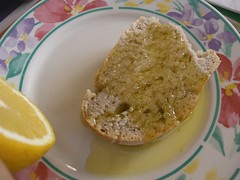
Monday, 28 September 2009

Galotiri (Γαλοτύρι)

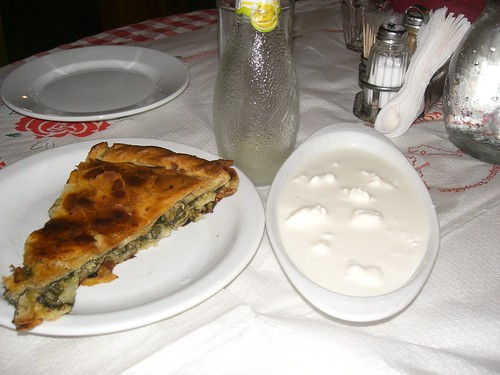
Galotiri (galo=milk, tiri=cheese, therefore: milky cheese) is a curd cheese made by combining feta cheese, yoghurt and milk. It's a product of Central Greece, and is used as a table cheese or added to pies and pasties. because it is a fresh curd cheese, it doesn't travel well, so it isn't well known around Greece outside its local origins. We were introduced to it on our recent trip to Pelion.

local pita and galotiri at pelion
My first taste of galotiri, Pelion, Central Greece

Galotiri can take the place of feta cheese, tzatziki or fresh mizithra; it is used in a similar way as a spread or accompaniment to other foods. It is lighter in calories and not as salty as plain feta cheese, making it a healthier alternative. It can be made at home and keeps about the same amount of time as fresh curd cheese, ie about two weeks, before it starts to take on a more sour taste.

There are many recipes for galotiri (γαλοτύρι) available on the internet. Here is the basic preparation method.

galotiri
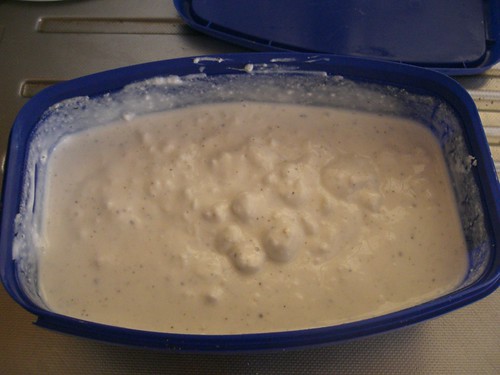
My home-made version of galotiri. This cheese is available ready made from supermarkets, but not in Crete as there is no demand for it (nor is it known at all).

You need:
200g feta cheese (use good quality barelled feta if you can get it)
100g strained yoghurt
half a cup of milk
salt - feta cheese is inherently salty, but this dip could still use some more...
freshly ground pepper - you can also spicy pepper, eg paprika, or peppercorn mixtures or even garlic to give it a tzatziki taste; some people add light tasty herbs like dill.

Crumble the feta cheese in a bowl. Add the other ingredients and mix everything well, taking care not to melt the feta cheese - it should be crumbly while all the other ingredients should look like thick soup. Some people heat the ingredients together, but I think this is unnecessary - you can simply stir the mixture till it takes on a smooth blend.

galotiri cottage cheese
Week-old galotiri resembles cottage cheese

The mixture is ready to use as is, but will acquire a better taste in a closed container over the next week. Just shake the container (without opening it) a little every day - open it after a week, and the galotiri is ready to be consumed - if you hadn't already consumed it soon after you made it. If you do manage to let the mixture stand in the fridge and work its magic, you will realise that you have created a good Greek substitute for cottage cheese.

©All Rights Reserved/Organically cooked. No part of this blog may be reproduced and/or copied by any means without prior consent from Maria Verivaki.
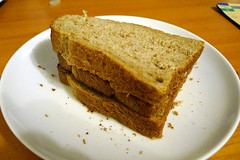
Friday, 31 July 2009

Lumen accipe et imperti (Λάβετε φως και μοιράσετέ το)

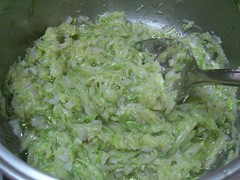
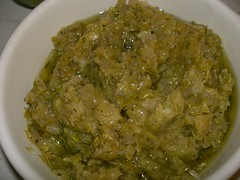
Here's a very summery recipe to use up an over-productive zucchini crop. Zucchini pate is very simple to make and can be used in a variety of ways, as Ruth Pretty notes, whose recipe Michelle led me to.

zucchini paste zucchini paste
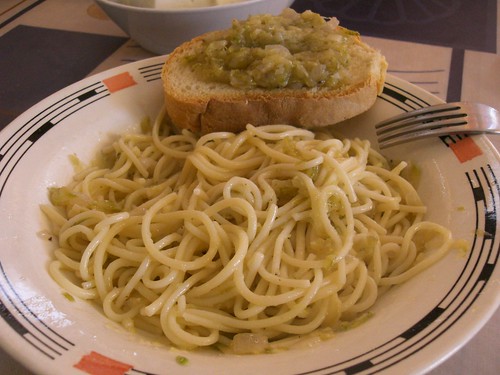
Although I enjoyed the zucchini pasta, I loved this pate spread on bread. I could survive on this throughout the summer.
zucchini paste

Lumen accipe et imperti ("receive the light and pass it on") was the school motto for WGC. Ruth, Michelle and I are all "old girls" of this state school in Wellington. All the schools in Wellington had nicknames, used mainly by pupils of other schools. Ours was "Wellington Grills". Most immigrant Greeks sent their children to state schools, but that's not where their grandchildren are being educated nowadays, a sign of upward mobility in the next generation of Wellington Greeks. Most are now attending private schools that their parents probably made fun of when they were young, places like St Farts and Snots Porridge. They have clearly moved up the ladder in Kiwi society, forming the middle classes of Kiwiland. This is not surprising; Greeks are a remarkably progressive race when they get out of their own country, taking up any opportunities given to them to make good, and instilling similar expectations in their children.


An old girl posing with her parents on Prizegiving Day before the end of the school year, November 1981.

Rachel also recommended the same pate recipe to me, spicing it up with onion and garlic, which is how I made it for a bit of added flavour.

You need:
a quantity of grated zucchini to suit your needs (courgettes and marrow may both be used)
a few tablespoons of olive oil (I used more than a few; zucchini absorbs oil very quickly)
a coarsely chopped onion
1-2 finely chopped cloves of garlic
salt and pepper

Heat the oil in a saucepan and add the onion and garlic. Cook till the onion has softened. Add the grated zucchini (if the zucchini came with the flower still attached to it, you can also add that chopped in thin strips) and let it stew away until most of the water has evaporated and the mixture looks like a thick paste. Season with salt and pepper, and serve on grilled bruschetta, toast, hot pasta, or even as a dip (alongside tzatziki) with crunchy vegetables.

Michelle tells me that this paste freezes well. All I can say is I'll be glad when I see the end of this year's zucchini crop...

©All Rights Reserved/Organically cooked. No part of this blog may be reproduced and/or copied by any means without prior consent from Maria Verivaki.

Sunday, 12 April 2009

Palm Sunday (Κυριακή των Βαΐων)

It's Palm Sunday today and the traditional Greek menu for the day is as follows:

bakaliaros

- bakaliaros (fried salt cod)
- skordalia (garlic dip)
- batsarosalata (boiled beetroot salad)

The Holy Week starts tomorrow, culminating in Easter Sunday. It's a week when most Greeks will usually try not to eat any meat, fish, eggs, cheese or milk. Fasting is supposed to be a time when you concentrate less on the specifics of what you eat, and more on the spiritual aspect of the act of fasting. I personally find it very hard not to think hard about what I eat when I am restricted, especially when staples like milk and cheese come out of my daily dieat; my vegan cooking is always more elaborate than my non-lenten cooking.

Happy fasting for those who are entering the Holy Week, and Happy Easter to everyone celebrating it today.

Wednesday, 25 June 2008

Baba ganoush (Μελιτζανοσαλάτα)

Much as I like to say I cook Cretan food in my kitchen, nost of the time, I'm actually cooking something that goes not just beyond the borders of the island, but the very country it belongs to, exhibiting a high degree of similarity with that of our neighbours, whose ancestors imported their cuisine into whichever land they conquered. Today, we're having baba ganoush (since there were no snails 'yiahni' leftovers), with eggplant dolmas, topped with yialantzi dolmas. The river of zucchini in our summer garden is still flowing, as it is in Riana's, but it now has a tributary - the aubergine.

As a trained linguist, I have always been interested in finding out the origins of the words we use in the language we speak. I was lucky to be bilingual, as were most of the children who attended Clyde Quay School in Mt Victoria when I was growing up. On leaving primary school, I was enrolled at Wellington Girls' College, where only a few of the 1000 girls attending were bilingual (poor souls). Although my English language skills were not as developed as my classmates', I never had any problems with academic language, since most technological and scientific vocabulary is derived from Greek or Latin, which I was studying anyway.

English belongs to the Germanic languages; in other words, it is related to a number of other languages (i.e. it isn't unique) like German, Swedish, Danish, among others. Greek comprises its own language group with no other related languages (i.e. it is unique); this is also the case with Armenian and, paradoxically, given its proximity to Greece, Albanian. Like all languages, in order to develop, they must borrow, and Greek is no exception to this, as our food words will attest.

Of course, a Greek would never call eggplant yemista 'dolmas' (we reserve that word for leaf parcels), and neither would they call melitzanosalata baba ganoush (nor would a Turk, for that matter), but vine leaves stuffed with rice are still called 'dolmadakia yialantzi', while our various regional versions of cheese pie are still called something that sounds like 'boreg'. One of our main herbs is 'maydanoz', which we often add to the 'kiyma' in our 'kofte'. Bairaktaris restaurant in Athens serves the best 'tas kebab' in all of Greece, and good 'baklava' is found all over the country. When we haven't planned anything for dinner, we might look into our fridge and prepare a meal 'tourlou tourlou'. All the words in inverted commas can be found in the Turkish language to denote the same food that they signify in Greek.

Here's a little quiz. See how many of the following words you recognize that are used in both Turkish and Greek cuisine:

cacik, pastirma, fasulye, pide, borek, ciger, karides, roka, Enginar, Dolması, Türlü, Ispanaklı, Pilav, Madaynoz, Kofte, Bamya, Defne, Lahana, Yahni, Helvasi, Guveci, tahin, yogurt, Peynirli, Portakal, Pekmez, Fistikli, Kaymak, Baklava, Sarması, Yalancı, Barbunya , Kiyma, Pırasa, Bezelye

When I was young, my mother would say to me (among the many down-to-earth things she said, at the risk of insulting her own race) that we must all have had Turkish ancestors in our family line, simply because Turks were living in Greece for 400 years. I remember her saying things like this when she felt angry about being put down by other Greeks in New Zealand, who might have seemed to her to be putting on airs, seeing themselves as more refined and cultured, quite unlike that of the country bumpkin that they once were when they first emigrated. She was too polite to tell them what she really felt, that we're all the same underneath.

Even though she hinted that her own origins might not be purely Greek, my mother never cooked foreign food; at least, she thought she never did. Our Bulgarian live-in taking care of my mother-in-law has on occassion cooked for us; all the meals were reminiscent of the ingredients and cooking style we are used to in our own homes, yet she insists that her recipes are Bulgarian. The Ottoman cuisine was more far-reaching than the regime, influencing the local food of the people living in the areas it passed over. Even though the Turkish yoke has ceased to exist in Greece, the Ottoman cuisine is still an integral part of life in Greece, and other parts of Europe, the Middle East and Northern Africa, all of which are inextricably entwined.

©All Rights Reserved/Organically cooked. No part of this blog may be reproduced and/or copied by any means without prior consent from Maria Verivaki.

For a diachronic view of traditional Greek cuisine, click here.

Answers: tzatziki, pastrouma. fasolia, pita, boureki, tsiyeri, garides, keftedes, roka, anginara, Dolmas, Tourlou, spanakı, pilafi, maidanoz, Bamia, Dafni, Lahano, Yahni, Halva, yiouvetsi, tahini, yaourti, Peynirli, Portakali, Petoumezi, Fistiki, Kaymaki, Baklava, Sarmas, Yalantzı, Barbounia , Kima, Prasa, bizelia

Wednesday, 30 April 2008

Staka dip with eggs (Στάκα με αυγά μάτια)

Here's a special meal that will be difficult to make in any place in the world except of course Crete. Not even my fellow Greek food bloggers can make this in Athens - they still have to substitute the ingredients for more generic products, which of course don't retain the original taste. Some regional produce (like cheese) doesn't travel well; it's also highly sought-after, with demand being greater than the available supplies. This dish is also one of those acquired tastes - not many people these days would be terribly interested in eating cholesterol-filled fried food. In fact, the only time we allow ourselves a dish like this is when we buy spring-fresh produce before Easter.

*** *** ***
read the poem
*** *** ***

Staka is a kind of buttery cream. It looks like curd cheese, but melts upon touch. You cannot pick it up and lead it to your mouth without it melting in your hands. Once it melts, it looks very much like butter. Once it has melted over medium heat, it is thickened with a little milk and flour (seasoned with salt), and the result is a thick non-congealing dip. The longer it cooks, the thicker the dip, and the more separated the oil becomes from the dip. It can be eaten as it is, the way it's normally done in restaurants, served as a side dish for a main meal.

As we were enjoying this dip at home (I had bought some staka to make a lovely traditional Cretan Easter meat pie), we were more indulgent. We added one more ingredient to it: two eggs, cooked in the oil which collected on one side of the saucepan, after I had spooned away the dip. The oil slid towards one edge of the saucepan, into which I broke the eggs. The result was that instead of eating gigandes, oops sorry, elephantes makedonias, as they are now called (since gaining protected-origin status) with leftover Easter lamb as our main meal, we ended up eating them as a side dish...

©All Rights Reserved/Organically cooked. No part of this blog may be reproduced and/or copied by any means without prior consent from Maria Verivaki.

CRETAN PRODUCE:
Xinohondro (hondro)
Stamnagathi
Marathopites
Avronies (wild asparagus)
Wedding pilafi
Orange juice
Lagos stifado
Sorrel
Silverbeet
Bougatsa Iordanis
Black mustard greens
Malotira
Cheese
Sfakianes pites
Olives tsakistes - pastes
Olive oil