Showing posts with label CHILDREN. Show all posts

Sunday, 21 January 2018

Happenings

Many many years ago, probably more than 35, some time in the early 80s, I remember a Kiwi woman coming into the fish and chip shop that my parents owned and operated. I happened to be there too, so it can't have been a schoolday. The woman was a customer, not a very regular one, but maybe she felt like some fish and chips that day.

"Are you from Greece?' she asked us. Yes, I answered (the children were always their parents' representatives in the shop).

"Oh, what a coincidence" (no, not really; Greeks were the main owner-operators of fish and chip shops back in those days), my daughter is living in Greece. She met and married a man on the island of Crete."

"Crete?!" my parents exclaimed, their faces lighting up gleefully. "We are from Crete! Which part of Crete does your daughter live in?" they asked.

"Hania," the lady replied.

"Hania?!" my parents cried, not believing what they were hearing. "We are from Hania! Is she living in the town?" they asked.

"No," said the lady, "she's living in a village called KOU-NOU-PI-DEE-AAAAA-NA". 

Split-second pause. "A-ha!" said my parents, but from the look on their face, you could tell that it was not really an a-ha moment; it was more of a shock to their ears, for they could not believe that this city woman's daughter gave up her comfortable urban life to move to a village where water supply was scarce, and there were more goats than people. 

We exchanged more niceties. If I remember correctly, she showed us a photo of her daughter holding her first child, the lady's grandson. When her order was ready, she paid for it and we said goodbye, at the same time wondering whether we would also see her coming into our shop once again, but this time with both her daughter and grandson; you had to be one tough cookie to leave urban life and go live in a goat village.

"The foreigners are taking over our country," said my mother, mindless of the fact that she was an immigrant. "Who would even want to live in Kou-nou-pi-dia-NAAAAA?" said my father. 

Turn the clock ahead four decades. Google Kounoupidiana and you will see no goats. Instead, you will see a whοle new town, whose residents are fully served in terms of any service, public or private, that they may need: schools, doctors, lawyers, sports centres, chemists, churches, shops, houses, apartment blocks, English language schools, confectioners, all the supermarket chains operating on the island. It even has a university, one of the best tertiary institutes in Greece. The 6,500 residents of Kounoupidiana - 8,500 including the 'suburbs' of Kounoupidiana) can easily live in their own little bubble, without even venturing to the central town of Hania, only 10-15 minutes away by car, depending on the traffic - not the four-legged variety, but the four-wheeled.  

Image may contain: 11 people, people smiling, people sitting, table and indoor

Last night, I met up with Philippa, the woman's daughter, whose life became firmly rooted on the island, despite being a stranger to the Greek world. It wasn't difficult to recognise her, as she reminded me so much of her mother, even after all those years. It's possibly the third time we have seen each other since I moved to Hania. We were at a Kiwi get-together organised by a former Greek Kiwi like myself. Auckland, Wellington and Christchurch Greeks reminisced their time in a faraway land, sharing some moments together. Funnily enough, among the little παρέα that we created, we were nearly all related, each one knowing someone else's relatives and acquaintances, notably our koumbaroi, meaning the primary attendant to the couple in a wedding ceremony or the godparent of one's child(ren). It really was a small world among the Greek diaspora communities of old. 


And while we are on the subject of Kiwi Greek life, I feel as though I have gone through the full Greek circle, having just invested the last remaining Kiwi dollars of my parents' savings (they both died too young to use it themselves) into the coveted - in Greek terms - 'investment property'. My parents both died too young to use their earnings themselves, but I am sure that they will be very proud of what their daughter did, to firmly root her life in our wonderful island. 

Naturally I will be super busy from now on as I work on my new project. Watch this space...

©All Rights Reserved/Organically cooked. No part of this blog may be reproduced and/or copied by any means without prior consent from Maria Verivaki.

Tuesday, 19 December 2017

Tinned tomatoes

I've been following the populist 'no more tinned tomatoes' debate that broke out just over a week ago in the New Zealand media, when a women's refuge worker demanded (not just requested) that food donations to the charity should not include tinned tomatoes. The 'Treatise on Tinned Tomatoes and Why They Are Like Books' did not get as much airtime as did the readers' vicious comments about the connection between 'poor people' and tinned tomatoes, which sounded like it was coming from non-Maori/Pasifika (read: white) higher-end middle class New Zealand society. The post (I found a cached version) did not actually villify tinned tomatoes. All the reasons that the writer gave for banning tinned tomatoes were based on solid facts and sound logic. Given that we are just days away before Christmas, it shouldn't be too difficult for most people to see why words like 'tinned' and 'staple foods' don't collocate well with 'Christmas'.


The women's refuge worker claimed that refuges (like food banks) often have many tinned tomatoes in their pantries, often past their due date. Women who use refuges generally don't use tinned tomatoes, nor did the people who raised them, and some of the women who use refuges don't even (know how to) cook. So if you gave those women a choice, they would never even ask for tinned tomatoes. In other words: if a woman cooks with tinned tomatoes, its a cultural thing. Pasifika/Maori women - the main users of women's refuges in NZ - are unlikely to have a cultural background of cooking with tinned tomatoes. Middle class NZ society might be very surprised to discover this: some people just don't use this quintessential global pantry stocker. By judging these women on foreign (to them) cultural terms, ie as good and knowledgeable budgeters ("tinned tomatoes are cheap!", "tinned tomatoes are versatile!"), the 'tinned tomato brigade' can't actually see what these women are feeling when they enter a refuge, ie sadness, depression, shellshock, running away from violence. Coupled with a lack of life skills and literacy skills, being cash strapped, in debt and looking after children, they wouldn't even feel like cooking, let alone cook from scratch: tinned tomatoes usually imply cooking from scratch.

Women who turn to a refuge for help have no family support - if they did, they would not be asking a refuge to help them. The writer made a point of how important it was to help such women get what they wanted, rather than what other people feel they need. In such moments, they want simple comforts: "spaghetti on toast or really simple things, stuff [that can be eaten] straight from a can if needs be".  Donors donate what they think poor people (which does not always mean the same thing as 'women in a refuge') need rather than want: "That’s you putting your values, and your mores, and your cultural prejudices on other people." Offering to teach women how to cook, how to use tinned tomatoes, and any other life skills they may be lacking is all very well, but there's a time and place for everything; when they arrive at a refuge, they need to settle into a new kind of life. Eventually, they may start preparing meals like they used to for themselves and their children; but some of these women may never want to cook, let alone from scratch. So tinned tomatoes are probably never going to be useful for them.

No automatic alt text available.
My old no longer wanted books started this foreign language library at CIHEAM.MAI Chania. Many students use it in their free time, and students also add to the collection.

The writer made the analogy that "tinned tomatoes are a bit like books": just like we don't all cook, we don't all read. While cooking and reading may sound like very basic activities to some people, to others they are not. For some people, cooking and reading are very difficult activities. Giving things to people who need things is not the same as giving people presents: the things you give to people who need things have to be useful things. Giving tinned tomatoes - a very cheap common product - to someone who has never used them is like giving away your old books which you no longer wish to read to people who never read novels. The better off harbour comfortable perceptions about what others should be doing all the time to become better off.

The treastise against tinned tomatoes aroused a storm of comments from both sides of the argument. A (Maori) woman working for another women's refuge added canned chickpeas and canned lentils to the forbidden list of items that refuges didn't want:
"We ask for fresh meat and vegetables and we get beans and lentils. What are our people going to do with chickpeas? Are they going to be making hummus in the safe house? Like tinned tomatoes, chickpeas and lentils have to be cooked and accompanied with other ingredients, using knowledge and supplies that many families [don't] have."
A (white) woman working for a Salvation Army food bank said she was shocked to hear that other charities were turning away tinned tomatoes:
"...the refuges are being a bit fussy... We are very short on things like [tinned] tomatoes... chickpeas and lentils are staples in Salvation Army food parcels given to families at this time of year... The staples are never going to go out of fashion. And hungry families will usually eat anything."
Anything? I doubt it. (And she also put her cultural prejudices into the picture by calling women in refuges hungry.)  Food is incredibly personal and highly cultural. Clearly the Salvation Army is catering for different kinds of people from those entering a women's refuge. People on a low income may also lead a more stable kind of life, not the nomadic existence of a woman fleeing from violence. Processed food is not necessarily the greatest miracle in the food world to make women's lives easier; having someone doing all the bloody cooking for you is even better than buying, carrying, storing, preparing and cooking food yourself. We don't all have that luxury of a private home cook; this usually happens when you are very wealthy or if you live in a cultural setting where one of the household's women (eg the grandmother) will prepare meals for all the family members, who may be working out of the home, or have been assigned other tasks. As mentioned above, if a woman has this kind of family support, she would not be asking a refuge to help keep her safe in the first place.


Snails and xinohondro - highly acquired Cretan tastes!

As I was following the discussion in the media, what really struck me was how unlikely it is among these refuges that someone will be cooking something for someone else, so that those people who need a decent meal (especially children) would find something that wasn't full of sugar/fat/salt (read: snack-type ready-to-eat highly-processed, eat-from-the-packet kind of food). It is already obvious that a lot of the people using these services don't have many life skills needed in order to maintain a healthy standard. So why not have someone cooking something on a regular basis, which can be served up to everyone and is also healthy and comforting? Some of the commentators mentioned that they would like to do such a thing as a cook-up, where some of the meals produced can be frozen for emergency moments. I think that the answer to this question will bring to the fore a host of other social issues that will be difficult to resolve.

It seems to have escaped people's notice that a lot of people in highly advanced countries like New Zealand are too busy to cook these days. This doesn't apply just to people in difficult situations. Most people in advanced countries spend their time in many creative ways, which often include doing things away from the home. And when they do have free time, they spend it more leisurely. Cooking is not a leisure activity when you are thinking about how to feed a family. It's a chore.

Image may contain: foodImage may contain: food
Lentil (φακές - left) and bean (φασολάδα - right) stew/soup - it depends on how much water you add.

Cooking for others, cooking with tomatoes and cooking with beans are therefore all very culturally based. In truth, I cook tomato-based bean dishes not because they are the yummiest thing imaginable, but because I have to feed a family, and beans are a pretty good quick cheap choice of food which can be prepared the night before, by the working woman in the household. (I am doing this right now as I write: a pot of lentil stew is boiling away on the stove. It should be ready before midnight. No, I don't use a pressure cooker.) This is not to say that a woman living in New Zealand from the Maori/Pasifika cultures cannot do the same thing for her family as a Greek or Indian woman (two cultures which use beans a lot in their daily diet); she doesn't do this simply because it's not part of her culture. She could be taught to do something like this - but if it was never part of your culture to prepare food in this way, learning to do this kind of chore is very difficult in modern times, when people are generally being 'taught' to treat food as a commodity: you buy/eat food when it's time to eat, or when you're hungry, or maybe to comfort you - and it's all ready prepared by someone else, and - generally speaking - you will generally cook when you feel like it. What may have been part of the food culture of a Maori/Pasifika woman fifty years ago has now changed, due to her translocation - due both to internal and external migration - into a highly advanced society headed and directed by non-Maori/Pasifika leaders. No matter how settled a woman in New Zealand who has turned to a refuge becomes, she is unlikely to revert to a less processed-food daily diet.

*** *** *** 

The 'tinned toms' discussion that ensued tells us much more about comfort food, processed food, and the act of cooking, than it does about how to use tinned tomatoes. The following can be implied:
- Comfort food is ready-to-eat food
- Cooking is for people who lead stable lives
- Canned chickpeas and lentils are the kinds of food that connoisseurs, health-freaks, vegetarians, vegans (and generally other 'smart-farts') know about (and eat)
- Certain cultural groups eat a lot of chickpeas and lentils, so they will know what to do with them
- Certain classes of people - especially those whose lives are less complicated - have the chance to be more adventurous in their food experiences
- Canned food (eg chickpeas and lentils) is for poor people
- Canned tomatoes are useful in a home where the act (which is now often considered an art) of cooking can actually take place (read: you have a kitchen, a stove/oven, AND you can afford to pay the electricity/gas bills)
... inter alia.

Canned tomatoes - and muuuuuuuuch more recently canned beans, but never ever canned lentils, except at LIDL when it's having a 'Spanish week' - are highly popular among Greek food banks and especially in soup kitchens. They are cheap and easy to work with. They make quick filling meals. A heated tin of tomatoes could quite possibly be poured over some boiled pasta. BUT: If this was never part of your culinary repertoire, then you will not eat it, let alone know how to make it. Culinary knowledge in western countries has passed into the realms of mystery, while things like chickpeas and lentils are considered food for the poor - or food for cultured. Even Greeks will acknowledge that beans are cheap and that's why the eat them.  Most Greek women with a family (including me) will cook up a bean dish once a week on a week-day, de rigeur.

I can't actually imagine any working Greek woman with a family here in Crete not cooking up a bean dish at least 2-3 times a month, but this is based on cultural norms. Greeks may have become impoverished - but still, there is much truth in saying that theirs is a dignified kind of poverty. We can have our cake and eat it, because we know how to make the cake. Greek identity these days often implies food knowledge. Recent Greek emigrants due to the economic crisis often end up working in their own food-based business. Their family background is not necessarily middle class. They rarely realise the superiority of their culinary skills because until they leave Greece, they do not realise that there are people out there who lack such knowledge. They are also astounded to learn that most people in highly advanced societies watch cooking shows and buy cookery books - but they rarely cook meals: most of their food will have been prepared by someone else, for them to heat and eat.

It's still not very common to see soaked ready-to-use chickpeas (let alone lentils) in Greek supermarkets; on the other hand, there is a plethora of dried beans on the shelves. If such canned products were presented to a Greek woman, and she was asked to produce something on the spot with them, I don't think she'd have much trouble producing a hot comforting meal in little time. All you need to make classic Greek φακές (lentil stew) and ρεβιθάδα (chickpea stew) are tomatoes, beans and water; if you add some minced onion and garlic, salt and pepper, your soup/stew - depending on the amount of water you add - will taste nicer. A hot bean soup made with canned tomatoes makes great comfort food - and it tastes better the next day.

Puttanesca is one of the quickest things I can cook from scratch 

Tinned tomatoes are often hailed as a food processing miracle by media cooks:
"The larder is worryingly bare when you've run out of tinned tomatoes. They are the cook's comfort blanket, the progenitor of any number of soups, sauces, stews and braises... Tomatoes are the best source of the carotenoid pigment lycopene. Some studies suggest it can help prevent prostate, lung, and stomach cancers. Tomatoes are an interesting exception to the rule that cooking food reduces or destroys valuable micronutrients: lycopene is better absorbed when it has been heated, either during processing or cooking, as the heat turns the molecule into more useful isomers. Tomatoes provide significant amounts of bone-strengthening vitamin K, and some research suggests that lycopene also supports bone health. Many studies link tomatoes with heart benefits, and although the mechanisms aren't yet clear, the antioxidant vitamins C and E in them, along with lycopene, seem to slow down the processes that would eventually cause heart disease."
An old photo of my pantry - these days I prefer to freeze our bumper summer tomato harvest.

In short, a pantry full of tinned tomatoes and chickpeas and lentils symbolises domestic wisdom, happiness and prosperity. But this is something that is not within the sight of a woman fleeing to a refuge with just her kids and the clothes they're all wearing. They'd rather be having some tea and toast, and maybe something sweet, like chocolate biscuits, to bump up their spirits. In other words, they want the same things you want. I highly doubt that the average citizen of a highly advanced society is eating tinned chickpeas or lentils cooked in tinned tomatoes on a daily, let alone weekly basis. We all want variety.

When buying "food for the poor", we really need to think about what we ourselves like to eat rather than what we think poor people 'should' be eating. Better still, charities can tell you what they need because they know who they're supplying. It's even better to give them money (they are likely to make better deals with suppliers), so they can do the appropriate shopping for that tiny segment of society that is rarely visible to the majority. Especially now before Christmas, to make it a merry one, skip that bloody canned food. As the Greek saying goes:
Φάτε τώρα που το βρήκατε, γιατί αύριο έρχεται η φακή.
(Eat now that you have good food, because the lentils are coming tomorrow.)

More articles on Greek food banks and soup kitchens:
http://www.organicallycooked.com/2013/03/soup-kitchen.html
http://www.organicallycooked.com/2013/10/food-bank-community-grocery.html
http://www.organicallycooked.com/2016/04/the-social-kitchen-of-hania.html

All quotes come from the following links:
https://thespinoff.co.nz/parenting/11-12-2017/please-no-more-bloody-tinned-tomatoes/
https://www.radionz.co.nz/national/programmes/afternoons/audio/2018625266/jackie-clarke-no-more-tinned-tomatoes
https://www.stuff.co.nz/national/99767397/
https://thespinoff.co.nz/parenting/13-12-2017/no-charities-dont-want-your-inedible-food-items/
http://www.nzherald.co.nz/nz/news/article.cfm?c_id=1&objectid=11958543
http://www.newshub.co.nz/home/new-zealand/2017/12/charities-ask-kiwis-to-donate-more-than-second-hand-goods-or-tinned-vegetables.html
https://www.tvnz.co.nz/one-news/new-zealand/hamiltons-salvation-army-shocked-auckland-charity-turning-away-tinned-tomatoes
https://www.stuff.co.nz/national/99813458/we-want-tinned-tomatoes-hamiltons-salvation-army-says
https://www.stuff.co.nz/manawatu-standard/news/99843749/comments-rejecting-tinned-tomatoes-illjudged
https://www.stuff.co.nz/national/99909805/get-off-your-tinned-tomato-high-horse
https://www.stuff.co.nz/business/opinion-analysis/99946985/hype-about-tinned-tomatoes-has-raised-the-debate-on-giving
https://www.theguardian.com/lifeandstyle/2013/oct/05/tinned-tomatoes-health-benefits-anti-cancer-strong-bones


©All Rights Reserved/Organically cooked. No part of this blog may be reproduced and/or copied by any means without prior consent from Maria Verivaki.

Friday, 29 January 2016

All in an evening's work

January as slow as molasses? You read about my busy January in my previous post; here's an account of yesterday evening, in my cabbie husband's words.

"Just as I was relaxing for the evening, the tablet rings out a fare. I was the nearest free cab within a 15km radius. When someone needs a taxi in winter this far away from the centre of town, it's usually because they need to go to the hospital. But the pick-up point for this fare was outside a supermarket. That's a bit suspect: if you do your shopping at a village supermarket, you must be within walking distance of the supermarket. 

When I arrived, I saw a man standing outside the supermarket (the only one in A_________) with a heap of bags sitting next to him on the ground. He was also carrying a bottle... of ouzo... which was open... and half-full. All I could think of that moment was FUCK. I put all his bags into the boot of the car. He sat in the front next to me. He didn't stop talking, not one moment. He was barely intelligible; I couldn't understand what he was talking about. All he had on his hands was the half-filled bottle. I suspected that he had paid for the goods he bought at the supermarket. But no one can really know what is in a drunk's pocket. 

"So, we're going home, are we?" I asked him, hoping that the ride would be as short as possible. Somewhere amidst the gibberish he was spieling off, I heard the name of another village: M_______. That's just seven kilometres away from the south coast of Crete, an hour away from where we were at that moment. This was going to be a very long night. I put on the metre, not justfor the reason that I should be on the right side of the law, but because I wanted to see how much the metre would clock up so I can at least talk about the fare the next day at the rank. Being able to tell a story out of it may be my only trophy for the evening. 

I suddenly remembered who this man was. He was a pensioner, having held some high-level public service job. I had picked him up once before, in a similar drunken state, again in the same village of A_______ and he had asked me to take him to the other side of the island. I took him to the town centre and dropped him off at the taxi rank, with the excuse that I had run out of petrol. He's well known among the cabbies. Some will take him round in circles (as long as they know his pockets are full). This is not my idea of work. At that moment, all I could think of was my warm house, the armchair and the TV. 

"M______? Are you sure that's where you want to go? It's a bit far, isn't it?" He said that he was going to see his friend V_______ who ran the cafe there.

"Don't you want to go home first and drop off your shopping?" I suggested, but he was adamant that he didn't want to go home. Had I known where he lived, I would have taken him there immediately. I was in two minds to turn for the town centre or to take the road to the south coast. I set off for the town centre. "No, not that way!" he shouted. In his drunken state of mind, he was still able to see the road. I was stuck with him. I had just cleaned the cab that morning, so I opened the window on his side so he could vomit if he needed to; from the north of the island, the journey to the south involves climbing up and down mountains. 

I've driven to the south coast many times over the course of my life as a cabbie. A faraway fare is a cabbie's joy.  But in the middle of winter, it is one of the most desolate experiences you will ever have. The villages in the province of Hania are small, so small that they now have very few inhabitants, nearly all of whom are old and go to bed early. We were leaving the last inhabited village on the way to the south coast. There were hardly any lights on in the houses we passed. They were either uninhabited, holiday homes at best, or the residents had gone to bed. Street lighting is poor. During the whole journey, the man didn't stop talking, occasionally taking a swig of ouzo form the bottle he was carrying. The smell of his alcoholism shielded me from the smell of his body odour. This man was in his own world at that moment. 

When we finally reached M______, I asked him where his friend lived. He said he didn't know. I headed for the village square. There was a kafeneio in the village, near the church. Thankfully, it had a light on, and I could see someone inside. I helped my fare out of the car, locked it and headed towards the kafeneio with him. As soon as we entered, I noticed the look of horror on the young owner's face. While my fare continued speaking in his unintelligible gibberish, I asked the cafe owner where we might find V_______. 

"V________'s my father," the man said, speaking in whispers. "He's been dead for three years." FUCK. My fare continued to call out to V_________. The cafe owner asked me to take him away. A baby was heard crying in a cot, and a toddler was playing on a mat, overlooked by a young woman who spoke Greek with an accent. If a young man wants to stay in his village, he needs to marry a teenager and bog her down with childcare responsibilities right from the word go, or he needs to import a foreign wife. The woman was fair, short and slim - she was probably Albanian. 

"OK, G______ (he had told me his name), let's go home and drop off that shopping, shall we?" I tried to coax my fare back into the cab. At this point, the metre had already written up 75 euro. 

"Home?" he looked at me with a wry smile. "I'm not ready to go home now! Take me to the town. I'm a great dancer! Did you know that? I am the best χορευτή in all of Crete! Let's go and listen to a λυρατζή, and I'll show you how good a dancer I am!"

I've been driving a cab for nearly 40 years. It's given me enough time to develop various people skills, one of which is the role of psycho-analyst. As we headed back to the village of A________, I worked out roughly where he lived. I was able to take him to his house. "No," he said, "I'm going to the town, remember?" 

"OK, G______, let's drop off the shopping first, so I can take a driving break, is that OK?" Luckily he agreed. I helped him out of the car once again (because I was really worried he might damage it, or throw up in it), and got him to the door of his house, a large 60s style village home built next to an olive grove, which he probably owned. He fumbled around for his keys, but he managed to open the door by himself. I would have done that for him too, but you never know when a drunk might wake up from his slumber. They are used to being robbed or attacked, and may recognise the signs of an imminent one, like he did when he realised I was taking him in another direction. 

I brought in his shopping - he had done a lot of it, 10 carrier bags full. The outside of the house did not give any sign of what you would find inside it. It was nothing less than a τρώγλη. Εverything was in disarray, the house was filthy. It was obvious that he lived alone, without any family. I wondered how long ago someone other than himself had entered his house. I may have been his first visitor for the year. 

When we had finished carrying the shopping, he asked me how much the fare cost, to my surprise, and partial relief. I showed him the meter: it had written up €140 at that point. "Oh, I've only got €100 on me at the moment," he said. I told him that would be OK. "No!" he insisted. "I have to pay you in full. Take me to an ATM." There was one in the village, so I took him there. He handed me the fare immediately. "Now let's hit the town!" he said. I'll show you what a good dancer I am!" 

Again, I had no choice, but to take him into town. I dropped him off at a kafeneio where I could hear Cretan music playing. "how much do I owe you up to here?" he asked me. "Nothing," I said, you paid me earlier, remember?" I just wanted to get rid of him at that point. "No, I didn't! You're still working!" So I asked him for €10. I didn't want anything other than to get away from him at that stage. "You're coming in to see me dance, aren't you?" he asked me, imploringly. "Of course I am," I lied. "Just let me park the car." 

What a night. But it wasn't over. As I was driving back home, I picked up another fare about three minutes away from my home. What's there to lose, I thought, I may as well go for the bonus prize. I arrive outside the house and a young woman enters the car. There was something unusual about her face. But it was dark, and I couldn't see her very well. I asked her where we were heading, thinking I'd picked up a typical winter's evening fare (town centre or hospital).  

"S__________", she said. 
"S________? That's a bit far for this time of night, don't you think?" S______ was just two or so kilometres from A________ where I'd picked up the drunk. 
"It's my husband's village," she said. 
"Oh, going home then?" I inquired, building up a picture of my fare. "No, we're separated. I'm from D______, in the H______ region. I live here now, and I'm going to pick up my son from his father's." I had picked her up from the middle of the road between her ex-husband's and her own village origins. She was in a bad state: I could now see that half her face was swollen. She told me that her husband had insisted on taking the child with him to show her what a good father he is because he wanted to help raise it, even though they were no longer together. She had advised him not to because the child was ill and he could wait until the child was better, but he didn't heed her advice. He had just called her to tell her that the child was unwell and he couldn't look after it. She said he'd left him because he beat her up. I wanted to ask her what a nice girl like herself was doing with a jerk like him, but I could tell what the answer would be: something like 'he was never violent when we were getting to know each other'. He was probably a good dancer too. Girls from small villages fall for that kind easily; it's a way of leaving your village - and ending up at another one. 

When I arrived at the house, I realised who her ex was: his drunk brother had blown out his brains at a wedding when he insisted that his gun wasn't loaded. "See, look, it's empty," he said, pointing it to his head. The dead man's brother came out of the house as soon as he heard the taxi drive by. He looked as though he had not shaved or changed his clothes for a year. The woman paid me. I thanked her and was just about to leave when I decided to ask her one more thing: "How will you get home tonight?" She said that her ex will probably give her a lift. I wondered if she would actually return home that night, or end up staying overnight at her ex's. I left, turning off the tablet, as I did not want another fare that night."

We all listened incredulously, as my husband related his evening's exploits. I'd phoned him once to ask him if he could pick up one of the children from the after-school activities, so I knew what was going on. I also called him twice to make sure he was OK. He called me after he picked up the second fare. I keep reminding myself that it's winter, and Greeks hate living through the darkness alone. Everything will be better in the summer, won't it? But not for everyone. Some of us live in perpetual crisis, while others live off other people's crises. (When he got home, he got a call from another cab driver who wanted to know if the drunk guy had any money to pay him for a ride out to the other side of the island. My husband said he had no idea.) 

©All Rights Reserved/Organically cooked. No part of this blog may be reproduced and/or copied by any means without prior consent from Maria Verivaki.

Friday, 20 November 2015

Relating the past with the present: History lesson Γ' Γυμνασιου

(The blue bits are translations from my son's third-year junior-high history textbook.)

Last week, my son asked me to help him with his upcoming history test. He wanted to 'say' the lesson to me, as it was presented in his history book (which you can find here: http://ebooks.edu.gr/modules/ebook/show.php/DSGYM-C105/65/515,2182/).
"I just want you to ask me random questions, to make sure I know it all," he said to me. 
"OK", I said, "which units?"
"5 (Hellenism in the mid 18thC until the beginning of the 19thC), 7 (The Friendly Society and the announcement of the Greek revolution in the Danubian principalities) and 8 (The development of the Greek Revolution of 1821-1827)." 
"Why not 6 (The revolutionary movements of the 18920-1821 period in Europe?)" I asked, which was about ). It starts off like this: "The European people questioned the decisions of the Vienna Congress (1815) by delivering policies and national claims. They projected politically the demands of the concessions of the constitution, establishing parliamentary institutions and the recognition of civil liberties and political rights. On this basis, they formulated three main political currents, which questioned the decisions of the rulers of Europe, each from his own perspective and in his own way: 
- Moderate liberals sought the establishment of constitutional monarchies in which the right to vote was given only to the wealthy, as was the case in England.
- Radical democrats aspired to establish republics that were not dominated by monarchs, which would recognize political rights for every single adult men and protect the weaker social groups.
- The Socialists, who appeared after 1850, considered that the most appropriate form of political organization would be a system of economic and social equality.
National claims arose as a result of the gradual awareness of nations..."
"The teacher didn't set that one for the test."
"But you've studied it in class, haven't you?"
"No." 
I was a little taken aback. "You know that this chapter might have been useful in understanding our present problems?" I asked him. 
"Yes, I've read it." If he had said he hadn't read it, I would have made him do it. 
"OK. Question 1," I said, scanning Unit 5. "Why was knowledge of the Greek language widespread in the mid 18thC to mid-19thC?" 
"Not the blue boxes, Mum." 
"Well, if you know the answer---"
"It's not in the test! I don't have enough time to tell you!"
"OK, ... What was the role of the Orthodox church in Hellenism?" 
"The Orthodox Church, recognized by the Ottoman administration as the leader of all the enslaved Christians, was opposed to the spread of ideas about enlightenment because they believed that a revolution will endanger themselves and Hellenism. This, however, did not prevent some clerics adopting enlightened perceptions and to take some action against the Ottoman domination." 
"And you know that they hold a similar position in the present, don't you? Can you give me some examples?"
"Ah, they want religious studies at school to continue..."
"... which violates the principle of the separation of state and church..."
"... and they aren't being taxed for the property they own...
"... which is bound to change in the long run. Good. Next question: What role did Russia play in the Greek Revolution?"
"Hang on, you didn't ask me the kinds of people that the Greek communities were made of at the time: Phanariots, merchants, ship owners, klephts."
"As their name implies!" (Because I get bored of the obvious. There is never enough time. PS: 'klepht' cf κλέβω = I steal.) 
"So, what role did Russia play in the Greek Revolution?"
"Around the beginning of the 18th century, the Greeks turned to Russia for help, since the Russians had interests in common with the Greeks as well as the same religion. Thus, in 1770, with Russian origins, the Greek revolution centered on the Peloponnese. But the mobilisation of the Greeks was not the desired one, while the small number of Russian warships participating, headed by brothers Orloff, proved insufficient. The revolution, known as the Orlofika, was thus suppressed. A similar fate befell the heroic efforts of the Greek envoy to Russia Lambros Katsonis in arousing the inhabitants of the Aegean islands..."
"And what is our relationship with Russia these days?"
"Um... we still have the same religion..."
"Are we friends with them?"
"Um ... the EU doesn't like Russia."
"But do WE like them?" 
"Um... Yes, I think so." 
"Because?"
"Because... they don't let others tell them what to do."
"OK. Next question. What do we mean by the Greek Enlightenment?"
"Starting with the Greek communities---"
"Where were they located?" 
"Asia Minor, the coastal parts of present-day Turkey and Russia. Starting with the Greek--- " 
"And which other country? 
"Um..."
"Check the map." He goes to the kitchen to check it out. 
"Ukraine"
"And what do we mean by the Pontus?"

Διονύσης Σαββόπουλος & Δόμνα Σαμίου - "Black Sea"
"Μαύρη θάλασσα κλειστή και ψυχή μου χαρισμένη, 
σ' όποιον πολύ σε θέλει"
"Black Sea, a closed space, I give my soul to anyone who wants her"


"That's not in the book, Mum."
"Oh... OK." Another time perhaps.  
"What was the question?"
"What do we mean by the Greek Enlightenment?"
"Starting with the Greek communities, the Greeks came into contact with the ideas of the Enlightenment. Η εκπαίδευση συνδέθηκε με τον αγώνα για ελευθερία. Traders in general and the Greeks who traveled in Europe disseminated those ideas in the Hellenic world. So the notion that was cultivated was that logic can not only explain the world but it can also change it. Education became linked to the struggle for freedom."
"But that doesn't tell me what the meaning of 'Greek Enlightenment' means..."
"But it's not int he book, Mum."
"Maybe the book is not enough. let's look it up." We did a quick Wikipedia search:
"The Greek Enlightenment is an ideological, literary, linguistic and philosophical current that, in a sense, tried to convey the ideas and values ​​of the European Enlightenment, of which it is an offshoot, in the area of ​​the enslaved Greek-language Orthodox peoples in the Ottoman Empire. Constantine Dimaras introduced the term. He meant it to be an indigenous and endogenous phenomenon of Hellenism which concurs with European enlightenment. This influenced him but the original dynamic did not cease to be domestic. In another aspect, Greek Enlightenment has its roots in the 15th century under the influence of European culture systematized to the early 19th century the idea of ​​national identity for people in the erstwhile ancient Greek territories. According to Apostolos Diamantis, the Greek Enlightenment was an intellectual movement seeking the education of the Greeks."
"So the most important element of the Greek enlightenment was?"
"Education. But that's in the next chapter about the Filiki Eteria (the Friendly Society)."
"OK the, tell me about...  the educational aspect of Filiki Eteria."
"Well... it was formed by some Greeks living in Russia, who wanted to revive the idea of a Greek state, and it was mainly aimed at wealthy Greeks so that Filiki Eteria could raise funds for their cause, but the wealthy Greeks didn't want to support them---"
"Which could explain why Greeks find it difficult nowadays to pay taxes, don't you think?"
"Oh, OK. So Filiki Eteria relaxed its policies and turned to the not so rich, but their ideas were still difficult to disseminate, so Filiki Eteria asked Ioannis Kapodistrias to lead them, because he was the Minister of Foreign Affairs in Russia---"
"But why Kapodistrias?"
"Because he was Greek. But Kapodistrias refused the position because he said that the Greek people weren't educated enough to rise up against the Ottomans."
"And that's where education becomes important, because this is still a problem even in our days, isn't it, because..."
"... because...?" He wasn't sure what I was getting at.
"... not enough of us are..." I started.
"Oh. Not enough of us are appropriately educated to stop foreign powers from meddling in our affairs. It's similar to the problems we have now in Greece. And why we are being ruled the way we are being ruled." 
We still had one more lesson (Unit 8to study. It contained the names of various protagonists related to the Greek revolution. 
"Which European underground train system includes a station named after a Greek war hero?" "That's not mentioned in the lesson!" On a visit to Paris five years ago, I remembered seeing Markou Botsaris' name on the metro map. It pays to be observant; that's a very special skill to develop over time. I asked him a few more questions (for which the answers were in the book!) and finished off by wishing him good luck for the exam.

The next day, when I came home, he told me that the exam was really easy. He passed with a grade of 19/20. 

©All Rights Reserved/Organically cooked. No part of this blog may be reproduced and/or copied by any means without prior consent from Maria Verivaki.

Tuesday, 25 November 2014

The threat of childhood obesity by Eva Stamou

Obesity is rarely mentioned in the Greek news. While the UK makes a big issue of it, and expends a great amount of time, effort and money into thinking up solutions for the problem, in Greek news, we simply get the latest results of an obesity survey, mentioned in passing in the news, and that's about it. Everyone is left to their own devices. Not that this is wrong, since obesity does have a lot to do with the food habits of the home environment, but it does seem wrong that no one is trying to find a solution to it, especially when Greece apparently claims the greatest weight levels for children aged 6-9 in Europe. The article below appeared today in Protagon. I have translated it into English in order to add (even) a (small) Greek voice to the global debate. 

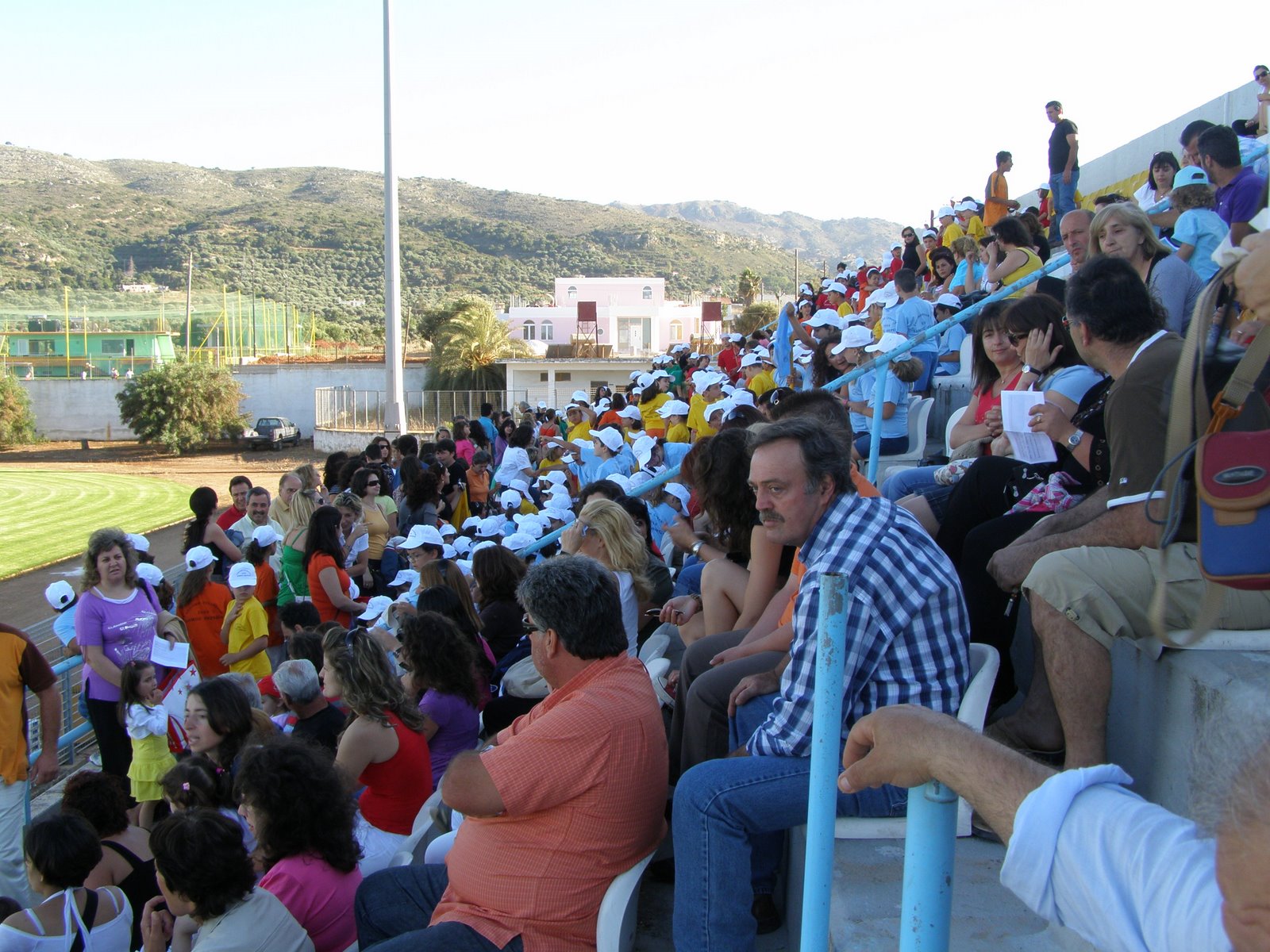
Inter-school sports day for primary school children in Hania:  I took this photo in June 2008

According to the survey results of the World Health Organisation which were released last month, the childhood obesity rate in Greece is among the highest in Europe. Survey data concern the obesity rate and the 'more than normal' body weight for children aged 6-9 years in 16 European countries, including ours. One of the actions taken by the Greek Society of Obesity to address the scourge of childhood obesity is to establish "Obesity Week" (October 21 to 26) to inform and raise public awareness. One week is not enough however.

We can laugh over the developments related to the case of the "new food" program devised by Michelle Obama, and the comments of American students on twitter, but in Greece the situation is just very sad. The absence of welfare interventions in our country is a trait that dates back to long before the economic crisis. Nutrition, dental, and psychiatric care during childhood and adolescence, unfortunately, remains almost inactive, not just because of limited resources but also because of the famous Greek discontinuity of party-appointed authority, which constantly creates obstacles and misunderstanding among public bodies.

Competent bodies should not ignore the relative economic status and dietary choices of the population, which is confirmed by the survey data, showing that childhood obesity is present at an increased incidence in low family incomes - but they should also not underestimate the role of prevention and systematic information to the public in the way that this works in all the other European states. It might also be good of the parents if, apart from seeking support from doctors, nutritionists and psychologists, they think seriously how they themselves can help their children, changing their way of life.

My work in Britain with families of adolescents suffering from eating disorders made me realize how painful and multidimensional this issue is. The first thing that psychology takes into account when facing the problem of childhood obesity is the eating habits of parents. If the child grows up copying the wrong habits of his/her parents - who may or may not be obese, according to their body type - it is necessary to address the problem as a problem of the whole family. Those using certain food items, such as sweets, as "bait" to encourage the child to do or not do something, or as a "painkiller" when the child is sad, help to create not only obese children, but also obese adults, since we can reproduce the wrong perception about food, which we acquired as children for the rest of our lives.

With the guidance of experts, parents are wise to set and follow certain dietary rules, so that they themselves provide the good example, even if they are not overweight. It is important to encourage the child to be involved in sports and exercise, helping them to choose something that suits the body type and temperament of their child. It is equally important not to devalue the child, to avoid comparisons with friends and classmates, so as to not create guilt about the child's extra weight.

The time has come for us to understand that childhood obesity is a threat to the individual and to public health. This disease is directly related to physical and mental disorders, which usually appear in childhood and are maintained into adulthood. An organized scientific approach on the part of the state is now compulsory.

©All Rights Reserved/Organically cooked. No part of this blog may be reproduced and/or copied by any means without prior consent from Maria Verivaki. 

Monday, 3 November 2014

Writing in Greek

When I first moved to Greece, my Greek language skills were 'good', probably better than most diaspora Greeks' skills, perhaps because I had studied linguistics, which meant that I could detect language patterns that would ultimately help me to use Greek more effectively. To improve your foreign language skills, it helps to live in a country where it is used as the main language medium, it also helps to speak the language frequently and converse with native speakers - but that will not necessarily help you to improve your written skills in that language.

My Greek reading skills were good to start with, but my writing skills were completely lacking. This is because I did not need to write in Greek. In fact, most people's writing skills in those days (over 2 decades ago) were lacking - apart from the occasional letter to a friend, Christmas cards, and shopping lists, we did not write much. These days, we write much more given our use of the internet; therefore, we read much more too, because we have access to more reading material than we ever did before.

This is in fact what helped me to improve my writing skills - thanks to the internet, I had access to as much reading material in the Greek language as I wanted. Reading allows you to 'see' the language, which then helps you to remember spelling and standardized word endings. I have now got to the stage where I write the Greek press releases for my son's local fencing club. Normally, I am simply informing local newspapers and web sites about the competitions that the young athletes take part in, the results, and messages of thanks to sponsors. The press releases are often used just as they have been written, but I notice that the print version in the local paper rewrites them to suit their newspaper's style.

My latest write-up is more descriptive: it discusses a visit by German students during an exchange trip. I've just sent it off to the papers and news sites. You get a sneak preview of it here - in translation!

"The Hania fencing club received a surprise visit last Wednesday from a group of high school students who came to Chania via an exchange programme from Straubing, a German town about 100 kilometers away from Munich. The exchange was organised through the 5th High School in Nea Hora, Chania, through e-Twinning. The visit to the fencing club was organized by the fencing coach, Mr. Michael Konstantinopoulos, who is a physical education teacher at the 5th High School. The German students stayed in Chania for a week. They also visited Knossos, and watched the football match between Platanias and PAS Ioannina, among other events planned for them. 

The fencing club in Hania, in the area known as Palea Ilektriki.
Η αίθουσα της Α.Λ.Ξ. Χανίων, στην Παλαιά Ηλεκτρική.

"In the frame of exchanging ideas and experiences, Mr. Konstantinopoulos organized the visit to the fencing club, so that our guests will have the opportunity to learn about the sport of fencing and to see Greek students participating in this sport which is particularly widespread in their country in contrast to Greece. This is the second time that the same German high school has visited the club, at their request, to get an experience of the fencing sport. After a short demonstration by the young athletes from the Hania club, our German guests also had the opportunity to test their skills with the swords under the supervision of Mr. Konstantinopoulos. 
The athletes of the fencing club show the German students how it's done.
Οι αθλητές της Α.Λ.Ξ. Χανίων κάνουν επίδειξη στους Γερμανούς επισκέπτες.
The German visitors get a chance to try out the swords for themselves.
Οι Γερμανοί επισκέπτες δοκιμάζουν το άθλημα.

"Overall, our German guests were quite enthusiastic about their fencing experience and left with the best impressions of the progressive nature of their Greek peers. They ask that such exchanges continue to occur in the future."

And here is the Greek version, which will appear sometime tomorrow in the following websites: www.kydon.gr, www.neatv.gr, www.haniotika-nea.gr, www.flashnews.grwww.zarpa.gr .

"Η Α.Λ.Χ. Χανίων έλαβε μια ευχάριστη  έκπληξη την περασμένη Τετάρτη από μια ομάδα μαθητών γυμνασίου που ήρθαν στα Χανιά μέσω μιας μαθητικής ανταλλαγής, από το Straubing, μια γερμανική πόλη περίπου 100 χιλιόμετρα από το Μόναχο. Η ανταλλαγή έγινε με το 5ο Γυμνάσιο στη Νέα Χώρα, Χανιά, μέσω του προγράμματος e-Twinning (http://www.etwinning.net). Η επίσκεψη στην Α.Λ.Χ. Χανίων διοργανώθηκε από τον προπονητή ξιφασκίας, τον κ. Μιχάλη Κωνσταντινόπουλος, ο οποίος είναι καθηγητής φυσικής αγωγής στο 5ο Γυμνάσιο. Οι Γερμανοί μαθητές έμειναν στα Χανιά για μια εβδομάδα. Επισκεφθήκαν επίσης και την Κνωσό, και παρακολούθησαν τον ποδοσφαιρικό αγώνα μεταξύ Πλατανιά και ΠΑΣ Γιάννενα, μεταξύ άλλων εκδηλώσεων που είχαν προγραμματιστεί για αυτούς. 

"Στο πλαίσιο ανταλλαγής ιδεών και εμπειριών, ο κ.  Κωνσταντινόπουλος οργάνωσε την επίσκεψη στην Α.Λ.Ξ. Χανίων, έτσι ώστε οι επισκέπτες μας να έχουν την ευκαιρία να γνωρίσουν το άθλημα της ξιφασκίας και να δουν Έλληνες μαθητές να συμμετέχουν σε αυτό το άθλημα ιδιαίτερα διαδεδομένο στη χωρά τους σε αντίθεση με την Ελλάδα. Αυτή είναι η δεύτερη φορά που το ίδιο γερμανικό γυμνάσιο έχει επισκεφτεί την λέσχη, μετά από αίτησή τους, για να πάρουν μια εμπειρία για την ξιφασκία. Μετά από μια μικρή επίδειξη του αθλήματος από τους Χανιώτες αθλητές της λέσχης μας, οι γερμανοί επισκέπτες είχαν επίσης την ευκαιρία να δοκιμάσουν τις δικές τους δεξιότητες με τα σπαθιά. υπό την επιτήρηση του κ. Κωνσταντινόπουλο. 

Συνολικά, οι γερμανοί επισκέπτες μας έμειναν ενθουσιασμένοι και έφυγαν με τις καλύτερες εντυπώσεις από την προοδευτική φύση των Ελλήνων ομολόγων τους. Έχουν ζητήσει τέτοιες ανταλλαγές να συνεχίσουν να λαμβάνουν χώρα στο μέλλον."

It's not a case of the internet degrading our reading and writing skills, if you know how to use this tool which has changed the world completely in just over a decade.

©All Rights Reserved/Organically cooked. No part of this blog may be reproduced and/or copied by any means without prior consent from Maria Verivaki. 

Sunday, 29 June 2014

California dreamin'

I was in Iraklio yesterday, close to the area of the Olympic stadium, built for the use of the Olympic Games held in Athens in 2004. Although the area doesn't show the same signs of disuse and neglect that the OAKA facilities show, it reinforces aspects of Greek identity in similar ways. The stadiums have a bigness to them that never boded well with small Greece, and the modernisation that took place in both of the surrounding areas was never really appropriate for the Greeks: no matter how much they seem to embrace modern trends, there will be some aspects of modernism that they will not be entralled with. This is the reason why these facilities look so neglected these days: they never really suited the Greek lifestyle.

My son was involved in a fencing tournament yesterday, which was held, not at the Pan-Cretan (Olympic) Satdium of Iraklio (shown below)...

... but right next door, at the LIDO, a small cosy gymansium built in just the right size for local use. The stadium was also in use ont he same day, and although fencing tournaments do take place in the Athens Olympic facilities (OAKA), the site today was seen as more appropriate: as the coach explained, if you live in a rented property of 80 square metres, and you are suddenly gifted a 2000 square metre space, at first you will be excited, but later you will realise that you prefer to live in the rented property rather than maintain such a big amount of space...

In the area of the Pan-Cretan Stadium, the roads have been done up to look like ... something like 'boulevards' and 'avenues', things I've seen in photos of places like 'California' and 'Miami', places that have names to the likes of 'Sunset Boulevard'.

Yes, it looks sleek and chic in many ways... but the rate of upkeep, and the fact that much of the land around this area is still in private hands, hasn't helped the general area maintain this sleek chic apperance.

Greeks don't prefer lifeless soulless places for their leisure activities. They will congregate in the dingiest looking places where there are many other like-minded people.

So places like parks and bicycle tracks and outdoor seating and wildlife and coastal roads will not attract people ... unless people are already installed there.
I was in the area in the morning, so this place was empty - by the end of the day, before my trip to Iraklio was over, the place was buzzing with life. 
Where there is a modern-style stadium, there is a modern-style shopping centre. In Athens it's called the Mall; in Iraklio it's called Talos. In the morning, the place looked quite empty because Greeks don't hang around at the mall all day long: the mall is for certain times. This quiet moment gave me and my daughter a chance to savour a little peace before we joined her brother at the fencing tournament.

Talos does not contain any traditional-style stores or eateries - they are all brand label type places. I let my daughter choose where to sit. Flocafe and Starbucks were side-by-side - she chose Flocafe. AS it was a special day, I let her choose what she wanted to have: I chose an iced chocolate (full of fat and sugar), and she chose a waffle with ice-cream (full of fat and sugar). If you eat like that most of the time, well, we all know what happens to you (obesity is oft discussed on the news these days in Western mass media - not so much at all int eh Greek media, though).

We did some shopping at Peacocks  and OVS, two brands we don't have in Hania, and then walked back to the stadium (oh yes, we walk everywhere in Iraklio, much to the surprise of my friends - my whole family knows why we walk everywhere) where we were just in time for my son's games. He is a very good fencer... and we knew he'd win first prize among the dozen kids participating in his age group... but his goals were not to win gold (he knew he could do that easily), nor was it to play well (he has been doing this already). His goal was to play the best that he has ever played. In a sense, he did this, because he didn't lose any of the rounds he played in. But his opponents still managed to score hits against him, something that made him realise that there is great room for improvement. (He told me about this at the end of the tournament. I liked that. It's called maturity.)

For a treat, I took him back to Talos to buy him some new clothes, and then I let him choose the place we would have our celebration lunch. (He hadn't eaten since breakfast, and we got to the shopping centre after 6.30pm.) Talos was slowly filling up. The cafe tables which were empty in the morning were now buzzing with human activity. Again, people weren't 'hanging around' at the mall - they were hanging around with each other. Greeks are very very social. If their friends were hanging around elsewhere, they'd flock there, not at the mall.

My son chose a place called Yankees. Its name gives us an idea about what kind of food it may be serving. If the name and decor isn't enough, the menu makes it obvious.

Modern food for modern people...
Chicago, Ribs, Antiburger - total cost: €32 with 3 soft drinks and a bottle of water. 
... but only in the right company, which is still dictated by tradition, and tradition says 'people above places'. But even if we were to place some importance on the actual site, the view of Mount Juktas with its face of sleeping Zeus made perfect sense to us, as we found ourselves not too far away from the birthplace and final resting place of Zeus.

Mt. Juktas, as seen from the city of Iraklio, yesterday. Legend says it is the face of Zeus.

The Greek world always led with a radiance of its own, quite unmatched and never able to copied anywhere else by anyone. This will be the key to survival in a competitive world.

©All Rights Reserved/Organically cooked. No part of this blog may be reproduced and/or copied by any means without prior consent from Maria Verivaki.
Wednesday, 16 April 2014

Orzo rice pasta with peas (Κριθαράκι με μπιζέλια)

The simplest photo can have the power to cause the most unexpected surprise. Last night, I put up this photo on my blog:

There's nothing special about this meal, except perhaps that the peas were picked and shelled an hour before I cooked them. (There would have been more peas, but they were quite tasty in their fresh state - I ate my share as I was shelling them.) But this photo caused a little bit of a riot. My facebook followers fell in love with it - I imagine they were trying to pick out one of the peas straight from the screen! My kids loved this meal so much, that I think I should immortalise it, despite it's unplanned nature and its sheer simplicity. It's also a good lenten recipe for the Holy Week that we find ourselves in.

You need:
a large cup (or two) of freshly shelled peas
5-6 tablespoons of extra virgin olive oil
an onion, chopped roughly
2 cloves of garlic, chopped finely
1-2 teaspoons of tomato paste
250g orzo rice pasta (half a packet - it is usually sold in 500g packs)
salt and pepper

Heat the oil, add the onion and garlic and cook till translucent on medium heat. Add the peas and stir them in to coat in oil. Do the same with the orzo. Now add the tomato paste and pour in 2-3 cups of water. Add some salt and pepper. Keep stirring over medium-high heat until the water is absorbed and the pasta is cooked. This is very important because orzo tends to stick to the bottom of the pan if left unattended. You may need to add more water. At any rate, the water will be absorbed by the pasta.

Once the pasta is cooked (it only needs about 10-15 minutes), let it stand to settle and absorb more of the liquids. It can be served both warm and cold (it goes well with yoghurt), and if you have the time and inclination, you can add other vegetables to it like cubed carrot and/or corn kernels.

©All Rights Reserved/Organically cooked. No part of this blog may be reproduced and/or copied by any means without prior consent from Maria Verivaki.

Wednesday, 9 April 2014

Trapped (Εγκλωβισμένοι)

All photos and links come from Haniotika Nea. More photos are found in each link mentioned.

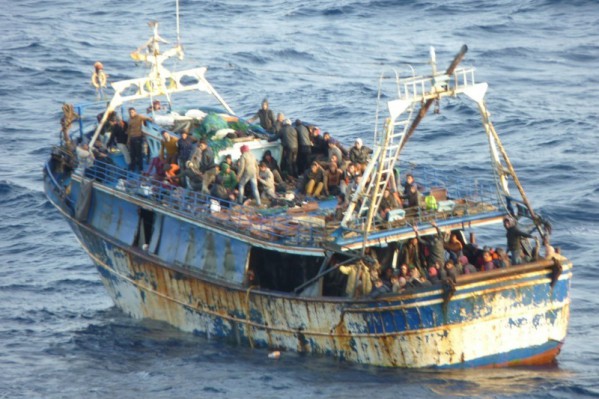
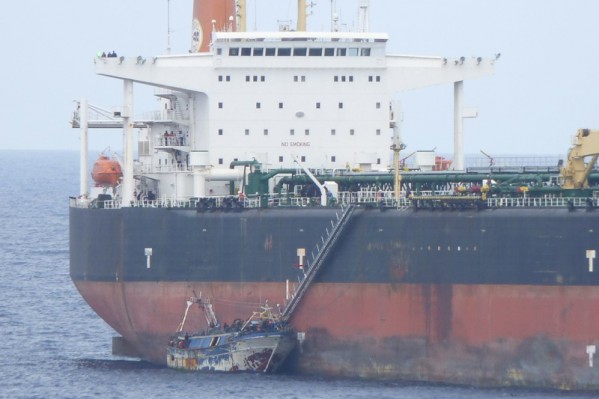
On the 31st of March, 2014, 345 people of undefined status were picked up in the sea 70km off the small harbour of Paelohora, a summer resort town on the south-western coast of the Mediterranean island of Crete. The rotten rusty leaky boat they were travelling on was towed by an oil tanker that was in the general area of the Libyan Sea, which the boat people boarded.


These people carried similar hopes and dreams of entering Europe as many others who have traveled in a similar way before them. Their quest: to seek a better life, like the many people all over the world who move from one place to another, both within their own countries and beyond their borders. Among them were women and minors whose ages could not be determined on sight. Their arrival coincided with claims by Médecins Sans Frontières that "Migrants face 'living hell' in Greek detention", as reported by the Guardian. Their arrival also coincided with the start of the tourist season in Hania, and the first charter flight to the region.


The boat people arrive in Paleohora

What do you do with 345 people who have nowhere to go in a foreign country? Only the state can get involved at an initial stage. Only the state has the right to be involved. The status of these people has to be determined, their health must be checked, their nationality must be verified, their reasons for finding themselves in this predicament must also be ascertained. At the same time, food and accommodation must be secured for them. It is not the job of the individual residents, nor should any of these actions be viewed as a form of goodwill. The problem of smuggling people into another country is a global one, and there are international laws which govern it.

Despite their undefined status and unexpected arrival, these people need to be accommodated in some way. There was no public space big enough to put them up in Paleohora. The hotels there are nearly all small family-owned businesses; they were empty at the time, but in all fairness, their use does not extend to providing free accommodation out of solidarity, nor should the state be paying such businesses to cater for the needs of unauthorised people in the country. The issue of where such people are accommodated, even temporarily, is a contentious one: no one really wants these people in their back yards, so to speak.

From Paleohora, they were transferred to EMEX, a centre which houses exhibitions in Hania, mainly of an agricultural/culinary nature, as well as the local water board, located in lush countryside with orange orchards and olive groves, about 10 minutes out of the town centre. (EMEX also happens to neighbour the long-standing minimum-security agricultural prison where low-risk prisoners are often seen outside the complex under guarded conditions working on the land; it is also close to the recently opened maximum-security prison.)

Local authorities and volunteer associations were all involved in the organisation of temporary accommodation facilities for the arrivals.

Bedding donated by various associations (a lot is most likely made in one of a number of local SMEs producing mattresses for the town's tourist industry - they are replaced regularly by large hotels, and the old ones are donated to those in need), chemical toilets, heaters and separate women-and-children quarters (for privacy) were set up for them by the local Red Cross and Samaritan groups. INKA supermarket, the Mediterranean Agronomic Institute of Chania (MAICh), the old people's retirement home (a state institution in Hania), the Orthodox Academy in Kolimbari (a religious-based unit) and the NATO Missile Firing Installation in Akrotiri offered their kitchen services (they each cooked an extra number of meals to make up the portions required), while the local state authorities, including Doctors of the World, began the Herculean task of working out who is who (smuggler, refugee or opportunist), which country they come from, and who needs medical attention.

The issue of how this leaky boat ended up in Cretan waters is also under scrutiny: it had first sent a distress signal from the sea zone of Malta, which begs the question about who 'pushed' it into Greek waters. While the state bodies did their utmost to meet the arrivals' immediate physical needs, Steki Metanaston (one of a number of anti-fascist, anti-racist groups in Hania, which has a very well-organised left-wing political climate in this respect, hence attacks of the Golden Dawn nature are practically non-existent in Hania) expressed the view that the state was 'unprepared' for this incident, since it treats migrants as 'illegals' and 'without rights', and the accommodation provided for these people was inappropriate. (You can find out more about their manifestos in this article, including discussion of the Dublin II treaty.) The various police associations of the island also complained about the diversion of all forces towards the guarding of the accommodation quarters of the migrants, potentially leaving the island unsecured; many officers worked throughout the two days needed to sort the migrants into groups, without adequate rest and nourishment. At the same time that this was going on, in Iraklio (the biggest city in Crete), a people-smuggler's ring was broken.

It is believed that the group consisted of mainly Egyptians (approximately 2/3), who will face deportation, while a large number of Syrians (not the complete remaining third) will not, as they are considered possible victims of a warzone, therefore, they may apply for political asylum. 6 smugglers were identified among them.

People who try to enter a country illegally are also organised in their own way, to meet their own demands. Three days after arriving in Hania, the Egyptians in the group decide to go on a hunger strike because they face the threat of deportation, also refusing to sign documents that stated their undefined status. The hunger strike did not last long, but the Egyptians continue to be held at EMEX, while the Syrians were given a document stating that they have 6 months to leave the country if their status remains undetermined.

Some of the more vulnerable Syrians were then removed from EMEX and taken to a hotel in the town, where they were allowed to stay until Monday (ie a week after their arrival); the others were looked after by the Rosa Nera squat (another strongly rooted left-wing organisation in Hania). No provision was made for the food needs of those who were dismissed from EMEX. It's cold and wet at the moment in Hania - where do these people go once they leave the hotel?! But that is not the worst of it: these people can apply for refugee status only in Athens, not Hania... but they are not allowed to travel to Athens as people of undetermined status, because Athens (together with the regions of Kerkira because it close to Albania, Thesprotia because it neighbours Kerkira, and Axaia because of the port area in Patras) is considered a Greek 'departure gate' - therefore, they may not go there because they may attempt to enter another country illegally... and Northern Europe doesn't want any more illegals in their countries... which are often blamed on Greece's incapability of dealing with issue... which is why Greece wants to pull out of the Dublin treaties (which state that illegal arrivals in the EU must be returned to the EU country where they first entered the EU... which is more often than not Spain, Italy and Greece).

And the icing on the cake: if these arrivals apply for refugee status in Greece, they will not be able to go to another EU country until they are given that status, which they may not get from the Greek authorities, and even if they do eventually get it, it will take years - Greece is often slammed for not dealing with this issue very quickly, and for not issuing such a status to most of the applicants. This also applies to other EU countries, as well as non-EU countries - no country hands out refugee status that easily. The paradox in the present situation is that it is highly unlikely that any of the boat people actually want to stay in Greece: they want to go elsewhere (their most likely destination while on that leaky boat was in fact Italy). There is a more pressing need right now: their status in Greece needs to be determined. Right now, they basically have a kind of non-status... leaving them, for all intents and purposes... trapped.

Boat people were rare in Greece before the barbed wire wall was put up between Turkey and Greece, which effectively stopped illegals arriving in Greece on foot. Some drowned in the freezing Evros river, but the wall basically meant that the only entry point to the Promised Land (aka the EU) was by sea. So the recent arrivals in Hania are effectively trapped here, and will be illegal residents in 6 months' time, unless they are offered another solution.

I wondered what would happen to these people after Monday when their hotel stay expires. I am pretty sure that these people will not be sleeping on the streets of Hania during that time, as their food and accommodation needs will be met somehow. In fact, this is what happened: churches, schools and local bodies collected clothing and food, while their hotel stay was extended: another two overnight stays will be paid for by the local authorities. (NB: the state said it could only afford to pay for one night.) In the meantime, the Egyptians seem to have disappeared overnight - no doubt, they were transferred to a holding centre in Iraklio, where they would eventually be boarded on the overnight ferry boat to Athens, from where they will eventually be deported.

PAIDIA
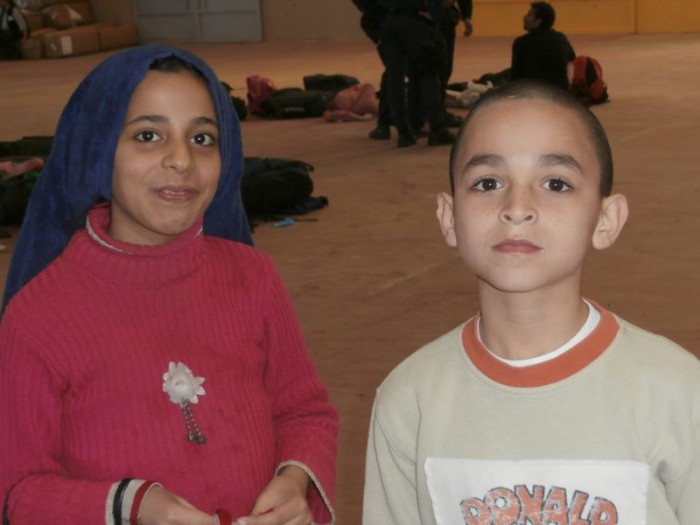
Photo of two Syrian children: from http://www.haniotika-nea.gr/fotografia-tis-imeras-121/
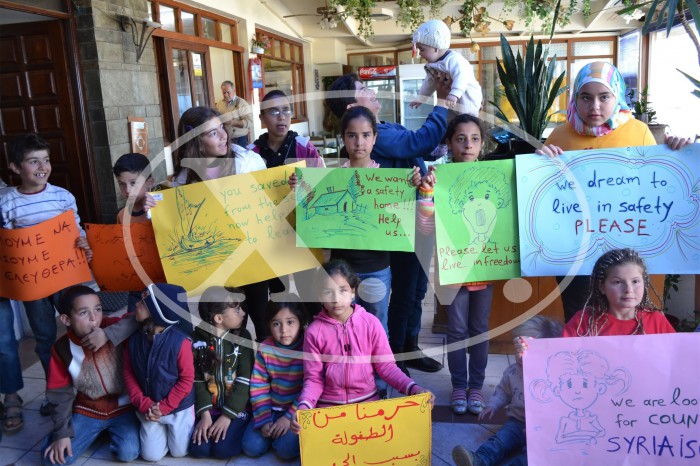
The number of minors on board that leaky boat was estimated at 107 - a huge number given that there were 345 people in total. Just 5 were from Syria and the other 102 were Egyptian. For the time being, they will not be deported: instead, they will be taken to various holding centres for minors in Athens, Thessaloniki and Crete. The accounts of members of the local authorities that are directly involved in the case are enlightening:
"... you try to find relatives of the first or second degree living legally in Europe, who want to get their children back to have a family reunion. The children from Syria have some relatives living legally in Germany and are likely to go there. The procedures may last for 1-2 months, but eventually the children will go where they want..."
"...Two shocking facts that I will never forget during these eight days in the holding center for the immigrants are: A boy from Egypt, who asked me anxiously if, at the guest house where he will be hosted, he will be able to go to school, because that was his dream. And all five children from Syria, on opening their suitcase, pulled out of it, not games, but the Syrian flag, which they hoisted..."
"... We hope to stop this tragedy... And we become better as individuals and as a state, we cannot close our eyes to them and sweep these problems under the carpet..." http://www.haniotika-nea.gr/telos-stin-peripetia-ton-anilikon-prosfigon/
From these accounts, it is clear that most of the local people want to see these arrivals being helped in some way... but most people cannot provide the help themselves. The above newspaper report shows both feelings of solidarity towards these people's plight, and the typical lackadaisical nature of Greek decision-making. 339 unexpected strangers needing hospitality is a lot to handle in one go. It's not easy to take them into our homes and it's not easy to feed them either. Above all, it is not the job of an individual, whether a person or a private organisation: it's the job of the state, as dictated by international laws.

As an example of what I am trying to say, I will use the provision of meals to illustrate my point. My workplace (MAICh, which was also involved in the provision of meals for the boat people) will be staging a dinner during Holy Week (next week) as an act of solidarity towards vulnerable social groups in Hania. This move is symbolic - many of our students are from the general areas of the countries where the recent arrivals are from. Naturally, the institute would want to keep its doors open to vulnerable groups on all days of the year, not just on festive days, and not as a one-off occasion. This comes at a time when the institute has had its state funding cut, and it faces its own financing dilemmas. But at the same time, it has expressed that it is open to collaborations with other organizations of the city.

This may all sound as though it goes against the principle of Greek hospitality, but it also goes against the international laws often created by countries who make war (in both the literal and figurative sense), leaving refugees in other countries, who are then distributed among yet other countries that are not necessarily well equipped to look after the needs of their own people, let alone strangers. The countries that have the luxury of distance, and therefore do not have to deal in any way with the immediate problems of these unfortunate people, are no better in the way they handle them: the so-called developed nations of the world do not accept so many refugees as may be believed by refugees themselves, nor are those countires in a rush to change their laws so that they can accept more. Take New Zealand for example: it accepts 700 refugees per year - that's a couple of boat loads of the size that arrived overnight in Hania last week. As I write this, an unconfirmed sighting of yet another boat in Greek waters is being checked, this time near the island of Kithira - that's not far from Crete...

I will end this post with a quote from Athens - The Truth" by David Cade:
‘Do you think we are racists?’ I (David Cade) say I’ve no idea, that I’d just like to know what she (a Greek psychologist) thinks. She replies that there are two definitions of racism: one that belongs to countries like the United States, the UK, and France, and one that is more general and appropriate for countries like Greece and Italy. Greece, she reminds me, is not like Britain, France, Spain, and other countries which have gone out all over the globe in recent centuries and conquered and colonised other lands. In her opinion, Greece’s problem is that as a member of the EU it’s being forced to wrestle with a definition that is only appropriate to countries where racism describes the treating of members of an invited resident race as inferior. But this definition can’t be applied in a country where immigrants arrive uninvited and unwanted. Greeks, Chryssoúla says, can’t be described as racist because they really don’t think of immigrants as being inferior. She reminds me that Greece is famed for its traditional philoxenía, its hospitality or, literally, its love of strangers, and she tells me many Greeks have given much help to immigrants, particularly by providing food and clothing when they turn up on the islands. And, indeed, I’ve witnessed several Greek restaurant owners giving food free to immigrants who simply stop and ask for it. So Greeks are well-disposed to visitors but draw the line at those people seeking to populate their country without permission or invitation. ‘To your country,’ she says, meaning the UK, ‘your government invited many people from India, from Uganda, and the Caribbean. To invite them and then to treat them badly, now that is racism! But to not invite immigrants and to not wish that they force themselves upon your country, that cannot be called racism!"
Just a thought. I think my country and her people are doing what ever they can for these people. And now, it's time the countries that created the status of these people also pulled their weight. It is heartening to know that, despite Helena Smith's sensationally headlined article being placed prominently on the Guardian website when it was first published, of the 1269 comments made on the article, the overwhelmingly majority are pro-Greece. As a commentator pointed out:
"It is sensationalist and shameful to be writing such articles, demonising a country, as if all of us, here in the UK and throughout the EU have nothing to do with it! Move the UK where Greece is, geographically, and then tell me how it feels like to be inundated by the world's most desperate people from every border, at the same time as the majority of your people is descending deeper in poverty and misery."
UPDATE 11/4/2014 - This report appeared in today's Haniotika Nea:
"The Syrian immigrants who are still being hosted at a hotel in Nea Hora (a suburb of Hania) are asking for help to leave Greece to go to European countries where they have relatives and the laws are more friendly to refugees. Speaking briefly before the local media, the migrants thanked all the Greeks who stood by them during their stay in Hania but also indicated that they had meant to go to neighboring Italy, and from there to other European cities. Among the Syrians are many children and minors with their parents who traveled to escape the flames of war."

If anyone thinks that Greece should be wasting her resources ascertaining the status of these people who don't want to stay here, they are completely deluded.

UPDATE: A month later, the Syrians are well and truly trapped in Hania.
DSC_0008

UPDATE 1/8/2014A solution was proposed by judicial order for the Syrians to be moved into the old psychiatric unit (close to my work place) that is no longer used. This was countered by the local hospital administration which still holds authority over the old premises, who stated that the buildings have not been cleaned for over a decade since they stopped being used, the water/electric facilities are not operating, there are no safety mechanisms, and the premises are basically uninhabitable in their present state. It  looks like the Syrians are well and truly stuck here without any options.

UPDATE 8/8/2014: The story of the Syrian refugees' stay in Hania ends tonight: "On the initiative of the Regional Government, a solution was found, regarding the Syrian refugees remaining in Chania for four months. Of the remaining refugees who do not exceed 70 in number, they will be given tickets to leave for Athens today. There will be an attempt to take them to camps for political refugees. It should be noted that of the [original] 140, many Syrians have managed recently in different ways to leave the country and go to Northern European countries where they have relatives and friends." This is the first time that the newspaper has reported the departure of the 'trapped' refugees. In essence, where there is a will, there is a way.

©All Rights Reserved/Organically cooked. No part of this blog may be reproduced and/or copied by any means without prior consent from Maria Verivaki.