As part of the interesting side of my work, I recently proofread a thesis listing over 350 species of flora, mainly low-lying shrubs that are used in similar ways to herbs, that grow in Palestine. As the study focussed on plants that grew in a Mediterranean country, many of them were recognisable to myself too, as part of the shared nature of Greece with other Mediterranean countries. Apart from food, herbs have always been used as a source of medicine from past times, and are the main basis of medicines in modern times, so the listing of plants used as food and medicinal uses, not to mention for social, animal and other uses, has been important throughout mankind's history:
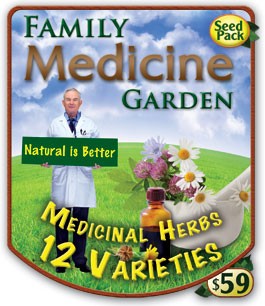 Interest in herbs is growing more and more these days, as people try to source their needs through nature. A friend from the US who knows that I rely on the use of a variety of local herbs in my cooking and use local herbs as teas in the winter sent me a link describing a seed pack containing medicinal herbs. She was wondering whether she should buy something like this to get a herb garden started. Some of the so-called medicinal 'herbs' in that seed pack are also considered common 'weeds', which basically means that they can even be found growing around her.
The seed pack basically represents how seemingly reputable international companies have commercialised the mundane, being, in this case, the health aspect of common plants for everyday use. It's good to see companies/people showing a healthy interest in the all-things-natural sphere, especially in countries whose biodiversity has been negatively affected by mass streamlining, the standardisation of nearly everything and a greatly reduced biodiversity in a more sterile environment. But a deeper look into what those medicinal herb seed packs contain makes me question their integrity. It contains a wide range of seeds that originate from different continents and climates. Plants from such differing environments need their own special conditions to grow appropriately. Acclimatisation to new environments needs time, usually over a long period (years) due to seasonal differences in various places.
Herbs are the main basis of a wide variety of modern-day medicines, and thousands of books have been written on the use of different naturally growing wild herbs (often used for animal feed or regarded as weeds these days). While growing up in NZ, I recall being fascinated by these books containing so much information about the common plants found growing around me without any help whatsoever save some rain. But at the time, very few people actually applied this knowledge in their daily life - such information was viewed as interesting but not highly applicable. With almost twice as many people living on the planet as there were back in my youth, and with greater issues surrounding food insecurity, this is changing of course; even so, knowledge and information is still being withheld from most people.
The Western world has commercialised the mundane and common to the point of omitting to inform people about how to recognise and value what we commonly see growing around us. Instead of educating people to have knowledge about what naturally occurs in our environment, we are living in a world which encourages us to buy chemical remedies whose combinations of artificial substances may actually be causing us more harm than the good they write on the packets. People are being encouraged to buy 'stuff' without being educated on how they can acquire the same stuff in a more natural form. We live in a nasty world, where knowledge is now being used as an elite weapon, and people are kept ignorant of truth in many ways. I've noticed this even in some blogs, which feed their readers with so very little information, and on a highly irregular basis, until the blog owner publishes a pricey book that contains 'all the knowledge'.
Here in Crete we still use herbs as ancient as our civilisation. We can still gather them in the wild (with restrictions), and many people have transplanted them from the wild into their own gardens, so they still contain their wild properties (they aren't hybrids). Despite world marketing trends, Greece still hasn't worked out an appropriate way to commercialise her indigenous herbs into a marketable profitable business. It is still being done rather haphazardly, and of course, we lose ground in the tight market every single second we delay, despite having some of the most marketable medicinal plant species in the world, in a country that is regarded as having the highest index of biodiversity levels in Europe.
©All Rights Reserved/Organically cooked. No part of this blog may be reproduced and/or copied by any means without prior consent from Maria Verivaki.
"The more popular knowledge on the uses of wild plants becomes obsolete, the more indispensable becomes the need to record this information, not only for historical reasons, but also in view of unveiling products and uses, long forsaken in the course of time; this is knowledge to be exploited for rural development and the so-called multiplier effect." (Tamara Saleh, Unpublished MAICh thesis, 2013)The herbs description contained scientific, common and English names, with information on location, photos, preparation methods and uses of each herb. Local herb specialists were used to collect the data, so the informaiton was gathered first hand from the field, using the knowledge of local shepherds, cooks and shop owners with a family history of herb gathering. Plants as common and mundane as wild grasses were documented in standardised fashion, with numbered references for the sources of the information:
|
Adiantum capillus-veneris L.
|
 WAY OF PRESERVATION WAY OF PRESERVATION
Leaves are air-dried for 3-4 days and kept in bags [19].
|
||||||||||||
|
Distribution in the Mediterranean:
Palestinian
Territories: NATIVE [4]
Distribution in PAL T.:
Nablus Mountain, Al Quds and Al Khalil Mountains, Jordan Ghour, Shafa
al Ghour, Dead Sea Region, Barriyat Al Quds and Barriyat Al Khalil [4].
Occurrence: rocky, humid habitats of
woodlands, shrublands, semi-steppe shrublands, shrub-steppes, deserts and extreme deserts [39].
Life form: hemicryptophyte [39].
Abundance: COMMON [4].
Blooming months: [4, 39]
|
|||||||||||||
|
English name(s):
Maidenhair fern
|
Common name(s) in Palestine:
كزبرة البير
|
||||||||||||
|
USES
Material: Parts used: leaves.
COSMETIC. As a hair wash to remove dandruff [21].
Medicinal: Parts used: leaves.
A decoction of leaves is an emmenagogue, used to treat cough [8]. Green leaf extraction is placed on affected areas of snakebites
[7].
|
|||||||||||||
Interest in herbs is growing more and more these days, as people try to source their needs through nature. A friend from the US who knows that I rely on the use of a variety of local herbs in my cooking and use local herbs as teas in the winter sent me a link describing a seed pack containing medicinal herbs. She was wondering whether she should buy something like this to get a herb garden started. Some of the so-called medicinal 'herbs' in that seed pack are also considered common 'weeds', which basically means that they can even be found growing around her.The seed pack basically represents how seemingly reputable international companies have commercialised the mundane, being, in this case, the health aspect of common plants for everyday use. It's good to see companies/people showing a healthy interest in the all-things-natural sphere, especially in countries whose biodiversity has been negatively affected by mass streamlining, the standardisation of nearly everything and a greatly reduced biodiversity in a more sterile environment. But a deeper look into what those medicinal herb seed packs contain makes me question their integrity. It contains a wide range of seeds that originate from different continents and climates. Plants from such differing environments need their own special conditions to grow appropriately. Acclimatisation to new environments needs time, usually over a long period (years) due to seasonal differences in various places.
Anthemis
melampodina Delile
|

PRESERVATION
Flowers are air-dried for 3-4 days and kept in bags [19].
USES
Medicinal: Parts used: flowers. An infusion helps to relieve colds and flu, cough, and all the symptoms of colds [7, 8].
|
||||||||||||
|
Distribution in the Mediterranean:
EGY, ISR, LIB (?), PAL, SYR [38].
Palestinian
Territories: NATIVE
Distribution in PAL T.:
Dead Sea
Region, Barriyat Al Quds and Barriyat Al Khalil [4].
Occurrence: dry, sandy habitats of
semi-steppe
shrublands, shrub-steppes, deserts and extreme deserts [39].
Life form: therophyte/ annual [39].
Abundance: RARE [4].
Blooming months: [4, 39]
|
|||||||||||||
|
English name(s):
Negev Chamomile
|
Common name(s) in Palestine:
|
||||||||||||
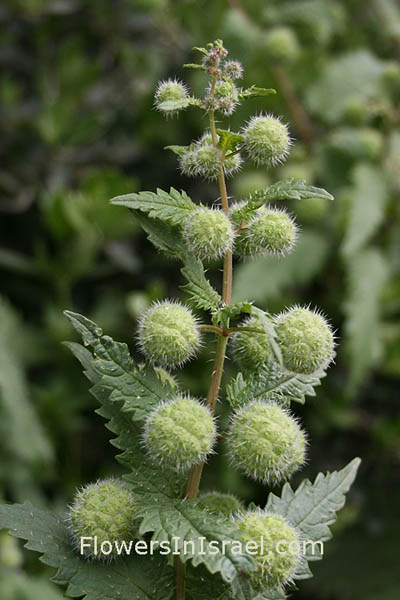
The seed pack also contains chamomile which grows wild in our garden every year without being sown; I pick it, dry it, store it and throw what I didn't use away once I can dry the new season's bounty. Nettle seed is also included in the pack, and that too grows wild - so wild that Greek gardens are full of them throughout the cooler season (it has started growing now in my garden - I use it in my spanakopita). For this reason, nettle is considered a weed - you don't really need to pay $59 to buy seeds for it to proliferate your garden with; in short, you are being ripped off. What's more, both chamomile and nettle have one growing season, after whcih they go to seed. The seeds lie dormant in the field where the plants were growing until the next season. Don't be surprised if your potted weeds died after the growing season; you will also need to buy more seeds if the seeds were hybrids.
|
Urtica pilulifera L.
Family: Urticaceae Juss.
|
PRESERVATION
Plant material is air-dried for 3-4 days and kept in bags [19].
USES
Food: Parts used: leaves.
Eaten as a salad [14].
Material: Parts used: leaves.
HYGIENE. The hair is washed with leaf infusion as anti-dandruff treatment.
Poisonous: Allergenic [40].
|
||||||||||||
|
Distribution in the Mediterranean:
ALB, ALG, BOS, CRO, CYP, EGY, FRA, GRE, ISR, ITA,
LEB, LIB, MAL, MON, MOR, PAL, POR, SLO, SPA, SYR, TN, TUR [38].
Palestinian
Territories: NATIVE
Distribution in PAL T.:
Nablus
Mountain, Al Quds and Al Khalil Mountains, Shafa Al Ghour, Jordan Ghour,
Barriyat Al Quds and Barriyat Al Khalil [4].
Occurrence: ruderal, nutrient rich habitats of
Mediterranean
woodlands and shrublands, semi-steppe shrublands, shrub-steppes, deserts and
extreme deserts [39].
Life form: therophyte/ annual [39].
Abundance: COMMON [4].
Blooming months: [4, 39]
|
|||||||||||||
|
English name(s):
Roman nettle
|
Common name(s) in Palestine:
قريص
نجمي Kurais najmi
|
||||||||||||
|
USES
Medicinal: Parts used:
whole plant, roots, leaves, seeds.
A decoction of plant material is
used in case of coughing. A decoction of roots is consumed to treat
anaemia [43]; a foliage decoction for the stomach, intestinal pain and
inflammations, liver disorders and circulatory system [5]; ground, roasted
seeds with honey to treat bed wetting [5]; a decoction of leaves in
combination to consume in case of urination problems [6]; a decoction of
leaves in combination as a bath to treat infections of the genitourinary
tracts [6]; a decoction of foliage, externally on a bandage to treat aching,
tired feet, legs [6]; dried, milled leaves with olive oil
applied on injuries, itches, burns [7].
|
|||||||||||||
The Western world has commercialised the mundane and common to the point of omitting to inform people about how to recognise and value what we commonly see growing around us. Instead of educating people to have knowledge about what naturally occurs in our environment, we are living in a world which encourages us to buy chemical remedies whose combinations of artificial substances may actually be causing us more harm than the good they write on the packets. People are being encouraged to buy 'stuff' without being educated on how they can acquire the same stuff in a more natural form. We live in a nasty world, where knowledge is now being used as an elite weapon, and people are kept ignorant of truth in many ways. I've noticed this even in some blogs, which feed their readers with so very little information, and on a highly irregular basis, until the blog owner publishes a pricey book that contains 'all the knowledge'.
 |
| For more information, click here. |
©All Rights Reserved/Organically cooked. No part of this blog may be reproduced and/or copied by any means without prior consent from Maria Verivaki.


