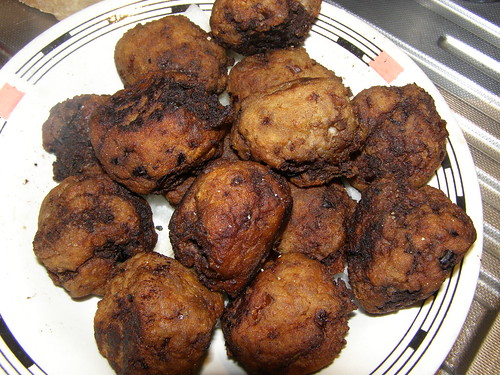
Here's a quick and easy recipe I found for fried meatballs, from one of those Sunday newspaper supplements (the Ethnos Cookbook), which will one day disappear with the demise of the paper-based media, in the same way that Gourmet folded recently.
You need:
1 kg beef mince
1 egg
1/2 cup olive oil
2 onions, grated
2 cloves of garlic, finely chopped
1 small bunch of fresh mint, finely chopped
1 tsp oregano
2 spring onions, finely chopped (I didn't have any on hand, so I used a leek instead)
the juice of a lemon
1/2 glass of white wine
2 tbsp of chopped parsley
1+1 shot-glasses of ouzo (or tsikoudia, if you are Cretan)
2+2 shot-glasses of water
100g bread
salt
pepper
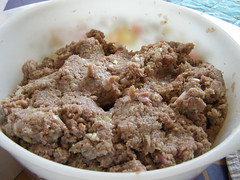
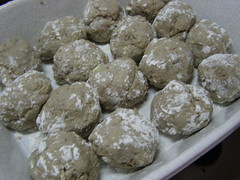
Soak the bread in 1 shot of ouzo and 2 shots of water. Mix all the other ingredients together, till everything has combined very well. Add the bread and mix that in well. Set the mixture aside for 3-4 hours for the fragrances to combine, then shape into small rounds the size of a golf ball. Roll the balls in flour, and let rest for 2 minutes. Fry the balls in very hot oil, turning over all sides until a hard crust is formed, then lower the temperature and cook till the meatballs are cooked through and are well browned.
These meatballs are hard and crisp on the outside but soft and tender on the inside. They can be served with a salad and some fried potatoes; we had them with beetroot salad and some galotiri dip.
©All Rights Reserved/Organically cooked. No part of this blog may be reproduced and/or copied by any means without prior consent from Maria Verivaki.
Greek identity with a difference, from the inside out and the outside in (formerly Organically Cooked - Linking Greek food with Greek identity: you eat what you are, or who you want to be)
Thursday, 3 December 2009
Monday, 30 November 2009
Belgium fingers (Mπισκότο Βελγίου)
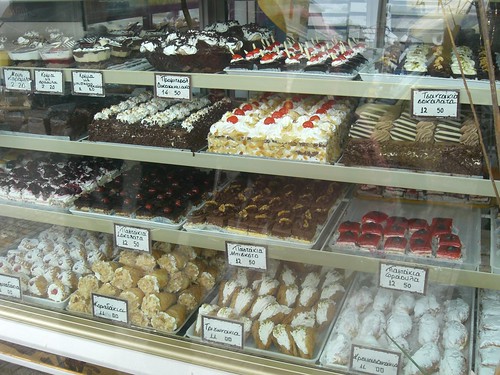
Greek cakes and sweets are usually overly sweet and syrupy, or creamy and stodgy. They are very difficult to enjoy on the road, as they leave behind messy trails of syrup and cream. The window displays of Greek cake shops are very tempting, but most of the cakes found there taste very similar to each other, even though they look very different from one another. Appearances count much more than what's inside them. If you have a particular fondness for chocolate, for instance, then how do you choose among the chocolate 'pas-tes' available? They all taste the same anyway, so no matter which one you choose, you will be satiated in the same way.
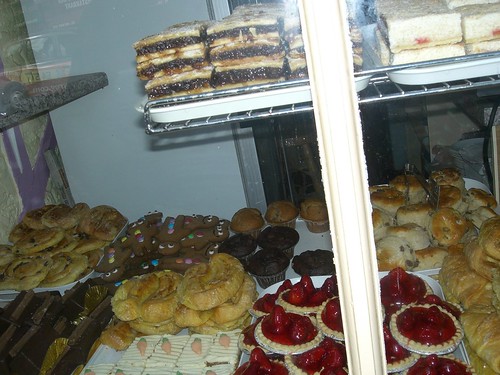
The is the exact opposite of the typical English cake display. Everything displayed in a shop window has its own unique appearance and taste. No two items are alike. If you have a particularly fondness for fruity desserts, for instance, you'll choose a strawberry tart. But if you prefer a crisp spicy biscuit, you'll want a gingerbread man. Do you like chocolate? Then go for a creamy eclair or a cakey muffin. Want to keep healthy? Then try some carrot cake. Not a single one of these sweets bears any resemblance to one another. And they're all delicious.
Cake shop in Greenwich, London: can you name all the sweets?
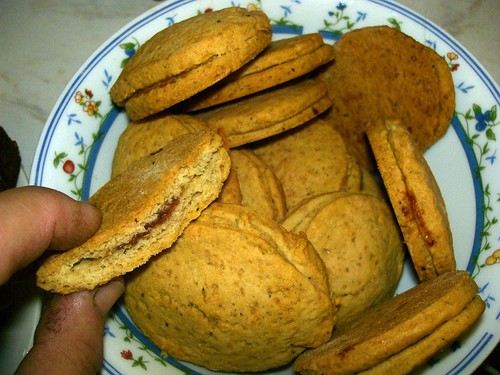
These sweet treats are very similar to the kinds of cakes and biscuits that were available at the confectionery stores in Wellington when I was living there. They were also similar to the sweets you could order in a cafe to go with a very large cup of cappuccino, along with some Kiwi favorites, like afghan biscuits, which had nothing to do with Afghanistan ,and Belgium biscuits, which, again, had nothing whatsoever to do with Belgium. Belgium (or Belgian) biscuits are spicy jam-filled topped with pink icing. They have their own unique taste.
You need:
125g butter or margarine
1/4 cup soft brown sugar (not granulated, crystal or powder sugar; soft dark brown sugar is the most suitable - I didn't have any available, so I used crystallised brown sugar)
1/2 teaspoon ground cinnamon
1/2 teaspoon ground cloves
1 egg
1 teaspoon baking powder
1 1/2 cups plain flour
raspberry jam
pink icing (I didn't use this, but these biscuits are usually iced in this way)
Cream butter and sugar together with the spices, then mix in the beaten egg. Add the flour and baking powder, and mix into the dough, which will be very soft. Roll out the dough onto a floured surface and cut small cookie-sized rounds. Spread a dab of raspberry jam over one cookie and top with another cookie round. Place the sandwich biscuits onto a greased baking tray and cook in a moderate oven for 15-20 minutes, till golden brown.
If you want to ice the biscuits, let them cool down completely, and then ice them on one side.
©All Rights Reserved/Organically cooked. No part of this blog may be reproduced and/or copied by any means without prior consent from Maria Verivaki.
You need:
125g butter or margarine
1/4 cup soft brown sugar (not granulated, crystal or powder sugar; soft dark brown sugar is the most suitable - I didn't have any available, so I used crystallised brown sugar)
1/2 teaspoon ground cinnamon
1/2 teaspoon ground cloves
1 egg
1 teaspoon baking powder
1 1/2 cups plain flour
raspberry jam
pink icing (I didn't use this, but these biscuits are usually iced in this way)
Cream butter and sugar together with the spices, then mix in the beaten egg. Add the flour and baking powder, and mix into the dough, which will be very soft. Roll out the dough onto a floured surface and cut small cookie-sized rounds. Spread a dab of raspberry jam over one cookie and top with another cookie round. Place the sandwich biscuits onto a greased baking tray and cook in a moderate oven for 15-20 minutes, till golden brown.
If you want to ice the biscuits, let them cool down completely, and then ice them on one side.
©All Rights Reserved/Organically cooked. No part of this blog may be reproduced and/or copied by any means without prior consent from Maria Verivaki.
Friday, 27 November 2009
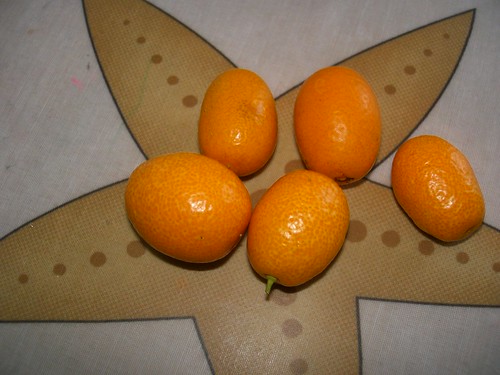
Kumquat (Κουμκουάτ)
"Hey guys!" My American-Greek colleague had just come into the office after taking summer leave for two weeks. "Guess where I've come back from!"
Eirini had been planning this trip for a long time. She had decided not to tell us where she was going, but promised us, in that good Greek manners style of hers, that she would bring us a little something back from her trip, something that could be used to help us guess where she spent her summer holidays.
"And I didn't forget that present I promised!" she laughed cheerily. This is what everyone in the office loves about Eirini: despite her curly 'r' sounds, she has remained true to her bloodlines - her sense of hospitality never fails to impress us.
"But just before I show you, does anyone want to hazard a guess about where I spent my vacation?"
"In or out?" Yiorgos offered.
"In, of course, Yioryi!" cried Eirini. "You know I can't afford a holiday abroad!"
"Island or mainland?" asked Carmen.
"Oh, you already know the answer to that one!" shrieked Eirini. "Who on earth would spend their summer on the mainland?"
"But there are so many Greek islands to choose from, Eirini!" Eleni complained. "Can't you at least help us out?"
"OK, OK," Eirini replied appeasingly. "Here's a little something I bought back for you."
She dug into her bag and bought out a little box. She lifted the lid of the box carefully so as to hide any words on the packaging that may provide clues of the contents. Inside it were little orange glaced balls, individually wrapped, each one sitting in its own little cushioned hollow casing, looking like precious gems."Bet you can't guess what these are!"
She passed them around to all of us. We all began to unwrap the morsels, ready to dig into them.
"Marzipan?" Yiorgos guessed first.
"Wrong!" Eirini laughed.
"Jellied egg yolks?" Carmen's attempt was welcomed with a few 'yeuws'.
"Baby mandarins?" Eleni hazarded.
"Close!" replied Eirini.
"Did you actually go to Kerkira, or did you just buy these from a souvenir shop?" I offered.
"Oh, Maria, you clever lass!" exclaimed Eirini. "I thought I'd catch you out on this one, but it seems you really DO know everything about Greek food." How well she knows me.
"Kerkira?" My colleagues looked bewildered. "What do they have there that we don't have here in Crete?"
"Oh, no," I replied. "Don't misunderstand me! We have kumquats here, too, but we just don't eat them!"
*** *** ***
Back in my bachelor (sic) days, I used to tend my own garden in my own house. When the fiance came along, he stared glaringly at it.
"What can you do with flowers apart from look at them?" he scoffed. Then I showed him the kumquat tree I had bought from my local nursery, the only place I bought plantlets from at the time - which shows how much I knew about gardening in my unmarried days!
"Hurrumph. And how many kumquats do you need to squeeze, to get a glass of juice, then?" was his reply. Cough, cough, splutter, splutter.
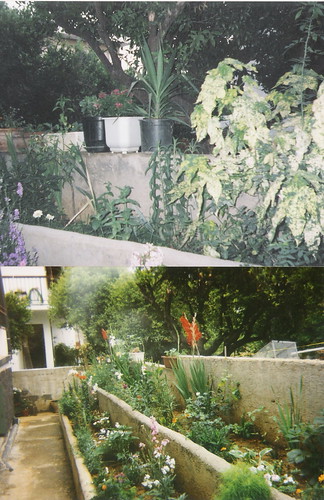
Can you see the kumquat tree? Click to view a larger photo with notes. There are no kumquats on the tree because, as you all know, I am not a gardener, and my husband only maintains a garden with real food...
I have also seen one more (very large) kumquat tree in Hania. It's located on an urban side street (photo to come as soon a I get into town again), close to a main road. The local nursery that sold me my kumquat tree (now alas chopped down by the tenants) had advised me that this species is hardy, highly tolerant of Cretan weather conditions, and makes for a pretty ornamental. And that's pretty much where the kumquat stayed: as a pretty tree for a pretty garden that does not require much maintenance. Another Corfiot oddity to be introduced by the British, during the few years they spent in Kerkira, along with gingibira, poutinga and kriket. And there they stayed.

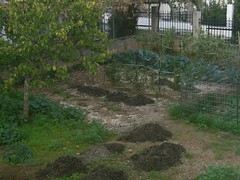
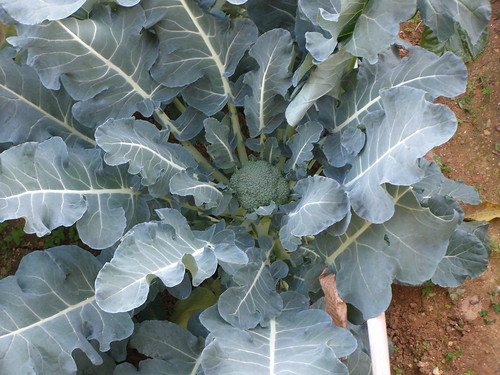
My husband's idea of a beautiful garden: dung mounds and cruciferous vegetables. Below is what he deems to be a pretty flower.

For more wild guesses about what the little orange globes were, click on my facebook page where I originally posted the kumquat photo.
©All Rights Reserved/Organically cooked. No part of this blog may be reproduced and/or copied by any means without prior consent from Maria Verivaki.
Thursday, 26 November 2009
Umami (Ουμάμι)
A little while back, after I had had a satisfying meal which consisted of tasty pastry-topped boureki (the chef at work had cooked it), a healthy (as usual) meal, based on the Mediterranean diet that I have been trying to raise my family on, I had a craving which I couldn't quite place. As I munched my way through the boureki, I thought about how my husband would be ladling the lentils I had cooked the previous night onto the children's plates, and how they would be very thankful for it, as they mopped up the sauce left on their plates with sourdough bread. An apple was offered as desert after the meal at work, but I passed on it. I wasn't hungry, but I knew I still wanted to eat something, something I still couldn't pinpoint. I went back to the office, and began to hammer out the last of the translations in a set of files all about natural resources management.
But my mind was still on food, and the taste (or lack of it) in my mouth. I let some time pass before I went out to the canteen to get myself a coffee. I had had an enjoyable meal for lunch, but for some reason my palate felt dry, though my stomach was full. The canteen was full of those tempting chocolatey biscuity bites that I usually fall for at times like these, when I crave for something to satisfy my palate, without exactly being able to pinpoint what it is that I want to eat. But even there, I found nothing that I really wanted to munch on at that moment.
Back at home, I found the dishes in a neat pile, waiting for me on the benchtop. I opened the fridge, without any particular food in my mind; I hoped that, by looking around on the shelves, I would find something that would tempt me and satisfy my craving. The leftover lentils had been placed tidily in a small bowl in the fridge. Salty lentils was not what I was after. Behind the bowl, there was a bar of dark chocolate with a citrus filling. No, I wasn't after a sweet, either, although this seemed like a logical choice. I even resorted to opening the deep freeze (that's when you know you're desperate). But there was nothing in there either, and even if there was, it would require defrosting and cooking.
I began to think of next day's meal. The vegetable box was crammed with round purple aubergines. The Asian bottled sauces on one of the shelves caught my attention. Thoughts of MSG clogged my taste-consumed mind. I suddenly realised that what my body was craving for was something savoury, exotic, uncommon. But you can't eat bottled sauces straight from the container. So desperate was I to get my taste satisfaction that I decided to cook a Chinese meal right after coming home from work; at least all that cleaning and slicing and chopping would keep my mind occupied... I set about slicing the aubergines into small chunks to make a stir-fry that I could serve with rice noodles.
Just as I had oiled the pan, the phone rang. "Hello?... basketball... first meeting... tonight... gymnasium... 6.30pm... OK." I wouldn't have time to cook a meal now. I left the aubergines on the kitchen bench and got the children ready for the meeting. The phone call had, for the time being, freed my mind of foodie thoughts.
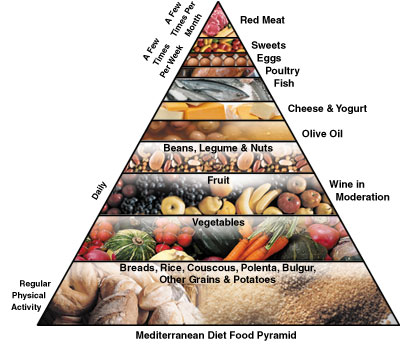
After driving in circles trying to find a place to park the car, we met up and made arrangements with the gym teacher. The children spent some time shooting baskets; I marveled at their energy, feeling guilty about my food-obsessed thoughts when I could have been thinking instead about ways not to eat. When we came out onto the street, darkness had descended but the air was warm, and there quite a few people taking advantage of the good Cretan climate on this early autumn evening, sitting at the outdoor tables of the fast food outlets in the area, with the atmosphere permeated by the smell of souvlaki. Then it struck me: that was my missing mystery taste; umami was on my mind. So much for all that healthy cooking and eating with loads of fruit and vegetables; my body was craving the taste found at the top of the Mediterranean diet pyramid: I want me some meat.
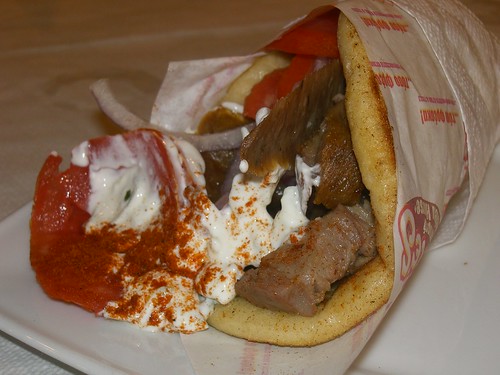
After getting my fix of umami, I craved no more... Four souvlaki yiros and three soft drinks set my family back by 15 euro.
We had a family meal at Vantes, a well-known souvlaki diner in a built-up busy congested area. The sounds of the traffic did not deter from the taste of this favorite Greek specialty. As I greedily swallowed my meat-filled pita, I wondered what vegetarians did when they craved some umami. Chinese bottled sauces, I suppose?
*** *** ***
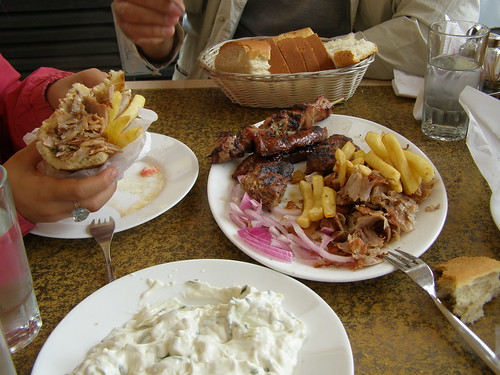
Since my recent visit to Vantes, I have also discovered that Hania is no longer limited to tried and true Cretan menu favorites. There was a whole host of different souvlaki meat offered at this souvlatzidiko (the traditional Greek fast food outlet), with a variety of toppings, just as one would expect to find in a mainland souvlaki shop: traditional yiro served with yoghurt, chicken yiro served with turmeric-flavoured yoghurt, doner kebab served with tzatziki and something called 'souvlaki Thessalonikis' which I didn't get to try this time round (this obviates the need for another visit - soon). Even bouyiourdi (albeit under a different name) was also on the menu, as was tirokafteri, both north mainland cheese dips, having made their way to Hania and now included as standard fare in taverna menus.
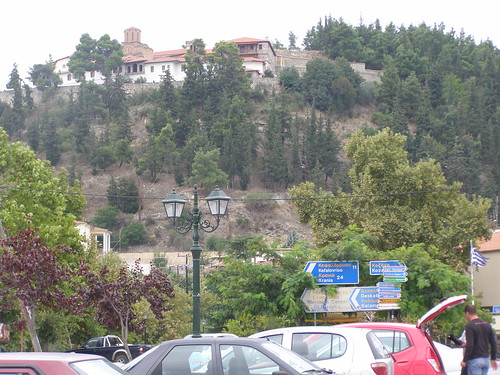
The best souvlaki I have ever tasted needs special mention. It was cooked in Elassona,in Central Greece. It looked like any other ordinary souvlaki, but the taste in that one smacked of umami in its most glorious form. We decided that its superior taste had to do with the animal husbandry techniques and cooking styles of the mainland. And just for the record, in Ellasona, souvlaki yiro is served, not with yoghurt or tzatziki, but with mustard and ketchup: very Greek, n'est-ce pas?! When we asked for yoghurt on the children's yiro and a serving of tzatziki with ours instead of the standard fare of the locality, the souvlaki shop owner said: "You're from Crete, aren't you?" So there you go...
If you don't have a souvlatzidiko near you, you can make this delicacy at home with any leftover roast and some decent pita bread.
©All Rights Reserved/Organically cooked. No part of this blog may be reproduced and/or copied by any means without prior consent from Maria Verivaki.
Monday, 23 November 2009
Quince preserve (Κυδώνι)
Working with quince is like watching magic happen before your eyes...

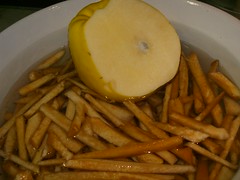
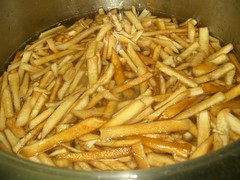
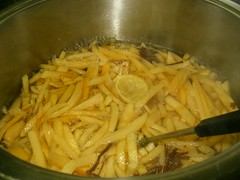
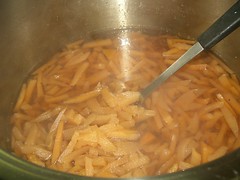
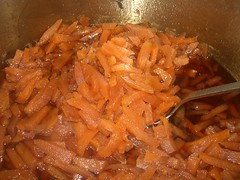
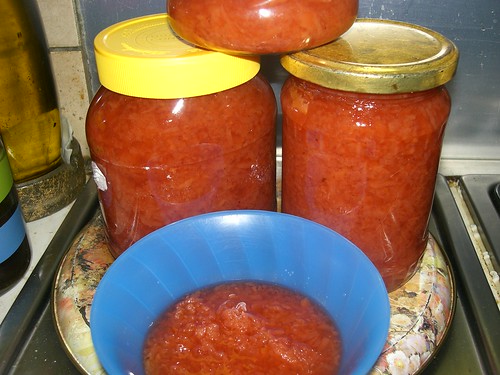
The different colour phases that quince passes through from its raw state to when it becomes a bottled spoon sweet preserve.

The different colour phases that quince passes through from its raw state to when it becomes a bottled spoon sweet preserve.
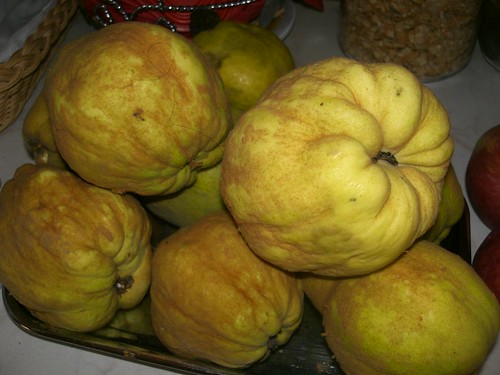
Quince starts off as a very ugly fruit, with its furry covering and pinched puckered pear-green skin.

I came by this quince during one of my recent forages (all I had to do was put my hand out the car window).
As you slice through it with a carving knife (at first, it seems hard and astringent), you come across a lily white interior which lasts for just a few seconds before it starts to oxidise. Never mind its rusty rotten looks; its aroma is intoxicating. You now have two choices: turn on the extractor fan (to mesmerise your neighbours) or secure all the doors and windows (to bathe in the aroma all by yourself).
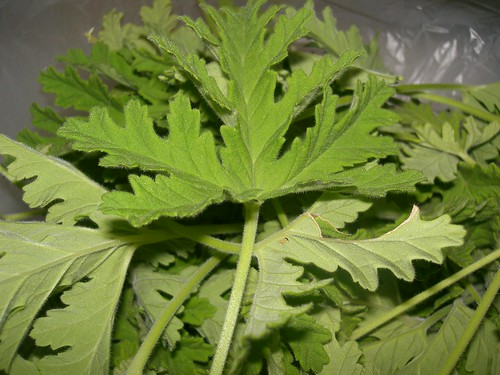
As the chopped (or grated) quince starts to warm up in a pot of water, it begins to whiten again, as if bleach had been added to it. Leave it to simmer for an hour with analogous amount of sugar, and when you return, it will have started to turn pink, reminding you of roses, as the air will now be highly scented; if you have a few sprigs of perlagonium at hand and a freshly picked lemon, those too now. The perfume of this combination of scented plants has now permeated the air; it's time to invite your girlfriends over for a sauna in its scented warmth while the quince cooks away in the syrup.
When it's time to check it again, you'll find that it has transformed into a ruby red sea, gleaming in the heat of the heavenly aromatic syrup. The more it cooks, the redder it becomes.

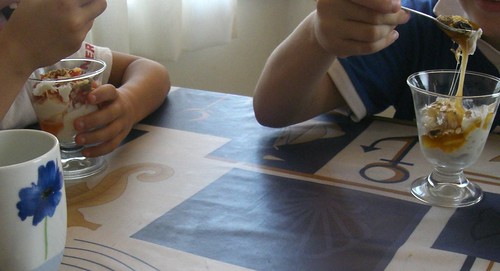
My favorite way to enjoy this dessert is with Greek strained yoghurt and muesli (or nut) topping. The quince dessert can also be replaced with honey if you don't have access to this spoon sweet (it is probably available from Greek specialty shops in most parts fo the world).
©All Rights Reserved/Organically cooked. No part of this blog may be reproduced and/or copied by any means without prior consent from Maria Verivaki.

I came by this quince during one of my recent forages (all I had to do was put my hand out the car window).
As you slice through it with a carving knife (at first, it seems hard and astringent), you come across a lily white interior which lasts for just a few seconds before it starts to oxidise. Never mind its rusty rotten looks; its aroma is intoxicating. You now have two choices: turn on the extractor fan (to mesmerise your neighbours) or secure all the doors and windows (to bathe in the aroma all by yourself).
As the chopped (or grated) quince starts to warm up in a pot of water, it begins to whiten again, as if bleach had been added to it. Leave it to simmer for an hour with analogous amount of sugar, and when you return, it will have started to turn pink, reminding you of roses, as the air will now be highly scented; if you have a few sprigs of perlagonium at hand and a freshly picked lemon, those too now. The perfume of this combination of scented plants has now permeated the air; it's time to invite your girlfriends over for a sauna in its scented warmth while the quince cooks away in the syrup.
When it's time to check it again, you'll find that it has transformed into a ruby red sea, gleaming in the heat of the heavenly aromatic syrup. The more it cooks, the redder it becomes.

My favorite way to enjoy this dessert is with Greek strained yoghurt and muesli (or nut) topping. The quince dessert can also be replaced with honey if you don't have access to this spoon sweet (it is probably available from Greek specialty shops in most parts fo the world).
And there you have it: quince spoon sweet, signaling the coming of Christmas and a taste of autumn rain, redolent of the approaching winter as autumn yields to it; there is nothing, absolutely nothing quite like it.
©All Rights Reserved/Organically cooked. No part of this blog may be reproduced and/or copied by any means without prior consent from Maria Verivaki.
Friday, 20 November 2009
Translating cookbooks (Μετάφραση)
I'm in the middle of translating a collection of recipes all based on locally available ingredients of Cretan origin, presented in new combinations. The recipes have all been devised by the head chef at MAICh, John Apostolakis. John's cooking style differs from the normal local cuisine in that he uses the same ingredients as one would expect in Cretan cooking, with a special emphasis on locally available ingredients, but the combinations would be considered unusual while the recipes are unique.
John Apostolakis, busy in the MAICh kitchen
John and his team cook and prepare food daily for 250 people, breakfast, lunch and dinner. His meals always contain a wide variety of fresh produce for all meals. There is always a Cretan emphasis in his creations, even though the food he presents isn't what you would expect to see being prepared in the average Cretan home. His philosophy is based on what he believes is a healthy meal served at the appropriate moment. His recipes all include locally available products (including newer cultivations like the recently introduced avocado) and locally made products (especially in his use of local cheese varieties). They do not use any refined cooking knowledge or processes, and neither does Cretan cooking; the best Cretan meals rely on the freshest highest-quality ingredients available to produce superlative their taste. Nor do they rely on exact measurements: the amount of each ingredient depends on preference and subtle taste combinations, all of which depend on the cook's/eater's mood.
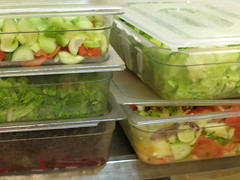
The students at MAICh eat their three full meals a day in the student restaurant. They start off with breakfast, which always looks like a tempting buffet smorgasbord. Apart from the common continental breakfast of bread and jam, or milk and cereals, the counter is also decorated with fresh seasonal salad (at the moment, you can choose between avocado, tomato, cucumber and olives), the same applying for fruit (right now, the grape season is in full swing). Lunch always consists of an array of salads - one of beans, one of potatoes, a green one, a red one, and a mixed one - to accompany a light, hot meal: spaghetti with a variety of sauces, vegetarian pizza, stewed or stuffed vegetables, to name a few. Dinner always consists of a stewed or roast meat dish, accompanied again by a range of salads.
When I sit at a seaside taverna only a few minutes away from my house, where he rich and the poor are sitting on neighbouring tables eating the same kind of food from the limited menu of the eaterie, I can truly feel that democracy really was born in Greece.
The staff also join the students at lunch in true Greek democratic style. These meal times are often my favorite in the week, because I do not have to cook or clean up afterwards, and there is always such a good variety of 'creative' food available that I find it difficult to eat 'sensibly'.
*** *** ***
I use an online translator tool for all translation work. Most people will complain that translator tools generate crazy translations; that is such an unfair comment. Translation tools take the time-consuming mundane manual writing/typing work out of the translation task, freeing up a translator's time and making the translation quicker and easier (and therefore cheaper) to produce. True, a translation tool will not be produce a translated piece of literature (as in a novel), but it is a useful tool for more neutral texts where most words are used in their literal meanings.Believe it or not, translating a cookbook from Greek to English is harder than translating a scientific text from English to Greek. Scientific texts use the literal, often a very specific, meaning of a word, which usually have an exact (or near-exact) one-word meaning in another language. This is not the case in cooking. Recipes from highly culturally based and/or localised cuisines often use obscure terms for ingredients which rarely have a direct translation in another language, although there may be some other more well-known word that roughly describes the ingredient.
A good example of this is how to translate 'mizithra', a white soft full-fat curd cheese produced all over Crete. To complicate matters, the term 'mizithra' is used all over Greece to denote different kinds of cheeses, according to the locality! As if that is not enough, the term 'mizithra' in Hania is used to denote a different cheese from the one the same word denotes in Iraklio, a prefecture of Eastern Crete, only 150 kilometres away!! The icing on the cake is that the term 'mizithra' is also PDO (Protected Designation of Origin) in Greece, denoting the white soft curd cheese produced in Hania (ie Western Crete, as opposed to Eastern Crete)!!!
Mizithra (PDO) in Hania shares some similarities with the well-known Italian ricotta cheese. Translating 'mizithra' as 'ricotta' makes Cretan cuisine sound like an imitation of Italian cuisine, in turn globalising the term. The other side of the coin is that anyone in the world should be able to use a translated cookbook (otherwise, why bother to translate it); if the exact ingredients cannot be found in a certain place, an alternative similar ingredient should be readily available. Cretan mizithra could be 'paneer' in India, 'ricotta' in Italy, 'cottage cheese' in Britain - but what about Thailand, where cheese is not eaten at all among the locals? Does 'tofu' fit the bill here? (The answer to that one is a firm 'No.')
*** *** ***
Here is a sample translation of one of John's recipes:
Σαλάτα με χούμελι και νιφάδες παλαιωμένης γραβιέρας
1 μαρούλι
250 γρ. σταμναγκάθι
2 κ.σ. χούμελι
3-4 κ.σ. έξτρα παρθένο ελαιόλαδο
50-60 γρ. γραβιέρα
ανθό του αλατιού
Πλένουμε το μαρούλι και το σταμναγκάθι, τα αφήνουμε λίγο να στεγνώσουν, τα κόβουμε, προσθέτουμε τη χούμελι και το έξτρα παρθένο ελαιόλαδο, κόβουμε τη γραβιέρα νιφάδες και τη προσθέτουμε στη σαλάτα μας.
1 μαρούλι
250 γρ. σταμναγκάθι
2 κ.σ. χούμελι
3-4 κ.σ. έξτρα παρθένο ελαιόλαδο
50-60 γρ. γραβιέρα
ανθό του αλατιού
Πλένουμε το μαρούλι και το σταμναγκάθι, τα αφήνουμε λίγο να στεγνώσουν, τα κόβουμε, προσθέτουμε τη χούμελι και το έξτρα παρθένο ελαιόλαδο, κόβουμε τη γραβιέρα νιφάδες και τη προσθέτουμε στη σαλάτα μας.
Using an online translator tool, you get something like this:
Salad and chips choumeli outdated graviera
1 cos
250 gr. stamnagathi
2 tablespoons choumeli
3.4 tbsp extra virgin olive oil
50-60 gr. gruyere
flower of salt
Wash the lettuce and stamnagathi, just let them dry, we cut them, add the choumeli and extra virgin olive oil, cut the ginger, flakes and add to our salad.
No doubt, there are a number of words the average reader will not be familiar with:
1 cos
250 gr. stamnagathi
2 tablespoons choumeli
3.4 tbsp extra virgin olive oil
50-60 gr. gruyere
flower of salt
Wash the lettuce and stamnagathi, just let them dry, we cut them, add the choumeli and extra virgin olive oil, cut the ginger, flakes and add to our salad.
No doubt, there are a number of words the average reader will not be familiar with:
- choumeli: this food product is not widespread and very little is known about it. It needs a clear definition. As it is a highly localised food product, a suitable alternative must be suggested to the reader (which, in this case, is honey - use a lesser amount than stated);
- graviera: it comes from the same word as 'gruyere', and denotes a similar kind of cheese. For some reason, the translator tool translates 'graviera' as 'gruyere', but simply transliterates the Greek letters into English in another occurrence in the same recipe, while the third occurrence of the same word is translated as 'ginger'!
- cos: the translator tool automatically chose the cos variety for the translation of the Greek word for 'lettuce' - for those not familiar with cos lettuce, this needs to be explained. In any case, other lettuce varieties can also be used instead of cos;
- stamnagathi: this refers to a local variety of a specific species of a wild (nowadays cultivated) green that grows only in Crete. It is relatively well known among the Greek culinary world, although it is difficult to designate a reasonable alternative. It is often referred to as 'spiny chicory' in English, due to its scientific name: Chicorium spinosum*.
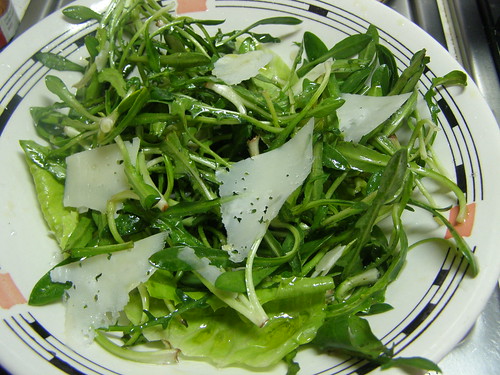
Lettuce and stamnagathi salad with choumeli and aged graviera flakes
1 lettuce (the Cos variety is widely used in Greece)
250g stamnagathi (spiny chicory, a wild green cultivated in Crete)
2 tbsp choumeli (a honey product, made by boiling the honeycomb)
3-4 tbsp extra virgin olive oil
50-60g Cretan graviera (hard yellow cheese similar to Swiss gruyere)
fleur de sel

Wash the lettuce and stamnagathi, allow to dry, and tear the leaves. Add the choumeli and extra virgin olive oil, slice the cheese into thin flaky shavings, and add to the salad.
1 lettuce (the Cos variety is widely used in Greece)
250g stamnagathi (spiny chicory, a wild green cultivated in Crete)
2 tbsp choumeli (a honey product, made by boiling the honeycomb)
3-4 tbsp extra virgin olive oil
50-60g Cretan graviera (hard yellow cheese similar to Swiss gruyere)
fleur de sel

Wash the lettuce and stamnagathi, allow to dry, and tear the leaves. Add the choumeli and extra virgin olive oil, slice the cheese into thin flaky shavings, and add to the salad.
This salad differs from local cuisine in that it has a sweet dressing (not the norm for Cretan cuisine to pair sweet with savoury) and the stamnagathi is served raw (stamnagathi is usually boiled). It also uses only a small amount of olive oil, another element in John's cooking style. He insists on using only extra virgin olive oil, but in very small quantities. This is a good thing because Cretans use too much of it in too much of their food, which does not bode well for their health (it has too many calories). Whereas only 40-50 years ago the average Cretan farmer walked 15 kilometres a day in and around his neighbourhood and fields, the modern Cretan farmer drives this number of kilometres instead and only walks two. Quantity of food needs to be balanced with the current dietary needs of a relatively sedentary lifestyle, while whatever quantity is lost should be replaced with quality.
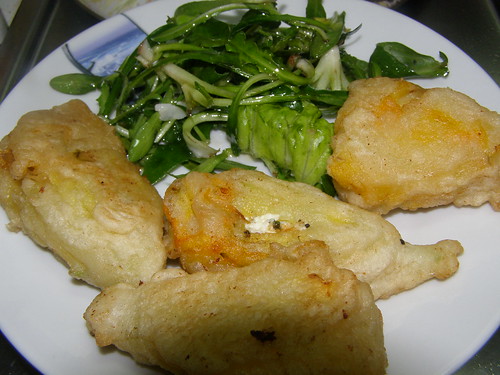
And what shall we pair this salad with? How about some kolokithoanthous?
Κολοκυθοανθοί γεμιστοί με ανθότυρο
20 τεμ. κολοκυθοανθοί
150 γρ. ανθότυρο
λίγο δυόσμο, ματζουράνα
ανθό του αλατιού
1 κ.σ. έξτρα παρθένο ελαιόλαδο
250 γρ. αλεύρι
200 γρ. νερό
λίγο ανθό του αλατιού
1 κ.γ. τσικουδιά
έξτρα παρθένο ελαιόλαδο για το τηγάνισμα

Πλένουμε προσεχτικά τους ανθούς για να μη σπάσουν, αναμιγνύομε τον ανθότυρο με το δυόσμο και τη ματζουράνα και το έξτρα παρθένο ελαιόλαδο και γεμίζουμε τους ανθούς με ένα κορνί. Φτιάχνουμε το χυλό και ρίχνουμε τους ανθούς προσεχτικά μέσα. Τους τηγανίζουμε σε έξτρα παρθένο ελαιόλαδο.
20 τεμ. κολοκυθοανθοί
150 γρ. ανθότυρο
λίγο δυόσμο, ματζουράνα
ανθό του αλατιού
1 κ.σ. έξτρα παρθένο ελαιόλαδο
250 γρ. αλεύρι
200 γρ. νερό
λίγο ανθό του αλατιού
1 κ.γ. τσικουδιά
έξτρα παρθένο ελαιόλαδο για το τηγάνισμα

Πλένουμε προσεχτικά τους ανθούς για να μη σπάσουν, αναμιγνύομε τον ανθότυρο με το δυόσμο και τη ματζουράνα και το έξτρα παρθένο ελαιόλαδο και γεμίζουμε τους ανθούς με ένα κορνί. Φτιάχνουμε το χυλό και ρίχνουμε τους ανθούς προσεχτικά μέσα. Τους τηγανίζουμε σε έξτρα παρθένο ελαιόλαδο.
*If you click on this link, you will find that most of the images are my own, even if they are on other websites (somebody has copied them; I recognise my kitchen and crockery in them!) - could it be that I am helping to invent or form the definition of a word?!
©All Rights Reserved/Organically cooked. No part of this blog may be reproduced and/or copied by any means without prior consent from Maria Verivaki.
Wednesday, 18 November 2009
Live cook show: Yemista (Μαγειρεύω τώρα! Γεμιστά)
Join me tonight (8pm Greek time) as I make Easy Peasy Yemistes Piperies (Stuffed Peppers): you will need some green bell peppers, some rice, some herbs (a herb garden, even one of those balcony- or window-sill types will do), some canned tomatoes (I'm using my own freshly frozen tomato), and some rice, along with all the other kitchen staples.
See you tonight at 8pm (Greek time)!
6.00pm: Now you know why I chose peppers ...
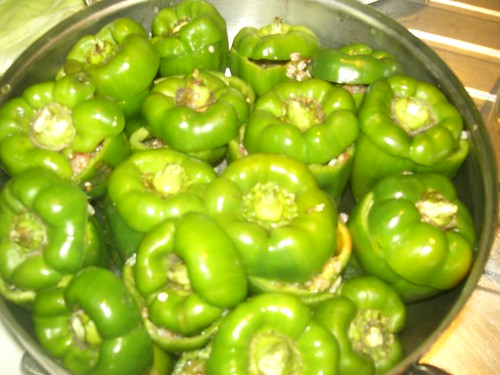
The summer garden is drawing to a close, but the peppers are still thriving. They are looking slightly deformed and 'not very pretty' - but they are still peppers and they still need to be used.
6.15pm: Here's a look at the ingredients:
Once you've got them laid out in front of you, these peppers will be delicious and easy to make (I think you'll be eating in an hour from the moment you start cooking them).
6.23pm: I know the kids won't be hot on the pepper business (they prefer to see stuffed tomatos, even though they only eat the stuffing and discard the tomatoes), but hey, waste not, want not, right?
6.26pm: If you're using canned tomatoes, you just need to open a can. But if you're using freshly frozen tomato (like me), then you'll have to defrost it (never a dull moment, is there?)
7.16pm: We had lentil soup (fa-kes) for lunch today. There's another serving of that for each one of us in the fridge, but can you imagine the scene at the table the next day? "Lentil soup again, Mum?!?" It's much easier to serve these kinds of leftovers the day after - with a bit of luck, they may have forgotten when they last ate them...
7.24pm: Wouldn't it be great if they could all be satisfied with an excitingly different salad like this one? But one of them doesn't do greens, while another doesn't do live spinach (it's got to be cooked). So I'd just be preparing food for half of us...
7.30pm: Don't they just love the same old regular meals served up? 'Comfort food' isn't the right phrase: it's 'comfortable food'...
7.35pm: It's not just me that's stuck in a rut: UK mums rely on a range of nine meals to keep everyone happy on a daily basis - it's not much different to myself. Where we differ is that they spend half the time I intend to spend tonight to cook the meal, and they usually don't cook from the previous day to feed the family the next day...
7.42pm: Yes vilges suola, fa-kes won't look and taste like Greek fa-kes if they aren't cooked like Greek fakes, and they need at least one and a half hours (see why cooking is a pain in the butt sometimes?)
8.00pm: OK, it's show time. First, wash your peppers, and slice off the top part to make a 'cap'. Remove and discard the seeds from the peppers with your fingers, and there you have the cavities ready to be filled. Place them tightly upright in a wide shallow pot (cooking them on an element, while not traditional, is much faster and more economical). That only took a minute or two, right? I managed to fit 15 small peppers in the pot.
8.05pm: Now pour the can of tomatoes into a bowl, and add salt, pepper and oregano (and a hint of cumin, which I use).
8.07pm: Chop up the herbs as finely as you can. I used the classic Greek parsley, fresh mint and dill (well, fennel, actually, we had it in the garden). Then whizz (very finely again) an onion in the multi moulineux and add that to the tomatoes. See what I mean by 'Easy Peasy' food?
8.10pm: Now add a wine glass of olive oil. Don't skimp here. unless you like boiled rice instead of savoury rice.
8.12pm: Well, cupcakes, now you know the secret of a quick meal - my mum actually made them like this many times (she was a working mum in NZ).
8.16pm: Now add one large tablespoon of rice for every pepper you have in the pot. Don't worry about the liquids - you can fix those later. I have 15 small peppers, so I'm using one medium-sized tablespoon of rice per pepper.
8.21pm: If the mixture looks too dry to you, add some water; mine looks a little dry, too.
8.24pm: Now use a tablespoon to fill the pepper shells. Really easy, isn't it?
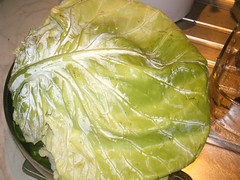
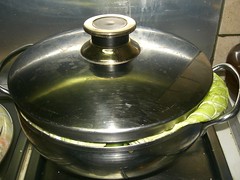
8.28pm: Place the caps on the peppers, pour some water and oil (in the mixtures that you prefer) so that there is liquid in the pot to just below 2cm of the tops of the peppers. Then place a couple of large cabbage leaves on top of the peppers, then place a plate large enough to fit on top of the pot. (I didn't need to use a plate, but this will help you keep the peppers from spilling as they cook - the cabbage leaves were enough for me.) Place the lid on the pot, and turn on the element. Cook on a high heat till the pot starts boiling, then turn the heat down completely, and let the peppers cook till the rice is done. You need about 25 minutes.
8.40pm: The dishes were a breeze on this one, just rinse and dry (except for the one that contained the oily rice stuffing).
While we're waiting for the rice to cook, here's my original recipe for yemista on the stovetop. Now get the kids to have their baths, warm up their evening milk and get them ready for bed. If you don't have kids, well, you can enjoy a glass of wine now or have a quick shower...
8.45pm: See you soon, cupcakes!
9.15pm: My yemista are nearly done: they needed more liquid (something you always need to watch for). I'm letting them cook a little longer. It's a good idea to sway the pot to and fro so that the liquid tips into the peppers. Remember, this is tomorrow's lunch, so, no rush...
9.30pm: DONE! Good night, and enjoy the rest of the evening!
UPDATE: Just came home from work - didn't they do well?
Now all I need to do is the dishes...
©All Rights Reserved/Organically cooked. No part of this blog may be reproduced and/or copied by any means without prior consent from Maria Verivaki.
See you tonight at 8pm (Greek time)!
6.00pm: Now you know why I chose peppers ...
6.15pm: Here's a look at the ingredients:
Once you've got them laid out in front of you, these peppers will be delicious and easy to make (I think you'll be eating in an hour from the moment you start cooking them).
6.23pm: I know the kids won't be hot on the pepper business (they prefer to see stuffed tomatos, even though they only eat the stuffing and discard the tomatoes), but hey, waste not, want not, right?
7.16pm: We had lentil soup (fa-kes) for lunch today. There's another serving of that for each one of us in the fridge, but can you imagine the scene at the table the next day? "Lentil soup again, Mum?!?" It's much easier to serve these kinds of leftovers the day after - with a bit of luck, they may have forgotten when they last ate them...7.30pm: Don't they just love the same old regular meals served up? 'Comfort food' isn't the right phrase: it's 'comfortable food'...
7.35pm: It's not just me that's stuck in a rut: UK mums rely on a range of nine meals to keep everyone happy on a daily basis - it's not much different to myself. Where we differ is that they spend half the time I intend to spend tonight to cook the meal, and they usually don't cook from the previous day to feed the family the next day...
7.42pm: Yes vilges suola, fa-kes won't look and taste like Greek fa-kes if they aren't cooked like Greek fakes, and they need at least one and a half hours (see why cooking is a pain in the butt sometimes?)
8.07pm: Chop up the herbs as finely as you can. I used the classic Greek parsley, fresh mint and dill (well, fennel, actually, we had it in the garden). Then whizz (very finely again) an onion in the multi moulineux and add that to the tomatoes. See what I mean by 'Easy Peasy' food?
8.12pm: Well, cupcakes, now you know the secret of a quick meal - my mum actually made them like this many times (she was a working mum in NZ).
8.21pm: If the mixture looks too dry to you, add some water; mine looks a little dry, too.
8.28pm: Place the caps on the peppers, pour some water and oil (in the mixtures that you prefer) so that there is liquid in the pot to just below 2cm of the tops of the peppers. Then place a couple of large cabbage leaves on top of the peppers, then place a plate large enough to fit on top of the pot. (I didn't need to use a plate, but this will help you keep the peppers from spilling as they cook - the cabbage leaves were enough for me.) Place the lid on the pot, and turn on the element. Cook on a high heat till the pot starts boiling, then turn the heat down completely, and let the peppers cook till the rice is done. You need about 25 minutes.
8.40pm: The dishes were a breeze on this one, just rinse and dry (except for the one that contained the oily rice stuffing).
While we're waiting for the rice to cook, here's my original recipe for yemista on the stovetop. Now get the kids to have their baths, warm up their evening milk and get them ready for bed. If you don't have kids, well, you can enjoy a glass of wine now or have a quick shower...
8.45pm: See you soon, cupcakes!
UPDATE: Just came home from work - didn't they do well?
©All Rights Reserved/Organically cooked. No part of this blog may be reproduced and/or copied by any means without prior consent from Maria Verivaki.
Subscribe to:
Posts (Atom)