Monday, 12 April 2010

Market share (Το μέρισμα της αγοράς)

Just before we get to London...

Cat Cora recently came to Hania and sampled our cuisine. A brief report was recently provided by a Cretan news site:
"Cat visited Chania for the first time, and after a short walk in the villages and downtown, she visited the Municipal Market and got impressed by the local traditional products and the authentic Cretan cuisine, such as kaltsounia with fennel, “lapathodolmades” and the local cheeses... She also promised that she will come back soon to Crete along with a group of chefs, to meet the food particularities of the place... It’s a good chance to inform the Americans about the Cretan diet and cuisine. The cuisine of Chania could even have its own brand name, such as cherry tomatoes from Santorini or the Lesbos ouzo”, she said."
Here's a chance to market Cretan cuisine by a renowned American chef of Greek heritage. But hang on a minute: Isn't Cretan cuisine well known in the global food world? Well, I thought it was. Since the 1960s, the virtues of the Mediterranean diet have been expounded on the scientific, health and culinary world. There are also some PDO products being made, which are specifically known around Greece; Cretan cheese is represented in Greece by such PDO brands as Graviera and Xinomizithra, and there are also a variety of dishes which are specific to the region of Hania itself, such as boureki and xidato, so the cuisine of Hania already does have its own 'brand' name*.

The article also mentions Cat's introduction of the fusion cuisine term “Hellasian”, a rather unfortunate word used to denote the mixture of Greek and Asian cuisine: aside from the undesirable connotations of the first four letters of the word (horrify yourself by googling the search string!), the cuisine of a single country probably doesn't easily fuse with the cuisine of a whole continent. I don't think it will catch on too quickly.

But then, I am not a marketing expert, while Cat Cora is a celebrity chef in the USA, a country which supports culinary revolutions, culinary creations and culinary marketing. She could do for Greek (or Cretan) cuisine what we are not doing in our country and need to do in order to survive in the competitive world: she could use her fame to sell us, she could help us to win our market share.

What do people know about Crete? Probably our best known image is as a holiday destination for Northern European tourists: sun, sand and sea. And high quality fresh seasonal produce. Most people know about our olive oil (which sadly is not generally marketed as such, but by more generic names like "Greek" and, believe it or not, "Italian"), but very few other fresh Cretan products leave the country and make it on to the shelves of the countries where our tourists are from. The reasons for this are manifold, involving transportation costs, quantities grown/produced, the high cost demanded for such products, politics and the lack of a market image. But that's what living in the 21st century is all about - how to secure a share in the global market, so if we don't get this aspect under control, we will be in serious trouble (as if we aren't already).

One of the problems involved in marketing ourselves is a lack of substantive interest, knowledge of world markets and cooperation on the part of the producers. Small farms and local producers are not able to or are unwilling to compete at an international level; some are content to sell on the local market or to a wholesaler, and that's as far as they are prepared to go. They generally do not invest their earnings (or the subsidies they specifically received for this purpose) in their business, nor do they do further research into new market niches. I'd like to believe that this is changing, but sadly, it isn't. People are still trying to work independently, blindly believing in the sustainability of tradition, too blind to see the new traditions that are being created right before their very eyes (the traditional kafeneion is a good example). There are exceptions to the rule, but they are still too not on a large enough scale to make a difference.

Nevertheless, Crete is one place in the Mediterranean that produces, and has the potential to produce, a great variety of comestibles, so the lack of a Cretan profile in the global food market is an great hindrance in her advancement. We produce the goods, but lack the know-how to get them where they are most wanted. Tourist surveys conducted in Greece have found that tourists would like more information and access to Cretan produce; while we're swatting flies, Holland is considered the largest citrus fruit market in Europe (they don't produce any themselves, but centralise the goods in their own country where it gets re-distributed).

*** *** ***

If Mr P were to hire me to think up of an image of Crete to promote and advance Cretan produce, what would that image, which will eventually be encompassed in a logo, be? Whatever it is, it has to be instantly recognisable. The symbol of the shape of the island...

.


... is probably not a good one; only a true Crete-o-phile will be able to remember that one (otherwise, it looks like a distorted sausage). When my son was only four, he was able to locate the blimp that represented his island homeland on an A4-size world map, but that's his homeland, and it is a shape that carries some meaning for him. The more regional one gets map-wise, the less easy it is to recognise the area being shown in the wider sense, which is also why a map of the province of Hania:


as our global symbol is even more ludicrous. Most of us will know what the map of the UK looks like, but when asked to picture the map of Wales or Scotland alone, we probably couldn't do it.

So what do people know us by? An image of Crete that people can file away efficiently in their mind, which they can recall easily when they are presented with sensory experiences, would have to be one that reminds people of how they know us: we need a food icon, combined with the summer holiday ideas of sun and sea:
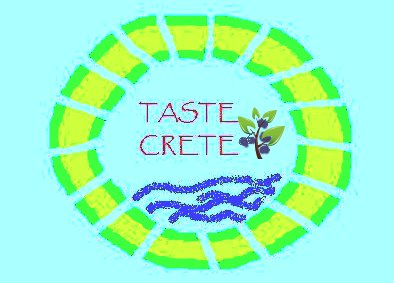
logo

The sun and sea are portrayed by internationally recognisable symbols, while the olive twig with a few purple drupes hanging off it ** is a symbol often associated with oil-producing and/or Mediterranean countries, and one of the biggest producers of olive oil in Greece is Crete. The addition of the phrase 'TASTE CRETE' is the way I think those interested in consuming our products will remember their holiday. The taste of fresh Cretan produce encompasses the sun and sea factor: Cretan produce often 'smells' of sun (in its flavours) and sea (where tourists often consume their food when holidaying in Crete). The phrase is also brief, easy to remember, and gets to the point: by buying fresh Cretan produce, you will get another 'taste' of 'Crete', as you remember her during your vacation. From my own travel experiences, most Northern Europeans have a fair idea about where to find 'Kreta Paradise'; very many of them have come to Crete at one point in their lives on a two-week summer 'package holiday'.

If I had a chance to give someone a taste of Crete, what products would I choose from among my kitchen to pass on to them so that they can pack them in a suitcase and take them with them to their home country, where they would open the package, and the aromas and tastes of Crete would pop out? I recently had a chance to do this for Jo Holland, just before I set off for the cold North...
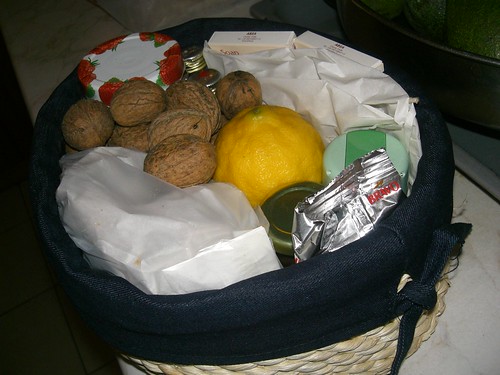

Due to weight, safety and size restrictions, I couldn't pack everything that I believe would have recreated a sense of that 'smell and taste' experience that I felt best represented Hania, but even then, I still managed to pack some fresh produce into that pretty basket, which Jo found particularly useful; maybe we shouldn't be too wary of Greeks bearing gifts after all, and the country of Greece can become known to produce something useful and sought after, unlike what we have been accused of lately (that we produce nothing and have nothing to export).

Mr P might like to consider how we can get our fresh products out of the country - they aren't perishable or difficult to transport as one might think, and they can tolerate transportation for a good number of days, so they will suffer less from our frequent strike action, road blockages and border closures!

The truth is that it all comes down to numbers in the end: there's few of us, and more of them. We will need to rely on those greater in number, those more organised than ourselves, those that are already well-equipped with the appropriate infrastructure, ready to deal with us, which they will do if we are willing to listen to them and start to prepare ourselves (is take up arms) for the fight for that bit of market share that we deserve.

To find out what was in the mystery parcel, Jo's post, and her fabulous photos - they make my food look better in her house in Blighty than they do in my own...

*Apologies to Cat Cora if she was being misreported. The article reports her interest in 'South American' cuisine, which was probably meant to be read as 'American South' or 'Southern American'. As a celebrity chef, however, she should be no stranger to researching the cuisine of any culture, so she could do a bit more homework before she visits a region, especially one she is herself a part of.
**That's what it is supposed to represent: it was the best I could come up with - I am still learning the ropes of online graphics programs!

©All Rights Reserved/Organically cooked. No part of this blog may be reproduced and/or copied by any means without prior consent from Maria Verivaki.

Friday, 9 April 2010

Nous sommes grecs (Είμαστε Έλληνες)

This post forms part of the series of our culinary adventures from our recent trip to Paris and London.

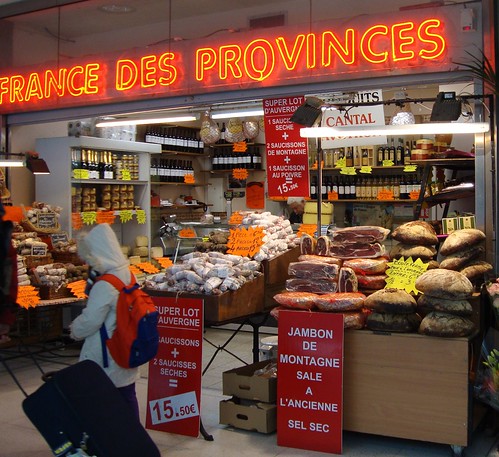
We had just stepped off the train that that took us from Charles de Gaulle airport to Gare du Nord. We had not even stepped out of the station yet when the bombardment began: wherever you looked, there was food; whatever you did, it would eventually involve food. However hard you tried, your senses would eventually be overwhelmed by the sight, the smell, the taste of food. It was practically speaking to you: "I am here and I'm not going to go away easily!"Food. French food.


gare du nord food shop
"Mmm, look at that bread...," exclaimed my husband. "And that ham, and that cheese..." We had not yet stepped out onto the Parisian rues. This may look a little kitsch, but it heralded what else we were about to discover in the next hour.

I thought I was the one who lived in a foodistic society. Yes, it's true that the visitor to Hania may feel overwhelmed by the culinary sights that s/he will encounter on their visit here, but they are very different to the bombardment of the senses that I experienced in a large urban Euorpean capital. The tourist there cannot help noticing the brasseries and bistros on nearly every single corner of every street, the patisseries and boulangeries lining the roads, the abundance of fresh produce and the emphasis on 'good food'.

Being a distrustful traveller, I decided that the main streets we were walking on and couldn't stray from out of fear of losing our way were possibly not going to be the best representations of the food lover's paradise that France generally is. How does one find a genuine slice of Parisian life? Which side street holds the promise of finding that cosy neighbourhood food shopper's delight?


My food photos from Paris; click here for my restaurant meals.

I must thank my husband for helping his wife digress from her firm map-reading habit. Despite the taste sensation he was surrounded by on his first visit to Paris, he still had Greece on his mind. "Look!" he beckoned to me, as we were walking along the rue La Fayette. "EDESSA!" Below the sign bearing the name of a Greek town was a window from which could clearly be seen an upright grill with a pile of meat staked through it. "Don't even think about it," I warned him. I had come to France to eat French food, not souvlaki.


It is always a special moment to find little reminders of Greece in a foreign country to make us feel more homely. My eyes could not stop wandering, with the thought in my mind that I have no idea when I would be able to do this again; I tried to take in as much as I could of the atmosphere on the Parisian streets. We were now on rue de Maubeuge. "Did you catch that one?" I pointed to a sign on a non-descript side street: Traiteur grec.


This was where the kitchens of a Greek catering business were located; their retail outlet was located at the end of the road...

"Well, we've got to check that one out, don't we?" I made up some excuse about how we shouldn't go down there because we would end up getting lost, but he insisted. The window was full of filo pastry triangles: tiropites, spanakopites. While I cringed, the children demanded some of their national food. Too late, I thought: quelle dommage! I kept looking back towards rue de Maubeuge, with the feeling that if I lost sight of it once we went into the
traiteur grec, Paris would disappear under my feet, because when a Greek meets up with another Greek in a foreign place, βρήκε ο γύφτος τη γενιά του*...

The traiteur grec had been living in Paris for a long time, and gave us some transport tips, in the good old-fashioned Greek-style GPS manner: "Go down this road, and then turn left, and walk along this way till you reach the church, which you walk right round, and you'll see a metro station, bt don't go in there, because you should get yourself across to the other side of the street where you'll find a bus stop for the no. 74 bus which takes you right to the Hotel de Ville near the Louvre, so you'll be able to see a bit of Paris as you make your way there." We thanked him for the tip, and continued to walk along that boring little road, where the sounds of school children could be heard behind a wall among the rabble of the rubbish bin collectors and service vehicles which were blocking the view to its end.

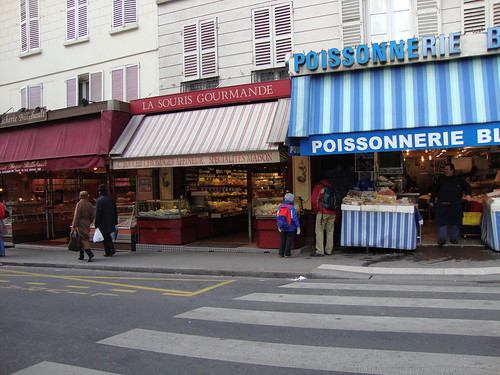
food shops
... amongst all the other specific and varied French food outlets.

When we finally reached the end, we forgot all his other instructions because... that's when the bombardment began. On the corner was an epicerie, with a charcuterie next door to it; across the road was the fromager, flanked by the boucher and the poissonier, the patissier and the boulanger, all bordered by a cafe and a bistro, with a brasserie just round the corner, a sushi shop and the traiteur grec's retail outlet, lending an international air to the place. There was also a tabac, a bijouterie and a household necessities store that stocked anything from the likes of toilet paper to firewood, the kind of stuff most of us would buy at a supermarche (a SHOPI was located here too, but not of the magnitude often associated with supermarkets). There was a genuine neighbourhood feel to the place, located in the middle of a European capital city, with everyone playing an equal role in creating the convivial ambience of the area, the epitome of a city planner's paradise.

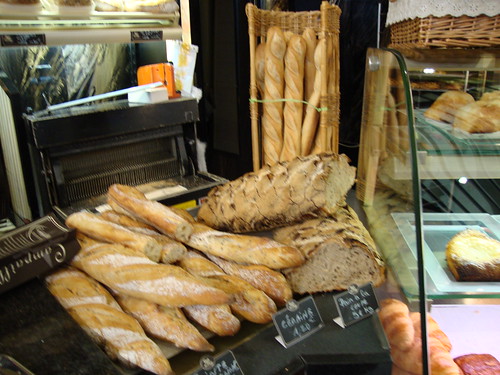
We forgot about the Louvre for the time being, and savoured the sights and smells. We had already worked out what we were going to have for lunch that day: First we went to the boulanger...
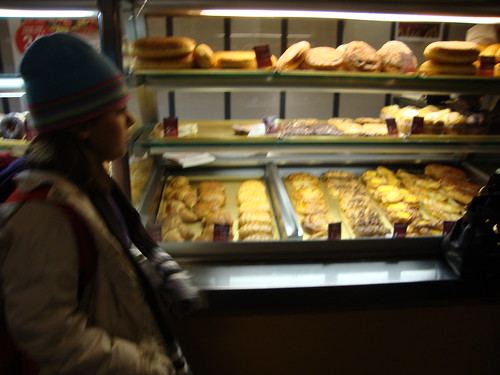
boulangerie

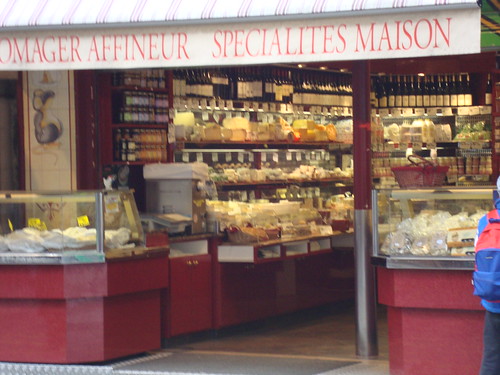
... then we bought some raclette aux epices and camembert from the fromager...
fromagerie

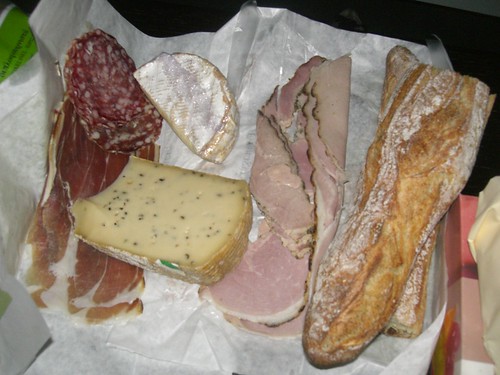
... and some cured meats from the charcuterie...
raclette aux epices, camembert and cured meats

... with which to fill our baguettes...
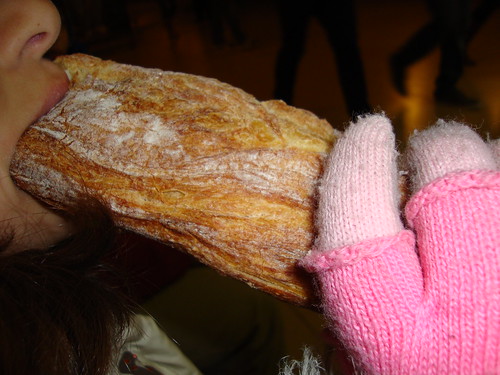
baguette sandwich

... finishing off with some pain au chocolat for dessert...
pain au chocolat, chaussons aux pomme, croissant
This photo was taken at a railway station.

... that we could eat on the banks of the Seine.
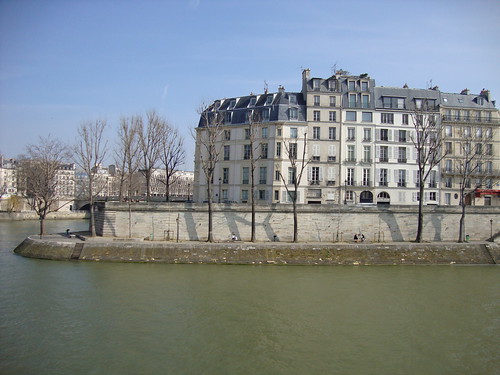
ile st louis
We spotted these happy-looking picknickers on Ile St Louis.

And all this would never have taken place if I had not pointed out the traiteur grec to my patriotic husband. Greeks often search out other Greeks wherver they go. This is a fundamental characteristic of the Greek mentality. It's always a comfort to know that one is not a stranger amongst strangers.

By being led astray, we all managed to catch a glimpse of the daily food life and goings-on that day in a no-tourist part of this magnificent city we call Paris. If I have one regret about my trip, it is that I went to Paris first and then to London. It should have been the other way around, so that I could stuff my suitcase with some lengths of saucisson and rounds of fromage, along with a couple of baguettes to keep my memories alive of the taste sensations of our Parisian experience.

For more ways to lose (and find) yourself in Paris, check out David Lebowitz's suggestions; Paris is filled with places for food lovers.

*The gypsy found one of his own kind; he then forgot that he was actually the foreigner.


©All Rights Reserved/Organically cooked. No part of this blog may be reproduced and/or copied by any means without prior consent from Maria Verivaki.
Tuesday, 6 April 2010

French salad a la Crete (Γαλλο-Κρητική σαλάτα)

Can I recreate the tastes of Paris in my own kitchen?

What is it about the food in Paris that made me like it more than what I am used to eating at home? The grass always seems greener on the other side, but the ingredients in my Parisian meals were not any fresher or of a higher quality than the ones I use on an everyday basis. I could not help noticing that the meals we had in France did not differ greatly from the meal I cook at home. What made the difference for me?
  • the sauces were thinner
  • the taste combinations were finer and more subtle
  • the beef in particular was generally more tender
  • the presentation of the meal on the diner's plate was much more refined, even when the food itself represented a homely meal
Most of the ingredients involved in the simple French cuisine that I tried on my trip can be found easily in Crete, so it is mainly a matter of how they are combined. Not only that, but many products grown/produced in Crete can replace some of the French ingredients, eg feta cheese instead of camembert, local varieties of cabbage and lettuce instead of endives and frisee. Even though Greek beef is not as tender as French beef, animal husbandry techniques are also changing in Crete (my butcher insists that the taste of Cretan beef is superlative in comparison to French beef!), so that only the cooking times may vary. Highly regional ingredients such as foie gras are not easily substitutable, but they are not a necessity in the preparation of daily meals. Where lard is used in French recipes, there can be no better alternative than extra virgin olive oil. It may not have the same texture, but it essentially does the same job as well as being healthier at the same time.

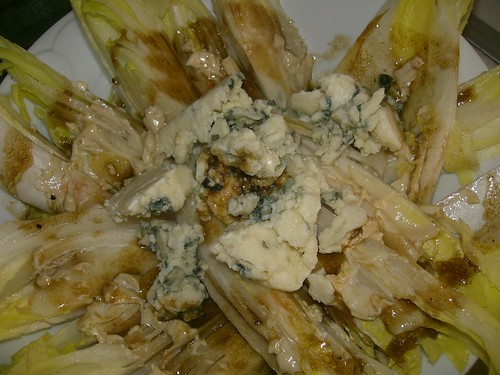
Chartier's endive salad was a simple dish consisting of crunchy quartered endives, a small block of camembert cheese placed in the middle of the plate, and a small amount of a creamy dressing which had been poured over the salad:

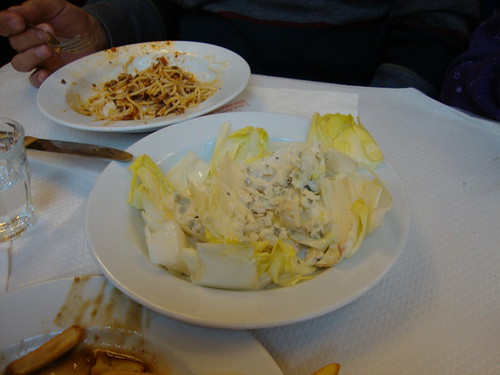
endive salad rocquefort
Endives, topped with a piece of rocquefort, with a light vinaigrette-mayonnaise salad; the endives were served as an entree in quarters which we chopped up, before mixing the salad to make it look more 'Greek'.

For my first attempt, I stuck as closely to the original ingredients as I possibly could, to give me more confidence to later when I wanted to find locally available ingredients that could replace the 'French' ones: endives are not produced in Crete, and neither is rocquefort (they were both imported).

Vinaigrette is basically an emulsion of oil and vinegar; instead of pouring oil and vinegar over a Greek salad, a vinaigrette can be used, which gives it a different taste using the same ingredients as a dressing. I shook 3:1 parts of olive oil:balsamic vinegar in a small jar, drizzled the emulsion onto the leaves, then left it in the fridge for the flavours to blend. It needed to be shaken again before I poured it over each section of endives:

salad d'endives au rocquefort
This salad was just as good as the one in the restaurant.

The next time I make this, I could use Greek feta cheese instead, as it easily replaces rocquefort. A good crisp cabbage can be used in place of the imported endives (until these are grown in Crete - at the rate of the globalisation of our food sector, I don't think it will take too long).

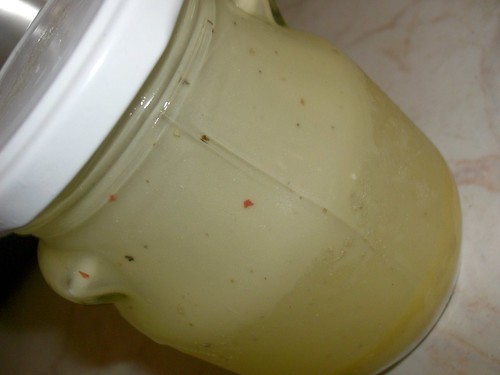
To be honest, I didn't like the colour of the dressing: it was too dark (due to the balsamic vinegar), so my next attempt at vinaigrette was made with 3:1 olive oil:white grape vinegar for a paler hue, with a tablespoon of mayonnaise, a small squirt of prepared mustard, some finely chopped garlic* and a dash of freshly ground pepper for extra taste.

home-made vinaigrette
My home-made salad dressing

I used this paler vinaigrette to make Chartier's frisee aux lardons salad:

frisee lardons

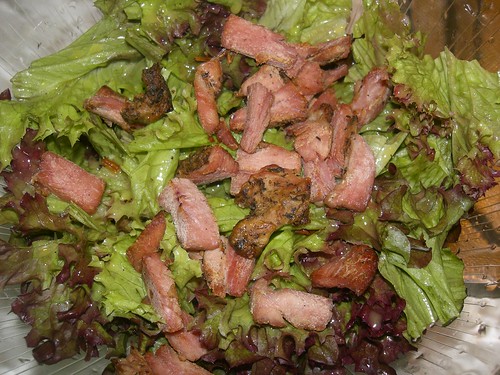
My version contained locally grown red curly lettuce (lollo) with lightly sauteed singlina (preserved pork) instead of bacon, which I cut up into small chunks and heated before adding to the salad:

red lettuce singlina salad
I can honestly say that my salad was better than the restaurant's version; the fresh ingredients and the home-made vinaigrette gave it a special aroma.

My "French salads a la Crete" were inspired by the new tastes I tried in France, and they are not radically different salads from the kind I am used to preparing on a regular basis. The taste combinations were somewhat novel for all of us, and added a new dimension to our regular diet.

The salad was an easy choice, n'est-ce pas? Now for those little meat parcels... (coming up in a future blog post).

* Since I used fresh garlic, the vinaigrette needed straining before being poured into the salad. Garlic powder can be used instead for a finer texture.

©All Rights Reserved/Organically cooked. No part of this blog may be reproduced and/or copied by any means without prior consent from Maria Verivaki.
Sunday, 4 April 2010

Easter 2010 (Πάσχα 2010)

Greek Christian as well as Russian (Eastern) Orthodox Easter does not always coincide with the Easter date for the Western Christian churches because they are based on different calendar systems. But today, for those who celebrate Easter in their culture, I can truly wish everyone a Happy Easter, because this year it falls on the same day, which usually occurs once every three years - but not necessarily: next year, we will once again all celebrate it together, but between 2017 and 2024, there will be no simultaneous celebrations...


This photograph represents one of the 25 Easter Sundays I lived through in New Zealand, a day always spent with the extended family, and always celebrated in my own family's home. The food was (just about) the same as what we cook and eat in my own Greek home on this day; the plates in any case are the same, since I inherited them all after my parents' passing.
(Click on the photo to see the notes.)


Easter in Crete

HAPPY EASTER TO ALL!
Easter 2010
ΚΑΛΟ ΠΑΣΧΑ!

©All Rights Reserved/Organically cooked. No part of this blog may be reproduced and/or copied by any means without prior consent from Maria Verivaki.
Thursday, 1 April 2010

Cabbage (Λάχανο)

A brief break from my travel musings to concentrate on the food of the holy times ahead of us...

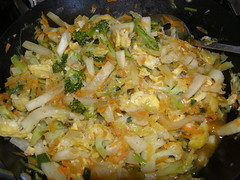
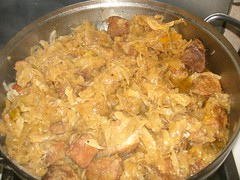
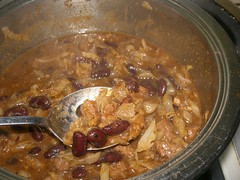
The cabbage is generally a misunderstood crop. We had a bumper crop of cabbage this year, but when we tried to give some away, people turned up their noses to it: "We don't eat fart grass," they said to us. Apart from making the usual salad out of it, I cooked it with pork chunks, added it to chili con carne to give the stew more bulk and it was a perfect addition to a stir-fry (cabbage is a good vegetable for sautees). When served with meat, cooked cabbage is a very comforting and hearty addition to a meal.

The combination of pork and cabbage is a popular and tasty one in most parts of Europe, but not well known in Crete. Pork is a mainstay on the Cretan barbecue menu, and most souvlaki is made from pork (the remainder being made with chicken). We roast and grill pork, we combine it with celery, it is a BBQ favorite; although cabbage is grown throughout the rainy months in Crete, it is never combined with pork. The odiferous lahanorizo has been banned from my kitchen (for reasons explained in the link); apart from its use in the surprisingly delightful lahanodolmades, cabbage is always served as a salad and rarely plays a greater role in the Cretan kitchen.

cabbage salad maich brassicae et allium stir fry
Wonderful ways with cabbage; if we grow it, we eat it.
pork and cabbage chili con carne

*** *** ***
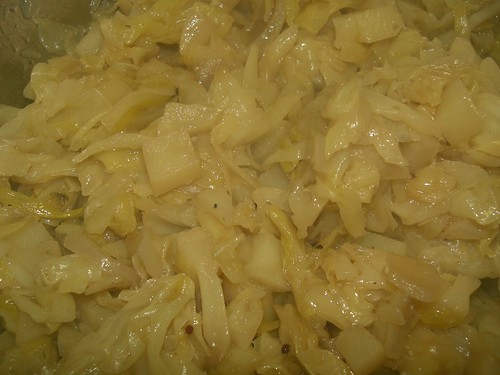
The cabbages were some of the hardiest plants of our winter garden, and they were waiting for us when we returned from our trip, giving me a chance to try Choucroute alsacienne, which I read on the menu card at the Chartier, but did not have the opportunity to try it. This dish seems to be one of the mainstays on their menu. If it is that popular, I felt I had to try it, and there is no better way to do so than with our healthy organic garden cabbage heads.

choucroute
My first attempt at making choucroute; I added a finely cubed potato to the cabbage while it was cooking.

Choucroute is different from the German sauerkraut, although it is based on it. It involves cooking spiced up cabbage in a mixture of wine and vinegar. Cooking a la francais in Crete is an easy task: the raw ingredients are easy to find, but their combination is new to me. Choucroute does not require special ingredients, although juniper berries (which seem to be added quite often in the recipes that I searched out) are not available where I live, so I used pimento (allspice) instead. The basic recipe for choucroute can be adapted according to the kind of wine, vinegar and spices you prefer to use.

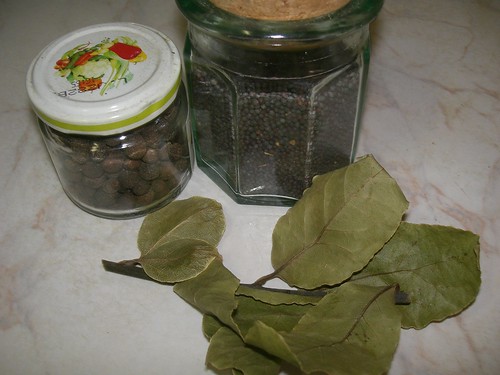
choucroute spices
I used bay leaf, pimentos, black mustard seeds and black peppercorns for my first choucroute. Next time, I'll be adding a little mustard to the spices to give it more taste.

Many recipes for choucroute call for ready-made sauerkraut which is spiced up and added to pork cuts. This is not an option in Crete, unless we want to buy some from the German-based supermarket chain LIDL, which often sells pre-made cook-and-heat foreign cuisine, mainly geared for the tourists or foreign residents of the island.

choucroute bakaliaros guacomople
My first choucroute did not use meat juices, since we had it with
as a hot vegetable salad to accompany fried bakaliaros (salt cod) on Greek Independence Day.

*** *** ***

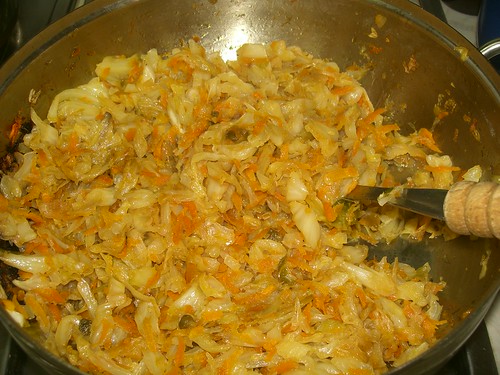
My favorite use of cabbage is as a saute. Here's the recipe I devised myself. Most of the fresh ingredients are locally grown or prepared, which is maybe why it tastes so good.

cabbage saute

You need:
1 small head of cabbage (the scraggly cabbage heads that are in the garden now are large but need a lot of clearing of bad parts)
1 large carrot, peeled
1 large onion
2-3 cloves of garlic
2 tablespoons of capers (I pick and pickle these every year)
a few tablespoons of olive oil
a few tablespooons of soya sauce
salt and pepper
Slice the cabbage finely, grate the carrot, chop the onion finely and mince the garlic finely. (Too many finely's, but this bit can't be underestimated.) Heat up the oil in a wide shallow pot, and then add the onion and garlic; cook till they become translucent. Keeping the heat high, add the cabbage, carefully stirring the pot regularly, so that the cooked wilted cabbage comes up the top and let's the crunchy cabbage move down the pot. Do this until all the cabbage is added, then added add the carrot and capers, and mix well. Let the cabbage cook away for a few minutes, until it loses its crunchy appearance. Then add the soya sauce, turn down the heat, place a lid on the pot, and simmer for a few minutes, until the cabbage is done to your liking.

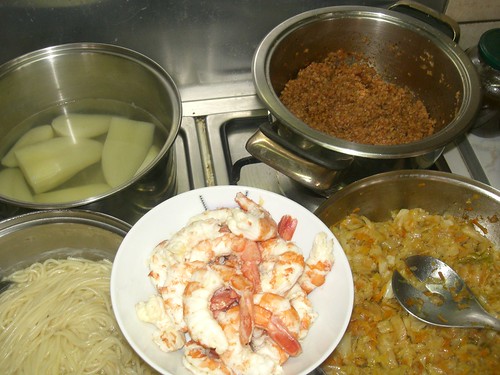
food for lent

Sauteed cabbage is a nice alternative to salad, and it goes well as an accompaniment to most meat and fish dishes. We're having it for lent with boiled potatoes and lemon shrimps (pasta and soya mince are also pictured in the above photo).

©All Rights Reserved/Organically cooked. No part of this blog may be reproduced and/or copied by any means without prior consent from Maria Verivaki.
Monday, 29 March 2010

Pulses (Όσπρια)

A brief break from my travel musings to concentrate on the food of the holy times ahead of us...

It's the start of Holy Week in the Christian Orthodox world, a time which necessitates the strictest fast (shellfish permitted), according to the church calendar. Pulses play a prominent role in this week's cooking regime, leading up to Easter Sunday.

The following popular Greek nursery rhyme seems so apt for the occasion, reproduced from bizeli.com, an infants' learning site. Coincidentally, 'μπιζέλι - bizeli' is the Cretan word for 'pea' ('αρακάς - arakas' is the generic Greek word for 'pea'), an influence of Venetian rule on the island.

pulses ospria beans

Το κουκί και το ρεβύθι (The broad bean and the garbanzo pulse)
εμαλώνανε στη βρύση (were arguing by the water source.)
και περνάει κι η φακί (Along comes the lentil)
και τα βάζει φυλακή (who locks them up in jail.)
και η φάβα τους φωνάζει (The yellow split pea was heard to shout:)
"Φακίιιιιιι, βγάλτα, δεν πειράζει" ("Hey you, lentil! Let them out!")

©All Rights Reserved/Organically cooked. No part of this blog may be reproduced and/or copied by any means without prior consent from Maria Verivaki.
Saturday, 27 March 2010

Snails (Xοχλιοί)

A brief break from my travel musings to concentrate on the food of the holy times ahead of us...

A favorite lenten meal in Crete consists of snails, boiled or fried, spiced up with vinegar and rosemary, as the following mantinada (Cretan form of poetry) attests:


"Ο Κρητικός στη ξενιτειά πόσα λεφτά δε δίδει
να βρει μπουμπουριστούς χοχλιούς να φάει με το ξύδι;"

Oh, how much would a Cretan pay if he could only track
some fried snails dressed in vinegar when in a foreign land?

Coincidentally, I saw many people at Le Chartier ordering the snail dish, the most expensive entree on the menu. The snail shells were huge, up to three (yes, that's 3!) times the size of the snail shells depicted here. I couldn't bring myself to order them, for similar reasons to the opinion expressed by the protagonist of this story...

(from 'The Roots of the Greeks: The Cretans', 2009, Pigasos Ekdotiki - Pegasus Publications, translated from the Greek)

©All Rights Reserved/Organically cooked. No part of this blog may be reproduced and/or copied by any means without prior consent from Maria Verivaki.
Thursday, 25 March 2010

Salt cod (Μπακαλιάρο)

A brief break from my travel musings to concentrate on the food of the holy times ahead of us...

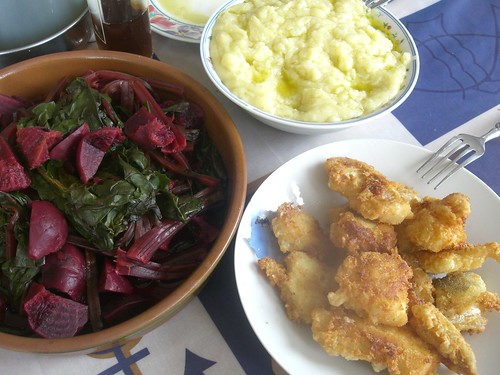
It's a double holiday today: the Annunciation of the Virgin Mary and Greek Independence Day. As the 25th of March always falls during Lent, it is one of the days when the fast is broken with fish. The traditional meal for this day is salt cod:

bakaliaros

- bakaliaros (fried salt cod)
- skordalia (garlic dip)
- batsaria (boiled beetroot)

Coincidentally, this same meal is also the traditional meal for Palm Sunday which is coming up this weekend, so we'll get a double dose of this just before Easter, which this year is coming very early for us Greeks.

choucroute bakaliaros guacomople
A new combination in a similar style to the old tradition...

Never being a stickler for tradition, I decided to skip the beetroot and skordalia today, replacing them with cabbage from the garden, cooked like a choucroute in the tradition of Alsace (I have developed a fancy for French food), and avocado garlic dip (guacomole) instead of the skordalia - all good substitutions to cut down on costs by using our own home-grown stuff.

©All Rights Reserved/Organically cooked. No part of this blog may be reproduced and/or copied by any means without prior consent from Maria Verivaki.
Monday, 22 March 2010

Bouillon Chartier (Εστιατόριο Σαρτιέ, Παρίσι)

This post forms part of the series of our culinary adventures from our recent trip to Paris and London.

"We know the customers make the restaurant. Sounds, tastes, smells, sight, everything converges so you will not miss a thing of this fabulous banquet of the senses. But the story of Chartier is the one you tell." Alors, here is my story of "Le Chartier", my Chartier.

chartier restaurant paris

I had been informed that eating out in Paris was expensive. I felt a little put out by this: is it always going to be expensive to eat in Paris sitting down, feet tucked under a table? I wondered how I was going to stretch my Greek euros while I was there, in order to afford to eat good French food cooked in the French manner without the culinary 'haute cuisine' complexities and high prices of those Michelin-star restaurants that people often refer to when they talk about French food. And what about all that undercooked blood-pink meat the French are supposed to be fond of?

frisee lardons
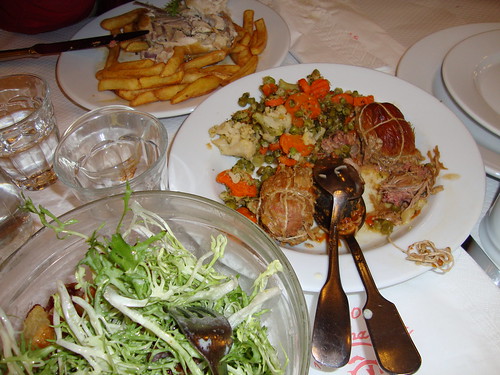
My very first meal in Paris: frisee aux lardons and paupillotes de veau jardiniere. I fell in love with French food there and then.

After a few google searches, I managed to chance on the perfect post for people in my disposition. Here is what Parisien Salon had to say about eating out on the cheap in Paris:
"CHEAP EATS: I’d have to say Chartier. Yes, it’s true– “You get what you pay for.” But I can’t think of anywhere else you can get a square meal and a truly authentic slice of life in old Paris than Chartier. Stick with the classics and the house wine and you’ll be fine, but be sure to order the frisée salad with hot bacon, which costs less than a café crème on the St. Germain de Pres, and is one of the best in town. Service is predictably gruff, and if you’re looking for “Hi, my name is Jean-Pierre, and I’ll be your waiter tonight!” you’re not going to get that here. I did see a roach come out of our breadbasket once and I was with some out-of-towners who said that I should alert the waiter. Obviously it was their first time at Chartier. In spite of it all, I keep going back. But am not sure they would."
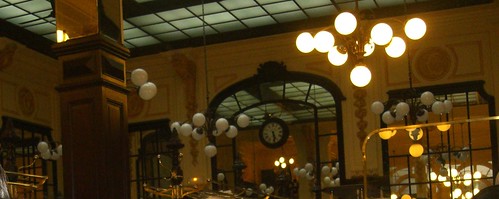
Well, maybe I'm just cheap. I decided to risk the roaches (they never surfaced). We were some of the ones that did return - three times to be exact, meaning that we ate, oops, sorry, dined a la carte at the Chartier four nights. In a row. I knew what to expect: "No silk, no crystal, no silverware, but the soul and the authenticity of a unique and timeless place." Its decor harks back to a former era, and is a vital part of the dining experience. I felt as though I had been transported to the 19th century, where men in tuxedos and top hats accompanied ladies sporting diamonds and fur coats. The little wooden drawers, the luggage racks and the small metal seats fixed to the dividing walls all recall times long gone. The windowless environment shuts off the outside world to the diners who enter a time warp when they spend that hour in their day at the restaurant. Those little details have made the Chartier a Parisian icon.

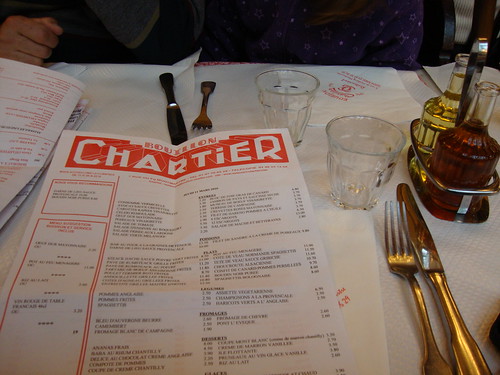
menu chartier restaurant paris
Some of the menu items seem to be standard entries, but there is something different being served every day. Note the date on the menu - a new card comes out daily.

I came to Paris with very little knowledge but the very basics of French cuisine. My likewise basic knowledge of the French language proved helpful in deciphering the menu card, which made me realise that although the Greek and French cuisine may differ from each other in many respects, they coincide in terms of the emphasis on the use made of fresh produce and the high quality of the ingredients. The meals at Chartier were of the unpretentious type: good solid home-style French food. I felt that I could re-create the recipes at home with the right ingredients. Many of the dishes on the menu (it changes daily) sounded very similar to Greek dishes, and it was easy to guess what I would be served (eg poulet fermier, cotes d'agneau, spaghetti bolognaise). This point was very important for travellers dining with children and/or fussy eaters with culturally inclined and acquired culinary tastes. I was more adventurous, ordering meals that I knew nothing about (steering clear of plats mentioning the words pieds, tetes and andouillettes - I do plenty of that at home, merci beaucoup).


Critics may say that I did not get a real taste of the Parisian food scene since I only frequented one restaurant, which represented a limited range of cooking styles. Click here to find out what I thought of the food.

The Chartier really is a good bargain for lunch or dinner if you want to try some carefully prepared classic French cuisine. I used Chartier's prices as a gauge when we considered eating out elsewhere, for example when we found ourselves close to the Centre Pompidou. The same entrees and plats were being served at the many eateries there, but their chalk menu boards showed higher prices. We were always lured back to our regular haunt, where the mood was slow-paced and we never felt rushed to eat our meal.

You may insist that you need to find yourself in the 9th arrondisement in order to visit it, but that's not a problem at all: the restaurant opens at 11.30am and works non-stop until 10pm every day. The waiters were generally very polite; the ones that weren't were still very efficient. The food costs the same at any time of the day, and you certainly don't have to stand to eat more cheaply (as many web pages informed me about eating out in Paris). The restaurant was visibly less busy between 2-5pm (we chose to eat Greek-time), and on Saturday night, as we exited the premises, a very large queue of diners had formed, all waiting to be seated. Despite their paper tablecloths and the waiters' scrawling your order over it (and then working out the bill on it when you were ready to leave), this was the only place on that night that we noticed doing a roaring trade (as we walked back to our hotel).

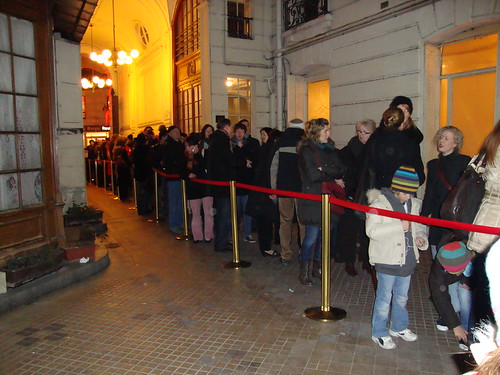
chartier restaurant paris
Because we always ate our main meal in the early afternoon, we never had to queue up like these people...

Chartier is located a few metres away from the Grands Boulevards metro station. A family of four can have an entree and plat, with half a litre of house wine and eau de robinet*, for no more than 50 euro. Take a look through my blog to see what we usually pay when we go to a tavern in Hania - you will be surprised to find that the prices are very similar. We never ordered dessert** after our meal, as this is generally not done in a Greek taverna anyway. But we never went without it: there was a patisserie in practically every street we walked on, and we always walked back to the hotel after our meal in order to deserve our sweet treat!

My photos of the Chartier do not really do this iconic Parisian restaurant justice. Click here for more photos, some of which are in black and white, and really suit the mood of the place.

*And no fizzy drinks for the kids - the French aren't into this themselves; "when in Rome, do as the Romans do", and you'll be all the more healthier for it.
** Not ordering dessert is not actually uncommon in Paris; many chalk boards outside brasseries gave a fixed price for a combination of an entree and a plat OR a plat and a dessert. This could be due to the economic crisis, or a healthier outlook on life, or (most likely) both.
©All Rights Reserved/Organically cooked. No part of this blog may be reproduced and/or copied by any means without prior consent from Maria Verivaki.
Friday, 19 March 2010

The traveller's breakfast (Πρωϊνό για τους ταξιδιώτες)

This post forms part of the series of our culinary adventures from our recent trip to Paris and London.

After searching the various online hotel booking sites and reading the reviews of the super-cheap hotels that I intended to book my family into, I did not expect much from the budget accommodation that we eventually checked into. What lured me to both my Paris and London hotels was the price on both counts, with the added bonus that breakfast was included in the price of the room. When travelling in cold countries with young children, it's really important for them to find a warm meal to start the day off. We stayed in one four-bedded room in each city for four nights. I'm running on Greek euro: it looks the same as the rest of Europe's euros, but Greeks are supposed to have some of the lowest salaries in the EU. I couldn't afford to spend much more than the cheapest hotels I found in each city: 100 euro per night (breakfast included) in Paris, and 68 pounds (approx. 76 euro) per night (breakfast included) in London.

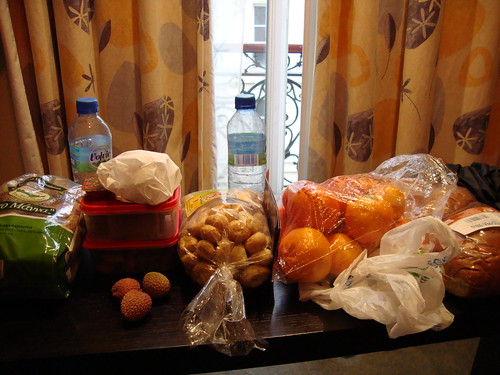
supplies
I came prepared...

I had read that the rooms were small, so we took only two suitcases. I had also read that the breakfast was 'only tea/coffee and bread/butter' so I packed some paximadia and a few clementine oranges in our bags in case we got peckish. I had nightmares about the 'filthy' bathrooms and 'dirty' floors and bedding. One of the hotels had even managed to make it into the 'top most dirtiest' in the UK. I had been warned, so I came prepared. I couldn't afford to be fussy - I only wanted a warm bed for the night, a place to keep myself clean, and a bite to munch on in the morning, and we all know the saying that 'beggars can't be choosers'.

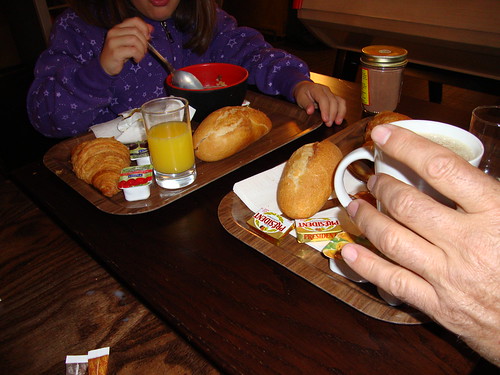
breakfast in paris
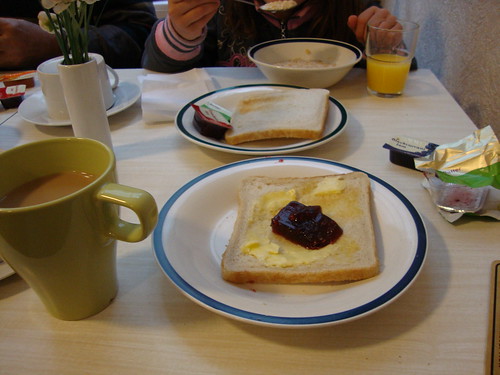
If I had to choose which one was better between the two, I'd say that in my breakfasts in Paris (above) were of higher quality with more atmosphere than those of London (below).
breakfast in london

To our pleasant surprise, the rooms in both hotels were always warm, the bathrooms were spacious (in contrast to the previous London hotel I stayed in), there was no mould or bed bugs as promised by other reviewers of the same hotels, and I would gladly stay again in either of them. The staff were also very polite, and responded to all our requests. The breakfasts were basically the same in both of them: juice, tea/coffee/milk, cornflakes, butter and jam to spread on your bread. The only difference was in the quality of the bread - in London, hotel bread is always a thin square sponge that is palatable when toasted, while in Paris, it's a crusty petit pain and/or a buttery croissant.

Hotel breakfasts are a part of the international cuisine: you know what to expect of them. Funnily enough, the French don't actually butter their baguettes, preferring them plain. We saw many people munching on them in Paris as they walked along the street in the afternoons, without any filling; far more healthy than the McDonalds packed meals people often seemed to be buying in London just as soon as they stepped on or off the tube. The weight difference between Parisians and Londoners was highly evident.

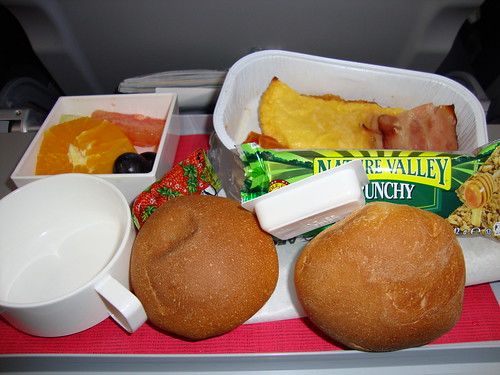
aegean air breakfast
Bacon and eggs, fresh fruit, a muesli bar, bread rolls with butter 'n jam, and a hot drink: Aegean Airlines' answer to the traditional English breakfast.

And since we had an early morning start on the first day of our travel, we also got a chance to experience the flying world's answer to breakfast - more international fare.

©All Rights Reserved/Organically cooked. No part of this blog may be reproduced and/or copied by any means without prior consent from Maria Verivaki.
Monday, 15 March 2010

Haiku (Χαϊκού)

Raising and educating children has never been easy. With the freedom of movement among EU nations, enabling its citizens to live and work in any of its 27 member states, people are now able to compare and contrast their own education system with the one their children are attending, but are not always able to make sense of it or see the benefits. I recently came across a Crete-UK forum discussion which highlighted this issue; the inspiration for the post came from my son's school homework.

"Dear Agony Aunt
," writes GoldenSyrup from the UK, "Is the certificate/diploma that students receive at the end of (Greek) school recognised in other countries? As the mother of a 7-year-old who has long school days and at least 2 hours of homework most nights, I am concerned that all this work will not result in anything other than a piece of paper that is only recognised in Greece. I have found out that if both parents are foreign (ie not Greek) then the child is considered to be 'foreign' even if he has been born and grew up here. This it seems has implications for university entrance..."

The seven-year-old is probably in 2nd-grade. The parents are probably both non-Greeks, living and/or working in Greece. They may not be able to read Greek fluently, and therefore cannot help their child with their homework. It isn't clear what the mother's concern is: is she worried that her child is learning something useless (non-transferable Greek-language skills), or is she worried that her child is being over-worked without any guarantee that this 'hard work' will be useful in the future?

Firstly, she has overlooked the fact that since both Greece and the UK are in the EU (well, so far, anyway, if you get my gist), then it is highly unlikely that there is no provision made for equating school qualifications between the countries. Oxford University, for example, states clearly what is accepted by them from Greek students*. Secondly, there is no such thing as a free lunch; her child is being occupied more productively in Greece than what would be the case for a child of this age in the UK.. Too much study and not enough play makes Jack a dull boy, you say. In a country like Greece (and especially in Crete), there's plenty of sunshine and free time for a seven-year-old to revel in - for a start, summer holidays last 12 whole weeks, not to mention all the other religious/national (and strike) holidays in between. In any case, if there were too much play and not enough study, then Jack would have all the leisure time he needs to collect plenty of ASBO's. Take your pick.

It's not just foreign mothers living in Greece who complain about the amount of homework their children have to do at school; it's also Greek parents. When the old-fashioned parrot-style rote learning system changed in Greece, which the parents of our youngsters' generation were used to themselves (and we all know how comfortable we feel with the status quo), everyone suddenly felt overwhelmed by the new syllabus. For a start the set books changed; instead of learning to count up to 20 in Grade 1 (!?!) children were expected to learn to count up to 100 (something which most kids were probably able to do in their kindergarten years anyway), and children are expected to be able to understand visual symbols very early on in their schooling, such as those employed by well known public companies like, for example: ΔΕΗ, ΟΤΕ, ΔΕ.ΔΙ.ΣΑ, all acronyms of state-owned enterprises, and therefore children see the bills coming into the house with their logos (Greece hasn't really begun a transition yet from a 'bills' culture to an online-payments one).

Here's an example of a how a Greek mother reacted to her child's homework. An Athenian radio announcer was disgusted that her child had to write the full names of the above-mentioned SOE's (I know the exercise she is talking about - it appears in the set books for Grade 2), complaining that her child could not differentiate between the different ways to spell the 'ee' sound in Greek (which is nothing compared to the number of ways to spell the 'ee' sound in English - wait till it starts learning that one!). She needn't have bothered to do that in the first place: she should have given her child a bill from one of those companies, and got them to copy the name of the SOE, or searched for it online, or better still, got her child to search for it online. This doesn't mean that the mother wasn't being a good teacher to her child - she is after all the mother, and not the teacher; maybe the teacher should have taken the time to explain to her class of children how to go about this exercise independently, without making mummy go crazy...

As a mother with children in primary school, I can understand the UK mother's (albeit misinformed) concern. She probably came from a more liberal educational background (like me), where children were not required to do a lot (or any) homework when they were as young as seven, where the theoretical importance of a playful youth (despite the higher incidence of social curses such as teenage pregnancy and binge-drinking) took priority over the three R's. But things are slowly changing from the parrot-learning days of the Greek education system, and even though it may sometimes seem that children are doing very repetitive exercises with little substance, the fact is that there is room for great creativity in the classroom within a structured programme. The main difference between the Greek education system and the Western one is that parents have a greater influence in their children's schooling in the former. Greek parents often act as guidance counsellors; these professionals are often missing from Greek schools due to mismanagement, lack of funds and other problems of Greek infrastructure. Greek parents, therefore, often take a great interest in their children's learning paths - they always want the best for their child, no matter how educated or rich they may be**.

One of the problems in the Greek education system is that it is very competitive. Children are encouraged to get straight A's from the day they enrol at primary school. It may sound like an impossible task to get very young pupils to learn to sit on a chair and hold a pencil in their hand for what seems like hours, conjugating verbs and declining nouns...,


... writing word families...,


... and doing sums...,


... among other activities, but this is what I have seen my kids doing for the last three years, since they started primary schools. Depending on their teacher, a child may have half an hour to two hours of homework on most nights. You must be thinking that this is too much, but you will probably not realise that a typical school day for a seven-year-old starts at 8.10am and finishes at 12.25pm, with two short breaks in the day. The homework they are doing is what they would have been doing in class, were the Greek school day longer.*** Children whose parents work and cannot pick them up at midday stay on at school at the all-day program, where they have an opportunity to complete their homework with the help of another (different) teacher, and they often go home with most of their homework assignments finished.

Some children are slower writers, others are slower thinkers; some children pick up the rules more quickly of being in a formal educational environment, while others need more time to acclimatise from the transition of kindergarten (no books or notebooks, not even a pencil case) to primary school (up to ten set books and half a dozen notebooks in the first three grades). But eventually, they realise what is expected of them. Some children show great skill at memorising facts and figures, while others don't. This is normal in most school environments all around the world. Where Greece differs from the Western system on this point is that Greek schools award academic achievement and very little else.

It's true that most of the homework exercises are based on rote learning, but my only real quibble is that most of the time, most teachers will only work with material in the set textbooks (Language, Mathematics, My Environment, each one issued with a coursebook and exercise book), and 'blindly' hand out photocopied material of the exercises covered in the day's lesson from the set books to be done as homework; these photocopies sometimes contain typos, which shows that the teacher is not reading them herself to check if they are do-able, before she hands them out to the pupils. Therefore, if you have learnt the material in the book and the photocopies, then you are considered an 'excellent' student. A student whose knowledge is beyond the book is classified as a genius, even though their knowledge may actually be bookish rather than showing any powers of reasoning or creativity. That's why a lot of Greek kids get classified as geniuses these days - it's easier to know (or find out about) things now than it was in the past. Greek parents rather than the state are usually responsible for that extra mile in their children's education.


When my son was 4 years old, his teacher showed the kindergarten class a small map of the world, and asked them where Crete was. My son was the only child in the class that peered deeply into the A4 size map, and found the pin-prick that represented his homeland. Five years later, my children's teachers are still amazed with their keen awareness of their global position. It is not the cost of the maps that prohibits these children from access to them in their own home: not many Greek children have the luxury of access to wall maps in their own house because Greeks generally don't like 'dirtying' their walls with sticky tape...

Young children learn mainly to 'write' what they 'say' (ie going from the spoken to the written form of Greek - which is relatively easy if Greek is spoken in the home), they become fluent readers at an early age (mainly because of the consistency between the Greek sounds and their written expression) and the set homework is generally not mentally demanding (it falls within the patterns of rote learning and repetition). This gives the creative parent a chance to extend their children's knowledge beyond the prescribed textbooks (the whole country is learning the same stuff at the same age) in any way they want. But it means that the parent has to take charge of their children's extra-curricular activities, something which most people in the US, UK, Australia and NZ do not have to do, because in those countries, it is taken for granted that the state organises and provides education. In Greece, once the school day is over, a parent directs their child's learning, and hence their child's future. It may sound unusual to parents who have been raised in the Western system of education, and it will be difficult for them to acclimatise to a new way of viewing the Greek education system.

GoldenSyrup's problem may derive from the idea that parents in the Western world have been indoctrinated to believe in being solely parents and not teachers of their children. In Greece, parents are expected by the school system itself to help their children in whatever way they can: personal help, private tuition (one-to-one lessons or in a group with other children), extra-curricular lessons (sports and the arts are barely covered within the Greek school system, given the tight timeframe - see above), audiovisual material, computers, etc. Some people have the knowledge, the money, the time to help their children in this way, while others don't. But these days, most parents have the confidence to demand these educational services from the state, which is a sure sign of progress from the days when people seemed to accept the status quo and felt comfortable in its staleness. Greece may not have reached the same educational standards as the west, but no one can accuse Greek parents of not trying. Evidence for this is the high number of enrolments in foreign universities (when a Greek school student doesn't make the grade in his own country, he will go abroad), even if it means coming back home as an unemployable over-qualified graduate.

*** *** ***

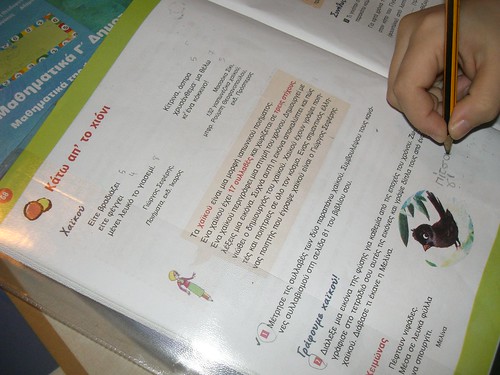
My 3rd-grader recently asked me to help him with some of his homework. The topic covered in this case was, of all things, haiku. From this, it can be concluded that the topics covered by the set books in the Greek education system are reasonably global, up-to-date and interesting, so a knowledgeable parent can easily find an activity to supplement the child's knowledge using the set books as a base. The textbook had a chapter on haiku-writing (in Greek, of course!). It gave examples of haiku poetry and explained what a haiku was. According to my child, the haiku idea was discussed in class, and the pupils were then asked to write a haiku themselves as a homework exercise.

haiku homework

My son was having trouble finding a starting point for his haiku, so I told him to look at the sky. (One easy way to get young children to write creatively is to show them a photo/picture.) I told him that I would tell him something about it in 17 syllables, the typical length of a haiku:

Σκοτεινιάζει τώρα, τα άσπρα σύννεφα γίνονται πιο μαύρα
(It is getting darker, the ice-white clouds, are now becoming blacker)

"Can I write that?" he asked me.

"Of course not," I said. "That was my haiku." And a very uninteresting one at that, but that was something my son couldn't judge at the time. "You have to write one on your own," I told him. In fact, I would have liked him to copy my haiku, so that his homework would be over and done with as quickly as possible; I wondered how many of his parents' classmates had done this anyway. Most parents in our village school had probably not heard of the concept of haiku in the first place, but they would have been able to follow the instructions given in the book and 'helped' their child to write one. (I found out later that quite a few did in fact do this!)

As a starting point, I showed him some family photos on the computer, and let him choose one on which to base his own haiku. He liked this photo.

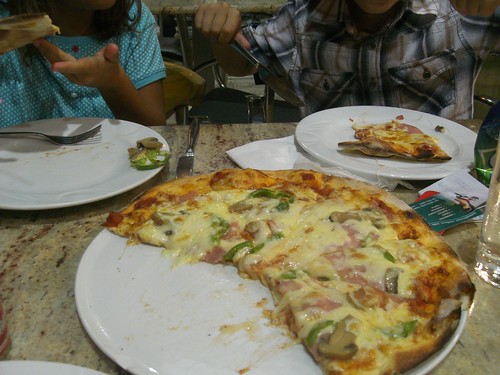
pizza at time out hania
Long hot summer night, under the sky in the shade, short sleeves and meals out.

He came up with the following 17-syllable 3-line verse:

Πίτα στογγυλή, ζαμπόν και τυρί, με πιπεριά στο ψωμί
A big round pizza, pink ham and bright cheese, with some pepper on the bread

I left it to the teacher to judge the haiku; my job was to get my son to do his homework ,and I can say that I succeeded in that direction. He had incorporated the idea of rhyming verse in his haiku, which is a form of poetry he is more familiar with in his own language. The main thing is that he had done his homework on his own, and that it was finished as quickly and painlessly as possible.

Every parent can provide some kind of brain food for their children. We all do what we can to prepare our kids for the big wide world - just think that these angelic faces will be doing their military service or studying in the army in a decade's time. Because my children are being raised in a bilingual environment (like GoldenSyrup's), they are more observant of the multi-cultural world around them; they are better able to fit the pieces of the global puzzle together, so that they can assimilate circumstances more quickly. Having learnt things from two different perspectives, they will be better able to cope with the big wide world around them. There are no skills that are learnt in vain.

*Oxford is one of the most competitive universities in the UK, which is why it also expects UK A-levels together the Greek high school leaving certificate, but this is not the general case.
**I am not talking about parents who are drug addicts, alcoholics or suffer from mental illness; in any case, such people need professional help to manage their condition - once they do this, they may be even better parents than those who do not suffer from such social problems.

*** Greek teachers often complain about their low pay, but it must also be said that they work far fewer hours than their British counterparts, with less accountability. The present government recently announced plans for many changes in the Greek education system, but they'll have to re-train the teachers first to stop thinking in rote-book style...


*** *** ***

You're reading this while I am on an educational family trip abroad. You may wonder about the correctness of my action in taking the children out of school during term time. I was a bit worried about it too. At the beginning of the week, I approached one of the teachers and told her that we would be away for a few days on holiday. Her reaction was not what I expected (Oh, how lovely! or maybe I'm sure you'll have a great time! or even Hmm, Isn't it cold there now?) - no, she asked me whether I would like the next two week's learning program (my daughter is in grade 2, just for the record) so that when my daughter comes back from holidaying in big cities, where her senses will be mesmerised by novelties, she won't have any gaps in her knowledge; I rest my case...

©All Rights Reserved/Organically cooked. No part of this blog may be reproduced and/or copied by any means without prior consent from Maria Verivaki.