Showing posts sorted by relevance for query Mr P. Sort by date Show all posts

Monday, 18 January 2010

The Ministry of Food - Part 1 (Το Υπουργείο Τροφίμων: Μέρος 1ο)

While I'm getting ready to visit the Ministry of Food exhibition at the Imperial War Museum in London, here's a taste of the what the Greek version could be like if I were running it. This post definitely needs to be taken in small bites...

Dear Mr P,

First things first, belated congratulations on taking office and heading the country. I trust that you will endeavour to steer our country in the right direction. Let me tell you that, as a loyal Greek citizen, you have my full support in your work, and that I will not allow the Year of the PIIGS to taint my beloved country's name with its stigma. As instructed by your team, I have been demanding and collecting all the receipts for all my purchases and placing them in a specially labelled box (which has, to my dismay, already started to fill up)...


PM's orders...

... to ensure that I will get the full tax rebate you have so generously allocated to every Greek citizen when I fill out my tax papers next year. When the Brussels sprouts from the European Commission come to check up on us again, to ensure that we aren't doing any (more) creative accounting and reporting a fiscal deficit only half as high as we now know to be the case, you can tell them to come to my place, and I will let them look into that little box, so that they can see that whoever sold me whatever has been charging the customer ΦΠΑ* and they've paid their dues to the taxman, and our country can once again stand tall and take pride in our achievements, such as winning the Eurovision song contest and the Euro Cup, organising the most successful modern Olympic Games ever to be held without an incident of terrorism marring the event, and the recent opening of one of the world's greatest museums in the world.


Waiting for their kidnapped sister to be returned...

They can
then leave us alone and concentrate on more pressing matters, like putting their money where their mouths are, in the more urgent issues of the failures in the economies of Dubai and Iceland, which the United Kingdom has invested in so heavily - may God grant them grace, as He has done so many times to our own precious land.


Babylonian profiteering - there was never a hint of sustainability in this project.

But I mustn't tire you with such banter, Mr P, because I know that you are a very busy man. In any case, my forte is not economics in the strictest sense; I should not be dabbling in the country's affairs in this sector and just leave this job in the hands of your expert team. Thus, at this point, I will immediately set upon the purpose of my writing to you: as a conscientious citizen, with skills, knowledge and expertise to offer, I would like to give my services to our country - yes, OUR country, and we don't need to be born here to claim that, as both of us would know - in the sector of home economics, via the Ministry of Food.

I know you have often come to my hometown in Crete on official duties, Mr P, and probably the best of Crete has been laid out for you to indulge in on all your visits. You were probably served dackos and hohlioi for amuse-bouches,
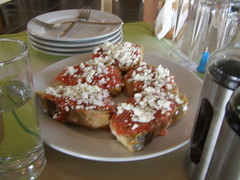
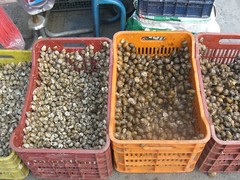
dakos made with home-made bread snails market athens

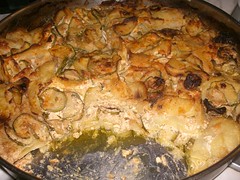
xidato and boureki as entrees,

xithato xidato boureki

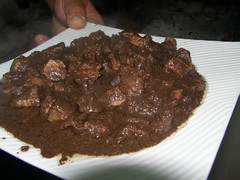
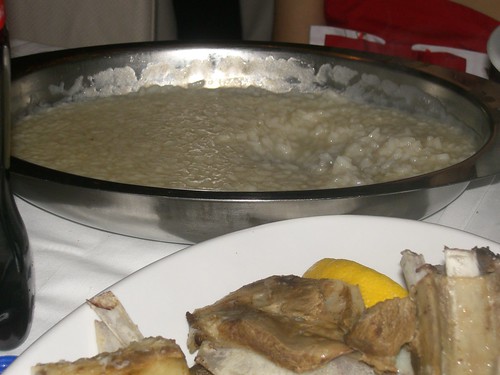
pilafi and vrasto for mains,

wedding pilafi and vrasto

with ascrolimbi as a salad,

ascolimbi

and kalitsounia drizzled with honey for dessert,
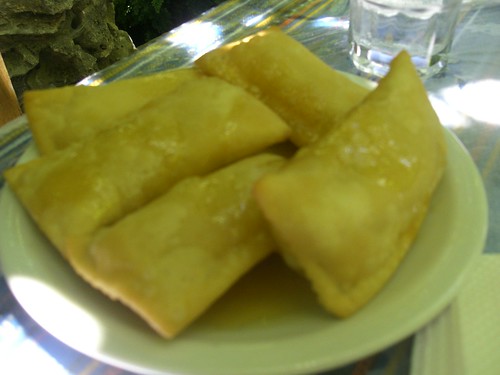
mizithropites kalitsounia ellanion fos argiroupoli hania-rethimno

all washed down with a few sensual glasses of Kotsifali wine.
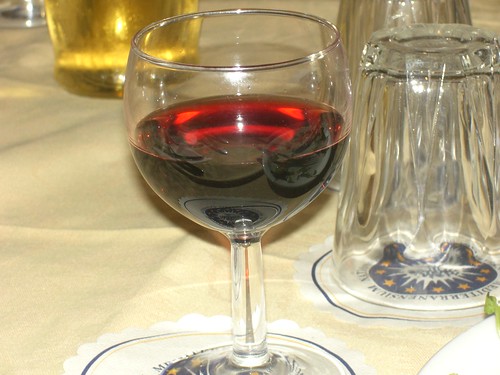
lunch at maich kotsifali wine

You would have noticed that we Cretans know how to eat well, without having to resort to molecular gastronomy and hi-tech plating to make our food look more appealing; none of that pretentious mumbo-jumbo for us, no sirree! Did all your senses come into play as you indulged in those Cretan meals you were offered as an honest guest? The kaleidoscopic array of colourful fresh produce, the luxurious aromas of the food as it makes its way to your table, the superlative tastes of the products, the rustic charm of your hosts' Cretan accent, almost a pre-requisite to proving its authenticity, as if the food could not taste so good if it were served by someone who did not pronounce their yia as jia, or their tis as tsi, and the hedonistic, if somewhat messy, feel of the kokkalaki. Good meat is like a woman, Mr G - it needs hands; your late father must have taught you something about that. You'd be surprised at how much we have in common on that point!
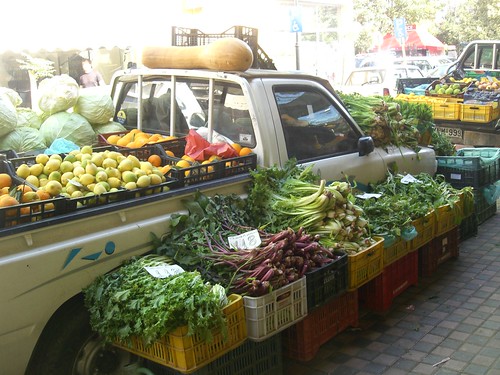
greengrocer hania chania
A greengrocer's in the town centre

You know how good we have it here: high quality food, raised in a mild temperate Mediterranean climate, where the rays of the sun never seem to be lacking, quickly thawing our early morning winter frost in the colder months. Don't get me wrong, Mr P, I'm not trying to acquire more subsidies for Cretan farmers (although you will recall how scroogy the last ones were, and how you yourself were treated when you came to support us in our rallies). I am just trying to remind you of the greatest boon to the epicureans among us: our food is practically all local, George. Can you believe it - in the globalised world we live in, the largest island in the Greek state can produce more than enough food to feed itself as well as other parts of the country without having to resort to foreign imports?


There are times when we all feel like indulging in something different from our traditional culinary regime...

I now touch upon the point that I wanted to make to you, George. Have you checked out the fresh produce section of the supermarket lately? Don't ask me which supermarket I was in; to my knowledge (gained from being my household's shopper-in-chief), they do not differ on this point. I beg your pardon - I apologise for assuming your ignorance on this topic, but as I already mentioned, I know you are a very busy man, and you probably do not have time yourself to do the food shopping in your household, but you might like to get a report on what is happening in these establishments from your staff (unless your wife would like to inform you about the situation herself during her weekly shop). I was in the supermarket the other day (you will find me in one of those establishments at least two or three times a week), looking to buy some crisp apples for my family, when I almost had a heart attack: as I was searching the fresh produce section to select some crispy apples for my brood, my eyes were dazzled by the array of foreign produce that passed before them:
baby corn from Thailand, radiccio and prickly pears from Italy, boiled beetroot from France, papaya from Ecuador, baby potatoes from Cyprus, pomegranates, kumquat and Medjoul dates from Israel, mango from Brazil, coconut from Sri Lanka, Brussels sprouts from Holland, radish from Israel, asparagus spears from Peru, plums and mini pineapple from South Africa, and large pineapple from Costa Rica.
We are constantly bombarded by so much choice that we are literally drowning in it. We cannot choose due to the abundance of choice, despite the fact that most of these products are out-of-season, not local, and possibly a tad inappropriate in our lifestyle. We have lost our sense of proportion when we feel the need to buy ready-boiled beetroot from a village supermarket; pray tell me - is it asking for too much from the average home cook to boil them themselves in their country kitchen? Hania is drowning in pomegranate production, while we are being offered imported ones! Poor Kerkira has been trying for years to make her kumquats more marketable, yet we are being sold such products by a country that does not even have enough water supplies to keep their plants growing! And what can one say about Holland, who grows a whole host of vegetables that they import all over Europe, even though she herself lacks land surface and grows everything hydroponically; she's even the top European distributor of citrus fruit - and she doesn't even grow any herself!!!
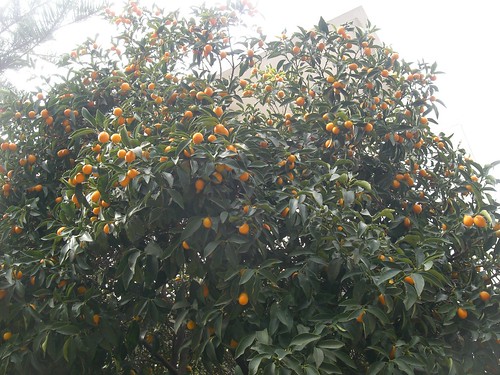
kumquat tree
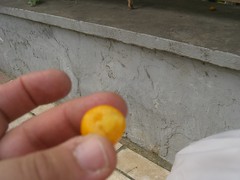
This kumquat tree in urban Hania was laden with fruits, at the same time (early January, 2010) that the supermarket was selling Israeli kumquat for 5.97 euro/kilo. The fruit was at its prime; it was a little bitter, but quite juicy. It isn't peeled - you bite into it as it is. Only the lower fruits on the tree had been picked - the rest will presumably fall onto the ground, unused. Kumquat is grown commercially only on the island of Kerkira.
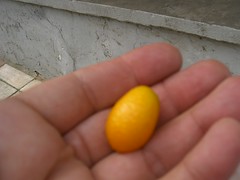
kumquat kumquat

And what's this with the pineapple? Even size seems to matter when choosing what foreign imported non-seasonal produce we are going to buy; perhaps this is because we have learnt to be more vocal about demanding our freedom to basic human rights (you should be proud of your grandfather's achievements in this respect), one of which is freedom of choice: when other people are fighting for their human right to have access to clean water, medicine and decent accomodation, our compatriots are saying**:

Μικ-PA! Με-ΓA-λα! Τα θέ-λω Ό-λα!
(Big! Small! We-Want-Them-ALL!)

And to think, we don't even cultivate the product ourselves! How on earth did we so quickly turn from snail-foraging war survivors to instant gratification pleasure seekers? By George, George -we're beginning to sound like the British: "I can bloody well eat what I like when I bloody well feel like it"! On top of that, we find ourselves in the midst of an economic crisis, and yet, supermarket giants proudly display provocative price tags, such as Peruvian asparagus spears at 7.94 euro/kilo! Last, but not least, have you ever tried imported fresh produce yourself, George? Perfect to look, tasteless to eat, which I discovered after falling into the temptation myself of gluttony. Did I really need to eat pomegranates after our own pomegranate season had ended?
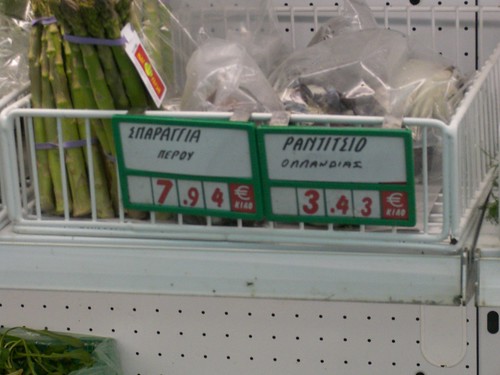
imported products in hania chania supermarket
Peruvian asparagus and Dutch radicci0 - the prices are a little scary...

And that's not all your (wo)man in Hania has noticed going on food-wise in the birthplace of the world-famous Mediterranean Diet. Our restaurants have stopped serving "mama's food"; they're now calling it "yiayia's food. And what's the outcome of all this new-fangled culinary fashion, George? For a start, there's the death of the Mediterranean diet, supplanted by a globalised food culture; obese Cretan children, who get little physical exercise and are raised on low-quality produce; a once food-based society now showing a lack of food knowledge; the loss of traditional culinary skills since cooking is not being passed on from one generation to another like it used to be; food fashions replacing food traditions. The list is too long to write up here, George; we need to form an expert team to address the issue, with special measures to protect us from such outcomes.
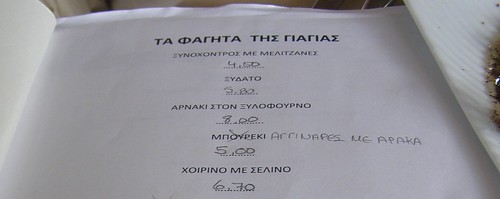
yiayia's kouzina
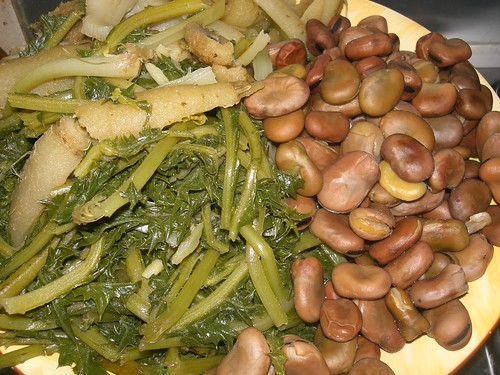
Eggplant with xinohondro, xidato, lamb in the wood fired oven, boureki in the summer (or artichokes with broad beans in the winter), pork with celery - if yiayia is the one cooking all these Cretan dishes, what is mama cooking these days???
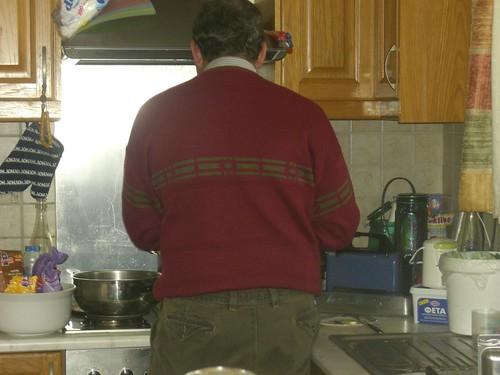
That's why you need me, Mr P: I'm a mama with primary school-aged children who are eating "yiayia's food" still being cooked by their very own mama! There's a clear need for mama's cooking to be introduced back into the home, otherwise can you imagine the implications of that phenomenon? The youth of today (our country's future, don't forget that!) are starting to be raised on the assumption that grandmothers cook, while mothers don't because they go out to work and don't have time to do this anymore. Before you criticise me for my anti-feminist sentiments, hear me out: mama's kouzina could easily be re-named papa's kouzina - equal rights for all!

Mr Organically cooks
Mr OC in the kitchen

In conclusion, before I exceed my talk time, I would like to present my manifesto, to prove to you how deeply I have considered these issues, with some practical solutions to overcome their negative outcomes:
  • PRODUCE BAN: There must be a ban on importing foreign produce that is growing seasonally in the homeland; we cannot be importing products grown in excess while ours are allowed to go to waste unsold, eventually being used for animal feed. In any case, imports must not exceed exports. calabrese fennel kohlrabi
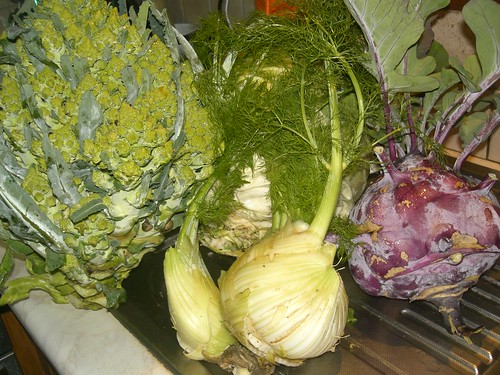
    None of these products are available as local produce in Hania stores; they are always imported. Yet they can all grow in Hania - these ones are from my uncles' farm, a mile away from my home.
  • CULTIVATION: Greek farmers should be planting not only well-known Mediterranean species, but also hardy tropical species previously unknown to Greek soil; Mr Organically Cooked has managed to produce mango in our village - maybe you can also make use of him in some way in the Ministry (Greek politics have always been very much a family affair, haven't they, George?). mango tree fournes hania chania
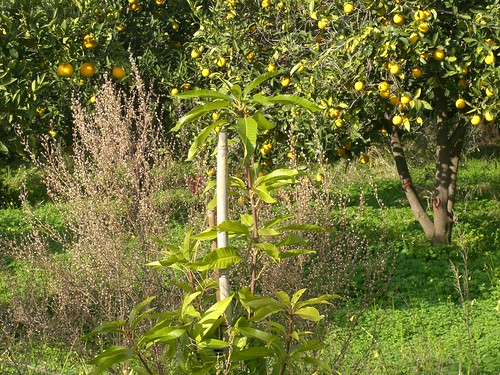
    Our very own mango tree, growing in our orange orchard
  • PROMOTION: Greek produce must be given priority over foreign products. This can be achieved by displaying them prominently, advertising via the "home is best" slogan, and other ethnocentric ploys that many other nations in the world to promote their own products over other countries'.
  • A car sticker I spotted while visiting the Duxford Air Museum, Cambridge, UK in 2006.
  • EDUCATION: We need to get people to take more interest in the food they eat, by teaching them to eat seasonally (ie sensibly), and showing them how to create gardens in limited spaces like rooftops and balconies, dissuading people from creating lawns and flower gardens in more arid places receiving less rain (eg Crete). It doesn't just have to be organic to taste good! fresh produce october hania chania
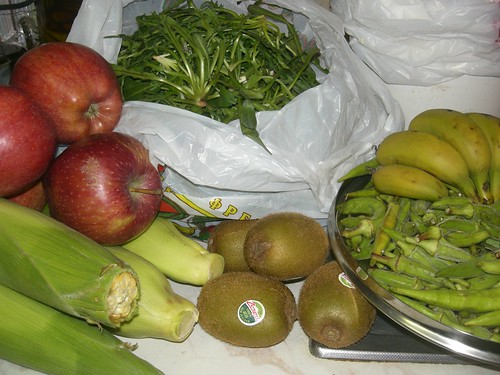
    Everything in this photo is local food (except for the kiwifruit), but none is organic.
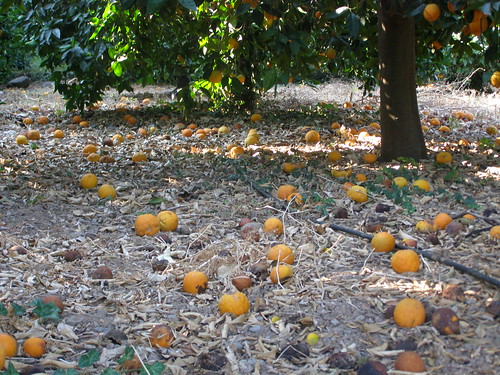
  • RATIONING: We must introduce a system of rationing imported goods. Everyone needs to carry a rations booklet, stating their imported food purchases: once they exceed their monthly limit, they will only be allowed to buy local produce. Fair trade is all part of the process by which we measure a country's progress, but enough is enough, don't you think?orange fournes Cheaper imports means that, often, Greek produce lies wastefully in the same place it was grown while people buy and consume foreign produce...
I trust, Yiorgaki, that you will take my considerations into serious account and get back to me once you have thought about how you intend to handle the situation. Until then, I leave my country in your strong hands. And if ever the Minister of Rural Development and Food, Mrs Katerina, or her deputy, Mr Mihali, decide that they cannot keep up with the demands of the job and aren't able to live up to the expectations of the tasks that they have been entrusted with, you know who to turn to, don't you?

Sincerely yours,
A loyal Greek citizen from the Megalonissos

PS: In case you were wondering which apple variety I purchased, I must admit I succumbed to temptation - Pink Lady, an imported variety from Italy. You will understand why I preferred them over the others - they were all bad apples!

pink lady apple italy
A Pink Lady apple (imported from Italy), standing next to another Australian invention (grown in Greece), the Granny Smith. Pink Lady is always unblemished and crisp - these are the kinds of apples I'd like to eat...


PPS: Forgive me once again for dabbling in matters that I am no expert in, but I hope you don't mind me mentioning that when you make major changes to our daily cost of living, could you at least try to make them during the day, and not during late-night parliamentary sessions when most people are sleeping and can't react to them? We're not all efoplistes, you know!

*ΦΠΑ = VAT = value-added tax
** Chant this in the tune of the well-known Greek slogan: Ψω-μί, παι-δεί-α, ε-λευ-θε-ρί-α!


©All Rights Reserved/Organically cooked. No part of this blog may be reproduced and/or copied by any means without prior consent from Maria Verivaki.

Friday, 28 May 2010

Receipts (Αποδείξεις)

Just before my book draw - click here; winner announced on Tuesday.

Dear Mr P ,

Things seem to be getting from bad to worse in Greece, don't they? How long will it be before Greece is told to take a hike out of the EU? I'm not too worried at this stage about that happening, but if it does, it will throw a spanner in the works concerning the Greek psyche, don't you think? My European identity was beginning to grow on me, but if we leave the EU, not only will we find ourselves in the throes of an economic crisis, but an identity crisis as well. Way down here where I live, it feels out of place to rename myself a Balkan. Either that, or give myself the now defunct Ottoman label, which would probably not go down too well on the general populace, so let's brush that aside for now, and deal with it when the time comes, shall we? Just as long as we don't forget that the issue may well come up in the near future, because some people no doubt are already thinking about it, aren't they? We don't want to look as though were caught 'στα πράσα' now, do we?!


How many receipts have you gathered so far in the place where you keep your stash? Maybe you are in the special category of people that don't have to collect them. No such thing, you say? Well, judging by the number of receipts people are leaving behind in the supermarket, the mini-market, the fast-food outlets, the canteens, the tavernas and all sorts of other places where I've been keeping my beady eyes open for more evidence of this happening, there seem to be quite a few people who appear not to need them. One customer even told the Chinese owner of a clothes shop that she was quite happy not to accept a receipt (if she got the obvious - there is no need for me to explain what that is because everyone in Greece knows what is meant by that).

Are you wondering whether I'm picking up those miscellaneous receipts and adding them to my own expenses? Yep, sure am, even though they often list things I never buy (namely cigarettes). In fact, since I'm one of the few people who seem to be taking this receipt business seriously (judging by some peop;e's behavior - see previous paragraph), the owner of the mini-market where I buy my weekly newspaper always asks me if I would like some of those uncollected receipts (for free, of course). If no one wants them, I may as well take them, right? More to the point, am I missing something for actually collecting receipts? Or do I live mainly among people who are above the law?

How are you going to check what I've claimed as having spent? I've already collected about 300 receipts* so far, and it's not even the middle of the year. Sounds like you're going to have to employ (and pay with money we haven't got) extra staff to help you cope with the new workload. Will you be inputting all this data onto EXCEL files" You do know what these are, dont' you? Are you seriously going to trace all the transactions via a firm's VAT registration number? For every single tax-filing citizen of Greece?** Boy, you've got yourself a handful!

What will you do when you discover that, as in my case, I have been to the supermarket three or four times in one day? Will you say, 'don't believe you?' You have only asked us to take note of the DATE, VAT number of the business and the TOTAL AMOUNT of each transaction we (say we) made. Do you really care about what we bought? Or how much it cost us (which is usually more than what other Europeans pay for the same product in their own countries)? Or whether I had to go to different branches of the same business (the same VAT number appears on the receipt regardless of the branch)? Well, I guess that's just throwing a few spanners in the works, isn't it?

Thank goodness the car is breaking down more often, thank goodness I needed to change my computer this year, thank goodness we decided to buy the new outdoor furniture this year instead of the last - I'm clocking up the expenses to no end. But are they permissible? You've still got a good few months to play around with me on that one before we file our tax returns again. I suppose you're not interested in the reciepts I obtained for services rendered on my recent family budget holiday (Paris and London); you're only interested in whether Greek businesses pay their taxes, not French or British businesses (and apparently they do pay their taxes there, but they have still managed to run up debts there too).

At the end of the day, what will this receipt-collecting business have proved? Where would you like to see me spending my money? Are you going to judge me by them? How do you feel about people learning to save their money instead of spending it? Can't I choose what I do with my money? What will all this evidence prove? When you rifle through my jumbo-size receipt folder, here's what I think you'll discover:
  1. that a large proportion of my income is spent on food (164 of my - to date - 283 permissible tax-rebate receipts are for food purchases: most people will tell you anyway that the supermarket, and food, in general terms, is where the largest share of their spending goes)
  2. that we don't go out for a meal much (only 3 receipts came from tavernas, and half a dozen were for snack food: the cost of living has escalated all of a sudden, and when this happens, dining out is one of the first things that is put aside for more prosperous times
  3. that my clothing purchases are on the cheap side (I have only 10 clothing receipts, totalling 330 euro, and I call that expensive even for cheapskates like myself: during our recent trip to London, we spent 114 pounds on clothing from PRIMARK, buying 25 items in total for all members of the family, which included 6 men's business shirts, all of which were much better quality than the stuff we buy in cheap Chinese clothing shops in Hania
  4. that I don't eat fish often enough (only 5 receipts concern fish suppliers: I was surprised to discover that I was cooking it for the family only once a month, but it shouldn't be such a big surprise when you discover how much it can cost - which is something up for discussion in a future post)
  5. that I started smoking recently (collecting other people's receipts if they have been discarded has become a way of life for many people: I am willing to place a bet that next year, come tax-return-filing time, accountants will be fiddling figures for their 'special' clients by removing receipts from some people's tax returns and distributing them in a way that suits others - I could even cook the books myself, by adding a few dates here and there for supermarket purchases in an EXCEL file - you don't seriously think Mr P and his gang are going to look at every single receipt sent in by every single Greek tax payer, do you???)
You haven't learnt much more about me than you already know, Mr P. But what I want to know is why should I be telling you this anyway. Why should you expect to have the right to find out what I do with my money, when we don't have the right (as yet) to know where you got yours from? Is this going to be a way of life now for the lower rungs of Greek society? Did you expect to find out anything different about the average low-income earner? I think you're barking up the wrong tree, George. You're chasing the wrong people, and by doing this, you're helping to destroy the few threads that remain in the basic structure of Greek society:
  1. People have minimised their use of their local kiosk because it didn't issue receipts, because you, George, hadn't planned efficiently before introducing the new measures: how could you expect kiosk owners to issue receipts when they were never required by law to have a machine to do this?
  2. People are preferring to do their shopping at the supermarket instead of going to the open-air street markets (the laiki) for their fresh supplies for the same reason as above - this also implies that they may be buying reduced quality or one that is generally not preferred by them, and it also implies that multinational companies will be gaining their ever-increasing share in the food business with their gloablised products, since most people will go to a supermarket to ensure they can pick up a receipt for their transactions.
  3. People are being forced to cheat the system in order for the system not to cheat them, a basic example being the collection of other people's receipts - a more extreme example is to show loyalty to regular customers, as in the case of an accountant helping a rich client.
  4. In the extreme case, we may be seeing a brother-against-brother state, where there is a lack of trust among people, since it is obvious that deception, corruption and tax evasion is still continuing despite the austerity measures.Greek society can be so predictable at times.
We lost our reputation in the world, we lost our economic power, now we are looking at losing the basic structure that our society was built on - the end of the geitonia as we knew it. It's a heavy cloud that hangs over Greece today, and it's not just the Icelandic ash and desert dust that's causing it.

*** *** ***
It's not far from the truth to say that Greece is a poor country with rich people. We've become a laughing stock around the world for knowing who owes money to the state, but not doing anything about collecting that money. These debts have been largely ignored because of the influence those owing money exert, and the fact that they have their own people in powerful positions, who can cover up their misdemeanors, by cooking their books accordingly. If Greece could just get her VIP citizens (doctors, entertainers and bar/nightclub owners are the main culprits) to pay their taxes just like the unimportant Greeks like myself, the IMF wouldn't have picked up another customer so quickly. The Greek government knows full well who owes taxes to the state, and has also publicly released the names of those φοροδιαφυγάδες. It doesn't take a great brain to realise that just a handful of Voskopoulos-type tax-evaders owe enough to get us out of the can forever.

Let's not put all the blame on the 'aeritzides' of Greek society. It's not just the tax-evaders that have damaged the economy: it is also those that are in positions of power, turning a blind eye to the tax debts of the evaders, while they themselves profit from such activities. Ever heard of a state-employed tax inspector with 3 million euro in their bank account? They're living the high life here in Greece, and all at the ordinary citizens' expense. It will be very difficult to learn to live an OPA!-less lifestyle from now on. Even more importantl;y, it's going to take a whole generation to teach people that they can't live on 'fakelakia' and 'rousfetia', and another generation to get used to the idea, so that they have no role model to look up to, their ancestors, the people who used to do this for a living. Opa.

If you want to enter my book draw - click here; winner announced on Tuesday.

*as at 28 May, 2010
**at this rate, I will probably collect approximately 800 receipts for my family, excluding my husband's taxi-related ones, which comes to 400 receipts per person; times that by the number of Greek tax-payers (the population of Greece is about 12 million)

©All Rights Reserved/Organically cooked. No part of this blog may be reproduced and/or copied by any means without prior consent from Maria Verivaki.

Monday, 12 April 2010

Market share (Το μέρισμα της αγοράς)

Just before we get to London...

Cat Cora recently came to Hania and sampled our cuisine. A brief report was recently provided by a Cretan news site:
"Cat visited Chania for the first time, and after a short walk in the villages and downtown, she visited the Municipal Market and got impressed by the local traditional products and the authentic Cretan cuisine, such as kaltsounia with fennel, “lapathodolmades” and the local cheeses... She also promised that she will come back soon to Crete along with a group of chefs, to meet the food particularities of the place... It’s a good chance to inform the Americans about the Cretan diet and cuisine. The cuisine of Chania could even have its own brand name, such as cherry tomatoes from Santorini or the Lesbos ouzo”, she said."
Here's a chance to market Cretan cuisine by a renowned American chef of Greek heritage. But hang on a minute: Isn't Cretan cuisine well known in the global food world? Well, I thought it was. Since the 1960s, the virtues of the Mediterranean diet have been expounded on the scientific, health and culinary world. There are also some PDO products being made, which are specifically known around Greece; Cretan cheese is represented in Greece by such PDO brands as Graviera and Xinomizithra, and there are also a variety of dishes which are specific to the region of Hania itself, such as boureki and xidato, so the cuisine of Hania already does have its own 'brand' name*.

The article also mentions Cat's introduction of the fusion cuisine term “Hellasian”, a rather unfortunate word used to denote the mixture of Greek and Asian cuisine: aside from the undesirable connotations of the first four letters of the word (horrify yourself by googling the search string!), the cuisine of a single country probably doesn't easily fuse with the cuisine of a whole continent. I don't think it will catch on too quickly.

But then, I am not a marketing expert, while Cat Cora is a celebrity chef in the USA, a country which supports culinary revolutions, culinary creations and culinary marketing. She could do for Greek (or Cretan) cuisine what we are not doing in our country and need to do in order to survive in the competitive world: she could use her fame to sell us, she could help us to win our market share.

What do people know about Crete? Probably our best known image is as a holiday destination for Northern European tourists: sun, sand and sea. And high quality fresh seasonal produce. Most people know about our olive oil (which sadly is not generally marketed as such, but by more generic names like "Greek" and, believe it or not, "Italian"), but very few other fresh Cretan products leave the country and make it on to the shelves of the countries where our tourists are from. The reasons for this are manifold, involving transportation costs, quantities grown/produced, the high cost demanded for such products, politics and the lack of a market image. But that's what living in the 21st century is all about - how to secure a share in the global market, so if we don't get this aspect under control, we will be in serious trouble (as if we aren't already).

One of the problems involved in marketing ourselves is a lack of substantive interest, knowledge of world markets and cooperation on the part of the producers. Small farms and local producers are not able to or are unwilling to compete at an international level; some are content to sell on the local market or to a wholesaler, and that's as far as they are prepared to go. They generally do not invest their earnings (or the subsidies they specifically received for this purpose) in their business, nor do they do further research into new market niches. I'd like to believe that this is changing, but sadly, it isn't. People are still trying to work independently, blindly believing in the sustainability of tradition, too blind to see the new traditions that are being created right before their very eyes (the traditional kafeneion is a good example). There are exceptions to the rule, but they are still too not on a large enough scale to make a difference.

Nevertheless, Crete is one place in the Mediterranean that produces, and has the potential to produce, a great variety of comestibles, so the lack of a Cretan profile in the global food market is an great hindrance in her advancement. We produce the goods, but lack the know-how to get them where they are most wanted. Tourist surveys conducted in Greece have found that tourists would like more information and access to Cretan produce; while we're swatting flies, Holland is considered the largest citrus fruit market in Europe (they don't produce any themselves, but centralise the goods in their own country where it gets re-distributed).

*** *** ***

If Mr P were to hire me to think up of an image of Crete to promote and advance Cretan produce, what would that image, which will eventually be encompassed in a logo, be? Whatever it is, it has to be instantly recognisable. The symbol of the shape of the island...

.


... is probably not a good one; only a true Crete-o-phile will be able to remember that one (otherwise, it looks like a distorted sausage). When my son was only four, he was able to locate the blimp that represented his island homeland on an A4-size world map, but that's his homeland, and it is a shape that carries some meaning for him. The more regional one gets map-wise, the less easy it is to recognise the area being shown in the wider sense, which is also why a map of the province of Hania:


as our global symbol is even more ludicrous. Most of us will know what the map of the UK looks like, but when asked to picture the map of Wales or Scotland alone, we probably couldn't do it.

So what do people know us by? An image of Crete that people can file away efficiently in their mind, which they can recall easily when they are presented with sensory experiences, would have to be one that reminds people of how they know us: we need a food icon, combined with the summer holiday ideas of sun and sea:

logo

The sun and sea are portrayed by internationally recognisable symbols, while the olive twig with a few purple drupes hanging off it ** is a symbol often associated with oil-producing and/or Mediterranean countries, and one of the biggest producers of olive oil in Greece is Crete. The addition of the phrase 'TASTE CRETE' is the way I think those interested in consuming our products will remember their holiday. The taste of fresh Cretan produce encompasses the sun and sea factor: Cretan produce often 'smells' of sun (in its flavours) and sea (where tourists often consume their food when holidaying in Crete). The phrase is also brief, easy to remember, and gets to the point: by buying fresh Cretan produce, you will get another 'taste' of 'Crete', as you remember her during your vacation. From my own travel experiences, most Northern Europeans have a fair idea about where to find 'Kreta Paradise'; very many of them have come to Crete at one point in their lives on a two-week summer 'package holiday'.

If I had a chance to give someone a taste of Crete, what products would I choose from among my kitchen to pass on to them so that they can pack them in a suitcase and take them with them to their home country, where they would open the package, and the aromas and tastes of Crete would pop out? I recently had a chance to do this for Jo Holland, just before I set off for the cold North...


Due to weight, safety and size restrictions, I couldn't pack everything that I believe would have recreated a sense of that 'smell and taste' experience that I felt best represented Hania, but even then, I still managed to pack some fresh produce into that pretty basket, which Jo found particularly useful; maybe we shouldn't be too wary of Greeks bearing gifts after all, and the country of Greece can become known to produce something useful and sought after, unlike what we have been accused of lately (that we produce nothing and have nothing to export).

Mr P might like to consider how we can get our fresh products out of the country - they aren't perishable or difficult to transport as one might think, and they can tolerate transportation for a good number of days, so they will suffer less from our frequent strike action, road blockages and border closures!

The truth is that it all comes down to numbers in the end: there's few of us, and more of them. We will need to rely on those greater in number, those more organised than ourselves, those that are already well-equipped with the appropriate infrastructure, ready to deal with us, which they will do if we are willing to listen to them and start to prepare ourselves (is take up arms) for the fight for that bit of market share that we deserve.

To find out what was in the mystery parcel, Jo's post, and her fabulous photos - they make my food look better in her house in Blighty than they do in my own...

*Apologies to Cat Cora if she was being misreported. The article reports her interest in 'South American' cuisine, which was probably meant to be read as 'American South' or 'Southern American'. As a celebrity chef, however, she should be no stranger to researching the cuisine of any culture, so she could do a bit more homework before she visits a region, especially one she is herself a part of.
**That's what it is supposed to represent: it was the best I could come up with - I am still learning the ropes of online graphics programs!

©All Rights Reserved/Organically cooked. No part of this blog may be reproduced and/or copied by any means without prior consent from Maria Verivaki.
Wednesday, 28 April 2010

Fresh (Φρέσκο)

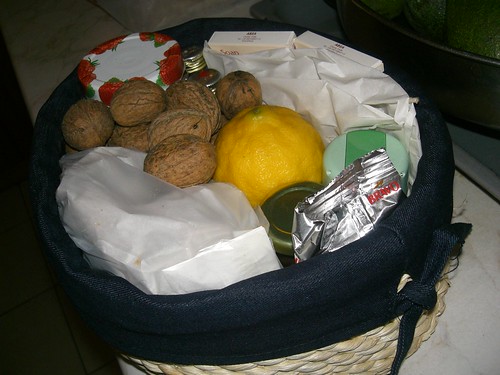
Could you teach your child to do this? And what is it exactly that these kids are eating?

artichoke leaves
(Watch the little girl eating something else.)

Jamie Oliver could show this photo to some other children to once more 'prove' that they don't know their greens, the way he did in West Virginia recently, when he showed a child a potato and asked it if it was a tomato (or was it the other round? I can't remember). Just as long as he knows it's an artichoke (and these kids are eating the leaf tips). It's always been a tough job trying to teach children to eat their greens (whether the vegetables are greens or red or yellow or purple) - and it's also difficult to get children to eat things that they are unfamiliar with - remember the Pakistani restaurant episode?

But I'm also wondering whether Jamie led those poor lost souls on in such a way that they would have given him the wrong answer, no matter what he asked them, even if they did in fact know the right answer. Were those young children psychologically attuned to giving a positive response (ie a YES answer) to all of Jamie's questions, regardless of the phrasing, content or intention, because they thought that this was what was expected of them? The 'expected' answer is viewed positively, while giving a different response is viewed as taboo, wrong, bad, something like chickening out.

This reminds me of my daughter learning the timestables, and how I'd trick her every now and then to make sure she was really understanding what she was doing instead of learning it off by heart. After we'd written out the timestables in numerical order, and then in random order, and finally in jumbled form, so that she had to think hard about the answer and count on her fingers if she couldn't remember it off by heart, I asked her:

"What's zero times three?"

She looked at me blankly. "That's not in the timestable."

"No," I answered, "but you know the answer, don't you?"

Her look hinted at uncertainty. "Zero?" she asked, not replied, because she was now stumped; I had thrown her off course.

"Are you sure?" I asked her, just to confuse her even more.

Again, a distrusting look. "Yyyyyeeeessss..."

"OK, so what's three times zero, then?"

Now she was really stumped.I decided to give her a hint."You know the answer to zero times three, now give me the answer to three times zero."

"Aaaaaaah, what did we say that was again?"

"You work it out, like you did last time." Tough mummy. But she got the positive response she wanted to get - that she was somehow 'correct' the last time she gave me the answer.

"Zero?" she asked, again with hesitation in her voice.

"Are YOU sure?" Very tough mummy.

"Mmmmmmm, nnnnoooo."

Before I did any more damage that day, I gave her the answer and congratulated her on knowing her timestables. But she's still wondering why I confuse her every now and again.

*** *** ***
Maybe those Huntington kids were just following the leader (ie copying the first child's answer, which may unfortunately have been the wrong answer), because of that human tendency that shows up in all human beings at one time or other, to simply follow the sheep at the front: remember the "four feet good, two feet bad" chant?

I think that probably what was happening, as it usually does at such a young age, when children's logic and confidence skills are still in their infancy and not very well developed, is that the children were expecting to be rewarded for giving the answer that they thought was expected of them, regardless whether they knew the right or wrong answer.

There's also the other issue of not knowing how to make a connection between the raw food and the cooked food, the lack of experience in the kitchen as well as the shopping, all of which may lead us to believe that Jamie might have a point after all, so I'll give him the benefit of the doubt.

Here's a slideshow of some old photographs from my collection presented in a new way. It makes a good teaching tool for school teachers to get kids talking about food preparation and the processing of ingredients.

*** *** ***

TASK: Ask children to think about the food they eat, and to see if they can name the ingredients that are needed to prepare the meals/dishes they mention. To simplify matters, ask them to think only about the fruit and/or vegetables in the meal (but make sure to omit the meat: it is a trickier task).

Now show them the slideshow, and ask them if they recognise what each plant is.

Then ask the children to think about where each ingredient in their chosen meal comes from, and if they have actually seen it themselves growing on a tree/plant.

Finally, get the students to think about what happened to this fresh product once it was harvested (ie in what ways it was processed), before it could be used in the meal they mentioned.

We all love the idea of fresh, but just how fresh is what we eat?
When we get it in our hands, what do we have to do with it before we can eat it?

This exercise can be used in classrooms that are equipped with online tools, so it's not possible to use it in most Greek schools at the moment; Mr P has promised this to us in the next teaching year - let's see...

Use WH- words to make up questions (which can be tailored for younger through to older pupils):
eg WHO eats these vegetables? WHO grows these vegetables? WHERE are they grown? WHAT meals use these vegetables, WHEN are they grown? WHICH are preferable for certain meals? HOW are they grown? etc.

The children may also use their own cameras to create their own set of fruit and vegetable photos, perhaps as they watch their parents cooking, or doing the shopping, or gardening. If these activities aren't done by the parents, then you've got a problem on your hands, I suppose; they could photograph some of their meals, and then work out what was in them using these pictures and other ideas you give them.


©All Rights Reserved/Organically cooked. No part of this blog may be reproduced and/or copied by any means without prior consent from Maria Verivaki.
Monday, 9 January 2012

The way we were: Greek girl in London (Όπως ήμασταν παλιά: Ελληνίδα στο Λονδίνο)

On reflection, I find that my ideas concerning food, travel and identity have remained quite stable over the years. So has my sense of humour. Some of the places mentioned below don't exist any more. As for the people (all names have been changed), I don't know where they are these days or what they're up to.

Thursday, 13/6/91 - 7.00am The flight from Bangkok to Amsterdam was OK, but Amsterdam-London was rather turbulent. Q met me at the airport, right after I passed through all the Zone B shit. God help those without EEC passports. Lovely vegetarian meal at an Indian restaurant. The tube was eventful - at one point, I realised that no one else was speaking except for me. Q looked relieved when I shut up. Brixton is colourful, to use Q's description, but if I had a choice, this isn't where I'd set up home in the long-term. Q says she's tired of it. She initially came to the area because it felt cool.

The bathroom in this house is on the top floor. No shower, just a bath. It's got huge windows with no curtains. Felt like the whole of London could see me naked. There's a windowless WC on the lower floor.

Friday, 14/6/91 - 8.50pm Went to a karaoke bar last night with Q. Disgusting. Q lost her purse there. Got home zonked*.

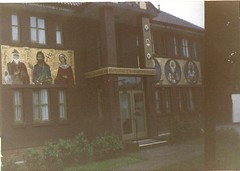
Had my first encounter with London Greeks, except that they weren't Greeks. They made it quite clear they were Cypriots. Took the tube to Haringey. Walked a fair bit because my travelcard doesnt extend to Zone 3. Strolled through Greek Cypriot territory. Greek shop signs, kafeneia, food stores, music, the lot! Talked to Barbara and another two Greek Cypriots in a bakery where I bought a flaouna (80p). Kept walking along Green Lanes. Not the most inspiring of places. Just as I was about to return up the road and leave the area, I saw a house with Greek Orthodox icons on the window. Out of curiosity, I approached it to check out the sign. At that point, somebody opened the door. He asked me if I was looking for anything in particular. Turned out to be a Romanian, and there was also a Greek priest in the room. The place was a bookstore selling Greek religious material (nothing in English, interestingly enough). They served me coffee with a kourmabie over a short chat. 

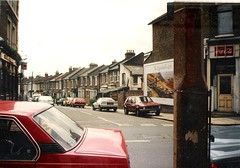
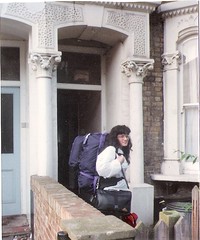
haringay june 1991I must have been day-dreaming after I left the bookshop - I got lost in the maze of streets with similar-looking houses. At one point, I decided to take a photo of all those narrow little boxes resembling toy soldiers lined up on the road in a straight line. As I put away my camera, to my horror, I saw a whole lot of Greek men staring at me - I was standing right outside a kafeneio window! Yuk!

Attended Taize prayer group with Q. Very new-age. Shut your eyes, sway to the rhythm, peace be with you,  we are all one. Groovy. It's probably more sensual to be in a group and meditate together with others than it is to stay at home and try to do this on your own. I much prefer the latter.

Saturday, 15/6/91 - 9.30am Got up this morning to find Evan in the kitchen, making his boyfriend's breakfast. Evan's a theology student. Had a chat about the Greek Orthodox church. A few minutes later, James walks in and sits at the table. Evan brought him scrambled eggs on a plate and sat it right before him. John then joined into the religion discussion. (Q told me this one's not gay.) Says he's really well versed on the Greek church. I never expected I'd be sharing a flat in London with English men who know as much about the Greek Orthodox church as I do - I haven't even been here for a week. I thought about inviting them all to come with me to a Greek Orthodox church service tomorrow, but decided against it for fear of sounding too bold. I'm supposed to be a transit flatmate. 

london june 1991Everyone here seems to do their own thing. They come in and out of the house as they please. They stay in their rooms unless they come to the living room to watch TV. They label their food in the fridge and cupboards. I bought some bread and cheese from the supermarket, but I can't bring myself to start labelling it. I just hid the cheese behind a jar that looked as though it hadn't been used in a long time. The jam had congealed around the rim. 

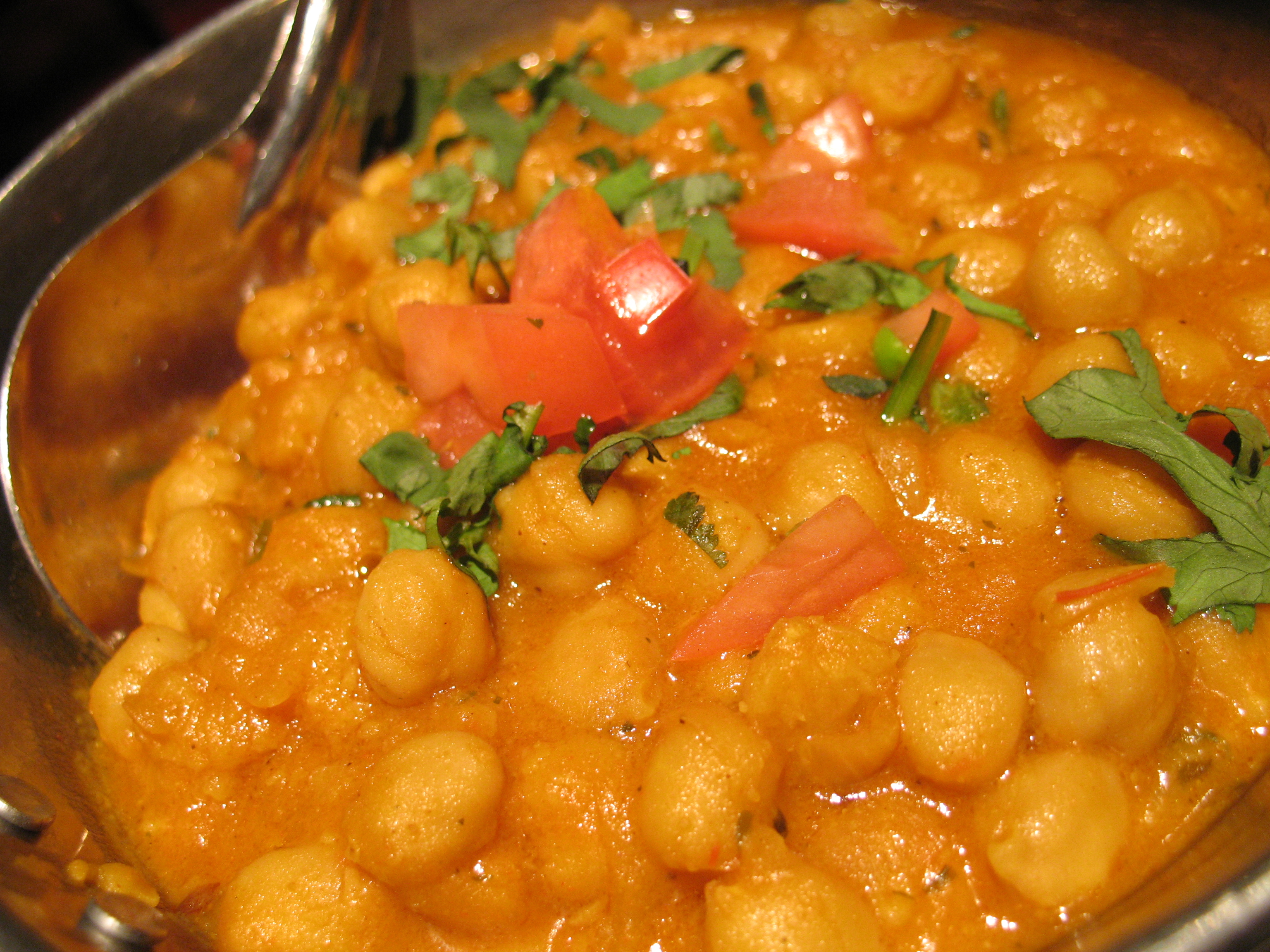
File:Chana masala.jpg
Saturday, 15/6/91 - 7.25pm Took a bus out to Covent Garden with Q. She wanted to go to a church fair. Browsed through a lot of bric-a-brac, as well as a nice array of food. Had some chickpea chana masala, and bought a sponge scrubber for the flat. I really don't think that brush they use gets rid of everything. The fair was held near a YHA office where there were some camper shops. Want to buy an immersion heater before I set off for Europe. 

Went to Campion House at Osterley in the afternoon. Had lunch there (very filling) and a coffee in the common room. Met up with Q's friends, Giovanni and Victor. Q seems to have a lot of gay friends. She probably thinks they're exotic. Spent the rest of the day with them at the Butterfly House in Syon Park.

Sunday, 16/6/91 - 9.00pm Had originally planned to go to the Greek Cathedral, but decided to go instead to the church in Leyton. Attended Orthos, then Liturgy, and had a cup of coffee after the service. I was given directions for the monastery near Colchester, a telephone number and contact person. Before I left, the priest gave me a loaf of prosforo. Headed back to the tube where I came across Garfunkel's. Decided to have a meal there - £4.95 (service NOT included - what a laugh!!) for the salad bar. Sounds cheap, but not if you have to pay this kind of money for each meal. It's eat all you want - I made sure to eat enough for lunch and dinner. It all tasted quite good, but it was all cold. I hate cold food on a cold day. It's rained nearly every day I've been here. Middle of June and still winter. P tells me it's definitely summer in Greece now.
Got home and did a thorough cleaning of the dishes. No one ever scrubs the inside of a mug here - they're all stained with brown rings. Don't they know about sponge scrubbers??

Monday, 17/6/91 - 8.30pm Left the house with Q. Took the tube and got off at Covent Garden. Decided to walk around the city. Ended up at St James Park, bought some sandwiches and picnicked with the pigeons. Visited Harrods - wanted to buy something from there as a souvenir, but the prices shocked me to the grave. Had a coffee in their cafe just to get a feel for the atmosphere (I miss Espressoholic's cappuccinos). 


Saw a man peeing against the wall as I walked to the house after getting off at Brixton. He smiled at me as I passed him and said 'Sorry' in a sing-song accent (I guess he was Carribean). Q says this sort of thing happens all the time. 


oxford june 1991
Tuesday, 18/6/91 - 6.30pm Q's asked me to go out with her tonight. Just a quick note to remind myself of the places I visited today at Oxford: museum, St Mary's church, botanical gardens, Christ Church, Bodleian library. Liked the college grounds most of all. Students wear gowns to classes! Must be quite an achievement getting into one of the university's colleges in the first place. They need to stick out above the rest.

Wednesday, 19/6/91 - 11.15am Last night was a really late one - spent the morning sleeping it off. Eddie is coming back home tomorrow to his room, so I cleaned it up and then moved into Q's room. Did a bit of washing. Then went out with Q to her friend's house for a Twin Peaks evening. I had this idea that we'd be visiting an English person's house, but they turned out to be Australian lesbians and Cypriot bisexuals. I'm sure now that she thinks gays are exotic. I suppose it's image-boosting: "Many of my friends are gay." Having said this, Evan and James are a nice couple. They seem to be much easier to talk to than this lot. They're all gay in their own way, but the English ones appear to be more down to earth, less confused about who they are.


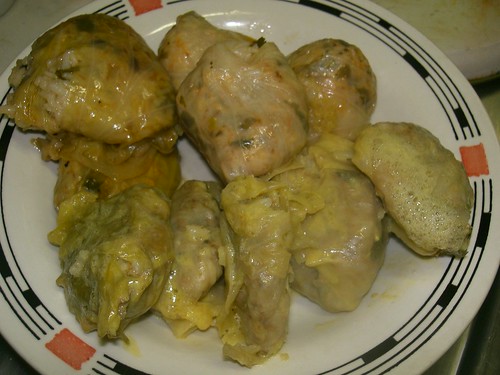
Wednesday, 19/6/91 - 6.40pm Decided to do my food shopping at Tony's today instead of Tesco's. The shop assistant gave me the mint for free because it was on its last legs. Also found some fennel. Brixton's shops sell nearly any food you want. The vine leaves were a little pricey. Made dolmades with cabbage for everyone. They all seem to love food with exotic names. 
lahanodolmades
  I probably didn't make lahanodolmades as good as this back then...

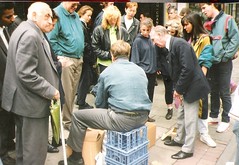
trafalgar square june 1991
Thursday, 20/6/91 - 11.45pm Packed day today. Visited a number of tourist sites. Walked around Trafalgar Square, visited St Paul's. You have to PAY here to see churches!?! Museum of London (free) - very interesting. Museum of Mankind - the Palestinian costumes were more appealing than the human shrunken skulls. Tower of London - outrageously expensive, something like $20NZ to enter. We've just come back from the Phoenix Theatre: Dancing with Lughnasa.

Friday, 21/6/91 - 7.15pm Decided to be Greek for the day and visited the Archbishop. He sounded only too pleased to have me as a guest in his office. Told me not many Greeks come to see him just out of interest. I tried to explain the make-up of the Greek Community in Wellington, but I think I lost him a bit there. He couldn't understand what I meant by Greek-Romanians. I was invited to the dance held by St Sophia's church at the end of the month. The Archbishop said he'll pass on my name and number to one of the organisers.

Just as I was leaving the Archbishopric, a Greek priest from K______ came to the office. Apparently, he's in London for an eye operation and comes to the Archbishopric every day to be fed. I couldn't work out if he was begging, or just genuinely poor. The way he spoke sounded a little melodramatic, like I was watching an old black and white Greek film. Stopped off at McDonalds for a meal. Don't remember McDonalds salads in Wellingon tasting so revolting. 

Q's off this evening. Thinks she's got something going with Paolo (all her boyfriends have foreign-sounding names), so she doesn't want to waste any chances. I won't see her until after the weekend. James suggested a walk in Brockwell Park to celebrate Solstice Day, the longest day of the year. It made me a little homesick - Mum and Dad just experienced the shortest night of the year, all alone. Must remember to give them a call very soon. James was at Eton, he's visited Mt Athos, and dabbled with Orthodoxy when he got back to the UK, which is how he met Evan. He's been around a lot of men most of his life. Weird that they don't live together. Something to do with wanting to be independent from what I understood. He really liked my exotic-sounding dolmades - he ate all the leftovers when we got back to the house. It's a nice feeling knowing your food's been appreciated. 

Saturday 22/6/91 - 7.30pm Visited Greenwich today. Docklands was supposed to be on the agenda too, but the monorail wasn't working - no trains at the weekend. Had to take the bus. I prefer them because they're slower than trains and you see more from a bus window. Even the way people walk on the street looks different to me. Greenwich market is fascinating: so many goods, colours, people. Bought a pair of cullotes, even though I constantly worry about my financial s
ituation. I don't want to overspend, but I don't want to feel like I'm bludging either.

I feel so alone today. The gays are away, but John and Eddie are both in the house. Eddie keeps to his room, John moves from his room to the TV room. I feel like I'm intruding, so I just stayed in Q's room. Maybe a youth hostel would provide more solace than this. Packing a day bag to go to the monastery tomorrow.

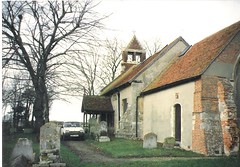
monastery essex june 1991Sunday 23/6/91 Arrived at the monastery - not without problems! Underground was slow, missed the 8am train to K______, couldn't find a taxi at T______, couldn't even make a public phone call from the one and only phone box. A grocery was open so I asked the nice looking blond shop assistant if he could help me out. He told me the monastery wasn't really within walking distance, so he called up a taxi for me. I asked him how much the call cost but he didn't ask for money. And they say the Brits save up their coppers! Love the English countryside - so different to urban London.  It looks like a much simpler place to live in. Most people are trapped in their urban routine though.

The service was long, the church was full. Quite a few converts - Sister X told me there's an equal ratio of converts to Orthodox-born. Some people overdid the religious routines here. Reminded me of Kiria D______; they make her look benign. Also some glamour girls coming in the latest fashion - a little inappropriate for a monastery. When I told them I was from NZ, they asked me 'Are there other Greeks there?' Attending Greek church is definitely an identity thing, sticking to your own kind. They reminded me of Mum's intermarriage fears. Cyprus is only four hours away if they wanted to find spouses for their sons and  daughters, so I can't understand what their problem is. Interestingly, I found more Greeks here rather than Cypriots. The meal afterwards was completely lenten. I was allowed to stay overnight, and shared a room with two other girls, one Cypriot (English accent), the other Greek (Greek accent). They wanted to keep their conversations private, and treated me like I wasn't in the room. Apparently, they come here often, so they're used to treating stranger-visitors like myself as invisible. I was exhausted anyway, so I had a lie-down, but I couldn't help overhearing them. Caught on that the Cypriot was recently divorced from an Englishman and has a sister who's a nun in Greece. He probably got tired of too much religious mumbo-jumbo. They thought I couldn't understand their conversation in Greek because I told them I was from New Zealand. The Cypriot girl asked me what language we speak there!?! The Greek girl wasn't even interested. I think they think I'm a New Zealander, not a Greek. 

Was in for a treat - first decent shower I've had since I arrived in the UK.  

monastery essex januray 1991
Monday 24/6/91 Today's much quieter, with all the picnickers and bride- or groom-seekers gone. Apart from church services, the nuns and monks go about duties like cooking, gardening, cleaning, reading. After breakfast, I took a walk with one of the nuns in the fields. She's a convert. Told me she lived a totally unholy life before coming here and finding inner peace. We spoke about a lot of things, all basically to do with making life choices. I kept thinking of Maslow's needs theory as I talked to her: when you've got most of the basic problems in life sorted out for you, you've got plenty of time to think about sorting out your priorities. The monks and nuns seem to like to do the talking here. I think they're trying to pass on messages, and maybe their words are more important then mine. She gave me a book as a present. It's got some nice ideas in it for Sunday School. 

Also met J, a very young-looking Greek girl who wants to be accepted as a nun and is currently undergoing training of some sort. She was due to start a PhD when she decided to come here instead. I can't believe she's doing this to herself; she still wears drainpipe jeans under her tunic.

Tuesday 25/6/91 - 7.00pm Arrived back at the house with a feeling of fullfilment which I didn't have before I went to the monastery. Everything looks strange and distant outside the Greek environment. Would like to return for a second visit. Wellington Greeks need this kind of group because it gives them a more coherent identity. 

Nikos (Cypriot) called me about the dance, church service and bible class. Interestingly, he said he was at the monastery the day before I arrived. These people are regular followers, but something drives them back to London. In or out?

Never going to those Taize groups again. The Jesus Prayer works so much better. 

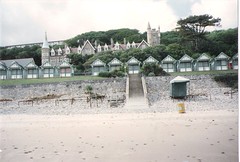
swansea? june 1991
Wednesday 26/6/91 - 1pm It's pouring today. Feeling like a drowned rat. Tried the Jesus prayer last night. Managed to make it last ten minutes before I got distracted. It was much easier to read the nun's book. Just about to board the bus to Swansea. 

Thursday 27/6/91 - 3.30pm Recognized G's parents immediately. They picked me up from the station and had a lunch ready for me: lasagne, salad, jelly and peaches. Feels like home! Then G's friends took me out to the Rock and Fountain where G used to work. Met up with their mates there and I had two bacardi-and-cokes. Not that I wanted the bacardi - I just felt I had to drink it, because they expected me to do so! TG they all go home early - all I wanted was to be vertical for a few hours.  

G's father showed me the office he keeps in the attic. A bit precarious allowing him to climb up that ladder at his age! Caught a glimpse of the morning paper - the headline was about a Thai butler and a dead family in Athens. OMG. Went out to Roshili, then Oxwich in the Gower peninsula. G's parents treated me to the best meal I've had out so far: a pub lunch! We came home with the rain. J and S have invited me to Mumbles on Friday night. More alcohol, I suppose.

Friday 28/6/91 - 8.10pm Too many distractions for prayers. I've only just remembered them, now that I look back on my diary notes. G's mum cooked up a large lunch today for G's cousin's arrival. Then G's cousin took me out for a drive to Mumbles - the romance of a summertime beach holiday is somewhat drenched out by the drizzle! Passed by a grocer's - intriguing array of fruit and veg. G's cousin picked up a lettuce for G's mum. As she was paying for it, I noticed the price: 5p. Back home for dinner. I do feel sorry for G's mum: she prepared another meal for us, her husband was drunk and her niece buys her a 5p present.

Monday 1/7/91 - 1.00am Can't sleep, so I'll just fill in the last few days' events. Friday night: Mumbles pub with J and S - more bacardi cokes. Felt a bit like Coronoation St coming alive. G's friends love a good gossip - they weren't surprised at all about the 5p lettuce! Saturday: took a leisurely stroll around G's village. What a delightful place. She must love coming back here. I can understand why she needed to leave in the first place. It's just too small. Took the bus back to London in the afternoon. Sunday morning: St Sophia's - very Anglo-Orthodox feeling in that church. The choir chants Byzantine verses using Anglican organ tunes! Nikos found me after the service (how on earth did he recognise me?) and suggested I stay for bible class - that went on until the early afternoon. Not even any mention of lunch! Then off to a fete in Wood Green; got a peek into a Cypriot-English wedding, and finally The Dance. Sat at a table with Andrew and his parents, who were obviously hawking around innocent young Greek girls in the churches to save their son from intermarriage. Dances finish early here so everyone can catch a train before midnight. No one even asked to chaperone me back to the station! Changed carriages to avoid a nutter in the one I got into first. Felt a little scary walking back home on my own at midnight. This is London, after all.

Monday 1/7/91 - 10.45pm Thinking of leaving London for Europe. Everyone goes to Paris, so I suppose I'll go there. Just returned from another young people's bible class that Nikos' friends had invited me to. Except that there was no bible class = it was more of a complaints session. They have similar church/priests/parish problems as we do back home. One group is obviously more educated than the other; each group sticks to their own kind. They don't see eye to eye. While there, I met up with Father D, KP's uncle - small world! He asked how she was doing. I didn't divulge what I knew about her, but he spilled the beans anyway. Apparently, he knows all about KP's problems with Dirty Den, who was supposedly a VIP during his time in London. He gets by purely on charm. 

Had a heart-to-heart chat with the priest. He told me straight out that he was angry with the youth group about hiring a Greek band to play at a concert for £350, all for just a 40-person turnout. Bad organisation all round. The way they explained it to me, I felt that they'd done nothing to promote the concert, hence the bad ticket sales. I wanted to tell them all about how we planned Wellington's Greek Week, but I was waiting for the bible class to start. Hung around for at least an hour, but nothing. Decided to head back home. Good example of their organisational skills - they run on Greek time!

Bought some chips on the way home at a shop run by Greek Cypriots. These guys looked really shady - ponytails and dark eyes. The Egyptian assistant was more approachable. Q's due home tomorrow.

oxford st june 1991
Tuesday 2/7/91 - 10.45pm Charing Cross Road has great bookshops - particularly liked Sister Moon. Spent the morning reading - feels nice to get back into this habit. But I can't buy anything, because it will really be too much to carry in a backpack round Europe.

Went to see Where Angels Fear to Tread in the evening with Q - £5.50 for the cheap seats. Now I know what John Lennon meant by 'rattle your jewellery'. After the film, we decided on dinner at a Chinese restaurant. Went to Wong Kei's where we were abused, so we left and went to another Chinese restaurant in the same area. The waiter asked Q for her name, address and number. She didn't oblige, so he then asked me. I didn't oblige either. Think I'll stick to Indian restaurants from now on. TG they're all gay or attached at the house. I've never seen John and Eddie's girlfriends, but supposedly, they do have one.

Captain Peacock: Mr. Humphries, are you free?
Mr. Humphries: I'm just pricing my ties, Captain Peacock.
Captain Peacock: The gentleman wishes to try on a dress.
Mr. Wilberforce Clayborne Humphries: I'm free!
Customer: It's for a fancy dress party.
Mr. Humphries: Oh yes. Thats what they all say.
Are you being served? Excerpt (12:00) from Season 3, Episode 3 

brixton june 1991Wednesday 3/7/91 Was excited to get a postcard from Richard. It's a good feeling to know that I now have some direction in my travels with a fixed destination in mind. Will make my way to Nurnberg. Prepared a meal for all the housemates. Q and I are at the point of clashing. It's true what they say: best friends should never live together. Making plans to leave asap. 

Thursday 4/7/91 - 10.15am Left Brixton (hooray) for Paris. On train to Dover. Got a Scot and a Russian for company.  (to be continued)

*** *** ***

In June 1991, I left my home of 25 years to do my big OE, the customary work-and-leisure travel that most New Zealanders undertake at some point in their lives to experience life beyond their country's borders. In those days, most Kiwis headed for Europe via London, and often ended up in Asia before (if indeed) returning home. I bought a one-way ticket to London where I stayed for three weeks, before embarking on my continental travels through Europe over a period of two months, eventually arriving in Athens in September. I had thought about travelling through Asia on my return to NZ, but that never ended up happening because, as most followers of this blog know, I ended up staying in Europe. Maybe (probably) I ended up in Greece through a process of self-discovery - the above-mentioned 'more coherent identity' - which I found here.

Although I had kept a diary before that (albeit at irregular intervals), this was the first time I felt the need to keep one systematically. For this reason, that particular diary was the only one I ever kept. The diary sat, for many years, on the bookshelf of whichever house I was living in at the time. The notes I kept show my first glimpses of London as I saw it 21 years ago. All the excerpts above have been taken from this diary, in a slightly edited form. My photographs were taken between June 1991 and January 1992. The youtube video reveals some background to my informal education on London life and homosexuality.

*Honest to God, I don't remember ANY of this.  

Thank you to all those who read this before I posted it.

©All Rights Reserved/Organically cooked. No part of this blog may be reproduced and/or copied by any means without prior consent from Maria Verivaki.