Sunday, 26 October 2008

Youvarlakia (Γιουβαρλάκια)

Dear Ms Verivaki,

I must congratulate you on your magnificent prose and excellent cooking skills. I am a regular follower of your Hania blogs (I read them both every day), and there has never been a moment that I have been disappointed by the food you present and the stories you write. I have fond memories of spending summers in my youth in Crete, and I feel as though I am right there with you when you describe village life, the beach, the weather, and daily life in that splendid Mediterranean town where you live.

Over the past year that I have been following your blog, I notice you have been cooking everything the way my dearly departed grandmother cooked (she was from Kambi); the same meals, the same ingredients, the same method. Your family must revere you for the feasts you conjure up in your kitchen. The photos seem to jump out of the screen, screaming "That's my grandmama!" to me.

There is one recipe that I haven't yet seen on your blog, and that's youvarlakia. It's my favorite Greek dish, the one that my mother makes for me and sends it from California via courier to my apartment in Connecticut where I'm studying IT, in a tupperware container which she has frozen. When I receive it, I simply warm it up in the microwave and eat it on the same night that I received the packet, saving one serving for the next day. It tastes so good, and it always makes me feel homesick.

Here is my mom's yourvalakia recipe. It took me a few times making it before I turned out a batch that I was even satisfied with. In my mind, my mom's yourvalakia are always smaller and lighter than mine, and the avgolemono is always fluffier and more nicely balanced in flavor, but I continue to practice, and some day I hope that it'll be good enough that I can serve it to my mom and she'll be proud of it.

I thought that it would eventually turn up in your recipe list, but it's been over a year, and I understand that you cook according to a strict cyclical repertoire of recipes. Maybe your family doesn't like youvarlakia? Well, all people are different, aren't they?

I have never felt closer to my second home than through your stories. I'm looking forward to being comforted by more of them this winter.

Your loyal reader...
*** *** ***


Kambi, 1919
Nikolas had heard the word 'Ameriki' mentioned many times in the village. Ameriki was the land of a poor man's wildest dream, something akin to utopia, where everyone is happy, employed and rich, like his brother, who sent one single postcard to his family since he left Kambi.
When Nikolas' older brother Grigori returned to the village from Ameriki, he had enough money on him to buy 90 acres of land in the village, and live happily ever after. After working in the restaurant trade for five years in New York, being the patriot that he was, Grigori decided to return to the mother country to buy the land his family could not afford to give him and to complete his Greek military service, at a time when Greece was under attack from an enemy.
"In Ameriki, people are prepared to fight for their freedom. How can I stand and watch when my country is in danger?" he replied to his family when they pleaded with him not to leave so soon after his arrival. His betrothal to a blooming village girl arranged (as befitted his financial position), he had no sooner invested his money in buying land than he left again, this time to Thesaloniki where his knowledge of English earned him the rank of officer. He managed to survive the Battle of Skra, only to die from malaria two months before the end of the campaign, having never set foot on the land that he had worked five years on foreign soil to buy. It was shared unevenly among his siblings: his four sisters received a large share each as a dowry, making them attractively eligible for marriage, while Grigori's brother ended up with the remainder, a mere pittance of the original amount.
Nikolas received 10 acres of the land that had been bought with his brother's money from Ameriki, along with the beautiful bride his brother never married. He married her out of pity; even though her engagement did not constitute a marriage (there was no marriage to consummate in the first place), she would have a hard time finding another husband after being betrothed once already. Word would have spread that she was engaged to be married; her fate had already been decided. Who knows when the next offer would come? Nikolas also felt that she had partly inherited his brother's fortune, so that she deserved to be in on his good fortune.
Aggeliki, for all her outward qualities, was not the most useful woman around the house. She had been raised in the 'mimou aptou' way, as if her beauty did not permit her to cook, wash and clean the way a less attractive woman might conduct herself with respect to these duties, lest by applying herself to such tasks, her beauty may deteriorate, fade away, disappear, as if age could never play a part in this demeaning process, and it was all to do with how often one's hands touched the soil on the ground or how much sunlight shone on a woman's face.
Nikolas' land was fruitful, especially once he had cleared most of it from the thyme and dictamo bushes, after which he set about planting it with olive trees. He hunted hares and wild birds, plentiful in his own fields, but the cook was wonting in culinary skills; the rumour spread all over the village, with its population of 500, that Aggeliki was a hopeless cook. Nikolas didn't know who to feel sorry for more: himself for earning such fate, or the oven-charred or water-sodden carcasses that came out of the kitchen, sometimes sporting their fur or plumage. When he sat at the kafeneio with other men from the village, and listened to their chatter about how their own wives conducted themselves at home, his gut tightened.
"Give her time, Nikola, you're not even into a year of married life," the others would comfort him. But he neglected to tell them that Aggeliki entered the marriage in this way right from the start, and that his clothing was now almost ragged and Aggeliki showed no sign of replacing them for him before they had become tatters. He felt that the land - and possibly Angela's inviting appearance - had cursed him into the misfortune of a loveless marriage.
*** *** ***
When Aggeliki became engaged to Grigori, she had hopes of leaving the village for good. She knew that Grigori had made a lot of money, but she didn't realise that he had invested it in the mountainous territory that made up the village of Kambi. She expected that, once he had finished his military duty, he would move to lower ground - as most villagers who prospered did - and build a suitable dwelling for them to live in. After all, this is what he must have been accustomed to living in in Ameriki; everyone there apparently lived in fully furnished houses and had their clothes made for them by tailors and seamstresses. They did not need to shear sheep, spin yarn, or weave cloth on the argalio, which would eventually be turned into bedsheets and men's shirts; like cooking, sewing was not Aggeliki's forte. So it was to her greatest disappointment that Grigori did not return from Thesaloniki. She knew what fate had in store for her.
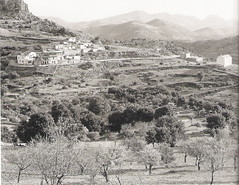
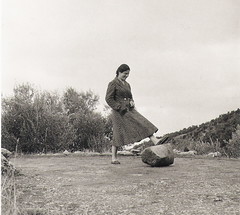
family 1960 village 1960 woman rolling stone on roof young woman 1960
(Crete in the 1960s, four decades after Aggeliki and Nikolas emigrated; the photos come from CRETE 1960, by John Donat, Crete University Press)


Aggeliki had not wanted to marry her fiance's brother, but there was no question of that now that Grigori was dead. Had she been married to Grigori before he had left for Thesaloniki, she would have inherited his land, a mixed blessing if ever there was one. She would have become a rich woman, highly ineligible for marriage; what man in the village would have been able to match her wealth? As it was, she suffered the cruel fate of being labelled a widow after Grigori's death anyway, even though she had never married; such was the nature of life in the impenetrable snow-capped mountains of Kambi, at the foothills of the Lefka Ori.
She looked around the house Grigori had built in roughshod style a short while before they were married: two simple stone-built rooms with openings for windows, blocked by wooden shutters to stop the winter cold from entering. There was an outhouse a little way from the house and an earth oven built next to one of them rooms. This was not the Ameriki she had dreamed of, nor was it the town of Hania that she had hoped to move to after her marriage. It was true that she had never known better than the village life she was born into, but no one could stop her from dreaming, which is what she did most of the day when Nikolas was away, clearing scrubland, planting olive trees, hunting hares and grazing sheep.
*** *** ***
Kambi, 1921
Nikolas was sitting at the kafeneio. He usually sat on his own these days, as he had little to share with the locals. It was almost three years since he married Aggeliki and still no children. He had by now grown accustomed to the way the kafeneio chatter died down when he entered the shop, and the compassionate smiles of the other men sitting in groups around the tables. He picked up one of the newspapers that had been left on the fireplace, to be used for kindling a flame. Although he had not finished primary school, his reading was at a reasonable level. He did not write anything apart from his name; there was no one to write to, in any case, and no one interested in reading anything that he wrote.
He had not grown tired of working the village land. What tired him most of all - and he seemed to have aged a decade since his wedding day - was that he was working with no future in mind. So what if he had thousands of olive trees; so what if his coffers were filled with olive oil. There was no one to eat it, and no one to sell it to; people were too poor in the village to buy more as their own stocks ran out, so they simply used it more sparingly. The economy of the country was still engaged in a new war effort; there was no interest in trading olive oil. So much effort for very little reward; produce-rich but lacking currency.
Every morning started off the same, as every evening finished. Routine after routine, with very little variation. Nikolas saddled the donkey, which lived in a makeshift shelter next to the main house, along with a group of six goats and sheep which Aggeliki milked each morning, and left for the hills. The land he had inherited had never before been touched by human hands. He worked most of the day with some paid labourers clearing the land of the scrub wood and rocks, digging it up, tilling it, and planting it with olive trees. Aggeliki had filled a woven bag with bread, some olives, a chunk of graviera and a carafe of wine for Nikolas to curb his hunger, before he came back home at midday. It was usually too hot to work after that; the sun did not rest even in winter. The midday meal was a very silent affair, one that always heightened the void between the couple. They could not fill the space between them with their presence. They had little to say to each other; their world had become static.

Without offspring, there was no one to work for but himself, and his wife, of course, who, at times, seemed to live in her own reticent world. Apart from his requests for better food and clean clothes to wear, he had very little to say to her. Yesterday, she had cooked youvarlakia in a tomato sauce, using the anidres tomatoes he had hung on the rafters of the house to dry for the winter, while the lemon tree was bulging from its own weight, laden with fruit. Hadn't she ever had youvarlakia? Didn't she know how to make an avgolemono sauce?
"What were you thinking, using the tomatoes I was saving for the winter? Where are we going to find them when we need them, woman!" He could hear the rumble in his own voice as he shouted at her. Usually the house was so quiet. He wasn't used to hearing himself speak like this. He left the house feeling more angry with himself than his wife.
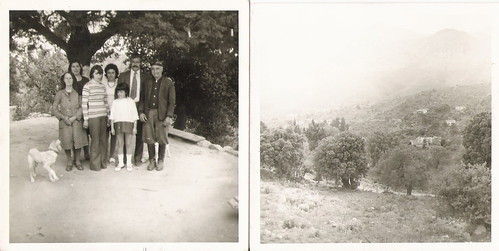
kambous 1974
(Kambi village, 1974)
Things were not looking good in Smyrna: according to the front page, war was imminent. His mind immediately conjured up the image of his brother leaving the village to fight against the Bulgarians. What was it that his brother had said? "In Ameriki, people are prepared to fight for their freedom. How can I stand and watch when my country is in danger?" Did he understand what he was fighting for? Had he thought about whether the cause was worth fighting for? Did he know how close the war was to the end when he lay sick and dying? Nikolas did not share his brother's patriotism. He did not want to fight a war that he hadn't started. He did not wish to be one of the victims of war like his brother. Now seemed a good time to leave the village, maybe even the island, and why not the country if it got to that stage. The shame of childlessness could be avoided if he simply lived elsewhere, far away from anyone who knew him. Nikolas put it in his mind to seek a passage to Ameriki.
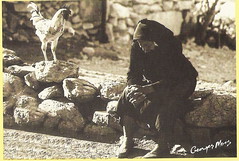
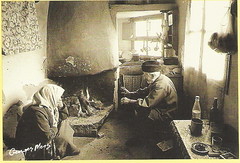
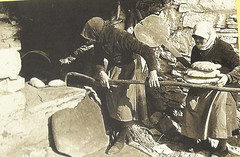
old woman and rooster george meis riding a donkey george meis old kitchen george meis baking bread george meis
(The kind of Crete Nikolas and Aggeliki left when they decided to emigrate to Ameriki
; these photos are more recent than the first set above. The photographs are works by George Meis, taken from a souvenir calendar of Crete)

(END OF PART ONE)

*** *** ***


Aggeliki may not have been too far wrong when she made youvarlakia with a tomato-based sauce. (In any case, her cooking improved once she went to Ameriki.) Youvarlakia is a meatball dish, in which the meatballs are made with rice, and cooked in an egg-and-lemon sauce, which turns them into a light main meal. My aunt in New Zealand used to make them, but not my mum; they simply didn't become a favorite in our house, along with, funnily enough, pastitsio, an all-time favorite Greek pasta dish.

youvarlakia youvarlakia cooking

The next time I had youvarlakia was in a hospital in Iraklio where my new-born son was under observation for an extremely rare blood disorder: at the age of two months, we discovered that he wasn't producing enough blood to supply his body with, which did thankfully clear up on its own when he was ten months old. He had six blood tranfusions in between this period. The hospital youvarlakia were cooked in the tradtional egg-and-lemon sauce, which my husband was never a great fan of. I enjoyed them, despite the hospital atmosphere.

My husband laughed them off : "They forgot the tomato," he said.

"But youvarlakia aren't cooked in tomato," I replied.
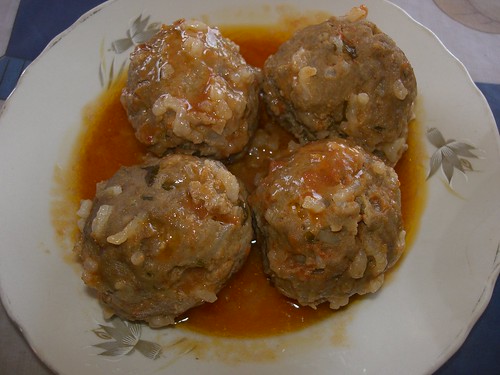
youvarlakia cooked in tomato
(My mother-in-law still cooks youvarlakia in tomato sauce.)

"Yes, they are," he said as we looked at each other wondering whether we were from different planets.
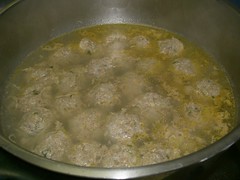
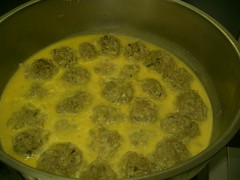
youvarlakia cookingyouvarlakia in avgolemono sauce

When life became a little more normal in our house after the hospital episodes, I cooked youvarlakia with the tomato sauce my husband liked, which, of course, was the way he had been brought up to eat them. I didn't really like them, but then I've never been a fan of tomato-based sauces. I'd rather eat garbanzo beans (chickpeas) than fasolada; I prefer a carbonara to a makaronada; give me a lettuce salad rather than the traditional Greek horiatiki. This is the reason why I prefer an avgolemono meat dish to my regular tomato-stew meat dishes, and believe me, youvarlakia in avgolemono are delicious. I have found one recipe (in Chrissa Paradissis' Greek Cookery, 1983 edition) that insists on using tomato AND egg-and-lemon sauce together to make youvarlakia, but mixing tomato and lemon is a rarity.

Aggeliki's cooking probably got better once she went to Ameriki, because life simply became less mundane and the tasks she performed in Crete on a daily basis probably became automated in Ameriki. Her kitchen would have been more well-fitted, her food did not have to be sourced straight from the fields, her house probably never resembled a mud-hut. And Nikolas was probably a happier man once he moved to Ameriki, because he would have found better working conditions and an appropriate salary. But the food they ate together wherever they set up home would still have been traditional Greek food, even if the ingredients weren't easily available.


(The video shows how Cretan families from Kambi were living in California in 1948; Crete at that time was extremely poor, while Greece was in the midst of a civil war. To the average Cretan, this picture would have seemed like a scene from paradise; poverty remains the main reason why, up to the late 1970s, Greek people emigrated to the New Worlds.)

Galatia in California makes her youvarlakia in the traditional Greek way. I got the recipe straight from her son Nick, who could well have been Nikolas' grandson. The recipe is exactly as he related it to me, with a couple of exceptions. I added a large onion (I am a great fan of all Allium species: onion, garlic, and leek), I used only two eggs, and I added olive oil to the pot after cooking the recipe according to Nick's instructions. The reason why is a simple Cretan one: we cannot do without our olive oil. It may add to the calories, but it will also add to the flavour; it also removes the eggy taste that my family isn't used to in their sauces. The original recipe before adding the olive oil - Galatia's youvarlakia are just so good with that extra dose of garlic - reminded me of the way my mother cooked Greek food in New Zealand. When you don't have access to cheap, high-quality olive oil (as we do in Crete), you go without. Tough luck.
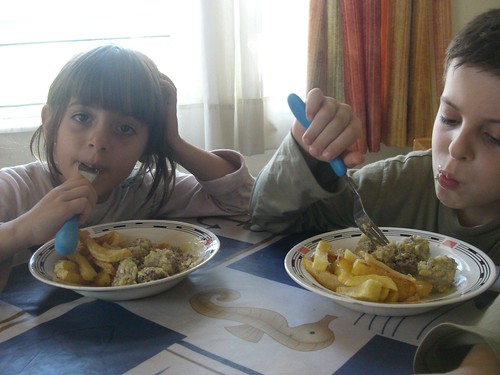
youvarlakia and fried potatoes

Since we don't eat youvarlakia often, you may be wondering if my fussy eaters actually ate this. As it was the first time I made this meal, I decided to soften it a little with a side dish of fried potatoes. I called the youvarlakia by another familiar name for mince balls, biftekia, which use the same ingredients, except that the rice is replaced with breadcrumbs. Next time I serve it, it won't be with potatoes, but with extra sauce to mop up with bread. After that, I might even call them by their real name, youvarlakia, and turn the sauce into a soup like Peter's. Evelyn also added a few chunky vegetables to it and turned it into a hearty meal for a cold day.

I know that, like leek and potato potage, first introduced to me by Ioanna, youvarlakia are going to become a firm family favorite. When I served up the youvarlakia for lunch, I had left the pot on the table. My husband asked me to take it away because "I could eat right out of it and not stop till I get to the bottom of the pan."
For the meatballs, you need:
1 pound of ground beef (about 450-500 grams)
1/2 onion, grated
4 to 5 garlic cloves (minced or grated)
1/2 cup rice (we use "Barba Ben's" long-grain)
1 egg
2 tablespoons chopped parsley
salt & pepper to taste
a little olive oil

For the sauce, you need: some butter, 3 eggs and 1/2 cup lemon juice

Mix the meatballs ingredients together well, and then make into small balls (about the size of walnuts). The one thing I always keep in mind is to keep the meatballs themselves small, more of a walnut size than a golfball. It took me a while to remember that the rice will cook and puff up in size.
Melt the butter in a large pot and place the meatballs in a single layer on the bottom (if you've made more meatballs than can fit in your pot, you can stack up a second layer). Cover the meatballs with water, going about 1/2 inch above the top layer of meatballs. Bring to a boil and let them cook at a low boil/high simmer for 20 to 25 minutes (until the rice has cooked, but keeping careful not to let all the water evaporate - you need the cooking liquid for the avgolemono).
Mix the eggs with 1/2 cup lemon juice and beat until frothy. Slowly add in the liquid from the meatballs and continue beating. Pour the avgolemono mixture back on top of the meatballs. If the avgolemono is too runny, or if the meatballs have sat around for a while (which is fine, and I should add that the meatballs, even without the avgolemono, are delicious) you can heat the whole mixture back on the stovetop, either to thicken the avgolemono, or to bring it back to a warm temperature, or both.
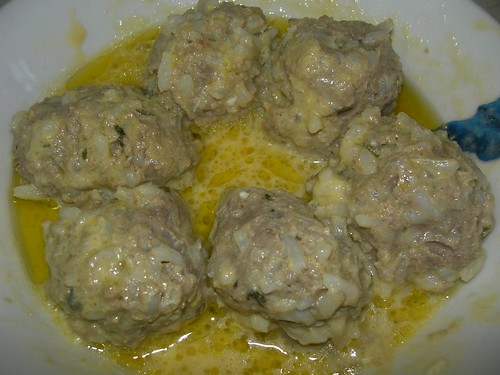
youvarlakia in avgolemono sauce

This post is dedicated to all the Cretans from Kambi, my mother's village, living in Modesto and Manteca, California, where very many of them congregated. It doesn't matter where they were born, whether it was in Crete or America, or whether they continue to speak Greek or not; they are still Greek at heart, and they know it. Thanks are due to Galatia Aretakis and her son Nick, because without their participation in this post, I would never have made youvarlakia.

©All Rights Reserved/Organically cooked. No part of this blog may be reproduced and/or copied by any means without prior consent from Maria Verivaki.

Friday, 24 October 2008

Amaranth (Βλήτα)

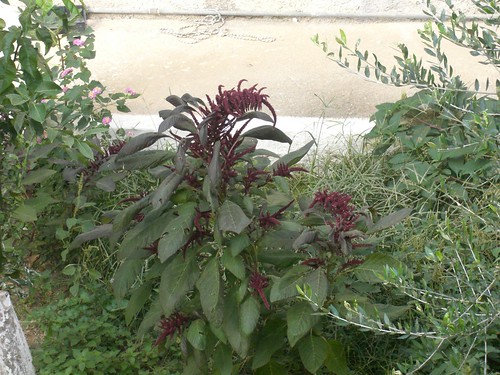
vlita amaranth going to seed in october

The amaranth plants which provided me throughout the summer with my wild greens, are now in full flower, waiting for a sharp wind to shake off their seeds, which will hibernate in the soil until mid-spring, when they start sprouting without any help at all, to give us our summer vlita.

vlita amaranth

A slightly more spectacular vlita is found in my neighbour's garden, with a red ferny frond instead of the common light green. Both varieties are edible.

Wednesday, 22 October 2008

Nettles (Τσουκνίδες)

Yesterday I did something that I wouldn't recommend anyone do without thinking of the risks involved first: I added an unidentified plant from the garden to my cooking.

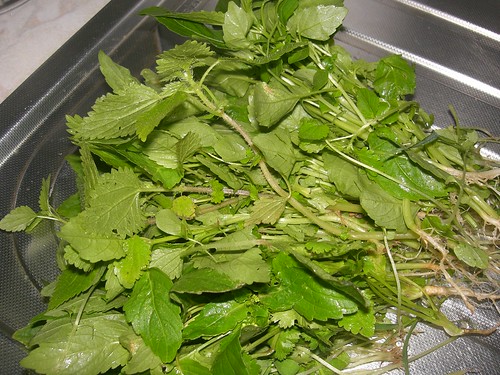
nettles
(a patch of nettles, among other weeds, growing around the celery)

Spurred on by the economic crisis and the fact that only about a fraction of the plant species in the world have been used as food, I decided that there can't be any harm in trying a new one, or at least one which is not commonly used in our cooking, but is prevalent in all the fields and gardens of the province, and is also known to be an edible plant species: nettles.

nettles

Nettles are those nasty stinging plants which cause an itchy sensation wherever they touch human skin. Most people would probably not know that they are edible, although I remember once my father bringing them home in our apartment in Hania, telling me that they are good for lowering blood pressure which he suffered from. (Pity he didn't just stick to eating this instead of getting involved with other blood-pressure lowering activities.) His sister had boiled them, so they resembled green mush. They looked very off-putting, but are apparently very nutritious: "Stinging nettle has a flavor similar to spinach when cooked, and is rich in vitamins A, C, D, iron, potassium, manganese, and calcium."

nettles
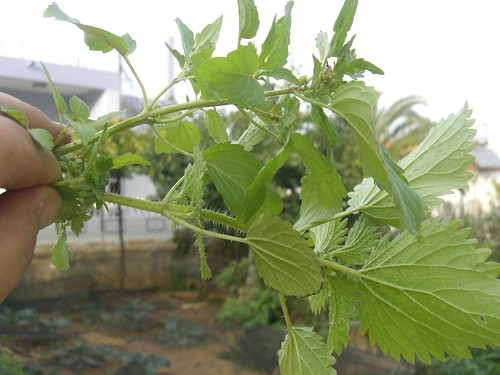
(one stings, the other doesn't; they look similar, despite the age difference - the stinging plant looks younger than the non-stinging one)

I knew that they would feel prickly, so I came prepared with some protective gloves to harvest them from the garden. But I was surprised when I couldn't see many thistles on them as I was picking them. I realised that there were two weeds growing side by side that looked exactly the same: one had stinging hairs on the stems and leaves,while the other was completely bald, but the shape of leaves and the general form of the weed seemed no different to each other. I decided to check out all the information available on nettles over the internet.

Wikipedia, usually our first choice for encyclopaedia-style information, tells us that most nettle species "share the property of having stinging hairs, and can be expected to have very similar medicinal uses to the stinging nettle." Possibly, the hairless species I found was also a nettle but not a stinging one. But the question is, are they edible too?

I finally found a reference for this non-stinging variety, but not before I added them to my latest kalitsounia and "spinach" pie making stint. I chopped the nettles in the same way that I would chop spinach and add it to a pie filling. I also tried the pie filling before cooking it, as well as after it came out of the oven. There was no discernible flavour that made the kalitsounia or pie taste different from what my family would normally eat as I cook it. The nettles - with and without sting - did not have any particular flavour in the first place, which makes me wonder whether makers of mass-produced spanakopita, my favorite takeaway, use nettles in their pie-fillings: they are much cheaper than spinach, although they may be harder to work with. But do not despair: blanching nettles removes their sting.

My non-stinging species was probably the wood nettle. Here's what WildManSteveBrill says about them:

stinging nettle; wood nettle
(the wood nettle, top, and the stinging nettle, bottom, against a backdrop of autumn garden )

"Other true nettle species are also edible. You'd think the stinging hairs would make nettle identification easy. Nevertheless, I once ran into some people in the woods who insisted that clearweed (Pilea pumila), a similar-looking, nonpoisonous plant with a translucent stem and no stinging hairs, was stinging nettles. They had been eating this unpalatably inedible nontoxic plant, which I had always rejected as unpalatable, all summer."

Photobucket

The kalitsounia were a complete success with the whole family - the contents of the tin disappeared as soon as I brought it out of the oven (hence no photos!), with no adverse side-effects. I had some remaining mixture which I made into a small pie for the deep freeze, using Laurie's ladenia pizza dough as a base. The family was informed about the nettles after they had eaten. The question is whether I would use nettles again in a meal, to compensate for a lack of organic leafy greens, and the answer is, yes, I would. Nettles don't seem to taste too different from any other grassy leaves; some people claim that they taste like spinach when cooked. When they are mixed into other ingredients such as soft cheese and other herbs (for a hortopita pie filling), they will go by completely unnoticed. However, I don't think I would use them on their own; they are simply too unpalatable-looking...

This is my entry for Kalyn's Weekend Herb Blogging, hosted this week by Laurie from Mediterranean Cooking in Alaska, who's tasted far less conventional greenery than the mere nettle: you should see what she did with spruce and pine tips.

©All Rights Reserved/Organically cooked. No part of this blog may be reproduced and/or copied by any means without prior consent from Maria Verivaki.
Monday, 20 October 2008

The real Greek lives in London (Ο γνήσιος 'Ελληνας ζει στο Λονδίνο)

Stavros recently posted some photographs of a Greek festival that took place in his part of the world, Maine, USA, where people living far away from Greece are maintaining customs and traditions that their parents passed on to them when they first emigrated from poverty-stricken Greece. Hermes from Australia thought the whole idea of staging a Greek festival in Maine was more like an American's nostalgisised attempt to hold on to an ancient culture whose language he can't speak.

Up until I was five years old, I didn't know I was a Greek. I thought I was just a diminutive form of the people who I was surrounded by: my parents, aunts and uncles, neighbours, the landlord, our friends. Everyone spoke the same language, went to the same church, had similar names (Kosta, Nikos, Yiannis, George for men and Maria, Toula, Soula, Voula for women), and ate roughly the same kind of food. All this was taking place in 1960s Wellington, in the suburb of Mount Victoria where many of those people lived at the time. This was the only world I knew up until 1970.

clyde quay school 1978
(7 of the 12 12-years-olds in this photo are of Greek origin;
Clyde Quay School, 1978, Wellington, NZ)


Then I started school, and that's when I realised that there were people who spoke my home language, and people who didn't. The people who spoke Greek were usually the same people as the ones I came across at church, while everyone else was some kind of 'inglezos' - English - or 'xenos' - foreigner. Greeks never considered themselves to be part of the 'xenos' category. I only realised I was the xenos when I was first labeled 'Greek', in the same way that I (and others) labelled people form other cultures, for example, Chinese or Indian. The only exception to this category was 'Maori'; they weren't 'inglezos', and they couldn't be 'xenos' because they were the indigenous people of New Zealand. They were 'maouri', as my parents' dialect called them.

My MA thesis (1991) centred around Greek language use in the Greek community of Wellington. One of the conclusions was that the Greek language was being maintained in the home, mainly by people who had direct contact with immigrant Greeks. When there are no immigrants in the home environment, maintaining the language through the generations becomes very difficult. This happens across all immigrant communities whose direct contact with the country the language is spoken in has been lost, due to permanent settlement away from the lingusitic environment. The Greek communities should be one of the first to suffer, in any case; only Cyprus uses Greek as a main language. In contrast, the Chinese language will continue to spread, because there is a constant influx of Chinese immigrants to countries all over the world. Greek migration has pretty much stopped; Greece is no longer a country of fleeing emigres.

So what happens to those people who called themselves Greek, then lost their language through the generations? Do they stop calling themselves Greek? During the course of my interviewing Greek people from all walk of life (I had to interview at least 100 people, and ensure that I had a good range of ages and generaitons), I also came across people who didn't speak the language very well, or whose children did not speak it at all. They still called themselves Greek, and they insisted that that's what they told people who asked them about their strange-sounding names: "I'm Greek," they all insisted.

The feeling a person has of his/her Greekness has never centred around the Greek language. There are many other factors involved. If the Greek language was one of the main defining factors in "engagement with Hellenism" as Hermes insists, surely the Greek communities of the disapora would have died out one by one, instead of flourishing, as they are still doing, judging by Stavros' and Laurie's reports of Greek festivals in Maine and Alaska, respectively. Clearly, religious choice is a more defining factor in the expression of Greekness than language - and if there were no Greek Orthodox church organising a Greek festival, there would be no festival.

Hermes, when your veins run Greek blood through your body, you cannot but be a Greek. Eventually it will become evident somewhere somehow, evn if you have tried to ignore it in your life, and that's when you will be caught by surprise, when you realise that you are a Greek and can no longer hide it.

I will never forget a visit by a Greek politician to New Zealand in 1990, because he made one of the most condescending remarks I had ever heard made towards a Greek born outside Greece (up until then, that is, as I heard many more after I came to live permanently in Greece). He had just been given a guided tour round the Greek community halls of Wellington when he chanced upon a meeting being held by the young people of the Greek community. "Κοίτα να δεις, μιλάνε Ελληνικά", he said, ("oh, look, they're speaking Greek") gawking at us like we were aliens. It was one of my closest encounters with a Greek politician. Once I came to Greece, I realised that there were also many other people like him who did not regard us as Greeks equal to himself. Maybe we weren't Greeks just like him, because we had better manners, in any case.

Every non-Greece-born Greek will probably have asked themselves this question at some time in their life: what is it that makes them say they are Greek, when in fact that they were born in Australia, New Zealand, Canada, or any other place in the world, except Greece? I think I just answered the $64,000,000 question (which has drastically depreciated in value just recently) of who is the real Greek:

the real greek
(Souvlaki chain restaurant found in the UK; this branch is located across the river Thames, on Southwark Bridge Road, London).

Who would have thought that a souvlatzidiko in the 'xeniteia' (the word Greeks use to mean a place away from their own homeland) would have provided the answer? What an elitist group we are.

©All Rights Reserved/Organically cooked. No part of this blog may be reproduced and/or copied by any means without prior consent from Maria Verivaki.

Saturday, 18 October 2008

Double identity (Διπλή ταυτότητα)

Recently, I had the odd task of having to prepare my children's school meals 160 nautical miles away from home. Really weird, but that was the agreement between me and my husband if I wanted to go to the big smoke and meet up with a friend. The food had to be able to remain relatively fresh; all I'd have to do when I came back home would be to put it into my children's schoolbags within the same hour that I arrived back home. What kind of healthy prepared street-cafe food can you buy for your children's Monday lunchboxes on a Sunday, when you're flying back home 160 nautical miles away at 5.30 the next morning?

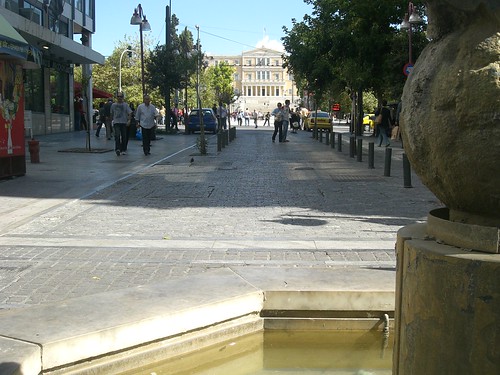
sintagma athens
(Sintagma Square in the distance)

I had arranged to meet up with my friend in the middle of Athens. Σύνταγμα - Sintagma (Constitution Square) - was teeming with people that day, even though it was a Sunday and all the commercial shops on Ermou St were closed. Despite the recent economic crisis, Athens looked like a city in love. The day was sunny, warm and breezy, perfect for a Sunday βόλτα (volta - stroll), which most of the town's residents were doing. Even the pigeons looked happy. People were taking photos of the parliamentary guards in their sentry boxes, the McDonalds on the corner was full of youthful faces enjoying their happy meals and a whole range of foreign languages could be heard all over the place, interrupted occasionally by the Greek language. I had some time to spare before the appointed meeting to search for what I could buy from around the area that could travel safely, not go off or become stale, stay intact without getting mushy in my backpack, and more importantly, resemble a nutritiously rich meal that could constitute a child's school meal.

plaka athens
(laidback atmosphere in Plaka)

The side streets of Sintagma Square leading to the Acropolis abound with mini-markets, cafes and παντοπολεία - pantopolia - literally a 'sell-everything' shop. In terms of edibles, the one I chanced on sold croissants, potato chips, sweets, sodas, fragile φρυγανιές (crumbly rusks that look like miniature toasts) as well as tinned goods. About the only healthy item in it was fruit, which was out of the question: bananas will go black with the merest touch, while the other all-time classic morning-break fruit, the apple, bruises easily, and may need peeling if you don't know what its pesticide content is.

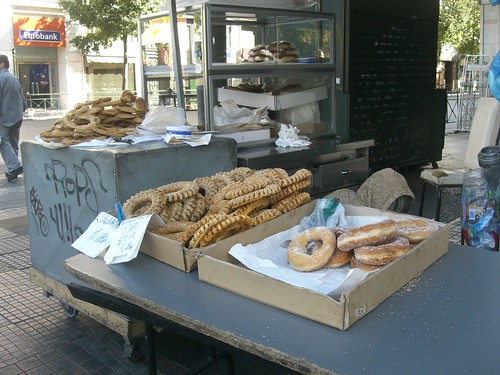
CIMG5026
(the bagel stand at Sintagma)

I was beginning to feel I had lost the battle for a healthy mid-morning school snack when I spotted a lady selling the classic Greek bagel - κουλούρι, koulouri - at a stand on the corner of the road on Μητροπόλεως (mitropoleos - Cathedral) and Φιλελλήνων (filelinon - Philhellenic) Streets. Bagels are quite durable; in any case, they don't lose their taste, nor do they become stale in 24 hours. A perfect choice; I bought two plain soft bagels, two hand-shaped hard ones and a tomato-and-feta filled soft bagel, ditching plans to buy the full range, which also included chocolate-filled ones. Koulouria are usually eaten on their own, but if you manage to avoid the temptation of munching into them on the street, they go great with a piece of cheese, a few olives and a glass of wine, which I didn't have handy on me at the time, the reason why I didn't deal with my own bagel choice (the filled one, naturally) till I got back to Hania.

Monday's school lunch wasn't tricky at all. The cafes in the area served luscious looking sandwiches and πίτες (pites - pies) of all types: cheese, sausage, sweet cream, spinach, hotdog, mince, you name it. My only caveat was that they would be subjected to all sorts of bruising, temperatures and humidity levels in my bag, so I decided not to buy anything from the road, except for my own lunch (before I was treated to a sumptuous dinner by my friend. I could easily buy my children something similar for their lunch from the airport cafeterias, which served this kind of food.

I had almost forgotten to have lunch that day (such a rare occurrence in my life), I was so excited, not just about meeting my friend, but because I had managed to achieve so much in one day. I had seen a few relatives in Aspropirgos (a dingy Western suburb in the Greater Athens area), walked through the neighbourhood I had lived in for two years before settling in Hania permanently (Egaleo, another neighbourhood of Western Athens), and enjoyed the luxury of the organised Athenian mass transportation system, via the suburban blue buses and the Athenian underground.

athens underground athens underground
(pottery shards and the ground layers found when the underground was being constructed)

It is a fact that Athens has not improved its dreary image since I was last living there, but that is simply not true about the means of transport: the underground in Athens is clean, modern, awesome, even beautiful. Walking into the underground world of Athens is like entering a museum full of ancient antiquities: in some parts of it, when the lighting is set in such a way that it highlights a particular monument on display in the foyers, you might even get the feeling that Hades is lurking somewhere in the twilight, ready to turn you into a pillar of salt if you dare to turn around and look, like he did to Eurydice when Orpheus wanted to check that Hades had kept his word about his lover's return. Most of the treasures found in the foundations of the underground during its construction were eventually turned into a museum display piece.

athens underground
(some of the Parthenon marbles Elgin didn't manage to steal, on display at the Acropolis metro station)

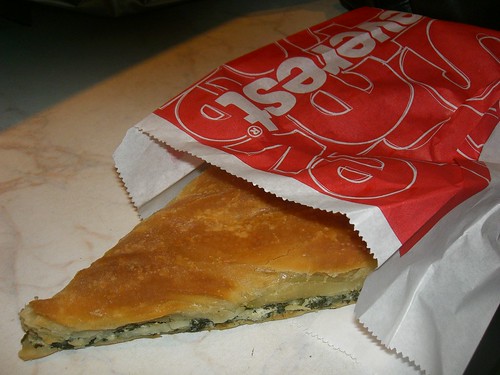
A long time had passed since I last went to see the Acropolis. Of course, the whole area has changed since I was last there, but my instinct led me in the right direction during my short interlude in the area. I got out of the metro at the Acropolis stop, located right next to the brand new Acropolis Museum, a strategic environmentally-friendly station, enabling people to have more efficient access to an important landmark, without the need to bring their own car to an already over-congested area (top marks to the town planners). The hot autumn sun made up my mind for me: the Acropolis also looks good at lower ground level, and I don't need to work up a sweat by walking up the hill to get to see it close up. (Believe me, I've been much closer to it than anyone can get to it in modern times.) It was at this point that I remembered I was feeling hungry and thirsty. Right across the Acropolis metro station were a few strategically positioned cafes and snack bars. Everest was located on a highly visible corner near a row of crafts and souvenir shops.

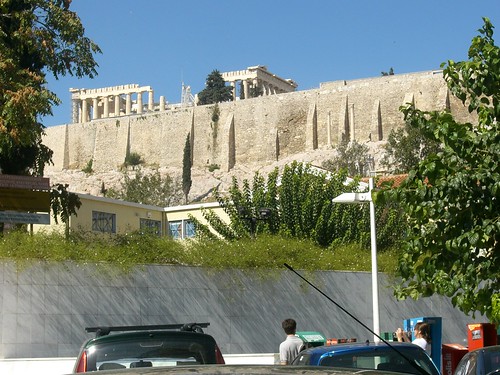
acropolis athens
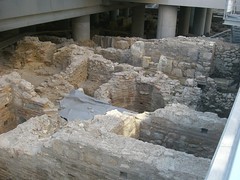
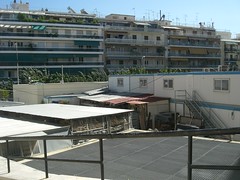
(above - the Acropolis of Athens; below - the foundations of the Acropolis museum among excavated ruins; a view of the apartment blocks facing the Acropolis - dingy as they look, they enjoy one of the most amazing views in the world )
acropolis museum acropolis museum

Everest is a chain store selling snack food and refreshments right throughout the country. Its food is prepared in the way most chain stores run; it is very centralised. At one of a few places in some industrial areas of the country (like Aspropirgos in Athens, where I overnighted with relatives before my Sunday adventure in the centre of Athens), people are busy preparing food in different ways for different businesses, most likely using processed ingredients: a fast-food chain may sell profiterole desserts in octagonal plastic tubs (like Everest), while another fast food chain might want chocolate mousse served in smooth round plastic bowls (like Goody's). Another chain may order spinach pie made with thick pastry (like Everest), while another chain may prefer to serve a spiral spinach pie made with thin filo pastry (like Gregory's). The food is prepared according to each customer's specifications, after which it is stored appropriately, and flown, trucked or shipped to the branches of these fast food outlets, be they close to the production plant or a remote island.

The advertising of each company may claim that their food is 'fresh', but this is all relative. A product that is stored under artificially controlled conditions to keep its appearance, shape and smell 'fresh' cannot be compared to the same product that was made and eaten on the same day in someone's kitchen, which will not be subjected to any kind of unnatural treatment in order to prevent it from spoilage. My Everest spanakopita cost me 1.95 euro and it was very satisfying; having said that, I must admit that I am a spanakopita fanatic, and it is usually the only thing I buy from a snack food outlet when I need to have a meal on the run. I ignore the ringing bells in my head sounding out warnings against fast food; we do this irregularly, and only when we need to. I even went into a McDonalds while I was at Sintagma; the coffee was OK, the toilets excellent.

Spanakopita was the kind of thing I had in mind for my children's school lunch. I decided to buy them each a piece of Everest spanakopita at the airport, another place where you can find 24/7 fast food chains en masse, each one claiming to serve you the healthiest food made with the freshest ingredients possible, served warm after a short zap in a microwave oven.

CIMG5060

When I arrived at Athens airport, I checked out each food outlet and wondered what kind of money people make in Athens in order to be able to afford to eat here: hot drinks cost well over 2 euro a cup, while sandwiches and pastry-encased cheese, spinach, sausage, chocolate or cream cost at least 3 euro a piece. A family of four with a delay between flights would need to spend at least 20 euro to eat here. In Hania, we spend about 40 euro for a modest but well-cooked fresh taverna family meal. I was in shock, and it was not just the cost of living that knocked me out: the Everest airport outlet was selling exactly the same spanakopita that I ate in central Athens for 3 euro and 30 cents at the airport; that's 1 euro and 35 cents more than in the other branch.

I was in two minds about what to do. In any case, there is an Everest outlet at Hania airport (which I was hoping would be open), so I decided to buy my children's meals when I arrived there instead, hoping also that I may find lower prices there. That way they would also be 'fresher'. I hopped off the aeroplane at 6.30am and walked through to the arrivals foyer. Everest was open there too: same spanakopita, same price as at Athens airport. It was too early in the morning to argue, but I've kept the receipts: one price at one outlet, a different one at another. Where I was born, we would call this a bloody rip-off. I bought two pieces of Everest spanakopita ("individually wrapped, thank you"), and took a cab, which, coincidentally, cost me twice as much as what it cost me in Athens to be driven the same number of kilometres. Where is the country heading to? I ask myself.

©All Rights Reserved/Organically cooked. No part of this blog may be reproduced and/or copied by any means without prior consent from Maria Verivaki.
Wednesday, 15 October 2008

Economic crisis? (Οικονομική κρίση;)

Today is the day the powers that be have designated as World Poverty Day. The images usually associated with poverty are hungry black children living in slums. With the recent economic crisis, poverty might take on a new meaning. Poverty in developing countries does not compare to poverty in developed countries. Let's not forget that poverty in developed countries partly has to do with how much debt an individual has accrued on a credit card (needs are satisfied without being paid for), while in developing countries, poverty has to do with not being able to acquire basic needs in the first place.

In developed countries, people don't have to spend a lot of money on food. They can fill their stomachs with hi-fat, hi-carb, low-nutrient-value food at a fraction of the cost people in developing countries pay for their food. Those same poor people are also the fattest people in the country. In terms of food shopping, poor people will buy cheap food. It is a sorry state of affairs that the cheapest food is also the least nutritious, and this trend is unlikely to cease. What do people do food-wise to economise? Eat cheap takeaways, for one, and buy ready food from discount supermarkets. I'm not an economist, so please forgive me if I get my facts wrong in this, but I don't think I'm deluded when I say that I believe the average Cretan family won't be doing this. Somewhere, some place, something is growing freely, cultivated by someone who is harvesting in excess, and giving it away to somebody who will somehow prepare it into a tasty edible that will be shared out among family members who may not have the time to cook. Of course, takeaways are also available, but if you have a plate of nutritious food placed before you, you won't even think about fast food.

The summer garden is now in recession, so there's a lull period in our harvest. If we were subsistence farmers (without a salaried or freelance career), we'd be having trouble finding food now. So many food bloggers have praised the merits of nettles: apparently, they reduce allergies, cleanse your blood, relieve pain, stop hair loss and bleeding, lower your blood pressure, aid in digestion and kill germs; it's about time I tried them myself. The nettles in our garden are prospering in the autumn climate, so they'll be making their way into my greens pies from now on until the spinach starts to grow.

Poverty levels in Greece are said to be the highest (along with Portugal) in the EU-15. This also correlates with low average salaries in these countries. These statements must be viewed in context: Greece always had a lower average salary than for other European countries, and this became more prevalent once the euro was introduced. The meaning of poverty may be a universal one, but it does not ring the same tone when it is used in different countries. Greeks don't live in mud-huts, for instance, no matter how poor they are. And the economy of Greece has never operated in the same way as the economy of the more developed countries of Europe.

For a start, Greek banks never lend money cheaply. If you borrow money in Greece, be prepared to pay it back with a huge interest rate. Cheap housing loans are very carefully monitored by the state; there are a number of pre-conditions that must be met before a cheap loan will be meted out to anyone, and it involves a huge amount of paperwork. People often take out loans to buy their first home, which usually means an apartment, or to build their first home, usually on land that their family already had in their possession, or at least owned freehold. This effectively means that a family who builds a new house will expect to be living in that house for a long time.

The second point is related to this last fact: in Greece, you do not buy (or build) a property with a short-term view to owning it. You do not play the buy-and-sell game with ancestral land. You just keep it, until a good opportunity arises to use it. If you do end up selling it, you were either in desperate need of cash, or the property did not get used in the way it was intended (eg to be lived in by a descendant), and maintaining it was more costly than getting rid of it.

Take a friend of mine, whose husband inherited a piece of land from his parents in an inner-city neighbourhood. The area is considered working class, but the value of the land as real estate is quite high, given its proximity to the main town. It is not a visually appealing neighbourhood, but this has nothing whatsoever to do with the value of the property. They took out a loan seven years ago and built a house. Then they took out a second loan and built another house on top of that house, "for the kids," a common practice in Greece, saving land and property for your offspring. They've been living there for the last seven years and their children are in their late teens: how likely is it that they are thinking of selling this house? Extremely unlikely, I think. This story is typical of many of my friends, colleagues and acquaintances. We belong to the same category, regardless of the area where we live, the money we earn, the cars we drive. Some of us simply have more money at our disposal, according to the work we are involved in. But land and housing remain a stable part of a person's life: you buy land to keep it or build on it, and once you own a house, you live in it for a long time.

Property loans seemed to cause the greatest damage in the recent US crisis, which had a domino effect on all the other countries affected. As for the sharemarket, this isn't what the average Cretan does with his/her money. If there's a lot of extra cash in someone's possession, they'll be using it to buy more land, or build more properties that they'll rent out until the family needs them for accommodation. The properties won't be sold off; they will be built to be kept in the family. The only exception is 'rural land', which is sold at 'ballooned' prices to foreign property investors - I think they'll be in trouble now (after the Greeks got their money).

What if they don't want to build or buy land? Then the money stays in the bank. The bank has loads of cash available for loans, so the bank doesn't have a cash flow problem. There's loads of money in Greek banks. Who are the greatest savers, by the way? The Albanians, according to a recent news report. They make and save money in exactly the same way that Greek migrants did when they were leaving Greece and going to places like Australia, New Zealand and Canada, which is why most of them ended up with their own properties in those countries too (Albanians are also property owners in Greece). The government only last week raised the guaranteed pay-out sum of a bank account, should a bank go bust, from 20,000 to 100,000 euro. Surely the government isn't kidding when they say that the Greek banking system is stable.

A lot of less knowledgeable Greeks doubted the validity of the government's promises, thanks to the dependence of Greek TV news (both state and private channels) on reporting the economic crisis in the rest of the world. The best place to keep your money is under your mattress, said one English economist. Your house will lose its value, said another. This kind of reporting caused many people to panic without reason. Greece just doesn't follow the rest of the world; they're always doing their own thing. You don't come to Greece to earn money or gain work experience, do you? You come to Greece to see the islands, get a good tan, and indulge yourself in high-quality nightlife. If Greece suffers, it's going to be next summer when the package tourists can't come because they can't afford it because their country is in recession after the recent economic crisis. If anything, this is going to give Greece a chance to catch up to the rest of the world (or that the rest of the world will lower their standards and come back to our earthly levels), but I doubt that this will mean that Greeks will start thinking the same way money-wise as the rest of the world. We're still going to keep our land and houses.

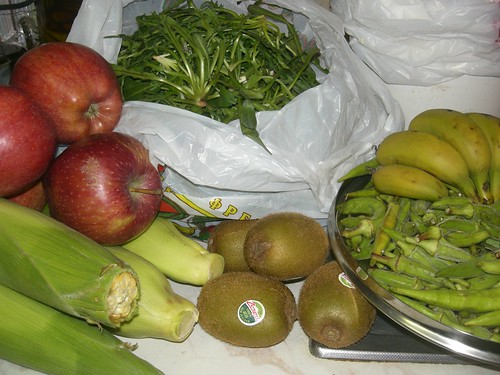
We relied heavily on our summer garden these past few months, something the average lawn-mowing, flower-growing Westerner doesn't (or, weather-wise, can't) do, another reason to need to buy cheap food, since they can't grow it themselves. Now that autumn has set in and the sun isn't always shining every day, there is a lull period in our harvest, a good thing, because I can now see the back of the fridge, I have to supplement our vegetable needs with bought produce. The economic crisis didn't stop me from spending 17 euro just last Monday to buy all these delicious vegetables: locally grown (not necessarily organic) okra and stamnagathi (no more vlita - amaranth - greens in the garden; they've all gone to seed in preparation for next summer), apples from the mainland, the last of the summer sweetcorn harvest, kiwifruit from New Zealand and some very sweet baby Cretan bananas grown in Iraklio (150km away). We may not earn much (my present employment situation could constitute a whole blog's worth of posts), but our food is still nutritious.

fresh produce october hania chania

And where did I find all these goodies? There are two greengrocers in the vicinity of my children's after-school activity groups. One sells mainly local produce, some of which is organic by default (eg wild greens picked from uncultivated hillside fields), while the other sells high quality fruit and vegetables imported from around the country. There is also an organic supplies shop (named after the goddess of the Earth, Gaia) located in between these two stores, and everything is within walking distance. If my children weren't involved in club activities, I wouldn't have bothered to shop from these stores, mainly because they are a little too far away from my house. I probably would have bought my extra needs from the local supermarket. Instead, I am now supporting small shops; my guess is most Greeks living in main centres still do this anyway.

stadium hania chania
(west: the tennis and chess clubs; east: another local produce shop; north: the local produce shop; south: the town centre, starting with our own form of Big Ben in the municipal gardens)
clock hania chania

But it's still easy to fall prey to those TV people, who've been forecasting doom and gloom for the past two weeks. On Saturday night, I asked my husband what he would like to have for lunch the next day.

"Let's go out," he suggested.

"Let's save our money," I replied; I had been sucked into the panic created by the media. I took out some goat meat from the deep freeze to make a tsigariasto meat stew and sliced some aubergines in preparation for eggplant pizza. It would have been so wasteful not to have used the garden produce after all, in these hard times.

©All Rights Reserved/Organically cooked. No part of this blog may be reproduced and/or copied by any means without prior consent from Maria Verivaki.

Tuesday, 14 October 2008

Zucchini flower spaghetti (Μακαρόνια με κολοκυθοανθούς)

I know what my son will be cooking when he is tall enough to stir a pot and use the gas cooker: plain boiled pasta. Most children love this meal in its plainest form. Pasta, at least in my 'fat' way of thinking, is an alternative to bread, which is why I never bring out bread on the table when we're eating pasta. Plain boiled pasta is one of the most uninviting dishes that I can think of. Spaghetti from a packet, tossed into a pot of boiling water, then drained onto a plate, resembling creamy white worms. My son's quite happy to eat pasta like that, without even a sprinkling of cheese on the dish. No oil, no sauce, no flavour (unless you can call plain boiled pasta a kind of flavour). I can't stand watching my children eat such an unappetising plate.

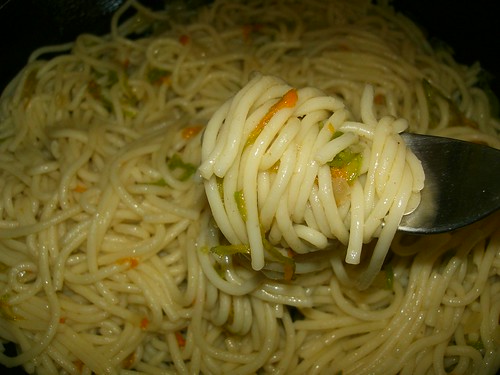
Before the children came home from school, I jazzed up the 'plain pasta' a little. I know my son's going to ask me "What are those orange things stuck on the spaghetti?" He'll probably have something to say about the bright green bits too, and the tiny white cubes. Eventually, he'll start poking his fork into it. He might pick off the coloured bits. I'll have to make an effort not to look at him while he's doing this. But I think he'll eat it in the end. The only thing I won't be telling him is that I added some flowers to his 'plain' pasta.

The seasonal nature of our cooking means that we often use the same ingredients in our daily meals until their growing season is over. This doesn't mean that we have to eat the same meal every day. We simply use the same substance over and over again, cooked in a different way. The pumpkin flower excess in my neighbour's garden is still g(r)owing strong. I pick nearly 20 flowers a day from the vine. This has led me to find ways of using those beauties more creatively. The recipes I have discovered could easily form another '101 ways to use..." book. So far, I've done the following with zucchini flowers:
My recipe sources are often from the internet these days. This is not necessarily the best or only source of information, but I would like to sing its praises; the internet has helped me to broaden my horizons, while living in a small non-English speaking island community. What would my English-language alternative media choices be in this small town if I didn't have the internet? I'd have to buy magazines and newspapers (from a limited range that offers well-known 'groan' titles like Women's Weekly and The Times), go to the second-hand bookshops in the town (we're lucky to have a couple run by English ladies), or order more books from Amazon (no try-before-you-buy browsing there). We do not have English language lending libraries; the best library in town is the children's library, which of course contains a specific range of books given its target audience. So here's to the internet, which came up with the following novel suggestions for different ways to use zucchini flowers:
which I've cooked today, a simple oil-and-garlic sauce with julienned zucca (pumpkin) flowers and a dash of red pepper. The aroma of the sauce cooking away is enough to intoxicate your senses. I've seen the same sauce served up with very thinly sliced green bell pepper instead of the zucca flowers, in case you can't find them, and it really is a very simple sauce to whip up quickly.

zucchini flower pasta

You need
:
half a wine glass of olive oil
1 large onion, finely chopped
3-5 cloves of garlic, finely chopped
12 large (or 18 small) zucchini flowers - if you can't get these, use very thinly sliced bell pepper slivers as an alternative
red pepper flakes (or ground red pepper)
1 courgette, grated (optional)
salt
250g fine spaghetti, boiled al dente

Heat the oil in a saucepan, and add the onion and garlic. Cook till translucent. Add the zucca flowers, and stir them in till just cooked. If you're using the zucchini as well, add this in at this point too. Season the sauce (I used ground red pepper to avoid 'picky eater syndrome'), and add the drained spaghetti into the saucepan, stirring around till the pasta is well oiled. Serve immediately; this dish can't wait!

This is my entry to Kalyn's Weekend Herb Blogging, hosted this week by Amy and Jonny from We Are Never Full.

©All Rights Reserved/Organically cooked. No part of this blog may be reproduced and/or copied by any means without prior consent from Maria Verivaki.
Saturday, 11 October 2008

Other people's food: Sicilian cauliflower pasta (Σικελιανή μακαρονάδα με κουνουπίδι)

We were recently treated to a meal so extravagantly different to the kind of food we usually cook. My neighbourhood does not seem very multicultural at first sight, but one of our neighbours is not actually Greek; she settled here with her Greek spouse, after leaving her native Italy. Eventually, her parents moved out here too, after leaving their native Sicily, although they moved to Rome at a young age. Susanna enjoys looking at our thriving garden while she herself is pottering about in her own. She reminds me of my own gardening interests before I moved out of my bachelor pad (some would say it was an old maid's house); she's into flower gardening, while we are pretty much vegetable gardeners. We often give her aubergines which she uses to make pasta alla Norma, her favorite summer pasta dish, and no wonder, given its Sicilian origins.


Sicilian food and culture is incredibly similar to Cretan food and culture. The Mediterranean diet, well known all over the world, was based on the diets of both these islands. Read what Diana Serbe has to say about Sicilian food and culture, and simply replace the words 'Sicily' and 'Italy' with Crete' and 'Greece': the statements will have exactly the same ring of truth about them:
"To have seen Italy without having seen Sicily, is not to have seen Italy at all" (Goethe). They came, they saw, they conquered: the Greeks, Romans, Arabs...When the Greeks saw the island of Sicily, they fell in love, sent their fleets, and set up colonies. The Romans saw what the Greeks had, fought them for it, and became the new conquerors. The Arabs saw what the Romans had, fought them for it, and put the island under their dominion...
Who would not fall in love with a country where even at night vegetables are "gleaming forth on the dark air, under the lamps." (D. H. Lawrence, Sea and Sardinia)? But what effect did such varied conquest have on Sicilian cooking? On the habits of the people? On the language?
Sicily is a large island of varied climate. There are subtropical areas growing prickly pears in abundance; every form of citrus is grown in Sicily - lemons, oranges, blood oranges... The quality of the vegetables gives a clue to the dishes of Sicily. Since their vegetables are of superior taste and quality, no Sicilian would defile them by creating complex dishes that mask the fresh flavor of their ingredients. Simplicity allows the pure taste of the vegetables to emerge. This is a key attitude to cooking, prevalent all over Sicily."
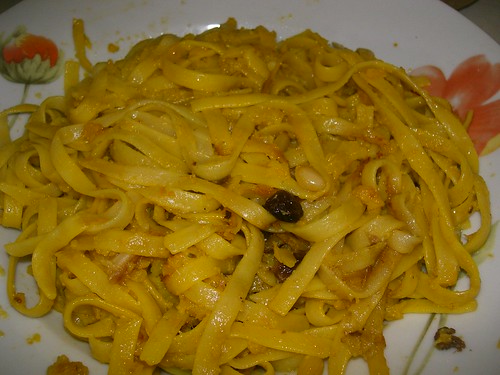
When we see each other from our own side of the fence, Susanna and I often talk about the food we cook with the garden produce. She recently asked us what all the new green plantlets are: broccoli, spinach, cabbage and cauliflower. Cauliflower, she tells me, is the main ingredient in her favorite winter pasta dish. She made some the other day and offered us a plate. The range of ingredients used in this pasta is really quite incredible. I would never have thought to combine these ingredients in one meal, and I would never have put it in my mind that such a dish could exist.

home made pasta rome anchovies cauliflower saffran raisins

I googled the ingredients she told us she used to make this pasta sauce, and sure enough, a number of Italian recipes came up using exactly the same ingredients that she herself used to make this exotic-looking dish: cauliflower, anchovies, saffron, pine nuts and raisins. And of course, like all good Italian cooks, she made the pasta herself.

©All Rights Reserved/Organically cooked. No part of this blog may be reproduced and/or copied by any means without prior consent from Maria Verivaki.

Wednesday, 8 October 2008

Little Crete (Μικρή Κρήτη)

The image of Athens that springs to mind in most people's heads is that of a tightly packed sprawling treeless city full of apartment blocks that bear a resemblance to the notion of inhabitable accommodation, with the pride and centrepiece being the Acropolis. The image is generally correct, but this did not resemble my first introduction to the city that the Scottish like to think compares to their very own Edinburgh (and why a sun-starved city like Edinburgh should, only the Scots can tell us - it's all Greek to me). As a Greek born abroad, I had very little idea what there was in Athens beyond the Parthenon. The leafy northern suburbs (like Kifissia) and the southern coastal suburbs (like Palio Faliro) were and still are unknown to me, despite having lived in Athens for nearly four years. I went to the wild west, into an area that remains relatively unknown to most of the tourists and locals alike; you don't go west of Athens unless you need to.

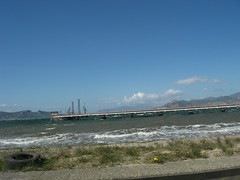
When I first arrived in Greece, my very first introduction to Athens was spent in an area that was very far removed from the images of the Athens that I thought I was coming to, a mental image acquired from the tourist brochures at the travel agencies, the travel books in the Wellington public library, and the postcards we were occasionally sent from our relatives. Everyone there lived in single story dwellings, there were quite a few parks and many open spaces surrounding the houses, and the Acropolis was regarded as one of the most useless rocky hills on a prime spot of land in central Athens. The area was close to the sea, hence the name given to the region: Παραλία Ασπροπύργου (Paralia Aspropirgou: the Aspropirgos coast).


Aspropirgos is located 17 kilometres west of the centre of Athens. Many members of my mother's family moved to this area from the village of Κάμποι (Kambi) in the 1960s, in search of work and better opportunities; generally speaking, they were aiming for a chance to improve their lives. In the poverty of the post-war era, with the demise of village and rural life, everyone was leaving the agricultural regions and moving into the urban environment. But in Paralia Aspropirgou, urbanisation never seemed to catch on at the rate that it had in the centre of Athens. The area only recently acquired footpaths and tarmac on the road, while the main form of grocery shopping is still the neighbourhood παντοπολείο (pantopolio). Everyone knows each other; they are often related to one another in some form, be it as a sibling, best man, godparent or the same village origins. Many people from Crete settled in this area, creating enclaves of Cretan communities, in the same way that immigrants to the New World did in America and Australasia.

My aunt was one of those 'migrants' who settled in Aspropirgos with her young family after her husband was 'excused' from his duties as a policeman (due to the curse of the bottle). There were many job opportunities available in the area, all within walking distance of the first dwellings in the area: makeshift roughshod container style houses, onto which rooms were added one by one, until they were big enough top house all the occupants. They usually contain two bedrooms, and resemble brick and mortar shacks. The area was classified as residential only recently; since then, pavements and tarmac were laid on the roads, which were also given street names. Eventually, Thia bought her own home, very similar to the one she rented when she first came out to the area. It still remains a simple house, although it has been modernised to the point where she has air conditioning in the summer and radiators in the winter. Her tiny garden contains an olive, a lemon and a walnut tree, all of which she planted herself.

paralia aspropirgou
(the footpath, tarmac and street names are relatively recent additions to Paralia Aspropirgou)

"When we moved up with Leonidas-God-rest-his-soul, I realised that we would never move back down to Crete. Because of the jobs. Because we had no work there. It was very tiring travelling to Crete and back during the olive season, so I sold the olive grove I had been given as part of my dowry. What use was it to us? We had jobs here, and our lives were based here. I bought my own home with the money from the sale, and helped my daughters into theirs."

So what kind of jobs did everyone do around here? Factories. Hundreds of factories. Light industry, heavy industry, shipbuilding yards, gas works, electricity plants, metal works, oil refineries, cement works. The different suburbs of Paralia Aspropirgou weren't named after a church, in the classical Greek manner; they were all named after the works close to it.

Ask a cabbie to go west of Athens beyond Egaleo and watch the reaction on his face.
"Where ya goin' to, kiria mou?" asked the taxi driver.
"Paralia Aspropirgou," I replied. His face scrunched up; Paralia Aspropirgou isn't the most popular destination for cab drivers - there's no guarantee of a return fare. It's like World's End, the point of no return.
"Know ya way round there?" he looked at me suspiciously.
"Sort of, you can drop me off at Halips."

halips paralia aspropirgou athens
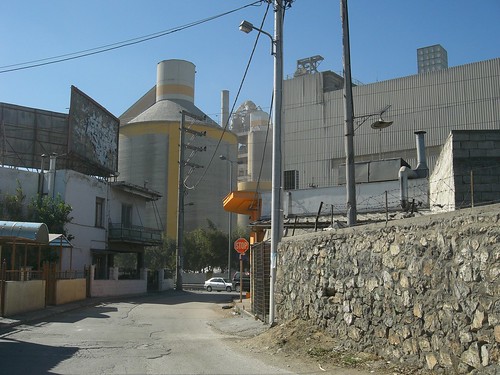
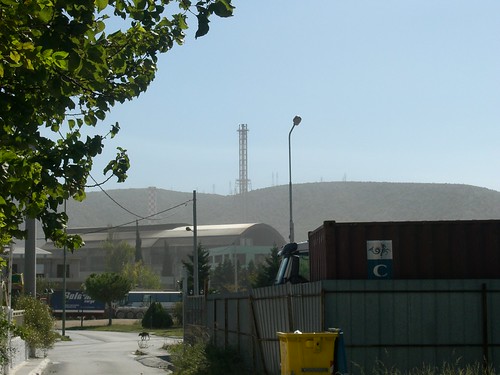
(Halips factory, as seen from the entrance to the suburb of Paralia Aspropirgou)

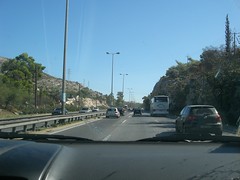
Halips (ΧΑΛΥΨ) is the now defunct cement works across the road from what looks like a narrow insignificant side street on one of the filthiest motorways in Europe, the very road that one must take to go from central Athens to Corinth. Looking at it from the motorway, it is difficult to imagine that there is sense of home and hearth behind the putrid dust storms that Halips left behind well after it closed down. Not a single house can be seen from the main road, only industrial plants. It looks like Hell, a wasteland of metal, concrete and glass, right next to the coast, a site probably chosen for the ease with which waste could be dumped without anyone needing to find out (toxicity tests started being conducted well after the environmental damage had turned the area into Athens' biggest sewer). Nothing shines here on the main road. If you saw the metal works in the Lord of the Rings films, you can conjure up the right picture in your mind. The windows are permanently covered with a thick film of dust, which doesn't get thicker because it is so dry, nothing can stick onto it any longer. It blows around continuously, entering the houses, settling on the ground, piling up in corners.

nafpiyia aspropirgou athens nafpiyia aspropirgou athens
(when you don't have a choice, you may indeed decide to go for a dip here; don't worry about the mass of ships ramming into you - this is a ship cemetery, they're not going anywhere)

On my first night there, I woke up in the middle of the night feeling somewhat disoriented, as is common when you stay in an unfamiliar place for the first time. From the window of the kitchen-cum-dining room where I slept, I saw a fire that seemed to be burning on the top of a chimney. I startled my aunt.

"Thia, wake up! Something's burning!" I pointed to the window. She turned to look at me, with a surprised look on her face, then looked back out the window without saying anything.

"What's that fire there?" I realised that she had seen this flame before.

oil refinery paralia aspropirgou athens
(look closely; you'll see the Olympic flame, too)

"Oh, that's the Olympic flame," she replied, and returned to her bed. "Διυλιστήρια (thilistiria - oil refineries)," she added. "Nothing to worry about." I think it should have been called δηλητήρια - dilitiria; poison.

I received a few more shocks over the next few days of living in Paralia Aspropirgou. One of the most shocking for me was that nobody could direct me as to how to get to Athens. No one knew how to go to the Acropolis. I finally found out from someone who had been living in Paralia Aspropirgou for a long time, and worked in Athens.

halips paralia aspropirgou athens
(the original Halips bus stop was at the point where the iconostasis is now; don't kid yourself about why the bus stop was moved a few metres away just below the recently built overpass )

"Cross the road and stand outside Halips. All the blue and white buses that pass this road terminate in central Athens (except one which clearly says PIREAS on its ticker tape). Buy your ticket at a kiosk before you board the bus and validate it once you get on. On a Sunday, getting into Athens takes a quarter of an hour from here, since there's less traffic."

It sounded surprisingly easy. "Why couldn't anyone else have given me this information?" I asked her.

"Oh, don't ask anyone anything here. They don't know, really they don't know anything. In any case, they do their shopping in Elefsina, which is only a few kilometres from Aspropirgos. It's much more convenient than entering central Athens. They'll just get lost, believe me, they'll never be able to return home if you let them loose there."

part of iera odos athens iera odos athens
(various views of Iera Odos; heading westwards, once you pass the signpost for the old monastery, the road loses its tree-lined scenery and takes on a deserted ghostly appearance)
iera odos athens iera odos athens

Elefsina, 5 kilometres westwards of Aspropirgos, is where the site of the ancient sacred mysteries perfomed in the goddess Demeter's honour are located. The site was highly significant in the ancient world, with members of her sect being sworn to secrecy about the ceremonies held there. The road from Eleusis (as it was then called) to Athens was known as Ιερά Οδός (Iera Odos), the Holy Road. It is still bears that name - Iera Odos offers some of the most pleasurable shopping opportunities in Western Athens - one big long stretch of road with few turns and bends, leading straight to the Parthenon, although this will not be so obvious any longer, what with the reshaping of the city of Athens once the urban sprawl began to spread out of control. There was a time when the Acropolis could be seen right along Iera Odos, although this has changed too, since the construction of tall buildings, obscuring the view of the hill where the Parthenon stands. My father remembers seeing it as he walked to work at the Pitsos appliance factory in Egaleo. It is more visible once you pass the site of the Agricultural University of Athens, which coincidentally is located in the most polluted area of the city, the western suburbs.

*** *** ***

So what did Little Crete have to offer in terms of edibles? I recently overnighted at my aunt's house, before meeting up with a friend who I had never met before in my life.

paralia aspropirgou CIMG4944
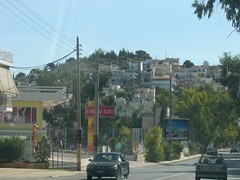
(typical views in the area of Paralia Aspropirgou)

"So what brings you to Athens, dear?" asked my aunt.
"I'm going to meet up with a friend who I've never met before," I answered.
"Oh.. well.. you know what you're doing, you always did." We left it at that.
"Are you hungry?" she asked me. I had left my own home in Hania at 7pm, and it was now half an hour before midnight.
"No, not really, Thia."
"I've got some leftover rabbit from today's lunch," she tempted me, an offer I couldn't really refuse. "I've cooked it with pasta, and there's just one more serving of it."

rabbit and spaghetti

Thia comes once or twice a year to Hania and stays with her brothers. When she returns to Athens, she takes whatever she can in terms of fresh produce back with her. Cretan products are not always difficult to source in Elefsina - her main shopping area - but they are not always available when she does her weekly shop. Her brothers give her freshly slaughtered rabbits and chickens, farm fresh eggs, potatoes and whatever is in the garden at the time of her visit. There are also some Cretan supplies stores in Elefsina. A very small laiki street market runs weekly in the area, mainly used by old people and those that do not own a car. Most people drive to the large well-stocked supermarkets in Elefsina to do their shopping.

"I almost forgot, Thia, I bought you some aubergines and peppers." She was most thankful; we discussed different recipes I cook to use up the eggplant surplus in our garden.

It was time to go to bed. Thia doesn't usually stay up so late. She did it for me. As it was a warm night, we left the window open in the bedroom. It was eerily quiet in the neighbourhood, save for a humming sound. This sound did not stop, in the same way that the Olympic flame never blows out in the Aspropirgos refineries. It was the sound of the humming machinery that was working 24/7 in the surrounding area, a slow buzz that did not so much interrupt the silence, as much as pervade the air. Every other sound was like an over-write on the silent humming, like the lyrics to the refrain of muzak playing in a supermarket, an artifical world where nothing seems to change. Paralia Aspropirgos had not changed much at all, despite my first visit to the area being seventeen years ago.

In the morning, Thia insisted that I have breakfast with her. She brought out some φρυγανιές (friganies - dry toast squares), feta cheese made in Hania by a local cheesemaker ("ask your uncles where they buy it from," she informed me), and a bowl of cured olives from the olive tree on her property, served with a cup of hot τούρκικο (tourkiko - Greek coffee, named after its origins).

cretan breakfast in athens

"Do you like it here, Thia?" What a question; she's been living here over thirty years.

"Of course, I do, dear, it's much better to be living in a little shabby house that I can call my own, rather than the best apartment in central Athens. If I didn't live here, I'd have gone back to Crete. I could never live in a box. And it really isn't that bad here; I know everybody and we all look out for each other. At night, all the lights from the factories sparkle like a Christmas tree. It's really quite beautiful."

If you could just keep your eyes away from the main road, Paralia Aspropirgos doesn't seem such a bad solution to the Greek housing and employment problem.

©All Rights Reserved/Organically cooked. No part of this blog may be reproduced and/or copied by any means without prior consent from Maria Verivaki.

Monday, 6 October 2008

Poor man's fruit (Το φρούτο του φτωχού)

Bread and water - basic food: "Plain fare gives as much pleasure as a costly diet, while bread and water confer the highest possible pleasure when they are brought to hungry lips." Epicurus (341?-270 BC). Thankfully, in Crete, by the early 19th century, most people could add something more substantial to this simple fare: olive oil.

In the good old days when all Cretans ate a Mediterranean diet based on seasonal availability, and poverty reigned, meaning that everyone had to at least source their food in some way to keep themselves fed in order to survive (as well as doing a heap of other chores), when someone did not want to eat the main meal that a Cretan mama had cooked for her (usually much larger than the current average of less than 1.5 children per) family, they ate psomi me ladi, bread dipped in oil, the meal of choice for the poorest farming communities - and only if there was enough bread in the house. My husband's grandmother had told him of times when her children (including his father) 'stole' a slice of the bread she had cooked for that day, and she would chase after them to get it back if she could, so that she could offer it to accompany lunch or dinner. (The children would clamber up trees to escape their mother's wrath.)

Despite its humble looks and origins, psomi me ladi sustained the Greek people for many years. The famine that killed thousands in Athens during WWII did not affect the Cretans in the same way. In the capital city of Athens, people had no access to bread and oil. They had money, but could not buy anything with it because there was no food available during the Nazi occupation. This was not exactly the case in Crete. I remember my father saying that bread and oil were always available in his village, since most people produced their own oil and as long as the Germans weren't taking their livestock, they could trade some chickens and eggs for flour. If they got hungry, it's because there wasn't enough food to go round because the families were large. In his case, his father had been killed on the first day of the Battle of Crete, and his mother had a hard time scraping up enough food for her five children.

My late father-in-law came from a family of ten children. If he were alive today, here's what he would probably be telling his grandchildren about dinner time in his home in Fournes:

"I was brought up in a family with ten children. At that dining-table at home one lax moment and half my dinner could be gone to my neighbour. I learned to eat quickly while defending my plate with a protective arm." (Small Island by Andrea Levy)

But even Gilbert
becomes a fussy eater when he is confronted with tasteless food:
"But with this English food I sat back, chewed slowly and will ed my compatriots to thieve. I had not yet seen a war zone but if the enemy had been frying up some fish and dumpling, who knows which way I would point my gun?"
(Small Island by Andrea Levy)

They may not always have had shoes to wear, they may not have had pencils and paper to go to school with (my mother had a piece of broken slate and chalk), but they always had something to eat that would give them energy. If they had psomi me ladi, they had the energy needed to work in the fields, under the hot sun, dig up the soil, plant trees, and gather crops. Fruit and vegetables were always available according to the season, but that's not what kept people active:

"No one carried a pound of superfluous flesh, in spite of the vast quantities of starchy food. They expended every ounce they ate in work... Vegetables and fruit were eaten because they were good for you, but it was the bread, potatoes, meat and floury puddings which staved off exhaustion." (The Thorn Birds by Colleen McCullough)

My mother's village, located at the foothills of the high peaks of Lefka Ori, could only grow crops that didn't require irrigation. Tomatoes were grown without ever being watered, save one single time when they were planted. These tomatoes grew right throughout the summer. At the end of their growing period, they were cut in bunches and hung onto the rafters of the roof in the stone cottages. These tomatoes just as they were, slightly shriveling but not drying completely, right throughout the winter. The villagers were never without tomatoes all year round, despite not having refrigerators. They had one more ingredient to add to their basic bread and oil.

My green-finger uncles insist that this method of preserving tomatoes has ceased to exist; times have changed, there is more pollution in the soil, air and water, and plants are not grown in the way they traditionally were grown, using only natural fertilisation and no chemical additives. Not only do tomatos not keep well using this system; in Crete, they no longer grow without irrigation.

tomato sauce and sourdough breadtomato bread olive oil

I still tell my fussy eaters that they can have some bread and oil if they don't want to eat what I've cooked. For example, today, we're having fish soup, not a popular choice with everyone. If they want something else, they'll have to learn to cook it themselves, which the children still can't do because they are too short to reach the cooker. Although their father is taller than me, which means he can reach the cooker easily, when it's his turn to cook, this is in fact what he makes for the children: a slab of slightly toasted sourdough bread, coated in oil and freshly grated tomato. (I know what my son will be cooking when he is tall enough to stir a pot and use the gas cooker: plain boiled pasta. )

september harvest
(late September harvest)

Psomi me ladi
can be dressed up with that most humble-looking red fruit, a basic food item for many Cretans: freshly grated tomato. Here's a slightly sharp-tasting sauce that combines tomato and olive oil with some herbs and spices, to make a great dip for thickly sliced sourdough bread.

tomato dip

1 large tomato, grated
1-2 cloves of garlic, according to taste
olive oil
salt
oregano seasoning
Drain the grated tomato of its excess liquids. Add the salt to the grated tomato, and let stand in a fine sieve until more liquids drain away. Chop the garlic finely and add this with the oregano to the strained tomato in a small wide bowl. Drizzle some olive oil over the tomato. Use this dip with slices of fresh sourdough bread (optionally toasted), as a snack or a light meal, accompanied by some cheese. Heaven...

This is my entry for Kalyn's Weekend Herb Blogging, hosted this week by Susan from The Well Seasoned Cook.

©All Rights Reserved/Organically cooked. No part of this blog may be reproduced and/or copied by any means without prior consent from Maria Verivaki.

Thursday, 2 October 2008

Pitahaya (Πιταχάγια)

Amongst the kinky imported fresh produce that makes it to the supermarkets in Crete, I spotted something that I'd never seen or heard of before. I have seen papaya, tamarillo, passionfruit, pineapple, lime, starfruit, and all sorts of other weird and wonderful crops, all carefully packed in boxes, specially made for the kind of fruit packed in them, with hollowed pockets to fit each one individually, all beautifully presented in uniform size. But I'd never before seen a bright pink fruit with tinges of neon green thorn-like protusions. It was Monday morning, the start of a new week; I decided to give it a try.

pitahaya

"What's this?" I asked the assistant at the fresh produce counter.

"Ahhh...," she started, looking closely at the label, "pi-ta-HA-ya."

"And what is it?" I asked, in full knowledge that it was a pointless question.

"I don't know," laughed the shop assistant.

"I'll let you know," I laughed back.

One euro and ninety-seven cents later, I took my pitahaya home. I wanted to find out what was inside this fluorescent creation of nature. But what do you do with a pitahaya? Do you cut it lengthways or widthways, do you peel it, what do you do with it? Before mutilating it, I decided to look it up on the internet)which I knew would spoil the surprise for me, as it would have photos of its interior).

pitahaya

Sure enough, it told me what to expect of a pitahaya and how to deal with it. As soon as I sliced it open lengthways - the outer inedible layer was as soft as a banana peel - the fruit seemed to peel away on its own. I smelt it - nothing. Maybe they have a special aroma when they are eaten fresh in the country they are grown... maybe.

It looked like an albino kiwifruit. It tasted rather bland. I stuck it in the fridge, thinking that maybe it will take on a different taste (like cactus figs) once they have been refrigerated. An hour later, I starting scooping it out with a spoon. Still no taste though; a little like low-quality vanilla ice-cream.

Oh well, I had my fun.

©All Rights Reserved/Organically cooked. No part of this blog may be reproduced and/or copied by any means without prior consent from Maria Verivaki.