Thursday, 15 May 2008

Courgette flower boureki (Κολοκυθοανθούς μπουρέκι)

We've been harvesting about three zucchini flowers a day from our summer garden. The traditional way to cook zucchini flowers in Crete is to stuff them with the same filling for vine leaves; delicious, yes, but we ate that last week. Zucchini flowers do keep in the fridge, but if you are collecting them daily from a small garden, the first to be collected will need to be used by the end of the week. I've collected 11 since Saturday, including today's.

Zucchini flowers are very often used fried in Italian recipes, either as they are (empty), dredged in batter and fried, or stuffed. Here's another filling that originates from Italy, although I've changed it a little to include local ingredients, which may sound rather boring; you're all probably thinking there she goes again using whatever she finds growing locally. In our house, we don't actually use just local produce; where would we be without our coffee, or soy sauce for our stir-fries? I even bought some cheddar cheese the other day, not to substitute Cretan graviera, but because I like it.

I also like to think that through my use of local products, I am eating more organic food. When you forage ingredients, they are less likely to be contaminated. When you live in a fertile village where most people produce a significant proportion of the fresh produce they use in their own garden or fields, it is more likely to be produced organically than with large doses of chemicals. This is why I make the effort to cook our own (or relatives’) produce.

As a masters graduate working with both biogenetics and sustainable agriculture students, I don’t actually trust BIO labeled goods in Hania unless they come from one source: GAIA. This is because GAIA does regular checks on all the produce they sell, and they have presented themselves with a no-nonsense approach to bio-organic produce. I don’t even trust the laiki produce at all – how on earth are eggplant and zucchini so HUGE and BLEMISH-FREE in the middle of winter!?! And as for supermarket produce labeled BIO, that’s a load of nonsense, since there are only 3 designated BIO labels in Greece from which all organic produce MUST pass – if they don’t carry that label (supermarket BIO-labelled produce don’t always carry it), then I don’t trust it.

Because of my work environment (I’m an English teacher at the Mediterranean Agronomic Institute of Chania), I take the organic business quite seriously. We have a garden full of produce every year – it’s only natural I take a healthy interest in it. Whenever I can, I cook organic. When it’s not possible, I don’t. I’m sure most informed people are like me (notice I don’t say educated). We are all being more and more informed about this serious issue, and it’s not as though we haven’t been given clear warnings: mad cow disease, bird flu, and the latest - imported sunflower oil tainted with lubricant, of all things.

"Marketing Trends for Organic Food in the 21st Century" (edited by George Baourakis) contains a number of articles discussing various issues concerning organically produced food. The key factor involved in preferring organic food is basically food safety. Consumers are more likely driven by factors such as food safety, healthy eating, sensory factors, environmental concerns and animal welfare as O'Reilly and colleagues note in Ireland about organic food consumers. What usually stops us from eating more organically is price and availability, as Eves and colleagues point out. Arvanitoyannis and Krystallis found through a survey that the people MOST likely to buy organic produce are women (NOT men), young (ie more educated) people, those who can afford it, and ESPECIALLY people with families. I think I belong to all those categories.

Last, but not least, comes the saddest reason why I would like to try to eat my local food if I believe it's healthier: both my mother and father died of cancer. Since no one has actually found a way to prevent it from ever occurring in one's life, I would like to try at least to eat a decent meal and not invite cancer into my own life, even though I obviously carry a heavy weight on my shoulders and have already borne two children who have inherited my medical history.

Gordon Ramsay also thinks it's a pretty good idea to use only local produce in his UK haute cuisine eateries (thereby saving the environment from excess CO2 emissions), so I'm just waiting for the invitation to rustle up a recipe or two for his restaurants using only local UK products. It should be a marvelous way to use up the nettles growing in his garden...

This recipe reminds me very much of Cretan boureki pie. The same ingredients are used, and they're basically all locally grown. Some people are simply not prepared to eat only local produce, which is their prerogative; they are privileged to have a choice, as all knowledgeable people know. I still commend Gordon for making a point of eating locally (it's miles better for you, if you get what I mean). If everyone were given a chance to discover what locally grown products are edible and a few ideas on how to prepare and cook them, I'm sure people would start eating more of them. Here's what one person said about using more UK local produce:

"Since signing up for a weekly organic fruit and vegetable box last year, I've had the pleasure of enjoying seasonal food. I've been introduced to some unfamiliar items (celeriac, kohl rabi, globe artichoke) and learnt to cook them, thanks to advice on the supplier's website. I've found new recipes for familiar items like beetroot and carrots and eaten better than ever before. To my surprise, I've really enjoyed the switch to varied, seasonal veg and recommend it highly..."

Admittedly, this was not the general opinion of the forum. It was more like: "I'll eat what I want, when I want." We all have this right, even if it is only in theory for many people of the world. Poor Gordon - he probably meant something like: "By all means, eat what you like, but at least try to include more local produce rather than imported foodstuff." Sometimes, it's better to stuff your mouth with food than open it to speak...

To fill a dozen zucchini flowers, you need:
1 large potato, boiled and mashed
1 medium courgette, scalded in hot water and grated finely
2 large tablespoons of mizithra cheese (ricotta to the uninitiated) (the recipe stated parmesan reggiano and grana padano - even if they can be bought in my local supermarket, they'd be mass-produced and low quality)
1 teaspoon of semolina
2 tablespoons of olive oil
a small sprig of parsley finely chopped
1 salt, pepper and oregano (the original recipe states marjoram, which I simply didn't have at the time)
1 clove of garlic
Preheat the oven to 200 degrees Celsius. Mix all the ingredients together thoroughly to make the filling. Stuff the flowers and close them. Don't worry about their opening - the pointed parts of the flower ends stick together. Take care not to tear the flowers, so that the filling does not spill out. (I found that the starch from the potato helped to keep them intact, even if they did break open.) Fry the flowers in boiling oil, drain them, put them in a baking dish and cook them for 10 minutes before serving. This last step can be performed before you are ready to serve them.

Serve them with a fresh green salad and feta cheese. Unused filling can be formed into patties or used to fill blanched tomato shells; both of these can be cooked in the oven rather than fried.

This is my entry to this week's Weekend Herb Blogging, hosted by a scientist in the kitchen.

MORE ZUCCHINI FLOWERS:
Picking courgette flowers
Dolmadakia
Spiral pie

Sunday, 11 May 2008

The great New Zealand pavlova (Παβλόβα – γλύκισμα της Νέας Ζηλανδίας)

I’ve just made my fourth batch of Greek Easter cookies – koulourakia. They’re a great breakfast food dunked in the morning cup of milk or coffee, and a great stomach filler in between meals. I’ve been making good use of those bright yellow free-range yolks we’ve been given by chicken-raising friends and neighbours. Yesterday, I used five of them, so I’ve got five egg whites lying in a bowl in my fridge. All good New Zealanders know what to do with egg white leftovers: make a pavlova. More likely, kiwis need to know what to do with leftover egg yolks; pavlovas have been made in New Zealand since at least 1929, before electric hand-mixers were even invented.

Pavlova, a meringue dessert covered in whipped cream and fresh fruit, was invented in New Zealand and named after a Russian ballerina of the same name who had visited the country, although some people would prefer to say that the Australians invented it. The earliest Australian recipe for it is dated 1935. Pav (as kiwis usually call it) is usually decorated with strawberry and kiwifruit, which does seem to hint more clearly to its origins. I can only go by what we were told at school and through the media while I was living in Aotearoa, which sent out clear messages that it was of Kiwi origin, in similar ways to what the Greeks have to do to make it clear to the whole world that Macedonia is Greek and not Fyromese. Wherever it came from, it’s a great desert.

In my hopes to find an original pavlova recipe, something my mum always made for every party we held at our house in our big wooden house in Mt Victoria, I consulted two of the very few NZ cookbooks I have in my Cretan kitchen. One of the books is almost as old as myself. As I browsed through the yellow pages of the NZ Women’s Weekly Cookbook, I wondered what on earth made me carry this book to the other side of the earth when I left my birth country. I suppose it was the fact that it had the words ‘New Zealand’ on the cover. I didn’t need much else to convince me to bring it over. My other NZ cookbook is the famous Edmonds Sure to Rise Cookery Book, every kiwi’s first cookbook, every flatter’s (someone sharing an apartment with other people) saviour, the source every Aotearoan consults for how to make banana cake, the book I still scour for New Zealandisms like pikelets and whitebait fritters.

Both cookbooks contain exactly the same recipe for pavlova, which is given below. Ivy recently made a pavlova using lemon juice, something a kiwi would never do. A teaspoon of vinegar is added to remove an over-eggy smell, while a tablespoon of cornflour is added to give the meringue a smoother appearance. I also have my mother’s old notebook in her own handwriting. Even though she never cooked New Zealand dishes, she was never one to say no to a good dessert; the great New Zealand pav is in her recipe book. She Greekified it a little – Greeks cannot make a cake to feed 8 people with only 3 egg whites; she doubled the recipe. Delia says that it’s very hard to make a pavlova without the correct recipe, so I find it hard to believe that she actually made a good pavlova, since she doesn’t have the right recipe at all. I especially like to make pavlova for Waitangi Day, a day of mixed feelings in Aotearoa. On the one hand, it represents the day New Zealand was ‘invented’, without taking into account when Aotearoa was born; on the other hand, it’s my parents’ wedding anniversary, when they were married in the Greek Orthodox Church of Wellington. And I can quietly eat the leftovers the next day on my birthday.

You need:
5 egg whites
3 tablespoons of cold water
1 ¼ cup of sugar
¼ teaspoon of salt

1 heaped tablespoon of cornflour
1 teaspoon of vanilla essence
1 teaspoon of vinegar
Whisk the egg whites till stiff. Add the water and beat again. Add the sugar one tablespoon at a time, beating after each addition until the meringue is thick and glossy. Fold in salt, cornflour, vinegar and vanilla essence. Dollop the meringue into an 8-inch, preferably springform, tin (I used a
tin with a removable bottom – another New Zealand remnant form my mother’s cupboards) that is lined with baking paper (which has also been greased with butter or oil). Shake it a little to make it settle evenly into the tin and bake in a slow moderate oven (150 degrees Celsius) for 30 minutes. Then lower the temperature to 135 degrees Celsius, and keep cooking for another 30 minutes. Turn off the oven and leave the pavlova in it overnight to cool. Make sure it’s far away from draughts, otherwise the meringue will melt and the crusty effect will be ruined.

When it has cooled down completely, peel away the papers and turn onto a plate dusted with icing sugar. If the bottom paper doesn’t come away easily, leave it, and remove the dessert from it as you slice it. Decorate the pavlova with whipped cream and sliced seasonal fruit, the most common being kiwifruit and strawberries. I decorated mine with strawberries from Crete and kiwifruit from Macedonia. Greeks took a long, long time to start producing good kiwifruit; they had to learn NOT to let the fruit ripen.

Pavlova needs to be cooked in the evening – a time when you are not going to use the oven for anything else afterwards – and allowed to dry out in the oven overnight. When cooked, it should have a thick crusty beige colour, with a soft lily white centre. It may sink a little after cooking, but this doesn’t matter so much, since it’s going to be covered in whipped cream. Neither does it matter if the crust breaks; the cream will help it to adhere to the meringue. My mother used to shape it into a ball so that when it sunk, it wouldn’t distort the shape of the cake. It keeps for up to a week (outside the fridge in an airtight container; in New Zealand, we had a special pavlova cake tray – now long gone – to keep it in); add the cream and fruit as nearest to the hour as when you are going to serve it – keep it in the fridge till then.

This post is dedicated to Will and Bella Parker, ex-patriate New Zealanders who were travelling with a group of other kiwis visiting my beautiful town just the other day. I noticed something very New Zealandish about the tour group’s T-shirts. They were all wearing name tags. I caught the name on one of them: Ngaire, a beautiful Aotearoan name. If I had another daughter, I'd name her Elina (the Greek word for flax linen is λινό, lino), just so I can call her Ngaire. There was no mistaking that group for anything other than kiwis, so I said hello. They all stopped and greeted me, tiki and koru gleaming emerald green round their necks: “What are you doing here?” they asked me, a funny thing to ask a Greek, most would think. Kiwi accents stay with you forever. “I should be asking you that question!” I replied, and we all laughed together. I bumped into them when their coach pulled up outside the Agora; I’ve already told you before, you never know who you might bump into there.

©All Rights Reserved/Organically cooked. No part of this blog may be reproduced and/or copied by any means without prior consent from Maria Verivaki.

MORE KIWIANA:
Afghans
Apple cake
Banana cake
Corn fritters
Gingernuts
Potato fritters
MEDITERRANEAN KIWI

Saturday, 10 May 2008

Frappe and instant coffee (Φραππέ και νεσκαφέ)

... (the beginning of the story can be found at the Hania daily photo site)

“Would you like a frappe, Maria?” she asked me. I told her that I never drink frappe coffee, even though I’ve been in Greece long enough to know that everyone drinks frappe and nothing else. At work, when I ask for a instant cup of hot coffee, they ask me how I can drink the stuff in the heat. I would dearly love to ask them which heat they are talking about, since all the rooms are air-conditioned, and you need a shawl to cover your back so you don't get a chill. I don't know what it is with Greeks and those cold frothy coffees they serve here, which all tourists find a novelty when they first come here and order them at the old harbour. A friend of mine once told me that the coffee grounds used to make it contain Greek olive oil-based soap, which is what creates the froth (soap suds?!?), but I'm wondering if that's just a way to advertise their product: "Drink frappe: the cleanest coffee in the world." I wonder if tourists would still drink it if they realised just how much coffee is used to make one frappe: nearly one tablespoon! Don't they wonder why their nerves are jittery afterwards? Do they know that it could bore holes through their intestines?

... (the end of the story can be found at the Hania daily photo site)

A whole coffee-table book has been dedicated to the making of this unique, utterly Greek-born, elixir, which has caught on all over the Balkans (and beyond). To make cold frothy frappe coffee, you need:
a large teaspoon of granular instant coffee
1-2 teaspoons of sugar
a shaker
a large glass
a straw
ice cubes
refrigerated water
milk (optional)
Measure the coffee and sugar into a shaker, and a little bit of the refrigerated water - about three tablespoons. Close the shaker, and shake the mixture about until the coffee becomes frothy and hardly any runny liquid is left in the shaker. Pour this froth into a glass and add some ice cubes to reach the top of the glass. Add as much cold water (and milk) needed to top up the glass. Stick a straw into it.

Enjoy this coffee while sitting on a balcony overlooking the sea, having cancelled all your morning's appointments. If you're having it at a cafe, sip on it slowly - it's meant to last you at least an hour. Don't do what I did when I first came to Greece - I drank it in the same way that I enjoy a cup of hot coffee, prompting my cousin to say: "Hey, slow down! If you drink frappe so quickly, what are you going to do for the rest of the time that we're sitting in the cafe?"

I must admit that I didn't make this frappe; I much prefer my coffee percolated. And for a completely different perspective on coffee, try Abraham's coffee soup or maybe some Cretan mountain tea.

©All Rights Reserved/Organically cooked. No part of this blog may be reproduced and/or copied by any means without prior consent from Maria Verivaki.

Friday, 9 May 2008

Dolmadakia - stuffed leaves and flowers (Ντολμαδάκια με αμπελόφυλλα κι ανθούς)

I was talking to a friend of mine today (Abraham Lincoln), and he was wondering what "I feel good" meant. Today I feel quite good: my children and husband are well, we watched TV as a family last night and laughed a great deal, I had just enough money to pay for some petrol, I used my credit card prudently to buy some milk and (B grade) tomatoes, it's Friday so I don't have to prepare school lunches tomorrow, and I'm going to use the vine leaves I collected from my garden and frozen a little while back, along with the zucchini flowers I've been collecting over the past week to stuff them (along with the tomatoes) and make yemista with dolmadakia caps to feed my family with. Maybe I'm just too simple-minded, but I really don't mind being a first-class Master's graduate with a simple mind; that makes me feel good too. And if you read some more of Abraham's stories, you might start feeling good about simple things too.

My husband is a very proud gardener; he loves his blue garden, now that he's buffed all the leaves with a sulphur powder to scare away some nasty mites. This powder is not a pesticide - it's a deterrent, and is permissible in organic agriculture. Every morning, after I returned home from taking the children to school, I picked the zucchini flowers that had sprouted the previous day. They flower in the early hours of the evening, then stay open for a couple of hours before they close up, and cannot be prised open for stuffing even by delicate fingers. All in all, I picked 9 flowers this past week. They were growing on their own stem, not at the end of a courgette; once you chop off the flower from a zucchini, it stops growing. Even zucchini flowers still attached to the courgette can be stuffed: look at how Lucy did that - the effect is stunning. I also had about thirty vine leaves in a packet, blanched, dried and frozen by my very own self, and these will form the caps of my stuffed vegetables today.

The vine leaves were thawed in their storage bag, placed in a pot of hot water. The zucchini flowers are incredibly resilient: after being cleared of their yellow powdery interior centre, they were stored one inside the other, and did not break when I took them out of their storage bag (in the fridge; they can't be frozen), remaining unblemished, as if they had all been freshly picked on the same day.

Nine zucchini flower parcels won't go a long way in this house - there are six of us eating this meal today. That's why today's leaf and flower parcels are going into the oven - as caps for the stuffed tomatoes. The recipe is the same as for my classic yemista and dolmadakia recipes combined.

Another most impressive dolmadakia leaf is large flat-leaf basil, which Marianna illustrates.

©All Rights Reserved/Organically cooked. No part of this blog may be reproduced and/or copied by any means without prior consent from Maria Verivaki.

This is my entry to this week's
Weekend Herb Blogging, hosted by Laurie.

MORE DOLMADES:
Yemista
Ayemista
Sorrel parcels
Silverbeet parcels
Lettuce parcels

Broad beans with artichokes (Αγγιναροκούκια)

The artichokes in the garden are doing a roaring trade; each plant (we use them as a border around our fences) contains at least 5 heads, and there are 15 plants in all, which really begs the question (to you, not to me): how many artichokes would you eat in one season? So far, we've had artichokes raw in a lemon dressing, I've cooked artichoke a la polita a couple of times, we've thrown artichoke in our salad, and there are still 70 artichoke heads in the garden. The plants remind me of my first home in Wellington, where my parents taught me to tear away the leaves from the heart and eat the succulent ends - and then to go and take a look at myself in a mirror. Followers of black gothic fashion will be thrilled to find out that their lips will match the colour of their clothes.

Artichokes (the globe artichoke, that is - nothing whatsoever to do with the Jerusalem artichoke) are a very Mediterranean ingredient, but they are not difficult to adapt into non-Mediterranean recipes. Once they have been cleared of their thorny fur, think of them as a kind of potato or carrot. They soften up nicely once they're cooked, and are especially delicious in a meat roast. The French really know what to do with them when they stuff them with meat.

It's been a while since we last had broad beans in our meals. Apparently broad beans contain some kind of enzyme that some children can't absorb. A test is done to see if Greek-born babies have this enzyme deficiency (the syndrome is called 'favism') by taking a blood swab from the baby's foot soon after it is born. The hospital staff warn you not to let your child eat broad beans until you can ascertain that it isn't allergic to certain food items. Not many children would want to eat broad beans anyway.

We were not lucky enough to find the time to plant broad beans in our garden this year, so I've bought some from the market. Don't they look revolting? The big fat beans are hidden amongst their unattractive foliage; only a connoisseur would give them a second glance. They need to be cleared of their yellow crown, and the black fibre sealing their skin is a little too tough to chew, so you can slice that off and leave the tender green bean exposed. The pod is usually too tough to chew, but if the pod makes a 'snap' sound when you open it to shell it, it is probably tender enough to eat once it's cooked. When cooked, broad beans are another of those smelly vegetables, like cauliflower, cabbage and celery; they smell raw-grassy, a bit like being stuck in a cow paddock on a rainy day. Broad beans are called fava beans in the West, but this word is reserved in Greece for the yellow split pea dip; the Egyptians make their version of fava from broad beans - the famous ful madames - using a similar technique as the Greeks do. Broad beans are also used in their dried form; they are especially popular soaked in water and eaten during fasting periods (skin removed), or turned into a soupy stew like fasolada. Their dense flavour goes well with meat, which is what the French usually combine with their 'feves'.

Broad beans can be eaten raw in salads (crown and black fibre removed), or they can be boiled and added to horta, especially vlita and stifno, which are now available seasonally. On this note, we're a little biased: our garden, whose soil we prepared for planting, is literally covered in vlita and stifno plantlets, which have sprouted on their own, from seed left in the soil since last year's crop. The horta currently being sold at the market have undoubtedly been sprayed heavily with pesticides, which is why we don't buy them. Not everyone has this choice. Vlita is loosely translated as 'amaranth' in English, while stifno has the morbid name of 'deadly nightshade', known as a poisonous plant in the West, just like the wild Tamus communis asparagus, both of which Cretans eat and still haven't died out.

Broad beans are definitely an acquired taste, as are artichokes, so this dish will undoubtedly appear to contain the strangest combination of unusual vegetables to the more sensitised among us. But it remains a spring favorite nonetheless in Crete as well as other parts of Greece, as my various cookbooks tell me. Broad beans can be substituted for carrots in the famous artichokes a la polita, and they can also be cooked in tomato sauce. Our preference is to cook them in a lemon-flour sauce.

You need:
1/4 cup olive oil
6-7 artichoke hearts (only fresh artichoke works here), cut into small chunks
750g broad beans (shell them from a kilo of pods; keep the pods only if they were tender enough to snap open when shelling), black fibre removed
5 spring onions
a small bunch of fennel, chopped small
salt and pepper
the juice of 2 lemons
a tablespoon of flour
Heat the oil in a large pot and add the onions, artichokes, beans, and fennel. Stir them about to wilt in the hot oil and turn down the heat. Add just enough water to cover them, season the dish and place the lid on the pot. Let the vegetables cook until they are tender - this will need at least one hour on a very low heat. Mix the flour into the lemon and pour it into the pot. Let the covered pot continue to cook on a low heat until the sauce blends with the vegetables, and everything is tender enough to eat. The sauce will also have thickened slightly into a gooey green soup. Serve with the usual Greek accompaniment: sourdough bread and feta cheese.

This is my entry to the Beautiful Vegetables 2008 event, hosted by eat the right stuff.

©All Rights Reserved/Organically cooked. No part of this blog may be reproduced and/or copied by any means without prior consent from Maria Verivaki.

MORE UNUSUAL VEGETABLES:
Artichokes a la polita
Cretan wild asparagus
Okra (lady's fingers)
Zucchini flowers
Swiss chard (silverbeet)
Mustard greens
Summer horta
Winter horta
Fennel pies
Sorrel (dock)

Thursday, 8 May 2008

Lunch at MAICh (Κολατσιό στο MAIX)

How does this lunch menu sound to you?

1. Roast vegetable medley (potatoes, aubergine, courgette, onions, peppers) in a tomato sauce topped with feta cheese
2. Choice of any salad from the following: carrot and lettuce, tomato and cucumber (with olives), dilitani pasta with tuna, potato and egg salad with tomato
3. Home-made bread
4. Cream cupcake


This is what was on offer today at the Mediterranean Agronomic Institute of Chania. The students at this graduate and research centre come from all over the Mediterranean and Europe, as well as Turkey and the Middle East. Only a few students are Greek, although the staff are mainly Greek. The students are all graduates from their own country and they come here to further their studies on agronomic issues (sustainable agriculture and biotechnology among them). Not only do the students study at the campus; they also live in the dormitories and eat at the institute's restaurant free of charge - these programmes are sponsored by the European Union and the Ministry of Agriculture. The campus offers conference facilities, too. I teach English here, and today I have a class with my groups.

I don't normally come during the lunch hour - the standard Mediterranean time of 1 o'clock - but I find that whenever I do have lunch at the MAICh restaurant, I am usually quite satisfied. Most of the foreign students with a Mediterranean background studying at MAICh are already used to the food; the cuisine of their own country is very similar to the Greek cuisine, despite each country's borders. However, there are admittedly many ways to serve up Mediterranean ingredients, and Greek cuisine is unique, especially if it's specialised even further into Cretan cuisine (and in Hania, it's probably been refined down to typically Haniotika tastes). The standard of the food at MAICh cannot be compared in any way with the low-quality school meals that Jamie Oliver was complaining about.

The food cooked and served at MAICh always contains large amounts of vegetables and salads (I've been working there for 13 years, so I should know). This is the most positive aspect of the menu. The variety of salads is immense; only someone who is totally against raw green and red vegetables would have a problem finding something to eat here. There is always a cooked (main) meal served along with the salads. The main meal at lunch does not usually contain meat - that is reserved for the evening meal. (I have no idea what the evening meal is like.)

I wasn't carrying my camera, so I couldn't snap a few shots of what was being offered today (the photo shows a bifteki meal - in the form of a hamburger), but I didn't really need to take any photos. Today's meals looked pretty much what you would expect them to look like if you were living in the Mediterranean. In fact, they looked exactly as you would have seen them served elsewhere in our town. Let's take the lettuce salad: Greeks don't tear lettuce, they shred it. Now let's take the tomato salad: Greeks never slice whole tomatoes in rounds for a salad; they cut them in chunks. Today's vegetable medley was briam, a well-known Greek dish, cooked in the traditional way. Peter's briam doesn't look too different from the one served here today. The menu was very typical of the Cretan diet: cooked vegetables, raw salads, pasta and tuna for the extra ravenous, some bread (made on the premises) to mop up the sauces, and a cupcake as a treat, although there should have been some fruit available for the weight or health conscious. Local oranges would have been an appropriate choice.

I can say that they were well-cooked, presentable and very Mediterranean. The cook focuses on using local products: the fresh produce are mainly locally grown, and he uses local cheeses in the main meals. The menu is non-Greek on an extremely rare basis; the main non-Greek meal that springs to my mind which I've had in the past there is stir-fry, but even that contained local vegetables, served on a bed of rice rather than noodles. In fact, most of the food on my website's list of recipes is served up for lunch on a regular basis: makaronada, fasolada, hortopita, boureki, yemista, soya-based souvlaki, pastitsio and biftekia, even spinach pastitsio. This gives me a sense of satisfaction knowing that what I cook on a daily basis is what everyone in my town is eating too.

I don't think the students have any reason to complain about their daily meals. Even breakfast is very Mediterranean in the sense that salad, cheese and olives are also served alongside the tradtional cornflakes and marmalade toasts. Instead, they should complain about the lack of heating, hot water and toilet paper, simple problems that often cause great misery to everyone, not just students living far away from their families.

©All Rights Reserved/Organically cooked. No part of this blog may be reproduced and/or copied by any means without prior consent from Maria Verivaki.

MORE RESTAURANTS:
AGORA
Therisso
London
Paleohora
Aroma

Bougatsa Iordanis


Wednesday, 7 May 2008

Bay leaves (Δάφνη)

Today's post is more to show off than anything else. In amongst our orange trees, we have a laurel tree growing, which we've been trying to cut down and get rid of for a while now, but every year, it springs up a branch or two. It grows in the summer, we snap it off the trunk in the autumn, bring it home and keep it in the basement ('a cool dark place') during the winter, and get a year's supply of bay leaves from spring onwards. Our very own bay leaves, combined with our black olives, lemons and olive oil in the background, create a sense of well-being and prosperity.

©All Rights Reserved/Organically cooked. No part of this blog may be reproduced and/or copied by any means without prior consent from Maria Verivaki.


Monday, 5 May 2008

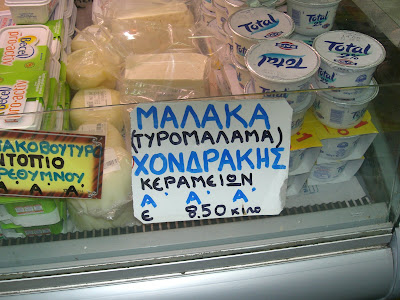
Malaka by the kilo


Sometimes, you've got to see it to believe it: triple-A quality malaka (μαλάκα) from the Hondrakis (Χονδράκης) dairy station: I guess you could call it 'hondromalaka' (χοντρομαλάκα). If it were made by the Archakis dairy station, then it would be archimalaka (αρχιμαλάκα).

Sunday, 4 May 2008

Xerotigana - Cretan wedding dessert (Ξεροτήγανα)

The tourist season was in full swing. Despite the sunny weather, the cold breeze whipped bare skin under the shade. While the locals were wearing long-sleeved T-shirts, the Northern Europeans - where so many of the tourists came from - were wandering around shirtless in their jandals (the women wore bikini tops). Some had already turned beetroot red, completely unaware that they were only an hour away from sunstroke. Ifigeneia stared at them as if they were aliens.

"Mama, aren't they crazy?" she asked her mother.

"Very much," Georgia replied, feeling satisfied that the flood of foreigners in her town did not greatly affect the culture in which she was raising her children. Had she been in New Zealand, Emmanuel and Ifigeneia would surely have gone with everyone else's flow. And Georgia herself wouldn't have been able to stop it because her children would tell her that they were Kiwis, even though their parents might call themselves Greek.

"They're eating ice-crea
m, mama. Is it summertime now?" Goergia was feeling like an ice-cream herself. Today was a good time for the first one for the summer season, even though Easter was only just over and spring hadn't finished. During the Easter festivities, she had suggested to her husband to buy some ice-cream for dessert, if of course there would be any space left after the lamb, the kalitsounia, the pie and all the other Easter food.

"Ice-cream, Georgia? Spring isn't even over yet, and you're thinking about ice-cream?" Her husband was very much dependent on the seasons, which dictated to him what he should eat, what he should wear, where he should go for a Sunday outing. The artichokes in the garden would be at their heaviest, harvest drooping with the weight, but Lambros would say: "It's too early for artichokes. Let them keep growing for a couple more weeks," in which time the artichokes would start blooming in purple thistles, their hearts too tough and fibrous to chew. In a September mini-heatwave, he'd carry a jacket in fear of a change of weather, even though climate change had already taken care of that. It could be a fine sunny day in the middle of winter - as so many were during the halcyon days in January - but he'd still want to drive up to the mountain plain of Omalos, because 'that's where everyone goes in the winter.' Georgia had been raised in a season-free country; all year round, one minute it rained, the next it hailed and then the sun shone through the clouds as if signalling that the worst was over - until a gale-force wind blew the roofs off the houses. Ice-cream was eaten anytime of the year. If Kiwis wait to eat one on a fine day, they might even miss out on having one in their own country altogether, as they'd be taking their holidays in Tonga or Tahiti when the sun finally did arrive in Aotearoa. And right now, Georgia felt like a Crazy Joe popsicle.

They were now nearing the Agora, where Georgia wanted to get some shopping done. She needed som
e malaka to make a meat pie with the leftover lamb from Easter. There was always too much leftover food at Easter; she had already frozen what she could, but it seemed pointless to freeze the lamb as it was - it would involve defrosting, making a pie crust, preparing the filling, and then cooking it. It was easier to freeze a pie in individual servings, ready to defrost and serve up on a busy day when she was at work once the schools opened again.

"Are we going to a park, mama?" It was always a problem entertaining the children when she had to cart them with her in town. Boredom was never a problem; they just wanted to stop at every toy shop windo
w and then go in and buy everything on display. Their faces dropped when they saw the Agora. "What are we going to do there?" asked Emmanuel.

"Well, I just need to bu
y some cheese, it won't take long."

"Can we go to the park afterwards?"


"We'll see," she replied, something the children were used to hearing from their mother, who was at that moment thinking about the traffic jam she'd have to encounter to get out of the town centre in the middle of the day. The Easter holidays always brought a flood of Greek tourists from the mainland who always
travelled with their private cars - usually SUVs - and drove in the same manic way as in their residential Athenian neighbourhoods. They stopped to let other cars pass at STOP signs, while ignoring them themselves. As they were coming into the town, a car with Athenian licence plates had stopped in the middle of a narrow road so that the driver could make a withdrawal from an ATM. He only got back into his car when the taxi driver who had queued behind him got out of his taxi and proceeded to enter his car, presumably to park it onto into someone's driveway, thereby unblocking the flow of traffic.

An idea suddenly struck her. "Would you like something to eat or drink while we're in the Agora?" Snacking out was always a spiritual enhancer for Georgia, even if it was only a coffee or a pastry, as long as she was sitting at a cafe and she could people-watch.

"Nah, I wanna go to the park," said Ifigeneia.

"OK, if you're feeling hungry, don't ask me to buy anything for you, because I won't." Georgia was sure that there was no way the children would pass up an opportunity to sit at a cafe and be served a snack. I
t's too tempting to pass by a food stall in the Agora and not feel hungry, even if you weren't hungry when you entered. And as Ifigeneia and Emmanuel entered the Agora, they came across a range of bread and pastry products, which filled their eye, as much as they would fill their stomachs.

"
Let's buy the cheese first," Georgia told them, trying to lure them away from the buying from the first shop they found, "and maybe we might find a place to sit down and have these."

The cheese store was on the other side of the cross-shaped market. As they walked past the central part of the Agora, Georgia noticed a few kafeneia serving the traditional Greek coffee, with a few old men sitting quietly at one of the tables. Hardly any were speaking, not even to each other. They looked lonely; the kafeneio was a way to see people coming and going all day long. They might have seen some acquaintances passing by, and would greet them as if they were visitors in their own house.

"Antonis, hronia polla, did you have a good time at the village
?"... "Emeis, kala persame, isiha pragmata... we're fine, everybody's well, ... hairetismata to your family, bye for now."

They could sit in the Agora all day long until it closed at 3pm. Maybe they'd go home a little earlier for lunch, take a siesta, and then go to their afternoon haunt, like Georgia's uncles, who each supported a different kafeneio in their village in the morning, and a different one in the afternoon, meeting up only for lunch.

The cheesemaker recognised her as one of his regular customers. "Kalimera madam," he greeted her smilingly, in th
at special way that all Greek shop owners greet their regulars.

Georgia thought it ap
propriate to use the seasonal greeting of 'Hronia Polla', one of those generic greetings that you can say almost any time (except at a wedding or funeral). "Some tiromalama, please," she asked him, adding "is it fresh?" although she knew it was.

The shop owner turned to his young assistant. "Fere ena fresko malaka."

"Mama, why did he say he was going to bring a malaka?" asked Emmanuel. The shop owner laughed with Georgia.

"Etsi to lene, call malaka by its name," he answered to the little boy.

"What?" asked Emmanuel. Confusion reigned.

After paying for the cheese, the trio took to one of the other sides of the cross and came across a modern cafe with a wide variety of pastries on display: kalitsounia, crepes, spanakopita, bougatsa, cheese pie, donuts, egg pastry avgokalamara, and the largest xerotigana (E1.20 each) Georgia had ever seen. She pointed to them: "Shall we sit here? You can have anything you like from the display." She stood in front of the donuts so they could only see the healthier snacks.

The children were glad to have a seat after all the walking around. "Can I have a xerotigano?" Ifigeneia could not be fooled when it came to food. She seemed to prefer only local cuisine, even though Georgia cooked everything from Indian curry to Kiwi kai. Despite her pre-school age, she had a very refined definition of what good food meant. Emmanuel was happy with a hamburger - as long as it contained no tomato, pickle or mustard. Ifigeneia knew a good pastry when she saw one, and those xerotigana looked perfect: tightly-packed rounds of thinly-spread pastry, fried and dipped in honey syrup. Georgia wasn't surprised when Emmanuel said he'd have what Ifigeneia was having.

A busty chubby peroxide blonde, her
tight pink lycra crossover top hiding very little of her cleavage, was clearing one of the tables. She smiled softly at them. Her bra wasn't her size; either that, or she was purposely wearing it extra-tight. One boob was sitting higher up than the other. A piece of thick denim just covering her buttocks was wrapped tightly round her midriff, flabby tummy hanging exposed over it. Her thick footless lime green tights and high-heeled brown mules made her look more like someone who'd just come from Minoos St. The colours of her clothes suited the spring season well; if anyone would look just at her face and not the clown's clothing she was wearing, they would have said she was beautiful, but it wouldn't have been easy not to gape at her from the neck down. She looked a scream.

A man was at the till. "Stella!" he bellowed, and the blonde turned to look at him. "Bring some water to the children." His voice was gruff, unpleasant. He was wearing a black shirt, hanging over his trousers. It was probably more comfortable than trying to smooth it over his huge stomach and tucking it into his trousers.

"Can I have a cup of coffee with that please?" No response. Georgia repeated herself.

"What KIND of coffee dja want?" Under normal circumstances, Georgia would have upped and gone elsewhere, but after living in Hania for so long, she knew that she would get the same kind of treatment at another place, maybe worse. In Hania, shop owners open and close their shops as they please. Like lambs to the slaughter, customers return to the same shops, simply because they were recommended by an acquaintance, while the store owners obviously profit enough to be able to enjoy more relaxed opening hours. They don't need to change their attitude towards customers; the store owner is always right.

So she gaped at his face, as if she was staring right through his head, and replied in a low timid voice: "Cappuccino, please," knowing that he wouldn't hear her, and hoping to grate on his nerves until he finally took the time (there were no other customers) to listen to her in the interested way Georgia had been brought up to expect from a shop owner, the way she used to show interest in the customers' orders in her parents' fish and chip shop in Wellington. After repeating her order two times, the shop owner decided she was British and that's why she spoke so softly; so he forgave her and cocked his head to one side to hear her better. No matter how Greek her face looked, her accent always gave her foreign-ness away.

Some tourists were approaching the cafe; they were Dutch: a middle-aged man, a slightly younger woman, and two spotty pale-faced teenage boys, wearing Hawaiian floral bermudas and T-shirts. The was man carrying a guide book as if it were a bible (with GRIEKENLAND on the cover) , a chunky camera dangling off his neck. They were looking at the pastry display, pointing mostly at the xerotigana
with a perplexed look. They stole glances at the children eating theirs, who seemed to be enjoying themselves immensely. Georgia smiled at them.

She decided to speak to them. "That's a traditional Cretan wedding dessert." It took them a few seconds to realise that she was talking to them. "We always have it at weddings. It's a pastry dipped in syrup."

The couple looked surprised with her offer of information, although she wasn't sure if they had understood her. They smiled and thanked her in that way that Northern Europeans have of saying 'thank you', as if someone had just offered them a service free of charge, and should be rewarded in some way. In any case, their confused looks had gone. They decided to take a seat. As they passed her table, Georgia almost fell off her chair. One of the boys was wearing a black t-shirt with a bullet-ridden ZONIANA signpost. She wondered whether they supported the abolition of the law stating that marijuana was a Class A drug. They were well versed in Cretan current affairs.

While the children ate their xerotigana, she sipped on her coffee slowly, as a cousin had once instructed her to do when she first arrived in Greece ("if you drink it too quickly, what are you going to do the rest of the time we're sitting here?" she had explained to her), letting it go tepid and undrinkable, while she watched the tourists walk up and down the main aisles of the Agora.

The Dutch family ordered xerotigana and ice-cream. "Stella!" roared the man at the till again. Stella produced the ubiquitous glasses of water, as if they were a sign that the shop owner was not the grouchy ruffian that he pretended to be. Georgia watched them breaking off bits of pastry; no sooner had they nipped a bit off and eaten it than another bit was broken off, until they had got to the tightest part of the pastry, which they ate more slowly.

"You speak very good English," the black-shirted shop owner broke into her daydream. "Are you Greek?" Georgia hated that question; it always carried a class distinction, a kind of segregation that she had slowly become accustomed to dealing with over the years.

"Yes, I am Greek," she replied, stressing the 'am' a little more than the other words, "but I was born έξω (= outside of Greece)." She could have told him where, but she knew that that would be the second question.

"Which country?" He still carried an inquisitive look.

"New Zealand."

"Hey, we're neighbours then. I was born in Australia, but my family left when I was very young. I don't remember hardly anything." Georgia couldn't explain to him that she remembered practically everything; she wouldn't know where to begin: the wooden houses, the wide streets, the dust-less environment, the green hills with their moving clouds of sheep...

His eyes took on a glassy haze, his voice softer than when he yelling to Stella. "I've always wanted to visit the house I was born in. I want to show it to my children. Don't you ever want to go back there?"

"To live there? No... My children were born here," she continued, "we live here now." The shop owner nodded in assent, showing recognition of the dilemma of being the tennis ball, batted between two countries, never gathering any moss, always wondering which side of the fence was greener.

"Kala einai ki'edo," he said, and Georgia smiled. It's just fine here, she thought to herself.

It was time to leave. Picking up the heavy bags of cheese, she got up to leave when the children had finished their dessert. "Now let's go to the park," Ifigeneia said. Georgia couldn't bear the thought of chasing children while carrying a block of malaka.

"Hey, shall we go to the supermarket instead?" Cries of protest came out of their mouths. "I'll buy you an ice-cream afterwards," she said, knowing that what she said was stupid - they'd just had a sweet pastry. "And we can eat it at the park near our house," she added as an afterthought.

"Yaaaaaaaaaaay!" they both cried.

The traffic on the road out of town was horrific. The queue stretched from the town centre out to the Nea Hora junction. It took Georgia half an hour to drive those four kilometres. The trip to the supermarket was to be a quick one: orzo pasta rice ('make sure it's Misko') and lavender-scented chlorine bleach ('in a white bottle') for her bedridden sudoku-solving mother-in-law. The last time she had bought her some orzo rice, she'd bought another brand. "It's not the one I wanted," scowled the old lady, as if it was her last god-given right to be permitted to choose the brand of orzo rice of her preference, and Georgia was simply being inconsiderate towards the needs of senior citizens. So Georgia simply put the pasta in her bag and pretended to make away with it, promising she'll buy Misko the next day, prompting her mother-in-law to snap: "Well, where are you going with it? I may as well have some to use, now that you've bought it!" When she returned the next day with a Misko packet, the old woman simply said: "Why did you bother to buy another packet? I'm not going to be eating kritharaki all this month!"

While the children were running up and down the aisles, bumping into other people's trolleys, and filling up her own one wit KINDER sweets, chocolate milk and coloured yoghurts, she looked for the lavender-scented chlorine bleach on the shelves, which contained every other fragrance but lavender. It became clear to Georgia that her mother-in-law must have seen it advertised on television, and the last bottle she bought could have been quite a while ago, when lavender-scented chlorine bleach was fragrance of the month, while this month, the 'in' fragrance was pine forest - the shelves were stacked with the stuff, outdoing even plain chlorine bleach. She wondered what fragrance was a hit 50 years ago when her mother-in-law had just moved from the manure-laid village paths to the town of Hania as a newly-wed - knowing that it was highly unlikely that fragrant chlorine bleach actually existed back then.

The shopping done, they all climbed back into the car. "Pagoto?" the children asked together. She stopped at a corner store to buy them an ice-cream. They chose whatever gleamed to their eye - shiny smartie candies in a plastic tube with what looked like a toilet roll made of speckled ice-cream stuck onto it. Perfect, thought Georgia; they would stop at the local park to
eat it, like an 'out-of-season' tourist', they wouldn't like it because it would be sickly sweet, they'd probably throw it away, they'd forget about the ice-cream while playing in the park, their appetite wouldn't be harmed, and they'll still lunch altogether with dad, as if nothing ever happened.

This post is dedicated to Dimitra, who would have liked to be sharing that coffee with Georgia. And if you want to see how xerotigana (which could loosely be translated as "dry fries"), the traditional Cretan wedding pastry dessert, also handed out at baptisms and other occasions of a celebratory nature, are made, come back to this page in about 20 years time...

©All Rights Reserved/Organically cooked. No part of this blog may be reproduced and/or copied by any means without prior consent from Maria Verivaki.

Saturday, 3 May 2008

Spring salad (Ανοιξιάτικη σαλάτα)

Easter was a time of over-indulgence in my family in terms of meat: at no other time of the year do we eat so much of it. Thank goodness, because I don't want to cook it again for a long time. Today's meal is a little τουρλού τουρλού ('tourlou tourlou' - a muddle). There's something for everyone in this salad, which is considered a main meal rather than an accompaniment. Greek salads such as the traditional village salad or horta are also main meals eaten with lots of bread to mop up the sauce, but this one contains its own 'mop': boiled potatoes. A salad consisting of boiled eggs and potato doesn't sound like something that could be attached to a real story; this is what I initially thought while I was writing up and publishing this post, but even this simple meal can produce a memory. On Saturdays after lunch, we normally have a lie-down - whether we sleep or not, it's 'quiet time' in the house. I was reading Salmon Fishing in the Yemen - I highly recommend it - and had come up to the part where the protagonist of the story is offered food and water in the middle of a desert landscape, when suddenly I remembered today's lunch being served up by my mother as part of our outdoor meal for the annual Cretan Association of Wellington picnic, held in late January or early February. So here I am, midday nap interrupted, scribbling down the story of my life.

The Cretan community of Wellington was one of the biggest Greek brotherhoods among the Greek Orthodox Community of Wellington (GOCW), which consisted of the following other groups: the Mytilineans, Cephalonians, Cypriots, Macedonians, Akarnanians and some other groups who attached themselves to one of the larger brotherhoods already mentioned. However, it was the Romanian-born Greeks that actually doubled the size of the Greek population of Wellington (among the many bits of trivia I gathered while researching my Masters thesis). They were third- and fourth-generation Greeks - they were usually better educated and more 'cultured' than the average unskilled Greek migrant - who had been living and working in Romania, a country very close to their homeland. They were eventually forced out of Romania, where they had made their home up until WWII, when the communist regime took over. Their first stop was Greece, but after living the poverty and miserable conditions of the Greek refugee camps, they decided to try their luck in another country, and some of them came to New Zealand. The Greek-born expatriates came in the same way that other immigrants came out to New Zealand - they wanted a better life than the poverty that they had been raised in.

The Cretans, despite being one of the last Greek groups to migrate to New Zealand, also became the biggest group. Most had left Greece during very difficult times in their own country during the late 1950s and early 1960s. It was during this period when New Zealand was short of labour, and started inviting people from other ('desirable') countries to work in Aotearoa on contract. A large number of women (from Crete and a few other islands) were given free return travel to New Zealand as long as they completed a two-year work contract, being seconded to jobs in the cleaning and catering industries. My mother was one of them; she arrived in New Zealand in 1963. Very few of those women decided to return to Greece after their two-year contract was over; in the course of a 2-day journey they went from oil lamps and a once-a-week bath using water boiled up on a wood fire to electricity and both hot and cold running water. Who could blame them? They even 'imported' their husbands from Greece; my father came to New Zealand on Jan 31, 1965 and married my mother on Feburary 6, 1965. They had been writing to each other on a monthly basis; my mother wrote a letter to my father and he'd reply to it. She didn't get a reply after the 13th letter; my father later explained that this was the time he was preparing for his journey to New Zealand. It seems like a plausible excuse.

The ex-patriate Greeks did come back to Greece, but only on holiday - very few came back to live here permanently. I consider myself one of the more fortunate members of the GOCW. Funnily enough, it was mainly the Cretans who actually returned to Greece, with or without their Kiwi-made families, which is why today, the Cretan Association of Wellington is on the verge of extinction, whereas the ex-patriate Wellington Cretans are thriving. It is no surprise that the Cretans were those who left New Zealand; here are just a few of the zillion reasons why this was easy to do, whereas it was difficult for all the other groups:
  • Crete is the largest island in Greece, making it most likely that a returning migrant will find work all year round, unlike the other regions, which have high economic activity for only a few months of the year (except for Cyprus; the Cypriots arrived in New Zealand after half the island was occupied illegally by Turkey). This is, of course, why the newer economic migrants of Greece (from Bulgaria and Albania) come to Crete to look for work rather than locating themselves in large cities - Greece is not known to be a technologically-driven country full of office workers;
  • 95% of the Wellington Cretans came from Hania, a thriving summer resort town. Some even built hotels on their native land, or bought land to build businesses in the tourism industry. There are no losers in this field;
  • Hania (as well as Iraklio, and possibly Rethimno) has an enticing night life for young people. Entertainment is a very important aspect of a person's attitude towards their place of residence. If there was 'nothing to do' here at all times of the day, ex-patriates would probably choose to ping-pong back and forth from Greece to New Zealand, a very costly time-consuming way to live in the 'patrida' (mother country (an aeroplane journey from Wellington to Athens consists of a 22-hour 3-plane flight, up to 6 hours of waiting time between flights, and that's not including the plane or ferry journey to Crete);
  • the other Greek migrants of Wellington came from underdeveloped regions of Greece, which today continue to suffer from deprivation and economic recession (except for Cyprus again; the former homes of Cypriot New Zealanders are in the illegally occupied non-European zone of Cyprus - they lost their homes). Hania, on the other hand, according to Haniotika Nea (14 April, 2008) comes first in people's choices for local tourism, and LAST in unemployment in Greece (the study was conducted by my work environment, the Mediterranean Agronomic Institute of Chania - MAICh); in the summer, there is work in the tourist industry for anyone that wants a job (conditions and salaries aside), whereas in the winter, labour is needed in the agricultural sector (I don't need to prove to anyone what a minefield that is in Crete - my blogs are filled with its splendours);
  • Hania is a relatively safe town to live in. At 10pm at night when I finish working at the private language institute, the roads fill up with laughing self-confident teenagers walking home alone or with their friends, or being picked up by their parents, whose cars have blocked the road outside the school. I used to walk home to the other side of town before I had a car, and never felt I was in danger. Of course, dangers exist, as they do in any place in the world, but the same safety rules still apply: don't walk down dark alleys alone, be street-wary, walk with a purpose, keep away from alcohol-saturated areas, etc, etc, but at least we don't get that daily reminder in our news reports that someone was raped, attacked, knifed or shot (vendetta crimes, which do break out sporadically, are more feudal rather than criminal);
  • Crete enjoys 300 days of sunshine; need I say more?
My family was one of those that did return, although each member made their way to Greece on their own, for different purposes: a holiday, the famous New Zealand OE, a wedding, a funeral; but the person who started the migration chain in the first place is also the person who can never return to Greece. Maybe she's watching us now, with a feeling of mission accomplished.

To make the spring salad my mother took to the Cretan Association's annual summer picnic (the hottest day of a Wellington summer is about as warm as an average day in the Cretan spring), you need:
1-2 boiled potatoes for each person, depending on how hungry they are, roughly chopped
1 boiled egg per person, sliced thickly
1 firm tomato per person, cut into small chunks
1/2 a medium sized onion per person
olive oil and vinegar for the dressing
salt to taste
any of the following: olives, cucumber slices, fresh broad beans, fresh cleaned artichoke cut into small pieces (not carrots, cabbage and lettuce; they are not traditionally used in this salad)
optional local additions: mizithra and crumbled bits or Cretan rusk
Mix everything together, dress and season. The oil mixes in with the egg well; thickened by the starch in the potato, it creates a mayonnaise taste. This is the equivalent of Greek potato salad. This is also a very simple meal that can be prepared quickly: it's especially appreciated when the weather is very hot and no one can be bothered slaving away in a hot kitchen preparing (let alone eating) a heavy meal. Enjoy this salad as part of a BBQ picnic, like the Cretans did in Wellington when they organised barbecues out at Waikanae Beach when it was just a holiday/weekend/retirement village and Maidstone Park when it had swimming pools and a miniature children's railway track.

©All Rights Reserved/Organically cooked. No part of this blog may be reproduced and/or copied by any means without prior consent from Maria Verivaki.

MORE SALADS:
Cabbage salad
Lettuce salad
Summer horta
Winter horta
Salad advice
Beetroot salad
Greek salad