Thursday, 17 January 2008

A day in the field (Ο ελαιώνας)


The olive trees are regenerating growth after the fire that razed our whole field (200 trees) a decade ago. We have cleared the land around 40 trees. The rest will have to wait. The fruit of the trees, the olive, does not ripen at the same time: some olives are black, while others are still green. But they are ready for picking for both table olives and olive oil.


The field was ploughed, and the earth was moved so that the olives now stand in step rows, rather than as one mass of trees like a forest. The ground is laid with black plastic nets, sewn together at their ends with wire, and pressed down with heavy stones. It may sound primitive, but this method has only been in use since the avialbalility of cheap nets, about 40 years ago. Before that, village women (my mother and her sisters) used to stand over the field with their back bent towards the ground, picking up every single olive from the earth. Back-breaking, poorly-paid work. No wonder my mother left Greece for New Zealand.

Unfortunately, the rain has damaged some of the paths leading to the trees, creating deep ravines along the tracks. In some countries, this is called "art". The floor of Tate Modern, an art gallery in London, was recently dug up for an exhibition. Apparently, the deep ravines on the floor represented the divisions of society for newly arrived immigrants to Britain. A lot of money was paid to "set up" the floor to resemble the ravines in our fields, whereas we are going to have to pay a lot of money to fill them up...

A lot of olive crop has also been lost due to lack of time and effort on our part. This makes us feel very sad, because we recelty bought 100 kilograms of olive oil to store in our house, for our daily cooking requirements; this oil could have come from our own trees. We also love to eat olives, and we could have put some more in lemon or salt if we had come to save the ones that were lost to the earth, but at least they will be providing good fertilisation for the filed, which is irrigated only by natural means, ie rain. We do not water the field at all.


The earth may look brown and dry, but the soil is still very fertile, and constantly producing nature'sl wonders. Stifno (deadly nightshade), radiki (dandelion) and tsohos (sowthistle) - all edible wild greens - are now flourishing on the paths. Our fields may be untended, but they will never be lost. And we aren't ready to sell them off to entrepreneurs who, in the most unlikely places of Western Crete, are building mansions with swimming pools for the rich retired northern Europeans. It is terribly tempting to dump this hard-to-work land and buy a luxury 4-wheel-drive SUV jeep, but if we hand no land to go to, then where would we drive with a fuel-consuming environmentally unfriendly monster?!


©All Rights Reserved/Organically cooked. No part of this blog may be reproduced and/or copied by any means without prior consent from Maria Verivaki.


See also:
A summer garden
A winter garden
An autumn garden
The rape of the countryside
Table olives

Wednesday, 16 January 2008

Winter life (Ο χειμωνιάτικος κήπος)


Bearing in mind that it is the middle of January in the Mediterranean island of Crete, our garden looks like this at the moment. Look out for a reddening tomato, white cauliflower heads, a green cabbage, some celery bushes, a pepper tree, a few eggplant trees, a broccolli bush and some baby Cos lettuce. My husband and his mother (83 years old) planted the garden in the niddle of autumn, and now my mother-in-law tends it. We are truly fortunate!


©All Rights Reserved/Organically cooked. No part of this blog may be reproduced and/or copied by any means without prior consent from Maria Verivaki.


See also:
A summer garden
An autumn garden
A day in the field
The rape of the countryside

Table olives

Sunday, 13 January 2008

Blue dragon (Μπλε δράκος)

If you ask me what kind of food I miss most from New Zealand, I'd say I miss the international cuisine that was available in Wellington, to suit all kinds of eaters from vegans to omnivores, from budget meals to luxurious buffets, from Uncle Changs to Great India. Food is plentiful in Crete, but the same 'gourmet' stuff is served up everywhere; no matter what restaurant or taverna you visit, the menu will contain exactly the same range of Greek cuisine that the previous restaurant or taverna you visited contained. You must have noticed this if ever you came to holiday in Crete or any other Greek island. Apart from a few bits and pieces of traditional local cuisine, the menu will also contain: moussaka, papoutsakia, village salad, calamari, dolmades, yemista, etc. Take the seaside road out of the town along the beaches of Northern Hania: The Seven Brothers, Diomedes, Caretta Caretta, .... they are all Greek restaurants, they all serve Greek food, made in the same way; the only difference is the cook. So there is really very little to choose from. We lack variety in this town. Our restaurants serve what we often cook in our own homes. People here are not really adventurous when it comes to food; in fact, they are downright traditional. The restaurants do serve a huge variety of food, but it's what all restaurants serve in Hania, especially during the summer.

What's more, I can't buy the ingredients needed in order to create those foreign meals I used to enjoy in New Zealand. Chinese ingredients are limited to a few supermarkets, which sell mass-produced brands of sauces, canned baby corn and spring roll sheets, making whatever you cook using these ingredients taste quite bland. Imagine using BLUE DRAGON noodles and BLUE DRAGON baby corn with BLUE DRAGON green chili sauce, and eating that with BLUE DRAGON sprouts in BLUE DRAGON spring roll sheets which you douse in BLUE DRAGON soya sauce and BLUE DRAGON chili sauce. You've just eaten a blue dragon, not a Chinese meal.

My hometown Wellington is not really much bigger in population than Chania. There are many similarities between the town I was born in and where I live now. I call both towns, even though Wellington is the capital city of New Zealand and the seat of government; basically, it was a small town when I lived there, and its population has not grown by that much since I left. The city including its outlying suburbs and satellite towns (where people live and commute into the city for work) has about 350,000 inhabitants. Hania is smaller in territory, and has about 160,000 inhabitants of whom about 60,000 live in the main town, but the number of people in Crete in the summer during the tourist season rises considerably, to over half a million. There are up to 45 chartered flights a day coming from all over northern Europe from April until October.


So it's not too small a town to sustain a variety of cuisine. It goes without saying that tourists would want to eat out at such places, but it would also give locals a chance to try it, and if it is well cooked, they might even take a liking to it. We do at present have a couple of Chinese restaurants, another specialising in Turkish food, and another dodgy-looking one advertising Tex-Mex cuisine. Of course, we have pizzerias, but that's more like fast food than real food. The new immigrants of Hania (from Albania, Bulgaria, Romania, Russia, northern Africa, the Middle East and South Asia) are not opening food outlets selling their own food, which sounds like a clear message that this food, or should I say these people, are not really being welcomed by the locals. In a town like Chania, abounding in fresh produce and good weather all year round, where most people eat freshly cooked homemade food every day, it seems a shame to have such a narrow-minded view concerning other people's food. Thus, in essence, what I miss most is the open-mindedness of society towards other law-abiding citizens from different cultures.

You need:
1 square of instant noodles
2-3 tablespoons of oil
1 onion, chopped small
2 cloves garlic, chopped small
1 knob of fresh root ginger, finely grated
1 greated carrot
2 cups of shredded cabbage
1 green pepper, chopped into thin strips
a cup of cooked shredded chicken or baby prawns or sliced sausage (optional)
soya sauce and chili sauce
Put the noodles into a pot of hot water, and drain them when they are limp.
In a saucepan, heat the oil and brown the onion, garlic and ginger. Add the vegetables and meat, and mix well tell everything is coated in oil. Cook till the cabbage is limp, adding a few drops of water if the ingredients are sticking to the pan. Add the sauces in a quantity to your liking, and mix well. Finally, add the noodles, and mix in well, ensuring once again that the noodles and vegetables do not stick to the pan. Voilà, one blue dragon!

©All Rights Reserved/Organically cooked. No part of this blog may be reproduced and/or copied by any means without prior consent from Maria Verivaki.

MORE ASIAN RECIPES:
Banana lassi
Chicken curry
Mango lassi
Stir-fry noodles
Stir-fry beef
Curried pancetta

Friday, 11 January 2008

Apple cake a la Amrita (Κέικ με μήλο)


Maybe it is a bit of nostalgia that makes me turn to my old New Zealand recipe books. But that's not all. Now that I am far away from my birthplace, I realise how ahead of the times NZ was, despite its lack of ancient culture its now highly globalised New-World society. While a student at Victoria University, some of my fellow students were vegetarian. Their motivation was mainly humanitarian, in that they were against animal cruelty, they expressed an aversion to eating dead animals and they had a heightened awareness of their existence in the world, way ahead of their Old-World counterparts. Like all good Kiwi citizens, I showed interest in what they had to say, and even tried to apply some vegetarian principles in my daily diet. What didn't occur to me at the time was that in our house, since my mother strictly observed all the Greek Orthodox Church fasting periods throughout the year, we actually were vegetarian at various times of the year: 50 days before Easter, 40 days before Christmas, 15 before the Assumption of the Virgin in August, as well as some single days of the year to respect a saint or a special event in the Church calendar (eg St John the Baptist, commemorated on August 29).

In the Wellington of the '80s, vegetarianism and an interest in healthy eating were propagated by all sorts of institutions. I remember the Meat Board advertising trim pork, leaflets with recipes using tofu, and Victoria University's Salient magazine with recipes like "Tomato Walnut Casserole". Who will forget the Mt Victoria Cafe (I lived up the road from it) with their queues extending round the corner up Queen St to eat barley rice pilaf, vegetable cottage pie and macadamia beans? There were columns written in the newspaper about how to get started in vegetarianism; here's what Anne Doornekamp has to say about it (from an article in the Dominion - found among the bits and pieces of yellow-aged newspaper clippings I carted with me when I moved to Greece):

... find out where your nearest health food shop is. Spend time browsing among the shelves at the different kinds of beans, grain and seeds... buy a simple recipe book... decide when you want to try your first vegetarian meal... find a recipe that appeals... choose a recipe which is simple, as your future confidence depends on the success of your first attempt."

Vegetarianism must have been a kind of "nouvelle cuisine" in the mid-80s, judging by comments such as those! My favorite progressive vegetarian outlet was the Organic Food Co-op, located at the time in a rundown area of Wellington, close to the red lights district. I even became a member of the co-op, working once every two months as a volunteer, I told my parents about the idea behind the co-op, but as usual, they simply scoffed at the new age thinking their daughter was propunding in the household: whoever heard of anyone who can survive their whole lives without eating meat? They needn't have worried about their daughter being seen in a forbidden district, as it was a Greek no-go area. I never came across any of my fellow Greek Wellingtonians whenever I was in the area. Which led me to think: "Am I the only weirdo?"

One of my friends had baked an apple cake for one of the Linguistics Department social nights (from which you can imagine the revelry our academic interest group imparted) and I asked her for the recipe. She gave it to me, and, as all good academics, she refered me to the source of the recipe: the AMRITA cook book, AMRITA being the first vegetarian restaurant in downtown Wellington. I bought the book - 100 pages, hand-written, each page illustrated in a unique way - and tried a great many recipes from it. The restaurant eventually closed down, but Wellington still abounds in vegetarian-interest cafes and eateries. One recipe became a firm favorite with my family: Christine's apple cake, which I'm making for a family friend tonight. It's just one more positive way (as for apple pie) to use those bad Greek apples that we buy here ...

You need
:
1 1/4 cups brown sugar (you can use white sugar equally well, but use LESS than the stated amount - it is sweeter and heavier)
2 eggs
1/2 cup olive oil
1 teaspoon vanilla
2 large apples diced
1 3/4 cups plain flour
1 teaspoon baking soda
1/2 teaspoon cinammon
1/2 teaspoon ground cloves

Beat the sugar, eggs, oil, vanilla, cinammon and nutmeg together till well blended. Add the apples, and mix them into the batter. Aift in the flour and baking soda. Mix well. Baked in an oiled tin. I used a ring tin, the very same one we used to use to make this cake in New Zealand (it's travelled a long way!) because this is a 'heavy' cake, so it tends not to cook in the centre. I lined the ring tin with baking paper to be on the safe side, as apple pieces tend to stick to the bottom of the tin if it is not greased well.
This post is dedicated to CV.

©All Rights Reserved/Organically cooked. No part of this blog may be reproduced and/or copied by any means without prior consent from Maria Verivaki.
MORE CAKES:
Banana cake
Brownies
Chocolate cake
Simple cake
Carrot cake muffins
Chocolate muffins

Vasilopita
Walnut cake
Halva
Tsoureki

Feta cheese (Φέτα)


How do you pick a good feta cheese? I suppose most people will tell you that it's a matter of personal taste: you taste a few brands, eg FAGE or DODONI (we don't all live close to producers!), you compare their taste (salty, mild), add to this your personal preference (hard, dry, moist) and maybe your own dietary requirements (goat or sheep milk). I suppose you might think I've got the best choice of feta available to me because I live in Fetaland, but I actually need to go to a specific supermarket to get the feta I want to buy for our liking. For a start, feta is NOT a traditional cheese of Crete; therefore, we cannot call Cretan-made white cheese 'feta'.

The original feta is the barrel-aged kind. That means that the milk is turned into a cheese in a barrel. If it's made in a barrel, it's got to look sort of round (if it's cut out of a barrel), not square, which shows it was made in a plastic container (easy to clean, easy to store, but NOT original). Even though the labelling might say "traditionally-made", "name-of-origin-protected", it may not necessarily be made in the traditional manner, so it can't have the original taste or texture. Feta should be slightly salty, to the point that you feel you haven't added it to the cheese. It should not taste of salt. It should also be a firm cheese that breaks off in chunks, not crumbles. It shouldn't have a solid look to it; the cheese should have cavities cavities running in it, like an eroded rock. Finally, feta should be moist, not watery. you should be able to bite it; it should not feel like a sponge. Feta is usually stored in its own brine. When you take it out, it needs to be rinsed free of this liquid, then drained before being placed on a plate for serving.

We buy FETA PLATAION, one of three barrel-aged feta cheese brands regularly available at a large Athens-based supermarket chain. We never buy square pieces of feta; it should always have an irregular shape. The small block in the photo is made by a large Greek dairy company; it is not barrel-aged. I must admit it tasted almost as good as the feta we prefer, the larger block in the photo, which is made in an area well known for feta production in the central Greek mainland. Therefore, for me to eat this cheese, I am adding to my carbon footprints. But people all over the world have always traded with their neighbours, so this is one kind of non-local food that I would be prepared to trade with our greek neighbours; I would recommend our stamnagathi (spiny chicory) as a suitable trading product. For more advice about how to buy good feta, read Nancy Gaifyllia's advice.

And how do you enjoy it? Drizzle a little olive oil over a small piece of cheese, and sprinkle some oregano on it. Take a paximadi (rusk) or some village bread - ambrosia!

©All Rights Reserved/Organically cooked. No part of this blog may be reproduced and/or copied by any means without prior consent from Maria Verivaki.

See also:
Taste sensationalism
To eat or not to eat?

Thursday, 10 January 2008

Fasolada (Φασολάδα)


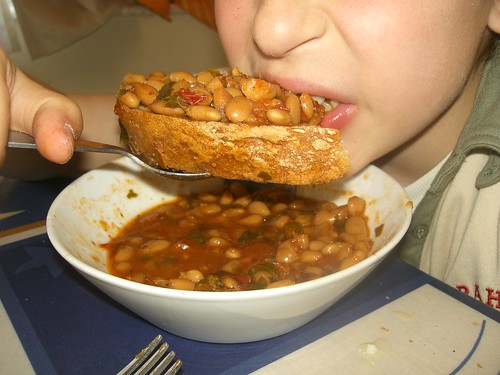
Fasolada - bean soup - is the national dish of Greece. It is also one of the most nutritious meals you can have. It is vegetarian, and combines the healthiest parts of the Mediterranean diet: vagetables, pulses (beans) and olive oil. And it's easy to make. It keeps in the fridge for up to five days. In our house, it is on the menu every fortnight. If you like your food colourful, then bean soup is the most colourful of all the bean-pulse dishes of Greek cuisine.

In my Cretan kitchen, we even have a special name for it; faskolada. A few years ago, we took our very young children on a trip to London. It was the middle of March, and needless to say, it was freezing. How we managed to escape rain for ten days in London beats me, but the cold we experienced more than made up for the lack of precipitation in that year. Every morning, after a hearty breakfast, we would dress up the children warmly to take them out sightseeing with us; we never hired a babysitter. After they put on their palto (coat), we would say to them: "Kapelo, gantia, kaskol!" (hat, gloves, scarf), and we'd help them to put them on.

One day, my daughter, then barely 4 years old, couldn't find her scarf. She asked me: "Pou ine to faskol mou?" meaning to say "Pou ine to kaskol mou?", which translates to "Where's my scarf?" We liked her slip of the tongue so much, that we wanted to keep the newly coined 'scarf' word in use. In honour of Christine's linguistic misdemeanours, we have renamed fasolada to faskolada instead. Not funny? Lost in translation...


You need:
400g dry white navy (haricot) beans
1/2 cup of olive oil
1 large onion, grated
2-3 cloves of garlic, minced
a small bunch (like a posy) of celery, chopped finely
a few sprigs of parsley, chopped finely
2 medium carrots, sliced in thin rounds
500g fresh tomato, pulped
1 teaspoon of tomato paste
salt, pepper and oregano
Boil some water in a large pot and pour the beans in. Let them cook for five minutes, then drain the water away and wash the beans. Apparently, beans contain certain toxins that can be eliminated by boiling them lightly in this way. You can use the same pot afterwards to heat the oil, and saute the onion and garlic in it. When they become translucent, add all the other ingredients (except the salt - it toughens dry beans and should be added towards the end of cooking time for best results) to the pot, and mix them into the oil. Add enough water to cover the pot with 3cm above the beans mixture and bring it to the boil. Cover the pot, turn the heat down to the minimum, and let the beans cook away for 1 1/2 hours.

If, after that time, the beans are still too tough for your liking to eat, you might try changing brands; let the beans cook longer, adding more water - you could also cook this soup more efficiently in a pressure cooker, something I have never used, as I still cook more or less the way a less modern Greek yiayia cook. It's all a matter of what you're used to. I let the beans cook for at least two hours, because everyone in my house likes them super soft. If there isn't enough water in the pot or the beans are starting to stick to the bottom of the pot, add some more, enough to cook the beans, not turn them into watery soup, as my husband dictates!

papara

Saucy bean dishes are best served with some boiled eggs and cheese. They go especially well with leftover BBQ meat and fried fish. When serving the soup, squeeze some lemon juice over it for a tangier taste. Don't forget the crusty sourdough bread! Freeze individual servings or leftovers for a nourishing ready meal.

©All Rights Reserved/Organically cooked. No part of this blog may be reproduced and/or copied by any means without prior consent from Maria Verivaki.

MORE BEAN RECIPES:
Chili con carne
String bean stew
Split yellow peas
Black-eyed beans
Pulses
Lentil stew
Giant butter beans

Wednesday, 9 January 2008

Pizza (Πίτσα με ζύμη μαγιάς)

I made a classic pizza using all the normal pizza parlour toppings using my favorite oily ladenia dough (click on the link for the dough recipe; see medcookingalaska for the original recipe). This has got to be the best pizza I have ever made. The recipe I used for making the crust is the same one as for ladenia, the best crust I have ever made with yeast. Once I had spread the dough out, I divided it into four uneven quarters. I topped each part appropriately for each member of the family. My husband likes the works, Christine likes a tomato sauce base on her cheese and ham pizza, Aristotle likes only cheese and ham, while I'm more of a vegetarian fan. It was a smash hit. The pictures speak for themselves. Making this pizza reminded me of my late mother who always baked home-made pizza for us, and loved to make 'the works' pizza. She even beat an egg and poured it over all the toppings. She would never make one pizza; it always had to be three: one in the tapsi (the Greek roasting dish) and two in classic holes-in-the-base pizza tins that she would deep-freeze. Good news too; even though Yianna spurned it the first time, she wants me to make the carnivore version of ladenia for her dinner party next week!


The dough remains the same as for the original recipe for ladenia (Greek pizza). The pizza toppings I chose were: ham and cheese slices, finely sliced tomato and green pepper and pepperoni salami. I forgot all about the mushrooms I had planned for my part of the pizza; I usually come last in terms of priority! As for anchovies and pineapple, we're more into Mediterranean toppings rather than the Hawaiian version; we never mix our sweet with our savoury. I drizzled olive oil and oregano over everything, and cooked it till the dough was ready. The tin needs to be the large Greek-style roasting dish, the same kind I used for ladenia.

A really delicious thick tomato sauce base can be used instead of the tomato slices and drizzling olive oil and oregano on the top, such as my puttanesca sauce for pasta. While it's cooking, it will turn the whole house into a Mediterranean aromatics factory! Believe it or not, the Greeks apparently invented pizza - the Italians simply perfected it. No wonder my mother used this kind of sauce in her pizzas. However you make this pizza, it will not last long; it's too delicious to remain uneaten. Maybe my mother was right to cook so many at a time!

©All Rights Reserved/Organically cooked. No part of this blog may be reproduced and/or copied by any means without prior consent from Maria Verivaki.

MORE PIZZA/PIE RECIPES:
Ladenia
Pizza without yeast
Pizza carbonara
Chicken pie
Cottage pie
Spanakopita/hortopita
Kalitsounia
Leek pie
Sfakianes pites
Spiral pie

Sunday, 6 January 2008

Roast chicken (Κοτόπουλο στο φούρνο)

Almost everyone who has children will know how difficult it is to get them to eat a variety of healthy food. Aristotle eats only 'white' or 'brown' food: pasta, rice, sausages, potatos, milk, chocolate, bread, cheese, beans and some meat. He won't eat salad, but he will eat spinach (or any other leafy green) in a pie. That's why spanakopita and kalitsounia are staples in my house. My deep freeze always contains at least one tin of spanakopita and a supermarket carrier bag full of kalitsounia ready to be baked on a weekly basis for the children's lunchboxes. Christine is the opposite; she likes colourful food: traditional Greek cuisine, fruit, vegetables and salads, especially horta. She's not really a meat or bean eater, and this worries me sometimes. If I make a roast chicken with potatoes, both children will compete against each other as to who will eat the most potatoes; if I make meatballs with rice, they'll go for the rice and douse it with yoghurt. I don't think they're eating unhealthily; in fact, they're eating only carbohydrates, and not mixing their carbs with protein, a great way to put on weight according to the Atkins diet.

I'm the opposite of my children: I'm an omnivore. You can see it just by looking at me. I like to try out new dishes, I eat anything edible, and I don't make any exceptions. So when my mother told me that I wouldn't get any of the meat in the meal she was making unless I ate all the potatos, or all the rice or all the orzo pasta on my plate, I'd eat it all, just to get my share of the New Zealand spring lamb stew or roast. Poor woman; she didn't know the damage it would cause me later in life. All she knew was that there was never enough food to feed everyone in her family (she was the oldest of five children) in the mountainous regions of Crete during World War II. Her father would have had to be lucky to run into a hare for her family to eat meat more often than Christmas and Easter. Chickens were kept for eggs; you could only kill them off if they had raised chicks to take their place in the coop. Sheep and goats needed land for grazing; my grandparents were too poor to be landlords. After the war, they eventually sold their two-roomed house in the village to a richer landowner who wanted to buy it as dowry for his daughter, and they eventually came to live in a seaside village neighbouring the one where I live now.

By that time, my mother had lived through so many poor times and meatless meals that she decided to emigrate. Coming to New Zealand for her must have been like going to another planet. New Zealand spring lamb abounded in all the butcheries of the country, and what's more, it was dirt cheap. I remember half a side of lamb (approximately 1.25 metres long, and 40 cm wide) being sold for 20 NZ dollars. At the time, butchers didn't even weigh it. My old-world parents, immigrants to the new world, never bought less than a side of lamb when they bought meat. And they made sure that they had a deep freeze large enough to keep it in, chopped up in the appropriate cuts. Those were the days when no one worried about cholestrol levels and only hippies were vegetarians. My parents were genuinely concerned about my mental state of health when I showed an interest in eating at the Mt Vic cafe, the first vegetarian eaterie in suburban Wellington. They were even more worried when they saw the queue outside the cafe. My parents were involved in the fish and chip shop business. The rise of vegetarianism and the eventual demise of the greasy chip shop were a serious threat to their existence, as it eventually turned out for our business in Newlands.

We all need some form of protein to survive, whether we are vegetarians or not. One of my vegetarian friends, a tall attractive slim young woman, told me that she never liked the taste of meat, and this is why she is vegetarian, not because she is protesting against animal cruelty (one I would never consider in my choice to eat or not eat meat). However, when her hair started falling out, changing colour, and becoming totally unmanageable, she finally realised that she had to eat at least a little bit of meat on a regular basis to maintain her health. That's when she started eating chicken weekly, the only meat she eats in her regular diet. I really admire her because she is a sensible healthy eater, and I wish I could be like her.

That's why I'm making roast chicken for the family today. I won't be serving anything with it - no bread (Aristotle would just eat that), no salad (Christine would choose that), no potatoes or rice (they'd both go for that alone), just plain chicken. I know they'll ask me if there's anything else to eat, but I'm not going to put anything else on the table. The chicken I am using is not the kind you use to make pilafi; I would buy that kind of chicken only from the butcher. The one I'm using today is a supermarket chicken, with all the fat removed, good for making chicken pie or adding to a stir-fry if any is left over. It's the kind of chicken you would buy ready cooked rotisserie-style from the supermarket. It's the kind of chicken fast food outlets serve fried. It's the kind of chicken you can use when you want to follow a recipe that says: "... add the chicken pieces and simmer for fifteen minutes." A battery hen, instant chicken, the kind that cooks faster than the potatoes you added to the pan to roast in the juices. Finger-lickin' good chicken, no need for supervision. Supermarket price: E3 a chicken, or 2 for E5.

You need:
a supermarket chicken, suitable for roasting
salt, pepper and oregano
Defrost the chicken. If you don't have time to do this, defrost it a little in the microwave, without letting it cook through. In any case, this meal can be made even if the chicken is still frozen, but it needs a much longer cooking time. Season it with salt, pepper and oregano. Rub in the spices (if you can be bothered) all over the skin (don't take it off). Place it in a roasting pan, with half a cup of water. Cover it with aluminium foil. Let it cook in a moderately hot oven. You can turn it over during that time if you like your roast chicken nicely browned. When the meat is about to come off the bones, take the aluminium foil off and let the chicken skin turn golden and crispy. Ready when you are.

©All Rights Reserved/Organically cooked. No part of this blog may be reproduced and/or copied by any means without prior consent from Maria Verivaki.

MORE CHICKEN RECIPES:
Free-range chicken
Pilafi
Chicken pie
Chicken curry
Yiouvetsi
Stir-fry noodles
Sunday roast

Saturday, 5 January 2008

Horta (Χόρτα σταμναγκάθι και μαρουλίδες)

The word 'horta' is the plural form of 'horto', meaning 'grass' - not to be confused with the kind of grass that grows on a lawn, which is called 'grasidi'. The Greeks use the word 'horta' interchangeably for the unwanted grasses and weeds that grow in fields, as well as for the various edible leafy greens that grow seasonally throughout the year. These usually grow wild, and are picked fresh for eating within the same week. In the summer, various kinds of horta grow uncultivated in our garden, and we never run out of them until the end of the season. We are growing some stamnagathi (spiny chicory) in our garden in front of the artichoke borders, and are hoping that it seeds to produce more plants next year. We also grow spinach and carrots, parsley and radish, with an unavoidable intercrop of stinging nettles. Although it grows wild, spiny chicory is in short supply and only grows in unspoilt, slighly remote areas of the province. The greens that are sold in shops are the cultivated varieties of the same wild species. They are not as tasty as those found in the wild, but beggars can't be choosers. Whether they are cultivated or found in the wild, spare a thought for the pickers; it's hard work bent over a field in the middle of winter. No wonder they are so expensive; I bought 2 kilos of horta last Thursday, at E7.30 a kilo - more expensive than meat, you might be wondering. Imagine how poor Ivy, who lives in Athens, feels when she pays E12 a kilo for her stamnagathi (spiny chicory)! Low income earners can hardly afford them. I prefer to buy them once every fortnight. As fresh greens, they can be eaten raw like a salad; once cooked, they can be kept in the fridge for a week, and they are eaten as a main meal or a warm salad. They are a very important part of our daily diet, given that we eat vegetables or salad with every main meal.

My absolute favorites are stamnagathi (spiny chicory; Cichorium spinosum), a low-lying shrub that grows amongst thorns in the hilly areas of Hania (foreground), often referred to spiny chicory in English. I also love maroulides, a kind of indigenous dandelion plant (background). My introduction to horta was in New Zealand when my immigrant Greek mother would take me and my sister to Pirie St Park, a few minutes walk away from where we lived in Mt Victoria, Wellington. We'd play on the swings, while she foraged among the low scrub and snapped the stems off bushes of amaranth, or dug up rooted grasses such as dandelion with a knife, which she gathered into a plastic supermarket carrier bag. Imagine how that would look in the days of political correctness: a 40-year-old woman brandishing a knife in a swing park! I had never tasted horta before I was 12; I found it too embarassing to even consider it. What would I tell my friends at Clyde Quay School when they asked me what we usually ate for tea (as the evening meal is called in NZ) at my house? "Grass? That's what sheep eat! Baa-baa! You have weeds for tea? Hey, everyone, Maria eats marijuana!"
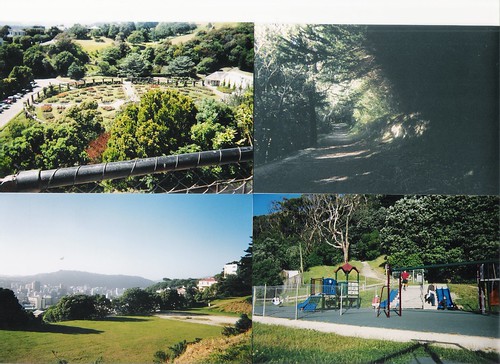
wellington new zealand
My mother's old horta haunts in Wellington, NZ

This is just what some boys from Wellington College, a boy's high school close to our house, once jeered out to us (and then broke out into raucous laughter) when my mother (lady on the left in the photo) took me to their school grounds to collect some horta. It was after school hours on a fine day, probably a Monday, when my parents didn't open the fish shop (until the "kinezo", as my parents called him, opened up a takeaways shop 300 metres away from our own shop, cutting our profits and forcing us to become more competitive). I pretended that I was deaf, dumb, mute, some kind of alien, and I didn't understand what they were saying to us. Now that I think back on that day, we must have looked really queer holding a plastic bag full of roadside greens that had been removed from the carefully tended grounds of one of the most revered boys' schools in Wellington. My mother always used a blunt silver knife to prise the horta out of the ground if they were very well-rooted, another good reason for someone to stare at you wildly. The sad thing about this incident is that the boys weren't pale-faced Pakehas - I still hold an image of that day: they two of them were in school uniform, sitting on a high fence above some flower beds. They were wearing regulation grey shorts, so that their brown legs were highly visible. Maybe they were still in the school grounds for sports practice. They were Maori, and they had no idea that what these two grasscutters were doing was actually what some of their ancestors had been doing for many years before the white man came and 'taught' them to eat different food.

My mother probably got a tip-off from her sister about where to collect the greens; one of my aunt's neighbours seemed to know all the best places for collecting horta, but wouldn't tell anyone else, obviously to keep all the good places known to himself only. "I saw Pantelis coming out of his car with a bagful of horta - wonder where he picked them from..." But horta were everywhere: by the hill at the end of Elisabeth St, near the bowling greens at Pirie St, surrounding the Byrd Memorial at the Mt Victoria Lookout, the whole of Wellington was so green that everyone who owned a quarter-acre bungalow could pick enough horta straight from their own patch of garden. My aunt still manages to do this; rain has a definite advantage, something that is lacking in Crete.

Worse tidings awaited me when a teacher from the school explained to us that a particular plant called black nightshade was highly poisonous and we shouldn't touch it at all. "Oh, that," I said, "my mother picks and cooks it and we eat it." What did I say that for? The ahead-of-her-time, politically-correct, progressive-thinking teacher gave me a funny look, and said, "Oh, does she?" Wasn't that nice of her? When I went home that evening, I told my mother about what the teacher told us. "Only the berries are poisonous and we don't eat those," she told me, "and you always eat stifno together with vlita." The amount of stifno you eat with vlita should be in a smaller proportion to that of vlita, about 1:4 stifno:vlita.


Talking about grass-eaters in my youth was a definite no-no; the same applied to other 'foreign' foods, like snails (found those in the garden, too) and black olives (from the Italian grocer's close to the park). It was simply something you didn't talk about as a young child growing up in the NZ of the seventies. How different life is now, when any oddity concerning your cultural heritage is an aspect to be flaunted, with no shame attached. And if you can get a journalist to write an article about it, you'll get your fifteen minutes worth of fame.

At the time, I was too young and ignorant to understand the importance of leafy greens: the role they played in the good health of the rural poor, how they help to fight against diabetes and heart disease, their low calorie and high nutritious value. Unfortunately, the original eaters of these greens in NZ were also swayed away from their native diet with the arrival of the European, and they, too, forgot the important role of puha (as horta are known by the New Zealand Maori) in their daily diet. It does beg the question why my Greek immigrant parents went to such lengths to find the food they were used to eating in the poor Greek villages that they were brought up in, while the native-born of a country, where it rained half the week and there was never a shortage of foliage, had been tricked into forsaking their native diet, and had had it instilled in them to buy their food from shops. I am not advocating a method for reducing poverty levels by getting the poor to forage for their own food in public parks; if this was ever implemented, anyway, they would probably be charged a tax , something like a congestion charge, to compensate for injuries caused to living organisms. On my last visit to NZ, however, I noticed that puha (the Maori word for amaranth) was being sold as an upmarket salad vegetable, in small bunches, tied together like a posy. My mother's sister who still lives in Mt Victoria picks the same stuff from the comfort of her own home, right from her tiny patch of a garden, where pasrley, mint, dandelion and amaranth grow nearly all year round without being sown.

The main problem with freshly picked wild greens is that you don't know who (or what) was treading (or doing whatever else) on them before you picked them. So it's very, very important to wash and clean them well, whether they've been picked in the wild or bought from a store. Plug the sink and wash them in there, beating them about, draining the sink and filling it up again, until the water is not muddy and has a certain clarity you normally associate with water. You will use a lot of it in doing this job. This is not being wasteful; it should make you think about the less affluent, whose water supply is impure or non-existent. Count your blessings here. Once you've washed the horta well, remove the rotten leaves; they stick out a mile away by their brown colour, as opposed to the natural green of the horta. Trim the stems if they are too tough to eat, or contain woody parts. Dandelion roots will actually become very soft when boiled, and they are the most delicious part of the plant. Give the horta a final wash in the sink.

At this point, you have to decide if you are going to eat them raw or cooked. Because they are a winter crop, we prefer to have them served hot. I believe that they could be used in the same way as spinach and vlita for kalitsounia and spanakopita, although I've never tried it (spinach being plentiful at this time of year). If you've decided to cook them, get your largest pot out of the cupboard and fill it with water which you've set to boil. Once the water starts bubbling, add enough washed horta to fill the pot to the top, and wait for them to shrink in size as they wilt in the heat of the water. Then add more horta, and turn them over using a ladle, or large slotted spoon to avoid burning yourself with the scalding water which may spill over the pot, so that the wilted greens are on top of the fresher ones. This is why we never add horta to a pot of cold water; it's also a waste of energy.

Once the pot is full, and it starts to boil, let the horta cook for about five minutes, and then drain away the water, and refill the pot with fresh water. Let the greens boil away again. I do this at least twice to remove all the impurities from the horta which weren't removed when I was cleaning them before cooking. It also removes the bitter taste of the greens, especially if they are cultivated and not grown in the wild. The water will have taken on a green colour, becoming lighter and more golden with every change of water. I left the horta boiling uncovered for an hour in their last change of water. This is a matter of taste. My family prefers them soft rather than crucnhy. In restaurants, they are served crunchier than in private homes. This is not just to skimp on cooking time and fuel consumption; in their less cooked form, they are bulkier, meaning that you can serve less of them on a plate. Coincidentally, restaurant owners also freeze parboiled (well-drained) individual servings of horta, and heat them up in boiling water when they are ordered by customers. I wouldn't do this myself, as horta are widely available in Crete throughout the year. I remember doing this once nearly 10 years ago when we had been allowed into a friend's field and told to dig up as many greens as we wanted to take away with us. We razed the field.

The final product is served with the traditional Greek dressing: olive oil, salt and lemon juice. If they are not being served as a salad, they can be the main course, served with boiled potatoes, boiled eggs, gruyere or feta, and of course, thick slices of sourdough bread to mop up the liquid. We're having it today with some leftover soutzoukakia from yesterday's meal.

This post is dedicated to my late mother, Zambia.

©All Rights Reserved/Organically cooked. No part of this blog may be reproduced and/or copied by any means without prior consent from Maria Verivaki.

MORE WILD GREENS RECIPES:
Kalitsounia fried
Kalitsounia in the oven
Marathopites
Spiral pie
Hortopita (spanakopita)
Horta in summer
Sorrel
Swiss chard (silverbeet)
Eggs with mustard greens
Mountain tea
Octopus stew
Wild asparagus

MORE SALADS:
Cabbage salad
Lettuce salad
Salad advice
Greek village salad
Cretan salad

Summer horta
Beetroot salad

See also:
A day in the field
The rape of the countryside

A summer garden
A winter garden
An autumn garden
Table olives