Wednesday, 19 December 2007

The contents of my fridge (Τι έχω στο ψυγείο μου)

The BBC has recently been checking the fridge contents of various people around the world. Here is a typical sample of what lurks in our own fridge, here in a rural suburb of Hania, which is a small town in Western Crete, the largest island in Greece. The boat ride to Athens lasts 6 hours, which means CO2 emissions are not easy to avoid. We buy mainly locally produced food, as well as Greek products. We rarely buy imported food products unless it's for a special occassion. This Christmas, I have treated myself to German lebkuchen and imported brussel sprouts, which I bought on one of my regular trips to the supermarket. I also buy imported saveloys and other sausage meats, because they are my favorite meat product and are not very well-known here.

The fridge door's main use is to store convenience food: imported soya sauce and small chocolates, Greek mustard, dates, children's pain reliever, Greek tomato puree, capers, jam, mayonaise, soda, ham and cheese slices, grated cheese, butter; generally, things we don't use very often. It also contains eggs (which are sometimes given to us by neighbours) and milk, which is a sore point in our lives, as we always buy fresh milk, and it is not cheap. A litre of long-life fresh milk costs 1.20 euro; we drink about a litre a day, so that's nearly 40 euro a month (which, coincidentally, is the amount of money I currently spend on petrol for ten days). Locally produced goat's milk - supposedly more healthy - costs twice as much per litre, which is why we don't buy it. By the way, we never drink bottled water, unless the water supply is cut off for works and maintenance, which unfortunately has been occurring rather frequently in recent times, so I always have half a dozen bottles in the pantry, just in case.

I rarely buy vegetables from local markets because I do not trust the farmers' methods of growing them. We are always assured that they do not use many pesticides, but everything on sale seems to look outsizedly perfect in appearance. Thankfully we have a large vegetable garden and some orange and olives groves in a village close to where we live, so we have a year-round supply of fresh oranges (we never buy orange juice). We have lemon and mandarin trees, but they don't supply us all the year round. We grow our own lettuce, tomatos, aubergines, zucchini, peppers, spinach, artichoke and celery, and freeze as much as possible if we can't use all the fresh harvest. When we run out, I prefer to buy vegetables from the supermarket or the state-recognised organic produce stores. We are also lucky to live close to other people who grow their own vegetables and they often give us products; recently someone gave us a crate of chestnuts!

We buy locally produced gruyere and cottage cheese, as well as mainland feta. I don't bother to read the labels concerning where margarine comes from and what it contains - we buy well-known brands and we know they contain chemicals. Some more of our staples are home-made pickled peppers and salted olives. We don't eat much bread - I only spend about 3 euro a week on fresh bread, including some mass-produced buns and rolls for children's sandwiches. The kids have a proper meal as a school lunch (which we have to provide), so they aren't eating a lot of junk food at the moment. The yoghurt pots are mainly a treat for them; in fact, there is hardly anything in the fridge which can be eaten without preparation. No wonder my children don't look into the fridge for a quick bite to eat. They usually raid the biscuit tin and ask me to warm up some milk for them to dunk biscuits in. I do make a cake for them once a week, but I don't have enough time to bake biscuits.

I like locally produced wine with my meal, and we always keep a few beers in the fridge just in case. Our meal today consists of lentil soup, accompanied by cheese, peppers, olives and boiled eggs. Todays' leftovers are roast meat and boiled beetroot. If they don't get eaten (but they probably will!), that'll be the dog's dinner. Aka never eats canned or dried manufactured dogfood - the local butcher (where all our meat comes from, except for sausages), gives us bones which we boil, along with some cheap pasta. I cook for her once a week.

I think our fridge contents show that we do care about what we eat and where it comes from. I am against over-stocking the fridge and pantry, and throwing out expensive or home-made food, so we make sure to buy and cook what we eat, and no more. Our two deep freezers are stocked up in the summer with excess garden produce; as we are now a week away from Christmas, their contents have decreased to the capacity of only one deep freeze. The other one is being defrosted and won't be used again until next summer!

©All Rights Reserved/Organically cooked. No part of this blog may be reproduced and/or copied by any means without prior consent from Maria Verivaki.

See also:
Taste sensationalism
To eat or not to eat?
Googling food
Eating locally
A day in the field

Saturday, 15 December 2007

Allium cepa (Κρεμμύδια)

I love anything whose main ingredient is onions (known as Allium cepa to scientists). The nutritional value per 100g (3.5oz) of raw onions (see wikipedia) should convince anyone who avoids them for the pure sake of keeping their breath smelling "clean": minimal fat-free Vitamin-C-loaded calories - but not when they're deep-fried and served as an accompaniment to fast food!

Pour a tablespoon of oil into a shallow pan, and place in it 4-5 large onions (cut into rings). On top of that, place 3-4 frozen sausages of your choice, turn the heat down and put a lid on the pan. The ice from the sausages will melt into the onions, which in turn will go soft and translucent. Season with salt and pepper, and add half a wineglass of white wine to the pan if you wish. They're done when the onion is crunchy enough to your liking.

©All Rights Reserved/Organically cooked. No part of this blog may be reproduced and/or copied by any means without prior consent from Maria Verivaki.

MORE ONION/LEEK RECIPES:
Pocahed salt cod
Leek and potato soup
French onion soup
Leek pie

Thursday, 13 December 2007

Christmas turkey (Χριστουγεννιάτικη γαλοπούλα)

Here go the British again, with their typical pedantic trivia - this time concerning how germs are spread. The bbc reports that if you wash a turkey or chicken prior to cooking it, you risk filling your benchtop with excessive bacteria. Even if this were the case, couldn't you wipe down the whole benchtop after you washed the turkey? The British have been cooking turkey for Christmas for a very long time now. What food poisoning did they suffer when turkeys were sold hanging on rods on the street in the middle of London in 1923???

I wouldn't be surprised if the British didn't know how to wipe down their benchtops - have you seen the way they do the dishes, as if grease and grime could just be scrubbed off with a scourer resembling a hairbrush? If you don't know the best way to wash a dish (shame on you), just take a ScotchBrite pad, squeeze only a drop of dishwashing liquid onto it (the FAIRY commercial is not entirely incorrect in its estimations - one small blob could clean 4 plates, 4 glasses, and all the basic cutlery when absorbed into a sponge with some water), wet it to make it soapy, let the tap run (which is worse - using more water than necessary, or getting rid of germs?), take a dirty dish (which you've cleared of food scraps) in one hand, and scrub it clean with the rough side of the ScotchBrite pad in your other hand. When the plate (cup, mug, glass, platter, etc) is clean and soapy, turn the pad over and give it a wipe with the sponge, then rinse it dry under the tap, and let it dry on a drainer - no need for a tea towel.

©All Rights Reserved/Organically cooked. No part of this blog may be reproduced and/or copied by any means without prior consent from Maria Verivaki.

MORE FESTIVALS:
New Year's cake
Christmas menu
Clean Monday
Ash Thursday
25 March

Sunday, 9 December 2007

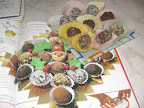
Crushed biscuit balls (Γλύκισμα από μπισκόττα)


Another rainy weekend trying to find something for the children stuck indoors to do. A public library Christmas crafts book provided the answer; a simple recipe, no cooking required, for a favorite sweet: chocolate crushed biscuit balls.
In a saucepan, help the children to melt 125g of butter. When it has cooled down a little, add 4 tablespoons of dessicated coconut, 4 tablespoons of honey, 4 tablespoons of cocoa powder and 250g of crushed semi-sweet plain breakfast biscuits. Stir that around really well, and pour the mixture into a square tin to set in the refrigerator. After a couple of hours, cut the set mixture into small squares, and roll each one into a small ball (they are malleable enough at this stage without being too soft). Roll them in your choice of dessicated coconut, chocolate powder, ground nuts or any other crumbly mixture that takes your fancy. For an extra treat, add some brandy to the mixture to make them into liquer balls for serving with adult coffee time!

©All Rights Reserved/Organically cooked. No part of this blog may be reproduced and/or copied by any means without prior consent from Maria Verivaki.

MORE BISCUITS:
Afghans
Brownies
Gingernuts
Koulourakia

Friday, 23 November 2007

Fava (Φάβα)

Greece's favourite bean puree is made from crushed dry yellow beans, which look like a cross between a pea and a lentil (but they're not green or brown). Not to be confused with the American meaning of fava, yellow split peas are commonly used to make this puree in Greece, although fava can also be made from the puree of dry broad beans (which is known as foulia in Greek), but it is not as tasty as the yellow split pea. This meal resebles Indian dhal in texture, so it can be used as a tasty dip for vegetables. Although it is extremely easy to cook, it does take a long time. It is not a freezer dish, but it can be stored in the fridge for a few days if it isn't eaten on the same day as it is cooked. And for such a tasty meal, it is economical in terms of cost and time.

You need:
250g split dried yellow peas
1 cup olive oil
3 large onions
salt and pepper
Pour the packet of fava into a pot and cover it with water. Boil the fava for thirty minutes, then drain the water away and let the fava stand for half an hour for the peas to swell a little. Drain them once again, and toss in the roughly chopped onions, oil and seasonings (it's that simple). Cover the ingredients with water, to level up to 1-2cm above the peas. Bring the pot to the boil, place a lid on the pot, turn down the heat to a low simmering point and let the fava boil away until all the water has evaporated and the peas have gone soft and mushy.

At this stage, you can put the mixture into a blender and turn it into a smooth paste, or leave as it is for a crunchier texture (I prefer the latter). Pour the mixture into individual plates, and have ready some thinly sliced onions, olives and and finely chopped parsley. You can also make some carrot and celery sticks to go with this meal, or use any other crunchy vegetable. Most people add more olive oil to their own dish, but that depends on how fanatically devoted to the liquid you are... The best protein to serve with fava is shrimps or calamari, but a good-quality grilled sausage also does the trick. We ate it with fresh whitebait, fried till crisp.

©All Rights Reserved/Organically cooked. No part of this blog may be reproduced and/or copied by any means without prior consent from Maria Verivaki.

MORE BEAN RECIPES:
Chili con carne
Lentil stew
Bean soup
String bean stew
Black-eyed beans
Pulses
Ginat butter beans

Wednesday, 21 November 2007

Onion soup (Κρεμμυδόσουπα γαλλική)

It's very cold today; not freezing in European terms, just very cold. Good soup weather, if you ask me, but since we ate fried young cod yesterday with lentil soup, I don't really want fish soup, or traditional Greek meat soup for that matter, which is madein exactly the same way as fish soup, except that fish is replaced with chunks of beef. To make matters worse, Greek beef tends to be tough and stringy - we are a nation of meat-eaters, but we don't raise good meat. Greeks aren't very creative in terms of their soups unfortunately, so I've gone for something French today, my favorite, onion soup. The recipes online (try elise and delia) all use roughly the same ingredients, with the same cooking style: caramelise thinly sliced onions in a saucepan, then add white wine, beef stock and seasonings. Let the soup simmer away till it takes on a golden brown colour. Enjoy it with some crusty bread topped with grated cheese, grilled on top of the soup, and a glass of white wine. A good stomach warmer, and a simple meal.

©All Rights Reserved/Organically cooked. No part of this blog may be reproduced and/or copied by any means without prior consent from Maria Verivaki.

MORE ONION/LEEK RECIPES:
Pocahed salt cod
Leek and potato soup
Leek pie

Sausages and onions

Saturday, 17 November 2007

Spanakorizo (Σπανακόριζο - spinach rice)


Spinach rice is very easy to prepare, and more impotantly, very healthy. It makes a saucy alternative to pilafi rice. You can serve it with a cheese selection, boiled eggs, grilled or fried fish, or roast meat. We like to smear it with strained yoghurt. It makes a filling lunch meal, but it's not party food; it forms part of the staple diet of Cretans (and Greeks alike). You can also freeze it BEFORE the rice is added, for later cooking. I do this regularly, so I always make double the recipe. In fact, I'm defrosting a batch I made a little while ago. Some people substitute cabbage for spinach (appropriately called lahanorizo). I would make it like this if it wasn't for my husband, who doesn't like the smell of cooking cabbage permeating the house.


You need:

1 1/2 cups of rice
half a cup of olive oil
1 onion, chopped small
a few cloves of garlic, minced
half a kilo of spinach
a bunch of parsley and/or fresh mint
half a kilo of fresh pulped tomato
1 teaspoon of tomato paste
salt, pepper and oregano
2 cups of water

Pour the oil in a pan, and sauté the onion and garlic till transparent. Add the well-washed shredded spinach, and saute till it reduces in bulk. Add the chopped parsley and mint, and mix it in with the spinach. Now add the tomato and tomato paste, along with some salt, pepper and oregano. Mix it all in and simmer for about 15 minutes. The spinach won't need much longer. You can also use frozen spinach to make this dish (not if you want to freeze it though!); it tastes just as good. If you're making the fresh spinach version, this is the point where you freeze it. Let the pot cool down, and pour it into small tubs, as large as the amount you want to cook when you defrost it. I find that a 500g tub is enough for a family of four when the spanakorizo is served with something else.

Now add the rice. If you are using frozen mixture, defrost it in a saucepan and make sure it is completely liquid before you pour in the rice. Add a cup of water for every cup of rice. I sometimes add a little less liquid so that the rice doesn't come out too soggy, in case the sauce was too liquidy, and top up the pan with more water if it needs it. Let the rice cook (white rice needs about a quarter of an hour), adding more water if the liquid seems to run out, or the rice is too gritty. Stir it every now and then to make sure the rice isn't sticking to the bottom of the pan (a sure sign that more water is needed).

When the rice is ready, turn off the heat, let the pot stand for a few minutes to settle the rice grains, and then serve it. If you don't eat it all on the same day, it heats up very well in the microwave.

The lovely Georgia made a Bulgarian version of this dish with vlita (amaranth greens) and a mixture of fresh herbs from the garden. She used lemon juice instead of tomato sauce, a more refreshing alternative in the summer.

©All Rights Reserved/Organically cooked. No part of this blog may be reproduced and/or copied by any means without prior consent from Maria Verivaki.

MORE RICE RECIPES:

Simple pilafi rice for children
Dolmades - Dolmadakia
Yemista - ayemista

Sunday, 11 November 2007

Freezer clearout (Ξεκαθάρισμα καταψύκτη - Τηγανίτες)


When the deep freeze is over-used, and in our house, so much of summer goodness is used to store winter nutrition, it does suffer from being defrosted infrequently. To speed things up, today's meals - starting from breakfast - were all concocted with a near-future freezer cleanout in mind. We started the day with frozen croissants for breakfasts, something I had bought on impulse from the supermarket, but would never buy again. On being cooked, the croissants were tasteless, and went hard almost as soon as they were cold. They needed 20 minutes cooking time, and as a treat, I cut them open and filled them with the Greek-brand Merenda chocolate-hazelnut cream (the well-known European equivalent of Nutella), which I noticed, had gone quite stiff at the bottom of the jar, a sign of its going bad. It's not just freezer foods that are forgotten about. Apart fromt he freezer, if you look into your larder, pantry, fridge, biscuit tin, breadbox and kitchen benchtop, where you might store little jars of various seasonings, as well as pickled peppers picked from your own garden, you'll find a number of items that need to be eaten or thrown out because they were not used before their expiry date, or they have taken on a stale appearance, making them completely unappetising.


For lunch, we enjoyed a "healthy" fry-up of food that would normally be classified as home-made fast food: stuff we buy from the supermarket to try out and forget to do so, lone frankfurters, stranded sausages, supermarket spring rolls (I won't be buying that brand again) and Cypriot meaty sausages (they were quite tasty), accompanied by a pan of fried potatoes. I added some stuffed aubergines (papoutsakia) that had strayed from their original tin, and pulped a couple of soft garden tomatoes with some olive oil to make a light sauce. The tin went into the oven. We washed this down with a couple of beers and a lettuce salad (from our own garden).


Dinner was more entertaining. I was clearing out the CD and DVD racks on my shelves - newspapers come these days with so much junk in them - when I came across a couple of UNICEF cookbooks for little chefs, and gave them to the kids. They found a recipe in one that showed them (pictorially) how to make chocolate-walnut pancakes (the book stated that the recipe came from Hungary). So they asked to cook it themselves! The pancakes cleared my fridge racks of cooking chocolate, butter and eggs, products whose expiry dates I don't always check on a regular basis, a good excuse to buy some fresh stuff!. To make the pancakes, you need to mix together 225g flour, 40 ml milk, 2 tablespoons water, 3 eggs, and 100 grams sugar. Let the mixture rest for an hour to make smooth pancakes. Now grind 100g walnuts and mix in 50g double cream and 2 tablespoons sugar. I used Greek yoghurt instead of cream. Set this mixture aside.

Cook the pancakes, one by one, by melting a dab of butter in a small pan, and pouring two large tablespoons of the runny egg mixture into the pan. They need a high heat and constant watching over the element so as not to burn. Aftr you cook them on both sides, take them out of the pan, and place a tablespoon of walnut mixture on one side of each pancake. Fold the pancake in half so that it sticks to the other side with the walnut cream. Melt 100 grams of cooking chocolate in 120ml of milk. When the milk and chocolate have blended together well, pour over the finished pancakes. These pancakes can be eaten for breakfast the next day, heated up a little in the microwave (and just how safe that is is anyone's guess).

©All Rights Reserved/Organically cooked. No part of this blog may be reproduced and/or copied by any means without prior consent from Maria Verivaki.

MORE WAYS TO USE LEFTOVERS:
Banana cake
Pizza carbonara
Chicken pie
Cottage pie
Chocolate balls
Kalitsounia
Papoutsakia
Tiropitakia
Taramasalata
Stir-fry noodles
Souvlaki
Dogfood

Thursday, 8 November 2007

Psarosoupa (Ψαρόσουπα - fish soup)

We still have NOT turned the heating on in Hania, but we DID have our first thunderstorm for the season this week - a fantastic display of roars and flashes reminded us that winter is finally here. It's not very cold yet, but even so, the sun still shines enough to turn a cold dawn into a humid morning. This cold weather is a good reason to make fish soup, an easy but somewhat demanding meal, containing such a variety of ingredients that it will suit everyone's tastes. It's not a meal that can be frozen, but it provides two completely different kinds of dishes, which compensates for the extra effort required to make this meal.

I use frozen fish to make this meal, although fresh fish can be used - but it's too expensive in Hania. A family of four could need 25 euro worth of fresh fish to make a decent fish soup - no thanks, not for my purse. Choose a fish species that has lots of thick meat on it. I like the taste and texture of red mullet. I also used another large plump fish which we call fangri in Greece. The more variety, the more delicious the soup will taste. You also need a variety of winter vegetables. The traditional Greek ones for this soup are carrot, onion, celery, courgettes and potatoes. I hate using courgettes in the winter, as they can only be grown in a greenhouse (these are my husband's choice); my 'foreign' additions include broccoli and brussel sprouts, but I would also add any other firm green vegetable that is in season. By the way, the ingredients and the method for making this soup are exactly the same as for meat soup, except that you use chunks of beef instead of fish (of course, ha, ha, ha).

I like to use five pieces of fish for this meal, and any amount of vegetables that I have available. The boiled veges make a wonderful hot or cold salad, with the traditional Greek olive oil-lemon-and-salt dressing. When preparing the vegetables and fish, clean them and leave everything whole. In a large pot, place the vegetables that need the most cooking to become tender, eg carrots. At the top of the pot, place the vegetables that need the least cooking, eg celery. Let the pot boil away until the veges are done. Then carefully lift them out and place them on a large dish, each kind heaped on its own. It will look beautiful. Now place the fish, slightly thawed with as few scales as possible in the pot and let them cook till done (when the flesh is tender); it doesn't need a long time. Lift the fish out of the pot when done and remove the skin, bones and innards, and place it on top of the veges or on the side in its own mound. It doesn't matter if it breaks up. Put the fish and vege platter aside. At this point, you can choose to serve the platter on its own, or make the soup and serve that on its own or accompanied by the fish and veges. We usually eat the platter contents in one meal, and I make the soup for the evening meal, to warm us up on a cold winter's night.

Now take the wonderfully aromatic stock you have just created with the fish and vegetables, and strain it through a colander into another pot; at this point, you are probably wondering how many items of crockery and kitchen utensils you will have lightly scented with the smell of the sea. Don't worry, you're almost there... Take a small piece of fish, half a potato, half a carrot, a bit of onion, a few leaves of brussel srpouts and a bit of courgette (which I wouldn't use myself) and blend them to a soft pulp with two large fresh tomatoes. If they don't blend well, add some stock to help in the liquidisation. Pour the pulp into the stock, and heat it up. When it is warm, add just enough rice to turn the stock into a soup (and not a pilau rice dish). Season the soup with salt and pepper, and add some olive oil so that the soup is not watery. The soup must be served immediately. Serve it in soup plates, and set a small plate for each diner to allow them to help themselves to the warmed-up platter of fish and vegetables. There should be lemon halves, salt and a bottle of olive oil on the table to allow each person to dress the fish and veges to their liking. If you serve it on its own, it can also be accompanied by a variety of cheeses. Don't forget the crunchy sourdough bread and a good glass of white wine!

©All Rights Reserved/Organically cooked. No part of this blog may be reproduced and/or copied by any means without prior consent from Maria Verivaki.

MORE FISH RECIPES:
Bakaliaros (cod)
Hake
Bakaliaros - bakaliaraki
Octopus stew
Shrimp in lemon
Squid stew
Squid fried
Taramasalata
Mussels sauce

MORE SOUPS:
Chicken stock
Poached fish soup
Fennel soup
Avgolemono
Leek and potato potage
Lentil soup
Bean soup
Black-eyed bean soup
French onion soup
Pumpkin soup

Tuesday, 30 October 2007

Table olives (Ελιές τσακιστές και παστές)

Despite the excess sunshine that we are still experiencing here in Chania, it's time to start picking olives off the trees in our olive grove to put into salt, lemon juice or vinegar to make olives edible as fruit (rather than to be pressed for olive oil). There are two main types of olives grown in Hania: lianes (very small fruit, only used for pressing into oil) and tsounates (used both for table olives and olive oil). Lianes are preferred for their endurance to stay on the tree without dropping off too early due to adverse weather conditions, but they are too small to be turned into table olives. They can be hand-picked or the branches can be "thrashed" by hand or machine tree by tree. Tsounates are not that sturdy; they drop off the trees at the slightest breeze, so nets are placed under the trees at the end of summer to catch them as they drop during the autumn and up to the middle of winter. They can then be gathered for pressing at a convenient time for the owner, but since they were already on the ground for quite a while before they were pressed, they will contain less oil than lianes. By the way, all olives start their life green; they all turn purple black over time.

Black olives are preferred for salting, while green olives are marinated in lemon juice, or salt and water; people choose whatever method suits their time and taste. Black olives are put in vinegar, also known as Kalamata olives, pointing the way to their origins, Kalamata. I have put olives in vinegar before, and they tasted delicious, but it's not common practice in Hania to do this, as the olive varieties grown here are different to those of other regions in Greece. Lemon juice (or bitter orange) and salt are the main preserving agents here. We don't eat olives straight from the trees; they are far too bitter.


The olives need to be large and firm. Pick them straight off the trees, not from the ground, and make sure they are as unblemished as possible. The fallen ones will be full of dackos flies and their eggs. These insects are harmless to humans, but cause great destruction to the trees and fruit. Separate the black olives from the green. Wash the black olives to free them of dust, then dry them well. You don't want any excess moisture when using salt. Place the black olives in a container that can be sealed with a lid, layering them in large-grain sea salt. When the container is filled to the top, close it and leave the olives in a cool dark place for up to a month to wrinkle and darken in the salt. Once you open the container a month later, drain them of the excess liquid that accumulates due to moisture. Take a cup full of olives and wash away the salt. Put them in a small bowl to serve. They can be kept in the fridge or at room teperature; They keep just as well both ways. While you're eating the washed olives, the salted ones will keep just as well in their original container. This method of preserving olives is really fuss-free.


Now for the bothersome green olives. They can be picked any time once they have grown to the size of an acorn nut, and should be firm and bright green. They need to be crushed with a wooden mallet on an easy-to-clean kitchen-top (or plastic bread board - I doubt a wooden one cleans well) before being placed in tap water for two-three days in order to remove most of their bitterness. Try not to smash the olives with the mallet; give them a firm tap so that they will open without the pip coming away. This job is a dirty one; anything the olive juice stains will remain there for life, unless you clean it off with bleach. Your fingers will turn as black as the black olives themselves. I always wear plastic gloves to do this job, as I don't think it would look too good going into an English lesson in the evening looking as if my fingers have developed gangrene. The best place to do this job is in the garden on a clear day when you won't feel the cold. I even keep an old T-shirt to wear just for this job. I have tried slitting the olives with a kinfe instead of crushing them, but they do need more time in the water (up to four days) and the taste is not the same, meaning I liked it, but not so my traditional Cretan husband. He has forbidden my use of this method.

Once you have crushed the olives, place them in a big open bowl of water, once again in a cool dark place for two-four days, depending on the method used to cut them. Change the water as often as you can; this removes the bitterness more quickly. After this period, drain the olives and pack them in glass jars, preferably big ones. You now have to start squeezing lemons for their juice, a tiring process than can leave you with hand-strain injury. The good part is that your hands will become as clean as they were before you started crushing the olives. Place a heaped tablespoon of salt (more if the jar is very large), and pour the unstrained lemon juice over the olives and a few tablespoons of olive oil to seal it, then close the jar with a tight-fitting lid. The olives will be ready in about two-three weeks, depending on the crushing method, their maturity at picking and individual taste.

Generally speaking, Greek dishes calling for olives cooked in meals, whether ripe or unripe, are NOT generally the norm, except treated ripened green ones in a tomato-stewed squid dish, where they are added in the last few minutes of cooking. I can't understand the reasoning why they are added in tomato-seafood dishes, but then puttanesca wouldn't be the same without black olives, would it?


The final method for marinating olives is to clean them by running tap water over them, place them in a clean coca-cola bottle, fill the bottle with tap water and add a tablespoon of sea salt on the top, before closing the bottle securely and leaving them in the bottle, WITHOUT opening it until about Easter time. Keep them in a cool, dark place. My bachelor uncles gave me this recipe. I have tried it in the past, and I prefer them done this way - they have a mature pure olive taste. We did not have enough green olives this time round to preserve them in this way, but I will try to remember to put some aside next year. When opening the bottle in April, beware: open it as slowly as possible, because the olives will have been fermenting all that time, and when you unscrew the cap, they may explode out of the bottle unexpectedly!

©All Rights Reserved/Organically cooked. No part of this blog may be reproduced and/or copied by any means without prior consent from Maria Verivaki.

See also:
A day in the field
The rape of the countryside

A summer garden
A winter garden
An autumn garden

Friday, 26 October 2007

Karidopita (Καρυδόπιτα - walnut pie)

Here is a party dessert that you can serve with ice-cream. I made it today because it is St Demetrius' Day, so my husband's celebrating his nameday today. It's a traditional Greek sweet, and it's unusual in that it doesn't contain flour. Walnuts added to a cake are also a firm favorite in Cretan cuisine, since there are so many walnut trees in the area.

You need:
250 g butter or margarine
6 eggs, separated
3/4 cup sugar
3 cups ground walnuts
3 cups dry breadcrumbs
2 teaspoons of cinammon
1 wineglass of brandy
1 orange, both the juice and the rind
2 teaspoons of baking powder
Mix well the butter or margarine and the egg yolks with the sugar. Add the breadcrumbs and walnuts, along with the cinammon, brandy, baking powder and the grated rind of the orange.
In another bowl, beat till stiff the 6 egg whites, and add them to the batter. If the mixture looks too dry, add the juice of the orange, or the equivalent in milk if you prefer. Turn the batter into an oiled baking tin (or pyrex dish if you want to serve it in the pan it is cooked in) and cook in a moderate oven for 40 minutes.

For the syrup:
While the cake is cooking, boil up 3 cups of water and 2 cups of sugar along with a quarter of a lemon and a cinammon stick, till it becomes thick and syrupy. When the cooked cake comes out of the oven, cut it into squares (but don't lift the pieces out!), and pour the slightly cooled syrup over the cake. It may remind you of a baklava when you serve it, except of course that it isn't a pastry pie! Serve a piece of pie with a scoop of ice-cream; chocolate or vanilla go best.

©All Rights Reserved/Organically cooked. No part of this blog may be reproduced and/or copied by any means without prior consent from Maria Verivaki.

MORE PUDDINGS:
Apple pie
Bougatsa
Brownies
Tsoureki
Chocolate cake
Chocolate pancakes

Apple pie
Tiropitakia
Halva
Fruit crumble

Saturday, 20 October 2007

Lazy Saturday meal (Κοτόπουλο με κάρυ - Λαχανοσαλάτα)

There are many days (plenty of them) when we can't be bothered with food. Today was one of them for me. A cabbage salad with grated carrot and slivers of pointy red peppers was dressed with salt, olive oil and wine vinegar (the common variety used in Greece). This was the accompaniment to some free-range chicken browned in olive oil with chopped onion, minced garlic and some more thinly sliced pointy red peppers, all doused with a bottle of ready made tikka masala sauce poured over it, in which it simmered for an hour - free-range chicken meat is tougher than indoor-reared chicken, so it needs a longer cooking time. Crusty bread is a must for the thick sauce that is produced by the various fats in the pot. We also had a choice of rose and white wine. A very simple, and very satisfying meal.

©All Rights Reserved/Organically cooked. No part of this blog may be reproduced and/or copied by any means without prior consent from Maria Verivaki.

MORE SALADS:
Summer horta
Winter horta
Lettuce salad
Salad advice
Greek village salad
Cretan salad

Beetroot salad

Wednesday, 17 October 2007

Corn and tuna pasta (Μακαρόνια με καλαμπόκι και τόνο)

Here's a favorite lunchbox meal of my children's. I prepare it in the evening and pack it for them to eat at school the next day, but it's so quick and easy that you can even prepare it in the morning so that the children can take it fresh with them. Both the kindergarten and the primary school have refrigerators and a conventional or microwave oven, so I'm not concerned about food going off in their bag before lunchtime.

Open a small tin of tuna, and drain it of the oil or brine. Likewise with a small tin of corn (not the creamed variety). Boil some pasta (enough for two servings) till al dente. When cooked, pour in the tuna and corn. I don't add salt, but that's up to you. Add two full tablespoons of mayonnaise and mix everything together. Voila!

This lunch snack reminds me of the Marks and Spencers sandwiches we ate while on a train journey from Cambridge to London: buttered wholewheat bread triangles filled with corn, cheese and tuna. Yum yum!

©All Rights Reserved/Organically cooked. No part of this blog may be reproduced and/or copied by any means without prior consent from Maria Verivaki.

MORE PASTA RECIPES:
Puttanesca
Bologanise
Stir-fry noodles
Stir-fry beef
Blue dragon
Octopus stew
Pastitsio
Pizza carbonara
Mussels sauce

Saturday, 13 October 2007

Guacomole (Αβοκάντο κρέμα)

Avocados are a relatively new fruit to Greece. The southern Greek climate is perfectly suited for their rapid growth, they are a sturdy plant not prone to serious attacks by pests and disease, and as their market value is high, the avocado has become one of the most popular alternative crops being planted in Crete. When they were first brought out onto the Greek market, the locals basically didn't know what to make of them. They thought of them as a fruit, so they served them after the traditional olive oil-y meal. They weren't sweet enough, so they sprinkled some sugar over them (thereby doubling the caloric value of the crop itself). They were then told to eat them as a salad, so they cut them up in a shallow dish and doused them in olive oil, not taking into account that the avocado itself was naturally endowed with its own lipids. I think that Greeks still view them as a mysterious crop. Avocado lends itself in Greek cuisine as a colourful addition to a tomato or lettuce salad, omitting the copious amounts of oil.
Here is my favorite dip, taking pride of place over traditional Greek dips such as taramosalata and hummus (but not tzatziki - that's a special one when made properly). With a hint of hot spice, it's perfect for chilly winter weather. Maybe it's the green colour; I even had my walls painted light green when I was living all by myself (and had control over whatever happened in my life, and made up my own rules about how I wanted to live). We have guacomole with bean or lentil soup, and dry roast meats. I love it with julienned vegetables (carrots, celery, cucumber) and crisps.
Take one soft but not bruised avocado. The one I used looked like the one in the photo; it was a South African imported variety (I'm still waiting for someone to give me some avocados fromt he village). Peel and stone it, put it into the blender with three cloves of garlic, some salt, a pinch of ground chili pepper, and the juice of a large lemon. Whizz everything together. If the mixture seems a bit gritty, and it isn't blending together, add a tablespoon of tomato juice or olive oil in the blender to smoothen out the lumps.

©All Rights Reserved/Organically cooked. No part of this blog may be reproduced and/or copied by any means without prior consent from Maria Verivaki.

MORE DIPS:
Fava
Taramasalata

Friday, 12 October 2007

Our autumn garden (Ο φθινοπωρινός κήπος)


Here are a couple of snapshots of our garden at the moment. Notice that the peppers and aubergines have taken a new lease of life from the cooler weather; they are by far the most productive crops in our garden. We have also planted some lettuce, cabbage, cauliflower and broccoli. They need constant watering, and we haven't had any rain since May. God help us through the winter (if there is going to be any).

Artichokes are an unusual vegetable; they are a favorite salad crop in Crete. The artichoke shrub dies down completely at the end of spring, and resurfaces in the beginning of autumn, in the same place where it had last been seen in the garden. The one in the photo is intercropping with a zucchini plant; I captured this shot because it looked so unusual - a summer vegetable and a winter vegetable entwined together harmoniously!

Apart from the artichokes, the rest of the winter garden is not doing so well; even if it is early October, the temperatures are still very high, averaging a maximum of 27-28 degrees Celsius daily. We really do want to see rain; winter crops (broccoli, cauliflower, cabbage and lettuce) are deperate for moisture, but all we can provide them with is dry brown soil.

©All Rights Reserved/Organically cooked. No part of this blog may be reproduced and/or copied by any means without prior consent from Maria Verivaki.

See also:
A day in the field
The rape of the countryside

A summer garden
A winter garden
Table olives

Banana cake muffins (Κέικ μπανάνας)

Banana cake is my favorite NZ tea-and-coffee accompaniment. Sadly, we never made it at home; my mother used to bake all the staple Greek sweets that my own family now enjoys in my own home, but she never made true NZ banana cake. She once made a Greek cake, to which she added bananas, but it still tasted like Greek cake, rather than the moist banana bread the Edmonds cookbook recipe turns into. We used to buy some as an occassional treat when we were in town. I remember a day when I was wearing my school uniform (a teal colour; most people would not know what the word 'teal' meant, let alone be able to visualise it as a colour), doing some shopping with my mother in James Smiths, or maybe Farmers, or was it Woolworths? It can't have been anywhere else, because they were my mother's favorite stores; you could find anything you wanted in them. If you wanted to buy someone a wedding gift, you went to James Smiths', if you wanted good quality moderately priced household goods, you went to Farmers, and if you wanted to buy lollies, you went to Woolworths. To get there, we had to pass the Dixon St deli where we used to buy salami and olives once the Italian grocery near our house closed down due to a sharp decline in trade when Wellingtonians began to take delight in visiting the new supermarkets and shopping malls that were sprouting up in the suburbs. We never did indulge in such activities as a trip to New World in Newtown, or Pak'n'Save in Kilbirnie. We lived just above Kent Terrace; we didn't need to go to Newtown or Kilbirnie. We had it all on Courtenay Place and Manners St.

I must have asked her then if we could buy some of the banana cake I was looking at in the window of a cake shop; I don't think it would have been on her shopping list. She bought two huge slices of it - each slice could have been cut into three decent portions. The aroma permeated our shopping bags. It smelt and felt like the cake my schoolmates bought in their lunchboxes. I was so happy when the shop assistant gave her the brown paper bag containing the cake. I couldn't wait to go home and have it with---

Before I had thought about how it would look in our banana-cake-less house, and how we were going to enjoy it as part of our tea, my mother suggested we could eat it by the Cuba St bucket fountain a few metres away from the deli. I hadn't expected this; without thinking, I just said 'OK'. She was treating me to some banana cake, so I felt I must reciprocate by taking her up on her offer. Mother and daughter sat silently, back to back (the outdoor seating was to blame) in the pedestrian zone, our shopping bags beside us, devouring the XL slices of banana cake by ourselves. I had a sudden panic attack, the feeling that I was in the wrong place. Two plump olive-skinned sheilas among a majority of paler faces, eating inappropriately oversized portions of a light dainty sweet,disregarding the ettiquette involved with eating banana cake. As I was sitting there with my mother gorging on my piece, the thought came to me that she never made this cake at home because she didn't know what to do with it. I wanted to tell her that we should have been sitting indoors, not outdoors, having a hot drink, stirring sugar cubes in a cup of tea sitting primly on a saucer, not scoffing it down in the middle of the street. I wanted to tell her that she didn't have to feel a stranger in NZ any longer, that she was a part of the melting pot culture that composed the genetic make-up of the average Kiwi, that there were plenty of other foreigners like her who were happy to be called a Kiwi, and they let their children be Kiwis just like the pale-faced lot. She had been in New Zealand for nearly 20 years at that point. By virtue of her years in the country, she had more claim to being a New Zealander than I did. I was tired of being a stranger in my own country, doing everything differently at home from what I did at shcool. We could make banana cake at home too, and eat it like the other girls did at school.

But we never did. So we sat there silently, not really knowing what to do with it now that we had it, so we did whatever came naturally to us. We were sitting there by chance, partaking in an experience that we did not want to be a part of. I wasn't being a fair dinkum Kiwi; instead I felt like a fraud, masquerading as a local in a Wellington Girls' uniform, hiding my true self. At the same time, I had a sense that I wasn't the good Greek girl I was supposed to be, either, because I was eating a huge piece of cake that I should have shared with the people who were passing by, especially the ones that smiled to us, mainly the Maori. They seemed to understand us better than the pale-faced lot. They looked more like us too with their dark features. Maybe just the lips; theirs were fuller than ours, but the shades of skin, hair and eyes were the same.

When I moved to Greece, the first cookbook that I bought on my first return visit to NZ was the Edmonds cookbook. I bought myself a loaf tin, and made banana cake regularly. I kept it in an old biscuit box with a Victorian scene on the lid. I ate it in small slices. I lived on my own, so I had no one to share it with. I had to eat it by myself. I ate it for breakfast, lunch and dinner, three slices a day. I may as well have eaten a slice as big as the Dixon St deli's and got it over and done with all at once. When I got married, I made it for my husband. He didn't like it. "Why don't you try making a Greek cake, Maria?" I knew what he'd say next: "Now that you don't live in Greece, you can't expect to cook like a New Zealander, like you did back home." Alas, how could he know that my late mother only cooked Greek food? Now that I was in Greece, I couldn't cook Greek food, because all I wanted to eat was Kiwi food. I had severed my past in so many ways, but I could not sever my taste buds completely from Kiwi kai. I never felt I belonged anywhere.

I was adamant that someone would eat my favorite cake with me. It had to be someone who had no past experience of what constituted Greek food or Kiwi food, someone who couldn't compare one cooking style to another. Finally my banana cake companions came along: my children. And to make sure that they feel at ease about eating banana cake, I muffinise all my cakes now, simply because muffins make decent-sized servings that do not lead to obesity, as well as leaving no crumbs. They also make for easier lunch box packing. Here's the genuine dinkum Kiwi cake recipe of choice from the bible of Kiwi cooking, the New Zealand Edmonds cookbook, altered for my Greek kitchen and supplemented by an extra addition of healthy goodness with locally collected walnuts. The mixture makes 18 medium-sized muffins, something between the giant sized ones you buy from 'health' shops (just think how healthy it is to over-eat), and the mini-sized ones that may be served as hors d'oeuvres (kids would need at least two of those for their morning break).


You need:

a muffin tin lined with paper-cases (or a greased or lined loaf tin)
2 bananas
2 eggs
1 teaspoon vanilla essence
3/4 cup sugar
125g margarine
1/4 cup milk
1 teaspoon bi-carb soda
200g self-raising flour
2/3 cup finely ground walnuts

In a bowl, blend (or whisk) together the bananas, eggs, vanilla, sugar and margarine. In a cup, mix together the soda with the milk. When it is frothy, pour it into the banana mixture. Mix in the flour to make a batter which isn't runny. Mix in the walnuts and spoon the mixture into the paper cases. If you fill them to the top, they will rise into mini-cakes when cooked; otherwise, fill them 2/3 of the way up, so that they remain as big as the paper case. Cook in a medium-hot oven till the cakes are done (test them with a toothpick). Let them cool before you serve them. To keep them for a week, store them in an air-tight tin. They can also be frozen; they defrost well in a child's schoolbag, so that by break-time, they are ready to eat.

Coincdentally, there is no mention of banana cake in the fifth edition of Edmonds cookbook which came out in 1914, not forgetting that the first edition of the Edmonds cookbook came out in 1907. How on earth d'ja know that, you might be wondering. It is in my possession, among other bits of New Zealand trivia that I could not bear to part with as I've already discussed in my afghan recipe). My edition with the banana cake recipe was published in 1983, but I've seen similar recipes on the internet for banana bread, all using the same ingredients, more or less. When were bananas readily available in New Zealand? The British must have known them since they discovered the Carribean, but when did they become readily avaialble in New Zealand? There's a tricky one for all of us to think about. MissJilly also mentions a nice simple banana cake recipe which could be used alternatively.

©All Rights Reserved/Organically cooked. No part of this blog may be reproduced and/or copied by any means without prior consent from Maria Verivaki.

MORE CAKES:
Apple pie
Chocolate cake
Simple cake
Carrot cake muffins
Chocolate muffins

Vasilopita
Walnut cake
Apple cake
Halva
Tsoureki


Saturday, 6 October 2007

Carrot cake muffins (Κέικ καρότου)

Muffins are perfect for school box lunches. They take up less space in a condensed area, come in their own packaging and leave no crumbs. I found a recipe for carrot cake on the web and turned it into muffins. I omitted the cinnamon, mainly because it's not a favorite of my family's. I also put the walnuts (we don't use pecans in Crete) in a blender and turned them into crumbs. They don't get stuck in your teeth this way!

For the sake of convenience, here is the carrot cake recipe from joyofbaking:
1
cup (110 grams) pecans or walnuts, toasted and coarsely chopped
3/4 pound (340 grams) raw carrots (about 2 1/2 cups finely grated)
2 cups (280 grams) all-purpose flour
1 teaspoon baking soda
1 1/2 teaspoons
baking powder
1/2 teaspoon salt
1 1/2 teaspoons ground cinnamon
4 large eggs
1 1/2 cups (300 grams) granulated white sugar
1 cup (240 ml) safflower or canola oil (but of course you can make this cake with olive oil)
2 teaspoons pure vanilla extract

Preheat oven to 180 degrees C). Chop the nuts coarsely. Peel and finely grate the carrots. Set aside. In a separate bowl whisk together the flour, baking soda, baking powder, salt, and ground cinnamon. Set aside. In a mixer, beat the eggs until frothy (about 1 minute). Gradually add the sugar and beat until the batter is thick and light colored (about 3 - 4 minutes). Add the oil in a steady stream and then beat in the vanilla extract. Add the flour mixture and beat just until incorporated. With a large rubber spatula fold in the grated carrots and chopped nuts. Divide batter between two prepared pans and bake 25 to 30 minutes or until a toothpick inserted in the center comes out clean. Remove from oven and let cool on a wire rack.

I made the recipe into muffins, which turned out excellent; they had a crispy exterior, while they remained soft and moist on the inside, but I didn't frost them (we don't need the extra calories). My only complaint is that they didn't have a spicy or tangy taste; without the cinnamon, they were rather bland, so the next time I make them, I will add orange or lemon zest to the batter. I highly recommend this recipe. It epitomises health, in that it contains many natural ingredients that we don't usually eat in our daily diet because they need preparation: carrots need paring and grating, the walnuts came from a friend's trees, and I added olive oil (produced from local olive groves). You can improvise on this recipe by adding raisins and crushed pineapple to make the cakes moister and more chewy. You can also freeze the muffins in the same way as banana cake muffins and allow them to defrost in a child's lunchbox; by break-tiume, they'll be ready for eating.

©All Rights Reserved/Organically cooked. No part of this blog may be reproduced and/or copied by any means without prior consent from Maria Verivaki.

MORE CAKES:
Banana cake
Brownies
Chocolate cake
Simple cake
Chocolate muffins
Vasilopita
Walnut cake
Halva
Apple cake
Tsoureki

Pizza (Πίτσα χωρίς μαγιά)

Here's a quick 'no yeast' based pizza dough that makes a thin, biscuity base. It's best eaten on the same day, as bread that does not contain yeast tends to dry out (whereas yeast products go mouldy instead). Mix some oil and margarine (about 1/2 cup worth) with an egg and a small tub of Greek yoghurt in a bowl. Add a teaspoon of baking powder and a sprinkling of salt. Then add the flour, enough to make a spreadable dough. Roll the dough out into a pizza or baking tin. I have a pizza tin that has holes in the base to allow the dough to cook better underneath.

For a filling yeast dough, look up my ladenia; it has now become a weekly treat for the whole family, and it is really easy to make. The dough requires very little kneading, it is easy to press out into a baking tin, and you can keep it vegetarian, as it contains a lot of olive oil, and makes a filling snack without the meaty toppings.

Top the pizza with a layer of thinly sliced ham, pepper rings, thinly sliced tomatoes and grated cheese. Cook till the pastry is crispy and brown, and the cheese is melted. Enjoy it once it's cooled down a little, as hot tomato burns!

©All Rights Reserved/Organically cooked. No part of this blog may be reproduced and/or copied by any means without prior consent from Maria Verivaki.

MORE PIZZA/PIE RECIPES:
Ladenia
Pizza with a yeast dough
Pizza carbonara
Chicken pie
Cottage pie
Spanakopita/hortopita
Kalitsounia
Leek pie
Sfakianes pites
Spiral pie