Greek identity with a difference, from the inside out and the outside in
(formerly Organically Cooked - Linking Greek food with Greek identity: you eat what you are, or who you want to be)
Last Sunday we were going through a heatwave. The barbecue area of our house is still under siege
by painters' tools, so our Sunday meat dish had to be a lazy affair -
souvlaki, with a garden salad as and some potatoes as a side, sounded like a tasty quick-fix meal. I looked in the cupboard for those delivery pamphlets we tend to keep for those just-in-case moments. I just needed to find the telephone number of our local souvlatzidiko. I ignored the prices stated on the pamphlet - they were way out of date, since the pamphlets had been there for a while: eg €2.50 for a pork souvlaki and €2.70 for chicken.
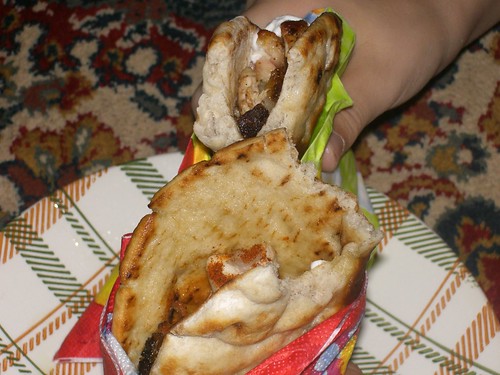
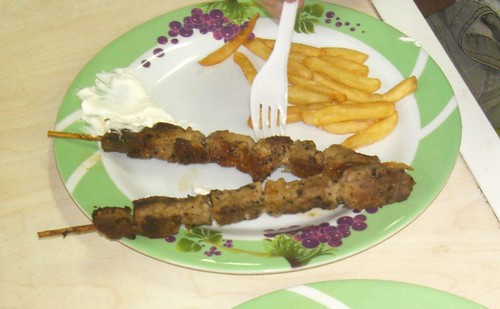
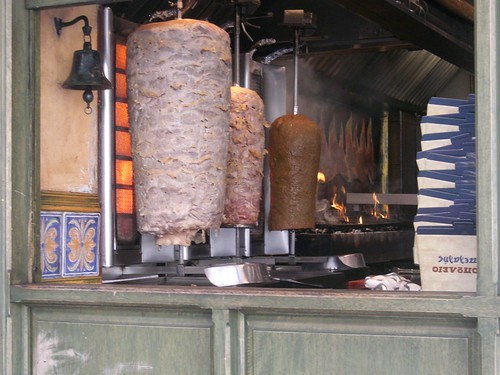
Souvlaki to the Greeks generally means slivers of meat wrapped in a pita bread (often called yiro), or cubes of meat on a skewer (usually referred to as xilaki or kalamaki), with bread as a side. The meat is cooked on an upright grill if it goes in the pita bread, or on a conventional barbecue-style grill if it's on a skewer.
Working at a souvlatzidiko is hot work all year round.
Since the economic crisis gripped the country, the price
of souvlaki in all forms has gone down, which shows how far the crisis
has penetrated: souvlaki is the most popular Greek fast food, and it was
generally viewed as the cheapest. Three years ago, a pork yiro used to cost as much €2.60; now it costs €2 at most places. Chicken yiro was as high as €2.70 - now that's down to about €2.30. A new place on the main road into town has a neon sign advertising yiro at €1.90 - that would be for pork yiro, as that is the meat of choice in Greek souvlaki.
Chicken xilaki (or kalamaki)
A pork kalamaki used to cost as much as €1.50; now that's down to €1.20 on average, although a number of places sell it as low as €1, which they proudly advertise on a chalk sandwich board outside their business. Chicken kalamaki has always been more expensive than pork - it's now €1.40-1.50. Beef souvlaki - which has made a comeback in Crete, after being the souvlaki of choice in the past, overtaken by pork for the last 4 decades - is only served as yiro (never skewered). It costs about the same as chicken souvlaki.
The fact that the price of souvlaki has come down and stayed down shows how much competition there is among souvlatzidika. The fact that the stores in my town don't have webpages also shows how traditional they are. When you need a souvlaki, you know where you're going to find one. Some souvlatzidika have closed down during the crisis, but that was inevitable, because there were too many of them around; the good ones know how to keep their customers.
8 chicken souvlaki, 8 pork souvlaki, a serving of fries and 4 pita breads (not charged) - €24.40; supplemented by a garden salad and some yoghurt, this is a very cheap way to enjoy meaty meal for Sunday lunch - and you don't cook it yourself. (For 6 eaters - 5 souvlaki were left over.)
I forgot that my local souvlatzidiko doesn't work on Sunday mornings which means that it's doing quite well to be able to close down half a day a week. It has lowered its prices since I last ordered souvlaki there - evidence that prices were too high before, and prices can be lowered. Our other cheap choice was in town, which felt a little too far away for me on a very hot Sunday midday, so I chose the closest one ot our house. I was surprised to find that it was quite a bit more expensive than what we expected to pay according to the local prices - but the servings were actually a little bigger. It's all about competition and trying to keep customers happy.
When my family visited London a few years ago, after touring the Greenwich area on a freezing cold Sunday in March, before heading back to the train station, we decided to stop somewhere to have a bite to eat, in the hope that we would feel warmer. I've never appreciated a hot meal as much as during that first trip to my favorite holiday destination in the world; it rained very little during our ten-day stay, but the temperatures were lower than 5 degrees Celsius most of the time. We found a diner on the main high street in the area with the word 'kebab' written on the sign. Finally, I thought, I'm getting a chance to eat at a Turkish restaurant. We all ordered kebabs, and came out of the restaurant at the end of the meal wondering if there was any essential difference between 'kebab' and 'souvlaki'.
Our first trip to London, March 2006 - temperatures ranged between 0 and 10.
Both 'souvlaki' and 'kebab' have the same modern Greek meaning: 'skewered meat'. The original meaning of the word 'kebab' is 'fried meat'; this meaning is retained in stew-like meals such as 'bowl kebab', but not in the Greek sense. The word 'souvlaki' means 'little souvla'; the big souvla is where Greek-style lamb is cooked at Easter, over a hot fire on a spit. Kebab is most likely Arabic in origin, and is used in the Turkish language for the same kind of food that we call souvlaki in Greece. Both words are used in Greece, but each one denotes something different. So it's really important to know what to ask for when ordering at a taverna, as Matt Barrett points out; his Tale of 2 Souvlakia makes an interesting point about using the right phraseology so that you can take back happy food memories from a Greek holiday.
When ordering souvlaki pita/yiro, you can ask to omit one of the garnishes, eg onions. When I make souvlaki at home using leftover BBQ meat, my kids prefer them without tomatoes and onions. Shame really, but hopefully, they'll learn to eat them as they were meant to be eaten once they get older.
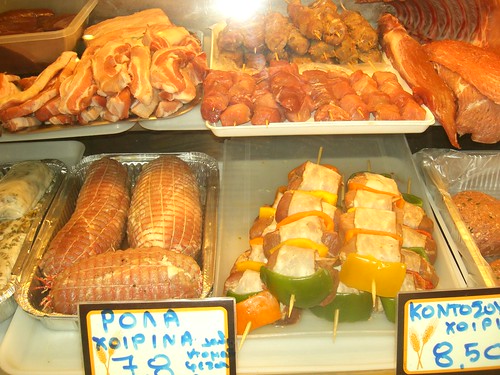
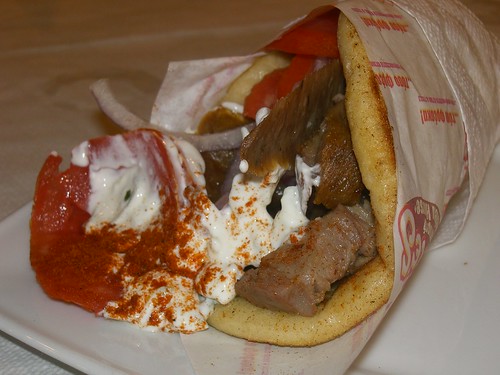
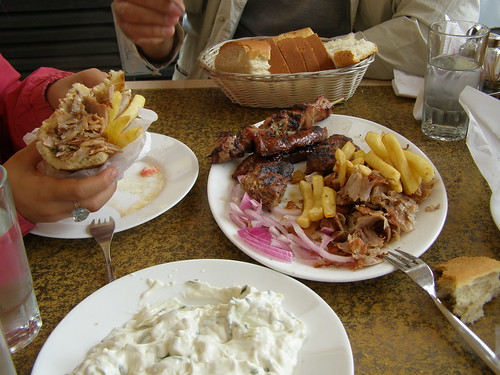
When Greeks ask for a 'souvlaki' from a takeaway bar, they usually mean pita bread wrapped round slivers of roast pork meat (you can also ask for chicken instead) that have been sliced off an upright rotating grill, topped with slices of onions and tomatoes and some yoghurt, and sprinkled with red pepper (paprika), and maybe a few fried potatoes added to it as well. But the same word can also mean cubed pork meat on skewers, cooked BBQ style, which is often served on a plate, although it can also be served wrapped round pita bread (skewer removed) with all the regular toppings. When buying freshly prepared skewered meat from a butcher, Greeks will ask for souvlaki; it's highly unlikely that they were expecting a cooked meal from a place like this!
This is really confusing for some people who expect to be served the sandwich style souvlaki at a taverna, but get the skewered souvlaki on a plate. Because of that politically correct tendency that English language speakers and Northern Europeans carry with them when they travel, to accept what they are given without question, most tourists simply thank the waiter and try to hide their dismayed looks, but inevitably, they go away thinking that Greece isn't all it's cracked up to be.
Souvlaki served to children at a day camp site; freshly prepared souvlaki is available from any Greek butcher's shop on a daily basis.
If you want a souvlaki wrapped in pita bread with greaseproof paper, you should ask for a 'pita yiro'; yiro' means 'round', so the souvlaki will be wrapped in pita bread and held with the hands. These are to the Greeks what the hamburger is to the American, or fish and chips to the British. Many takeaway places also serve them on a plate at the table, not just as take-out meals. If you really do want the skewered meat, then say 'xilaki' or 'kalamaki', which both mean 'little stick', meaning that the souvlakia will be cubed meat (still on the skewers), served on a plate; the normal serving size is two 'xilakia/kalamakia' per person. If the taverna is more up-market, a metal skewer is used instead, and you'll probably get one large souvlaki.
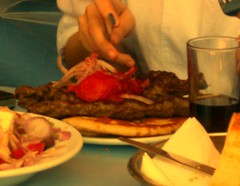
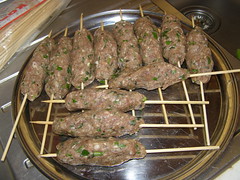
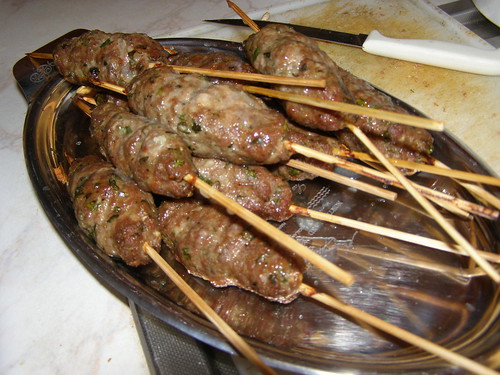
Souvlakia in Greece are hardly ever referred to as kebabs. The Greek 'kebab' (a word adopted into the Greek culture from the time of the occupation of the Ottomans) has come to denote compacted minced meat with herbs and spices added, wrapped round a skewer and cooked over an open fire, just like the souvlakia on sticks. So if you ask for a 'kebab', don't be surprised if the meat on the skewer looks like one long sausage without its casing; that's what you asked for. If you ask for a 'pita kebab', then that sausage will come inside some pita bread (minus the skewer) with all the trimmings, just like the 'yiro' described above.
*** *** ***
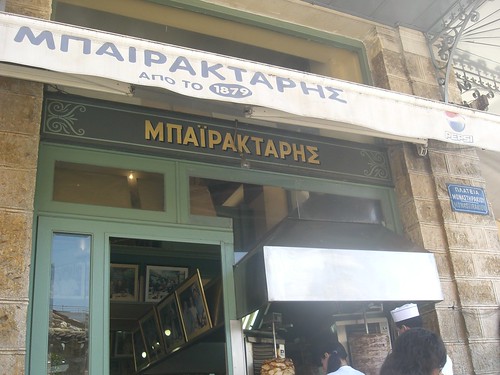
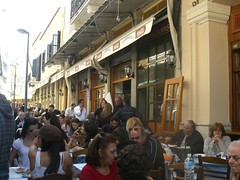
For a truly Athenian food experience, you mustn't miss out on al fresco dining, under one of the most famous monuments in the world, at one of the kebab houses located in Monastiraki, in the centre of Athens. If you've been through Athens without doing this, then you've probably missed out on the greatest traditional culinary experience that this city has to offer.
Bairaktaris, Thanasis and Savvas all serve really good juicy kebabs that very few cooks can imitate in their own homes. The secret is in the large quantities they make and their own special blends of herbs and spices that they have developed over the decades. Some kebab shops serve mainly (or only) kebabs, so that their product is always fresh, given the large turnover of the same product. I've been to all three of the kebab restaurants mentioned above, and I found the food served at all of them equally good. Savvas seemed to have the most friendly staff and there was no hawking for customers (at least on the day I was there).
These kebab houses on Monastiraki Square are located in the same area and have a very respectable reputation; they are always crowded with diners eating delicious succulent kebabs served on pita bread with onions and tomato. Salad, fried potatoes and tzatziki are always served on the side ,and some of these places serve little else. .
To make kebabs of the highest order, you need a good recipe, the right cooking facilities and possibly some good cooking skills learnt from experience. Making kebabs is a little like making biftekia; you can use a basic meatball recipe, but the kebab mixture must be super smooth and sticky, so that it will stay put when you stick a skewer into its centre. Make sure all the ingredients are so finely cut or ground that when they are rolled into a ball, they will look like one big reddish brown mass.
I'm still perfecting my kebab recipe in terms of spice combinations. A perfect kebab needs to be smoother in appearance than mine, it should be cooked over an open fire, and it should retain its juices.
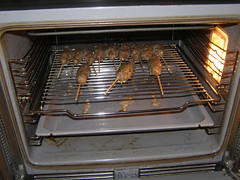
Lamb mince is unusual to work with in Greece, since not many butchers will mince lamb for you (and this is the preferred meat, along with beef, that is used in Turkish kebabs, due to religious practices). I found some lamb mince recently at AB Vasilopoulos, although it was imported from France and mixed together with beef mince. I added some onion, garlic, herbs and spices, shaped them into rissoles, skewered them and grilled them in a hot oven, turning on all sides to get them as browned as possible. We had them with a fantastic tzatziki and a Greek salad; it made an excellent meal during a heatwave in early June this year, with Joy and Bryan for company, who accepted my blog intro's invitation: "If you're ever in Hania, come and join us for lunch...".
The 1st of April is the day that people around the world generally recognise as a day when it is permissible to lie, so today I will present some myths concerning the subject of Greek food. I recently came across a chunk of web text, whose every idea I dispute:
"Since most Greeks don't barbecue at home(this applies to urban/apartment dwellers; non-urban/single-dwelling Greek houses always have some sort of BBQ installed in their yard), Tsiknopempti is one of the busiest restaurant days of the year(this may be true in Athens, but August 15th is far busier in most other parts of Greece - this day falls in the middle of summer, when Athenians are usually away from home, on holiday, somewhere in rural/island Greece). Most Carnival specialties are made during the final week(highly unlikely; in Crete, at any rate, they're made throughout the year!), when cheese and dairy are embraced(as they are all year!!) in preparation for the 40 days(it's NOT 40 days!!!) of Lenten abstention -- many Greeks still observe the period's traditional rigorous fast(this statement does not take into account the modern meaning of fasting in the Greek context).
This is how myths are born: by perpetuation. And there are plenty of way to perpetuate myths, the common modern one being the internet.
Let's start withfeta cheese.
The most popular cheese in my house is feta: it is produced in Central Greece.
Still on the subject of souvlaki, what kind of meat does a typical souvlaki contain: lamb, pork or beef?
A souvlatzidiko in Thessaloniki, offering both pork (the first two meats) and beef (the smaller round) souvlaki
This one causes the most confusion abroad. The precursor of the modern 'souvlaki' was the 'doner kebab', which was made with beef. Beef continued to be a meat choice in Greek souvlaki, but pork also made inroads in this sector. For a start, it was cheaper than beef, and Greeks don't have a religious reason not to eat pork, as did the Muslim Ottomans where the idea of the doner kebab started. Souvlaki is still generally a pork dish in Greece; it's only in the last 4-5 years in Crete that beef has suddenly reappeared in the souvlaki trade (still only available in the larger souvlaki shops). In any case, it is never made with lamb, as it is in the souvlaki shops of many Greek communities abroad, notably those of Australia. The different meats used in each different country to make souvlaki often reflect the cuisine of that country, rather than the origins of souvlaki. In the last 15 years, chicken is also offered in Greece, as a healthier alternative to pork.
Here's a good one: did you know that hummus is a Greek food?
"Of course hummus is Greek, Maria," you reproach me, "it's on every single menu card in Greek restaurants" - in America, the UK, et alia, right? It's never actually found on a Greek taverna menu in Greece. As Mariana Kavroulaki rightfully pointed out to me through my facebook page, no Greek yiayia living in Greece will know how to make hummus; it's eaten all over the Mediterranean and the Middle East (Cyprus included) - but not in Greece. Ask the average Greek what χούμος (hummus) is, and I'm sure they'll say 'soil'. The only aspects of Greek life that Athenos actually got right in their series of three advertising spots for hummus were the Greek yiayia's clothes and the Greek landscape. The word 'yiayia' is pronounced incorrectly (it should be yiaYIA, not YIAyia), and the average Greek yiayia - at least from Crete - would never accuse a well-dressed young girl of being a prostitute, nor would she tell her that she will go to hell if she is unmarried and living with her partner. The ad with the house-husband will simply be dismissed as a case of the impossible: few Greek couples can afford to live in relationships where only one partner works.
Can Greek yoghurt only be made in Greece?
If you want your Greek yoghurt to be 'Greek', you need to make sure that the milk used to make it was also produced in Greece; wording like this ('from 100% Greek milk') makes economic sense.
Unlike feta cheese which has a PDO status and can only be made in certain places in Greece, Greek yoghurt does not, which is why Greek yoghurt is found all over the world. Coincidentally, we never say 'Greek yoghurt' in Greece; we call it σταγγισμένο (στραγγιστό), straggismeno/straggisto, meaning 'strained'. The phrase 'Greek yoghurt' has now become synonymous all over the world with strained (ie Greek-style) yoghurt. Strained yoghurt in Greece isn't always made with milk originating in Greece (a well-known yoghurt manufacturer in Greece uses a mixture of cow's milk imported from Germany (50%), France (25%), Holland (22%) and Italy (3%). But this isn't necessarily a bad thing; there are worse ways to produce yoghurt; the more informed you are, the more informed choices you will make.
Misunderstandings occur both ways. For example, what is the average Greek person's idea about 'toast'?
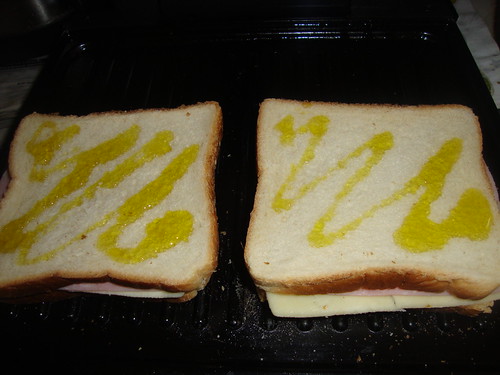
My children still think of this as a 'toast': cheese and ham toasted sandwich (drizzled with olive oil).
Just as many people misunderstand Greek food and confuse it with similar kinds of food served abroad that are passed off as Greek, most Greeks living in Greece are horrified when they eventually find out that the English word 'toast' consists simply of a toasted slice of bread from a square loaf. What Greeks think of as toast (they call is 'tost') is in fact a toasted sandwich.
And now for the icing on the cake. A US reader recently asked me: "We've been to Greece four times in the past five years, and every time we eat at a taverna, my mom asks the owner if the bread they serve is truly Greek bread. My mom is convinced that she read somewhere that Greece imports its bread from African now and no longer has bakeries that make the bread on the premises. She insists she read that somewhere back in the 80s. Do you know anything about this? Could this be true?"
Yes, of course the bread Greeks eat comes from Africa. Greece no longer has bakeries. Happy April Fool's Day. (Χαλασμένα τηλέφωνα* all round...)
*** *** ***
There is a lot of misinformation out there in the web world, where anyone can write anything they want, without making any reference to previous research, without providing any evidence or empirical observations. Opinions are often understood as generalisations, and untested hypotheses are taken as facts. Students, scholars and laypeople are all taught to embrace the web to get access to the latest information instantly, but few people are taught to scrutinise the information they access. A lot of what is believed about Greek food in wider 'foodistic' circles is often based on generalisations and/or biased sources as well as cases of misreporting. Current food trends in Greece are not being taken into account in the wider web-based literature on Greek cuisine, possibly due to the language barrier: Greeks generally read in Greek, so they are unaware of the dissemination of misinformation, while non-Greeks usually look for their sources in another language (mainly English), hence the mix-up.
This short video will introduce you to a number of Greek food blogs available on the web. More will have been added since it was produced. To find one of the websites, note the name and look it up as a search string.
The urban/rural differences of Greek citizens, the different approaches to Greek cuisine taken by the Greek diaspora, the regional differences inherent in Greek cuisine due to the geography of the country, and the recent economic turmoil that the country is facing do not help to avoid the rise of a very generalised view of what Greek food is all about. The worst consequence deriving from this confusion is the misunderstood nature of the Greek identity itself.
To find out what is really trulyhappening in the Greek food scene in Greece and abroad, the blogosphere is the place to go. Restaurants and tavernas may sound like good places to check out the scene, but that's going to work out to be more expensive for your pocket: turning on your computer is much easier and more satisfying, as the array of food porn begins to jump out of the screen! More importantly, Greek food blogs are generally not commercially slanted, which means that the writers are genuinely interested in passing on a food-related message or recipe to the reader. By looking up Greek food blogs on the web, you will get a feel for what is genuinely being cooked in Greek homes around the world.
Vicky Koumantou, representing GreekFoodBlogs, recently appeared on Greek TV spotlighted the growing Greek food bloggers' movement. Among the many good points that Vicky makes, I've chosen to highlight the following:
'There is now no excuse not to know how to cook',
'You can continue to cook your mum's traditional meals without referring to your mum',
'Greek food blogs show the direction that Greek home cooks are heading towards, whether they cook with different ingredients to those of the past, or if they use international recipes',
'A blog recipe index is like a cookbook',
'A food blogger's work leaves behind food memories that children may have grown up with',
'Later generations will cook and eat more consciously: our mistakes will remain lessons for them'.
And finally, the most environmentally-friendly but controversial in marketing terms:
'Why write a cookbook when you can write a blog more easily, making it instantly accessible instead of worrying about distribution?'
When I first started writing my own blog nearly four years ago, there were already a number of Greek food blogs being written. The English-language Greek food blogs were mainly written by Greek food bloggers outside Greece. Numbers have now grown to around 200 Greek food blogs, 30 of which are written in English. Vicky Koumantou, representing GreekFoodBlogs, says: "The culinary Greek tradition is reflected through Greek food blogs, as it passes from one generation to the other, from grandmother to mother to daughter. It's humble cooks like those who have kept the hearth lit in Greek homes; they're the ones that lay the table at home every day for their families, providing love through food."
Greek food bloggers have their very own portal, GreekFoodBlogs, which unites all Greek food bloggers around the world on one site. The first Greek food bloggers' camp took place in Athens on 16th October, 2010, which gave Greek food bloggers a chance to meet each other and share ideas. Greek food blogs are growing in number, and this should come as no surprise: a)Lonely Planet listed Greek cuisine as one of the best in the world for travellers, b) the Mediterranean diet, often associated with Greece and in particular Crete, is propounded by health specialists as one of the healthiest diets in the world, and c) Greeks have one of the greatest rates of longevity in the world, mainly attributed to their diet, among other factors.
So what are you waiting for? Cook Greek - you have no excuse not to!
*Chinese whispers: lit. 'broken telephones', said when the original meaning of a message is lost through widespread misreporting.
A little while back, after I had had a satisfying meal which consisted of tasty pastry-topped boureki (the chef at work had cooked it), a healthy (as usual) meal, based on the Mediterranean diet that I have been trying to raise my family on, I had a craving which I couldn't quite place. As I munched my way through the boureki, I thought about how my husband would be ladling the lentils I had cooked the previous night onto the children's plates, and how they would be very thankful for it, as they mopped up the sauce left on their plates with sourdough bread. An apple was offered as desert after the meal at work, but I passed on it. I wasn't hungry, but I knew I still wanted to eat something, something I still couldn't pinpoint. I went back to the office, and began to hammer out the last of the translations in a set of files all about natural resources management.
But my mind was still on food, and the taste (or lack of it) in my mouth. I let some time pass before I went out to the canteen to get myself a coffee. I had had an enjoyable meal for lunch, but for some reason my palate felt dry, though my stomach was full. The canteen was full of those tempting chocolatey biscuity bites that I usually fall for at times like these, when I crave for something to satisfy my palate, without exactly being able to pinpoint what it is that I want to eat. But even there, I found nothing that I really wanted to munch on at that moment.
Back at home, I found the dishes in a neat pile, waiting for me on the benchtop. I opened the fridge, without any particular food in my mind; I hoped that, by looking around on the shelves, I would find something that would tempt me and satisfy my craving. The leftover lentils had been placed tidily in a small bowl in the fridge. Salty lentils was not what I was after. Behind the bowl, there was a bar of dark chocolate with a citrus filling. No, I wasn't after a sweet, either, although this seemed like a logical choice. I even resorted to opening the deep freeze (that's when you know you're desperate). But there was nothing in there either, and even if there was, it would require defrosting and cooking.
I began to think of next day's meal. The vegetable box was crammed with round purple aubergines. The Asian bottled sauces on one of the shelves caught my attention. Thoughts of MSG clogged my taste-consumed mind. I suddenly realised that what my body was craving for was something savoury, exotic, uncommon. But you can't eat bottled sauces straight from the container. So desperate was I to get my taste satisfaction that I decided to cook a Chinese meal right after coming home from work; at least all that cleaning and slicing and chopping would keep my mind occupied... I set about slicing the aubergines into small chunks to make a stir-fry that I could serve with rice noodles.
Just as I had oiled the pan, the phone rang. "Hello?... basketball... first meeting... tonight... gymnasium... 6.30pm... OK." I wouldn't have time to cook a meal now. I left the aubergines on the kitchen bench and got the children ready for the meeting. The phone call had, for the time being, freed my mind of foodie thoughts.
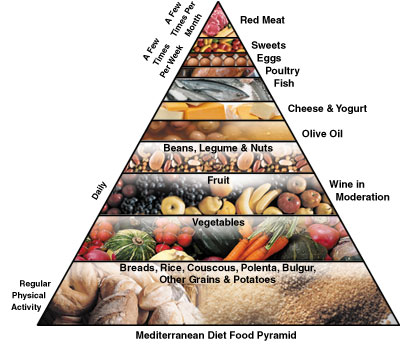
After driving in circles trying to find a place to park the car, we met up and made arrangements with the gym teacher. The children spent some time shooting baskets; I marveled at their energy, feeling guilty about my food-obsessed thoughts when I could have been thinking instead about ways not to eat. When we came out onto the street, darkness had descended but the air was warm, and there quite a few people taking advantage of the good Cretan climate on this early autumn evening, sitting at the outdoor tables of the fast food outlets in the area, with the atmosphere permeated by the smell of souvlaki. Then it struck me: that was my missing mystery taste; umami was on my mind. So much for all that healthy cooking and eating with loads of fruit and vegetables; my body was craving the taste found at the top of the Mediterranean diet pyramid: I want me some meat.
After getting my fix of umami, I craved no more... Four souvlaki yiros and three soft drinks set my family back by 15 euro.
We had a family meal at Vantes, a well-known souvlaki diner in a built-up busy congested area. The sounds of the traffic did not deter from the taste of this favorite Greek specialty. As I greedily swallowed my meat-filled pita, I wondered what vegetarians did when they craved some umami. Chinese bottled sauces, I suppose?
*** *** ***
Since my recent visit to Vantes, I have also discovered that Hania is no longer limited to tried and true Cretan menu favorites. There was a whole host of different souvlaki meat offered at this souvlatzidiko (the traditional Greek fast food outlet), with a variety of toppings, just as one would expect to find in a mainland souvlaki shop: traditional yiro served with yoghurt, chicken yiro served with turmeric-flavoured yoghurt, doner kebab served with tzatziki and something called 'souvlaki Thessalonikis' which I didn't get to try this time round (this obviates the need for another visit - soon). Even bouyiourdi (albeit under a different name) was also on the menu, as was tirokafteri, both north mainland cheese dips, having made their way to Hania and now included as standard fare in taverna menus.
Souvlaki served close to the central bus station in Elassona, Northern Greece.
The best souvlaki I have ever tasted needs special mention. It was cooked in Elassona,in Central Greece. It looked like any other ordinary souvlaki, but the taste in that one smacked of umami in its most glorious form. We decided that its superior taste had to do with the animal husbandry techniques and cooking styles of the mainland. And just for the record, in Ellasona, souvlaki yiro is served, not with yoghurt or tzatziki, but with mustard and ketchup: very Greek, n'est-ce pas?! When we asked for yoghurt on the children's yiro and a serving of tzatziki with ours instead of the standard fare of the locality, the souvlaki shop owner said: "You're from Crete, aren't you?" So there you go...
"That's a lot of meat," my husband remarked as we waited for our yiros to be made. "Will they go through it in one night?" It was about 8pm on a weekday earlier this month.
Ya! souvlatzidiko, Hania centre
Of course they will go through all that meat in one night. Souvlaki (or yiro, the terms are often used interchangeably) are incredibly popular these days for so many reasons. Souvlaki is a cheap meal - in fact, it has never been as cheap as it is now, all to do with the crisis, of course. The seating areas at souvlaki shops are always crowded, but that tells only half the story - the delivery bikes don't stop running after a certain hour: most of the business conducted by souvlatzidika is done over the phone, not in the shop.
Yiros may be a cheap meal, but it is a filling meal, containing your meat (pork, chicken or beef), carbs (fried potatoes and pita bread) and salad vegetables (tomatoes and onions, lettuce on demand), all topped with a dollop of dairy (strained yoghurt). In other words, it's a complete meal. All that's missing is dessert; on a hot summer's night, you'll probably round off your souvlaki dinner with watermelon to cleanse the palate.
But yiros is more than just a meal. Yiros makes you feel good - it's the equivalent of an adult version of a happy meal, which is eaten by all age groups, making an outing to a souvlatzidiko the perfect family mid-week jaunt. Going for out a yiros is a psychologically uplifting experience. It places you straight in the thick of the crowds, where you will be seen; in a small town, you will bump into people along the way, all of whom are going there for the same purpose, to get themselves a souvlaki.
Souvlatzidiko in Hania (left) and Thessaloniki (right) - yiros is a quintessential Greek meal that knows no boundaries
If you want to see where the young people are in town, look towards a souvlatzidiko, and you will find them both behind and in front of the counter, jamming themselves together to make room for everyone in the limited seating spaces available at such places. And if you don't eat meat, no worries: souvlatzidika have moved along with the modern times - there are vegetarian options available too. The easiest one of its kind is simply to omit the meat, but there are now places offering vegetarian bifteki (burger patties) made with zucchini or chickpeas.
Most people go to a souvlatzidiko with their παρέα, but you will see a loner here and there, snacking on a tasty pita wrap. Even that person is not alone - the souvlatzidiko in our times has become a meeting place and no wonder - yiro can work out cheaper than a drink at a cafe. What's more, yiro is a democratic choice in food - a yiro is a yiro is a yiro, and everyone eats the same thing from a souvlatzidiko - only the meat choice may be different (you can choose among pork, beef and chicken - rarely lamb though in Hania as our lamb meat is not appropriate for this kind of cooking), but the difference in price is not much more than 30 eurocents. Yiro is the most popular Greek junk food - and it's not even junk, if you consider that it's a completely transparent meal.
Vantes souvlaki, Gogoni St
So cheers to yiro for being very cheap, somewhat healthy, highly democratic, very transparent, psychologically uplifting, and entertainingly social. And most of all, because it tastes so good.
Friday is usually souvlaki night in our house. I know that sounds very western, having a 'junk food night'; I like to refer to it in this way because it sounds very trendy, at the same time as restrictive: you can't have a souvlaki unless it's Friday. It's the end of the week, the weekly routine has worn us out, and we want something 'easy', 'cheap', 'tasty', 'able to be eaten with the fingers' (but we still sit at the table to eat it) and 'not requiring cleaning up' (and we still bring out a plate to place it on), and above all 'uplifting'. Souvlaki has all these things. It's kind of like a McDonalds happy meal, only that it contains 'real food' which is likened to junk food because it is cooked and served quickly. So when I go to pick up the kids from their sports clubs, I buy the souvlaki on the way.
"Mum, I was wondering... Can we try that new donuts place?... You said we'd try them some time... We could have donuts instead of souvlaki..." My daughter was in the car with me. She had been talking about this new donuts parlour for a while now. According to her daily descriptions of what goes on at school, kids bring these donuts with them as part of their school meals. I am not surprised to hear this: most kids eat a heap of mass-produced junk as part of their school meals every day, and I am witness to this happening when I take my kids to school and see what the other kids are carrying in their hands. My daughter is still at primary school, so she still sees lunchboxes (at high school, lunchboxes are not 'cool'). It sounds like a nightmare scenario: mass-produced donuts are going into Cretan kids' lunchboxes...
I found it difficult to say no, because I had indeed 'promised' to do this one day, and anyway, I wanted to see what the big fuss was all about with these donuts. They are made by a well-known Greek company, and a branch had opened up in Hania only about a month or so ago. I had only ever seen them once before, when my daughter was given one of these donuts by someone celebrating their birthday at her sports club. I had had a tiny little bite, and yes, I am delighted to say that they tasted quite good, and they had that donut aroma that I remembered from New Zealand, which is probably the last time I had an American-style donut. Greek bakeries do in fact sell large round donuts (which we call λουκουμά - lou-kou-MA) with a hole in the middle, and they taste OK, but they don't taste like American-style donuts. Never having been to America, I can't say I really know what an American-style donut really tastes like, but New Zealand had always followed on from the trending global food of the modern world throughout the late 20th century, so that I can probably say I have a fair idea of what an American-style donut tastes like. We were also exposed to the branded food stores very early on, which are still a novelty in places like Hania, where any item in the store tastes the same no matter where you find yourself in the world.
Donuts are something like a snack; I didn't like the idea of replacing the souvlaki with this sweet spongy thing, which I somehow knew my husband would not be enarmoured by. Neither did I really want a donut myself at that moment. But there are some things you do for your kids, and living in the real world is very important, especially during this difficult time for Greece, as Greeks are being forced to accept that the world beyond thier borders is invading the world within their borders, at a faster pace than most Greeks can handle. I left the western world over two decades ago and embraced the idiosyncratic disconnected world of Greece because I preferred the lifestyle, but this can no longer continue. It's an anytime, anywhere world now, everywhere, and through the www, which is basically acessible to anyone, everyone knows what everyone else is doing and eating. The donuts shop is the latest food trend in town. It's an experience; for the novice, it's a bit like going to a McDonalds or a Starbucks for the first time in your life, when a new one opens in your neighbourhood. You don't necessarily go for the hamburger or the coffee - you go for the experience.
So we drive to the donuts store, park the car and enter the store. The first thing I noticed was how busy it was, with customers coming in and out. The store is only a small outlet; there is a row of freezers against the wall behind the small counter, a woman at the cash register, and a man who simply takes your order (there is a limited product range), takes the donuts out of the freezer and wraps them up for you in a little parcel (which reminded me of a packet of fish and chips) and places them in a plastic bag. Yes, the donuts - all of them - are in the freezer. Nothing is sold 'fresh', only 'fresh frozen'. The donuts are made in the company's Athens headquarters and frozen immediately, they are then transported frozen throughout the country, and customers buy frozen donuts in various sizes, falvours and packaging. So the donut is not an on-the-go snack - you buy the donut to eat it later (that's not what I recall about the donuts I ate in New Zealand)
More information on the Greek donuts company can be found on this post from my facebook site.
For me, the donut store felt like a deja vu experience. It reminded me of the late 1970s when, in my young teens, I entered the doors of a McDonalds restaurant for the first time, and ate my first McDonalds hamburger at Courtenay Place. Back then, mass-produced hamburgers and fries were regarded not so much as a global food trend, but a significant part of western culture. Having a McDonalds in your town was a sign of progress. We even ate at McDonalds as a family, as a break from routine, about twice a month. What was different back then was that there was no backlash against junk food, mass-produced food, technologically-produced food, hi-carb, hi-fat and hi-sugar food/drink. A McDonalds meal was seen as a perfect way to find something to eat when you were on the go the whole day and you didn't have time to cook. Large portions of fries and drinks were seen as 'value for money', not excess calorie agents. McDonalds was cheap and affordable, it had a dining area, and it also acted as a pick-me-up centre, somewhere you could grab a coffee, use the bathroom and continue on your way. They were not an eating experience; they carried a functional purpose.
Mega corporations and fast food chains are now being chastised for various reasons. Now that we live in a better informed and more transparent society, where companies have websites which tell you what ingredients your choice of mass- and technologically-produced, hi-carb, hi-fat, hi-sugar food/drink contains (the donuts under discussion are all made with margarine), and we hear stories every day about the dangers of mass- and technologically-produced, hi-carb, hi-fat, hi-sugar food/drink, you'd think that people would choose a healthier product over a margarine-based donut. You'd think that they'd prefer a local snack (like dakos) instead of a donut that has travelled 300 kilometres to reach the customer. You'd think that this mass-producing food operation would be snubbed over some eaterie that produces fresh food snacks.
But that isn't happening. Despite knowing what is good for us, we want what is not so good for us, adn we are all entitled to our choice. It's kind of scary seeing how people queue up to pick up junk. But that's just the company's policy: their branches only open 2-3 hours in the evening, and no time else, fooling people into believing that the queues show how popular their product is (a very clever marketing ploy). Not only that, but these donuts are cheap, so cheap (and filling, with all those fatty sugary carbs) that conceivably, you could eat them every day, especially in a crisis. 70 cents for - how many calories? Those donuts are larger than the average-sized American-style donut I remember. Dunkin Donuts seems to average them at 300 calories each, but these ones must have at least 400-500 calories... What's more, they don't taste so bad. Why eat something good for you when you can eat cheap'n'tasty junk? More importantly, this business is doing well in the crisis. It's got a winning formula. For the long-term worrier, though, it probably doesn't intend to expand beyond the Greek border (the level of English on the website is shocking, it doesn't accept online orders and it doesn't have outlets abroad), so growth stops here, I guess.
But for now, the donuts business is a sure winner. It also gives us a taste of the future - food will be cheap, full of carbs and mass-produced. This has already happened in the world, but don't forget, I am talking about Greece; we were a bit slow to catch on. Somewhere in my reading, I recall a story about how human beings were born to evolve into carb-eaters - evolution is not about chewing your food slowly, but gulping it down quickly. And in another story, I recall reading about how the human brain is actually very lazy - if it doesn't need to work hard, it won't. It seems our apathy is just a sign of human nature...
While visiting an uncle at the local village cafe-taverna last night...
- Χρόνια Πολλά, θείο Νίκο!
- Well, aren't you going to sit down, then? It's my treat.
- I've just come home from work. We really need to get back home, and...
- Well, you need to rest then. Sit down.
- OK, just for a few minutes.
- So what am I going to treat you? Souvlaki, steak?
- We've just popped in to say hello, uncle!
- OK, just a souvlaki then. What about you, kids? You'd like a souvlaki, wouldn't you?
- Um, no.
- OK, and what will you have to drink?
- Um, nothing.
- Just water.
- Water with the souvlaki? OK then. Hey, Ilias, two souvlaki for the kids.
- We didn't say anything.
- What did you say you were having to drink?
- Just water, thank you.
- And one coca-cola, Ilias.
- Can I please have a gazoza instead?
- Who, you? OK, who wants the coca-cola then?
- I'll have it!
- And one gazoza, Ilias, and get those souvlaki going! What are you going to have Maria?
- Oh, I'll just have some fries, then.
- Don't you want any sausages with that?
- No, not really.
- Ok then, two sausages, Ilias, got that? What's your husband having?
- I'll be fine with a nip of tsikoudia, thanks, uncle.
- A pork steak then. Ilias, make that two!
The photos are from a previous similar occasion at the same venue, but the story is always the same. A visit to these people inevitably means a treat.
We make our own souvlaki (otherwise known as kebabs or gyro) as a dinner snack usng leftover roast meat from the Sunday roast. They taste just like the real thing, and they don't have that greasy smell to them that lingers in takeaway outlets.
For each person, you need one pita bread; you can use a soft tortilla, Lebanese pita bread or any other round single-serving piece of bread. You can even use Indian chapatti, roti or naan if they are the size of a small plate. In Greece, pita bread can be bought from the deep-freeze supermarket counter; 10 to a packet cost 1 euro. I always keep a bag in my deep-freeze. They are very easy to defrost, and don't stick to one another.
Have ready some sliced tomato, thin onion rings, Greek-style yoghurt and paprika pepper. Cut some greaseproof paper into squares the size of the pita bread. Chop the roast meat into small pieces, and heat it up in a small non-stick saucepan. You need about 2-3 tablespoons of meat for each pita. You don't need to add oil or seasonings as you heat the meat, because it would have been seasoned when originally cooked.
Home made souvlaki without the trimmings - the kid's version
Heat the pitas individually in a saucepan. Brush them with olive oil so that they don't burn in the pan. Place a heated pita on a paper square. Add 2-3 tablspoons of prepared meat in the middle of the pita, letting the meat spread out downwards, leaving the top part of the pita empty. Place some tomato and onion over the meat. Spoon some yoghurt over the middle of the mound of ingredients. Now roll it up, with the help of the greasproof paper, into the shape of an ice-cream cone. Then, take a paper napkin and roll the souvlaki up in that (for extra support). Sprinkle some paprika over the top. This dish can be messy; serve it on a plate!
When my kids were young, I fed them standard portions of food at standard times. They maintained this regime throughout primary school, but in the last year, I notice how voracious their appetites have become. They are getting taller, older and hungrier, especially in the evenings, when they have been out and about doing their after-school activities.
Our main lunch meals during the week usually consist of slow-cooked bean dishes, a mince sauce for pasta and one egg meal a week, with a good deal of 'leftovers' clearance. But our evening meals are often more exciting: If I don't have time to whip up a pita (or the kitchen is too cold for rolling out dough in it), we've established a souvlaki night, I sometimes resort to a baking a frozen pizza and a quick dakos snack is also in order, with or without grated tomato (our supply is about to run out soon). But nothing beats a warm meal on a winter's night, prepared by mother.
Evening meals need to be quick and easy to prepare and cook. My choice dish for something quick and easy is an orzo pasta rice meal. You can add virtually anyting to it, including leftovers and various odds and sods that need to be used up before they gooff. If cooked in double quantities, it can be served the next day as leftovers, or perhaps as a side dish to complement another meal. All I added to this one was a few frozen/canned vegetables, olive oil and some spices. It's very filling and can be warmed up easily.
My tuna patties were made by mashing a large can of tuna and adding a few slices of crumbled bread (not breadcrumbs), as well as some herbs and spices, garlic and onion. They were easy to make and there were enough for two meals (to accompany a lentil stew the next day). Canned tuna is not always cheap, so the addition of bread, onion and herbs makes it go a longer way.
Frozen chicken pieces are generally cheap and they cook quickly - a packet of 10 small legs costs about €4-4.50, while wings cost about half that. Small potatoes have been selling for €0.38/kg for the past month, so this meal - which made enough food to be served the next day for lunch as well - was very economical. Frozen chicken doesn't need a long time to cook - the meat becomes tender quite quickly - and if you cut up the potatoes into small chunks, it is ready in an hour from when you placed the baking tin in the oven.
A souvlaki costs about €2 in Hania at the moment - if you used this price as a cost-per-person for a meal, then souvlaki is the most expensive meal out of all the dishes I've presented in this post. A souvlaki looks cheap on the face of it, but it would still cost you more to eat souvlaki every night than it would to prepare a filling meal virtually from scratch using basic supermarket ingredients. Home-made food is still much cheaper to serve in Greece than meals out, including the cost of the ingredients and the energy needed to cook them. They needn't take too much time to prepare or even cook, nor do they need to cost much money - what's more, they remain very healthy transparent meals for a growing family.
Last night, after a work-related event which I attended with my whole family, as it was too late to cook a meal when we got back home, we bought souvlaki.
Vegetarian souvlaki with peppers, tomatoes, zucchini, fried potatoes, onion, potatoes, red pepper and tzatziki, all rolled up in Greek-style pita bread.
They also come vegetarian these days - in fact, you can get almost anything as a filling. (And if you want a vegan souvlaki, you simply ask to have a nistisomo, ie without meat or dairy.
You may be wondering about what kind of event held in a Greek town a whole family with children could attend during a school night, which goes on till late (we left at 9pm) that doesn't include food! This will be revealed in a later post.
But for now, enjoy these night shots of Hania, which I managed to take when we went out for a mid-week walk through the harbour on a wet cold night when the street were deserted, all taken by Venetian port behind the marina.
And something to remind us of the season:
The event took place at the ΚΕΠΠΕΔΗΧ-ΚΑΜ - Centre of Mediterranean Architecture, which you can learn more about here.
Join me in half an hour (8:00pm Greek time) when I make souvlaki yiro!
You need: some greek pita bread, some leftover cold roast meat of your choice (sausages will also do), some tomato, some onion, some parsley, some strained Greek yoghurt, a potato, paprika, olive oil
Your mise en place for souvlaki yiro
Now for the hardware: a small frying pan, a larger frying pan, some greaseproof paper cut in a square larger than the pita bread, a large paper napkin, the usual kitchen cooking and serving utensils
Check back at 8pm (Greek time)! 8.00pm: The news just began on the telly, therefore, it's show time. OK, keeping everything separate, chop up your meat into small small sliced chunks, slice your washed tomato, clean the onion and slice it thinly, chop up the parsley finely and add it to the onion, and chip your potato - I'm making yiro for four, so I'm using two potatoes.
8.06pm: Whoops, did I forget to tell you to heat up the oil in the large frying pan? Do that while you're chopping up the veges and meat. (Vegetarians can join in the fun too - they just won't be eating the real thing.)
I've place the meat in the small frying pan to be ready when I start heating it up - remember, it's already cooked since it's leftover meat, so it won't need any cooking, just heating up.
8.13pm: Now wait till the oil is smoky hot before you fry the chips, otherwise, they'll go soggy and take forever to cook. In the meantime, wash the chips to get rid of starch, then salt them very lightly and let them drain well.
8.16pm: My oil's smoking hot, so I've just added the chips.
8.27pm: Mmm, don't they look good? Don't eat them just yet - take them out of the oil, don't let them drain too much, and put them aside (no pecking).
Cooking and blogging at the same time (is fun!)
8.32pm: Now turn on the heat under the small sauce pan and start heating up the sliced meat chunks. You only want your meat to heat through, so don't let it cook on its own for too long. Keep turning it over in the pan. Don't add oil or seasonings since it's leftover meat or ready spiced sausage.
8.40pm: My meat looks done. What do you think?
8.45pm: Now for the fiddly bit. Drain the large saucepan of oil. Put the oil aside for frying potatoes or something else another.
8.46pm: Heat the large sauce pan and place one pita on it. Don't add more oil to the pan at this point. 8.47pm: Turn the pita over onto the other side. Cook that too and watch it - it'll be ready in a minute!
8.50pm: Did I tell you that this is a dirty job?!
8.51pm: I'm cooking the third pita. Repeat the process for each pita separately (I know, i hate this bit too), oiling the pan with a tablespoon on oil each time you change pitas.
8.52pm: Hi Natalia!
8.59pm: Still hanging on in there! Now for assembly time! The pictures speak for themselves!
Place the pita on the greaseproof paper. Place layers of the different ingredients on top. Wrap the paper around the pita folding the pita slightly. Then wrap the paper napkin arounf the greaseproof paper - this is how it is done at souvlaki shops.
9.05pm: Yes, Natalia, you can cook the pitas in the oven. This is healthier (but not the real thing!!!!)
9.10pm: Tada!
Top with yoghurt (or tzatziki) and sprinkle a little paprika on top. Tastes just as good as the real souvlaki shop pita yiro!
9.21pm: Thanks for joining me - this was really fun! And here's the maid cleaning up for me: