Greek identity with a difference, from the inside out and the outside in
(formerly Organically Cooked - Linking Greek food with Greek identity: you eat what you are, or who you want to be)
Primary schools in Greece are closing this week for summer break (three whole months), in time for the elections. It will be time to hit the beach once again. Greek beaches are rated very highly: the Blue Flag organisation, which rates beaches on 32 criteria (upon application), has judged 394 Greek beaches as worthy of a Blue Flag award,
giving Greece second place in the world for the 2012 international
awards (the most Blue Flag beaches are in Spain). Of those 394 beaches,
97 are located in Crete, of which 25 are in Hania. I live close
to a number of those Blue Flag beaches.
My favorite beaches are on the west coast of Crete, like Falasarna - but these days, it's an expense to get to them.
The beaches of Crete are still generally accessible to all of us democratically, whether you are rich or poor. For a small fee, you can hire a deckchair and sit under an umbrella for as long as you like. If you prefer to be more frugal, you can take your own furniture with you and set it up in the same general area. If you go early enough, you will even find a tree to sit under in the shade all day long, if you have the time. There are usually inexpensive canteens on the beach where you can buy something to eat and drink. Again, you can bring your own food and drink, whether you rent deckchairs or not. Most people do this these days, but it's not easy to keep your drinks cold the whole day, and it's difficult to bring ice-cream with you, so you will inevitably need their services.
Agious Apostolous beach, last Saturday
The beach is a refreshing place to relax. Thankfully, we live close to a good beach, and we prefer it to driving too far away, to keep our costs down, as petrol is expensive now. So we like to hang out at our local beaches. The area is quite busy because both tourists and locals use these beaches, which causes a bit of undesirable people congestion, but you can't have everything the way you want. I don't mind people congestion so much, to be honest. Generally speaking, the large number of people at the beach doesn't match the noise level - we are all there for relaxing and enjoying a refreshing dip, so most people are quiet, and very few play loud music, or any music at all. A good number carry their reading material with them, both tourists and locals alike.
Chrysi Akti is one of a string of beaches leading from the town to the west coast of Crete.
My local beaches are situated close to the town. We don't live very far from an urban centre, but the difference between urban and rural life is quite sharply contrasted in the environment, despite the proximity. So it's quite easy for peddlers to walk from the town to the beach, searching for potential customers sell their bric-a-brac, to peddle their wares. The beach is a good place to do this because it's usually frequented by tourists and other people with disposable income. There's little police presence during the day, since there is little trouble here. The peddler's wares are enticing: colourful accessories, gadgets, all sorts of knick-knacks, pirated CDs and DVDs, even clothing and massage services. It's almost like an open-air shopping centre - the mall by the seaside! Such services are not limited to Crete - they are available all over the country at nearly all the beaches. (And it doesn't need to be said that this kind of business isn't limited to Greece: While in Berlin,
we were surprised to see immigrants selling all sorts of ex-commie
paraphernalia on street corners, making a mockery of the EU tax and
migration laws.)
The beach mall at Chrysi Akti - clockwise, starting from top left: Chinese masseur, Roma lace tablecloth seller, Pakistani clothes merchant, African bag specialist, Pakistani sunglasses expert and African faux bijoux entrepreneur. All photos taken in early September 2011 at midday on a Sunday.
Most of the beach peddlers are illegal immigrants, while most of the items are fake brand products. Naturally, the sellers aren't registered with the tax department (and for all intents and purposes, most of them don't exist in Greece because they are here illegally). While legal businesses close down due to mounting costs and reduced clientele, the illegal businesses keep on mushrooming, selling untaxed bootleg junk with no overhead costs.
The canteen at Chrysi Akti was closed for a few days last year during the season because - as the owner mentions in his protest letter, he was dobbed in for having seating at his canteen. He vowed to return, with or without seats (and he did), lamenting that he was a law-abiding tax-paying business owner that wasn't allowed to conduct his services due to a minor trespass.
Some people think that Greek beaches are over-commercialised, with too many food and drink places, as well as souvenir shops. Well, if we don't develop the beach areas commercially to some extent, we may as well become an ouzo republic. It is generally recognised through studies and research (including those conducted through my own workplace) that tourists to Greece want high standards at cheap prices, so some commercialisation is inevitable. The areas that get commercialised need to be the places where people with disposable income congregate, and in Crete, those are our beaches and archaeological sites which are easily accessible. This also helps keep prices down through the competition. Rules need to be in place to keep the environment clean and sustainable, but legal seaside businesses need to be developed, otherwise we'll just have illegal ones.
The seaside resort of Loutro is located on the south coast of Hania. It is not accessible by road - you need a boat to get to it; and naturally, it is a car-free zone.
For a quieter off-the-beaten-track summer holiday, Crete in particular still offers myriads of choices, especially given that the island is formed around a mountain range peaking at nearly 2,500 metres. Even though I've travelled around most of the island, I still find much joy in discovering places that people don't know very well, because they are not so easily accessible. There are still places to hide in Crete if you want.
Fish is expensive; just look at the photo - koutsomoura (Barbatus barbatus) for €14/kg, European hake (bakaliaraki) for €12/kg. Tasty stuff, but not for everyone's pockets. When I saw this sign, I couldn't walk by the fishmonger's display without stopping to get my hands on it...:
... especially when I know that I can turn it into a right feast, something like this:
Marida and garida (γαριδα), served with sriracha sauce that I bought in Den Haag, and some home-made dolmathakia.
Shrimps are now spawning (you can see this in the first picture - the shrimp is blue on its belly) and the fresh shrimp season is over until the autumn.
The BBC recently published a post about how the Ancient Greeks might have viewed the crisis and tried to solve it. One of the ideas that was discussed was how the Delphi oracle would have handled things:
In response to, say, "Should Greece leave the euro?" the oracle might
have responded: "Greece should abandon the euro if the euro has
abandoned Greece," leaving proponents and opponents of "Grexit" to
squabble over what exactly that meant. It must have been something like
listening to modern economists.
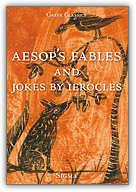
I often wonder what my ancestors would thoguht about things the way they are now. While at the supermarket, I came across a book title that caught my attention: Aesop's Fables. The supermarket is a locally-based, non-international chain, located near the beach in a tourist area. This book was intended for tourists, and this supermarket, although frequented by both tourists and locals alike, only sells books for tourists (other supermarkets also sell Greek titles). I picked up a copy to refresh my memory; I have always been quite fond of Aesop's stories as they relate to the simple honest life and they are based in Greek antiquity.
In the election run-up, Aesop's stories seem to be quite valid even today. The ancient Greek story teller's whose mythical fables always have a moral conclusion. Aesop was said to be a simple man, starting his life as a slave, who was eventually freed. He obviously had the chance to experience life from many aspects. His freedom gave him the chance to be politically active; Greece may have invented democracy, but life was never really very democratic for most of her citizens. As Aesop had seen life as both a slave and a free man, he had an inner vision which he began to express through his stories, which describe the simple facts of life, sometimes stating the obvious, but always weighted with instructive truths.
Aesop's villains and victims, as well as his heroes, were often based not just on ordinary people, but on animals that took on human feelings and attributes, as well as the ancient gods who were also known for particular attributes. Zeus was the boss, but sometimes his vices got the better of him; Hera was a cunning jealous wife; Athina was revered for her wisdom, and so on.
Although Aesop's fables have survived through the ages, they were never written down by him, so we only have later scholars' writings which were probably based on Aesop's original stories; they were most likely altered by the time they were handed down to us. If Aesop were alive today, I wonder what he would make of the global economic crisis, in which his own country plays the starring role. Instead of The Two Dogs, he might have written "The Two Countries":
The EU€ continent had two countries, one of which was generally rich, while the other was generally poor. The rich one got richer by working all year round, rain or shine, producing high technology products and selling them expensively all over the world; even though it was a rich country, it still needed to borrow money, but it would do so with cheap interest rates because it was a rich country. The poor country produced olive oil and only in season; it sold it cheaply to the rich country instead of marketing it herself to the rest of the world, and then it would wait until the following year for the next season's olive harvest. It would borrow money from the EU€ which always arranged for it to be lent to her, but with an expensive interest rate, because it was a poor country and no one was really sure how likely it was that they would get it back. The money was never enough to tide the poor country through to the next season's harvest, accentuated by the fact that olive trees bear only in alternate years, so its debts kept growing and it needed to borrow even more money more regularly. Eventually, this made the rich country angry, accusing the poor country of doing nothing but enjoying the earnings of the rich country's labours as it slaved away in factories, while the poor country sat on her verandah, soaking up the sunshine and bathing her food in the olive oil it didn't sell for reasons of self-sufficiency. "Don't blame me," the poor country said. "Blame the EU€, who is the one that lets me sit at home all day and live off the work of others. If there were factories here too, I'd be working in them instead of sitting on the verandah all day squatting flies."
The moral of this fable is that we shouldn't blame children for being lazy when it's their parents who've taught them to be that way.
Even though I try to teach my own children not to be lazy, I realise that I am often fighting a losing battle because of what they see happening around them. Sometimes, there seems to be no point in working hard, because at the moment in Greece, the hard workers are not being rewarded for such pious behaviour.
Every single story in the book (there are close to 200 little tales of this kind) by SIGMA Publications has a direct parallel with the present consumption culture which is related to the global crisis. They are both funny and sad at the same time, even if they sometimes sound cruel. The book is available for purchase online (at the same price that I bought it for at the supermarket).
Life in Greece is like a long
novel which doesn't have an ending; at any rate, you don't want it to end, because it's such a good story, even if the events are very predictable. But there isn't enough time to write down all the stories. If Aesop were alive today, I wouldn't be surprised if he wrote a blog, furiously trying to keep up with the daily developments.
Every year, my children's primary school organises a school trip for the whole school just before schools break up for the end of the term, and the long Greek school summer holidays begin (12 weeks in total). Crete is isolated from the country, so it isn't possible to leave the island for a day trip, but parents are always welcome to accompany their children on this trip, and most of the time, I join mine because the coach ride takes us to some of the lesser visited areas of Crete, and at a cheaper price than taking a private vehicle, with the added bonus of having someone else do the driving.
Despite the relatively small size of the island - the fifth largest in the Mediterranean Sea - Crete's fame and tourist value is mainly due to her wide variety of landscape, archaeological significance, historical importance and areas of natural beauty for relaxation and leisure. Visits to the beach, which invariably involve more
responsibility on the part of the teachers, aren't preferred, but most Cretan
children spend most of their summer by the beach (and needless to say, we have some of the best beaches in Europe). We generally stick to the west of Crete because it takes at least
two hours to get to Iraklio (the northern mid-point of the island) from Hania, and
another two hours to get back, so that's a long driving time. There are endless possibilities for interesting places to visit, and there is no shortage of
ideas for stops en route. In fact, every few kilometres on the highway, you will come across a sign showing a notable point of interest on the next exit.
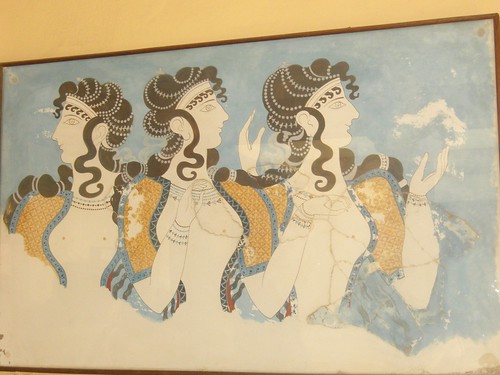
The beautiful ladies of Knossos were recreated form the few remains that were still left on the frescoes.
Crete is world-famous as the island where the first civilisation of Europe, Knossos, was based, since it is the origin of Cretan, Greek and European culture. This was actually my children's first day-long school trip. It is located in Iraklio at the mid-point of the northern coastline, so all children from all parts of Crete probably visit it at some point in their primary school years. There are also areas of great significance in Cretan history, which allow Cretan children to gain knowledge of their island's historical developments by direct experience. Two years ago, we visited Arkadi, which played an active role in the Cretan resistance of Ottoman rule during the Cretan revolt: the death of nearly 1000 Cretans in the Arkadi monastery in 1866 bought attention to Greece and her fight for independence.
Arkadi monastery, in the prefecture of Rethmino
Apart from historical sites of interest, we now have our modern wonders being built in Crete as she modernises, like the dam (Fragma Potamon) in the Amari valley of Rethimno, with a capacity of 22.5 million cubic metres of water; when it is full, its depth reaches 44 metres. Water is precious on an island that doesn't get much rainfall during the hot dry summer months.
The Rivers Dam, in the prefecture of Rethmino
The areas of natural beauty are often used as stopovers to admire the Cretan scenery from many different angles. Sometimes there seems to be nothing to do in these areas with thos ebreathtaking views, apart from just sitting in the shade and gazing out at the landscape. For this reason, it could be said that the locals don't often visit these places themselves, because they are out of the way and the costs of getting there don't warrant the excursion. The annual school trip provides me with an opportunity to travel to such places and remind me of my majestic surroundings.
This year, the trip was more relaxing and less rigidly structured, due to the economic crisis. Other years, we paid for the coach and a pre-ordered meal (which in my honest opinion wasn't always very good and invariably involved too much meaty food that never all got eaten and was simply thrown away). This year, we only paid for the coach (€6.50 per person) and we could bring or buy whatever we wanted to eat along the way without planned dining stops. The bus tour involved both long and short stopovers, depending on the area, where parents and children (including those unaccompanied by their parents, who had their teachers as guardians for the day) were free to spend it in any way they wanted, as long as they got back to the bus by the set time.
Our first stop was at the seaside resort of Georgioupoli, a quiet sleepy village off the highway. Twenty years ago, there were about half a dozen cafes or tavernas in the area. Now there are - well, too many, which looks rather silly in the middle of a crisis. I first visited Georgioupoli with my mother, who had heard of the church built in the sea, which I visited with her. This year, I took my children there too; I have started to go full circle.
While we were walking over the rocky causeway to get to the church, I was amused to see other children following me. None of the other parents bothered to come - most stopped off for coffee at one of those seaside resorts.
Our next stop was at the 3,500 year old cave of Melidoni, which has been used by the local residents since its formation. It was dedicated to Gaia (the goddess of the earth) and Hermes (the gods' messenger). In modern times, it is now a cave of great environmental value, as well as being a site of historical interest due to the deaths of civilians in the cave in their attempt to avoid the Turks during Ottoman rule.
The kiosk before the entrance to the Melidoni cave afford splendid views of Mt Psiloritis (2450m). The old village houses in the surrounding area are built in the style of the Venetians, early conquerors of Crete.
After a brief guided tour in the cave, we got a quick glimpse from the coach of the beautiful Venetian village of Melidoni where the cave is situated. The village was recorded as early as the 14th century, and many of the older buildings there are built in a style reminiscent of those times: arched gates, tall heavy doors and stonework.
After the cave visit, we had another short stopover at the village of Margarites, situated close to Melidoni, also originating during the time of the Venetian occupation. Margarites is well known all over Greece for its pottery, due to the numerous deposits of clay in the area, which explains to some extent the long pre-occupation of the inhabitants with the art of pottery. Permanent kilns were set up in the area since the beginning of the last century. The decline of the pottery industry began in the 1960s, once plastic became more practical and cheaper to produce, but the potter's skill is noticeably still alive in Margarites, and there are local people who have been involved all their life in this trade.
The old traditional pottery style of Greece, the making of urns and other such functional vessels, is still going strong in the village of Margarites, and they sit side-by-side with the newer art forms of clay work, such as wall hangings and ornaments.
For lunch, we stopped off at Rethimno, a venetian town smaller than but similar to Hania, where I took the kids for a souvlaki, an economical and enjoyable Greek kiddies' treat. Because we had a lot of time to spare, with the promise of an ice-cream dessert, I lured them into visiting the Fortezza of Rethimno with me, a very well-maintained historical site.
Rethimo is a small town, so most sites worth visiting are tightly clustered together, but to admire them, you still need mroe than a day. (Needless to say, no one followed us up here, after all that retsina and souvlaki...) The pirate ship in Rethimno harbour made quite an impression on my son, who also saw it asail from the coach!
On the way back home, we also got another stopover by the picturesque Lake Kourna, the only natural freshwater lake in Crete. There really isn't much to do here, except chill out!
Potato fields, vineyards, olive trees - the residents are well set up to be self-sufficient in a remote area. Many of them also tend sheep and goats, rabbits and chickens, so they are never out of meat and cheese for their daily use.
The natural beauty of the Cretan landscape, the ease with which the earth yields enough food to feed her people, and her relative proximity to the mainland without being too close to it have all helped to make Crete a permanent home to many of our tourists who have sold up in their homelands and come to live here. It really is quite a good place to raise a family, without being too small to make us feel disconnected with the rest of the world.
The coach trip refreshed my early holiday memories of my homeland. It's
difficult to experience Crete in this way on a regular basis due to the
economic situation and the daily routine., even though we live
relatively close to such beautiful surroundings. Most of the time, most
of us take a lot of what our homeland has to offer us for granted. But
most of the time, such scenery also needs a good παρέα and κέφι to be enjoyed fully. A busload of jolly parents and their children, especially after a few retsinas, raises everyone's spirits.
When I phoned them, I wasn't even sure that their telephone would still be working. They assured me they would be home; I assured them that they did not need to go to any trouble before my visit. Old people never take no for an answer. When I arrived, I found my aunts quite busy: Sofia was stooped over the stove top, while her twin sister Agapi was laying the table. The cutlery tinkled against the plates as her shaky hand laid down each piece. They had aged considerably since I had last seen them, almost a decade ago just before my mother died. At the time, they still seemed sprightly, but even then, it was obvious that they were slowing down. Although their minds did not admit to this fact, their bodies were showing signs of wear and tear. My mother's unmarried twin sisters were the oldest children in the family. The only ones that did not emigrate, they had managed to outlive every single one of their siblings. Now at eighty-eight, they were getting on.
"Martha mou!"
"How wonderful to see you again, after all these years!"
"The spitting image of our Elpitha!"
"Sit down, my child, you must be tired after that journey!"
I set down my present of a box of chocolates from the zaharoplasteio on the corner of the heavy wooden table with the curved legs. It was still laid with the same crochet tablecloth that I remembered on all my visits. My mother had bought it for them on my first visit to Greece with her when I was only a child. A great to-do was made about how to keep it clean. A transparent plastic tablecloth was bought from a shop in the town for that purpose, and laid over the crochet to allow it to show. Ever since then, when they had guests, my aunts would cover the plastic with another embroidered white tablecloth where we would eat from. It looked crisply cleaned and ironed, despite some stubborn oil stains.
The table was set for three, with a plate and fork at each setting. I recall that they never used knives. One would always be found in the middle of the table, but there were never enough to go round to all the diners. In the middle of the table was a small bowl of sliced tomatoes swimming in olive oil, sitting next to a plate of feta cheese.
"I don't know if you'll like our food today," Sofia apologised.
"We're fasting and we forgot you were coming, to buy some meat" Agapi explained.
I feel luck is on my side today. It's pointless reminding them that I'm a vegetarian. Sofia was now bringing a large bowl to the table filled with bright colours. The room took on an aroma of freshly pressed garlic.
Orzo purslane salad - a favorite recipe passed on to me by a friend:
Saute some garlic (and onion) in a little olive oil, then add chopped coloured peppers. Pour in a cup (or two) of orzo rice pasta, add water and salt, and cook till the pasta is done. Before serving, add the leaves of the purslane weed.
"Smells so good, Thia Sofia!" I said truthfully.
"Mmm, but it's not ready yet!" Thia Agapi said. "We always forget to do at least one thing, don;t we, Sofia?" Sofia frowned, trying to remember what it was that Agapi remembered but she did not.
"I'll just go out and get the missing ingredient!" Agapi said as she made her way to the back door.
"Oh!" cried Sofia. "The purslane!"
"Yes!" Agapi laughed, with Sofia joining her just before she went out into the garden. "The orzo purslane salad isn't ready until we add some purslane to it!"
Prices are in euro (valid in Hania). All
ingredients are Greek or locally sourced; those marked with * are
considered frugal here because they are cheap and/or people have their
own supplies.
With the good weather setting in now, I had to move all my fruit and veg
that does not need refrigeration outdoors. Some of the onions had begun to spoil indoors - they are the last stock of last year's harvests. Until April, I had no problem keeping them dry, but now in May, they are starting to show their age, rotting inside, and sprouting thick green stems. Greeks often keep their
lemons, potatoes, onions and garlic (all of which are Greek cuisine
staples) on their balconies in the summer to keep them aired, because they sprout and
spoil very quickly in the overly-warm indoor environment of most Greek
homes.
Which reminds me of another point: home construction has changed
so much, so that Greek homes no longer have appropriate storage
conditions as in the way that village houses were once built. This is
why we can't maintain certain past practices of our ancestors - living
conditions have changed too much, and no matter how bad things get in
Greece (which they won't, in my optismistic mind), we can only return to
some aspects of out past lifestyles, not all of them.
Just when I was wondering what to do with those onions that were spoiling too quickly to be eaten, I came across this comment on my facebook page:
"Vlita, I could stuff myself! Love them with zucchini and sivrasi!"
My friend Georgia wrote it, when she saw my photograph of the first vlita I harvested for the season. Sivrasi? I asked myself. What on earth is that? Feeling quite ignorant, I immediately googled it (being the conventional lass that I am, instead of yahooing or binging it, and wahtever else, that can't compete with the big fish), and came up with another friend's notes about it: Laurie says that she first read about sivrasi in a couple of Greek cookbooks:
"I first read about Sivrasi in Susie Atsaides book: Greek Generations: A Medley of Ethnic Recipes, Folklore, and Village Traditions.
She calls Sivrasi “an island secret,” and her recipe calls for a
whopping one cup of oil for every two cups of onions. Diane Kochilas
includes a recipe for Sivrasi in The Glorious Foods of Greece, and says it is served “over pasta, flour-based creams, greens, legumes, and even cheese pies.” Internet recipes include Sivrasi with meatballs, fish and tomato sauce, as well as over lentils and rice."
If you love onions, then sivrasi is for you. It's basically a long slow cooking of onion slices, until they almost caramelise, which are used to top a dish and add extra flavour. Sivrasi is an island specialty of the Dodecanese (where Georgia is from), a group of islands north-east of Crete, and the term is unknown in Western Crete (although it may be better known in Eastern Crete, which has more contact with the Dodecanese). It's a good Greek way to spice up a cheap meal, using the humblest of ingredients, the onion. The good thing about it is that you can never make too much sivrasi - if you love onions, then there is never enough sivrasi to go round.
Horta with sivrasi and spicy German sausages (they were on sale - €2 for 5 in a jar).
Peeling onions is not much fun, but the idea of topping my next harvest of horta with sivrasi made it sound more appealing. All it needs is a little olive oil to soften them, and some salt and pepper for seasoning. I also added some garlic in my first sivrasi session, and placed some boiled baby potatoes (a classic accompaniment of Greek horta) to darken a little in the pan together with the onions.
Depending on the dish, you can also try doing the same thing with leek, eg with a meat or fish dish.
Total cost of the meal for four people: about €2-3, together with the sausages, potatoes and bread; about 50-75 cents per serving.
Greece has been a scapegoat these last three years for many of Europe's and the world's ills. Because Greece has received so much attention these days in the global mass media, with images of rioting and burning Athens, and angry people involved in demonstrations, most people's ideas of what is happening in Greece are distorted. They are not to blame of course: it's the immaturity and ignorance of the press that is mainly at fault, both inside and outside the country, not to mention the opportunity to catch people's attention with sensational news.
The international headlines I have been reading about Greece lately don't have to do only with the exaggerated topic of whether Greece will exit the Euro - they are scaring people away from the country. The BBC is discussing Greek holidays using the sensational question:
Imagine if someone told her to take drachmas: her next question will be "Where can I get them from?" Whether she would want to take euros is contestable, as another potential Greek holidaymaker laments:
Her euros would be useless because, presumably, they are Greek euros and not French or German ones (or maybe she simply doesn't want to holiday in France or Germany in the near future)...
The word 'safe' conjures up images in your head of fear and security. But the article itself is concerned solely with the economic situation - a sensational headline was attached to a completely unrelated topic. The article mentions the
economic woes of UK prospective holidaymakers (most of whom come on a
package tour to Greece backed up with insurance).
Worse still, from the very start, the article tells people about how to cope with a GREXIT. So tourists who don't want to cancel their Greek holiday are now being swayed into adjusting their holiday plans according to an action that the locals in the country don't even want to consider possible: if you are 'planning' your Greek holidays around a GREXIT, you may as well try to remember what you did about the infamous Year-2000 problem (remember that fiasco, where nothing happened and you wasted your hard-earned cash stocking up on bottled water and radio batteries).
Athens is usually seen as the model for non-Athens trips to Greece: whatever is happening there is believed to be happening elsewhere too. But what is actually happening in Athens? Apart from a few central streets where protests invariably always take place, and an increase in house robberies in the suburbs, the only real safety issues for tourists that I can think of in Athens would be similar to the ones I take precautions over when travelling in any capital city. My protection tactics to keep me (and my whole family) safe can basically be summarised in one phrase: act street-wise.
Coincidentally, if you can bother yourself to find video footage of police and rioters at Syntagma Square outside the Greek Parliament, you will probably notice demonstrators breaking off bits of marble from various points on the street and throwing it at the police. That's what I call dangerous - I wouldn't want to be a policeman standing there, even if I were dressed up in riot gear.
*** *** ***
A reader recently asked me if it was 'safe' to travel in Greece. He has booked a few days in Athens, an week-long guided bus tour, and a 5-day cruise:
"Do you believe we should be seriously concerned about our safety in Greece? We
do not plan to be near universities or the business district of Athens."
Mention of the 'universities and business districts of Athens' in conjunction with 'safety' shows how influenced people abroad are from what they see on the mainstream media. Athens is IN Greece - but Athens is not Greece in her entirety. (And one other thing: Greeks are tired of strikes - they don't demonstrate in the middle of an over-heated city in the middle of summer like they used to - something to do with the weather - but that's another issue.)
A facebook discussion revealed that tourists ask Greek residents if it's safe to walk the streets, if there is enough food available in Greece and whether there is cash in the ATMs. Apparently, prospective travellers to Greece have been asking similar questions for many years, about whether it's safe to come to here - the fear of the unknown causes reactionary sensationalism.
If you asked me about whether Greece was 'safe' to visit on a summer holiday, here is how I'd reply:
There is no problem with safety in Greece. There may be strikes which may 'stuff up' your holiday in the sense
that things won't go completely as planned, but it will probably still be an entertaining, interesting and above all safe holiday. Strikes may affect your actual travel time: carry some reading material with you! If it's important for you to get back to your own country on a certain day at a certain time, make appropriate plans: I always pretend that it will be snowing or foggy when I am at a Northern European airport, so I never plan anything important or urgent upon immediate arrival from a holiday.
Despite the
political turmoil in Greece, there have been no such things as killings in public, politically
related murders, people being rounded up off the streets or taken out of their houses forcibly, and led to prisons where they are interrogated and/or tortured. The racist attack reported in Patras recently is simply the outcome of problems in a specific area among a specific group of people (similar to race-motivated attacks in the area of London where I was staying this year, and was constantly being warned by locals about the social problems of the area - I personally felt quite safe there myself). All that there is in Greece is a politically-motivated economic slowdown with protests in the very
central streets of Athens and a few other urban areas, where you'll see lots of closed-up businesses.
In large urban areas, you may encounter homeless people, drug addicts and prostitutes (if you go past places where they congregate). In small rural or island destinations, such sights are rare: I am more likely to see gypsies in large numbers than I am to see homeless people, drug addicts and prostitutes, because my daily routes take me past gypsy settlements. Wherever you encounter these sights, don't forget that they were always there to begin with, and instances have risen, given the effects of the
economic downturn. Generally speaking, people whose daily life takes them past these images try to brush past them in order to get on with their life. I know
this sounds horribly insensitive, but it's a survival tactic all over the world to
do this; it's not a new way of coping with global problems, except in Greece, which was relatively untouched in general terms by such problems until their exacerbation with the economic crisis. When we saw homeless people sheltering in doorways with their dogs and blankets on our recent Northern European trip, we did the same thing.
The Greek islands and the countryside remain relatively stable places. Nothing much happens here. Food is distributed to people in villages, just like it always has been: apart from the migrants who are now out of work and need economic support, there have always been old people who are unable to prepare meals for themselves; churches have always provided this kind of home help and σισσίτιο.
It's sensible of foreign governments to provide travel warnings to their citizens. That's one thing I admire about organised regulated economies, and it pays to heed such advice in times of crisis. But I really don't believe that any travel advice about Greece is actually based on Greece -
it's based on a few individual examples of skirmishes in large urban areas that received too much attention from the press, as well as speculation about what could happen when a country changes currencies overnight (which of course will never happen, unless you think Mark Pragnell is a genius to state the obvious). You won't hear reports in the global press about Greek primary school children going on a day-trip by coach before school breaks up for the summer to the same places that tourists go. My nieces who live in a remote Athens suburb recently went to the island of Aegina without their parents, on a school trip - surely their parents wouldn't have allowed them to go so far away by coach and ferry if it weren't considered safe to do so in the first place!
During our recent travels, we got as far north to try the famous Vlaamse frites, the Belgian version of French fries (which
we ended up eating in Amsterdam instead of somewhere in Brussels, due
to the circumstances we found ourselves in at the time).
Vlaamse
frites in Amsterdam, from the Manneken Pis outlet near the Central
Station. The cone is a traditional way to serve fried potatoes in
Northern Europe.
Most of the ready-cut potatoes for frying or oven-baking are not
actually cut as thickly as Vlaamse frites - most of the time, they
resemble French fries instead, if being used for frying, or potato
wedges, if they are destined for the oven. Vlaamse frites are not so
well known as French fries.
The tastiest fried potatoes
are those that have been fried twice. My
parents owned a fish and chip shop, and throughout my teens, I watched
my father preparing potatoes for deep-frying in the vats. Vlaamse frites (apparently the
original French fries) are closer to the kind of fried potatoes we used
to cook at the shop - thick cut, double-fried, in beef tallow. After the
fat had been used two or three times, my father would empty the vats
and store the used fat in large drums which were then towed away by a
company that worked in the processing of such products.
Naturally,
I don't use beef fat in my cooking; we only use olive oil because it's
cheap and plentiful here in Crete, not to mention healthier. You can
make really good French fries or Vlaamse frites by double-frying freshly
cut potatoes and using olive oil.
Although I don't own
many single-use kitchen gadgets, since our Northern Europe holiday, I
invested in a poffertje pan, a waffle maker, and just recently, a potato
chipper. This little gadget is something I picked up for a friend in
the UK (after he couldn't find one there), so I bought one for myself
too. It is appropriate for making French fries which are cut into little
sticks...
These
potatoes have been cut by hand. My very small friteuse - a remnant of
my single days - is perfect for cooking a single serving.
...
but they don't make good Vlaamse frites, which are cut more thickly. I
prefer Vlaamse frites to French fries, as they are closer to the size of
Greek freshly-cut potatoes for frying.
Patates tiganites (fried potatoes), sprinkled with oregano, served at a souvlatsidiko in Rethimno.
So far, I haven't found a potato
chipper that cuts fries more thickly, but the thought of filling my
kitchen cupboards with more single-use objects makes me feel
uncomfortably materialistic. I shall just continue to cut them by hand.
My uncles never buy vegetables, eating only what they grow themselves. When it's not in season in their garden, they simply do without unless they have frozen it from last season's harvests. They have salads with every meal, which are always picked fresh within the hour that they make them. Their crockery is broken, the handles of their knives are sometimes held together with wire, and they never lay a tablecloth, but their salads always taste so good because they are fresh and organic, with only olive oil to add another taste dimension to them.
Purslane (called glistrida - γλιστρίδα - in Greek) features a lot in my uncles' salads as soon as they get the summer garden going in spring. Glistrida grows unaided as soon as we start irrigating the spring-planted summer garden, usually all around the planted crops. Together with vlita, purslane forms our first free food of the season. Onion forms a staple in all their salads, and they add whatever is available in the garden: one time I saw them add slices of fresh artichokes, another time they added lettuce. In the summer, it's always tomato.
Now that the zucchini has taken off, I've been adding it fresh and raw to many Greek dishes which traditionally take cucumber. It's not a "Greek thing" to add raw zucchini to dishes - my uncles would never eat zucchini raw. They would think I was mad if I were to tell them that I have used grated zucchini in tzatziki instead of the normal cucumber. But ever since I learnt a nice technique to "cook" zucchini without heat, I find that raw zucchini is tastier than cucumber; besides, we are better at growing zucchini than we are at growing cucumber...
You need:
a small fresh zucchini (maximum diameter 3cm)
some fresh purslane (it wilts easily once cut)
an onion
some olives
some feta cheese
lemon juice
olive oil
salt
Wash the zucchini and use a mandolin slicer to cut it into thin slices. Place the zucchini in the juice of the lemon. Set aside and allow to marinate for at least a quarter of an hour. Use only the leaves of the purslane (the stems can be used, but the leaves are much tastier) - this is a tedious process but it is worth your while! Slice the onion into thin rings. Drain the lemon juice out of the zucchini. Mix all the ingredients together in a bowl, crumbling the feta and drizzling the olive oil and salt over them.
All this salad needs is crusty bread and a glass of wine - and a shady balcony to enjoy it on.
There was once an old grand-looking mansion located on the road between port of Souda and the town of Hania.
It had arched windows, and it was in a derelict state. It reminded me
old grandeur that could not be maintained. The mansion looked distinctly
Ottoman in style, and I suppose it must have been owned at one point by
a family of rich Cretan Turks, who were all sent away during the population exchange in 1922, when
Turkish-speaking Christians were sent to Greece and Greek-speaking
Muslims were sent to Turkey, to live in foregin lands and never to
return to the place they called their homeland. Every day, I would pass it as I drove to work, and
thought to myself that one day, I would stop and photograph it. Then
another day as I was driving past, I noticed that something didn't look
right. In the place where the mansion used to be, there was now a pile of rubble. It was gone forever.
Every day as I drive to work and back home, I pass many old landmarks in
Hania which remind me of the town's relatively recent past, when there
were a large number of Ottoman Turks living here. One of the most
unusual landmarks would have to be the former mosque at the traffic
lights of Koumbes, where I am often held up. Thankfully, that building
is still in use and it is well maintained.
The former mosque at the traffic lights of Koumbes is now used as souvlatzidiko - some of the best souvlaki and roast chicken is sold here. The hairdresser's salon next door to it has closed, a victim of the economic crisis.
Just before Christmas, I noticed a calendar sitting at a cashier's desk at an INKA supermarket (the local chain in Hania), which contained images of Hania's past, as life was a century ago. Many of the mages of such landmarks are not included in the tourist images that visitors to Greece carry with them. Even the locals will be surprised when they see photos of familiar landmarks in unfamiliar environments.
Koumbes, 1913; the landmark is seen from the same aspect in both pictures. The road to the left leads into the town of Hania, the road to the right (not visible in the photos) leads to the port of Souda and the road straight ahead leads to the hills of Malaxa. The horse and carriage in the photo are heading towards the town of Hania.
Greece's present is curently under threat, due to the changes that are necessary in order to secure the country's future. Who knows when landmarks such as these ones will also be eradicated.
When my family was living in New Zealand, I remember always paying doctors after a consultation. We never received free medical care apart from hospitalisation after being referred to it by our General Practitioner (GP), or because of an accident. Medication from a pharmacy was also paid for. We'd show the doctor's prescription to the pharmacist, and come back in a quarter of an hour to pick it up because it had to be prepared (unlike in Greece, where the packet is simply taken out of a drawer or cupboard, complete with the manufacturer's logo). Medical services were partly subsidised for everyone, and everyone paid more or less the same price for such services. You could choose your doctor, therefore you could choose your prices too, and if you could afford it and deemed it necessary, you could have private health insurance; but the ultimate cost of medical care in NZ (pre-1990) was democratic without private care being needed.
When I came to Greece, the last thing I had on my mind was getting sick. But eventually, like most people, I got sick enough to believe that I needed a doctor: I had a bad cold and had lost my voice completely. I asked my boss what to do; I thought she'd recommend a good GP in the area. Instead, she told me about IKA. I was covered to receive free medical care through my work by the national health system of Greece. IKA had offices and doctors' surgeries in a centralised building for the area where I was living and working. Armed with my health book (all hand-written: at the time, there was no such thing as computerisation in the state departments), I made my way to IKA.
EOPYY has now taken the place of the former IKA since the restructuring of the health and medical care sector in Greece. EOPYY covers 75% of the country's population (9.5 million Greek citizens - you don't have to be of Greek nationality to have Greek citizenship). Some of
these people pay into the system, while others are dependants of those
paying into it (eg my children). Now, EOPYY doesn't have enough funds to continue to provide free services, due to overuse, misuse and abuse of the free system in former times. Pharmacists are now refusing to offer the state credit in order to fill doctors' prescriptions, due to the state's outstanding debts to them (caused by a lack of funds, leading to an inability to pay). Payback time, as Ms Lagarde stated.
The first thing that struck me was the decrepit state of the building. It was over-used and had suffered from being knocked about quite a bit. But this was to be expected; most government offices looked very much the same as this building. In a sense, I was already used to this 'style', one that I associated with Greece in general: state property looks like bombed rubble, while private property is maintained to a luxurious level. As I made my way through the maze of corridors, trying to separate the administrative section from the doctors' surgeries, I was astounded to find myself among crowds of people looking lost in space: they were queuing (in the Greek sense of the word) outside various doors, and many of these people looked like they had been through hell before they had come to the IKA offices. They looked old and/or tired, just like the building IKA was housed in, and I wondered if it was really necessary for me to take my place in a similar 'queue', one which did not seem to have a beginning or an end (but only a middle). I was ill, but no one seemed to care. Everyone seemed ill, but we all had to fend for ourselves, unless we had a friend or relative to look after us.
Pharmacy in Hania - it's got an olive tree growing in it from the basement.
Eventually, I did get through, and I got to see a grumpy middle-aged doctor, who examined me very quickly in a bright if somewhat inadequately furnished surgery. He wrote out a prescription on a stamped IKA paper, which he gave me. I then left his office - the consultation was free of charge, and the prescription costs were 25% of the price stated on the packet (which I picked up from a chemist - if the prescription wasn't written out on official IKA paper, I'd have had to pay the full price of the medication; most drugs are available without prescription for the full price from the counter). Getting somewhat lost as I exited his office, I found myself in the laboratory area where blood and urine samples were tested. I watched old people with few social skills carrying urine samples in their shaky hands, laying them on the counter, and waiting to be told where to take them to get them tested.
What on earth am I doing here? I asked myself. Since then, I've avoided using the 'free' doctors, not even for my children. I didn't want to be subjected to the torture of seeing very sick specimens of humanity (not just physically ill, but socially and psychologically ill) waiting their turn to see a free doctor. No matter how sick my children have been (and they were quite sick as babies), I preferred to save my money for doctors with waiting rooms, clean surgeries and a general interest in me*.
*** *** ***
This was the idea behind anything free in Greece: an over-used system which was systematically abused by making false claims - people would bribe doctors to give them disability pensions, uninsured patients would use other people's health books to gain access to the system, and the doctors themselves all supported this system to their own benefit. Even the administrative staff involved in the health system knew how to use it to their advantage and cheat the state out of millions of drachma/euro. The end result was that the people who were contributing to the system were not always the ones to benefit; they also had to fight for their right to get the free services - waiting time for appointments to use the system vary, with an average waiting time of at least a month. If my child has a worrying temperature, I can't wait for a month to see the paediatrician. The irony is that I see the SAME paediatrician that I would have seen in the IKA offices had I made an appointment through them. But because I choose to see her in her private surgery and not the IKA (oops, sorry, EOPYY now) offices, I pay. If I deem a visit to be non-urgent (eg a medical check-up), I make an appointment through the state system and see her without paying - but I wait a long time for the appointment to come up.
The 'free' system (still) extends to every sector in Greek society at a heavy price. Let's start with the 'free' education system: schools, schoolbooks, university studies - they are all 'free'. So why are Greeks paying over €5 billion a year on private education for their children? Our free education system is not only worthless, it is also a fraud. Sometimes, the free system bordered on the insane. Some of the freebies sound ludicrous in modern times. There are even subsidised island holidays available for pensioners and state-insured employees, where people are paid the cost of breakfast and one meal together with the accommodation costs of a modest hotel, usually on an island or other coastal resort, through Ergatiki Estia**. When I got married in 1999, as a health-insured private-sector tax-paying employee, I was entitled to a little payout from the Ergatiki Estia, just because I got married (it was something like 135,000 drachmas)! I filled in an application form in October 1999 and got the money some time the following year (they phoned me from the local offices to come and pick it up).
I particularly like the set-up for Greek military personnel. They are (still) able to live completely off the kindness of the state for a very long time. Wherever they are stationed, they have access to free housing in state-provided military housing blocks, complete with schools and churches (they may need to go on a waiting list for a position to come up), which entails free use of electricity, free water, free basic landline connection, virtually-free cellphone connection and - the most expensive expense this year for 'normal' Greek people - free heating. All the things that 'normal' people pay for, they get for free as military personnel. Once they come out of the system (eg they decide to move into their own home once they are stationed permanently in one area), they find themselves unable to cope with real life. When their salary doesn't go on paying basic daily expenses, they can (and do) use it to buy luxury cars and build luxury homes (generally speaking, they do not travel abroad on luxury holidays - they like the confines of their own borders and their Greek-centric lifestyles make them prefer to travel in package tours with other Greeks, so they rarely take luxury holidays). Once they start paying their electricity and heating bills instead of having them paid for by the state, they find they cannot afford to drive their luxury cars any more, and they regret
building super-sonic extra-large houses which they couldn't afford to
live in before they even built them. And of course, they complain about the property taxes, which they usually pay at the eleventh hour (out of fear of having their
electricity supply disconnected). It should surprise no one that Greek military personnel in permanent state employment (like police officers) often come from poor families - they are encouraged to enter such professions because they do not cost the parents anything to 'educate' their children there; moreover, they are guaranteed a job (however lowly paid - it is a job after all) at the end of their studies, which offers them social stability and financial perks.
So who was paying for this free system? Taxes, I suppose. But Greeks don't pay their taxes, we often hear in the foreign media. Unfortunately, there's some truth in what the foreign media reports: some people in Greece, indeed, do not pay their fair share of taxes, finding loopholes in the system to avoid doing so, or simply just avoiding payment until they are forced to make it, by which time they have done their best to hide their money in such a way that they can declare themselves insolvent.
"I think more of the little kids from a school in a little village
in Niger who get teaching two hours a day, sharing one chair for three
of them, and who are very keen to get an education. I have them in my
mind all the time. Because I think they need even more help than the
people in Athens."
Everything that sounded 'derogatory' about Greek people in that interview got reported in the mainstream media:
PASOK leader Evangelos Venizelos accused Ms Lagarde of "insulting the Greek people"... and added: "Nobody can humiliate the Greek people during the crisis." Left-wing leader Alexis Tsipras insisted: "The last thing we seek in Greece is her sympathy. Greek workers pay their taxes, which are unbearable. For tax-evaders, she should turn to Pasok and New Democracy to explain to her why they
haven't touched the big money and have been chasing the simple worker
for two years."
The blame game is a common trait in Greek politics: it's never our fault, it's always someone else's. But the mass media conveniently forgot to report what Lagarde said in the same interview about Greek children:
And what about their children, who can't conceivably be held
responsible? "Well, hey, parents are responsible, right? So parents have
to pay their tax." (Christine Lagarde)
What do you do with naughty people who find ways to avoid paying taxes? Surely they need to be punished in some way. One way to do this is to punish everyone across the board, by making everyone pay extra taxes, which is what has happened in Greece at the moment.
But isn't that unfair? Yeah, it's unfair. The truth is that even with this across-the-board tax (like the recently introduced property tax), not everyone has paid it, because they believe that they shouldn't pay it (ie in their opinion, it should not have been levied on them), even at a time when Greece needs money to prevent her from defaulting on her debts, and running the risk of not getting any more money from her 'benefactors' to prevent her from defaulting. Come to think of it, this is what child
psychologists tell you to do with teenagers who continually spend their
pocket money too quickly before they are due to pick up the next
instalment: let them off the first time, cover them the second time, and cut them off the third time it happens. When you leave them to their own fiscal devices, eventually, they get the message and they learn.
I've been left to my own economies for all my adult life. My parents had always lived like this, both in their youth in Greece and in their middle age in New Zealand (neither of them got the chance to experience life in their older years). I haven't always been employed (both in NZ and GR), but I never got into debt. I've never wanted to be in that position, so when I was unemployed, I simply stayed put and didn't spend. It sounds like a boring life, but that's what economic austerity has always been like - unexciting. Living off other people's money is OK only if you don't have to pay it back. But that isn't how the real world operates. It's also a hard quality to teach young children these days, because they live in the instant gratification era. They think their parents are loaded with money, because - in Greece anyway - they always seem to be paying for something.
I've been paying all my life for other people's sins, sings Rita Sakellariou, but now no more, I can't do this any longer.
*If the medication prescribed by the paid doctor is expensive, I then have to get it approved by a state doctor, otherwise I have to pay the full price, which I often do, because this inevitably means more queuing and time-wasting - thankfully, we don't get that ill these days, but this is a problem for the chronically sick. **About 2-3 months ago, I read somewhere that these had been terminated with the crisis - but I'm obviously wrong, given the dates in this article.
It is morning. The sky is clear and blue. It is hot, even though it is still early morning. It will stay hot the whole day.
The air is cool at this hour. Time to open the windows for fresh air, but not the shutters - the sun burns too brightly at this time. The rooms fill with the fresh breeze as the birds tweet their songs, as they feel the warmth of the coming summer.
The garden looks lush and verdant. All that winter rain is now
working to its benefit! The tomato plants have grown stronger, they
already need training. The zucchini is filled with small fruit - not long now, we will be eating them. The apricots are still green but the tree is overloaded.
It's Saturday and there are jobs to done and promises to be attended to:
"You promised to sew up my jeans."
"Didn't you say we'd bake a cake today?"
"Don't get me to do it, I'm going to sow some corn today."
It's Saturday and our supplies must be replenished before the shops close:
"How much bread should I buy?"
"Do we need any milk?"
"What meat will we have for Sunday lunch?"
"Are there any leftovers? No? So, τί θα φάμε σήμερα?"
This salad was inspired by Magda's post on purslane. I used artichokes instead of the cucumbers mentioned in her recipe.
There is no time to waste, but there is plenty of time. Time to turn the sheets, air the pillows, put on a washload, clear the dust off the shelves (it will come back in less than an hour), sweep the yard, mop the dusty balconies (which will fill up again with dust by nightfall), and simply enjoy the morning at home away from school, the office, the roads, and all the other emblems of civilisation that have ensnared us for the sake of the evolution of humanity.
Where we once thought that life can only get better, we now find that life can in fact get worse and we cannot keep up with improvements because we cannot compete with those who have jumped the gun. But when we cast aside the modern urban world that put us into this mess, and we put a bit of the primitive back into our contemporary, it is possible to believe that life can be sweet without too much sugar.
Spring is a time for new growth. The garden looks empty,
but it still yields fruit to those that accept its offerings. The
artichokes will begin to bloom if they are not harvested soon, and the
purslane has just sprouted, all on its own, as if by magic. Lunch just needs some cheese today, with a few pantry staples added (olives and onions), and that ubiquitous splash of olive oil. We take it for granted that we live like royalty. But I'd prefer to keep such things to myself - I don't really want the place to get too crowded.
Prices are in euro (valid in Hania). All
ingredients are Greek or locally sourced; those marked with * are
considered frugal here because they are cheap and/or people have their
own supplies.
While we travelled through Northern Europe last month, we tasted our first waffle. I've never made waffles before because, like poffertjes, waffles need special equipment, which is only used to make that specific dish. I'm still not convinced that it's a good idea to buy single-use equipment, but since I invested in a special Dutch pancake tin while I was there, I decided that a waffle maker is something I had to have after all, especially if you have children. Apparently you can make waffle batter into pancakes - but they wouldn't be waffles, woud they? And like poffertjes, waffles are fun to make and easily enjoyed by everyone and they provide happy memories.
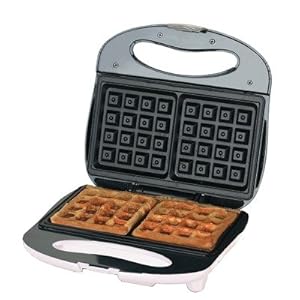
I bought a cheap waffle maker in Hania, made in China. It cost €25 with a one-year guarantee. (That's expensive for a cheap import, isn't it? Prices in Hania are always much more expensive than elsewhere in Greece.) The waffle maker doubles up as a toasted sandwich maker too (the irons come out), but since we already have a toasted sandwich maker, it's unlikely that I'll use my new gadget other than as a waffle maker. Such equipment make me feel materialistic, so I look for ways to get the best use out of them.
I've been given a good recipe by my friend Uta for waffles. Uta's original recipe is especially clever in that grated apple is
added to it to make the waffles stay moist and juicy until the next day,
so you can have them as a dinner treat and then enjoy the remaining for
breakfast the next day. By replacing various ingredients in the batter with local ingredients, notably olive oil instead of butter, I've come up with a Greek-inspired waffle recipe.
You need: 125g olive oil* (instead of butter) 70ml orange juice* (instead of milk - or you can use a mixture) 125g flour (I used a mix of white and brown flour - ~25 cents) 1 small teaspoon baking powder* 1 apple, grated (~25 cents), OR: 1 small zucchini, grated (it basically does the same job - it keeps the batter moist - in the autumn, I also use pear) 2 eggs* 2 tablespoons
sugar* vanilla flavouring (I omitted this, since I was using fresh orange juice - you can add orange zest for more flavour)
Mix ingredients together to make a thick batter. Heat the waffle iron and bake the waffles until
golden brown. The mixture is enough for 6 waffles (or 8 smaller ones, with missing corners).
Waffle batter containing grated apple
Waffle batter can be flavoured or kept moist in many different ways. To avoid buying apples (something we don't grow ourselves), I used fresh zucchini (we cut the first one from the garden on the 15th of May). Grated zucchini is used in sweet treats like zucchini bread and zucchini-chocolate cake. This is a very clever way to keep children eating healthy food.
A teddy bear's picnic with Greek toppings - the cream, the organic strawberries and the chocolate topping are all products of Greece.
The first time I cook something new, it's to get the hang of it. The second time I make the same thing is never like the first time I made it. This time, I divided the batter and added grated zucchini in one lot, and grated zucchini with cocoa powder in the second lot. The plain zucchini waffles tasted good with cheese - great for people who aren't too keen on sweet snacks. Savoury waffles make a great meal.
Waffle batter containing grated zucchini and cocoa powder - I added just enough cocoa to give the waffle a rich chocolate colour.
Waffles have very little to do with Greek cuisine, but when made in a
healthy way with Greek ingredients, they can be enjoyed as a Greek-inspired twist.
All the different waffles I've made so far have been very successful. The same recipe can be adapted in many ways to ensure that you're not just eating a fatty hi-carb sweet treat.
The waffle batter can be made at night, ready to pour the next day into the waffle maker, so you can start the day off with home-made fruit and veg waffles: before you leave the house, you'll have had a good dose of olive oil, eggs, orange juice and zucchini, topped with some home-made jam and
organic fruits from the garden. (I usually halve the recipe when I keep the mixture overnight in the fridge.)
Cost of 8 waffles: about €1, eaten once as an evening snack and the next day for breakfast, among four people. Together with the toppings, each serving costs about 50 cents.





 Patates tiganites (fried potatoes), sprinkled with oregano, served at a souvlatsidiko in Rethimno.