Monday, 17 May 2010

Taxi! (Ταξί!)

 If you are coming to Greece (the country hasn't been obliterated off the map yet, you know) on a summer holiday this year, your biggest worry is probably not whether you will need an umbrella (sunshine guaranteed) or if the food will be good (you already know that if you are reading this blog). One of your biggest worries is probably going to be how to avoid being ripped off in this smash and grab country which was recently bailed out of poverty by the IMF.

Apparently one of the biggest rip-off artists this country has ever produced is taxi drivers: according to the popular press, Greek taxi drivers don't take you where you want to go, they don't use the taxi meter, they ask you where you want to go before you get in the cab (and leave you in the lurch if they don't like your destination), they tell you an inflated price, they take you round and round in circles to charge more money, and they perform a whole host of other pranks to find a way to make themselves rich while you pay them half your holiday budget just to get from the airport to your hotel. At the same time, it should be remembered that this kind of thing happens everywhere, not just in Greece

But when a Greek taxi driver DOES take you where you want to go, USES the taxi meter, DOESN'T ask you where you want to go before you get into the cab, DOESN'T leave you in the lurch even when your destination was out of their way (which they DIDN'T tell you in the first place anyway), DIDN'T inflate the price, DIDN'T take you round and round in circles (as if he didn't have anything better to do himself), but simply did his job, we never hear about it in the reviews, do we?  

Of the 25,000 taxis in Greece, half of them are yellow, ie they are Athenian cabs and work in the greater Athens area, what is known as Attiki (Attica), which consists of approximately 4000 square kilometers; that's just 3% of the land surface of the country (which is approximately 132,000 square km). Attiki is where close to half the population (approximately 5 million) of the whole country (approximately 11 million) make their home.It's hard to keep track of 12,500 taxis in a capital city with a density of over 1000 people per square km, as it would be in any country in the world. But these days, every legal taxi carries a microchip stuck to the windscreen, which a traffic officer can zap with an infra-red light to check its status.

Taxis were, until this year, a privileged profession. Anyone holding a B-category professional driver's licence can become a taxi driver, but buying a taxi licence is very expensive. It depends on the region; a taxi licence in Hania costs about 200,000 euro - that's a serious amount of money to invest in an occupation which you may end up not enjoying in the long run, and that doesn't even include the money for the actual car. In Athens, it is a guaranteed source of income, and you can make your money in a few years time, provided you work hard and you are young enough to do that, because eventually your nerves will wear out and you won't be able to hack the pace. You will have been accosted with knives and guns enough times to wonder how you managed to stay alive, and you will have seen so many hoons on the road and so many crashes, that you will realise that there is no such thing as a traffic accident, but they are all perpetrated by stupidity (which is why the road toll in Greece is very high).
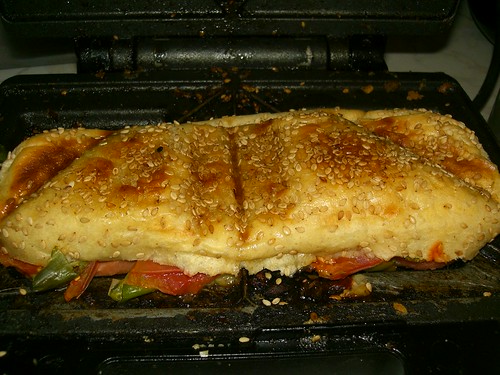
cabbie's dinner
My husband gets asked by other cabbies where he gets his delicious sandwiches from, because they always smell good, and they are placed in one of those commercial paper bags specially made for hot dogs and rolls (available from paperware stockists).

One of the most infamous cases of an illegally operating Greek taxi occurred a few years ago. The driver was literally caught in the act - completely by chance of course: how on earth can traffic officers stop and check every single taxi on the road in a built-up city without causing more chaos than already exists? The probability of this incident happening was a chance in one (or two) million: While putting in a normal day's work driving up and down the busy streets of Athens, a legal taxi owner-operator got stuck in a traffic jam (which is all part of a day's work in Athens). While he was waiting for the queue of traffic to decongest and continue on his way, he had plenty of time to survey his surroundings and take in little details like the licence plate number of the taxi cab stationed in front of his. It was exactly the same as his own. After the initial shock, he collected himself enough to call the police on his cellphone, who managed to catch the unlicensed driver and confiscate his car. At the same time, by catching that one guy, a racket was discovered involving false licence plating, garages which ordered a lot of yellow car paint (to change the colour of a vehicle and make it look like an Athenian cab), and other illegal activity. On being questioned, the fake cabbie insisted that he had bought himself a Mercedes and simply wanted to find a way to pay it off more quickly...

At the moment, you buy a taxi licence off the previous owner, not a state company. But very soon, in line with EU regulations, the taxi business will be freed up and become a more public profession, rather than the closed racket that it is at the moment. Unlike the London cab business, where there are black cabs (expensive) and mini-cabs (private cars used as taxis, that are much cheaper to hire than a black cab, and you don't need to be a registered 'knowledge' holder), Greece has only one sort of taxi, the one with a meter, and no other kind of cab service is presently legal.

Whereas once it used to be cheap to take a cab in Greece, this is no longer the case. If you are coming here on holiday, keep in mind that taxi fares have gone up considerably. Do not base your idea of how much a fare should cost by what it cost the last time you were here; and don't ask the taxi driver how much it will cost to go to a particular place - he should be able to give you an approximate indication of how much it will cost, but ultimately, it all boils down to what the meter writes up, and the meter should ALWAYS be turned on. If your taxi driver doesn't turn it on when you enter the taxi, tell him/her to do so. If s/he still doesn't want to turn it on, then ask to be taken back to your original pick up point so that you may take another cab. The rest is up to you. And when you get to your destination, don't forget to ask for the receipt, after paying the driver - yes, taxis are now legally required, for tax purposes, to issue paper receipts, whether the customer asks for one or not.

It used to be cheap for everyone (including us low-income-earning Greeks) to take a taxi and drive for miles. That's not the case any more. Rising petrol prices, the green-living policies and the austerity measures which introduced new taxation systems (all taxis must have a machine installed in the cab in full view of the customer that issues paper receipts) have raised the price of taxi fares to a level unknown before in Greece. Taxi fares now resemble the luxury that such a mode of transportation should be.

*** *** ***
Economic crisis (or volcanic eruption) or not, those of you who want to come to Chania (or Hania - it's the same place) may be wanting some information about the taxi services here. For a start, you don't flag taxis down in Hania. There are taxi ranks at all the main pick-up points, like the airport, the harbour, the main square in the town, and other service areas dotted around the city. There are grey taxis (which means that they are registered in a village), and blue taxis (which means they are registered in the urban area of the province of Hania). Hania is a small town, and taxi drivers know each other or of each other - a stranger in the crowd stands out easily, so it is easier to curb and put a halt to illegal cab activities altogether.
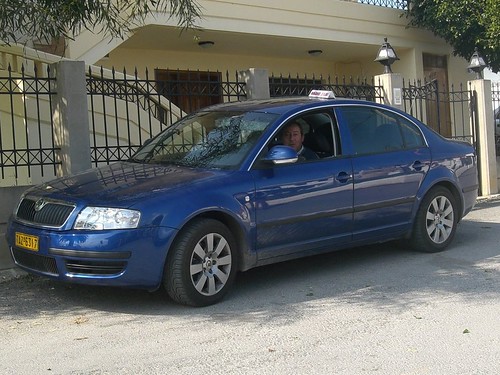
taxi

In the meantime, here are the official indicative prices for journeys made by the Ermis taxi company in Hania.

Luggage, scheduled pick-ups, telephone appointments at an arranged time and minimum fare fees also apply; they are not included in the list of prices in the table. The Ermis Taxi company (which has over 200 cars in its fleet, while the Kydon company has about 25 - go figure) has a special van available for hire if you have disability or mobility problems, at no extra cost (the driver receives a salary and performs a community service rather than working for himself). Taxi drivers' yarns about their work experiences are free of charge; just ask for a good story...

RADIO TAXI CO-OPERATIVE ‘ERMIS’
INDICATIVE FARES for 2010*


CHANIA TOWN
AIRPORT
AGIOUS APOSTOLOUS
STALOS
AGIA MARINA
PLATANIAS
AIRPORT
€23
--
€32
€35
€36
€41
GOLDEN SAND BEACH
€7
€30
€7
€8
€9
€10
AGIOUS APOSTOLOUS
€8
€32
--
€8
€9
€10
KALAMAKI BEACH
€8
€33
€7
€7
€9
€10
STALOS
€11
€35
€7
--
€7
€8
AGIA MARINA
€13
€36
€10
€7
--
€7
PLATANIAS
€15
€41
€12
€7
€7
--
GERANI
€17
€45
€13
€10
€10
€8
MALEME
€20
€47
€15
€12
€12
€10
KOLYMBARI
€30
€48
€25
€22
€21
€20
KASTELI
€42
€65
€38
€35
€34
€32
OMALOS
€55
€78
€55
€55
€60
€60
THERISSO
€23
€45
€25
€30
€30
€32
ELAFONISI
€85
€95
€80
€75
€74
€73
PALEOHORA
€85
€108
€75
€75
€70
€70
SOUGIA
€75
€95
€70
€70
€70
€70
SFAKIA
€80
€97
€82
€85
€87
€90
RETHIMNO
€70
€87
€76
€78
€80
€85
PLAKIAS
€100
€115
€105
€107
€109
€110
HERAKLEION
€150
€160
€155
€160
€160
€165
LIMNOUPOLI
€12
€35
€12
€13
€15
€17

  • HANIA (town) to SOUDA BAY (ferry port): 10 euro
  • Hourly charge for day-trip hire: 35 euro/hour
  • Airport surcharge fee (due to arrival wait-time): 5 euro
RADIO TAXI COOPERATIVE – PREFECTURE OF CHANIA
ERMIS
Mournion 38 – Tel: 28210-98700
IR No.: 998454319 – Chania Tax Office B
You can also book our taxi: call 6977-399-306 (when you have arrived in Crete).

Happy holidays to all. You can also find this information on One Day in Hania.

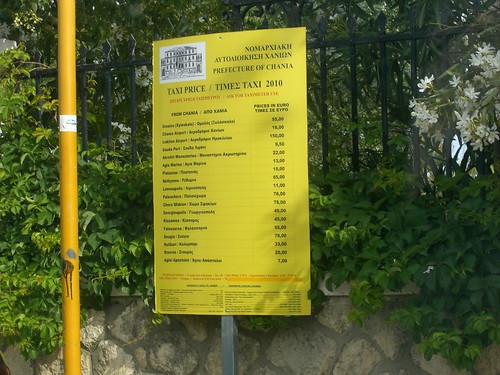
UPDATE 25 May 2010: Signs with inidicative prices (slightly different from the table I have posted above: some destinations have lower prices, while others have higher prices) of taxi fares covering the 2010 summer season have now been posted around the town. The one I have included below is found close to the Agora (the central market in Hania), therefore it lists prices to/from Hania. In the same manner, a sign posted at the airport will list prices to/from the airport.
inidicative taxi fare prices hania chania

*UPDATE 22 June 2010: As of 1st July, 2010, taxi fares will increase by 11%, because of the changes in the way taxi drivers will be taxed from this day onwards. In order to get an idea of the new indicative prices for the destinations listed in the tables above (in both the text and the photo), you need to add 11% to the price shown.

©All Rights Reserved/Organically cooked. No part of this blog may be reproduced and/or copied by any means without prior consent from Maria Verivaki.

Friday, 14 May 2010

Stamnagathi (Σταμναγκάθι)

Stamnagathi has always been a prized leafy green that grows mainly on the island of Crete. It grows in the wild, its leaves sprout in amongst a thorny bush, and it's found growing in areas which are accessed mainly by goats, in remote valleys and mountain plateaus, therefore it's organic de facto. The best time to forage it is in spring, when the leaves are at their most tender. It's also sold at a high price - more than what you would expect to pay for meat - upwards of at least 7-8 euro a kilo - at least this is how I remember stamnagathi when I was first introduced to this tasty bitter green, all those many years ago when I first came to live in Crete and created my own Cretan kitchen.


Fifteen years on, stamnagathi is now available all year round, is widely cultivated on the island (ie not organic de facto any longer), goats don't even get near it these days, and what's more, it's cheap. This year, stamnagathi was hardly ever sold more than 5-6 euro a kilo; it's now available at less than 4 euro (I saw it just a few days ago selling at 3.14 a kilo). It's also widely used in both cooked and uncooked salads; its novel use in the modern kitchen has given it a new lease of life and greater attention on the part of food connoisseurs. One could call it a kind of fashion in modern Greek and Cretan cuisine.

This sounds like great news for all those people who love stamnagathi, and know its benefits. As with all crops that have undergone widespread cultivation, stamnagathi has now changed in taste and appearance, something that is inevitable when a crop is grown differently. Stamnagathi may now lack the slightly bitter taste it used to have, or the wild, dark green appearance of the leaves, but it is still very tasty. These days, it has a brighter green colour, and the roots, which can be the tastiest part (at least, they are for me), can be a little tough; it is now allowed to grow very large, which means it is not as tender as it used to be, but it brings in more profits for the grower, even though its price has now fallen. The roots soften on boiling but sometimes need more cooking time than the wild variety.

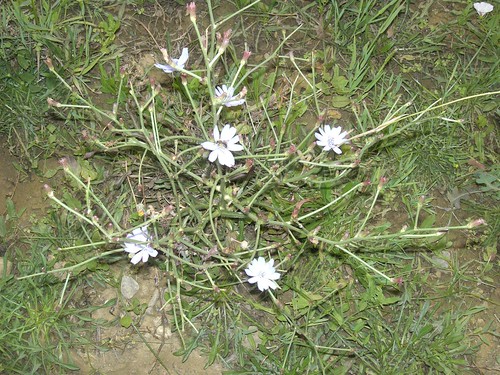
stamnagathi flower
The flower of the stamnagathis (spiny chicory - Chicorium spinosum) is actually blue-mauve, which didn't come out very well in this photo.

Wild stamnagathi used to be plentiful, but because most people now own a car that can take them to normally inaccessible areas, it has suffered the ravages of over-foraging. Pretty soon it will become an endangered species. Life is changing on the island - and so is the food.

©All Rights Reserved/Organically cooked. No part of this blog may be reproduced and/or copied by any means without prior consent from Maria Verivaki.
Tuesday, 11 May 2010

Modern living (Μοντέρνα ζωή)

Have you ever browsed through the Unhappy Hipsters site? If you ever had any doubts about modern living, you will find solace in their witty one-sentence captions of photos showing modern living in the de-cultured globalised setting of Western (or westernised) society.

I have always wanted to do something similar myself with food photos that show out-of-this-world food or food products that most people would find an abomination. But that would mean that I would have to copy other people's photographs and make rather irksome remarks about them (the former is illegal).

But the gnawing need to write quirky one-liners still grates at me, especially now in the sombre mood that my country has sunk into. I have decided to use my own stock of 3,000 online food photos to do this. Can I rise up to the challenge of making a mockery of life and writing sarcastic comments about my own food? I am smiling already...

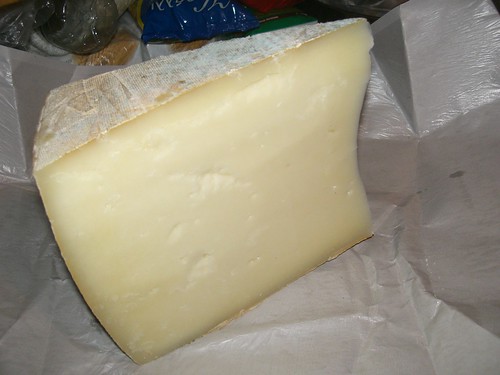
graviera hard yellow cretan cheese
When Luna said the moon was like a big wheel of cheese, Jerry thought she meant it metaphorically. But tonight, the moon looked like a pacman, and she had bought home the missing chunk. He didn't think she would actually go to the lengths that she did to find out what flavour it had.

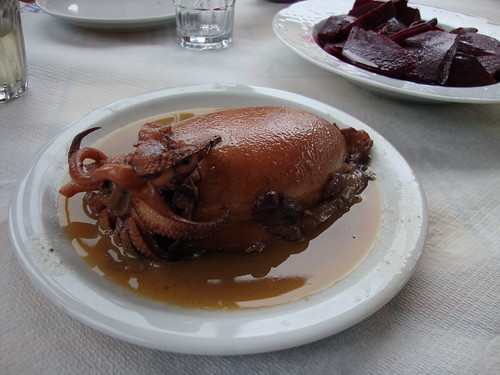
cuttlefish in wine soupies krasates
The waiter set down the plate and walked hurriedly away. As Warren picked up his knife and fork, the first tentacle popped out of the sack, and suddenly another and then another followed in quick succession. When this process began to repeat itself exponentially, Warren simply threw the cutlery down on the table and made a run towards where the waiters were. He knew he'd be safer there.


marathomizithropites
Their dependence on fresh supplies was owing to the fact that they did not possess a refrigerator, hence they were accustomed to foraging and purchasing food products on a daily basis. He did not complain at the huge inputs of leafy greens that she would often place before him on his return from work, but felt a slight revulsion in the middle of spring when all the crops had been harvested and only the grass and weeds remained.

flower and lettuce salad
He had had a dozen roses sent to Tiffany in an attempt to convince her to give him another chance, but now realised that she was on a destructive path to get him out of her life - only the previous evening, he had found all his Mickey Mouse comics ripped to shreds. Upon seeing the rose petals, in the salad, he knew it was over. 

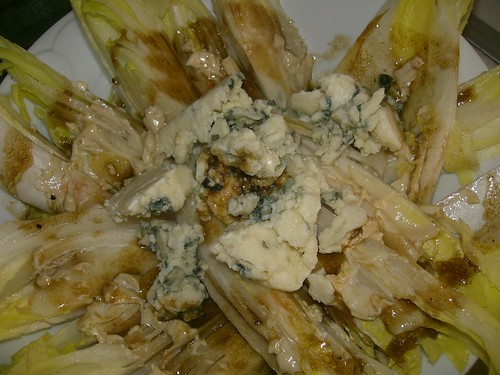
salade d'endives au rocquefort
Jeremy did not realise that the cheese had gone mouldy until the powdery blue fluff wafted up his nostrils as he took a bit from the chunk he was holding, causing him to sneeze. That's when he saw it - and promptly regurgitated the contents of his stomach.

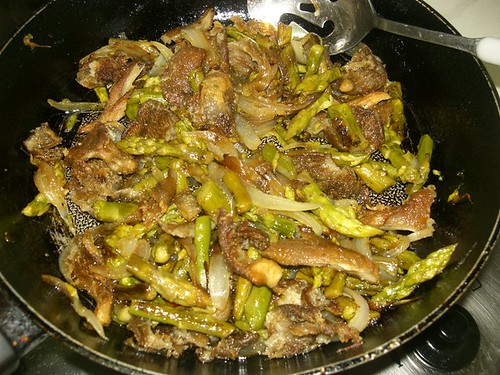
mushroom asparagus sautee
Ida knew it was pointless trying to talk any sense into him. He rejected her concerns and simply told her to concentrate on the real issue: "You can't see the forest for the trees, can you?" 

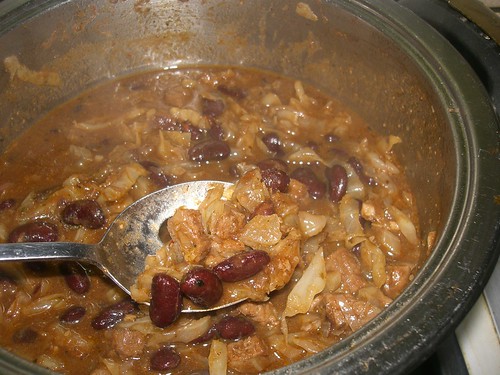
chili con carne
"It's somewhere in there!" she cried despairingly. "I know it is!" She held up the other contact lens and showed it to him. "It looks like this. Just keep sifting and it'll turn up!"

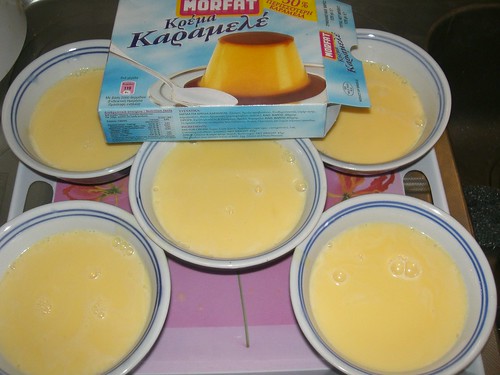
creme caramel convenience food
Petunia was a born perfectionist. And why shouldn't it all turn out to be perfect? She had followed the instructions to the letter. Nothing could go wrong.

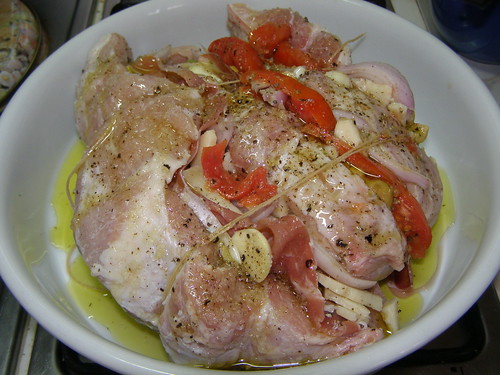
stuffed pork on the bone 
The taller ones could hardly move, but the smaller ones were able to wriggle out from the open cracks of their prison. The chance of pulling the others out to safety and escaping altogether was not a feasible one to contemplate at that moment.

vasilopita cupcakes
No matter which way they were dressed, whichever way you looked at them, they were all the same underneath.

And we really all are the same underneath.

The recent economic crises - the Greek one was different from the global one - have made us all rethink about the way modern globalised living has shaped our lives. Buying property at inflated prices, taking out loans to survive off money that can't be paid back, securing a job in the unproductive high-paying Greek state sector - they were, are, and will always be unsustainable ways to live an artificial life; at the same time, by going through these crises, we may have been given the chance to see life at a more basic level, one that we can all enjoy and survive through.

©All Rights Reserved/Organically cooked. No part of this blog may be reproduced and/or copied by any means without prior consent from Maria Verivaki.
Sunday, 9 May 2010

Mother's Day (Η μέρα της μητέρας)

As the number of family members shrunk after the children departed, it would be normal to expect that the kitchen table would have some empty spaces. But those spaces were quickly filled by new occupants. A visiting friend recently told me about how she would spend some of her time in my mother's company.

"She was like a mother to me, and a grandmother to my children, even though she didn't have any grandchildren herself yet. I was studying in Palmerston North, and would come back home to my husband and children at the weekends. She knew that I didn't have time to visit her after church AND cook a meal for my own family, so she would simply invite me over for Sunday lunch. Not having a mother of my own (she had died when I was a child), I felt like her own daughter who had recently left home and gone overseas. I felt as though I was filling that void in her life.

"I knew what to expect at every meal she served me, and I can remember every detail about those Sunday meals. For a start, there would always be a plate of horta on the table. She knew I loved horta, so she would go and pick them just before I visited. She'd make enough so that I'd have my fill during the Sunday lunch, and then she'd put some horta in a tupper so I could take it away with me when I went back to Palmerston North, the same tupper she had filled for me the previous Sunday and I had brought back with me to return to her.

"She had already roasted the lamb with the potatoes, and boiled a whole chicken from the morning, before she went to church, so all she had to do when we returned from the service was to strain the stock. Then she'd season the chicken, put it in a roasting pan, take out the lamb roast from the oven, and put the chicken into the oven to brown. Halfway during the cooking time, she'd turn it over to brown on the other side. At the same time, she got the pilafi going. When the chicken was done, she'd place the baking tray with the roast lamb and potatoes back into the oven to warm it all up. And when the pilafi was ready, she'd serve it all up, fresh and hot.

"I knew her health wasn't in the best of shape, but no one could have guessed this if they hadn't known about it. She was a dab hand in the kitchen. She knew her space well and moved around agilely in its familiarity. 'You shouldn't have gone to so much trouble,' I would tell her. But she insisted that it wasn't any trouble at all, and I knew it wasn't because this kind of meal preparation was child's play for her. I simply felt guilty that she was cooking so much food for my family every time I visited. Her own children had flown the nest, so it would seem natural that she would like to take a rest from this kind of mothering. But it didn't seem natural to her; she could not stop playing mother even when there were no children in the house.

"At the end of the meal, I'd help her to clear the table and do the dishes. She let me do that at least, as she'd be rather tired by then. She would start preparing dessert. From one of the kitchen cupboards, she'd take out some big clear plastic tubs with orange lids, each one containing something different in them: melomakarona, kourambiedes and koulourakia. Then she'd brew some coffee, and we had all this while listening to the Greek music programme on Radio Active.

"I'd stay at her house until the end of the music hour by which time she had all the tuppers ready for me to take away. She always gave me the remaining pilafi, 'for the children, they all love rice,' she'd say, and that way, I didn't have to cook dinner in the evening, either. And that was a typical Sunday for me in your mother's company."

lunch for a friend

The meal that has just been described was the typical Sunday meal throughout my New Zealand days, all except the horta, which my mother was obviously cooking to please her guest.

You never really stop being a mother, even when there are no children in the house any more. You simply adopt new ones so that you can find a way to continue playing this important role.

©All Rights Reserved/Organically cooked. No part of this blog may be reproduced and/or copied by any means without prior consent from Maria Verivaki.
Friday, 7 May 2010

Avronies (Αβρονιές)

Here's an unusual green that is very popular in Crete at the moment. It grows in the wild, and as yet no one is cultivating it. We can find it growing in our orange groves, but only in small quantities, which is why I usually buy a bunch before spring is out, when it won't be available after that.


Avronies are an asparagus-like spear which grow very long and spindly. They aren't easily spotted because they snake along the earth, giving themselves away by their slightly furry tip which sticks up like grass. Only the tender parts are used (the remaining part of the plant is too woody), and their taste is rather bitter, which is why avronies are usually boiled to remove their bitterness before being used in a meal.

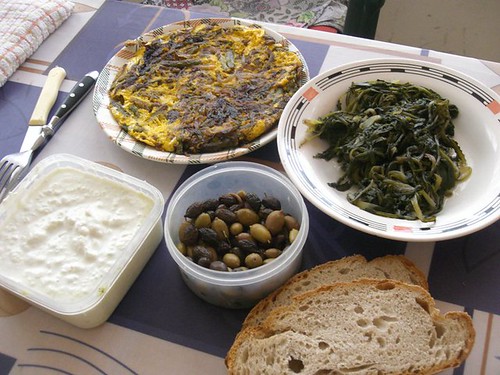
avronies tsimoulia omelette
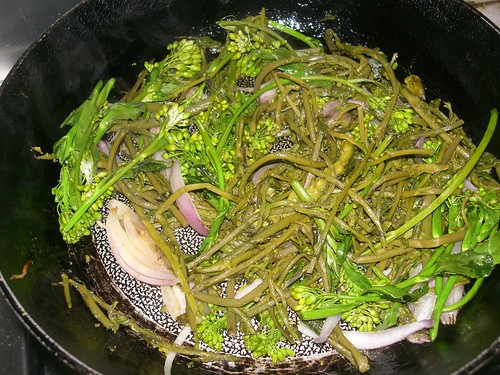
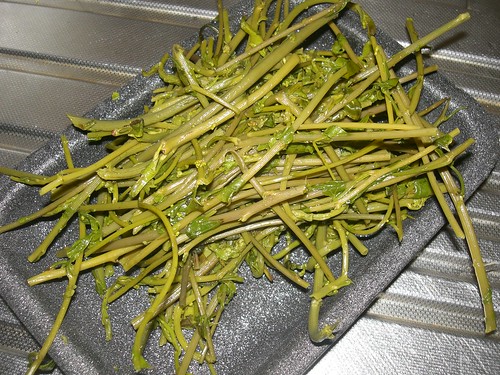
After I boiled the avronies (below, left), I had to discard some of them because they were still too woody and stalky to eat. The tsimoulia (bright green in the top photo) were simply washed (they were tender enough). 
boiled avronies avronies tsimoulia omelette

I've presented this dish before, but I think it's worthy of a second mention. It's mainly a forager's specialty, and it's usually cooked with eggs, like an omelette. I haven't changed the basic recipe from the last time I made it, but because I didn't have enough avronies, I also added some more edible greens called tsimoulia, the tender flowery stalks of the cabbage plant, which grow once the cabbage head has been cut off the base of the thick stalk.

Thick asparagus spears of the type available in Western supermarkets are now also available, grown in Northern Greece; both the white and green varieties are sold in Crete. They have a different taste from avronies, but they can easily replace the wild variety in the omelette I made.

mushroom asparagus sautee
Conventional asparagus, now grown in Northern Greece, sauteed with mushrooms and onions, makes a delicious vegetable-based filling for an omelette.

I used Greek asparagus in the meal I prepared on the 5th of May, as I waited for my husband to come home at 3pm as he usually does when he is on day shift. I laid the table at his usual place, taking care to fill a pitcher with cool water because it was a very warm day and he would come home feeling parched.

on the 5th of May
The table was set expectantly...

My husband came home on time and I served him the meal p. He picked up the remote control and asked me which channel the news was on at this hour. Even though he usually sits down to eat his midday meal at about this time, he can never remember which one it is. I reminded him that there wold be no TV news that day, as there was no school for the children, because the teachers and the journalists were on strike. So we didn't watch any TV that day. While three people were being pulled dead out of a burning building, we were having lunch, unaware of what was going on that day.

Those people would also have been getting ready to return home, after their work was done. They would have been going home at this hour to a similar seat at their table, and someone would have been waiting for them to come home. For the three who died in the bank fire, their place at the midday table would remain empty that day and forever from now on. I will remember this for many days to come. Whenever I lay the midday table, this thought will creep into my head like a disease, and it won't go away easily, unless I find a way to numb my mind on purpose.

The asparagus and mushroom omelette is the last meal I cooked since that day. As the saying goes, tomorrow is another day. Maybe it will be better. In any case, life continues.

©All Rights Reserved/Organically cooked. No part of this blog may be reproduced and/or copied by any means without prior consent from Maria Verivaki.
Wednesday, 5 May 2010

So when the government decides to take out a loan with the IMF, and the deal is signed and done, that's when the unions (damn them) tell their members to go on strike. So they close all the public services and the schools, and the journalists stage a news blackout in the whole country, so that the citizens have to rely on the foreign press to hear what's happening in their own damn country. And everyone goes for a long walk in the centre of Athens staging a peaceful uneventful demonstration. But in amongst the strollers with their banners telling the IMF to go home, there are fucking hoons who have nothing better to do and don't even know what the demonstration is about. They just want to let off their firecrackers, which they do, in a building that houses a bank. And no one know what the fuck is going on (unless they live down the road or something like that). And then three bank employees in their 30s die in the ensuing fire, and that's when the keepers of the news decide to break people's news fasts and tell them what's happening in their own country - because if they don't hear it in the emotional sympathetic voice of their own lyrical language, then they'll just have to take the word of the foreign press that this is what's happening in their own country, and they don't need to hear it over next morning's breakfast while they're watching the news as they drink their coffee, do they?

When Greek journalists go on strike, they deny the right of the ordinary Greek citizens to find about what's going on in their own country. If it weren't for those three deaths in the bank fire during the protests, they'd still be on strike - what made them change their minds and start reporting the news after all? The severity of the case or the shame of starving Greek citizens the right to know what is happening in their country from their own people, and forcing them to turn to the foreign press???

From now on, the fifth of May in Greece will be associated with the blatant irresponsibility of that handful who don't want to grow up and simply continue to refuse to stop abusing a system that could work if only they let it.

http://news.yahoo.com/s/ap/20100505/ap_on_bi_ge/eu_greece_financial_crisis_84
http://news.bbc.co.uk/2/hi/europe/8662117.stm
http://edition.cnn.com/video/data/2.0/video/world/2010/05/05/magnay.protests.in.greece.cnn.html

Visiting Greece this summer? Have a good holiday then.

Monday, 3 May 2010

The creative character of Cretan cuisine (Ο δημιουργικός χαρακτήρας της κρητικής κουζίνας)

Here's how one lazy Greek passed her day recently.

It all started with the fish. It was Saturday, the best day for cooking fish in our house, as we are usually all at home without other obligations. I had wanted to cook some salmon with fennel flavoured with an ouzo sauce, a dish I had come across in my blog readings. The combinaton of fennel and salmon was a match made in heaven, one of my friends had told me recently. So off I went to the fish market in search of some salmon.
It was not the best day forbuying fish though. The weather was too rough for fishing, and very little fresh fish had been brought in to the markets. All the fish shops seemed to be selling yesterday's catches, judging from the amounts of each variety found in their display, and it was early morning. The salmon was priced at 14 euro a kilo, but the pieces were not cut evenly. Some slices were from the tail end - thick but small - while others were misshaped into squares; there was no way of knowing how many days they had been in the fridge.

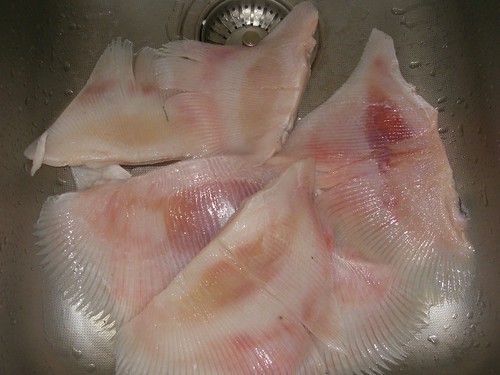
skate salahi

My attention was caught by the skate wings. I had once seen a skate (σαλάχι) being caught at the beach. This was the most plentiful fish at the fishmonger's this morning: 10 euro a kilo. The pieces looked large and filling, with the added bonus of having no sharp bones, just some soft bone cartilage that can easily be removed and doesn't cause pain on biting.

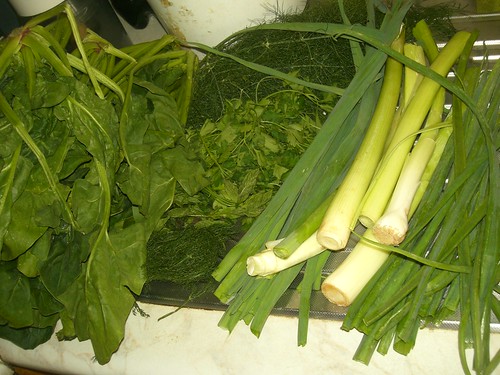
I had plenty of fennel at home; the stalks with their willowing fronds are a common feature of the Cretan countryside. But the bulbs are not grown for retail selling in Greece. All the fennel bulbs I have ever used in my cooking (and always with seafood, especially cuttlefish) have been grown by relatives who have an interest in cultivating foreign vegetables, but only for their own consumption. I would have to buy imported fennel to try this dish, even though I knew that their seasonal quality would be compromised. Another nagging feeling in my mind was the fact that in the same week, I had already bought some celeriac (celery root) to make another foriegn-inspired dish, and I felt that it would weigh down unnecessarily to my carbon footprinting of the world. I decided to make do with what ingredients I had on hand and decide how I could best substitute the various items once I got back home.

aromatic herbs

Apart from the celeriac and some carrots, my fridge was holding a hoard of leafy herbs and greens, that I had forgotten to turn into marathopites (vegetarian fennel pies) during the week. I set aside the fish and made piles of all the greens on the kitchen work top.Then I went down to the herb garden my mother-in-law tends and picked some fresh fennel weed and mint, and chopped off some of the leafy green tops from the onions and garlic that she had also planted. The fish, I decided, needed less preparation time, so I set to work on the greens, cleaning them, drying them well (they shouldn't be too damp when adding to a pie), and chopping them into a bowl. It's hard to keep track of the quantities of each ingredient. Ultimately, it boils down to what you have on hand, and how much you have to use up; your pies will take on the flavour of the most powerful ingredient in the mixture.

I'm not a great fan of making pastry, but since it was Saturday and I didn't manage to buy any from my favorite pastry maker int he town, I had to roll my own. It's a messy job and your hands get very sore when using a rolling pin. It's not a job you can do on a regular basis if you are often away from home. The good thing about home-made pastry is that it keeps in the fridge for two days, and you can break off as much as you need to use on one day, and keep the rest refrigerated if you don't have time to roll and fill pastries on the same day (I find it very tiresome and repetitive work). With a weary heart, as I thought about the time racing away and Saturday's lunch meal that still had not been cooked, I got the pastry going.

You need:
a glass of water
a small wineglass of olive oil
a nip of tsikouthia (Cretan alcoholic drink - ouzo can be used instead)
a pinch of salt
a kilo of flour (I use organic flour, Limnos flour and/or a special blend made by Miloi Kritis for pie-making)


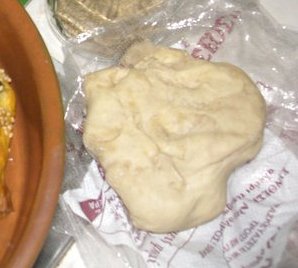
pastry for kalitsounia

Place all the ingredients in a bowl and mix them lightly with a spoon. Then start adding the flour, by pouring three cups in the liquid all at once. Mix well, and keep adding flour, this time at the rate of  1/2 a cup, and mix it in until the mixture stops looking like a batter, and more like dough, which can be kneaded in the bowl without your hands getting bits of it stuck onto your hands. When the dough looks as though it has the right consistency, tip it onto a floured surface and knead it well so that it looks like an evenly shaped ball of dough.  You may not need to use all the flour. This dough will yield 25-30 small rounds of pastry.

At this stage, the dough can placed back in the bowl and covered with a towel until you are ready to use it. It will keep out of the fridge overnight in cool temperatures. At this stage, my dough becomes soft and easy to roll out. If I don't use it immediately, I place it in a plastic bag and put it in the fridge, along with the pie filling - and try to remember that I must use both of them up in the next two days...

*** *** ***

Once some space had been cleared, I looked at the original fish recipe again. It was a very uncomplicated recipe. The butter would have to be omitted, since we only use olive oil in our cooking. Butter gives a different texture to food, but I have long learned to go without it, since we have plentiful supplies of probably the best variety of extra virgin olive oil at our disposal all year round. I say this without any hint of superiority. You need to taste it to understand the difference.

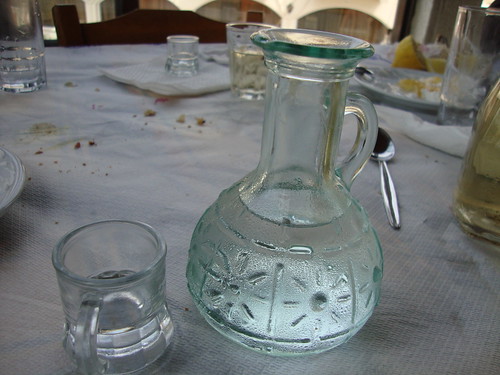
tsikoudia

Although I have a bottle of ouzo at home, no one drinks its. It is a remnant left in our drinks cabinet, and I haven't opened the bottle in a long time. Tsikoudia, the Cretan equivalent of fiery-tasting alcoholic clear-coloured spirit (it does not go cloudy when ice is added to it), has a different taste from ouzo, but it has essentially the same kinds of characteristics. Many Cretan housewives use it to flavour their dough when making pastries and pies. I decided to use this more familiar taste (to my family) than introduce too many new ideas in our midday meal.

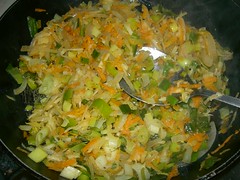
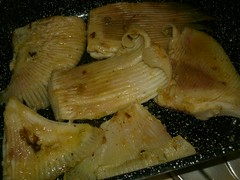
sauteed aromatic herbs and vegetables seared skate salahi
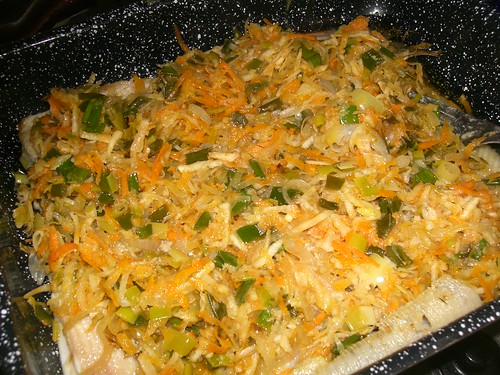
skate salahi with aromatic herbs and vegetables

Celeriac and fennel bulbs are two comepletely different things. They share one feature which is their subtle aromas. Again, they are different in that respect too, but I had now already devised my own recipe that I felt certain would work with the skate wings. Once I created the recipe - from the fresh ingredients I had available - I realised that I would have to divert from the original cooking style as stated in the recipe. As I was searing the fish fillets in the frying pan, I could tell by the texture of the finished seared fillets that the appearance of this half-cooked fish would not go down well with my family. Seared meat and fish is not common in Greek cooking, where everything must be, in general terms, well cooked. I decided to cook the fish in the oven, like a fish plaki dish.

Here is the dish that I created. It serves 5-6 people.

You need
600g filleted skate wings or other fleshy fish - salmon and galeos (shark) will also work
1 carrot, grated
1/4 of a large celeriac root, grated
1 onion, finely sliced
1 leek, finely chopped 
1-2 fat garlic cloves, finely minced
1 nip of tsikoudia
olive oil
freshly ground sea salt
freshly ground pepper

skate salahi with aromatic herbs and vegetables

Heat some oil and sear the fish fillets on both sides (three minutes cooking time for each side) one-by-one. Place each seared fillet in a deep baking dish.

Heat some more oil and and saute the onion and garlic till translucent. Add the carrot, leek and celeriac, and cook on low heat till the vegetables have softened. Season well and add the tsikoudia. Let simmer for five minutes. Turn off the heat and top the pan over the fish fillets. Add half a small wineglass of water (to stop the fish from sticking to the cooking vessel. Place the baking dish in the oven and cook for twenty minutes or so, until the flavours have blended. This dish keeps well for a day and can be reheated.

fried skate salahi

Skate wings can also be fried, lightly floured on both sides. For a heartier meal, they could be dipped in batter and served like fish and chips.

*** *** ***
Moving on to the pies, I plucked up the courage (after lunch, after I had thrown all the fish-smelling dishes into the dishwasher) to continue with the marathopites. Remembering how ungratefully my previous efforts at making marathopites were received by the children (whose tastes change as they grow older - or is it just that they become fussier?) I decided to add some mizithra (Cretan cottage cheese) to the original greens mixture.

Then I began to roll out the pastry - with my hands. I snapped bits of dough off (the size of golf balls) and rolled them out in the plam of my hand. To enlarge them, I used a rolling pin and sprinkled a little flour over them as I pressed them. Making small rounds of dough is much less tiring than flouring the whole table and cutting rounds off, then reshaping the pastry off-cuts into another ball of dough which again needs to be rolled out.
kaltsounia

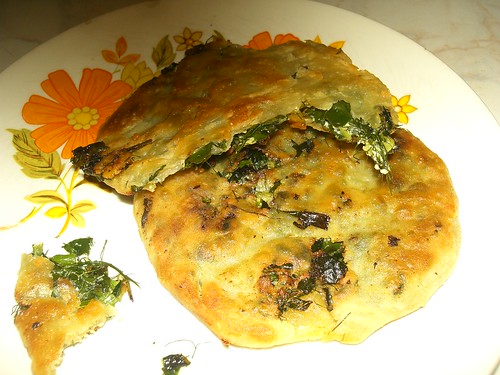
I filled each pastry round with an amount of filling equal to that of the size of the ball of dough that I cut off and rolled out. They were placed on an oiled baking dish, brushed with beaten egg and sprinkled with sesame seed. At this size, I could fit 12 pastries on one baking sheet. They were cooked on the low shelf in a moderate oven.

I was now getting impatient. I had been in the kitchen for most of the working day, and I wanted to get out of there as soon as I could. There was enough dough and mixture for another tray of marathokalitsounia (as I had now christened them, since they were neither marathopites, nor kalitsounia). I began to work robotically, first breaking off the remaining dough into small balls, then shaping balls of filling in the same size and leaving them on a plate.Then I spread out the dough balls into little rounds and topped them with a ball of filling.

marathomizithropites

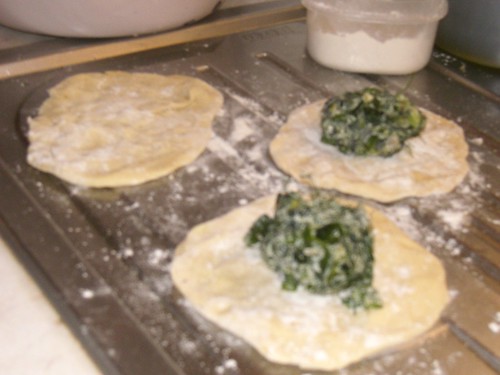
These I sealed like little pouches that had been punched down again, so that when I finished with them, they looked like seamless flat pies that had no opening: marathomizithropites, I named them, from the Cretan technique of making marathopites and mizithropites. These could be baked in the oven on an oiled baking tin, or individually fried in a pan on both sides. As the first lot of pastries were cooking in the oven, I cooked half the pies I made in the pan, each one separately, and placed the other half ready pies in the deep freeze, to use at a later date. 

marathomizithropites

This is the first time I had skate, and therefore, the first time I cooked it. Two different fish dishes, using whatever was on hand, to cater for the desires of all the family members, and two different kinds of pie, with the same dough and filling mixture, with enough remaining to be cooked for another (busy) days. Not a cookbook in sight with any recipes resembling the ones I made up in one morning, but first an idea (from the other blogger), and then a desire (to rid my fridge of excess produce), making instinctive and creative use of all the seasonal resources found in our surroundings.

This is in fact how many Cretan (and other Greek island) women used to cook in the past, and how some are (obviously) still cooking. Some food resources from the past are now not eaten, because of the changes in the Cretan society and the fast pace of the technological development that has taken the whole world by storm due to globalisation. A woman - she's only 66 years old - recently told me that when she left her village and moved to another due to marriage, she was cooking things like omathies (a kind of sausage made from the pork offal), something which very few people would now do, because they require special skills in making them, sausages are now more readily available everywhere, everyone has a refrigerator, and few people keep a pig on their land as a valuable food resource (more likely they keep a number for commercial purposes). That same woman also told me that she used to harvest fern fronds (also known as fiddleheads) when they had just appeared in spring, a most unlikely ingredient in Cretan cuisine, and a practice that has literally died out in modern times!

This is actually the origin of Cretan cuisine, making use of all edible resources without unnecessary wastage, watching and learning from the older generation, continuing traditions by adding new ideas and resources as they become available (eg refrigeration, imported products, ease of availability of fresh ingredients), using all the senses to create a memorable dining occassion, one that no tourist can find in a Cretan restaurant, because the daily cuisine of the home differs from the commercialised Cretan cuisine, in which tourists expect to see a standard product that has a known label attached to it.

If Cretan cuisine could not develop in this way (among other avenues that it has also taken), it would have become a dead cuisine, stalled in time, and brought alive every now and then by restaurants for the purposes of serving tourists and the younger generations who have no tangible link to their own past. It would resemble a quaint tradition, something that is paired with traditonal heel-slapping dancing and the grating rhythm of the Cretan rizitika music. But Cretan cooking has never been locked in the depths of the past (and neither has Cretan music - thank God that developed in the modern way it did!) and now with the emphasis on organic fresh local seasonal high quality produce, it is constantly evolving and becoming known as one of the healthiest and most varied cuisines in the modern world, with its foundations lying in simple cooking techniques and fresh primary produce.

And then they call the Greeks lazy and unproductive...

©All Rights Reserved/Organically cooked. No part of this blog may be reproduced and/or copied by any means without prior consent from Maria Verivaki.
Saturday, 1 May 2010

May Day (Πρωτομαγιά)

The first of May is a Greek holiday (one of many) recognising the right of the worker to a 40-hour week. When it falls during the weekend (like this year), it means that we miss out on the 'holiday' aspect of the celebro-commemoration because, unlike in some countries (with fewer national/religious holidays), a Greek bank holiday is always celebrated on the day it occurs, and not 'moved' to a more convenient weekday (like Monday or Friday) for the full not-at-work effect to be felt.

Protomayia (the first of May) in Greece is also associated sunny (but not overly warm) weather and the countryside. It is one of the few days that people like to go picknicking in parks and shady fields (since the economic crisis hit, this has become more common). You will see people collecting flowers and making wreaths out of them.

flower and lettuce salad kritamos coastal herb in egg and potato salad
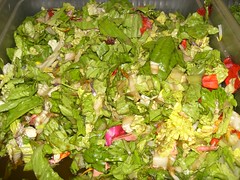
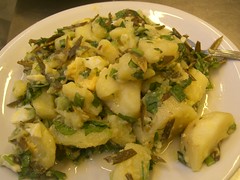
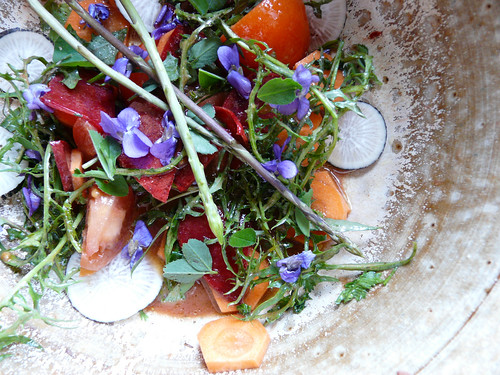
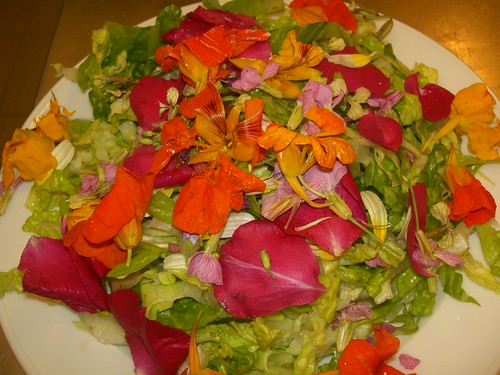
John the cook at MAICh prepared these delicious salads for the students. Left: flower petals on a bed of lettuce; right: kritamos, a coastal weed (which needs to be pickled before use) in an egg and potato salad.
flower and lettuce salad
Click on the photo above to enlarge it and read the notes about the flower species added to it.

If you don't feel like collecting flowers and then making wreaths out of them, you can always add them to your food. The petals of edible species of flowers are many and varied. They add vibrant spring colour to a bed of greens, and each flower has its own distinctive taste. Some are bland while others remind you of a mixture of spices.

riana's salad
Riana's salad; you can get more information about edible flowers from her collection of photos.

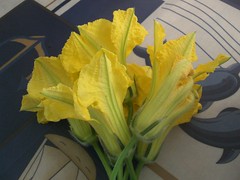
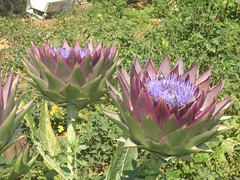
It may sound unusual to add flowers to your food, but it is actually more common than you think. Artichokes, zucchini flowers and capers are also edible flowers, except that they are bigger and/or covered in thorns, and don't usually get placed in a flower vase.

kolokithoanthous pumpkin zucchini flowers artichoke in flower

But if they did, they would also look pretty spectacular, wouldn't they?
 
©All Rights Reserved/Organically cooked.
No part of this blog may be reproduced and/or copied by any means without prior consent from Maria Verivaki.