Wednesday, 19 November 2008

Pumpkin (Κολοκύθα)

One huge pumpkin can go a very long way, without a bit of it going to waste.

I was recently given a pumpkin by my uncles, tenderly raised by their green fingers, in the midst of an olive grove, overlooking the Mediterranean sea. This pumpkin was about the size of a long oval summer watermelon. It didn't weigh as much as a watermelon (which would have weighed at least ten kilos), because of its hollow interior. When I first brought it home, everyone wondered what I would end up doing with it, including myself.
"You're not feeding us pumpkin every day, Maria," lamented my husband.
"What can you cook with pumpkin, Mum?" asked my adventurous daughter.
"I don't like it, Mum," my white-food-only-please son declared.

Pumpkin is not a popular vegetable in Crete. It is sold in greengrocers', but it is not often asked for by customers. Pumpkin is usually cooked by those who have pumpkins growing in their gardens, or people given pumpkins by local farmers. In Crete, they are usually turned into savoury pies. Some farmers use pumpkin as animal feed. Just lately, pumpkins have taken on a decorative nature, due to the rise in popularity of American culture and their association with Halloween. Decorated pumpkins are sometimes seen in ex-pat American-Cretans' homes.

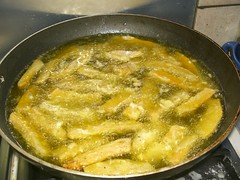
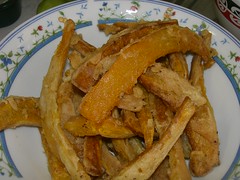
An American friend of mine told me how delicious pumpkin is when you fry it. Fried food may be unhealthy for you, but at least we fry our food using only olive oil. My mother-in-law loved this fried pumpkin; in fact, we all did.
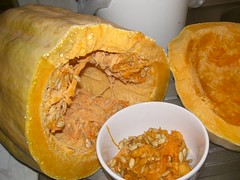
pumpkin pumpkin chips frying pumpkin chips fried pumpkin chips
Pumpkin chips, by Dimitra Sergakis: dredge the pumpkin chips in seasoned flour, then dip in ice-cold water and shake off excess water, then dredge again in the flour, and cook in very hot olive oil till crispy, then drain on kitchen paper. Cook in small batches to keep the oil hot...

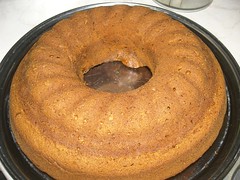
Despite smelling like heaven as it was cooking in the oven,
Susan's cake wasn't very popular in my house. Where did I go wrong? I didn't; my Cretan family is simply not used to ginger, cinnamon and clove aromas in their cakes and sweets. These spices are very reminiscent of autumn and cold weather; they are not overly used in the local cuisine, hence my family simply wasn't accustomed to them. Some argue that it is all in the genes; either you have a predisposition for certain foods, or you don't want to go near them, an explanation often given for lactose intolerance in certain cultural groups, eg Asians and Native Americans.

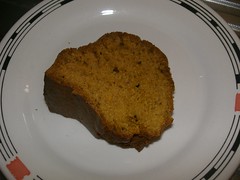
Despite my Greek genes, I was brought up in a gingerbread and gingernut culture, and all those Northern European recipes that were popular in the New Zealand climate, with cool summers and cold winters. In Crete, cinnamon and cloves are mainly used in honey-dipped sweets like melomakarona (Christmas biscuits) and baklava. But my pumpkin cake did not go to waste. Half was shared among my colleagues at work (it was a big hit), while the other half was eaten by the children during their morning break at school - sliced, with chocolate spread on one side. They loved it.
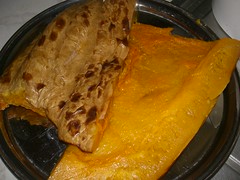
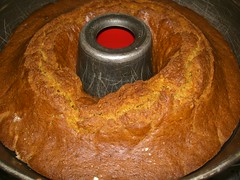
roast pumpkin pumpkin cake pumpkin bread pumpkin bread cake
Susan's pumpkin bread: she has a very good technique for softening the pumpkin...

Pumpkin soup is always welcome in the winter. It goes well with curry spices, some more heavy aromas that are not common in the Cretan kitchen; another recipe enjoyed principally by myself (which is why I didn't make it with this pumpkin this time round - I'm waiting for the next pumpkin to arrive).

The famous Gordon Ramsay pumpkin soup that I've been making long before I found out who he was...
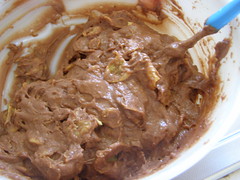
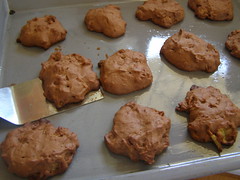
The pumpkin cookies made an excellent bento school lunchbox filler. To make sure that the children would eat them, I added cocoa and cornflakes. The pumpkin pulp went by unnoticed. But it was there, making these biscuits extra healthy.

chocloate pumkin cornflake drop cookies chocloate pumkin cornflake drop cookies
My very own pumpkin cookies, specially created for Thanksgiving (recipe will be posted on 27 November), based on the idea of using cornflakes in a New Zealand biscuit, the afghan.
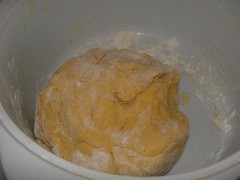
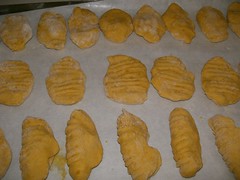
I originally made the pumpkin gnocchi as a way to use up the pumpkin excess in my kitchen, after seeing a Sunday newspaper supplement featuring Aglaia Kremezi's pumpkin recipes. She tells us that the Spanish conquistadors mistook the pumpkin for a new variety of melon. As I was making the pumpkin gnocchi, I suddenly had another idea for making pasta with the same dough...

pumpkin egg dough pumpkin gnocchi
Aglaia Kremezis' pumpkin gnocchi, oil and seasonings added ...
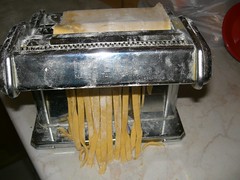
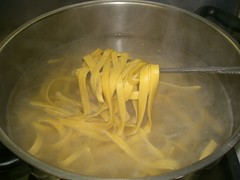
... pumpkin fettuccine, using my late mother's pasta machine. This was an absolute hit in the house. The children were most intrigued that they could make their own spaghetti; they now want to make it every week...

pumpkin fettuccine
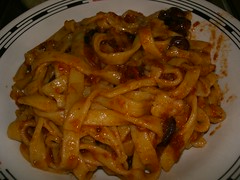
home-made pumpkin fettucine home-made pumpkin fettucine and puttanesca
Fettuccine a la puttanesca using pumpkin gnocchi dough...
But the most spectacular pumpkin recipe of all was Susan's pumpkin honey pie. One taste of this, and you're sure to think you've gone to heaven. It warmed up the kitchen and sent a delicious smell through the air. I called the pie μελόπιτα - melopita: 'honey pie' - which is kind of true: it contained honey, eggs and spices, and pumpkin of course, but I preferred not to admit that part, just in case everyone got frightened into thinking that everything they ate would be turned into a pumpkin, like Cinderella's story. Half of it was enjoyed by my colleagues, while the other half was eaten by my family.
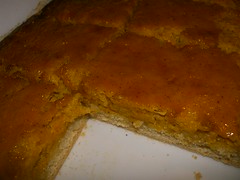
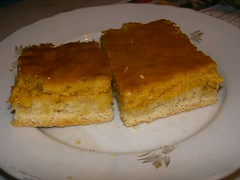
pumpkin honey pie pumpkin pie

If I could make this pie a second time around, I'd have it with some ice-cream, garnished with some whipped cream and topped with a spoonful of syrupy Greek grape dessert. If my family were a little more open-minded concerning international cuisine, I'd make this pie a staple part of a Christmas dinner.

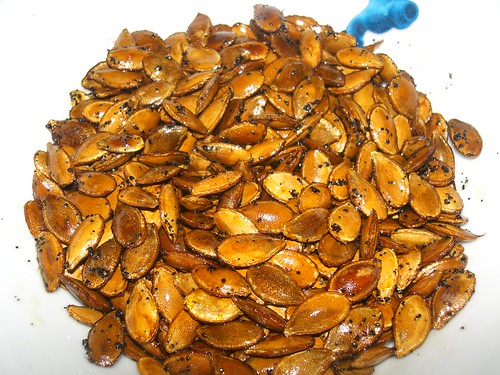
Last but not least, not even the pumpkin seeds went to waste!

roasted pumpkin seed
Roasted pumpkin seeds: as Elise says, don't bother opening them to eat only the seed; they taste good whole.

None of this pumpkin was binned, except for a very thin layer of outer skin. The whole pumpkin was treated with the respect it deserves as a food item and a commodity. It constituted a substantial part of our meals, was eaten in a variety of different forms, and was enjoyed by a lot of people. In these hard economic times, it doesn't make sense to shirk at the thought of cooking the same food when you can cook it differently using the same ingredients in a different combination. We cannot afford to waste food any longer.

This is my entry for this week's Weekend herb Blogging, hosted by Siri from Siri's Corner.

©All Rights Reserved/Organically cooked. No part of this blog may be reproduced and/or copied by any means without prior consent from Maria Verivaki.

Monday, 17 November 2008

Food labelling (Τι γράφει η ετικέττα)

For my husband's nameday, we decided it was too much trouble to cook a sit-down meal; we didn't even prepare the food ourselves. It all came from the freezers of our local supermarket. This was definitely a novel adventure for both of us. I never trust the quality of food prepared in industrial kitchens, while my husband's reservations lie mainly in the 'will this taste good?' domain. In any case, we didn't have much time to think about any of these things, as we had to make up our minds quite quickly about what we were going to serve on the day.

mass produced mezedes

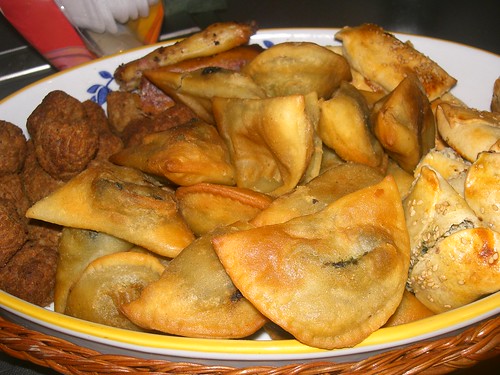
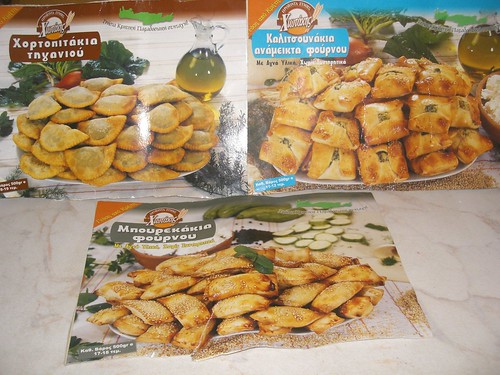
Party food in Hania nearly always includes locally made traditional pastries, kalitsounia, stuffed with various savoury fillings. This was our prime consideration when we had to choose from the myriad of packets available in the supermarket deep freeze. Priority was also given to easy-to-handle finger food, to the exclusion of sauce-based food. Our final choices were nearly all locally produced; this should not be a surprise, as the whole of Greece specialises in their own regional cuisine. There are many standard national favorites (eg bifteki, dolmades, kalamari), but in a place like Crete, with an abundance of wild greens and all kinds of other produce, there are also many dishes that are unique, not only to the island, but even to one particular area of the island. They are considered standard fare, and are mass-produced for busy people: no one can imagine a wedding without xerotigana, nor an Easter without kalitsounia, for instance, but we don't all make these delicacies ourselves.

frozen pastries from crete

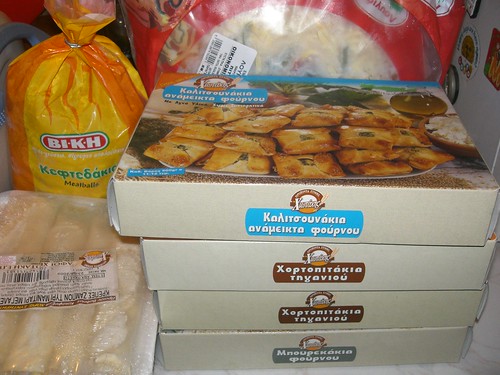
Our final choice for μεζεδάκια - mezedakia (appetisers) included the following: kalitsounia with greens, kalitsounia with spinach and mizithra, boureki pasties, locally-produced cheese crackers, locally produced pizzas and meatballs shipped from the mainland. Having never bought such snacks, the main method we employed in choosing what to buy came from the supposed appearance of the finished product on the packaging. We also checked the listed ingredients. I was always thought of packaged food products as unhealthy because they are bound to contain artificial colours, preservatives and other additives that we simply don't add to our food when we're cooking in our own kitchen. I was surprised by how few unknown non-kitchen ingredients most of them contained. All the products carried a 'use by' date well into 2009.

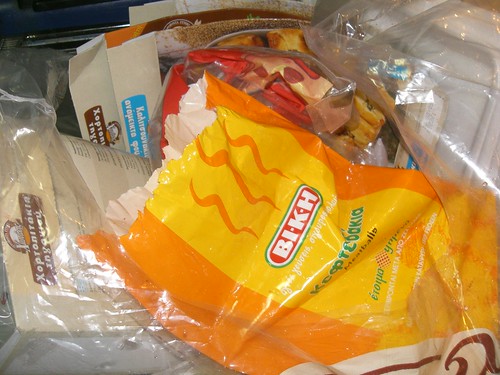
BIKY MEATBALLS: 6.06 euro/1kg
Of all our party food choices, the meatballs contained the most chemical additives. They were also the most clearly labelled, with a claim that 50% of their total ingredients contained meat. Most of the list contained ingredients you would normally find in meatballs: meat, pork fat, salt, egg, garlic, ginger, coriander, pepper, mint, parsley. From the range of spices listed these meatballs could substitute for pot pourri. Not that any of the herbs and spices could actually be seen or tasted. The labelling also stated that they were pre-cooked, needing only to be heated up for serving.

Among the listed ingredients that do not belong in a home kitchen were 'aroma' (literally 'perfume'; some kind of flavour enhancer) and συντιριτικό 'sintiritiko' (preservative), as well as something that was abbreviated as 'galact.', obviously a product derived from milk, which could be included to bind the ingredients, add more bulk or create a softer texture. There was also something called 'soya protein', a source of fat in processed foods, carrying the claim that it was from a non-GMO source, as well as 'phosphoric salts', which must be quite different to the salt used in a home kitchen for it to be labelled as phosphoric.

Another ingredient which read strangely was 'MΔk kot.'; I have no idea what this might mean, unless the 'kot.' refers to κοτόπουλο 'kotopoulo' - chicken. If this is the case, then I suspect that the meatballs contained MRM: "mechanically recovered meat which is obtained by pushing the carcass through a giant teabag-like screen to produce a slurry of protein, which is then bound back together with polyphosphates and gums" (Felicity Lawrence, Not on the Label). Chicken skin, considered the most useless chicken meat, rather than being thrown away, is usually minced so finely that it becomes totally unrecognisable, and cannot be traced visually in a finished food product. Felicity Lawrence also reports that some chicken nugget brands are made entirely out of chicken skin, which lacks any kind of nutritional value whatsoever.

The meatballs were tasty - in that chicken nugget way that all junk food tastes. No effort was made on the part of the manufacturers in terms of shape: the meatballs weren't round. They were more like sliced chunks of mincemeat rolled into a sausage - somebody obviously could not be bothered to shape them properly. I hope I never need to buy this sort of food again for a long time.

Interestingly enough, the same company produces meatballs in different packaging (a tray instead of a bag; it looks more appealing), using the same ingredients, but without the chemical or non-kitchen ingredient additives, a discovery I made on my next visit to the supermarket. They also contained 'breadcrumbs' instead of 'wheat starch', which is made from a by-product of wheat kernels; in other words, it is a waste product used as an additive in food products, to mimic wheat. They are of course more expensive: 8.50 euro per kilo.

LOUGIAKIS PIZZAS: 8.08 euro/3 pieces, each yielding 8 standard pizza slices
There was nothing listed in the ingredients that sounded unusual: flour, salt, water, yeast (which is what I use to make pizza dough, with the addition of olive oil), edam, gouda, peppers, salami, ham and bacon. Generalised varieties of edam and gouda cheese, ham, bacon and salami are often found in the deli section of supermarkets; they are usually the cheapest kinds of sandwich fillings, and they are not all made in Greece. This shouldn't be a reason to shun them; some imported deli items are usually very tasty, such as Kerrygold regato cheese, a popular choice in Greece. A 'salsa' was also mentioned in the list of ingredients, but wasn't elaborated on. This seemed very dubious: surely the ingredients of the salsa should have been on the label. The labeling did not list any preservatives, colourings or other chemical additives.

My husband commented that the cooked product did not smell 'stale' or 'rotten', as when deli items are not very fresh, or they have been subjected to temperature extremes. This does not surprise me: the pizzas were made by a company whose premises are 100 metres away from the supermarket the product was bought from. They spent very little time in transit, which proves that buying local is often a more efficient choice than sourcing organic, which may be more time-consuming and distant.

I have tasted other pizza brands, but this was the tastiest I'd ever had of store-bought pizzas. Our guests thought so too. They had an almost home-made flavour to them; it's a pity that some of the ingredients could not be deduced.

TSATSARONAKIS CHEESE CRACKERS: 1.44 euro/150g
The crackers were made by a local bakery, and again, no mention was made of chemical additives. The recipe sounded simple: flour, tomato juice, olive oil, yeast, salt and locally-produced graviera cheese. My only reservation was that these crackers were not tasty on their own; they needed to be paired with some olives and a piece of cheese, or some tzatziki. It was no surprise that they did not prove to be very popular. They made a great accompaniment to our meals later in the week, especially with bean stews.

mass produced mezedes
XIOTAKIS pastry goods

greens pasties: 3.93 euro/18 pieces - 2 packets
cheese and spinach pasties: 4.10 euro/12 pieces
boureki pasties: 3.93/18 pieces
filled crepes: 3.76/5 pieces - 2 packets (halved to produce 10 pieces per packet)

These pastries were probably the most delicious pret-a-manger appetiser I have eaten in a long time. Everyone remarked on how home-made they looked and tasted. These pastry goods are traditionally made by most mothers and grandmothers throughout the whole province of Hania. The ingredient contents were very wholesome, listing food items that are commonly found in a home kitchen: flour, oil, salt, pepper, mizithra (Cretan soft white cheese) and greens. They were also the only items that included an English translation of the ingredients. The labelling insists: "only fresh ingredients, no preservatives." I'm willing to believe this, as the taste of these products was almost as good as the home-made versions.

The pies only stood out as industrially produced from their uniform size: all the pieces were made in the same shape in the same dimensions. The spinach and cheese kalitsounia did not hold their shape well after they were cooked (in the oven, as with the boureki pies, brushed with egg and sprinkled with sesame seed); they had a heavy look to them, possibly because there was too much mixture for the pastry shell. The same could be said for the crepes (fried); they too felt heavy and were prone to disintegrating from the weight of the mixture and the frying process. The boureki pies and horto-kalitsouna came out practically perfect.

*** *** ***

My main reservation with mass-produced food is that I don't feel comfortable eating something that is made in an industrial kitchen. This kind of food should be reserved for desperate times, and eaten very infrequently. Product labelling is not as simple as it sounds. Most of the time, we find listed ingredients whose appearance, taste and smell are completely unknown to us. Even if we are told that what is in the product we are buying, we don't really know what is in it. Those unknown ingredients are never normally found in a home kitchen.

What surprised me most about my choice in ready-to-cook party food was how cheap it was to buy, compared to making these delicacies myself. The ingredients would have cost me approximately the same amount of money to buy and prepare this food at home, but I would have remained unpaid for my effort to produce them... No wonder people go for this sort of food when time is pressing.

It was obvious that industrially produced local food was superior to industrial food produced elsewhere. Local food technicians know what their fellow citizens want to eat, and they have to try to maintain a high standard. They also use local ingredients, sourced within a small distance away for the point where they will be manipulated, and where the final product will be sold. A town like Hania is very feudal in its solidarity to small enterprises; word will spread if their products are not high quality, and people will simply stop buying them, preferring another local brand. Cretan cuisine in particular is well-known all over Greece; quality cannot be compromised if a local business wants to compete with a mainland giant producer for a similar product.

recycling?

Another problem arose after I started opening up the packaged products. My kitchen benchtop suddenly began overflowing with paper and plastic. Never in my life have I had to amass so much throwaway packaging, coming straight out of my kitchen. It's all very well to talk about recycling paper and plastic, but surely not this kind of quantity from food products. So much care is taken to package products, not only to stop them from decomposing, but also to maintain shape and texture. Appearance is the all-important consideration here.

How much can you eat of this stodge? As the host for the night, I couldn't eat much myself. I was too busy 'entertaining' my guests. Even those few bits and pieces that I did eat made my stomach feel heavy. It could have been that I'm simply not used to eating pastry and fried food as a main meal. I was reminded of a visit to Pizza Hut with my family in London. All we ordered was a pizza, some oven-fried potatoes, a coleslaw and soft drink, shared among the family. Everything was very tasty, but why did our stomachs feel as though they were about to explode?

©All Rights Reserved/Organically cooked. No part of this blog may be reproduced and/or copied by any means without prior consent from Maria Verivaki.
Friday, 14 November 2008

Dimitra's story (Δήμητρα)

I finally got round to visiting them on my way to pick some olives from Fournes, a short detour from my route. They would appreciate my dropping off the photos of their granddaughter's wedding and great-grandson's baptism. They will not be expecting to see the bride, groom and neofotisto so soon, so this will be seem such a treat. Long-distance journeys are never easy; the telephone makes one feel that they are never far away. In any case, a photograph is bound to be on its snail-mail way soon.

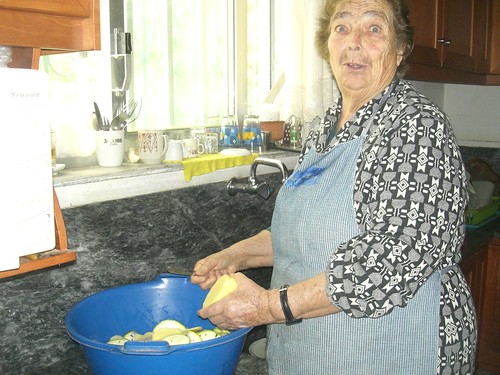
dimitra

"Why, hello there! Look who remembered us, Mihali!" my aunt greeted me as I entered the house. The front door is never locked; I simply pushed it and it swung open.

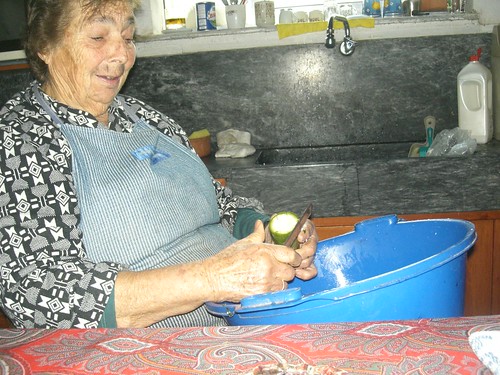
"Happy nameday, Thia!" I replied. I saw her standing in her usual position, over the sink, slicing courgettes. Even though there are no children or grandchildren living in her vicinity, she's still cooking up a storm in her kitchen, a whole tin of food, enough for a family of six. I wondered how many vegetables that woman must have cleaned, pared and chopped in her lifetime of 79 years.

"Na hairese ton andra sou!" she replied. She always remembers my husband's nameday, but can never get round to calling us on the day, as she is too busy accepting phone calls for her nameday on St Demetrius'.

Thio was nowhere to be seen; he had probably wandered off to the kafeneio to pass the morning, away from his wife's space. "The same to you and Thio!" I reciprocated, only just remembering the correct wish for the occasion of a nameday. My brain never seemed to be able to cope with categorising the appropriate expressions for each occasion. Most of the time, I keep my mouth shut just in case I make a faux pas, and say something unlikely, such as 'Hronia polla' at a funeral, or some other highly inappropriate occassion for such a wish.

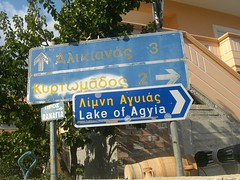
"You know how much I love it when you come over!" Yes, I did know, feeling guilty that I did not visit more often. Whenever I pass the sign pointing in the direction of the village, I tell myself that I must remember to turn onto their road on my return journey from the olive grove, by which time it always seems too late to spend time in another person's kitchen when I could be in my own.

(Ayia Lake is now a protected area; pouraki is a similar sweet to baklava, made locally.)

"Shall I make you a cup of coffee, sweetie? What about a pouraki?" Even when I'm not hungry, I know that the food I will be eating in this house will not be available to me again until my next visit. Eat what you can now, Thia's said to me on many an occasion, because you don't know when you'll be able to find it again.

"Yes, please," I replied, awaiting with eagerness that little sweet roll filled with nuts from the surrounding trees, seeped in aromatic honey syrup. "That's a big tin of boureki you're making, isn't it, Thia?" I can't see any potato in the tin; she didn't add any potato to her moussaka, either. Once Thio was diagnosed as diabetic, Thia had to adjust her recipes to accommodate him. Not that potato would make much of a difference to Thio's sugar levels; it's all in the mind.


"This'll be enough for two days. But it's not just for us, you know," she explained. "I'm going to your uncle's house and we'll have our lunch there." More guilty feelings; another person I hadn't seen in a long long time. Thio Perikli is her older brother. What am I waiting for?

"How's he doing?" I asked, a question I prefer to avoid, because the answer is never very good.

"Life's a chore for them, they've aged, we've all aged, but they haven't aged well. Athina's practically blind, and all she does is sit around the house now, she never gets out. And her husband's not any better, thinks he can feel death knocking on the door." They both had recently voiced their concerns of losing each other.

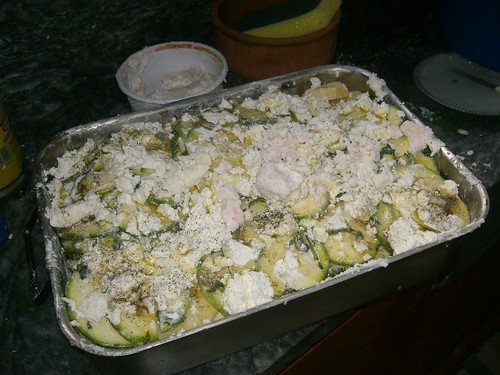
She rummaged around the bowl of courgette slices as though she was searching for something. "Ah, here it is," she said, pulling out a huge pristine white potato from under the mint-dotted courgettes. "I had to hide it until Thio left the house. What the eye don't see, the mind don't know." The oldest trick in the book. "He's just gone to the kafeneio to pick up some bread. The baker's coming round today. Not that we eat much ourselves - it's not too good for Thio's diabetes - but we buy some out of habit, like we did in the old days," she sighed, still standing at the sink with her hands full of vegetables.

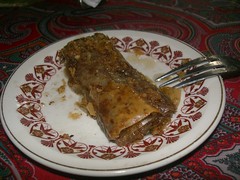
boureki

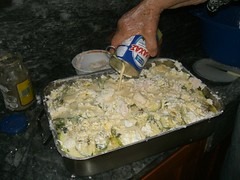
She began layering the vegetables and mizithra into the baking tin. "We used to make our own bread in the village, me, Marika - may the Lord forgive her - and your yiayia," she continued. "We would buy flour with yiayia's pension, after pappou was killed in the war, and if we didn't have enough money we would trade some eggs, or whatever else we grew in excess. In those days, we used ten okades of flour, which isn't ten kilos, but much much more, and we always made ten huge loaves of bread to last a whole week for the six of us."

She opened the oven door. "Don't you top your boureki with filo pastry?" I asked her.

"Oh, I'm past rolling out pastry, dear, that's for the young like you to do." Not that I could be bothered doing it myself; I just throw my boureki into the oven as it is, bare; the cheese burns slightly as the pie cooks, creating the illusion that there is a sheet of pastry topping it. "Besides, if your thio sees it, he'll start another rant about his diabetes levels."

It was a heroic gesture for her to visit her brother and his wife daily. "I don't really want to go to your uncle's house. They always seem so depressed, you know, and this reverberates onto me. It lowers my morale and raises my blood pressure, so I always leave their house feeling ill. They don't realise how much this takes a toll on me; I've still got your thio to look after." She had that worried look on her face, the fear of the unknown, mixed with the knowledge that, whatever it was that she would discover, it would not be something good.

drakiana
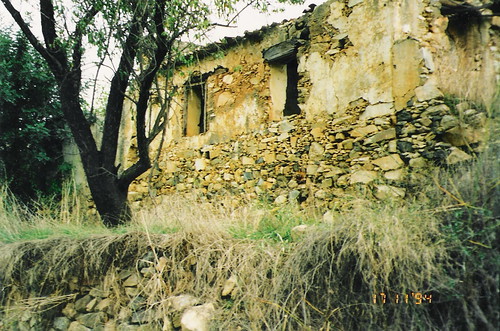
(the original family home in the village of Drakiana)

"Sometimes I feel as if I've gone back in time, and we're eating altogether in the house with your yiayia." Her blue eyes always twinkle when she recalls the past. Her father was killed on the first day of the Battle of Crete, but her stories never seem to recall those days of misery. "When the midday meal was cooked, your yiayia would tell us to come to the table so that we could eat together. We never ever started eating until all of us were home. It was a rule that she enforced strictly. She never wanted anyone to feel that he'd missed out on the first pick. It was usually Manoli who was missing from the house, so Marika or Niko would go out and look for him. He was the youngest, so he was always out playing with the other orphans in the neighbourhood." I had never thought of my father as a young boy, carelessly playing in the mud streets, being called home by his older siblings. What games did he play in those post-war days?

tsouri
(A toy fashioned from wire, called a tsouri; this photograph was taken in 1960: from John Donat's KPHTH - CRETE 1960)

Thia now sat on a chair and began cutting up all the vegetable scraps into tiny cubes for the chickens and rabbits Thio kept in the sohoro near their house. "We may have been orphans, but we weren't like the other orphaned children in the village. We always ate off plates. I usually helped my mother in the kitchen, and Marika would lay the table, and we each had our own plate," she continued, "not like in Elenara's house. She was widowed too, but there were ten of them in the family, eleven counting herself, so there was never enough food in her house. She'd plonk a hot cauldron full of food in the middle of the table, and all the children would rush to it, like they'd never seen food before, and fish whatever they could out of the pot with their hands. We were much more civilised, we ate like royalty compared to them." She smiled with a satisfied look on her face.

kirtomado hania chania

"I was lucky, because when I got married, I came into another good family, and we all lived well there too. I was only seventeen, but everyone loved me, and I loved them too, you know. I would go with my mother-in-law to the fields and we would gather horta together. If I was given a taliro (five drachmas) for each bag of horta that I gathered, I'd be the richest woman in the world." She spoke as if she were Mother Earth herself, Demeter, the guardian goddess of grains and agriculture. She had finished chopping the vegetables, and now sat with the palms of her hands on her knees, tucked away under an enormous blue apron.

animal feed

She only seems to remember the good times, not the war. "There was never a sad moment in those days, not like now, when all you hear about is doom and gloom..."

©All Rights Reserved/Organically cooked. No part of this blog may be reproduced and/or copied by any means without prior consent from Maria Verivaki.
Wednesday, 12 November 2008

Colours of Hania: Olive (Eλιά)

This work was inspired by Kalliope's Spectral studies series.

Wherever you look in the town, the presence of the olive tree cannot be ignored. The olive tree is to Crete what the pumpkin is to America during the autumn season. Olives have, for a long time, been the mainstay in both the agricultural and winter economy of Hania, and a good year in the life of the town is often measured by a good olive harvest. The silvery green leaves of the tree make a beautiful backdrop to the once-ripened purple black olive fruits.

olive trees in a school hania chania village set in olive fields hania chania olive trees in the town hania chania olive trees at maich hania chania olive lined street hania chania
(The omnipresent olive tree: at school, peppering a village, near the town's gymnasium, at my workplace, lining a village street.)

Olive trees crop heavily one year, and lightly the next. This year, there are signs of βεντέμα (vendema), a bumper crop; the branches are laden with fruit, weighed down heavily by the drupes. It's still too early to harvest them for olive oil, but it's a perfect time for collecting green olives for curing, to be eaten once they have sweetened; olives are never eaten straight from the tree. In Crete, they have not turned black yet; this process of maturation takes place over a long period of time. If it doesn't rain soon, this year's olive oil yield will be greatly reduced, at the same time, with compromised quality.

green olives lianes lianes olives lianes olives purple olives
(olives - lianes variety - in a range of hues)
olive lined street hania chania olive tree curing green olives for brine tsakistes olives for the winter
(olive trees lining the streets; olives - tsounates variety - for curing)

The small bead-like variety (λιανές - lianes) are used purely for olive oil, while the larger, fatter ones (τσουνάτες - tsounates) make excellent table olives, besides being used for pressing. Tsounates were the most popular variety in Crete for a long time, but in the modern age where there is a desire to produce and harvest quickly and efficiently, lianes are now more common: they are more resilient, staying on the tree without dropping in adverse weather conditions (as do tsounates), and produce olive oil at greater quantities per kilo. This being said, the value of the old-fashioned tsounates must not be forgotten: they produce a higher quality of olive oil, able to be stored for longer periods of time than the oil produced from lianes. For the uninitiated, Kalamata olives are not produced in Crete; they're a product grown out of the Peloponese, where Kalamata is located. Although a variety of different olive species are grown in Crete, the varieties are generally dominated by lianes and tsounates.

Olive harvesting in Crete is still conducted in the old-fashioned way: by hand. Tsounates are allowed to fall off the tree naturally onto black nets, which are then lifted and the olives poured into sacks and transported to the press. Having a stronger stem, lianes do not drop so easily; the branches are beaten with a stick, so that the olives fall off the tree onto the nets. The very young olives trees (μουρέλα - mourela) are hand-picked to protect the young branches.

mourela olive trees hania chania mourela olive trees hania chania ornamental olive tree maich hania chania ornamental olive tree olive tree intercropping
(Young trees - mourela; ornamental olive trees; mourela intercropped to use up the empty space in the land more efficiently)

olive tree nets olive field hania chania olive tree trunk olive tree trunk olive tree trunk
(Nets; an olive grove; gnarled trunks; the remains of the roots of a tree that has been dug up)

The main technological addition to gathering the crop is the electric beating rod, a long stick with flexible strips of plastic, which is inserted among the branches of a tree. When turned on, the rod rotates, while the strips fly in the air, slapping anything in their way, causing the olives to be severed from their stem. In more developed countries,the trunks of the olive tree are mechanically shaken by heavy machinery. This can only take place when there is ample space between the trees for the machinery to enter. Olive trees are planted too close together in Crete, mainly to get as many trees as possible on a piece of land; space is always lacking on our small fields.

The photos have been taken in various parts of the town, both in the rural and urban zones. Their omnipresence lends the town a sense of innocence in an ever-growing globalised world.

*** *** ***

In Crete, we cure freshly picked olives in salt or brine for future use as table olives; otherwise, the olives are pressed for oil. Freshly picked olives are far too bitter to eat as they are. But there are other places in the world where they use freshly picked olives in their cooking, albeit in their cooked form. Here is a recipe I found from Saretta, who lives in Italy, Amid the Olive Trees, as her blog is called.

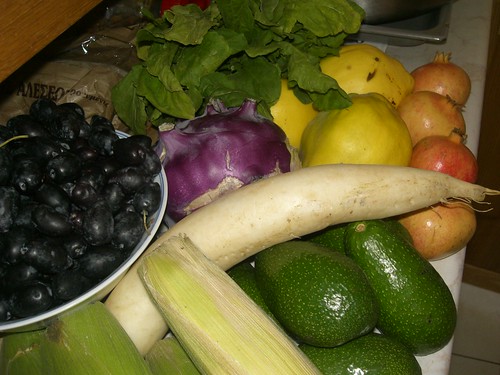
fresh autumn produce
(Kalamata olives, along with other fresh fruit and vegetables that I found at the laiki market)

Freshly picked black Nolca olives are washed, dried and fried in olive oil, with a little tomato, salt and basil. In Hania, fresh black olives are not in season yet (the Nolca variety is not grown here), so I bought some Kalamata olives form the street market to try out the same recipe, with ther exception of basil; I used oregano instead. It made an interesting hors d'oeuvre, served with good-quality bread and cheese, to accompany our fasolada. I can imagine this dish being made in ancient times, as it is simple and nutritious.

For the original recipe, check out Saretta's site.

©All Rights Reserved/Organically cooked. No part of this blog may be reproduced and/or copied by any means without prior consent from Maria Verivaki.
Tuesday, 11 November 2008

Briam (Μπριάμ)

This year's summer in Greece was not as warm as other summers (I am going by my measure of not using the air conditioner more than five times throughout the summer months), so we expected a cooler autumn. September was indeed cool, and it gave us plenty of rain. Our autumn nights now darken early; by 5.30pm,when I come home from work, it is dusk. Everything seems to be going like clockwork, but there is still something wrong with the weather.
What has happened to the rain? The last time it rained in Hania was in September. We have not even turned on the heating system, and it is nearly the middle of November; good for our pockets, but not for agriculture. Despite the long breezy summer being well behind us, this year's winter in Crete seems to have been seriously delayed. If it does not rain soon enough in Hania, the olive crop will suffer. Olives are usually irrigated naturally; the rain does all the job. Even if they are watered by pipes and hoses, the olives still need to be dampened by the rain itself before they start on their growth spurt, fattening and ripening to become olives fit for pressing into olive oil.

Every year, I find that the cold weather starts later and later in Hania. I think this is the latest that it has ever started for us. I usually tell my foreign students that by mid-October, it will be too cold to sit by our lovely old Venetian harbour; they must be thinking that I want it all to myself...

From one day in hania
Every evening, the daily weather report promises rain for Crete in the very near future; the BBC weather reports do the same thing, but rain never comes to Hania. Maybe everyone is just trying to subdue our fury over the dry weather.

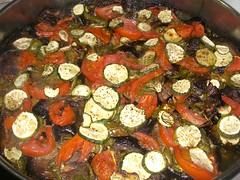
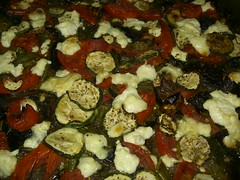
Our garden has found it very difficult to let go of the summer. I finally picked the last two courgettes from the zucchini plants and uprooted the chunky stems of the plants, with their tinder dry brown leaves still clinging to them. I've added the zucchini, cut into thin slices, to my basic eggplant pizza recipe, turning it into the Greek version of ratatouille, briam.

briam vegan briam vegetarian
(vegan briam; vegetarian briam - add the cheese in the final cooking stage)

Instead of grated hard yellow cheese, I've used white goat's cheese, the local mizithra. Briam is perfect for vegans and vegetarians alike; the addition of cheese is optional. Potatoes may also be added in thin slices for those who prefer more carbohydrates with their baked vegetables.

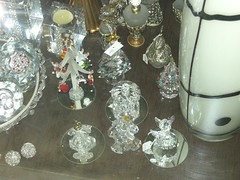
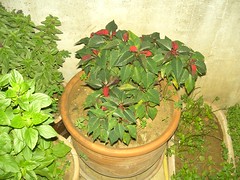
With Christmas so close, I'd say that briam would make the perfect Christmas meal, with its red and green hues. It was such a surprise to see the Christmas decorations being put up in the shops when the sun is still shining down on us. Even the leaves of our poinsettia have just started to redden at the peaks of the stalks.

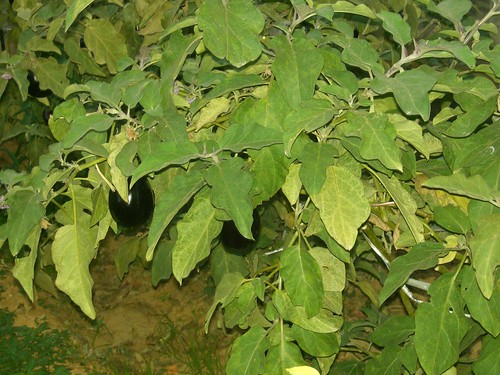
chirstmas decorations poinsettia eggplants at dusk in mid november hania chania
(these photos were taken today at dusk)

Some people find it very hard to let go of the summer; I would like to see an end, at least, to the eggplant excess in the garden, as it's getting very difficult to find storage space for them.

This is my entry for Weekend Herb Blogging, now run hosted by Haalo. This week's host is Heather from Diary of a Food Fanatic.

©All Rights Reserved/Organically cooked. No part of this blog may be reproduced and/or copied by any means without prior consent from Maria Verivaki.