Showing posts sorted by relevance for query mushroom. Sort by date Show all posts

Friday, 7 May 2010

Avronies (Αβρονιές)

Here's an unusual green that is very popular in Crete at the moment. It grows in the wild, and as yet no one is cultivating it. We can find it growing in our orange groves, but only in small quantities, which is why I usually buy a bunch before spring is out, when it won't be available after that.


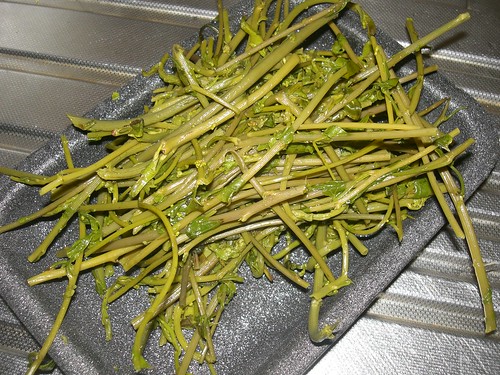
Avronies are an asparagus-like spear which grow very long and spindly. They aren't easily spotted because they snake along the earth, giving themselves away by their slightly furry tip which sticks up like grass. Only the tender parts are used (the remaining part of the plant is too woody), and their taste is rather bitter, which is why avronies are usually boiled to remove their bitterness before being used in a meal.
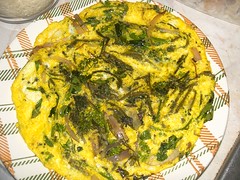
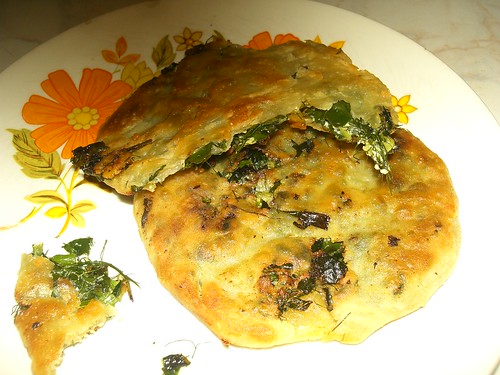
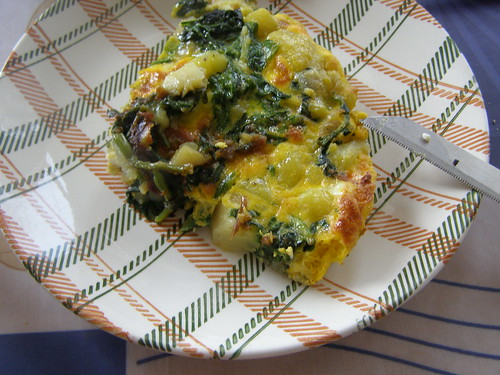
avronies tsimoulia omelette
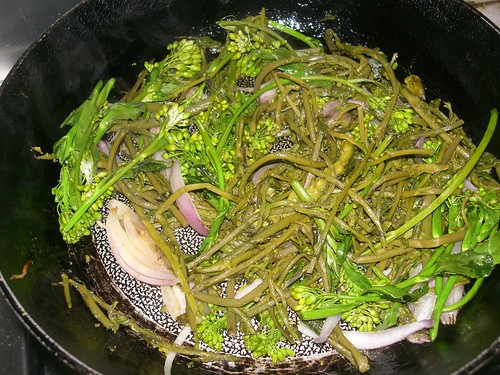
After I boiled the avronies (below, left), I had to discard some of them because they were still too woody and stalky to eat. The tsimoulia (bright green in the top photo) were simply washed (they were tender enough). 
boiled avronies avronies tsimoulia omelette

I've presented this dish before, but I think it's worthy of a second mention. It's mainly a forager's specialty, and it's usually cooked with eggs, like an omelette. I haven't changed the basic recipe from the last time I made it, but because I didn't have enough avronies, I also added some more edible greens called tsimoulia, the tender flowery stalks of the cabbage plant, which grow once the cabbage head has been cut off the base of the thick stalk.

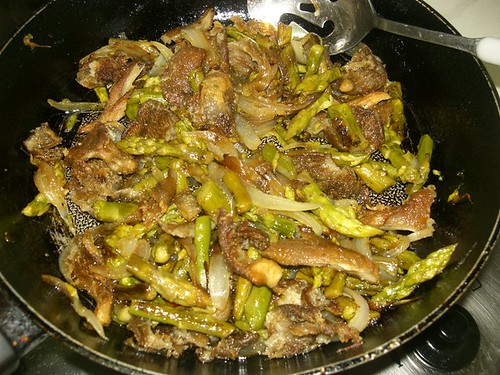
Thick asparagus spears of the type available in Western supermarkets are now also available, grown in Northern Greece; both the white and green varieties are sold in Crete. They have a different taste from avronies, but they can easily replace the wild variety in the omelette I made.
mushroom asparagus sautee
Conventional asparagus, now grown in Northern Greece, sauteed with mushrooms and onions, makes a delicious vegetable-based filling for an omelette.

I used Greek asparagus in the meal I prepared on the 5th of May, as I waited for my husband to come home at 3pm as he usually does when he is on day shift. I laid the table at his usual place, taking care to fill a pitcher with cool water because it was a very warm day and he would come home feeling parched.
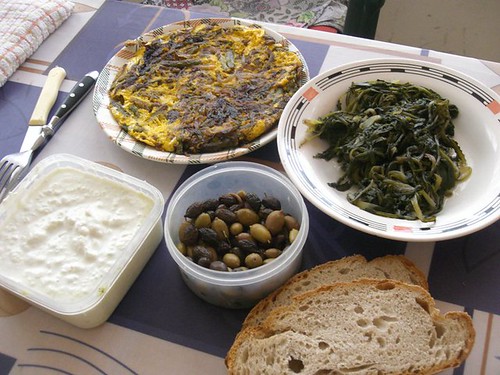
on the 5th of May
The table was set expectantly...

My husband came home on time and I served him the meal p. He picked up the remote control and asked me which channel the news was on at this hour. Even though he usually sits down to eat his midday meal at about this time, he can never remember which one it is. I reminded him that there wold be no TV news that day, as there was no school for the children, because the teachers and the journalists were on strike. So we didn't watch any TV that day. While three people were being pulled dead out of a burning building, we were having lunch, unaware of what was going on that day.

Those people would also have been getting ready to return home, after their work was done. They would have been going home at this hour to a similar seat at their table, and someone would have been waiting for them to come home. For the three who died in the bank fire, their place at the midday table would remain empty that day and forever from now on. I will remember this for many days to come. Whenever I lay the midday table, this thought will creep into my head like a disease, and it won't go away easily, unless I find a way to numb my mind on purpose.

The asparagus and mushroom omelette is the last meal I cooked since that day. As the saying goes, tomorrow is another day. Maybe it will be better. In any case, life continues.

©All Rights Reserved/Organically cooked. No part of this blog may be reproduced and/or copied by any means without prior consent from Maria Verivaki.

Tuesday, 3 November 2009

Cook the Books - French Lessons: Adventures with Knife, Fork, and Corkscrew by Peter Mayle (Μαγειρεύοντας τα Βιβλία)

This post is part of the Cook the Books blog event running until November 8, 2009. Read Peter Mayles' French Lessons: Adventures with Knife, Fork, and Corkscrew and cook something inspired by the book. Post your inspiration on your blog and link to Cook the Books.)

What with the French being so close to Greece (both countries class themselves as Mediterranean, since they share the sea of the same name), I have always felt Greece has more in common with them than most people are prepared to believe. For a start, they both love smoking and find it frigging hard to obey the recently introduced smoking bans in their countries. Then they both love their long extended lunches and siestas. They both also take pride in their institutions, which may sound a little old-fashioned in some ways, as if they have not moved on with the times, but hey, that's the Greeks (or the French) for you. ANd only recently, we found out about how politically nepotistic they can be, when Mr Sarkozy's son wanted to become president of Paris' CBD (depsite not having finished his degree and being only frigging 23 years old).

The French invented the restaurant, and it seems that they always loved dining out, which must have something to do with the development of their 'haute cuisine'. Peter Mayle describes his adventures in France as he travelled to various foodie (to use the modern word) celebrations. Such events are celebrated all around the world by cultures that are strongly linked to their food. Greece is no stranger to such occasions. I have participated in (or seen advertised) the Celebration of the Cherry, the Olive, the Sardine, the Kalitsouni, The Wine, and the Tsikoudia (the Cretan fiery spirit), to name a few.

Well, I think it's amusing...

Frogs' legs being out of the question (we can't buy them here) while snails are a bit deja vue for a Cretan cook like myself, I decided to make a dish that Peter Mayle described in his book when he went to Bourg-en-Bresse for the annual celebration (or more likely commemoration) of Les Glorieuses, in the elite chicken zone 80 kilometres north of Lyon, 'the greatest chicken show on earth'. Despite the many food events that take place in Crete regularly, I don't think I've ever heard of one of those being organised here.)

My inspiration to choose chicken as the main ingredient of my French dish comes from a recent discussion that developed from one of my Flickr photo posts. As we find out from Peter, not all chickens are the same, and this certainly applies in Crete too; different kinds of chicken are raised for different purposes. You don't just pick up the first chook you see in the supermarket deep freeze or butcher's counter: you buy chicken according to the dish you want to cook with it.

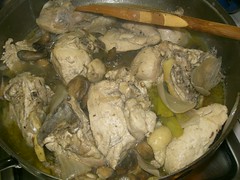
CIMG8863 CIMG8864
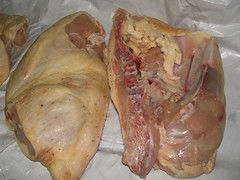
Choosing high quality ingredients and simple cooking styles assures success. The chicken I chose was lined with blobs of fat which I removed for this dish - I put all the fat into a plastic bag and stored it in the freezer to be used for stock making (it makes a good pilafi).

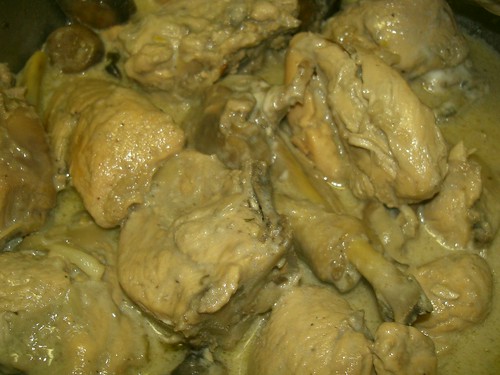
Peter provides a detailed account of a chicken and mushroom dish that he enjoyed just before the chicken show. I used this description for my Cook the Books creation. The cream and mushrooms give that rich taste often associated with French cuisine.

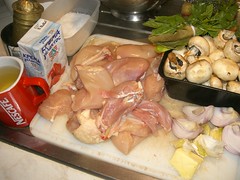
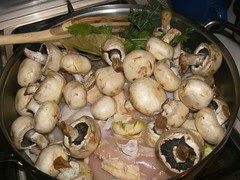
"First into the pan goes a generous knob of butter, followed by the chicken breasts and legs, a large onion cut into quarters, a dozen or so sliced champignons de Paris - those small, tightly capped white mushrooms - a couple of cloves of garlic en chemise, crushed but not peeled, and a bouquet garni of herbs. When the colour of the chicken has turned to deep gold, a large glass of white wine is poured into the pan, and allowed to reduce before half a litre of creme fraiche is added. The bird is cooked for thirty minutes, the sauce is strained through a fine sieve, the dish is seasoned to taste, and there you have it."

Et voila, it's as simple as that; or so it seems, if you have the appropriate ingredients at hand. My only problem is that most ingredients from foreign cuisine are not often easily available in my small Greek island town; I replaced them with their closest Cretan counterparts, and found that the dish could still be kept genuinely French. When your ingredients are of the highest quality, then French cooking need not be a difficult task, even outside France.

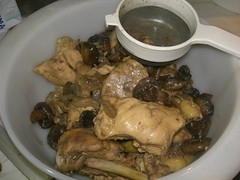
CIMG8865 CIMG8867
I followed Peter's instructions as closely as possible...
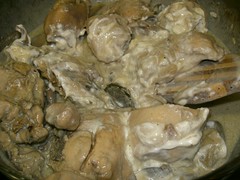
CIMG8868 CIMG8869

The chicken played a very important role in making this dish. I chose a fresh fatty chicken which would cook at the same rate of time it took to cook the mushrooms. Very lean chicken (the kind we often buy frozen) would begin to disintegrate before the mushrooms were ready, while an "old" hen (or rooster) would require more cooking time because it is tough. out olive oil in Crete is akin to anathema, which is why I chose to add some and reduce the amount of butter. Creme fraiche isn't available in Crete (neither is sour cream), so I mixed some double cream with Greek strained yoghurt, to give the creamy slightly sour taste that creme fraiche contains. My bouquet garni was made with one sprig of all the herbs I could find in my kitchen: mint, parsley, fennel, bay leaf, and the top of a leek. Finally, I chose the most tightly capped mushrooms that I could find; since they were small, I decided to leave them whole.

Exact quantities are always a problem when cooking in this very vague manner. Peter did give approximate amounts, but the truth is that being able to guess correctly without being provided exact quantities takes a bit of experience. I think I managed it very nicely. The only part where I swayed from the original recipe was the moment I chose to strain the sauce. Peter tells us that the sauce must be strained after the addition of the creme fraiche, but I chose to do this just before I added the cream, mainly out of the fear of the unknown: I've never cooked meat with cream or yoghurt before, and I wasn't sure how the cream would turn out. As it was, I realised I could have done this after the dish was cooked with the cream; I don't think this affected the taste of the final product.

CIMG8870
Et voila! Bon appetit!

So, bon appetit, everyone. I hope you enjoyed this foray into French cuisine as much as I did. The woody mushroom smell aromatised my kitchen in that magic way that country cooking always manages to do when high quality ingredients are fresh and cooking styles are simple; I felt as if I was in the middle of a forest!

If exact quantities are important to you, this BBC recipe comes very, VERY close to the recipe that Peter describes in his book.

Thanks to Joy in Philadelphia who managed to secure a copy of the book for me.

©All Rights Reserved/Organically cooked. No part of this blog may be reproduced and/or copied by any means without prior consent from Maria Verivaki.
Tuesday, 11 May 2010

Modern living (Μοντέρνα ζωή)

Have you ever browsed through the Unhappy Hipsters site? If you ever had any doubts about modern living, you will find solace in their witty one-sentence captions of photos showing modern living in the de-cultured globalised setting of Western (or westernised) society.

I have always wanted to do something similar myself with food photos that show out-of-this-world food or food products that most people would find an abomination. But that would mean that I would have to copy other people's photographs and make rather irksome remarks about them (the former is illegal).

But the gnawing need to write quirky one-liners still grates at me, especially now in the sombre mood that my country has sunk into. I have decided to use my own stock of 3,000 online food photos to do this. Can I rise up to the challenge of making a mockery of life and writing sarcastic comments about my own food? I am smiling already...

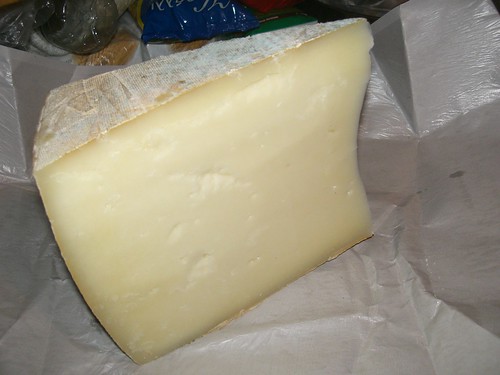
graviera hard yellow cretan cheese
When Luna said the moon was like a big wheel of cheese, Jerry thought she meant it metaphorically. But tonight, the moon looked like a pacman, and she had bought home the missing chunk. He didn't think she would actually go to the lengths that she did to find out what flavour it had.

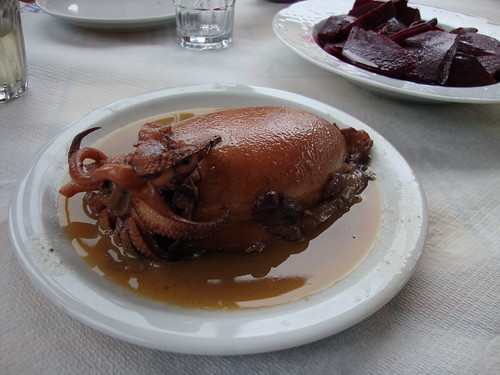
cuttlefish in wine soupies krasates
The waiter set down the plate and walked hurriedly away. As Warren picked up his knife and fork, the first tentacle popped out of the sack, and suddenly another and then another followed in quick succession. When this process began to repeat itself exponentially, Warren simply threw the cutlery down on the table and made a run towards where the waiters were. He knew he'd be safer there.


marathomizithropites
Their dependence on fresh supplies was owing to the fact that they did not possess a refrigerator, hence they were accustomed to foraging and purchasing food products on a daily basis. He did not complain at the huge inputs of leafy greens that she would often place before him on his return from work, but felt a slight revulsion in the middle of spring when all the crops had been harvested and only the grass and weeds remained.

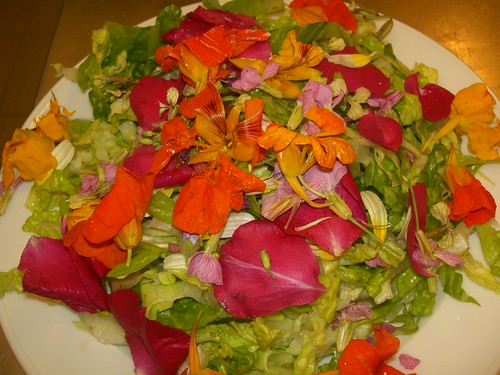
flower and lettuce salad
He had had a dozen roses sent to Tiffany in an attempt to convince her to give him another chance, but now realised that she was on a destructive path to get him out of her life - only the previous evening, he had found all his Mickey Mouse comics ripped to shreds. Upon seeing the rose petals, in the salad, he knew it was over. 

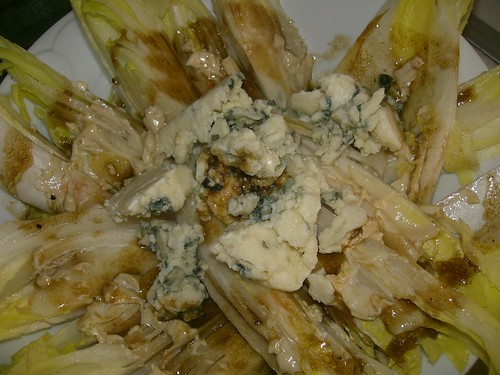
salade d'endives au rocquefort
Jeremy did not realise that the cheese had gone mouldy until the powdery blue fluff wafted up his nostrils as he took a bit from the chunk he was holding, causing him to sneeze. That's when he saw it - and promptly regurgitated the contents of his stomach.

mushroom asparagus sautee
Ida knew it was pointless trying to talk any sense into him. He rejected her concerns and simply told her to concentrate on the real issue: "You can't see the forest for the trees, can you?" 

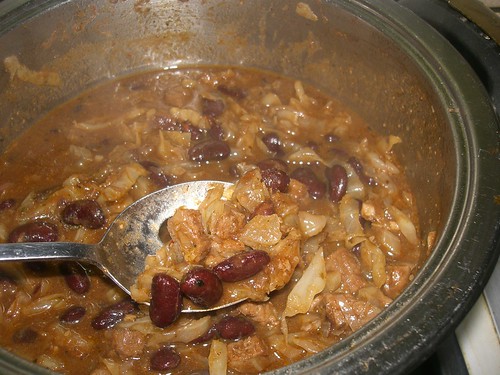
chili con carne
"It's somewhere in there!" she cried despairingly. "I know it is!" She held up the other contact lens and showed it to him. "It looks like this. Just keep sifting and it'll turn up!"

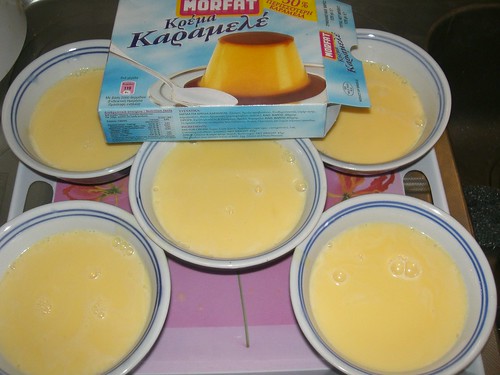
creme caramel convenience food
Petunia was a born perfectionist. And why shouldn't it all turn out to be perfect? She had followed the instructions to the letter. Nothing could go wrong.

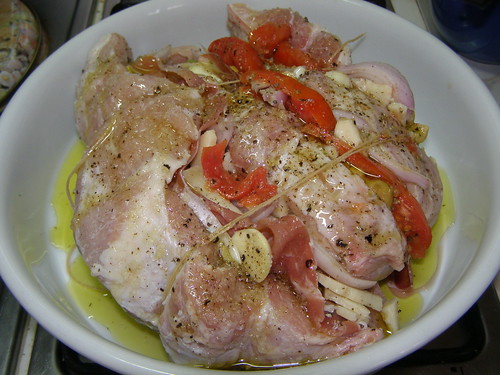
stuffed pork on the bone 
The taller ones could hardly move, but the smaller ones were able to wriggle out from the open cracks of their prison. The chance of pulling the others out to safety and escaping altogether was not a feasible one to contemplate at that moment.

vasilopita cupcakes
No matter which way they were dressed, whichever way you looked at them, they were all the same underneath.

And we really all are the same underneath.

The recent economic crises - the Greek one was different from the global one - have made us all rethink about the way modern globalised living has shaped our lives. Buying property at inflated prices, taking out loans to survive off money that can't be paid back, securing a job in the unproductive high-paying Greek state sector - they were, are, and will always be unsustainable ways to live an artificial life; at the same time, by going through these crises, we may have been given the chance to see life at a more basic level, one that we can all enjoy and survive through.

©All Rights Reserved/Organically cooked. No part of this blog may be reproduced and/or copied by any means without prior consent from Maria Verivaki.
Sunday, 15 November 2009

Potato and silverbeet omelette (Ομελέττα με πατάτα και σέσκουλα)

These days, life is all about getting machines and software to work for you, rather than you working for them. It's all about making life easier for you to live, so that you do less work, free up your time, and have more time to do the things you want to do, rather than doing things you have to do.

A little while ago I came across this search string which landed a New Zealand searcher onto my website: 'potato and silverbeet omelette'. I don't have many recipes for silverbeet (the popular name for Swiss chard in New Zealand) in my blog, but the few that I do have seem to be among the most popular on my site* among the 'down-under' population. Google's top-ten response for this particular search string was composed of 8 sites from Australia; my site was one of the two non-Aussie sites included because it sounds like a site that originated close to 'down under' (not surprising, since I call myself a Mediterranean kiwi). Here are the first five sites listed in the search:
  1. Potato and silverbeet soup (but not omelette)
  2. Silverbeet frittata (no potato)
  3. Mushroom, bacon, and tomato omelette (provided on a page all about healthy recipes for children, and how to grow silverbeet in their school garden)
  4. All manner of silverbeet recipes (but not in the combination desired, ie silverbeet, potato and omelette)
  5. Fish with silverbeet, and another dish containing potato (which didn't include silverbeet).
There were no omelettes containing the ingredients mentioned in any of the ten sites listed. Mine came in at No. 8; it was actually a discussion of my memories of silverbeet in my parent's garden in New Zealand, and how I used silverbeet to make dolmades, a Greek specialty that is usually made with grape vine or cabbage leaves.

spinach potato omelette spinach potato omelette
Sometimes it pays to think laterally...

The combination of ingredients that was used in the search string, while not unique, is hardly a name for a well-known recipe. It sounds like the searcher needed to use up their excess supply of silverbeet, a common and very popular green in New Zealand, which grows easily, and can be treated like spinach, a more common, more popular and tastier green known worldwide by mainly the same name. Had the searcher used 'spinach' instead of 'silverbeet', they would have got a better response: 7 of the 10 recipes listed on the first google search page were for omelette recipes that contained both spinach and potato ('swiss chard and potato omelette' only produced 3 appropriate recipes).

spinach potato omelette
Although I could have made a special effort and gone to the trouble of acquiring some silverbeet from my neighbour's garden, I decided to use the spinach I had just bought. This post was inspired by a statistics counter search string that led a Kiwi to my blog.

It pays to know the similarities and equivalent alternatives these days if you're searching for a particular recipe, otherwise you may be left floundering while everyone else is enjoying their frappe coffee during their extra leisure time. I wonder if that poor Kiwi managed to find what they were looking for; hopefully, it won't have got too lost in its search for a way to use up that excess silverbeet in the garden. Silverbeetopita, anyone?

So here it is, just for those of you who couldn't think up the idea of replacing silverbeet with spinach and are still searching the web for something that doesn't 'exist': omelette with potato and silverbeet (or spinach, if you prefer; I omitted the chile bit in this recipe, as I felt it was totally unnecessary, more unnecessary dining trends, in my opinion). I'm sure the same will apply for "crispy noodle salad with silverbeet", "silverbeet salad" and any other creative recipe using that overly common green that we can't seem to use up as quickly as it grows.

*Coincidentally, one of my most popular pages is all about how to freeze eggplant!

©All Rights Reserved/Organically cooked. No part of this blog may be reproduced and/or copied by any means without prior consent from Maria Verivaki.
Saturday, 17 January 2015

Steak and kidney-less pie

One of our more memorable meals in London was taken on New Year's Eve at the Battersea Pie Station in Covent Garden. We had ended up there after attempting a walk along the Thames, starting from Cannon St. At Blackfriars, we were stopped by the crowd and safety control units who were policing the area and keeping people away from the riverside, due to the fireworks event that was schedule to take place later in the evening. Our detour away from the riverside took us through some very London sites of great historical interest. It almost felt Dickensian.

Poultry obviously takes its name from its former association with the chicken trade.

We were intrigued by what looked like a private function with a focus on seafood...

... and highly unamused by this vile-sounding Christmas food special! (It has been described as: "An overwhelmingly negative reaction, ranging from 'aggressively disgusting' to 'one of the worst things I’ve ever put in my mouth'. It gets points for effort, attempting to combine virtually every festive ingredient, but it tastes like someone has pushed their Christmas leftovers into a blender and served them with rice.")

New Year's Eve is a very quiet day for London business people, but even when London is supposedly sleeping...

... it keeps changing looks, as it prepares for various events, and this time, the portaloos made it look like it would be welcoming the New Year with a heavy bout of drinking.

We eventually needed to use a bathroom ourselves, so I popped into a Pret-a-Manger and bought some Christmas mince pies which I'd really wanted to try while in London.

When I asked for the bathroom facilities, believe it or not, this place did NOT have toilets! So we held off, in the hope that we would eventually find a place to take a leak legally.

At The Strand, the former Aldwych tube station, often used as a film location, looked ghostly silent. This street was cut off to strollers due to the fireworks event.

Somerset House was looking very festive with its ice rink (where we found some free bathroom facilities).

I had a quick browse through the ridiculously overpriced Fortnum and Masons shop (it was sponsoring the ice rink) - 50 pounds for a set of 6 Christmas crackers, did I read that right?!

A short stroll away, we found ourselves at Covent Garden. Cold weather makes you feel hungry all the time. I chose the Battersea Pie Station, in the hope that I would find some steak and kidney pie (and Cornish pasty - another of my favorite pies in New Zealand). We weren't disappointed. My family lets me do the ordering most places when in London, because they know I know the food well enough. My early life in colonial New Zealand stopped abruptly just when New Zealand's food tastes became more international, so I still have fond memories of New Zealand old-fashioned comfort food, which were invariably British-based.
Chicken and mushroom pie, steak and kidney pie, and Cornish pasty - ~20 pounds, with a bottle of beer and a cup of tea.
Back home, when I decided to make a steak kidney pie myself, I found it near impossible to find kidneys! In Greece, the sale of beef and chicken kidneys has been banned since the mad cow furore - which started in the UK; yet, they aren't banned there! Although lamb's kidneys are still available for purchase here, when I tried to track some down, I found that they are never severed from the actual animal, so you have to buy the part of the animal that they are connected to. This is done for transparency reasons: in this way, the butcher is showing you that the animal was healthy - if the kidney is missing, the buyer may wonder whether the animal was sick. 
I used this very easy-to-follow recipe as the basis of my beef stew and pastry. The beef stew was cooked last night, the pastry was made this morning, and we had the pie for lunch with some leek and potato soup. 

To replace the umami taste of the kidneys, I bought a packet containing two slices of kavurma, adding some mushrooms and soya sauce (I was out of Worcestershire sauce) to my beef stew. I think the taste was successful, and the whole family enjoyed the pie, which will be made again eventually, because I froze half the stew. Slow-cooked food takes a long time to cook, so why not make a double batch and save your time later?

Bonus photo: A chat with the butcher where I bought the beef also revealed another mysterious EU meat regulation, which forbids lamb's spleen from being sold - but cow's spleen is permissible!

At any rate, if you have close relations with someone who raises their own meat, you can procure everything. I had lamb's spleen in sheep's intestine last week at an inner-city cafe bar, where the landlord-owner-cook prepares everything freshly and to order.

©All Rights Reserved/Organically cooked. No part of this blog may be reproduced and/or copied by any means without prior consent from Maria Verivaki.
Monday, 31 December 2007

Stir-fry beef with vegetables (Κινέζικο μοσχάρι με λαχανικά)

It's been quite cold in Hania (we're not used to anything under 10 degrees Celsius here), and since the children aren't at school, I can't be bothered leaving the house to go to shopping for supplies. I have been content to use up ingredients in our fridge, freezer and pantry. Today, I don't know what my food will taste like, because I have never made it before, and I am not using a recipe. I did look at some recipes for stir-fry beef over the web, but I don't believe they would work for Greek beef. You will probably agree with me.

Take Delia's recipe: "... 1 tablespoon of oil, let it sizzle [in the pan], then add the meat and toss it and stir-fry it in the hot oil for about 2 minutes. Then remove the meat to a plate." Two minutes cooking time for the beef? Greek beef is never tender enough to be cooked so little; try eating beef cooked for two minutes, even if it is cut into thin strips. It's be like eating a rubber band that eventually snaps back into your face when pulled.

I liked the sound of the sizzling beef recipe on the bbc some shaoxing wine, char sui sauce, peanut oil, caster sugar, mushroom soy sauce, sesame oil, fresh ginger, kecap manis, and Sichuan pepper; we have no Asian food supply stores in Hania, and the variety of Asian ingredients available here is limited to the BLUE DRAGON range (an utterly tasteless substitute for the genuine product, I'm sorry to say). I had bought some sesame oil a while ago just to try it out, but unfortunately it doesn't agree with our palate, so it is lurking somewhere in the back of my pantry. We can get fresh ginger (thanks to the increased demand for the product, due mainly to the influx of Asian immigrants into Greece), but I'd have to drag myself out of the house to buy some. Shopping with children in the supermarket over the Christmas holidays means I will end up buying more Christmas decorations and cheap toys and junk food than I ever thought I needed.

You need
:
half a kilo of beef, sliced into short thin strips
half a wineglass of soy sauce
a few tablespoons of sesame oil
a wineglass of white wine
2 medium onion, minced
6 cloves of garlic, minced
Marinate the beef in the oil, soy sauce and wine overnight.

The next day, saute the onion and garlic in a little olive oil till soft and translucent. Then add the beef with a little of the marinade (discard the rest). Mix the ingredients well, and stir them around until they are all well coated with the olive oil. Then add:
  • 2 large carrots, sliced into thin rounds
  • 2 medium onions, sliced thinly
  • 2 large green peppers, sliced into short thin strips
  • a can of sliced mushrooms, drained
  • freshly ground pepper and salt
Stir everything to mix all the ingredients in well. Let the beef cook until it is done; Greek beef needs at least half an hour when cut in slivers. The other vegetables will have become quite soft by this stage, so plan to add them after 20 minutes cooking time if you prefer a crunchy stir-fry. When you add the vegetables, you could also add:
  • any other small-cut vegetables that you like
  • chili (in any form), or any other spice that you prefer
Before serving the meal, I added 10 drops of tabasco sauce. I prefer it to chili powder and dried chilis. It gives it a more authentic foreign taste. If there will be eaters who are not in favour of very spicy or hot food, you can place this sauce on the table and each diner can add it to his individual plate. This dish doesn't need a salad to go with it because it contains a lot of vegetables. Serve it over a plate of hot noodles, steamed rice or pilafi rice (save the boiled chicken meat to make chicken pie) - and don't forget the white wine.

©All Rights Reserved/Organically cooked. No part of this blog may be reproduced and/or copied by any means without prior consent from Maria Verivaki.
MORE MEAT RECIPES:
Avgolemono stew
Sunday roast
Chicken
Rabbit/Hare
Mince
Curried pork chops
Tsigariasto
Souvlaki
Yiouvetsi
Pork

Tuesday, 1 April 2008

Fried oyster mushrooms (Μανίτες πλευρωτούς τηγανιτές)

Today we're having fried mushrooms
Those that grow like big white brooms
Hanging off the tall tree trunks
In florets full of creamy tufts

I don't know them very well
I can't guess they're edible
So ours are grown in holes in sacks
Filled with mulch from big haystacks

On Pleurotus ostreatus type
Is what the Greeks prefer to dine
I like to buy them at the market
Where they're stored in big brown baskets

After dusting them just slightly
Chop them up haphazardly
Chop the stalks off if you please
They're too tough for granny's teeth

They come out looking like triangles
That makes them easier to handle
Others say that these small parts
Have the shape of small love hearts

Dredge them in a little flour
Heat the pan with oil full power
Shake the excess flour off them
Then just toss them in the saucepan

Let them fry up very well
When they're ready, they will smell
Of forest green and timber dark
That's when you should pull them up

Place them on absorbent paper
To get rid of excess larder
Have the salt and pepper ready
A little shake is all that's needy

Fetch the horta and the feta
Ready waiting at the table
Now enjoy your little feast
A glass of wine is all you need!

©All Rights Reserved/Organically cooked. No part of this blog may be reproduced and/or copied by any means without prior consent from Maria Verivaki.
MORE MUSHROOM RECIPES:
Pizza carbonara
Pizza
Chicken roast
Chicken pie
Bolognaise sauce
Pastitsio
Stir-fry noodles