Showing posts sorted by relevance for query eggplant. Sort by date Show all posts

Sunday, 21 July 2013

Melitzanopita - Eggplant pie (Μελιτζανόπιτα)

I was buying some (French) beef the other day, which I asked to be turned into mince. The woman at the supermarket counter asked me what I was going to make.

"Bifteki for the freezer," I told her, "and I will also leave some to make a makaronada for tomorrow's lunch."

"If you have some cooked mince left over," she said to me, "use it in a melitzanopita." She explained that aubergine/eggplant pie was her favorite pita. Her mother in law introduced her to it recently, making it into a large pie (made with filo pastry) which she served up as a main meal with salad, as well as on a buffet table for a party. These days, her daughter in law makes it into little pies enclosed in thick pastry (made with puff pastry sheets) and she takes them to the beach as part of a picnic lunch. "They freeze really well, too," she added.

I'd never made eggplant pie before, although I have heard of eggplant used in similar ways, eg vegetarian patties and fritters. Looking it up in my Greek cookbooks, I came across a couple of recipes for eggplant pie, made by some famous old-school Greek TV chefs. They were labelled plainly - melitzanopita - but neither used mince in the recipe: they both used dairy products (cheese and cream). One version (1990) - made by Ilias Mamalakis, who stated that the recipe was given to him by Dimitris Bliziotis, a Greek food historian - was made into a large pie while the other (1999) - made by Vefa Alexiadou (no history of the origin is mentioned) was made into individual fat cigars. Both versions used different thicknesses of Greek filo pastry and the recipes were very frugal in nature, with a clear focus on simple Greek flavours. Ilia's pie contained just coriander seeds to flavour it, while Vefa's used parsley and mint. The basic idea was to make an eggplant filling for a simple pastry casing, which could be rolled up in any way that the cook felt like making them.

Ilias' (left) and Vefa's (right) melitzanopita recipes
I thought this sounded like a nice novel way to use up the eggplant that is rolling into the house from our summer garden at the moment. It also sounded like something I would really like to make - when we hear of a new kind of food, we are open to it as long as it suits our taste spectra. Before looking up 'melitzanopita' (or 'eggplant pie', 'aubergine pie' etc) on the web - my first stop for anything that I don't know these days - I decided that it had to be a very Mediterranean taste combination, something that decidedly fits into the Greek taste spectrum. Melitzanopita sounds unusual, but the ingredients needed to make it are actually very common. Although the pie is not a well known Greek recipe, I bet that it must have been tried out at the very least on one of those morning TV shows that housewives watch, which screen while I'm at work. (By the time I come home, old Greek re-runs are playing, and then it's Turkish soap opera extravaganza time, as Greece can no longer afford to make her own.)

Sure enough, I came across a number of youtube videos from the private Greek TV channels, which often contain a mixture of make-you-feel-good topics for ladies of no particular occupation: a bit of fashion, some celeb gossip, a recipe by a home cook, with the show being hosted by strappy-dressed peroxide blondes. This kind of light-entertainment program features on most of the private channels, unlike the former Greek state broadcaster, still doing a pirate run on ebu.ch, which is now featuring no entertainment, and only political discussions, operatic music and other very politico-socio-cultural  formal types of Greek-style urban-context amusement. (I am hard pressed to understand if the operatic bits are what rural Greeks expected to suddenly be bombarded with on the pirate ERT - then again, they probably don't use internet to watch anything, ergo... pirate ERT is broadcasting not for the masses, but the minority. And let's not talk about the new public but not-quite-legal broadcaster that hit Greek TV screens a couple of weeks ago - it's quite simply an embarrassment.)
Vegetarian filling for melitzanopita
The melitzanopita was made into what looked like a delicious vegetarian pie using soft white cheese and home-made pastry (ALPHA -  June 2012). Admittedly, Vasilis Kalilidis made a really hash job of his pastry, but as I mention on my blog how trivial it is to worry about how perfect your filo pastry sheets come out: when you cut it, it's gonna get scrappy anyway, so the most important thing about making pastry is that your pie remains in one piece after it's cooked and you are serving it, whether on the plate or as finger food.
Melitzanopita with mince cooked eggplant and mince (made in the same way as for makaronada
The next link I found came from - yet again - another TV morning show recipe featured on the web, only a week after the previous one (ANT1 - 12 June 2012). Argiro Barbaridou's melitzanopita did contain mince, but it was quite a 'heavy' recipe: it also contained eggs and cheese, which didn't entice me to make it, as I prefer my pies simpler. Eggs, cheese, mince and eggplant, covered in carb-filled pastry, all in one dish reminds me of very rich meals like moussaka, which are better eaten during the winter in colder weather.

But the chef who started this eggplant pie craze appeared a whole month before the vegetarian and meat version (SKAI - 8 May 2012) - George Gounaridis' melitzanopita is vegetarian (it contains cheese). That's what I love about cooking - making the same food in different ways, to satisfy different tastes. The well known restauranteur made his own thin (perfect) filo pastry which he layered into a baking tin with a simple filling of cooked eggplant, tomatoes and onions. The finished pie looked very light and very appetising.
Don't worry about how scrappy your pastry looks; it'll break up easily at any rate once it's cooked.

So you get the picture: eggplant pie can be made any way you want - vegetarian or with meat, even vegan, with the addition of perhaps a binding agent (eg breadcrumbs, semolina or crushed nuts). The pastry can be home made or store bought, in any thickness. But the most important aspect is to make sure that the eggplant is prepared in some way before adding it to the pie. Either it is cooked in cubes, or it is cooked whole and the skin is scraped away before being used for the filling. Eggplant is one of those vegetables that needs a lot of olive oil to cook well enough not to taste like cardboard (which is probably why Gwyneth Paltrow doesn't like eggplant). To avoid the oil, it needs to be roasted. Either way, it needs some preparation time before being used in meals such as pies.
I decided to make my melitzanopita in the shape of a 'snail pie.'
After deciding what kind of filling you want, and what kind of filo pastry you will end up using, you can then choose which shape of pita to use. Whether you make a large pie to cut into pieces, or you make individual pies is up to you. I decided to make my melitzanopita into 'snail pies' - an idea I found from yet another recent melitzanopita recipe from a well known Greek TV chef (no date is given for Dina Nikolaou's pie, but I suspect it was as recently as 1-2 years) - as I really like shaping filo in this way, and it cuts up nicely into smaller pieces, for good portion control.
Sarikopita, Strifti, Kihi - they are all names for a round pie made up of pieces of filled pastry made in the shape of a snail's shell. 

While there is no shortage of melitzanopita recipes in Greek, eggplant pie is found in just a few non-Greek recipes. I have heard that Martha Stewart has some kind of Greek background, so I wonder if it was this aspect of her identity that drove her to make individual eggplant cheese pies in 2010. I think her vegetarian muffin-shaped melitzanopitakia look dreamy. Her recipe is not far off the one I used: I added strained cubed tomato, I didn't use coriander and I used crushed walnuts instead of pistachios. Crushed nuts are a great addition to pie fillings because they give pies an added texture, the nuts soak up excess liquids in a filling (the same job breadcrumbs and rice do) which often makes pastry soggy, and nuts act like protein in a vegetarian dish. The walnuts also had a sweetening effect on the eggplant, which can sometimes taste bitter, depending on the quality of the eggplant.
The cooked pies - vegetarian (top) and mince (bottom) melitzanopita
The important thing in an eggplant pie is not so much what you add to the filling, as much as the texture of the final filling. The creamier and firmer, the better, because it's easier to work with, and it cooks better. The fillings should be pre-cooked before being added to the pastry. I used Dina Nikolaou's recipe to make my vegetarian melitzanopita, while for the mince version, I simply fried some small cubes of eggplant in olive oil, drained them and then added them to some leftover makaronada mince. That constituted my meat-eggplant filling. Both pies worked well because the eggplant was paired with classic Mediterranean tastes. It all depends on what you want to make, how you want to make it, and the desired finished look of the pie.

Vegan melitzanopita for the 2nd Symposium: Food, Memory and Identity in Greece and the Diaspora taking place this weekend. The filling contains the same ingredients as the Gounaridis pita without the cheese; instead, I added some green peppers (with the onion), and a mixture of breadcrumbs and walnuts to bind the (cooked pureed) filling. It smells like mince - very cheap, very Greek and very frugal (the whole thing can't have cost me more than €1.50 to make - all the ingredients are found in most Cretan homes, and half would come from a small summer garden).

Melitzanopita, as it is made by Greeks, from the recipes available on the web, fits well within the taste spectrum of Greek food, using commonly associated combinations in Greek cuisine: eggplant and mince or eggplant and tomato, spiced up with parsley and mint, dressed in olive oil and encased in classic Greek filo pastry. It is an aromatic pie and makes a full meal, coupled with a green salad and some wine. More importantly, it's not an acquired taste and it is very versatile; these two aspects will make it popular among a wide variety of people.

©All Rights Reserved/Organically cooked. No part of this blog may be reproduced and/or copied by any means without prior consent from Maria Verivaki.

Thursday, 4 July 2013

Imam baldi (Ιμάμ μπαλντί)

A dish dating back to Ottoman times; don't forget to read the story about imam baldi before you learn to how to cook it.

Eggplant is one of those vegetables that, together with tomatos, have established themselves as firm summer favorites. Most recipe websites instruct you to prepare eggplant for cooking by slicing them and sprinkling salt over them to make them sweat, to remove their bitterness. In all my years of cooking the eggplant we grow in our Cretan garden, I have never really needed to do this. They are rarely bitter.

Eggplant has one inherent problem - to make them tasty, they need to be cooked in a lot of olive oil. If you don't like the idea of frying them (which is the quick way to cook eggplant in oil), you can roast them in the oven, using less oil, but that takes so long and uses so much heating energy that it works out too epensively. Even when I bake eggplant, I always fry them lightly first.

This version of imam baldi uses both frying and baking, giving a perfectly cooked eggplant that isn't too oily.

You need:
5-6 eggplant (both the long and the round versions work well here)
1 large onion, roughly chopped
2-3 cloves of garlic, finely minced
1 large green bell pepper, finely sliced
1 large red pepper (preferably the long variety, known as Florinis in Greece), finely sliced
2 large tomatos, cut into small cubes
1 teaspoon of tomato puree
the leaves of 2 sprigs of mint, finely chopped
salt, pepper, oregano

Slice the eggplant lengthways and scoop out a small amount of flesh to make a cavity in each eggplant half. Put aside the flesh. Fry each half in very hot olive oil, turning to cook each side 3-4 minutes. Place each fried piece, cavity side up, in a medium baking tin.

Cut the eggplant flesh into small cubes. Ladle some of the olive oil you used to fry the eggplant (the amount you use is at your discretion) into a saucepan, and add all the ingredients excpet the eggplant halves. Cook on high heat for 10 minutes, stirring constantly to avoid the sauce sticking to the pot. Spoon the filling into the cavities. Don't worry if all the filling doesn't fit into the eggplant halves - it will reduce during the cooking process. Carefully pour a cup of water into the baking tin, without upsetting the filling in the eggplant. Place the baking tin into a moderate oven and cook for an hour.


A vegetarian instead of a vegan version of this dish can be made by adding some crumbled feta or mizithra cheese over the filling. I made a vegan version to serve with fried calamari and fried potatoes. I never feel guilty serving too many fried foods at once - we only use extra virgin olive oil in all our cooking.

©All Rights Reserved/Organically cooked. No part of this blog may be reproduced and/or copied by any means without prior consent from Maria Verivaki.

Tuesday, 5 February 2008

Freezing eggplant (Πως να σηντηρείτε μελιτζάνες στην κατάψυξη)

UPDATE 15/08/2012: THIS IS MY MOST POPULAR POST THIS MONTH - AND I STILL FREEZE EGGPLANT THIS WAY

We grow as much as we can in our garden - well, actually yiayia used to grown things in the garden, while we mainly harvested the crops and ate them fresh or preserved whatever we didn't eat by freezing the cooked or raw products. We are now at the beginning of February, and we have a lot of greens in the garden; mainly winter crops such as cauliflower, cabbage, dandelion, parsley, celery and radish, as well as some stray summer crops like aubergines and tomatoes which have been fooled by the good weather to keep on producing. Aubergines seem to be the hardiest of these plants, and they have become an indispensable part of my Cretan kitchen in the summer. I have become somewhat of a self-professed expert on how to make full use of these purple beauties, unlike some of my acquaintances.

Aglaia's knowledge of food is limited to what she reads (only Greek books, and never from the internet), and who she asks for advice (her mother and her civil servant work colleagues); as for her cooking, it's even more restricted because she teaches during the day, and then spends her afternoons ferrying her children to their various extra-curricular cla
sses. She is fanatically pro-organic, but if she doesn't have any time to cook, I can't understand what she feeds her family on, given that organic food is usually, I beg your pardon, ALWAYS unprocessed and needs a great deal of time in terms of preparation to get it onto the dinner plate; I've seen Aglaia in souvlaki shops, and she does keep a deep freeze full of pizzas, but I wouldn't call those food items that she has in her house organic.

So I wasn't surprised when she told me that, despite the abundance of eggplant in the garden (which of course her husband tends, as she believes, and I quote, that gardening is men's work, even though she confessed that her husband irons his own clothes because - you guessed it - she's just too busy), she doesn
't use it much in her cooking because it doesn't freeze at all. I didn't like this at all business, especially since I freeze aubergine successfully, if I may so myself.

So Aglaia, if you ever chance to use the internet one day (maybe when someone else invites you to look something up in it), or someone refers you to my website (fat chance, none of your friends, colleagues or acquaintances read English, never mind speak the language), this post has been written especially with you in mind; yes, you CAN freeze eggplant.

Aubergine (eggplant) is one of those vegetables which you don't eat very often; it needs a special cooking style, or isn't quite so suitable in terms of taste and texture to be added to common dishes. It's often used to make a specific dish, say eggplant parmesan, or moussaka. But if you grow it in the garden, you can freeze it by using a variety of methods so that you can enjoy its freshness in the winter without any loss of flavour, colour or texture. The main problem with aubergine is that if it isn't used within a particular period of time, it turns brown, and looks very unappetising. So, if you want to freeze it, this should be done when it is at its freshest. Aubergine is used in slices, cubed, or as a shelled vegetable suitable for filling with a variety of meat or vegetarian fillings. It should be frozen in exactly the same way as you would be using it. Never freeze it whole; to use it, you would need to defrost it, and it would simply become a soggy brown sponge.

Aubergines come in many shapes, colours and sizes. The ones grown commercially in Greece are the long or round purple variety (or a mixture of mottled purple and white), but we have also grown white eggplant, which comes in a squat round shape, and is a little sweeter than the purple variety. The white variety is eaten mainly in fried slices. It can be used in exactly the same way as purple eggplant, but it loses its whiteness both in the freezer and after it is cooked. In other countries (eg India and Thailand), aubergine is as small as a brussel sprout, or has a different colour; I've only seen these varieties in pictures, but they look interesting, and apparently taste much like the European variety, so their appearance is quite deceptive.

Other vegetables can also be frozen in the same way as aubergine; I have applied some (or all) of the techniques described below to courgettes (zucchini), bell peppers and tomatos. The bonus with tomatos is that their flesh can also be pureed and frozen for later use in a sauce or casserole.

SLICES
Raw:
Once you have cleaned the aubergine, slice it into rounds. Make sure the aubergine is dry when you place it in the freezer in separate layers. Separate the layers with wrap (I use clean plastic supermarket carrier bags - it's a way of recycling them). Once the slices have frozen solid, they can be packed altogether in a plastic bag. When you want to use it, don't let it defrost. Use it straight from the freezer. If you want to fry or boil it, do this BEFORE you freeze it (see below). The same process described can be used for aubergine cubes.

Boiled: Aubergines are often tossed into boiling water for five minutes, to rid them of their bitterness. The aubergine I freeze is always from our own crop (why bother to freeze it if you can get it 'fresh' all year round?) and it's never bitter, possibly because of the soil and the kind of fertiliser we use. If you do want to blanch the aubergine before freezing it, make sure it is at its freshest, and dry it well before you put it in the freezer. The less moisture, the better the results.

Fried: When I freeze aubergine in slices, it is always fried. In this way, I can use it as it is in eggplant parmesan or moussaka, without worrying about whether it will defrost too quickly, or add too much liquid in the food I am preparing. Fry the slices of fresh aubergine and drain them well on absorbent paper. Then put them in separate layers in the deep freeze in the same way as for raw slices (see above).


Oven-roasted: This is a healthier altenative to frying aubergine. Place the slices on an oiled oven tray and brush them on the top with olive oil. Let them roast till they are partly cooked. Once they have cooled down, freeze them in separate layers, as for blanched or fried slices.

SHELLS
Aubergine is often used as a shelled vegetable; the flesh of the aubergine is spooned out and the remaining shell is filled with various mixtures. These shells can be frozen raw as for yemista, or fired and filled as for papoutsakia. It isn't advisable to freeze empty fried (or blanched) shell, because once they are cooked in this way, they lose their shape. It is very difficult to fill them neatly once they are frozen lopsidedly! Once the shells are filled, they are cooked in the oven; frying them is difficult because you can't secure the filling easily. Because eggplant comes in different shapes and sizes, you need to shell accordingly.


Round variety: Round eggplant vary in size. If they are as large as a tennis ball, slice off the top, so that the stalk and leaves have been removed, and the exposed flesh is white, not green. Then take a spoon and remove the white flesh. he flesh is discarded; in any case, this is what goes brown very quickly. Take care not to break through the skin. When you have done this, freeze them as quickly as possible, to stop them from turning brown too quickly. If they are larger than a tennis ball (and probably rounder, too), cut them in half lengthwise, so that each half contains part of the stalk. Then spoon out the flesh and proceed as described above.


Long variety: Long eggplant usually have a more slender shape. To shell this kind of aubergine, slice off the stalk as for the round variety, then slice off a little of the skin towards the centre of one long side of the aubergine. When you remove the flesh from this incision, it will take on the shape of a boat. Freeze them raw. If you want to fry and freeze them, you must also fill them, otherwise they lose their shape.


frozen eggplant chunks
Cubed eggplant makes a great comfort meal in the winter: eggplant risotto.
 
MORE AUBERGINE (EGGPLANT) RECIPES:
We eat quite a lot of aubergine throughout the year. Here is a list of meals you can prepare and freeze using aubergine. In this way, the sahpe, colour and flavour of the eggplant is retained without any loss, and you won't have to worry about it turning soggy or brown once you take it out of the freezer.
Papoutsakia: Use shelled, fried eggplant with the filling added before you freeze them.
Moussaka: Use raw, blanched or fried slices OR prepare the moussaka and freeze it in the tin you intend to cook it in OR cook moussaka, cut it into individual servings and then freeze each serving separately.
Dog food: When boiling meat, rice or macaroni for your pet, add a few slices of eggplant for a healthier option. Our dog never complained!
Eggplant parmesan: Use fried slices or prepare the dish and freeze it before the final cooking stage.
Pastitsio: Add minced aubergine into the mince mixture, and freeze the pastitsio before the final cooking stage OR cook the pastitsio, let it cool down, cut it into individual servings, and freeze the servings separately.
Spaghetti bolognaise: Add minced aubergine into the mince mixture, and freeze it after it is cooked.
Yemista in the oven: Use raw shells straight from the freezer; don't fill them with the filling as rice doesn't freeze well.
Yemista in the pot: Use raw shells straight from the freezer; don't fill them with the filling as rice doesn't freeze well.
Melitzanosalata: Sorry, that can't be frozen!
Eggplant pickle: Sorry, I didn't make that, I only ate it!


©All Rights Reserved/Organically cooked. No part of this blog may be reproduced and/or copied by any means without prior consent from Maria Verivaki.

Wednesday, 15 September 2010

Eggplant cheese rolls at Aithrion (Μελιτζανομπουρεκάκια στο Αίθριον)

This year has been annus horribilis for most people right around the world. It is no different for us either. The economic crisis meant we could not stray too far away from our home for a summer holiday break.. I am left with memories of last year's summer holiday, and the wonderful meals we savoured in Northern Greece. 

Summer was never my favorite season. I always liked the rain. Good thing, as I lived in New Zealand for a long time, and had to put up with it on most days. Since living in Greece, I've spent every single summer in Hania, and hardly ever saw a drop of rain throughout the summer months. Last year was the first time I saw a really rainy summer, when I visited Halkidiki. It felt strange walking on the beach in our swimwear, watching the rain falling down. It first started to spit before heavy raindrops began to splatter onto the sand. The beach-goers were all scrambling to get their gear packed and they were gone in seconds.

haystack cassandra halkidiki cassandra halkidiki cassandra halkidiki
rainy day cassandra halkidiki rainy day cassandra halkidiki
We made it back to the car just in time before the rainfall turned into a heavy downpour with thunder and lightning, the likes of which I had never seen. We were driving in the rain in a place unknown to us. We had been harbouring dreams of driving up and down the first two legs of Halkidiki (the third one isn't open to females) to look at the scenery. We were already impressed by the unusual scenery (to us Cretans) that we had come across: mechanically-rolled haystacks, patchwork quilt fields and forest-lined coastlines. Now all we wanted was to find a safe place away from the storm to get some lunch.

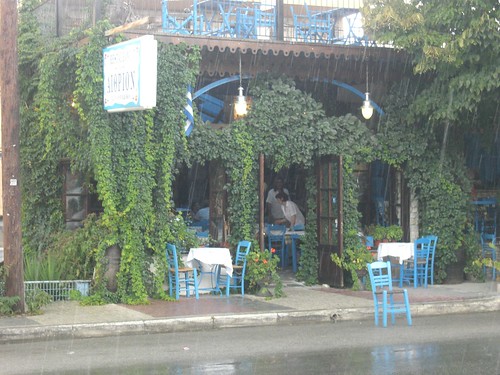
 aithrion cassandra halkidiki

On our holiday up to that point, we had been dining out on a lot of barbecued meat, and we were all tired of this, craving, instead, for something cooked in a pot with an oily sauce.We passed quite a few fast food places before we came across Aithrion. Even in the driving rain, it looked very, very pretty - the overgrown greenery made us feel closer to nature.

We parked the car across the road from the restaurant and waited for the rain to retreat a little. It didn't. It just got harder and harder. It's really frightening trying to cross a busy road in the rain with two children in tow!

aithrion cassandra halkidiki

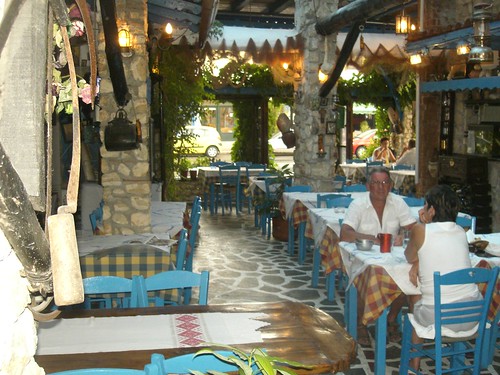
The atmosphere at Aithrion may be described by some people as rather kitsch: old-time trinkets from yesteryear hanging on the walls, traditional handcrafts, odd one-of-a-kind furniture with no set pattern. We liked it a lot. I guess we're a bit old-fashioned! The owner was also a musician (he told us he often came to Hania and played music in the taverna of a friend!), so there were a lot of music memorabilia such as photographs of songers and song verses pasted around the restaurant.

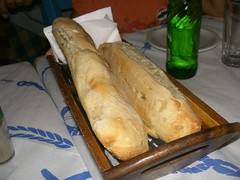
It wasn't just the atmosphere, but the food was also fanstastic: home-made bread, soutzoukakia, makaronada, gigandes, rabbit stifado, and the specialty of the house: deep-fried cheese-filled aubergine rolls. At the end of the meal, we were treated to donuts in chocolate syrup and sweet wine. What a way to finish our stay in Northern Greece.
aithrion cassandra halkidiki dessert aithrion cassandra halkidiki 
aithrion cassandra halkidiki
aithrion cassandra halkidiki aithrion cassandra halkidiki

This year, I decided to try making my own version of melitzanobourekakia at home; here's what I came up with.

You need
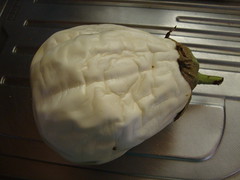
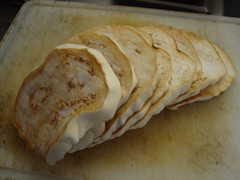
1 large eggplant, sliced thinly (I used a white eggplant which yielded 8 large slices - white eggplant is sweeter and is ideal for frying)
creamy soft white curd cheese (I used Cretan mizithra)
some Greek strained yoghurt
a sprig of fresh mint, chopped finely
salt and pepper
thick runny batter made with a simple flour-water mixture
oil for frying

white eggplant white eggplant slices
This eggplant looks shrivelled. It had been lying in the shade for a few days after it was picked. It's actually perfect for frying because it is less juicy. The texture of the uncooked product doesn't affect the taste of the cooked dish. The slices, in retrospect, should have been thinner. To make them more pliable, maybe they need to be boiled slightly, and left to cool before using them.

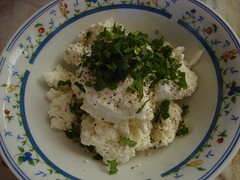
You may want to prepare the eggplant slices by salting them and letting them run their excess juices out of the flesh. I don't do this because home-grown Cretan garden eggplant is generally very tasty rather than bitter. Season the eggplant slices with salt and pepper. Allow the eggplant to drain away its excess juices. Mix the curd cheese (I used about a fistful of mizithra) with the yoghurt (I used about 100g), and add the salt (if you did not use it in the eggplant preparation), pepper and mint.

filling for melitzanobourekakia melitzanobourekakia
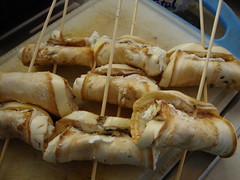
Take a slice of eggplant, and place a tablespoon of mixture at one end. Roll up the eggplant slice, trying to cover the filling as well as possible. Secure it with a toothpick, or a long souvlaki skewer (kebab), which will make frying them easier.

melitzanobourekakia melitzanobourekakia

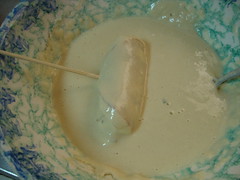
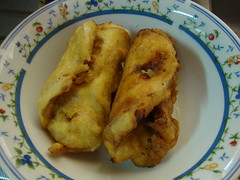
When you are ready to cook the eggplant rolls, heat a large amount of oil in a small deep saucepan. (A friteusse works even better in this case, as it is less messy, but it uses a lot of oil.) Then dip the roll into the flour-and-water batter, covering all parts well. The batter acts as a seal. Deep fry until the rolls are well browned all over. Remove from the oil and drain on absorbent paper. Take out the toothpick or skewer.

melitzanobourekakia
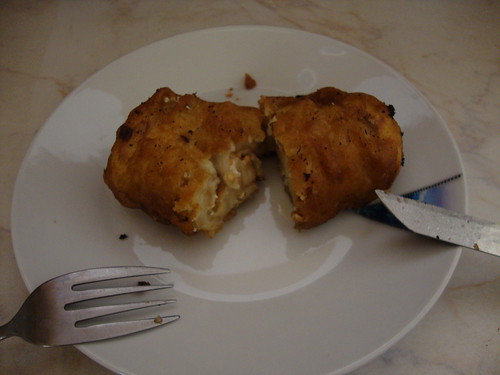
I couldn't achieve the runny texture of Aithrion's melitzanobourekakia filling; I suspect that if more yoghurt is added, the the filling will be runnier.

Serve these rolls as an appetiser, or as a main meal with a green salad. They are very filling!

new use for a plastic lined tablecloth

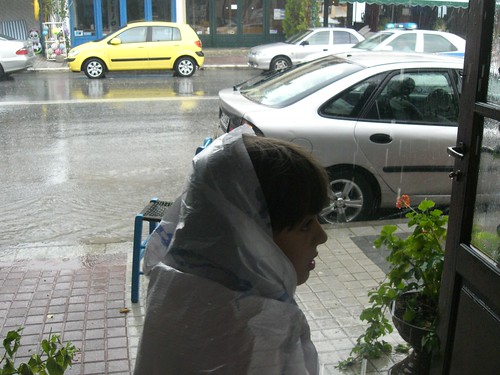
It was still raining when we left the restaurant. The staff taught us a new use for the traditional Greek plastic-lined paper tablecloth: it could also become a raincoat! The rain did not stop us from venturing further into Halkidiki, where Cheryl warmed us up with coffee, cake and chocolate chip biscuits.

If you are in the area of Halkidiki, you might like to try Aithrion on the Cassandra leg; the total cost of our meal (including drinks) was 43 euro (at last year's prices).

©All Rights Reserved/Organically cooked. No part of this blog may be reproduced and/or copied by any means without prior consent from Maria Verivaki.

Monday, 7 July 2008

Aubergine shoes - papoutsakia (Παπουτσάκια)

These days, I need look no further than the garden for my inspiration as to what to cook. Today's glance into our vegetable patch concluded in a papoutsakia marathon...


papoutsakia eggplant aubergine

...now that the courgettes' reign is almost over; they came, they conquered and now they're leaving. The aubergines have now invaded. May their reign be short-lived; I'm fast running out of jigsaw puzzle space in the deep freeze, as there is almost no more room at the inn.

eggplant aubergine

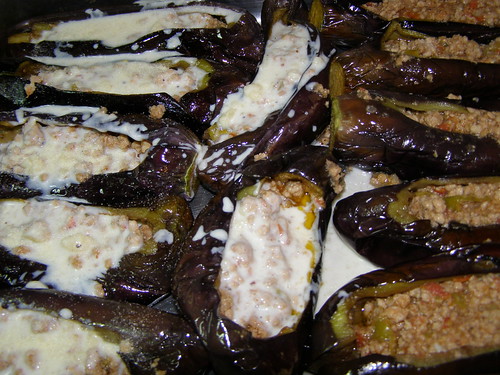
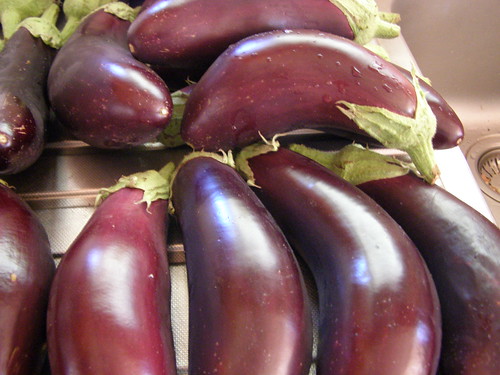
Long and thin ones, short and fat ones, take your pick. The short fat round variety gets used for imam baldi, moussaka, and aubergine dip. The long thin ones can also be used in the same way, but, oh the elegance of the sleek and slender long thin eggplant, turned into little shoes (papoutsakia) - fried eggplant shells stuffed with mince and topped with bechamel and cheese. They come in a wide variety of styles:

ballet slippers...
eggplant aubergine ballet slipper

comfortable loafers...
eggplant aubergine loafer

high heeled stilettos...
eggplant aubergine stiletto

evzones' tsarouhia...
eggplant aubergine tsarouhia

strapless mules...
eggplant aubergine peep-toe mules

and worn-out sneakers.
eggplant aubergine worn-out sneakers

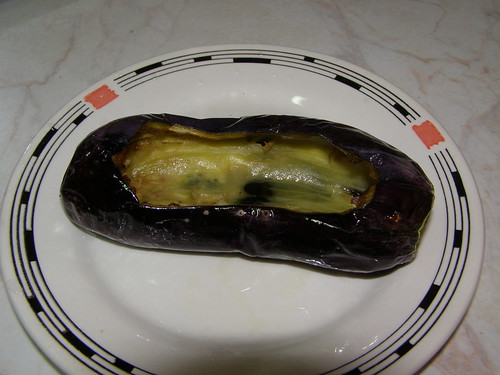
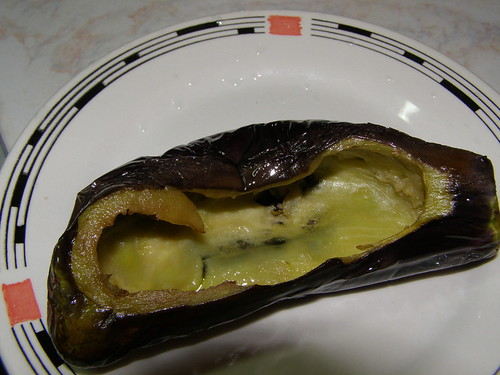
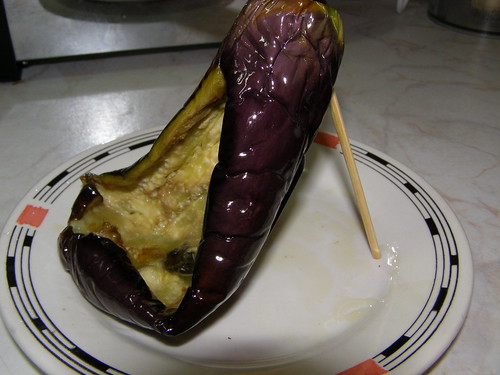
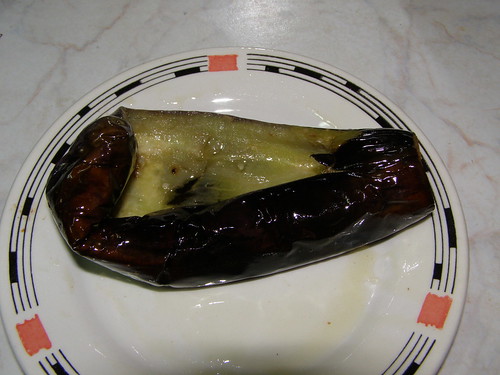
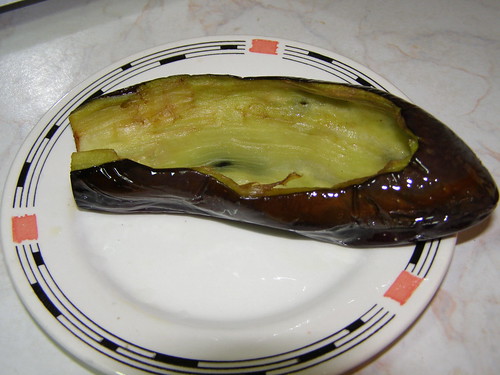
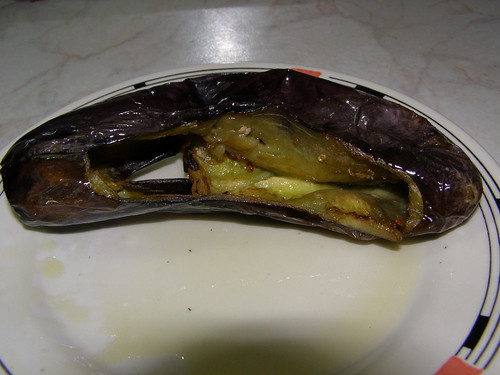
A very much healthier alternative to frying the shells is to bake the aubergines in the oven as for melitzanosalata. When they are done, slice off one side, and scoop out the flesh (and make melitzanosalata, thereby eliminating waste). Use the empty shells to make papoutsakia, by filling them with mince sauce topped with bechamel sauce and grated cheese (or just cheese if bechamel sauce is too much fuss and/or too fatty to make).

eggplant shells aubergine

(Click here for the recipe for
papoutsakia.)


©All Rights Reserved/Organically cooked. No part of this blog may be reproduced and/or copied by any means without prior consent from Maria Verivaki.

Friday, 16 July 2010

Eggplant skordostoubi from Zakinthos (Μελιτζάνες σκορδοστούμπι από την Ζάκυνθο)

Greek television is currently serving up 'κονσέρβες', repeats of old programmes and serials that the average Greek will have seen a few thousand times. Most of the programmes are not high quality; this could be said for television in general in any country. Amongst the trash, there are a minor few that stand out for their entertainment or informative value. I'm not a great fan of television, but I don't mind watching 'Εισαι το ταίρι μου' (comedy - entertainment value) every summer, and my whole family never tires of watching Ilias Mamalakis, Greece's favorite all-time cook, whose food shows combine travel all over Greece, where Ilias enters people's kitchens and watches them cook lesser-known Greek regional dishes that never get written into Greek cookbooks. Ilias' food travel shows have done more than educate Greek people about the different kinds food of their compatriots: he has united the Greeks who share a love for the gastronomical culture of their country by introducing them to food and ideas that not even the popular Greek food blogs and Greek cookbooks can do.
Nowadays, sadly, young people are not so involved in the food customs of the family. More and more food is being sold ready-to-eat, and people do not have to go far to find any food product they desire, due to the ease of shopping in supermarkets. The traditional food of every regional pocket of Greece is either mainly seen as an 'old-people' thing because of the newer more globalised food trends taking hold in Greece, or something that is cooked at large gatherings and isn't often made by people in their homes, hence there is a lack of tradition in the passing of knowledge from one generation to another.

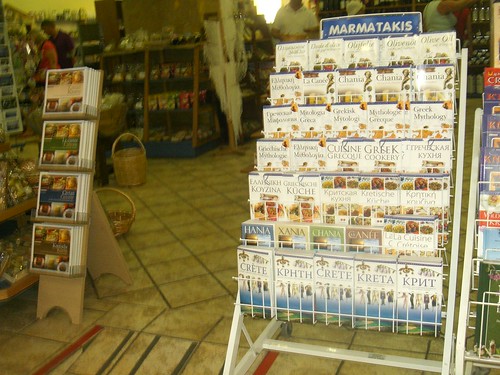
cretan cookbooks
Greek souvenir cookbooks tend to be too generic: the full range of Greek cuisine has never really been showcased in such books, since most present an often nationalised segment of regional cooking, containing the odd exceptional dish.

Greek cookbooks tend to be sold in the region where they are produced, and because of low demand, regional cookbooks about Greek cooking, other than those produced in the region where one lives, are difficult to find. In Hania, for example, I can find just about any book my heart desires about Cretan food, but not, say, about the food customs of the island of Zakinthos, to name one example. Such cookbooks will also have a low demand commercially outside their native region, so that they are not widespread, even in large bookshops. I can't browse Greek cookbooks in a bookshop in Hania - I have to go to Athens for that kind of shopping. Thankfully, we have people like Ilias Mamalakis and other Greek chefs who also do gastro-travel programmes and give away recipes on the show. And now, for the first time on the internet, we have a Greek Food Blogs portal, which anyone writing on the web about Greek food can join, showcasing the food that is being prepared by home chefs cooking Greek food from all over the world.

*** *** ***

The other day, a repeat of Ilias' television programme Mπουκιά και Συχώριο was showing at midday while we were having lunch. Ilias was in Zakinthos, an island in the Ionian Sea (Western Greece) which is also known as Zante. Ilias first had a taste of a local sweet called φυτούρα (fitoura - also known as fritoura), a completely unknown traditional delicacy of the island, made primarily in this area and not elsewhere, which is available all year round, and is especially popular during the fasting periods because it does not contain animal products. Fitoura is a dense semolina pudding, which is poured into a tin and allowed to cool. It is then cut up into diamond shapes and the fitoura pieces are fried in oil (not necessarily olive oil). When cool enough to handle, the fitoura is rolled in sugar before it is served. It sounds so simple, but it is never made outside Zakinthos. It is a local treat, made primarily in large quantities and served at festivals, from where it is never missing.


After Ilias ate his fitoura, with the help of a local cook, he made aubergines 'skordostoubi', another specialty of Zakinthos: eggplant cooked in a garlicky vinegar tomato sauce. This seemed like a perfect alternative for us to try now that we have a glut of eggplant in our summer garden. Eggplant grows easily in Crete and it is one of those vegetables that landmarks a Greek summer, including the Cretan kitchen. It is always difficult to keep accurate notes when watching a television cookery show, so I asked my Zakinthian friend Kiki to help me out. This dish requires a lot of olive oil and a lot of frying, neither of which are these days very popular in excess for health reasons. Through Facebook (finally, I found a valid use for it!) Kiki gave me some tips to reduce the excess frying.


eggplant skordostoubi zakinthos

For 3 average servings, you need:
3 large eggplant, cut into thick slices (not small, not cubes)
1 large onion coarsely chopped
2-3 cloves garlic coarsely chopped
half a wineglass of vinegar
2 tomatoes, grated
100-150g feta cheese cut in cubes (in Zakintho, they use a local product called ladotiri, cheese preserved in olive oil, but it is doubtful that you will be able to find an authentic alternative such as this one outside the region - feta is a good substitute)
olive oil
salt and pepper
oregano

Heat some olive oil - you will need quite a bit because eggplant soak up a lot of oil - and brown all the fleshy sides of the eggplant pieces. (Alternatively, if you don't like frying, you can brown them in as little oil as you prefer, but they won't have that Mediterranean taste we've come to know well in fried eggplant.) Remove the eggplant from the pan when it is ready and set aside.

In another saucepan, heat 2 tablespoons of olive oil and saute the onions and garlic. When they are transparent, add the grated tomato. Let the sauce cook for a few minutes, then add the vinegar which has had the salt and pepper added to it. Stir the sauce, then add the cooked eggplant.


eggplant skordostoubi zakinthos

Now the cooking can be finished off either in the pot or the oven, whichever you prefer: If cooking in the pot, allow the eggplant to cook till soft (if you didn't fry them, they will need a longer period of cooking time), add the feta cheese cut in cubes, allow the ingredients to blend, and the meal is ready. Alternatively, pour the dish into a baking tin and place in a PRE-WARMED oven. Add the feta cheese chunks on top of the mixture. Again, if the eggplant wasn't fried, then it will need a longer cooking time. When the cheese has softened/melted, the dish is ready (about 20-25 minutes).

This dish makes a very rich sauce - you don't need much to accompany it, except maybe some good quality bread. And if you want to keep it vegan, just omit the feta cheese.

If you are interested in other recipes from Zakinthos, check out Kiki's blog: she has also written a Greek cookbook (in Greek) containing some of the local specialties.

©All Rights Reserved/Organically cooked. No part of this blog may be reproduced and/or copied by any means without prior consent from Maria Verivaki.