Showing posts sorted by relevance for query economic crisis. Sort by date Show all posts

Monday, 3 April 2017

Empty shops

One of the classic descriptions of the appearance of Greek cities today is the 'empty shops' syndrome, which stretches as far back as the beginning of the crisis:
From the empty shops, to the half-full theatres, restaurants, concert halls and hotels, the signs are everywhere: economic crisis has come to Greece and it is biting hard.  (7 Feb 2010)
The blame for the empty shops syndrome is, of course, being laid firmly on the economic crisis:
In pictures: Athens' empty shops testament to austerity (24 Sep 2012) 
Greek debt talks: Empty shops and divided societies; "none of them were closed before the crisis." (10 June 2015)
A more recent quote about empty shops hints at the deceptive nature of the Greek crisis:
Central Athens is seeing fewer stores closing, while in areas such as Peristeri and Kallithea [west Athens suburbs], more businesses are shutting down. (13 April 2016)
Somewhere, something is happening, while elsewhere, it is not.

It shouldn't be forgotten that the empty shops syndrome is not limited to Greece: all over Europe and the United States, many streets are lined with empty shops in what would once have been bustling commercial districts. But the abandonment of commercial activity in these areas should not be seen as a sign of an economic crisis alone: it's more likely a crisis of values, which preceded any economic crisis.  The closed shops syndrome can be equated with the demise of the printed press, and the decline in standards of television shows: society is changing radically, due to technological progress, changes in attitudes concerning desirable places to live, the different ways we work nowadays, and changes in living standards, notwithstanding job opportunities, of course. We can infer from the above articles that a healthy society is one where shops don't have boarded windows. But for shops to be working, you don't just need money in people's pockets; you also need people. So when the people go, the shops go too:
Across the city of Athens, 300,000 houses and flats are empty. Where most capitals suffer from a shortage of housing, a combination of changing demographics and the financial crisis has led to a surfeit in the Greek capital. (3 July 2015)
Where did the people go? Why did they leave? What crises do the loss of the people allude to? A recent article in the Greek press (see http://www.tovima.gr/finance/article/?aid=871310) analyses these issues without the rose-tinted view of the economic crisis being blamed for everything, and describes the multiple crises that led to the closed shops and boarded windows in Athens:
"The main reason for the new unpleasant reality is the ongoing recession and the empty wallets of the consumers who are moving very cautiously, in reaching into their pockets. But the roads that once knew glory days are also affected due to a series of other factors, such as increasing purchases made on the internet, the creation of large shopping centers that facilitate consumers in their shopping, and even the movement of populations away from the center and out to the suburbs." (ToVima)
Monastiraki, in the flea market
(which is a tourist area)
Take for instance Patission St, which is described in the article as being one of the meccas of Athenian shopping streets in the past, but is now filled with empty shops. Located on Patission St is the Polytechneio, one of the most important university establishments in Athens, where demonstrations are common, street bins are burned, and riot police march against protesters: eventually, shoppers get tired of being harassed, and they give up on this area - and find another one. So the fall in their prices (both to buy and to rent) is no surprise: the prices rarely reflected the 'events' that took place regularly here. At some time, the bubble had to burst. And when it did, shop owners had existential thoughts:
"From [2008] onwards, the situation took a downward turn, year on year the fall was great, and there were large differences that made you think that there was no longer any reason for your shop to exist . There were winter afternoons when I was sitting in the shop all day and not a single person entered. I felt scared." (ToVima)
In other words, they closed down their business because they were afraid of being alone in a depressed area.

Monastiraki, across from the square
(where the buildings are neglected)
As we became richer, our housing choices changed. Instead of living in tiny apartments, we moved out to the greener suburbs, where shopping centres and large supermarkets were built to cater for our needs. Most likely, we kept the little apartment we used to live in as an extra income. So the shops in the area had to change their wares to suit the pockets of the tenants of those formerly owner-occupied houses (where there would have been more disposable income). And now that there is an economic crisis - if people can't pay the rent, they won't be buying from boutiques, either.

It's not all doom and gloom though. A once popular business can survive by relocating, going where their old customers moved to. You can't be selling items favoured by the middle class when the middle class has left the area and the working class moves in. A business may also have to morph into a new form in order to survive, a bit like Nokia: from making boots, they went to making phones.
"The high consumption of clothing and footwear lasted for about twenty years, until about 2000 [ie after we got into the EU]. Since then, there has been an increase in consumption of technology products. If someone spends €900 on a cellphone, they won't be spending much money on clothes." (ToVima)
The empty shops syndrome didn't actually start with the economic crisis:
"Before the crisis, until 2007-2008, the landlords demanded €2,000 a month for a small shop. They reached the point where they were used to seeing them vacant. But they wouldn't drop the prices. In recent years, they have put water in their wine and prices have fallen below €1,000, even maybe less than €500." (ToVima)
Mitropoleos, behind Ermou Street
In other words, what has happened is market correction. There is little remaining of the 'goodwill' factor involved in businesses, because new shops have to start from scratch: a new form of business, based on a new model, with new items, for new customers. It's all changed. Except in one place in Athens: Ermou St, in the city centre:
"... there are now two kinds of shopping streets: first, there are the so-called small but important ones whose business core is based on cafes, clothing and footwear, such as Tsakalof, Ermou, Voukourestiou and Patriarchou Ioakeim Streets, and then there are the commercial streets with large stores such as Heliopolis and Vouliagmeni Streets." (ToVima)
So it wasn't really the economic crisis that led to the empty shops syndrome: there were many other factors at play. The economic crisis came into play in the following way: In the past, private businesses sprung up where there was a good source of money, rather than a demand for a product. After entry to the EU, many people landed jobs in the public sector. They then had more disposable income, which was being spent on thing like shoes and clothes, sweets and fast food, cafes and tavernas, as well as all-night entertainment. When the house of cards began to fall, the public service stopped hiring, and the businesses that the public sector was propping up began to suffer in a domino effect. That was the effect of the economic crisis. But the origins of the closed-down businesses had deeper roots.

*** *** ***

In Hania, we are definitely much luckier than other parts of Greece. We don't see many closed or boarded shops these days. This can be partly explained by our tourism industry, which keeps money rolling into (and out of) the system. The empty shop windows are located in places similar to Manousogiannakidon St: streets that run off the outskirts of the main town centre, which are mainly residential - in other words, the buildings were never really made for shops and the areas were never really shopping precincts (they were mainly residential - the most that they could sustain would be a convenience store and a bakery), When the crisis first struck, the main shops to close down were 'boutiques' located in the narrow streets of the old town (places like Potie St), which sold 'exclusive fashion' at high prices. For a while, these streets remained boarded up, until a new use was found for them: cafes and bars now line these streets. Locals still have money for daily cheap outings in the town. You can mull over a €3-4 cup of coffee for a long time at an al fresco cafe,  chatting with a friend as yo both enjoy the good weather, giving good value for money. The added bonus is that these places are no longer empty and they give life to the city, making people feel safe as they walk through them. These streets also open up other shop opportunities - shops open where the people go. So it's not all bad down here: there's plenty to buy and eat in Hania in terms of day-afternoon-evening activities. But not so late at night... One of the most interesting changes in Hania's entertainment scene is that we don't have a night life here. So, no discos, party-places and all-night bars, not even in the old harbour. Perhaps we are being influenced by our tourists: they come here to see and do a lot of things, and by the end of the day, they are tired and just want to laze around in their rooms, a bit like us... :)

©All Rights Reserved/Organically cooked. No part of this blog may be reproduced and/or copied by any means without prior consent from Maria Verivaki.

Thursday, 17 July 2014

Greek cuisine, Greek identity and the economic crisis: a crisis of taste

A dietitian friend of mine in Germany recently asked me about the relationship between Greek food and the economic crisis. Here is a seminar I presented last year about this very topic. Presenting it again this year has given me a chance to give it a reality check - yes, it still holds true. 

GREEK CUISINE, GREEK IDENTITY and the ECONOMIC CRISIS
Maria Verivaki
English teacher, Food blogger
Mediterranean Agronomic Institute of Chania

ABSTRACT 
Greek cuisine is often associated with concepts such as hospitality, homeliness and tradition, all of which require certain sacrifices, in terms of time and money. It is also seen as an important and defining element of Greek identity. But the economic crisis has affected standard Greek values and the Greek identity is being reshaped as developments change the structure of Greek society. The traditional cuisine associated with Greece cannot remain untouched by this. What changes has Greek cuisine, as related to Greek identity, undergone due to the crisis?
The economic crisis brought this 'new' form of heating - and 'old' form of cooking - into my home.

This paper does not attempt to answer the question directly. Rather, introspective insights will yield partial answers to this issue, using personal experience and knowledge gleaned from various sources, mainly from the Greek national and international press coupled with personal experiences, with particular emphasis on the area of Western Crete, where the author lives and works. The question will remain open, as a recommendation for further research into the topic of Greek identity and how it relates to Greek cuisine.

INTRODUCTION
Greek cuisine is mired in the myths created about it by the nostalgic diaspora, history enthusiasts and sun-seeking tourists. Numerous books have been written about it, acquainting the whole world with the concept of Greek cuisine, while at the same time standardising Greek food in the minds of both those of Hellenic and non-Hellenic heritage. While there are many standard dishes instantly recognisable as Greek food, the basic ingredients and meals that are often ascribed as Greek and known to the non-Greek world represent only a limited range of the full gamut of Greek cuisine. What's more, what is prepared in the Greek home is rarely representative of what is cooked in the tavernas and restaurants for the tourist.

Greek food is glorified in pictures. Sometimes the setting is more important than the food. 

GREEK CUISINE 
The country of Greece is as varied as its cuisine. The north is known for its redolent pita, the south for its great variety of horta, and the islands for their regional specialties originating in their limited supply of ingredients. But what is often presented in restaurants in a country with a booming tourist industry associated with it is a variation of mainly summer specialty dishes such as yemista and horiatiki salata. In Crete, some regional specialties will be added, perhaps boureki and kalitsounia. In the north, these regional specialties will be replaced by the locality's specialties, maybe tirokafteri and some kind of pita. But all Greek eateries will unfailingly mention (for example) tzatziki and moussaka, and these dishes will be presented in such a way that one expects them to be commonly prepared in the average Greek home by the average Greek home cook.
Haniotiko boureki: a very regional dish from Hania

The truth is that Greek cuisine is made up of a regional range of different cuisines, in the same way that a number of regions make up the country. Many of the locally well-known dishes will not necessarily be well-known to Greeks outside the region concerned, nor will they even appear on a tourist restaurant menu. But these specialties are now appearing in high-end Greek restaurants, often in variable forms from those originally found in the home and non-tourist kitchens where they are still commonly prepared. One of the reasons for this is the economic crisis: as Greeks are rediscovering and reshaping their identity, they are digging up and uncovering more basic elements of their culinary history in an attempt to reach beyond the surface of the traditional identity that they have - often mistakenly - become synonymous with.
Bougatsa Iordanis: a local specialty of Hania, different to other forms of bougatsa in Greece.

The Greek diaspora has always played a major role in the global dissemination of Greek cuisine. The diaspora is made up of people of Hellenic origin who congregate in different places around the globe outside Greece. Their regional differences are not accentuated as they relate with each other abroad for the simple reason that they find themselves outside the country - there, they become Greeks, and so does their food. In the diaspora, they are no longer a Cretan, Athenian, Samioti, etc; they are Greek. Their shared Greek experiences are expressed in their shared Greek food.
Sometimes the only Greek element of Greek yoghurt sold abroad under this label is the design of the packaging.

The economic crisis has created a new Hellenic disapora wave - this in turn will have some influence in the dissemination of Greek cuisine and how it is being redefined in global terms, as expressed in the homes of those new immigrants and the food businesses that are operated by them. In the same way that the 1922 crisis in Smyrna reshaped Greek cuisine within the Greek borders, so too are the new Greek migrants likely to redefine Greek cuisine outside the country, in the food that they prepare in their home, the products they import, and the Greek restaurants they operate.

Before looking into Greek cuisine abroad, we need to understand what it is all about in the domestic environment: what Greek cuisine means in the urban/rural context, lifestyle choice, the concept of a Greek product and its promotion, shopping trends, the difference between eating at home and eating out, the influence of unemployment and soup kitchens, the resurgence of gardens, chicken coops and foraging and Greek television food programs.

THE URBAN/RURAL DIVIDE
One of the reasons for the varied range of cuisine that one will come across at any one moment all over Greece is the different landscape that Greeks live in. Mountains and coastlines yield different food in different quantities. This is in antithesis with the urban landscape, particularly that of a densely populated capital city like Athens, which is concreted and does not give people the opportunity to be self-sufficient to any degree. The local seasonal abundance which rural life depends on for its culinary creativity is to be found in the street markets (laiki) of urban Greece where producers and/or their products congregate from all over the country. Hence, urban Greeks conceivably have a greater range of products available to them at any one time compared to the rural Greek.
My home cooked summer meals often depend on what is in the garden. I obviously had access to cucumbers and vine leaves and herbs to make this meal. 

But in an economic crisis, where money is scarce, food choices become limited by what you can afford, which is especially true in a city. The rural Greek household, on the other hand, despite having always been much more limited in terms of the range of products found in the average rural kitchen, will not be greatly affected by an economic crisis. Rural Greek kitchens are supplemented not by a weekly laiki, but by the gardening season. In a crisis, this is hardly likely to change, as people continue to grow a good deal of their own produce, maybe even more than they used to before the crisis as a way of safeguarding their future.
The colours of my local laiki last weekend.
A Greek laiki shopping experience is not complete without one of those clunky wire baskets with wheels. Personally, I prefer the shopper.

Unlike the more technologically advanced nations, Greece has a relatively more balanced urban/rural population, at 60/40. This means that for every 1 person living in the city, there are approximately 2 people working in the countryside, which often involves work that has to do with food production. Compare this figure to the UK's urban/rural population, which stands at 80/20 - each person living in the countryside equates with 4 living in urban areas. In Greece there are more people working with food, compared to other European countries. This factor accentuates the relationship of the Greek people with their culinary heritage. Food is seen not just as a means of survival, but a form of expression, and a regional one at that, as each Greek region produces a variety of distinct products. 

My husband is a keen gardener. 

The different food available in the rural and urban context will naturally give rise to a different kind of cuisine. An urban cook looks for inspiration from the range of products in a store, while the rural cook will look into her garden and base meals around it. An urban cook will also be able to use prepared ingredients while the rural cook may be spending more time processing a product before preparing it for a meal. A possible influence of the economic crisis may be that the finished meal cooked in either kitchen - the rural or the urban - will not necessarily reflect what is traditionally labelled as Greek cuisine: the urban cook will prepare a meal according to her pocket, which may mean cutting corners (eg my pastitsio which contained leftover makaronada mince and much more pasta), whereas the rural cook may prepare a frugal meal using a wide variety of whatever is available in the garden with a less conventional mixture (eg my spanakopites which contain a variety of horta rather than mainly spinach, or adding orange in a salad, like it was added during the war as related to me by my mother-in-law).

LIFESTYLE CHOICE
The modern world has given people the choice to live however they like wherever they like. Whether you live in the city or the countryside, you can eat the same food. Supermarkets, refrigeration and the free market have given Greek people the opportunity to eat all kinds of food that even their parents may not have dreamed of eating in their youth. These days, most Greek people, wherever they live, are within reach of pre-cooked packaged beetroot available at fresh produce stalls, ready-to-cook refrigerated pizzas and a store (usually a supermarket) that sells Chinese noodles as a standard product. Soya bean meat substitutes are readily available for vegetarians, which is quite a different concept to fasting according to Greek tradition, as is gluten-free food, an unknown concept in Greece until only relatively recently.
My Greek guests like to be surprised by my international cooking. These Chinese dumplings were made using local ingredients, flavoured with Asian sauces.

The freedom to choose what we eat allows us to diverge from tradition and eat in a way that does not reflect our cultural background. Indeed, with the rise in travel, a more conscious attitude towards healthy food (meaning less meat, less fat and less fried food), and the wider availability of products among the range generally regarded as global cuisine has paved the way towards a move away from Greek cuisine. Freedom of choice has also helped working people immensely; when there is no one to do the cooking for you, you can choose between a packet of ready-to-cook spanakorizo or a pizza in the freezer section of the supermarket; pre-cut salads with less conventional leafy greens (eg red lettuce varieties or baby spinach) are now common (and many supermarkets sell imported salads of this sort); and if you don't have the time to make a spanakopita yourself, you can buy ready ones at a range of prices to suit your pocket. The same applies to a dinner party - these days not everyone cooks a traditional Greek meal for their guests (this is mainly done in villages), while having your party catered for, or cooking something less conventional is becoming all the more common.

The economic crisis influences our choices in our freedom to choose what to prepare, cook and eat, whether we are cooking for ourselves or for others. At my own dinner parties, I often prepare Asian specialties like spring rolls using Greek ingredients. At a recent dinner party I attended in Hania, given by a newly-wed couple, we were served ready-to-cook spanakotiropitakia as an hors d'oeuvre, a baked macaroni-bacon-cheese dish for mains, served with a 'fancy' green salad (lettuce with pomegranate and balsamic vinegar). Such meals are cheap/easy to produce, but not essentially 'Greek' in nature. This style of cooking points in the direction that Greeks are tending towards: global cuisine that does not cost too much time or money.

GREEK PRODUCTS
This leads us to a pressing issue in our times: what exactly do we mean when we talk about a Greek food product? Is it a product produced on Greek soil? Can it include a finished product made in Greece with imported ingredients? What about a product with a mixture of origins and/or ingredients? There are many ways to illustrate this concept. I will use three examples: Greek meat, Greek milk and Greek yoghurt.

MEAT: Greek meat is often regarded as meaning the meat from an animal born/raised/killed in Greece. But few people will read the fine-print on the label concerning the origin of the animal. Beef sold in Cretan supermarkets, for instance, is often born in France, where it was raised up to 5 months old, then it is brought into Greece where it continues to be raised, until it is finally slaughtered in Greece. The meat from such animals is sold as Greek meat. The recent horsemeat scandal has heightened awareness against imported meat - but Greek meat is rarely purely Greek anyway and it is more expensive than imported beef.

MILK: Milk has been a contentious economic sore point for many years, since well before the crisis, when a litre of milk was being sold at about the same price as a litre of petrol. After a long campaign (well before the crisis), the average price of a litre of milk decreased. But truly cheap milk in Greece is never of Greek origin; Greek milk consistently continues to be more expensive than imported milk, selling approximately at 1.5 times a higher price. During the crisis, people tend to buy cheaper products. The cheapest milk on the Greek supermarket shelves is consistently not produced in Greece.
Somewhere in the US...

YOGHURT: Greek yoghurt is a high point of discussion all over the world. What is Greek yoghurt? Is it yoghurt made in Greece? Is it yohgurt made with Greek milk? Is it a particular kind of yoghurt? And when can a yoghurt be labelled 'Greek'? We understand that the phrase 'Greek yoghurt' basically means 'strained yoghurt'. In Greece, the most popular brand of strained yoghurt is made with a mixture of milk imported from France and Germany. Labels bearing the phrase 'Greek yoghurt' appear all over the world - they rarely write 'strained yoghurt'; the closest they come to describing what they mean by Greek yoghurt is when they write 'Greek-style yoghurt'.

THE 'GREEK FOOD' CRAZE
The subject of Greek yoghurt leads to the issue of the Greek food craze abroad. Despite the bad reputation of the Greek economy in global terms, we find that Greek cuisine enjoys a record high degree of popularity. Greek food is being recognised in Western countries in ways that it was not considered in the past. This is possibly due to the perceived health benefits of the Mediterranean diet, its high reliance on cooking with olive oil and fresh vegetables, and the taste quality of export-value Greek food products. The economic crisis has partly fuelled this foreign interest because the main export products in Greece are to do with food.
Greeks often sell Greek products packed/prepared in a way that will appeal mainly to foreign buyers, not locals. 

In the scramble for market share, suddenly Greek food is is being exported in all sorts of forms for all sorts of prices. Farmed snails, olive oil in decorative bottle designs, truffles found in Greece, mastich crystals and mastich-flavoured drinks, among others, including some of the more well known products such as wine, honey, feta and olives, coupled with the 'organic' label, are being sold at the high end of the market. Some of these products are not being targetted towards the local market, eg farmed snails and olive oil in decorative bottles; they would be considered by most Greeks as over-priced as well as easily replaced by cheaper and more readily-available products. In terms of the economic crisis, what is the degree to which these enterprises benefited from it? Did they originate in the economic crisis, or were they a natural progression of the Greek food export market? Has food marketing in Greece changed to accommodate a new kind of post-crisis food market or is this Greek food craze a purely foreign export issue? These food-based questions all provide some kind of insight into the Greek identity.

EATING IN vs DINING OUT
Going out for a meal had always been the norm for many Greeks: taverna food was considered quite cheap in the pre-crisis days. But it is now widely reported in the media that Greeks don't eat out much, and a quick glance in the local tavernas will probably confirm that. Beyond the taverna though, we see the cafes full to the brim on most warm days. It's cheaper to go out to a cafe than a taverna, which explains why people choose the latter. So going out is still important in the crisis period in Greece, but the setting has changed. And so has the expenditure. Due to the change in the setting, no doubt the food has changed too.
Souvlaki is the most popular meal out these days - young people are seen crowding round the often very limited outdoor seating areas.

One of the most popular meals out these days is the souvlaki. Souvlaki stores have opened up at very quick rates in the last year or so. Since the economic crisis gripped the country, the price of souvlaki in all forms has gone down, which shows how far the crisis has penetrated: souvlaki is the most popular Greek fast food, and it was generally viewed as the cheapest. Souvlaki is more than just a meal. It makes you feel good, the equivalent of a family 'happy meal', eaten by all age groups, making an outing to a souvlatzidiko the perfect family mid-week jaunt. Going for out a souvlaki is a psychologically uplifting experience, and it is a very democratic meal - there are various choices available, all being sold for roughly the same price.

TV COOKERY PROGRAMS
Greek television is not without its food shows and they remain very popular. We see home cooks showing us how to cook cheaply, gourmet cooks making fancy foreign desserts, modern cooks using labelled ingredients (the infamous philadelphia cheese that goes into anything and everything, from pennes with sausage to stuffed chicken), and homely cooks doing something exciting in the kitchen on the morning shows of the private free-access channels.

If a host of different cooking shows were all playing at the same time on different channels, and you had only one television and no recording facilities, which one would you watch if you felt like watching a TV food show?

* A program that shows you how to cook a well-known traditional Greek dish
* A program that shows how to cook something unusual, not common or creative, eg melitzanopita
* A program that shows how to cook within the spectrum of international cuisine, eg globally well known sweets made by a famous Greek dessert chef
* A program showcasing frugal food, eg a supermarket-sponsored food show featuring easy-to-make meals that don't cost much
* Something showing traditional Greek regional dishes, eg the kind that home cooks in rural regions make, which don't often make it into the cookbooks

Melitzanopita (eggplant pie), made by myself. 

We can watch all these shows on Greek TV. So, how 'Greek' is the food they are cooking? Is it part of the Greek cuisine spectre, or is Greek cuisine veering towards global cuisine trends, where the traditional tried and tested is being replaced by modern global food? Do people cook like this at home, or are they sticking to traditional Greek cookery? Is it cheap to cook like this, or has the crisis affected us in terms of the nationality of the food we prepare at home? Is this an urban trend, or has it also infiltrated the Greek rural kitchen? Is it a special-use cuisine, or do people aspire to cook like this on a regular basis? using a particular brand-name food product, eg mass-produced cheese spread in a pizza?

All the above options are available to Greek TV viewers, and they are popular all over the country, regardless of the landscape.

COST
Price is the most important factor for most people, as exemplified by the Greek Potato Movement, a move to cut the middleman out of the food-buying chain and get products straight from the producer. Surveys have also shown the following trends in Greek consumers:

82% seek specials
80% compare prices
77% prefer Greek products over imports
74% use a shopping list
71% buy only what they need
70% buy the cheaper alternatives
93% have limited their 'eating out'
63% buy less meat
60% buy less fish
51% buy fewer sweets
48% buy less alcohol

UNEMPLOYMENT and SOUP KITCHENS
The consequences of unemployment have led to rapid detrimental effects in the home environment. People find themselves with not enough money to buy quality food. The fact that they are unemployed does not give them the luxury of preparing the slow-cooked traditional Greek meals that they may have been raised on. People are constantly on the move in such a way that they do not necessarily spend so much time at home, even if they are not employed. Suddenly, they find themselves in a new situation, one that has often been referred to as reverting to past habits.
This meal was served in a soup kitchen in Hania. 

There is the preponderance of the home garden, which has always been an effective way to save money. Convenience food is also being sought in discount supermarkets, as a way to keep the food budget of a household down. People are always on the lookout for cheap food sources.

Foraging has always been a popular activity in Greece, but it has taken on new proportions during the crisis: there is a certain amount of 'foraging' going on which is not always legal (people may be trespassing onto fields that are not theirs to harvest procuts). For those who live in urban environments, food parcels and various handouts by non-profit organisations are commonly organised. And we have probably all been witness to the sight of people searching in rubbish bins. These people are often looking for something useful in them, which usually means something to eat. Soup kitchens are now found even in places where food insecurity was never an issue in the past, together with community grocery stores and community gardens. Solidarity against hunger is being shown in various forms all over the country.

CONCLUSION
As Greeks, we all share a common concept of what constitutes Greek food, but we are Western Europeans at heart and our food and lifestyle choices reflect this. The economic crisis has westernised us even more. Despite having less money, we all still eat - we are not starving.

©All Rights Reserved/Organically cooked. No part of this blog may be reproduced and/or copied by any means without prior consent from Maria Verivaki.

Tuesday, 30 July 2013

Bitter orange (Νεραντζάκι)

What does the Greek economic crisis taste of? One of the projects at the 2nd Symposium of Greek Gastronomy that greatly touched my heart was that of the bitter orange art project by Ino Varvariti and Persefoni Myrtsou. They harvested the well known bitter oranges in December 2012, January 2013 and March 2013 from the trees that line the roads of the largest cities of Greece, Athens and Thessaloniki, as a way to identify the taste of the crisis. Bitter orange trees are very hardy trees, and they make a spectacular sight throughout the period when the dark green foliage stands as a stunning background to the bright orange fruit that it is laden with.
Bitter orange trees in Syntagma Square

Bitter orange trees in an inner-city Athens street.
These bitter orange trees are used purely for decoration, as their fruit is too bitter to be eaten raw. They can survive in cold/low temperatures where sweet orange trees do not grow, even in highly urbanised settings. When they are in flower, they mask the polluted air of the city with the sweet smell of their blossom; when the oranges take on their bright colour, they look similar to a Christmas tree. Christmas is when they look their best.
"Their strength against harsh weather conditions and sicknesses, their fragrant flowers and their beautiful fruits, are some of the reasons why these trees are often planted in the urban centres of Greece in order to embellish the urban spaces. However, these 'urban' bitter oranges are rarely harvested by the citizens, due to the polluted environment of the cities and due to the fact that the origin of food is usually connected to its production in the rural space."
I thought that the historical centre's taste of bitter orange was a little more bitter than Syntagma's taste. By trying the different varieites, you are able to understand the effects of the crisis in each area through the bitterness of each variety. 
But the fruit of these trees, despite being too bitter to eat raw, can be used in a number of ways:
"After a certain procedure and with the addition of sugar, it is often used for the making of marmalades and sweets. Also, the leaves, the flowers and the skin, due to their fragrance are used for the making of confectioneries, in alcoholic beverages and in aromatology."
In Crete, the juice of the bitter orange can be used to flavour dishes or to marinate meat and fish, in the same way as lemons. Bitter orange juice is also used as a curing treatment and preservation for olives. The peel of the fruit can be dried and candied, to be used as dried fruit in sweets, pies, savouries and salads. But most of the time, the peel is turned into a typical Greek dessert known as the γλυκό του κουταλιού, the spoon sweet, where an array of bitter or under-ripe fruits are turned into a syrupy dessert.
Bitter orange spoon sweet is typically served in Greece as a refreshment with a glass of water, sometimes together with black coffee. This is considered a special treat for guests to one's home. Therefore, it serves as a medium for discussion
The harvest points of Persefoni's and Ino's bitter orange spoon sweet were some well known spots in central streets running through Athens. Most of these areas carry some emotional weight in the minds of all Greeks:
"The selected urban areas (around Syntagma Square, the historical centre and Kypseli in Athens; Agiou Mina, Vassileos Irakleiou, Proxenou Koromila and Mitropoleos streets, as well as the “Upper” town in Thessaloniki) are spaces registered in the personal and collective subconscious as agents of historical memory, but they also remain alive parts of the cities in the present. Now the marks of the economic crisis are visible in these spaces."
So Ino's and Persefoni's bitter orange, harvested from the urban areas of Greece most heavily bruised by the economic crisis, takes on a symbolic social character:
"The spoon-sweet still maintains this [hospitality] attribute, and thus becomes the point of departure for the creation of new associations and construction of new meanings. Furthermore, it enables an open dialogue and exchange of ideas in relation to the crisis in Greece."
By turning the urban bitter orange into spoon sweet and serving it in the village of Amari, Persefoni and Ino brought the taste of the crisis to the Symposium and to the village of Amari. It had also previsouly travelled to Berlin, as part of the exhibition “Domestic crisis” at the Institut für alles Mögliche. There, the audience, being predominantly German, had to be shown how to eat the bitter orange spoon sweet, because, being German, they were not familiar with this tradition, unlike at Amari, where the bitter orange was more well known to the participants and the subtle differences in taste among the different areas where the fruit was harvested (they were all prepared separately) could be appreciated.

The bitter orange spoon sweet project was directly associated with the economic crisis, as was my own presentation (Greek food, Greek identity and the economic crisis). If I lived in the middle of the crisis-ridden neighbourhoods where the bitter oranges were harvested, I would probably be the first to use them. Therefore, I can relate to Persefoni's and Ino's urban bitter orange spoon sweet - it's all part of the frugal food lifestyle that the crisis has forced us to adopt.

All the photos (except the first two) come from the artists' personal archive. The photos of the bitter orange trees in urban Athens have been taken from the blogs credited to them below each photo. The italicised paragraphs come from Persefoni's and Ino's exhibition work.

©All Rights Reserved/Organically cooked. No part of this blog may be reproduced and/or copied by any means without prior consent from Maria Verivaki.
Friday, 5 December 2008

Urban garden (Αστικός κήπος)

There's a serious economic crisis reigning in Greece, invisibly infiltrating the town of hania, visible only the those who read between the lines. People want to work, but are either denied the right to do so, or can't find enough of it. The state has always made a show of their provision of free health care to their protegees, the privileged public servants of Greece. But it has recently been revealed that this free care was at the expense of private businesses and promises that the owners would be paid; the chemists' union has stopped providing drugs to state-insured citizens, and doctors have stopped treating state-insured patients for free. Boutiques and specialised stores are void of customers. The only businesses doing well in Greece are the banks - they're always full of people, people paying off their debts, people withdrawing cash, people taking out loans, people transferring their debts from one bank to another; in general, people needing money.

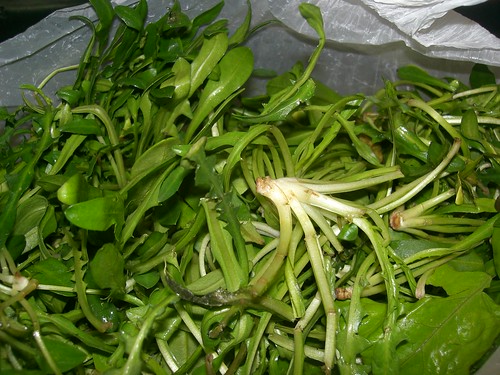
The economic crisis has hit food sales. In Hania, stamnagathi is a prized green, usually selling for at least 7 euro a kilo; in the heart of winter, I've paid more than 8 euro a kilo, which in some cases is more than the price of meat per kilo. Stamnagathi is a fortnightly staple in our house, alternating with other more conventional greens such as cabbage and brocolli. So you can imagine how thrilled I was to find it selling at less than 5 euro a kilo last week. At that price, I should have bought the whole crate and washed, boiled and frozen it to last me until the end of winter.

stamnagathi

As with any cheap product, I was worried about buying low quality: price is nearly always associated with quality, even if this supposition is only in the mind. I decided to ask the shopkeeper why the price of stamnagathi had dropped dramatically. The price of petrol has fallen dramatically, but here's what the shopkeeper had to say:

"This year, stamnagathi has had a slow start because it hasn't rained so much. There has been a sterady supply of it, but it hasn't had that lush green look it used to have at this time of year last year. (I had bought some at this time, and it was rather tasteless and dry.) Now that it's been raining more, it has started to grow more profusely. I was selling it last week at just under 7 euro a kilo, but it wasn't selling. Stamnagathi has always sold at constant levels right throughout the winter. I think it's got to do with the economic crisis. Now stamnagathi is being brought in to us sorted into two types (that's never happened before): the large thick glossy type which sells at a higher price, and the small thin type which sells at a lower price. It gives people a choice price-wise, but it's really the same thing."

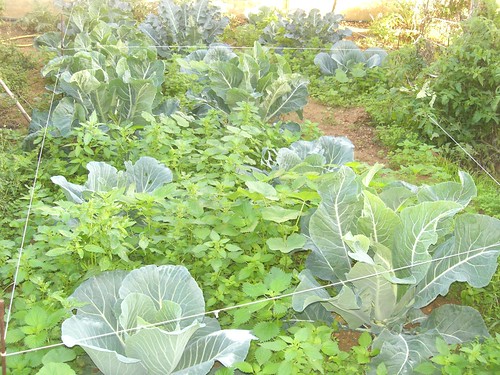
This discussion made me feel very guilty about spending my hard-earned income on a bag of spinach, since the garden is full of nettles, and nettles really do taste like spinach in a spanakopita. I was too lazy to bother harvesting them.

nettles cabbage cauliflower broccoli

The economic crisis was made more obvious to me recently by an amazing discovery I made while getting some chores done in the town centre. I was to meet up with someone while I was there, and we arranged a meeting place. I was the first to arrive at the shopping mall - the only one in Hania - so I wandered around it until my friend arrived.

shopping centre hania chania
The shopping centre reminds me of other shopping precincts around the world, the kind I used to go to in New Zealand, where the shops were always crammed with colourful wares, while the street kids hung around on the benches in the middle of the squares, sniffing glue to while away the time; all that glitters is not gold.

The shopping complex on Boniali street in Hania was modelled around typical shopping malls in large cities, in the hope that it will attract an atmosphere of shoppers that come to view the place as an events arena. People could window shop, try out new things, have a bite to eat from one of the eateries, maybe even food-court style, and entertain their kids. One look at the mall now, and you will think that the economic crisis has had a serious impact in Hania; most of the shop windows are dusty and the units empty. The ones that are being used are divided into two categories: the street-facing units are used as shops selling consumer items (they are all being used), while the offices tucked away in the large marble corridors of the complex, invisible at street level, are being used as offices for private businesses such as engineering and graphics firms. There are many unused compartments, turning the wide corridors into unattractive alleyways that look unsafe. There is underground parking available, but it is expensive; the suers of the car park are usually people who run businesses in the shopping mall and its environs rather than shoppers.

The shopping centre has not been affected by the economic crisis; it was simply never a success. The local community does not do their shopping according to the laws of a shopping mall culture. People use stores referred to them by contacts, or on their own judgment; they love walking down the main shopping streets checking out the windows. If it isn't at street level, then it's invisible. Even food shopping is specialised: if it isn't general supplies which you can pick up from your one-stop shop, the supermarket, it's mizithra, xinohondro, and hand-made filo pastry, sold in stores that have a long established tradition of selling the same product in the same location. Why would anyone want to buy their mizithra from a specialty store located in a modern building with no history? The shops in the mall that opened up and shut down, one after the other, represented markets that were affected by recessions and booms in the economy, as well as seasonal differences, mainly knick-knack articles which made suitable Christmas gifts or interesting artistic additions to the household furnishings - when one could afford it.

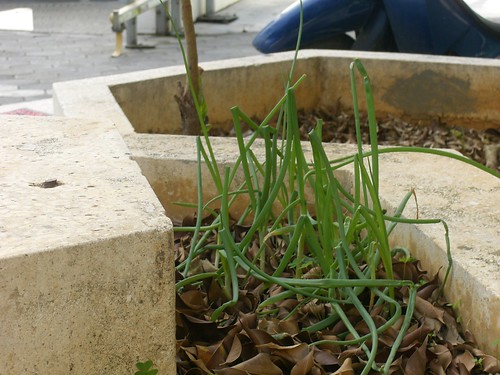
Life in Hania does not centre around a shopping mall. Events in a small Mediteranean town have never centred on a commercial enterprise. People have their own private circle of friends; either that, or they organise a get-together with their families, entertaining in their own homes, or going out to cafes where they would be seen, as well as being able to people-watch themselves. This plush clean modern complex, comprised of three different buildings with offices located at the higher levels, became a lunar wasteground with a clinically clean white appearance. Its flower boxes, surrounded by benches for visitors' comfort, are void of colour, filled mainly with weeded earth, save a few sturdy yucca shrubs, planted at a time when there was some hope that the shopping centre would be more successful. But if someone cared to look more closely, they would also have found something else growing in the flower boxes, which would probably seem preposterous in another town:

some spring onions, ...
shopping centre hania chania spring onion lower bed

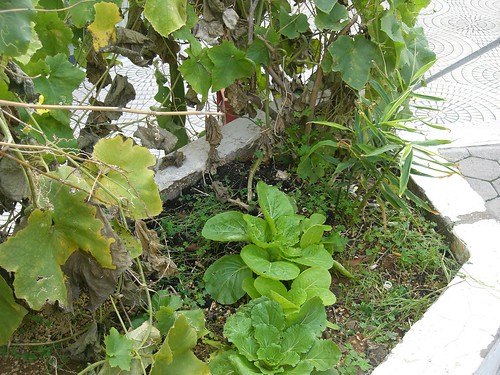
... a few lettuce plants with a climbing pumpkin creeper and grapevine in the background...
shopping centre hania chania lettuce flower bed

... and some coriander.
shopping centre hania chania coriander flower bed

Someone's using these useless flower boxes as their garden. Maybe it's one of the more organically-minded store owners in the mall, maybe it's someone who lives in one of the boxy little apartments in the inner-city, maybe it's someone who simply doesn't have a garden, but wants to eat fresh greens that they have planted themselves. Could it be someone who's feeling the economic pinch, trying to feed a family? It was the coriander that got me wondering: maybe it's an economic migrant that wants a taste of his (or her) homeland. Coriander is never sold at the fresh produce section of our supermarkets. Although I've started growing coriander at home, this herb is too pungent for my family's tastebuds; it's already starting to seed before I had the chance to use it.

Behind the facade of the big flash cars that don't fit onto our narrow roads, the flashy Christmas decorations in the shop windows and the expensive price tags in the high fashion boutiques, a cloud of insecurity hangs over Hania, a fair distance away from our senses so as to seem intangible.

©All Rights Reserved/Organically cooked. No part of this blog may be reproduced and/or copied by any means without prior consent from Maria Verivaki.

Wednesday, 25 April 2012

The Greeks: The Land and People Since the War by James Pettifer

Before October 2009, Greece was a small and insignificant country; since then, she has managed to destabilise the Eurozone, distract the attendees of the Cannes G20 2011 summit meeting and throw the global economy into complete disarray.  So just who are 'those Greeks', and what is that country they call Ελλάδα all about?

That's a difficult, not to say a dangerous topic to get into. It's a controversial action to lump a group of people together and speak of them as of the same ilk, without taking into account their individuality. On the surface though, the Greeks seem like a homogeneous group, with their common language and religion, as well as a recognisable cuisine, all of which are shared among the Greeks living in Greece as well as the diaspora Greeks around the world. Throughout my blog writings, I've painted quite a different picture of 'the Greeks': a people divided between two camps, living under one roof, nudging each other for space. 

The Greeks: A Land and People Since the WarThe topic of 'the Greeks' is quite a hot one at the moment: books written on 'them' in the past, which until recently were out of print, have suddenly resurfaced and are now being prepared for publications as e-books. The topic of Greek identity is also a very complex one, which can be seen from the many different topics that various authors select to write about it. Even books written in Greek about 'them' are now being translated into English and German (some as old as 40 years), which shows a clear interest in things Greek by the non-Greek world. I recently dug up one of those out-of-print books from my own library. The Greeks: The Land and People Since the War by James Pettifer was published in 1993 by Penguin. It has been sitting on my bookshelves since it first came out, one of the few books I bought in Greece, before I realised that I was paying far too much for a book of the kind that I'd borrow instead from a library in New Zealand. Having fanatically embraced the rise of e-books, I searched the title and found, not at all to my surprise, that this book is being made ready for e-publishing next month. As the book was published nearly 20 years ago, and great changes have taken place in Greece since then, how true the new revised version will remain to the original will be interesting to see.

The title of Pettifer's book hints at a separation of the country from the inhabitants, which is a very wise idea; it reminds me of something I have often heard said by many of my compatriots: "I have no problem with Greece, it's the Greeks that annoy me."Although a university professor, Pettifer does not use footnotes or other common forms of academic annotation to provide evidence for anything he writes in his 239-page book; he seems to be writing in a descriptive manner, almost like a travelogue form the golden age of the Grand Tour days, using his experiences and opinions to base his writings. An outsider, Pettifer manages to hold his own in this respect, showing a deep personal interest in his subject, backed by verifiable historical references. Despite the lack of a bibliography, which I personally found disconcerting given the writer's academic background, this glaring omission is made up for by the inclusion of maps, quotes from other sources, photographs and a very thorough index, covering topics such as 'Elgin', 'Macedonia', 'bank accounts for the rich', 'yoghurt', corruption', among others, which all remain quite topical in the present time.

ακούει κανείς;
FYR Macedonia has been wrongly labelled in this translated children's book.

When I arrived in Greece, I knew very little about the country of Greece, despite being of Greek origin, a Greek speaker, a regular follower of the Greek church and eating mainly Greek food. Pettifer's book helped me to fill in some of the gaps in my knowledge. He writes about timeless issues of Greek identity and heritage which still hold true, although a shift may have taken place over time; but the actual topics he discusses are still important ones today, despite the change they have undergone. What is even more revealing are the predictions he makes at the end of each chapter, giving an idea of which direction these topics were heading towards in the mid-90s, which shows that the Greek identity is/was in a constant state of transition. Pettifer was writing what he saw and understood at the time: "Any volume of this kind is bound to be out of date as soon as it is written" he states in the introduction. But his predictions have a ring of truth about them two decades on, despite the economic crisis causing fundamental changes which have shaken the whole system and overturned many previous tenets. Throughout the book, Pettifer makes references to an economic crisis in the country; hence, the present economic crisis should come as absolutely no surprise.

The book is divided into three parts: From Civil War to Democracy, Contemporary Perceptions, and Neighbours and Minorities, each one containing some of the 19 chapters of the book, not including the introduction. One of those chapters is devoted to Food, Drink and Material Life, where he mentions that:
"The gap between the world of the Mountain and the City can be seen clearly here."
 An apartment dweller will not have easy access to fresh food; the supermarket culture makes everything seasonal now. 
The urban/rural divide is very noticeable in many aspects of daily life, and food is no exception. Although nearly everything is widely available at the supermarkets in almost all parts of Greece, the rural dweller is far more likely to stick predominantly to a more traditional diet, even nowadays:
"... the Greek peasant's diet has changed little from antiquity, with its staples of beans, lentils and maize bread, cheese as the main protein source, plenty of fruit and vegetables in season, fish for coast and island-dwellers, and meat for special occasions, usually festivals in the Orthodox Church calendar."
Note his use of the word 'peasant': I do not understand it condescendingly; rather, he is simply trying to describe the rural Greek of the time. (It is perhaps true that there are fewer peasants now in Greece than there were in the early '90s - there are now more 'provincials'.) Although he diesn't specifically mention this, I find that his references to 'the Greeks' describe those of us with regional loyalties, where the present urban lifestyle has not globalised our thinking very much:
"Economics matter a good deal. Greeks love to eat out and do so more often than most Europeans... But to afford to do so, a certain amount of simplicity is important, for the labour involved in some French cuisine would make prices prohibitive... Although Greeks know about haute cuisine, there is an inborn tendency to prepare their food in a few straightforward, well-known ways. Greeks understand that there are no short cuts with food, especially as far as freshness is concerned. This means that there is an enormous emphasis on food being eaten in season. This can involve a degree of monotony as those who have tired of Greek salad in the summer months well appreciate. But it does mean that the cuisine of the winter is quite different from that of summer."
a simple greek meal of tomato salad, tzatziki and bread - all you need to complement the scene is a green mountain or mediterranean blue seashore
 Eating a simple meal like this one at a taverna was very affordable only a year ago. In September 2011, extra tax was levied on all prepared food sold at cafes and tavernas, bringing about a serious crisis in the dining-out industry and culture.

Nowadays, of course, this has changed with the convenience food culture that Greece has embraced, but the economic crisis again makes Greeks turn back to old habits, for economic reasons. I would argue that rural Greeks ate and still eat in the way that Pettifer described in 1993. Between then and now, they were living in a fantasy world - the economic crisis has directed them back to their original sense. 

Towards the end of the chapter, he makes two predictions:
"What will not change is the Greek sense of food and drink as part of their sacred process of hospitality, ultimately a religious obligation, and the charm and dignity of that ritual."
Despite the crisis, the television news reports that come out before a feast day always mention what is happening at the food markets; this is just as much true now as it was two decades ago. Greek food has always had a special place in Greek society, and this will probably continue. But it is doubtful, in the present harsh economic times, if:
"... [in] every Greek home today... on Easter Sunday, when the Orthodox believers break the Lenten fast, it is with mayeiritsa, made with the intestines of the milk-fed lamb that the family will roast the following morning."
A few corners were cut last Easter. That doesn't mean that those Greeks who were used to eating mayeiritsa at midnight on Easter Sunday will now refrain from this custom (it's not actually a Cretan one): they're simply biding their time until things get better and they can afford their mayeiritsa once again.

©All Rights Reserved/Organically cooked. No part of this blog may be reproduced and/or copied by any means without prior consent from Maria Verivaki.

Monday, 15 July 2013

Greek Cuisine, Greek Identity and the Economic Crisis: What is Greek cuisine?

During the 2nd Symposium of Greek Gastronomy, taking place 20-21 July 2013 in Amari, Rethminon, Crete, I will speak about the relationship between "Greek Cuisine, Greek Identity and the Economic Crisis". For the next few days, I'll give you some ideas as to what my contribution may contain.

Photo: and my contribution will be: 
Greek Cuisine, Greek Identity and the Economic Crisis:  a Greek Identity Crisis

In order to talk about the relationship between Greek food and Greek identity and how the economic crisis has affected it, I need to define what Greek cuisine is. I can only spend about 1-2 minutes doing this; if you had just 1-2 minutes to say what Greek cuisine is all about, what would you say?

If you feel so inclined, feel free to answer as a comment, or on my facebook page.)

©All Rights Reserved/Organically cooked. No part of this blog may be reproduced and/or copied by any means without prior consent from Maria Verivaki.