Friday, 15 November 2013

Spanakopita (Σπανακόπιτα)

Making a Greek pita is, for me, a mindless task. Rolling out pastry is not a mental chore, it's a physical one. So while I'm rolling out my pastry, I have much time to think and organise my thoughts. To make the task more challenging for me, I try to invent a new design to score the pastry.

Apart from a design I learnt from a youtube video...

and the classic square-shaped pieces...

I also do one of my own designs, which I call 'marigold':


Cooking can sometimes be mundane, but you can make it more exciting in your own way.  However I decide to score the pastry, I don't worry about it breaking - it still sits nicely on the top of the pie, and it was going to break anyway once it is served. 
I make a pita every week in the winter. This week's pita contained spinach and soft white cheese. It was made in a square-shaped baking vessel - for a change. I always make layered pastry pies - so my filling is never one layer - it's usually 2-3 layers, with pastry in between. Square pies are easier to deal with when you use store-bought pastry.

You needa
500-600g finely cut spinach (I used spinach frozen from last spring to make the pita in the photo)
1 large onion, finely chopped
2-3 sprigs of finely minced fresh mint (or a teaspoon of dried mint)
500g Cretan mizithra or crumbled feta (I use mizithra because it's cheaper and possibly tastier)
1 egg
3-4 tablespoons of breadcrumbs (to ensure that any moisture in the filling is soaked up and won't make the pastry soggy)
salt and pepper (don't use too much salt if you use feta cheese)
10 sheets of filo pastry (I make my own filo pastry, which is a little thicker, therefore I use fewer sheets, about 8)
olive oil for brushing over the pastry

Thaw your pastry first (if you are using store-bought pastry). Mix all the filling ingredients together. (If you are making your own pastry, you should have the filling ingredients ready first. Then roll out one sheet at a time and use it immediately.) Turn on your oven to pre-heat to 200C.
Layer 1Grease the bottom of a baking vessel (pyrex or tin). Place one sheet of pastry on it. (This piece of pastry should hang slightly over the sides of the baking vessel so that it will seal the pie at the end. In my photo, you will see that I didn't do this perfectly, but I use my own home-made filo pastry which is sturdier than store-bought pastry.) Grease the pastry and lay another sheet over it (do this twice). Dot a third of the filling evenly over the pastry. 
Layer 2: Lay another sheet of pastry over the filling. Press it down to make the filling spread evenly below the pastry. Grease the pastry and lay another sheet over it. Dot another third of the filling over the pastry. 
Layer 3: Repeat the instructions for Layer 2. Grease the pastry and lay another sheet over it (do this twice). Brush the final layer of pastry with olive oil, then turn the pastry hanging over the sides of the baking vessel over the top layer of the pie. Brush those with olive oil too. Then score the pastry with a knife, making cuts right down to the bottom of the baking tray, to make the cuts you want when you finally serve the pie.
You can see each layer of filling and the pastry layers.
Place the pie on the lowest shelf of your oven. Turn on the 'fan' function, which circulates the air all around oven. Turn down the temperature to 180C. Cook the pie for 40-50 minutes, depending on how golden you want the pastry. The fan function is important, so that you do not get soggy pastry at the bottom of the pie. If you do not have a fan function in your oven, cook it at 200C for at least an hour. Some ovens also have a function that allows them to cook using only the bottom heating elements. You can use this at high heat for 10 minutes or so, at the end of baking time. Allow the pie to cool for 10 minutes outside the oven before serving - you will need to cut again wth the knife to ensure that each piece comes out separately.

©All Rights Reserved/Organically cooked. No part of this blog may be reproduced and/or copied by any means without prior consent from Maria Verivaki.

Thursday, 14 November 2013

Splinogardoumo - spleen sausage (Σπληνογάρδουμο)

I recently saw a photo of a dish that I have not enjoyed in a long time... not for at least 15 years. It made me realise that I would no longer be able to savour this dish in our times. Even if I wanted to make it, I cannot. And yet, I used to help my mother make this dish, from a very young age, throughout my teens. The way the world has changed since those times does not allow this to take place for most of us.

Splinogardoumo, before it's cooked

The spleen of a lamb or goat is sliced into one long strip (which sometimes breaks, but you try hard not to let this happen), which is then stuffed into the large intestine of the animal. I used to help my mother to do this: I held the spleen from one side and she held it from the other. Then she used a knife to cut it at one point. As she sliced downwards, she'd pull the strip away from the rest of the spleen which I was holding onto, so it could be cut into one big long strip.

The spleen, cut into one strip, and the twig on the right, waiting to be used to stuff the intestine. It is seasoned with salt, pepper and oregano. 

Then, the spleen is stuffed into the large intestine (the colon), using a special technique. The thin intestines could not be used as they were too flimsy to be stuffed (they were turned into something else). You need to use a twig chopped from a tree, which I also remember my mother used. My cousin explains the technique in detail:
First you take the intestine and you hold it open under the tap and let water, a lot of water, run throught it so it gets very clean. This is important because there may still be some droppings in it, as it always keep some due to the fact that is the last part of intestine, and we need that exact part of the intestine to use for making spinogardoumo. Once it's clean with the water, then you hold the one end in your left hand, and with the right hand you take the twig and the spleen together and you press it onto the end of the intestine you are holding. You press it hard and with your left hand you start bringing the intestine down. Once it's all brought down, you will realise it's already inside out. Then your splinogardoumo is ready to be cooked. It needs a lot of skill to do this so the intestine does not break.
The combination of the spleen and intestine produced the splinogardoumo - spleen sausage. This was added to a red or white stew (depending on whether you used tomato or lemon), together with the small intestines, but it could also be roasted.

Stewed splinogardoumo

When I came to Crete, this dish was still available on restaurant menus, and I remember having it a couple of times when we went out. But it has since disappeared, being available only when made to order, or perhaps to the special diner who specifically orders (and pays well for) it. The Greek relationship with intestines is now limited mainly to home-cooks and people who raise animals for their own eating. You can't even buy spleen at a butcher, possibly due to EC regulations which demand that it be disposed of hygienically and not eaten to avoid the risk of transmissible spongiform encephalopathies (TSE), despite the fact that Greeks have been using these parts of the animal as human food since ancient times. Even when I have been lucky enough to get my hands on an animal's innards, the spleen and large intestine were not passed onto me, for these very reasons.

Food politics play a major influence in what and how we eat. As I explained, I can't really make this dish because the ingredients are not readily accessible to me. Even through the photos, I can still taste the splinogardoumo that my mother used to make. She cooked it in a similar way to my cousin's as we are descended from the same family and region. The photos in this post were taken only just recently, by my cousin, who made the splinogardoumo with her father. Spleen sausage is also made in other parts of Greece, but in a different way, and it is more often called splinadero (σπληνάντερο).

©All Rights Reserved/Organically cooked. No part of this blog may be reproduced and/or copied by any means without prior consent from Maria Verivaki.

Wednesday, 13 November 2013

You could be anywhere

Chocolate flakes, grated coconut and vanilla pods from Madagascar,
Ground hazelnuts, sliced blanched almonds and vanilla-flavoured sugar,
Apple-cinammon mini-pizzas, coloured Christmas cookies and vials of 'baking flavourings'
(at €1.99, a 20-pack of vials is cheaper than buying real lemons, oranges and rum)
Cranberries, plum halves, pitted cherries and sugar strands, all complete with paper cake doilies,
And don't forget the lebkuchem, speculoos, marzipan, pandoro and Advent calendar.
Be in quick because they go so fast - how can Christmas in Crete be complete without them?

LIDL delivers its leaflets to households every weekend. LIDL has done much more than any other institute/organisation in terms of the promotion of German cuisine. Angela, you need to tell the troika to carry more cookies in their briefcases whenever they have meetings in Greece.

©All Rights Reserved/Organically cooked. No part of this blog may be reproduced and/or copied by any means without prior consent from Maria Verivaki.

Tuesday, 12 November 2013

Donuts (Ντόνατς)

Friday is usually souvlaki night in our house. I know that sounds very western, having a 'junk food night'; I like to refer to it in this way because it sounds very trendy, at the same time as restrictive: you can't have a souvlaki unless it's Friday. It's the end of the week, the weekly routine has worn us out, and we want something 'easy', 'cheap', 'tasty', 'able to be eaten with the fingers' (but we still sit at the table to eat it) and 'not requiring cleaning up' (and we still bring out a plate to place it on), and above all 'uplifting'. Souvlaki has all these things. It's kind of like a McDonalds happy meal, only that it contains 'real food' which is likened to junk food because it is cooked and served quickly. So when I go to pick up the kids from their sports clubs, I buy the souvlaki on the way.

"Mum, I was wondering... Can we try that new donuts place?... You said we'd try them some time... We could have donuts instead of souvlaki..." My daughter was in the car with me. She had been talking about this new donuts parlour for a while now. According to her daily descriptions of what goes on at school, kids bring these donuts with them as part of their school meals. I am not surprised to hear this: most kids eat a heap of mass-produced junk as part of their school meals every day, and I am witness to this happening when I take my kids to school and see what the other kids are carrying in their hands. My daughter is still at primary school, so she still sees lunchboxes (at high school, lunchboxes are not 'cool'). It sounds like a nightmare scenario: mass-produced donuts are going into Cretan kids' lunchboxes...

I found it difficult to say no, because I had indeed 'promised' to do this one day, and anyway, I wanted to see what the big fuss was all about with these donuts. They are made by a well-known Greek company, and a branch had opened up in Hania only about a month or so ago. I had only ever seen them once before, when my daughter was given one of these donuts by someone celebrating their birthday at her sports club. I had had a tiny little bite, and yes, I am delighted to say that they tasted quite good, and they had that donut aroma that I remembered from New Zealand, which is probably the last time I had an American-style donut. Greek bakeries do in fact sell large round donuts (which we call λουκουμά - lou-kou-MA) with a hole in the middle, and they taste OK, but they don't taste like American-style donuts. Never having been to America, I can't say I really know what an American-style donut really tastes like, but New Zealand had always followed on from the trending global food of the modern world throughout the late 20th century, so that I can probably say I have a fair idea of what an American-style donut tastes like. We were also exposed to the branded food stores very early on, which are still a novelty in places like Hania, where any item in the store tastes the same no matter where you find yourself in the world. 

Donuts are something like a snack; I didn't like the idea of replacing the souvlaki with this sweet spongy thing, which I somehow knew my husband would not be enarmoured by. Neither did I really want a donut myself at that moment. But there are some things you do for your kids, and living in the real world is very important, especially during this difficult time for Greece, as Greeks are being forced to accept that the world beyond thier borders is invading the world within their borders, at a faster pace than most Greeks can handle. I left the western world over two decades ago and embraced the idiosyncratic disconnected world of Greece because I preferred the lifestyle, but this can no longer continue. It's an anytime, anywhere world now, everywhere, and through the www, which is basically acessible to anyone, everyone knows what everyone else is doing and eating. The donuts shop is the latest food trend in town. It's an experience; for the novice, it's a bit like going to a McDonalds or a Starbucks for the first time in your life, when a new one opens in your neighbourhood. You don't necessarily go for the hamburger or the coffee - you go for the experience.

So we drive to the donuts store, park the car and enter the store. The first thing I noticed was how busy it was, with customers coming in and out. The store is only a small outlet; there is a row of freezers against the wall behind the small counter, a woman at the cash register, and a man who simply takes your order (there is a limited product range), takes the donuts out of the freezer and wraps them up for you in a little parcel (which reminded me of a packet of fish and chips) and places them in a plastic bag. Yes, the donuts - all of them - are in the freezer. Nothing is sold 'fresh', only 'fresh frozen'. The donuts are made in the company's Athens headquarters and frozen immediately, they are then transported frozen throughout the country, and customers buy frozen donuts in various sizes, falvours and packaging. So the donut is not an on-the-go snack - you buy the donut to eat it later (that's not what I recall about the donuts I ate in New Zealand)


More information on the Greek donuts company can be found on this post from my facebook site.

For me, the donut store felt like a deja vu experience. It reminded me of the late 1970s when, in my young teens, I entered the doors of a McDonalds restaurant for the first time, and ate my first McDonalds hamburger at Courtenay Place. Back then, mass-produced hamburgers and fries were regarded not so much as a global food trend, but a significant part of western culture. Having a McDonalds in your town was a sign of progress. We even ate at McDonalds as a family, as a break from routine, about twice a month. What was different back then was that there was no backlash against junk food, mass-produced food, technologically-produced food, hi-carb, hi-fat and hi-sugar food/drink. A McDonalds meal was seen as a perfect way to find something to eat when you were on the go the whole day and you didn't have time to cook. Large portions of fries and drinks were seen as 'value for money', not excess calorie agents. McDonalds was cheap and affordable, it had a dining area, and it also acted as a pick-me-up centre, somewhere you could grab a coffee, use the bathroom and continue on your way. They were not an eating experience; they carried a functional purpose.

Mega corporations and fast food chains are now being chastised for various reasons. Now that we live in a better informed and more transparent society, where companies have websites which tell you what ingredients your choice of mass- and technologically-produced, hi-carb, hi-fat, hi-sugar food/drink contains (the donuts under discussion are all made with margarine), and we hear stories every day about the dangers of mass- and technologically-produced, hi-carb, hi-fat, hi-sugar food/drink, you'd think that people would choose a healthier product over a margarine-based donut. You'd think that they'd prefer a local snack (like dakos) instead of a donut that has travelled 300 kilometres to reach the customer. You'd think that this mass-producing food operation would be snubbed over some eaterie that produces fresh food snacks.

But that isn't happening. Despite knowing what is good for us, we want what is not so good for us, adn we are all entitled to our choice. It's kind of scary seeing how people queue up to pick up junk. But that's just the company's policy: their branches only open 2-3 hours in the evening, and no time else, fooling people into believing that the queues show how popular their product is (a very clever marketing ploy). Not only that, but these donuts are cheap, so cheap (and filling, with all those fatty sugary carbs) that conceivably, you could eat them every day, especially in a crisis. 70 cents for - how many calories? Those donuts are larger than the average-sized American-style donut I remember. Dunkin Donuts seems to average them at 300 calories each, but these ones must have at least 400-500 calories... What's more, they don't taste so bad. Why eat something good for you when you can eat cheap'n'tasty junk? More importantly, this business is doing well in the crisis. It's got a winning formula. For the long-term worrier, though, it probably doesn't intend to expand beyond the Greek border (the level of English on the website is shocking, it doesn't accept online orders and it doesn't have outlets abroad), so growth stops here, I guess.

But for now, the donuts business is a sure winner. It also gives us a taste of the future - food will be cheap, full of carbs and mass-produced. This has already happened in the world, but don't forget, I am talking about Greece; we were a bit slow to catch on. Somewhere in my reading, I recall a story about how human beings were born to evolve into carb-eaters - evolution is not about chewing your food slowly, but gulping it down quickly. And in another story, I recall reading about how the human brain is actually very lazy - if it doesn't need to work hard, it won't. It seems our apathy is just a sign of human nature...

©All Rights Reserved/Organically cooked. No part of this blog may be reproduced and/or copied by any means without prior consent from Maria Verivaki

Monday, 11 November 2013

Ajvar - Eggplant and pepper sauce (Αϊβάρ)

Sorry, folk, I don't know where the photos went - I had borrowed them from the web, and they seem to have been taken down since I used them. For more ajvar photos, see this post

After reading my Peppers post, a reader told me about another dish I can make with peppers: ajvar (pronounced 'ay-var' or 'ay-ver') from Eastern European cuisine, which uses peppers and eggplant. It's not an unusual combination, as these two summer vegetables often grow together, and this is a great way to use up my remaining eggplant, which is not such a popular vegetable now, as other vegetables have taken its place during the summer-winter transition. The name of the dish comes from 'caviar'; ajvar is poor man's caviar. It is used as a dip, a spread and an addition to casseroles. I found a simple ajvar recipe and made just enough to last us as a side salad. It was a very tasty salad, unbelievably good for such a simple dish.


Ajvar looks simple on the surface, but it is not generally made in a small home kitchen like mine, nor is it made by one person. Ajvar has a very social role and is a village affair in parts of former communist states that were once part of Yugoslavia, like Serbia and Makedonija (often written as Macedonia in English). Take my friend Fidanka's recipe for ajvar, as she explains it to me:
"We use florina type peppers (long red sweet peppers), seeds removed, and eggplants: 50 kg peppers, and 50 big size eggplants [yo need more peppers than eggplants] The vegetables are roasted over fire, peeled, ground and placed in huge pan. We add 3-4 liters oil and we cook it over fire, outdoors for 4-5 hours, continuously stirring. This is my family's recipe, but it varies from family to family, in terms of the pepper/eggplant ratio, oil, addition of parsley or garlic, shili pepper, etc. It is usually flavoured with just salt. The hot ajvar is placed in hot jars and then the jars are placed in a big pot all together, wrapped in old blankets. The next day, the jars are cold and the sauce can last for several years like this without changing the flavour. But of course, it never stays longer on my shelves than April the following year..."
Fidanka's ajvar
I'm tempted to make ajvar again and bottle it in jars, to use in my stews and soups, and as a spread. Something so simple can create so much satisfaction, as well as the feeling of security that always comes when you see a pantry full of jars of food that you prepared yourself and you know will tide you throughout the winter months.

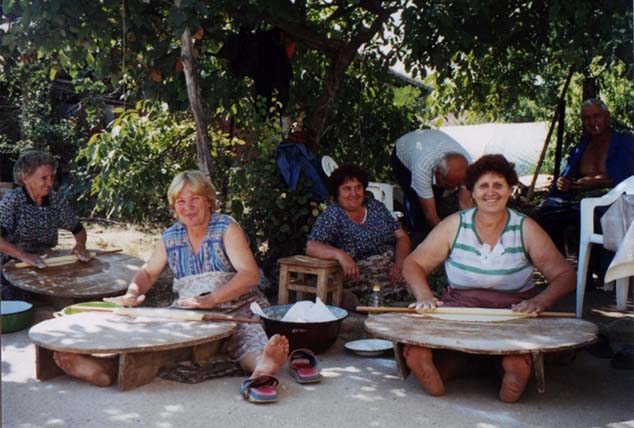
Making ajvar (left) and yufki (right) in the former Yugoslavian republic of Macedonia. 
The yufki photo is as recent as 2012.

Making ajvar is a once-a-year thing, and only when the vegetables are in season. This blog gives you some idea about the importance of making ajvar in its social context. Communally made storeable food, like making yufki (a kind of egg and milk based pasta that can be kept all year round and is used in a variety of dishes), is still popular in the former communist countries which border Greece - this is quite a world apart apart from their neighbours (ie us), who never really performed culinary tasks collectively: apart, perhaps, from keeping a pig, or making wine and raki, virtually everything else is prepared for an individual family to enjoy. The barriers of politics once ensured that not even neighbours could learn from each other.
The regular pepper variety used for ajvar is Kurtovska kapija, although other pepper varieties are now also used (eg Slonovo uvo, Palanecno cudo), but Kurtovska kapija is considered one of the best because it contains low water content and high dry matter. Fidanka should know about this: the pepper photo is from her PhD pepper experiment, although the PhD was not connected to ajvar-making (!) Her brother likes to joke that her ajvar must be the best in Macedonija because it's made by a PhD pepper expert!

Fidanka tells me that in her home town of Strumcia, which is known for growing vegetables in open fields, plastic tunnels and greenhouses, the municipality has for several years now been organising the AJVERIJADA, where housewives get together and make ajvar. A committee tastes the results and competitors are awarded.

In recent years, ajvar (as well as yufki) has been commercialised, as all home-made food has been around the world, which has to do with the easy access to technology and more people working outside the home, lacking time to take part in traditional activities, but there is still the deep-rooted belief that 'my mother's ajvar is the best' (a bit like hearing a Cretan saying 'my mother's kalitsounia are the best') especially when there many variations to each dish depending on region, taste, etc.

My own version of ajvar preserves is made with onion and garlic. I prefer my sauces to be chunky rather than smooth, so I didn't grind the vegetables. I intend to use these sauces in winter stews. Ajvar is often eaten as a spread on bread, accompanied by things like feta cheese. 

Even though ajvar is widely available commercially, in Macedonija, there is still a great sense of pride in continuing the tradition of making it communally. The taste of commercially made ajvar - as with any food product - is nearly always distinguishable from the home-made one. It all has to do with the future of food, or the food of the future, and how we see our future being shaped by world food trends.

©All Rights Reserved/Organically cooked. No part of this blog may be reproduced and/or copied by any means without prior consent from Maria Verivaki.

Sunday, 10 November 2013

Bottleneck

Last Friday, I took the regular route to go home from work, via a bottleneck two-way carriage road where cars are sometimes parked on the footpath, hard against the buildings on the street, which create serious problems for traffic flow. Generally speaking, the locals' driving behaviour has become less aggressive and less arrogant as time goes by - there is even less honking than there used to be. But on this occassion, I was surprised at how arrogant it was.

The Koumbes crossroads - I was waiting for the traffic lights to turn green outside the white apartment buildings (you can see a black car there waiting at the traffic lights).

I approached the traffic lights, which were red, and stopped behind another car. The driver of the car in front of me could not stop directly at the traffic lights because a man had blocked the road by stopping right in front of the traffic lights, half on the footpath (which is practically non-existent, as there is a taverna located right on the corner, which brings out its tables and chairs there), half on the road. The driver of the parked car was, you guessed it, waiting for his BBQ chicken order. And right across the road, virtually next to me, sat another driver in her parked car. She was waiting for her son who was, yes, waiting for his souvlaki order. The lights turn green for the drivers on the intersecting road, and they start driving into the bottleneck. Along comes one car and waits to see when the taverna customers would budge. Nothing. Along comes another car, and he stops too. The son rushes out of the taverna and gets into the parked car mext to me, and the woman drives off. Finally, the road opens, and the cars that waited patiently - not even a single honk - drive off too. The other parked car remained where it was.

Koumbes, 100 years ago. The bottleneck road is on the right hand side of the Ottoman cenotaph in the above picture. The main road in the photo below leads from Hania to the Souda ferry port. 

I felt a bit of relief when the one car left because the traffic lights at the point where I was waiting don't stay green for too long, only just enough for 4-5 cars to pass. But because it is a bottleneck, and it leads onto a main arterial route, it gets busy. It was hot, and I had rolled down the driver's window. Just when I think that it's nearly time for the red light at my end to turn green, I get prepared to leave without too much delay. At this point (the light was still red), a SUV (the kind of car that will have a minimum €800 road tax bill for 2014, as well as a minimum €500 luxury tax added to it) turns into the road... very slowly... and then stops, in the middle of the road. Just like that. The woman driver was looking out of the driver's window which was rolled down, and she was smiling... she had just seen a good friend across the road... in the taverna, one of the waitresses, in fact... and then... the driver of the SUV... reverses... by just a metre or two... and stops again... still in the middle of the road... in order to be able to talk to her friend more directly. She continued to look out the window absentmindedly, smiling, laughing, looking as happy as a clam, and now, with that completely oblivious look on her face, she began... chatting... to the waitress on the other side of the street.

The parked car had stopped on the tiles in front of the open door. The pot plants are there to prevent cars from parkingon the tiles. I recall the building in its former state too as shown below. 

I could sense the lights about to change any minute now... so... I honked... continuously... with my hand firmly down on the horn. The woman in the SUV did not respond to the horn; she simply strained her head out of the window... in order to try to understand what her friend across the street was saying to her. The honking was interpreted as a nuisance, not as a signal to stop blocking the road. She hardly put it in her mind that it was intended for her; she simply carried on trying to have a conversation with her friend in the middle of the tight squeeze. I've been driving for 16 years in Hania. It's the first time I have ever used the horn in this way. I usually drive as if the fact that I do in fact hate driving does not bother me: patiently, defensively and above all, legally.

The driver of the SUV turned the corner (from where you see a white pick-up truck) into this road - she stopped right outside the door you see in the photo. This is located across the road from the taverna, which recently took over this former cafe and converted it for extra seating. The waiting staff walks back and forth with orders. 

And then the light turns green for me... and the SUV is still in the middle of the road... and I am stuck motionless behind the other car, who cannot drive across the junction because now not just one parked car in front of her, but another stopped car beside her had blocked the whole road... and no one seemed ot give a toss. There were now more cars behind me too, making the bottleneck even worse. So I kept honking (incessantly, without a single break), and suddenly... the miracle happens... and the driver of the SUV realises that she is in fact that dipstick on the road. So she looks away from her friend and begins to stare hard at the windscreen in front of her... and slowly... very slowly... gets her car going... at which point she passes my car.

A close up of the bottleneck on a day when the taverna caught fire...

"YOU FUCKING IDIOT!" I screamed out to her as she went by. (Another first for me: it's the first time I have cursed another driver on the road.) She continued staring in front of her. Perhaps she did not understand what I meant because I spoke in English, not Greek. You know what language dominates in a person's psyche when they swear or count (including the language they use to write shopping lists).

©All Rights Reserved/Organically cooked. No part of this blog may be reproduced and/or copied by any means without prior consent from Maria Verivaki.

Saturday, 9 November 2013

Silent beauty (Αμίλιτη ομορφιά)

Last weekend was a busy one for us, as we had to clear the summer garden of the old crops which were now not producing in good form since the arrival of the colder weather and shorter days. By Sunday afternoon, most of this work had finished. To get away from the house, we suggested to the kids to take a drive out to our village fields... which they politely turned down. Now that they are getting older, not only do they not want to do things with their parents, but they don't even want to accompany them! Worse still, they are now using the NO word as a response to politely-stated imperatives!! To top it all off, they even said: "Aren't you tired of taking us everywhere? Don't you want to do something on your own for once?"!!!
They're getting bigger...
So we left them at home watching at least one of the many screens we have in it (tv, computer, tablet), and husband and I climbed into the car (together with our dog) and went on a peaceful drive out to the fields all by ourselves, as the kids suggested (the silence was deafening), to see what life looked like away from our creature comforts.

The first sight we came across was a potato patch:

... and a field full of winter greens (lettuce, onions, celery, parsley, broad beans, etc):

Look at how fresh everything looked: these fields have never been planted before, so the earth is very pure.

Another part of the field has been sown with spinach, which is just coming up.

The photovoltaics in the background are not part of our own fields, but it's a growing movement as part of the concept of green energy from Renewable Energy Sources. I am not really convinced - most of these panels went up during a period when certain licences were being handed out to certain individuals who were subsidised: it's always the same people being subsidised for various projects, so it's not as though many people are profiting (it ends up being the same ones for different projects).

All these vegetables have been planted by a laiki (street market) stall holder using our field. So for the first time, vegetables grown on our fields will now be available for sale to the townies. We are hoping that the farmer will remember our contribution during the harvest period; he is a cousin, after all! If that fails, I could just take a little trip every Saturday to the street market and pick up my weekly needs...

The children need not have come to see these sights with us; after all, the trip had a very functional purpose. But I wonder if they would have been equally fascinated as I was when I saw the fresh new pine trees growing on one of the empty spaces where seeds were dropping onto it from a pine tree overlooking our field which is located on a higher point.

And if I pointed out the different hues of the mountains in this light, I wonder if they would have looked up and said "Oh, now that is beautiful, they all look a different shade of blue", or whether they would have said: "We see the mountains from home too, big deal."

They also missed the sunset that we saw from this spot, which is a shame as they generally don't see many sunsets during the school year, because our house is located in such a way that we have a good view of sunrise and not sunset. But maybe they'll say that the sun rises and sets every day, so they will eventually see it another time. Yes, they will, I remind myself, but probably not from this place.

This coming weekend looks like it's going to be another calm one, before it starts to rain again (as the weatherman predicts). They may be lucky to catch sight of this sunset if they decide to follow us on our trip.

©All Rights Reserved/Organically cooked. No part of this blog may be reproduced and/or copied by any means without prior consent from Maria Verivaki

Friday, 8 November 2013

Pressed for time

What's the moral of the story? Scroll below if you want to skip the details.

The children are growing up now, and I am finding that I can do grown-up things with them, things that I never wanted to do with them before, because they felt more like little pains in the butts when they were around me, rather than fun companions. One of those things that I like to do with them now is to have a sit-down snack when we are running errands in town. This usually happens on Saturday mornings (not afternoons, because that's the eve of never never on a Sunday for Greek commercial centres).

We had almost an hour to kill before my daughter finished from basketball, so I sat down with my son (after we had both had a hair cut - another crisis-related experience that I may remind myself to write about another time) at one of my favorite people-watching places in the town, located on a pedestrian zone behind the touristy area just off Stivanadika (the leather street). I hadn't been there for close to two years, so I was delighted to see this particular place still going, looking pretty much the same as I remembered it from past times. It was a really busy moment for the cafe because on that day, a lot of people were in town. It wasn't just the lovely calm weather but the 100 years celebrations of the Agora that bought a lot of us into town. There were only two tables free, a big one and a small one. We took the small one naturally, and waited for the customary menu to arrive.

The waitresses never seemed to stop running in and out of the cafe, bringing menus, orders, bills, receipts, and clearing tables. But that menu card didn't arrive, so we picked one up off another table. Menu cards are fun to browse, even though you know what you want to order; I didn't need to check if the cafe had cappuccino on the list, but my son had more difficulty finding what he wanted. The 'toasted sandwich' came in an array of tastes at cafes and he found it difficult to choose from the list of toasts that he found in the menu. Mindful I suppose of the many crisis discussions that take place in our home, he chose the cheapest one. I told him not to do that - there's always a time to splurge! He then chose the one called 'French toast' (there were no accompanying photos). I wondered whether that would be a sweet toast with cinnamon  or one of those things the French call 'croque monsieur', but I decided not to worry him (he needs to find out for himself how to handle disappointments when they come).

All that was now missing was the waitress to come along to take our order. Every time she came past our table, we were hoping she would stop... but this didn't seem to happen. I raised my hand at one point to grab her attention (I really hate doing that), and she did eventually notice, but my problem now was not that she would come to take our order, but that time was running out and we had to be somewhere else very soon...

Eventually she came. My son ordered his French toast, and I asked for a cappuccino in a large cup. I'm a fussy cafe coffee drinker, being rarely happy with the coffee served in Hania's cafes: usually, cappuccino in Hania is served in a small cup, and usually, it's tepid. But today's outing was not a quest for good coffee; it was just a mother and son moment that I wanted to enjoy, and we were both in need of a pick-me-up.

The waitress didn't understand my extra request (the big cup). I realised she was not Greek from her accent, but I didn't expect not to be understood. I had to repeat the order a couple of times; as an English teacher, I know how she was probably feeling at that moment, and I didn't really want to make her any more uncomfortable. The place was really busy now - there were hardly any spare tables (and Greeks still don't sit communally, as is common elsewhere).

I was still worried about the time, and I hoped things would hurry along now that the order had been taken... but that didn't happen. Even my son was now getting fidgety. It looked like there was only a 25-minute timeframe for the order to be prepared, come to our table and for us to finish it. Not very relaxing if the point of your visit to the cafe was to relax... I tried to stop the waitresses, but I was out of luck. They were both zipping in and out of the cafe at lightning speed. They were rushed off their feet. I went into the cafe kitchen and asked if the order would be getting ready soon, because otherwise, I told them, I'm sorry, but I would have to leave.

The assistant looked at her order list. "Yours is being made up now," she told me. I thanked her and went back to my table. A few more minutes later, and the order finally came (coffee first). The  cappuccino was not the best I'd ever had (the froth was a bit lacking), but at least it was hot. I always keep in mind that I am a fussy coffee drinker, so I easily forgive anyone who can't make a coffee good enough for my tastes. My son's toast was, in his opinion, the best he'd ever had. (Why it was called French is beyond me - the baguette had something to do with it no doubt, but it looked more like a good sandwich-type roll to me than anything else.) I gulped down my coffee, trying not to let my son know how annoyed I was that I could not savour it more slowly. Thankfully the sandwich was cut in two pieces, so I knew he would eventually have to carry one piece with him as we made our way to the other side of the town to pick up his sister...

I didn't really have time to wait till the bill came, so I hurried that one along too. Time was now of the essence. The waitress came round, looked at the empty plates and cups (the other half of the sandwich was now in my son's hand), and said: "A nescafe and a toast, is that right?" No, it wasn't, and I suppose I could have just said "Yes" and the cafe would have lost money on my order, but I didn't, so I had to wait a bit more for her to correct the bill, which still didn't sound right when it came back (I think they under-charged me), but I really didn't have time to get it corrected for a second time. Still, it was polite service with a smile all the way, and I was happy to see the staff doing whatever they could do to please me, even if it didn't really make a difference. Some things cannot be undone.

The moral of the story is:
- don't sit at cafes which are full if you are in a hurry,
- don't expect to be given priority if it is not your turn,
- don't pretend you are trying to relax when you are looking at the clock all the time,
- the customer is not always right: you chose to be where you are, whereas the staff didn't choose to attend to your needs - they simply have to
and above all,
- just because you think you understand the ideology of a concept well doesn't mean that thing will work out the way you want or expect them to:
Capitalism is not real; it is an idea. America is not real; it is an idea that someone had ages ago. Britain, Christianity, Islam, karate, Wednesdays are all just ideas that we choose to believe in and very nice ideas they are, too, when they serve a purpose. These concepts, though, cannot be served to the detriment of actual reality. http://www.newstatesman.com/politics/2013/10/russell-brand-on-revolution
We can enjoy daily life more if we put it into perspective.

If you like cool places away from the crowds, you might like to try the Red Bicycle cafe - but don't order medium-rare beef steak, like this German customer did: 'rare' meat is never served in Crete, so it's only to be expected that it wouldn't be cooked according to your expectations (ie your own concept) of a rare meat dish (we don't generally eat pink meat - we still think of that as 'raw'). As for beggars and illegally-copied CD/DVD sellers, that's not the cafe's problem - it's a European issue. 

©All Rights Reserved/Organically cooked. No part of this blog may be reproduced and/or copied by any means without prior consent from Maria Verivaki.

Thursday, 7 November 2013

Itinerant (Επαίτης)

Last Saturday morning, I came across this array of people in the town.

Once you move past the Agora in the town centre (where all distance measurements start from in Hania), you tend to be surrounded by a variety of people whose purpose to be on the road does not always seem clear. There are beggars, peddlers and traders of all sorts, people who ask you for a cigarette or your spare coins, others who wander in and out of shops telling the same old story, holding perhaps some cigarette lighters, pens and paper napkins for sale, and still others who don't open their mouths to speak to you or anyone else, but they speak instead with their eyes. As an orchestrated group of wandering vagrants, their visibility smacks of crisis, but it pays to remember that they were there before the crisis too; their actions may look crisis-related, but before the crisis, perhaps they were simply regarded as an oddity, whereas now they serve to remind us of how easy it is to fall into the trap of unemployment, hardship, poverty and homelessness.

We don't always look at the man in the dirty clothes sitting on a doorstep with his hands hidden in his hands, a cup set in front of him to catch the passersby's coins, even though we walk right past him, and we sense his presence. He's a common sight but he isn't original. The Charlie Chaplin make-up hides the identity of another beggar, but his purpose is all the same as the man wearing the dirty clothes. Yes, he has talent; but he's not on TV where he should be. He's out of place in a Mediterranean Greek seaside resort town. Personally I wonder what brought out the modestly dressed woman carrying a heavy bag on her shoulder, walking among all the outdoor diners seated on the footpath who are having a drink or eating souvlaki. "She looks just like me," I might say to myself, as I try to imagine her with children to feed, clothe and home (maybe they are waiting for her at home), as I watch her holding up cigarette lighters, pens and paper napkins, which she hopes to exchange for some coins. She is not a beggar; she has something to sell you, something that you think you might need, and she won't just take your money - she'll make you take something for it. 

But it may occur to you that none of these itinerants asks you directly for food; they only ask for money. Are they not hungry? They must be eating something if they are still on their feet. So, what do they eat? The man in the dirty clothes looks as though he only wants a smoke and some alcohol, perhaps to forget that he is hungry; Charlie Chaplin looks like a stick figure - he has to, to fit into his costume - so he doesn't need to eat much in the first place, and the lady selling the cigarette lighters, pens and paper napkins looks well-rounded, indicating that she is well-fed, leading one to believe that if she is indeed a mother, she is probably on a hi-carb food bank diet. Their food needs catered for, they are after something else. None of them need food. 
Beggars have always been a steady part of city life through the ages - the one pictured in the postcard is shown outside St Sophia in Constantinople, about a century ago.

Where do they sleep, these people? The man with the dirty clothes is probably sleeping on the floor in his clothes - that's why they're dirty. Charlie Chaplin seems to fare better - he's got to keep his costume in good nick, and he needs to wash his face, unliek the dirty man whose apparel suits the unwashed look. And the modestly dressed lady - she's clean and tidy, she's got a home to go to. No, it's neither the rent nor the food that my fellow townspeople need. They want to do something else with that money. We may have other priorities, but at least we are not hungry. And if it is a light winter, we will not get too cold.

I don't much go into the town these days, unless I really, really need to. Country life is so much more coveted these days. 

©All Rights Reserved/Organically cooked. No part of this blog may be reproduced and/or copied by any means without prior consent from Maria Verivaki.

Wednesday, 6 November 2013

BOGOFs (2 + 2 δώρο)

Buy 2 packets of pasta, get 2 packets free, the special read above a supermarket shelf. Not the standard buy-1-get-1-free special, but pretty good nevertheless. No point refusing; pasta is one of those ingredients that rarely goes off past its expiry date, and it is very versatile. So I bought some spaghetti and some orzo rice (not all pasta shapes were on sale), which are both favorites in our house.
8x500g pasta = €0.55x4 = €2.20 for 4kg of 100% Greek pasta.
After picking out the few bits and pieces that I needed, I went to one of the cashiers to pay for them. I was surprised to see the owner of the mini-market in my neighburhood waiting in the queue. There is another branch of the same supermarket closer to his shop, but I suppose he feesl a bit embarrassed going there because it's a much smaller branch, and he would be buying out most fo the supermarket's stock of basic goods: I noticed he had filled up at least 4 supermarket trolleys worth of products, most of which were of the 'bogof' type - there were quite a few packets of pasta in one of the trolleys. The pasta was not packaged together with the classic warning about the product being sold as one item and each packet may not be sold separately.

The mini-market owner was buying supermarket stock on special, probably selling each item at the regular price, and making a 50% profit without any hidden expenses apart from fuel. The specials are distributed by brochure on a regular basis, so he knows when they are on. I only shop from mini-markets when I desperately need a product and the supermarket is not open, or when I want to pick up the local paper (if I were a smoker, I suppose I would use them more often). Otherwise, I always feel as though I am being ripped off in such places.

©All Rights Reserved/Organically cooked. No part of this blog may be reproduced and/or copied by any means without prior consent from Maria Verivaki

Tuesday, 5 November 2013

Peppers (Πιπεριές)

Peppers are great in the freezer: you can freeze them whole (especially good if they are hot small peppers like chilis - they slice well too), or as shells (for filing in various ways, eg yemista in Greek cuisine), or in strips to add in stews (I like themin this form for my weekly soupy bean or lentil stews). We had a good run of peppers this past summer, and only recently cleared the garden of the last pepper plants. There are only so many peppers you can use and freeze, and I stil had plenty left over.
So I set about making a pepper sauce, from an idea that I got in a Greek blog: I let cook till soft some chopped peppers, onion, garlic, herbs and spices, with some sugar, vinegar and tomato paste (as we are now clean out of tomatoes which didn't do so well in our garden this year for some reason). This pepper sauce makes a great addition to stews and soups, adding a stronger flavour similar to the way stock gives an extra punch to them with a vegetarian twist.

But as you can see, there were still quite a few peppers remaining in my store, so I had to think up of another way to use them: what about a spicy muhammara?! Muhammara is a fantastic spicy party-winning dip, made primarily with red roasted peppers and ground nuts, that can be eaten with crispy snacks like toasted bread and carrot sticks. In some ways, it's very similar to the Greek eggplant dip (melitzanosalata). But it's also fantastic as an accompaniment to meat and fish; I made it to go with Saturday's meal of fried sole fillets which were on special at the supermarket, at €6.34/kg.
The muhammara recipe I used mentioned pomegranate molasses, which I didn't have (I used a little cider vinegar mixed with some home-made grape molasses, which we call 'petimezi' in Greece), but I topped it off with some pomegranate seeds which gave the muhammara a bit more texture.

I always find it a challenge to use up ingredients or preserve them in unusual ways. These two little projects kept me busy at the weekend.

©All Rights Reserved/Organically cooked. No part of this blog may be reproduced and/or copied by any means without prior consent from Maria Verivaki.

Monday, 4 November 2013

Sunday trading (Κυριακάτικη αργία)

"Sunday trading" is the phrase used int he west to denote shops opening up on Sundays. In Greece, we haven't quite got a phrase that can be translated in the same way - it is more likely to hear about the Κυριακάτικη αργία - the "Sunday holiday". So you can understand form this that Sunday trading is regarded as an abomination, according to Greek shop owners and workers. But Sunday trading is regarded as quite 'normal' by most Western countries for at least two decades now. I remember when it was first introduced in New Zealand, and I thought it was a little weird... but now that it's commonplace, I think it's a perfect way to brighten up the drab atmosphere of the ghost town appearance of our commercial centres after the shops close down on Saturday at 2-3pm.
SUNDAY SHOPPING The streets of many cities around the country were busier than usual on Sunday, as shops opened for the first time on Sundays outside the holiday period. The first phase of Sunday opening also kicked off a ten-day sales period. Shop owner unions, who were unhappy with the move, said the more people seemed to be window shopping rather than actual shopping. Nevertheless, Development Minister Kostis Hatzidakis said "our cities are changing image today. The consumers have embraced both the idea of the new sales 10-day periods and the opening of stores on Sunday. Therefore, we did very well in not listening to those fearing what is new. We are following what is taking place in most European countries. Why should it not take place in Greece as well?" Describing the move as "unacceptable and reactionary", main opposition Syriza said that "only big department stores and the multinational chains will benefit from the redistribution of the reduced turnover" cause by its salary and pension cuts. http://www.enetenglish.gr/?i=news.en.home&id=1583
Yesterday was, supposedly, the first Sunday that shops were allowed to open in Greece - but this is a half-truth. In tourist areas, shops are open all day long every day. Then there are the Easter and Christmas Sunday shopping days, to allow people to get more shopping done at more convenient times for them. But when Sunday trading happens simply as a way to allow people to shop when they feel like it, and not for any special reason, people get hoity-toity about it in Greece, with flimsy excuses like "It's the Lord's day" (ask doctors, nurses, policemen, firemen, etc about the Easters and Christmases they've spent on duty), and "Everyone deserves a day of rest" (ask those same shift workers about the day they prefer to have off, so they can get any real personal work done, like take your kids for a medical check-up, do some banking, etc).
Never (trade) on  a Sunday, complete with Melina Mercouri waving to sailors on the wharf.
The business community of Hania declared that they would not open their stores on Sunday, so I am assuming that the shops were closed in the centre, but I heard that supermarkets (which don't fit into the small-medium enterprise framework) would open this Sunday around the country. I had no shopping to do, so I don't know what happened in the areas of Hania where those supermarkets opened. I am sure that quite a bit of harassment took place from the anti groups, as these photos clearly depict, taken in Athens, which always bears the brunt of all forces.
ΚΥΡΙΑΚΗ 3 ΝΟΕΜΒΡΗ: ΔΕΝ ΕΙΝΑΙ ΑΡΓΙΑ; ΝΑ ΓΙΝΕΙ ΑΠΕΡΓΙΑ!!!
Την Κυριακή 3 Νοεμβρίου 2013 ξεκινάει η εφαρμογή του νόμου με τον οποίο η κυβέρνηση ΝΔ - ΠΑΣΟΚ σε συνεργασία με την εργοδοσία επιδιώκουν να καταργήσουν την κυριακάτικη αργία. Ο συγκεκριμένος νόμος προβλέπει την καθιέρωση τεσσάρων εκπτωτικών περιόδων το χρόνο, με την πρώτη Κυριακή κάθε περιόδου να θεωρείται εργάσιμη. Είναι δεδομένο ότι αυτό το μέτρο θα γίνει προσπάθεια να γενικευθεί σε όσο το δυνατόν περισσότερες Κυριακές, άλλωστε ο συγκεκριμένος νόμος ήδη δίνει τη δυνατότητα να ανοίγουν όλες τις Κυριακές του έτους τα εμπορικά καταστήματα μέχρι 250 τ.μ. Η απελευθέρωση του ωραρίου αποτελεί χρόνιο αίτημα του ΣΕΒ. Το νέο αυτό μέτρο οδηγεί στην εξόντωση των εργαζομένων στο εμπόριο καθώς ο ελεύθερός τους χρόνος συρρικνώνεται δραματικά, η εργασία τους εντατικοποιείται ακόμα περισσότερο.
Φυσικά το νέο μέτρο δεν αφορά μόνο τους εργαζόμενους στο εμπόριο. Το επόμενο βήμα για την κυβέρνηση στην συρρίκνωση των αργιών είναι οι κλάδοι που συνδέονται με το εμπόριο, πχ λογιστές, τραπεζοϋπάλληλοι, συμβολαιογράφοι για να μπορέσει να «δουλέψει η οικονομία» και φυσικά στόχος του μεγάλου κεφαλαίου αποτελεί η 7ήμερη εργασία για όλους τους εργαζόμενους
Οι εκπρόσωποι της κυβέρνησης θεωρούν ότι το «πρωτογενές πλεόνασμα» και το «success story» περνάει μέσα από την 7ήμερη εργασία, ο ελληνικός λαός όμως ξέρει ότι τα άδεια καταστήματα πολλαπλασιάζονται επειδή το εισόδημα του έχει μειωθεί από 40 έως 60% από το 2010, από την γιγάντωση της ανεργίας, κι από την διαρκή φοροληστεία που έχουν εξαπολύσεις οι κυβερνήσεις ΝΔ και ΠΑΣΟΚ και δεν μπορεί πλέον να ψωνίζει ούτε τις καθημερινές !
Ως ΑΝΤΑΡΣΥΑ Χανίων
Καλούμε τους εργαζόμενους στο εμπόριο να βάλουν φρένο στην κατάργηση της κυριακάτικης αργίας, στην ελαστικοποίηση του ωραρίου τους, στην συρρίκνωση του ελεύθερου χρόνου τους απεργώντας την Κυριακή 3 Νοέμβρη
Καλούμε τους αυτοαπασχολούμενους στο χώρο του εμπορίου, σε συστράτευση και κοινό αγώνα με τους εμποροϋπαλλήλους. Τους καλούμε να κάνουν πράξη τις αποφάσεις που πήραν το προηγούμενο διάστημα ενάντια στο άνοιγμα των καταστημάτων τις Κυριακές, να αντιδράσουν και να καταδικάσουν στην πράξη την κατάργηση της κυριακάτικης αργίας
Καλούμε το Εργατικό Κέντρο Χανίων να πράξει το αυτονόητο, δηλαδή να κηρύξει απεργία την Κυριακή 3 Νοέμβρη.
Καλούμε τους εργαζόμενους που δεν δουλεύουν εκείνη την μέρα να συμμετέχουν σε απεργιακές φρουρές για να ανατραπεί αυτό το μέτρο. Για να μην χρειαστεί οι ίδιοι να απεργήσουν κάποια επόμενη Κυριακή που θα έχει γενικευτεί το μέτρο
Καλούμε τους Χανιώτες και τις Χανιώτισσες να μην πάνε να ψωνίσουν την Κυριακή 3 Νοέμβρη, να μην στηρίξουν με την στάση τους αυτή την απόφαση.

Υπερασπιζόμαστε την Κυριακή ως υποχρεωτική αργία για όλα τα καταστήματα. Κατάργηση της μερικής απασχόλησης, του ωρομίσθιου, των συμβάσεων ορισμένου χρόνου και όλων των ελαστικών μορφών εργασίας και μετατροπής τους σε 8ωρες συμβάσεις αορίστου χρόνου. Υπογραφή κλαδικής σύμβασης.

ΑΝΤ.ΑΡ.ΣΥ.Α. Χανίων
Ι found this leaflet in my supermarket trolley this morning - the same text is available here - from the "Front of the Greek Anticapitalist Left" (a name that presumably distinguishes them from the 'capitalist left').

In such a hugely democratic country that we were in the past, where simply anything went, and anyone could do what they liked with complete disregard to how others felt, because in those days there were no rules against such behaviour (and if there were any rules, there was little or no monitoring), it seems such a huge breach of rights to prevent someone from doing what they feel like doing. This was made more obvious to me by my son's reaction during a conversation with his dad on Saturday night:
- If they are letting the supermarkets open on Sunday, then small businesses will close down because supermarkets will take away their business (dad said).
- I don't get it dad, if the small businesses are open, then people may choose to go to them too, just like they do already.
- Well, if the supermarkets open, then other smaller businesses will be swayed to open, because they will feel they are losing out on business.
- That makes sense, doesn't it, dad?
- But Sunday should be a rest day for shop workers.
- Any shops that don't want to open can stay shut if they want.
- But they won't - they will be swayed into opening too.
- How can they be swayed to open, dad? They can stay closed if they want to.
- But... they will either be losing profits or losing their day of rest (says dad, a little tongue-tied by now).
- So why do you work on Sundays, dad?
- Well... I'm a taxi driver... I'm not a shop... (and a few more flimsy excuses).
- OK, dad, don't go to work tomorrow then.
So what do you think dad did the next day, which was a Sunday? Did he go to work in his taxi?
(see the comments section for the answer)

I never really saw it as an economic crisis - it's more an identity crisis, where we have to make changes to suit our choices, not just our pockets.

©All Rights Reserved/Organically cooked. No part of this blog may be reproduced and/or copied by any means without prior consent from Maria Verivaki.
Sunday, 3 November 2013

A century old (Εκατό χρονών)

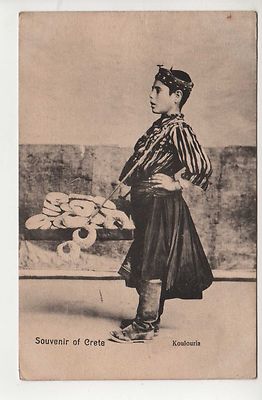
The koulouri seller...

... made a comeback...

... for yesterday's celebration of the Agora's 100 years of operation.


©All Rights Reserved/Organically cooked. No part of this blog may be reproduced and/or copied by any means without prior consent from Maria Verivaki.

Saturday, 2 November 2013

Protecting your child

Two members of Golden Dawn were murdered and a third was fighting for his life on Friday night after two men on a motorcycle rode past the neofascist party’s offices in Neo Iraklio, northern Athens, and opened fire on people that were standing outside the building.

You can't protect your children from all dangers and you won't always know where your children are. But as parents, we like to believe we can protect our children from all dangers, and we also want to believe that we have a fair idea of their whereabouts when they are out of the house.

But what if one day your teenager comes back home drunk? What, as a parent, do you assume? What, as a parent, do you do? When my children were toddlers, I remember a cousin telling me that "kids will be kids and they will all get drunk at some point in their life", and I was thinking "shit, i never got drunk when i was a kid, and i never turned up drunk when i came back home, and i don't see why my kids have to come back home drunk." I've kept this story in my head, because of that 'never say never' phrase that niggles in the back of our minds when we say 'never', because I don't want to sound like a tiger mum.

A couple of weeks ago, I read in the local paper that one Saturday evening, 3 teenagers aged 15-16 years old were transferred to the emergency department with symptoms of acute intoxication. One doctor put this ever-increasing phenomenon down to parents' not controlling their children's outings:
"They believe that if the child goes to parties, it will probably get drunk, without considering this to be a major issue. Recently, a mother of a teenager had come to the [young people's] clinic where she explained that her child had been brought home twice in a comatose state and she felt that the child had simply got drunk. She viewed the incident in an entirely frivolous manner. Another mother told [the doctors at the clinic] that as soon as her child obtained his driver's licence, it got drunk. But later, it was caught in the act, and only when she went to get it out of jail did she feel mobilized into doing something about it." http://www.haniotika-nea.gr/anhlikoi-sto-alkool/
I understand from this that parents generally know what their kids are up to - they know that their kids go to parties and they know they are drinking a lot of alcohol. Naturally they won't stop them from going to a party or drinking alcohol - but they don't seem to stop them from getting drunk either. Does drinking alcohol and getting drunk really have to go together? Is it an absolute rite of passage of a young person to get drunk at a party and to be taken to hospital in a comatose state before coming back home after the party? I don't see why this has to happen. It didn't happen to me when I was young, and it shouldn't have to happen to my children, and I am going to try to make sure it doesn't have to happen to my kids either. And I don't see why I can't try to make sure it doesn't happen to them, despite what that cousin told me.

With this in mind, I suppose the parents of the two Golden Dawn members who died of gunshots (to the head and the chest) in yesterday's (most probably) terrorist attack knew that their children (just 22 and 27 years old, as I have been reading in the reports that are now streaming through the mass media about the incident) were going to the regular Golden Dawn Friday night meetings at the party's offices. And I suppose that those parents knew where to find their child if they wanted to get a hold of him (they parents would have comforted themselves by knowing that he has his cellphone). I also suppose that they knew what their child was up to (he's going to a meeting among people of like minds). I suppose they saw their child out the door and they said to him 'keep safe', or some other words to that effect. They wouldn't have expected that on that night, when their child was at a Golden Dawn meeting, their child would die of a gunshot wound to the head or the chest. No one expected that either, except perhaps the police, as this report states - not even the police could have protected us against this attack.

Could the parents have protected their child from being at the wrong place at the wrong time? What did those parents do about keeping him safe in the first place? Could they not have done something more? Did their child have to go to that meeting?

Before that, it was a game. Now, it's war.

©All Rights Reserved/Organically cooked. No part of this blog may be reproduced and/or copied by any means without prior consent from Maria Verivaki.

Friday, 1 November 2013

The business sector

In the paper edition of the Kathimerini yesterday (according to a radio announcer who I was listening to in the car), it was argued that even in crisis, Greece is still falling back on "failed economic methods", which are clearly no longer a recipe for growth, however much they might have seemed successful in the past: opening up restaurants, bars and cafes, which form 90% of the new businesses being opened in the most recent period, while 25% of these new businesses are the "mass congregation" (μαζική εστίαση) type.

The biggest problem with such businesses is that they do not help to create a suitable environment for Greek business to move onto "new age production": such businesses have to do with entertainment, and not production, and they have the added disadvantage in that they are not seen as particularly useful in a recession. Despite this, during the economic crisis, Greeks continue to open up new restaurants, cafes and bars in the same way that they used to, with the main difference between past and present being in the "brighter packaging" -  fancy chairs, shiny paper, funky glass shapes, upmarket decor, paper napkins that look so pretty you don't want to wipe your hands or face on them, etc. 

Worse still is the high price attached to the basic products that are sold in such environments, especially for things like yoghurt, coffee, ice-cream, biktekakia (little meat balls), etc. What seems to be the most important aspect of such products is the wrapping - the product contained in them is not necessarily expensive, but the price is not based on the final product: it is based, as stated above, on the chairs and paper and glass shapes and decor and those pretty paper napkins. When people use such services, they rarely think about what they are paying for to come on their plate, or in their glass or inside the wrapping (until the bill comes). 
From http://endeavor.org.gr/en/report - the full report is available here
In Greece, only 1/1000 businesses seem to show strong development dynamics; most are lacking a business plan. The most successful Greek business developers are young (20-45 years of age), they are experienced in business and have built up professional networks, and are business-focussed by choice. They have never worked in the public service, they have wide experience abroad, and they understand well the importance of building up contacts and networks. They also seek employees, mainly in their sales and IT departments. So it's not all doom and gloom. Opportunities are there, and so are the right people... but the wrong choices are being made by most new entrepreneurs.

The trend of opening up food-related businesses is not a new phenomenon in the European world. Similar problems are now coming to light in other western countries. It seems that we have nothing new to produce or sell, because these days most people have most of the things/services that they need, and any extra things/services that they would like simply go onto a wish list because we generally can't afford them and it's become more difficult to access such products. Most people in Greece for example have a mobile phone, whether it's a simple or more complex model, and few of us update it. 

People often ask me why I never opened up my own little taverna. Having worked in my parents' fish and chip shop, I could envisage all the problems involved. While I've been in Greece, I could see the preponderance of such businesses, and the image problem that seemed to be chasing most of them. People need to eat, but above all, the food must be cheap. Otherwise, your business will have to be geared for another market, one where your food is not going to be eaten by the locals, but by richer foreigners.   

Eating out in your own locality doesn't have to be expensive, but if you choose places that try to impress their goodness on you by creating an image that is sold to you through expensive packaging, you are going to have to pay a ton for that, and so is the business owner. My food philosophy is that food must be prepared with the eater in mind, and it must be accessible to everyone. Unfortunately, that simply isn't the way business works these days. Such businesses need owners with money, who are catering for customers with money;  in Crete, such a business is liable to close down after the summer period, or have great difficulty staying open all year round, so the investment is risky and non-profitable. People who open such businesses try to keep costs down by hiring relatives and paying minimum wage (and probably no social insurance). Using one's own produce is also a way to keep costs down, as well as one's own premises, but this simply makes the businesses viable, at the same time as giving family members something to do - it doesn't promote growth (in fact, it is a pretty much one-stop static business with little future). 

Real growth is the Greek food industry is not going to be found in the opening of restaurants and cafes serving up the same frappes and village salads; it is already being found in the primary sector - but it will take a lot more work to run such a business than choosing pretty packaging.  

©All Rights Reserved/Organically cooked. No part of this blog may be reproduced and/or copied by any means without prior consent from Maria Verivaki.