Tuesday, 20 November 2012

Greek road tax (Τέλη κυκλοφορίας)

Even though I don't own much technology because I can't afford it, I do revere any new invention that makes life easier, and I like to use online systems to make utilities payments, something most Greeks still don't do because they fear that there is some kind of goblin at the invisible end of the system that will gobble up all their money. So you still see many people queueing at banks and post offices, paying bills. I only did that when I absolutely had to, eg road tax, which until last year used to involve a wait for the payment slip to be sent to your address, and then you had to queue up at the bank to pay it and get a sticker as proof of payment (or a trip to your local tax department offices, if you preferred to pay in arrears, like many sods did).

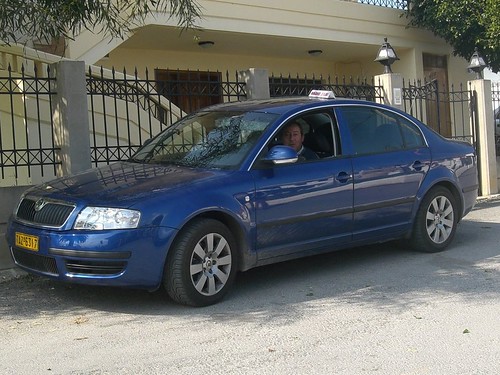
This year, the Greek government decided to do away with the sticker thing, and make road tax payments a mainly online transaction. If a Greek police officer stops you, s/he can check if you've paid your road tax by entering your car's licence plate into the system (presumably, they are equipped to do this). There is no other way to prove that you've paid road tax. Hence, it's up to the state to ensure that people have paid their dues.

Most foreigners will know that Greeks love their cars, not wanting to walk anywhere when they know they can drive (this hasn't changed much). Most people have at least two cars per household. In the past, it was easy to cheat the system: Once a system cheat paid for a road tax sticker, they then went back to the tax department and claimed they'd lost it. The officials would then issue the cheat with a new sticker, which they simply stuck onto their second car, ie, they would only pay road tax on the first car, and the unpaid road tax on the second car remained unchecked, because there was no one bothering to do this.  At least now, the state won't be paying for worthless paper.

You may say that people can still get away with paying road tax like they did before in Greece, because the state and police are both inefficient. True, but at least the state won't be running up the expenses it used to run up in the past. Now that Greece is (finally) uphauling tax payments to a more transparent cross-referenced system, there is less chance of being able to cheat. It's getting harder to be able to cheat, and the cheats are now being caught out.

Some people will inevitably remain tax evaders and others will simply pay less tax even when they are making a lot of money, but that happens everywhere, as was recently pointed out by some critics in the UK of Starbucks, Amazon and Google, who belong to the case of 'legal tax evasion' - they pay a very low rate of tax because of a loophole in the law when they report greater losses than profits. And there are people who simply 'put off' paying their dues until the law catches up with them, by which time they have declared themselves bankrupt. But these are extreme cases: in general, we are all καλά φακελομένοι these days...

*** *** ***

If you are an ex-pat and live in Greece but don't speak Greek, here is how you pay Greek road tax:
  1. To pay without being registered in the online system, go to http://www.gsis.gr/
  2. Click on 'χωρίς κωδικούς'.
  3. Then click on 'EΙΣΟΔΟΣ' at the bottom right-hand corner.
  4. That will get you to a page with two blanks: in the first, enter your personal tax number (ΑΦΜ); in the second, enter your licence plate number (Aριθμός Κυκλοφορίας).
  5. Click 'ANAZΗΤΗΣΗ' - if your details are correct, you will see a message at the top of the boxes saying "Επιτυχής αναζήτηση. Πατήστε Εκτύπωση" (Successful search. Press Print).
  6. Press 'ΕΚΤΥΠΩΣΗ'. This will create a PDF file with your name, personal tax number, the amount you owe and your car's licence plate number, as well as a payment code. 
  7. Print this out and go to a bank to pay it - or simply use the e-banking services of your bank, like most people do in Western countries, using the payment code.
Greece may not have chosen the euro (it is more likely that the euro chose her), but the choice Greece is making now point to her Westernification. It's pretty much final - no more Ottoman excuses.

UPDATE 22/11/2012: Just heard from my cabbie husband that owners of uninsured vehicles will now be penalised through the tax department. One can assume that some digital vehicle registration ownership is now in place and is actually in use. No more excuses...

UPDATE 28/11/2012: Due to the fact that not all Greeks are connected online, it has been decided that you can pay it at a bank using just your personal tax number and car licence plate number (ie no need for an online printout). 

UPDATE 31/12/2012: And of course, there is always an extension granted in Greece for every tax bill you can think of. Every year, an extension is granted to car owners to pay their road tax, and in this case, it is up to one week. This is the reason why Greeks generally don't pay anything on time. Why should they, when they know they will be granted an extension to the expiry date?

©All Rights Reserved/Organically cooked. No part of this blog may be reproduced and/or copied by any means without prior consent from Maria Verivaki.

Monday, 19 November 2012

A rainy day (Μια βροχερή μέρα)

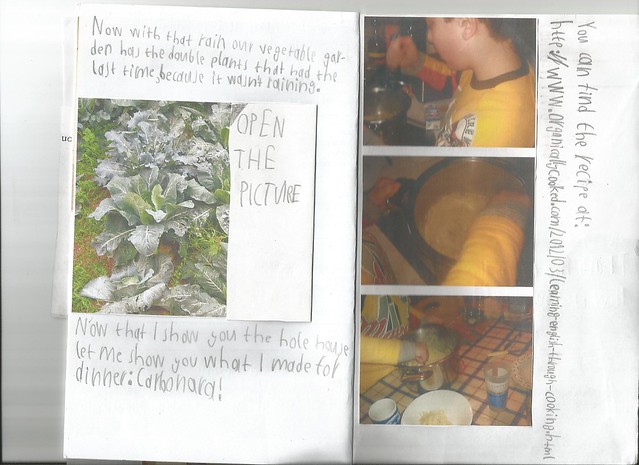
My son wrote today's post and he told me to publish it.

Dad hates it when it rains at the weekend.

Scan0003

He says it should rain during the week when we have better things to do. I'm glad it rains at the weekend because I'd have to help him with whatever he was doing if it wasn't raining.

Scan0004

Because it was raining, we all stayed at home and did various jobs. But even though it's raining, it's still not cold enough to light the wood stove. 

Scan0008

When it rains, you feel like eating more food. It makes you feel warmer.

Scan0009

I made carbonara last night and Mum made spring rolls.

 
If Cosco starts shipping spring roll wrappers and srichacha sauce through Pireas instead of Rotterdam (along with the Hewlett Packard products), Chinese food supplies just might catch on in Greece as their cost drops (so I won't have to beg my northern friends to carry this stuff for me).

Scan0010

Today it's Monday and it's still raining. Maybe Dad's wish has been granted and the weather will be good at the weekend.

©All Rights Reserved/Organically cooked. No part of this blog may be reproduced and/or copied by any means without prior consent from Maria Verivaki.

Sunday, 18 November 2012

Dream interpreter (Ονειροκρίτης)

The new year's calendar selections in the bookshops present no surprises. The over-priced wall calendars consist of glossy tourist photos of Greece, presenting the country in all its dream-like glory, often centred around a Greek theme (eg Crete, cats, donkeys, etc). The dates are printed in little boxes in the classic style of a calendar, but no mention is made of the importance of the day, except perhaps by shading the boxes in a different colour to highlight the weekend or a public holiday. Wall calendars that include all the feastdays written in the boxes are more difficult to find: they are likely to be available in specialised stores, often given away by religious organisations to their members, and you may be lucky to find them in a newspaper supplement at the end of the year. I'm specifically making one up for an old-aged diaspora aunt whose special needs include XL print.

 Tourist wall calendar, combining the γιορτές (feastdays) via the Eortologio.

There is also the little page-a-day calendar, a traditional albeit old-fashioned iconic symbol of Greek popular culture, which gives you much more information than is given in any of the glossy wall calendars, including the saints' days celebrated on each day, so you will know whose nameday it is on that day. They are excellent value for money.

 
The page-a-day calendar answers all these questions for you:
What day is it today? (the first word gives the day, the big number the date, and the last word the month); I wonder who's celebrating their nameday. (right under the big number); What time should I milk the cows? (sunrise time is given right below the name of the day); When should I feed the chickens? (sunset time is next to sunrise time); Is it time to trim the grapevine? (moon quarter is stated next to sunset time - agricultural tasks are performed according to whether the moon is getting 'bigger' (ie approaching full moon) or getting 'smaller' (approaching new moon); Is it a fasting day? (the bold text below sunset/sunrise/moon quarter: eg καταλυσις εις παντα = 'non-fasting day'); What shall I read? (bible reading for the day given in the two lines above the name of the month); Any ideas for cooking? (it's written on the back of the paper - you will see it once you peel off it off, tomorrow - other versions of this calendar come with poems, sports trivia and religious verses).  

Image of Dinner With PersephoneΙn the same place where you find the calendars in a Greek bookshop, you will also find the Kazamias, the book form of a Greek new year's calendar, an almanac containing the same information as the useful little page-a-days, with extra bonus trivia such as encyclopaedia entries, recipes and even dream interpretation, ονειροκρίτες. Dream interpreteters need constant updating, hence the reason why these books near the calendar section of a bookstore. We need new dream interpretations on a regular basis as the world changes, because as the world changes, so do our dreams, which depend on where we get our inspiration from, as Patricia Storace clearly illustrates in Dinner with Persephone:
Artemidorus
Another person calls to me, this time a girl in blue jeans standing on the corner beside a stack of books piled on an upended crate. "Do you need one?" she asks. "What are they?" I slow down, shift my packages, and climb toward her... She holds up a volume and flips the pages. "Dream books. Oneirokrites." Actually, I did bring one. But it was written in the second century, the Oneirokritika, a handbook of dreams collected by a professional dream interpreter named Artemidorus, who traveled in Greek cities, and recorded and classified the dreams people told him in order to make a manual of the art of dream interpretation for his son. It is a social history of shocking intimacy, a study of the unconscious lives of people of another world, trying to divine the future through their dreams, while we, so far away, try to divine the past. The Oneirokritika ... was an inspiration for Freud's Interpretaiton of Dreams. "I do have one," I say, "but it's old." "You are foreign?" she asks, and I nod. "How long have you lived here?" "Two days." "Then you will need a new one. You will have new dreams here."
My mother-in-law refers to (a very old) dream interpreter on a regular basis. It's always depressing to hear about her dreams; the interpretation is more often negative than positive and causes her great anxiety throughout the day. She never seems to have good dreams, ones whose symbolism in the unconscious world predicts a happy outcome in the real world. Most of the time, she tells us about her dreams when we are about to do something that she predicts will have a bad outcome, like for example when we treat a stray cat with kindness: "Oh, don't do that! I saw a cat in my dream last night, which means someone's conspiring against you." I often wonder if she realises that her dreams aren't actually our dreams; logically, they should befall her, and not us.

Predicting the future is as old as the evolution of the human being. Natural phenomena like earthquakes, random celestial events such as eclipses, animal sounds, and the ancient orcales are among the events used in the past to predict the future. Nature has provided the greatest inspiration for dream interpretation, since it forms the most primitive form of life, while the evolution of technology is a relatively recent form of inspiration in people's dreams.

Never having owned a dream interpreter, I decided to add such a book to my collection in this exceptionally difficult year for Greeks. My ονειροκρίτη is organised alphabetically, according to the names of things or actions. Ιt contains interpretations based on Artemidorus' original works, judging by the kinds of entries (eg αγάνωτα - cooking vessels that haven't been treated by a tinker); I can only guess that the entries still have some validity, judging by the number of references made in the book to times of economic hardship. Either that, or times of economic hardship have always been a part of everyday life: 
File:Tinsmith's Shop interior.JPGAγάνωτα (untinkered cooking vessels): If you see your cooking vessels in your dreams and they are untinkered, await economic hardhsip. If you are served food from untinkered tin vessels, you will go through a worrying period. Among the betrothed this means the dissolution of the engagement.
Something as simple (and delightful in taste) as the artichoke can also be a symbol of financial hardship:
Αγγινάρα (artichoke): If you see it in its season, the dream is good, but if you see it out of season, await bitterness, slander and bad financial news. If you're eating it raw and it makes your lips turn yellow [don't they mean black?], a bad outcome in litigation cases awaits you.
Despite its quackish-sounding predictions, similar to those of psychics and fortune-tellers, I felt rewarded by the high level of the occurrence of fresh food items in the dream interpreter, all directly inspired by nature. But even natural items such as fruit and vegetables are often associated with an impending disaster. Cucumbers can only mean problems: 
Αγγούρι (cucumber): If you are eating cucumber in the winter, it means grief and worries. If you give it to another person, you will end up arguing with the person you are giving it to. If someone is giving it to you, that person will be the reason for your grief.
The thing is that these days we are unlikely to dream so simply, so the dream interpreter could be said to be highly imprecise given the complexity of our present world. For instance, it does not include an entry for υπολογιστή (computer). So if for example, you see a salty computer screen in your dream, you can't look up computer, but you can look up salt:
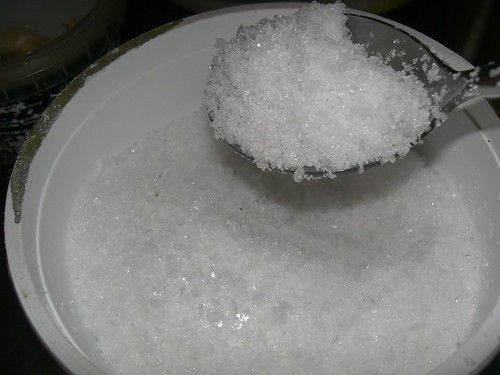
rock saltΑλάτι (salt): If you have salt in your hand and it is spilling out of it, you will lose, out of neglect, a person that is highly valuable for you. If you're grinding salt, you will pass through a period of unhappiness. If you're sprinkling it on food, you will see bitterness enter your life. But you will also get some small help. If you are lending or borrowing salt, you will give or receive bitterness. If someone is asking you for salt, you will get a letter.
But if the salt was on a computer screen, does that mean someone is giving it you? Or did you give it to someone else? If the screen is salt-clogged, you will not even be able to see the person involved in the first place. And if you had the sound turned off, you will not hear if someone was asking for it or giving it to you. And could the letter be an email instead, which most of us receive every day (and very often in the form of junk mail)? As our world becomes more complex, so do our dreams...

©All Rights Reserved/Organically cooked. No part of this blog may be reproduced and/or copied by any means without prior consent from Maria Verivaki.

Saturday, 17 November 2012

Above all equals

Last night, I was feeling very tired, from what turned out to be a very busy week, not just at work, but also at home, and when I saw how untidy the house was, I realised I was going to have a busy weekend too, so I just flopped onto the couch and tried not to think too much about it all, because admittedly it made me even more tired.

But the cold weather also made me hungry, and I could have just dipped my hand into the cheese bowl, and dipped my other hand into the bowl of olives and and cut myself a slice of bread and called that dinner, but I really couldn't stand having another meal like that because that's what I'd been having most other nights that week.

So even though I felt like a dead weight, I took out my heavy shallow saucepan and chopped an onion and minced some garlic, and poured over some olive oil which was difficult enough when you're cold, tired and hungry, and tossed it all into the saucepan, and because I was too tired to consult a recipe, I just started tossing into the pan whatever lay before me - some cabbage which I'd shredded in preparation for a salad that was never made, some spinach and leeks that I'd prepared for making spanakopita, but that never got made either, and the very very last of the summer garden peppers, and why not grate a carrot to go into that, I thought, which is what I did, and then I remembered that there was no protein in it the pot, so I threw in a few frozen mussels, which did the trick.

Despite that drained feeling, I hadn't lost my senses completely so as not to remember that a good Chinese stir-fry needs some soya sauce, and some finely grated ginger, and a chilli pepper or two, all good fridge/freezer staples, and a few rice noodles which you can add to the hot vegetable medley and let them soak up all the juices as they cook in the hot pan with the hot vegetables, which is especially useful to avoid having to use another pan and create more work in the kitchen.

And when it was all ready, I poured the contents of the pot into a huge bowl and found some chopsticks and began eating, making my way into the living room, where everyone else was watching Charlie and the Chocolate Factory, and then everyone began asking me if they could have some of that aromatic meal I was enjoying, and so I passed around the bowl, and we all ate from it, and we just kept passing it around so we all ate an equal share, but because I was worried that this splendid meal was being consumed at record speed, I demanded that I get the most share, because even though we were supposed to be sharing this meal equally among equals, I considered myself as above all equals, because I was the cook, and I dreaded the thought of remaining hungry, because if my stomach remained empty, I wouldn't be able to fathom the tiredness and the cold.

If I weren't feeling so cold, tired and hungry, there'd have been a photo to prove that this meal took place, so you'll just have to take my word for it. In the meantime, καλή νύχτα...


Bonus photo: here's is the above-described meal, cooked up again today. It's being prepared early to make spring rolls tonight.

©All Rights Reserved/Organically cooked. No part of this blog may be reproduced and/or copied by any means without prior consent from Maria Verivaki.
Friday, 16 November 2012

Tiding it through

The economic crisis has wreaked havoc on society mainly by the frightening effect is has had on many people, if we are to judge all the reports that we hear - very often in Greece - about people fleeing from it. We don't really know if they are going to a better place but the feedback we get about them is that they are going to a place which is not in crisis, which sounds incongruous because the crisis is a global one.

Two-day-old boiled beetroot leaves and bulbs, two-day-old roast meatballs in tomato sauce, one-day-old spinach rice: fresh food that has been appropriately cooked and stored does not go off after the day it was cooked - it simply becomes more flavourful. The cheap plonk went well with my delicious home-cooked meal, made by my own hands.

I suppose it's easy for me to say this, as I sit in my office at work, or in my comfortable home in rural Crete. "You don't need to flee," is what I hear being directed at me, as I am wearing my old clothes, driving my old car, buying velcro to sew onto my kids' hand-me-down coats to avoid buying new ones, folding away clothes instead of ironing them, eating my one-to-two-day-old well-cooked food, heating my home with wood, among other activities often associated with 'poverty'.


 Έρχονται κάτι στιγμές Certain times are coming
Που θαρρώ πως τα 'χω δει όλα  When I thought I had seen it all
... Και στο όνομα ετούτων των στιγμών And in the name of those moments
Show must go on
Και ίσως κάποτε τελειώσει And maybe at some time it will finish
Όταν κι ο πάγος στην Ανταρκτική θα έχει λιώσει Like when the ice on the Antarctic will have melted
Έρχονται κάτι στιγμές που λες Certain times are coming when you say
Το δυο χιλιάδες δώδεκα νομίζω In 2012 I think
Που θα σε κάνουν να παραδεχτείς σαν κλαις That they will make you admit as you cry
Τον φαύλο κύκλο μου ποτίζω "I'm watering my own vicious circle"
Έρχονται κάτι στιγμές Certain times are coming
Κι ότι έχτιζα αιώνες τώρα το γκρεμίζω And whatever I built over the centuries I am know knocking down
Και στ' όνομα ετούτων των στιγμών And in the name of those moments
Show must go on
(Sung by Haris Alexiou, lyrics by the late Manolis Rasoulis)
No, I don't need to flee, because I saw what happened to those who did flee before me. They came back to a Greece that was better than the one they left. It was never Utopia, but it was pretty good value. Why would I want to leave my country now when I know that things will only be better in the future? It should be obvious to most by now that it is part of the Greek mentality to flee in times of adversity, while this trait is less inherent in other cultures who face a similar predicament:
Some 501,000 foreigners had moved to Germany, the EU's dominant economy, between January and June 2012 - a rise of 15% compared with the same period last year, the data showed. The number of Greeks moving to the country rose by 78%. The figure for Portugal and Spain went up by 53% over the same period.
It's not just Greek people who are leaving, it's Greek businesses too:
[In contrast,] Greek firms and national businesses, which enlarged successfully here and assured themselves great profit and wealth, are making hippity-hoppity jumps on the first turn of the economic cycle. For example, the decisions of the 3E and FAGE companies to transfer their economic headwuarters, the former to Switzerland and the latter to Luxembourg, are indicative and do not provoke the best feelings among... the Greek people.
This is in sharp contrast to the number of multi-nationals presently entering the Greek market. Cosco, a Chinese firm that operates part of the port of Pireas in Athens, has made a deal with Hewlett-Packard that the latter's goods will be entering Europe not through the traditional port of Rotterdam in Holland, but through Greece. Unilever is also proposing something similar, with its intention to introduce 110 of its products to Europe through Greece, stating strategic reasons.

Five years from now, Greece will be a much nicer country than it already is, and in a much better economic position than it is at present. Ten years from now, the Greeks who left will be thinking about wanting to move back. Although Greece will be a much nicer country then, it will also be a different kind of Greece; what may have seemed easy to do in the past (return to the mother country, live off inherited land in an inherited house, planting tomatoes and sipping ouzo in the patio) will now not be so easy. Nor will the Greeks tiding out the crisis in their own country be so willing to make it so easy for the deserters, once this crisis business tides through. And it will: the crisis won't last forever, just like all previous crises, because no crises last forever. Wars finish when there is nothing left to destroy, which means that starting up again from scratch is the only thing left.

©All Rights Reserved/Organically cooked. No part of this blog may be reproduced and/or copied by any means without prior consent from Maria Verivaki.

Thursday, 15 November 2012

Olive harvest (Μάζεμα)

It's olive picking season now, and the work is in full swing at the moment in Hania. Even though it hasn't rained a lot, the precipitation that has fallen in the area was enough to strengthen the crops.

When I arrived at work yesterday, I found the gardeners gathering (mechanically with the help of a motorised beating stick) the olives of the tree in the main courtyard. 

Despite the fact that the olive trees at the campus of MAICh are mainly ornamental, they are not exempt from this mainstay activity.
This one tree will yield 5kg of fruit, which should yield 1 litre of olive oil.

Panda, MAICh's resident cat, is now more easily able to climb into the heart of the trunk to get a nap while the weather is still good.  
“Agriculture is the mother of all arts. When it is well conducted, all other arts prosper. When it is neglected, all other arts decline”, Xenophon 430-355 BC 
The method of gathering olives depicted in the photos is standard practice all over the island in our times.

©All Rights Reserved/Organically cooked. No part of this blog may be reproduced and/or copied by any means without prior consent from Maria Verivaki.
Wednesday, 14 November 2012

Full house

It's  International Food Photography Day today!

"Maria, if anyone opened our fridge and saw this, they'd wonder what kind of crisis we were going through," my husband remarked on Monday night.


The contents of the fridge don't hint at an economic crisis, but they hide another one: the only cook in the house doesn't always have time to perform her duties.

The truth is that it's already started to empty. I've managed to clear some space in it the other day when I cooked up the bag of beets (bottom left hand corner), dug out the leeks for a soup (F&V compartment), ate the boureki leftovers (metal vessel) and gave the dog Sunday's leftovers (ceramic vessel). And now that I've prepared the okra (blue bag) and spinach (below the blue bag),we should be set for a pie-making session tonight. But school lunches constantly refill it (eg top left hand corner), and the quince (below the lunch box) will last us throughout the winter - seriously!

©All Rights Reserved/Organically cooked. No part of this blog may be reproduced and/or copied by any means without prior consent from Maria Verivaki.

Tuesday, 13 November 2012

Rip-off

As yesterday's post showed, it's easy to get ripped off in Greece, and this often involves food-related businesses: σου πιάνουν τον κώλο, as we say in Greek (they grab your ass). Last Saturday, while we were on a family shopping trip, my kids spotted a packet of fresh chicken wings next to the butcher's counter at the supermarket, where my husband and I were looking at the meat array.

"How about some fried chicken wings for Sunday's lunch instead of pork steaks?" my son asked me. Nice idea, I thought, but got a bit worried when I noticed the price on the packet: €3.19 for less than 1kg of (Greek) chicken wings; the by-the-kilo price was stated in finer print at the bottom of the sticker, €3.99. So I checked the frozen counter where I thought they would be selling cheaper chicken wings. Not a chance on that day, which I would think is highly unusual at a supermarket on a Saturday - I would have thought they'd be fully stocked. There were no chicken wings in the freezer, unlike other times when there usually is.


"Let's buy some meat from a butcher rather than the supermarket," I suggested. After we left the Carrefour, we stopped off at the 108 ΚΡΕΟΠΩΛΕΙΟ, a local butcher run by the Motakis-Tzougrakis partners, which has various branches in different locations around the town. There was a mountain of Greek chicken wings in the display selling at €2.30/kg - that's nearly half the price of the supermarket.

Supermarkets in many western countries have forced independent butchers to close down, but in Crete, and I'd say the whole of Greece, butchers never closed down due to competition with supermarkets. They have successfully competed with them, mainly because Greeks are used to seeing meat in its whole form. Although meat is now often and regularly sold in vacuum-packed portions in supermarkets, there is always a butcher's counter in the stores too, which shows that Greeks are not squeamish about seeing their meat in this form. Furthermore, most Greek meat speciality dishes cannot be made from the meat in vacuum packs. Meat has also become an expensive commodity these days, so it pays to have a good idea of the value of something before you get your ass grabbed.

©All Rights Reserved/Organically cooked. No part of this blog may be reproduced and/or copied by any means without prior consent from Maria Verivaki.

Monday, 12 November 2012

Greece in crisis

You will rarely see me in one of those trnedy-looking cafes that we see throughout Greece, where many beautiful people sit, often outdoors, enjoying the generally good/mild weather of our beautiful country. That's because it is generally too expensive to do this.


I can, of course, go out occassionally, without my children, and have a drink/coffee with a freind, but I don't do this much at all. In fact, I'd say that there has to be a very very very special reason for me to do this, and last week, I did in fact do this, and there was indeed a very very special reason for me to do this. And even though the coffee I had cost 66% of the cost of the coffee at this place (€3), I still felt that even that €3 amount felt like too much for my own household income level - it's just too much for a cup of coffee that we all know we can make for a lot (and I mean a heck of a lot) less in our home.

Thanks to Kostas for supplying me with the photo - it is virtually impossible for me to get my hands on such receipts, for the reasons stated above.It makes no difference where this receipt was issued - Athens, Crete, somewhere else; in a Greece of crisis, it mocks the whole show.

©All Rights Reserved/Organically cooked. No part of this blog may be reproduced and/or copied by any means without prior consent from Maria Verivaki.

Saturday, 10 November 2012

The design of this particular boat reminded me of Christmas. Boats are traditional Christmas symbols in Greece.


 Καίτη (Katy)

The area where the photo was taken looks like a quiet fishing village, but it is actually located near one of the most important ports in Greece, 100 metres away from where cruise ships dock in the port of Souda.

©All Rights Reserved/Organically cooked. No part of this blog may be reproduced and/or copied by any means without prior consent from Maria Verivaki.

Friday, 9 November 2012

The Two Faces of January by Patricia Highsmith

Living in a small town in Greece, in her recent past, had a very negative ring to it. Pressure from international trends often led to small towns being regarded as symbols of backwardness. Until the crisis hit, the general attitudes towards small Greek towns were usually disparaging. Admittedly, small towns have always lacked the faster pace of progress of a capital city or a large urban conglomeration, and they often lack symbols of urban culture that resemble progress, like regular theatre showings, 24-hour supermarkets and brand-labelled fast-food outlets, but such institutions are only possible when there is a large population available to sustain them, or if such elements are seen as desirable by a community. Lack of opportunities still plagues small towns, although this problem could also be attributed to a disinterest by the community to develop feasible opportunities.

1st editionHania in the early 1960s, as Patricia Highsmith describes it, while using the island of Crete as the setting of her novel The Two Faces of January, is a boring dusty old-fashioned-looking town, where nothing interesting happens. The story is set in the depths of winter, which has always been regarded by most Greek urbanites as the most boring time to be in the επαρχία away from the mainland, because the islands' sea-and-sun image do not allow for regular activities associated with island life to take place (swimming, sunbathing, dining outdoors). This is still very much true in the second millenium. The Mediterranean islands may be some of the most beautiful in the world, but they seem to have a 'Closed till next year' appearance in the wintertime, when the rains come in deluges, and transportation is hampered.

So is μεσιμέρι (mesiMEri), the middle of the day, whether it's summer or winter; the town empties out eerily at this time of the day, something that visitors find disconcerting, even in modern times, as many of my students have remarked, particularly concerning weekends. On Sunday, all the commercial stores are closed, giving a ghostly appearance to what seems like a modern town, judging from the store-fronts.

Chester, a character from Highsmith's novel, and his wife Colette arrive in Hania at this time of the day, and are faced with an image that arouses feelings of poverty mixed with rural peasantry:
Photo: Roula Spartali
Chania, at 3.30[pm], presented a town square sprinkled with idle men, centred with a cement memorial statue of some sort, and ringed around with various shops and restaurants. It had a backwater, fifty-years-behind-the-times look of certain towns Chester had seen in the United States, an atmosphere that inspired him to wonder how the inhabitants could possibly make a living. Consequently Chania appeared a little sad. It was not nearly as big as Chester had expected... They strolled in the direction of the sea, which was visible down the street from the main square. The town seemed to offer nothing in the way of beauty. The shops were tiny and poor-looking, there was nothing like a museum or a government building in view. The port was a long curve with a wide wharf going out into the water. The only boats in the harbour were two old tankers.
Many small towns all over Europe, in order to increase their touristic potential, advertise themselves as a place for a weekend or mini-break. Hania, however urbanised it may look, is not really the kind of place a self-confessed urbanite would ever like to find themselves in. Rydal, who travelled to Hania with Chester and Colette, finds it to be a suitable place for contemplation more than anything else:
Photo: Magda Vogiatzi
The paper of Chania, a slim, four-sheet affair, reported what Rydal had expected, absolutely nothing. Rydal asked and was told that the Iraklion and Athens papers would be on sale that evening.  Rydal walked into a cafe and had a cup of coffee. It was a dull town, Chania, but Rydal rather like dull towns, because they forced one to look at things - for want of anything else to do - that one might not otherwise notice. Like the number of flowerpots on window-sills as compared with the number in Athens or in other small towns he had been in on the mainland; the number of cripples on the street; the quality of the building materials used in the houses; the variety or lack of variety in the foodstuffs in the market. The public market looked a bit impoverished, like the rest of the town.
The desolation of a boring town is heightened when an unhappy event takes place in it. Unlike in a large city where you can change suburbs, in a small town, there is nowhere to hide:
Photo: Chrysoula Zikou
Chester had never detested any town as much as he detested Chania. The pattern of the buildings on the street of the hotel had taken on a meaning to him: they were a symbol of hell, a trademark of hell, the very face of hell. Chania was where he had lost Colette. Chania was where he had existed for three days like a hunted dog and watched a seedy young bum seduce his wife... Chania reminded him of his second year at Harvard, when the news of his father's bankruptcy had come, and when Annette, the girl he had been engaged to, had broken off the engagement - instantly, on hearing of the bankruptcy... Chania reminded him of all that. Chania reminded him of failure.
Generally speaking, Highsmith's descriptions of Crete are qell on the mark, although there was one which I found to be completely lacking in credibility for the time period that it takes place in:
Photo: Bettina Truper
'They walked to the market, drifted down aisles of shoes and boots that smelled of cattle urine, stared with detachment and wonder at hanging meat, cut in a manner that made the pieces unidentifiable. They bought ice-cream cones and wandered on, holding hands to keep from getting separated. Colette found a loose, buttonless vest... Rydal helped her bargain for it. They got it for thirty drachmas less that the first price the woman had asked for it. 'I don't think people would pay the first price they ask in places like this, do you? Colette said. 'It's silly tourists who make the prices go up everywhere.'... The ruddy-cheeked peasant woman rolled the vest carefully in a sheet of newspaper, tucked the ends in, and presented it to Colette.
In 1960s Hania, the shoes and boots would probably have smelt very animal-ish,  but the hanging meat in the market would all be quite recognisable. It is highly unlikely that any ice-cream was being sold in Hania in January in the 1960s (in fast, winter ice-cream sales are a relatively recent development here). And I don't think Rydal and Colette would have gotten separated in the market of Hania - it wouldn't have been that busy! A more credible food scene describes a meal taken near the market in Hania:
Photo: Chrysoula Zikou
'Can we eat something in a crummy place?' she asked... 'Where the Greeks go?' Smiling, Rydal pulled her by the arm back in the direction of the town. 'Does this town have anything else?' Colette was quite definite about what she wanted. She wanted a hole-in-the-wall, stand-up kind of place, and Rydal found one in a street next to the market. They ate a piece of hot goat meat on a slab of grey bread, and shared a glass of the worst retsina Rydal had ever put in his mouth. 
Photo: Anastasia Tsigounaki
Hania had not cultivated her tourist image in the early 1960s, so no doubt most places looked crummy, and the food would have been quite basic. Our bread certainly does look grey compared to the model bread being propounded in the 1960s, which was a clean white loaf. Most of the best bread in Greece is an off-white colour. But even in the film version of the novel, some of the food items will be part of a product-placement campaign by the sponsors: EPSA soft drinks would have been unheard of in Hania at the time!

Patricia Highsmith's descriptions of Hania have not put me off her story. In fact, the desolate descriptions suit the storyline: a psychological thriller whose main charcaters are all hiding some kidn of skeleton in the cupboard. The descriptions remind me of the complaints I hear from visitors who never really understood the town, visiting it at the wrong time of the year while they were whizzing through Europe on a whilrwind tour of the continent and couldn't find a more convenient or suitable time to come here. The idea of the desolation one feels in a small town which they expected to be different is developed very well by Highsmith, as the characters change their relationships with each other, tending towards hatred and fear.

In fact, I can't wait to see The Two Faces of January played out on the big screen. I will watch it in a cinema which will be located not far from where the shooting of the film took place. I can imagine the rounds of applause every time my dusty town comes into view. I normally wait till the DVD comes out, but this time, I think I will make it to the cinema, where I expect that there will be no empty seats every night The Two Faces of January is showing.

All photos taken in Hania (photo set can be found in Chania Crete by Nikos), during the shooting of The Two Faces of January last month, starring Viggo Morntensen, Kirsten Dunst and Oscar Isaac.


©All Rights Reserved/Organically cooked. No part of this blog may be reproduced and/or copied by any means without prior consent from Maria Verivaki.

Thursday, 8 November 2012

Pitch dark (Πίσα σκοτάδι)

As I left the house with my daughter last night to take her to basketball training, I noticed how eerily dark the streets looked without any street lighting. Random strikes by the public power corporation were taking place all over the town, due to action taken by employees over salary cuts and loss of privileges. The basketball coaching session was taking place in the school gymnasium of a semi-urban semi-rural area, with low housing and large open fields with short olive trees. The only lights came from the few cars that passed through the blackness, and a fire that was lit by the side of a large empty square by a convoy of travelling people (to use the euphemism for politically correct reasons - τσιγγάνοι describes them as they would know themselves). 

It was pitch dark when we got there. Driving on rural roads in the dark is quite unnerving, especially now that more cyclists are on the road. They use tiny lights that make them stand out on a reasonably lit road - but barely visible on an unlit one. The school, being part of the public grid, was enveloped in darkness. There were no emergency lights in the gym, only the school buildings next to it. The coach got the girls together near the doorway. It was a very warm night. She gave them a pep talk and held a discussion about the hows and whys of being part of a team, playing competitively and fairly, and making a good impression wherever they played. This continued for 40 minutes, until the coach finally called off the training session. She had done her best, but I could tell that even she had felt beaten that evening. The girls didn't notice - they were too busy watching the loiterers outside the gym, who were chanting 'Δεύτε λάβετε φως' while shining their mobile phone torch lights at the gym entrance.  

Arriving back home, I found my husband fumbling in the dark trying to find candles. Then I heard him swearing as he tried to find a lighter. Not being smokers, we couldn't remember the last time we needed to use one ourselves. He'd been varnishing shutters all day in 30C heat - despite it being mid-autumn - while he too was on strike - and he really wanted to take a shower, but found the darkness overwhelming.


My mother never used her silver. It was purely for decorative purposes. I inherited this candelabra with the original candles (red) she had placed in it when it sat on one of the nestled tables in our New Zealand living room. In Greece, it found its calling.

The family gathered in the living room, the only room that I allowed them to use candles, out of fear that the children would see them as a toy and set fire to the house. I brought out some potato chips to life their spirits, as junk food usually has that effect.

"Bloody bastards," my husband fumed, "couldn't they at least warn us where and when the power will be disconnected, so that we could at least plan to do something else?"

"You expected to be warned?" I laughed sarcastically. "This is Greece, and you expect to be given a schedule?!" I remember doing evening lessons in both Athens and Hania, teaching children by the flame of a gas light. Lessons were never cancelled - in the private sector in Greece, the show always goes on.

It's at times like this, when he acts like he doesn't know his own country, that I feel like telling him that if he doesn't like the country, he has only two choices: either he helps it to change, to he leaves it: 'Να η πόρτα! Harsh words, especially coming from someone who wasn't born here. But he is not alone in losing patience with Greece:
"It is not possible every time you make a privatization in Greece to go on strike. It is not possible that public transport cannot collect fares and services will not be able to collect revenue... If we cannot say these things in Europe in a friendly way to each other, and instead, when we do say them, we are regarded as Martians, it will be impossible to make progress."
This comes from a woman who showed patience with the Greeks on a number of occasions. Perhaps she's had enough too. But she really ought to know better - those Greeks never stop surprising people with their resilience, even if seems misguided to others.

By 7.30pm, the lights had all come back on. We had our showers, I cooked the next day's meal - μακαρονάδα - and the television began playing, so the disconnection was completely forgotten, and it will stay forgotten until the next disconnection takes place. And there will definitely be another one, and this cat-and-mouse game will continue for as long as it takes. And we won't get any warning, either. Remember: this is Greece, and Greeks are pretty predictable. They don't need a hurricane to destroy the country; they're pretty good at getting the job done all by themselves. But even a hurricane has its good side: after total destruction, you can only start from ground zero, and what you build will be better than what was there before.

©All Rights Reserved/Organically cooked. No part of this blog may be reproduced and/or copied by any means without prior consent from Maria Verivaki.
Wednesday, 7 November 2012

Congratulations (Mπράβο)

This post is dedicated to my former students at MAICh. Photos from the 2010-2011 intake.

When I came into work yesterday, I was confronted with an onslaught of 'congratulations', whose origins I didn't understand. It was later revealed to me that the results of the student evaluations of the institute had been published. Former students of the institute were recently asked to provide feedback (anonymously) to the institute about its operation and the educational program. Here's what former students had to say about my contribution:

Do you find the English language support adequate?
Not at all 7%
Inadequate 2%
OK 15%
Adequate 48%
Highly adequate 28% (total 91%)
How satisfied were you with English language teaching in MAICh?
Not at all 9%
Inadequate 5%
OK 18%
Adequate 44%
Highly adequate 24% (total 86%)

Would you like the Engish language courses to continue in the second year?Not at all 6%
No 14%
Don't care 24%
Yes 22%
Very much 34% (total 80%)

It should be noted that I am one of the teachers that students see for most of the year, unlike the professors of other courses, who they see at the most for two weeks during intensive courses. So my relationship with the students may be influenced by this fact (they get to know me better). I've been working at the same job for almost 18 years now, which is a long time to be at one place, but the nature of the job has changed over time. For the first 12 years, I was working up to 10 hours per week; I have been a full-time employee here for only the last three years.

This is something to be proud of because it's not everyday you receive praise in Greece from doing your job well.

©All Rights Reserved/Organically cooked. No part of this blog may be reproduced and/or copied by any means without prior consent from Maria Verivaki.

Tuesday, 6 November 2012

The Greece of the past?

Theopi Skarlatos is 'mourning the vanishing Greece of her childhood', as she writes about it on the BBC website.
"There is high unemployment, an increase in drug use, depression and prostitution. People have been filmed foraging for food in bins after dark, and schoolchildren are reported to have collapsed from malnutrition. It seems a long way from the pretty pictures on dusty postcards at stalls beneath the Acropolis."
As usual, the burden rests on 'Athens' (and no less than the notorious district of Agios Panteleimonas, in Theopi's eyes) to tell the world what is happening in 'Greece', even though Athens never represented what was happening in the rest of the country. In the similar way that the Greek public and private sectors work, Athens and the rest of the country run parallel to each other, rarely converging.
 "Drool", "Nothing like good old traditional Cretan snacks!", "Heaven musta sentcha from above. OPA!!" (comments on my facebook page)
Toasted bread slices with feta cheese and fresh tomato, drizzled with olive oil (no added salt). 

Theopi goes on to say:
"And so it has fallen to the international media to portray as true a picture as possible of what is happening in the country that once gave birth to democracy, but which is now struggling to show it is still in possession of it."
Poor Theopi, I think to myself. She wasn't born to Cretans. At any rate, the past is a foreign country: they do things differently there.

©All Rights Reserved/Organically cooked. No part of this blog may be reproduced and/or copied by any means without prior consent from Maria Verivaki.

Monday, 5 November 2012

Scheduled strike

Taxi owners in Greece are on 'duration strike' as of today, meaning that they haven't given an end date to the strike, which depends on their issues being resolved: a reduction in the flat tax rate which stands at 28% at the moment, and the potential loss of business through privatisation plans which will allow hotels to have their own taxi services to and from airports (on islands, this is the main source of revenue for cabbies).

The cabbies are not alone - the whole country seems to be going on strike this week, according to today's headlines: the public power suppliers start today, while the public servants' union and the general workers' union (ie everybody who isn't a public servant or freelancer/business owner) have called for a 48-hour general strike starting from tomorrow. Journalists and lawyers have also announced strikes, but as far as I know, they are constantly on strike anyway (so why are they announcing a new one? to substantiate themselves, I suppose).

taxi
Mr Organically Cooked in his cab


Strikes are optional among the union strikes, but not necessarily so among the 'closed shops' (eg taxis, journalists, lawyers). There, it is demanded of everyone to strike. Cab drivers who do not own the taxi themselves regard themselves as out of the game, so they may continue to work - but that's a bit risky, if you get my gist. It's up to the owners of the cab they work for to get it off the road (for the taxi's safety).

Admittedly, the tourist season is over, so there isn't much cab work to deal with at the moment. My husband works onlyu during the day because there is little to no work at night. He has also given up weekend work - agian, because business is too low. "If I can pay the daily running costs of the cab," he tells me, which are currently in the range of €30-40, "at least I won't be in the red."

Mr Organically Cooked in his garden

Strikes are not desirable, but we don't make the rules; other do, and we just follow them. That's when we are thankful for the good weather. There's the summer garden to clear up, the wooden shutters that need to be varnished, the iron fencing that needs to be painted, the spinach that needs planting, the basement that needs a tidy-up, a bike that needs to be repaired, and I'm sure we'll find many other jobs that need doing too. Public servants who choose to go on strike, along with those 'general workers', will probably indulge in such activities in places Crete, and other rural areas of Greece, where to go on strike means to get some work done. Don't know about journalists and lawyers - their palms generally tend to be smooth.

©All Rights Reserved/Organically cooked. No part of this blog may be reproduced and/or copied by any means without prior consent from Maria Verivaki.

Sunday, 4 November 2012

Feast (Γιορτή)

The wedding feast in Crete consists of a standardised menu which is based on a display of wealth and prosperity. To have a full table was once a way of showing how wealthy you were. On a feast day, the same wedding feast is also prepared at home, in smaller quantities. Such feast days are mainly of the nameday type.

The most important part of the feast is the pilafi rice. Strong fatty stock is essential:


The chicken came from a coop in Apokoronas, while goat was reared on land near Sfakia. We don't really eat much meat these days, but when we do, we like to know where it's from.

Meat is boiled until all tender and the fat is left in the strained stock.


The boiled meat is often served as is, but this is getting increasingly unpopular in modern times. It doesn't not always get eaten. I par-boiled the meat instead, and turned it into two more dishes that are also seen at wedding feasts: the chicken became a roast:


The chicken was cooked in tomato, the potatoes in lemon. Most Greek meals can be based either on lemon or tomato: this goes for practically all bean, vegetable and meat dishes.

... while the goat became tsigariasto, a slow-cooked stew using just olive oil and wine. 


The pilafi is cooked in the stock just before the time of serving - always. This means that you must know that all your guests have arrived. Pilafi is served piping hot, slightly undercooked, and oily-creamy, so that the rice takes on a pearly effect.


At a wedding, the order of the food is pilafi rice and boiled meat first, then roast meat and potatoes, while tsigariasto may be served as an appetiser. Too much meat, you may be thinking, but a feast demands that you put on a good show; therefore you put out your 'best' food. One salad is also served with the whole meal - but its purpose is simply to make the table look full and perhaps to add some colour to the meal. I was recently given a few cucumbers which I turned into a tzatziki; this paired well with the pilafi. Yoghurt is often used as an accompaniment to rice. But salad (and beans, and vegetables, and other healthy foods) are generally regarded as foods for non-feast days, something you would eat more often on a daily basis. A feast in Crete demands meat.


Desert is not a necessary part of a meal, although in modern times, a wedding feast will also include a creamy wedding torte, an influence of global cuisine. Fruit is also very common. I decided to make a karidopita, to use up the last season's supply of walnuts and oranges (I had a hunch one of our guests would be bringing with her my new supply of walnuts). Karidopita goes well with ice-cream, another fridge clearance item: it's November, and rural Cretans rarely eat ice-cream at this time of year.


All the food can be cooked in stages. I boiled and strained the meat on Friday night, while watching Downton Abbey. as I was thinking that I could have used at least one servant myself). The next day, I prepared the cake and salads in the morning, and got the meat going at about midday. Apart from an hour spent par-boiling, the meat was cooked on the element or in the oven for another four hours, on very low heat. It did not require very much attention, I just needed to keep my mind on the job. The pilafi was the only dish that needed quick work. 


It goes without saying that wine is a very important part of a Cretan feast. Most rural folk like their rose-coloured home-brew. I've gotten a bit tired of this stuff as of late, as that is all I have been drinking for the last decade. I bought some light fruity bottled white wine which was highly appreciated by my guests, who left after midnight last night. I went to bed thinking about those servants I could use to help me clear up this morning, but when I awoke, I found the kids working together to clear up. Times are moving fast these days.   

©All Rights Reserved/Organically cooked. No part of this blog may be reproduced and/or copied by any means without prior consent from Maria Verivaki.

Saturday, 3 November 2012

During my walk today, I came across this water tank on one of the low-lying terraced houses by the water's edge in Souda Bay. The houses in the area are so small that the roof is often used by the inhabitants as extra living space. A number of old-aged men were on the rooftops today pottering around...
The cloudy weather suits the mood of the message.

©All Rights Reserved/Organically cooked. No part of this blog may be reproduced and/or copied by any means without prior consent from Maria Verivaki.

Friday, 2 November 2012

Cheap 'n' Greek 'n' frugal: Creamy leek, potato and red pepper soup (Σούπα με πράσα, πατάτα και κόκκινες πιπεριές)

Last night, as I was sifting through my fridge's darker corners, to see what was hiding, I found some leeks and red peppers that which did not look very worn out from having lain there for so long, but they really needed to get out of the fridge and into a cooking vessel. The result was a heavenly soup that I could never even have dreamed of if I didn't experiment. The recipe below is written in the same experimental way that I created this soup, based on my regular potato and leek soup.


You need:
500gr leeks (whole - I use both the white and green parts), washed well and chopped small
500gr potatoes, peeled and cubed (from a mountain dweller friend's bounty)
1 large onion, roughly chopped
3-5 red bell peppers (from our garden) chopped roughly
a few glugs of olive oil
a bouquet garni comprising of: celery stalk, thyme (or dill seeds) and 2 bay leaves (I also used bahari)
salt and pepper (I used peppercorns, but had to fish them out when I was ready to puree the soup)

Place all the ingredients in a large pot and let soften on the lowest heat setting for 30 minutes with no lid on the pot. Pour 4-5 glass of water into the pot (depending on how thick you want your soup) and let cook slowly for another 30 minutes. Switch off the element, allow the soup to cool slightly, remove whole herbs and spices and puree.

Wine from Peloponesos, sausages from Pilio, feta cheese from Plataies, local bakery bread and soup made from garden-grown produce: it can't get more Greek than this. 

It's not a Greek custom to add cream and dairy products to soups. It's better to serve some cheese on the side to go with the soup. And if you like your meals a little heftier, fry some sausages. In this way, you can cater for vegans, vegetarians and omnivores alike, all with the same meal. And don't forget the bread and  wine.

©All Rights Reserved/Organically cooked. No part of this blog may be reproduced and/or copied by any means without prior consent from Maria Verivaki.

Thursday, 1 November 2012

End of an era (Τέλος εποχής)

While studying in New Zealand, I had to face the fact that there really wasn't much I would be able to do there with a Master's in sociolinguitics. I could teach English or one of the foreign languages I had learnt, I could do translation work, and I could get involved in more research. New Zealand was restructuring her economy at the time, so most of the above choices were not really feasible, as I had seen from my contemporaries, who were also facing similar problems in finding such jobs. The language-teacher market was saturated, even though a lot of Asians were coming to settle permanently in the country, while translation work in the classcial foreign languages of the time (French, German, Italian and Spanish) was minimal in a country like NZ. At the age of 24, I was not interested in continuing my studies, especially when I knew deep down inside me that my highly specialised research work did not have much passing in a generally monolingual country like NZ. I had to admit to myself that being a sociolinguist in NZ was not really an economically viable option.

The Ministry of Foreign Affairs in NZ was also downsizing its activities around the globe for this particular reason (certain operations were not economically viable), which meant the closure of the NZ embassy in Greece in 1991. At first, this seemed a great insult to Greeks, because Greece was still maintaining a Greek consulate in NZ (in Wellington), which had been opened relatively recently; before Greece joined the EU, Greece was represented in NZ by an honorary member of the Greek community of NZ, in Wellington, where most people of Greek origin lived. Steps were taken to raise the NZ Greek consulate to embassy level, which had no effect on the NZ government, who had made up their mind: there was no need for a NZ embassy/consulate in Greece. Passports could be issued in Rome or London, a bilateral agreement between NZ and Greece existed for the purposes of repatriating Greeks so that they could receive their NZ pension in Greece, and exchange visits by dignitaries could still be made when necessary, eg during the commemoration of the Battle of Crete. Investment opportunities were not viewed as of interest to either side. It was not a diplomatic issue to close down the embassy: it was purely economic.

While NZ was in recession in 1991, Greece was enjoying economic wealth. With foresight, NZ stalled the recession by changing tact, despite the political cost it may have had to incur (and in the case of the NZ embassy's closure in Greece, nothing was really lost). It was a bit too early for Greek authorities to do the same, since the Greek consulate in NZ had only just opened a few years before that. Instead of keeping the status quo (which had lower running costs), plans were made to turn the consulate into an embassy (which happened in 1999). The decision to close the Greek embassy in NZ came 13 years later, in the middle of a recession that seems to have no end: operations in NZ will cease as of 31 March 2013.

This decision will also entail the closure of other state-paid activities outside Greece. The Greek school teacher comes to mind. For more than three decades (it all started with entry to the EU), the Greek state has been paying Greek school teachers to go abroad as representatives of the country, in order to teach and maintain within the Greek diaspora Greek language and culture. At this difficult economic time in Greece, paying such people to go to other countries to support 3rd-4th generation Greek immigrants should be viewed as a luxury, something that was stated in no uncertain terms by a representative of the Ministry of Foreign Affairs in Greece as recently as 17th October 2012. During a special parliamentary committe meeting set up to discuss issues raised by the World Council of Hellenes Abroad (which was televised on Greek state TV on 27th October), it was mentioned that Greek language and cultural education should be promoted abroad, but it should be the job of the permanent residents of the Greek communities abroad, not something that the Greek government should provide and pay for because Greek school teachers go abroad for 'other' reasons, which were not discussed in the meeting. The only comment the representative made about this issue was "ας μην κρυβόμαστε πίσω από την πλάτη μας" (let's not hide behind our backs). The perks of such jobs are too numerous to mention, not least of which is being able to travel around some of the most interesting places in the world, all on a state salary.

So, the end of an era has come. Of course it will be sad to see the Greek embassy leave New Zealand, with the ensuing problems of issuing Greek passports to the local Greek community members who have not (yet) become New Zealand citizens (and would therefore have dual citizenship in this way). But the end was nigh, and preparations had to be made for it; all good things come to an end - with new things born to replace them. This will be evident from the new Greek migrants aborad, most of whom are educated to the level required to realise what is feasible and what isn't, without the need to have it explained to them. We don't like to state the obvious - most of the time, it is too hurtful.

©All Rights Reserved/Organically cooked. No part of this blog may be reproduced and/or copied by any means without prior consent from Maria Verivaki.