Wednesday, 21 April 2010

The Ministry of Food Exhibition, Imperial War Museum - Part 2 (Το Υπουργείο Τροφίμων: Μέρος 2ο)

This post forms part of the series of our culinary adventures from our recent trip to Paris and London.

Education is a powerful tool. It is one of the most important factors in changing people's attitudes and behaviour. It is a positive force in the development of a nation, and it can even be used to instil prejudice and disseminate propaganda. I was the first person in my family to go to university; none of my ancestors had even completed primary school. To be educated in an English speaking country is both a blessing and a curse: on the one hand, English-speaking nations always had some of most respected educational systems, and high levels of education (in the good old days, anyway); on the other hand, an English-language education  is often monoculturally-inclined (at least, that's what mine was like), given the language's widespread use. If I had been raised in Greece and not New Zealand, my life would have been dramatically different now.
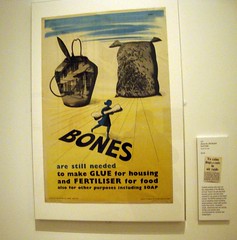
kitchen front cafe ministry of food iwm london bones ministry of food iwm london
Forget what Gordon Ramsay told you about saving bones for stock making (Kitchen Front IWM cafe tray cover); in WW2, bones were needed for making glue and fertiliser (WW2 Ministry of Food campaign poster).

I was born nearly 20 years after the end of food rationing in the UK, a system intended to restrict everyone's (including the royal family's¹) consumption of basic food items in order for there to be a fair distribution of the limited resources² available at the time, due to the destruction caused by WW2. I started school in 1970, and my teachers were likely to have been at least 25 years old or more; even though food rationing was not practiced in NZ, it's likely that NZ was heavily influenced by such an event, since NZ still had a strongly British influence, and her most important trading partner was in fact Britain. Some of my teachers were actually born in the UK (a net exporter of population to Australia, South Africa and NZ in the 70s and 80s).
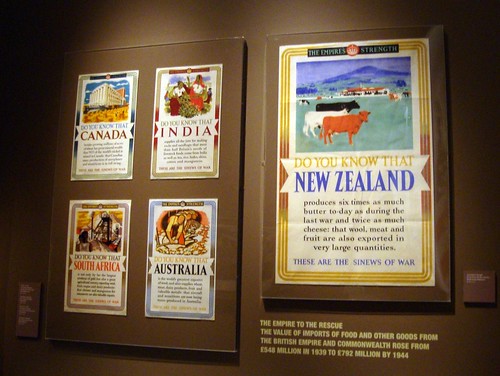
food imports ww2 uk ministry of food iwm
The sinews of war - the importance of the colonies: "In the desperate austerity of the 1940s, the colonies were seen less as fragile possessions to be held in trust than as economic assets to be milked for all they were worth. Administrators who had spent most of their careers cautiously guarding the equilibrium of their colonies now devoted their energies to cash crops, marketing boards, monopolies, rationing and 'Grow More Food' campaigns." (Dominic Sandbrook, Never Had It So Good, 2005)

As a kiwi schoolchild, it never occurred to me that what my teachers were teaching me in Social Studies and what my Domestic Science teachers were teaching me during the cooking classes in manual training, were all partly based on British WW2 experiences. I thought it was simply the outcome of their own high level of education, not the effects of WW2, a concept which conjured up images of Europe and communism, bombed out buildings and Hitler, none of which had much to do with the rolling green pastures dotted with white woolly sheep in the kiwi countryside and the plentiful supplies of cheap New Zealand lamb, creamy yellow butter and frothy full-fat milk. Even my parents thought of their new home as the land of  'του πουλιού το γάλα'³.

protective foods ministry of food iwm london
In WW2, vegetables suddenly came into fashion, and have been ever since - but you can't live off those alone: "No one carried a pound of superfluous flesh, in spite of the vast quantities of starchy food. They expended every ounce they ate in work... Vegetables and fruit were eaten because they were good for you, but it was the bread, potatoes, meat and floury puddings which staved off exhaustion." (Colleen McCullough, The Thorn Birds, 1977)

Tthe Ministry of Food exhibition at the Imperial War Museum in London was a deja vu experience for me; I discovered my educational roots. The Ministry of Food exhibition hows how the British public were re-educated to change the way they thought about food in post-WW2 Britain. This had long-lasting effects, and not just in the UK alone; the WW2 Ministry of Food's campaign influenced the farthest outposts of British colonialism.

Visiting the exhibition helped me to piece together the jigsaw puzzle of my own personal food history. For instance, why did I scold my mother when she cooked a potato dish and served bread with it?
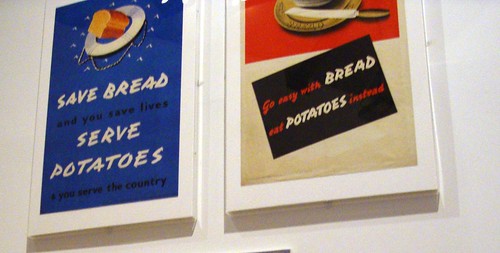

Why did I insist (in those days) that brown bread was healthier than white bread?

national loaf ministry of food iwm london
Brown bread - you either loved it or hated it, as the quotes attest.

Why did she show disgust when I bit into my apple with the skin on, or boiled potatoes without peeling them?
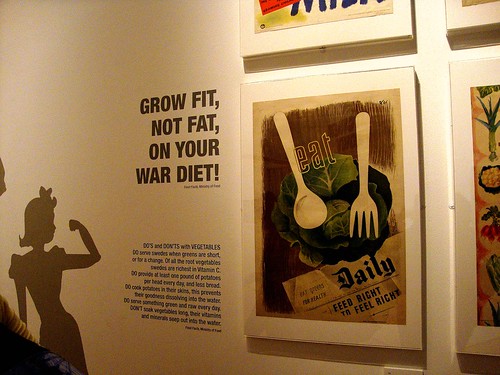
dons and donts ministry of food iwm london
WW2 food Dos and Don'ts: an image of my schoolteachers immediately came to my mind as I was reading these, and I didn't even go to school in the UK.

Why am I trying to force-feed my husband par-boiled vegetables? It's hardly a European habit to eat crunchy raw vegetables, nor is it deemed suitable to leave them all unpeeled. So where did I pick up my non-European ways, given that I was born European (well, that's how the NZ census used to classify me). Do carrots really make your eyesight better? And why do I keep the adage "meat and two veg" in mind whenever and with whatever I'm cooking?

The answer to all of these questions lies in the UK's post-WW2 educational campaign to make better use of scarce resources, now almost a thing of the past in the lands of plenty that the Western world has become, the high level of literacy and education needed to teach old dogs new tricks, and Britain's readiness - having already been through similar problems arising during WW1 - to introduce the food rationing system efficiently and effectivelyª.

*** *** ***
The consequences of WW2 destroyed the food chain throughout the whole of Europe. Some countries, like Greece, had lost all the infrastructure needed to distribute food to all the population, hence many people starved. Being essentially an island, Britain was cut off from her crucial food supplies by the sinking of her ships. Due to a lack of food during and after WW2, food rationing was in force in Britain from 1940 until 1954. In order to obtain basic food supplies, everyone had to have a ration book which they had to use at the grocer's that they were registered with; they could only purchase food items (including clothing and tools) with their ration book, and only in the amounts that they were legally entitled to. Children, pregnant women and labourers were given extra rations. Even vegetarians were catered for and given extra egg and cheese rations.

a week's worth of rations ministry of food iwm london
The photo shows a week's worth of food rations, as well as the Queen's ration book.

The government created the Ministry of Food (hence the name of the IWM exhibition), which served to fairly distribute all the food in the country (both local produce and imported products) to all the people in Britain. It also had another more important task: to re-educate the import-dependent British people to produce their own food (and therefore reduce imports), eat seasonally, recycle and not waste. It all sounds familiar, doesn't it? Except that in those days, there were no supermarkets or refrigerators.

food imports ww2 uk ministry of food iwm
UK food imports: the most carbon footprint laden are tea, sugar and rice, each one needing up to 11,200 miles of travel to get to the UK: "... lamb and butter from New Zealand, tea from India, chocolate from Nigeria, coffee from Kenya, and apples, pears and grapes from Africa... [and] toys that were identified as 'Empire Made'." (David Cannadine, Ornamentalism, 2001)

After WW2, the food situation actually worsened rather than improved, since the US stopped sending food supplies to Britain. Soldiers came home, families grew; there were more mouths to feed:
Britain in 1945... Meat rationed, butter rationed, lard rationed, margarine rationed, sugar rationed, tea rationed, cheese rationed, jam rationed, eggs rationed, sweets rationed, soap rationed, clothes rationed. Make do and mend." (David Kynaston, Austerity Britain, 2007)
Without limitations on the amount for each individual and an emphasis on the importance of maintaining a vegetable garden, Britain would have found it very difficult to feed her people. A fortnight after the end of WW2, the government made it clear to the people that "Every inch of useable English soil will still have to be made to grow food" (David Kynaston, Austerity Britain, 2007).
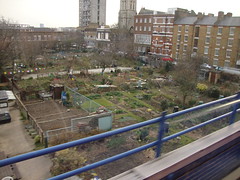
allotments dlr to lewisham gatwick to london allotments
Allotments were made use to the full during and after WW2. I can feel the pain of the owners of these ones (left: from the DLR to Lewisham (Mudchute??); right: from the train to Gatwick): when you don't live near your patch of land, it is difficult to tend it. The colour of the sky also dampens your mood (pun not intended). They remind me of our orange orchards and olive groves, 10km away from our house - our summer garden is a different story altogether.
farmer jim

A high reliance on food imports is now viewed as highly unsustainable due to the carbon footprint-laden food miles; the idea of a poor country providing food for a rich country is also contentious. It seems incredible that 70 years ago, a country as advanced as Britain was able to provide only a third of the food required to feed its own population (around 46 million at the time), relying heavily on food imports, whose transport to the UK required long sea journeys from the colonies.
We all think and talk about food eternally, not because we are hungry but because our meals are boring and expensive and difficult to come by... what I wouldn't give for orange juice or steak and onions or chocolate or apples or cream. (1941 diary extract, quote from the Ministry of Food exhibition)
Throughout Britain's history, food was always imported to keep people fed; food imports have been a crucial element of Britain's food supply since the industrial revolution. From the colonies, Britain acquired a liking for exotic tastes that local food could not provide, especially for what has often been termed as the Brits' 'insatiable desire for something sweet': the ease of importing novel (and tasty) food into Britain created a certain dependence on them, as in the cases of tea and sugar.

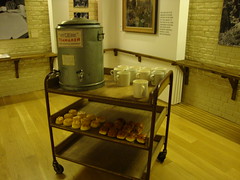
celebration tea ministry of food iwm london time for tea ministry of food iwm london
The exhibits in the photos above were the most nostalgic for me. They reminded me of the plain-looking (but tasty) cakes and biscuits we ate during a morning or afternoon break in tea-houses (aka cafes) when I lived in Wellington in the 1980s. They represent a period in time that we cannot return to, before lattes and cappuccinos.

This kind of dependence can easily become a cause for war, and it isn't only in the past that food was being used as a weapon. With fewer imports now available, the daily British diet was radically changed with the introduction of food rationing. All of a sudden, milk and eggs were replaced by their powdered substitutes; fresh eggs were limited to one a week and fresh milk was allocated to those who needed it most (mainly children). Since people had never used these powders to cook with before, they had to be 'taught' to use them appropriately, which is where the powerful role of education and literacy came into play, via pamphlets, radio broadcasts, demonstrations, newspaper advertisements and posters, all of which were prepared by the Ministry of Food.
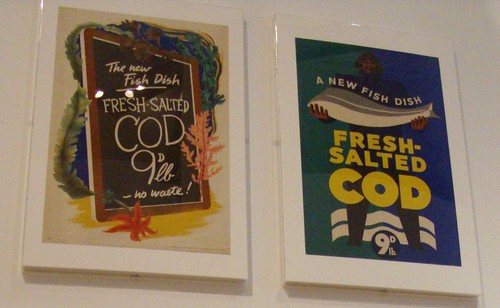
salt cod ministry of food iwm london
Fish wasn't rationed, but fresh fish was hard to find. Salt cod was a relatively new product for the British; people were, once again, 'taught' to use it.

Complaining about the tastelessness of egg powder did no good when there was no alternative. Even the weekly allowance of one fresh egg per week wasn't always easy to get hold of, for example, when there was a strike; not everyone was happy about the political and economic situation at the time, even if the war was over. All meat (except chicken) was strictly rationed. Fish wasn't, but it was expensive and hard to come by. Canned goods were also allocated by rationing. Fresh fruit and vegetables were eaten by those who had an allotment or used their garden to grow them; otherwise, people had to queue up to buy them when they were available. Bread and sweets were also rationed on and off. Everyone ate the same food, cooked in the same way, for nine years.
Meat ration lasts for only three evening meals, ... that is Saturday, Sunday, Monday. Tuesday and Wednesday I cook a handful of rice, dodged up in some way with curry or cheese. But the cheese ration is so small there is little left. Thursday I have a pound of sausages. These make do for Thursday, Friday and part of Saturday... All rather monotonous, but we are not hungry... (diary extract, quote from the Ministry of Food exhibition)
The end of the war only made the rationing situation worse, when the US stopped supplying food to the UK: "there are bad times just round the corner," a politician of the time warned. Food rationing has been blamed for the decline in British cuisine and people's interest in cooking. The above account gives a grim view of the food situation. People could not really enjoy their food; they ate to sustain themselves.
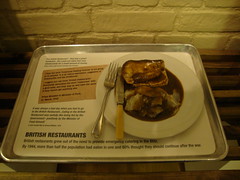
british restaurants ministry of food iwm london school dinner ministry of food iwm london
At the risk of sounding ignorant, I have not the foggiest idea of what is being pictured here (can Jamie Oliver?), and neither does it look particularly appetising.  Was food rationing to blame for the lack of attraction to/in the British cuisine, or was it simply a result of Britain's main interests lying away from the land, home and hearth, so that most people were occupied with other business and not with food? Well, I guess we can definitely say, by looking at these photos, that British cuisine has no influence whatsoever in Greek cuisine...
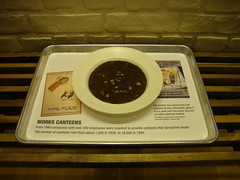
canteen rubble clearing canteen ministry of food iwm london rubble clearing canteen ministry of food iwm london

In amongst the misery, there are also many positive aspects of the WW2 food rationing system. It helped people to develop the qualities of living in a fair world where everyone patiently waited until it was their turn for something, so that no one couldn't say they were given an equal chance to survive:
The British prided themselves on their ability to form an orderly queue; they had plenty of opportunities to prove it. (Dominic Sandbrook, Never Had It So Good, 2005).

We did think that once Japan was beaten, we should do away with queues, but it doesn't seem like it. Yesterday, I queued 1/2 an hour in Woolworths for some biscuits... The fish problem seems to be a bit better here - it isn't quite so rotten, although the queues are still there (Muriel Bowmer, In: David Kynaston, Austerity Britain, 2007).
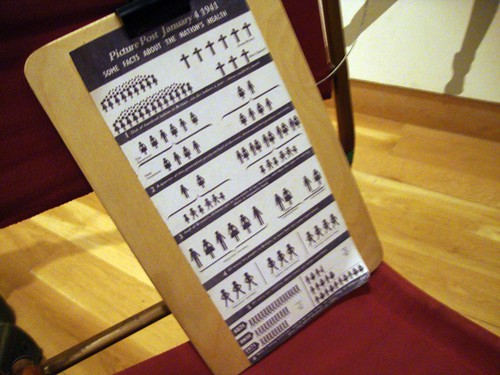
Queuing - ie, waiting for your turn when it came up - is what I remember most about the years I spent living in New Zealand, everyone's right to a fair share of everything, their rightful share of the pie, a concept that was pretty much shattered for me when I first came to live in Greece in 1991º, where some people seemed to be getting a huge hunk of it, while others never even saw it.

nhs health chart ministry of food iwm london
The nation's health: the NHS was established in 1948 during the rationing period:
"During the war, although there were privations and shortages, people generally had a good diet. When the war ended, it was found that the average food intake was much higher than when it began... with virtually no unemployment and the rationing system, with its fixed prices, [poor people] ate better than in the past... People at all levels of society took nutrition seriously and ate sensibly with the rations and whatever vegetables and fruit were available, and with less sugar and fewer sweet snacks there was less tooth decay. As a whole, the population was slimmer and healthier than it is today; people ate less fat and sugar, less meat and many more vegetables." (Jill Norman, Eating for Victory, 2007)

But all that talk of vegetables being good for you, digging for victory by growing your own, recycling to reduce imports, is all by the by; this propaganda served its purpose (to make you feel guilty, just like the carbon footprints ideology in today's society), but was readily forgotten once the good times came back.

war on waste ministry of food iwm london
In through one ear and out through the other: how much food do you buy and chuck out?

Rationing's success lay in its effort to maintain the whole nation's health with everyone getting the due attention they needed. Obesity and tooth decay were practically unheard of, everyone had access to food and no one starved; everyone's voice was heard, from the baby to the pensioner, and everyone was taken into account, from the vegetarian to the cats and dogs.

*** *** ***
Rationing finally came to an end almost a decade after the war was over.
'Almost at once,' wrote Harry Hopkins, 'affluence came hurrying on the heels of penury. Suddenly, the shops were piled high with all sorts of goods. Boom was in the air.' (Dominic Sandbrook, Never Had It So Good, 2005).
It has been suggested that rationing could be re-introduced in modern times, for the purposes of living in a more environmentally-friendly world:
"I'm afraid you've reached your monthly allowance of Kenyan green beans, Sir - you'll have to buy locally grown ones from now on. The last truckload we saw of those came in last week..."
... or perhaps as a way to curb obesity:
"Sorry, Ma'am, I see you've been classified under the Big O category - I'm afraid you've used all your bacon rations for this month, so you can only buy low-fat turkey meat for the next fortnight!"
... or even just to maintain the community spirit: To promote the idea of people registering with a local food supplier, they might be given incentives such as fixed prices, discounts, and the like, for similar reasons as when you have a neighbourhood butcher or grocer where you do your regular shopping, in order to give small businesses a better chance to survive and to provide a kind of 'neighbourhood watch' service:
"'Ello there, Mrs Patel, sorry to 'ear about your 'usband. Was a good man, weren't 'e? Well, I see your sons' been taking good care o' you. The older one popped in yesterday, axed me if I'd 'ad your OAP milk rations sent to you, an' I told 'im I did. Good lad, 'in 'e?"
In the market-driven economy that we all live in, it sounds highly unlikely that it would be accepted by most...

But it did work in WW2 Britain, and I cannot help but look upon the food rationing system in great awe, when I know that no one starved in a country that could not even feed her own people, as they did elsewhere. They patiently waited for their turn to pick up their weekly rations, and never forgot to say their good mornings, pleases and thank yous (as they still do), and always remembered to queue, whether it was raining or the sirens had just gone off warning of an air raid, or a V2 rocket had just landed and shaken the ground beneath their feet, the food queues always being the last to disperse.

Moving photos adorn the walls of the exhibition: the milkman carrying a crate of full bottles of milk, walking amongst the rubble of a bombed London suburb; a mother of 16 children, looking at all the ration books of her family members, working out her food needs for the week; the queue of people at a bombed fishmonger's premises. There are lessons to be learnt from the food rationing system in the modern world amongst the beleaguered nations in the present economic crisis: to weather the storm, it is not enough to take measures, one must also wait their turn. If only things could have been like this for the Greek people during WW2. Sadly, despite the food-rich world that they lived in, many Greeks died of hunger during WW2. We can't change the past, we can only learn from it.

¹People noticed that the royal family's faces always looked rosier than the rest of the population's: "... Mary King managed to get near to the car of the visiting King and Queen: 'She looked a little too matronly for her age. Considering the rationing... she certainly looked well-fed.' " (David Kynaston, Austerity Britain, 2007)
²The black market was thriving for those who had the means (ie money) and the right connections: "... the black market... - including off-ration and under-the-counter sales as well as tipping and favouritism - were at least as extensive after the war as during it; ... I suspect there's more dishonesty in this country today than for many years." (David Kynaston, Austerity Britain, 2007)
³Bird's milk, in the literal sense; metaphorically, this phrase is used to denote 'abundance'.
ªBritain had learnt some hard lessons during WW1, when food supplies were so depleted that there were only 6 weeks' worth of food in country - the situation bears a great similarity to Greece's recent money woes: most of the time, there is only 6 weeks' worth of money left in the state coffers to pay out pensions and salaries...
ºThings are better now in Greece, but they weren't perfect in WW2 Britain either: "I doubt if a single Englishman did not avail himself of the help of the black market." (Diary extract, In: David Kynaston, Austerity Britain, 2007). Everyone will grab a chance when offered it, won't they?

*** *** ***

I rounded off my visit to the exhibition with a meal from the Kitchen Front - the museum cafe (coincidentally voted by radio listeners in 2008 as one of the best museum cafes in London) had been given a facelift to coincide with the Ministry of Food exhibition, selling WW2-inspired foods.
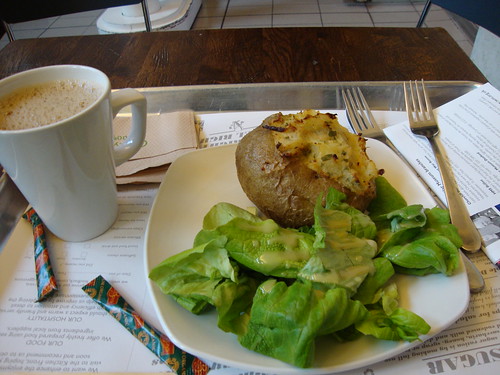
ministry of food cafe iwm london

I had the baked potato with kipper stuffing. Potatoes are easy to grow and store in the UK, and were promoted as a 'protective food'. Fresh fish wasn't on the ration, while lettuce (but without the vinaigrette, of course!) could be grown in the garden or even above the bomb shelter by the tenant/owner of a house, so this meal could be said to be very ration-friendly. Very good indeed; possibly boring on an everyday basis (the main problem with Britain's WW2 rations), but tasty. I also fancied a slice of that beetroot cocoa cake on offer, mainly to compare my muffin version with the cafe's, but passed on it, since I had to keep plenty of extra space in my stomach for... (the post on that is coming soon).

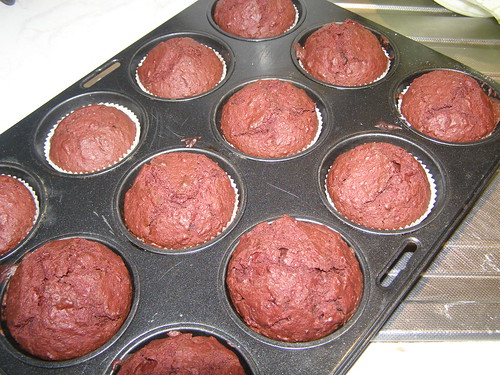
chocolate beetroot muffins
My chocolate beetroot muffins - a good way of incorporating fresh vegetables in sweets and cutting down on ingredients that were difficult to access during the war.

If I had to mention a minus point about the exhibition, I'd say it was the amount of white spaces on the wall; I would have liked them to be covered with more quotes and newspaper clippings. The Imperial War Museum offers entertainment and knowledge for all ages and interests - we've visited the museum three times already  as a family! Look at how my own family was entertained while I went to see Ministry of Food exhibition:

The children were guided through the WWI
Terrible Trenches, and my husband got a chance - by special arrangement - to handle his favorite toys:
terrible trenches iwm london weapons repository iwm london
(The Terrible Trenches - thanks to lego for the photo - is a specially designed children's exhibition; the WW2 weapons on the table were laid out for Mr OC's enjoyment - thanks to Paul Cornish at IWM)


We were also greatly amused when the young man at the welcome desk of the museum, after patiently listening to me as I explained in English which tickets we wanted to buy for which exhibitions, replied to us in Greek; we can be found all over the place, can't we!

And special thanks to Cynthia, who provided the motivation for my whole trip.

©All Rights Reserved/Organically cooked. No part of this blog may be reproduced and/or copied by any means without prior consent from Maria Verivaki.

Sunday, 18 April 2010

Colourful dips (Χρωματιστά ντιπ)

I can generally do without meat, but I find it very hard to go without cheese and milk. Hence, I never fast in the strictest sense during Greek orthodox lenten periods, because I just find it too difficult to do so. How on earth I managed to do it in the past, even for a week or two is beyond me. Dairy products are part of my family's life nearly every day.

Since our summer holidays in Northern Greece, we've been slightly overindulging in Greek dips made with cheese or yoghurt. Here are some of our discoveries of good Greek cheese and milky dips. They are perfect during the warmer weather for a light lunch, and especially now that summer is near us.

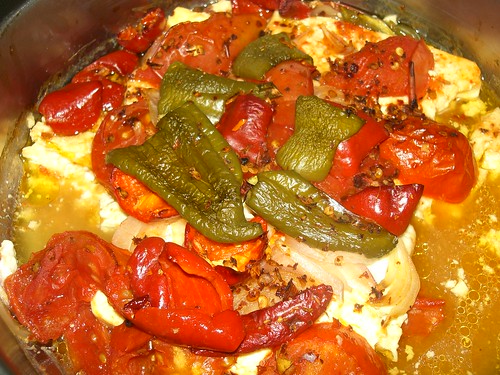
Bouyiourdi
- feta cheese, tomatos and peppers, cooked till melting consistency, and topped with chili flakes.

CIMG8787

Galotiri - a mild milky dip from Central Greece with a taste resembling cottage cheese, using both cheese and yoghurt, sometimes also called pseftotiri (= fake cheese), as it is a quickly made cheat's version of a kind of curd cheese, also called galotiri, made in Central Greece.

galotiri

Htipiti - a Northern Greek hot feta cheese dip using roasted red peppers and chili peppers; htipiti (lit.: beaten) is also known as tirokafteri (lit.: hot cheese) or kopanisti (another word for 'beaten') in various parts of Greece.

pans and grills ladadika thessaloniki htipiti dolmadakia ladokolla
Tirokafteri (left) and tzatziki (right) served with dolmadakia

Tzatziki - the all-time taverna classic, hinting at reminisces of a summer spent in Greece.

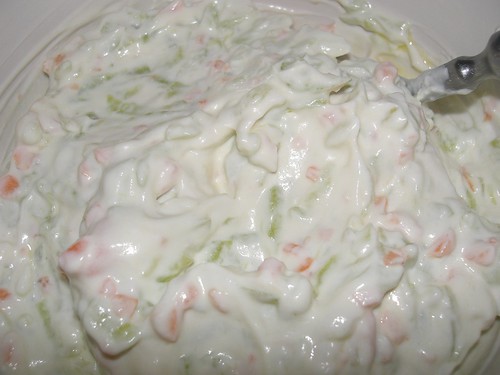
tzatziki with carrot

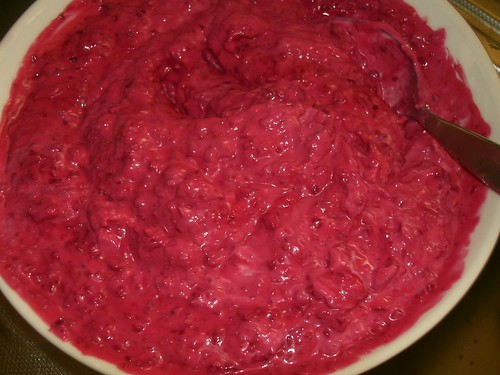
Beetroot yoghurt dip - this is a very refreshing dip similar to tzatziki; instead of cucumber, it contains beetroot, which gives it its intense pink colour. It goes really well with seafood.

beetroot yoghurt dip

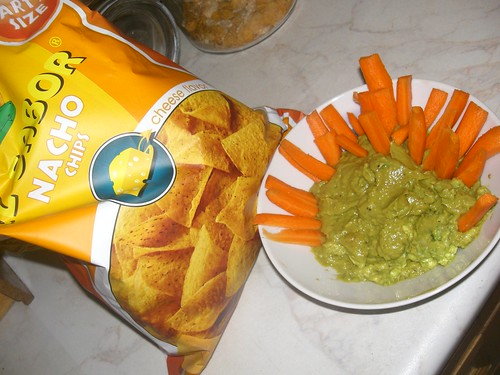
Guacomole isn't traditionally made with yoghurt, but it is another great dip that can take on a Mediterranean flavour with a dairy addition, turning it into a green version of tzatziki.

guacomole and nacho chips

And finally, melitzanosalata (eggplant dip) can also be added to this list; it isn't strictly a milky dip, but it can also be made with the addition of yoghurt for a creamier taste and texture.

©All Rights Reserved/Organically cooked. No part of this blog may be reproduced and/or copied by any means without prior consent from Maria Verivaki.

Thursday, 15 April 2010

Acquired taste (Eπίκτητη γεύση)

This post forms part of the series of our culinary adventures from our recent trip to Paris and London.

Pretend you are nine years old, and have been raised almost exclusively on a culturally inclined cuisine defined by home-cooked meals: what does it feel like when you enter a cultural anomaly and are told: "Eat this 'cos that's all there is to eat"?
*

Sometimes I completely forget I'm hungry. Like today, when we went from one adventure to another. We started off by taking a train that went under the sea, and when we came back up on the ground...
gare du nord eurostar st pancras eurostar
From the Gare du Nord to St Pancras: no baggage claim or shuttle services to the city centre


... we ended up being in another country, with a different language and weather in just over two hours. When the day is so full of so many new sights and sounds, and so many buttons to press...

flight control deck science museum imax science museum
Science Museum flight control simulation; IMAX theater

... when it's all over, I just want to sit down somewhere - anywhere - and rest. If I don't find a chair, I'll just sit down any old place, and I won't notice if it's dirty or cold, which is why my parents have just got annoyed with me.

"We're on the street!" my father began to shout, which would have sounded silly to a passerby because it was pretty obvious where we were.

"Well, there's no chair anywhere!" I replied. "Let's go somewhere where they have some!" I was almost crying now. We'd been walking around for a while and I was feeling very tired. That's when it suddenly hit me: the last time I had eaten something was long ago enough for me to be feeling very, very hungry right now. And ditto for the toilet, where at least there would be a place to sit.

"I have to go." I looked at my mother hopefully. This one usually works.

"We'll be getting there soon," she answered.

"Where?"

"You'll see." When she says that, it's because she can't point to the place where we're heading, and I know we'll be walking for even longer. "And it will have a toilet," she added, for reassurance. We had just come out of the underground. I preferred it down there, even though the walls always made me feel like I was in the biggest bathroom in the world, with all those plain block-colour tiles. If you touch them, they feel as cold as the tiles covering the walls of a restroom.

tube exit sign
This exit sign reminds me of a bathroom mirror.

Even if you don't manage to get a seat when you get on the train and you end up standing for the whole journey, at least you can be guaranteed of finding a seat once you get off the train, because all the people waiting at the platform will have jumped into the carriage you just left and no one will be there, so you have the whole place to yourself.

paris metro
It does not get any more comfortable than this - a furniture store advertising their wares in a Paris metro station; we waited for the second train just so that we could all rest our tired feet here. When you're on holiday, you're in no hurry.
paris metro

We were walking along a street with many shops, none of which seemed to be open. Mum was taking photographs every now and then, but I couldn't see anything special. All the buildings were similar, and they looked kind of old. They didn't have a lot of colours, just a lot of brown. And we just kept on walking along these dull-looking roads, as if we didn't have a home to go to. It was getting dark, and I really didn't feel like walking any more. It was time to be somewhere nice and warm.

muslim centre whitechapel road islamic bank whitechapel
Having been raised in an enclave of a minority culture among a dominant white class, I felt at home in Whitechapel. The locals are also more likely to be family-oriented, hence, in our case, we fitted in quite nicely ...

"When are we going to sit down?" I whined. Mum and Dad were smiling and laughing and talking with Uncle, while they looked around at the old brown buildings. They weren't paying me and my sister much attention. We may as well have been wearing invisibility cloaks. There were plenty of restaurants and places selling food on the street, but with Mum and Dad, it always has to be a specific one, not just any old place. As we passed the food places one-by-one, I could smell what was coming from behind their doors, but I could not quite place the food. I couldn't tell you if it was meat or vegetables or spaghetti or rice. These smells were new to me.

*** *** ***

We finally went into one of the buildings, where it was lovely and warm. Now the aroma of the food began to hit my nose with quite a smack. I was dreaming of makaronada. I ate makaronada every day in Paris, and it was really good. From what I know, all restaurants serve makaronada. I hoped the one served here was going to be as good as the one I had in Paris.

We walked upstairs and a man showed us to a table in the corner. He passed us some menu cards, then he went away. Mum told me that since we were going to be in England now, I would be able to read and understand everything on the menu card, unlike in Paris, where I didn't understand anything because it was in French, and only Mum knew French, so she ordered everyone's meals there. But when I looked at the menu card, the only words I could understand was the word 'Drinks'. It's not that I couldn't read what was printed on the card: the first two words were papadom and samosa, but I couldn't imagine what they were. Everything looked Chinese to me**. As I looked around the restaurant, I began to notice that some other things were also not quite right, because I couldn't hear anyone speaking in English, either, not even the waiters.

"Where does it say 'makaronada', Mum?" Mum gave me one of those looks which I understood Linkimmediately - I knew that no matter what she tried to do for me, I would be disappointed.

"They don't do makaronada here," she explained apologetically, "but they have lots of meat dishes, and plenty of pilafi***." She spoke in that way of hers that she has when she tries to get me interested in eating something I don't know, or something that isn't white.

"I just want the pilafi, Mum, you know that. And don't forget to ask for some yoghurt," I reminded her. We once had pilafi in Athens, but the people who made it said that they didn't eat yoghurt with their pilafi, and since they didn't have any yoghurt in their fridge, I had to go without; I can't remember if I ate it on that night, but Mum says I did, so I suppose I must have been very hungry. Just as I'd mentioned the yoghurt, a chubby man came to the table carrying a bottle of water and two small dishes filled with coloured food. He placed them on the table and left us again without saying a word.

raita and green salad lahore kebab house
Raita and salad

"Finally!" My sister made a grab for the lettuce in one of the dishes. She eats everything I don't eat, and she sometimes likes the kind of food I like. But unlike her, I never forget to use the cutlery provided. She's smaller than me, so I suppose she's worried she'll be the last to eat anything, so she makes a grab for the food before she goes for the cutlery.

"Why didn't they bring any bread with that?" she asked. "How are we going to eat the tzatziki?" That didn't stop her; she picked up her knife, dipped into the bowl and licked off the yoghurt.

Well, at least they have yoghurt, I thought. I asked Mum if she could tell the waiters to bring some plain white yoghurt because this tzatziki looked spotty. She told me it wasn't on the menu, and we can't ask for food that isn't written on the menu card.

"But don't they need yoghurt to make tzatziki?" I complained.

Mum looked at me squarely. I knew this look of hers, too: it means "Gosh, you're SO clever" and it usually means that she can't fool me. She tried to comfort me in my confusion. "Everyone makes their yoghurt in different ways, dear, and this one's practically the same thing as what we eat at home."

I was not that easily convinced. "It's got black spots in it. Can I ask them to bring some of this without the spots?" I was beginning to panic over the lack of white food on the table so far.

"Mmmm, the tzatziki's nice," my sister said, dipping a lettuce leaf into the bowl, and licking her fingers after she ate it. "It's different to real tzatziki, but it's still nice."

I was tempted to try it (the tzatziki, not the lettuce - I don't do greens, thank you), but I decided to wait till the pilafi came. But even if I did want to try it, I don't use my fingers like my sister does, and there were only knives and forks on the table. My sister was right: where's the bread?

Quite a while had passed, and no more food had come to the table. "When's the pilafi coming?" I asked Mum.

"I'll order it when the waiter comes," she replied.

"We still haven't ordered?! When's he going to come, then?"

Mum sighed. "He'll come when he's ready. He's very busy. Look at all these people coming in now."

The restaurant was filling up very quickly. A whole lot of people had come in together and they sat in the middle of the room, where there was a long line of connected tables. They all looked like they all came from one big family. There were old men and women, younger men and women, and lots of children. But they too didn't look as though they spoke English; some of the woman wore colourful clothes, they all wore lots of rings and bracelets and necklaces, and they didn't have white skin.

I had an idea. "I can tell the waiter we're ready to order, Mum." I knew who the waiters were. They were all dressed in black trousers and black shirts. Too much black, I think. I preferred the waiters in Paris, with their red waistcoats and white aprons.

"You can't do that!" Mum scolded me. I couldn't understand why I couldn't. We had come here to eat, and in my case at least, I wasn't doing that. I was bored and tired. That's also another moment when I remember to go to the toilet. It gives me something to do. My sister decided to join me.

"Do both of you need to piss at the same time?" No one understood her using the Pee-word, because they weren't Greek. "Can't you wait until we've ordered?"

"Why haven't we done that already?!" Normally, she lets us go to the toilet on our own, but this time, she made us wait, and told us something about being visitors in a foreign country, and how we shouldn't do things like that on our own. I can't understand that one, since all toilets are there for the same job. But maybe it's a good idea, because we're not in our country and somebody else might be in the restroom and say something to us, and we wouldn't understand them (especially here where they weren't speaking English), so we waited. Eventually, a waiter finally came to the table, and Mum and Uncle began ordering the meals. I wondered how long it would take to bring the food after all that waiting, because now I knew for sure that I was definitely feeling hungry, and not so much feeling like a pee after all.

mango lassi lahore kebab house
Mango lassi

The first thing that came to the table was a large jug containing an orange drink. Milkshake, Mum called it. She knows I only drink chocolate milkshake, so I can't understand why she didn't order it in the first place, and I didn't appreciate the joke she was playing on me, especially when I'm feeling very hungry, like now. Everyone looked to be enjoying that orange-coloured milkshake, while all I had to drink was water.

"Are you sure I'm going to like the food, Mum?" I was beginning to have my doubts after the spotty tzatziki, the salad greens (the only greens I do are in spanakopita) and the orange-coloured milkshake.

"Son," my father turned to talk to me, "you are sometimes indefatigable, you know that?"

"No, I don't, because I don't know what 'indefatigable' means." I don't like it when people call me names, especially names I don't understand.

chicken kebab and lamb kofta lahore kebab house
Spicy chicken and kofta kebabs

Eventually the waiter returned, carrying two plates with some things on them, the likes of which I had never seen before.

"Here's something you'll like: chicken souvlaki! And sausage!" Mum placed an orange-coloured cube on my plate and called it 'chicken'. I don't know why she was lying to me; everyone knows that chicken is white, not orange, and souvlaki has a stick in the middle, which neither of these two 'souvlaki' had.

"Well, look at your sister," she said, turning to look at her. "She's eating it, and she seems to like it." Just as Mum had said that, the peace that was already crumbling at our table was suddenly extinguished completely by my sister's shrieks.

"Water, water, water, water, WATER, WATER, NOW!" I knew it; nothing would be safe in this place. While Dad tried to calm her down with some of the milkshake - the water had run out, because she ended up drinking it all and her mouth was still on fire - Mum tried to convince me that it was only the sausage (with the hole in the middle) and not the orange chicken that had caused my sister's eruption, because the orange chicken was only mildly spiced, which basically amounts to saying that it contains only one bottle of pepper and not two, in my opinion. When the drinks ran out, all my sister could do was use her hand as a fan in front of her mouth. Her hand was rapidly flapping up and down in front of her face, to no avail; she was still feeling the sting from the burning.

"I'm not having any of it!" I cried. "And sausages don't have holes down their middle, either!" I hate it when I can't recognise any food on the table; it was pretty obvious that this food was not the food my mother was pretending it was. "The pilafi had better be white!" I threatened.

hot food lahore kebab house
All of the dishes pictured here - lamb chops, potatoes, meat stew and meatballs - were very hot and spicy, totally child-unfriendly; if you don't like your tongue burning while you eat, then you would have found most of it unpalatable, save the naan bread and steamed rice.

Slowly, more food began to arrive at our table, but nothing was familiar to me. I didn't try any of it, just to be on the safe side, especially since I could hear the word 'hot' floating around in the conversation just a tad too often for my liking. It's not fair, I thought. Food, food, everywhere, and not a bite to eat. Do you know what it's like to watch everyone eating and enjoying their meal, while you yourself can't find any pleasure in any of it?

At least Mum wasn't lying about the pilafi - it was just how I liked my food: white. And it tasted OK without the yoghurt. The bread wasn't too bad, either.

Jamie Oliver can rant and rave as much as he wants; if kids don't like it, then they won't eat it, no matter how healthy or tasty it is made out to be.

*** *** ***
I felt dreadfully guilty that my children weren't able to enjoy the meal at the Lahore Kebab House, a Pakistani restaurant in London, so I tried to make up for it afterwards by buying them dessert in a nearby cafe, which turned out to be owned by Bangladeshis****. This place had a kinky feel to it: For a start, it had some private cubicles on one side of the room especially reserved for mothers, women and families, which could be sectioned off from the view of the other customers. Then there was the matter about closing time, which we thought was rather early (10pm) - the staff kept reminding us (the paying customers) that they were closing 'in five minutes'...

bangladeshi dessert cafe whitechapel
Note the well-groomed ladies at the counter, wearing traditional sari-style clothing: appearance is very important in minority cultures; they may look different from the majority, but they're more concerned about the opinions of the minority looking at them.

South Asian food is not really so different from Greek food. The Pakistani meal looks Greek in appearance (especially if the crockery was different). We eat a lot of barbecued meats and red stews; the main difference between them is that they contain a different blend of herbs and spices, and Greek food is generally not hot and spicy. As for the sweets, I was able to pick out the desserts that resembled Greek-style funnel cakes and halva. 'Indo-European' has a wider significance than language groups; it can be used to refer to the cuisine of this historic family.

bangladeshi dessert cafe whitechapel bangladeshi dessert cafe whitechapel
Thankfully, none of the desserts were hot (the box contains a variety of halva and funnel cakes), and the children also found something familiar to them in their favorite colours.

All's well that ends well, but next time I have the opportunity to go to a place like this one, I'll make sure the kids have had a meal they enjoy beforehand. It's very hard to convince children that their tongues aren't really on fire, especially when you know your own mouth feels like Mt Vesuvius before it erupted...

*Via Karen Resta
**Understandably, the Greeks don't say "it's all Greek to me".
***Plain white rice, the kind served in Asian restaurants to accompany other dishes.
****As a novice, I couldn't really tell the difference between the Indees/Parkeys/Dessies, although it pays to know this kind of information when walking around in Londonstani in order to avoid mistakenly calling everything "Indian".


©All Rights Reserved/Organically cooked. No part of this blog may be reproduced and/or copied by any means without prior consent from Maria Verivaki.

Monday, 12 April 2010

Market share (Το μέρισμα της αγοράς)

Just before we get to London...

Cat Cora recently came to Hania and sampled our cuisine. A brief report was recently provided by a Cretan news site:
"Cat visited Chania for the first time, and after a short walk in the villages and downtown, she visited the Municipal Market and got impressed by the local traditional products and the authentic Cretan cuisine, such as kaltsounia with fennel, “lapathodolmades” and the local cheeses... She also promised that she will come back soon to Crete along with a group of chefs, to meet the food particularities of the place... It’s a good chance to inform the Americans about the Cretan diet and cuisine. The cuisine of Chania could even have its own brand name, such as cherry tomatoes from Santorini or the Lesbos ouzo”, she said."
Here's a chance to market Cretan cuisine by a renowned American chef of Greek heritage. But hang on a minute: Isn't Cretan cuisine well known in the global food world? Well, I thought it was. Since the 1960s, the virtues of the Mediterranean diet have been expounded on the scientific, health and culinary world. There are also some PDO products being made, which are specifically known around Greece; Cretan cheese is represented in Greece by such PDO brands as Graviera and Xinomizithra, and there are also a variety of dishes which are specific to the region of Hania itself, such as boureki and xidato, so the cuisine of Hania already does have its own 'brand' name*.

The article also mentions Cat's introduction of the fusion cuisine term “Hellasian”, a rather unfortunate word used to denote the mixture of Greek and Asian cuisine: aside from the undesirable connotations of the first four letters of the word (horrify yourself by googling the search string!), the cuisine of a single country probably doesn't easily fuse with the cuisine of a whole continent. I don't think it will catch on too quickly.

But then, I am not a marketing expert, while Cat Cora is a celebrity chef in the USA, a country which supports culinary revolutions, culinary creations and culinary marketing. She could do for Greek (or Cretan) cuisine what we are not doing in our country and need to do in order to survive in the competitive world: she could use her fame to sell us, she could help us to win our market share.

What do people know about Crete? Probably our best known image is as a holiday destination for Northern European tourists: sun, sand and sea. And high quality fresh seasonal produce. Most people know about our olive oil (which sadly is not generally marketed as such, but by more generic names like "Greek" and, believe it or not, "Italian"), but very few other fresh Cretan products leave the country and make it on to the shelves of the countries where our tourists are from. The reasons for this are manifold, involving transportation costs, quantities grown/produced, the high cost demanded for such products, politics and the lack of a market image. But that's what living in the 21st century is all about - how to secure a share in the global market, so if we don't get this aspect under control, we will be in serious trouble (as if we aren't already).

One of the problems involved in marketing ourselves is a lack of substantive interest, knowledge of world markets and cooperation on the part of the producers. Small farms and local producers are not able to or are unwilling to compete at an international level; some are content to sell on the local market or to a wholesaler, and that's as far as they are prepared to go. They generally do not invest their earnings (or the subsidies they specifically received for this purpose) in their business, nor do they do further research into new market niches. I'd like to believe that this is changing, but sadly, it isn't. People are still trying to work independently, blindly believing in the sustainability of tradition, too blind to see the new traditions that are being created right before their very eyes (the traditional kafeneion is a good example). There are exceptions to the rule, but they are still too not on a large enough scale to make a difference.

Nevertheless, Crete is one place in the Mediterranean that produces, and has the potential to produce, a great variety of comestibles, so the lack of a Cretan profile in the global food market is an great hindrance in her advancement. We produce the goods, but lack the know-how to get them where they are most wanted. Tourist surveys conducted in Greece have found that tourists would like more information and access to Cretan produce; while we're swatting flies, Holland is considered the largest citrus fruit market in Europe (they don't produce any themselves, but centralise the goods in their own country where it gets re-distributed).

*** *** ***

If Mr P were to hire me to think up of an image of Crete to promote and advance Cretan produce, what would that image, which will eventually be encompassed in a logo, be? Whatever it is, it has to be instantly recognisable. The symbol of the shape of the island...

.


... is probably not a good one; only a true Crete-o-phile will be able to remember that one (otherwise, it looks like a distorted sausage). When my son was only four, he was able to locate the blimp that represented his island homeland on an A4-size world map, but that's his homeland, and it is a shape that carries some meaning for him. The more regional one gets map-wise, the less easy it is to recognise the area being shown in the wider sense, which is also why a map of the province of Hania:


as our global symbol is even more ludicrous. Most of us will know what the map of the UK looks like, but when asked to picture the map of Wales or Scotland alone, we probably couldn't do it.

So what do people know us by? An image of Crete that people can file away efficiently in their mind, which they can recall easily when they are presented with sensory experiences, would have to be one that reminds people of how they know us: we need a food icon, combined with the summer holiday ideas of sun and sea:

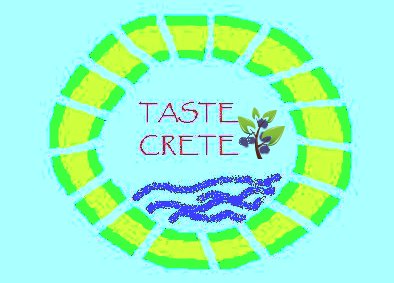
logo

The sun and sea are portrayed by internationally recognisable symbols, while the olive twig with a few purple drupes hanging off it ** is a symbol often associated with oil-producing and/or Mediterranean countries, and one of the biggest producers of olive oil in Greece is Crete. The addition of the phrase 'TASTE CRETE' is the way I think those interested in consuming our products will remember their holiday. The taste of fresh Cretan produce encompasses the sun and sea factor: Cretan produce often 'smells' of sun (in its flavours) and sea (where tourists often consume their food when holidaying in Crete). The phrase is also brief, easy to remember, and gets to the point: by buying fresh Cretan produce, you will get another 'taste' of 'Crete', as you remember her during your vacation. From my own travel experiences, most Northern Europeans have a fair idea about where to find 'Kreta Paradise'; very many of them have come to Crete at one point in their lives on a two-week summer 'package holiday'.

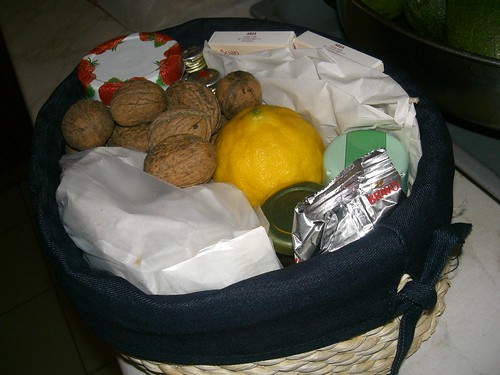
If I had a chance to give someone a taste of Crete, what products would I choose from among my kitchen to pass on to them so that they can pack them in a suitcase and take them with them to their home country, where they would open the package, and the aromas and tastes of Crete would pop out? I recently had a chance to do this for Jo Holland, just before I set off for the cold North...


Due to weight, safety and size restrictions, I couldn't pack everything that I believe would have recreated a sense of that 'smell and taste' experience that I felt best represented Hania, but even then, I still managed to pack some fresh produce into that pretty basket, which Jo found particularly useful; maybe we shouldn't be too wary of Greeks bearing gifts after all, and the country of Greece can become known to produce something useful and sought after, unlike what we have been accused of lately (that we produce nothing and have nothing to export).

Mr P might like to consider how we can get our fresh products out of the country - they aren't perishable or difficult to transport as one might think, and they can tolerate transportation for a good number of days, so they will suffer less from our frequent strike action, road blockages and border closures!

The truth is that it all comes down to numbers in the end: there's few of us, and more of them. We will need to rely on those greater in number, those more organised than ourselves, those that are already well-equipped with the appropriate infrastructure, ready to deal with us, which they will do if we are willing to listen to them and start to prepare ourselves (is take up arms) for the fight for that bit of market share that we deserve.

To find out what was in the mystery parcel, Jo's post, and her fabulous photos - they make my food look better in her house in Blighty than they do in my own...

*Apologies to Cat Cora if she was being misreported. The article reports her interest in 'South American' cuisine, which was probably meant to be read as 'American South' or 'Southern American'. As a celebrity chef, however, she should be no stranger to researching the cuisine of any culture, so she could do a bit more homework before she visits a region, especially one she is herself a part of.
**That's what it is supposed to represent: it was the best I could come up with - I am still learning the ropes of online graphics programs!

©All Rights Reserved/Organically cooked. No part of this blog may be reproduced and/or copied by any means without prior consent from Maria Verivaki.