Monday, 10 November 2008

Cook the Books: La Cucina by Lily Prior (Μαγειρεύουμε τα Βιβλία: Η Κουζίνα - Λίλυ Πράιορ)

This post is part of the Cook the Books blog event running until December 15, 2008: read Lily Prior's La Cucina, and cook something inspired by the book. Post your inspiration on your blog, linking to Ioanna's, Deb's and the Cook the Book blog. For those who wish to participate but can't find the book, I am willing to send you my copy (the first to send me their address at my email: mverivaki at hotmail dot com).

WARNING: this post contains a spoiler - if you don't want to know about the story till you have read it, don't read on post!!

Rosa lived in la cucina throughout her whole childhood, which was interrupted by the death of her first love, Bartolomeo. La cucina was the basis of the whole life of la fattoria which belonged to Rosa's family; this was where her mama found her new husband, after overturning barrels of ale and smashing all the preserves jars which Rosa had so lovingly prepared. It was also where Rosa found solace after Bartolomeo's death; the farm could not produce enough harvests to keep up with Rosa's cooking frenzy after that point in her life. Even after Rosa had left la fattoria, the food she had prepared, using up all her own resources from her trousseau, fed her family and more during the war when food was scarce.

Food and the act of eating were the focal points in Rosa's daily life, governing every part of her body and actions. She referred to her thighs as 'loins' and her breasts as 'watermelons'. Her brothers were the 'fruits of (her mother's) womb'. When her lover tore off her corset which fitted her in the manner of a 'vacuum-packed' food package, he delivered her 'naked form like a monstrous pea from its pod.' When she went into her frenetic cooking mode, she woke up the whole house with her 'nocturnal thrusts as I pounded the dough'. Even the rain was like 'fat slippery drops'. Her eyes 'feasted' on something delectable, while her heart felt 'crushed like a clove of garlic' when she was upset.
PB040002
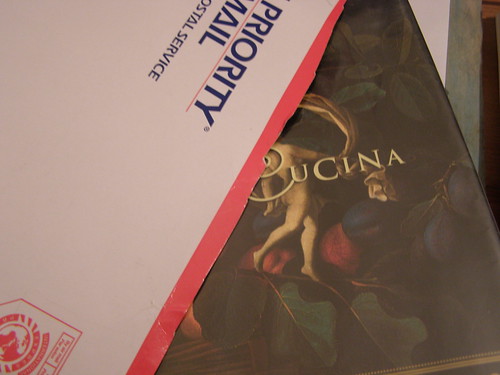
I begged Rachel from Old Saratoga Books to give me her copy of La Cucina for the Cook the Books event.

La cucina was also where the full range of olfactory sensations resided, all the aromas once can imagine pervading the air of a pre-WWII Sicilian kitchen: freshly brewed coffee, nutmeg, vanilla, the milky smell of the many babies mama bore, old leather, sheep's cheese, violets, stale tobacco, the smell of death, and most of all, of proving dough, which was worked with Rosa's hands into all shapes of pasta: ravioli, spirali, rigatoni, spaghetti, cannelloni; and all manner of bread: ciabatta, focaccia, pane rimacinato.

Sex smelt, tasted and felt like food: musky, salty, pungent. Menstruation was believed by Rosa to be the effect of eating too many artichokes. As she drifted into a lemon-flavoured sleep, she went shopping at the market naked, while her lover's hands were as light as a zabaglione. The office girls dressed like tarts, while she blushed like a beetroot when she saw her lover.

The delights of the Sicilian cuisine need no exultation, suffice it to say that Rosa tempts the reader's tastebuds with honey walnut cookies, panelle (chickpea fritters), pomodoro (tomato sauce), pig blood sausages, dolci, cassata, nucatoli, torta, frittedda, formaggio alla Argentiera, pollo alla Mesinese, pasta alla Norma, pasta con acciughe e mollica, maccu (fava), and torta di ricotta, among the many other dishes she mentions and describes. Food forms a part of nearly every page in the book, using the technique in which parts of the story are narrated by actually giving us a recipe. Any food lover will be able to recreate reasonable versions of pasticcio do Sostanza, tonno alla Siracusa or Sicilian 'strattu (if they can find enough tomatoes, that is) by reading the appropriate parts of La Cucina.

Sicilian cooking was heavily influenced by the Greeks, among the many other races that had also occupied the island (the Romans, Phoenicians, Arabs and Normans). The proximity of Crete to Sicily, coupled with the fact that they are both islands, enhances the possibility of a similarity in the temperament of the people that live there. The way Rosa cooks reminds me so much of myself. I am always involved in a cooking frenzy - as a working mother and wife of a demanding Cretan (read: Sicilian) husband, sourcing fresh ingredients and cooking take up most of my free hours when I am not at work or with the children.

I find it totally natural that food seeps into every part of her life, as it does in Crete. Rosa's sex life is a conjoining of loins rubbing against each other; there is an old adage in Greek that the best way to a man’s heart is through his stomach. Her lover admits that 'amore e cucina complement each other', and 'eating is akin to lovemaking.' Rosa’s cucina antics are like an orgy; in Crete, cooking is an all-or-nothing activity, involving a huge amount of effort on the part of the cook (both in terms of cooking and cleaning up afterwards), only for the meal she prepared to be scoffed up in next to no time - the end finale of the act...

Rosa's favorite pastime before she goes to work is to search for the best ingredients, also a task of immense importance in my own kouzina (as we call it in Greek), at the instigation of my gourmet husband; my daughter has picked up the gourmet gene from her father, and can tell, even at her youthful age of six, what is ‘right’ and what is not in her mama’s kitchen...
*** *** ***
I was recently given a huge pumpkin by my uncles who grow everything imaginable in their garden: besides the traditional Greek vegetables, they grow kohlrabi, green cauliflower and finnocchio, among others. As it sat in a corner of the kitchen balcony, I wondered what Rosa would have done with it; pumpkin was not mentioned in the book.
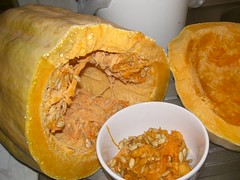
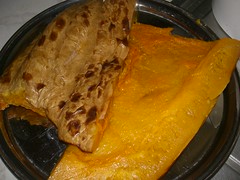
pumpkin roast pumpkin
(the pumpkin, roasted to soften it; the skin peels off easily at this stage)

Mine started off being added to cake, then it was turned into cookies and a pie, and there was still the other half to be used up. Roasted pumpkin becomes soft and pliable, making it perfect for adding to dough. While Rosa was living in la fattoria, she was making dough nearly every day, kneading it into bread and cutting it into all sorts of pasta shapes. Rosa's kitchen madness descended on me: I threw an egg into the pumpkin mash and began mixing it in, the slimy goo squelching in the palms of my hand, the egg whites oozing through my fingers. Once I started mixing the seasoned flour into the mud pool, my movements becoming more rhythmic, and the mixture felt more familiar to me.
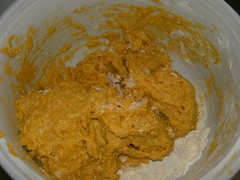
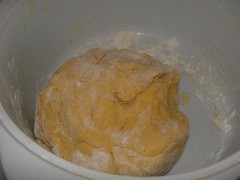
pumpkin egg dough pumpkin egg dough
(1 cup of pumpkin puree, 1 egg, 2 tablespoons of olive oil, salt and pepper, 2 cups of flour, more flour for dusting)
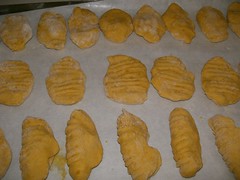
Gnocchi was the first thing that came to my mind. Although Rosa never cooked them in La Cucina, I felt certain that she must have cooked them some time in her life, as all good Italian cooks do, probably with the addition of potato; pumpkin is a perfect substitute. In fact, you can add anything to flavour gnocchi; I added crushed garlic to mine, while Laurie added a wild Alaskan green to hers, turning them into a green dumpling. I made what seemed like endless trays of gnocchi with the first ball of dough, which had by this time started to overtake the kitchen bench. I was beginning to wonder what I would do with all that gnocchi, when...

pumpkin gnocchi filo pastry and pasta machine

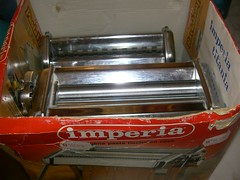
...I suddenly remembered my mother's pastry machine, hidden away in a corner cupboard of my kitchen. There was one part of the machine which had never ever been used, not in Wellington, where the pastry machine was bought and first used to roll out the pastry for my mother's kalitsounia, nor in Greece, where I took it into my home, once I inherited it on my mother's passing. The 'pastry' machine was actually a lasagne and pasta maker, made in Milano, and purchased by special order by my mother in New Zealand. It amazes me now that the pasta cutter, which had never found a use in our home, was still in the original box; we were Cretans, not Sicilians, and we never made pasta.
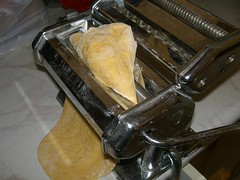
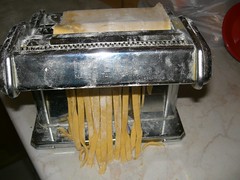
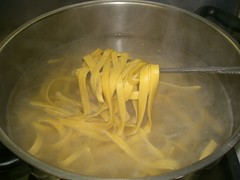
pumpkin pasta pumpkin fettuccine
home-made pumpkin fettucine

Rosa's cucina inspired me to make my own pasta from the pumpkin gnocchi dough I had been kneading. Home-made fettuccine contains similar ingredients to gnocchi (see Ioanna's recipe, which includes step-by-step instructions on how to make the pasta). I placed the gnocchi onto a flat tray and put it in the deep freeze; the gnocchi would have to be eaten on another day, not today, when, at Rosa's inspiration, I had an urge to use my mother's pasta machine. I kneaded the dough till it was evenly soft and pliable, then set up the machine on the kitchen worktop. By constantly dusting the pastry with flour, I was able to keep it from becoming sticky and breaking up. The smell of the dough wafted through the rooms of the house.

"What's that dough for, Mum? Biscuits, pizza?" The children had detected the aroma of freshly kneaded dough, and came to investigate. They watched in amazement as the long flat piece of dough came out of the other end in long even strips, which I hung on a clothes hanger. The pasta smelt heavenly; the kitchen had been transformed into a scented bakery. The flour particles were being spread around the kitchen, coating everything snowy white. The children searched the benchtop for some dough scraps to play with, but were disappointed. Pasta making is very efficient in that all the dough can be kneaded back into the main mixture, leaving very little waste.
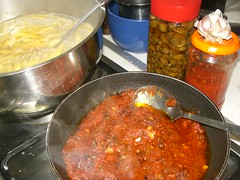
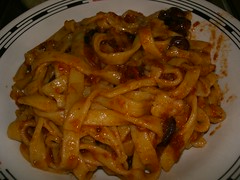
home-made pumpkin fettucine and puutanesca home-made pumpkin fettucine and puttanesca
(pumpkin fettucine a la puttanesca using pumpkin gnocchi dough)

Time was running out; il marito was due to return from work soon, and all I had prepared was the pasta. What sauce could I tempt him with that needed the minimum of time and the simplest of ingredients to make? I found the answer in my well-stocked larder: an unopened jar of capers which I had pickled in June, a jar of tomato sauce made in August, garlic from the garden, and a jar of thick black store-bought Kalamata olives. Along with the staples of olive oil, salt and pepper, this could only mean one thing: a saucy puttanesca, its aromatic steam invading the nostrils, numbing the mind senseless, the most appropriate sauce after an orgiastic frenzy in ma cucina...
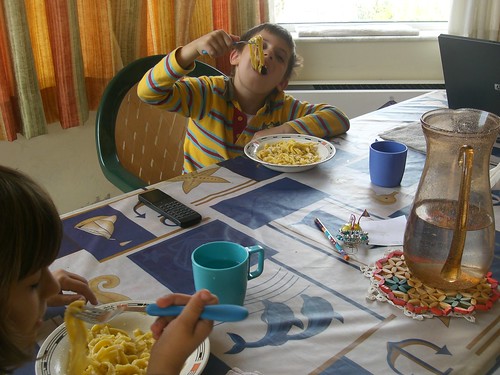
home-made pumpkin fettucine
I like this photo of my children enjoying their pasta plain with freshly grated parmesan.

There was enough pasta left over for at least another two people. I decided to hold back from cooking it all at once, lest my stomach became overly full; we all know what happened to Rosa after she served her lover that sumptuous timbalo. I froze it along with the gnocchi, for a more subdued meal later in the week. The garden is still being over-productive in the eggplant department: perfect for a pasta alla Norma, another of Rosa's culinary masterpieces; as one of her neighbours remarked: "She may be a whore, but she knows how to cook."

©All Rights Reserved/Organically cooked. No part of this blog may be reproduced and/or copied by any means without prior consent from Maria Verivaki.

Saturday, 8 November 2008

Traversing four continents (Διασχίζοντας τέσσερεις ήπειρους)

In the globalised world that we live in, it becomes an unavoidable necessity to buy goods that have been imported. It has long been recognised that ASIA is more than willing to produce products that all countries right around the world can import cheaply, while the wholesalers can still make a reasonable profit selling them off to consumers at an equally cheap price. This is the commercial curse of modern times. If you want to buy something that hasn't been manufactured in Asia, you have to pay considerably more for it.

CIMG5062

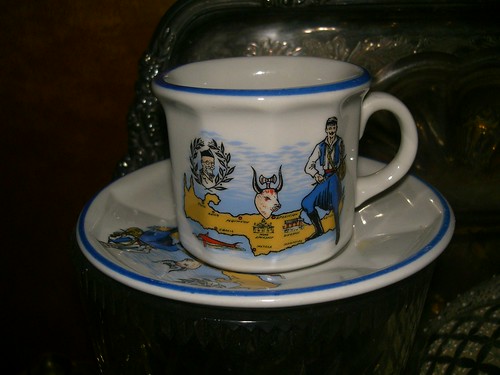
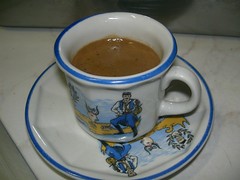
This is probably where this little coffee and saucer set took its first steps, in a factory somewhere in Asia. Hundreds of thousands of these white demi-tasses were probably made in a a noisy dirty factory, by underpaid overworked employees of rich and powerful businessmen who had people in the right places to turn a blind eye to the working conditions their employees were subjected to. It's hard to imagine what kind of injuries they might have sustained to produce these ornamental cups and saucers. A stack of badly stored boxes may have crashed onto someone's head; maybe someone else suffered first-degree burns by improper handling of the pottery in the kilns.

Nevertheless, this little coffee cup and saucer, appropriately decorated with a map of the island of Crete, travelled intact to EUROPE, eventually making its way down to Hania, on the island of Crete. Knowing the Greek authorities, it's not difficult to imagine the Cretan cups ending up in Kerkyra by mistake, or the Kerkyra ones accidentally being sent to Crete. These ones made their way to the souvenir shops of Stivanadika, where most tourists buy their souvenirs from: T-shirts, old-fashioned summer dresses, handmade leather sandals, I-love-Crete keyrings, gold jewellery fashioned in Cretan-inspired designs, olive oil soap, mugs, tea-towels, among a host of others. Cups and saucers always comes in 6-packs; it must have had another five siblings, all packed in the same box, waiting to start a life in a person's home.

*** *** ***

The Daughter of a Poor Farmer had been born into a poor agricultural family in a village in the foothills of the Λευκά Όρη (Lefka Ori - White Mountains) of Hania. She would have liked to go to school - there were 150 children enrolled in the village when the second world war broke out - but this was impossible. After second grade, she didn't attend much at all; there were more important tasks to be done. One of the easiest for a young girl her age was to lead the family's cows to a grazing field every day and milk them. By the time her tasks were completed, while her mother looked after her four younger siblings, there was just enough time to clean up and tidy the two rooms where the family lived: one room for the humans, and another for the animals.

As she left childhood and entered adulthood (there was no such thing as adolescence in those days), she began helping her mother carry fresh produce to Hania, where they would sell or exchange them for products they didn't produce themselves: rice, sugar, coffee, coloured thread for the rugs she made on the αργαλειό (argalio, weaving loom), buttons for shirts. They would start walking in the afternoon with the donkey laden with goods, and keep walking until it was very dark. There was a spot in the mountains which was sheltered and they overnighted here, sleeping on the ground. In the early morning, they'd wake up and continue on to the road for Hania, in order to get to the market to do their trade. After the days' work was over, they'd make their way back up again, stopping in the same place. The journey was more difficult this time, as the walk was uphill, getting steeper and steeper as they walked back up. They could only ride the donkeys if they had not once again been loaded up with more goods.

Although her family had a few patches of earth of their own, they did not have many olive trees to produce the amount of olive oil that their family used; five adults and two parents needed about 200kg of olive oil a year, especially if the main form of sustenance was psomi me ladi. The Daughter of a Poor Farmer became a μαζώχτρα (mazohtra), an olive picker for other wealthier families. In those times, olives were left to fall on the ground, and were then picked up, one-by-one, with the pickers' backs bent the whole time. Either they were collected into large baskets, or they were thrown onto large sheets. (Technology, as well as the black plastic netting that is now used to collect olives that drop onto the ground, took a long time to get to the mountainous villages, by which time, rural life had suffered a decline.) From this job, she was given a small share of the crop to take home with her, after it was ground into oil.

She had by now reached the age of 30, but she was so poor that she was never considered a worthy bride. As the oldest child in a family of five, this spelt doom for the family: if she didn't get married first, then the girls next in line would also have the same fate. Eventually, the family had enough oil to cover their needs from the girls' work, so The Daughter of a Poor Farmer asked to be paid in money instead. She worked with a bent back one whole olive season and dreamed of what she would do with the first real cash that she had received in her life.

All spring, she waited patiently to be paid for the work she had done all that winter, but the money didn't seem to be coming forth. There being no telephones in those days (no electricity, let alone phone lines), she had to walk to the olive press herself to find the owner and ask him for her pay. She put on her best clothes and the only pair of shoes she had, which was quite clean, since shoes were never worn in and around the house when work was being done. They were saved for 'good' days.

The Daughter of a Poor Farmer entered the olive press. No one paid any attention to her, even though no one was doing any work in particular at that moment. She asked someone about being paid by The Rich Landowner for her last olive-picking season's work.

"Φαλίρισε (falirise)," was the one-word reply she got.

"What does that mean?" she asked.

"Φαλίρισε," the man repeated without looking at her. "He's got no money to pay you with. The bank's repossessed all his assets."

The Daughter of a Poor Farmer returned home and told her parents what she had learned. All that work for nothing, fake promises, false aspirations. If this was life in the village, they were resigned to poverty, and all because The Daughter of a Poor Farmer was still unmarried. It was at about this time that an announcement went up near the community offices about a paid passage to a relatively new country in AUSTRALASIA, offering the opportunity for women to work as cleaners and cooks, in return for a small salary which they could save and a paid return trip to their homeland. They needed to stay for two years in the job that they were offered, and there would be a training period in an institute in Athens where the girls would be offered English lesons and basic training in the service sector. To The Daughter of a Poor Farmer, this sounded perfect, even though she had no idea where she was heading to.

*** *** ***
The Daughter of a Poor Farmer was assigned as a chambermaid in a boys' agricultural boarding institute. She cleaned the rooms and kept the lobbies clean. The work was not very difficult, but the hours never seemed long enough. Once work was over, there was nothing to do, nothing at least for The Daughter of a Poor Farmer, who was not used to going out on the town, drinking alcohol in pubs, meeting up with the opposite sex. Imagine if her parents found out where she was now: how could she prove to them that she did not carry on as the other women did? They were all from the same island, but for the first time in her life, The Daughter of a Poor Farmer wondered whether she had anything in common with her compatriots.

The institute housed its own church on the premises. The Daughter of a Poor Farmer was invited to attend the church service, along with the other employees. She accepted the invitation. As she entered the church, she wondered why there were no icons on hanging on the walls, like in the Greek Orthodox Church that she had been raised in. No one seemed to be making the sign of the cross. Even if she wanted to do so, she couldn't understand what the priest was saying, and where was his petrahili? She looked at the pale faces of her employers and the dark faces of the young male pupils, and wondered what she was doing in their church. She felt that she did not belong here. The thought suddenly struck her that were she to die here, there would be no place for her to be buried, because there was no Christian Orthodox church. She suddenly felt very alone, and the two year-contract now seemed to her a long way away.

*** *** ***
The people at the institute were very kind to all their staff. They knew that the Greek girls wanted to see the other girls that they had travelled with, most of whom eventually settled in the Capital City. The Capital City had a Greek church in the centre of the city; wherever there is a Greek church, there are Greek people, and wherever there are Greek people, the Greek language will be heard. The Daughter of a Poor Farmer had met many Greek people in the Capital City on the day trips that the institute organised for their foreign workers. At the end of her contract, she decided to move there, instead of going back to the island. Sofia and Tasos, islanders like herself, had befriended her. They liked her so much that Tasos declared: "I'm going to find you a husband from the island." And that would end the blight on her family: the stigma of the unmarried eldest daughter.

From The Daughter of a Poor Farmer, she was transformed into A Successful Immigrant with a faithful husband and university-educated children. She still longed for the island, and went back to visit her sisters and their husbands and their children as often as possible, but she could not change the fact that her heart was on the island, but her home was thousands of miles away. Every time she visited her homeland - it was getting harder to do that as the years went on - she bought a trinket to remind her of the place where she was born. One of her favorite souvenirs was a set of demi-tasse coffee cups with a picture of the island. She kept them as far away from dust as possible, in the confines of her elaborate wall unit in the lounge which she opened up on just a few days a year - you could count them on the fingers of one hand: Christmas, Easter, her nameday and her husband's nameday; the children were by now celebrating their own namedays in their own homes. But the demi-tasses with the island motif were her favorite coffee cups, and she always served her guests Greek coffee in them, even if they didn't take it in the formal room where the cups were kept.

*** *** ***
"Talk about a hoarder. How many coffee cups can a person own?"
"Do you think they have any resale value?"
"Let's organise a garage sale."
"Do charity shops collect?"

The children of the Successful Immigrant had all been back to their parents' homeland at some point in their lives. They all had fond memories of the place where their parents were born, where they had spent a few winter holidays when they were young, before their grandparents had died. Since then, they never really felt any attachment to the island, since their last direct link had away, and they all had lives of their own in the New World, which had now become part of the globalised universe that the Earth had turned into.

The Youngest Daughter of the Successful Immigrant had herself moved to AMERICA, where she was recently called from on her mother's passing. She had never been a supporter of her mother's hoarding excesses, always berating her for spending money on yet another useless dust-collecting trinket, but when she saw the coffee cups with the picture of the island plastered across them, her mind flooded with memories of her parents, her grandparents, the village house, the souvenir shops, the blue sky, the golden sand of the beach, the light lunches at the tavernas that she had enjoyed under the shade of a tamarisk tree, her first love. It suddenly occurred to her that her mother had sacrificed her entire life to give her family a better opportunity in life, all the while living her life in an adopted homeland. She looked around the lounge, the most under-used room in the house she was brought up in with a twenty-five metre hallway, and everywhere she saw Crete: on the wall as an embroidered hanging, on the glass door as a sand-blasted picture, on the coaster set on the nested tables, in the tablecloth of the dining room table, in a faded postcard that her aunt had sent, now long gone herself, all signs that her mother had been living a temporary life in the New World with a permanent sense of home in the Old World, the lounge being transformed into a mausoleum of Crete.

The house was emptied of its contents and sold to a new owner, a property investor, who planned to turn it into four self-contained apartments, the latest fashion for old inner-city houses. After the expenses were paid, the inheritors all received their share of their parents' estate, and The Youngest Daughter was now free to go back to America, the place she now called home, her suitcase packed carefully so as not to disturb the demi-tasse coffee cups nestled safely in amongst her clothing. They would now start a new life in a new wall unit in a new house in a new country, where people would constantly ask The Youngest Daughter about the history of these cups, where they came from, and how she acquired them.

*** *** ***
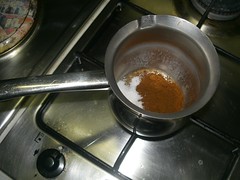
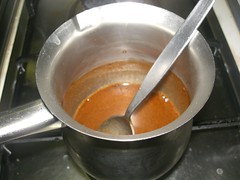
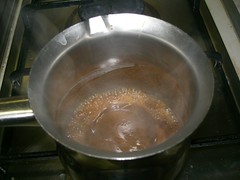
To recreate the coffee traditionally served in a demi-tasse cup in Greece, it's best to make it for each individual guest separately. A host will probably never make more than 2-3 servings all at once; in any case, the coffee will need to be made separately for each guest, depending on the amount of sugar each one wants: no sugar is a σκέτος καφές - sketos kafes, one teaspoon is a μέτριος καφές - metrios kafes and 2 teaspoons is a γλυκός καφές - glikos kafes. Don't ask for 3 teaspoons of sugar; that might get mistaken for something like coffee-flavoured ice-cream syrup.

making greek coffee making greek coffee making greek coffee greek coffee

For each serving of coffee, you need:
one heaped teaspoon of traditional ground powdery Greek coffee per person
0-2 teaspoons of sugar, according to the sweetness desired
3/4 of a demi-tasse of water (use the cup as your measure)
Put all the above ingrdients in a μπρίκι - briki, a small cooking pot with a long handle. Place the briki over a high gas flame, all the time stirring the content of the briki with a teaspoon, to ensure that the sugar melts. Just before the water starts to boil, allow the coffee to froth up without stirring, otherwise, the καϊμάκι - kaimaki (the aromatic froth that forms as the coffee is being brewed) will be lost. As the froth rises, take the briki off the flame just before the froth spills over. Pour the coffee into the demi-tasse cups; if making more than one serving at a time, pour some kaimaki in each cup, so that it is divided evenly, then pour the remaining coffee over the froth.

©All Rights Reserved/Organically cooked. No part of this blog may be reproduced and/or copied by any means without prior consent from Maria Verivaki.
Thursday, 6 November 2008

Winter stock-up (Εφοδιασμός για το χειμώνα)

Just the other day I was featured on the Daily Random Food blogs in The Foodie Blogroll. I'm wondering whether the name of my blog is misleading some people to think that I only use organic ingredients in my cooking, and the answer is, no, of course not, as I believe that is impossible.

Organically Cooked isn't all about eating organically; sometimes it's more convenient to eat local than organic food. And it isn't all about food, either; it's a way of life that tries to keep one attuned to nature rather than consumerism. The recent economic crisis has made me wonder how much I can economise even more than what I was doing before it hit the world.

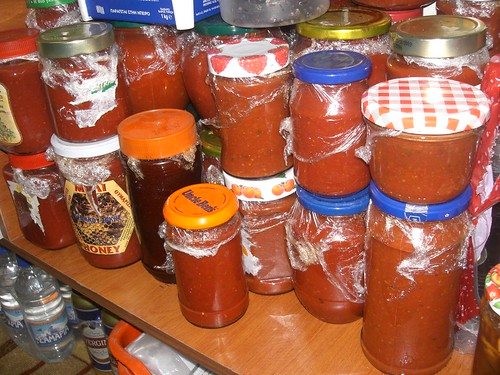
Tomato sauce...

tomato paste for the winter

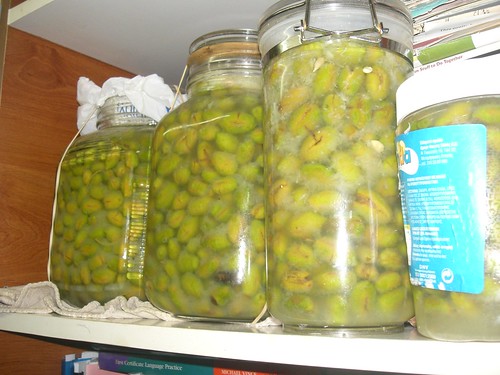
... cured olives...

tsakistes olives for the winter

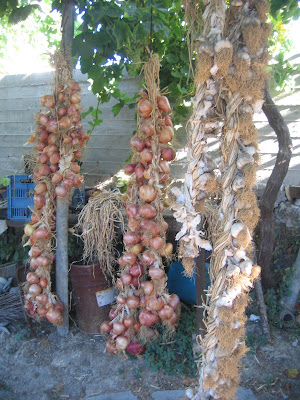
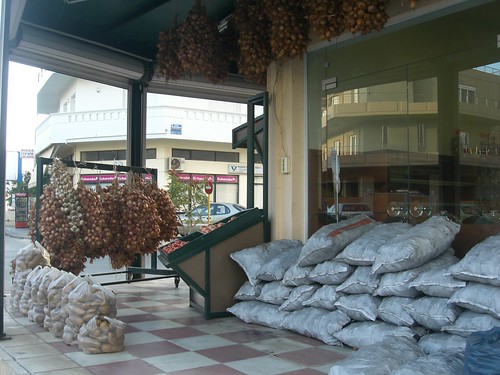
... onions and garlic (I particularly liked the arrangement I recently saw in a shop in Hania)...

winter stock up hania chania

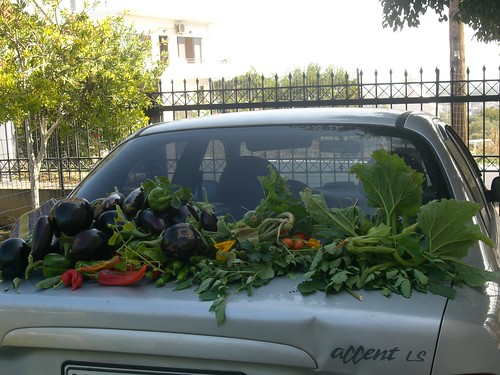
... garden produce: our harvest at the end of October, sitting on the most popular car model in Greece...

late october autumn harvest

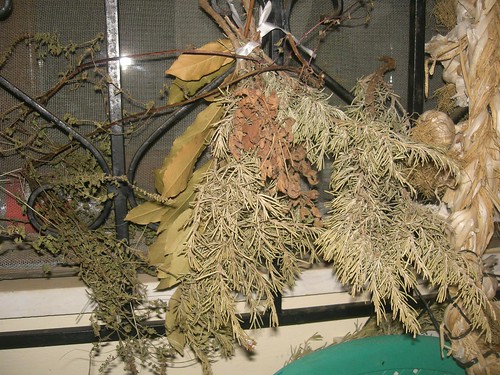
... and some drying herbs.

drying herbs

©All Rights Reserved/Organically cooked. No part of this blog may be reproduced and/or copied by any means without prior consent from Maria Verivaki.
Wednesday, 5 November 2008

Welcoming the new president of the US (Καλωσορίζοντας τον νέο πρόεδρο των ΗΠΑ)

"In a nation that was founded on genocide and then built on the backs of slaves, it was an unexpected moment, shocking in its simplicity: Barack Obama, a good man, a black man, said he would bring change to Washington, and the majority of the country liked that idea. The racists were present throughout the campaign and in the voting booth. But they are no longer the majority, and we will see their flame of hate fizzle out in our lifetime." (Michael Moore; thanks to Meg Wolff)

God bless Barack Hussein Obama!
God bless America!
God bless each and every one of us!

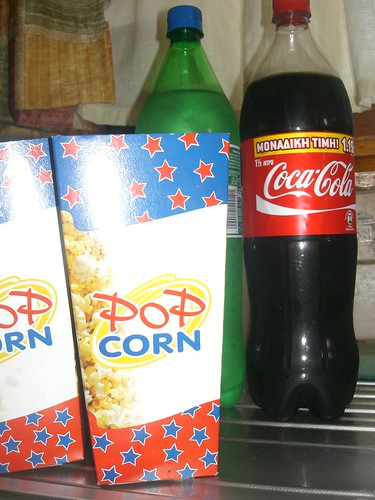
US food
The last time I took my children to the cinema, I bought them popcorn. I kept the boxes specially for this post. That was over six weeks ago. I believed that it was possible...

PS: Commiserations to the losers

the sneaky dirty rat fink

Happy GUY FAWKES DAY to those who will be celebrating it with bonfires and fireworks!

Tuesday, 4 November 2008

Loyia tis Ploris (Λόγια της Πλώρης)

Have you ever experienced a meal that was prepared and cooked as exquisitely as it was served to you? For me, this is a rare occasion, but as fate would have it, it could not be avoided. As a Greek food blogger, it is impossible not to visit Λόγια της Πλώρης (Loyia tis Ploris). Practically all the Greek food bloggers I know have been there, so it seems inevitable that I would somehow end up there too.

loyia tis ploris athens fish taverna

The first to discover this restaurant in a charming side street of the dingy main road leading out of Athens towards the west was Laurie, who chanced upon this gem of a place through a leisurely stroll in an area not many people would think to look for a fish taverna of exceptional taste and quality:

"Logia tis Ploris is a fish taverna, on a narrow pedestrian walkway, in a quiet, aging, residential neighborhood one block off busy Peiraios Street. The young owners have tastefully renovated a neoclassical house, and serve food one is more likely to encounter at a table near than sea than in downtown Athens."

Ioanna
decided to follow her by taking Peter to Loyia tis Ploris on his most recent trip to Greece:

"How often does it happen that one meets a fellow bloger who lives on the other side of the world in an Athenian restaurant suggested to you by another fellow blogger who lives in Alaska? Not at all often, I would say, unless you have Greek roots such as Gourmet Peter whom I had the good fortune to meet after a year's worth of blogging friendship."

You don't believe this could happen? The proof is in Peter's photographs:

"The taverna was very quiet, the music kept to a minimum and the service prompt. We ordered off the menu like a kid in a candy store with mom's stolen purse...we barely had any elbow room on the table!"

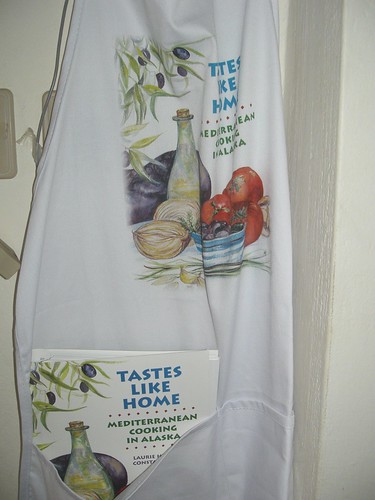
mediterranean cooking in alaska
(Mediterranean Cooking in Alaska arrives in Crete)

It was only natural that I follow in their footsteps, or should I say, Laurie's footsteps, because I would never have thought of walking westwards in central Athens in the evening. I couldn't explain why I was perturbed at the thought of going west, leaving the lit-up rock of the Acropolis behind us. Indeed, on that one day I spent in the capital, I had stayed overnight at a relative's house in the west, bombarded by the dust, debris and cement in one of the dirtiest suburbs in the whole of Greater Athens. "It's just off Ιερά Οδός (Iera Odos)," explained my friend, who didn't know that I had been doing most of my shopping on Iera Odos at the street market during my years of teaching in an English language school in Egaleo.

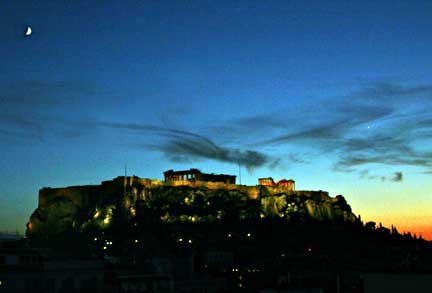
parthenon at sunset athens
(A magical early October evening in the capital city; even the stars and moon were present.)

So, here I was following someone I had never met before in my life through the dreariest Athenian suburbs, wondering where I would end up. Although I have been living in Greece for a long time, Crete cannot be likened to Athens in any way; it felt strange to be walking through a part of Greece that reminded me of the alternative cafe culture as I remembered it in Wellington: dark rooms, smoky lights, modern furniture bordering on the eccentric. In early October, Hania had practically 'shut down' until the next tourist season in the following year; yet, here I was walking around in an area that was just starting to burst into life, with its indoor entertainment targeting youth.

When we finally arrived at the restaurant, I was pleasantly surprised; I felt as if I had been transported to the Athens of the old black-and-white movies, where everyone lived in brick houses whose windowsills were decorated with flowerboxes filled with gardenias and geraniums. The atmosphere of Loyia tis Ploris did this neighbourhood justice; there were some tables arranged in an outdoor patio, with pretty tablecloths and a little vase of flowers in the centre. It was too cold to sit outside that night, so we entered the restaurant...

... and sat at the same table as Peter and Ioanna, the last Greek food bloggers to visit Loyia tis Ploris. Window seats always have a special lure to them, even if the view shows an evening setting. As we ate our meal, we watched people opening their windows, closing the shutters, switching off lights, locking their doors for the night, retiring for the day, on a quiet Sunday evening in the heart of old-time Athens.

There were few people in the restaurant that night. The music was not too intrusive, but the emptiness of the room unnerved me slightly. Loyia tis Ploris is big on live music; on a Sunday night, this is not a possibility, as most people in the neighbourhood would be annoyed by the noise, especially if they were trying to get a good night's sleep before going to work the next day. Maybe this is why the restaurant wasn't too full. There was a small group of young people chatting wildly in Greek and English, and a trio of Greek males who looked as though they had met up at the restaurant to discuss some private business. We were the third group of customers for the evening.

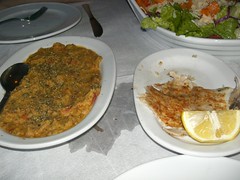
A good-looking friendly young man came to take our order, explaining that every single item on the menu was available. We started with some aromatic tender smoked fish fillets (μπακαλιάρος - bakaliaros; cod) and a mashed bean dip (φάβα παντρεμένη - fava pantremeni), served with some fresh bread. The meal continued with a spectacular salad served in a 'boat', which is only fitting for a restaurant named Loyia tis Ploris: "words of the prow". The white house wine was a perfect accompaniment.

fava pantremeni and smoked bakaliaros cod loyia tis ploris salad

Another boat followed: fresh shellfish in a dill sauce. Just as the wine was beginning to run out, another carafe magically appeared on the table, without being invited.

loyia tis ploris cockles in dill sauce loyia tis ploris shells

The west of the night was vewy blerwy. I wemember a pan of fennel-scented pasta being plonked in front of me, with some shellfish floating on top of it. Were dey cwabs making a won for wit? I twyed to photogwaph em, but the plate kept moving. Or was it my camewa? I only managed to gwab a shot of em az zere carcasses lay on top of the cockle shells. When we asked for the bill, they must have bought us somefing sweet, az I wemember eating desert. I jus carn wemember what it was. I thing it was before the expanding peppermints emerged. Whatever it was, it was wewy wewy good...

My friends knew better what to choose to eat at Loyia tis Ploris than I did; after all, they cook the same kind of food in their kitchens that we ate at Loyia tis Ploris. If you want to try some fancy fava dip, look no further than on Laurie's, Peter's and Ioanna's websites. For a child-friendly version, try mine. You could also try making your own pasta (like Ioanna did) and then serving it with a spectacular shellfish pasta, like Peter's; pick out the shellfish before serving to children and just say 'makaronada'. For an exquisite dressing for shellfish, try Laurie; if the kids don't like 'em, eat 'em all yourself.

Loyia tis Ploris has clearly become a cult classic in the food blogosphere. I extend the invitation to all food bloggers despite their cultural inclination, and may I meet up with more of you. And please, do come to Hania where I'll serve up seasonal goodies from our garden on our balcony with a view of the port of Souda and the nightly ferry boat; we're waiting for you.

©All Rights Reserved/Organically cooked. No part of this blog may be reproduced and/or copied by any means without prior consent from Maria Verivaki.
Sunday, 2 November 2008

The influence of the Greek education system on biscuit making skills in young children (Η επιρροή της Ελληνικής παιδείας στην παρασκευή μπισκότων)

It's very easy to keep children entertained at home: give them a DVD player, a remote control, a stack of DVDs, and they'll stay in one place for a long period of time, zonking their brains out, turning into zombie zappers. Eventually when they want to talk to their parents, they aim the remote control at them. If they don't get their attention, they start screaming, or something similar to what we do when we can't get technology to work for us. Trying to wean children away from watching television at the weekend is a more difficult task, especially when they are very young, because they are simply not independent enough to act on their own devices and involve themselves in something creative without needing assistance from an adult. You can tell them to work by themselves on a project, but you have to be prepared to be more forgiving towards them when they accidentally damage or stain part of the house or furniture.

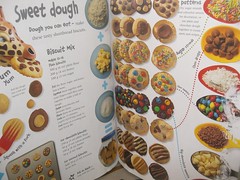
We have a lot of books lying around the house for the children to browse through and pick an activity they'd like to try. They've made volcanoes erupt (using vinegar and baking soda), they've made an aquarium (in a shoe box; the fish are hanging on strings) and they've made lap books (thanks to Paula, a home schooling teacher in the US, who likes to blog about food, which is how I discovered her) . But they still need help to do all these things, and even more so in the kitchen, where they're 'playing' with knives and heat. On a recent rainy weekend, my children asked me to let them make some biscuits that they saw in a DK activity book.

lapbook DK biscuit recipe

The instructions in the book were quite simple, and there was also a page full of different biscuit designs that they could try. They particularly liked the coloured biscuits, which of course they wouldn't be able to re-create since we don't keep this kind of confectionery in our house. I explained to them that I would help them to make the dough, but they could make all the biscuits. I disappeared from the kitchen (I felt like a homeless person) to let them work independently.

I heard an argument start between the children. Aristotle was annoyed that Christine wasn't lining up the finished biscuits in a similar pattern on the baking tray: Aristotle was angry because "she's not making a motivo." His view of the world is an ordered one where everything has to be done in synchrony, one step at a time, following some logical pattern. He wanted to see a motif on the baking tray. Needless to say, he is stuck on doing one activity before moving on to another activity: it is common knowledge that men can only do one task at a time, while women perform multi-tasking (something to do with women possessing a larger corpus callossum in the brain).

children making biscuits
(if you want to make the biscuits - the recipe is simple and the children had lots of fun making them - the recipe is given in the photo from the book)

Christine, in the meantime, was looking at the biscuit designs in the book and trying to copy them. She did her best, but was annoyed that she wasn't able to make her biscuits look exactly the same as the illustrations. "Why don't you make up some of your own designs?" I asked her. She stared at me blankly, as if she did not understand what I meant. Her brother, on the other hand, understood exactly what I meant; "That's not what the book says," he answered. If it's not in the book, it can't be done; if the teacher (in this case, the book) didn't say it should be done, then it shouldn't be done. It was very hard to convince the children that they could shape and top the biscuits any way they wanted.

Similarly with school homework, "δεν το είπε η κυρία" (den to ipe i kiria - the teacher didn't tell us to do that) is often what a Greek child will tell its parents if they suggest deviating in any way from the teacher's instructions. Going against the exact orders of the teacher, even if s/he explained something incorrectly, is a sacrilege; the teacher is always right, even if s/he is wrong.

All over the world, the education system is the same: the most important things a child must learn at school are the three R's (Reading, w-Riting and a-Rithmetic), while anything creative gets second (or no) place. Science subjects are treated with reverence, but even they do not get the respect they are due, because if you can't think creatively, you can't really be a scientist, and there is so much to discover that is still unknown in the world, but children in Greece (and, I suspect, in most parts of the world) are learning what is already known, what is in the set textbooks of their education system and libraries, all in the aim of turning children into miniature self-important professors, despite the fact that in this world, we also need plumbers, laboratory technicians and rubbish collectors to make it go round.

Here's an example from my first-grade daughter's homework (yes, she really does have homework at age 6). Every day, the teacher (a lovely young woman with some teaching experience) gives the children a typed (or sometimes hand-written) sheet of language exercises. There is usually a letter-identifying exercise (eg "circle all the K's and k's"), a find-the-correct-spelling task (a given word must be found in a word cloud) and a picture exercise where children write down the word they see in the illustration.

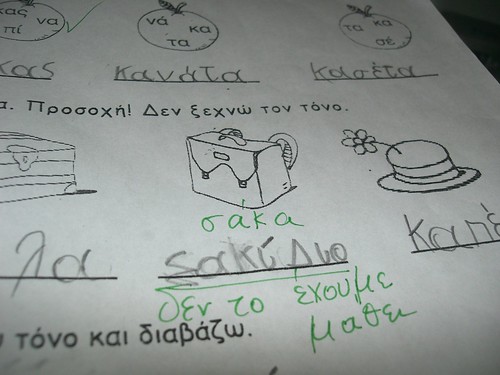
Christine generally has no problem doing any of these activities. Upon seeing a paintbrush, she wrote pinelo (πινέλο), she recognised the cat - gata (γάτα) - and she recognised the bag: the general word for 'bag' in Greek is tsanta (τσάντα). But she didn't know how to spell 'tsanta'; the 'ts' and 'nt' letter combinations are difficult to recognise for a young child who has only recently started learning to read in Greek. I 'knew' that the teacher wasn't expecting Christine to write the word 'tsanta' on the line underneath the bag picture; I had previous experience of the same photocopied material (would you believe it, teachers aren't even writing their own student handouts?) from my son's homework, exactly one year ago.

"'Tsanta'. How do you write 'tsanta', Mum?" asked Christine.

On an informative note, the Greek language is not difficult to read once the letters and basic spelling rules are learnt, which is why, by Christmas, most first-grade Greek children can read practically any printed matter in the Greek language. (This can not happen for the English language where each letter or pair of letters does not have a standard pronunciation pattern: just think about how the words 'though', 'rough', 'through' and 'thought' are pronounced.) As a teacher myself, I don't believe in spoon-feeding children, not just my own. I tried to get her to think creatively so that she would do the exercise herself.

"Well, if you can't write the word 'tsanta', can you think of another word for 'tsanta'?"

Christine thought about it for a while. "'Sakidio?'" she offered. Σακίδιο is a kind of backpack, similar to a school bag.

children's greek homework

"OK," I replied, knowing that I should have made a more exclamatory remark like 'bravo!' or 'excellent!' to encourage her ability to think for herself; what held me back was that, once again, I 'knew' that this was not the answer that the teacher was expecting. I had seen all this before. Sure enough, the next day, the red ink (in this case, purple) was sprawled all over the bag icon: the 'correct' word was 'σάκα' (saka - an old-fashioned word for school bag, which no one uses nowadays, as it is reminiscent of 'satchel') and the teacher underlined the fact that the word 'sakidio' contains a combination of letters (the two vowels at the end) which 'have not yet been taught'. Why she couldn't just tick it as correct, and write 'saka' as a synonym rather than a correction, I do not wish to go into. It reminds me of teachers who can only go into a lesson carrying an answer book to the pupils' textbooks. What upsets me most is that she expected a six-year-old child to work through a homework sheet according to what had been taught int he class, without the child bringing in her own experiences.

I accidentally came across a brilliant mp3 - the only one I have ever heard, come to think of it. As I was perusing Jeremy's Wellington blog (where I was born), I noticed a side link in his favorite blogs that sounded vaguely familiar "Creativity Killer of Kids: our Education System." I had to check it out, and that's where I discovered Sir Ken Robinson. Please listen to his lecture; you may think he's trying to sound funny, but that's only because he is trying to attract your attention, as he has a serious point to make - I do this all the time with my adult students. He believes that creativity is as important as literacy in the education of children, and it should be given equal status; but the education systems of most countries of the world are "educating children out of creativity": they are teaching them not to make mistakes, and if you don't make mistakes, you will never be creative.

*** *** ***

"Mum, we've finished," the children called out from the kitchen. There was no more space on the baking tray, but there was some dough left in colours (yellow and chocolate).

"I'm going to make some biscuits, too," I told the children.

"Which pattern are you going to choose?" asked my son.

"None of those ones," I replied. "I'm going to make up a design of my own."

"How?" He was bewildered.

biscuits creative biscuits
(biscuits according to the book; biscuits according to imagination)

"Just watch me," I said. I rolled each leftover bit of dough into two long strands and stacked them one on top of each other in alternate colours. Then I rolled the new dough combination altogether to get the strands to adhere to one another. Finally, I cut the sausage shape into slices: checkered biscuits.

"Wow," they both exclaimed.

"You don't have to make these ones," I warned them. "Think up something for yourself."

Sir Ken finishes off his lecture with the following statement: "We may not see our children's future, but they will, and our job is to make something of it." He also quotes another well-known writer who has this to say about the human being's actions against creativity: "If all insects disappeared from the Earth, in 50 years time, there would be no life; but if all people disappeared from Earth, in 50 years time life would flourish."

©All Rights Reserved/Organically cooked. No part of this blog may be reproduced and/or copied by any means without prior consent from Maria Verivaki.
Thursday, 30 October 2008

The yo-yo (Το γιογιό)

Last Sunday, on St Demetrius Day, it was open house at our place. We clean up the house, we prepare a lot of food, and we wait for our guests to come. St Demetrius Day is my husband's saint's day, the day he celebrates his name. We never invite people to our house, but they never forget to come, either; friends' and family namedays are much easier to remember than birthdays, and for this reason, it is seen as an obligation of the guests to either visit or phone the celebrant and pass on their good wishes to his/her family.

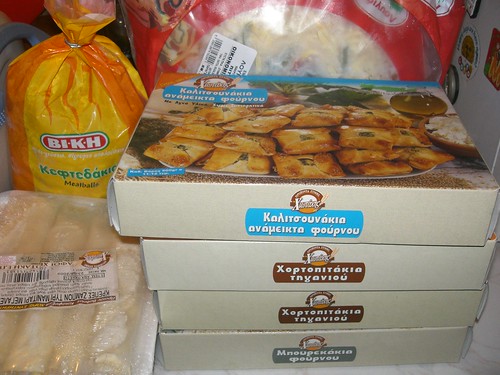
So what does Organically Cooked prepare for her husband's nameday? You can imagine the fuss in my kitchen, the mayhem that must be taking place, as everything must be in order and only the best will do for this day. You must be envisioning mezedakia of all shapes and colours and main courses to explode your mind being prepared frantically all the week, in preparation for their final bake-off. And being the venerable cook that I am on such an auspicious occasion, there is no leeway for erroneous actions. Hence your bewilderment at the sight of the boxed frozen food: pizza, kalitsounia, crepes and meatballs, along with some store-bought cakes and sweets. Allow me to explain myself.

frozen pastries from crete

A typical week in the life of Organically Cooked starts off with Monday morning: that's when the mayhem starts, without needing to prolong or re-create it in the kitchen at the weekend. On Monday morning (one of my two no-office-work days), I have to prepare Tuesday's meal (or both Monday and Tuesday's meal, if I hadn't prepared that the night before). After getting the kids up, preparing their breakfast and dropping them off at school (primary schools in Greece start by law at 8:10am), I buy our daily bread and milk needs. Our favorite bakery supplies the INKA supermarket chain in Hania with the full range of white and brown bread, rolls, burger buns, baguettes, olive bread, cheese bread, bacon bread, you name it, so it only follows that I go to the supermarket and not the local bakery to buy a 3-day supply of bread and milk. This allows me to pick up any other bits and pieces that we may have run out of: ham and cheese for the children's sandwiches, stamnagathi horta now that we have no more vlita in our garden, maybe a pot of yogurt, the odd paper napkin, whatever I remembered to write down on my list.


After unloading the shopping, I need to start cooking. Whatever is on the menu for that day, I need to make enough to last two days so that there will be some leftovers for another day later in the week when I'm working again. Let's not forget the evening meal: if it isn't dakos or bread, oil and tomato, then I need to prepare it: pancakes, kalitsounia, a pizza; there's a cyclical choice of something different every night, all of which does the rounds every week.

Any errands to run in town? Maybe some irrigation or olive-harvesting in the village, the main job at this time of year in the fields. We like to harvest our own table olives; they need to be cured using various treatments. And did my uncles promise me a pumpkin, or some farm-fresh eggs? I need to go pick those up too, otherwise I won't get asked if I need anything again. What about a washload of clothes? "You've got a washing machine for that," I hear someone say. Yes, I do, but we don't have a drier, and neither do we need one with all that Mediterranean sunshine we get. Any dishes to clean? We only use the dishwasher when the kitchen bench top gets out of control; perhaps this is what forces everyone to clean up after themselves...

washing with a view of souda bay autumn produce hania chania
(the washing has a view right up to Souda Bay; fresh village produce)

Time to pick up the children, after half-past three. Since I've had the day 'free', you may be wondering where the mayhem is. Six and seven year olds have no sense of responsibility concerning possessions: "Where did you leave your jacket?", "Did you forget your pencil case under your desk?", "What happened to your lunch bag?" By the time we get home, the countdown begins: we have approximately 70 minutes to have the main meal of the day and finish off any homework that wasn't completed at the afternoon session of the all-day school program (working parents use this state-provided service) before...

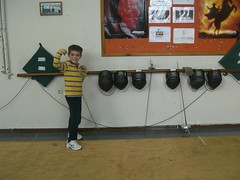
tennis lessons at palia ilektriki hania chania fencing club hania chania

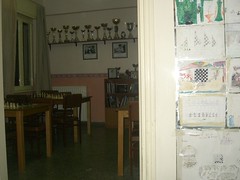
...Number 1 joins his fencing club, while Number 2 plays tennis. Fencing starts at 5pm near the old town gymnasium close to our house. Number 2 has a tennis lesson for one hour in the middle of town; her club starts at 6pm. While I drop off Number 1, I go back home to Number 2. We leave the house at 5.45pm and weave through the inner city traffic to go to the town's stadium for the tennis lesson. Meanwhile, Number 1 finishes fencing at 6.30pm; I go back to pick him up, only to go back into town to pick up Number 2 at 7pm. We find a parking spot and Number 1 gets fertilised and irrigated with some water and a home-made snack. If I didn't bring food from home, I'd have to buy some puff pastry crap to feed them with. I drop him off at the chess club for a one-hour lesson at 7pm. In the meantime, I dash back to the stadium (chess and tennis are located in the same area) to pick up Number 2, who also has her snack in the car. As a way to pass the time before Number 1 finishes from chess club, we do some shopping together: there are two good fresh produce shops in the area, as well as a (not-so-good) supermarket, and the best organic supplies shop in Hania.

By the end of the after-school activities session, I've been walking and driving up and down town like a yo-yo. But it's not only me: every night of the week during the school year, the roads of Hania (and every other town in Greece) fill up with yo-yo-ing mother taxi drivers. Practically every single mother in this town (and every other town in Greece) has become a yo-yo at some point in her life, ferrying children from one activity to the other. In my house where there already is one taxi driver, it seems as though we are doubling up on energy, but there's a saying in Greece that should explain why this is happening: "the shoemaker's children are never shod".

chess club hania chania school bags

Some time after 8 o'clock, we're all in the car, on our way home. Then it's dinner, bathtime and the preparation of the next day's school meals: a packed lunch in a bento box.

lunch box
(After the nameday party, we were left with quite a few boxed sweets, a very popular 'present' to bring to a nameday, hence their inclusion in the children's lunch the next day: baby bananas, a mini-roll sandwich, dakos and chocolate eclair)

Then a quick ckeck of the contents of the children's school bags. The evening is almost over; there's not much energy or time left to do much else anyway. The next day, I'm on a 9 to 5 basis at work. I really only have time to prepare a meal and check the children's homework and bags. The next three days are either like a Monday or a Tuesday. That leaves the weekend to do whatever wasn't done during the week: mending my daughter's trousers which she tears at the knees on the basis of one per week, tidying up the house, ironing, gardening. Let's not forget that we like to eat a decent meat-based meal on Sunday, and we also had to cure the olives we picked from the village. Don't we all need some time to relax, too?

curing green olives for brine
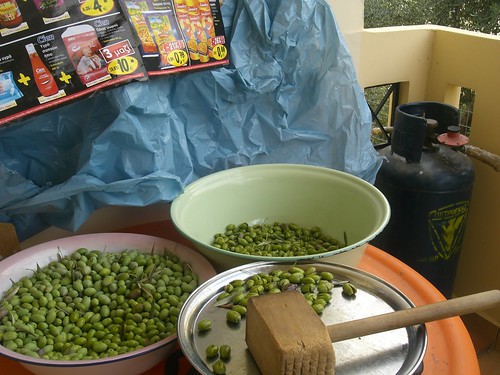
(A telling photo: my kitchen balcony - the children use the orange table for activity work on sunny days. I was cracking green olives here all morning Saturday. The plastic sheeting and newspapers were stuck on the wall to prevent the oil stains from the crushed olives splattering the walls. The gas bottle connects with our kitchen through a hole in the wall; mainland Greece has gas pipes, but not insular Greece. The crockery - the two large tubs, the tray and the overturned pot under the tray - are all from New Zealand, remnants from my mother's kitchen. The mallet belongs to my mother-in-law, but it looks as though I have already inherited it.)

It wasn't my intention to put store-bought snacks on the dining table on my husband's nameday, but that's all I felt I could cope with, given the daily routine we now follow with the children's schedules. St Demetrius fell on a Sunday this year, which means that the next day is also the start of new mayhem. Life is too short to worry about minor matters. At least tomorrow, there'll be a home-cooked meal, with the start of another round of the weekly mayhem.

©All Rights Reserved/Organically cooked. No part of this blog may be reproduced and/or copied by any means without prior consent from Maria Verivaki.
Wednesday, 29 October 2008

Summer garden, autumn hotpot (Καλοκαιρινός κήπος, φθινοπωρινό τσικάλι)

Our summer garden is supposed to be coming to an end, but it doesn't seem to be turning out that way. The aubergine plants never seem to stop producing - I have a large supermarket carrier bag full of them, apart from the bag I gave to my aunt in Athens and another one to the cleaning lady who helped me spruce up my home after the dust bomb it had become over the summer. Aubergines have always been my favorite summer vegetable. In my opinion, they have a sweet taste when cooked in olive oil, and I eat them in the same way that I eat meat. When they are cut in thick slices, they are no less hefty than a grilled steak, but so much better for you. No matter how much olive oil you cook them in, it could never feel as stodgy as animal fat.
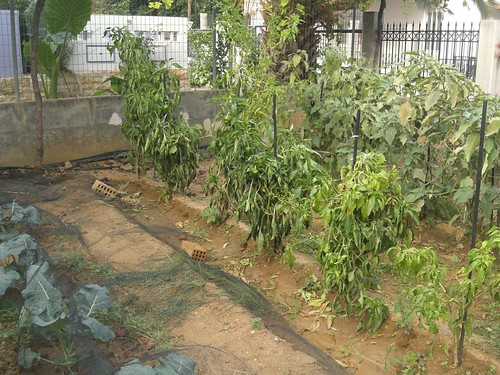
autumn garden
(part of our autumn garden - the pepper and eggplant trees should keep producing until Christmas, while the cauliflower, broccoli and cabbage have just started)

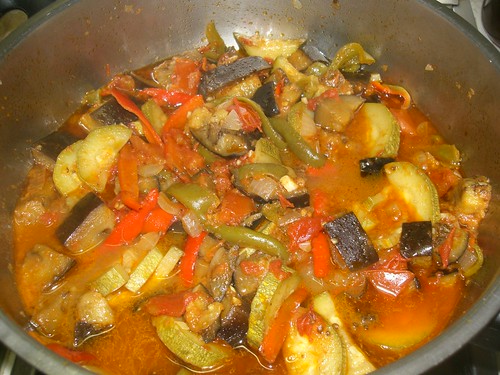
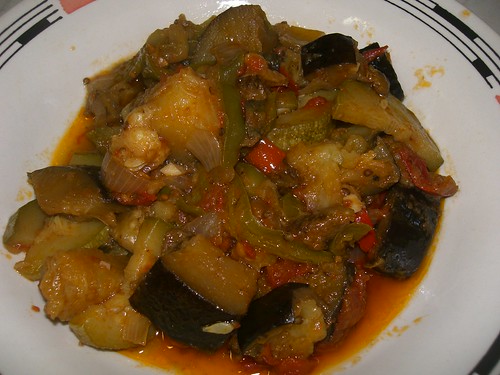
The garden is mainly producing aubergine at the moment, apart from the nettles, which are starting to come in handy for pie-fillings. Then there are the red Florinis pepper, the green bell peppers, the zucchini (probably the very last ones for the season), and the few surviving tomato plants. All these vegetables can be combined into one hotpot, baked either in the oven or in a pot on the stove.

ratatouille

This dish is cooked all over Europe under different names: ratatouille (France), briam (Greece), also called tourlou tourlou (Cyprus, Turkey), pisto (Spain), tiella (Italy). I use exactly the same combination of vegetables to make pasta sauce (with the addition of mince), vegetarian lasagne, and moussaka (with the addition of mince and potatoes). The recipe for each individual dish differs only slightly, mainly in terms of preference of cooking style and the herbs and spices added to it. The general idea is the same.

The recipe I chose to make is based on the French ratatouille. We recently saw the DVD with the same name, which inspired me to make it. I was impressed with the topic chosen for a children's film, and the children fell in love with Remy, the ratty chef. Remy's haute cuisine version of ratatouille was reviewed by Ego, a gastronome, who felt it compared equally to his mother's peasant cooking in a French village - the freshest ingredients, cooked ot perfection. Remy sheds some light on the difference between cooking for the family and being a chef; I'm definitely in the former category.

You need:
1 cup of olive oil (aubergine soaks up a lot of oil, hence the large quantity needed)
2 large aubergines, cut into small cubes
1 large courgette, thinly sliced (in half moons if it is very large)
1 large onion, roughly chopped
1-2 red peppers, cut into slivers
1-2 green peppers, cut into slivers
2-3 cloves of garlic, finely chopped
2 large tomatoes, cut into small cubes
1 large tomato, pureed
salt, pepper, oregano
chopped parsley to garnish

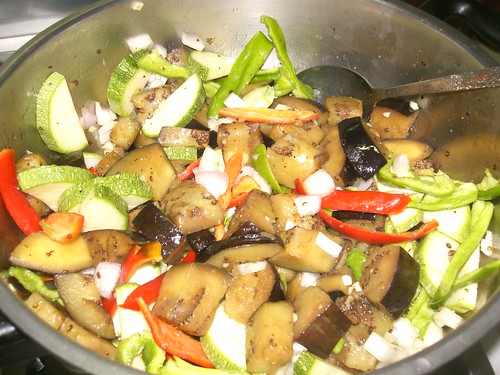
ratatouille

Add half the oil into a pot and brown the aubergines in it. Take care that the eggplant does not stick onto the pan, as it will soak up the oil very fast. Add more oil if necessary. When the aubergine is all coated in the oil and has taken on a darker colour, add the remaining vegetables. Mix them well in the pot, until everything is coated in oil. Then add the tomatoes and seasoning. Place a lid on the pot and leave the ratatouille to simmer on the lowest heat for about an hour. Don't mix it too much, because the vegetables will break up. They are more attractive and less soupy when they are intact.

ratatouille

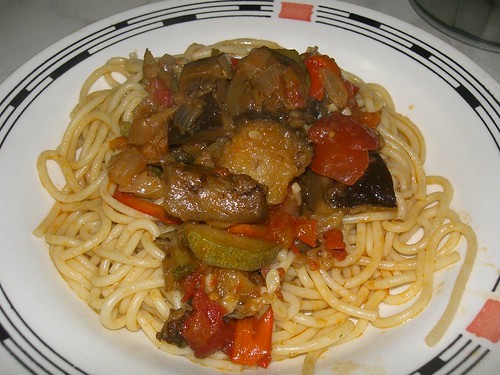
Serve the ratatouille warm with (or without) some roast meat. My personal favorite is to accompany it with some good cheese. It can also be slow-cooked in the oven in a sealed tin instead of a pot. It is delicious at room temperature, and even better when served the day after it was cooked. If you've overcooked it or stirred it too much (so that it looks like a sauce instead of a stew), boil up some spaghettini, drain it well, and serve this over it. Don't forget the cheese!

ratatouille pasta

This is my entry for Kalyn's Weekend Herb Blogging, appropriately hosted on its third anniversary by her very self.

©All Rights Reserved/Organically cooked. No part of this blog may be reproduced and/or copied by any means without prior consent from Maria Verivaki.