Tuesday, 22 January 2013

Urban cuisine (Aστική κουζίνα)

Have you noticed the preponderance of product placement in Greek cookery programmes, showcasing Philadelphia cream cheese and Oreos biscuits? LIDL supermarket sponsors another one and Lacta chocolate is going to the big screen...

I can't say I miss going out for a taverna meal because I know I cook the same kind of food as what you will find in a traditional Greek taverna in Crete. This provides some comfort to me, because I know I don't really need to go out to have such a meal, and besides, it's cheaper to cook the same meal at home. What I'd really like to be able to do is to go out for a cheap meal to a place where I can order and enjoy the kind of meal I don't often cook at home, something like a Chinese or Indian meal. Not that this is going to happen any time soon; although there are new eateries opening up on a regular basis in the town, they don't necessarily look as thought they are going to serve anything novel that I can't prepare at home more cheaply.
Meals on the overnight ferry from Hania to Athens: you can choose between Greek and global cuisine, but there is more of the latter than the former, and even when you do try to choose the former, it is not really 'authentic' for want of a better word. Potatoes are always pre-cut, rice is par-boiled and bread is made from ready-made dough (ie it is not bought fresh from a bakery). Price is the main indicator in the food choices of the ship's owners. The bun shape in the photo is never - ever! - sold in Hania, even though this ferry boat is owned by a Hania-based firm (it must be cheaper). Sun-dried tomatoes never appear in a Cretan taverna menu, nor does halloumi cheese (which turned out to have fake grill marks on it, made by BBQ sauce). Apart from the youvarlakia and tzatziki, everything else on the trays in the photo could have appeared in any part of the world. On a monopoly such as the ferry boat, I paid €26 for what you see pictured above.

Haniotes never really had a chance to experience cheap international cuisine, and I think this phase of social growth and mind-broadening is going to bypass us completely. International food is expensive to reproduce in Crete; despite the abundance of fresh products on the island, it's not easy to substitute certain tastes. I'm lucky enough to have had the chance to enjoy not just this kind of food, but also the atmosphere involved in eating such meals, throughout my travels. Most Cretans have never experienced a "food court", for example. Meals out are definitely changing, even in a stalwart traditional Mediterranean town like Hania, but they aren't going towards international food - they are going towards global food.
My first meal in Athens comprised a fixed menu (included in the price of the hotel - special pre-arranged reduced group rate of €30pp/pn, sharing in a double room) at the hotel Civitel Attik. Note the lack of any real Greek look to the salad which was flavoured with balsamic (not red wine) vinegar, the bread served with the main meal (exactly the same bun as on the ferry boat), the potatoes served with their skin, the turmeric-flavoured rice and the boneless chicken. 


The only place I've seen anything resembling a food court in Greece is at a shopping centre, close to the hotel where we were staying. You could choose any meal from a range of international choices, including crepes (~ €3.50), rolls and sandwiches, burgers, ice-cream, frozen yoghurt, elaborate coffees and all sorts of other 'to-go' food and drink stalls lining the dining area. The Far East stall (visible on the right of Everest) was the only 'international' cuisine on offer that differed from the regular European/American 'global' food.


During last weekend's trip to Athens, I had many opportunities where I was able to try food that I don't normally eat or cook at home. Even though I was still in Greece, I found that I had far fewer opportunities to eat food that I could truly categorise as a Greek meal. Save Friday night's ship journey (where I was effectively still in Cretan waters), I did not once sit down to eat a Greek meal. All I ate was international food, all served denuded of its cultural origin. Even the meat was completely boneless (I've never cooked boneless meat at home) which brings to mind the recent food scandal involving horse meat: I really did not know what I was placing between my jaws, even when I thought I did.
The hotel breakfast (included in the room price) presented all the delights we like to indulge in when we're staying away from home, but very few of these delights were actually Greek-tasting in origin. But a hotel can be forgiven because they cater for the tastes of many nationalities which means that the food they serve often reflects global standards. Not many people are used to tomatoes and feta cheese with their coffee, for instance!

What is more overwhelming is that this food tasted good, in the same way that hi-fat hi-carb hi-salt food (and who knows? it may even have contained sugar) always tastes good. I can't directly label it all as junk food because most of the time, it was served on a plate with a knife and fork. It felt like a proper meal, although I rarely prepare food in a similar way.

The young people working at a fun park's hot dog stand did an excellent job. You could choose between the standard frankfurter (€3.20) and tasty traditional Greek-style sausage (€4.20). Toppings were the standard ketchup, mustard and mayonnaise - none of which are particularly Greek. 

The truth is that this kind of food is much easier to prepare than anything I eat at home, even something as simple as a salad or stir-fry, both of which require copious amounts of fresh ingredients and time spent chopping everything finely. It's so much easier to wrap some food inside a sculpted piece of cooked dough, or to fry something directly from its frozen state.

Pantry staples can easily be whipped up into a carbonara. 

If there is anything that keeps Cretan cuisine going strongly on the island, it is perhaps the islanders' food racism, an aversion to modern food customs pervading Greek society. It is still cheap to buy fresh ingredients in Greece, but the time it takes to produce a meal makes the whole process sound rather unsavoury to the younger generation. A bean stew is economical, filling and tasty - but it's not very modern. It's wrong to assume that unemployment means people have more free time available to cook the old-fashioned Greek way (with fresh ingredients and long slow cooking times). The economic crisis has made people search for easier, quicker and cheaper solutions to feed themselves while they get on with the job of rebuilding their lives after the catastrophe that has befallen them. In Crete, this is a slower process for one simple reason: Crete is not suffering as much as other parts of Greece, for the reasons I have explained many times in my blog.

In Greece, pork ribs are always sold attached to the steak, so you can imagine my surprise last week when I saw a rack of pork ribs at the supermarket. 

If any inferences can be made by observing Greeks' present eating patterns in the capital city, one thing is certain: their style of eating out shows the kind of progress they desire - global food for global citizens. The direction that Athens is taking is that of a city heading towards the future, using its past as a background to the present. In this way, Athens is developing a unique personality - not just in terms of food - from these changes; the way I saw Athens on my last visit, the city felt urban, modern, international and cosmopolitan. That is quite a change to the boring, tacky, traditional, souvenir-kitsch look of the past, when Athens felt like just another concrete jungle lacking any individual charisma. It took a crisis to get to this point, but at least the crisis has its positive side. 

Greek culture is often regarded as very connected with its culinary cultural practices, but the crisis, coupled with modern food trends, is changing this. Elena Paravanti refutes this opinion, saying that people are being misinformed about the true cost of non-traditional meals, but this is taking into account only the cost of food, and not the desire of the average Greek to move in the direction of local trends. Even if we accept that food is not just something we throw our money on, we still have to accept that people don't have much disposable income to spend on traditional choices. Foo must provide value for money in terms of energy. When people do not have much money to spend in general, their main motivation to buy something has to do with the price, as noted by Dimitrios Tsivrikos, a UK (Greek-heritage) expert in consumer psychology, in terms of some food companies' tactics to change to producing a smaller-sized product for the same price as the larger-sized product that they have stopped producing, possibly as a cost-cutting measure:  
"People in the UK only value food as a commodity for energy, rather than on the continent where it is seen as something worth spending money on. In fact, price is often the indicator people will look at – they don't look at nutritional value, or how it's produced... this thinking offers no incentive to shops and brands to improve the quality of their products. "It's a waste of the supermarket's time to focus on quality. The only competitive edge is their price... [The use of cheap additives] signifies how much supermarkets will do to lower the price of food, but also the fact that people don't pay attention to anything about nutritional value. But in reality we are paying a higher price because it affects our health." (The Guardian, 
Modern urban food doesn't have to be completely lacking in culture, but when price is a significant factor as it is now for most Europeans (and Greeks especially), it could have an effect on the way people think about food. If, for example, Philadelphia cream cheese (readily available at all supermarkets in Greece) is a cheaper option than, say, traditional creamy Cretan mizithra, a young person will more likely move towards it. Pasta baked with milk and cheese (or just a packet mixture) is cheaper, just as filling and less time-consuming to make than the traditional Greek favorite pastitsio, which requires three pots and an oven tray to make. 


My own family complained last week when the pastitsio I made came out more like a macaroni cheese (I used a reduced amount of mince). I remind them that if we reared our own meat in the same way that we grow spinach, possibly our pastitsio would have an authentic ring to it, in the same way as our spanakopitas. For now, they may have to be content with a spinach-based pastitsio instead. That's the difference between urban and rural cuisine: if you have eat, you eat it, but if you don't, you have to think about how much it will cost you to buy it.

©All Rights Reserved/Organically cooked. No part of this blog may be reproduced and/or copied by any means without prior consent from Maria Verivaki.

Monday, 21 January 2013

Snow

Hania's snowy peaks at the Lefka Ori are a very pretty sight at the moment, especially since we are having a run of good weather right now, so that the view from the lowlands to the highlands is very clear. While Crete is experiencing temperatures of 21 degrees Celsius, the UK seems to be covered in snow, with freezing temperatures, zero visibility and treacherous driving conditions.  
The heavy snowfall in Northern Europe has shed light on the fears of a culture rooted in the Protestant work ethic: the havoc of snowy conditions has pitted this work ethic against common sense. Flights, trains and even horse races have been cancelled - but people are insisting on getting to work. I'd hate to be a parent in this position: wouldn't it be better to keep my children and myself safe at home on a day like this, than to put on an act of bravery battling with the forces of nature? Do you really need to have an official authority tell you whether to go to work/school? Are schools really 'slacking off' just because of the snow? And why do walkers need to be officially warned not to venture up mountains during heavy snowfall? Can't they see it would be foolish to try this?

What happens when one person braved the weather and got to work (albeit in a disheveled state) while the others didn't? Should the 'snow holiday' be treated as annual leave? Should teachers and children make up for lost lessons by going in to school on Saturdays? And what's the litmus test in this case? how much snow there is at your front door? 
'Perish the thought that a bus crashed in the bad weather carrying children to school' wrote a reader to the BBC's live snow updates. But that's just what happened anyway. I feel sorry for the parents who put their kids on that bus, placing trust in the social system, instead of taking heed of their own misapprehensions; I feel sorry for the bus driver who did what he thought was being expected of him, instead of listening to his instincts;  I feel sorry for those children who will now have nightmares of a possible bad end to that bus ride. But all this could have been avoided. At times like this, Europe's northwestern extremity could take lessons from her southeastern extremity: If you don't need to be out, then don't go out. It may feel like a small challenge getting to work/school - but that return journey home might end up being a nightmare. 

It's an identity thing, isn't it? It's the fear of being branded a slacker in a Keep-Calm-and-Carry-On culture. 
One thing is certain: Northern Europeans need to warm up their bones. Time to book a holiday to Crete.

©All Rights Reserved/Organically cooked. No part of this blog may be reproduced and/or copied by any means without prior consent from Maria Verivaki.

Sunday, 20 January 2013

Pork ribs (Χοιρινά παϊδάκια)

Today's Sunday lunch consisted of a novel meat cut that I;ve seen being sold in Greece for the first time in my years here: pork ribs. In Greece, pork ribs are always sold attached to the steak, so you can imagine my surprise last week when I saw a rack of pork ribs at the supermarket. The spare ribs were vacuum-packed, with a membrane stuck around them, and labelled χοιρινά παϊδάκια (pork chops) and sold for about €5.50/kg. 


Facebook friends tell me that this cut is also known as κορτεζίνα in Greece. But I bet most butchers would not even know it. Although it's a cheap cut, butchers would never sell pork like this: if you ask for it, they'll complain that they wouldn't be able to sell pork steaks if the ribs were missing. One way you can get access to them is if you ask the butcher to keep aside 'pork bone scraps'; but you have to tell him you're willing to pay for them, and that they are for your dog (and you will get them for less than what I paid for them).


The fact that this vacuum pack is being cut from Greek (and not imported) meat shows what people are looking for these days. Greeks still eat traditional Greek meals, but they also like novelty dishes like this, which they will have become accustomed to form travels and studies abroad. This kind of cuisine is essentially urban in nature; recipes for such 'novel' cuisine are also being passed around on Greek web sites and cooking magazines.

What could be difficult about cooking pork ribs? After looking it up on the internet, I found that this meat cut did prove to be a small challenge if you haven't cooked them before: dry-rub and glaze sauce are new concepts for me. Most recipes tell you to use your favorite dry-rub and your favorite BBQ sauce, both being things I am not familiar with, so I had to make them all myself. 

My version of a dry rub: mix together some salt, pepper, oregano, brown sugar, paprika.
My version of BBQ sauce: use a mixture of imported bottled sauces that I have in my fridge - hoisin sauce, mustard, worcestershire sauce, HP sauce.

I served the pork ribs with a garden-fresh coleslaw of red and white cabbage, finely chopped celery and carrots, made with mayonnaise and mustard. French fries were also on the cards for lunch, but I decided to serve the leftover pastitsio for carbs instead (waste not, want not). And that ginger beer we picked up from the supermarket the other day was perfect for a non-alcoholic substitute to our regular Sunday beer or wine. 

©All Rights Reserved/Organically cooked. No part of this blog may be reproduced and/or copied by any means without prior consent from Maria Verivaki.

Saturday, 19 January 2013

Olive trees...


... don't die...


... that easily.


This one graces the town centre on the congested Apokoronou St - judging from its roots, it should be around for a while. Only two months ago, it was even producing fruit. If you like this tree, check out another one growing inside a chemist's in the main square of the city centre.

All photos taken today.

©All Rights Reserved/Organically cooked. No part of this blog may be reproduced and/or copied by any means without prior consent from Maria Verivaki.

Friday, 18 January 2013

The Holy Olive Tree (Η Ιερή Ελιά)

The Western suburbs of Athens bear no resemblance to the East, North and South of the capital. Ever since I can remember, they have been regarded as belonging to the lowest in the socio-economic order of Athenian life. It is in the Western suburbs of Athens that industry rooted itself when the city began to expand. This is in total disregard to their significance in the growth of the capital city of Greece: the Western suburbs, the most congested and the most polluted in the whole of the capital, have been linked to Athens since antiquity, and their present fate is truly a sad one.

It was in the west of Athens that the philosopher Plato housed his Academy during the 5th century BC, which was fenced off naturally with olive trees. These olive trees were believed to have originated from 12 mythical olive trees which represented the 12 gateways to the city of Athens. These 12 trees were, according to the myth, clones of the Holy Olive Tree which the goddess of wisdom, Athena gifted to the city in order to win the seat of patron to the city, in a contest against the god the sea, Poseidon (had he won instead, Athens would have been called Poseidonas), which is how Athens was born.

This Holy Olive Tree is believed to have survived somewhere in Plato's Academy, possibly one of the 12 trees that once marked the gateways to Athens, and it is thought that Plato sat below its branches with his students. From those olive trees evolved the largest Olive Grove in all of the Athens region, none of which remains now because the olive grove was eventually reduced to a single tree, Plato's Holy Olive Tree, which met an untimely end in the mid-1970s, when it was knocked down by a bus in an accident. Its trunk was then salvaged and preserved, and it has been on display in the and put on display in the nearby Agricultural University of Athens, while experts picked three parts of it that looked healthy enough to reproduce in an area with some temporary fencing around it. And indeed, over the next 30 or so years, it did shows signs of growth, which is remarkable given that it regrew in amongst the pollution and congestion. This is the reason that its recent death yesterday is being greatly mourned among all Greeks all over the world: somebody (probably one or two people who are completely ignorant of letters or blatantly ignored the signs) uprooted the main trunk, most likely for the purposes of keeping themselves warm.

It should sound surprising that a university with an agricultural nature should be situated in the middle of an industrial zone. But this is where the Olive Grove was located, in which the Holy Olive Tree was rooted, and it remained the sole witness for nearly 2,500 years to many changes in the area. For a start, the philosophers left (Plato's Academy is now an archaeological site), and the Olive Grove it lay in was slowly replaced by heavy industry. The University provides an indirect reference point to the agricultural nature of the general area. The Holy Olive Tree was located near the Holy Road itself which in ancient times linked the Acropolis with the goddess Demtetra's temple of mysteries (a cult that began after her daughter Persephone was abducted by Hades from the underworld) in Eleusis (present-day Elefsina), in the westernmost Athens suburb.

The Holy Road is still named thus, and along its course which forms a main arterial route (running side parallel to Athinas Avenue, which basically starts and ends at the same place as the Holy Road), you will find bus stops with the very names I have mentioned (all in bold green above). The Holy Olive tree has suffered a sad fate, but we must not necesasrily blame those accused of cutting it down (namely gypsies and very poor - possibly illegal - immigrants). I feel quite sure that it was not an act performed by the local (and very noble) working class of this area; if they really were such low-life themselves, they would have done this ages ago, and not waited for the economic crisis to come before they did it. It is clearly an act that shows that the state is not functioning correctly. It comes at a time of economic crisis coupled with the winter cold.

Even sadder is the simple fact that most Greeks will not ever have visited the former area of Plato's Academy, despite its relative proximity to the Acropolis, and although those living in the Western suburbs may have seen the bus stop sign for the Holy Tree, it is doubtful that they would have actually stopped off there to see the Holy Tree itself. After all, buses are used for the purposes of commuting, and not touring. So as they lament the loss of the Holy Olive Tree, they have to admit to themselves that they never gave it due credit.

A place I bet you haven't visited: the Palataki (Παλατάκι - Little Palace), along the Holy road itself. I took my son there last weekend while I was in Athens. The Western suburb of Haidari was where the King of Greece (Otto) had a country house built in true Gothic style (as were his origins) in the 1800s. It now houses the local children's unit of the public library. The Little Palace is surrounded by trees in a park, where locals can sit at a cafe (of course).

My relatives, my workplace in Athens, and even the house that I rented are/were all located in the Western suburbs, so I have a tender spot for this area where I lived, worked and shopped. Although I was very often in the area (unlike the majority of Athenians who may have got as far as a popular nightclub in the area), I am also guilty of the same deed as most Greeks. I have plied the Holy Road by bus and on foot, many many many times, but not once did I bother to check out the Holy Tree, or even Plato's Academy.

Although news reports are now flooding in telling us that it wasn't the r;genuine' Holy Olive Tree that was uprooted, this simply detracts from the issue: something's not quite working right in society for this to happen at such a critical period.

For more information about the sad fate of the Holy Olive Tree, here are some helpful links (in both Greek and English):
http://greece.greekreporter.com/2013/01/17/platos-tree-cut-down-for-firewood-2/ 
http://www.tovima.gr/society/article/?aid=493552
http://akadimia-platonos.blogspot.gr/2013/01/1976-3.html
http://el.wikipedia.org/wiki/%CE%91%CE%BA%CE%B1%CE%B4%CE%B7%CE%BC%CE%AF%CE%B1_%CE%A0%CE%BB%CE%AC%CF%84%CF%89%CE%BD%CE%BF%CF%82
http://ieraodo.blogspot.gr/2010/10/blog-post_09.html
http://ieraodo.blogspot.gr/2013/01/blog-post.html
http://www.matrix24.gr/2013/01/%CF%84%CF%83%CE%AC%CE%BC%CF%80%CE%B1-%CE%BA%CE%BB%CE%B1%CE%AF%CE%B3%CE%B1%CE%BD%CE%B5-%CF%83%CF%84%CE%B1-%CE%BC%CE%BC%CE%B5-%CF%84%CE%B7%CE%BD-%CE%B5%CE%BB%CE%B9%CE%AC-%CF%84%CE%BF%CF%85-%CF%80%CE%BB/
For my own stories about Western Athens, click on teh links below:
http://www.organicallycooked.com/search?q=%22western+athens%22
http://www.organicallycooked.com/search?q=elefsina
http://www.organicallycooked.com/search?q=eleusis
http://www.organicallycooked.com/search?q=egaleo
For past and present photos of the Holy Olive Tree (including the trunk), click on this google-images link.

There is also another side to the coin in the demise of the Holy Olive Tree. We need to break away from our ancient past. We are modern Greeks, and we need to be reborn without the heavy burden of our past constantly wearing us down. May this day bring forth a new leaf. Amen.

©All Rights Reserved/Organically cooked. No part of this blog may be reproduced and/or copied by any means without prior consent from Maria Verivaki.

Thursday, 17 January 2013

Lycabettus (Λυκαβηττός)

We couldn't have wished for better weather while in Athens: brilliant winter sunshine without the sweltering heat of the summer, perfect for a leisurely stroll in the capital around one of its seductive points of attraction, and it has many to choose from. But walking is not everyone's sport. In deference to my Athenian hosts who are not great fanatics of leg power, preferring to strut around in their labelled clothing and high heeled boots, I bought a €7 return ticket to the top of Lycabettus Hill for a 2-minute ride in the cable car (which Greeks know as the 'teleferik', from the French). The cable car ride took me back to my student days in Wellington: I used the cable car to get to university during wet weather to save me from getting drenched. In this case, we took the cable car to avoid getting drenched in sweat.

On exiting the dark train tunnel, your eyes will be dazzled by the brilliant sunshine that tourists yearn to experience when they come to Greece (which makes Athens seem such a disappointment when it's raining!), while your mind is hypnotised by the panoramic views. As your eyes feast on the captivating vista, you wonder where you have been all these years, and why you didn't manage to get here earlier. The dazzling rays of the sun fall on the apartment buildings, giving them a resplendent look with an air of luxury. Living on the top floor of one of those buildings feels like being awake in your dreams. Once regarded as the ultimate in urban living, the 're-ti-re' is now seen as an unnecessary luxury due to the high cost of living. From this height, even the jumbled streets appear to lose their haphazard placement, since you can make out the lines of the roads, hiding the sprawl of the concrete jungle. So it's all a question of point of view, and if you are looking at Athens from the right place, this can improve your feelings about a city that has suffered an immense loss of dignity in recent times.
What do you first turn your attention to from this point in Lycabettus? Should you admire the rocky hill itself with the pine forest? Or maybe use the zoom on your camera to spy on the houses directly below the hill with the swimming pools on the roof? How about looking for the Acropolis instead, with the brilliant coastline in the distance? Or maybe visit St George's church first and light a candle? Or grab a table at the cafe before the crowds get to them and it's standing room only after that?
Sitting at an outdoor cafe is a very Greek way to pass the time on a fine clear day. As you sip your tea or coffee at Lycabettus Hill, don't be surprised if you find that time moves backwards. No, it doesn't stand still; it takes you back to the days of the romantic if somewhat melodramatic black and white Greek films of the 1960s, the ones that you (if you have Greek heritage, that is) used to watch with your parents at a Greek cinema night, or on a VHS, where women wore pointy shoes, and their menfolk wore suits and skinny ties, and they all went to the bouzoukia where they sat at a table and solemnly clapped to the music as they smoked their cigars and sipped their aperitifs. In those days, everyone was happy even if they were poor. And in their angry or sad moments, they still managed to laugh and smile, even the ones that didn't emigrate, but stayed on to watch their children emigrate 40 years later.
Mind you, you don't have to sit at a cafe and order expensive drinks when you reach the top of Lycabettus. But a place at a table is an iconic part of Greek life in general, and any trip to any point of attraction in any part of Greece will include this. The tables beckon you to come, almost as if seducing you; it's difficult to deny their charm and turn them down. At any rate, it may be a while before you return to this spot (it took me nearly two decades to return to Lycabettus), and you need to live the experience there and then. By taking a seat at a cafe, even if you have no Greek hertiage, you will suddenly find that you have become Greek yourself, and there is no better place to go Greek for a day than at the enchanting hill of Lycabettus, as you recall the words of the Nobel Peace Prize winner Odysseus Elytis, when he wrote that to be Greek is to feel the same way whether you are standing next to the Parthenon or next to a lichnari (oil-lit lamp).

A man of letters once said that when a man is tired of London, he is tired of life, but I say that if a man has not visited Athens at some point in his life, then he hasn't lived life at all. And when he experiences Athens from the top of Lycabettus, even if he is an atheist, he will understand the sign at the entrance to the cable car tunnel:

"Great and wonderful are Thy deeds, O Lord God the Almighty!"

If you like this post, you may like this one too.

©All Rights Reserved/Organically cooked. No part of this blog may be reproduced and/or copied by any means without prior consent from Maria Verivaki.

Wednesday, 16 January 2013

Ice (skating) - Πάγο(δρόμιο)

It's icy cold now in the Cretan winter mornings. It often warms up a little in the day, but houses do not warm up in the winter sunshine. So every morning, we jump out of bed, throw on something warm to prevent the cold from seeping through our skins, wash ourselves quickly with icy water and warm up some breakfast. Two years ago, we would turn on the radaitors for a quarter of an hour to break the ice, in a manner of speaking, but now, we don't do that. It feels Dickensian here at times, but there's not much we can do about it except to grin and bear it.
Mist, fog, smoke, smog - the closer you are to the sea and mountains, the thicker it is. It's hard to work out if the wood-fires are to blame or if it;s just the weather phenomena; humidity is a regular feature of the Cretan climate.
These crisp mornings are nothing new to the locals. Rural Cretans have always been used to such conditions, perhaps not so much in recent times due to improved housing construction and heating methods, but homes were never kept warm all day in our recent past. But in our less recent past, ice was a prized item, 'harvested' for use as well as to make some money. In the same way that we nowadays try to find ways to create something to make money, my mountain-village ancestors tried to find things to sell to the town dwellers. One of the things that they sold to them was ice.

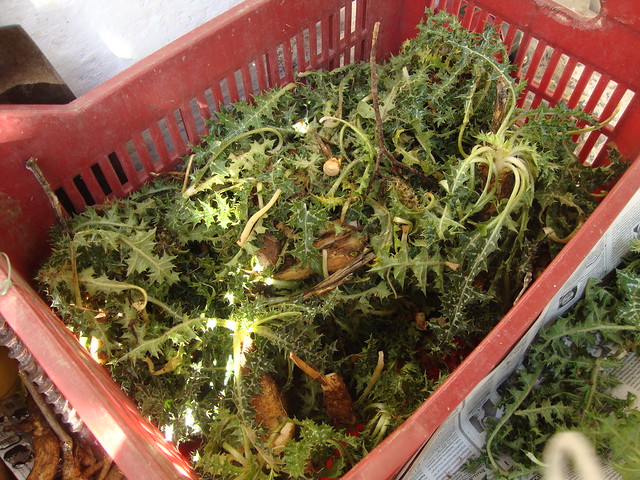
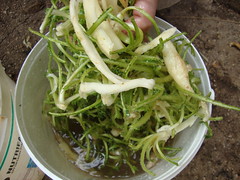
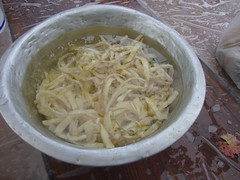
Even in the past, when people were more self-sufficient, they were never really completely self-sufficient. They were simply more self-sufficient than they are now because of the fewer opportunities to trade products, whether with goods or money. To make ends meet, they still had to engage in the some kind of bartering system, swapping goods that they had an excess of with goods that they did not have, with people who had them and needed/wanted their goods. For example, my grandfather from the mountain village of Kambi traded in ascrolimbri, a wild green that grows in specific microclimates and landscapes in Crete. This task involved foraging them, clearing them of dirt, peeling them to reduce excess weight and finally loading them onto the donkey for the ride into town. Ascrolimbi in those days were considered a delicacy in the same way that they are now. Not everyone has access to them, not then nor now, and they make a nice change to the daily diet. Although they look unusual, they are very tasty; both the leaf and root are eaten. They look similar to other greens found in the wild, but they are not the same ones, and the other greens are not edible.

askrolimbi
 Pappou never cleaned the ascrolimbi, but if he did, he could have commanded higher prices.
askrolimbi askrolimbi

Freezing and cold storage were known to my ancestors, even though they had no refrigerators or even electricity - the latter came in the 1970s in the mountain villages of Crete. The Lefka Ori mountain range is covered in snow throughout the winter. That snow looks as though it disappears by the end of June (or mid-July, as happened last year due to the heavy winter), but there are in fact pockets of ice remaining in places that are not visible from all vantage points. These ice-filled crevices were discovered by the villagers during their hiking, hunting and foraging expeditions. With their axes and picks, they carved out blocks and managed to take them into town to sell or exchange them for goods that they needed and could not produce in the mountains, eg sugar and rice.

An ice-skating rink is erected in Hania by the stadium every year during hte Christmas period.

Ice melts in the sun, but compa\ct ice can in fact last a while on a journey. Most of the villagers who walked from the mountains to the town for goods exchange would set off for the road to Hania at about midnight. So it would be cold and dark when the ice was being transported, and it would not melt away so quickly.

Snow on Lefka Ori

Walking or riding a donkey to Hania was always done in small groups of two or three people. There were no telephone lines then, but people had other ways to communicate with each other. Houses in the mountain villages were not very close to each other, but a small cluster would often be within view from each other. The time to set off for Hania would be arranged. Even if people didn't have clocks, they had ways of knowing what time it was, eg from the position of the moon or the stars. Then, at the pre-determined time, they would come out of their houses and wait for the signal to begin the journey.

The skating rink

My grandmother would swing a lit lamp from a vantage point where she could see the other house and her neighbour would be able to see her. The neighbour would then swing back her lantern. There were no street lights, so it was pitch dark throughout the night. Only the moon and stars offered any lighting, if they were visible on a clear night. The only light visible on the ground would be that which came from those lamps. And with the signal exchange complete, they would start their journey. The journey to Hania took about 4-5 hours, with a couple of stops for the animals (and the people) to rest, taken in clearings off the road. The villagers would arrive in time for early morning trading at the Agora, while the donkey rested and was fed/watered. Riding back up the mountain was always more difficult. If it was raining, you still had to set off to go back home, because you had nowhere to stay in the town. The animals needed to rest more often up the hill - they were always laden on both legs of the journey.

Although snow is rare on low ground in Hania, it has been known to happen (photos from December 2010).

Trading in ice stopped as early as it started. It was never really very feasible. It was difficult to carve out of the mountain, difficult to carry, difficult to transport and difficult to keep it from melting. But ice trading is similar to today's attempts to trade in natural or semi-processed elements with as little cost as possible and as much value added as necessary in order to make a small profit. Pretty soon though, technology catches up with the process and you need to move on to find something esle to trade in. Fashions come and go, and so is the case in natural products. These days the buzzwords in Greece are 'extra-virgin' and 'green energy'. But for how long? Somebody somewhere else has already found cheaper ways to procure these elements - there's a bit of άρπα κόλλα να προλάβεις everywhere in the marketing world these days.

©All Rights Reserved/Organically cooked. No part of this blog may be reproduced and/or copied by any means without prior consent from Maria Verivaki.

Tuesday, 15 January 2013

The cutting of the New Year's cake (H κοπή της πίτας)

Greece is not just a country, it is a way of life. As J.W.von Goethe said, "let's discover the land of the Greeks because the Greeks have dreamt the dream of life so beautifully." Thank you, Ann-Britt Gay Hartwig.

The custom of the cutting of the βασιλόπιτα (St Basil's pie - New Year's cake) is a symbolic gesture associated with good fortune in the coming year. It is not reserved for only the beginning of the year; an organisation, a school, a firm, a sports group and any other body may cut a vasilopita at any time early in the year as a gesture of goodwill. This could be accompanied by a fund-raising venture, or a get-together.
In Greece, where there is wine, there is food.
The cutting of the New Year's cake is like a bonding session: it the equivalent of the office Christmas party. It is always treated as a family affair. At the Mediterranean Agronomic Institute of Chania (MAICh), the Director oganised a staff party, inviting all retirees from the institute to come and join us in the celebration.
Staff and students mingle together on occassions like this.
Instead of having a lunch meal at the student restaurant, we had a buffet-style dinner at the restaurant usually reserved for conference facilities. The Director spoke first, followed by the student representative, and then the cake was cut by the Director. This is usually distributed to the attendees, but because our get-together was accompanied by food and wine, we left it for dessert.

The chef serves mainly vegetarian dishes - although meat was served, it was not overwhelming. Chicken and beef, with some lamb, are the main meats served. Pork, a greek favorite, is rartely used, because half our students are Muslims.

While we helped ourselves at the buffet (wine was served with the meal), the musicians from OKTABA, a local group that plays in a club in Hania, one of whose members, Yiannis Katsikandarakis, works at MAICh, played some Greek favorites. Food, wine and music entail dancing - and there was plenty of that too.
I ate later than most because I waited for my family to come after the kids finished school. In the meantime, I set the table to start them off. At celebrations of this kind, I am unable to eat or enjoy the atmosphere alone. 
The vasilopita was then shared out. The hidden coin was quickly found by a student. As a symbolic gesture, he was given a prize of a return ticket to Athens with the local ferry boat service (sponsored by ANEK).
Come to Greece to find your κέφι!
In Greece, the New year doesn't start until a vasilopita has been cut. For this reason, it's never too late to wish someone a Happy New Year.

©All Rights Reserved/Organically cooked. No part of this blog may be reproduced and/or copied by any means without prior consent from Maria Verivaki.