Friday, 12 October 2012

Uncontrolled

Gorse bushes cover a good deal of the landscape of Crete, as they are difficult to control; it is also the case that controlling it is not always feasible, as it may be too costly or involve strong herbicides.

High rise apartment blocks are often seen standing right next to a section of land covered in gorse and other low-lying scrub. It is most likely waiting for that moment when it too will be transformed into a high rise apartment block. The owner is probably waiting to become rich, or sell the piece of land for a high price.

 
Friends from abroad often remark that for a remarkably Westernised country with close contact to Eastern borders, Greece behaves as though she is still 'under development', as nothing seems to look finished.


Some land parcels seem ot be situated in a prime location but they look as though they have been left to lie in ruins, when all this time, they could have been developed into something that may be paying good money.


So many places end up having a worthless look about them, when in fact they have a high real estate value.


Other times, such areas may look under- or mis-utilised.


But when the time comes to utilise them, mistakes may still be made. Nevertheless, something positive will now come out of all this uncontrolled gorse growth - now that all land parcels and property (regardless of use) will be taxed as of 2013, unused land (and property) will be too expensive to hang on to for the sake of just having something and not making use of it.


It will be interesting to see the same areas in a decade's time; it is unlikely that the gorse bushes will still be there. Greece is ploughing through with developments, even if they seem strange to her. Never before has her Europeanisation taken such a firm hold. Diaspora Greeks beware: that old property of pappou's is suddenly going to become very costly to maintain...


All photos taken recently in the Souda area, close to the ferry port.

©All Rights Reserved/Organically cooked. No part of this blog may be reproduced and/or copied by any means without prior consent from Maria Verivaki.

Thursday, 11 October 2012

Student daze (Φοιτητική ζωή)

When I was studying at university, I used to walk to and from the campus every day. It took me about half an hour to walk down a hill, then walk along a flat road and finally walk up a steep hill to get to the campus which was situated amidst a panaromic setting. I would walk because I was saving money and getting exercise at the same time. Although my meals were often prepared by my mother, throughout my bachelor degree, I was also helping my parents after classes at their fish and chip shop, where I would also be doing my reading or writing my assignments. With the exception of my dad, we all had our share of the housework too. It wasn't an easy life, but it wasn't an exceptionally hard one, either.

It's quite a different story to the students I teach at MAICh. They stay in dormitories with private bathrooms, which are cleaned once a week by institute staff. Their bedsheets are also changed on that day. Every morning, they wake up to a full breakfast served by the restaurant staff. After attending classes all morning, they then come back to the restaurant for a cooked lunch (with desert). Unless there is a laboratory session or an extra class scheduled, afternoons are usually free for study or leisure, and there is also one more meal served in the early evening. The campus also has sports facilities - football, basketball and tennis/squash courts - all set in a peaceful pine forest surrounding, and wi-fi is available throughout the campus. Most of the students are on a full board and tuition scholarship; some of them (depending on which country they come from - Greece is not included) also receive a small monthly allowance to cover personal needs. Personally, I think they've got it easy.

But as the world moves forward, we become more demanding; as our standard of living rises, so do our expectations. We want a better life, because improving one's standing is seen as a right. Even though we have it all on a plate, so to speak, we are still within our rights to complain, and we still find reason to complain: "I don't like the food, it's the same every day", "there's too much homework, I don't have enough time to relax", "the afternoon classes should be cancelled, I prefer to sleep then", "€20 pocket money isn't enough to buy my monthly supply of cigarettes and phone cards". All complaints are valid, even if they sound somewhat trivial.

 Imam baldi eggplant, risotto and 'breakfast salad' with honey-mustard dressing, with coleslaw and beetroot-walnut pasta salad - part of yesterday's lunch served at MAICh campus; the restaurant dining areas is seen in the background.

It's only when their study period is over that they will remember the days when they were studying on a beautiful island in Greece, where all they did was study or play as they pleased, and the food was fresh, local and seasonal every day.  That's when they will remember the sit-down variety meals they shared with an international group of friends. Then they might remember the pizza, spaghetti and souvlaki lunches which were always the most popular ones, and the queue was long before they got to the end of it. And if it's snowing where they are right now, they will remember Crete's good weather and the shady restaurant balcony with the wooden tables, since most of the time, they were able to sit outdoors. Above all, they will remember that they were lucky to have had the chance to experience all this in one of the most beautiful settings in Europe, during a period in their life when they were young and carefree.

©All Rights Reserved/Organically cooked. No part of this blog may be reproduced and/or copied by any means without prior consent from Maria Verivaki.

Wednesday, 10 October 2012

Red (Κόκκινο)

The tomato season in our garden is over, but it isn't over in everyone's gardens yet. We have garden-grown fresh tomato available to us for at least six months a year. Red foods, including other garden favorites like red peppers, and a summer staple like watermelon, supposedly protect you from strokes., due to their lycopene presence. So go red and keep healthy.
The Cretan farmer's favorite snack for half the year: tomato salad and dakos rusks. Greenhouse tomatos are also available after the summer, but they never really taste the same as a summer-grown tomato.

©All Rights Reserved/Organically cooked. No part of this blog may be reproduced and/or copied by any means without prior consent from Maria Verivaki.

Tuesday, 9 October 2012

15 minutes (15 λεπτά)

Jamie Oliver, a respected UK chef, supporter of real food, advisor to the state on nutrition issues, entrepreneur of businesses employing troubled teens, ordinary-looking bloke with extraordinary charm, has published yet another sure-to-sell (expensive) cookbook with a catchy title, Jamie's 15-Minute Meals. You can't browse through it on Amazon (presumably because Jamie is well known enough not to need to resort to such attention as self-advertising). Nor is the book available on environmentally-friendly e-book readers, which means that if you want to view/read the book, you need to have a paper copy in your hands; you need to buy it or lend it from a library, which is why I believe it won't be getting into my hands very soon, hence I can't provide a review of this book. 

To make a simple but tasty puttanesca sauce using fresh ingredients in a quarter of an hour, you could try boiling your pasta in with the watery sauce. Cleaning/chopping/grating the onion, garlic, peppers, caper leaves and tomatoes didn't take as long as it did to simmer the sauce; the former needed about 5 minutes, the latter needed about 25 minutes.

I work fast in my own kitchen, mainly because I know where things are kept, and I like to prep meals, so that I can concentrate on cooking times and flavourings. But there are very few meals that I can truly say I cook in 15 minutes. I can prepare a salad or serve leftovers in less than that time, but to actually cook a whole meal in 15 minutes? Impossible: it would undoubtedly mean skimping on cooking time.

Jamie defends his position for his previous book for 30-minute meals (critics were equally dubious about that one too...), saying:
“I could give you a lot of defensive s--- and say they didn’t do the recipes exactly from the book or didn’t use a food processor for chopping – which is an absolute must, unless you have knife skills like me. I look on Twitter and somebody says it took them 45 minutes and I think ‘God bless you, keep trying and you’ll speed up next time'."
So what does it take to be able to cook a meal from his book in 15 minutes? According to Stevie Parle, a professional chef who made Jamie's Seared Asian Beef, it only took him 10 minutes. But beef (in particular) cooked in less than a quarter of an hour could (and would) never be contemplated in a Greek kitchen, yet Stevie tells us he can cook that up for you whipper-snapper. In fact, no meat would be cooked in such little time in a Greek kitchen - and if you keep things neutral in terms of countries, just think of how long it takes to cook something in order to ensure that any bacteria that may unwittingly be carried in raw meat is killed off. By the time you place the meat into the cooking vessel and heat it up to start cooking, you've wasted a few minutes already, so your mea\t won't even be cooking for fifteen minutes

Vegetable pasta sauce using fresh ingredients - if you cooked the sauce for only 10 or so minutes, you'd get a soup instead of a sauce.

Including the phrase '15 minutes' in the title of a book makes it sound very appealing to the health conscious who spend too long at work making enough disposable income to buy this expensive book, but I wouldn't have thought that Jamie Oliver would need to resort to such cheap tricks. After all, he's known for his sensible approach to food. What I found particularly alarming was the number of recipes using raw meat, which were all to be cooked in up to 15 minutes. Even if the meal I'm preparing is a tomato sauce to top something like pasta, I'd still need more time than Jamie to cook it - if it contained raw meat, I'd be suspicious of something that took less than 15 minutes to cook.


Speaking of Greek food, Sarah Rainey tried to cook Jamie's Greek chicken, herby vegetable couscous and tzatziki (never mind the fact that it is highly unlikely you will find couscous in Greek cuisine, and the only thing that makes this dish sound Greek at all is perhaps the mention of tzatziki) in a quarter of an hour: "The recipe is written in his trademark chatty style: I’m told to “scrunch” the cucumber and “bash” the chicken before “popping” it all on a platter to serve." It still took her twice as long to make the dish, while forgetting to add a couple of ingredients, grating her thumb while she made the tzatziki and almost burning rather than chargrilling the chicken, in order to meet the time restriction.


To make a puttanesca sauce in fifteen minutes, your tomato sauce will need to pre-prepared.

Jamie's runaway success with his '15 minutes' book was based on the outcome of his previous success with Jamie's 30-Minute Meals, which was also criticised for the time factor, although I'd be more inclined to believe it to be feasible (especially if the meals were mainly vegetarian). I like his humanitarian actions, but they too obviously have marketing appeal, and it's quite clear that this very young millionaire's marketing skills dominate in his latest venture - it will clearly make money, even if it doesn't yield what it promises. As a potential reviewer on Amazon stated: "I was thinking of buying Jamie's 30 Minute Meals but then I saw Jamie's 15 Minute Meals... so now I might just wait for the 5 minute one." 

©All Rights Reserved/Organically cooked. No part of this blog may be reproduced and/or copied by any means without prior consent from Maria Verivaki.

Monday, 8 October 2012

Hollywood comes to Hania

Last week, as I was picking up the kids form school, a phantom bus caught my eye. The old bus didn't look out of place in the empty parking lot where I saw it while driving along the main road, but it had a strange load of suitcases tied up to it on the top rack on its ceiling. They looked like those old square cardboard ones that the few of us that travelled long distance used to carry (no wheels). I last remember seeing this kind of luggage transportation in 1974...

 Photo by Roula Spartali

Photo by Tim Perks
Photo by Magda Vogiatzi
I thought I'd try photographing it the next day as I was taking the kids to school. Alas, by that time, the bus had disappeared. It felt like I'd seen a ghost from my past!

It turns out that this was all in aid of the filming of The Two faces of January, starring Viggo Mortensen of Lord of the Rings fame. The film is set in 1962, and uses Athens, Crete and Istanbul for on location filming, while part of it will also be filmed at Ealing Studios in London.

Recreating the Hania of 1962 is not difficult, thanks to John Sooklaris' work on youtube. He has uploaded the videos his father Antonis Sooklaris (the Anglicised form of Tsouhlarakis) took when his family (immigrant Greeks living in the US) came to Hania on a holiday in 1961, known as the PanCretan Excursion. Marie Sooklaris, John's sister, remembers the trip:
"I was in Chania for a month one summer when I was 11 (1961) and I have fond memories. I remember souvlaki from the street vendors -- the best I think I've ever had. My brother started putting up the films on youtube after my father died. Too bad he wasn't around to see what a splash they made. My dad loved to film and tape everything. We arrived in Hania in May of 1961, stayed for a month with my mother's cousin. Even though I was only 11, I have vivid memories of my time there." (personal communication through my facebook page)
Hania, Crete, 1961

The above video depicts the inspiration for the recreations of charming 1960s Hania and her Venetian harbour in the photograph sets uploaded by Chania Nikos and Tim Perks. You will also see some food shots - street sellers, refreshments, kafeneia, watermelons με το μαχαίρι, among others. These photos all hint at the seamless continuity of more than 5,500 years of continuous habitation in the area.

A word of note about the refreshments used in the filming: in the photo sets I've linked (see above paragraph), EPSA soft drinks (and other advertising paraphernalia for EPSA) are shown prominently throughout the set, but this would have been unlikely in Hania 1962, as the locally made GERANI soft drinks were very popular in Hania at the time. This may have to do with the film sponsors.

©All Rights Reserved/Organically cooked. No part of this blog may be reproduced and/or copied by any means without prior consent from Maria Verivaki.

Sunday, 7 October 2012

MAICh menu, 8-14/10/2012

My workplace is updating its website. A decision has been made to include the weekly menu for our international live-in students. Significance must be placed on food, since we live in a food-centric Greek island, considered the birthplace of the Mediterranean diet, with a great variety of local produce. The menu outlined below is for this week, starting tomorrow; the photos show a variety of meals served over the past year (they don't necessarily match the descriptions).

Monday
Lunch: Pasta with bolognaise, mushroom, vegetable or tomato sauce, served with aged gruyere
A variety of 6-7 salads
Dinner: Smoked lentil soup
Breaded fillet of catfish with seasonal vegetables
A variety of 2-3 salads


Tuesday
Lunch: Beef or vegetarian souvlaki with seasonal vegetables
Tzatziki and a variety of 5-6 salads
Dinner: Orzo vegetable soup
Chicken with grape syrup and Cretan herbs
Fried potatoes
A variety of 2-3 salads

https://fbcdn-sphotos-h-a.akamaihd.net/hphotos-ak-ash4/307702_10151187261765067_2063234478_n.jpgWednesday
Lunch: Eggplant imam baldi
Risotto
A variety of 6-7 salads
Dinner: Orange flavoured bean soup
Braised beef flavoured with orange and thyme, served with home-made pasta

https://fbcdn-sphotos-f-a.akamaihd.net/hphotos-ak-snc7/580851_10151219736725067_562579611_n.jpgThursday
Lunch: Pasta with chicken and/or seasonal vegetables
A variety of 6-7 salads
Dinner: Cream with smoked yellow fava
Beef with basil, sun-dried tomatoes and vegetables

Friday
Lunch: Pizza with home-made crust and freshly grated gruyere
A variety of 6-7 salads
Dinner: Vegetable-rice soup
Braised lamb or pork with herbs and thyme honey
Fried potatoes


Saturday
Lunch: Green beans with fresh Cretan curd cheese
A variety of 3-4 salads
Dinner: Citrus flavoured chickpea (garbanzo) soup
Golden-fried chicken
Risotto
A variety of 2-3 salads


Sunday
Dinner: A choice of beef or vegetarian moussaka
A variety of 2-3 salads

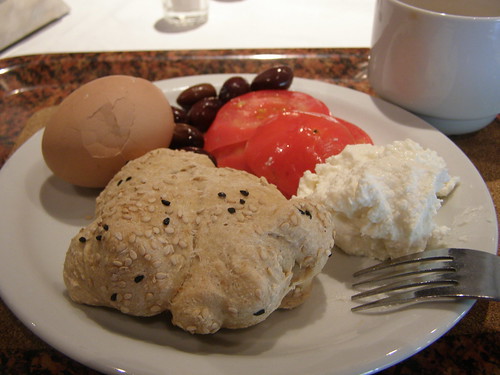
maich breakfastA full range of vegetarian breakfast meals is available every morning. Seasonal salads are served with organic extra virgin olive oil and home-made accompaniments: vinegar-honey sauce, orange vinaigrette, honey-mustard vinaigrette, herbed yoghurt, curry ketchup. Only extra-virgin organic olive oil is used in cooking and frying. All meals are accompanied by home-made bread and fruit or a sweet.


You will notice a number of orange-flavoured meals - this is because use of local seasonal (and naturally fresh) produce is being made in the meals. Oranges are plentiful at the moment. Some menu items are standard (eg pasta once a week), while the major changes that occur on a monthly basis usually refer to the seasonality of the items. The chef - Yannis Apostolakis - is well known in the area, and has made a number of appearances on nationwide television cooking shows. We're obviously in good hands.

©All Rights Reserved/Organically cooked. No part of this blog may be reproduced and/or copied by any means without prior consent from Maria Verivaki.

Saturday, 6 October 2012

Λιτλ Σίζερ (Pizza pasta espresso bar)

Despite the economic crisis, a number of new businesses are opening in Hania. The ones that I notice more, maybe due to my interests, are those focussed on food. As we passed a new pizza-pasta-espresso bar (as the store describes itself), my kids, tempted by the aromas, asked me if they could have some pizza here.

I generally keep away from pizzerias because I've never found one that can mae a tasty pizza crust that isn't soggy, or too thick. The thin ones disintegrate too quickly, the thick ones leave you feeling stuffed; sometimes they aren't cooked crispy enough, other times the sauce has made the crust go soggy.


I hadn't ordered any pizza for myself, preferring a cappuccino instead. But when the pizza came to our table - served delectably on square wooden plates - the first thing I noticed was the crust. It looked quite good. Even the children remarked on how good the pizza was. They didn't pin point what they liked about it - the toppings didn't taste any different to when we have a take-out pizza, which isn't very often. I think they must have liked the crust. At one point, they even made a point of insisting that their father should try this pizza, which I think was a good idea, as he is a fussy crust kind of person.

I have to say that the cappuccino was good too, which, in my humble opinion, it generally isn't in Hania (I am a fussy cafe-coffee kind of person). I also studied the bill - €5.60 for the lot. I think that's a pretty good price for a once-in-a-while treat. The cappuccino was also the cheapest I have ever come across anywhere - €1.20 - and what's more, it was very good coffee. 

Dad is hard to rope in for a pizza night out, and I can't blame him when I told him where the pizza bar is located. Apokoronou St is very noisy and dusty; during the day, you can't sit at one of the many cafes in the area without noticing this. I found the pizzeria's phone number on the internet, and found that they do indeed do take-out pizza. They allowed me to order it, but we had to pick it up ourselves, as we were outside their delivery zone. The pizza was still cooking when we arrived to pick it up. 


A good test for take-out pizza is whether the pizza survives intact after being knocked about during the driving process. Usually, it doesn't, but this one passed the test with a very high grade. And the crust was still perfect. 

A look at their advertising leaflet will make you understand why I'm not mentioning the name of the business. I've heard how not-really-very-good that brand of pizza can be in the US, but that's the whole point of not using the name: this pizza looks way better than anything you'll get from them in the US. So why bother ruining their reputation? The one in Hania really does serve very good pizza, even if it goes by the name of the big US chain. NB: the box wrapping is generic (no mention of the little emperor). 

To be honest, I had no idea that there was such a pizza brand as the one using the Roman emperor's name, possibly because I have never had any reason to use thier delivery services. Once the US chain restaurant was pointed out to me by a facebook reader, I was then able to understand why the pizza parlour that delivered the pizzas in Home Alone was called Little Nero's...

©All Rights Reserved/Organically cooked. No part of this blog may be reproduced and/or copied by any means without prior consent from Maria Verivaki.

Friday, 5 October 2012

Married fava (Φάβα παντρεμένη)

I know I'm bragging when I tell you that I'm up to date with every single one of my tax, utilities and other bills, because put together, these days, they make hefty amounts, and my guess is that most honest people are still wondering how to make all those unfair payments. It's still hot in Hania and it still hasn't really rained here save a few drops of drizzle, so I can be thankful that we don't have to turn on the wood fire heater yet, and many of my colleagues are praying for this weather to continue so that they can save on heating costs too.

One way I have managed to continue to be up to date with all those bills is to cook really cheap food jazzed up with very tasty garden vegetables. My cheap food always gets noshed up really quickly because it's very tasty, even though it may not look like a feast to begin with. But the smells emanating from my kitchen don't give any hint of cheapness or low quality - it makes my family even more impatient to eat.

Take last Sunday when I was cooking fava to have ready for Monday's main meal. The aroma in the peas' sweetness wanted through the house; instead of having the tsigariasto meat dish that I had prepared for the Sunday lunch, the family ended up eating half of Monday's lunch instead.

"But it's Sunday," I complained. "Sunday is meat day, you can't eat that fava!"


"We'll just have that meat tomorrow instead," they all insisted. So fava it was, even though bean dishes are usually Never Never on a Sunday for us. And since it didn't feel right to serve such a cheap and frugal humble dish on a Sunday, I jazzed it up with a sivrasi medley of onions, foraged capers and garden peppers, which turned my simple fava dish into fava pantremeni ('married' split yellow peas - φάβα παντρεμένη), a popular way to serve fava in the Cyclades. The married effect comes from combining capers and yellow split peas, which make a very compatible pair.

Apart from some crusty bread, you also need some extra virgin olive oil - as much as you like - which is usually used as a dressing over fava. Luckily, that remains cheap and Greek and frugal where I am.

©All Rights Reserved/Organically cooked. No part of this blog may be reproduced and/or copied by any means without prior consent from Maria Verivaki.

Thursday, 4 October 2012

Bric-a-brac (Ψιλικά)

The simplest people, with their down-to-earth ways, are often the most honest people. 

Last Saturday, I found myself in the port town of Souda, close to the Athens ferry terminal. For such a significant port of call, which has been frequented by enormous cruise ships throughout the spring and summer, the town of Souda remains chaotically undeveloped. It is not uncommon to find uncultivated fields covered in thorny gorse, while the port itself is modestly unassuming, despite its being the gateway to Hania for those who choose to come to the island by sea.

The Athens-to-Hania ferry boat (above) fits in the photo, but cruise liners (bottom) do not!

The main road of Souda contains the usual array of shops and service offices commonly found in any Greek town, which provide all the facilities needed to make it a hub zone for the surrounding region: baker, zaharoplasteio, chemist, greengrocer's,post office, bookshop, toyshop, glassware, horticultural supplier, DIY store, kiosk, souvlatzidiko, snack bar, kafeneio and modern fast-food outlet, being the main ones, along with at least one omnipresent multi-national supermarket chain. The side-street leading off the main road to the ships is lined with ticket agencies and flashy cafes, as if it is an entertainment centre that everyone would want to stop off at as soon as they land on the island.


Now that I'm making kefir on a daily basis, I found that I needed to buy some new kitchen equipment. Metal tools are best avoided with kefir, so I needed to buy a small plastic strainer with a handle as I only had metal ones at home. Avoiding the supermarket due to my aversion of the mainly imported foods it stocks, rather than their Greek (and slightly pricier) equivalents, I looked out for one of those 'general stores' that stock all sorts of bric-a-brac, from small electronic kitchen gadgets (eg mini-mixers, mini-vacuum cleaners, etc), to possible gifts (eg ceramic Made-in-China picture frames), incandescent light bulbs and even Christmas decorations, which are often moved to the darkest corners of the shelves until their time comes to be displayed more prominently.

Sure enough, there was one of those shops. It looked as tired and dusty as its owner, a largish woman wearing a flowery housecoat, who was jabbering away with another customer when I entered. "Zesti, zesti! Kaikame oloi!" she complained, wiping her brow, which was dripping with sweat even so early in the morning, as we were in the middle of an autumn heatwave which saw temperatures soaring to the mid-30s and no sign of waning. She paid no attention to me, as she undividingly splattered it over the other customer. This was a cue as to how she would treat me when it was my turn to get her undivided attention: each customer is of utmost priority.


So I waited my turn, rummaging through the bric-a-brac on display, carefully avoiding any objects covered in dust, when I found some small plastic airtight containers which looked perfect for my kids' lunchboxes. Last week, they complained that I put yemista in their lunch, without a small pot of yoghurt to accompany the rice, which we usually have at home. My son returned the yemista untouched; when I scolded him, he told me he would reheat his meal and eat it with yoghurt now that he had come home, prompting me to find less deceptive ways to stave off their hunger while they were at school.

"Do you have one more of these plastic containers?" I asked the woman, explaining that I need two of them.

"Just a minute, dear," she replied, "I think I'm still asleep - this weather's gonna kill us off!" she said, as she tried to count some change she was handing to the previous customer. The container was found on a portable rack of 'seasonal' items which included children's drink bottles, it being the start of the school year, and there would be a need for such things. While she was finishing off with the previous customer (they still had some gossip to catch up on), I looked around for a plastic strainer, but to no avail, as there didn't seem to be any order in the shelves which I could make sense of.


"Right, love, what can I do for you?" I asked her about a plastic strainer. "Middle aisle, right at the end, on your right," she answered, pinpointing me to the exact location where I found a number of strainers in different sizes and colours. I found exactly what I was looking for, and brought it back to the counter.

"Anything else, dearie?" she asked me, just as a fat black and white cat walked into the store, meowing softly. I showed her the plastic container and explained that I wanted another one in the same size. She promptly went to search the same places in the store that I had already searched.

"I've looked there already, and I don't seem to have found anything," I tried to offer helpfully, but she wasn't listening because she was too involved in what she was doing, knowing better than I did the nooks and crannies of her haberdashery cornucopia.


"I know where I've got them," she suddenly announced, "I'll just look out the back in the store room where I keep other tupperware along the same lines. You just take a seat and make yourself comfy," she said, pointing to a chair near the cashier's desk, in front of which was an old TV set that looked remarkably similar to one I have in the kitchen. It's so old (more than 25 years) that I keep wondering why it hasn't broken down yet, and I've often cursed it as it is the protagonist of many arguments over eating times in our house, when somebody wants to watch something, while somebody else wants to watch something else, leading me to remove the aerial plug so that everyone ends up watching nothing.

"Yes, puss, I know you're hungry, and I'm going to feed you soon, just be a little more patient, sweetie." She was humming as spoke to the cat, as if trying to placate it by pretending to be looking after its needs when she was actually looking after mine. She disappeared round the back of the shop, allowing me to snap a few photos without any bother. After a few moments, she reappeared with a mountain of tupper boxes, which all looked quite inappropriate, but she had a smile on her face which gave me the impression that she was going to find exactly what I was looking for. By this point, another customer had entered the shop.

"I hope you don't mind if it's not the same shape," she apologised, "but it will be the same capacity," she emphasised. Sure enough, when she opened the boxes, which had other boxes nestled inside them like a Russian matryoshka doll, the last box she opened contained the box that I wanted. She looked very pleased with herself; I thanked her for taking so much trouble to find it for me, and asked her how much my wares cost.
"That's 50 cents for each container, and... what does that strainer say on the side?" She scrutinised it carefully. "€1, so that's  €2 altogether." She took out a plastic bag and placed my bric-a-brac into it and then ran up a receipt on the till.

"Are you still handing out receipts?" asked the next customer. "They won't count towards anything you know," she said looking at me. "The only ones that will be needed are for doctors, restaurants and cabs," she said knowingly. Printing out a receipt is now standard practice in most stores, and there has been a severe clampdown in tax evasion of this petty kind, but 'freelancers' (of the type mentioned by the woman) still pose a problem.

"Well, I'd better collect as many as I can, because my husband's a cabbie," I let her know.

"Oh, in that case, here's a few more," the store owner said to me, pointing to the pile of uncollected receipts that some of her customers left behind. "Not everyone needs them for filing their tax forms, so they leave them here." I picked up a couple more, thanking her once again, and wishing her a good day as I made my way out of the shop.

"See you again soon, κοπέλα μου," she said, and I told her that most likely I will.

©All Rights Reserved/Organically cooked. No part of this blog may be reproduced and/or copied by any means without prior consent from Maria Verivaki.