Sunday, 15 August 2010

Coleslaw (Λαχανοσαλάτα με μαγιονέζα)

Today being the Feast of the Dormition of the Virgin Mary, Happy Nameday to all of us called Panayiotis, Panayiota, Depsina and Maria - except in Crete, where only married women celebrate their nameday today: the unmarried ones are relegated to celebrating their nameday on November 21, the Feast of the Presentation to the Church of the Virgin Mary...

The table had been set on the covered balcony. A long white broderie anglaise tablecloth covered the wooden buffet table, with the edges embroidered in red cross-stitch. Along with the chairs forming the outdoor furniture, they were some of the very few household goods items that Zoe had not bought from the States when she and her family decided to move back to the πατρίδα, once her parents retired. They left soon after they had completed the necessary paperwork allowing them to pick up their pension payments in Greece; this all took place nearly a decade ago.

Everything in their former home had been carefully packed (with the word 'fragile' written clearly on the outside of the parcel where appropriate), and repatriated to their new home on the island, which had been built according to plans made by a Greek architect who lived in the States. The house had a slanting roof on the front facade, which looked out onto a busy traffic route on the hilly road where the house was situated. This road hadn't yet been paved by the local council, which always made this modern building look slightly out of place in the area, as though it was still under development. The back part of the house which led to the garden had a few glass bricks set in the walls to let in the light, while the front consisted mainly of glass doors, with green iron gratings covering them. The windows did not have shutters, as Zoe had deemed them unnecessary, since she wasn't used to them in the first place; the only other home she had ever known was the two-storey house in New Jersey where her family had previously lived, and whenever the locals asked her if the hot Mediterranean sun bothered her, she gave the excuse that having shutters and thick curtains was like doubling up on items that did the same job. The air-conditioner sufficed to keep the temperature to a tolerable level during the summer, which lasted nearly seven months of the year, as Zoe was to find out once she moved to Greece permanently; before that, she'd only been coming to Greece on her family's annual two-week summer holiday.

Zoe took great pride in the way she decorated her house on that one time in the year that it was opened up to the family's guests, on the day of her husband's nameday. In the middle of the table was a large carved watermelon, in the shape of a gigantic rose. She had paid good money for this to be made specially for the event, and had asked the sculptor - a local restaurateur who often sculpted various squash and melons to decorate his own business - to ensure its freshness by not starting it earlier than on the evening before the day's planned event. Everything had to be perfect for the day.

This year, she had decided on a Mexican theme. On top of the white tablecloth, she had placed two large orange tassled sashes stretching the length of the table. The thick terracotta plates were set on woven brown placemats which had a colourful daisy design on their outer rim. Zoe had acquired these items (among many others) over the years from the sales in the large department stores in her Jersey hometown. At the end of every season, she would add a few bits and pieces to the miscellaneous stash in her trousseau. In the case of the terracotta plates, she had never quite got round to using them. it was quite a task to coordinate all the accessories so that they gave off the right air. Panayiotis couldn't understand why she had taken down the overly large framed photo of their wedding - the most glamorous the village had ever seen - and replace it with a cone-shaped hat.

"It's a sombrero, Panos," she informed him. She often spoke to her husband using a schoolteacher's voice. She did not expect him to 'know' as much as she did, which she put down to her foundation college education. Panayiotis had barely finished Greek high school and had never been out of the country before they met; Zoe did not expect him to be as well versed in general trivia as she was herself. She felt obliged to educate her husband on global knowledge. "A sombrero," she continued, "is the hat men wear in Mexico." Not that she had been to Mexico in the first place. She was simply relaying what she had seen in pictures and travel brochures. Many of her American Greek friends had been to Mexico on their honeymoon. She would have done the same had she stayed there and married Aristides. But she didn't; she came to Greece the following summer after their break-up, convinced herself that she had fallen in love with a local man, and got married here. After the wedding ceremony, the happy couple left for the States, so that Zoe could introduce Panayiotis to Jersey, so that all her friends and acquaintances could meet him. Zoe had taken her honeymoon in her hometown. It was Panayiotis' first and last trip out of the country. 

The invited guests all seemed to have turned up, more or less at the stated time (she had specifically told them individually over the phone not to arrive too much later than the stated hour), It was time to get the rice cooking for the pilafi. Zoe dialed her mother's telephone number. Her parents lived in a small apartment, kind of like a bachelor pad, that they had built next to the garage of the main property, their daughter's house, to give Zoe and her husband some privacy. The original plan was to build a classic upstairs-downstairs Greek house, maximizing on building space on the modest plot of land they had bought with their hard-earned dollars, but Zoe had objected. She wanted a house, not an apartment. Her father's original idea to grow a large vegetable garden in his retirement had to be downgraded.

"Έλα μαμά," she spoke quickly, "το πιλάφι, OK?"

"Ναι παιδί μου," her mother spoke softly, "θα το βάλω τώρα." She had hardly got the words out of her mouth when Zoe had already hung up. 

The guests were seated both indoors and outdoors, enjoying the view which looked out to the small island of Thodorou. They had all come to Zoe's house carrying their customary little gifts: some bought sweets and πάστες from the zaharoplasteio, others bought decorative ornaments from the cheap glassware shops in the main town, and the ex-pat Americans carried little reminders of her former home that Zoe did not often recall, but which created a slight flutter in her heart and a surge of nostalgia in her mind every time she opened the carefully wrapped presents, complete with ribbons and decorative motifs: Hershey's chocolate kisses, Betty Crocker pancake mixture and pistachio pudding Jell-O, all staple party foods at the huge buffet tables of the parties of her American friends, both Greek and not, which they held in their equally large houses.

When she heard the two short rings of the telephone, the agreed signal from her mother, she knew that the pilafi was ready. She sent Panayiotis down to her mother's to bring the pot. As the hostess of the event, she felt she could not abandon the scene herself, especially since her cousins had arrived with their young children. She was very worried that an accident might take place right before her eyes. Her previous evening's dreams included visions of glasses of coloured liquids - coke, juice, red wine - spilt onto the plush beige denim twill couch and feather pillows, plates and glasses laid precariously at the table's edge and being smashed into smithereens once they fell off the table, and palm prints on the window and oily fingers touching the taffeta curtains.

Zoe picked up a crystal Lenox glass. She carefully placed it - the only one - in the middle of the buffet table so that everyone would think it had been used. She had decided against using her Lenox set for this event - in fact, it had never ever been used - because of her fear of breakages. These items were now irreplaceable (not to mention very expensive), there being no Lenox supplier in the town. They remained in the (locked) wall cabinet in the open-plan living room where she kept many other items of crockery and glassware that had never been used. This did not worry her in the least - they were not there to be used, they were there to be admired; look but don't touch. She tapped the Lenox glass with a silver-plated spoon (the silverware was OK to use; it didn't break and was not damaged by the dishwasher) to get the attention of all her guests.

"Καλωσορίσατε!" She spoke loudly and clearly, with the tone of enjoyment ringing in her voice, and her smile beamed around the room as she watched everyone's faces turning to look at her.

"Καλώς σας βρήκαμε!" the guests replied in unison.

"Χρόνια Πολλά, Παναγιώτη!" The guests all bid her husband the customary good wishes, and the official feasting began.

"ΕλΆτε, παιδιά," Zoe said gleefully, "σηκωθεΊτε, περΆσετε να πΆρετε ένα πιΆτο!" Zoe had been born and raised a Greek, but one thing she could never lose was the American twang in her Greek accent. This did not prevent anyone from understanding her spoken Greek; her idiosyncratically placed stress marks were just taken to denote a part of her personality, the former ex-pat US citizen, used to different ways and manners; to the locals, it matched her foreign ways and gave them a hint of flavour. Had her speech rhythms assimilated completely to the Greek accent, she would have been mistaken for an eccentric local. Now she had an excuse to sound different.

As much as the locals didn't always understand her, Zoe had the same problem when she tried to make sense of them most of the time. She found their make-do-and-mend lifestyle too simple, their cheap standardised choice of attire too dour, their insular surroundings too restricted. She had not contemplated these daily facts about living on the island before her permanent arrival. Sometimes, it helped not to think about it, but to just file these thoughts away in her mind, like a disused room where there may be some old unsightly furniture covered with well-worn sheets to stop them from getting dusty. It also kept them out of public view. She did not need to view them in her daily surroundings; they were conveniently hidden away and she had to face them only infrequently. It was kind of like putting up with an uncomfortable situation for as little as one needed to, before normality would return.

She did not have a lot to do with the locals herself; she did not approve of popping in and out of each other's houses, as was commonly practiced by most of the neighbours. Visiting had always been by arrangement for Zoe. She did not feel comfortable dropping into people's houses herself. What if they were busy? Or sleeping? Don't they want some privacy themselves? And how can you enter someone's house without carrying an appropriate gift? Her front door was always closed, and the house could only be accessed at the front gate by an electronic tracking system (that travelled from the States, in the container with the furniture). Hers was the only house in the village that possessed such a device. Most people couldn't understand why she had also installed a burglar alarm in the house. "Σαν φρoύριο το έκανες!" her neighbours would tell her. But Zoe did not like to take chances. 'Better safe than sorry' was a motto that had been instilled in her since primary school in the States.

The plates and forks had started making tinkering noises, as everyone stood up and passed slowly round the buffet table. Each bowl or plate had its own ladle or serving fork in it, and all the guests took great care not to mix them up or leave the tablecloth unstained. This was not your average 'τραπέζι'; the scene had come directly out of a 'home and garden' magazine and it seemed a shame to ruin it by placing the wrong ladle in the wrong bowl or - worse still - allowing sauces and oil to drip onto the crisply ironed tablecloth. Zoe had spent the best part of the previous evening ensuring that the decorations would be perfect, while her mother had spent the best part of her own evening preparing most of the meals. Zoe was responsible for transferring the dishes to an appropriate item of crockery, to be diligently plated. Her arrangements often looked too good to eat.

Zoe did not serve herself right away. She chatted with her guests as they passed by the buffet, pointing out what they had not put on their plate. When most of the guests had finished their first tour of the table, Zoe picked up a dish and began to mingle around the guests, serving it onto their plate, so that they didn't need to stand up again and take themselves for a second tour round the buffet table. Salads and pastries were what people craved most of all, and Zoe had made sure that there were plenty of them at her τραπέζι. There were kalitsounia with spinach, kalitsounia with mizithra, mini-pastries filled with potato and bacon, tiropitakia, mince-filled crepes and Chinese-style spring rolls. She had come across them at the supermarket, and couldn't resist the temptation of buying some; it had been a long time since she had had Chinese food, which she didn't really miss. It just felt more of a normality for Zoe that she could keep this kind of food in her home freezer, in the same way that everyone (that she knew) did in Jersey. 

She had also prepared many salads (she couldn't handle those quite well, as they didn't need any cooking), and made sure there were plenty of cooling dips on the table: Greek salad, maroulosalata, lahanosalata, taramosalata, melitzanosalata and the classic all-time Greek favorite tzatziki. Although the fasting period for the Dormition of the Virgin Mary had just finished, she had insisted on including a bowl of taramosalata in the range of dishes. Panayiotis thought it odd that she would include this particular fasting recipe on a feast day, but Zoe explained to him that there would be many American guests from her side of the family at the party, and they would expect it.

"We used to eat taramosalata all year round!" she exclaimed (she was conscious of her schoolmarm voice being over-used in one day). "It's only here that I've been told I can only eat it at certain times of the year!"

She picked up a bowl of tzatziki in one hand, and in the other, the platter of kalitsounia and walked around the room.

"Τζατζικάκi, να σας βάλω; Καλιτσουνάκι, πάρτε ένα!" she bid to each person, who most likely had already taken one, but Zoe was very insistent, and so they took another one out of politeness. Zoe liked to see her guests filling their plates. This was a sign that the food was being appreciated in the way that it should be. It also meant that there would be few leftovers; she preferred to eat vicariously by watching her guests.

"Πολύ νόστιμα, Ζωϊτσα μου," her neighbour Kiria Popi was complimenting her on the taste of the pastries, "τόσο πιτίδια δεν τά 'χω δει ποτέ μου! Εσύ τά 'φτιαξες κορίτσι μου;"

Zoe laughed. "Η μαμά έφτιαξε το μείγμα, και εγώ τα δίπλωσα," she explained. Her mum knew what to put into those pastries to make them so tasty, and Zoe knew how to seal them into perfect little square envelopes to make them look like the prettiest kalitsounia for miles.

"Ντρέπομαι να το φάω, τόσο όμορφο που είναι!" Indeed, each kalitsouni was a work of art. It was a pity that one had to bite into it and ruin its form; it had taken much longer to shape each one than it would take to gobble it all up.

"Άσε με να σου βάλω και λίγο τζατζικάκι στο πιάτο σας!" Zoe never let her mother use fresh garlic in the tzatziki. She used garlic powder instead because it didn't taint the breath in that undesirable manner that Kiria Popi's tzatziki did.

Her load became lighter and lighter as she walked round the whole of the living room, and onto the balcony, making sure to leave no one out. When she finally returned to the table, all the kalitsounia were gone, and the bowl of tzatziki was nearly empty. Feeling quite good about herself, she proceeded to take the empty plates to the kitchen sink and came back to the table to pick up some more dishes, selecting the ones that looked rather untouched compared to the other half-cleared platters.The cabbage salad was looking quite forlorn. Ladling out this dish would be quite a challenge, so she picked it up on its own and began her rounds once again.

cabbage salad
This Chinese cabbage was imported from Spain and sold in Greece; carrots are mainly grown in central Greece, with much fewer quantities being grown in Crete - the weather is not particularly suited for the commercial cultivation of carrots in Crete.


Zoe took the same route as before. "Λαχανοσαλάτα, everybody!" she exclaimed, melding the languages together, as she often did. Kiria Popi swayed her fingers in the air, indicating that she didn't want any.

"Μα γιατί!" Zoe cried. She always felt very nervous when a bowl of food did not go as quickly as she thought it would. It reminded her of the times when her parents ended up binning the food that people complained about at the Greek restaurant they ran in Jersey. It usually meant there was something wrong with the dish; it may not have tasted the same to the customers as the last time they had it, so they knew they had to bin it or eat it themselves.

salad dressing
 What essential ingredient is missing from the dressing for my lahanosalata?
Click on the photograph to see what each item is.

"Τί είναι αυτό;" asked Kiria Popi's daughter. Rania was a chef in a local hotel situated by the sea. She worked long hours every day, with only one day off a week. On her working days, she often came home as late as midnight, but she never shunned any work she was given, because in winter, she was always laid off and had to register with the unemployment department. She often helped her parents in the olive harvest during that time. She lived at home and her parents always expressed their wish that they see her happily married one day, so that she didn't have to work so hard, even though Rania herself never complained about her job. She was satisfied with her lot, and glad to be working in a job that she enjoyed. "Better than being a cleaner," she said, showing compassion for her work colleagues, and re-telling some of the horror stories they had told her about - vomit on the bedsheets after a drunken night out, blood on the walls after an argument, and levels of cleanliness: the English left their underpants lying around the floor, the Greeks never picked up their paper mess, and the Germans acted like they had never used the bathroom, because it would be left as clean as when they had first entered it at the beginning of their stay, leaving all the hotel staff to wonder where exactly they did their business.

Zoe had a good relationship with Rania. It could be said that Rania was her only real friend on the island, since Zoe was very family-oriented, and in truth, did not fit in very well with groups outside the family circles. Rania had helped Zoe get a job in the same hotel where she cooked. Zoe worked in the souvenirs and accessories shop, one of the hotel's sidelines. She had come into the job at the right time, and had managed to secure the day shift; another shop assistant picked up where she left off every day. Initially, the owner wanted her to work all day, with a break in the middle of the day, but Zoe insisted that such working conditions were inhuman. "Τι νομίζετε πως είμαστε, Αλβανίδες", she complained. The hotel owner could not afford to lose Zoe as a member of his staff. For a start, she was a native English speaker. She also had a knack of selling expensive items, and many of them; she had the gift of the gab. The profits Zoe brought in from the sales of accessories and souvenirs were worth it. To keep her in the shop during peak-hour trade, he asked her to come in at 10am and leave at 6pm, thereby completing a 40-hour week during the the busiest times of the day: after 6pm, most tourists would be having their evening meal, and if they weren't going to a bar or club after that, they'd then return to their hotel room, take in the view of the sea and feel the cool evening mist on the balcony.

When she wasn't working, Zoe and Rania would often go out together (if their days off coincided) for a drink. Zoe especially enjoyed these outings, a rare moment of getting away from the limitations of the village surroundings. They would go to to a beach bar and sit at an outdoor cafe, sipping away the evening on a frappe or something more alcoholic, according to their mood. They would get whatever was bothering them off their chest, Zoe letting off steam about their husbands, Rania talking about all the μαλάκες she had met which most of the time put her off marriage. Even Zoe had taken an active part in this kind of conversation, after her husband had left for work without flushing the toilet.

"Άκου να μην πατήσει το καζανάκι," Rania repeated her words comfortingly, but her face showed sarcasm. She was laughing.

"But Rania, can you imagine how I FELT when I entered the STINKing BATHroom?!" Zoe cried. Bathrooms and toilets were a very serious matter for Zoe. When the house was being built, she insisted that the plumbing be made wide enough for the toilet paper to be flushed through it without creating a blockage, unlike the neighbours' toilets which all had a small open basket for discarding the used toilet paper. She detested the sight of those bins, lined with supermarket carrier bags - 'they sell bin liners in the supermarket, you know!' she had once told Rania, who shrugged off the comment as though she had no idea what Zoe was on about. What she did know was that Zoe had greater spending power than anyone else she knew, which was perhaps the reason why she did not need to re-use supermarket carrier bags.

Zoe was just about to ladle some lahanosalata into Rania's plate, when Rania stopped her. "Who made it?" she asked, looking into the bowl.

"Λαχανοσαλάτα είναι, βρε!" Zoe replied. Rania was always making fun of Zoe's cooking skills, which Zoe never failed to admit to when the girls were together. Rania was also a good teller of jokes. She could always put a smile on the faces of the people around her. She fully deserved the modest popularity she often enjoyed when she found herself in a crowd.

"Oh, it's coleslaw," said Rania, upon further inspection of what was in the bowl. During her training at the State School of Chefs, one of the weekly assignments for her class group was to take a vegetable assigned to them by the instructor, and for each member to create a different dish with it using international standard restaurant dishes as a guideline. During the cabbage season, her group transformed the cabbage into a typical Greek lahanosalata, a German sauerkrat, a French choucroute alsacienne, an Asian stir-fry and an American coleslaw. She was familiar with international cuisine, even though she had only travelled once out of the country, on a college trip during her chef's training, a fleeting visit to that took her to two capital cities, Paris and London. Upon her return, she told her parents that everyone eats Greek food everywhere, but they cook it in a different way and give it different names.

cabbage salad
The dressing in this delicious cabbage salad doesn't contain olive oil, so it lacks Greek character. 

"Wanna try some, mama?  It's nice." She ignored Zoe's comment, because Zoe had a habit of turning trivia into matters of major importance.

"It's lahanosalata, ρε παιδιά," Zoe was trying to justify her creation. "We always made it like this at the restaurant and called it lahanosalata - it used to be really popular and our customers loved it!"

Stathi - another ex-pat who lived in the same part of Jersey as Zoe - jumped into the conversation, dribbling sauce over his beard. "Powli orayo," he said, in perfect timing to save Zoe's face. He was sitting on the other side of the table. "Hey, I remember having this regularly at the Greek Cafe. Nina's Greek Cafe!" He shouted gaily, as he said Zoe's mother's name out loud.

"Hey, Zoe, those were the days, weren't they?" He became very nostalgic, as he remembered older times now long gone, and this had an effect on Zoe. She fought back the tears. She was acclimatising well to life in Greece, but every now and then, when she experienced a sudden jolt back to the past, she would become sick with nostalgia.

"Speaking of Nina, where is she?" Stathi asked Zoe. Stathi was a ping-ponger; he spent half the year in Greece and the other half in the US. He was happy in both worlds, but couldn't live only in one place or the other. His son was married in the States, while his daughter was married in Athens, so that half his grandchildren were here and the other half there. Since he became widowed, they were his whole world. He loved them all and was glad to have the good health to enjoy them all.

"Oh, she's downstairs, Stathi," Zoe explained. "You know my dad, he's not feeling well," she explained apologetically. Her father had been suffering from coronary heart disease since they were still living in the States, and the Greek summer heat did not make him feel any better. On hot days like these ones, Iakovos preferred to stay away from the crowds, not only because of the discomfort he felt, but also because he did not want to hinder his daughter's guests from enjoying themselves. Nina was very wary of Iakovos' feelings. She did not want him to undergo any more unnecessary stress in his condition. It was so much easier to handle health issues back home, where the health service sector, despite being costly, could at least be guaranteed. Here, they were constantly confused as to where to go to be treated in an emergency. The local hospital A&E was always full of anxious unhappy-looking people who all seemed lost, as if they had no idea what was wrong with them and why they were there. And all that waiting amongst patients with high temperatures, coughing fits, vomiting! Heaven forbid that anything happened to Iakovos on a feast day like today, when the A&E beds would be full of drunken revellers having their heads stitched up after a fight at the close of the evening's festivities.

It was a difficult move for them to make in their old age, after Zoe's announcement that she intended to marry. They had no other children. If Zoe left the country, they couldn't stay on by themselves. They raised a family and they wanted to see that family continue to grow. On the one hand, they regretted the move for the usual reasons that makes adjusting to life in a 'new' country very difficult in their old age: the climate, the infrastructure, the state services - everything seemed out of whack for them, after spending so long in the ξενιτειά, that was in fact where they felt more at home. But on the other hand, they were grateful for the chance to see their daughter happy and smiling, doing what she particularly enjoyed: home-making and decorating.

Her break-up with Aristides had cost the family dearly.  Just when all of Zoe's friends had been getting married and starting their own homes, Zoe's life had fallen apart. She wanted a big Greek wedding with all the trimmings; Aristides wanted something more low-key. She had the money; Aristides had only just entered the IT sector, and was struggling to keep up with Zoe's demands. Her parents liked him; he was of immigrant stock like themselves. He had come to the States on a scholarship, and decided to stay on after comparing the economic situation of the two countries. He chickened out of the relationship; Zoe was too dominant. All Zoe wanted what was everyone else had. And by everyone else, she of course was referring to the other Greek Americans.

"... she's keeping him company, so that he isn't alone," Zoe continued. "You can pop down to see them if you like. You know they'll like that." Zoe collected herself and tried to put a smile back on her face as she ladled out a spoonful of salad onto Kiria Popi's plate.

"Lahanosalata for you, Rania?" Zoe asked, having completely forgotten what the the conversation was about before Stathi spoke.

"It's got mayoneza in it, hasn't it?" Rania asked. "That's why I called it a coleslaw," she explained. "You know what I mean: a lahanosalata looks kind of different."

Zoe had her limits. She was not the cleverest woman in the world. But an egg is an egg is an egg, and this salad was a lahanosalata, no matter what Rania was trying to tell her.

"No, I don't know what you mean. It's a lahanosalata," she repeated."It's got cabbage in it, so what else could it be?" She tried to laugh, but the sound she made could have been interpreted as a cry. She was now clasping the bowl to her stomach, as she was worried that her hands might start to tremble. Whatever did Rania think she was doing?! 

Rania could see that she was making Zoe uncomfortable. She did not like this feeling; it was not in Rania's nature to hurt other people with what she said. But it did not take much to wind up Zoe. Her friend and neighbour often looked lost among her own people, an outsider among the insiders, despite the good deal of money and spirit she had invested in her attempt to resettle in the πατρίδα, which bore little resemblance to the country whose passport she held.

"Hey, now, that's a good σαλάτα you made there, Zoe, you know that," she tried to appease her. "I just thought that the creamy mayonnaise dressing made it look more like a coleslaw than a lahanosalata." Rania was using the typical Greek taverna menu as a guideline in categorising the food she was eating. Now she began to wonder if Zoe's family made lahanosalata with mayonnaise because it was cheaper to buy mayonnaise in the States than virgin olive oil. The color of the dressing reminded her of the coleslaw she had tried the first time she had ever eaten KFC in London. Being the typical Cretan, she wanted some salad with her chicken. A decade ago, that was all KFC  was serving green-wise.

"What do yo put in your lahanosalata - lemon or vinegar?" Kiria Popi asked Zoe.

"Oh, um..." Zoe tried to remember what she put in the salad. "Vinegar." She realised that now was not a good time to tell anyone that the dressing contained both lemon and vinegar.

"Mmm, tastes kind of  sweet to me," Rania said, licking her lips clean of the creamy dressing. "Did you use balsamic instead of wine vinegar?"

Zoe had already moved onto the next little παρέα of guests. She pretended not to hear Rania. What point would there be in telling her that the dressing included honey? Rania would probably then think she had simply emptied out the contents of her pantry and thrown everything into the bowl randomly.

*** *** ***
Zoe was probably right in calling her salad a lahanosalata - after all, it consisted predominantly of cabbage, which is what lahanosalata essentially means (λάχανο-cabbage + σαλάτα-salad). But a Greek lahanosalata would not contain mayonnaise. It's unlikely that you would find a lahanosalata dressed with mayonnaise at a taverna in Greece, except in a fast-food restaurant, and even then, it would probably be labelled 'coleslaw'. And if a salad - any salad - is labelled 'Greek', well then, it must - in my humble opinion - contain one essential ingredient, which is olive oil. And this one didn't, which is why I didn't call it just plain lahanosalata; that would be straying from the truth, wouldn't it?
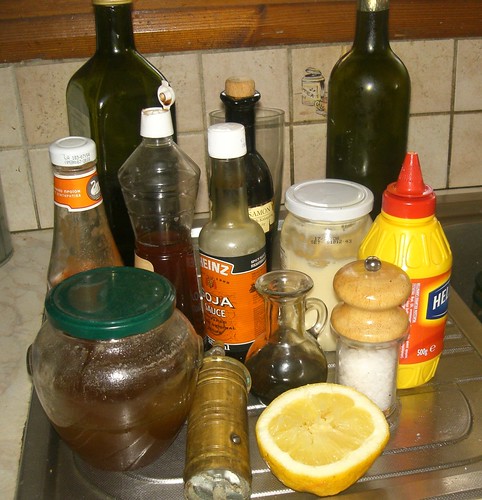
salad dressings
You can dress a salad in any way you please, but only a certain combination of these will make a truly Greek dressing.

People like to put labels to most things in life, because it is easier to recall concepts in this way. Categorising also leads to stereotypes - correct or incorrect ones - to which people often assign certain qualities that help them to acquire and remember concepts more easily. Let's take olive oil and vinegar, for example. If we pour olive oil and vinegar over a salad, we have a Greek salad dressing (xitholado = vinegar-oil). But if we shake olive oil and vinegar in a jar together to form an emulsion,  not only will the dressing look different, but it will also taste different. Food-conscious people would more likely call the latter a vinaigrette. The same ingredients have been used in both the xitholado and vinaigrette dressings, but only the former is more representative of what one would expect of a Greek salad dressing.

To take another example, let's pretend that somebody tells you that you are going to eat 'Greek food' tonight. When the salad comes dressed in mayonnaise instead of olive oil with lemon or vinegar, it's only natural that you will be surprised. When the lamb stew tastes as though it has been flavored with bourbon and cream sherry and cooked with almonds instead of red wine, tomato and/onions, surely you should be asking yourself if you heard right (didn't they say 'Greek food'?). And if the filo pastry dessert you ordered had a banana and chocolate filling instead of a syrup-drenched nut filling, well, no matter how delicious the whole meal tasted (and I'm sure it did), it probably wasn't what you'd have expected of a Greek meal, right?

Greeks do in fact use a lot of mayonnaise nowadays, judging from the supermarket shelves which stock all kinds of sauces and ready salad dressings. You can buy just any globalised ingredient in Hania these days. Mayonnaise, along with soya sauce, ketchup and mustard, have all made their way into the Greek diet in the same way that taramosalata, Kalamata olives, strained Greek yoghurt and tzatziki are standard supermarket products in (for example) British supermarkets. Creamy salad dressings are popular here, but they are not typically characterised as 'Greek'; they are part of the globalised convenience-food range of products that are not made at home, but store-bought, kind of like 'poutinga'.

The Greek version of a creamy salad dressing is more likely to use yoghurt, which is a natural ingredient more readily associated with Greek (and other Middle Eastern) cuisine. I've also heard of feta cheese crumbled into a dressing to make it creamy. Again, feta cheese gives a Greek sense to a dressing than mayonnaise.

Diaspora Greeks (Greek people living outside Greece) have developed their own form of Greek cuisine, according to the availability of products in their own environment. Their cooking has adopted elements of both the local and the Greek cuisine, often resembling the basic principles of Greek food; in the melting-pot cultures where many diaspora cuisines are based, it's likely that the development of the cuisine will probably be more divergent. Diaspora restaurant owners probably devise dishes that they know will be popular among their clientele. It's difficult to characterise such cuisine as solely Greek when the recipes contain few (or no) essential Greek ingredients or culinary techniques associated with Greek cuisine (like when a salad doesn't contain olive oil, as one blatant example).


Such cuisines are probably developing into a hyphenated cuisine, a bit like the identity of the developers (eg Greek-Australian, Greek-American, Greek-Kiwi). I can remember instances of Greek food traditions in my own family home which surprised me when I came to Greece, because, somehow, I saw them as confusing. For example, melomakarona and kourambiedes were made and served by most Greek women in New Zealand throughout the year. On coming to Greece, I  discovered that they are only available in cake shops during the Christmas season! Another interesting example is presented in a discussion about Greek-Australian souvlaki, which is made from lamb; it's never made with lamb in Greece, only pork, along with the more recent and healthier addition of chicken meat to the standard souvlaki menu. In Australia, lamb is plentiful, and just as importantly, larger than Greek lamb, which makes it more natural to use it for making souvlaki. Moreover, in the Southern Hemisphere melting-pot cultures, pork is a less popular meat than lamb (unlike in Crete, for example, where it is the most popular and often the cheapest cut), another reason why lamb is being used in making Greek souvlaki 'down under'.

I simply cook for my family according to handed-down traditions with a few modern tweaks included in the recipes; I'm not an expert on the history of Greek cuisine. But I think I know what constitutes a Greek-based meal. And I'm still going to insist that mayonnaise has little to do with Greek cuisine. It's one of those products that's going to characterise what we'll all eventually be eating - global cuisine.

Special thanks to my two editors on opposite sides of the coast.


©All Rights Reserved/Organically cooked. No part of this blog may be reproduced and/or copied by any means without prior consent from Maria Verivaki.

Tuesday, 10 August 2010

Old people's food (Τα γεύματα των γερόντων)

Greek doctors killing patients, patients dying while waiting to be attended, maggots in patients' wounds, doctors and nurses having sex in the ear, throat and nose ward, and what else? Oh yes, Greek doctors saving the lives of people who wanted to die instead. That's what most people have heard about Greek hospitals.

My mother-in-law had recently hurt her leg and couldn't walk on it. It was late at night and she couldn't be convinced to go to the hospital for an X-ray, even though it was obvious that she was in great pain. Old people generally don't like being told what to do and she was adamant that she would be fine by the next day. But she wasn't. She HAD to go to hospital, she HAD to have an X-ray, and she HAD to have special pain killers; she realised this herself eventually.

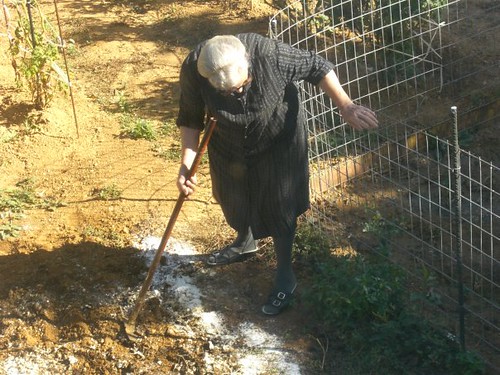
grandmother
Yiayia loves gardening. We believe it is probably this that keeps her in good health in her old age.

Yiayia was born one year after the last Ottoman Muslim Cretan left the island. She has lived a very different kind of life from the one most of us know. At her age, she just wants a bit of peace and quiet before the end comes. She keeps telling us that it isn't very far now. She is constantly reminded of this herself when she falls down, or develops a cold, or feels an ache or pain somewhere in her body. On her most recent fall, she probably wondered: "Is this it?"

She probably didn't want to go to hospital because she had seen the insides of a hospital too much in her life; they aren't the most enticing places anywhere. In Hania, the hospital is relatively new, so at least it has an air of modernity to it, and the signs and walls aren't defaced. But in any hospital the world over, there's the usual rigmarole of the hospital experience that everyone wishes they could avoid: the waiting time in the A&E room.

Past experiences make me think that maybe yiayia had a point. If you have to go to the A&E on a Friday or Saturday night, you are likely to have to put up with the drunks and party revellers who might have got into a punch-up and need stitches. So the A&E beds will be filled with such cases while you, the genuine patient, the one who got sick at the wrong time, will have to wait in the corridors with the pretty girls in their high heeled clonkers and revealing dresses, as they wait for their current boyfriends to come out of surgery. They bring their own entertainment with them in the form of loud ringtones for their cellphones, so this will be your chance to catch up with all the latest pop songs.

aphrodite
Many old people living in remote villages have to battle loneliness on a daily basis. This woman has no family to care for her, but still prefers to live alone, in the company of one other neighbour just like her. She recently burnt her face when her hair caught fire while trying to light an old-fashioned wood-fired oven in the winter.

During the same time period, there are the road accident victims, often young people, led to the A&E via speeding or drunk drivers, or bad driving habits. They are rushed into the hospital through the A&E, their arrival announced by the urgent tone of the ambulance sirens and the screeching tyres. The A&E doctors have no choice, but to stop what they're doing, and rush off to help their colleagues in whatever way they are asked to. Your own 'emergency' loses its importance when a case like this comes up.

Another bad time to go to the A&E is in the afternoon on weekdays, or during the weekend, when people have just finished their day's/week's work, and they decide that they don't have time to visit the doctor (and pay the standard 40-50 euro fee for a consultation), so they just crowd into the A&E. Over-worked interns (who are often not being paid the overtime that they do) work their way through patients suffering from common colds, grating coughs, itchy rashes and other completely non-A&E conditions that take up doctors' time in the A&E department and could have been dealt with at a more appropriate time in a more convenient place.

By mid-morning of the day after she had the fall, Yiayia realised that she wasn't going to get any better, so we trundled her into the car and took her to the hospital.

"Mama, put on your seatbelt," I said.

"Is it OK if I don't wear it?" she replied.

"No," I answered.

"Για να μην σκάσουμε €300," replied her son.

"What's that?" she asked, pointing to the upright blue boxes on the side of the road. They were post office mail boxes, where the mailman now delivers people's letters, instead of privately to their homes. This was the first day Yiayia had left the confines of our neighbourhood in more than two years since she broke her (other) leg. On arriving at the entrance to the A&E, we asked a porter for a wheelchair. He promptly came out to meet us with a hospital bed.

"Oh, I can't climb up onto that," complained Yiayia.

"You don't need to," the porter replied. "I'll get on it, no worries." And he set about to help her up in that way that only porters and nurses know about handling people in this situation, so that they cause them the least amount of pain.

"No! No!" cried Yiayia, fearing the pain. Before she could say 'No!' again, she was lying on the bed.

"OK, Yiayia," said the porter, "we're going for a ride." He drove the bed in the direction of the waiting room. "Take a ticket from the cashier," he said to us.

The cheery lady who had seen what was going on (the stretcher bed gives a case a sense of urgency) gave me a ticket with our priority order number written on it. It wasn't really necessary that morning, because, thankfully, it wasn't busy at the A&E that day. There were actually a lot of people waiting outside the doctors' offices, but only half were patients, mainly very old frail people. The others were their carers. It's a general rule of thumb that at least two people will accompany their old relative to the hospital. The male will usually do the driving, while the female will be at the patient's bedside. There was such a case being attended to at that moment by the doctors, and one more similar case (though not on a bed) outside the surgery as we arrived. The room looked busy, but the patients were actually very few.

three generations
When this yiayia became less mobile, her sons took her into their homes. She now lives with one of them on a monthly rotational basis among her offspring. It's still a rarity (and a luxury) to put old people into retirement homes in Hania. In any case, these people are happiest when in their own home environment or their own family.

The porter was just about to knock on the door to let the doctors know that a special case had arrived. Since my mother-in-law was lying on an A&E stretcher, she had to be dealt with quickly in order to release the bed. At that moment, the door of the surgery opened and a young soft-spoken intern came out.

"What's wrong with Yiayia?" he asked us in the corridor, looking intently at her, but not bothering to take her into the surgery. The bed was bulky, there was another person in a bed too, and it would have simply resulted in a major blockage. In any case, she was surely headed for an X-ray. It is usual for carers in Greece to do more talking than the actual patients. They usually know what's wrong, and they know where it hurts. We explained the circumstances of the fall.

"Where does it hurt, Yiayia?" the doctor asked, this time, addressing the patient. "Does it hurt here where I'm touching?"

"Well," Yiayia started, "I don't feel any-- don't! Not yet! I'll tell you where it hurts!"

The doctor remained calm and continued prodding. "Here?"

"No, not there either."

"Where does it hurt, Yiayia?"

"Well," Yiayia started again, "it's a sharp pain, but I don't have it all the time, I can't stand completely still without moving, but if I take a little step and put pressure on my foot, it hurts really badly all over the place, you see,..."

The doctor looked flustered. "We need to know exactly where, so that we can give appropriate instructions to the X-ray department." Yiayia had still not defined the exact place where her leg hurt.

"She hurts from here," I explained to the doctor, showing with my hand about 10cm above her knee, "to here," pointing to 10cm below the knee. Doctors are not prophets!

Without delay, the doctor took out a piece of paper (a recycled photocopy of an old form; the old notepad with the hospital header was not being used, a sign of how harsh economic times really are in Greece), and wrote out the directions for the X-ray department. The porter, who had waited patiently with us the whole time, explained the procedure: another ticket was necessary. I had to go back to the cashier.

"Who is your NHS provider?" she asked me. I gave her the information she asked for.

"OK, that's 12 euro and 62 cents," she informed me, "and with the receipt that I give you, and the doctor's diagnosis," as she handed me a form, "which the doctor will fill out, you go to your NHS provider and you'll receive a 75% rebate." I thanked her and went back in the direction of the A&E waiting room.

The porter led us to the X-ray department, and dealt with all the procedures there. We simply waited outside until my mother-in-law was returned to us. Again, we were dealt with promptly and appropriately, with the kind of respect due to people of my mother-in-law's age.

After the X-ray had been taken, the porter wheeled her out. "We're just going to wait for a few minutes until the photos are ready," he explained. He moved away from us and helped some of the other staff who were doing the same job as himself.

"Πρέπει να του δώσεις κάτι," my mother-in-law whispered to her son.

"No," I whispered back.

"Μας βοήθησε πάρα πολύ," she said.

"Τη δουλειά του κάνει," I replied. She looked confused. Her son, who was looking at his mother, then turned to look at me.

"No," I said to him too.

"Ένα τάλιρο--."

"Are you crazy?" I said firmly. "Since when did τάλιρα drop into your hands that easily? Does anyone tip me when I proofread or translate their work promptly and efficiently? You know it's wrong, we hear it on the news all the time. When is this fakelaki business going to stop?"

My mother-in-law continued telling her son that he should pay the porter for getting us through A&E (even though there was no queue anyway!) while I kept saying "No". My husband was in two minds: to tip or not to tip? Wasn't he simply doing his job?! The idea of fakelaki is often perpetuated by the people who continue to pay it - my mother in law was born and raised with this kind of belief, so imbibed in it, that she thinks even someone who is simply doing his job well should be paid both by the state and by herself! With a dominating matriarch in the family and our close contact with nature, my family still has strong links to the ways of the old world, so that misunderstandings can easily occur because of the generation gap: just imagine a globalised 8 and 9 year old, living with their old-fashioned 40s-50s parents, whose choices are influenced by the presence of an 86-year old WW2 survivor!


The past governing of Greece was really just a case of a home-grown style of bourgeoisie class ruling over everyone in a lower order than themselves: power-wielding state employees and people in 'closed shop' professions were among the highest order, the χρυσοχέρηδες sitting on the roost, while the 'hoi polloi' pecked at their droppings. This is what is now being toppled, slowly but surely; it is definitely being stomped on, and it's a proud moment in Greece's history, completely overshadowed by the negativity surrounding the country and the fact that progress in this direction, despite being sure and steady, is slow in making itself visible.


It took an economic crisis for people to realise that there is now no turning back to the outdated and inefficient system of giving favours to get a job done, a system many historians and political analysts claim to be a remnant from Ottoman times. These dramatic changes in the way Greece's service sector is being reorganised are not ebbing waves as they were in the past whenever a new government came into power, to be swept away by newer ones - the changes in Greece are now once-and-for-all, and they also need the full cooperation and participation of ALL the Greek people. Everyone in the country has to play their part appropriately, but, as can be seen from Yiayia's case, some people are not easily able to change their ways due to personality, age, and/or other factors.

When the X-rays came through, the porter wheeled us back to the A&E doctors, where we had to wait until the patient being attended to came out. He made sure we got prompt attention so that Yiayia didn't have to suffer any more discomfort than necessary and the bed could be freed as soon as possible for the next patient who needed it. All's well that ends well; Yiayia hadn't fractured any bones, but needed some painkillers to relive an inflammation that had been causing her pain.

The porter guided us to our car. I watched my mother-in-law looking at her son and raising her eyebrows. I watched my husband putting his hand into his trouser pocket. 


"No," I insisted. He didn't say anything. He took his hand out of his pocket, only to put it back in again.

"No," I repeated.


"OK," he said. 

"I still think it's wrong," said Yiayia, as we drove away from the hospital. "Times have changed from how I remember them."

The message had got through, at least this time. We were home and dry in just over an hour after we had set out on our little adventure.

*** *** ***

Given her condition, I had to take on the extra role of cooking for her. Since we cook fresh food most days, it sounds quite easy to simply make a larger amount of food and give her a serving. This is not as easy as it sounds. She is a fussy eater in the same way that many old people are: their bodies can't digest food in the same way as a young person's, their tastes change in old age, their teeth aren't always in the best condition, and their memories of food play a role in what they consider a 'good' meal. On top of that, Yiayia hurt her leg during a fasting period, so she didn't want to eat any meat or fish, limiting the variety of food that I could have cooked for her.

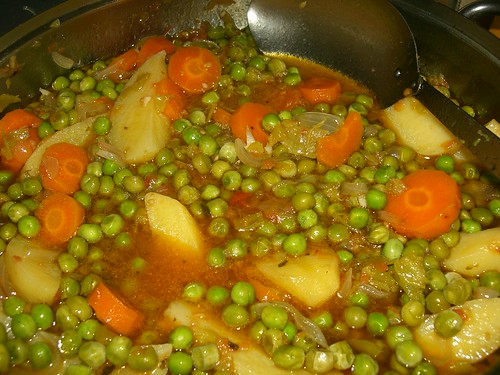
Yiayia usually cooks for herself, always using simple ingredients that are either available from the garden or easily stored in the kitchen for use when needed. In fact, her favorite kinds of meals could be described as 'all-season food': meals that are made from fresh-frozen or easy-to-store ingredients. Among her favorites are tinned squid in a red sauce, bakaliaro (salt cod) in an onion-leek sauce, and the one below, made with year-round easy-to-store fresh carrots and potatoes, and frozen peas.

all season foodall season food
all season food
You need:
a few tablespoons of olive oil
1 medium onion, thinly sliced
2 cloves of garlic, chopped finely
1-2 green bell peppers, chopped in thin strips (optional; we had lots of them in garden)
2 carrots, sliced thinly
4 small potatoes, cut into quarters
3 cups of frozen peas, rinsed
2 tomatoes, freshly grated (the skins make the sauce gritty; the seeds can be left in)
1 teaspoon of tomato paste (optional)
a sprig of parsley (optional; I would have added this but had run out at the time)
salt, pepper and oregano

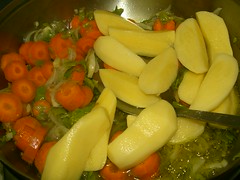
Heat the oil in a wide saucepan. Add the onions and garlic (and peppers), and saute till transparent. Add the carrots and potatoes, tossing them well in the oil till everything is coasted in oil. Let them cook on low heat for a few minutes, then add the tomatoes and dry seasonings. Place a lid on the saucepan, and cook on low heat until the potatoes have softened. Then add the peas and parsley, and allow the dish to cook for a further 15 minutes, or until everything is soft. Old people like their food mushier than us!

Serve this tasty stew with some feta cheese or mizithra. It is very similar to the way Greek people cook fasolakia (green beans), which Yiayia said she wasn't hot on, even though the garden was full of bean vines that she'd been tending up until the time of her accident!

©All Rights Reserved/Organically cooked. No part of this blog may be reproduced and/or copied by any means without prior consent from Maria Verivaki.

Thursday, 5 August 2010

Feast (Πανηγύρι)

Sometimes, it feels a little bit like this in my neighbourhood: you never know just who might be passing by on his donkey...

On the eve of the Feast of the Transfiguration of Christ, the village was celebrating with a paniyiri, as they did every year on the same day. It was hot and humid, as it always was at this time of year, being early August. Heatwaves always seemed to take place at the same time annually.

A novelty in this year's paniyiri was the roadworks. Roadworks in the middle of summer means that most of the time, very little gets done, because most of the people involved in them are taking annual leave, so that the roadworks are delayed into the winter when it starts raining, and work cannot take place; the roadworks stretch out interminably, leaving the roads exposed, without a layer of tar to keep down the dust and grit (which turns to mud and sludge in the winter rain). These roadworks were similar to the ones that had taken place only a few months before. The tar layer had been removed, large channels were dug into the middle of the ground, and pipes had been laid. Then the gullies were covered with earth, and only the tar needed to be laid; for some reason, this part of the job was always delayed. Last year's roadworks were for sewerage pipes, while this year's were to repair and change the old water supply pipes. If the pipes had been laid at the same time, the residents would not have to be eating dust off their tables for two years in a row. In the summer, the windows of the houses were always left open, and only the shutters were closed, so that every time a car passed, or more drilling was taking place, all the houses would fill up with the dust that was enveloping the village, which entered through the gaps in the wooden slats of the shutters.

Alkmene was watering the garden. It had to be done early that day before the priest came to begin the vespers service. She could not be seen to be watering the garden while he was performing the liturgy. In fact, she should not be seen even now, because she was wearing a bright green T-shirt, highly inappropriate a colour for a woman in her predicament, but there were few people about at this hour. It was too hot to be walking around. She thought about the people in the neighbouring streets who would be watering their gardens later in the evening when it was cooler, since they would not be in full view of the ceremony, and felt a pang of jealousy that she could not enjoy the same privacy that the others would have. Alkmene's house was positioned right across the road from the iconostasi, and on this particular day, not only would there be no privacy, but people would be wandering in and around her front yard as they observed the service taking place from the opposite side of the road where the shrine was located.

iconostasi kalithea vamvakolpoulo

Alkmene's neighbour, Koula, was at the iconostasi cleaning it. The passing cars continued to drive up and down the road without slowing down, lifting the dust off the ground and spraying it up in the air as they sped past, so that it came to rest on the icons that Koula had just wiped down. The icons were very old, tired-looking family heirlooms; they had obviously been kept in storage for the whole year and only taken out on this day, when they would be displayed on the roadside shrine. She waved to Koula as she placed a watering hose in the irrigation gully beside a row of tomatoes. She turned on the hose full blast to let the water run into the channels very quickly. Her husband would have had a fit if he had seen her. He was always warning her to be gentle with the plants, while Alkmene complained that it would take too long that way to water the garden and there were other jobs to do apart from holding a water hose and standing in the same position for 10 minutes per irrigation channel.

She began to sweep the yard, keeping a tab on the gullies as they filled up and moving the hoses appropriately. As if the dirt from the road wasn't enough, there were the berries from the benjamin tree that were dropping by the hundreds every time a puff of hot air blew through the leaves. There were so many of them covering the ground that, as she tried to sweep them away, she stepped on them and they opened up leaving behind their powdery residue which exuded a fig-like aroma. The yard had to be clean today, as her house would be in full view of the events that were about to start in only a short time. People would be congregating in it to hear the priest's chants.

A car stopped outside the house, and a plump woman stepped out. Even though it was hot, she was dressed in a full-skirted floral polyester dress and a black short-sleeved blazer, traditional church finery for the area. She was holding a plate covered in tin foil. Her rounded face was glowing red from the heat as she spoke to Alkmene.

"Has the paniyiri not started yet?"

"It's a bit early," Alkmene replied curtly. The sun was still burning hot, and nobody was interested in walking about on the street in such climatic conditions. There was very little shade to offer, and no way to avoid the gritty dust of the untarred road.

"Oh... but the sign said 7.00pm." The woman looked disapponted.

"It's not seven yet," replied Alkmene, at once realising that she was being rather terse. This woman may have travelled far to get here, and she had obviously cooked a dish for the pot-luck meal after the event.

"There's a park next to Kir Manolis' house if you want to rest before the priest comes," she offered. Alkmene thought about bringing out a chair for her to sit, but she was still cleaning up the yard. It would feel odd if the woman sat with her while she was pushing a broom. She did not invite her in.

"Thank you," answered the lady cheerfully, and then turned to her son who was driving. "Don't come back for me... someone will be going back down the hill... I'll catch a lift with them...No don't worry."

Alkmene did not know this woman, but she did know quite a few of those who began arriving afterwards. She knew she had to hurry to change clothes, because she was still in that green T-shirt, and it would be frowned upon by all of her acquaintances; most people in the area had not kept up with the changing times. Her own family did not give two tosses what colour clothes she wore, but twelve months had not passed yet since her mother-in-law's death, and the locals would be talking.

iconostasis kalithea vamvakolpoulo

Some people began to arrive on foot, while others were being dropped off by car, while the driver went off in search of a parking spot in the narrow street close to the iconostasi. Pretty soon, there would be a traffic jam, but this was only to be expected. The road leading to the shrine was rather steep, and there would be no joy to derive from parking further away and walking up the street under a hot baking sun. Most of the women had haggard-looking wrinkled faces, with tired smiles lowered eyes; their lives had closed the fill circle, but their faces still gleamed of hope for the future.

They had nowhere to sit. The women were leaning against the iron railings of the house, under the shade of the benjamin tree which was still dropping its filthy fruit. By the time the liturgy begins, they'll be suffering from heat stroke, Alkmene thought to herself. She opened the door of her late mother-in-law's house and began to bring out all the rickety wooden chairs with the woven straw seats, offering them to the women in order of probable age.

"Na 'sai kala, koritsi mou," the women thanked her as she handed them a chair.

"Tipota tipota," she replied. She would have to hurry herself, as she was still wearing her muddy gardening shoes. He legs were spattered with dirt, as were her black shorts. She felt unclean, standing so close to the women who had made the effort to spruce themselves up for the event, shedding their dowdy black robes for the evening. More and more people were arriving, and the cars were now slowing down as they passed the congested village street.

"Kopelia," one of them called out, "where can we leave the food?" She directed her to the little park close to the shrine where the lenten feast (if those two words could possibly be ever collocated, she thought to herself) would take place after the service. The Transfiguration of Christ fell during the two-week fast before the Dormition of the Virgin Mary, and even though it was a celebration, the fast was still observed.

Alkmene looked at her watch: 6.45. She hadn't realised how late it was getting. And it was still burning hot. She had a quarter of an hour to finish her tasks, get the children dressed and have a quick shower herself before coming down to attend the liturgy. She hoped that she could find something black to wear that did not need ironing and was free of oil stains.

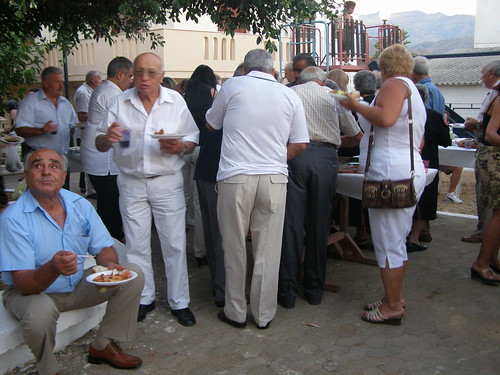
paniyiri

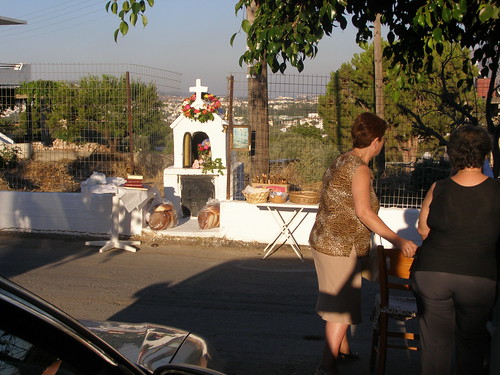
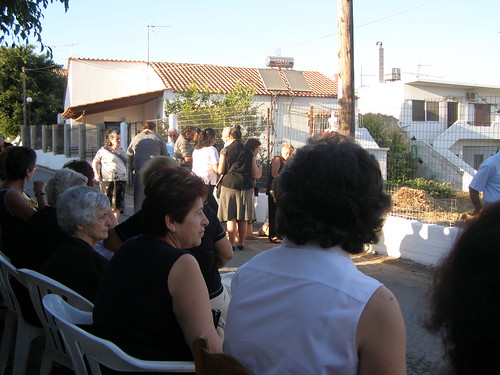
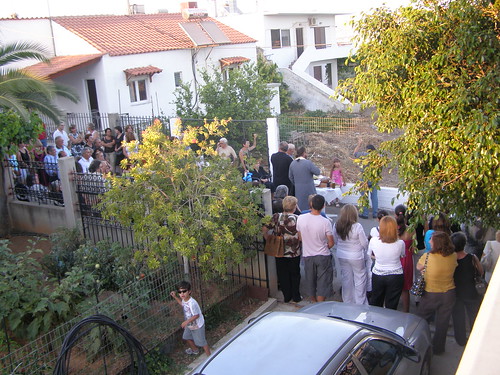
The priest had just turned up in his new Rav. He was accompanied by the mayor and a representative from the village council. Kir Manolis approached him before anyone else, and began the customary round of handshakes and official smiles. Kir Manolis shook hands with everyone, even the old ladies, who had all come to take part in the celebration which he had organised. He didn't live in the village any longer, but still maintained a house in the area where he put up his guests, usually Athenians who he did business with. He would come to stay overnight on the day before the feast and leave the day after. The older women then greeted the priest and bent down and kissed his hand. Then they filed past to queue up before the icon of the Transfiguration. They left money in a basket on a table that Koula had decked with a plain white tablecloth. Then they took a candle from a box the priest had brought with him and lit it in the candlelabra. They made the sign of the cross by jiggling their hands quickly up and down in front of their body and bent down to kiss the icon which had been hung up on Manolis' chicken wire fence with a piece of cord. Then they moved away and found a spot to lean against for support as they crowded into the front yard of Alkmene's house, which had suddenly been turned into a church, with various shapes and sizes of seating forming the pews under the shade of the benjamin tree.

Alkmene lined up the children to get them to follow the same procedure as the rest of the congregation, one after the other, from the oldest to the youngest, which she had to pick up to do this, as he was still too short to reach the icon. Only her eldest son looked well-dressed; the other three were all wearing his cast-offs, which had become very shabby and worn out by the time her youngest child inherited them. She looked forward to the day that little Alexis would grow out of those clothes, because she could throw them out afterwards. Even though she dearly wanted a daughter, there would be no more babies; she'd had her tubes tied. She had told her husband about it after she returned from the hospital with Alexis. He did not make an issue of it. He also saw it as inevitable; it was the only contraceptive that actually worked.

With his hymn book open, the priest began the service:
Eulogitos o theos...

Five minutes into the service, a ring tune interupted it:
Καίγομαι... στην αγκαλιά σου (I'm burning... in your embrace)
Καίγομαι
... με τα φιλιά σου (I'm burning... with your kisses)
Καίγομαι... χίλια κομμάτια (I'm burning... into a thousand pieces)
Γίνετ' η ζωή μου και το κορμί μου (My life, my body)
Καίγομαι
... (I'm burning)

Τhe owner of the cellphone could be seen fumbling around for it in her bag, as she walked away from the crowd to answer it, which she didn't do immediately. In the meantime, the cellphone continued onto the second verse: "I'm burning", it blared, as the priest kept chanting. A gust of wind blew down some more fruit from the benjamin, so that it fell in the women's hair, along with the dust which was being sprayed around them.

More people kept arriving, most of them neighbours coming on foot from the nearby houses in the little enclave that constituted the village, a rather insignificant spread-out area, with a kafeneio and the church at the bottom of the hill. The steeper part was purely residential, with larger expanses of land being used as vegetable gardens, fenced-off olive groves and vineyards. The enclave was located next to another narrow road that formed a junction leading to the larger neighbouring villages.

The people that were coming in their cars were having problems finding a place to park. But everyone was showing respect for the priest, and his chanting, and the religious nature of the meeting, so that no horns were honked, and no tempers were frayed. Older women were being dropped off, while the men parked the cars. Quite a few young people also turned up holding babies, trailed by older children. Alkmene was surprised to see so many unknown faces to her; where did these people hide at other times? The road away from her house led to an auxiliary farmer's road which in turn led to large expanses of unfenced fields. It was in effect, a dead-end street. Few people passed by her house, and those that did were usually in their cars driving up and down the road. They did not stop to have a conversation.

A gypsy drove by in his truck. The driver was holding a microphone hooked up to a sound system:

"Exo kremmidia, (I've got onions)
kala kremidia, (good onions)
kremmidia Mesogiana, (onions from the Middle Earth)
elate na parete kremmidia!" (come and buy some onions!)

His chant was competing with that of the priest's. No one said anything; it was a normal hour for travelling salesmen to be out in the area. Alkmene was thinking about the huge braids of onions that this particular one was selling, but it was not an appropriate moment to purchase one. In any case, onion sellers were plentiful at this time of year, so she would just have to wait for the next one to pass. The driver continued along the road as the family dog started singing her usual dirge every time traveling salesmen passed by calling out his wares, which he reserved only for them:

"Aouuuuuuuuuuuuuuuuuuuuu!"

Alkmene's children started laughing. Nikitas, the oldest one, turned to her. "Mama, the dog's gone nuts again." Alkmene put one finger in front of her mouth to hush him.

"A, a, a, aouuuuuuuuuuuuuuuuuuuuu!" The dog continued to howl until the peddler's truck had left the vicinity.

A neighbour who lived on the road just off the enclave had come back home. He had a surprised look on his face when he saw the crowds on the street. He slowed down to look for a parking place in front of his house. Rental properties weren't common in the area; he was one of the few tenants of absentee landladies who had inherited property and moved into a house woned by their husbands. He stopped to let his wife out of the car, holding their newborn baby. She was dressed in a sarong with her bathing suit showing through it. He stopped his car in front of someone else's driveway and stepped out of the car, exposing his overweight body clad only in a speedo, just as the priest was chanting 'Eleison me'. They had just come back from a day at the beach. Their poodle had started yapping out of excitement from the moment it spotted their car.
"Skase," he shouted back to it.
"Kirie eleison," chanted the priest.

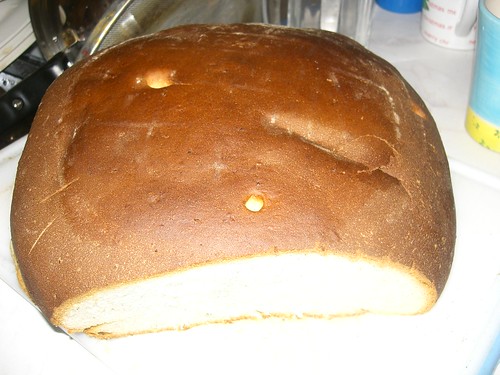
artos paniyiri

It had started to cool down slightly. While Alkmene was keeping an eye on her flock, trying to stop them from fighting or shouting, or generally just being heard, the children's cousins came running into the yard. Her sisters-in-law had turned up, concealed somewhere in the crowds. Their children's clothes were very clean and fashionable, with the word ''Benetton" emblazoned all over them. The boys became rather boisterous. It was getting difficult to control them all.

The same cellphone went off again.
Καίγομαι... στην αγκαλιά σου Καίγομαι... με τα φιλιά σου Καίγομαι, χίλια ---

The owner picked it up this time before the verse ended, just as the gypsy was making the return journey back to the main road.

"Aouuuuuuuuuuuuuuuuuuuuu!"

On the hearing the dog, the younger children began to head towards the back part of the house.

"Oxi tora," Alkmene admonished them. She was worried that they would step into the garden. The soil was still very damp; they would get muddy. She knew how much attention the other children's parents paid to their dress. In the past, they had given Alkmene some of their children's old clothes that they had grown out of; nothing was worn out until Alkmene went through it with her children. She turned her head back to the priest. Just then, she noticed two neighbours' children heading out of the garden.

"Oxi stis laspes," she warned them, wondering how the children had managed to get away from their protective grandparents.

An eggplant tree was slanting lopsidedly onto another one. It looked slightly uprooted.

"Kali xefortosi," she thought. There was an eggplant glut in the garden at the moment. It wasn't that she had run out of ideas for different ways to cook them; nobody wanted to eat them any more. The children refused to put it into their mouths, all four of them, even though they were generally good eaters.

"Mono afta trome," Nikitas had complained, and it was no further from the truth; she had been cooking eggplant for the last three days. First she made papoutsakia stuffed with cheese and tomato, the next day she made moussaka (they were not fanatic fasters), and the following day they ate leftovers. Today she had cooked pasta ala Norma, a recipe her Sicilian neighbour had taught her, which used eggplant as a base; this was the last straw. None of the children put any of the eggplant sauce on their pasta, and even her husband winced when he saw what was coming onto the table. They all ate their spaghetti plain with grated cheese, accompanied by a tomato salad. She had mixed some of the sauce into a few dog biscuits so that at least she didn't feel as though she had wasted her time cooking something nobody would eat.

The Sicilian was among the crowd, smiling as she patted the heads of the children and pinched their cheeks. Still a very striking woman despite her 77 years, she always had a sad look on her face. She was a retired schoolteacher who had come to live on the island because her daughter had married a local doctor, and she preferred to live close to her only child rather than live alone in her villa in Sicily. Alkmene couldn't avoid her now.

"I've forgotten it," she started, and tears began to well up in her eyes. "Now I can't even remember how to do the sign of the cross like a good Catholic!" She was going to start shedding buckets now. Alkmene had seen this all before. "Ego no in Italia 14 xronia tora", she began to repeat the same story Alkmene had been hearing since she came to live in the village, which was two years after Suzanna had arrived from Sicily. She gave her a sympathetic smile. The priest was jiggling his censer towards the congregation. Suzanna bowed as she made the sign of the cross, Orthodox-style.

Kiria Klio was being flanked on each side by her daughter and her Bulgarian live-in, each woman walking beside her, with one arm around her shoulder and the other propping her up by the arms. Alkmene had not seen her in a long time. When she first met her, Klio was still tending hens and rabbits in the sohoro behind the park. The woman spent most of her time indoors now; she was a bag of bones. Her carers had dressed her in a blue robe that looked two sizes too large, but it was probably the smallest size that such old ladies' robes came in. Maria wondered if she would get to live to such an old age herself; her mother-in-law had died last year at the age of 92, pampered and looked after in her own home by her son and Alkmene. As Nektarios had inherited the family home, it was deemed appropriate for Alkmene to take care of her, even though the other children - Nektarios' sisters - lived less than a kilometre away on land originally owned by their parents. They had all built new houses on their properties. Only Alkmene and Nektarios lived in an old house which could not be renovated due to building restrictions; it had to be torn down and rebuilt, and that wasn't going to happen in a one-income family with 4 children to raise, unless an earthquake knocked it down. The walls of the house were all cracked.

"Have you got a small table handy?" Niki whispered to Maria, who could hardly hear her above the priest's chants (he was nearing the hymn of the loaves and fishes), Kir Manolis' loud chatter (he was tone deaf), and the braying of Yiannis' donkey (it could even be heard at night)."We need to cut up the artos."

Alkmene entered her late mother-in-law's house, which had originally been a storage area, but was boarded up and turned into a self-contained flat just before Nektarios and Alkmene were married. It was in better condition than their own house because, in a sense, it was newer. Tiles had been laid down just before her mother-in-law had moved in, and only one person had ever lived in it. Everything had been left as it was when she had died. They had only moved the deep freeze into her house, to clear up some space in their own house as the children took it up over the years. There was a small coffee table with a formica top, the old-fashioned kind with trolley wheels on the legs and a small shelf below the surface. She wheeled it out.

"Will this do?"

Margarita was standing next to Niki with a huge transparent plastic bag full of artos. "It's fine," she said. "Got a spare knife?"

She went into the house again, and opened the cutlery drawer. When her mother in law had died, Nektarios' sisters had all raided the drawers and cupboards. She never found out what they had taken, and did not show any interest in the topic until her husband had one day remarked that his father's hunting gun was missing. It was old and hadn't been used in recent times. When he asked his sisters about it, none admitted to taking it. From this point on, he had distanced himself from their families, which he was never really close to anyway, being the only boy. He felt insulted to be lied to by his own family. They in turn accused him of using his mother's pension (479 euro a month) for his own expenses. He reminded them that they were not contributing anything towards their mother's utilities bills ("all the mains are connected to your house!") or buying any groceries for her ("she eats whatever you grow!").

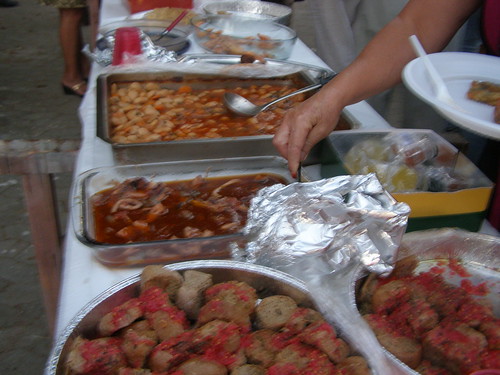
paniyiri lenten foods

After they took what they wanted, they never came back to the house. They only met up at church for the memorial services. Whenever Alkmene ran into them in the street or at the local supermarket, they avoided speaking to her. This did not worry her so much as how the children might feel if they cut off all ties with their cousins in such a small neighbourhood. One of trheir aunts lived close to park where the cousins all met up to play, next to Kir Manolis' house. The children spoke badly about their cousins, so Alkmene assumed that things were OK and her sisters-in-law did not want to hinder the family relationships involved. She wondered where they were hiding among the crowds. Possibly they allowed the children to come to her yard to conceal any ill emotions among their sihoriani.

She found a bread knife in the drawer. It looked old and new at the same time. Her mother-in-law was a lover of fine things, and this knife looked much better than any Alkmene owned herself. Her mother-in-law liked to look after her possessions and berated Alkmene often for not taking care of material goods in the same way. Alkmene could not explain to her that she could not keep up with the antics of the boys, and sometimes things did break, and it wasn't a big deal in the Made-in-China culture of modern society to throw something away and replace it with something new. It was difficult to convince an old woman who had raised five daughters and one son that it was hard work raising four boisterous boys.

"You should have had a daughter to act as your maid," she'd say to her.

As she came out of the house holding the bread knife, a jogger was running up the hill. He looked like a tourist who didn't want to miss out on his daily run even though he was on holiday. Only mad dogs and Englishman, thought Alkmene, a phrase she remembered from her days of English lessons at school. She had finished high school with good grades, but her parents didn't let her go on to university, even though she had earned a place for a Sociology degree at the Aegean University in Mytilene. They did not want her to leave home and live on her own. All her brothers and sisters had ended up studying 'something' in a private institute in the town, and qualifying to be 'someone'. Only she had opted 'not to waste my time studying to be a nobody', as she had put it, and became a waitress at the old harbour in the touristic part of the town, where she met her husband, a regular customer of the beachfront cafe. Nektarios liked her because she paid no attention to him, or to any of the others in his parea. She continued working after they got married until she gave birth to her first son. At first, she was glad to have left the shift hours that the tourist services sector demanded, but now that money was tight, she wondered whether she should look around for a job, even though she knew that this was a hopeless dream, as there would be no one to look after the children while she was out of the house. Nektarios was a lorry driver in the food services sector, delivering goods to supermarkets and other retail outlets. He was out working all hours, but never worked weekends.

Niki and Margarita had taken all the artos out of the bag and were slicing them thickly, to be distributed to the congregation at the end of the service. Maria lined up the boys and passed on the job of cutting up the artos to them. She gave the knife to Nikitas.

"Cut the bread the same way as Kiria Niki, and don't let anyone else use the knife." By 'anyone else', she meant his younger brothers, who were watching Nikitas 'playing' with a new 'toy'..

"Dimitris, you hold the plastic bag. And you can put the slices into the bag, Thodori."

"Kai 'go?" asked Alexis, who was too little to do anything useful.

"You pick up the crumbs and eat them," she said. Alkmene had a knack of getting all the children involved in an activity. People marvelled at her educative skills and kept telling her that she should have become a teacher, which made Alkmene sad that she had missed out on an education. She had heard of young girls going back to school after they had gotten married and had children, but she wondered how to get this one round her husband.

Alexis bent down to pick up the crumbs from the ground.

"From the table, Alexi!" She spoke in a muffled voice, but he didn't hear her. He was enjoying the bread. Just then, some more of the boys' cousins burst through the gate. Alkmene only just glimpsed two of her sisters-in-law joining the by now large crowd of people that the congregation had become. Their husbands were ambling behind at a slower pace, worry beads in their hands, cell phones in their shirt pockets.

"Whatcha doin', Nikitas?" his cousin Yiorgo asked him jealously, wishing he could assume some kind of important role in the fanfare.

"Douleia," Nikitas repsonded.

"We're helping, too," his brothers added.

"Theleis ligo?" Alexis was offering some crumbs to Yiorgo and his sister Eleni.

"Are the others coming?" Thodori asked.

"Mi milate dinata!" Niki admonished them all.

"Poli eftohepsan kai epeinasan..." the service was nearing the end. At this point, Kir Manolis stood up from his chair, picked up his walking stick and made his way towards the priest, where he stood next to him and faced the crowd. The wind blew dust from the untarmacked road over both of them. They shook their heads and waved their hands in front of their face to keep it from entering their eyes and nose.

paniyiri

Kir Manolis was about to tell the story of how the iconostasis came to be built. He did this every year, so everyone attending the event annually must have heard it dozens of times. Alkmene had only been in the neighbourhood for ten years, so she had not quite had her first dozen narrations, and Kir Manolis was getting older, not younger. His hands shook as he stood, but he kept his poise. He had left the village when he was only a teenager and had worked his way up the social ladder. Until only a few years ago, he had owned a small local supermarket chain which he had recently sold to a multinational company. He was very rich, but never seemed happy.

"Some of you might remember my mother," he began, which didn't sound very likely, as she had died three decades ago, and if anyone did remember his mother, they would be close to their 'teleutaia katoikia' themselves.

"She built this shrine in my honour," he continued, "from her grief at my being prisoner by the Nazis when they discovered my role in the resistance movement." Kir Manolis wasn't quite eighty years old, which made him hardly ten years old when the Battle of Crete took place.

"She dedicated this site to the feast day of the Transfiguration of Christ for my safe return," he boomed out as proudly as he could despite his frail voice which had weakened over the years in the same way as his hearing. "As you can see," he waved his hand in the air over the section of land where the shrine was situated, "I honour her act of faith, and maintain the site as it is today."

Epideixies, all of them, Alkmene thought. She knew what he meant by that last statement: Kir Manolis was the eldest of the four children who had inherited that particular section of land, which was now regarded as a 'fillet', ever since the building boom in rural areas, boosted by the foreign import idea of "Living with the Gods", the slogan for a construction company building homes for Northern European retirees. Kir Manolis was the only one who disagreed with the sale of the land, a large plot bordered by the two main roads that ran through the village. He had inherited the family home adjacent to the land, effectively leaving the remaining family members out of pocket. Kir Manolis continued his monologue, until the mayor nudged him and pointed surreptitiously to his watch.

"Diefxon ton agion pateron imon, kirie sou christe o theos, eleison kai soson imas, amen." The service had ended, and everyone relaxed a little. Now people began to move among the crowd, shaking hands with one another. Everyone was smiling, exchanging their 'Chronia Polla's and 'Kai tou chronou's. Alkmene was doing the same thing with all the guests in her yard. As she turned to greet everyone, she was unexpectantly confronted with Toula, one of her sisters-in-law, who had entered the yard on the pretext of looking for her her children. Her black dress looked very summery, even though it was more appropriate for evening wear, with its diamante centrepiece around the bodice.

"Chronia polla, Alkmene mou."

Although Alkmene was taken by surprise, she managed to give an appropriate response - "Kai tou chronou" - and raised her hands to Toula's shoulders to kiss her on both cheeks. Somebody had to break the ice; the one-year memorial service was coming up.

After the xairetoures were over, everyone made their way to the little park next to Kir Manolis house - another of Kir Manolis' possessions, which he had converted into a children's play area, donating the land to the local council, so that in effect, it could never be sold or used by the inheritors - and the feast continued with the food. The Ladies' Auxiliary Society of the parish - funded by Kir Manolis - had ensured a good spread of dishes, despite the lenten associations of the event: octopus salad, fried kalamari, fava dip, shrimp in lemon, giant beans in tomato sauce, cucumber slices, tomato quarters, taramosalata, snails in wine sauce, stuffed vegetables, zucchini flowers, dakos rusks, olives, zucchini patties. Everything looked so colourful that the absence of meat was not noticed in the slightest. Alkmene's contribution was bite-sized pastries made with an oil-based mixture containing aromatic onion and amaranth greens and herbs from the garden.

Everyone lined up to pick up their plastic plate, fork and cup. They passed by all the silver foil tins and platters that had been arranged on trestle tables, and kept coming back and forth to refill their plates. There was more food than was necessary for the number of guests, but very little was left by the end of the evening. Children gorged on fizzy drinks, while their parents cheered each other with wine. There were few places to sit; the children managed to eat while sitting on the swings, the see-saw, the slide and the merry-go-round. Balancing plates on laps made everyone an easy target for olive oil stains* ("there goes my blouse!"). Everyone seemed to be enjoying themselves and getting along together, putting aside their differences for the day, calling a truce in respect of the miraculous day that was to follow, the Transfiguration of Christ.

Rania, Nektarios' younger sister, took the opportunity to join Alkmene and Toula in this happy moment. Alkmene felt a thaw in their relationship, and hoped that this would continue - at least for long enough to complete the formalities required for her mother-in-law's upcoming memorial service. She had enjoyed the time away from close family relationships that had arisen from the rift, even though it did not feel right to her that such a large close-knit family could disintegrate in so short a time over so trivial a matter. Time would tell.

*To remove olive oil stains from your clothes: if the stain is fresh, put a spot of dishwashing liquid on the stain and rub it a little; it will come out in the next wash. If you don't have access to any at the time, dab the stain with white benzine when you get home and rub it in; it should come out in the next wash.

To see what a typical feast in my area looks like, click here.

Special thanks to my two editors on opposite sides of the coast.

©All Rights Reserved/Organically cooked. No part of this blog may be reproduced and/or copied by any means without prior consent from Maria Verivaki.
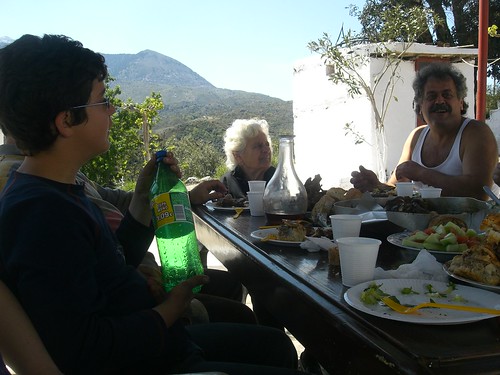
Monday, 2 August 2010

Eggplant risotto (Ριζότο με μελιτζάνες)

I’ve been keeping a blog for three years. I started out writing about my limited view of the world, sharing an opinion about some news item that took my fancy. It was all quite random, but there was always a related food  photo uploaded with each post, mainly to add colour to a rather dull looking page full of words. I didn’t know who would be reading what I was writing, nor if anyone was really interested in it. I was just writing for the sake of doing something that looked productive in a world where most of the time life is routine and productivity is achieved by superficial means, pushing a button to start an machine, doing the daily shopping and cooking a meal with all the mod cons of the average kitchen.

I got the wacky idea to start recording all the food I cook for my family as a way of entering the writing world. I methodically and meticulously recorded every detail of the recipes I prepared in my kitchen: sensing my own mortality after the shortened lives of my parents, I wanted to ensure that my children would be able to remember to do some of things I did for them, or at least they could learnt to cook (or show someone else how to cook) their mother’s food, some of which they may even have acquired an affection for. To increase my readership, I entitled all posts by the name of a recipe or food item, so that people searching for a recipe would be able to land by chance onto my site. My first readers were food bloggers interested in the intricacies of Greek cooking. Comments ranged from ‘Delicious!’ to ‘Could you add garlic to this?’. This was not the intended response – I make no effort to be an outstanding cook – but it was a welcome start to a reader's circle.

I was enjoying being read, but I also knew that I would eventually reach an upper limit in such a venture. I cook to feed, not to create or to excite. And since most of what we eat in our house is seasonal, this means that I could only blog about food for a period of up to twelve months. We eat pretty much the same food from one week to the next, depending on what is in season. For example, fasolada is not a once-a-year affair: it’s a weekly winter entry, whose consistency does not change from one time I cook it to the next. I may have such a glut of zucchini in the garden that I can create all kinds of new recipes, but the truth is I don't. There is only so much you can do with eggplant, for instance, which the whole family will eat.

To beat away the boredom, I started a city daily photo blog, with the intention of evading the drudgery of the kitchen with its precise measurements, specialised terminology, detailed methodolgy and focus on hygiene. Instead of worrying about ingredients and cooking methods, I was now worried about running out of photos of my daily surroundings, some of which I thought of as commonplace. How many similar beach photos can someone tolerate seeing on the same blog? How many times can I photograph different olive or orange trees and say something new about them?

After three years of blogging about the traditional seasonal food we grew, cooked and ate, I find that there is very little to write about on this topic. I'd be fooling you if I were to start cooking food that is not seasonal or traditional in the area where I live. The only time we eat out of season or away from tradition is when we travel or I get nostalgic for foreign food (sourcing my ingredients from supermarkets that cater for tourists rather than locals cooking international cuisine). I'd be repeating myself if I were to continue to describe the food I cook in my house on a daily basis.

In the knowledgeable light of the coming of the end, I started throwing in an anecdote or two in the recipe and photo posts, turning them into stories and photographic exhibits. I played with cooking terms, I mixed in jokes, I tossed in a spicy word or two. And thus, my story-writing was born. The food blog eventually started taking on a new shape, confounding my readers in the process. What was I doing – cooking or story-telling? Some shirked away from the madwoman that I had become while others remained endeared to the blog, enjoying the hilarity of the scenes portrayed and the dry wit of the author or the poignancy of the feelings provoked. All I can do is update my food blog with a restaurant review or maybe a kinky food-based story that I know will delight many.

It is the final set of readers that I owe the development of my writing skills: without their continued interest in what I write, my food blog would probably have fizzled out long ago, accelerated by a lack of new dishes being cooked in my kitchen and the general boredom of any rote task, which of course I continue to perform in the kitchen. Of course I'm still cooking; I'll be cooking for a long time yet, but there must be light at the end of the tunnel. I never set out to be a cook; in fact, I'm surprised I ended up cooking such superb meals as my (often-copied) photographs attest. As I look back over my blog, I ask myself: did I really cook that? I hope my children remember that indeed I did. With two young ones, I still have a good many kitchen years ahead of me...

kitchen
I've cleaned up my kitchen for all of you to see: not a pot boiling, not a dirty dish in sight, no garden glut to deal with.


Through this post, I praise those of you who continue to read me despite my many shortcomings as a cook and writer, which will have become apparent over time. I hope to continue to entertain you. Year 4 of Organically Cooked starts here.

*** *** ***
The glut of aubergines has not ended, and from previous experience, I know that it won't end until the end of September. Our eggplant trees are our most loyal garden plants. They keep on producing until Christmas, but by then, the shrub is looking a little worse for wear. Thankfully, aubergine freezes well too; one of the most popular posts on my blog (apart from fasolada) is all about how to freeze eggplant. 
frozen eggplant chunks
Last year's eggplant was waiting this year for me in the freezer.

As I was clearing out the freezer I found last year's batch of frozen eggplant, which is sad because I couldn't really use it now that the new season's vegetables had started to grow. I couldn't just throw it out, so I decided to cook it for our pet dog, who basically eats what we eat, because she gets our leftover. So I heated some oil in a pan, and added the eggplant. That eggplant had been frozen at the height of the season so that its Mediterranean summer aroma was wafting around the room; even I realised that this food was not yet fit for doggie consumption at this point. When the eggplant had softened, I added some rice and poured in enough water to make what looked like a risotto. As I stirred the pot and watched what was taking shape in it, I began wishing the dog's dinner was mine. 

eggplant risotto
The dog's food looked so good...

Here is the eggplant risotto remake, originally modelled on the dog's dinner.

aubergine eggplant risotto
... that I made an improved version for myself.

You need: 
3 medium-sized eggplant, chopped into small cubes
1 medium-sized onion, chopped small
6 banana peppers, chopped roughly in small chunks (optional)
2-3 cloves garlic, finely chopped
a few glugs of olive oil
a cup of white rice, preferably basmati
salt and pepper
Heat the oil in a saucepan. Add the onion and garlic, and cook till translucent. Then add the aubergine cubes and cook till just soft, so that they don't lose their shape. If you are using the banana peppers (we have a glut of those too), add them together with the aubergine. You will need a lot of oil, because eggplant soaks it all up very very quickly. It sounds quite fattening, but if it's only olive oil, don't forget that it's an anti-oxidant and will keep you looking young. When the aubergine is done, add 2 and a 1/2 cups of water to the mixture. Add the washed rice and then the seasonings, and stir everything together to blend. When the water reaches boiling point, turn down the heat to the lowest point, and let the risotto cook away on its own, without stirring it (or the rice will break up).

Serve this risotto with a green (or garden-fresh salad), and some red wine. Bread is superfluous today!

©All Rights Reserved/Organically cooked. No part of this blog may be reproduced and/or copied by any means without prior consent from Maria Verivaki.