Showing posts sorted by date for query mushroom. Sort by relevance Show all posts

Saturday, 17 January 2015

Steak and kidney-less pie

One of our more memorable meals in London was taken on New Year's Eve at the Battersea Pie Station in Covent Garden. We had ended up there after attempting a walk along the Thames, starting from Cannon St. At Blackfriars, we were stopped by the crowd and safety control units who were policing the area and keeping people away from the riverside, due to the fireworks event that was schedule to take place later in the evening. Our detour away from the riverside took us through some very London sites of great historical interest. It almost felt Dickensian.

Poultry obviously takes its name from its former association with the chicken trade.

We were intrigued by what looked like a private function with a focus on seafood...

... and highly unamused by this vile-sounding Christmas food special! (It has been described as: "An overwhelmingly negative reaction, ranging from 'aggressively disgusting' to 'one of the worst things I’ve ever put in my mouth'. It gets points for effort, attempting to combine virtually every festive ingredient, but it tastes like someone has pushed their Christmas leftovers into a blender and served them with rice.")

New Year's Eve is a very quiet day for London business people, but even when London is supposedly sleeping...

... it keeps changing looks, as it prepares for various events, and this time, the portaloos made it look like it would be welcoming the New Year with a heavy bout of drinking.

We eventually needed to use a bathroom ourselves, so I popped into a Pret-a-Manger and bought some Christmas mince pies which I'd really wanted to try while in London.

When I asked for the bathroom facilities, believe it or not, this place did NOT have toilets! So we held off, in the hope that we would eventually find a place to take a leak legally.

At The Strand, the former Aldwych tube station, often used as a film location, looked ghostly silent. This street was cut off to strollers due to the fireworks event.

Somerset House was looking very festive with its ice rink (where we found some free bathroom facilities).

I had a quick browse through the ridiculously overpriced Fortnum and Masons shop (it was sponsoring the ice rink) - 50 pounds for a set of 6 Christmas crackers, did I read that right?!

A short stroll away, we found ourselves at Covent Garden. Cold weather makes you feel hungry all the time. I chose the Battersea Pie Station, in the hope that I would find some steak and kidney pie (and Cornish pasty - another of my favorite pies in New Zealand). We weren't disappointed. My family lets me do the ordering most places when in London, because they know I know the food well enough. My early life in colonial New Zealand stopped abruptly just when New Zealand's food tastes became more international, so I still have fond memories of New Zealand old-fashioned comfort food, which were invariably British-based.
Chicken and mushroom pie, steak and kidney pie, and Cornish pasty - ~20 pounds, with a bottle of beer and a cup of tea.
Back home, when I decided to make a steak kidney pie myself, I found it near impossible to find kidneys! In Greece, the sale of beef and chicken kidneys has been banned since the mad cow furore - which started in the UK; yet, they aren't banned there! Although lamb's kidneys are still available for purchase here, when I tried to track some down, I found that they are never severed from the actual animal, so you have to buy the part of the animal that they are connected to. This is done for transparency reasons: in this way, the butcher is showing you that the animal was healthy - if the kidney is missing, the buyer may wonder whether the animal was sick. 
I used this very easy-to-follow recipe as the basis of my beef stew and pastry. The beef stew was cooked last night, the pastry was made this morning, and we had the pie for lunch with some leek and potato soup. 

To replace the umami taste of the kidneys, I bought a packet containing two slices of kavurma, adding some mushrooms and soya sauce (I was out of Worcestershire sauce) to my beef stew. I think the taste was successful, and the whole family enjoyed the pie, which will be made again eventually, because I froze half the stew. Slow-cooked food takes a long time to cook, so why not make a double batch and save your time later?

Bonus photo: A chat with the butcher where I bought the beef also revealed another mysterious EU meat regulation, which forbids lamb's spleen from being sold - but cow's spleen is permissible!

At any rate, if you have close relations with someone who raises their own meat, you can procure everything. I had lamb's spleen in sheep's intestine last week at an inner-city cafe bar, where the landlord-owner-cook prepares everything freshly and to order.

©All Rights Reserved/Organically cooked. No part of this blog may be reproduced and/or copied by any means without prior consent from Maria Verivaki.

Sunday, 7 October 2012

MAICh menu, 8-14/10/2012

My workplace is updating its website. A decision has been made to include the weekly menu for our international live-in students. Significance must be placed on food, since we live in a food-centric Greek island, considered the birthplace of the Mediterranean diet, with a great variety of local produce. The menu outlined below is for this week, starting tomorrow; the photos show a variety of meals served over the past year (they don't necessarily match the descriptions).

Monday
Lunch: Pasta with bolognaise, mushroom, vegetable or tomato sauce, served with aged gruyere
A variety of 6-7 salads
Dinner: Smoked lentil soup
Breaded fillet of catfish with seasonal vegetables
A variety of 2-3 salads


Tuesday
Lunch: Beef or vegetarian souvlaki with seasonal vegetables
Tzatziki and a variety of 5-6 salads
Dinner: Orzo vegetable soup
Chicken with grape syrup and Cretan herbs
Fried potatoes
A variety of 2-3 salads

https://fbcdn-sphotos-h-a.akamaihd.net/hphotos-ak-ash4/307702_10151187261765067_2063234478_n.jpgWednesday
Lunch: Eggplant imam baldi
Risotto
A variety of 6-7 salads
Dinner: Orange flavoured bean soup
Braised beef flavoured with orange and thyme, served with home-made pasta

https://fbcdn-sphotos-f-a.akamaihd.net/hphotos-ak-snc7/580851_10151219736725067_562579611_n.jpgThursday
Lunch: Pasta with chicken and/or seasonal vegetables
A variety of 6-7 salads
Dinner: Cream with smoked yellow fava
Beef with basil, sun-dried tomatoes and vegetables

Friday
Lunch: Pizza with home-made crust and freshly grated gruyere
A variety of 6-7 salads
Dinner: Vegetable-rice soup
Braised lamb or pork with herbs and thyme honey
Fried potatoes


Saturday
Lunch: Green beans with fresh Cretan curd cheese
A variety of 3-4 salads
Dinner: Citrus flavoured chickpea (garbanzo) soup
Golden-fried chicken
Risotto
A variety of 2-3 salads


Sunday
Dinner: A choice of beef or vegetarian moussaka
A variety of 2-3 salads

maich breakfastA full range of vegetarian breakfast meals is available every morning. Seasonal salads are served with organic extra virgin olive oil and home-made accompaniments: vinegar-honey sauce, orange vinaigrette, honey-mustard vinaigrette, herbed yoghurt, curry ketchup. Only extra-virgin organic olive oil is used in cooking and frying. All meals are accompanied by home-made bread and fruit or a sweet.


You will notice a number of orange-flavoured meals - this is because use of local seasonal (and naturally fresh) produce is being made in the meals. Oranges are plentiful at the moment. Some menu items are standard (eg pasta once a week), while the major changes that occur on a monthly basis usually refer to the seasonality of the items. The chef - Yannis Apostolakis - is well known in the area, and has made a number of appearances on nationwide television cooking shows. We're obviously in good hands.

©All Rights Reserved/Organically cooked. No part of this blog may be reproduced and/or copied by any means without prior consent from Maria Verivaki.

Wednesday, 5 October 2011

Karpenisi (Καρπενήσι)

Tune in every second day this week to see how we spent our family holiday in Central/Northern Greece. 

Our first night in Karpenisi was spent in the town with Hrisida and her family, who treated us to some freshly baked zimaropita and then took us out for dinner at the local taverna. There is a limited range of dining options in the town itself, but there are many places to choose from if one includes the outlying villages. It was quite late so we decided to stay in the town. The church bells were ringing in joyous mode that evening. People were dressed in their best clothes, all waiting by the main church in the town for the procession of the icon of the Virgin Mary, which was about to take place on the main roads. The church is dedicated to the Birth of the Virgin Mary, which is honoured on September 8th, with vespers always being held on the eve of a feast.

litany karpenisi litany karpenisi litany karpenisi litany karpenisi litany karpenisi litany karpenisi
Greece is a well known destination for religious tourism. There are many monasteries and churches with a very touristy reputation on both the mainland and the islands. The video and photos show a typical procession when an icon is taken out of the church and paraded around the main streets of a town. Bear in mind that Karpenisi is located near an important monastery, hence the monk (no, he's not one of Harry Potter's elevation teachers).

"Get used to the dings dongs," Hrisida warned me. "Church bells ring here on a regular basis. We're used to their clanging. Don't forget, there are a number of monasteries near the town."


Karpenisi is an unusual town, both in landscape and population: there are many young people in the area from the TEI (state technological institute) located here, civil servants and old-age pensioners. The Velouchi ski resort provides the town with its main tourist input. Karpenisi, and indeed the whole of the prefecture of Evritania, holds a significant place in Greek history, due to the many heroes of the Greek revolution coming from here, as well as many significant historical events taking place within the area.

Karpenisi, Switzerland of Greece
Karpenisi in the summer and winter

Karpenisi is small and quite centralised in its structure. The weather is much cooler here than other urban centres in Greece, naturally because of its altitude. There are two main commercial roads in the town, both converging at the main square, and both built on a steep incline. The whole area is surrounded by dense forested mountains. Many high-rise apartments can be seen dotting the hill, but such constructions have now been halted by law, given the nature value of the area; these developments did not pair well with the landscape. In the summer, the climate remains quite cool in the mornings and evenings, heating up during the day. In the winter, snow may cover the ground for days on end. Being used to walking barefoot, I found the floor tiles in Hrisida's house very cold; in Hania, even the floor is warm throughout the summer months.

Karpenisi became a centre of enlightenment with its unique School of Karpenisi. Karpenisi continued to have a high school, which was something to be revered in the early 20th century, as few Greek villages had anything more than a primary school. Striving to educate one's children to give them a better start in life has always held an important place in Greek people's minds and hearts. This accounts for the high education level of the Karpenisiotes, and one of the reasons why they often ended up in government jobs.

Karpenisi isn't the kind of place you go to stay at: it's a good place to base yourself to explore an area of Greece that is not touristy at all. In fact, it's one of Greece's best-kept secrets in terms of off-the-beaten-track places to visit. Hiking, mountaineering, skiing, mushroom foraging, game hunting: they are only a few of the outdoor activities you can enjoy in the area. Every activity has its season too, so that the area is visited all year round. The roads leading in and out of the town all lead to protected villages, stunning scenery, beautiful landscape and nature trails. 

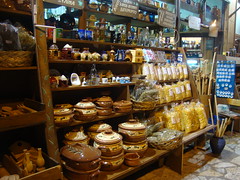
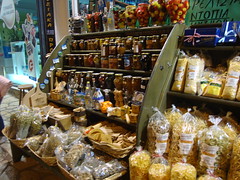
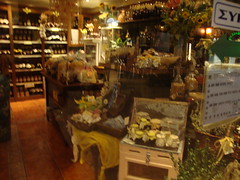
During our stroll in the town, I also noticed a good number of food stores. Each place proudly displayed their fresh-looking wares in the windows. This is a sign that people are very interested in what they eat here, and they probably continue the food traditions learnt from their mother's kitchen.

 DSC05894 DSC05905 DSC05933
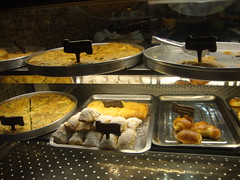
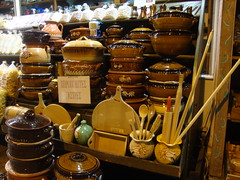
Pies are very popular in the north. Not that a good pita can't be found anywhere in Greece, but they differ from Cretan pastries, for example, which are usually smaller and often fried. For the beans to be bagged in this way means that they were probably grown locally or bought directly from the farmer (many places sell loose beans in Northern/Central Greece). Home-made noodles are a feature of northern Greek cuisine - they are also made in Crete, but less frequently. Other souvenir-type items on display are crockery and kitchen utensils - again, they are food-based.
DSC05906 DSC05910 DSC05903

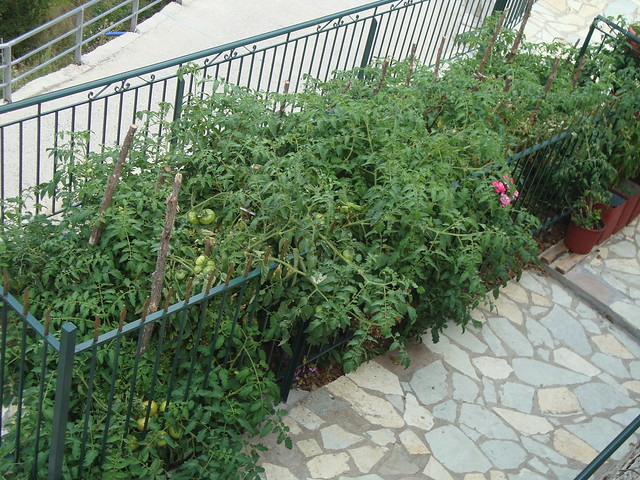
Like any region in Greece, the terrain is used to the best of its ability to grow or raise anything edible. It's not the easiest place to grow Mediterranean plants like tomatoes and aubergines. "Not that it can't be done," Hrisida reminded me; she had shown me her tomato plants which were still green in early September; "it just takes longer". But it's a good place to rear animals for meat. Small farms in the outlying regions supply Karpenisi with high-quality local meat and dairy products, while the rivers provide a range of fish species, including trout. There is no shortage of fish and meat here; what there is a shortage of is fresh fruit and vegetables. "They're more expensive to buy here," Hrisida explained. "We don't produce much in the region given the altitude."

DSC06023
They took a while to redden, but Hrisida informs me that she did get a good crop of tomatoes this summer.

Karpenisi is well known for the typical local produce of a densely forested area: cheese, yoghurt and butter; local meat and cured meats; fruits and nuts growing on trees suited to high altitudes, like cherries, chestnuts, walnuts, berries, black cherries, crab apples and figs. Noodles and pasta are made here according to local customs. Honey (especially fir tree honey, which is only produced every second year) and honey-based products like royal jelly are also a feature of wooded regions, as are tsipouro-based liqueurs (made using the 'raki' produced in the area) flavoured with local berries and fruit. My whole family noticed the difference in the taste of the meat in the regions of Central Greece that we toured - let's just say it was some of the tastiest meat we have ever eaten. Specialties of Karpenisi include include meat and cheese dishes. (Hrisida noted at this point that she's tired of it and would prefer some tasty Cretan vegetables.) There's more pasture land available here, whereas in Crete, animals are fed on less natural food, with more processed animal feed.

DSC06174 DSC06175 DSC06219 
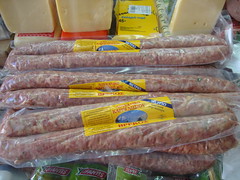
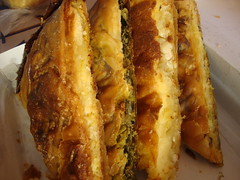
Sasauges, feta cheese and pies (milk pie, greens pie, pumpkin pie and leek pie); local products and local tastes, representing Karpenisi. The cheeses bear no resemblance whatsoever to any of the Cretan cheeses we buy.
DSC05932

During the meal, I asked Hrisida what she thought about the differences in Greek cuisine among the different regions of Greece. I found that wherever we went, there was a huge emphasis on the local and seasonal, but what it consists of changed as we went from south to north, as do the colours and flavours and textures of the food. So, would it be true that the cooking of northern Greece is less Mediterranean in style, while keeping with the tradition of the emphasis of Greek cuisine on the fresh, local and seasonal?

"That's a tricky one. Are pites part of the Mediterrenean diet? Is Italian pasta part of it too? Pites are the equivalent of lasagne and pitsa, although they relate more to the Balkans and Turkey. We don't do paximadia, which shows that northerners probably baked bread more frequently. So up north there's an emphasis on cooking with dough either as a pita or home-made pasta. The Pontiacs  especially do a lot of fresh home-made pasta, which they boil like the Turks. We do trahana and pites, as well as hilopites (χυλοπιτες), also known as 'yiofkades' - γιοφκάδες in Macedonia and Thrace, as well as Turkey, what FYR Macedonia calls 'yufki*', which is dried pasta. In the Peloponnese and the islands, they seem to do a lot of frying, even dough in little morsels, like xerotigana and kalitsounia because of the vast amounts of olive oil there. In mainland Greece they used to have more wheat and flour available to them than in southern Greece. So we can say it's more of a flour-based diet. That goes also for more flour-based Turkish-influenced desserts like ravani, baklava and galaktoboureko, and a lot of baking like koulourakia (biscuits) and tsourekia (sweet loaves). Of course the north used to use more animal fats like pork fat and butter, but this isn't the case now."

Hrisida recalls that on her last visit to Crete, she came across tsigariasto, lamb or goat meat cooked purely in olive oil, as if it'sfried. "That was quite a novelty for us, meat cooked in so much olive oil, instead of being baked, stewed or roasted. Frying is a quick cooking method that doesn't use up much firewood, which was very scarce in Crete compared with mainland Greece. Antikristo is also a very primitive form of cooking, not wanting to waste any heat. You might see more slow-cooked dishes in mainland Greece with thick sauces. But northerners also rely on pulses, vegetables, fish and fruits."

hrisida's harvest maria's harvest
Left: Hrisida's harvests in Karpenisi. Right: Maria's harvests in Hania. Apart from potatoes and onions (not pictured), Hrisida also grows corn, which she also gets ground to make cornmeal. The colours, flavours and textures of the local produce of each region in Greece are different, but the emphasis is always on the fresh, local and seasonal.

Greek regional cuisine has less to divide it than it does to unite it. In modern times, the different products of the different regions of Greece are now being produced on a more centralised basis, so that each region concentrates on what it does best. While each regional range is distributed in various parts of the country, problems still remain: certain products are produced in small quantities, so there is not enough to go round (eg feta and sausages from Karpenisi: Hrisida says: "If anyone tries to sell you 'genuine feta Karpenissiou' outside the region, they're probably not telling you the truth; there isn't enough to go round, even for our own needs'), while other products (eg mizithra from Crete) are highly perishable and do not travel well. But regionalism in food is a valued trait, so Greeks in the rural regions continue to prepare, cook and eat their 'own' food, because that's what they've grown up with, that's what they like to eat, and most importantly, that's what's fresh, local and seasonal where they live, supplementing any restrictions with products from other areas of Greece. 

We were lucky to have good weather while we were in Karpenisi. Hrisida had told me to bring warm clothes for everyone, which I duly did, but they really weren't necessary. "At this time last year, it was raining continuously for a fortnight, so I didn't want to risk it with you," she said. The cafes were full of young people enjoying the unusually warm air of a Karpenisi evening, giving off an atmosphere of gaiety, akin to the entertainment value of the Venetian port in Hania. "Don't put ideas in your head," Hrisida said, "it's not like this all the time. If there's a breeze blowing, it gets frosty and everyone stays indoors. The place closes down by ten on such nights." I found that hard to believe, but maybe we were just very lucky.

* One of my former students from FYR Macedonia has sent me photos showing how these are made: the women all get together in her village and they make hundreds of them at the end of summer when fresh milk and eggs are plentiful. They shape the dough into flat pites and they dry them in an outhouse. They repeat the process in other people's houses until all the women have their supply of yufki. When they want to eat them, they break them up, so it's essentially like pasta - they also use them both fried and boiled in the same dish.
©All Rights Reserved/Organically cooked. No part of this blog may be reproduced and/or copied by any means without prior consent from Maria Verivaki.