Showing posts sorted by date for query avgolemono. Sort by relevance Show all posts

Wednesday, 24 December 2014

Last posting

Happy Nameday if your name is Ahmed (Ahmad/Ahmet). It's St Ahmed's today in teh Greek orthodox church calendar.

What has happened to my time as of late? It flies, perhaps too quickly for my liking. I don't use it up so leisurely any longer. I was hoping to get a quick post in before Christmas, but I also know that whatever I would have written two days ago would have become obsolete by now.

I was woken up not by carol singers today, like we usually are on Christmas Eve, but by the mourning toll of the church bells. Since last night, I knew that Christmas had been cancelled in my neighbourhood, after the area was swarmed by cars parked on every available spot in an area that does not even have a footpath. How easily we change our traditions after a tragedy. "Να τα πούμε;" (Shall we say them?), as the saying goes concerning the question traditionally asked by carol singers before they begin singing, was banished here this year. If anyone asked any question, it would have been along the lines of "Δεν τα είπαμε;" (Didn't we say them already?). The event could have been predicted, sooner or later. Or perhaps the question was "Δεν σου τό 'πα;" (Hadn't I told you so?), since it could also have been avoided. We all knew it was bound to happen. Even his parents had predicted the event when they got rid of the motorbike. They gave him a car instead.
Prepping Christmas lunch: A friend was asking me yesterday if she can find lamb shanks in Hania - as long as you know how to tell the butcher how to cut the meat, yes, you can find lamb shanks. Generally speaking, butchers hack it to pieces here, and the locals use it in this way. Forget about what you see in the Greek haute cuisine magazines: they show mainly urban cuisine, and what we aspire to, rather than what we really are. My contribution for Christmas Day lunch is: guacomole, roasted peppers and lettuce with kid avgolemono.
Now we can also make predictions for the summer. For instance, we can be quite sure that we will no longer be woken up at the same time in the middle of the siesta, and later on, in the middle of the night, by the garish sounds coming from the same car as it sped up and down the road, windows rolled down, car stereo full blast. The car is now scrap metal, and its driver buried under the earth, joining his young cousin who died under similar circumstances a few years ago. His young mother will wear black for the rest of her life, as will the mothers of the other two teens who died with him. The fourth one - who had just finished his teens a year earlier - is still fighting for his life. I predict he will make it, but he won't be the same person that he was.

Since the event, I have had to reorganise Christmas Day lunch. The mother's wails can still be heard. Tomorrow's lunch will now be pot luck, at a friend's house. Making as little effort as possible in order not to be seen or heard, we shall pack our pots and pans, and head out of the area. We'll be wearing our seatbelts, and only one of us will drink, to ensure that we can make it back home.

Life doesn't always go as planned, but that is no reason to get angry. Rearranging keeps you on your toes. You can't have everything you want all the time, but you can probably have everything you need. You may or may not be the perpetrator of all your own misery, but you can usually be the creator of all your own happiness.

Merry Christmas to all. I hope to be back in time for the New Year. Till then, more work to get through...

©All Rights Reserved/Organically cooked. No part of this blog may be reproduced and/or copied by any means without prior consent from Maria Verivaki.

Saturday, 19 April 2014

Happy Easter (Καλό Πάσχα)

Dear mum,

I don't often write to you because we often speak, albeit silently, but I thought it was about time I sent you a note which can stand as a testament in time for a future moment. Telephone/telepathic conversations don't get recorded (actually, they tell us on the news that all phone calls may be recorded nowadays, but I highly doubt anyone would be willing to sift through my ones with you, even if they existed, to help us recall the things we talked about), but writing things down in a computer keeps permanent records of everything. It's a highly connected world now, mum, so long as you can use a computer. Would you believe it, I chat with The Little Laughing Olive Tree every day, and I don't even pay a single cent? Actually I chat with people all over the world, even people I don't know. It's all got to do with that telephone that you would ask me about every now and then, the one where you can see the person you are speaking to. It's been invented now, mum (like that train we once heard about on the news which will go under the sea and connect England with France - I've even taken it). 

I've just finished cooking most of my Easter delicacies, and I've now sat down with a cup of coffee to write this letter. I had the kids help me, just like I helped you to make all these things. Easter is one of those times when I really want to make all the traditional festive meals, probably because I remember making them with you, more than anything else. You know how much time kalitsounia take to make and how little time they need to be eaten. But I make kalitsounia, and koulourakia, and kreatotourta, and red eggs, and avgolemono (they call it fricasee here), because I know how much the family loves to see these foods at Easter. And just like you, I don't spoil them by making all these cholesterol-laden goodies all year round, which makes them appreciate them even more, I suppose. (Unlike you though, I don't have fat kids. There really was no need to tell me to eat all the potatoes you put on my plate before I ate my lamb chop, especially in 1980s NZ where half a side of a lamb cost just 20 NZ dollars, and there were someting like 20 sheep for every person in the country).

I don't cook the quantities that you did, but not just for health reasons. You see, even though I live in Kriti, and I am related by blood and marriage to so many more people here than I ever could count in NZ, I don't often get the chance to pull all the little families that make up our extended family together, like you did back in NZ. People here all have their little παρέα, and their festival customs, which isn't a bad thing. But it's very hard to penetrate those little circles that each group creates, especially now with that thing called the crisis.


You've probably understood something about the crisis, that it's a really bad thing that has cast a curse on Greece, and people are suffering, but if you are watching any of it (you don't have TV up there, do you?) you are probably wondering what it's all about, because it isn't like sickness and disease, or war with guns and bullets and blood and invaders. If I remember rightly, you never saw much of that anyway, even though you were seven years old when the Battle of Crete took place, because the invaders didn't quite manage to get as far as your mountain village. But dad saw lots of that (please show him the letter - I don't know if he's living in the same quarters with you, and I bet he spends a lot of time with his brothers and sisters now that they have all joined him up there, but no doubt, you see him), because he lost his father in the war, and so did my husband's mother (but she really doesn't like to talk about it much - her (mutual to you) grand-daughter has to do a school project about it next week, which involves recording her grandmother in an interview about what happened in those days, and I really don't know if she will agree to it. Θα δούμε - I may just have to help her along a bit on that one: as I mentioned to you above, it's all recorded on computer).

A lot of people do often say that things are not better now and they were better in the past, but I don't believe that at all. For a start, I don't have to work as hard as you, mum. In fact, I don't see anyone here working as hard as you and dad did. Apart from milk, food isn't expensive here (I think it's more expensive in NZ these days). We are free to believe what we like and do as we like, as long as we do not break the law. And unlike in the Greece of the past, you get caught so much more easily these days if you break the law. It's all got to do with the invention of the computer. That's a hard one to explain, but it's like you're being watched all the time, and if you really want to break the law, you need to be really deviant, so that eventually you get caught out as the nooses tighten.  It wasn't like that when you were living in Greece, but the past is over and done with. It's all to do with the crisis. 

The crisis is difficult to explain. The word 'κρίση' generally has a negative meaning, so you know it's something bad. I liken it to climate change. You may remember my mentioning this to you every now and then. You probably thought of me as an eco-nutter back then, but it's been proven now that climate change is a serious threat to the whole world, perhaps the most serious threat of all. Suddenly it's really cold or really hot unexpectedly, and you have to learn to adjust to these new extremes. For example, you may be flooded one day and the next day there may be a drought. That's like the crisis which goes something like this: sometimes you have a lot of money and you can spend it on anything you like and you don't even have to save it because there's more of it coming where it came from, but sometimes you don't have much money at all and you can't even make ends meet to pay your living expenses. So if you create reservoirs that don't flood, and can always be kept full, you are saved from the climate change crisis. Likewise, if you can limit your spending, change your habits and above all stop grumbling, you are probably saved from the worst. 

16

Everyone has been affected by the crisis. So we can say that we are all in the same boat. Suddenly, we have all become one and the same. That's one of the outcomes of the crisis. I think it's a  good thing, but most people around me are always mumbling about how bad it is. Well, it's bad if you live in a place where you can't even grow your own herbs, or if you can't get used to living with less. Most people are in this category. They were used to having most things done for them by others. Admittedly, some people are worse off than others. But even in poorer times, Greece still lets people who haven't got much money avoid paying their daily expenses. I know people who don't pay any of the taxes we pay because (on paper at least), they are considered poor - they don't even pay their electicity bills. And most people with loans have not had to repay them - I know plenty in that category too. And they know how and where to get more monetary benefits. Don't think that this applies to me and my family: we don't receive any benefits, we pay all our dues, and above all, we try to maintain our dignity. 

To my advantage, as the tax-paying Greek, prices have dropped, and I don't waste anything, and I mean nothing at all: I have a place to store plastic bags, a place to store rubber bands, used paper (I don't mean toilet paper - I mean paper for printers: you need them for the computer). And the most important outcome of all is that there is more solidarity among Greek people. People are more sharing and caring nowadays. My kids remind me every now and then to give them a packet of makaronia or beans to take to school, which collects on behalf of the community grocery, and I always give away the kids' clothes when they don't fit them any longer, just like you did, when you sent them to your nieces in Greece. People gives us things, and we give things to them. But it's not about things: we share a lot more than just tangible items than we ever did in the past.  

I really don't think the mumblers have good cause to grumble so much. The only ones that do have a good reason to complain are those that don't have jobs. But as I told you above, there is greater solidarity on the part of the government to help these people out. Admittedly,we would all like to be helped even more than we are now, but I think that's just asking for someone else to pay for everything. Most Greeks are mainly annoyed about the taxes they have to pay, which they weren't used to paying in the past. Even people outside Greece also mumble about the Greek problems, because they are afraid that the same bad times in Greece are coming their way. The whole world now uses Greece as a reference point. You hear people from other countries saying things like 'We don't want to become like Greece." You could say that Greece has become the feared μπαμπούλα you used to warn us about. But Greeks have shown that they have managed to get over the crisis in some way, and this is even more alarming to the non-Greeks, because it is proof that they may have to undergo a similar makeover. It's the same everywhere now, mum. 

But seriously, mum, things are getting better, and they will get even better. You know how much better your life was than your mother's and I can guarantee you that my own life is better than yours. And I really believe that your grandchildren's lives will be better than their parents'. Crises of various sorts come and go; there was never a period of no crisis, life has always been an uphill battle, with different difficulties for the many different people that exist on earth. (And yes, the earth is STILL the only place with human life. We haven't yet come across people from another planet, and there was no man on the moon after all, like you insisted, despite the many advances in science that help us to find out more about the universe. Sadly though, there is still no cure for cancer.) And all crises come to an end. If they didn't, then the world would end and the human race would die off eventually. Money can't buy eternal life. 

Don't worry, we aren't starving.  How could we when you can see kalitsounia, koulourakia, kreatopita, avgolemono and red eggs on my table? We'll never starve here, I can guarantee you that, as long as no one comes along to take the food out of our mouth. There is plenty of food to go round for everyone in greece, and good qaulity cheap food too. We're now being extra cautious that no one will take the food out of our mouths, too. Ever since my husband fenced off his orange field in his village (unlike all the other fields around it), we have realised that it produces many more oranges that we originally thought. We're even giving them away (I trade them with a friend for her fresh eggs).  

Oh, and look, while I was writing this letter, I was reading this newspaper article (I don't have to buy the newspaper in paper form anymore. I read it on the computer, at about the same price that it would cost me to buy the paper version. And what's more: I can read any number of papers that I want every day, all for the price of one. And I even write one myself, and people all over the world read it!), which said this:
In the past few days we have witnessed an effort to change the climate, to make it appear the crisis has ended and that Greece is making a leap toward normality. The primary surplus and the five-year bond sold to international investors raise the hope that our creditors’ harsh grip will loosen, money will flow into the real economy and the country will recover. These developments, along with words of encouragement from foreign officials and some publications, play a positive role in improving the climate. It is the light at the end of the tunnel for which we have yearned – and sometimes even the illusion of light leads us toward it. http://www.ekathimerini.com/4dcgi/_w_articles_wsite3_1_17/04/2014_539074
It's really all about whether you see the cup half empty or half full. I definitely don't see a full cup, but I think that the glass holds just enough for my needs at the moment. I keep trying to keep it half full. As soon as I see it emptying, I pull the reins in the house. I'm the boss in it, just like you were, and everyone knows that. Even at work, my opinion counts more now. It's the crisis, mum; things are falling into place.  

It's been really cold lately. It even snowed last night on the mountains, your mountains, the ones where you were born. I don't know how lucky we will be to manage to get the Holy Fire home to us, but I really don't bother with this mumbo-jumbo anymore. At least this year, Greek Easter falls on the same day as the Catholics', so when the Pope comes on tv (they show him on the news in Greece too), and says 'Christ has risen', he won't be lying. Anyway, why do I need to bring the Holy Fire home with me, when I don't even light a kandili? I'll never forget that time when one of the kids dropped the candle in the car. I am not prepared to go through that again. I can't afford to buy another car right now. And anyway, we're modern people, mum. I don't tell my kids to fast, I don't force them to go for Holy Communion, they get to the kalitsounia and koulourakia well before Easter Sunday, we don't dress formally, we have Turkish friends, we have gay friends. We aren't regular church goers like in NZ, but I think that's because we go to church here for different reasons compared to NZ. For a start, we don't need to go to church here in order to feel a sense of Greekness and catch up with the other Greeks, like we did back in NZ. We are Greek, we already know that, and we don't need to prove it to ourselves. 
Galatas, Easter service, 20th April 2014
OK, I better sign off now, mum, because I'm talking politics, sex and religion, which you don't like to talk about or question. Anyway, it's nearly time to get ready for the Holy Fire thing tonight. When we do go to church, we always prefer the church where we know we will bump into our extended family, so I'll be seeing your brothers tonight. I've also talked with your sisters, and they are all fine. If they knew how to use a computer, I'd talk to them every day too, like I do with The Little Laughing Olive Tree, so I have to limit my call times with them. But they never forget me, and I hear from them often. They are like substitute mothers. (I thought you'd like that. I mean, I call my mother-in-law 'mama', but we don't share much with each other. You may not know what I mean because you never had to live with your mother-in-law. But it's really quite OK.) And your grandchildren are fine too. At the moment, they are downloading music for their dad to play in the taxi. (We don't use tape recorders anymore - we take them down from the computer.) They don't know much about you, to be honest, because they don't quite understand how it came about that I was born in NZ and I call myself Greek. Sometimes they ask me if I am actually Greek. So I suppose I could say that they are cottoning on to something that they will understand a little better when they grow up. 

Happy Easter, mum, and dad, of course. We'll talk again soon. Bye for now.

UPDATE: Good thing I haven't posted the letter yet. I've updated it with some family photos. Here's what we looked like last night.


©All Rights Reserved/Organically cooked. No part of this blog may be reproduced and/or copied by any means without prior consent from Maria Verivaki.

Saturday, 23 February 2013

Packet soups

There were always packet soups in our house when we were growing up. My mother never used them in the way that instructions stated on the back of the packet: she used to add them to her own recipes for extra flavour. In this way, she used a tomato soup sachet to make a thick soup with rice, a chicken noodle sachet for avgolemono, and stock cubes for giving pilafi rice cooked in chicken stock an extra kick. Now that I'm cooking for the family, I can understand why she did this. Had there been paximadi, high quality olive oil and free-range chicken available in New Zealand during our time there (similar foods that she had learnt to prepare food with when she was still in Greece), soup packets would probably have been unnecessary. But soup was still a popular meal in our house, possibly due to the New Zealand climate.

At times, I've bought these sachets myself thinking I would use them when I didn't have time to cook 'properly'. Although there have been many times when I have not been able to do just that (cook properly) for various reasons (lack of time or will), those packet soups have never come out to be used as a meal and they are still lying in my cupboards. There's never really been any reason to add this salt-laden flavouring agent to any of our meals because they already have a high quality taste and flavour without them; I may be cooking similar meals to my mother's but our vegetables usually come from our garden.

When there isn't enough time to cook, a boiled or fried egg, or maybe some cheese with some bread and a salad will suffice. If they can't find any ham and cheese in the fridge, the children will whip up a dakos; when he's on his own, my son prefers thick slices of sourdough bread drizzled with our own supplies of extra virgin olive oil, lemon from our own trees and oregano presented to us as a gift.  Packet soups and sachet meals are always found at the supermarket, but they are never sold as cheaply as one would expect, for such meals to catch on. Soup in general is seen as a winter food, but soup has never been popular in contemporary Greece in the first place.  


I was doing a pantry clearance the other day when I came across the packet soups. I felt rather guilty about the fact that they've been lying there for over a year and I know I'll never use them. I know I can use them to cook our pets' food (which I am now doing), but even that feels strange: I'm feeding our pets food that I consider inferior for human consumption.  

In the past, it was easy to get bones and offcuts for free from butchers and the meat counters at supermarkets, but these days this is difficult. The last time I asked for them at a top-end supermarket, I was told that anything that isn't sold (including trimmings) is sent back to the main offices of the chain (I wonder what they do with them.) And if you aren't actually buying much meat in the first place, then you have no reason to be at a butcher or meat counter asking for scraps. 

For the next month, our dog cat will be trying a new range of pasta dishes, all cooked with finely chopped garden vegetables, olive oil and sachet flavours: tomato, spring vegetable, carbonara, thai green curry, red curry paste, chicken stock and even vanilla pudding. I started with the tomato soup packet the other day. Usually they scoff down their meal as soon as the food hits their plate. I was a little worried when the dog left hers lying in the old frying pan that serves as her plate. I felt some relief to see the food missing the next morning. Maybe this kind of food is just a little more difficult to digest.

Having been raised in a household where packaged highly  processed food of this kind did have its place, it should come as a surprise to most people that I could live without them. Living in rural Crete, I know why there is no need for such food to exist at all.

©All Rights Reserved/Organically cooked. No part of this blog may be reproduced and/or copied by any means without prior consent from Maria Verivaki.
Sunday, 21 August 2011

Mother's food (Η κουζίνα της μαμάς)

Growing up in New Zealand, my home food was essentially Greek – except during the Easter period, when it was essentially Cretan. When I found myself among other Greek-Kiwis, they would be comparing the souvla, kokoretsi and mayiritsa that they ate on Greek Orthodox Easter Sunday (Catholic – or Calendar Easter – was only viewed as a public and not religious holiday among the Greek-New Zealand). That was quite a different meal to the one I ate on that same day, which consisted of kreatotourta, kalitsounia and gardoumakia, all Cretan Easter specialities. We were all diaspora Greeks, and even though our language and food were essentially the same, the dialect of each one of these collective elements of our Greek identity was quite different.

DSC05208

In the traditional family setting, ‘Mother’ is usually the first person we associate with food. It is insignificant whether she is a good cook or not – she plays the most basic role in the food identity of a person, because she is most likely the first person to bring food to us, our first point of reference in our nutrition. The role of the mother can be played by other actors: sometimes, it is actually the father who does most of the cooking in a family, while other times, it is a grandmother - or even a servant, as in the case of wealthy families in the US/UK in the 19th century. Our first contact with food in this traditional setting will involve that one person. "Mother’s food" will form an integral part of our food memories, regardless of how we feel about it. The cuisine is not important at this stage, nor is the quality of the food; in the case of the immigrant, there is a strong bond with food from the homeland, as this excerpt attests:
97 Orchard: An Edible History of Five Immigrant Families in One New York Tenement"... the foods of home, no matter how meagre, could haunt the immigrant - especially at life's most critical moments... a dying Irish seamstress... [in] New York... in the 1860s... [was] abandoned by her husband, lived with her two children in a tenement on the west side of Manhattan... She has no more fears or anxieties, she is not even troubled about her little one... We asked her about her food. She said she could not relish many things, and she often thought if she could only get some of the good old plain things she ate in Ireland at her brother's farm she should feel so much better. I told her we would get her some good genuine oatmeal cake from an Irish friend. Her face lighted up at once, and she seemed cheered by the promise." (97 Orchard by Jane Ziegelman, 2010)

Growing up in New Zealand, before I reached my teenage years, I did not eat horta, even though they were a very integral part of my mother's food. To me, horta were a source of embarrassment. Horta were not available at the vegetable market; no one ever mentioned them at school, apart from only a few other Greek children (and usually as a common source of chagrin). The wild-growing grasses (notably dandelion) that my mother collected in the green belt zones of Wellington's rolling hills and parks looked like something sheep would eat. For some reason, they did not fit in with the notion of 'food', as I had formed it, in the context of mainstream New Zealand, despite my immigrant upbringing and the frequency with which horta were served in our house.

DSC05213

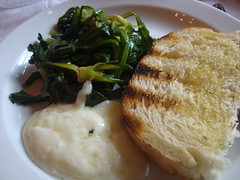
I don't quite remember how I started eating horta, although I do have a clear image of myself sitting at the kitchen table of our house before we renovated it, eating horta for the first time, while my parents looked on. I was surprised by their fresh taste, their cathartic lemony tang and their oily goodness oozing down my throat as their slightly crunchy stems yielded a nutty flavour. I also recall that my parents did not have a look of surprise on their face as they watched their first-born enjoying her first wild greens. In fact, it was quite the opposite; the message I got from my mother's face was something like: 'Επιτέλος, έβαλες μυαλό' (finally, you have come to your senses).

gardoumia

The food my mother cooked at home resembled as much as possible the food that she had eaten when she herself was growing up - the only exception being that tehre was a greater amount of meat on our plates in New Zealand than there ever would have been in Crete. Living in a foreign country did not stop my parents from preparing Greek/Cretan food. Mother would make her own mizithra from cow's milk (via bottles, recalling the fresh milk deliveries of the past), she foraged wild greens from the local parks, she used the whole lamb (innards included, which were never displayed in butchers’ windows) that Father bought from a farmer to make the Cretan Easter specialties, and they both shopped at the Italian grocer's for Spanish olive oil, Kalamata olives and freshly ground Greek coffee. On the rare occasions that they visited their homeland, they returned with loukoumia in their suitcases and Greek vlita (amaranth) seeds in their coat pockets (one way to avoid customs back in those days). Greek food imports to New Zealand were limited, but the majority of Mother’s food was prepared using whatever resources were available.

DSC05211

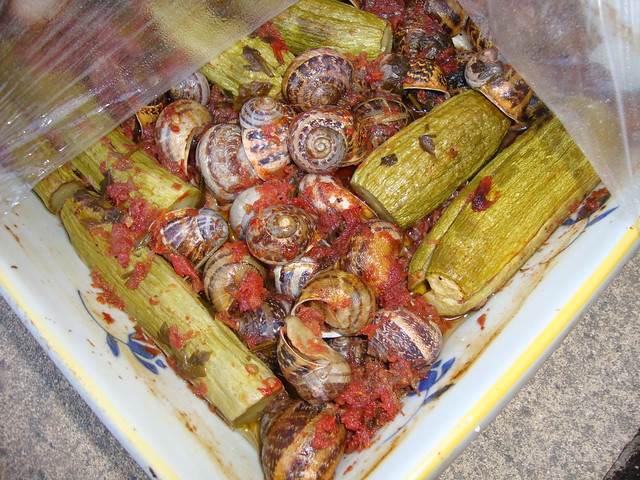
It was when I moved permanently to Crete that I realised the significance of horta in my mother's family cooking. It was also at this time that I discovered the importance my mother attached to snails as food, which she prepared on a regular basis in New Zealand. That was probably the only "mother's food" that I never tried. Now that I cook and eat them myself, I realise what a terrible mistake I made in my misguided youth. By the time I realised this, it was too late to try my mother's snails, because by that time, she had already died. By denying myself the opportunity to enjoy my mother's food, I had denied myself a part of my own identity.

*** *** ***

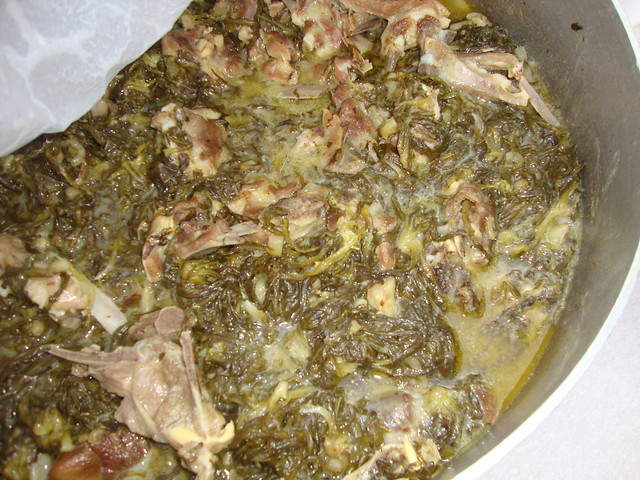
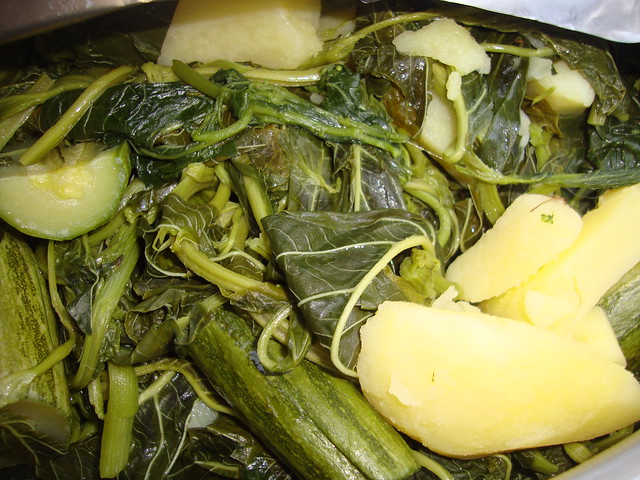
All the above photographs (except the gardoumakia) were taken in the village of Karanou, Hania, during the First Symposium on Greek Gastronomy, which took place in July of this year. They depict meals cooked on a daily basis by the women of this village, to be eaten in the family home. The meals are all frugal in nature and environmentally friendly, making use of the locally-grown wild and garden greens, and the environmentally friendly approach of the head-to-tail use of animals used as food. The meals do not always look appetising, and they may also look 'poor' with their use of primitive ingredients (which are now being used in the creative cuisine of the affluent) and their lack of sophisticated cooking techniques (despite the fact that they require more cooking skills than, say, preparing a fancy raw salad). But such dishes represent the food of the Cretan people, and they have sustained them for the last two centuries at least. I'll bet many a Cretan woman will remember the first time she cooked each one of these meals (in the same way I do), and how her eaters - especially her children - felt after she had nourished them with it.

©All Rights Reserved/Organically cooked. No part of this blog may be reproduced and/or copied by any means without prior consent from Maria Verivaki.

Saturday, 23 April 2011

Easter 2011 (Πάσχα)

When calendar Easter and Orthodox Easter both fall on the same day, it's always busy in Crete. Both Greeks and non-Greeks converge on the island at the same time, but for different reasons: Greeks from the mainland get together with their families at Easter, while our non-Greek tourists usually come because of their preference for the milder weather as opposed to our scorching summer climate.

These three items unify Greeks at Easter, wherever they come from or live: koulourakia (Greek Easter biscuits), tsoureki (Greek Easter sweet bread) and dyed 'red' eggs (which are 'cracked' on Easter Day). Nowadays the busy Greek home can enjoy these traditions without having to make them themselves. Apart from the store-bought cheat's versions shown above, there are also women's cooperatives that make them, so they come out looking as if they were made at home; those that operate in rural areas often use ingredients from home-grown or home-raised produce.

Easter is the most important religious festival in Greece (unlike Christmas in Greece, which is pretty much quiet). The action all takes place at the midnight service on Saturday night. In the past, everything used to stay closed on Sunday but this has changed dramatically - when Easter falls during the tourist period in Crete (as it invariably does), most places will be open to serve the needs of tourists. If you're here on holiday on Easter Sunday and you'd like to take part in a cultural experience today, those of you who have hired a car will be in a better position: wander off the motorway, drive around the countryside, and use your nose to guide you. Although Easter is a family holiday, and most locals will spend it at home in family groups, most (if not all) tavernas will be open today, catering for our tourists and visitors.

Lamb on the spit, being cooked at a Greek festival in Anchorage, Alaska (courtesy of Laurie Constantino). I recall a few of my NZ Greek friends cooking lamb on the spit, but it still felt foreign to me even when I lived in NZ, because it wasn't part of my own home's tradition at Easter. My Cretan mother would be making lettuce avgolemono lamb stew (top right), kalitsounia (bottom left) and Cretan meat pie (bottom right) instead. And right to this day, that's what I make, too.
 

Most Greeks will tell you that lamb on the spit is traditional on Easter Sunday. Yes, it is... but not exactly. Whole lamb on the spit is actually a Northern/Central Greek tradition, not a Cretan tradition. In a sense, it's an imported tradition from the mainland to Crete. We see the equipment used to cook it being sold here too, because lamb on the spit has now passed into the general Greek tradition, but if you speak to older Cretans, they will tell you that they remember seeing lamb on the spit for the first time in Northern Greece, among 'other' Greeks, and in the army, like for example my husband. He first remembers seeing it while he was doing his military service: by then, he was in his early twenties. On Easter Day, it was (and I suppose it still is) a tradition to roast lamb on the spit at the barracks. A row of spits would be set up by the soldiers, each one holding a lamb, and the villagers in the area where the barracks were located were all invited to join in the festivities. 

Cooking lamb on the spit involves a lot of work (although electric spits now help to ease the burden of turning it) and it also involves a lot of eaters - if you have a small family, then this is not a feasible way to cook it. This is the main reason why my own family has never celebrated Easter in this way: in fact, the only time I have celebrated Easter with lamb on the spit is once in Athens and another time in Hania when a friend from Thessaloniki organised the event. Most people in and around Hania cook Easter lamb in the oven, in avgolemono sauce, on the BBQ, and in a traditional Cretan meat pie. Restaurants and tavernas probably won't offer lamb on the spit in Crete on Easter Day for two reasons: Easter is a family celebration, so most people will get together in each other's house for this feast, and tourists may not be familiar with the tradition themselves, so they won't be looking to order lamb on the spit. 


antikristo upright bbq argiroupoli hania-rethimno fragma taverna antikristo
Antikristo: a tradition of Eastern Crete; lamb on the bone is cooked on an upright grill. It needs to be turned to cook evenly, which is why the electrified version (on the right) is simpler to use. These photos were taken in villages in Rethimno.

The Cretan tradition in roasting meat over an open fire is known as 'antikristO' (with the emphasis on the 'O'). This unusual kind of BBQ consists of an upright grill, surrounding an open charcoal fire in the middle. An electrified version of this also exists, where the meat turn around in a circular fashion, like a clock; this is different to the lamb on the spit, where the lamb goes round and round like a ferris wheel. To add to the confusion, antikristo is a tradition of Eastern Crete, which explains why you'll probably never see it in Hania (you will see it in Rethimnno and Iraklio).

*** *** ***

If you're offered a chance to participate, make sure you know what to say to your hosts. Greek 'Happy Easter' wishes follow the timeline of the events of the first Easter 2000 years ago:
As Easter approaches, people farewelling each other may wish their friends Καλό Πάσχα (ka-lO pAs-ha): "I wish you a good Easter" (NB: they only say this before Easter).
During the Holy Week, as Easter Day approaches, they may say Καλή Ανάσταση (ka-lI anAstasi): "I wish you a good Resurrection" (to remind us of the reasoning behind Easter).
After the midnight Easter Saturday service, they will then greet each other with Χριστός Ανέστη! (hristOs anEsti!): "Christ has Risen!" This greeting is used the first time you see someone after Easter for the next 50 days, until Pentecost, instead of the usual 'Hello' (Γειά σας) .

And finally, to reply to someone who has just said told you that Χριστός Ανέστη, you answer: Αληθώς Ανέστη! (alithOs anEsti!): Truly He has Risen!, which originated as a way to distinguish the believers from the non-believers. 

If it's all confusing for you to remember each of the different greetings, then there's also the generic 'umbrella' greeting: Χρόνια Πολλά! ((hrOnia pollA), which covers just about any happy event, and you can say it pretty much throughout the Easter period.


For all of us, whether we are religiously inclined or not, may Easter be a happy one, wherever you are. 

©All Rights Reserved/Organically cooked. No part of this blog may be reproduced and/or copied by any means without prior consent from Maria Verivaki.

Wednesday, 6 April 2011

The Cretan taverna (Ταβέρνα)

If certain discussion topics about Cretan cuisine are not pointed out to me, I would take them for granted. For instance, ordering a meal at a Cretan taverna (highlighted by a reader*) sounds like stating the obvious: you enter the taverna seating area, choose your table, sit down, take out the list you wrote back at home of your favorite meals from Organically cooked, find them on the menu card and order them. Then it occurred to me that whenever I go out for a meal at a taverna, I don't usually look at the menu card. So, the question is: how can you be sure of ordering a good meal in a Cretan taverna? My husband is the expert here, so I leave you in his trusted care...

Day and time: To enjoy a good meal, you need to have the appropriate weather. The best time of year to enjoy a meal out is when the weather is good but it isn't quite summer yet. That doesn't have anything to do with tourism; tourists usually go to places with a good view, so they don't usually go to the kinds of places I like to go to. If it's too hot, you don't really feel like eating; if it's too cold, you eat to warm up, so you may not really be enjoying your meal. I also hate going out for a meal on a public holiday. You need to get to the place early to grab a table, you need to wait for a long time till your order comes, the food won't be cooked to perfection because there are too many people wanting to eat at the same time, the ingredients won't be that good, either, for the same reasons, and there will be too much cacophony. I like going to a taverna at midday, not in the evening, because that's when I like to have the biggest meal of the day, at lunchtime, not dinnertime. I'd never go to a mountain taverna at the weekend after snow has fallen. It's every man and his dog then. All you'll remember of the trip is how long it took you to get back home because everyone blocked the road with their big cars.
ravdoucha waves on the rocks Summertime by the sea (Waves on the rocks at Ravdoucha), wintertime in the mountains (Drakoulakis at Omalos): Crete has something for everyone all year round. Tourists generally aren't catered for from November to March, but private groups and individuals come to Crete, and they are never disappointed - as long as it's not raining, autumn, late winter and early spring are the best times to visit to Crete if swimming isn't your main aim.

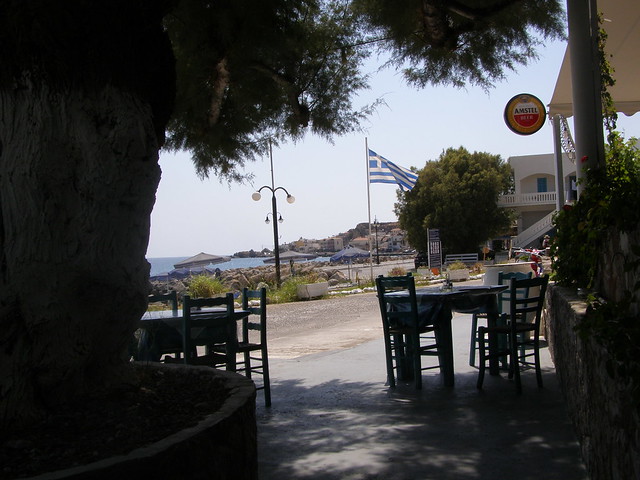
The seaside taverna: I'm not a seaside taverna kind of person. If you want to eat by the seaside, you've got to be prepared to pay for it. That's why you go to the seaside, for the view. You pay for the view, not the food. You might want to go to the seaside to eat out if you want to eat fresh fish. But to eat fresh fish, you've got to be prepared to pay for that, too, because fish is the most expensive meal you can buy at a taverna. I like to go to a seaside taverna in the summer, and preferably in the evening. Who wants to burn under the sun? Seaside tavernas are for tourists. They won't be asking if the calamari is frozen; they just want to eat calamari. If I have to go to the seaside for a meal out, I choose places that offer lots of shade. Most likely, I'll be on holiday by the sea, which is why I'll go to a seaside taverna. But I won't order fish because it's just too expensive. I'd probably order calamari which is reasonably well-priced, which we don't eat at home all the time, and a plate of αχινούς (ahinous - sea urchins), which we only eat when we go out. That's a special dish, which is why I'd order it at a seaside taverna.
It's relatively cheap to eat out at a place like this (Kalamaki taverna at Kalamaki beach), the perfect place to be on a summer's evening. But it's not something locals can do every day - thank goodness for good home cooking and a roomy balcony, like ours. If I really want to eat fish, I would eat it in the Agora in central Hania, where fish is cooked freshly on a daily basis when the market is open. It many not be next to the sea, but the people-watching entertainment is priceless.
The countryside taverna: I prefer to go to the countryside for a meal out, which invariably means good meat raised in the area where you choose to go out for a meal. It's likely to be cheap too, because the owner of the taverna is probably raising most of his ingredients himself. The countryside is usually quiet and peaceful, you're surrounded by natural landscape, most of the food will have been raised in the same area where you're eating it, and the chief cook will probably be from the area, probably a woman, so she'll know how to cook the traditional dishes very well. And that's what I want when I go out for a meal: traditional Cretan food, food that I know well, cooked with the best ingredients in the way I've come to know and love it. These sorts of places are really well priced. We never pay more than 11-12 euro a person when we go out, and we never feel hungry after our meal. The decor is unimportant at places like this; they're probably situated amongst beautiful landscape. Who needs indoor decor when you're surrounded by Cretan wilderness?

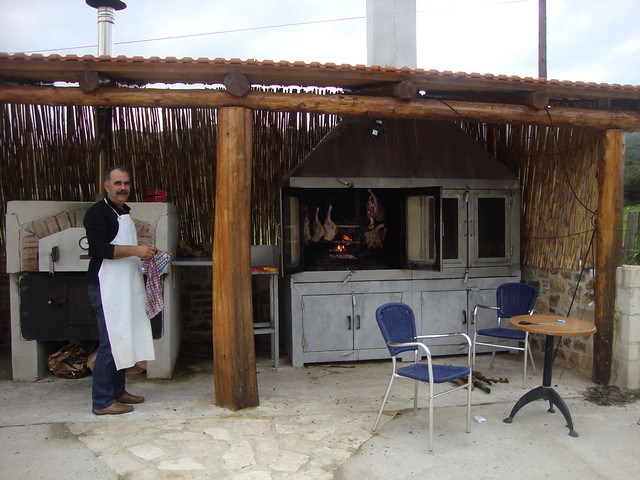
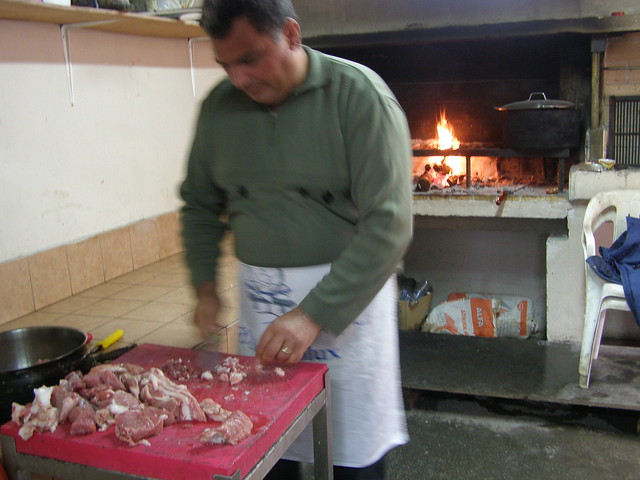
Getting a feel for what is cooking is always an educational experience in countryside tavernas in Crete: wood-fired ovens and barbecues are the norm. Left: Fragma taverna in Rethimno, which specialises in antikristo, an upright BBQ. Right: Botanical Garden Restaurant on the Fournes road past Omalos.

The choice of taverna: I hardly ever go to a taverna that I don't know well, or haven't been told about. Wherever I go, it's always συστημένος; a colleague will have been there and told me about the place. So I usually know what to expect from most places before I go there. Every now and then, when I find myself in the position of having to choose an unreviewed taverna, the first thing I do is park the car and tell the family to come with me to find out what the taverna's offering (the wife never wants to accompany me when I do this). I head towards the kitchen to see what's cooking. Decor,  location, bathrooms, tableware, none of that's going to tell you whether the food's good. You have to go into the kitchen and see what's in the pots or the ovens. If you don't get the chance to see what's in them, at least you'll be able to smell them. At this stage, you might end up talking to the frontpeople at the taverna. I ask them what's in the pots and pans. If it sounds like the food I want to eat, then I tell the wife and kids to choose a table (they're usually waiting for me in the car, anyway).

drakoulakis taverna omalosto kima paleohora hania chania
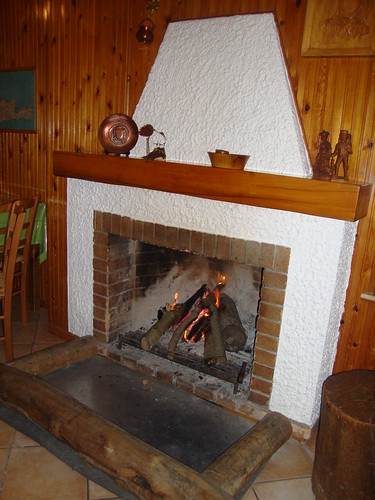
A fireplace in the winter (Drakoulakis at Omalos), a shady spot near the sea in the summer: Crete at its best.

Choice of table: Steer clear of fireplaces; even in the winter, it's usually too hot to sit very close to it. I only sit outdoors in July and August. Or during a heatwave. And always in the shade. Never near a door, because it'll open and close all the time and creates draughts.

to kima paleohora hania chania 1PC060002
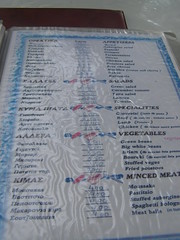
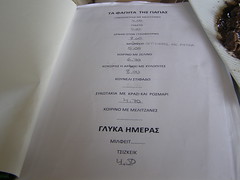
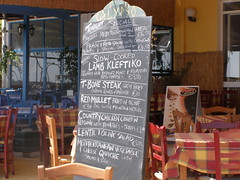
 The typical Greek taverna menu is broken up into appetisers, salads, mains cooked in the oven and grilled dishes, what Greeks call 'της ώρας' because they're cooked on order (top left: To Kima, Paleohora). Specials may be written on a separate piece of paper (top right: Botanical Garden Restaurant), or they may be communicated to the guests (bottom left: Leventis, Therisso). Menus in tourist areas are invariably written in the global style on a chalkboard (bottom right: Paleohora).
DSC02872 restaurant paleohora hania chania

The menu card: I never look at a menu card. I always ask the waiter to tell us what's on offer. I grew up at a time when we listened more than we read. I'm used to getting the menu told to to me. Sometimes, the menu card lists dishes that aren't available, so what's the point of seeing a menu card? Tavernas sometimes have a specialty of the area that they don't always write on the menu. It's something that they'll tell discerning customers about, things that are only available in small quantities, which is why they'll only tell you about them if you ask them. Tavernas that use meat raised by the owners do things like fried liver and sweetbread from freshly slaughtered meat, but there's not enough to go round, so they might be keeping it for their regular customers. But they'll tell you if you ask for it. 

dakos koukouvayia owl's eyes
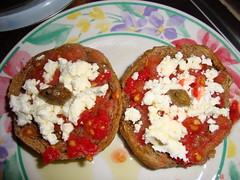
Cretan appetisers make up a complete meal of themselves. I prefer vegetarian meals, so I don't need much more to eat than a selection of these salads and dips.
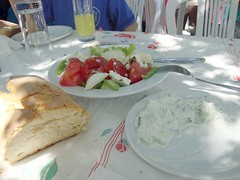
best cretan appetisers greek salad meal with tzatziki and bread
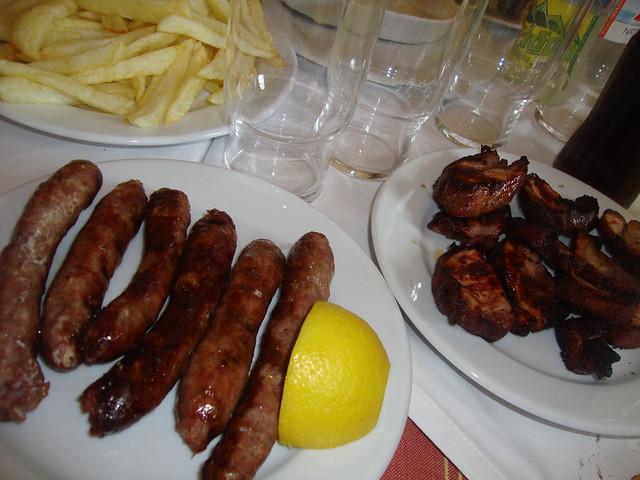
The more carnivorous among us need not feel left out. Left: country-style sausages (loukanika) and smoked pork (apaki); right: grilled rabbit.

Salads and appetisers: I love tomato salad, but tomato is only really good in summer; I never order a tomato salad once the tomato season is over. Even then, I still don't order tomato salad much at a taverna, because I - we, my whole family - loves horta. I grow vlita in the summer, but I can't get enough of them, so I'll still order them at a taverna. In the winter, I always order stamnagathi. I just want something to go with my meat, not to be eaten instead of them. Salads always require a lot of olive oil too, so you end up dipping your bread into the salad all the time. I don't like my salads to be too creative, otherwise they become a complete meal, and I'll have eaten too much before the main meat dishes arrive at the table, so I don't see the point of ordering too much salad. Besides, we eat a lot of salads and horta at home; most of the time, I've grown them myself. What's the point of paying for salad at a taverna? Same applies to all those mezedakia, like apaki and loukanika (sausages). I like kalitsounia and dakos, but I don't need to order them at a taverna; we eat all that at home on a regular basis! I let kids order what they want, but I know it's not the cleverest idea to allow them to have so many appetisers at a taverna, because they'll feel too stuffed to eat some of the mains dishes. They're kids; they'll learn. I'll make an exception for staka in the winter, which we never eat at home. Tzatziki is great in the summer, but only just enough to go with your meat. Too much of any of those, and I won't be able to enjoy my meat. I'll be eating bread instead. I make an exception to french fries, as long as they're not προ-κατ; they are usually freshly cut and freshly fried at good tavernas, and the taverna is most likely to be cooking their own harvest. But I'd much rather have fried courgette and aubergine chips in the summer.
tsigariasto kokoretsi ellanion fos argiroupoli hania-rethimno
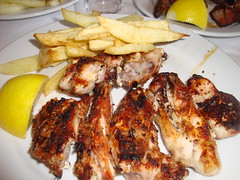
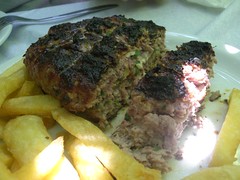
Meat specialties abound in Crete: my photos don't do it justice; tsigariasto (goat cooked in oil), kokoretsi (roast intestines and offal on the spit), roast potatoes and pork cooked in blood, stuffed bifteki (hamburger).
stuffed bifteki ellanion fos argiroupoli hania-rethimno xidato xithato and lamb roast potatoes cooked in wood fired oven

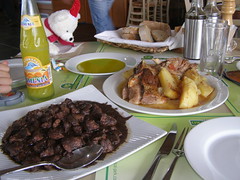
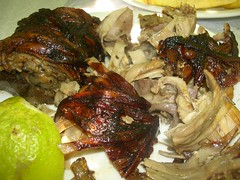
The main course: A Cretan countryside taverna offers a standard menu. I already know what it will be offering. That's what I go for, I know what I want to eat: roast lamb with potatoes, tsigariasto (goat cooked in the tradition of Sfakia), avgolemono lamb or goat, roast pig, well-grilled pork steaks, rooster in wine sauce. Each taverna might offer a signature dish of their own, which I might try. I can remember eating grilled rabbit - it tasted like tender barbecued chicken, it was fantastic. So was the roast lamb stuffed with mizithra. It's all to do with the ingredients: if they aren't good to start with, then the food won't be. If I don't go to a countryside taverna or I'm less sure of the ingredients, then I choose general Greek cuisine. You can't go wrong with makaronada, bifteki or pastitsio, because these dishes are made fresh daily. I personally would never choose boureki and yemista, because I eat plenty of that at home. When I go out for a meal, I eat meat, not vegetables!

DSC03119 ravdoucha waves on the rocks
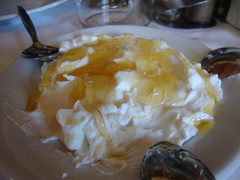
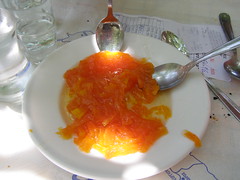
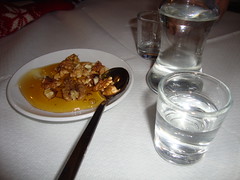
Dessert in a Cretan taverna is usually on the house: it can be traditional, like yoghurt with honey or a syrupy spoon sweet...
DSC02874
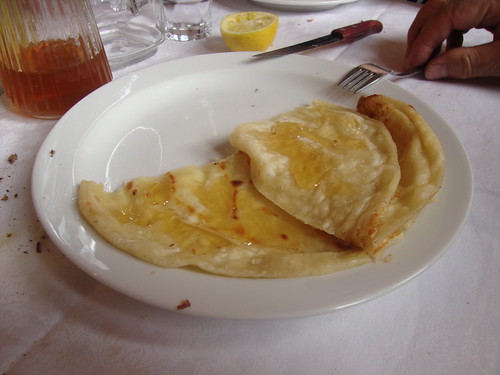
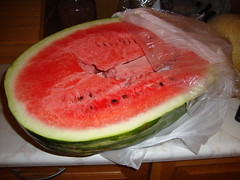
... or more complicated with Sfakianes pites (cheese and honey pies), which are menu choices, so they need to be ordered (and paid for. In the summer, fresh locally grown watermelon is usually served.
DSC03222 ab watermelon

Dessert: Dessert? You don't order that, do you? That comes at the end of the meal, on the house. At any rate, you'll be too full to eat dessert by then. If there's enough room, you can order Sfakianes
pites. But that's about all: dessert is unnecessary after a rich meal. All you need is a nip of tsikoudia.

 lemonia hiliomoudou hania chania FIX beer
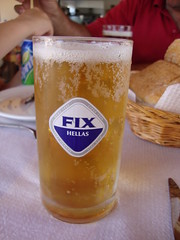
This is pretty much what we drink when we go out. Cretan fare is simple in essence; we don't complicate it with bottled wines.

Drinks: I like wine, and it's usually good at tavernas, because, again, the owner is probably making his own. I never buy bottled wine. Apart from the prices of bottled wine, I don't like drinking wine which I know has additives to get the taste and colour right. Home-made wine, the kind that our tavernas here always serve, taste just like the wine I drink at home, which is older than a decade, and was allowed to ferment naturally in a wooden barrel. Bottled wine can be good, but I don't really feel the need to order it. Bottled wine is what raises the price of a meal. You can ask the owner to taste both the red and white house wine on offer at the taverna and choose which one you prefer. I like beer too, but it only really goes well with grilled meat, especially in the summer. We let the kids order a fizzy drink when we go out, as it's their occasional treat. But we always ask the waiter to bring the drinks with the food, because kids are kids, and they'll drink it before they even take their first bite.p

Crete in spring or at Easter is one of the best times to visit the island, but most people come in the summer. If you are coming to Crete during the hotter season, check out my summer food post specially written for tourists, Taste Crete.

*Because of the sheer volume of photographs I upload, it's easier to view them on my facebook page (if you have a facebook account, click 'Like'). My food photographs chronicle my husband's advice: these are my family's rules when we go out for (usually) lunch. Our taverna food choices (with a heavy bias towards meat) reflect the Cretan style of eating out, which differs from the summertime tourist's choices. Vegetarians need not fear - Greek cuisine fully caters for the non-carnivore!

©All Rights Reserved/Organically cooked. No part of this blog may be reproduced and/or copied by any means without prior consent from Maria Verivaki.