Showing posts with label SOUP. Show all posts

Monday, 1 February 2016

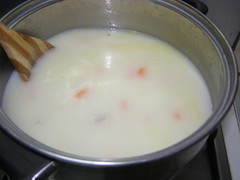
Youvarlakia soup (Γιουβαρλάκια σούπα)

Youvarlakia is Greece's version of a meatball soup, most commonly made with white sauce, although you will also see it made occasionally with tomato. The dish basically consists of meatballs boiled in a light water-based broth, with egg and lemon juice beaten into it once the meatballs are cooked. I make youvarlakia about once a month in the winter period. Since the kids have become avid vegetable eaters, I now add a lot of vegetables to the soup, together with the meatballs, and our youvarlakia soup turns into a very hearty and less meaty meal. My recent youvarlakia variation turned out to be the most popular version of the dish to date.


For the meatballs, you need:
1 kg minced beef (or pork, or a mixture of beef and pork)
1 large onion, finely grated
2-3 garlic cloves, finely grated
1/2 cup rice
a few springs of parsley, finely chopped
a few sprigs of mint, finely chopped
salt & pepper to taste
a little olive oil
some flour for dusting

For the soup, you need:
3 litres of water (or stock - I prefer water for a lighter soup)
50g butter (you can also use olive oil instead - I prefer butter because I don't use stock)
a few sprigs of dill, finely chopped
1/2 small cauliflower (or broccoli), broken into bite-size florets
1 large carrot, cut in small chunks
1 cup of peas
These are the vegetables I used in this version of the soup. You can use any vegetables that will keep their shape when cooked - I try to use only seasonal vegetables, especially if we grow them ourselves.

For the sauce, you need:
2 eggs
1/2 cup lemon juice

Mix all the ingredients for the meatballs (except the flour) together very well by kneading them. Make golf-ball sized balls, and roll them in flour. Set them aside while making the soup.

Boil all the ingredients for the soup together. When you get a rolling boil, add the meatballs, one by one, and continue to boil the soup until the liquid starts rolling again. It may need more water if the liquids have evaporated too quickly (you can make it as thick as you prefer). Turn down the heat to the minimum, place a lid on the pot and continue to cook the soup until it becomes creamy, for at least 60 minutes. Turn off the heat, take off the lid and allow the soup to settle for a quarter of an hour.

In a large bowl, beat the eggs and lemon juice together. Pour a tablespoon of the soup into the egg and lemon mixture and keep beating the sauce (otherwise the egg will 'cook', like scrambled eggs). Pour another tablespoon into the sauce and keep beating. Keep doing this until the bowl is nearly full. (Don't try to hurry this step - you will spoil the soup by cooking the egg.) Now pour the sauce slowly into the soup. Stir it in gently. The soup is now ready. Serve it hot.


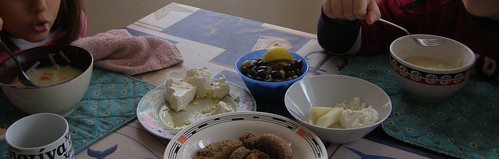
Youvarlakia soup is hearty enough to be eaten on its own with some thick slices of toasted bread. If you like to add a bit more protein to it, try it with a thin slice of feta cheese on the side, or crumbled into the soup. This soup will congeal once it cools down, but when warmed up, it becomes runny again. It also tastes good the next day.

©All Rights Reserved/Organically cooked. No part of this blog may be reproduced and/or copied by any means without prior consent from Maria Verivaki.

Sunday, 2 March 2014

Chicken soup with broccoli (Κοτόσουπα με μπρόκολο)

Yes, broccoli again. I've uprooted all our broccoli plants, but I still have a freezer-shelf full of the stuff. It has occurred to me that we have been eating a lot of broccoli this winter, but this is for economy more than anything else. Instead of buying winter vegetables, I use our bumper crop of broccoli wherever I can. We have so much broccoli from the garden, that I par-boil a large pot of broccoli twice a week (yes, really), which gives me a chance to use it in different ways when I come home from work, eg stir-fries, soups, fritters, etc. I'm so glad I'm a really good cook, because I can cook broccoli this often and make sure that my while family still manages to enjoy their meal. We have had it in so many different forms, that they never complain. I'm that creative. Even the dog eats broccoli mixed in with her food. And if you know a thing or two about broccoli, it is regarded as a superfood.


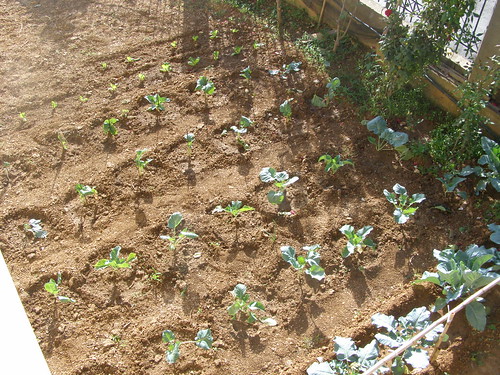
The broccoli season is over - my neighbour's broccoli plants (the ones with the yellow flowers) are going  the way mine did and they need uprooting.

I knew that from a long time ago, when one of our Algerian students at the Institute researched the "Genetic and epigentic control of glucosinolates pathways synthesis in broccoli", whatever that means (I proofread a lot of stuff which I don't always understand), a thesis which contained a lot of research on the benefits of broccoli in the diet. Since then, broccoli is described in the internet press as a nutritional show stopper, an anti-cancer agent, a tumour reducer, an age suppresor, a vitamin-packed agent with more Vitamin C than an orange, among others. Well, I'm glad to hear all that, because we really do eat a lot of broccoli, and it just might help us all to keep up our good health, now that Greece has no public health system (just yet, apart from hospitals). We don't lead the kind of life that gives us the privilege of making proclamations like "I'm President of the United States, and I'm not going to eat any more broccoli!" like George Bush did. But lucky for us, broccoli keeps us healthy.

This broccoli soup was made on the go, with little time to spare for 'real' cooking; I was harvesting and processing celery for the freezer, at the same time as picking spinach from among the tall and rather overgrown nettles that have now surrounded all the spinach plants. But don't take my soft whinge seriously: the winter garden is really easy to maintain. The plants seem to grow by themselves, they rarely need much care, and all I do is harvest. It's really not as difficult as it may sound. I just wish I could be doing something else instead, like work on the project, which is underway - slowly, slowly...

I made this amazing soup last Friday, despite my aching bones, after a very tiring week, as I thought about the three-day weekend that we are now in the middle of (it's Kathara Deftera tomorrow). Perhaps everyone loved it so much because it was a cold night, but I have a feeling that they liked it because it was really delicious. it has a pungent taste because fo teh way I used the garlic. Normally I cook it in some way, eg sauteeing in oil before being added to a meal. In this recipe, the garlic is not cooked at all, so it has a strong but fresh flavour.

You need:
4 chicken backs, with necks
4-5 medium potatoes
about 3 cups of broccoli cut into bite sized individual heads
2 large cloves of garlic
salt, pepper and oregano


Boil the chicken backs, broccoli and peeled potatoes in a large pot of water, till the potatoes are soft. Remove the chicken, broccoli and potatoes from the pot. Puree 3 potatoes with the garlic and some of the stock water (strained to remove impurities from the chicken) in a blender. Pour the puree into another pot. Strain all the remaining liquid into the pot with the puree. Add the chicken meat (which you shredded from the chicken backs and necks), and all the seasonings. Chop the remaining potatoes and all the broccoli into small pieces. Mix well to form a blended soup. Heat through.

Serve the soup piping hot, with crusty bread. It will not make you feel poor as you think that you are cooking again with broccoli which you grew yourself; it will make you feel somewhat superior, having so much superfood at your disposal.

©All Rights Reserved/Organically cooked. No part of this blog may be reproduced and/or copied by any means without prior consent from Maria Verivaki.

Monday, 23 December 2013

Chicken soup (Κοτόσουπα)

I used to cook mainly with plant-based foods, and there wasn't much meat in our meals. Meat was left for the weekends, with maybe a mince dish in the middle of the week. But that's not working much these days - the children are growing fast and they seem to want to eat much more than they ever ate before. Not only that, but I can tell that they want to eat more meat. I started adding chicken to many of our meals just for them, which they appreciated. As they grow older, they are also more open to eating a wider variety of dishes, which means I am freer to cook more creatively.

Last week, when we were all feeling very poorly due to the cold weather, I made the kids their first chicken soup. In many countries, chicken soup is a staple meal for winter, cold weather and sickness. But soup has never been regarded as a 'proper' meal in Greece, and the main kinds of soup made by Cretans were never really very satisfying (they were generally very smelly, and terribly boring-looking). Fish soup is still widely popular, but it's a smelly business. Chicken soup is much less hassle - and it is really cheap to make, now that we can buy chicken backs.
I've been buying chicken backs for a while now. We are still lucky to be able to get the necks too. In more developed countries, the necks are no longer sold because they are used in the food industry to make canned/frozen/bottled stock. In Crete, I have yet to find ready made stock - and it doesn't sound like something I would want to buy anyway!
In pre-crisis Greece, chicken backs were thrown away - literally. Anyone who wanted to cook for their pets (like I did) could pick up chicken backs (with the necks attached) for free from the supermarket. I used to do this all the time. Not only that, but I would cook them, remove the meat and add it to chicken pie or a stir-fry, and voila, I would be feeding the family cheaply (the dog would eat the bones, and some rice/macaroni cooked in the broth, if I didn't need the stock for making pilafi or soup).
An old photo, dated 25/3/2011 - discarded supermarket chicken backs, turned into dog food, stock and pie meat. What made me feel embarrassed to blog abut this photo was that I would be called stingy, cheap, μίζερη. But that was simply other people's mistaken perceptions - I was simply ahead of them when it comes to survival skills. I suppose they know this now - I had a feeling people would eventually see things my way...

I would never tell anyone what I did (I am only telling someone now, by writing it) but I don't understand why my compatriots would attach so little importance to food that was fit for human consumption. They had no idea of the true value of something that they were paying for. In fact, I couldn't understand a lot of things about pre-crisis Greece, but those days seem to be over. Greeks seem to be understanding the rest of the world better these days, and trying to catch up with the way the modern world is going - showing compassion, sympathy and solidarity with poorer people. One could say that we are now living in the post-crisis period. This suggests that 'the crisis' is over, and in essence, it is: Greeks are now learning to live within their means, they accept their new reality, and they know there is no going back to the past:
"The crisis is changing Greece for the better, he told me. The bloated, clientelist public sector that employed unqualified people in return for political support, is being reformed. Greeks are learning to live within their means. Tax evasion is no longer accepted. A new culture of solidarity has emerged: a feeling of "we are all in it together". There is even a spirit of entrepreneurialism being born. It is, he said, a painful transition - but a necessary one. Psychiatrists talk of the five stages of grief: denial, anger, bargaining, depression and acceptance. Maybe Greece, which has known much grief, is edging towards the final stage. I meet far more now who tell me that if they could choose between going back to 2004, when Greece basked in the Olympics and European football victory and felt wealthy - or now, pushing on, out of all this - they would take the latter. The realisation has dawned that pre-crisis Greece was an illusion: it was a party which just had to end."(Mark Lowen, 23/12/2013, http://www.bbc.co.uk/news/magazine-25431288)
We need to remember what kind of crisis we are talking about - the state of the economy may still not be good, but the real crisis was never the economy: it was in the Greek identity.

My chicken soup was based on the ingredients list in the BBC link. I tweaked it a bit to make the soup more suitable to my family's taste. The whole family loved this soup, even my husband, who thought he'd had enough of chicken soup in his youth (I can imagine what his mother was making - it was never as good as my version), and cheap chicken while he was serving military duty.

You need:

a few glugs of olive oil
2 roughly chopped onions
2 finely chopped sticks of dark green Greek celery (it resembles lovage and is far more common than regular celery as it is known in western countries)
2 roughly diced carrots
2-3 boiled potatoes
4 chicken backs with necks attached
salt and freshly ground pepper

Boil the chicken backs in a medium pot with plenty of water with the potatoes till the meat is very soft and close to falling off the bone. While the pot is boiling, heat the olive oil in a pan or pot and add the carrots, onion and celery. Saute till slightly softened.

When the chicken is ready, remove the chicken backs and potatoes from the stock. Strain the stock clean. When cold enough to handle, remove the meat from the bones EXCEPT the necks, and add to the strained stock. Add all the cooked vegetables, including the potatoes, broken up into chunks. Now puree half the soup in a blender. Pour the blended soup back into the pot with the rest of the soup and mix well. Add as much water as needed to fill the pot. Mix everything till well blended. Season with salt and pepper.

Serve in individual bowls with a chicken neck for decoration.

©All Rights Reserved/Organically cooked. No part of this blog may be reproduced and/or copied by any means without prior consent from Maria Verivaki.

Saturday, 12 October 2013

Crisis food

I got the supermarket early enough before the peak hour, which is how I managed to get hold of some πλατάρια - chickens' ribcages and necks.

In the pre-crisis days, when a butcher/supermarket boned various cuts of meat (which are usually sold in styrofoam trays and wrapped in plastic), this part of the animal was usually thrown away. When I bought meat, I would ask for 'some scraps' (this the kind of thing I used ot be given) so I could cook them up for my pets with some pasta or rice.

Since the crisis, these scraps are no longer thrown away - they are sold. They are popular (I can only find some when I am in the supermarket early enough). Not everyone uses them for their pets - they are seen in the same light as fresh food good enough to eat. They were selling at €1.57/kg - I bought 4, which works out to about 25 cents each.

When I bought them, the assistant asked me if I was going to turn them into soup. Greece is not really a soup culture (and it's 30 degrees Celsius today), but it is not unusual to find interesting vegetable-based soups which use meat stock on the menus of modern-style casual eateries these days, so I guess this will be a category which we could describe as 'watch this space'.

©All Rights Reserved/Organically cooked. No part of this blog may be reproduced and/or copied by any means without prior consent from Maria Verivaki.  

Wednesday, 13 March 2013

Soup kitchen (Συσσίτιο)

Soup kitchens: that's a scary phrase - it means poverty, misery, κακομοιριά. Unless we need them, we don't know anything about them. If you need to use the services of a soup kitchen, you have reached the lowest level - you are unable to feed yourself, whether it is because you cannot afford to, or because you are unable to.

Cook up an oily vegetable-based sauce with some cheap meat cuts (in this case, frankfurter chunks were added), pour some water over it and add the pasta - this is quick and easy to cook, and it provides a lot of servings with little effort.

So what do the poor and disabled eat when someone else provides them with their meal? I can only imagine it is something cheap and easy to cook, which can be made in large batches, to provide many portions. Those who cook the meal must procure the ingredients in the cheapest way they can. They are not running a for-profit service - they are serving hungry malnourished people. In Greece, cooking for others is guaranteed to involve large pots of something cooking fresh over a fire - the idea of packaged food does not hold, even among the poor and those who provide food for them. Packaged food is regarded as crap - not only that, but it;s expensive in a country rich in agricultural products. When you know someone is unable to feed themselves, you try to give them the best food you can afford. A hot meal is symbolic of love and sympathy; it will warm up the soul of the impoverished even before they begin to eat.

The people in need come to the parish church, slide open the aluminium window and leave their empty clean container on the mantelpiece. Not all soup kitchens have communal dining areas, but there is another reason why these people may not wish to dine with others - disability may impede them from doing so, while poverty is sometimes best suffered in silence.

Few people would be able to guess who is receiving soup kitchen meals. Most of the people who receive soup kitchen meals do not look as though they are living in discomfort. The area of St George's church in Katsifariana is not built up, there are many green fields full of orchards surrounding the church, and there are no homeless people to be seen inthe area. The people who come to the church with their empty plastic containers do not all come from the area: some walk from Souda; others use their motorbike to drive in from Hania; some come in battered cars. Distribution is the biggest problem in feeding the poor, who are all from different walks in life, but have one thing in common: an empty stomach. Your home keeps you sheltered, but it does not feed you. You can own your own home forever (who cares if the electricity is cut off?), but to keep yourself nourished, you need 2000 calories a day, spread over at least three meals, and there is never a point in your life when you will be able to say that you have enough food to keep you alive forever.

When the meal is cooked, the bowls are taken to the counter and filled. The bowls contain multiple servings. Bread is also provided, as is fruit as well as salad.

The wife of the priest cooks the meals herself, with the help of some girls and women who peel potatoes, chop vegetables and clean the kitchen. These women are not in employment themselves, but may be in a better economic position to keep themselves and their families nourished. Different meals are cooked every day. The meals are offered to families where both members have lost their jobs, and hence have no income apart from what may be needed to pay the basic utility bills: electricity, water, telephone, rent, heating fuel - it probably won't be enough even for all of that. Some meals are also offered to immigrants who will not be entitled to any benefits from the Greek state. Their existence hangs on a thread.

The people who use these services will not look much different from me. They will live in a similar house to my own. Every morning, they will get up and splash some water on their face, and comb their hair, and make a cup of tea or coffee like I do. But unlike me, they will not leave the house to go to work. I imagine that if they leave the house at all, it will be in search of work, or a hardship grant, or some food.

Before the economic crisis, this parish church used to cook up to 40 meal portions. This gradually doubled to 80 portions; it is now serving 135 portions daily - that's a 240% increase since 2009.

Many people who have recently lost their source of income use the services of this soup kitchen. But the fact is that this soup kitchen had been started well before the crisis. The economic crisis may sound like a new concept, but in reality, many of our fellow citizens have been living through some kind of crisis well before the economic crisis broke out. Churches have always been there to help them through difficult times. 


This is the kind of cooking I enjoy doing myself. If I were unemployed, I'd want to work in a soup kitchen because I know my food would always be appreciated. Plating fancy salads and hearing the first-world complaints of diners with too much spare cash and not enough sense and knowledge to cook a meal for themselves would probably not give me job satisfaction. I can imagine tipping their plates over their heads. I like cooking real food for real people.

I have never been to a soup kitchen. It is not my job to go to one, except as an onlooker, a kind of nosy-parker, and this is neither possible, nor welcome. Thanks again to Eirini who goes along to help at this one when she has time; her photos show how the system works in a non-descript area on the outskirts of the town of Chania, concealing the problems of the area in such a way that no one will ever suspect what may be hiding behind the picturesque facade of our Mediterranean coastal resort town. 

©All Rights Reserved/Organically cooked. No part of this blog may be reproduced and/or copied by any means without prior consent from Maria Verivaki.

Saturday, 23 February 2013

Packet soups

There were always packet soups in our house when we were growing up. My mother never used them in the way that instructions stated on the back of the packet: she used to add them to her own recipes for extra flavour. In this way, she used a tomato soup sachet to make a thick soup with rice, a chicken noodle sachet for avgolemono, and stock cubes for giving pilafi rice cooked in chicken stock an extra kick. Now that I'm cooking for the family, I can understand why she did this. Had there been paximadi, high quality olive oil and free-range chicken available in New Zealand during our time there (similar foods that she had learnt to prepare food with when she was still in Greece), soup packets would probably have been unnecessary. But soup was still a popular meal in our house, possibly due to the New Zealand climate.

At times, I've bought these sachets myself thinking I would use them when I didn't have time to cook 'properly'. Although there have been many times when I have not been able to do just that (cook properly) for various reasons (lack of time or will), those packet soups have never come out to be used as a meal and they are still lying in my cupboards. There's never really been any reason to add this salt-laden flavouring agent to any of our meals because they already have a high quality taste and flavour without them; I may be cooking similar meals to my mother's but our vegetables usually come from our garden.

When there isn't enough time to cook, a boiled or fried egg, or maybe some cheese with some bread and a salad will suffice. If they can't find any ham and cheese in the fridge, the children will whip up a dakos; when he's on his own, my son prefers thick slices of sourdough bread drizzled with our own supplies of extra virgin olive oil, lemon from our own trees and oregano presented to us as a gift.  Packet soups and sachet meals are always found at the supermarket, but they are never sold as cheaply as one would expect, for such meals to catch on. Soup in general is seen as a winter food, but soup has never been popular in contemporary Greece in the first place.  


I was doing a pantry clearance the other day when I came across the packet soups. I felt rather guilty about the fact that they've been lying there for over a year and I know I'll never use them. I know I can use them to cook our pets' food (which I am now doing), but even that feels strange: I'm feeding our pets food that I consider inferior for human consumption.  

In the past, it was easy to get bones and offcuts for free from butchers and the meat counters at supermarkets, but these days this is difficult. The last time I asked for them at a top-end supermarket, I was told that anything that isn't sold (including trimmings) is sent back to the main offices of the chain (I wonder what they do with them.) And if you aren't actually buying much meat in the first place, then you have no reason to be at a butcher or meat counter asking for scraps. 

For the next month, our dog cat will be trying a new range of pasta dishes, all cooked with finely chopped garden vegetables, olive oil and sachet flavours: tomato, spring vegetable, carbonara, thai green curry, red curry paste, chicken stock and even vanilla pudding. I started with the tomato soup packet the other day. Usually they scoff down their meal as soon as the food hits their plate. I was a little worried when the dog left hers lying in the old frying pan that serves as her plate. I felt some relief to see the food missing the next morning. Maybe this kind of food is just a little more difficult to digest.

Having been raised in a household where packaged highly  processed food of this kind did have its place, it should come as a surprise to most people that I could live without them. Living in rural Crete, I know why there is no need for such food to exist at all.

©All Rights Reserved/Organically cooked. No part of this blog may be reproduced and/or copied by any means without prior consent from Maria Verivaki.

Thursday, 3 January 2013

Hungry (Πεινασμένος)

Every day on the TV news during the Christmas period, food was the main focus in most items: how people are donating to food banks, how the poor, needy and homeless are being fed in soup kitchens, and how people are asking churches to look after their children because they don't have enough money to buy food to nourish them. The stories are all from Athens: the worst-hit area is the Western suburbs (the poorest and most polluted part of Athens), an area I know well as I worked there before moving to Crete, choosing also to live in the area instead of following my colleagues every night, back into the glitzy facade of central Athens (beneath the veneer, that too was grimy). The Western suburbs of Athens are full of working class people who have worked very hard to maintain their dignity in a city that never really allowed them to rise. These same people are now suffering the loss of what they strove to maintain: their dignity, as they search, not for ways to keep themselves sheltered, but ways to feed themselves and their families. Urban areas suffer the most in times of crisis because they cannot be self-sufficient to any degree. As a priest said in one of those reports, "all that these people have left for them is a house and a car, and neither of those can put food on your plate."

A stroll off the beaten track in Hania led to my chancing on an event staged by a work colleague. She was holding a 'soup party' in a very quiet narrow car-free zone in the old town of Hania.

The situation is now very dire. Teachers are now noticing that children are fainting in class, being sent to school without breakfast, not even a glass of milk, and their lunchboxes contain very little food and/or very low-quality food (one person remarked that when a child opened its lunchbox, he saw just one piece of toast bread in it). A milk-at-school campaign is now being started to help the children most badly in need of nutrituous food. Soup kitchens abound now, but this is not really going to solve the problem because people cannot really be fed nutritiously, even from soup kitchens. What malnourished people need is high-energy food full of proteins; but what they're most likely getting is hi-carb food - filling, but fattening, which is not really appropriate for a sedentary body like many homeless and unemployed people's.

Ilektra is a forester, and her partner is a cook. They presented a range of soothingly warm soups (pumpkin, greens, beetroot and onion) outside Ilektra's friend's arts and crafts store. 

Because soup kitchens have to cater for a large number of people, they cannot cook meals that require a lot of preparation in terms of vegetable chopping. What's most likely to go into a soup kitchen meal is a lot of beans, rice and pasta, and little fresh food, cheese or meat. Food collection points ask people to place non-perishables in the bins and the food isn't collected on a daily basis, because it isn't easy to do this. I recently felt guiltywhen I placed a packet of pasta into a food collection bin at the supermarket, which was filled with other dry goods, like flour, sugar, condensed milk, etc. I know that I can afford to give better quality food. But I had no choice. I could not place anything other than dry packeted goods. I couldn't bring my excess garden-grown produce to it, as it would go off. And what about all those oranges that fall off our trees every year? It's doubtful that the hungry and homeless have eaten very fresh food in a while, but even in that case, there are some foods that the very hungry cannot eat. An apple for example would do much more good for an empty stomach than an orange.

Ilektra was motivated to do this by her desire to share good food and drink (wine and tsikoudia were also offered) in the Christmas spirit. Note that she did not provide food like a soup kitchen - she just enjoyed the idea of sharing her food and called her event a 'soupa party'.   

Foraging has always been a favorite pasttime of both rural and urban Greeks, although admittedly, it is mainly the domain of people who live near areas where they can forage. But recently, I have seen people foraging in areas where no one would have done so in the recent past - near roadsides and urban areas, ie places that are more likely to be polluted by car fumes and animal faeces. But that's all that is available to some people: if you don't live near fields or pastureland, and you can't afford the transport costs, you will forage at any place where you know you can find food. This is in fact what happened during Greece's famine in WW2 when the Nazis confiscated all food resources for their troops' supplies and blocked Athenians' access to food, thereby causing starvation which led to death in the coldest harshest winter of that period. Athenians took to the hills that surrounded them, stripping the earth bare of foliage, cutting down trees for firewood.

The atmosphere at the 'soupa party'. 

The Greek Orthodox Church has graciously extended a helping hand to people in need of food. Nice idea, I thought to myself. But that is not going to really help alleviate the ordinary Athenian's hunger and the problem of feeding a hungry society, as I recently discussed on my facebook page:

  • Organically Cooked It sounds like a nice gesture, but I'm afraid that is all it is, it won't make a difference to the Greek food crisis (this is my opinion, but I feel sure about this). 
    The problem is that people need to live NEAR their land to be able to work it to produce food on it - if you live far away, you need petrol and time to get to it, but if you have a job, you don't have time to work on your land; if you are unemployed, you don't have the money to get to your land. The church owns a lot of land and doesn't want the state to make it pay taxes on its land - ie it wants to be an exception to the rule that is forcing all Greeks to be taxed on their land ownership as of 1/1/2013. The church is saying that it will allow people to cultivate freely on it, but that is akin to saying "come work it for me for free". I believe there is no such thing as a free lunch, especially these days in Greece where not even the bones and off-cuts of meat cut at the supermarket butcher counter are given away for free (I used to ask for them and cook them with cheap pasta to feed our dog). Now, people are buying them to turn into soup (it's the cheapest way to get yourself some protein).
    I cant speak for the church, or tell it what to do, but I feel it's pretending to be generous. I know how hard it is for me and my husband to visit our fields regularly given that we have a regular day job and our kids are young and need our attention. When we go, we often find things missing in them (ie someone has come along and picked up firewood, or foraged, or harvested our own crops). I hold no grudges - if people are hungry, in need or whatever, then I guess this happens, especially when fields are located far from inhabited areas. Ours are only 10 or so km away, but we can't drive there and back every day when we have other jobs, and we have no place to stay overnight to get more work done on them over a weekend, for example.
    In a nutshell,I don't think the church's offer will provide the soluton to the Greek food crisis.

Look at the homeless people being fed a New Year's lunch in the BBC link I mention above: do they look as though they are in a position to be able to work someone else's land to provide for their own food needs?

I hosted New Year's lunch this year. The vasilopita was made with our own supplies of oranges and olive oil, the eggs were given to me by relatives, the fruit and vegetables were all our own supplies, as was the wine; but we don't raise beef (for the moussaka mince), or goat (for the tsigariasto stew), or pork (for the tigania) - nor do we grow our own wheat to grind into flour. No money, no honey.  

It's at times like this that you realise you are really useless and your actions will not have the desired effect. Teaching a man to fish is better than giving a man a fish, but when he's hungry and lives far away from the sea, a fishing rod will be useless. He needs that fish badly. But what people really need at the moment is not just food, but a job. They need money. We are not self-sufficient. Neither can we be truly self-sufficient. Trying to fend for ourselves as our ancestors did in the past means we are condemned to an antiquated lifestyle that does not allow us to advance. If you really had to pick every piece of fruit you ate yourself, and you had to keep guard over your land like a hawk to stop people stealing the fruits of your labour, that's all you're going to do in life: feed yourself. Isn't life worth more than that? If the church really wants to help hungry people, well, how about providing jobs on the land (the church's land, mind you), and paying them money, instead of just letting them work their land? Can unemployed Athenians (ie the main group suffering from a lack of food) really be expcted to cultivate land far away from their apartments? I don't think so.

If there is a food crisis in Greece at the moment, it all has to do with the distribution of food. Rural areas grow more than they need, urban centres can't access the freefall; rural people tend to have their own supplies of a range of products, urban people need to buy everything, but don't have the money to do this now; transportation costs cannot always be met for food to be distributed to those that need it, on time before it perishes. It's not a lack of resources that is stopping Greeks from being able to feed themselves - it's a lack of coordination, and the high transport costs.

©All Rights Reserved/Organically cooked. No part of this blog may be reproduced and/or copied by any means without prior consent from Maria Verivaki.

Friday, 2 November 2012

Cheap 'n' Greek 'n' frugal: Creamy leek, potato and red pepper soup (Σούπα με πράσα, πατάτα και κόκκινες πιπεριές)

Last night, as I was sifting through my fridge's darker corners, to see what was hiding, I found some leeks and red peppers that which did not look very worn out from having lain there for so long, but they really needed to get out of the fridge and into a cooking vessel. The result was a heavenly soup that I could never even have dreamed of if I didn't experiment. The recipe below is written in the same experimental way that I created this soup, based on my regular potato and leek soup.


You need:
500gr leeks (whole - I use both the white and green parts), washed well and chopped small
500gr potatoes, peeled and cubed (from a mountain dweller friend's bounty)
1 large onion, roughly chopped
3-5 red bell peppers (from our garden) chopped roughly
a few glugs of olive oil
a bouquet garni comprising of: celery stalk, thyme (or dill seeds) and 2 bay leaves (I also used bahari)
salt and pepper (I used peppercorns, but had to fish them out when I was ready to puree the soup)

Place all the ingredients in a large pot and let soften on the lowest heat setting for 30 minutes with no lid on the pot. Pour 4-5 glass of water into the pot (depending on how thick you want your soup) and let cook slowly for another 30 minutes. Switch off the element, allow the soup to cool slightly, remove whole herbs and spices and puree.

Wine from Peloponesos, sausages from Pilio, feta cheese from Plataies, local bakery bread and soup made from garden-grown produce: it can't get more Greek than this. 

It's not a Greek custom to add cream and dairy products to soups. It's better to serve some cheese on the side to go with the soup. And if you like your meals a little heftier, fry some sausages. In this way, you can cater for vegans, vegetarians and omnivores alike, all with the same meal. And don't forget the bread and  wine.

©All Rights Reserved/Organically cooked. No part of this blog may be reproduced and/or copied by any means without prior consent from Maria Verivaki.

Friday, 4 May 2012

Cheap 'n' Greek 'n' frugal: Lentil stew (Φακές)

Prices are in euro (valid in Hania). All ingredients are Greek or locally sourced; those marked with * are considered frugal here because they are cheap and/or people have their own supplies.

Lentil stew (or soup - it can be made into either, using the same ingredients) - commonly known as 'fa-KIES' in Greek, is eaten as frequently as fasolada, the Greek national bean dish. It's easier and quicker to make than fasolada, which is why I like making it. It's always the first meal I make when we return from a long trip away from home, because it's so easy to make - you can unpack your suitcases, put a load of washing on and get over jet lag or place/climate changes while it's cooking. All the ingredients needed to make it are pantry staples. As a stew, it simply gets better when left overnight. And it will be left overnight,because, just like fasolada, you never make enough for only one serving, so you'll have more time to rest after your holiday.

You need:
a few glugs of olive oil
400g-500g brown lentils (Greek-grown lentils cost about €2)
1 large onion*
2 cloves of garlic*
400g pureed tomato (I use my home-made tomato sauce)*
salt, pepper and oregano to taste*

Finely chop the onion and garlic. Wash the lentils and drain them. Heat the oil in a large pot, place all the ingredients in it, add plenty of water (twice the volume of the ingredients), and cover the pot. Cook on the lowest heat for two-three hours. I went to the supermarket to stock up on fresh food while my fakies were cooking.

My cutlery, crockery and clock are all family heirlooms from my NZ years.

We like our lentils like a stew. If you prefer them to be a soup, just add more water (to your plate or the pot) and mix till well blended. We had our lentil stew with classic Greek bakery bread, some slivers of Dutch herbed cheese which I'd bought at Zaanse Schans, and avocado dip sprinkled with smoked paprika powder (a present from a friend in Holland).

Total cost of the meal for four people (served twice): about €3, together with the cheese; about 40 cents per serving.

©All Rights Reserved/Organically cooked. No part of this blog may be reproduced and/or copied by any means without prior consent from Maria Verivaki.

Monday, 21 December 2009

Egg and lemon soup (Σούπα αυγολέμονο)

Five minutes: that's about the amount of time I would say I spend washing my hands and face, brushing my hair and teeth, and applying a dab of perfume and maybe some lip balm on a cold morning, before going to work. That's after I've spent 10 minutes toasting bread, warming up milk and serving it all up for the kids' breakfast. So Xanthe Clay is way ahead of me when she makes the classic Greek soup, avgolemono, in just five precious minutes:

(Thanks for link, Peter)

Is chicken stock really truly that kind of brown colour? Is pre-cooked rice an ingredient or a fast food? Maybe this is the way soup is served in a fast food restaurant; it needs five minutes to cook, and if not eaten in the next five minutes, it will go off. To cook such a soup from scratch, admittedly, it would not take 5 minutes to make, but whoever heard of a whole meal being cooked in 5 minutes, except in fast food restaurants?

This kind of video is supposedly an attempt to get people cooking some kind of 'real food', which is all the rage these days, judging by discussions among 'top chefs' like Alice Waters and Anthony Bourdain:


(Thanks for the link, Elissa)

And I congratulate Xanthe's effort in this direction. But let's not forget, as Alice Waters says: where did each of Xanthe's ready-to-eat ingredients come from and how easy is it to actually cook the same food from scratch without wasting, beg your pardon, spending too much time in the kitchen? Xanthe's version of avgolemono soup serves 2 people and can be made in just 5 minutes. She probably needed a longer time buying her ingredients from the supermarket; in how much of a rush can 2 diners possibly be?

My mum used to make avgolemono soup very often on cold winter nights in New Zealand, especially after she came home with my father and her children from the fish and chip shop my parents owned and operated. It would be 7.30 at night, and she'd go into the kitchen as soon as we came home. She'd tell us to take our baths or finish our school homework, while during this time, she'd whip up the evening meal. Even though convenience foods were widely available in 1980s New Zealand, she hardly ever used them. Nearly everything she cooked was related to the food she remembered from Crete, and it was cooked from scratch.

I can still remember how she made avgolemono soup. As I write this, I remember our house in Wellington, the kitchen table, the cutlery and crockery; most of the time, I used to help her mix the hot stock with the egg and lemon sauce. "Pour it in drop by drop!" she'd tell me. "Wait till I've blended it in well!" she'd ask me. "Don't let the egg cook!" she'd warn me.

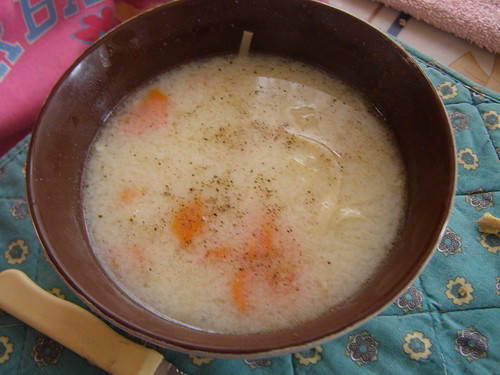
kid-friendly egg and lemon soup
This soup took longer than five minutes to cook; by planning ahead, it is never a toilsome soup to make.

Here's my version of quick and easy avgolemono soup, using Xanthe's ingredients list as a base, which you can make for dinner after you've come home from work, to feed your family a nourishing winter warmer in the cold days that are ahead of us - and making use of all the fresh ingredients available around you. Making chicken stock does not require the luxury of time; you can make it in the 15-20 minutes it took Xanthe to buy her ready-to-gloop ingredients from the supermarket (and if time really is a hassle, then make your stock 1-3 days before: it keeps this long in the fridge).

For a family of 4, you need:
2 fresh chicken drumsticks (We usually buy whole chickens - I reserve the wings and neck to make really good stock, but you won't get much meat out of them if you intend to add bits of chicken to the soup)
the juice of 1-2 lemons, depending on how tangy you want it to be, placed in a medium sized bowl
2 eggs (we like our avgolemono less eggy and more lemony)
a fistful of raw rice (I am using Asian egg noodles today instead, for a more kid-friendly meal)
salt and pepper (you can add some chopped parsley as a garnish, like Xanthe did, but this is definitely not what the average working wife and mother who lacks time would feel the need to do when serving up a nutritious meal right after she's been at work...)

Place the chicken parts in a medium-sized pot and cover with cold water. Let the water boil away for about 15 minutes. Depending on the kind of chicken used (ie how the chicken is reared), it may require more or less cooking time (which is why I prefer to use chicken wings and necks for stock making). Strain the stock into another pot. If the use of too many pots in the kitchen perturbs you, then it's best to make your stock the night before so you can maintain control over the dirty dishes; my urbanised friends always freak out when they see the detritus of my kitchen - that's before they've tasted the food of course, after which they've forgotten about the kitchen chaos. Maybe they realised it was worth the effort. But they probably wouldn't invite me to cook in their kitchen.


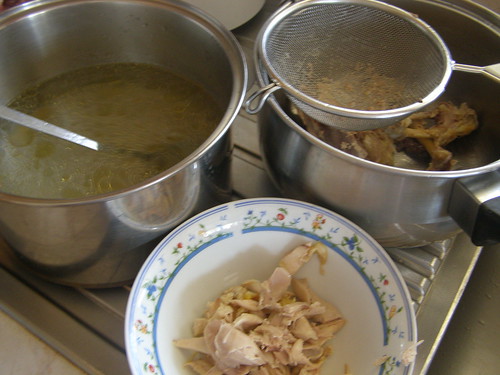
My chicken stock always comes out golden, never brown, in colour. I only ever watched my mother make chicken stock in New Zealand, and her Kiwi chicken also gave her golden, never brown, liquid. The stock in the above photos looks fatty, but you can skim the fat off before you use it, like I did for this soup. This pot produced 4 servings of hearty chicken soup.
making chicken stock


Make sure your chicken stock is very hot, then add the washed rice (or noodles). Let it boil away, without stirring (which will make the rice go mushy), for as long as it takes to cook the rice/noodles. At this point, start making the egg and lemon sauce. Break the eggs into the bowl containing the lemon juice, add some salt, and use a fork, whisk or hand-mixer to blend everything together. Remove the meat in small bits from the chicken and set aside. Switch off the stock pot.

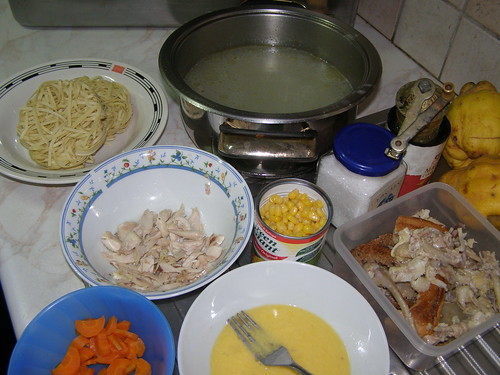
soup making
Making a hearty chicken egg and lemon soup; even the dog gets her share today (bottom right-hand corner: the tub contains the chicken bones and skin).
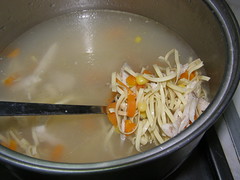
avgolemono soup avgolemono soup

Now comes the tricky bit. Stir a shotglass-full of the hot stock (clear liquid is preferable - strain away the rice) into your egg and lemon sauce and whisk it in really well. Keep doing this until at least a third of the stock liquid has been added to the egg and lemon sauce, which should be cool rather than hot at all times. Now turn up the heat for the soup pot to very low, tip the egg and stock mixture back into the soup pot and stir it gently but constantly, so that the egg does not 'cook'. Add the chicken meat and stir till the soup has warmed up, and has a thick soupy texture, but don't let it boil because the egg may start to cook, and that's highly undesirable.

kid-friendly egg and lemon soup
Avgolemono soup with all the trimmings: a selection of cheeses, two different kinds of olives, extra lemon for tanginess, and paximadi (Cretan dry rusks) for dunking.

Serve hot, ladled into soup bowls, and sprinkle (read: garnish) with pepper. I had also added a carrot to the chicken as it was boiling, so I could make this soup more nourishing; the carrot was sliced into thin rounds, and added at the same time as the chicken pieces (along with some tinned corn - remember, we're making this soup kid-friendly).

Real food, for real people.

©All Rights Reserved/Organically cooked. No part of this blog may be reproduced and/or copied by any means without prior consent from Maria Verivaki.

Friday, 13 November 2009

Cauliflower soup (Κουνουπιδόσουπα)

It's almost Christmas and the Greek Orthodox winter fasting season is about to begin. The cold weather has set in; despite many sunny spells, I can't remember so much rain so early on a regular basis, all these years I've been living in Hania. It's the perfect time to be thinking about soup, a kind of food I can't even stand to think about in the warm weather that we are used to in Hania. The winter garden is growing but it isn't ready for harvesting. The freezer needs to be emptied of last year's stored winter products, one of which was cauliflower. This soup used up the last of my frozen cauliflower florets, and it was a winner for taste. It also used up some leftover ingredients in my fridge, helping me to clear it of little bowls of this and little bowls of that. Soup is a really good choice for helping the cook to clear out the kitchen; now you know what 'soup of the day' might entail on a slow Monday evening in a bistro or cafe.

autumn garden
Showing off Mr Organically Cooked's garden: broccoli, cauliflower, cabbage and lettuce

You need:
1 tbsp of butter
4-5 tbsp of olive oil
1 onion, finely chopped
2 cloves of garlic, finely chopped
half a cauliflower cut into florets
a few sprigs of Greek celery, finely chopped
1/2 teaspoon of dried thyme
2 cups of chicken or vegetable broth (I had none available but I did have one lonely cooked chicken drumstick from a leftover meal, which I threw into the soup for flavour)
2-3 tablespoons of cream (this can be omitted if you want to keep the soup light in taste; I had an open carton in the fridge and used it up in this soup)
a fistful of strong flavoured grated cheese (I used regato, but Cretan graviera would also have been a good choice)
salt and pepper, paprika to garnish

cauliflower soup cauliflower soup
This creamy soup was very spicy without the heat, perfect for our first truly chilly day just a little while ago.

Heat the oil and butter together and lightly saute the onion and garlic. Add the celery and cauliflower, mix everything to coat in olive oil, then add the stock, thyme salt and pepper. Bring to the boil, then turn down the heat and simmer until the cauliflower is cooked through (about half an hour). Let the pot cool a little, then puree it to make a creamy soup. Add more water or stock to make it more runny, if preferred. Add the cheese and cream, and mix in well. Heat the soup (but don't let it boil), serve and sprinkle some paprika over each individual dish.

The recipe is based on a post in Katie's blog, where you'll find lots of other tastes from rural France, as well as plenty of French bureaucracy tales; if you substitute the word 'Greece' for 'France', and all the derivatives of both words, you will find that pretty much the same applies in Greece for most aspects of the Francais lifestyle. 'Ti Ellinas, ti Gallos?' a Greek might say...

winter crops
The winter garden, three weeks later

How the garden does grow quickly in this weather: humidity and sunshine are perfect for leafy greens. We're already planting a second lot of lettuce.

©All Rights Reserved/Organically cooked. No part of this blog may be reproduced and/or copied by any means without prior consent from Maria Verivaki.

Saturday, 8 March 2008

Fennel soup (Σούπα μαραθόριζα)

With the advent of mass tourism and new immigrants to Crete, there has been an advent in exotic tastes available in the supermarket. Once scarcely heard of in Hania, everybody now seems to know what to do with star fruit, lychees and mangos. Vegetables are trickier; ginger is seen as a spicy addition to stews, while celeriac and Chinese lettuce are viewed with suspicion, because they are mainly purchased by tourists and foreign (ie British or German) residents who have bought homes in Crete for their retirement.

Fennel bulb grows with a tuft of fine green leaves on the top, flaring out like an Indian soldier's hat. Fennel bulbs are not what gives us the commonly found Greek fennel bush. They are a different variety. Fennel bulbs are a cultivated crop, not commonly grown in Crete, although they are used in minor ways in the Cretan diet. My uncles grow them on their farm. Sometimes, they eat them in the same way that they eat Greek salad: sliced small with a sprinkling of salt. They discard the fennel leaves, which are not as aromatic as the Greek fennel found growing wild on the roadside; I've been told they aren't used in the same way as wild Greek fennel, even though they look very similar to it. Another way we also like to cook fennel bulb is with cuttlefish, stewed with tomato. This is especially popular during fasting periods.

It's not always easy to persuade people into trying out new food, so I thought I'd treat myself to something different, even if it won't be enjoyed by many in the house. (It's International Women's Day today, so I am entitled to treat myself, even if it means cooking my own meal!) The internet popped out this tasty recipe from timesonline: fennel bulb soup with spicy sausage. It lists six fennel bulbs in the ingredients to make a soup that serves ten people. The sausage had to be omitted because it wasn't a meat-eating day in our house. It also mentioned tinned cannelini beans; tinned beans in a Cretan household which still practices the Mediterranean diet are completely out of the question. I added a cubed potato to give the soup a lighter flavour. It would also cream well in the blender. In any case, bean soup is on the menu for Monday, Clean Monday, kite-flying day in Greece.

You need:
1/4 cup olive oil (although the recipe states 4 tablespoons for 10 servings, olive oil is never used so miserly in a Mediterranean kitchen)
2 fennel bulbs, chopped small
3 garlic cloves, chopped finely
2 celery sticks, chopped finely (I used Greek celery, which is more pungent; the leaves are used as well as the stalks. It enhanced the soup's flavour in a positive way)
1 litre of chicken stock (stock cubes do well; if you use vegetable stock, the soup becomes lenten fare)
2 bay leaves
2 potatoes, cut into small cubes
a handful of parsley, stalks and leaves separated
1 teaspoon of freshly ground coriander seeds
salt and pepper


Heat the oil in a pot and add the garlic, celery and fennel. Let them stew for about five minutes; your kitchen will start to smell of the sensuous aroma of the fennel bulb permeating through it. Now, add the coriander, potato, parsley (both stalks and leaves) bay leaves, salt and pepper. Mix all the ingredients till they are coated in oil, then add the stock. Let everything cook away until the potato and fennel is soft. Discard the bay leaves and parsley stalks, then whizz the soup in a blender till smooth. Return it to the pan and gently heat it through before serving.This soup has a pleasant aroma, and a very piquant flavour, without the addition of extra spices. It is especially nice eaten with high quality bread and cheese.

©All Rights Reserved/Organically cooked. No part of this blog may be reproduced and/or copied by any means without prior consent from Maria Verivaki.

MORE FENNEL RECIPES:
Octopus stew
Spanakopita - hotropita - spiral pie
Marathopites
Yemista - dolmades - dolmadakia
Kalitsounia

MORE SOUPS:
Chicken stock
Poached fish soup
Avgolemono
Pumpkin soup
Leek and potato potage
Lentil soup
Bean soup
Black-eyed bean soup
French onion soup
Fish soup

Sunday, 24 February 2008

Pumpkin soup (Κολοκυθόσουπα)

I've been making pumpkin soup since I started living on my own, and started taking charge of my own kitchen, cooking things I never ate at home, mainly due to a lack of interest on the part of the chief (and only) cook in our traditional Greek home. Mother didn't want us meddling in her kitchen. It was her 'myspace'. Now that I'm a mother myself, I understand my own mother better; I hate it when someone takes charge of my kitchen. My husband gets an earful when he chops bread and doesn't clear the crumbs, or when he drags in garden produce and strews soil all over the worktop.

I've always had a love for spicy food, so when I was given a pumpkin recently by my uncles (bachelor experienced farmers), I couldn't wait to turn it into pumpkin soup. My last round of soup-making involved a recipe by a famous chef turning leeks and potatos into something delicious called 'potage', so I was willing to give Gordon Ramsay another chance. I found a Gordon Ramsay recipe on the bfeedme website.

One thing that must be pointed out is that Gordon Ramsay's name has been used by a food blogger, who obviously hasn't tried the recipe themselves. The recipe was actually copied straight from a timesonline food article, which obviously had been misprinted: one of the biggest problems with the recipe (both timesonline and bfeedme) was that it listed apples in the ingredients, but didn't mention what the apples were doing in the recipe. Do they get browned with the onions, or boiled in the stock? Were they not supposed to be there at all? (In any case, I am not a great fan of mixing my sweet with my savoury, so I left them out all together.)

I did a quick check of other pumpkin soup recipes (as I have always called orange squash myself), and found that they were all roughly the same as Gordon Ramsay's poshly named 'lightly spiced butternut squash soup'. PumpkinPatches does a nice job pointing out that it's easy to boil and mash pumpkin rather than buying canned pumpkin mash, elise adds more heat to some mass-produced curry powder, myhouseandgarden adds potato (instead of carrot, as PumpkinPatches did) and so on, and so forth. Gordon's soup is just another variation of the others.


My next quibble is with the callous manner which cooks use the word 'curry', meaning curry powder. For a start, authentic South Asian cooking does not use a ready mix of spices, nor do they use the word 'curry' in the way we have associated the word with any spicy-hot Indian dish. In actual fact, meals are prepared with individual spices, not a general melee of cumin-smelling (as mild curry is usually made of) or chili-tasting (as hot curry is usually made of) powders. And for the real taste of a good 'curry' (pardon my use of the word), it is important for the cook to grind the actual spices into powder before using them. This is the reason why I never have mass-produced curry powder in my kitchen and why I like to have a well-stocked spice cupboard. It sounds so labour-intensive making your own spice mix; I've tried this before, and it really is worth the effort.


Here's a basic recipe for spicy pumpkin soup, without resorting to mass-produced powders or tinned products procedures.

You need:
2 tablespoons of olive oil
15g butter (the mix of oil and butter gives the soup a spicier taste, but you can use oil only for a lenten meal)
2 onions, peeled and chopped
3 cloves of garlic, chopped finely
2 bay leaves
a small piece of minced fresh ginger (thanks to the influx of economic migrants into Crete, this is available in most supermarkets; you can use powdered ginger if you don't have any fresh stuff)
1/2 teaspoon of turmeric powder (fresh turmeric root is not available in Crete)
1/2 teaspoon of ground cumin seeds
1/2 teaspoon of ground coriander seeds
1 teaspoon of ground dried chili peppers
salt and freshly ground black pepper (here's a tip: grind all the spices together in a pestle and mortar; it will save heaps of time)
1 litre hot chicken stock (I use stock cubes because chicken stock in our house is always turned into pilafi)
250g peeled cubed pumpkin, cut into cubes
a handful of parsley leaves, chopped (it would be great to have fresh coriander instead, but this is not readily available in Crete)
Heat the oil and butter, then add the onions, garlic, ginger and ground spices. It is important to sizzle the spices in the oil because it adds more flavour to the dish. Stir well, then cover the pan with a lid and cook over a low heat for a few minutes until the onions begin to soften. Tip in the squash and stir it around, being careful not to let it stick to the bottom of the pot. Cook for about 10-12 minutes over medium heat, stirring occasionally, until the squash is tender and lightly caramelised. Pour in just enough hot stock to cover the vegetables and gently simmer for another 5-10 minutes. Fish out and discard the bay leaves. In batches, purée the soup in a food processor or liquidiser until smooth. Return the soup to the pan to reheat. Taste and adjust the seasoning. Ladle the soup into warm bowls and garnish with the parsley.

Pumpkin soup doesn't look like much, just a bowl of orange-coloured goo. That's why the flavour of the spices is so important. Some people also add cream to this soup, but pumpkin is so creamy in itself that it seems like a waste of extra calories to do this! And you know you can also freeze it in small servings, too. This soup goes really well with some roast meat - Gordon apparently serves it with pancetta, a kind of fatty rasher of pork (similar to a bacon slice). In Greece, this is a small fatty pork chop, readily available at the supermarket meat counter.

©All Rights Reserved/Organically cooked. No part of this blog may be reproduced and/or copied by any means without prior consent from Maria Verivaki.

MORE SOUPS:
Chicken stock
Poached fish soup
Fennel soup
Avgolemono
Leek and potato potage
Lentil soup
Bean soup
Black-eyed bean soup
French onion soup
Fish soup

Wednesday, 13 February 2008

Leek and potato potage (Σούπα με πατάτες και πράσα)

My cooking tends somewhat to the traditional side of Cretan cooking, rather than the more modern New Zealand approach to food. I was never this drab; I could never have imagined myself as being this drab. My other half hasn't noticed how I feel; it's all Greek to him. But winter life is getting us both down. He hates being cooped up at home. I hate having to face his morose expression, due in part to his mother's declining health, and to another part, to the heavy winter Crete has been experiencing recently.

My favourite season in New Zealand was actually the winter. It was a time of staying indoors, an activity I indulged in, being cosy and warm, drinking Maggi Cup-A-Soup, and poetry readings. My last Kiwi winter was spent writing a book about immigrant Greeks (it's still in press). In the Med, winter denotes the kind of deadness that is instantly revived the minute the sun's rays come into view. Cretans were not made for bad weather. Their houses are not insulated, their sewers overflow, tomatos stop growing. Life here revolves around the sun and hot weather, whether or not it is a sign of global warming and climate change. We haven't had any sun in Hania for the last eight days, and the temperature has dropped to 6 degrees Celsius. The sky looms above you with a big black cloud, the wind whips through you and freezes your breath; the sun is trying to peek through all of this, without much luck.

Crete has always had a cold winter, in a matter of speaking. This year is no exception; our mountains are all covered in snow, and some people even had to be air-lifted to safety just a few days ago from the Lefka Ori (the White Mountain range of Hania). Admittedly, they were families with young children, who wanted to show the kids the snow - they went on a day-trip with their car, without being prepared for snowy conditions; no chains on the tyres, and the car was probably a sedan. Happy-go-luckies. Despite this, winter is Crete has always been a very mild affair compared to where my fellow bloggers live. Laurie tried to show me the little lake she has in front of her house; all I saw was whitewash. Peter claims he's tired of winter, even though he's a born-and-bred Torontan. Rhona provides revealing photographs of daily life in the snow. It doesn't sound as if climate change has affected areas that were traditionally snowed in. They're still snowed it. So I mustn't complain now that in Hania we haven't seen the sun for so many days; this kind of weather is right up my alley. I thrive on cold weather - it sharpens my mental powers. The baking sun only serves to numb them into a kind of hibernation until the humid autumn passes. No wonder Northern Europeans see us as lazy frappé-go-lucky half-wits who seem to have a bee in their bonnet about the word 'Macedonia'. They spend only two weeks in this climate. I'm sure they'd be just as sunstruck if they had to spend all their lives here. This cold winter provides a glimmer of hope that climate change has not affected us as seriously as the experts would have us believe.

Whoever is really worried about climate change is more than welcome to take steps against it: go ahead and eat locally, I say to the British, whose food supplies need to be air-freighted into the country to meet their stringent quality standards, and extravagant unseasonal fetishes. And since we're talking about eating locally, why not take your holidays locally too, instead of flying out of Heathrow and warming up the London climate? How does Blackpool and Brighton sound to you? I'll bet they both beat Paleohora any day, don't they? Concern over climate change is a way of passing the buck for some people. Maybe Londoners will be able to go swimming in the Thames soon, with all that extra sunshine they've been enjoying recently, from what I've noticed in the webcams. Instead of lowering their house heating, they worry about the plight of turtles and start putting them into the refrigerator to stop them from coming out of hibernation, as if that were a priority in keeping the balance of the ecosystem.

I love other people's food. The trouble is, in this town, other people's food is the same as mine. I recently taught a group of 45-year-old unemployed women basic English for the service sector, and we invariably ended up talking about food. I asked them what each one had cooked for today's meal: I wasn't surprised when they told me that they were having one of the following dishes: horta, biftekia, gigandes, fakes, fasolakia, fasolada, with sausages, omeletta. All these meals are easy to prepare from the evening before or after a busy day (the women were involved in a training program which took place all morning for three consecutive months). What's more, these foods are all a part of the Mediterranean diet that they were themselves brought up on - just look at the preponderance of beans and pulses. I came out feeling very positive, that I was a normal cook churning out the same good food that all good housewives and cooks were making on a daily basis in Hania. No one incidentally cooked meat during the week (apart from the biftekia and sausages which were probably used as an accompaniment to horta or beans); meat is still reserved by traditional cooks for the end of the week, more likely for health reasons these days, rather than the reason given by people in the past, that meat was reserved for special occasions, there wasn't enough available, that there was no means of preserving it (no electricity or modern appliances).

To break the routine, and maybe the ice in the weather, I thought I'd take a creative stance today. Having read about what the young vibrant Ioanna cooks in her kitchen (as opposed to my own perceived staleness), I thought I'd indulge in a Gordon Ramsay creation from the bold UK chef who seems to have a penchant for naming his culinary creations in some European language other than English, and mixing meat and fish in the same dish. Whereas I have stagnated in my cooking ventures, reading Ioanna's webpage has revived my craving for something foreign, from a completely different world to the one I'm living in. I thought I'd try a potage de leeks et potatos. Je ne sais pas what my other half is going to think about this soup; il y a some leftover moussaka for anybody who ne veux pas to try this very un-Grecque concoction. I'm game.


For the
sake of convenience, the recipe is repeated here. The franglais are my own mutations to the original.
500gr leeks, the pale and light green part only, chopped (pas un favourit de mon homme)
500gr potatoes
1 large onion
100ml white wine (j'ai seulement red)
1.5 lt stock (stock a la Knorr)
30gr butter
2 tbsp olive oil
200ml cream or a mixture of milk and cream) (pas something dans la cuisine Cretan)
1 bouquet garni comprising of: celery, thyme, parsley and 2 bay leaves (Je n'ai pas fait this since before I was married)
(Et ou est le salt and pepper??)

In a large pan sweat the leeks, onions and potatoes (I take it they are also chopped small??) together with the butter and oil, about 10 minutes. Add the wine and wait until it evaporates a little bit. Add the stock and boucket garni and simmer until the potato is soft. Remove the bouquet garni and liquify in the blender until smooth. Add the cream and bring to a gentle simmer for a couple of minutes. Serve warm with loads of freshly ground pepper (voila le pepper, mais il n'ya pas de salt) and a nice slice of bread. (Je add le salt).

While I'm cooking the soup, I feel slightly dizzy. I wonder, could it be the wine wafting through my nostrils that has made me drunk enough to feel as though the earth is moving? I look up, and find the lightbulbs moving. No, I was not experiencing a kitchen love affair on St Valentine's Day. I just felt the final tremors of an earthquake which was felt somewhere in the Peloponese. In any case, the smell of the suop is intoxicating, and vigorously refreshing. I loved it. Perfect with a slice of feta and some thick crusty bread. Vive la France! We all loved this soup, and the proof is in the child enjoying it.

This post is dedicated to Christine, my best taster.

©All Rights Reserved/Organically cooked. No part of this blog may be reproduced and/or copied by any means without prior consent from Maria Verivaki.

MORE SOUPS:
Chicken stock
Poached fish soup
Fennel soup
Avgolemono
Lentil soup
Bean soup
Black-eyed bean soup
French onion soup
Fish soup
Pumpkin soup