Showing posts with label ONION. Show all posts

Sunday, 21 April 2013

Suvir Saran's samosa recipe

It's amazing who you can meet on facebook. I recently met... (deep breath)...:
"Top Chef Master, Suvir Saran, the author of three widely acclaimed cookbooks; Masala Farm: Stories and Recipes from an Uncommon Life in the Country (2012), American Masala: 125 New Classics From My Home Kitchen (2007) and Indian Home Cooking (2004). Saran established new standards for Indian food in America when he teamed up with tandoor master Hemant Mathur in 2004 to create the authentic flavors of Indian home cooking at the 75-seat restaurant Dévi in Manhattan, which received a one-star rating in the Michelin Guide New York City two years in a row."
Suvir's heritage and identity dominate his cooking style. They form the basis of how he approaches food. I could relate to his insistence to remain true to the Indian food he grew up with, as I have my similarly strong feelings about the main culinary influences in my life. I have been following Suvir's culinary expertise though his online photo albums, since I've always liked to cook Asian cooking in my home.

He recently posted a series of samosa photos, and I expressed an interest in making them, as I hadn't made samosa for more than two years now. The photos reminded me of the truly creative vegetarian (and often practically vegan) international cuisine that I miss. The way I cook at home would be even more monocultural if my family hadn't travelled to more international places. I told Suvir that I had decided to make samosa that evening. He was happy to hear this and asked me if I make my own pastry, which of course, I do, which he was pleased about. I nearly always have my home-made filo pastry dough sitting in the fridge, to be used for various purposes throughout the week. It's very versatile.


On his own initiative, Suvir sent me his recipe for a samosa filling, which comes from his latest book, Masala World:

2 lbs/910 g (about 6) red potatoes
1/2 cup/8 g finely chopped fresh cilantro/fresh coriander leaves
3 tbsp neutral-flavored oil (like canola or grapeseed)
2 dried red chiles, coarsely ground in a mortar and pestle
1 tbsp coriander seeds
2 tsp cumin seeds
1/8 tsp asafetida
1/4 tsp cayenne pepper
2 tsp ground amchur (green mango powder)
1 1/2 tsp kosher salt
3/4 cup/100 g frozen peas


This recipe contains ingredients that I cannot easily get here. Red potatoes for a start: in Hania, a potato is a potato. It's always earth brown on the outside and creamy-white on the inside. We do not have red potatoes on the market. I have seen them in London (where I also learnt what plaintains and yams were), and really wanted to try them; but potatoes in my suitcase... oh well, maybe next time. Cilantro is not popular in Crete, although some organic shops are now selling it, and the chef at my workplace also uses it in salads, which is how I have become accustomed to its taste. But the night I was making samosa, it was out of my reach. I once grew it and no one appreciated its taste in our food... It's an acquired one, I guess; parsley will have to do instead. Canola oil and grapeseed oil do not figure in my household for obvious reasons: we grow olives, we produce olive oil, it's all extra virgin. Other oils could add another dimension to my food, but right now, I have EVOO by the barrel-full in our basement. It will have to do.


The good news is that fresh chili peppers are now becoming almost as widely available as fresh ginger, which is now a standard supermarket product. I place both in the freezer to ensure I don't run out. Chilis can be sliced and ginger grated straight from their frozen state. But certain spices, like green mango powder and asafetida, are simply not available in our little corner of the world. Through my interest in Indian cuisine, I knew that mango powder is sour and could be replaced by lemon, while asafetida gives a taste similar to onions.

I told Suvir that I will use onion in the filling instead of asafetida; on learning this, he warned me to use only a tiny bit of onion, and very very very finely minced at that.  Suvir believes that onions don't work everywhere, and in some recipes, they should only provide a hint of flavour that does not overpower the eater. In some cases - and particularly samosa, as he explained - the eater should not even taste the onion in the dish, which is why he suggested that the onion is very finely minced. On the other hand, I use onions and garlic in most of my dishes. We go through about 50kg of onions a year in our household.

This reminds me of a very funny story. The only other good cook who I know that does not like to use onion except in very small amounts is my mother-in-law. I had once bought some onions, which she noticed were all rather on the big side. She asked me what I would do if I needed only a small onion in a recipe; I told her that there would never be a time that I would need only a small amount onion! Then she asked me what I would do if the recipe required just half an onion; I said that the recipe was probably written incorrectly! Twelve years later, I have met my match!

Shaping samosa requires technique. I knew I could not master that in one evening, straight after work! Mine look quite flat compared to the samosa that I saw in Suvir's photo sets. It seemed that I had cut the pastry a little too small. While they are not perfectly shaped, I know that they were very tasty because they were made from scratch and I took great care to follow Suvir's recipe as closely as possible.


Cooking takes time and practice. It is not something everyone enjoys doing, but everyone has to eat. What we eat is not always an independent choice; sometimes we have to make do with what we've got. We've come to a point where the Western world thinks it can eat what it likes when it likes, but we also know how much we have been fooled by agribusiness, so that we are not necessarily eating what we think we are eating. Maybe the world has evolved to such an extent that we might have gone the full circle, and are now turning back to our past for more answers. All I know is that right now, if I want to eat samosa, I have to make it myself. And if I couldn't cook, then I'd have no samosa.

©All Rights Reserved/Organically cooked. No part of this blog may be reproduced and/or copied by any means without prior consent from Maria Verivaki.

Friday, 5 October 2012

Married fava (Φάβα παντρεμένη)

I know I'm bragging when I tell you that I'm up to date with every single one of my tax, utilities and other bills, because put together, these days, they make hefty amounts, and my guess is that most honest people are still wondering how to make all those unfair payments. It's still hot in Hania and it still hasn't really rained here save a few drops of drizzle, so I can be thankful that we don't have to turn on the wood fire heater yet, and many of my colleagues are praying for this weather to continue so that they can save on heating costs too.

One way I have managed to continue to be up to date with all those bills is to cook really cheap food jazzed up with very tasty garden vegetables. My cheap food always gets noshed up really quickly because it's very tasty, even though it may not look like a feast to begin with. But the smells emanating from my kitchen don't give any hint of cheapness or low quality - it makes my family even more impatient to eat.

Take last Sunday when I was cooking fava to have ready for Monday's main meal. The aroma in the peas' sweetness wanted through the house; instead of having the tsigariasto meat dish that I had prepared for the Sunday lunch, the family ended up eating half of Monday's lunch instead.

"But it's Sunday," I complained. "Sunday is meat day, you can't eat that fava!"


"We'll just have that meat tomorrow instead," they all insisted. So fava it was, even though bean dishes are usually Never Never on a Sunday for us. And since it didn't feel right to serve such a cheap and frugal humble dish on a Sunday, I jazzed it up with a sivrasi medley of onions, foraged capers and garden peppers, which turned my simple fava dish into fava pantremeni ('married' split yellow peas - φάβα παντρεμένη), a popular way to serve fava in the Cyclades. The married effect comes from combining capers and yellow split peas, which make a very compatible pair.

Apart from some crusty bread, you also need some extra virgin olive oil - as much as you like - which is usually used as a dressing over fava. Luckily, that remains cheap and Greek and frugal where I am.

©All Rights Reserved/Organically cooked. No part of this blog may be reproduced and/or copied by any means without prior consent from Maria Verivaki.

Tuesday, 17 July 2012

Cheap 'n' Greek 'n' frugal: Ugly ducklings

The price of crisps may rise soon in the UK, if it doesn't stop raining; the wet weather is affecting the potato harvest. This is devastating news indeed - during the Olympic games, no doubt many packets of crisps will be bought, and if the potato harvest fails, this will result in a shortage of the all-time favorite crispy snack in the long-term.


The potato harvest in Greece this year is anything but a failure. Beautiful potatoes are making their way to the fruit and vege stands everywhere in my town. I am still surviving on a gift from my uncles: they gave me a large bag full of medium-sized potatoes, good for chipping, and a crate full of baby potatoes, which they used to feed their animals with, but now keep aside for me, because they know I have more patience when it comes to peeling them. These dirty little babes are some of the ugliest edible vegetables you may have seen in your life, and they really are a pain to prepare for eating. Few people realise that by removing so much dirt from their diet, they are prone to more allergies, exacerbates by the over-use of hand sanitisers, wet wipes and Caesarean births:
"Nature’s dirt floor has been replaced by tile; our once soiled and sooted bodies and clothes are cleaned almost daily; our muddy water is filtered and treated; our rotting and fermenting food has been chilled; and the cowshed has been neatly tucked out of sight. While these improvements in hygiene and sanitation deserve applause, they have inadvertently given rise to a set of truly human-made diseases."
This kind of food is not available for sale in places where hygiene plays an important role. Dirt clinging to one's food is regarded as below certain standards, hazardous to touch, full of bacteria. But potatoes need to be dug out of the earth, so somebody must have touched that food to get it to a place where it would be washed and sanitised, then prepared in all sorts of non-toxic (as the wording will probably state on the packet) chemical mixtures, before it was processed into something that is edible and extremely clean.  

My dirty little spuds are excellent for roasting (peeled) or boiling (unpeeled) whole, without cutting them. Because they were covered in a lot of dirt when they were given to me, I can't roast them whole unpeeled. But if you scrub their exterior with a soft sponge...

... place them in a pot of water, ...

... and boil them till tender in the middle, ...

 ... you will be able to peel them effortlessly, and will end up with a beautiful soft clean potato, perfect for your summer (or monsoon, depending on your whereabouts) salads.


This heavenly salad contains a simple mix of boiled baby potatoes, a sliced onion, some banana peppers and a bed of purslane, dressed in olive oil and salt.. Everything has come from a private garden - the amount of money that I would have needed to buy these ingredients from a store has been spent instead in the time that I needed to process the ingredients.

*** *** ***

Speaking of crisps, Greek preferences mainly tend towards the plain salted variety, or flavoured with oregano. Salt and vinegar is sold in multi-national supermarket chains, but it's not really a Greek preference. A flavour which is very slowly catching on is cheese and onion (my personal favorite, marketed by Crunchips), while barbecue flavour (whatever that means) is usually the third option available at the supermarket. Then there are also the quirky flavours like feta cheese, tomato, tzatziki and Mediterranean herbs (etc), but they never really last long on the shelves, often replaced other quirky new flavours, as in the international market - who would really want to eat fish and chips, chili chocolate or squirrel-flavoured crisps?! Apart from Greek brands, you can also get Lays, which are often on sale, but I find that they are too flaky and don't crush too easily; while Ruffles (also a Lays product) are thicker and chunkier, they don't have the right combination of taste and salt that I want in a potato crisp, like Kettles and Boxer crisps, which aren't sold in Greece (my personal favorites).
But crisps are also easy to make at home, and when the potatoes are as good (albeit dirty) as the ones I have access to, they are a good cheap alternative to store-bought crisps.With just four not-so-medium potatoes and a mandolin slicer, I made enough crisps for the whole family.
 
You generally need one potato per person, thinly sliced. Pat each slice dry (to make crispier crisps), place in batches in very very hot oil, one by one, and watch the crisps form. Drain in a colander with large holes (don't place them on absorbent paper - they will simply soak up more oil and lose their crispness), then flavour as you want - I did the Greek classic salt and oregano, and served them with tzatziki. Now there's no need to worry about a shortage of crisps. And how much does one potato and some olive oil cost you? Much much less than a bag of store-bought crisps (which are slightly more expensive in Greece than they are in Northern Europe).

©All Rights Reserved/Organically cooked. No part of this blog may be reproduced and/or copied by any means without prior consent from Maria Verivaki.

Friday, 8 June 2012

Cheap 'n' Greek 'n' frugal: Sivrasi (Σύβραση)

Prices are in euro (valid in Hania). All ingredients are Greek or locally sourced; those marked with * are considered frugal here because they are cheap and/or people have their own supplies.

With the good weather setting in now, I had to move all my fruit and veg that does not need refrigeration outdoors. Some of the onions had begun to spoil indoors - they are the last stock of last year's harvests. Until April, I had no problem keeping them dry, but now in May, they are starting to show their age, rotting inside, and sprouting thick green stems. Greeks often keep their lemons, potatoes, onions and garlic (all of which are Greek cuisine staples) on their balconies in the summer to keep them aired, because they sprout and spoil very quickly in the overly-warm indoor environment of most Greek homes.


Which reminds me of another point: home construction has changed so much, so that Greek homes no longer have appropriate storage conditions as in the way that village houses were once built. This is why we can't maintain certain past practices of our ancestors - living conditions have changed too much, and no matter how bad things get in Greece (which they won't, in my optismistic mind), we can only return to some aspects of out past lifestyles, not all of them.

Just when I was wondering what to do with those onions that were spoiling too quickly to be eaten, I came across this comment on my facebook page:
"Vlita, I could stuff myself! Love them with zucchini and sivrasi!"
My friend Georgia wrote it, when she saw my photograph of the first vlita I harvested for the season. Sivrasi? I asked myself. What on earth is that? Feeling quite ignorant, I immediately googled it (being the conventional lass that I am, instead of yahooing or binging it, and wahtever else, that can't compete with the big fish), and came up with another friend's notes about it: Laurie says that she first read about sivrasi in a couple of Greek cookbooks:
"I first read about Sivrasi in Susie Atsaides book: Greek Generations: A Medley of Ethnic Recipes, Folklore, and Village Traditions. She calls Sivrasi “an island secret,” and her recipe calls for a whopping one cup of oil for every two cups of onions. Diane Kochilas includes a recipe for Sivrasi in The Glorious Foods of Greece, and says it is served “over pasta, flour-based creams, greens, legumes, and even cheese pies.” Internet recipes include Sivrasi with meatballs, fish and tomato sauce, as well as over lentils and rice."
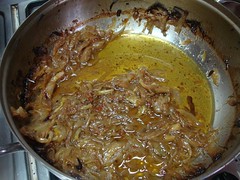
If you love onions, then sivrasi is for you. It's basically a long slow cooking of onion slices, until they almost caramelise, which are used to top a dish and add extra flavour. Sivrasi is an island specialty of the Dodecanese (where Georgia is from), a group of islands north-east of Crete, and the term is unknown in Western Crete (although it may be better known in Eastern Crete, which has more contact with the Dodecanese). It's a good Greek way to spice up a cheap meal, using the humblest of ingredients, the onion. The good thing about it is that you can never make too much sivrasi - if you love onions, then there is never enough sivrasi to go round.

Horta with sivrasi and spicy German sausages (they were on sale - €2 for 5 in a jar).
Peeling onions is not much fun, but the idea of topping my next harvest of horta with sivrasi made it sound more appealing. All it needs is a little olive oil to soften them, and some salt and pepper for seasoning. I also added some garlic in my first sivrasi session, and placed some boiled baby potatoes (a classic accompaniment of Greek horta) to darken a little in the pan together with the onions.

Depending on the dish, you can also try doing the same thing with leek, eg with a meat or fish dish.

Total cost of the meal for four people: about €2-3, together with the sausages, potatoes and bread; about 50-75 cents per serving.

©All Rights Reserved/Organically cooked. No part of this blog may be reproduced and/or copied by any means without prior consent from Maria Verivaki.

Saturday, 2 June 2012

500: Artichokes with purslane (Αγγινάρες με γλιστρίδα)

Flash fiction: 500 words (or thereabouts).

It is morning. The sky is clear and blue. It is hot, even though it is still early morning. It will stay hot the whole day.

The air is cool at this hour. Time to open the windows for fresh air, but not the shutters - the sun burns too brightly at this time. The rooms fill with the fresh breeze as the birds tweet their songs, as they feel the warmth of the coming summer.

The garden looks lush and verdant. All that winter rain is now working to its benefit! The tomato plants have grown stronger, they already need training. The zucchini is filled with small fruit - not long now, we will be eating them. The apricots are still green but the tree is overloaded.

It's Saturday and there are jobs to done and promises to be attended to:
"You promised to sew up my jeans."
"Didn't you say we'd bake a cake today?"
"Don't get me to do it, I'm going to sow some corn today."

It's Saturday and our supplies must be replenished before the shops close: 
"How much bread should I buy?"
"Do we need any milk?"

"What meat will we have for Sunday lunch?"
"Are there any leftovers? No? So, τί θα φάμε σήμερα?"

This salad was inspired by Magda's post on purslane. I used artichokes instead of the cucumbers mentioned in her recipe. 

There is no time to waste, but there is plenty of time. Time to turn the sheets, air the pillows, put on a washload, clear the dust off the shelves (it will come back in less than an hour), sweep the yard, mop the dusty balconies (which will fill up again with dust by nightfall), and simply enjoy the morning at home away from school, the office, the roads, and all the other emblems of civilisation that have ensnared us for the sake of the evolution of humanity.

Where we once thought that life can only get better, we now find that life can in fact get worse and we cannot keep up with improvements because we cannot compete with those who have jumped the gun. But when we cast aside the modern urban world that put us into this mess, and we put a bit of the primitive back into our contemporary, it is possible to believe that life can be sweet without too much sugar.

Spring is a time for new growth. The garden looks empty, but it still yields fruit to those that accept its offerings. The artichokes will begin to bloom if they are not harvested soon, and the purslane has just sprouted, all on its own, as if by magic. Lunch just needs some cheese today, with a few pantry staples added (olives and onions), and that ubiquitous splash of olive oil. We take it for granted that we live like royalty. But I'd prefer to keep such things to myself - I don't really want the place to get too crowded.

©All Rights Reserved/Organically cooked. No part of this blog may be reproduced and/or copied by any means without prior consent from Maria Verivaki.

Sunday, 4 March 2012

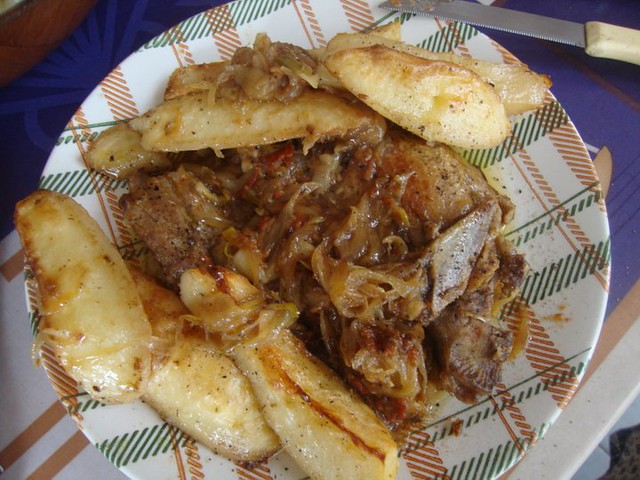
Pork steaks with onion (Μπριτζόλες με κρεμμύδια)

Peeling onions isn't everyone's favorite job, but I personally love it. it's relatively mindless and robotic, and although onion is considered a stinky vegetable that makes you cry, I personally find its aroma quite intoxicating. I find it difficult to cook without onion for this reason - every main meal I cook uses onion. Even though my kids complain about the strong smell when I'm peeling onions, they always ask me what delicious food I'm making once the onions start cooking. Onions are like salt - they add that special oomph to a meal.

A bit of trivia: new research using state-of-the-art laboratory techniques show that cheap onion waste (ie the bits that we throw away: the top, root and dry matter of the onion) has applications as a good source of cheap green synthetic anti-oxidant material (from a study conducted at MAICh.

The onion seller is a regular sight in Crete in mid-summer. We bought a couple of braids from this man in mid-July and hung them up under a balcony staircase. In a cool, airy spot, they won't sprout. These onion braids last us about 8 months.

Here's a simple no-fuss recipe for pork steaks in an onion sauce, which I made quite regularly throughout the winter. (I'd make it now too, because it's really simple, but it's nearing Easter, so we're clearing our freezer and not buying any new meat to make way for lamb.)

You need:
5-10 large onions (as many as you feel like peeling)
some olive oil to saute onions
4 large pork steaks
half a cup of olive oil
half a cup of wine
half a cup prepared mustard
salt, pepper and oregano


Peel onions and slice thickly. Saute in a pan till limp and transparent, but not for a long time. Transfer them to a baking tin (I use a round 30cm tapsi). Lay the cleaned pork steaks over them. In a bowl, mix together the remaining ingredients, and spoon over the pork steaks. Add half a cup of water. Place them baking tin in the oven and cook on moderate heat for 45-60 minutes. Then turn the steaks and let them cook for another 20 minutes or so. (That's it.)


The onion sauce makes the steaks quite heavy, so I don't usually serve carbohydrates with this dish, except bread, which we use to mop up the oily onion sauce. All it needs is a fresh leafy salad and some cold beer.

©All Rights Reserved/Organically cooked. No part of this blog may be reproduced and/or copied by any means without prior consent from Maria Verivaki.

Friday, 20 January 2012

Cheap 'n' Greek 'n' frugal: Stifado (Οικονομικό στιφάδο)

Prices are in euro (valid in Hania). All ingredients are Greek or locally sourced; those marked with * are considered frugal here because they are cheap and/or people have their own supplies. 

Making a beef stifado in Greece illustrates how one country's frugal meals may actually form another country's luxury meals. Meat is quite expensive these days, especially beef which now costs over 10 euro a kilo for Greek-raised beef, and about the same for French beef (and a little more than that for Dutch beef), so I wouldn't call a beef dish frugal in Greek terms. Since we aren't vegetarians, we still indulge in the classic meat-based meal for Sunday lunch. The trick to making a frugal meal out of expensive meat is to find ways to stretch the dish and keep it filling and tasty.

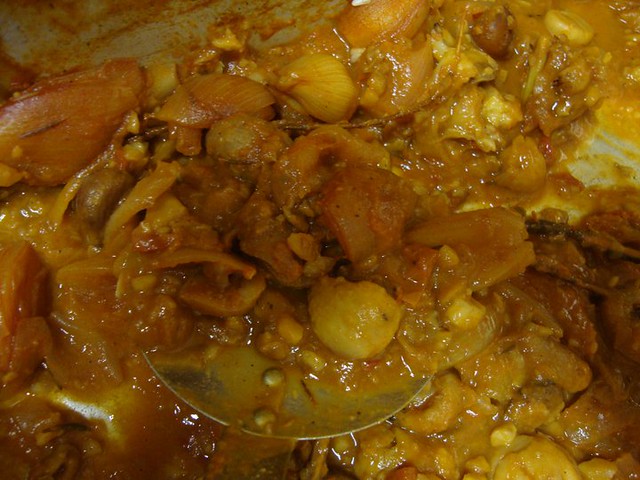
Classic Greek stifado is basically a stew made from chunks of (usually) beef or rabbit, slow-cooked in a light tomato/wine sauce, with spices and lots of onions. I usually make this dish with rabbit, which I'm given every now and then by farming folk living in the area... but I haven't been given one in a while. I made stifado recently with some Greek beef, which takes a long time to stew to make it very tender. You can use a pressure cooker if you have one; I let my stifado slow-cook for about three hours on the element, just checking it constantly to make sure there are enough liquids in the pot.

To make stifado frugal, I cook a bit more than I need for a Sunday meal, so I can have some leftovers to use in a more frugal meal the next day (serves 4-6)
1 large onion, finely chopped* 
1-2 fat cloves of garlic, finely chopped*
a few glugs of olive oil*
1kg beef cut up into golfball-sized chunks (~11 euro)
half a wineglass of home-brewed wine*
~150g tomato sauce* (a third of a store-bought tin costs about ~30 cents)

2 bay leaves*
1 teaspoon of allspice berries*
salt and pepper*
20 small onions (~50 cents)

Pour some oil into a shallow heavy-based pan, and cook the large onion and garlic till translucent. Add the beef chunks and brown them well all over. Then pour in the wine, and let the beef cook in that (uncovered) for about 20 minutes. Add the tomato sauce, spices and seasonings, together with a cup of water and turn the heat down to the lowest point. Cover the pot and let the beef cook for about 45 minutes. It will need to be checked at this point, and you will add more water to it, but never too much: I added two more cups of water at regular intervals. If you add the water altogether, it will feel like the beef was boiled rather than stewed. Test the beef for doneness by checking if a knife goes through a chunk without too much trouble. As soon as you think you are nearing this point, add the small onions (peeled, with a small cross incised on their root side) and let them sit on top of the meat, half soaking in water. Close the lid and allow the beef to continue to cook until it is done.


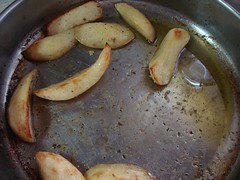
Stifado is traditionally served with fries in Greece, but only with freshly-cut potatoes - don't use pre-cooked ones because you'll ruin the taste. You'll need about 4-5 medium-sized potatoes, cut into French fries and (~70 cents for the potatoes) some olive oil for frying.*

Serve 3-5 pieces of beef and a 3-4 onions per person, sitting in a good amount of sauce on the plate, and place a few French fries next to the meat. Serve the stifado with a plain green salad. Keep about 3-4 chunks of meat (with sauce and onions) for tomorrow's frugal meal...

Total cost of meal: about 13 euro; 2.50-3 euro per person.

©All Rights Reserved/Organically cooked. No part of this blog may be reproduced and/or copied by any means without prior consent from Maria Verivaki.

Saturday, 19 March 2011

Internet cuisine (Διαδικτυακή κουζίνα)

The world is full of badness and sadness right now, but we must all plod on, living life as well as we can, because who knows what might happen tomorrow?

"A colleague recently asked another food writer where a recipe she featured came from, and the reply was 'from the internet'." Claudia Roden, A Taste of Thyme, 2000.

When Saturday's weather took a turn for the worse last Sunday, I had to make new plans for the pork chops that I had defrosted. I couldn't barbecue them outdoors, as we had planned, so I decided to use the internet to give me some ideas about how to cook them. The rise in 'internet cuisine' is helping to teach people how to cook, as well as creating global food trends; cooking has never been so easy or as interesting as it is now. Using 'pork chops' as a search string, I was mesmerised by the number of images that came up showing well-cooked pork chops, sizzling brown on the outside, sitting on a range of dressings, their juices oozing out onto the plate. So much value for money from a simple broadband internet connection - I could not get this much value from a book. In an environmentally more conscious world, it's a luxury to hoard paper; apart from online sources, we can now use electronic readers. I don't want to believe that the age of the paper book is over, but it certainly looks to be going that way.

In Greece, pork is a very popular meat. It's the main one used to make the nationally popular street-food souvlaki, both in a pita bread and on a skewer. Grilled pork chops are a standard feature at tavernas, cooked over charcoal, and similarly for home barbecues. The Greek seasonings for pork chops usually consist of oregano, ground pepper and salt, with lemon juice sprinkled over them. Sometimes, pork chops are marinated in wine before grilling. That's the general Greek way of cooking pork steaks. In the winter when the weather makes it difficult to cook outdoors, they are usually placed under a grill in a conventional oven.

A little while ago, we managed to get hold of some locally reared pork. My husband was called up by a friend: "A pig will be slaughtered tomorrow," he informed him, "it's first in, first served." So he went out to the village of Nippos, where a farming family runs a dairy station, raising mainly sheep and goats, producing various milk products, curing olives and keeping a few pigs for the eventual sale of their meat. My husband bought back enough for 5 family-sized meals. We paid 5.50 euro per kilo, which is similar to the retail price of pork (it can go down to 3.50 euro per kilo when sold on special). When he bought it home, we left it in the fridge for three days to allow the remaining blood to drain away, then placed it in the freezer. This is the first time that we have bought pork with such transparency; we do this more often with sheep or goat meat. 

As I pondered about how I would cook our first meal using that meat, I decided to look up a few photos of pork chops on the internet. I showed them to my husband: he was mesmerised by the tempting food porn showing pork steaks in a range of poses, dressed in a variety of sauces and seasonings. He particularly liked the look of this set of photos, but was rather taken aback by the ingredients list: apple juice, brown sugar, soy sauce and mustard! I know what he was wondering: how can a dish containing such unusual ingredients (for Greek standards) look so good?

A Taste of Thyme: Culinary Cultures of the Middle EastIn A Taste of Thyme (2000), Sami Zubaida and Richard Tapper sum up the reasons why some people like some kinds of food and why others don't: "At the most obvious level, the wealthy and poor in a society, different ethnic groups, city and village dwellers, men and women, adults and children, eat differently... Commensality implies shared understandings and evaluations of what constitutes 'proper' food. But when we entertain guests from other traditions, we expect them - challenge them - to approve and applaud our food. Every culture and community is proud of its own food traditions and tends to be ambivalent or contemptuous about those of others... Stereotypes of other ethnic and religious groups frequently refer to food customs... Alternatively, a cosmopolitan orientation may be demonstrated by those who consume 'ethnic' foods, though dishes served in 'ethnic' restaurants are often adjusted radically to suit the perceived tastes of the local consumers, just as native cuisine may be almost unrecognizable when served to international tourists."

Although we may be veering towards a world that functions according to global trends, we're still a world full of different people, with our own culinary idiosyncratic preferences and dislikes. There is still a sense of national standards in the food people eat around the world. Greece is one of those countries where food is still perceived according to a set of national standards rather than global ones. Home-cooked family meals are still associated with known favorites. I often use the internet for cooking ideas, but I still need to make sure that the meal will suit the tastebuds of my eaters, as well as the availability of ingredients in my kitchen on a Sunday morning (apple juice is still considered to be quite definitely 'foreign' in Crete). What interested me more was the technique used in the original recipe to cook the meat, which was well illustrated and described by the author. My adapted recipe using common ingredients in a Cretan kitchen resulted in a very tasty and satisfying meal for all of us.

You need:
4 pork chops (don't trim the fat off)
5 large onions, thinly sliced
1 tablespoon of prepared mustard (mustard is just as common as mayonnaise all over Greece)
3 large tablespoons of home-made tomato sauce (a teaspoon of tomato paste diluted in a wineglass of water can replace this)
1/2 wine glass of Cretan home-brewed wine
a glass of water
3-4 drops of tabasco sauce (optional: for such a large meal, you'd expect more drops to experience heat; I am simply introducing it in small doses)
olive oil (it's difficult for a Cretan to quantify the amount of olive oil used in an individual recipe: my measurement is usually in 'glugs')
oregano, salt and pepper

pork
Our Sunday meals are the ones that usually involve more thought than the meals I cook during the week - but they are also the ones that I would say are easier to prepare.

Set the oven to heat up at 180C. Heat some olive oil in a Dutch oven on the stovetop and sautee the onions till soft and translucent. While they are cooking, place the mustard, tomato sauce, water, wine and tabasco sauce in a bowl and blend the ingredients well. When the onions are ready, set them aside, and heat up some oil in another saucepan, enough to cover its surface like a thin film. The saucepan should be large enough to hold the pork chops. Place them on the pan, seasoning them with salt, pepper and oregano. Let them cook on high heat till they are brown on both sides (about 5 minutes), turning them once and seasoning them again. Then pour the liquids over the pork chops and let them cook in this sauce for about 5 minutes. Now lift the pork chops out of the pan and place them over the onions, then pour the sauce over them. Seal them with the lid of the Dutch oven and place them in the oven to cook till tender; this will take about 30 minutes.

porky porki
Either I was too tired to remember to photograph the different stages of the meal, or it was too good to wait. What you see here is the remains of the meal, which were combined and re-heated the next day as leftovers.

To add some bulk to the meal, I cooked (separately) some lemon potatoes, which should be placed in the oven half an hour before the pork chops, so that everything will cook at the same time and can be served together. All you need is a salad and some good wine to complete the meal. 

©All Rights Reserved/Organically cooked. No part of this blog may be reproduced and/or copied by any means without prior consent from Maria Verivaki.

Monday, 31 January 2011

Chestnut stew (Κάστανα στιφάδο)

Upon hearing the word στιφάδο (stifado), Greek people generally conjure up an image in their mind of a rich red stew of hare or rabbit, chicken, beef or pork, cooked with a large quantity of onions. It constitutes staple winter fare in most parts of Greece, replacing the Sunday roast during the colder months of the year. But with the rising interest in healthy food and a move away from meat, many people nowadays crave a vegetarian version of the same kind of dish. The creative chef at MAICh, Yiani Apostolaki, has once again used his love and knowledge of Cretan cuisine to create a meatless stifado, which has many variations, and can only be termed a masterpiece. Yiani's chestnut stifado is often on the menu during the chestnut season at MAICh, where it is enjoyed by the resident students and staff of the institute.

chestnutstifado

After having this for lunch at work one day, I decided that I had to make it at home as soon as I could for the whole family to enjoy. My own version of chestnut stifado reflects my family's preferences in spice tastes.

You need:
a few tablespoons of olive oil
1 large onion, chopped finely
2-3 cloves of garlic, chopped finely
500g chestnuts, shelled (to do this, follow the advice in this post; Cretan chestnuts peel easily - not so those from other regions, as I have discovered, when I wanted to buy some bigger and 'better-looking' chestnuts!)
500g whole small stewing onions (large ones don't cook evenly; make a small cross on top of the cleaned onions, as described in this post)
a can of pureed tinned tomatoes (I use my own home-made tomato sauce)
1 teaspoon of tomato paste (for a thicker sauce - this is optional)
1 small wineglass of wine
1 stick of cinammon
6-10 carnation cloves
2 bay leaves
freshly ground pepper
sea salt

In a wide pot, heat the oil and sautee the chopped onion and garlic till translucent. Add the whole onions and mix till they are coated in oil. Add the seasonings and wine, and leave the pot to simmer for a few minutes. Now add the pureed tomatos and tomato paste. If the mixture is too thick, you can add some water to the pot at this stage, but don't add too much: this will depend on the size of the onions. The topmost level of the liquids should be about 1cm below the topmost surface of the onions. Place a lid on the pot, and let the onions simmer at the lowest heat for 30 minutes. Now add the chestnuts, which will have been partly cooked when they were boiled (or roasted) to be cleaned,and cover the pot again. Allow the chestnuts enough time to soften. This depends on the desired texture; if you prefer the nuts to crunchy, then the stew doesn't need a lot of cooking time.

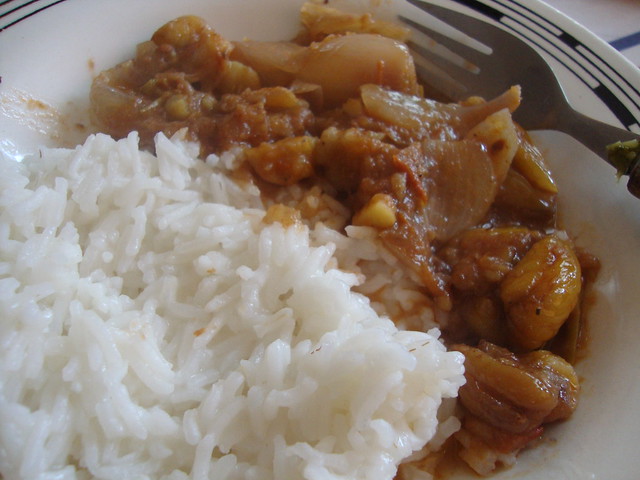
chestnut stifado with pilafi

The meat version of this same stew (ie using meat chunks instead of chestnuts) will fill you up very quickly. But the vegetarian versions are so much lighter, that you will find yourself eating more than one serving, or a very large one at that, and you won't have that bloated stuffed feeling that eating such a rich meal usually gives!

Not only that, but the same technique, sauce and spices can also be used in vegetarian stifado using other ingredients; any firm vegetables will work, eg carrots, potatoes, eggplant, mushrooms and pumpkin (which Yiani also adds to his chestnut stifado), as long as they can retain their shape while cooking. Such vegetables have the same fullness as meat, while being exclusively vegetarian products. The tomato-based sauce hints at the taste of umami, a taste inherent in meat that people often crave, even when they are vegetarians, thus satisfying their tastebuds. Only the cooking times for each vegetable will change, according to the desired texture of the finished dish.

The traditional way to serve stifado in Greece is with fried potatoes or thick pasta, but any carbohydrate will do. I served mine with pilafi rice made with a very light chicken stock. Using aromatic basmati rice provides even more umami taste, if you want to keep the meal completely vegan. This dish also needs a very fresh green salad to accompany it, and very little else.

UPDATE 8-12-2011: Due to the recent popularity of this post, here are two variations of chestnut stew: one uses potatoes (served at a mountain village food festival) and the other with mushrooms (served in a popular restaurant in Hania). 


©All Rights Reserved/Organically cooked. No part of this blog may be reproduced and/or copied by any means without prior consent from Maria Verivaki.

Monday, 22 November 2010

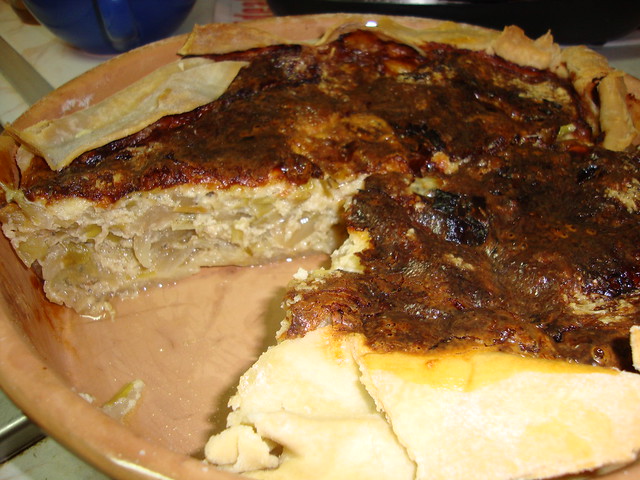
Leek and onion pie (Πρασοκρεμμυδόπιτα)

I love all allium plants (onions, garlic and leeks). Onions and garlic are never missing from my kitchen. When the leek season begins in early autumn, they are never missing from my kitchen, either. I also once question the use of half an onion (or half a clove of garlic, or half a leek) in a recipe. Why half? What would happen if a whole one was used? Would the recipe be ruined?! There is no such thing as half an allium in my cooking style.

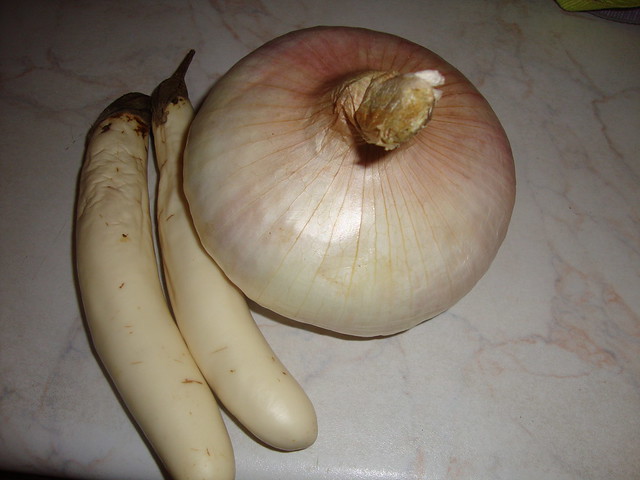
leeks from zakinthos and white eggplants
Supermarkets in Crete sell anything and everything these days: Zakinthian onions and Santorini eggplants.

When I go shopping, if I find a novel fruit or vegetable (ie a plant that is not grown in Crete) at the supermarket, I always buy one item to take home and show my keen gardener husband. On my most recent visit, I saw some giant onions (seriously, they were huge), which I thought were made just for me in the size I prefer for a meal! The label accompanying them named them Zakinthian onions. Through my Zakinthian friend Kiki, I discovered that these onions are called belousiotika (Μπελουσιώτικα) onions, because they are grown in a village called Μπελουσι (Belousi) in Zakinthos. Not only are they huge, they are also sweet. You won't cry when chopping these onions - they seem to lack the stinging-eye effect that we often feel when we are peeling onions. They also have thick flesh, unlike their regular counterparts.

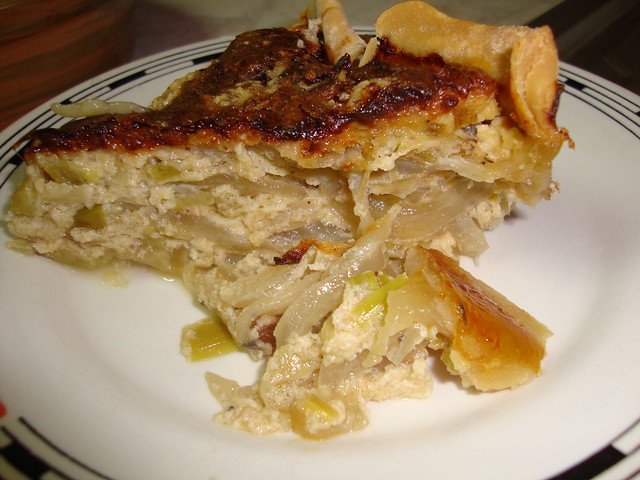
leek and onion pie
My best food is my creative food: just by looking at what I have available, I can whip something up that I have never cooked before. When the ingredients are good quality, the dish usually comes out very tasty.

Apparently these Belousiotika onions are often used in salads, but I thought their sweet taste would go well in a spectacular vegetable-based pie. Just by looking into my fridge and pantry, I decided to use them together with some leeks; the combination turned out into a perfect πίτα. 

You need:
1 belousiotiko onion (or 3 regular onions, to make up the bulk)
3 thick leeks (or 5-6 skinny ones, which are locally grown in Crete during the autumn)
a few tablespoons of olive oil
salt and pepper
200g single low-fat cream (even though I hardly ever use this much in my cooking, I always store some long-life cream in the fridge, for those 'just-in-case' days; it was perfect for today's recipe)
2 eggs
100g grated parmesan cheese
some pastry of your choice (I made my own, using the classic Cretan recipe: some water, a little bit of olive oil, a dash of salt and some all-purpose flour; you could also use frozen pastry)

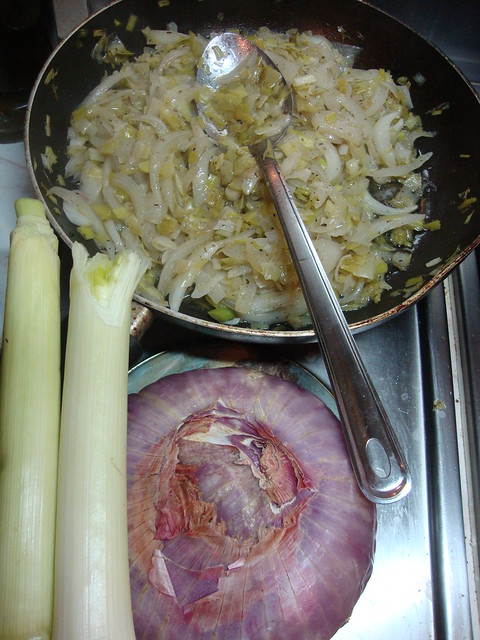
leek and onion pie filling
For an idea of size, the Belousiotiko onion covers more than the elemnet below it, while it seems to be as tall as a half a leek!

Chop the onion(s) into thin slivers. Clear the leeks of debris (they often contain soil among their layers) and chop them into small chunks (I always use the green tops in whatever I cook with leeks). Heat a few tablespoons of olive oil (I use a bit more than that, being Cretan!) and saute the onions and leeks until they become wilted, transparent and soft. Add salt and pepper to season. Beat the eggs and cream together, and pour in the leek and onion mixture.

Roll out your pastry and fit it into an 8-inch round flan tin (or ceramic pie dish). The pastry (whichever type you choose to use) must be baked blind, because the pie filling is very liquidy and will not help the pastry set quickly enough. Cook the pastry for 15 minutes in a hot oven. Then take the tin out of the oven and pour in the filling. Sprinkle the top of the pie with the grated cheese. Place the pie back in the oven, and let it cook in a moderate oven (180C) until the pie turns a golden brown colour on the top. To check if the pie is done, shake the tin a little: if it is set, the top will be firm like a custard. When you cut into it (I always do with pies like this), the pastry at the bottom of the pie will feel firm and the knife won't come out looking 'wet' but 'oily' instead.

leek and onion pie

This makes a very filling pie. It goes well on its own, with a glass of white wine.

©All Rights Reserved/Organically cooked. No part of this blog may be reproduced and/or copied by any means without prior consent from Maria Verivaki.

Wednesday, 9 April 2008

Beetroot salad and egg dye for Greek Easter (Μπατζάρια βραστά και φυσική βαφή για τα Πασχαλινά αυγά)

There is no Greek Easter without the hard-boiled red eggs that all Greek housewives will be dyeing on Megali Pempti (Holy Thursday) just before Easter. The supermarkets are full of non-toxic dyes in sachets, in all ranges of colours, although the traditional colour is red, symbolising Christ's blood. It's said that some women who were going to the market to sell their eggs passed by Jesus on the cross and the blood from his pierced hands and feet fell on the eggs, which became stained red. Whatever the symbolism involved, all Greek houses will see red eggs at Easter, whether they are ready-bought dyed, or home-made; we all can't wait to select one from the basket and crack it (tzougkrisma) onto someone else's to see whose egg will dominate throughout the contest.

In the plastic world we live in, the art of dyeing red eggs naturally has nearly become extinct. Here's a way to use natural substances to colour and decorate Easter eggs, and keep them edible after you've had your fun cracking them at the Easter table. We never eat them if they're dyed with unnatural 'non-toxic' chemical substances, so the eggs are pretty much wasted.

My mother used to use shop-bought clothes dye to get her eggs red, but she also created a natural design on the eggs, something not many people will remember or bother with these days, as most dye sachets come with adhesive plastic spring motifs to stick onto the eggs after boiling or dyeing them, depending on the instructions. The practice of decorating them with leaves is also continued in some Eastern European countries, as my Bulgarian students have informed me.

As this is an experimental session two weeks before Holy Thursday, I'm only dyeing four eggs today. The free-range eggs given to me by my uncles are far too precious to throw away afterwards, but because I am using beetroot juice as a natural dye, I won't need to throw them out. No matter what the sachet says about the dye being non-toxic, I still don't believe it; mine will be going into tomorrow's potato salad. Greeks boil the beetroot greens with the beetroot bulb, and eat it as a salad - greens and all - dressed with olive oil, vinegar and salt. And since I'm cooking beetroot today, it's a chance to see if what is written on the internet about beetroot being a natural red dye for eggs is true.

To prepare the motifs on the eggs:
To make these natural decorations, you need some old stockings, parsley leaves or other decorative leaves that are large enough to leave an imprint on the egg shell, and some twist ties or small elastic bands.

Place a parsley leaf on a damp egg and then carefully place it in an old nylon stocking, wrapping the egg tightly with the stocking so that the leaf will not be displaced. Twist the stocking tightly at the top, tying it with a small rubber band, piece of string or twist-tie, anything that will not damage the egg or displace the leaf.

To make the dye:
All factors must be considered when making natural dyes, so I must start off by telling you that the eggs I used were a beige colour, while the beetroot and red onion skins created a rusty brown dye. Yellow (Spanish) onions are the best for a deep red egg dye colour, so save your yellow onion skins over the lent period if you want to use them to make a natural dye. This is a variety of onions we don't commonly find in the places where I shop in Hania (although I did find them in LIDL recently and used them to dye eggs red great success); we use mainly red onions here. In any case, natural dyes and materials are all a matter of experimentation. The red onion skins with the beetroot gave a brown colour, although the dye looked red. The yellow onions skins created the classic red colour of Greek Easter eggs, while the dye itself looked orangey-brown (see top photo; the brown eggs are dyed with beetroot, while the red eggs are dyed with yellow onion skins).

Place the skins of about 15 onions into a pot with 4 cups of strained juice from boiled beetroot and 2 tablespoons of vinegar to make sure the dye 'sets' and does not create a runny effect when the egg is removed from the dye and dried. Let them boil away in the pot for half an hour. Strain the dye into another pot and discard the onion skins. There should be just enough to cover the eggs. The trick is not to add too much water, otherwise, the dye will not be very strong - the more natural ingredients you use, the stronger the colour - naturally!

To dye the eggs:
Some people boil the egg in the dye, while others boil the eggs separately and then add them to the dye. As the dye is made from natural substances, I have no qualms about dyeing the eggs in it. The only problem when boiling and/or dyeing eggs is to take care that they do not crack during any of the stages. They'll be pretty useless for 'tzougrisma'!

Begin by washing the eggs so that they are free of dirt, straw and grease (the dye won't 'take' otherwise). Place the cleaned, pre-decorated eggs in the pot with the prepared dye and begin by boiling them on a high heat - there should only be one layer of eggs in the pot. I added one undecorated egg as a colour control. When the water is boiling and the eggs are starting to rattle in the pot (that's why you should only have one layer!), lower the heat to a minimum and leave them to boil for half an hour. Turn the heat off (your eggs are cooked) and leave the eggs in the dye until they have taken the desired colour. You can check this by lifting the control egg out of the pot with a slotted spoon.

To shine dyed eggs:
Some dyes include a gloss to make the eggs shiny after they have been dyed (more chemicals, if you ask me). The traditional way to do this is by brushing them with olive oil. Pour some olive oil on a tea-towel (paper towels leave too much residue) and lightly rub it all over the egg. Lay them on a plate lined with some paper towels to absorb the excess oil while drying.

Your eggs are now finished - and they're still edible. My eggs didn't turn out like the traditional red eggs for Greek Easter, but don't they look beautiful in the old bird's nest that we found in an orange tree in our village... And the children didn't bat an eyelid on seeing the un-red eggs; they knew what to do with them!

©All Rights Reserved/Organically cooked. No part of this blog may be reproduced and/or copied by any means without prior consent from Maria Verivaki.

MORE FESTIVALS:
Christmas
New Year's cake
Clean Monday
25 March (Independence Day)
Ash Thursday
Fasting

Friday, 28 March 2008

Spanakopita spiral for Lent (Στριφτή χορτόπιτα νηστίσιμη)

I love any sort of spinach pie. Give me anything green encased in crust - I dig it (although I myself may not have dug it). There's the last remaining lot of spinach and silverbeet to chop up. The pastry maker sold me the filo (phyllo) yesterday - but I'm bored of making the same pies again and again: square kalitsounia, half-moon kalitsounia, pastry twists, spanakopites. How about a strifti pita (spiral pie)? This sort of pita is made in Northern Greece, but it's become a popular shape for spanakopita and hortopita all over Greece, and is sold in traditional fast food outlets here in Crete.


Recently I came across a recipe for seskoulopita (sefklopita), a strange name, meaning silverbeet (Swiss chard) pie. Although I could have made it using only Swiss chard, I added spinach, simply because we had plenty of it. The recipe also included cheese, but I wanted to make something I remember my mother making in New Zealand during Lent - lenten kalitsounia, which were always fried in a shallow pan (unlike the kalitsounia which included cheese, which were baked in the oven).

Here's a very rustic recipe for a pie using wild greens. Don't be put off by the 'raw' taste you imagine you will encounter when you bite into it; I had friends over from New Zealand, and everyone thought it was a super vegetarian pie. My son ate one eighth on his own. Lenten spanakopites/hortopites are also made and sold in takeaway shops during Lent. Some people like their food simple.

You need:
3 thick filo pastry sheets, cut into halves (ie six sheets in all) for a 36cm round tin (but you can substitute thin filo pastry for thick - you will then need six sheets, and you will leave them intact - they will be folded in half instead)
a large bunch of spinach, chopped finely
a large bunch of silverbeet, chopped finely
1 large onion, chopped finely
a few sprigs of herbs that you have handy: I added parsley, mint and fennel, all finely chopped, as well as dried oregano
1/4 cup olive oil
2 tablespoons of dry breadcrumbs (to soak up any excess moisture)
salt, pepper
For this pie to be successful, you need to make sure that all the greens are clean (no grit) and DRY. The less water retained in the cleaned and washed greens, the less likely the ingredients will spill out of the pastry which will break open (if it's too damp) while cooking. This is why I added breadcrumbs to the finely chopped greens - to soak up any excess moisture. You can also substitute semolina for breadcrumbs; it depends on what you have handy. The olive oil is added to the greens to keep them compact. The greens will not wilt and cook properly if they are too dry.

Mix all the ingredients together. Form long sausages (or snakes) with the rectangle pastry sheets. Place them in rounds in the tin. I started my spiral from the rim; Peter started his cheesy striftopita from the centre. Form the strips into a continuous spiral. When all the twists have been laid, brush them with oil (for a completely vegan lenten version) or butter or egg (if you can't fathom the idea that there is no cheese in the pie - I brushed it with egg, more out of habit; I simply broke the egg into a bowl, and before I realised that this was supposed to be a lenten pie, the bowl of egg was finished). Cook the pie for forty minutes at moderate heat, till the pie crust is golden brown.

When you are ready to serve the pie, cut it lengthwise into quarters, and then cut the pieces in half again. The pie is meant to be eaten in spiral bits, rather than as a piece, otherwise it may fall to pieces and lose its shape. I served this meal as part of a very green luncheon (which included stuffed silverbeet dolmades topped with meat patties) for Ian and Anne, who had wearily travelled from so far away to see me, so this post is dedicated to them. You might also like to look at my leek spiral pie, another delicious use of filo pastry and greens.

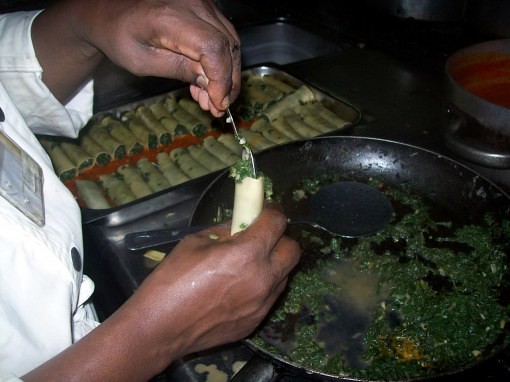
And if you don't want to use filo pastry, why not try using this pie filling in caneloni, like Chef Richard did in Burundi!
chef richard in burundi cooking greek-inspired food by me


©All Rights Reserved/Organically cooked. No part of this blog may be reproduced and/or copied by any means without prior consent from Maria Verivaki.

MORE WILD GREENS RECIPES:
Kalitsounia fried
Kalitsounia in the oven
Marathopites
Wild asparagus
Hortopita (spanakopita)
Horta in winter
Horta in summer
Sorrel
Swiss chard (silverbeet)
Eggs with mustard greens
Mountain tea

MORE PASTRY RECIPES:
Kalitsounia fried
Easter kalitsounia
Prasopita
Kalitsounia in the oven
Marathopites
Hortopita (spanakopita)
Tiropitakia
Filo-pastry making
Sfakianes pites
Summer kalitsounia