Showing posts with label NEW ZEALAND. Show all posts

Sunday, 21 January 2018

Happenings

Many many years ago, probably more than 35, some time in the early 80s, I remember a Kiwi woman coming into the fish and chip shop that my parents owned and operated. I happened to be there too, so it can't have been a schoolday. The woman was a customer, not a very regular one, but maybe she felt like some fish and chips that day.

"Are you from Greece?' she asked us. Yes, I answered (the children were always their parents' representatives in the shop).

"Oh, what a coincidence" (no, not really; Greeks were the main owner-operators of fish and chip shops back in those days), my daughter is living in Greece. She met and married a man on the island of Crete."

"Crete?!" my parents exclaimed, their faces lighting up gleefully. "We are from Crete! Which part of Crete does your daughter live in?" they asked.

"Hania," the lady replied.

"Hania?!" my parents cried, not believing what they were hearing. "We are from Hania! Is she living in the town?" they asked.

"No," said the lady, "she's living in a village called KOU-NOU-PI-DEE-AAAAA-NA". 

Split-second pause. "A-ha!" said my parents, but from the look on their face, you could tell that it was not really an a-ha moment; it was more of a shock to their ears, for they could not believe that this city woman's daughter gave up her comfortable urban life to move to a village where water supply was scarce, and there were more goats than people. 

We exchanged more niceties. If I remember correctly, she showed us a photo of her daughter holding her first child, the lady's grandson. When her order was ready, she paid for it and we said goodbye, at the same time wondering whether we would also see her coming into our shop once again, but this time with both her daughter and grandson; you had to be one tough cookie to leave urban life and go live in a goat village.

"The foreigners are taking over our country," said my mother, mindless of the fact that she was an immigrant. "Who would even want to live in Kou-nou-pi-dia-NAAAAA?" said my father. 

Turn the clock ahead four decades. Google Kounoupidiana and you will see no goats. Instead, you will see a whοle new town, whose residents are fully served in terms of any service, public or private, that they may need: schools, doctors, lawyers, sports centres, chemists, churches, shops, houses, apartment blocks, English language schools, confectioners, all the supermarket chains operating on the island. It even has a university, one of the best tertiary institutes in Greece. The 6,500 residents of Kounoupidiana - 8,500 including the 'suburbs' of Kounoupidiana) can easily live in their own little bubble, without even venturing to the central town of Hania, only 10-15 minutes away by car, depending on the traffic - not the four-legged variety, but the four-wheeled.  

Image may contain: 11 people, people smiling, people sitting, table and indoor

Last night, I met up with Philippa, the woman's daughter, whose life became firmly rooted on the island, despite being a stranger to the Greek world. It wasn't difficult to recognise her, as she reminded me so much of her mother, even after all those years. It's possibly the third time we have seen each other since I moved to Hania. We were at a Kiwi get-together organised by a former Greek Kiwi like myself. Auckland, Wellington and Christchurch Greeks reminisced their time in a faraway land, sharing some moments together. Funnily enough, among the little παρέα that we created, we were nearly all related, each one knowing someone else's relatives and acquaintances, notably our koumbaroi, meaning the primary attendant to the couple in a wedding ceremony or the godparent of one's child(ren). It really was a small world among the Greek diaspora communities of old. 


And while we are on the subject of Kiwi Greek life, I feel as though I have gone through the full Greek circle, having just invested the last remaining Kiwi dollars of my parents' savings (they both died too young to use it themselves) into the coveted - in Greek terms - 'investment property'. My parents both died too young to use their earnings themselves, but I am sure that they will be very proud of what their daughter did, to firmly root her life in our wonderful island. 

Naturally I will be super busy from now on as I work on my new project. Watch this space...

©All Rights Reserved/Organically cooked. No part of this blog may be reproduced and/or copied by any means without prior consent from Maria Verivaki.

Tuesday, 19 December 2017

Tinned tomatoes

I've been following the populist 'no more tinned tomatoes' debate that broke out just over a week ago in the New Zealand media, when a women's refuge worker demanded (not just requested) that food donations to the charity should not include tinned tomatoes. The 'Treatise on Tinned Tomatoes and Why They Are Like Books' did not get as much airtime as did the readers' vicious comments about the connection between 'poor people' and tinned tomatoes, which sounded like it was coming from non-Maori/Pasifika (read: white) higher-end middle class New Zealand society. The post (I found a cached version) did not actually villify tinned tomatoes. All the reasons that the writer gave for banning tinned tomatoes were based on solid facts and sound logic. Given that we are just days away before Christmas, it shouldn't be too difficult for most people to see why words like 'tinned' and 'staple foods' don't collocate well with 'Christmas'.


The women's refuge worker claimed that refuges (like food banks) often have many tinned tomatoes in their pantries, often past their due date. Women who use refuges generally don't use tinned tomatoes, nor did the people who raised them, and some of the women who use refuges don't even (know how to) cook. So if you gave those women a choice, they would never even ask for tinned tomatoes. In other words: if a woman cooks with tinned tomatoes, its a cultural thing. Pasifika/Maori women - the main users of women's refuges in NZ - are unlikely to have a cultural background of cooking with tinned tomatoes. Middle class NZ society might be very surprised to discover this: some people just don't use this quintessential global pantry stocker. By judging these women on foreign (to them) cultural terms, ie as good and knowledgeable budgeters ("tinned tomatoes are cheap!", "tinned tomatoes are versatile!"), the 'tinned tomato brigade' can't actually see what these women are feeling when they enter a refuge, ie sadness, depression, shellshock, running away from violence. Coupled with a lack of life skills and literacy skills, being cash strapped, in debt and looking after children, they wouldn't even feel like cooking, let alone cook from scratch: tinned tomatoes usually imply cooking from scratch.

Women who turn to a refuge for help have no family support - if they did, they would not be asking a refuge to help them. The writer made a point of how important it was to help such women get what they wanted, rather than what other people feel they need. In such moments, they want simple comforts: "spaghetti on toast or really simple things, stuff [that can be eaten] straight from a can if needs be".  Donors donate what they think poor people (which does not always mean the same thing as 'women in a refuge') need rather than want: "That’s you putting your values, and your mores, and your cultural prejudices on other people." Offering to teach women how to cook, how to use tinned tomatoes, and any other life skills they may be lacking is all very well, but there's a time and place for everything; when they arrive at a refuge, they need to settle into a new kind of life. Eventually, they may start preparing meals like they used to for themselves and their children; but some of these women may never want to cook, let alone from scratch. So tinned tomatoes are probably never going to be useful for them.

No automatic alt text available.
My old no longer wanted books started this foreign language library at CIHEAM.MAI Chania. Many students use it in their free time, and students also add to the collection.

The writer made the analogy that "tinned tomatoes are a bit like books": just like we don't all cook, we don't all read. While cooking and reading may sound like very basic activities to some people, to others they are not. For some people, cooking and reading are very difficult activities. Giving things to people who need things is not the same as giving people presents: the things you give to people who need things have to be useful things. Giving tinned tomatoes - a very cheap common product - to someone who has never used them is like giving away your old books which you no longer wish to read to people who never read novels. The better off harbour comfortable perceptions about what others should be doing all the time to become better off.

The treastise against tinned tomatoes aroused a storm of comments from both sides of the argument. A (Maori) woman working for another women's refuge added canned chickpeas and canned lentils to the forbidden list of items that refuges didn't want:
"We ask for fresh meat and vegetables and we get beans and lentils. What are our people going to do with chickpeas? Are they going to be making hummus in the safe house? Like tinned tomatoes, chickpeas and lentils have to be cooked and accompanied with other ingredients, using knowledge and supplies that many families [don't] have."
A (white) woman working for a Salvation Army food bank said she was shocked to hear that other charities were turning away tinned tomatoes:
"...the refuges are being a bit fussy... We are very short on things like [tinned] tomatoes... chickpeas and lentils are staples in Salvation Army food parcels given to families at this time of year... The staples are never going to go out of fashion. And hungry families will usually eat anything."
Anything? I doubt it. (And she also put her cultural prejudices into the picture by calling women in refuges hungry.)  Food is incredibly personal and highly cultural. Clearly the Salvation Army is catering for different kinds of people from those entering a women's refuge. People on a low income may also lead a more stable kind of life, not the nomadic existence of a woman fleeing from violence. Processed food is not necessarily the greatest miracle in the food world to make women's lives easier; having someone doing all the bloody cooking for you is even better than buying, carrying, storing, preparing and cooking food yourself. We don't all have that luxury of a private home cook; this usually happens when you are very wealthy or if you live in a cultural setting where one of the household's women (eg the grandmother) will prepare meals for all the family members, who may be working out of the home, or have been assigned other tasks. As mentioned above, if a woman has this kind of family support, she would not be asking a refuge to help keep her safe in the first place.


Snails and xinohondro - highly acquired Cretan tastes!

As I was following the discussion in the media, what really struck me was how unlikely it is among these refuges that someone will be cooking something for someone else, so that those people who need a decent meal (especially children) would find something that wasn't full of sugar/fat/salt (read: snack-type ready-to-eat highly-processed, eat-from-the-packet kind of food). It is already obvious that a lot of the people using these services don't have many life skills needed in order to maintain a healthy standard. So why not have someone cooking something on a regular basis, which can be served up to everyone and is also healthy and comforting? Some of the commentators mentioned that they would like to do such a thing as a cook-up, where some of the meals produced can be frozen for emergency moments. I think that the answer to this question will bring to the fore a host of other social issues that will be difficult to resolve.

It seems to have escaped people's notice that a lot of people in highly advanced countries like New Zealand are too busy to cook these days. This doesn't apply just to people in difficult situations. Most people in advanced countries spend their time in many creative ways, which often include doing things away from the home. And when they do have free time, they spend it more leisurely. Cooking is not a leisure activity when you are thinking about how to feed a family. It's a chore.

Image may contain: foodImage may contain: food
Lentil (φακές - left) and bean (φασολάδα - right) stew/soup - it depends on how much water you add.

Cooking for others, cooking with tomatoes and cooking with beans are therefore all very culturally based. In truth, I cook tomato-based bean dishes not because they are the yummiest thing imaginable, but because I have to feed a family, and beans are a pretty good quick cheap choice of food which can be prepared the night before, by the working woman in the household. (I am doing this right now as I write: a pot of lentil stew is boiling away on the stove. It should be ready before midnight. No, I don't use a pressure cooker.) This is not to say that a woman living in New Zealand from the Maori/Pasifika cultures cannot do the same thing for her family as a Greek or Indian woman (two cultures which use beans a lot in their daily diet); she doesn't do this simply because it's not part of her culture. She could be taught to do something like this - but if it was never part of your culture to prepare food in this way, learning to do this kind of chore is very difficult in modern times, when people are generally being 'taught' to treat food as a commodity: you buy/eat food when it's time to eat, or when you're hungry, or maybe to comfort you - and it's all ready prepared by someone else, and - generally speaking - you will generally cook when you feel like it. What may have been part of the food culture of a Maori/Pasifika woman fifty years ago has now changed, due to her translocation - due both to internal and external migration - into a highly advanced society headed and directed by non-Maori/Pasifika leaders. No matter how settled a woman in New Zealand who has turned to a refuge becomes, she is unlikely to revert to a less processed-food daily diet.

*** *** *** 

The 'tinned toms' discussion that ensued tells us much more about comfort food, processed food, and the act of cooking, than it does about how to use tinned tomatoes. The following can be implied:
- Comfort food is ready-to-eat food
- Cooking is for people who lead stable lives
- Canned chickpeas and lentils are the kinds of food that connoisseurs, health-freaks, vegetarians, vegans (and generally other 'smart-farts') know about (and eat)
- Certain cultural groups eat a lot of chickpeas and lentils, so they will know what to do with them
- Certain classes of people - especially those whose lives are less complicated - have the chance to be more adventurous in their food experiences
- Canned food (eg chickpeas and lentils) is for poor people
- Canned tomatoes are useful in a home where the act (which is now often considered an art) of cooking can actually take place (read: you have a kitchen, a stove/oven, AND you can afford to pay the electricity/gas bills)
... inter alia.

Canned tomatoes - and muuuuuuuuch more recently canned beans, but never ever canned lentils, except at LIDL when it's having a 'Spanish week' - are highly popular among Greek food banks and especially in soup kitchens. They are cheap and easy to work with. They make quick filling meals. A heated tin of tomatoes could quite possibly be poured over some boiled pasta. BUT: If this was never part of your culinary repertoire, then you will not eat it, let alone know how to make it. Culinary knowledge in western countries has passed into the realms of mystery, while things like chickpeas and lentils are considered food for the poor - or food for cultured. Even Greeks will acknowledge that beans are cheap and that's why the eat them.  Most Greek women with a family (including me) will cook up a bean dish once a week on a week-day, de rigeur.

I can't actually imagine any working Greek woman with a family here in Crete not cooking up a bean dish at least 2-3 times a month, but this is based on cultural norms. Greeks may have become impoverished - but still, there is much truth in saying that theirs is a dignified kind of poverty. We can have our cake and eat it, because we know how to make the cake. Greek identity these days often implies food knowledge. Recent Greek emigrants due to the economic crisis often end up working in their own food-based business. Their family background is not necessarily middle class. They rarely realise the superiority of their culinary skills because until they leave Greece, they do not realise that there are people out there who lack such knowledge. They are also astounded to learn that most people in highly advanced societies watch cooking shows and buy cookery books - but they rarely cook meals: most of their food will have been prepared by someone else, for them to heat and eat.

It's still not very common to see soaked ready-to-use chickpeas (let alone lentils) in Greek supermarkets; on the other hand, there is a plethora of dried beans on the shelves. If such canned products were presented to a Greek woman, and she was asked to produce something on the spot with them, I don't think she'd have much trouble producing a hot comforting meal in little time. All you need to make classic Greek φακές (lentil stew) and ρεβιθάδα (chickpea stew) are tomatoes, beans and water; if you add some minced onion and garlic, salt and pepper, your soup/stew - depending on the amount of water you add - will taste nicer. A hot bean soup made with canned tomatoes makes great comfort food - and it tastes better the next day.

Puttanesca is one of the quickest things I can cook from scratch 

Tinned tomatoes are often hailed as a food processing miracle by media cooks:
"The larder is worryingly bare when you've run out of tinned tomatoes. They are the cook's comfort blanket, the progenitor of any number of soups, sauces, stews and braises... Tomatoes are the best source of the carotenoid pigment lycopene. Some studies suggest it can help prevent prostate, lung, and stomach cancers. Tomatoes are an interesting exception to the rule that cooking food reduces or destroys valuable micronutrients: lycopene is better absorbed when it has been heated, either during processing or cooking, as the heat turns the molecule into more useful isomers. Tomatoes provide significant amounts of bone-strengthening vitamin K, and some research suggests that lycopene also supports bone health. Many studies link tomatoes with heart benefits, and although the mechanisms aren't yet clear, the antioxidant vitamins C and E in them, along with lycopene, seem to slow down the processes that would eventually cause heart disease."
An old photo of my pantry - these days I prefer to freeze our bumper summer tomato harvest.

In short, a pantry full of tinned tomatoes and chickpeas and lentils symbolises domestic wisdom, happiness and prosperity. But this is something that is not within the sight of a woman fleeing to a refuge with just her kids and the clothes they're all wearing. They'd rather be having some tea and toast, and maybe something sweet, like chocolate biscuits, to bump up their spirits. In other words, they want the same things you want. I highly doubt that the average citizen of a highly advanced society is eating tinned chickpeas or lentils cooked in tinned tomatoes on a daily, let alone weekly basis. We all want variety.

When buying "food for the poor", we really need to think about what we ourselves like to eat rather than what we think poor people 'should' be eating. Better still, charities can tell you what they need because they know who they're supplying. It's even better to give them money (they are likely to make better deals with suppliers), so they can do the appropriate shopping for that tiny segment of society that is rarely visible to the majority. Especially now before Christmas, to make it a merry one, skip that bloody canned food. As the Greek saying goes:
Φάτε τώρα που το βρήκατε, γιατί αύριο έρχεται η φακή.
(Eat now that you have good food, because the lentils are coming tomorrow.)

More articles on Greek food banks and soup kitchens:
http://www.organicallycooked.com/2013/03/soup-kitchen.html
http://www.organicallycooked.com/2013/10/food-bank-community-grocery.html
http://www.organicallycooked.com/2016/04/the-social-kitchen-of-hania.html

All quotes come from the following links:
https://thespinoff.co.nz/parenting/11-12-2017/please-no-more-bloody-tinned-tomatoes/
https://www.radionz.co.nz/national/programmes/afternoons/audio/2018625266/jackie-clarke-no-more-tinned-tomatoes
https://www.stuff.co.nz/national/99767397/
https://thespinoff.co.nz/parenting/13-12-2017/no-charities-dont-want-your-inedible-food-items/
http://www.nzherald.co.nz/nz/news/article.cfm?c_id=1&objectid=11958543
http://www.newshub.co.nz/home/new-zealand/2017/12/charities-ask-kiwis-to-donate-more-than-second-hand-goods-or-tinned-vegetables.html
https://www.tvnz.co.nz/one-news/new-zealand/hamiltons-salvation-army-shocked-auckland-charity-turning-away-tinned-tomatoes
https://www.stuff.co.nz/national/99813458/we-want-tinned-tomatoes-hamiltons-salvation-army-says
https://www.stuff.co.nz/manawatu-standard/news/99843749/comments-rejecting-tinned-tomatoes-illjudged
https://www.stuff.co.nz/national/99909805/get-off-your-tinned-tomato-high-horse
https://www.stuff.co.nz/business/opinion-analysis/99946985/hype-about-tinned-tomatoes-has-raised-the-debate-on-giving
https://www.theguardian.com/lifeandstyle/2013/oct/05/tinned-tomatoes-health-benefits-anti-cancer-strong-bones


©All Rights Reserved/Organically cooked. No part of this blog may be reproduced and/or copied by any means without prior consent from Maria Verivaki.

Wednesday, 17 May 2017

People waiting

“Come on you. Let’s go you, people are waiting.” 
Quote from "America America" by Elia Kazan

Immigration is high on the agenda of the global world these days. Not all doors are open though; some doors are even having walls built over them so that they can never open. Βarriers to immigration have been coming up and down over the years, so Trump's (physical) wall and Brexit's (figurative) wall are not new in this respect. (UPDATE 14/6/23: Greece has built a big huge one too.) As 'special relationships' begin to disintegrate, even race and wealth factors don't factor into the barriers: the doors just try to stay shut, as in the New World (places like the US and Australia) which is trying to limit immigration. There are reduced employment opportunities now for the growing population of the world due to automated technology which has changed the job market, coupled with the situation where people who are looking to migrate for better opportunities in life are all trying to get to the same places. But it pays to remember that in the world's history, there have always been periods of limiting migration and periods of opening up opportunities for it. At present, we find ourselves in the limiting part of the cycle.

If my parents were still alive, they might be bewildered by this: they migrated at a time when migration was very common. "Don't forget us," my father said to his friend as he left Greece on a ship from Pireas bound for Wellington. His friend settled there with his wife and children. Eventually, they met my mother who was visiting Wellington while she was working in a boarding school in the small agricultural town of Fielding 160km away. My mother had a two-year contract to work there, after which she could choose to stay in NZ or go back home. But before the two-year contract was over, she was already married to my father in NZ, with my father's friend acting as best man.
keratas taverna
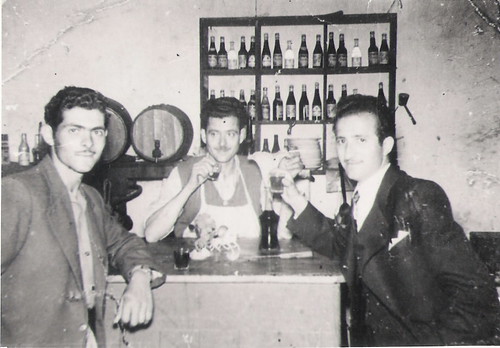
Dad - left - as a teenager at Keratas taverna in Platanias, Chania, Crete

My parents never met in person until a week before their wedding. They got to know each other through my father's friends, photographs, and letters they wrote to each other. My mother kept this 10-month long correspondence with my father, which I found after their deaths, and I decided to read the letters only recently. (My father's letters stayed in Greece and were probably thrown away.) Although they are in essence love letters, they told me much less about love than about commitment, compromise and assurance. The fifteen letters in total (an excerpt from each one in consecutive order is included in this post) reveal the novelty and excitement of getting involved in something completely different, as well as the fear of leaving not so much one's homeland, but rather, leaving behind the most important people in one's life, their immediate family members. The letters are really about the pain of making the decision to emigrate for a better future, while their immediate past keeps chasing them back.

My parents didn't finish primary school, but they were literate in the way that most people of their time were literate: they could read and write, but didn't necessarily spell words according to standard Greek spelling rules; they rarely used stress marks or punctuation: no commas, no full stops; new lines indicated a new paragraph or idea, while capital letters often highlighted words or they were used randomly at the beginning of a word. But they wrote in a way that anyone could read their letters: as long as you can read the Greek alphabet and understand  basic Greek grammar, you would be able to understand their letters. Even my mother's mother was literate in a similar manner, from the one sample I have of her writing (she received many letter from her children in NZ). The only real difference between my father's and grandmother's written language skills is that my father wrote words using standard Greek pronunciation, whereas my grandmother wrote everything as it would be spoken in a Cretan accent.

My father's letters always started and ended in the same way, a hint of the importance of the formalities at the time in Greek letter writing. You always ask about the recipient's health at the beginning of a letter:
My dear Zambia, gia sou. I hope my letter finds you (singular) in full health and happiness in the same way that I am well and happy, at the time of writing. Dearest Zambia, I received your letter and I read your news with great happiness and was glad to hear that you are well. 
... and you always send greetings to them at the end:
With this news, I close my letter. You have lots of greetings from D., M. and children, and all the cousins that are here. Send my greetings especially to our little sister (my mother's sister who was also living in NZ). Regards with love, your future husband, Manolis, gia sas.
letters
The letters (and a card) that Dad wrote to Mum

My father was writing his letters from Athens, in the port town of Pireas, to my mother who was living and working in NZ. But in that year of correspondence with my mother, he travelled regularly to Crete. Crete was the reference point of all his letters:
Last Saturday I went to your house and met your respectable parents and I left a ring, the ring which will unite us for ever. I hope they wrote you all the details. I am very happy in general with all your relatives, parents and brothers, they gave us a huge welcome, even though you were not there. The truth is that that particular night was really rather sad but with God's will, everything will be forgotten one day. 
The sadness of the event was not so much that my mother didn't attend her own engagement party; it was because she was not in the country. In my mother's case, the need to emigrate was greater than the need to find a partner: my mother was the oldest among her siblings and her family was very poor, too poor to marry. An arranged marriage would be a much easier way to find a partner than to wait for Mr Right to come along. Poor girls were not seen as desirable - except to poor men:
I noticed that you wrote that you have understood that I am a good man. In this way I have understood that I have found a truly good girl to live with in love and happiness for the rest of my life, as it has been determined by the all powerful God. 
What's a poor man to do in a country that could not provide for him? My father realised that he would be leaving his family soon:
Zambia, I have ordered the wedding rings in the size according to the little paper that you sent me in your letter. Concerning the issue of the invitation [to come to NZ] which you wrote about, you say you have to spend a year [in NZ] to be entitled to get the invitation process going, and I have been told that it takes a long time, so the earlier you start it, the better.
Immigration involved a lengthy waiting period, which does not seem to be too different from our times. Applications are processed one by one, on a case by case basis, they go through different offices and officials, and the process can seem drawn out:
Two days ago I came back from Crete and I read your lovely letter and I am very happy to see that you are well. I didn't write immediately because I was arranging to fix (ie fill in) the documents you sent me but I was told to ask and find out what to write in the question where the paper asks me to complete some information I don't understand, so I to our koumbaro A. to tell me what to write. Surely he too will have fixed such a document and he will know, in case I make a mistake. I will wait until he replies before fixing it. I am waiting for his reply. Better to delay it a little than to make a mistake and need to redo it.
While you wait for the process to catch up with you, you do a lot of thinking. Doubts cross your mind when you suddenly realise that what you are about to do, but the need to maintain stability in your life overrides the fear of the unknown:
So my dear Zambia, I will fix the paper that you have sent me in the way A. told me to do it in his recent letter, and I will send it to you. But before I make these plans for the invitation, I want you to write to me about how life is there, and if it is like here. There is no reason for me to leave, and for the two of us to live alone far away from our own people, if you can come back here instead, I am not going to go back to the village except for a volta (short holiday). I can work here [in Pireas], I can earn a little or a lot, we will live according to our class, but again if you see that we can be better off there, I may as well come, to stay for a certain period of time and then we will see. I can't write anything else to you about this, because I don't know where is better. But you've lived here, and you are over there now, you must have come to some conclusion where life is better, and to act accordingly. Ι will send you the paper and I will wait for you to write to me what you are going to do, if you will start the procedure for me to come or if you will come back here. As you wish, I leave you to your will.
There is a clear sinking feeling in my father's letter that he has no other choice but to leave. This is confirmed in his next letter:
I note that you wrote that of those who have gone there (NZ) some like it, whereas others don't. I want to find out if you money remains (you don't live hand to mouth), to save some money so we can return here and do something (set ourselves up). That's why I wrote to you to tell me how things are there because if we are to work and just make ends meet and not be able to earn the money for the return tickets, we may as well stay here (Greece). That's why I wrote to you. At any rate, A. wrote to me that I would be earning 80 pounds a month and if this is so, it sounds good. You asked me to write what job I do and how much money I make here. Wherever I go to work, they say they will pay you 64 drachma as a basic wage. I was working at the port and getting 650 to 700 drachmas a week but they cut my number of working days since Christmas so I am going to go and find work where M. is working, whenever they need an extra hand. Since Easter when I returned from Crete I got a job at the ship repair yards and I was making 58 drachma clear there but I had also fixed my papers to get a job in a factory which makes refrigerators, stoves and other things (ΠΙΤΣΟΣ) and they informed me to go, so I left the ship repair yards, and I've been at the factory since last week, but I don't know what fees they will take off my wage (ie taxes) and I don't know what I will clear, but whatever job anyone has here, life is very difficult for those who do not have a home and are renting.
Having your own home has always been important to Greeks, and never more so than now in difficult times. It seems that it's also important to most people in the world judging by the value of house prices in western society, but there is a clear difference between owning a house in the New World and owning a home in a country like Greece: the house where a family lives is never seen as an investment property, it is always regarded as a home that will always be in the possession of the same family. It can be divided up into smaller homes to avoid rentals for future generations, or it can be passed on to one child while other children inherit something else, eg an orchard or olive grove. Post-WW2 village life - where more than likely there was a family home - was clearly not viable for both my parents: my father did the odd job for wealthier relatives while my mother was an olive picker who was not always paid for her work, so they both migrated to the capital city eventually. Dad found port and factory work, but Mum went to Athens only to do a paid training course in housekeeping and English language learning in preparation for emigration. If they could have secured their own home in the capital city, I think they would not have left Greece. And here lies another big difference between the Greek 60s migrants and the neo-immigrants of today: the rural poor - people who literally had nothing to lose - were emigrating in the 60s, while in our times it is the educated urban class, who often maintain home ownership in Greece (among other income earning assets), that are emigrating.


Sometimes, there was nothing new for my father to write to my mother. So he would ask her about the the progress of his case in the immigration process:
Zambia, I noted that you wrote that you went to A. who told you that he wrote to me. Could you check if he has sent in my papers, if he hasn't done so already, because I hear that it takes a long time for the officials to start dealing with them. And please ask him to tell me the date he sent them in, so I can ask when they will arrive approximately.
It sounds like he was in a rush to leave. Reading between the lines, I think he was just feeling the pressure of the waiting time. He mentions the same thing in the next letter:
My Dearest Zambia, I don't believe you will misunderstand me for writing back so late but this delay happened because I received a letter from the British embassy and they were asking for some documentation from me and I went to Crete to get them and I then came back to Athens and they sent me from one office to another until today when I was checked by some doctors and now, I've finished with all this business and all that remains is the notification for me to come. That's why I hadn't written to you and I know that this would have worried you but now that you have read that everything is ok, you will be happy and all your worries will be over. I was worried too until today when I arranged all the papers.
But he didn't stop writing to my mother, even when there was no new news:
My most beloved Zambia, gia sou. I hope my letter finds you in full health and happiness as it leaves us. My Dearest I received your letter and I am glad that you are well. I noted that you wrote that you are waiting for a letter from the embassy. Well, when you receive a letter, write to me and tell me what they say. From here, I have no other news to tell you...
I remember my mother saying that she would never write more than one letter back to her prospective husband: it was always get-one-letter, write-one-back. I remember her telling me this as she laughed about it: "I didn't want to be taken for a ride". And my honourable father knew this, so he kept writing, even when he didn't have much news to write about. It is said that when you don't do much, you start meddling:
My Dearest I received your letter and I am glad that you are well. So, I got a letter from A. but he didn't write anything about what you wrote to me, about sending me an address so I can go there and ask if I can leave earlier. I am wondering where he went, so I can go and ask too, because I go to the embassy to ask and they say they don't know. 
My father was feeling the pressure of the time passing, in other words the time being wasted, when what he wanted to do was get on with the life he had been planning:
Well Zambio mou, yesterday as soon as I arrived from Crete I read all the letters that had arrived and immediately I went with that man who A. had written to me about, together with a clerk at the embassy, and they told us that as soon as the conditional visa comes, they will inform us. Well, that man who A. told me about told me to write to you not to pay any money to anyone until I get that conditional visa so that he can fix my passport, and later, we will send you the address of the office of the representative of his agency so that you can go with A. to pay the costs of my journey to come over. I asked him about the price of the ticket and he said that there's a 3,000 (drachma) difference between the plane and the ship, but you will arrange what's best, I don't mind how I come.
We can surmise from the above that there were charlatans everywhere. But what most excited me was the different journeys available in those days: you could take the slow cheap one by boat, or you could take the fast expensive one by plane. These days, a long boat journey would be classified as an expensive cruise holiday while budget travellers book lo-cost airlines.
mumdad
Dad's first few months in New Zealand, with Mum - left - and the "little sister"

The end of the waiting time was fast approaching; preparations for departure were now beginning:
I was late in writing back to you because I was in Crete and D. sent your letter down to me and that's why I didn't write from there (in Pireaas) and now I came back on Saturday and I went to T. about the chest you wrote about that you wanted me to bring to you, and he told me that I can take only one suitcase with a maximum weight of 20kg, just like you already told me, so I will send the chest by ship which will leave from here on 2 February for New Zealand and it will arrive in a month. Now concerning my arrival, I don't know when I will come because A. wrote that he went to the embassy and they told him that they have sent the required documents for me to get a passport issued and I went to the embassy here and they told me that it hasn't gone there yet and when it comes they will inform me.
And that moment eventually came:
So, I want you to know that today I am going to Crete and I will return on the 10th of the month because they told me that I will leave some time between the 15th of the month to the 20th, now which day exactly I don't know, however they told me that by the 20th, I will have left. They told me that they will inform you and you will know which day I will come. That's what they told me at the agency. And as I already wrote to you, I won't be able to take more than 20kg, so concerning the things you wrote to my mother about, my folks will send them to us by ship.
Dad finished that letter with a post-script:
PS: Dear Zambio I had writtten the letter in Athens, but I hadn't got round to sending it so I am posting the letter from Crete. I am leaving Crete on the 12th of the month and then I leave (Greece) whatever day they tell me. I am coming soon. In any case, everything is ok now.
Of course, everything worked out fine, otherwise I wouldn't be writing this story:
Well, Zambio mou I know that you are worried I am coming later than we had agreed, and that's why I am writing to you. If my letter comes before I come, you will be comforted, I know, I am going through the same feelings, because they told me that I would be leaving by the 20th of the month and I went to Crete and I came back with your brother here (to Athens) and we have been here now for 8 days and today they told us that I will leave on the 26th of the month because they told us that I would have to stay two nights in one place if I left with the earlier plane, I can't remember the placename they mentioned, and then I would leave and go to another place and stay there too, and I would have to change 4 planes to come over, but as we agreed today with the people at the agency for the plane that leaves on the 26th of the month, I will have one stop in Sydney where I will stay for 15 hours and then I will leave for Wellington but I will need two planes to get there [he was probably flying into NZ through Auckland], but don't worry, I just want someone from all of you over there, if it is easy for you, to wait for me at the airport as they told me that they will have informed you, and you will know when I will be arriving.
And yes, 'they' were all waiting for him at the airport. The letters stop here. My father arrived in NZ on the 31st of January 1965, starting work immediately at the Prestige nylon manufacturing plant in Pirie St. My parents married a week later (it happened to be Waitangi Day). I was born a year later, and the rest is history, I guess. 

©All Rights Reserved/Organically cooked. No part of this blog may be reproduced and/or copied by any means without prior consent from Maria Verivaki.

Monday, 20 June 2016

Last Lands Conquered

My latest quilt project is about how the world was conquered. Many of the fabrics were collected from scraps, repurposed fabrics (eg curtains), used clothing and gifts from friends. The design of the quilt top is broadly based on a pattern I found on the web (Lantern Bloom by Fons and Porter). As I was using fabric scraps, I adapted the pattern to suit by scrap sizes, and added sashing to make it bigger. 


The fabrics were chosen with a specific story in mind: the race to conquer the last lands on Earth. 

The South Pacific's colours and patterns were waiting to be discovered.
The whole world had been discovered...
... and all the oceans of the Earth had been sailed...
... in the company of the animals of the sea and the land...
... with the knowledge gained from clocks and stars, using the sun and the moon as guides on those very long journeys.
The last great land mass to be discovered - New Zealand - was finally colonised in 1840 by the British (the French would have got it if the Brits hadn't got there when they did), and it slowly began to be anglified and eventually europeanised.

Not everyone was interested in the Far East - modern Greece had just come into being and was a popular stop on young men's Grand Tour, notably Lord Byron's, who died fighting for Greece's liberation. Greece's beauty and her monuments became famous to the point that some visitors - like Thomas Bruce, aka the Earl of Elgin - set their sights on taking some with them when they left. 

And in this way, the last undisocvered lands were conquered and pillaged. 

A lot of discovering was going on in the early 1800s. And in 2016, we are still talking about what happened 200 or so years ago, and still arguing about whether it was right or wrong. Whichever it was, one thing we can say is that it was the way of the world. What had to happen did happen. Many things that are happening today continue to happen even though they are not desirable. Time and tide wait for no man.

©All Rights Reserved/Organically cooked. No part of this blog may be reproduced and/or copied by any means without prior consent from Maria Verivaki.

Wednesday, 30 December 2015

I had a dream (Ονειρεύτηκα)

I don't normally remember my dreams. They are forgotten almost as quickly as I wake up and open my eyes. This one contained elements of both my past and present life, and it married them so beautifully, which is perhaps why I can still remember quite a few details of that dream. I just related it to a colleague, and she thought it was quite symbolic of the times we live in, so I decided to write it down, just for the record.

I'm in the Greek Orthodox Church of Wellington. What am I doing here, I ask myself. I try not to make myself look too conspicuous. It's the moment when the δίσκο (THIS-ko - collection tray) is being passed around. 'I don't want to hear any clink-clink', the (now-deceased) Archbishop says (as I recall him saying once when I was still living in Wellington - he preferred to hear a gentle rustle, like leaves falling from the trees to the ground). 

The collection tray passes by me, but I don't add any money to it. I remember thinking that the church doesn't pay property taxes. But the old man passing it round stays rooted to the ground in front of me. So much for not wanting to make myself look conspicuous; I just shrug back at him. He points to the tray with his finger and nods towards me, making it obvious that he won't leave if I don't contribute. 

I take out my purse and open it. Then I turn it upside down over the collection tray. The clink-clink sound can be heard as a few coppers fall onto it. Nothing silver comes out with it. The old man is now both annoyed and embarrassed. "I've just come from Greece," I say, "and we're still under capital controls!"

A lady turns and looks at me very sympathetically. She disappears for a moment behind the μπαγκάρι (ba-GA-ri - candle counter). When she returns, she is holding an EFT-POS machine. 

I don't know what happened next, because at this point I woke up. According to a Kiwi friend, there is indeed an EFT-POS machine now in Wellington's Greek Orthodox church.

Καλή Χρονιά!
Happy New Year!


©All Rights Reserved/Organically cooked. No part of this blog may be reproduced and/or copied by any means without prior consent from Maria Verivaki.

Saturday, 5 December 2015

Kiwi rack of lamb (Αρνάκι Νέα Ζηλανδίας)

A kiwi rack of lamb, bought on 50% discount at the Marinopoulos supermarket, originally priced at 22 euro. A long long time had passed since I had last bought a kiwi rack of lamb. At this price, it seemed the right time to do so now.


Cretan lamb is much much smaller, somewhat scrawnier than kiwi lamb. A Cretan lamb chop always feels like I'm eating a lollipop meatball. We don't often eat lamb because we prefer beef and pork. So when I saw it on special, I thought it would be a meal I would enjoy cooking and eating, to remember (much) older times.

I'm now very used to Cretan lamb, which is smaller than Greek lamb raised in the mainland. Although we also buy French and Dutch meat (where our main meat imports - beef, pork and chicken - come from), we buy only Greek lamb. So this kiwi meat smelt very different in my kitchen. I remembered the first time I smelt Greek lamb cooking in the oven of a small Greek home kitchen. At the time, for me, it stunk. Nowadays, it smells quite neutral to me. I am more likely to detect the scent of the wine it's soaked in, and the herbs and spices used to cook it, than the meat itself.

I tried to recall the smells in our NZ house when we cooked kiwi lamb, but I couldn't remember them. I couldn't even remember the smell of kiwi meat as my mother cooked it before we went to church, so that our Sunday roast could be ready when we returned home. I remembered nothing. Nothing! Like I had never even been there.

The smell of the rack of lamb in my kitchen smelt wrong. The smell was pretty strong. No doubt, someone would notice soon. So I soaked the lamb in wine, doused it in spices and cooked it for ages, hoping that the smell would somehow go away (or at least, stay hidden). But that smell didn't go away. Even though it was somehow veiled by the seasonings, it had now permeated the kitchen on this rather cold Saturday.

"What's that smell, Mum?" my son asked me, making me feel rather nervous.

"That looks so good!" my daughter said, comforting me somewhat as she saw me taking out the roast from the oven.

"Is it cooked through?" my husband asked, which is usually his main concern with meat. I could see it falling off the bone. My husband then noted that his father had once bought kiwi lamb when he was young and his mother cooked it, but the smell put them off, and it was left uneaten.

Oh, shit, I thought. But times have changed: "Whoever isn't hungry isn't obliged to eat," I reminded everyone. We all sat down for dinner.

The rack of lamb looked huge as it sat in the roasting pan. I'd had to cut it in half to make it fit. I wondered if we would get through it, especially if mutiny was declared (over the smell, which was faint, but still quite discernible). Things turned out well. The lamb was really quite OK. Some comments were made about the differences noted when compared to the lamb we usually cook at home. The smell was apparent to all (I knew it!), so I was ready with my wine-and-spices story. I remembered the price of that rack of lamb (information that I kept to myself), and I praised myself for landing such a bargain. Should I have bought two pieces at that price, I wondered. The supermarket freezer had quite a few of them in stock (all bearing the 50% discount sticker).

I took a bite, concealing my own hesitation. Any second thoughts I had about this rack of lamb had to remain in my head. Poor thing, I thought, it's like it had landed in a house full of loud opinionated (ie obnoxious) people, an invited guest who was regarded as a freak. Make yourself at home, they all said to it as they poked it prodded it, exposing its foreigness in all the ways possible. I felt embarrassed, almost ready to apologise to the visitor for any offence we may have caused.

Perhaps these awkward feelings might not have arisen, had the company been different. But it's much easier for me to change the meat than it is the company. Greek lamb or kiwi lamb, it will make little difference to me. The sooner I don't have to cook, the more quickly I will enjoy my food, Όπου γη και πατρίς - the origin of the lamb will make no difference.

(Note to myself: Next lamb dish - Greek-style fricassee, with lettuce from our garden. Do not use kiwi meat. Wrong smell.)

©All Rights Reserved/Organically cooked. No part of this blog may be reproduced and/or copied by any means without prior consent from Maria Verivaki.

Sunday, 6 July 2014

The Greek Collection: The baoulo (Το μπαούλο)

The project is well underway: come and join me at The Greek Collection.

Every now and then, I like to go through my cupboards to get rid of things I no longer use or don't want to keep. Now that the children have grown up a little, and they don't grow out of their clothes so quickly, I don't do this too often. Even so, when I do do it, I also tend to avoid certain cupboards, with the excuse that even though I never use the things in those cupboards - which coincidentally the original owner of those things never did either - I simply can't throw them away for sentimental reasons.

Some time last February, I once again opened up one of those cupboards and stared at its contents. A sense of grief came over me, as I thought about my mother who had toiled many hours in the mountain village where her home was located, making these hand-woven things: sheets, tablecloths, table runners (that is what they looked like to me - they were in fact body towels), pillow cases, aprons, tea towels, blankets, rugs, fabric for making other household items, and many other fabrics, all of which she had made herself on a traditional Cretan wooden loom, called 'argalio' (αργαλειό).
Αργαλειός νομός Ηράκλειου
A typical weaving loom in Crete. There is great interest in the argalio nowadays as part of popular history and culture, and it is still used in traditional fabric art, as a tourist attraction and in making souvenirs. From my reading, I ascertain that my mother's generation was the last to use the argalio for making their household linen needs, as they are the ones that did not actually use them int he way they were intended. But the truth is that to a large extent, most women of my mother's generation used the argalio for the purposes of preparing their dowry box, as Evdoxia Epitropaki explains: «I made all my dowry requirements with the weaving loom that my grandmother and mother used and I have kept them stored in my baoulo. The only thing I didn't make was curtains. I made everything else... Do not forget that at that time there was nothing ready-made.»

All these items, once made, were folded away and placed in a large storage trunk, called a 'baoulo' (μπαούλο - a dowry box in essence), in readiness for the day when my mother would set up her own home and she would need these things. Her two younger sisters did the same; each one had their own baoulo. At the age of 30, my mother left Greece, leaving these items behind in the baoulo, in the company of mothballs. Her first home in New Zealand was a dormitory in a rural town called Fielding, where she worked at the Fielding Agricultural High School. She arrived 'with half a suitcase', a common saying among early Greek immigrants, describing their arrival in a country of the New World with a handful of belongings; it often makes reference to the pride they feel about how, despite their very poor background and humble beginnings, they settled into a new country and became wealthy, now owning so many things that they would need more than one suitcase to pack them all into (something like a shipping container would be more appropriate).

I have kept my mother's baoulo - it now stores our Christmas tree and decorations.
The baoulo was lined with this design. It was clearly intended for use as a dowry box. 
It was painted brown, with a blue design on the top.
(On the state of the basement - it's a man's world: my husband stores his garden tools in it.) 

Nearly two years after her arrival to Fielding, my mother left for Wellington, the capital city of New Zealand, seeking the company of other Greeks. The Greek community of Wellington was by then well established as the largest Greek community in 1960s New Zealand. Through the community, my mother met the people (who eventually became my godparents) who eventually introduced her to her future husband, my father. As she prepared for marriage, her mother wrote to her, asking my mother what she would like to be sent to her from her baoulo. I remember my mother telling me about this, something along the following lines:
"Nothing. I don't need any of that stuff. We have no need for such things here. You can buy everything you need from the shops. And it's all better than that stuff." The last time my mother sighted her 'stuff' was during her last visit to Greece. The fabrics had lived in the baoulo for over three decades.

My mother died shortly after her last visit to Crete. A little while later, her brothers asked me if I would like to take the baoulo to my house, as a way to free up space in their home. The truth was that these items were regarded as inheritance. Since my mother never took them away herself, they were now being passed on to her children. I remember my uncle bringing the whole baoulo to my first home in Hania using his pick-up truck. He helped me to place the baoulo in the spare room. I thanked him for his help, and after he left, I went through the magical experience of opening up the baoulo. I felt like a pirate going through his loot. Although I did not find any treasure in the baoulo, I found myself unlocking the secrets of my mother's past.

Find out more:
Facebook - The Greek Collection 
Pinterest - mverivaki/the-greek-collection
Stories - The Greek Collection


©All Rights Reserved/Maria Verivaki/The Greek Collection/Organically Cooked. No part of this blog may be reproduced and/or copied by any means without prior consent from Maria Verivaki.

Saturday, 19 April 2014

Happy Easter (Καλό Πάσχα)

Dear mum,

I don't often write to you because we often speak, albeit silently, but I thought it was about time I sent you a note which can stand as a testament in time for a future moment. Telephone/telepathic conversations don't get recorded (actually, they tell us on the news that all phone calls may be recorded nowadays, but I highly doubt anyone would be willing to sift through my ones with you, even if they existed, to help us recall the things we talked about), but writing things down in a computer keeps permanent records of everything. It's a highly connected world now, mum, so long as you can use a computer. Would you believe it, I chat with The Little Laughing Olive Tree every day, and I don't even pay a single cent? Actually I chat with people all over the world, even people I don't know. It's all got to do with that telephone that you would ask me about every now and then, the one where you can see the person you are speaking to. It's been invented now, mum (like that train we once heard about on the news which will go under the sea and connect England with France - I've even taken it). 

I've just finished cooking most of my Easter delicacies, and I've now sat down with a cup of coffee to write this letter. I had the kids help me, just like I helped you to make all these things. Easter is one of those times when I really want to make all the traditional festive meals, probably because I remember making them with you, more than anything else. You know how much time kalitsounia take to make and how little time they need to be eaten. But I make kalitsounia, and koulourakia, and kreatotourta, and red eggs, and avgolemono (they call it fricasee here), because I know how much the family loves to see these foods at Easter. And just like you, I don't spoil them by making all these cholesterol-laden goodies all year round, which makes them appreciate them even more, I suppose. (Unlike you though, I don't have fat kids. There really was no need to tell me to eat all the potatoes you put on my plate before I ate my lamb chop, especially in 1980s NZ where half a side of a lamb cost just 20 NZ dollars, and there were someting like 20 sheep for every person in the country).

I don't cook the quantities that you did, but not just for health reasons. You see, even though I live in Kriti, and I am related by blood and marriage to so many more people here than I ever could count in NZ, I don't often get the chance to pull all the little families that make up our extended family together, like you did back in NZ. People here all have their little παρέα, and their festival customs, which isn't a bad thing. But it's very hard to penetrate those little circles that each group creates, especially now with that thing called the crisis.


You've probably understood something about the crisis, that it's a really bad thing that has cast a curse on Greece, and people are suffering, but if you are watching any of it (you don't have TV up there, do you?) you are probably wondering what it's all about, because it isn't like sickness and disease, or war with guns and bullets and blood and invaders. If I remember rightly, you never saw much of that anyway, even though you were seven years old when the Battle of Crete took place, because the invaders didn't quite manage to get as far as your mountain village. But dad saw lots of that (please show him the letter - I don't know if he's living in the same quarters with you, and I bet he spends a lot of time with his brothers and sisters now that they have all joined him up there, but no doubt, you see him), because he lost his father in the war, and so did my husband's mother (but she really doesn't like to talk about it much - her (mutual to you) grand-daughter has to do a school project about it next week, which involves recording her grandmother in an interview about what happened in those days, and I really don't know if she will agree to it. Θα δούμε - I may just have to help her along a bit on that one: as I mentioned to you above, it's all recorded on computer).

A lot of people do often say that things are not better now and they were better in the past, but I don't believe that at all. For a start, I don't have to work as hard as you, mum. In fact, I don't see anyone here working as hard as you and dad did. Apart from milk, food isn't expensive here (I think it's more expensive in NZ these days). We are free to believe what we like and do as we like, as long as we do not break the law. And unlike in the Greece of the past, you get caught so much more easily these days if you break the law. It's all got to do with the invention of the computer. That's a hard one to explain, but it's like you're being watched all the time, and if you really want to break the law, you need to be really deviant, so that eventually you get caught out as the nooses tighten.  It wasn't like that when you were living in Greece, but the past is over and done with. It's all to do with the crisis. 

The crisis is difficult to explain. The word 'κρίση' generally has a negative meaning, so you know it's something bad. I liken it to climate change. You may remember my mentioning this to you every now and then. You probably thought of me as an eco-nutter back then, but it's been proven now that climate change is a serious threat to the whole world, perhaps the most serious threat of all. Suddenly it's really cold or really hot unexpectedly, and you have to learn to adjust to these new extremes. For example, you may be flooded one day and the next day there may be a drought. That's like the crisis which goes something like this: sometimes you have a lot of money and you can spend it on anything you like and you don't even have to save it because there's more of it coming where it came from, but sometimes you don't have much money at all and you can't even make ends meet to pay your living expenses. So if you create reservoirs that don't flood, and can always be kept full, you are saved from the climate change crisis. Likewise, if you can limit your spending, change your habits and above all stop grumbling, you are probably saved from the worst. 

16

Everyone has been affected by the crisis. So we can say that we are all in the same boat. Suddenly, we have all become one and the same. That's one of the outcomes of the crisis. I think it's a  good thing, but most people around me are always mumbling about how bad it is. Well, it's bad if you live in a place where you can't even grow your own herbs, or if you can't get used to living with less. Most people are in this category. They were used to having most things done for them by others. Admittedly, some people are worse off than others. But even in poorer times, Greece still lets people who haven't got much money avoid paying their daily expenses. I know people who don't pay any of the taxes we pay because (on paper at least), they are considered poor - they don't even pay their electicity bills. And most people with loans have not had to repay them - I know plenty in that category too. And they know how and where to get more monetary benefits. Don't think that this applies to me and my family: we don't receive any benefits, we pay all our dues, and above all, we try to maintain our dignity. 

To my advantage, as the tax-paying Greek, prices have dropped, and I don't waste anything, and I mean nothing at all: I have a place to store plastic bags, a place to store rubber bands, used paper (I don't mean toilet paper - I mean paper for printers: you need them for the computer). And the most important outcome of all is that there is more solidarity among Greek people. People are more sharing and caring nowadays. My kids remind me every now and then to give them a packet of makaronia or beans to take to school, which collects on behalf of the community grocery, and I always give away the kids' clothes when they don't fit them any longer, just like you did, when you sent them to your nieces in Greece. People gives us things, and we give things to them. But it's not about things: we share a lot more than just tangible items than we ever did in the past.  

I really don't think the mumblers have good cause to grumble so much. The only ones that do have a good reason to complain are those that don't have jobs. But as I told you above, there is greater solidarity on the part of the government to help these people out. Admittedly,we would all like to be helped even more than we are now, but I think that's just asking for someone else to pay for everything. Most Greeks are mainly annoyed about the taxes they have to pay, which they weren't used to paying in the past. Even people outside Greece also mumble about the Greek problems, because they are afraid that the same bad times in Greece are coming their way. The whole world now uses Greece as a reference point. You hear people from other countries saying things like 'We don't want to become like Greece." You could say that Greece has become the feared μπαμπούλα you used to warn us about. But Greeks have shown that they have managed to get over the crisis in some way, and this is even more alarming to the non-Greeks, because it is proof that they may have to undergo a similar makeover. It's the same everywhere now, mum. 

But seriously, mum, things are getting better, and they will get even better. You know how much better your life was than your mother's and I can guarantee you that my own life is better than yours. And I really believe that your grandchildren's lives will be better than their parents'. Crises of various sorts come and go; there was never a period of no crisis, life has always been an uphill battle, with different difficulties for the many different people that exist on earth. (And yes, the earth is STILL the only place with human life. We haven't yet come across people from another planet, and there was no man on the moon after all, like you insisted, despite the many advances in science that help us to find out more about the universe. Sadly though, there is still no cure for cancer.) And all crises come to an end. If they didn't, then the world would end and the human race would die off eventually. Money can't buy eternal life. 

Don't worry, we aren't starving.  How could we when you can see kalitsounia, koulourakia, kreatopita, avgolemono and red eggs on my table? We'll never starve here, I can guarantee you that, as long as no one comes along to take the food out of our mouth. There is plenty of food to go round for everyone in greece, and good qaulity cheap food too. We're now being extra cautious that no one will take the food out of our mouths, too. Ever since my husband fenced off his orange field in his village (unlike all the other fields around it), we have realised that it produces many more oranges that we originally thought. We're even giving them away (I trade them with a friend for her fresh eggs).  

Oh, and look, while I was writing this letter, I was reading this newspaper article (I don't have to buy the newspaper in paper form anymore. I read it on the computer, at about the same price that it would cost me to buy the paper version. And what's more: I can read any number of papers that I want every day, all for the price of one. And I even write one myself, and people all over the world read it!), which said this:
In the past few days we have witnessed an effort to change the climate, to make it appear the crisis has ended and that Greece is making a leap toward normality. The primary surplus and the five-year bond sold to international investors raise the hope that our creditors’ harsh grip will loosen, money will flow into the real economy and the country will recover. These developments, along with words of encouragement from foreign officials and some publications, play a positive role in improving the climate. It is the light at the end of the tunnel for which we have yearned – and sometimes even the illusion of light leads us toward it. http://www.ekathimerini.com/4dcgi/_w_articles_wsite3_1_17/04/2014_539074
It's really all about whether you see the cup half empty or half full. I definitely don't see a full cup, but I think that the glass holds just enough for my needs at the moment. I keep trying to keep it half full. As soon as I see it emptying, I pull the reins in the house. I'm the boss in it, just like you were, and everyone knows that. Even at work, my opinion counts more now. It's the crisis, mum; things are falling into place.  

It's been really cold lately. It even snowed last night on the mountains, your mountains, the ones where you were born. I don't know how lucky we will be to manage to get the Holy Fire home to us, but I really don't bother with this mumbo-jumbo anymore. At least this year, Greek Easter falls on the same day as the Catholics', so when the Pope comes on tv (they show him on the news in Greece too), and says 'Christ has risen', he won't be lying. Anyway, why do I need to bring the Holy Fire home with me, when I don't even light a kandili? I'll never forget that time when one of the kids dropped the candle in the car. I am not prepared to go through that again. I can't afford to buy another car right now. And anyway, we're modern people, mum. I don't tell my kids to fast, I don't force them to go for Holy Communion, they get to the kalitsounia and koulourakia well before Easter Sunday, we don't dress formally, we have Turkish friends, we have gay friends. We aren't regular church goers like in NZ, but I think that's because we go to church here for different reasons compared to NZ. For a start, we don't need to go to church here in order to feel a sense of Greekness and catch up with the other Greeks, like we did back in NZ. We are Greek, we already know that, and we don't need to prove it to ourselves. 
Galatas, Easter service, 20th April 2014
OK, I better sign off now, mum, because I'm talking politics, sex and religion, which you don't like to talk about or question. Anyway, it's nearly time to get ready for the Holy Fire thing tonight. When we do go to church, we always prefer the church where we know we will bump into our extended family, so I'll be seeing your brothers tonight. I've also talked with your sisters, and they are all fine. If they knew how to use a computer, I'd talk to them every day too, like I do with The Little Laughing Olive Tree, so I have to limit my call times with them. But they never forget me, and I hear from them often. They are like substitute mothers. (I thought you'd like that. I mean, I call my mother-in-law 'mama', but we don't share much with each other. You may not know what I mean because you never had to live with your mother-in-law. But it's really quite OK.) And your grandchildren are fine too. At the moment, they are downloading music for their dad to play in the taxi. (We don't use tape recorders anymore - we take them down from the computer.) They don't know much about you, to be honest, because they don't quite understand how it came about that I was born in NZ and I call myself Greek. Sometimes they ask me if I am actually Greek. So I suppose I could say that they are cottoning on to something that they will understand a little better when they grow up. 

Happy Easter, mum, and dad, of course. We'll talk again soon. Bye for now.

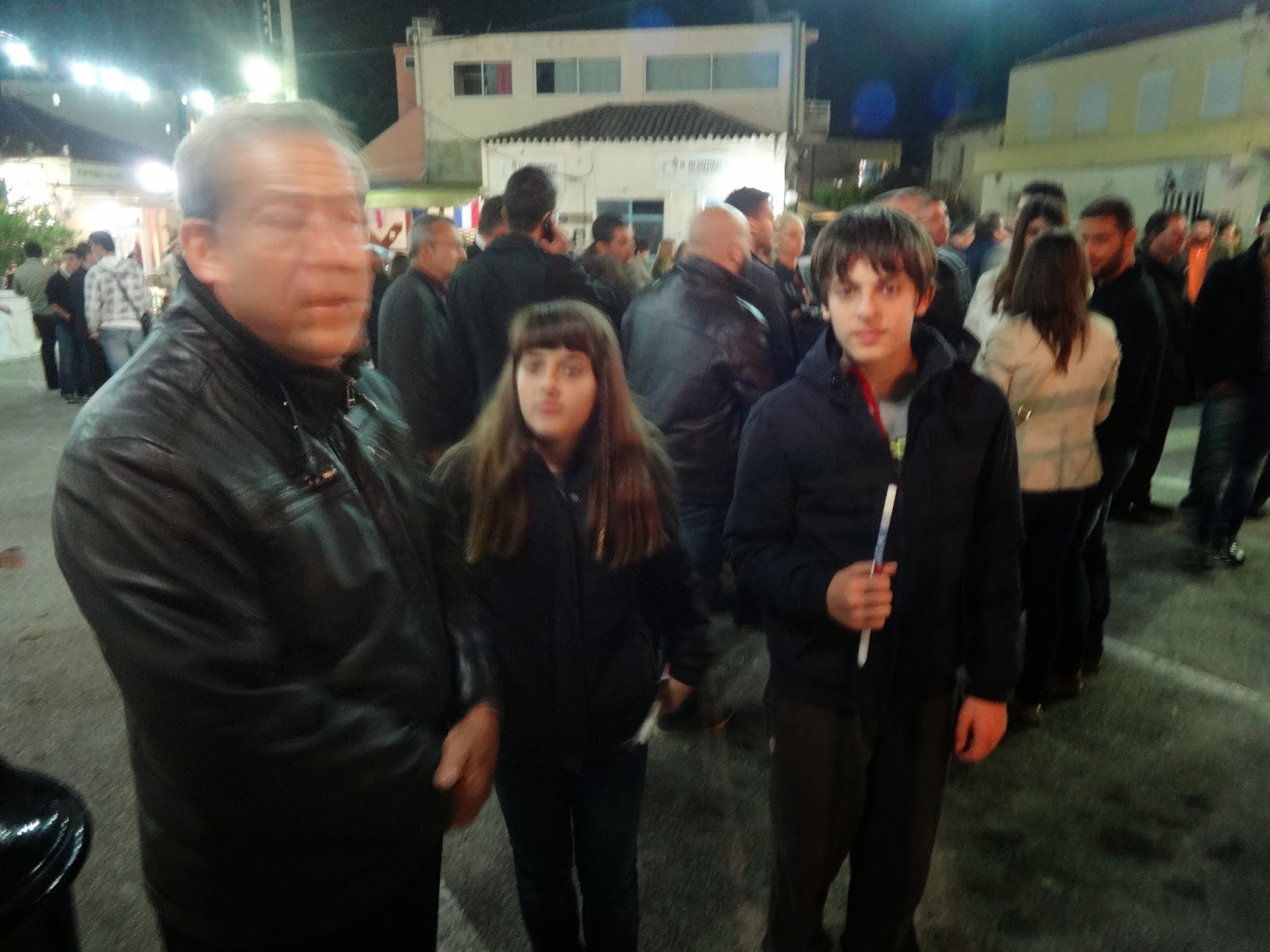
UPDATE: Good thing I haven't posted the letter yet. I've updated it with some family photos. Here's what we looked like last night.


©All Rights Reserved/Organically cooked. No part of this blog may be reproduced and/or copied by any means without prior consent from Maria Verivaki.