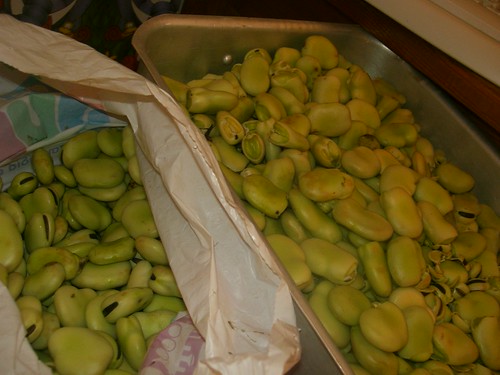
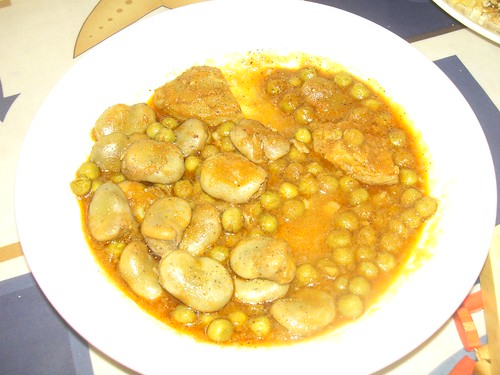
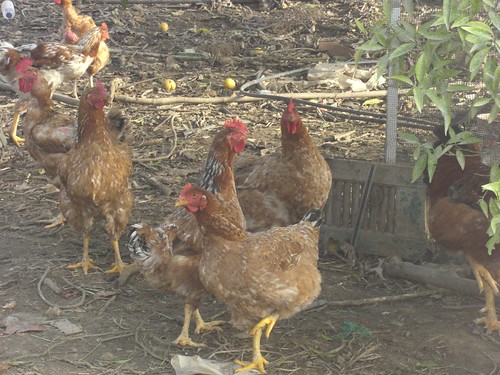
My husband and I were recently talking about moving house and building a new one a few kilometres away from where we currently live now, in a countryside setting.
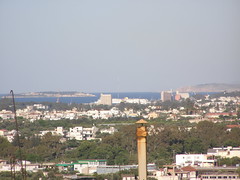
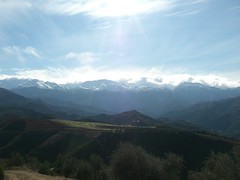
Left: The view we have now. Right: The view we want in the future.
It may sound like we have suddenly come into a windfall. Fortunately or unfortunately - depending on the way one views the saying 'money can't buy happiness' - this isn't the case. One day, we'd like to be able to move house for a change of lifestyle: we'd like to live on
a large tract of (family-owned) land, closer to our
orange orchards and
olive grove, giving us more flexibility to grow more of our own produce, including the possibility of raising animals (something we aren't doing now) for our own use.
Our closest neighbours at the moment near the olive grove live 1.5 kilometres away - they are retired Germans! We often see them foraging along the road heading towards our grove. Living in the countryside is not as difficult as it seems in modern times, since the roads are now tarmacked, and basic services (water, phone, electricity) are more readily available.
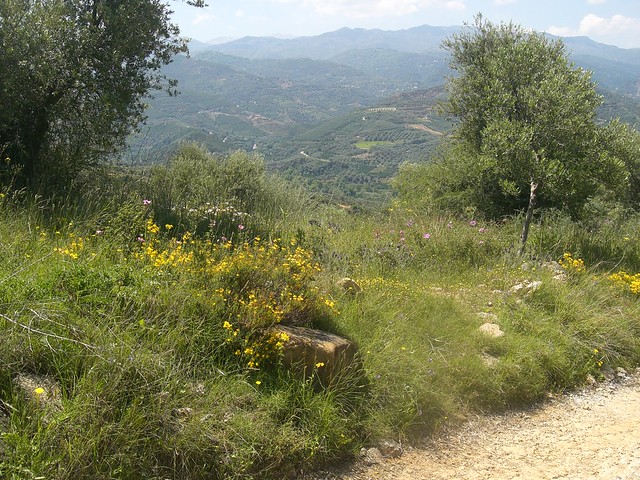
Keeping animals carries with it a huge responsibility - it means that you can't leave your home without making arrangements for someone else to carry on your work while you are away. (This way of life is not much different from how we live now - living with an elderly person who has lost her mobility means we still do pretty much the same thing.) Since we'd both be closer to retirement, we would have more time on our hands to do this. And as I look out from the window of our new house that looks down onto our olive trees and up to the Lefka Ori, I would then be inspired to type up that novel that I've been writing in my head for the last year or so...
Another view of Lefka Ori from the olive grove
But it seems that I am coming in too late to the game. Food from the earth is old hat; according to
Rachel Laudan, I'm a
Culinary Luddite!
The article presented in the above reader was written almost a decade ago, and was recently revised for publication in the Utne Reader, which provides a number of links to other food-related debates. It received some attention in the NY times blog; the comments there share similarities in their misunderstanding about modern food with some of Rachel's ideas about slow food. In essence, one could say that humans now all eat processed food, whether they like it or not, but the notion of 'processed (ie fast) food' needs to be distinguished among categories of food and not confused with 'junk food'.
One of the recurrent themes in the article is that "
Eating fresh, natural food was regarded with suspicion verging on horror, something to which only the uncivilised, the poor, and the starving resorted."
* If this has some measure of truth, it is only because refrigeration wasn't invented until relatively recently, and even then, most people (in the case of Greece,
as recently as less than 40 years) wouldn't have had a refrigerator in their house, so they would have spent a lot of time
foraging fresh ingredients and
eating what they could there and then before finding other ways to preserve or store it before that fresh food - both raw and cooked - went bad.
It is difficult to understand the feeling of euphoria that a farmer has when he plants a successful garden...
The availability of refrigeration ("
egalitarian, available more or less equally to all, without demanding disproportionate amount of resources of time and money") has obliterated any revulsion against eating fresh food; it's helped many of the still "
uncivilised" and "
poor" to be able to preserve their own fresh produce easily and make it available to them in less abundant times - so long as there is regular power supply in their area. We don't usually starve in this day and age due to lack of food; it's usually
war, politics and mismanagement that keep food away from the needy. How many times have we heard about
supermarkets and the ordinary public that throw away edible food?
The evolution of mankind has constantly improved living conditions for people and animals, and even for plants. Through evolution, we went from milk to yoghurt, from dry crackers to soft raised bread, from freshly caught fish to salted cod. Through evolution, we went from being primitive nomads foraging their food daily to civilised settlers with "
a securely-locked storehouse jammed with preserved, processed foods."
Some people buy their processed food; some others process their own produce. We generally live in abundant times, with the luxury to do both at whatever cost we can afford.
But these ample supplies of preserved food were not actually enough. As Rachel admits:
"the rich, in search of a varied diet, bought, stole, wheedled, robbed, taxed, and ran off with appealing plants and animals, foodstuffs, and culinary techniques from wherever they could find them." In other words, fresh food really was the key to the
tastiest meal for both the rich and the poor, but for the former, it put them out of their routine in their quest to procure it, while for the latter, it was all they had.
Food rationing during WW2 in Britain put the lack of fresh food (with a heavy reliance on preserved imported food) in the spotlight:
We all think and talk about food eternally, not because we are hungry but because our meals are boring and expensive and difficult to come by... what I wouldn't give for orange juice or steak and onions or chocolate or apples or cream. (1941 diary extract, quote from the Ministry of Food exhibition)
Boring. That's how they regarded the "
modern, fast, homogeneous and international" food that was being imported into the country during the period the UK was subjected to food rationing.
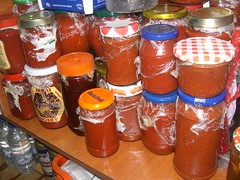
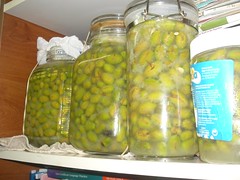
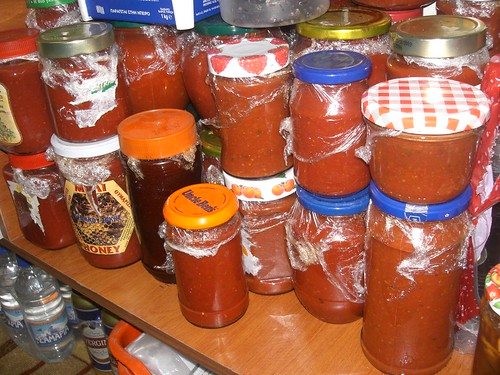
I spend a lot of my time preserving fresh produce, especially in the summer. Two of the most important products in our Cretan kitchen are tomatoes and olives.
"
Traditional societies," Rachel reminds us, "
were aristocratic, made up of the many who toiled to produce, process, preserve and prepare food, and the few who, supported by the limited surplus, could do other things." Throughout the world, there was, is, and always will be, a divide between the rich and the poor. The world survives on this kind of separation of the people. The rich will always have access to better quality food in a greater variety than the poor, while the poor will constantly be working to provide food and other services for the rich. Some people will continue to "get on with their lives", while others will continue to provide the basic services the former group needs to continue with their lives.
Despised products like corn syrup and GMOs will continue to be hated while, at the same time, be considered more acceptable elements of the food chain for certain elements of society (the poor is an obvious one), besides bringing in great profits for their makers. Discount supermarkets will probably always sell the cheapest canned tomatoes, while placing an organic label on the packaging will always give added value; you buy the quality that you pay for. The range in prices for food is there to remind us that we all have different pockets and different priorities. No matter how the world changes, people will always need to be fed, and the food people generally want to eat still comes from freshly grown produce that is processed, preserved and prepared into an edible form, not from chemicals or glass tubes. Fresh food will continue to form the basis of fast food.
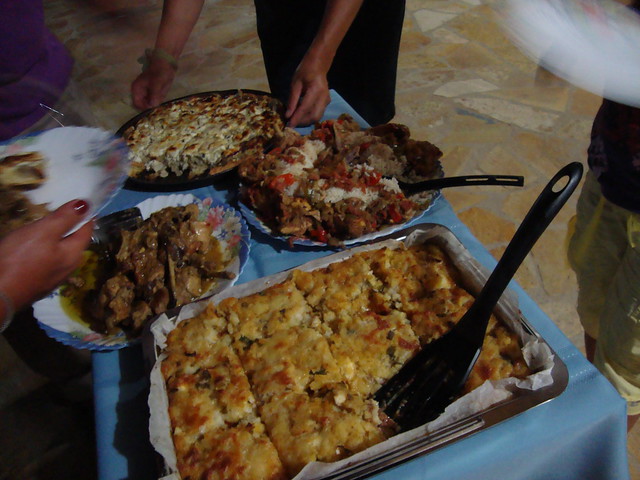
We were recently invited to dinner at the country house of some friends who spend their summers on the island. When it was time to serve the meal, the first thing the hostess did was to tell us what each dish was, and the origins of the ingredients: "The chicken is from the village, the rabbit is from my mother's farm, and the artichokes (in the tart) were freshly picked and refrigerated by my mother in the spring." None of the food was processed by the hosts, and some of meal wasn't what I'd call traditional Greek cuisine, but they took pride in knowing the origin of the fresh ingredients.
"City dwellers, above all, relied on fast food." No surprise, and they still do, since they are the ones most likely to live in small dwellings with tiny kitchens and no gardens; they are also the ones who are most likely to work not just outside the home, but for long hours away from home and quite a distance from home, so they need to have easy-to-store (or -buy) food that can be cooked or reheated quickly. There are times when these townies differ little from mountain dwellers who need to have a bit of salt cod in their pantries (or frozen fish in their deep freeze) if they want a taste of fish every now and then without putting themselves to the trouble of procuring it the day they want to cook it. That's what evolution has given us: time-saving technology and the ability to store safely preserved fresh food that doesn't go off quickly.
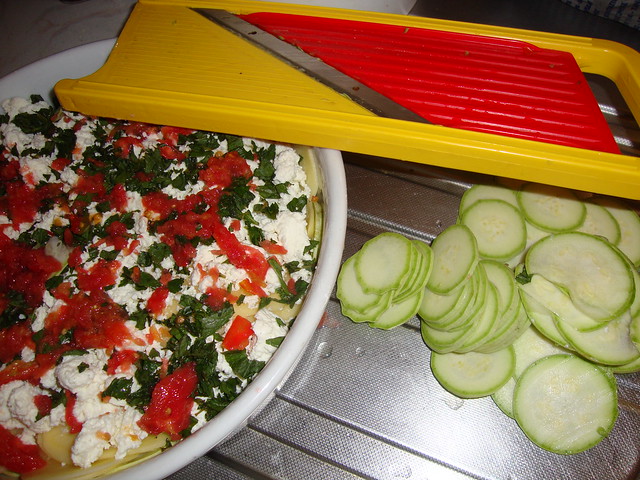
Boureki in 15 minutes, with the help of a mandolin slicer, then into the freezer it goes, with a note attached: "Just add oil"; 'fast food' that my grandmother would have recognised. The aspect of "servitude" is now performed by technology.
That's why I can send my kids away to study without worrying what they'll be eating
**, because no matter how 'bad' the food is wherever they are, no matter how much of that notorious 'bad food' they pour into their bodies, food safety can generally be relied upon by keeping in mind a few general rules. And that's the idea that I have about that village house: while my kids are away eating 'bad food', I'll be growing fresh produce and turning it into '
good food' (just like I do now), so that when my brood comes home for the holidays and we want to spend quality time together as a family, I won't need to slave away in the kitchen preparing their favorite
pastitsio or
boureki or order take-out food because I had gotten used to having more me-time and don't want to give it up. I'll just pop a tin of freshly preserved food out of the fridge and get on with life, and my kids won't even know it wasn't prepared on the same day - they are eating the same food cooked in the same way now.
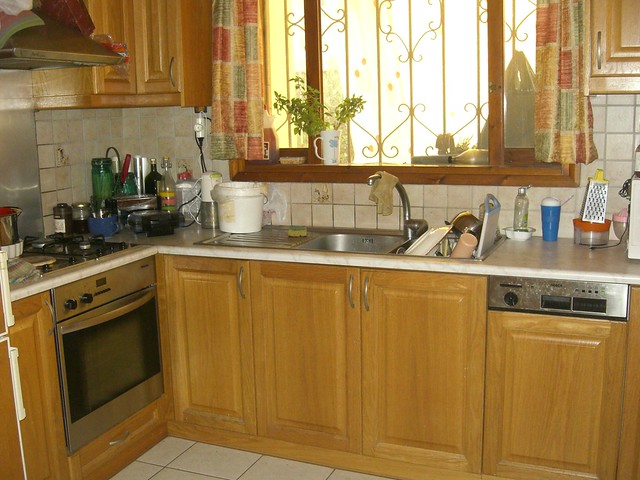
Apart from the refrigerator and deep freeze, my right-hand man in the kitchen when I preserve/prepare fresh produce is my instant mixer/cutter - can you see it? It's a tireless servant, cheap to buy and lasts for ages.
I take exception to the idea that slow food is just a notion of bygone times: "...
it is easy to wax nostalgic about a time when families and friends met to relax over delicious food, and to forget that, far from being an invention of the late twentieth century, fast food has become a mainstay of every society." My experience of eating in Crete goes wildly against this: people take great pride in
the food they grow, cook and eat, and they always share it among family and friends. It is unthinkable to do otherwise. It is also difficult to believe (for a Greek islander like myself) that most people do not partake of
a delicious meal in a relaxing environment with their family; they are missing out on one of the greatest moments in life. A common prejudice is that people who are very involved in food production live a simple isolated life and do not have a good grasp of modern life; in short, they show signs of a lack of progress. How far away from the truth that is in Crete.
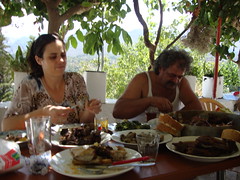
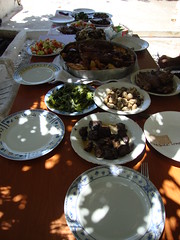
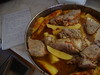
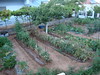
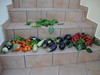
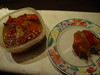
Vegetarians aside, I pity those who cannot savour the taste from the tapsi in the photograph below. Everything (literally, including the salt) was harvested/raised/produced by the man (he's my age) in the top left photo, while his wife (sitting next to him, 10 years younger) cooked everything shown on the table in the top right photograph. You might be wondering if they live a peasant lifestyle: he's a carpenter, she's a school cleaner, and they live in the town in a semi-detached suburban house. Their land and their food is very important to them. Their 3 children go to school in the town, and take part in urban activities. They are no different to the teacher and the taxi driver who visited them. 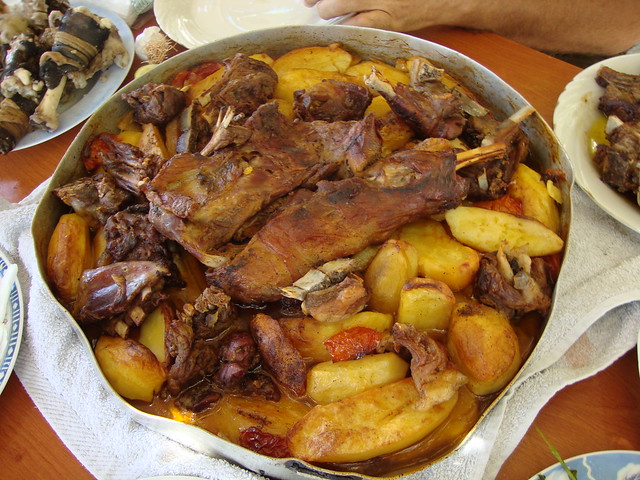
The idea that home-cooked food is 'slow' will never have occurred to some Cretans, since they often assume that this is the only kind of food that can be called 'φαγητό'. When they eat 'fast food' (don't confuse this term with its modern meaning of 'junk food'), they'll tell you that they didn't cook any 'φαγητό' (food) today, because they didn't have time, eg during the
olive harvest, but even though it wouldn't be as
appetising or
appealing as their slow food, it would still have been somewhat
tasty and
delicious, maybe a boiled farm-fresh egg and a potato, served with whatever fresh seasonable salad vegetables are on hand, all doused with olive oil, and a few slices of bakery bread, with maybe some tinned tuna or luncheon meat for extra protein.
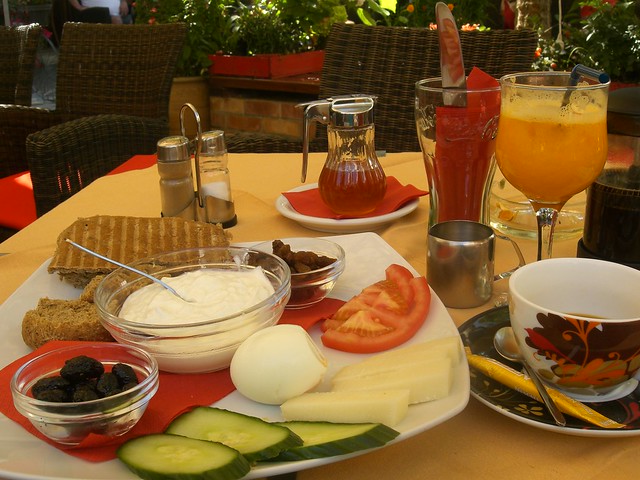
This kind of meal is touted as Cretan breakfast - it is what tourists look out for on a tourist menu. Most of the food in the photo involves requires a minimal amount of processing; it can also be said to be 'fast food' as it is very quick to prepare.
This kind of meal is called 'πρόχειρο φαγητο' (Google translates this phrase as 'snack'), nearly always made with slow food, not a supermarket TV dinner or a can of
baked beans. Fast food to those people is a boiled potato without the
horta, a salad without the
roast meat, the ubiquitous slice of bread and hunk of cheese that children carried to school with them for 'κολατσιό' reminiscent of the post-WW2 era when Greece was rebuilding herself from the ravages of war.

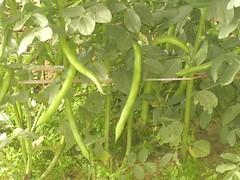
 As I was writing this post, I went about on my normal daily food-preparation duties: cooking the Sunday roast (using granny's recipe), watering the garden, and harvesting fresh produce. My daughter made me a (classy) glass of orange juice using oranges from our own trees, and at the end of the day, I ate some of my home-prepared 'fast food' on a slice of bakery bread and thought about the different ways I was going to prepare/preserve my produce (the eggplants were turned into moussaka (frozen in portions), while the zucchini were made into boureki for the next day's meal.
One thing I particularly like about the food customs in Crete is that they haven't quite yet reached the completely globalised point as they have in other cultures. Nearly all global foods are available on the island, but you will have to visit the
high-end supermarkets to find (to put it more politely) acquired tastes. For instance, don't look too hard to find
chili-flavoured strawberry jam in Crete. Not that people shouldn't eat chili-flavoured strawberry jam, but here, they don't need to, nor do they demand it, and if it were available, given that people's tastebuds are culturally attuned, it probably wouldn't be popular. Again, only the
high-end supermarkets make the effort to sell outlandish food, eg, of all things, Mexican blackberries! Of course, outlandish food calls for outlandish prices: imported Dutch strawberries (off-season) are now available for over 11 euro a kilo!
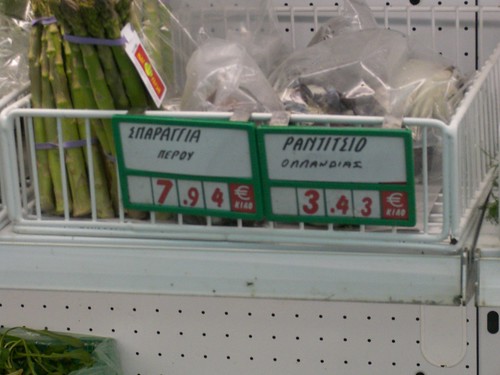
Peruvian asparagus spears are available in the local supermarket (at absurd prices), but it's highly unlikely a local will buy them. This kind of food is generally bought by tourist residents, ie Northern Europeans who have retired here.
In Crete, people can still find a great variety of good quality affordable locally produced food. In the prefecture of Hania alone, I counted at least 15 varieties of locally produced cheeses (the French would relish in the sight!), each made in a different village of Western Crete, less than 100 kilometres from the main town, ranging from 10 to 18 euro a kilo, in the local supermarket. This range does not include the imported cheeses which are also available, eg Edam, Cheddar and Gouda, to name a few of the well-known mass-produced global cheeses. Local, national and imported cheeses are eaten with a different purpose in mind; convenience and choice are available for all.
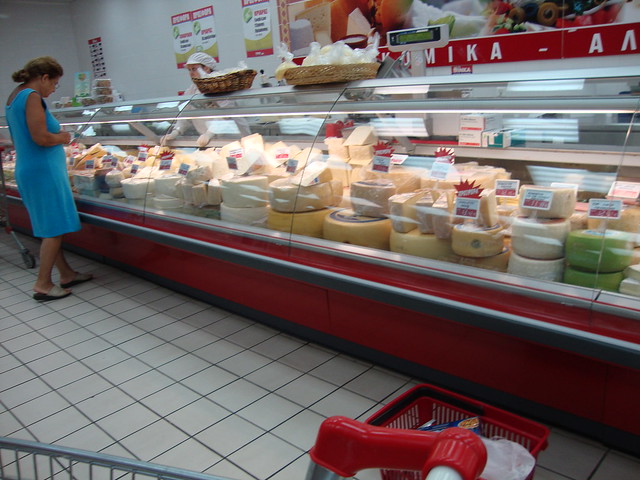
Cretans generally demand a high degree of traceability in their food. Origin and degree of processing are just as important as price and taste in their decision to buy fresh produce. The range of graviera cheeses (starting from the white block where the woman is standing, right up to the green round on the other side) available at the local supermarket shows just how much variety there is in a small town like Hania - these cheeses are all made in villages within less than 100 kilometres of the main town; they all have their own distinct taste and cannot be confused with each other. These cheeses are rarely available outside Hania, and each region in Crete has its own local cheesemakers. In the summer, Athenians holidaying in Crete buy cheese rounds in their hordes, as variety in Cretan cheese isn't easily available there - transport costs make it unfeasible to send such products even to the mainland...
The food industry is a profitable one in Crete; people still look for quality and ask about origin. Does this make us culinary Luddites? Are we eating in an unsustainable or old-fashioned manner that does not bode well for our future progress? Is it just a waste of time to
teach the next generation about this old-fashioned food chain, because in the hi-tech, wireless world that they'll be living in, they won't have the time to cook and eat in this way? I really don't think so. From my own family's experience, where I try to ply them with non-Greek favorites, I have come to the conclusion that people will continue to eat the way their culture has brought them up to eat:
An American needs food but wants a hamburger, French fries, and a soft drink. A person in Mauritius needs food but wants a mango, rice, lentils, and beans. Clearly, wants are shaped by one’s society. (A Framework for Marketing Management, by Philip Kotler, 2001).
*** *** ***
Just like the average Greek, fast food (of the type referred to in the article) is everywhere in my own life - but not necessarily in the form that we normally associate with fast food. Fast food allows me, the person who cooks for the whole family, to get on with my own life: I usually buy our daily bread from the bakery; I buy fresh meat ready chopped in the way I want it to cook a meal; I keep a small piece of ham to slice for sandwiches; I buy fruit and vegetables that I don't grow from the supermarket; we always buy our cheese. They are my fast foods - but they were prepared/grown/raised in appropriate facilities with the latest technology that the producer can afford (this is especially the case with bread), using as many
locally sourced ingredients as possible. When we process our own food, this shows 'choice', not a lack of progress. But there is also a lot of fast food in my house that I have prepared myself. For a start, there are tins of boureki, pastitsio, moussaka, papoutsakia, home-made pizza and spinach pasties in my deep freeze throughout the year, made with the fresh produce from our garden, which I processed, prepared and preserved. That's how I can have a 'fresh' meal on the table every day even though I didn't have time to cook.
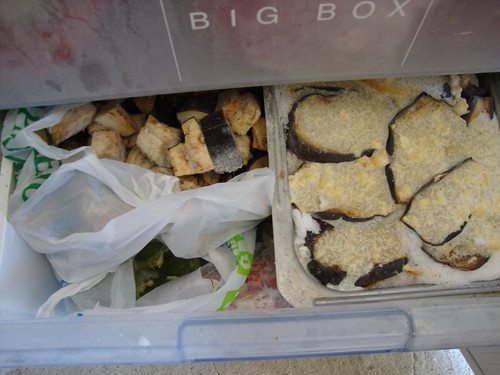
Aubergine cubes, bell pepper shells, tins of prepared Greek meals (the one you can see is moussaka), all waiting in my deep freeze for their turn to be eaten in less abundant (and busier) times.
A (foreign) friend of mine once asked me if I had a once-a-week takeaways night in our house. I admitted that I didn't. This is not because we don't like takeout pizzas or souvlaki - they are both regarded as treats, not 'πρόχειρο φαγητο'. I can produce my own version of fast food in the same time that it takes to order it over the phone and wait for it to arrive to my house: a slice of bread or some bakery rusks, topped with a piece of cheese, cured olives from our fields, a piece of
roasted pepper preserved in its own marinade, a freshly marinated anchovy,
et voilά, I've got myself a pizza (albeit in deconstructed form). When we eat food that wasn't prepared by ourselves, it usually feels like our own because there is traceability in the ingredients used. Having access to a variety of nutritious safe fast food shows 'progress'. It isn't necessary to resort to the masses of verified junk loaded with sugar or fat.
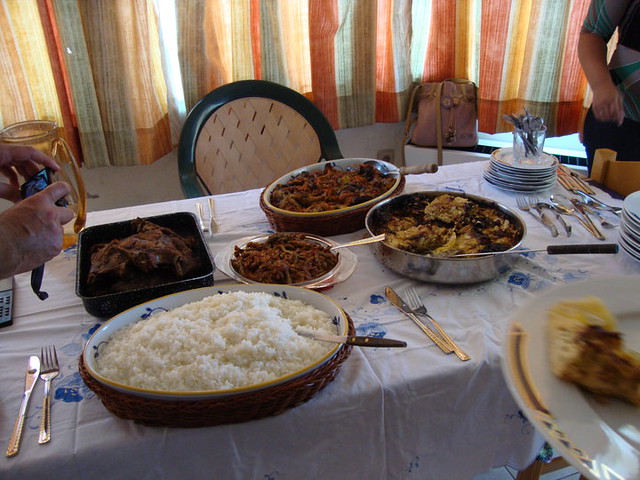
When I met up with Kalofagas recently on his first visit to Hania, we (his friends in the area) decided that the best meal Peter could eat was a home-cooked one, because that is what truly represents the taste of Crete, not a standard uniformly Greek tourist restaurant meal. My "ethnic" dishes of "peasant origin" may have been "invented" for the "urban aristocrats" but they probably never tasted as good as when they were cooked in a farm kitchen!
The menu was as follows: ορεκτικά - marinated sardines, roasted peppers, eggplant dip; κύρια πιάτα - pilafi, boureki, eggplant imam, yiahni green beans, pork steaks; επιδόρπια - orange pie, kalitsounia with honey.
A question often asked of school pupils to discuss in the classroom is what technological innovations they would like to see in the future that haven't yet been invented. When they've all finished telling me about aeroplane cars and cleaner-robots, I then tell them what I'd like to see invented some time: an oven which will automatically prepare my choice of meal where my only input is the provision of the raw ingredients. Now that's what I call tasty freshly prepared fast food, made with as much fuss as the way the dishwasher gets my plates spanking clean.
*** *** ***
Rachel insists that, as a historian, she can't accept the sharp divide between good and bad food, in the way that the Culinary Luddites claim. She makes a plea instead for Culinary Modernism:
"We need to know how to prepare good food, and we need a culinary ethos, As far as good food goes, they [the Culinary Luddites] have done us all a service by teaching us how to use the bounty of delivered to us (ironically) by the global economy. Their culinary ethos, though, is another matter. Were we able to turn back the clock, as they urge, most of us would be toiling all day in the fields or the kitchen; many of us would be starving. Nostalgia is not what we need. What we need is an ethos that comes to terms with contemporary, industrialised food, not one that dismissed it, an ethos that opens choices for everyone, not one that closes them for many so that a few may enjoy their labour, and an ethos that does not prejudge, but decides case by case when natural is preferable to processed, fresh to preserved, old to new, slow to fast, artisanal to industrial. Such an ethos, and not a timorous Luddism, is what will impel us to create the matchless modern cuisines appropriate to our time."
In other words, food in this day and age has to come
fast, otherwise we won't be able to cope with the other demands made on us by modern life. There is an assumption in the article that most people are (or should be) living urban lives, even though some of us have made a conscious choice not to be urban. It all depends on priorities. For rural people however, it is anathema to suggest that the emphasis on fresh food produced on a small scale is a misconceived notion; it can be equated with removing the very means that allow them to survive. In order to use 'fast food' instead of producing/preparing their own 'slow food', not only will they have to buy their food, but they'll have to be in paid employment to achieve this, and that's just not going to happen for at least 12% of the Greek population in the coming winter;
Fraser and Rimas are probably correct to a certain extent when they
advocate that we learn to store surplus food, live locally, farm organically and diversify our crops.
As a linguist, I'd argue that Rachel didn't really mean we should be eating modern fast food at all - just fast
er (and safer) food than what it was in the past.
*The inverted commas " have been used to denote quotes (in bold) from the article.
**Some Greek mothers never stop worrying about what their kids are eating when they are studying as far away as the UK. They will send them food parcels to their children, containing meals they cooked at home the previous day, froze solid, then sent to the UK by courier! (But that story is for another post.)
©All Rights Reserved/Organically cooked. No part of this blog may be reproduced and/or copied by any means without prior consent from Maria Verivaki.
LABELS: CARBON FOOTPRINTS, cost of living, CRETE, current affairs, economic crisis, family, FREEZER, GARDEN, GREEK CUISINE, history, JUNK FOOD, KITCHEN, LARDER, LOCAL FOOD, MEDITERRANEAN, POVERTY, SUMMER, there's no such thing as a free lunch, TRADITIONAL, WINTER, urban life, cooking can sometimes be mundane, ORGANIC, REVIEW, SUPERMARKET, what's in a name?
 I'm no longer worried about when Greece runs out of money, as this is already a well established fact about Greece, a country so desperate to find money from anywhere it can, that it's practically begging (non)tax payers to pay their taxes, by allowing people with unpaid tax dues up to 31.12.2103 to pay just 50% of what they owe if they pay half what they owe up front (or: they can pay whatever they can, and the same amount will be forgiven, while the remainder can be paid in small amounts over a long period of time). As for those who paid all their tax dues on time, like myself, well, they can revel in the knowledge that they simply don't owe anything, it's that simple. (So if you are the 'paying' kind of person, you are the true loser; if you were a true believer of the ΔΕΝ ΠΛΗΡΩΝΩ movement, you have just been vindicated.)