Showing posts with label no such thing as a free lunch. Show all posts

Tuesday, 14 August 2012

Boureki for the freezer (Μπουρέκι για την κατάψυξη)

My most popular posts have remained stable over the years that I have been writing this blog (which is five this month - happy blogoversary to me!): fasolada (bean soup), Roses (a story about the chocolate brand) and how to freeze aubergine (see sidebar on the right-hand side). The latter has become the most popular post this month, given that it's summer and the aubergine season is in full swing.

I freeze everything that grows in our summer garden: eggplant, zucchini, peppers, tomato, beans, corn and herbs (as well as winter garden produce, in season); my biggest forte is freezing a meal that I have made from such produce, at a stage where it is ready to cook without defrosting. My freezing techniques have been learnt by experimentation, mainly borne out of the desire to preserve a great amount of excess produce. Some of my techniques sound quite unusual, and they probably aren't well documented in other sources, because they seem to go against what we take for granted.

Eggplants, like potatoes, turn brown when their peel is removed and their flesh is revealed. You need to work very quickly to stop this from happening when you want to freeze them. If they are left to go brown, they are useless in terms of freezing. The most important aspect of freezing any vegetable is to freeze it at its freshest, in the same form that it will be cooked when it is to be used.

Boureki, a Chania specialty containing potatoes, zucchini and mizithra cheese, with herbs and olive oil added, is a self-crusting pie. I freeze it at the point where it is assembled in the tin with all its ingrdients, except the olive oil, which is poured over the top. Some cooks make boureki with the addition of pastry, but I never do this - it's too time-consuming.


The tins go into the freezer at the ready-to-cook stage - all they need when I decide to cook them is to pour some olive oil over them. Because I freeze a lot of boureki every summer (6-8 family-sized tins), I place them very carefully, one by one, in the freezer. I never freeze one tin on top of another - they will stick together (even when the bottom tin is frozen solid and you place a fresh tin in top). They can be stacked on top of one another once the tins have all frozen. This goes for all my pie-type freezer meals: moussaka, pastitsio and spinach pies.


Sometimes I mix the ingredients together in a large mixing bowl, other times I make the boureki in layers. At any rate, the potatos don't discolour. The thin slices of frozen potato are visible in the photo. To avoid freeze-burn, it's better to keep them in a plastic bag.


When it's time to cook the boureki, I take a tin out of the freezer, pour 1/2 cup of olive oil over it and stick it in the oven - WITHOUT DEFROSTING! That way, the potatoes do not have time to discolour. The boureki cooked from frozen does not need extra water added to it - it will have accumulated enough liquids from the freezing process.

Boureki is always beter the next day, as Laurie says, who made boureki in Alaska with a mixture of feta and ricotta cheese, as mizithra is unavaible there. My frozen boureki is always made to be eaten in this way: I cook it in the evening (last year I was cooking them in the wood-fired oven), and it is left overnight to set. The next day, it comes out of the tin like a piece of pie. It makes a very fresh nourishing meal in the winter when everyone comes home from school or work very tired, and there are other activities to attend to in the evening, leaving no time to cook meals 'from scratch'!

©All Rights Reserved/Organically cooked. No part of this blog may be reproduced and/or copied by any means without prior consent from Maria Verivaki.

Saturday, 19 May 2012

500 words: Snails on Royal Albert

Flash fiction: 500 words (or thereabouts) 

The doorbell was ringing. It was almost four, siesta hour. Nothing moved at this hour, except children on bikes in the empty πλατεία. The only καφενείο and μπακάλι in the village were both closed; they hadn't opened their doors for two years now.

Evanthia had picked up the village routine very soon after moving to the island, on her husband's insistence, since they weren't making ends meet in the city. The daughter of a Greek Australian businessman, she had come to Greece at the age of twenty on her first unaccompanied holiday to the mother country. She met an electrician, giving up her university degree half-way through to get married. The children came soon after. Most Christmases were spent in Australia, while Easter was always at her husband's village – and her own parents’birth. After twenty years of living the life of a cosmopolitan middle-class housewife in a coastal Athenian suburb in an apartment bought by her parents, she suddenly found herself in an old εξοχικό, surrounded by grazing fields, olive groves and hilly countryside.

Before their move, they sent the children to their grandparents in Australia. The twins were due to start university; they may as well study where they would probably end up living. Evanthia’s family were surprised that she wouldn't go with them. Her family pleaded with her: “You’ll have a better life here" where Vaggelis could work in the family business (window cleaning high-rise buildings).

Her siblings could not understand what was holding her back. Evanthia wasn’t happy leaving an urban area with all its creature comforts. But she loved her husband too much to give him up, something she couldn't easily discuss with her divorced brother or unmarried sister. No matter how close they were as a family, Evanthia felt the taboo of discussing her paersonal happiness, lest she sounded condescending. To them, life was about moving up the employment ladder and into the property market, which their parents had already helped them to do anyway.

Vaggelis adamantly refused to hear anything of moving to the ξενιτειά. “I’m not leaving the country I was born and raised in at the age of 50 to die in a foreign country!” He’d been out of work for a year before making the decision to move away. “You don’t have to come with me,” he reminded her, “but don’t expect me to stay here when all around us people are leaving.”

What Evanthia found most difficult to cope with was the very basic way people approached life in the country. She knew nearly everyone, being related to most people, but they had very little in common. Their world as housewives was on a different tangent to her former life. Instead of the supermarket or the λαϊκή, they’d go to their fields for ingredients to cook with. Nothing was simply heated up in a microwave – everything required preparation from scratch.

“No wonder you’re bored,” her neighbour Keti told her. “Gather some snails and by the time you clean and cook them, the morning is over.”

Evanthia got off the sofa to open the door, where she found her neighbor holding a plate of some strange-looking dish.

“I bought you something!” Keti laughed sweetly, with a radiant smile on her face.  “You know Vaggelis loves this, don’t you?” On seeing the snail shells, Evanthia was seized with revulsion, but managed to keep a straight face as she didn’t want to disturb the peace. Vaggelis was sleeping, after working in the olive grove grafting wild trees with domesticated species. She took the plate from Keti’s hand and was just about to thank her when something caught her eye. She looked intently at the plate.

Snails on Royal Albert:my mother's crockery sits in my china cabinet, neavily unused.
“It’s freshly cooked, if that's what you're worried about,” Keti assured her, noticing her scrutinizing countenance.

“I know that,” Evanthia replied. “I just never expected to see χοχλιούς on Royal Albert.”

“Ρού-α τί?” Keti had always found Evanthia difficult to understand herself.

©All Rights Reserved/Organically cooked. No part of this blog may be reproduced and/or copied by any means without prior consent from Maria Verivaki.
Thursday, 4 August 2011

The 2011 Greek cabbies' strike (Απεργία ταξί)

UPDATE: The strike ended on Friday, 5th August, 3pm. 

 My husband is in the third week of strike action taken by his professional group, the Greek cabbies. During this period, he was on airport duty almost daily, directing tourists to the buses that would take them into the town, ensuring that the strike was not broken (cabbies were only allowed to accept work without money), and making sure that freelancing moonlighters were not hijacking the trade (a good number were caught making a quick buck). This strike action is unprecedented in that it is the longest lasting strike in the history of the Greek taxi drivers' profession. During this time, some tourists questioned him about the strike and what he thought of the chaos it caused. 

Isn't a bad time for you to be striking?
Yes, it is. As a cabbie working in a Greek summer resort town, I make money in the summer, so these three weeks, which have come at the busiest time in the year for me, have cost me a similar amount of money as I would have made in January and February put together. But this strike couldn't have been delayed. since the Minister of Infrastructure and Transport (MIT) decided to announce the changes now, in the middle of the season, so we've had to go on strike at this time.

What exactly are you striking for?
The present MIT (Yianis Ragousis) overturned a decision by the former MIT (Dimitris Repas), and the changes he has decided to bring about in the profession of the Greek cabbie would in effect spell the death knell for most cabbies. Repas deregulated the Greek taxi industry a year ago, but he placed a ceiling on the number of cabs each area will have. His idea was that the Greek taxi industry will follow other European states' laws on the number of taxi licences issued in an area, which is usually about 1 cab per 1000 inhabitants. After the cabinet was reshuffled, Ragousis took his place and overturned Repas' decision by allowing free reign on the number of licences issued in an area, with no cap, completely disregarding his predecessor and other European states' laws already in force. If the industry is saturated, then there won't be enough work for all of us working in it, let alone the loss in the value of the licence, which most people working in the industry have paid for dearly.

Why are cabbies against deregulation? Isn't it the way things are going in a country like Greece which has serious economic problems?
Just to put things straight, the cabbies aren't against deregulation. They simply want it to take place with laws that will protect both old-timers and newcomers to the profession. Such laws already exist in other European countries. All we want is to be like them, and none of them have completely deregulated taxi industries. When deregulation comes, it's still going to hit the existing cabbies. There'll be mini-buses, private care hire, mini-vans, taxi fleets, all-inclusive airport transfers, hotel chauffeurs, and a whole host of new services that haven't been exploited yet in Greece, like they are in other countries. But these services exist alongside private cabbies like myself, along with well-established rules to protect both customers and businesses.

taxi
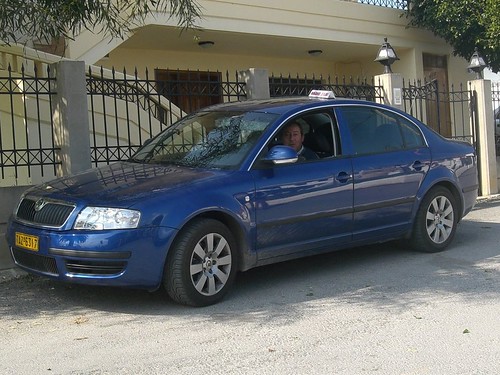
Mr Organically Cooked in his cab

But isn't this strike hurting the tourist industry at a critical time?
Yes it is. But when you have been given an ultimatum, what should you do? Should you just grin and bear it? By striking, you are showing your indignation. A well-organised strike has a better chance of making an impact. So far, no one in Greece has chosen to accept the fate handed out to them by the government. Everyone goes on strike. Strikes are a way of life in Greece. At any rate, tourists use taxis mainly for port transfers. They don't use taxis the way Greek people do, or should I say used to, when the Greek taxi was considered very cheap. They know taxis are expensive means of transport from their own experience in their own country.


What do you think of your colleagues' action blocking access to some ferry ports and airport terminals around the country?
Such actions are deemed harmful for the tourist industry, but again, I don't believe it. It simply gives Greece a bad name, which the country has already earned from our politicians' actions! Again, it's politicians' actions that have caused this strike! The actions of the taxi drivers at the ports were wrong for moral reasons, but people should be asking themselves where the police were to stop them from behaving like that. In any other country, this wouldn't have taken place; why was it allowed to take place in Greece?! The police only got involved when they realised we were serious; surely, they should enforce law and order at the first instance, and not take a wait-and-see stance.

But many of those tourists may not visit Greece again, after what they went through during the blockades!
Well, I don't doubt that they will be angry, but somehow I doubt that they didn't know what they'd be in for if they came to Greece. I don't use the internet much, but my wife who uses the internet all the time says that there is no one in the western world, where nearly all our tourists come from, who doesn't know about the problems that Greece is going through. The Greek crisis has practically become a serial with thousands of episodes, most of which contain untruthful claims made by people who don't speak our language, don't understand our culture and don't even live here! Everyone seems to have something to say about Greece these days, because she's on the news all the time, all over the world. People come to Greece for a holiday because they want to, not because they are afraid their holiday will be ruined. At any rate, they probably see Greece as a safe holiday destination, which is why we've had record numbers of visitors to Greece this year. We're being told that this is due to the Arab unrest, but I'm not convinced that people are coming here just because they can't go elsewhere. When I go on holiday, I make a conscious choice about the destination, and I know what I want to do when I get there. Each place is unique. I don't think western tourists make less intelligent decisions than I do.


But the blockades stopped tourists from doing what they wanted to do while they were in Greece, so it was like they wasted their money coming here!
The blockades were enacted to make a statement to the government. Our unions constantly asked the MIT to see us and discuss the situation so that we could resolve it, but he keeps telling us that he isn't backing down on his new interpretation of the law, and he could only talk with us after summer. Somehow, the cabbies had to make a statement, and like all Greek strikes, it involved some chaos, which is a Greek word. Chaos is as old as ancient Greece! And we have to accept that sometimes things go wrong on holiday. Just look at what snow does to the Eurostar trains, or what happens when volcanic ash disrupts flights for two weeks. Travellers who were caught up in the disruptions still managed to sue the airlines and train companies just because their holiday was stuffed up by an unpredictable act of nature! At least in Greece, strikes are announced, so if you still decide to go ahead with your trip, even though you've been informed about the strike action through website information, you are partly to blame for being a victim of your own fate.

While you're on strike, how are you coping financially?
That's a very tricky question. Like all freelancers, most cabbies will have savings. Cabbies are usually family-oriented men, so if their wives work, they'll be in a luckier position. The ones who I really feel for are those that entered the taxi trade only recently, because they are most likely to owe money on their cab. They've got serious bills to pay. I'm glad I live in the country because at least my food is free. Athenians don't have that luxury. Being out of pocket is part and parcel of striking.But if we don't strike, we risk losing our trade completely. Since the announcement of the deregulation, an application for a fleet of 1700 taxis has been lodged with the Attika (Athens) peripheral administration unit. Who can afford to buy 1700 licenses on the cheap? Only people like Vgenopoulos, the owner of Olympic Airlines, who will then add an airport transfer to each flight, using his fleet with us as low-paid chauffeurs. It's a clear case of the big fish eating the little fish, impoverishment through globalisation.

  Although I don't completely get it, I guess Sunday's (6-Aug-2011) Kathimerini magazine supplement cartoon is trying to show the strength the cabbies showed during the strike (akin to brute force).

How likely is it that your actions will have an effect on changing the government's stance on the deregulation of the Greek taxi industry?
We're hopeful that they are taking heed of our actions, because our strike so far is the longest on record in our sector, so we are showing endurance at a critical time when it's hurting our pockets, and we would really truly rather be out there working than losing money. The fact that Ragousis refuses to see us and the dissent concerning his actions within government circles makes us feel very hopeful that this issue will be resolved the way we believe it should be. Strikes always involve an element of risk. You may get nothing out of them, which is what happens most of the time these days. But if you have a real cause, and you show how strongly you believe in it, then you have to stick it out. That's what we're doing.

*** *** ***
As I write this, we are awaiting the result of tomorrow's talks, not with Ragousis, but with the heads of the peripheral administration units of Greece (a clear sign of the government losing face, by not sending its own representative), who have pledged not to issue any new cab licenses until the new laws are drawn up and the taxi unions are given a chance to debate them. There is a 99% chance that the strike will be resolved. This is a clear defeat for the government, who tried to enact the new taxi laws by presidential decree, which means that the law does not need to be debated (whereas drawing up a bill means debate before the law is passed, after which it cannot be changed). Since the Greek economic crisis broke out, the cabbies' strike is the only one among the low-middle class professional establishment in Greece to claim a partial victory during the extreme austerity conditions exercised by the government, possibly due to the unfairness that it uncovered, coupled with the fact that it combined endurance with a nationwide compulsory strike (unlike the public sector, where striking takes place 1-2 days and is optional for the union members).  

UPDATE: The strike ended on Friday, 5th August, 3pm.

©All Rights Reserved/Organically cooked. No part of this blog may be reproduced and/or copied by any means without prior consent from Maria Verivaki.