Tuesday, 23 July 2013

Wild aromatic Cretan herbs (Άγρια αρωματικά βότανα της Κρήτης)

A friend from New York who has been holidaying in Crete this summer told me how much she was enjoying the island's aroma, so much that she would rub her skin with the wild herbs found on almost every roadside to keep their perfume on her body. Natural smells of this type are not to be found in her environment, and she simply wants to savour them for as long as she can, before she returns home, where the smells and aromas have little to do with what is growing in the soil.

The wild natural smells that surround me, which are easily encountered almost everywhere on the island, being especially pronounced away from urban spaces, are often taken for granted by the locals, because they are found in plethora. Wherever I walk, I am not far from a bristly bush of bright purple wild thyme or a wild-growing rosemary plant. Then again, everyone has something highly aromatic growing in their garden or among their potted plants. Smells chase you in Crete.

I recently proof-read a Master's thesis based on a detailed profiling of four Cretan herbs that grow in the wild:

Origanum microphyllum, 
Origanum microphyllum - mantzourana in Greek, used dried, for tea (always in combination with Sideritis syriaca/cretica). "Origanum microphyllum (benth.) Vogel, commonly called “Matziorana”, is a perennial dwarf shrub endemic to Crete (Greece), with numerous stems 20-50cm usually branched... It is used as an aromatic and medicinal plant, usually as medicinal tea by infusing leaves and/or inflorescences in boiling water."
Origanum dictamnus, 
Origanum dictamnus - diktamos (also known as erontas) in Greek, used dried, for tea (always in combination with Sideritis syriaca/cretica). "According to ancient mythology the plant was dedicated to the ancient Cretan goddess Diktynna and thus was named dittany, it is well known since Aristotle’s time for its curing abilities and is broadly used in Crete till now as a panacea for every illness. Nowadays, as in the past, dittany is used as a condiment, herbal tea plant to cure cough and sore throats, relieve stomach-ache and several pains (Kouri et al., 2007). It has also many remedial properties such as anti-hemorrhage, healing wounds and gastric ulcers, facilitating childbirth and abortion, stimulating the nervous system (Economakis et al., 2002), spleen problems, against rheumatism and gynecological disorders, diabetes and obesity. Its cutaneous uses are antiseptic, anti-inflammatory, anti-bleeding, and cicatrizing, and since it has been characterized by the U.S.A.CFR (2009) as a safe spice for consumption, it can be applied as a natural food additive, with a flavoring, antioxidant or preservative role (Liolios et al., 2010). It was also largely used in monasteries since the middle age, by the Benedictines and Trappistines monks in the famous liqueurs Benedictine and Trappistine, respectively."
Origanum vulgare,
Origanum vulgare - common oregano, rigani in Greek, the savoury herb, used dried, sometimes fresh, for flavour. "O. vulgare subsp. hirtum is widely used as spice under the name “Greek Oregano” and it is generally accepted that the Greek Oregano has the best quality; it is used in meat products, salads, soups and sauces, but it is also commonly used in traditional medicine to treat various diseases, for instance its essential oil has been recommended against rheumatism, toothache, and was used in the past for the preparation of soaps with antiseptic properties. The infusions of the leaves and flowers are used against cold, cough, and diarrhea. It has also been reported that the inhalation of the essential oils cure chronic pneumonia. These biological properties are reported to be related to the chemical composition of the plant, especially its essential oil (Skoula and Kamenopoulos, 1997)."
and Satureja thymbra.
Satureja thrymba, throumbi in Greek, a kind of savoury herb often call Pink Savoury, which is used in a similar way to Origanum vulgare (oregano - rigani). "S. thymbra has commercial importance as it is used as spice, and its essential oil is used in folk medicine as antiseptic, tonic, gastric sedative and diuretic. It also favors cicatrization of skin sores and wounds (Capone et al., 1989). The aerial parts of the plant have been widely used in traditional medicine, to treat many ailments such as muscle pains, cramps, arthritis, and infectious diseases (Marković et al., 2011). In addition, they are used in pharmaceuticals as anti-bacterials for the treatment of cold and bronchitis and in cosmetics (Gören et al., 2004)."
These herbs are all related, as they belong to the Lamiacease family; in fact, they all sound or look like the savoury herb commonly known as oregano, which they could well be, but they are all used in quite different ways in Crete. They are rich in many substances:
The main constituents for Origanum microphyllum were β-caryophyllene (20.73%), linalool (14.67%), cis-sabinene-hydrate (12.81), juniper-camphor (7.56%), sabinene (4.41 %), γ-terpinene (4.17%), and α-humulene (4.16%). The essential oil of Origanum dictamnus was dominated by carvacrol (22.77%), p-cymene (15.34%), γ-terpinene (11.57%), cis-thujone (9.53%), β-caryophyllene (7.44%), trans-thujone (6.10%), and α-copaene (4.24%). Carvacrol (58.70%), p-cymene (9.23%), γ-terpinene (7.57%), β-caryophyllene (5.67%), β-bisabolene (2.62%) and β-myrcene (2.44%) were the major constituents of Origanum vulgare. The chemical composition of Satureja thymbra was characterized by the presence of γ-terpinene (32.96%), thymol (17.13%), β-caryophyllene (16.04%), p-cymene (14.45%), α-terpinene (2.33%) and carvacrol (2.13%)... Almost all four plant species were rich in rosmarinic acid, apigenin and its derivatives and flavanones. Caffeic acid derivatives were present in O. microphyllum fractions and also in the ethyl acetate fraction of O. dictamnus. Vicenin-2 was found in O. dictamnus fractions, in the butanol fraction of O. vulgare and in S. thymbra. O. vulgare fractions contained luteolin and its derivatives, which have also been found in S. thymbra fractions. Quercetin glucoside, ferulic acid and stachydrine derivative were only present in S. thymbra, whereas yannaneic acid, p-coumaric acid derivative and maleate of homoplantagenine were found only in O. dictamnus... Comparing the results among the plant species, S. thymbra exhibited the highest antiradical activity in all cases. It should be noted that O. dictamnus has shown prooxidant activity in one of the assays. (Asma TAIR, MAICh thesis, 2013)
The further up you walk or drive, the more the aromatic wild plants growing. Some plants acclimatise well to lower ground (my uncle has successfully grown all the above plants in his coastal village garden except for Satureja thymbra, which I chanced upon on a drive through the southern coast); some are much harder to grow away from their habitat, eg Satureja thymbra and Sideritis syriaca/cretica (which my uncle harvested from a mountain side during a recent forage).
Sideritis syriaca/cretica - malotira in Greek, used dried, as a tea, usually in combination with Origanum dictamus - diktamos or erontas - or Origanum microphyllus - mantzourana; the latter two are used in much smaller quantities than malotira, which is the main herb used to make the tea (it can also be used on its own).
Generally speaking, with a little bit of care and attention, it is not hard to grow something useful for your nutrition in Crete.

©All Rights Reserved/Organically cooked. No part of this blog may be reproduced and/or copied by any means without prior consent from Maria Verivaki.

Monday, 22 July 2013

Reading between the lines (Διαβάζοντας ανάμεσα στις γραμμές)

My children know I write a blog and that I have a facebook page, but they rarely follow what I do on the computer. They aren't yet at the stage of surfing the web to discover the world - they are at the stage where they want to download new music, play games and chat with friends. One day, I know they will google their parents' names; I wonder what they will discover. In my case, it will probably be information overload, which tends to make people switch off because they are bamboozled with too much data. For this reason, I do not get them to read what I write at this stage, even though I know that I am writing this blog for the purpose of keeping a record of what we are doing together.

The other day, my son watched me typing on the blogger platform, which came as rather a shock. You know people read you, but you don't think it's your own family. I felt 'discovered', so I thought that this would be the right time to ask him if he would like to read something I wrote on the blog. (Actually, he knew I had just been interviewed by the BBC4 Food Programme on the topic of frugal food, so I suppose he was taking an interest in why others were interested in me.) I wanted to see how much he understood of what I was writing: I don't send my kids to private language schools to learn English, and we don't do formal lessons together (even though I am an English teacher), so their knowledge of English is based on the exposure I give them to the language, and more importantly, the opportunities they get to use the language. 

The post I gave him to read contained a lot of what a teacher would call 'unknown words' (or phrases) in the passage, as his Greek school teachers would call them too: come of age, clientele, contribution, on her behalf, etc. So I was curious to see what he might make out of what he was about to read.

The first thing he asked me about was the person I was writing about. "Did you work with her?" That's what it sounded like in the text. But Thalia is an imaginary person, something I didn't want to reveal at this stage. (Most people think I write about a particular person, but that is not the case at all - my characters are an amalgamation of different people I have met; they don't actually exist in real life.) "Does she have a broken arm?" he asked me. I told him to check the tense of the verb that contained this information (it was in the past perfect, not the present tense). "Oh, she HAD a broken arm, but NOW it's NOT broken," he said. (Good, I thought.)

But I was in for a surprise: "Frappe and cigarettes - everyone wastes their money on this, except us, right?" He was reading between the lines. On the one hand, I was pleased to see this happening because it will have a great bearing in his future studies; on the other, I wondered how much I had influenced my kids, and in what way. By swaying them to think of smoking as a waste of money, I could actually be creating a prejudice in them towards smokers. This is something that I believe can't be helped in parenting: we have no control over the place where we were born, and the people who raised us. We can change the rest, but not those two things.

"What's drachma, Mum?" My son was born during the last year of the drachma being in use. He has no concept of the drachma except as something old and no longer in use, hence he could not immediately see that drachma was a Greek word transliterated into English. Despite this hiccup, he rarely asked me to explain other words in the passage, even the ones that I thought would be unknown to him, which possibly shows that he was comprehending unknown concepts by trying to fit the unknown ideas into the known ones and working out their meaning in this way. We all do this during times of information overload in the internet age.

But what impressed me most about his relationship to the drachma is that he has no memories of it. He sees drachma as something you read about in books or see in a coin collection. Drachma is not something real or useful in his life. It represents historical stories for him, ones that his parents tell him about from time to time. Drachma for him is like cassette recorders, vinyl records and dial telephones. In the future, he will be able to say he knows what those things are because his parents still have things like that stuck somewhere in the basement, or he may look them up on the internet, but he will not have any direct experience of them himself because they are not a part of his life. They are to do with the past - and that part is over and done with. 

"Is Thalia really going to go to New Zealand?" he then asked me. "Where you write 'Δεν ξέρει που πάνε τα τέσσερα,' you mean that she doesn't understand what life is like there, don't you?" My comment here is very subjective; again, his reading between the lines shows that he is using his experiences to understand what he is reading about. His experiences are based on what he hears being said at home. The theme of immigration often comes up in our discussions, but it is not a theme that my own children have lived through: they know that we aren't interested in emigrating, and now that I think about it, they have not lost any school friends to emigration. This fleeing-abroad business is a figment of the media's imagination to a certain extent - some Greek problems do not concern all Greek citizens; they simply concern the media, both in Greece and abroad, when news is sensationalised.

"Why do you think she wants to go to New Zealand?" I asked him. He didn't take long to think about his answer:

"She's got everything she needs here, but she wants more than that, and it's difficult to have everything in life when you're starting from the beginning, but she isn't thinking about that now, is she?" I dislike it when I realise I have influenced my kids in such a way, because, like most parents, we believe that we have allowed our children to make their own choices. But the truth is that at this age, they are making choices based on their parents' choices. That's part of parenthood; it can't be helped.

I was also surprised by what he understood when he read this sentence: 
If I bought styrofoam coffee on a daily basis, then I wouldn't be able to tell my kids that they should make their own chocolate milk instead of buying it ready shaken.
"But you don't buy us any chocolate milk, Mum, not even powder!" I was tempted to reply that I don't drink styrofoam coffee either, but I decided that I was probably being a bit harsh. So I bought a box of chocolate milk powder for them. And even I have begun drinking a styrofoam coffee here and there, in the form of a 'freddo, metrio me afrogala' when we go to the beach.

I notice that the packet of chocolate powder is still quite full. Perhaps this is because the kids have already understood that we can have all things in moderation, as a famous Greek once said; and on that matter, know thyself. That also helps.

©All Rights Reserved/Organically cooked. No part of this blog may be reproduced and/or copied by any means without prior consent from Maria Verivaki. 

Sunday, 21 July 2013

Melitzanopita - Eggplant pie (Μελιτζανόπιτα)

I was buying some (French) beef the other day, which I asked to be turned into mince. The woman at the supermarket counter asked me what I was going to make.

"Bifteki for the freezer," I told her, "and I will also leave some to make a makaronada for tomorrow's lunch."

"If you have some cooked mince left over," she said to me, "use it in a melitzanopita." She explained that aubergine/eggplant pie was her favorite pita. Her mother in law introduced her to it recently, making it into a large pie (made with filo pastry) which she served up as a main meal with salad, as well as on a buffet table for a party. These days, her daughter in law makes it into little pies enclosed in thick pastry (made with puff pastry sheets) and she takes them to the beach as part of a picnic lunch. "They freeze really well, too," she added.

I'd never made eggplant pie before, although I have heard of eggplant used in similar ways, eg vegetarian patties and fritters. Looking it up in my Greek cookbooks, I came across a couple of recipes for eggplant pie, made by some famous old-school Greek TV chefs. They were labelled plainly - melitzanopita - but neither used mince in the recipe: they both used dairy products (cheese and cream). One version (1990) - made by Ilias Mamalakis, who stated that the recipe was given to him by Dimitris Bliziotis, a Greek food historian - was made into a large pie while the other (1999) - made by Vefa Alexiadou (no history of the origin is mentioned) was made into individual fat cigars. Both versions used different thicknesses of Greek filo pastry and the recipes were very frugal in nature, with a clear focus on simple Greek flavours. Ilia's pie contained just coriander seeds to flavour it, while Vefa's used parsley and mint. The basic idea was to make an eggplant filling for a simple pastry casing, which could be rolled up in any way that the cook felt like making them.

Ilias' (left) and Vefa's (right) melitzanopita recipes
I thought this sounded like a nice novel way to use up the eggplant that is rolling into the house from our summer garden at the moment. It also sounded like something I would really like to make - when we hear of a new kind of food, we are open to it as long as it suits our taste spectra. Before looking up 'melitzanopita' (or 'eggplant pie', 'aubergine pie' etc) on the web - my first stop for anything that I don't know these days - I decided that it had to be a very Mediterranean taste combination, something that decidedly fits into the Greek taste spectrum. Melitzanopita sounds unusual, but the ingredients needed to make it are actually very common. Although the pie is not a well known Greek recipe, I bet that it must have been tried out at the very least on one of those morning TV shows that housewives watch, which screen while I'm at work. (By the time I come home, old Greek re-runs are playing, and then it's Turkish soap opera extravaganza time, as Greece can no longer afford to make her own.)

Sure enough, I came across a number of youtube videos from the private Greek TV channels, which often contain a mixture of make-you-feel-good topics for ladies of no particular occupation: a bit of fashion, some celeb gossip, a recipe by a home cook, with the show being hosted by strappy-dressed peroxide blondes. This kind of light-entertainment program features on most of the private channels, unlike the former Greek state broadcaster, still doing a pirate run on ebu.ch, which is now featuring no entertainment, and only political discussions, operatic music and other very politico-socio-cultural  formal types of Greek-style urban-context amusement. (I am hard pressed to understand if the operatic bits are what rural Greeks expected to suddenly be bombarded with on the pirate ERT - then again, they probably don't use internet to watch anything, ergo... pirate ERT is broadcasting not for the masses, but the minority. And let's not talk about the new public but not-quite-legal broadcaster that hit Greek TV screens a couple of weeks ago - it's quite simply an embarrassment.)
Vegetarian filling for melitzanopita
The melitzanopita was made into what looked like a delicious vegetarian pie using soft white cheese and home-made pastry (ALPHA -  June 2012). Admittedly, Vasilis Kalilidis made a really hash job of his pastry, but as I mention on my blog how trivial it is to worry about how perfect your filo pastry sheets come out: when you cut it, it's gonna get scrappy anyway, so the most important thing about making pastry is that your pie remains in one piece after it's cooked and you are serving it, whether on the plate or as finger food.
Melitzanopita with mince cooked eggplant and mince (made in the same way as for makaronada
The next link I found came from - yet again - another TV morning show recipe featured on the web, only a week after the previous one (ANT1 - 12 June 2012). Argiro Barbaridou's melitzanopita did contain mince, but it was quite a 'heavy' recipe: it also contained eggs and cheese, which didn't entice me to make it, as I prefer my pies simpler. Eggs, cheese, mince and eggplant, covered in carb-filled pastry, all in one dish reminds me of very rich meals like moussaka, which are better eaten during the winter in colder weather.

But the chef who started this eggplant pie craze appeared a whole month before the vegetarian and meat version (SKAI - 8 May 2012) - George Gounaridis' melitzanopita is vegetarian (it contains cheese). That's what I love about cooking - making the same food in different ways, to satisfy different tastes. The well known restauranteur made his own thin (perfect) filo pastry which he layered into a baking tin with a simple filling of cooked eggplant, tomatoes and onions. The finished pie looked very light and very appetising.
Don't worry about how scrappy your pastry looks; it'll break up easily at any rate once it's cooked.

So you get the picture: eggplant pie can be made any way you want - vegetarian or with meat, even vegan, with the addition of perhaps a binding agent (eg breadcrumbs, semolina or crushed nuts). The pastry can be home made or store bought, in any thickness. But the most important aspect is to make sure that the eggplant is prepared in some way before adding it to the pie. Either it is cooked in cubes, or it is cooked whole and the skin is scraped away before being used for the filling. Eggplant is one of those vegetables that needs a lot of olive oil to cook well enough not to taste like cardboard (which is probably why Gwyneth Paltrow doesn't like eggplant). To avoid the oil, it needs to be roasted. Either way, it needs some preparation time before being used in meals such as pies.
I decided to make my melitzanopita in the shape of a 'snail pie.'
After deciding what kind of filling you want, and what kind of filo pastry you will end up using, you can then choose which shape of pita to use. Whether you make a large pie to cut into pieces, or you make individual pies is up to you. I decided to make my melitzanopita into 'snail pies' - an idea I found from yet another recent melitzanopita recipe from a well known Greek TV chef (no date is given for Dina Nikolaou's pie, but I suspect it was as recently as 1-2 years) - as I really like shaping filo in this way, and it cuts up nicely into smaller pieces, for good portion control.
Sarikopita, Strifti, Kihi - they are all names for a round pie made up of pieces of filled pastry made in the shape of a snail's shell. 

While there is no shortage of melitzanopita recipes in Greek, eggplant pie is found in just a few non-Greek recipes. I have heard that Martha Stewart has some kind of Greek background, so I wonder if it was this aspect of her identity that drove her to make individual eggplant cheese pies in 2010. I think her vegetarian muffin-shaped melitzanopitakia look dreamy. Her recipe is not far off the one I used: I added strained cubed tomato, I didn't use coriander and I used crushed walnuts instead of pistachios. Crushed nuts are a great addition to pie fillings because they give pies an added texture, the nuts soak up excess liquids in a filling (the same job breadcrumbs and rice do) which often makes pastry soggy, and nuts act like protein in a vegetarian dish. The walnuts also had a sweetening effect on the eggplant, which can sometimes taste bitter, depending on the quality of the eggplant.
The cooked pies - vegetarian (top) and mince (bottom) melitzanopita
The important thing in an eggplant pie is not so much what you add to the filling, as much as the texture of the final filling. The creamier and firmer, the better, because it's easier to work with, and it cooks better. The fillings should be pre-cooked before being added to the pastry. I used Dina Nikolaou's recipe to make my vegetarian melitzanopita, while for the mince version, I simply fried some small cubes of eggplant in olive oil, drained them and then added them to some leftover makaronada mince. That constituted my meat-eggplant filling. Both pies worked well because the eggplant was paired with classic Mediterranean tastes. It all depends on what you want to make, how you want to make it, and the desired finished look of the pie.

Vegan melitzanopita for the 2nd Symposium: Food, Memory and Identity in Greece and the Diaspora taking place this weekend. The filling contains the same ingredients as the Gounaridis pita without the cheese; instead, I added some green peppers (with the onion), and a mixture of breadcrumbs and walnuts to bind the (cooked pureed) filling. It smells like mince - very cheap, very Greek and very frugal (the whole thing can't have cost me more than €1.50 to make - all the ingredients are found in most Cretan homes, and half would come from a small summer garden).

Melitzanopita, as it is made by Greeks, from the recipes available on the web, fits well within the taste spectrum of Greek food, using commonly associated combinations in Greek cuisine: eggplant and mince or eggplant and tomato, spiced up with parsley and mint, dressed in olive oil and encased in classic Greek filo pastry. It is an aromatic pie and makes a full meal, coupled with a green salad and some wine. More importantly, it's not an acquired taste and it is very versatile; these two aspects will make it popular among a wide variety of people.

©All Rights Reserved/Organically cooked. No part of this blog may be reproduced and/or copied by any means without prior consent from Maria Verivaki.

Saturday, 20 July 2013

Frugal living

That fridge looks rather bare, I thought, as I opened it up to find something to nibble on. It wasn't really empty, but I wanted something 'fast' and 'tasty' - and there really was nothing  in there that I could just grab on the spot and eat as is. Most of what was in my fridge last Tuesday (the day I was contacted by the BBC4 Food Programme to discuss frugal food) was unprocessed fresh food grown in our or another person's garden. If I wanted to eat anything from there, I'd have to process it - eg clean, peel, cut the fruit or veg. It wasn't quick enough for me at that moment.

The contents of my fridge, 17/7/2013 - I was surprised at how little processed food the shelves contained (the door shelves always contain more processed food, mainly in the form of my Asian bottled sauces).
Taking the shelves from the bottom upwards, there were:
1)  a range of different kinds of garden-grown peppers, and cucumbers (gherkins and Asian cucumbers which are popularly grown in Crete, known as atzouri)
2) some leftover vegetables, home-made tomato sauce, the last of my home-cured olives, an unopened pottle of yoghurt, some mizithra cheese and some home-made spoon sweets - bitter orange (made by my mother-in-law from our own fruit supply) and kumquat (which I made from a gift from a freind)
3) eggs - loads of them, due to generous friends whose chickens are laying in great profusion at the moment due to the breezy summer weather (free-range chickens don't like very cold and very hot weather, when they stop production), a bottle of water, 2 cartons of milk, and some dark chocolate flavoured with orange bits (I could have scoffed that, but it is not my favorite taste, so I just left it)
4) some melons and watermelon (more gifts from someone else's over-producing garden), and finally
5) a few bottles of beer, some corn husks (I have a craving to make tamales one day, so I saved the husks from our garden-grown corn), some butter spread, my home-pickled capers, a couple of cartons of cream, and some more jars of bitter orange spoon sweets (to last us to next season).

I may not have found exactly what I was looking for, but I was still quite amazed to find so much food in my fridge that was grown by us or someone we know, so much fresh, unprocessed food. (There were also some zucchini and eggplant waiting to be stored on the kitchen worktop.) In other words, most of that food came free - I did not have to spend money on it. But that only tells half the story. To procure that food, I spent a lot time. It didn't cover all my wants, just most of my needs. We sometimes lack variety when eating mainly in this way (using a lot of local fresh seasonal food), so our wants also show signs of lacking. I didn't have what I wanted to eat ready for me to eat it, so I had to make it myself.

By careful substitution, using some frozen and fresh vegetables, and the addition of some leftover meat from a feast we had attended, I made these delisious dumplings (I also made the wonton wrappers myself - recipe to follow). One dozen dumplings cost me not much more than €1.
Most people I speak to about food issues don't believe that it's feasible to rely on home-grown food, and they think I don't do my sums properly when I passionately describe the savings that can be made if food could be sourced as cheaply as possible. They insist that the quantities of such cheaply sourced food would not be enough to feed a family nutritiously. I can proudly tell myself now that what these people say is actually a good excuse for NOT making the effort required to source their food cheaply in whatever way they can. I live in the countryside, hence I have cheap sources of fruit and veg. Urban people will not have these cheap sources of food (I won't say 'free' - nothing is free in this world, it all comes with some kind of effort). My very cheap sources of food allow me to save a lot of money by using a limited variety of foods whcih are turned into an endless variety of dishes. My cheap food saves me a lot of money, because I can process it and make it good for eating at a later date too; I don't waste or throw it away, or spend money on food items that would render my cheap sources unnecessary. Most importantly, the food I have in my fridge at the moment keeps my family very healthy, and it keeps me in pocket.

The day after the BBC interview, I did a big shop at the supermarket and stocked up on things we don't produce ourselves, which complement our fruit and veg food. Kids want a ham and cheese sandwich every now and then, a bit of grated cheese is a nice way to round off a weekly pasta dish, and some ready-to-eat meat (in the form of smoked pork steak) is a good addition to a quick stir-fry, home-made souvlaki or any other meal where just a little bit of meat makes a mainly vegetarian meal so much more exciting. These cheap cured meat cuts go a long way - most will be frozen for later use. I know which supermarkets offer which specials, so I plan my shopping trips accordingly. On this shopping trip, I was accompanied by my husband, who snuck a packet of feta cheese into the shopping basket while I wasn't watching; I could have bought this feta more cheaply from another supermarket - he was obviously not prepared for the wait. 

Another thing those people say (the ones who think that cheap food sources are not easy to find) is that it is time-consuming processing food to make it edible, and then cooking from scratch. I won't contradict them - they are right, it does take a lot of time. But when that is all you have, and you don't make it a habit to buy processed food whose contents you cannot trust or do not know, then you need to do this - you need to think creatively, spend some time looking out for quality cheap ingredients, process them appropriately and find some interesting recipes to turn that food into delicious meals that your family will remember. It doesn't make a difference where you live - there is cheap food to be had. For example, I came across some 100% Greek fatless pork with very little bone for €3.05/kg - I picked up 5 kilos and stored it appropriately in the freezer in meal-sized parcels. That's all you need - you'll be able to save a lot of money by freezing bits and pieces here and there.

 I was a little annoyed with myself for not buying any chocolate on my last shopping trip; I think that;s what I was craving. Then again, the fewer chocolate bars in the house, the less chance there is of their disappearing as soon as they enter the house. To make up for the lack of chocolate in the house, I made the family's favorite chocolate cake instead, to use up some of the eggs. 

During the BBC interview, I was asked if I thought it was indeed possible to eat very frugally. And of course, I said it was. I did keep in mind that I live in a rural area (which helps), and I know I have a keen gardener in my family (which is also useful), but I also mentioned one more thing that is true for anyone who suddenly finds themselves with less money in their pockets and greater financial responsibilities: you have to change your way of thinking. You can no longer continue to live like you did in the recent past, no matter where you live, and you have to make new sacrifices that you thought you would never have to make. If you can't do that, then no matter where you live, you will eventually find yourself in difficulty, whether it's related to money or to your own sanity.

Living frugally - food- or otherwise - is possible ony if you want to make it happen. It's a matter of balancing my wants with my needs. If I can keep my needs down, I can choose which of my wants I can have. One thing I know for sure is that I cannot have everything.

©All Rights Reserved/Organically cooked. No part of this blog may be reproduced and/or copied by any means without prior consent from Maria Verivaki.

Friday, 19 July 2013

Meet the world in Crete

Yes, we have it all.


Come to Crete and see it for yourself.

Greek Cuisine, Greek Identity and the Economic Crisis: Urban and rural cuisine

During the 2nd Symposium of Greek Gastronomy, taking place 20-21 July 2013 in Amari, Rethminon, CreteI will speak about the relationship between "Greek Cuisine, Greek Identity and the Economic Crisis". For the next few days, I'll give you some ideas as to what my contribution may contain.

Photo: and my contribution will be: 
Greek Cuisine, Greek Identity and the Economic Crisis:  a Greek Identity Crisis

A few years ago, I used to work with a woman who was born in Athens and came to live in Crete when she married a Cretan. Her husband likes to go fishing, and she told me that she learnt to eat fish here in Crete due to her husband's hobby. "But I'm not a fussy person," she went on to say. "I always ate everything. But in Athens, there are some things that we simply don't eat, whereas in Crete, everyone seems to eat them. Like snails. I still don't eat them. And broad beans in their pod for that matter. And thorny artichokes. I don't eat those either."

How much of an omnivore are you? 

If you feel so inclined, feel free to answer as a comment, or on my facebook page.)

©All Rights Reserved/Organically cooked. No part of this blog may be reproduced and/or copied by any means without prior consent from Maria Verivaki.

Thursday, 18 July 2013

Greek Cuisine, Greek Identity and the Economic Crisis: TV dinners

During the 2nd Symposium of Greek Gastronomy, taking place 20-21 July 2013 in Amari, Rethminon, CreteI will speak about the relationship between "Greek Cuisine, Greek Identity and the Economic Crisis". For the next few days, I'll give you some ideas as to what my contribution may contain.

Photo: and my contribution will be: 
Greek Cuisine, Greek Identity and the Economic Crisis:  a Greek Identity Crisis
If all these cooking shows were all playing at the same time on different channels, and you had only one television and no recording facilities, which one would you watch if you felt like watching a TV food show?

* Something that shows how to cook something unusual, not common or creative, eg melitzanopita
* Something that shows how to cook within the spectrum of international cuisine, eg globally well known sweets made by a famous Greek dessert chef 
* Something using a particular brand-name food product, eg mass-produced cheese spread in a pizza
* Something showcasing frugal food, eg a supermarket-sponsored food show featuring easy-to-make meals that don't cost much
* Something showing traditional Greek regional dishes, eg the kind that home cooks in rural regions make, which don't often make it into the cookbooks

If you feel so inclined, feel free to answer as a comment, or on my facebook page.)

©All Rights Reserved/Organically cooked. No part of this blog may be reproduced and/or copied by any means without prior consent from Maria Verivaki.

Wednesday, 17 July 2013

Greek Cuisine, Greek Identity and the Economic Crisis: Choices

During the 2nd Symposium of Greek Gastronomy, taking place 20-21 July 2013 in Amari, Rethminon, CreteI will speak about the relationship between "Greek Cuisine, Greek Identity and the Economic Crisis". For the next few days, I'll give you some ideas as to what my contribution may contain.

Photo: and my contribution will be: 
Greek Cuisine, Greek Identity and the Economic Crisis:  a Greek Identity Crisis
About a year ago, a newly-wed couple invited us to their home for dinner. It was the first formal dinner party that they were having in their new home, as a married couple. They wanted to cook everything themselves, much as, I suppose, their parents did whenever they were holding dinner parties at their house. They served the food as courses, rather than the usual free-for-all that is more commonly associated with the Greek style of eating, where all the food comes out together: some heat'n'eat tiropitakia for hors d'oeuvres, oven carbonara and pre-prepared chicken wings for mains, served with 'fancy' salad (salad greens with pomegranate and balsamic vinegar), and one of those tourta ice-cream cakes for dessert that you buy from the zaharoplasteio. 


What would you serve/did you serve at your first formal dinner party in your own home? 

If you feel so inclined, feel free to answer as a comment, or on my facebook page.)

©All Rights Reserved/Organically cooked. No part of this blog may be reproduced and/or copied by any means without prior consent from Maria Verivaki.

Tuesday, 16 July 2013

Greek Cuisine, Greek Identity and the Economic Crisis: Prices

During the 2nd Symposium of Greek Gastronomy, taking place 20-21 July 2013 in Amari, Rethminon, CreteI will speak about the relationship between "Greek Cuisine, Greek Identity and the Economic Crisis". For the next few days, I'll give you some ideas as to what my contribution may contain.

Photo: and my contribution will be: 
Greek Cuisine, Greek Identity and the Economic Crisis:  a Greek Identity Crisis
The indicative prices below apply at the moment, when shopping in Hania:
* Cretan graviera -  13/kg; Naxos graviera - 11/kg; Dutch gouda -  7/kg
* Cretan goat's milk -  2/litre; Greek cow's milk - 1.30/litre; imported cow's milk - 0.85/litre
* Greek beef 11/kg; French beef 9/kg
* Olymbos strained yoghurt (made with 100% Greek milk) - 3.30/kg; FAGE strained yoghurt (made with 100% non-Greek milk) - 2.74/kg (0.70 off the normal price)
* Subjectively good-tasting Mizithra at the supermarket - 7.00/kg; subjectively excellent mizithra at the street market - 6.50/kg
* Papadopoulos filled bicsuits - 1.00 a packet; Oreos - 0.80 a packet

Which ones would you choose if you were faced with these choices?

If you feel so inclined, feel free to answer as a comment, or on my facebook page.)

©All Rights Reserved/Organically cooked. No part of this blog may be reproduced and/or copied by any means without prior consent from Maria Verivaki.

Monday, 15 July 2013

Greek Cuisine, Greek Identity and the Economic Crisis: What is Greek cuisine?

During the 2nd Symposium of Greek Gastronomy, taking place 20-21 July 2013 in Amari, Rethminon, Crete, I will speak about the relationship between "Greek Cuisine, Greek Identity and the Economic Crisis". For the next few days, I'll give you some ideas as to what my contribution may contain.

Photo: and my contribution will be: 
Greek Cuisine, Greek Identity and the Economic Crisis:  a Greek Identity Crisis

In order to talk about the relationship between Greek food and Greek identity and how the economic crisis has affected it, I need to define what Greek cuisine is. I can only spend about 1-2 minutes doing this; if you had just 1-2 minutes to say what Greek cuisine is all about, what would you say?

If you feel so inclined, feel free to answer as a comment, or on my facebook page.)

©All Rights Reserved/Organically cooked. No part of this blog may be reproduced and/or copied by any means without prior consent from Maria Verivaki.

Sunday, 14 July 2013

Okra hotpot (Μπάμιες στην κατσαρόλα)

Here's a very simple seasonal hotpot for the summer, using one of those vegetables that people either love or hate. When fresh okra isn't prepared properly, it can be very slimy and unpalatable, rather like snails, when they aren't prepared properly. But if you know how to prepare them, then they are simply a dream.

My mother loved the taste of okra in tomato sauce; but in New Zealand, she could only get them canned (in tomato sauce), as they were never sold fresh in pre-1990s Wellington. These days, they, like most unusual fruit and vegetables, such as pomegranate, another exotic species that I knew all about in theory, but had never seen, let alone touched in its fresh form until I came to Greece, are readily available in Asian markets. My mother would add the canned okra to finish off a chicken pot roast just as the chicken was nearly done.

Okra can be roasted with meat, or braised on the stovetop, with or without meat. I generally prefer to cook meat separately from my vegetarian dishes, so here's how I cooked okra today in the pot. My recipe is based on the classic Greek recipe for braised okra. A word of warning: this dish will only taste as good as the quality of your okra.

You need:
a bag of prepared okra (you can find them in the freezer section of the supermarket; if you have bought them fresh, you need to prepare them first, as I do here, apparently the best way to do it, according to many happy readers)
a large onion, finely sliced
1-2 cloves garlic, finely chopped
a can of pureed tomatoes (I use my own home-made tomato sauce)
a wineglass of olive oil
some water
some wine (optional)
3-4 slim small zucchini, cut in half lenghthways (optional)
2-3 small potatoes, cut in quarters (optional)
oregano, salt and pepper

Heat the oil in a medium saucepan, and saute the onion and garlic. Add the okra and coat well in oil. Let cook for 5 minutes. If  using potatoes and zucchini, add them now and coat them well in olive oil too. Now add the tomato, oregano, salt and pepper. Shake the pot around so that the tomato spreads out. Don't stir with a spoon too much because the okra is liable to break (and become gooey). Then add the wine (which you don't need to add if you prepared your okra fresh, using wine to soak them), and shake the pot around again. You may need water to bring the liquids up to just cover the vegetables. Close the pot with a lid, and let the okra cook away for an hour or so on the lowest heat setting.

For additional taste, pour the ready okra over some grilled meat in a roasting dish and cook for 20 minutes in the oven in moderate heat. The okra will become crunchy.

©All Rights Reserved/Organically cooked. No part of this blog may be reproduced and/or copied by any means without prior consent from Maria Verivaki.

Saturday, 13 July 2013

Yiros (Γύρος)

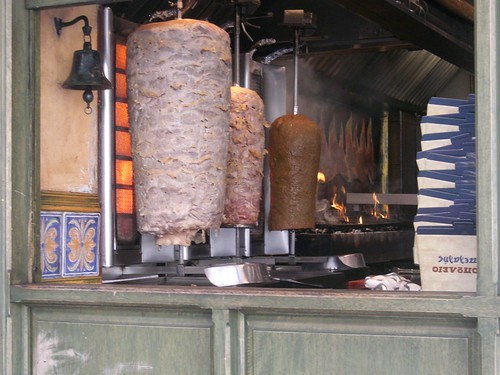
"That's a lot of meat," my husband remarked as we waited for our yiros to be made. "Will they go through it in one night?" It was about 8pm on a weekday earlier this month.

Ya! souvlatzidiko, Hania centre
Of course they will go through all that meat in one night. Souvlaki (or yiro, the terms are often used interchangeably) are incredibly popular these days for so many reasons. Souvlaki is a cheap meal - in fact, it has never been as cheap as it is now, all to do with the crisis, of course. The seating areas at souvlaki shops are always crowded, but that tells only half the story - the delivery bikes don't stop running after a certain hour: most of the business conducted by souvlatzidika is done over the phone, not in the shop.

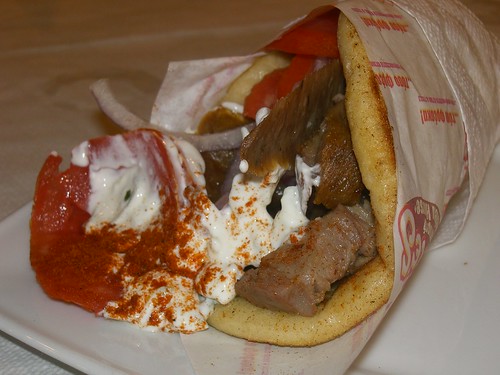
Yiros may be a cheap meal, but it is a filling meal, containing your meat (pork, chicken or beef), carbs (fried potatoes and pita bread) and salad vegetables (tomatoes and onions, lettuce on demand), all topped with a dollop of dairy (strained yoghurt). In other words, it's a complete meal. All that's missing is dessert; on a hot summer's night, you'll probably round off your souvlaki dinner with watermelon to cleanse the palate.

But yiros is more than just a meal. Yiros makes you feel good - it's the equivalent of an adult version of a happy meal, which is eaten by all age groups, making an outing to a souvlatzidiko the perfect family mid-week jaunt. Going for out a yiros is a psychologically uplifting experience. It places you straight in the thick of the crowds, where you will be seen; in a small town, you will bump into people along the way, all of whom are going there for the same purpose, to get themselves a souvlaki.

doner kebab thessaloniki
Souvlatzidiko in Hania (left) and Thessaloniki (right) - yiros is a quintessential Greek meal that knows no boundaries

If you want to see where the young people are in town, look towards a souvlatzidiko, and you will find them both behind and in front of the counter, jamming themselves together to make room for everyone in the limited seating spaces available at such places. And if you don't eat meat, no worries: souvlatzidika have moved along with the modern times - there are vegetarian options available too. The easiest one of its kind is simply to omit the meat, but there are now places offering vegetarian bifteki (burger patties) made with zucchini or chickpeas.

Most people go to a souvlatzidiko with their παρέα, but you will see a loner here and there, snacking on a tasty pita wrap. Even that person is not alone - the souvlatzidiko in our times has become a meeting place and no wonder - yiro can work out cheaper than a drink at a cafe. What's more, yiro is a democratic choice in food - a yiro is a yiro is a yiro, and everyone eats the same thing from a souvlatzidiko - only the meat choice may be different (you can choose among pork, beef and chicken - rarely lamb though in Hania as our lamb meat is not appropriate for this kind of cooking), but the difference in price is not much more than 30 eurocents. Yiro is the most popular Greek junk food - and it's not even junk, if you consider that it's a completely transparent meal.


souvlaki
Vantes souvlaki, Gogoni St
So cheers to yiro for being very cheap, somewhat healthy, highly democratic, very transparent, psychologically uplifting, and entertainingly social. And most of all, because it tastes so good.

©All Rights Reserved/Organically cooked. No part of this blog may be reproduced and/or copied by any means without prior consent from Maria Verivaki.

Friday, 12 July 2013

Athens, 1963 (Αθήνα, 1963)

Back in 1963 in Athens, you could get piroshki at a souvlaki shop, filled with mince, cheese, sausage or potato.

Piroski and Krapfen are on the menu of this souvlaki store in Monastiraki, 1963.
Photo: Nicholas Econopouly (thanks to Matt Barrett for granting me permission to use it)
These don't of course feature on any menu these days, although... they have morphed into different snacks. Mince and/or potato pies are a rarity in Greek snack shops, but you can find mince-filled bougatsa in Northern Greece. Tiropita (cheese pie) has always been a popular favorite all over Greece. The present-day loukanikopita is probably based on something similar to the tasty sausage piroshki.

Piroshki were introduced to Greece by the Hellenic diaspora living in the northeast of Europe, what we generally like to call the former USSR or Russia these days. They seem to have been forgotten over the years, but the more recent Russian migrants to Greece are now bringing them back into circulation in large urban centres. However, they are still seen as something rather exotic than commonplace, as this ad for a Russian piroski store in Athens suggests (dated December 2012):


And if you felt like something sweet, back in 1963 Athens, you could have krapfen with marmalade (note the spelling mistake on the sign - it says 'KRAPFEM'), which hasn't been heard of in a while... under that name, at least. Although 'loukoumas' is generally known as the Greek-style doughnut with a hole in the middle and covered in crystallised sugar, marmalade-filled no-hole krapfen are still around. They are known as a 'doughnut' now, but judging from the original name that they went by, they probably made their appearance in WW2. 1963 was still considered a very post-war period in Greece as the country had only just got over our civil war a decade before that.

Greek cuisine has always been a dynamic cuisine, picking up the good bits of all those who have passed through the country.

UPDATE: See Uli's note in the comments: "Krapfen might have come before WWII - together with the Bavarian King Otto back in the early 19th century, because the word is used in southern Germany only..."

©All Rights Reserved/Organically cooked. No part of this blog may be reproduced and/or copied by any means without prior consent from Maria Verivaki.

Thursday, 11 July 2013

The weeping (Ο κλαυθμών)

In the horrible little Greece that Ellada has become as of late, regarding the question of jobs for the people, pay rises, and now, the redundancies that are being discussed and negotiated, it has always been about public service jobs and nothing else. And so it continues, with the forced mobilisations, mandatory redundancies and firing of employees - it's all about one class of people who gained rights above all others: either you were a public servant or you were not.

And so it remains, as it has always been this way unfortunately in contemporary Greece, always. We even have a whole square named after weeping public servants: Πλατεία Κλαυθμώνος, Plateia Klafthmonos, the Square of the Weeping:
"Klafthmonos is the name of a central public square in Athens... since 1878, the name that remains until today, "Klafthmonos' Square... The name "Klathmonos" was given to it after a vignette in the Estia magazine, because, there in front of the Finance Ministry, redundant civil servants gathered together after every election to protest against their dismissal, since at the time, there was no permanence of public employees and each new government laid off employees hired by the previous government and recruited their own voters... at the end of June 1989 on the occasion of the unveiling of the eponymous sculpture, the name of the square was changed to "National Reconciliation Square", a name which is not in use."
It's still Klafthmonos Square today, and it reminds us of what we are by now used to for over a century and a half - that public servants are a social class in Greece, and that - most likely - this will not change.
Life continues much the same for most of us.
When Harilaos Trikoupis made it a term in the revised Constitution of Greece in 1911 that the permanence of public employees is guaranteed, he had no idea what his edicts would be putting the country through a century later. Trikoupis was Prime Minister seven times. Despite the economic crisis of his sixth term, he was still voted in one more time:
His sixth turn in office (June 22, 1892–May 15, 1893) was a dramatic one. The country's treasury had been depleted by overspending and systemic corruption often caused by political campaigns in which parties promised massive spending programs. Trikoupis stood before parliament and made the most famous statement of his career: "Regretfully, we are bankrupt" (Greek: "Δυστυχώς επτωχεύσαμεν"). The servicing of foreign loans was suspended, and all non-essential spending was cut.
And the worst thing is: Nothing seems to have changed since then. We are back to square one: already, the cries and wails are ruining the summer peace...

UPDATE: A little extra information from someone more knowledgeable - Athenians used to refer to the fired public servants as 'Pausanians'; it's a play on words, using the verb 'pavo' (I cease) since their dismissal was more euphemistically phrased as 'cessation'.

©All Rights Reserved/Organically cooked. No part of this blog may be reproduced and/or copied by any means without prior consent from Maria Verivaki.

Wednesday, 10 July 2013

Living in Kafka's world (Ζούμε τον κόσμο του Κάφκα)

A non-Greek friend asked me to translate this article from today's Greek news reports. It's a pertinent addition to my blog: how Greek journalists report the crisis in general is something that is, generally speaking, unavailable to the non-Greek world. This translation will give you an insight into the way the Greek language is used to convey strong meaning. Keep in mind that the literary style of a newspaper article is quite different to the way such concepts are conveyed in English language newspapers: ie, it's definitely not the Guardian.

"Many people were surprised by the huge international appeal of the recent anniversary of the 130 years since the birth of Kafka. Yet it should not be a surprise: the world in which we live today, and especially that one which is before us now, has reached the point of being more "Kafka-esque" than any other period in the post-war years. People feel it, understand it, live it in their own skin. Besides, Kafka lived in the dark years of the Weimar Republic, which, internationally speaking, today's Greece can so systematically be paralleled more and more.
Brunch at my house yesterday: there are some meals I never cook or prepare, because my husband is such an expert at them, and does them so much better than me (eg tomato salad and fried eggs). I know what it means when he comes home in the morning during his day shift in the cab and wants to make brunch: "How's business today, honey?" "Oh, really good, I've picked up one fare today so far, 3.50 euro." (He'd been up since 5, he'd walked round the port of Souda twice with another cabbie, and it was 10am when he came home.)
"It is a world with all the inter-war characteristics of the loss of freedom and the decline of democracy, closure imposed by the uncontrolled continuous domination of a state that not only does not serve, but targets people who do not react. And this, by invoking a superior value, which, however, is never fulfilled and therefore never stops there, but leads nowhere, grounded in an unprecedented law of necessity which constantly violates the constitutional order: the editorial operations and retroactive new taxes are the last of the many examples.

"Kafka became great at describing in unparalleled clarity such a world in which man, the citizen, has no defense against the system. However, unlike the spiritual creators such as Kafka who was bloodily  self-critical and wanted the bulk of his work destroyed, the politicians - most of them at least - had no doubt about the importance of their self and their historical necessity, the importance of their existence, especially concerning what they are doing by building such a domineering world.

"Instead of placing themselves in the world and its course, it usually happens the other way around: They understand practically everything with a deeper point of reference to their own existence - that is something which everyone can understand. This allows for pathetic mediocrity in people who have done nothing in their lives to be portrayed as advocates of a society who ended up literally - and let's allow the slightly inappropriate expression - like their faces*.

"With this ingrained conceit, their utter disregard for the substance, the ease and superficiality, the mastery to say that black is white and to change the "I believe" and the "positions" as they see fit, most of our politicians have helped in slowly building these little worlds that resemble themselves. Worlds which, however, precisely because of these characteristics, there comes a time when they cannot stand anymore, collapsing under the weight of their own instability. To those worlds, which politicians co-authored, some great spirits come to reveal, in the full sense of the term.

"In the last sixty-plus years, Europe, the western part, at least (and as a part of it, including Greece, for a few decades) thought that it had definitely and irrevocably avoided  such a world. I was wrong.

"The emphasis on human rights and the quality of democracy in the postwar world, as well as the long-standing true effort to overcome national antagonisms in favor of the "common house" of Europe, has filled two generations with a naïve, as has been demonstrated, optimism. But the events of the very last few years were enough to be able to demolish them all.

"While, until the beginning of the third millennium, we lived in a world of optimism that suited having a "national" anthem using lyrics by Schiller and music by Beethoven for the greatest values, ​​such as brotherhood, today, we find ourselves living suddenly in another one, which much more suitably finds itself emerging through the magnificently dark pages of Kafka or, using another side of Beethoven, that of his darkest and largest musical works, in his last quartets.

"Of course, all this does not say anything to our politicians at a time when they speak of the damned, or they fight like roosters on the television screens. Well, this is precisely the problem. That they do not speak.

"And that people who destroyed this place (who are now arguing about who is less at fault) are also those who will supposedly "save" it ..."

*σαν τα μούτρα σου - like your face (meaning: that we are not as beautiful as we think we are)

Thanks to Google Translate for removing the time factor involved in typing when doing translations - it's never been so easy to translate anything. 

©All Rights Reserved/Organically cooked. No part of this blog may be reproduced and/or copied by any means without prior consent from Maria Verivaki.

Tuesday, 9 July 2013

Greece, now

A friend from NY who is here on holiday thought she would be losing a lot of weight while in Crete because all she will be eating is watermelon...


... but how can you eat just watermelon when you are sitting right above the wall where the waves are lapping the rock below your feet?


©All Rights Reserved/Organically cooked. No part of this blog may be reproduced and/or copied by any means without prior consent from Maria Verivaki.

Sunday, 7 July 2013

Cafe bar (Καφέ-μπαρ)

When we arrived at the cafe bar, we couldn't see our friends. We looked around at the tables located near the children's play area, where we had once sat the last time we had come to this 'poly-entertainment' centre, so that we could watch them playing on the trampolines. But our friends weren't there. Then we realised that there was much more to the cafe bar than just the children's play area: we discovered seating areas at different levels, indoors and outdoors. The space near the bowling parlour was empty, understandably; the weather was too good to stay inside.

We found them sitting at a large table, chatting with people we did not know. We live in a small town, and yet we don't know everyone in it. We do not even bump into each other occasionally; some of us are neatly tucked away in our own little corners of our own little world.. We only know a certain section of the population, and naturally, we keep company with people who are similar to us; it was instantly obvious that this group of people were not like us.

For a start, they seemed very comfortable sitting around a table at a cafe bar, and not just any cafe bar, but specifically this one. They could not be imagined sitting at the crassier places near the tourist area close to our house. It would be the wrong stratum, despite the fact the our friend's BFF lived on the other side of town, close to us: "Well, I already had a house, " she meowed, "and my mother lives there too, on the ground floor," - purr, purr - "so I couldn't bear the thought of moving up here, even though it is where my husband would prefer to live," she explained.

"MARIA MOU!" my host was screeching (she is well known for her very loud voice), "come and meet Ev-do-XI-a!" There was no need for me and my husband to come and meet Evdoxia; Evdoxia had already been placed before us whether she wanted to meet us or not. Our host had moved to a different table, pulling aside only Evdoxia from the previous one. She came to sit with us, as only a good business person would. Being well versed in public relations, she did not look uncomfortable sitting with the hoi polloi.

Evdoxia had long peroxide hair, which she had had styled in the shape of a 60s bouffant beehive hair-do. Her teeth had been whitened professionally and she wore a long tapered white sundress over her waif-like figure. Around her neck hung a large diamond sea-blue pendant on a silver chain. Her short calculated steps were taken in high-heeled cork platform shoes, which completed the coordinated 60s look. It was like seeing Twiggy sitting before me. I not only felt under-dressed; I knew I was badly dressed. My Primark jeans had that cheap functional look to them, and my crinkly Indian cotton gold-embroidered top looked unironed (it looks unironed even when I do iron it, so I don't usually bother to iron it in the first place). But my outfit choice matched Evdoxia's in that we were dressed in similar period costume.With my flower-power hippie look, straggly split ends to match, we were from opposite ends of the same spectrum.

"I've known this little girl since she was knee-high!" our host proclained as she smothered Evdoxia in her busty embrace. Indeed, Evdoxia still looked like a little girl, not a day older than 25. I couldn't work out what she'd botoxed, as it was done quite discreetly. Evdoxia smiled widely and laughed softly the whole time she sat with us. She showed interest in our names and what my husband did for a living. She did not ask what I did for a living, presumably because she thought I did what she did, which was nothing except to look pretty. (Since I wasn't doing a good job of it, she avoided me the embarrassment of asking.) But she could probably tell that I did my own housework and cooking, which she probably doesn't do, presumably because she has one of the few Filipino maids still working in hania (they're so much less demanding than Albanians, I've been told), her mother lives downstairs, and she is probably spending an awful lot of time preening herself.

I imagined Evdoxia's kitchen to be very clean because waifs don't eat, and if they do, it's probably salad or something from Gwyneth Paltrow's cookbook, not the puff pastry delights her husband's multi-million-euro business was producing. But being a high-profile businessman's wife, she probably did have kids - she can't have gotten away with that one - and she was sure to be much older than 25, as our host was 55 herself, and she'd known Evdoxia since she was a teenager. I presumed that her children were bouncing away on the trampolines on the other side of the complex. They would no doubt eventually appear at the table by her side, perhaps when they wanted some granita, ice-cream, crisps, pasta, tourta or soda. Or simply some more money for the games.

Evdoxia politely sat with us for long enough to show solidarity towards the lower classes, after which she got up slowly, shaking my husband's hand (not mine) and bidding us a good evening. She went back to her παρεούλα, right above where we were sitting. The up-theres were now drinking aperitifs in long glasses with multiple straws in various colours and psychedelic umbrellas. We ordered our ice-creams and drinks at the same time that I noticed a large platter of mezedakia making its way to Evdoxia's table. This time, Evdoxia was sucking at a cigarette, and letting out the smoke in an upwards motion by tilting her head back towards us. She now looked in her element - less formal and more open - leaning over the table to have a heart-to-heart chat with another female member of her troupe.

Eventually the troupe's children arrived at the table. The girls were all wearing BFF T-shirts. A chubby early-teen wearing black leggings sat by Evdoxia's side. She looked very much like her mother; her mousy brown hair told of what colour her mother's peroxide roots were. She weighed more than her mother, presumably because she was eating her dad's puff pastry delights.

Just as we were finishing off our ice-creams, a plate of something that looked like a deconstructed ekmek arrived at our table. The shredded pastry rounds were delicately filled with walnuts and very lightly doused in syrup. The arrangement was plated beautifully with little balls of ice-cream around it, chocolate sauce drizzled over it in fancy patterns, and puffs of whipped cream in the corners of the plate.

"Κερασμένο από την κα. Ευδοξία," the waiter said, and we all looked in the direction of Evdoxia's table. Our host picked up her coffee glass and swung it high in the air in Evdoxia's direction. But Evdoxia didn't notice, as she was obviously engrossed in the conversation taking place at her own table. She was sitting right behind us, so she had her back to us and couldn't have seen the arrival of her κέρασμα. The desert looked and felt just like Evdoxia - light and fluffy, airy and breezy. As it melted in our mouths, it left behind the rather heavy feeling you get when you've had too much of a good thing. We were having ice-cream followed by ice-cream. There is definitely a moment when it actually feels too much.

I am so annoyed I forgot to take a photo of the ekmek ice cream dessert. You will have to be content with my description; at the same time, you need to use your imagination.  

PS: Time for a blogging break (because I am really really busy with 'real' work). See you later...

©All Rights Reserved/Organically cooked. No part of this blog may be reproduced and/or copied by any means without prior consent from Maria Verivaki.