Thursday, 28 August 2008

Beach party (Πάρτυ στη παραλία)


Kalamaki Beach has always held good memories for me. When I was eight, my family came to Greece on holiday. We stayed with our grandmother close to Kalamaki Beach, which was my first acquaintance with the area.

kalamaki 1974

I then saw it again in 1991, when I returned on what I thought was going to be another short holiday to Greece. At the time, I wouldn't have believed anyone if they told me that, in less than a decade, I would end up living 3 kilometres away from this beach.

CIMG4482

After 34 years, the area has changed drastically. The traffic that plies the road must have increased 1000-fold. The mountains can hardly be seen for the apartment blocks - everyone wants to live by the sea. The number of trees has been increased, while the whole coast has seen an accelerated rate of development in the tourism sector. The large white hotel complex was opened up only two years ago. The breakwater barrier and the electricity post above it are the only two things that seem to have remained constant.

kalamaki beach 20008
(You can read the full version of the story of my 1974 trip at Organically Cooked)

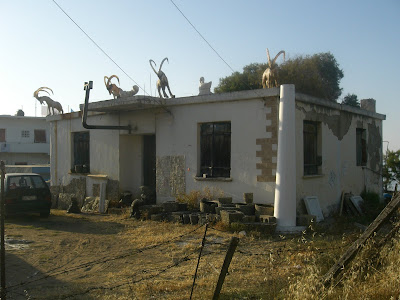
George's parents came to Crete as children, refugees from the Smyrna crisis of 1922. He was born in Hania. Apart from a short spell in the inland village of Manoliopoulo, George has lived all his life by the sea. In the late 1940s, he came to live at Kalamaki Beach, on a plot of land donated by the government to his family (as was the case with most refugees from the Smyrna crisis). At the time, because the land next to the sea was considered infertile, it was also considered useless: sandy soil where nothing could be grown, no orange or olive trees to cultivate, not even a tree for shade. The trees in the photos were planted after the house was built. The land is now worth at least a million euro per 500 square metres. George eventually moved to Thessaloniki, where he married and had children. After his marriage broke up, he moved to Tampa, Florida, where he spent 24 years making swimming pools and other fibreglass models (like the ones he has on the roof of his house), before coming back to Crete to live with his mother (she is now 105 years old).


I first met George (his house is right behind the tallest tree in the first colour photo, but it is not visible) when he noticed me coming to the beach every day with my children (close to where they took their swimming lessons). I was using a hidden path, partly obscured by tall canes, which I discovered when I saw some tourists using it; there are small pension-type hotels dotted all around the area. He noticed that while the children played in the water and made sandcastles, I sat on a deck chair reading a book, which George immediately took as a sure sign that something was wrong in my life (?$*!#(%?). His house was directly behind the part of the beach that I particularly liked - save the barking dogs he kept on his property. Over the summer, I met an interesting person, the children were served refreshments after their swim, and George's dogs stopped barking when they saw us, a sign that we were now familiar to them. George loves to couple good company with good food, and his yard, looking more like a furniture scrapyard than a private home, is always ready to hold a BBQ without too much notice. Today, he's staging a small beach party for us to mark the end of summer.

george

When weather and time permit, he takes his boat (he made it himself) out into the sea for a little cruise, and sometimes goes fishing. He only does this with company, otherwise, he says, it's boring for him. he likes to be a tour guide to the friends he has made along the way at kalamaki Beach.

boat kalamaki hania chania

The master chef began working under the shade of a tamarisk tree, hidden from the view of the deck-chaired beach bar customers behind the net.

bbq at kalamaki beach hania chania

We ate a bit of this...

bbq kalamaki hania chania

... and a bit of that.

bbq kalamaki hania chania

The variety of dishes was really quite amazing.

beach bbq

A traditional dressing for grilled fish was used: finely chopped parsley and thinly sliced onions, piled on the fish, over which a lemon-olive oil-salt dressing was poured.

bbq fish

The adults enjoyed themselves...

kalamaki beach hania chania

... and so did the children...

kalamaki hania chania

... who even had a midnight swim!

midnight swim kalamaki hania chania

When Greeks come back from their vacation and go back to work, they wish each other a happy winter.

kalamaki hania chania

Καλό χειμώνα!
(kalo heemona)

©All Rights Reserved/Organically cooked. No part of this blog may be reproduced and/or copied by any means without prior consent from Maria Verivaki.

Wednesday, 27 August 2008

Drying herbs (Αποξηραμμένα μυρωδικά)


Locally grown herbs from the region of Hania, Crete, drying on the branches of a 100-year-old olive tree. Can you pick them out? diktamo, malotira, orange peel.

Galatas
village, Hania, Crete.

Monday, 25 August 2008

Okra - bamies (Μπάμιες στο φούρνο)

When he left the family nest, he didn't realise that he had just eaten his last cooked meal and had left home cooking behind for life. No more Sunday roasts, no more pastitsio, no more T-bone steaks marinated in those Cretan herbs his parents had carried in seed form in their coat pockets on the aeroplane, a reminder of their holidays back to the homeland, to make their way into the lawn of their Wellington garden. It took him a long time to recall those home-brewed smells and tastes because the food he was now eating in London was quite satisfactory: exotic tastes, covered in colourful gloopy sauces, nothing of which resembled his mother's home cooking, but at least it was cheap and edible.

He was now picturing her in the kitchen of the family home, opening the back door to go into the garden. He watched her in his mind, climbing the stairs to enter the raised garden bed. Her first stop would be the greenhouse, a roughly constructed shed made with the old doors and windows of their renovated house. She'd pokes in its undergrowth for any sign of a tomato, maybe a cucumber, or some parsley, being careful not to disturb the overgrown zucchini that was left to seed. Around the greenhouse grew all the horta - weeds to the average Joe Bloggs - which she used for spanakopita fillings and yemista herbs. How he missed those garden fresh salads oozing with the olive oil she drizzled over them from a metal canister.

harrods food hallsupermarket

He once tried to make a Greek salad in his flat at Clapham Junction. While shopping at the ASDA across the road, trying to decide if he should buy the 2-for-the-price-of-1 packaged beef mince or the heat-and-serve meat patties, he came across the fresh produce section and spotted some firm red tomatoes. They looked as though they had just been picked off the tree. He placed a 4-pack in his basket. Everything seemed to be packaged using this number, the magic number for the perfect family, the perfect number of flatmates sharing a house, the perfect number of meal portions: 'serves 4'.

clap junc

Back at home, as he began to prepare the salad, he noticed that the label on the tomato packet stated that they were grown in the Canary Islands; not that it made a difference to him if they were from Kenya or Spain, but he couldn't picture in his mind where the Canary Islands fell on the map, despite having travelled extensively. It annoyed him that he didn't know where his food came from any more.

The salad was a disaster. There was only sunflower oil in the house, so the dressing didn't even look right. Olive oil had a green tinge to it, not like the sunflower oil on his plate which resembled children's cough medicine. The tomatoes were overly-firm; despite their red exterior, their innards were still green and seedy, and they contained no juice, which is what gives a Greek salad its flavour. Worst of all, they were completely tasteless. He could have been eating unripe apples, such was the sensation in his mouth; the tomato felt like sandpaper. There was not a hint of sun-kissed flesh, the kind of smell a tomato emits as it is sliced. Only the feta cheese seemed to have any decent taste to it. His girlfriend had bought it at a gourmet cheese store at Notting Hill on one of their recent Sunday strolls there. He regretted crumbling it into the salad, and tried to fish out the chunkier pieces so that it would not go to waste. This was one of the reasons he had stopped cooking at home; the whole exercise seemed pointless when the fresh products lacked taste.

It was much more enjoyable to eat out, since he could savour a different culture's cuisine every night of the week at a reasonable price. He now had a list of a dozen of his favorite restaurants and would rotationally frequent each of them on a fortnightly basis. One day it was Chinese, the next Pakistani, the following gourmet hamburgers, and so on. He was spoiled for choice in his dining habits, never ordering the same meal twice.

Now that he was on vacation in Crete, his appetite had swelled. His uncles and aunts always asked him what he would like to eat, and cooked whatever took his fancy. He felt as though he was being doted on, but never said no to a second helping, whether it was oven-roasted meat or aubergine cooked in tomato sauce. Everything tasted like he remembered it in his mother's kitchen. As his aunt Antonia would say: "Eat it now that you've got it in front of you, because you never know when you'll get the chance to try this again."

As he entered his cousin's house (she had invited him for Sunday lunch), memories of his childhood home kept flashing in his mind. She was setting the kitchen table. "Hey, these plates look familiar. I think we had the same ones."

"They were Dad's," she replied, as she opened the oven to check the roast. He noticed that some of the plates were chipped, but he could sense the sentimentality that his cousin felt for them now that her own parents had passed away.

A familiar scent caught his nose. His cousin had lived across the street from him in Wellington, and both their mothers cooked roughly the same kind of food. He was sure of it, but could not see any pots simmering on the stove.

"Are you cooking bamies?"

okra freshokra sundried
(fresh okra - shaven sundried okra; click here for the recipe)
"Yeah, but don't worry," she began to explain, "I've made plenty of roast potatoes if you don't like them."

"No!!!" he shook his head wildly. "I love bamies! Mum cooks them with chicken."

"Oh, I remember," she said, like the expert cook her mother was. She was beginning to look like her now, short and bulky in a matronly way, busying her way deftly around her kitchen, bringing out the cutlery, glasses and paper napkins to lay the table. This was what eating was like in his family home, a ritual associated with the appropriate equipment, with every item taking its place ceremoniously on the dining room table. He could not recall the last time he saw a table in London high enough to sit at on a chair, or large enough to seat a family. Although he had been working for many years in London, he still could not afford to rent a flat of his own. He and most of his acquaintances lived in digs, tiny bedsits barely large enough to house a bed and chair, if a writing desk could be fitted in somewhere, then the room was considered 'large'. Apart from the usual arguments over the phone bill and the cleaning arrangements, cooking a meal in the communal kitchen also created feelings of distrust: should it be shared? if so, how much money should each flatter fork out to cover the meal? who cleans up afterwards? does the meal cater for everyone's taste, needs, idiosyncracies? low-calorie, carb-free, kosher, gluten-free, vegetarian, vegan, environmentally friendly, politically correct?

"Bamies from a tin, right?" she asked.

He looked at her somewhat confused. "Yeah... canned in tomato sauce."

She started laughing. "I couldn't understand how our parents even liked the stuff, it all came out like goo."

"But you used to eat it, too, didn't you?" She ate everything, and it showed.

"Yes, I did," she replied regretfully. "But now I know how much they missed the real thing. Now that we eat them here fresh. They grow on gigantic tree-like shrubs and they're covered in prickly fur, so they aren't easy to pick."

"You picked these yourself?"

"No, I bought them at a fresh produce market in the Agora. But I've seen the trees. Okra looks fresh when the pod is firm and bright green. You have to shave them a little on the top and let them dry in the sun for a couple of days so that they don't turn into goo..."

He had no idea what she was talking about now. The discussion about food was getting too technical. He couldn't remember if he had ever seen fresh okra on sale at the supermarket. He made a mental note of going to Brixton market when he got back to London to see if he could find them. Not that he was planning to buy them himself; for a start, where was he going to find any sunlight in London to let them dry? When he left Gatwick airport, it was pouring heavily and the temperature was 14 degrees Celsius: all this is mid-August.

roast okra bamies

"... we like them in a lamb roast with potatoes," she was still talking. "They go crispy, like french fries, but with a meaty taste, kind of like that jerky meat Australians like to eat. We never eat them mushy, and I don't think our parents ate them mushy when they cooked them here in Crete. They just weren't available fresh in New Zealand. They're kind of an acquired taste."

An acquired taste. What Londoners would say of potted shrimp pate, boar terrine layered with chestnuts, olive oil infused with black truffles, whisky-flavoured seville marmalade. When asked to give their opinion of okra, most wouldn't know what it was, let alone have tasted it. If they were shown what it was in a photo, they might think of it as a 'native's' choice of vegetable, associated with a community whose skin was dark. They probably couldn't place it in any of the mongrelised versions of international dishes in the average Londoner's repertoire.

roast okra bamies

Roast okra - made all the more delectable with garden fresh tomato pulp and virgin olive oil. He had one serving, with tender-cooked lamb and roast skin-blackened potatoes. The okra was firm, chewy and juicy. His cousin asked him if he would like a second helping, which he obliged to. Then she asked if anyone wanted the last scrapings off the tin. He took those too. Like his aunt, he wondered when he would get another chance to savour a meal like this one.

This is my entry for Weekend Herb Blogging, this week hosted by Katie from Thyme for Cooking.

(Dedicated to PH, who licked the tin clean)

©All Rights Reserved/Organically cooked. No part of this blog may be reproduced and/or copied by any means without prior consent from Maria Verivaki.

Saturday, 23 August 2008

Fish and chips (Ψάρι και πατάτες)

When I was 12 years old, my parents bought a fish and chip shop in one of the not-so-interesting suburbs of the greater area of Wellington. Mum had been made redundant from her factory job after its closure, while Dad knew that his factory job was on the line, as that business was also on the verge of closure. At the start of the 80s when factories started to close down at the rate of one per hour, my parents were in their mid-40s: far too young to retire, far too uneducated and unskilled to look for work in trades other than service sector. The house we had bought five years ago (which permanently put off any dreams they might have had of moving back to Greece) had rotten wooden foundations, disused fireplaces and chimneys and a leaky bathroom ceiling. Unemployment benefit was out of the question, according to the work ethic upheld by most Greek migrants at the time. It was the service sector or nothing.

fish shop
(Dad at the shop with one of his employees)

I acted as my parents’ official translator at the lawyer’s office when they signed the contract to buy a fish and chip shop. It must have been one of the hardest moments in their life, to realize that the time had come for them to get into the catering business, the livelihood of most of the successful Greeks in the Greek Orthodox Community of Wellington. Why didn’t they enter the food trade earlier, when they were younger, more mobile, more able to work under pressure? They had probably put it off for so long, since they were comfortable in their routine factory jobs. For the last dozen or so years, they had been working 9 to 5 jobs, with the odd night shift and overtime, enabling them to be home in the evenings, and always close to their children. The shop would change their whole way of life.

Every morning, Dad would get up early to buy fish fillets and potatoes at the market warehouses in Allen St, not too far from our house. Or he’d shop at the Moore Wilson’s food supplier for flour, baking powder, ketchup sachets and tartare sauce. Then he’d drop us off at school, and make his way to the shop in Newlands, a quarter of an hour away from our house, to start cleaning, filleting and cutting fish. The potatoes had to be scraped of their skin and chipped (all by machine). All the delivery agents would make their calls at some point or other in the day. They popped in some time in the morning to deliver hot dogs, sausages, pineapple rings, curry rolls, spring rolls, donuts, corn fritters, paua fritters, reams of paper, Coca-Cola, Fanta and Leed, among the hundreds of bits and pieces we needed to keep the fish and chip shop stocked. How he managed to do all this without any English skills to speak of amazes me.

My mother stayed at home to cook, wash and clean, like all Greek ladies of her time. By 10 o’clock, she had prepared the evening meal and done most of the daily household chores. Then she did something that practically no other Greek woman of her time did: she took her bag and keys, locked the house and drove her own car to the shop. She was one of the few Greek immigrant women driving in Wellington, an awesome spectacle, the envy of the other Greek women who knew that this feat of my mother’s – gaining a driver’s licence after her fourth driving test – placed her well above them in the ranks of the successful Greek families. She only learnt to drive after my parents bought the fish shop; she had no other choice but to learn, what with the business being located so far from our house.

Mum’s job was to pre-cook all the fried bits and pieces that were sold along with the chips. First, a light batter would be made up and allowed to rise. Then she’d take the fish pieces, dredge them in flour, dip them in the batter and toss them into one of the two vats filled with lard that were used for this purpose. Dad took care of the third vat, pre-cooking chips in huge rectangular metal baskets. Everything would be drained well, then laid out on paper-lined drawers below the counter, and allowed to cool down before they were re-cooked in the customers’ orders.

In the early afternoon, Dad would come to pick us up from school. We were in our mid-teens before we were allowed to take the bus by ourselves. To get to the bus stop, we had to walk past the Parliament buildings, probably the most policed area of the whole of the city. It took a while for our parents to realize that the chances of being raped or kidnapped at half-past three in the afternoon after school when the streets of Wellington were teeming with trails of teal-uniformed school girls were actually quite minimal.

I’d take up my position by one of the deep freezers that we had in the work space behind the counter, while the little laughing olive tree took up her position by the second freezer. We’d open our school bags, spread out our books and start doing our homework, as fast as we could before the 6 o’clock teatime customers started arriving. I earned my linguistics major on that freezer. That’s where all my term papers were written. When the shop got busy, we’d leave our textbooks, notebooks and pencil cases to come out to the front of the shop and take the customers’ orders while Mum and Dad did the greasy cooking. When we needed something from the deep freezers, we’d pile our books one on top of the other, hold on to them tightly, open the freezer and get what we wanted. When things started to quieten down on the front, after seven o’clock, we’d go back to our homework. Kiwis all wanted to eat a the same time, or so it seemed to us. The rush over, Mum and Dad would clean up and get ready to close down by 8pm – unless it was late night shopping night, and we’d close at 9pm. The last customers were the drinkers from the pub at the shopping centre. They’d come in just before we closed down, reeking of alcohol, with their friends of the opposite sex, laughing rather raucously, as though they had just left from a Christmas party. They were the most talkative customers, the ones my parents were most afraid of.

When we came home, we weren’t so much exhausted, as smelly, greasy and rattled. We reeked of fish and lard. We ate our meal late, had a bath, finished off our homework and laid out our school uniforms clean and ready for the next day. Then we went to bed. There wasn’t much else that could be fitted into the evening. This was what most days of the year were like for us. This is what I thought life in New Zealand was going to be like for the rest of my life. No wonder I liked Greece better.

*** *** ***

View Larger Map

I had the pleasure of enjoying fish and chips today – fish and chips, Greek style, that is. Mama was with me. True, it wasn’t my mama, but this mama was the same age that my own mama would have been, were she still alive today. She would also have been wearing a stocking to tighten her swollen arm filled with fluid after her lymph glands were snipped following breast cancer. Mama would have enjoyed the ride out to the fish taverna at Kissamos, which took us past a little church built on the side of a rock, the sacred cite dedicated to the birthday of St John the Baptist, celebrated on the 23rd of June, a place I had visited with her during the brief period we spent together in Crete.

st john baptist kasteli hania chania.

She would have asked me to stop – as I did – so that she could go into the church, make the sign of the cross and light a candle.

st john baptist kasteli hania chaniast johna kasteli hania chania

Then she would have taken her grandchildren into the church to do the same. She’d probably have washed her hands and face at the fountain with the cool running water and walked around the cave telling the children that everyone has a guardian angel looking out for them.

st john kasteli hania chania

She probably wouldn’t have wanted to walk down the underpass just next to the cave, which leads to the coolest bluest lagoon I've ever seen, the perfect place for a secluded swim away from the crowds; it's not the right kind of place for sufferers of osteoporosis.

underpass from cave to lagoon hania chanialagoon st john hania chania

She would probably have rested on one of the stone benches outside the church in the cool damp air of the cave, away from the harsh bright sunlight and the high levels of humidity, which would probably have done her more good anyway.


As we drive by the Kasteli shipyards, she might have looked out at the fishermen's boats and told to the children to watch out for pirates.

kasteli shipyard hania chaniakasteli shipyard hania chania

“We’re having fish today!” she would announce as we seat ourselves at the taverna, with probably a hint of irony in her voice as memories of the fish and chip shop would flood back to us.

"And no alcohol for you because you're driving!" she would add, and I would agree with her.

fangri

We’d talk about it as if it were yesterday that we were serving our regular customers in the shop – you never forget those ones: the lady whose cat had an amputated leg, the old man who always said 'woo-o-oo' at the end of every sentence
, the widower who would always cry when he mentioned his late wife – and wonder what all the friends and relatives we left behind are doing now in Aotearoa.

calamari and chipstsikoudia grapes

After we eat our meal, she’d ask for the bill. I’d offer to pay, and she’d say, “No dear, let me get it this time.” And I’d say, “OK, thanks, mama,” just like I did today.

©All Rights Reserved/Organically cooked. No part of this blog may be reproduced and/or copied by any means without prior consent from Maria Verivaki.

Thursday, 21 August 2008

Mylos taverna (Η μύλος του κερατά)


My father was born in the hills behind the seaside village of Platanias, near the village of Agia Marina on the west coast of Hania, in a neighbourhood called Drakiana. All that remains of it are the ruins of his first home, a 14th-century church dedicated to St George and a zillion fields full of orange and olive trees.

drakiana
(the house Dad was born in - Drakiana)
He lived there until the mid-50s when, as a young raunchy lad, he was talked into going to Athens and working at the docks in Pireas harbour. The work he found instead was as a drudge, carrying heavy loads on and off ships, while the pay was extremely low. He always remembered his early years in the village as the best he had ever lived; his brother would play klarino at night, while during the day, he would take his dog hunting. He hated every single minute of his working life in Athens. All he liked about his time in the big Greek smoke was the yard of the house where he lived with his family, when neighbours and friends would come to spend the evening together in Agia Sofia, a working class neighbourhood of Pireaus.

letters
(all the letters my Dad wrote to my Mum)

When at last he could take no more of the slave-like under-paid working conditions that his employers forced him to accept, instead of returning to the village, he decided to take up someone’s offer to marry a Greek woman who had emigrated to New Zealand two years before him. They had been corresponding for a year before his departure from Greece; my mother wrote the first letter, then he replied, then she wrote back, and so on, until the 13th letter, when he didn’t write back. My mother never wrote another letter, thinking that maybe he had ditched her. He turned up on her doorstep instead, on a beautiful summer’s day in Wellington on the 31st of January, 1965:

mumdad
(Dad's first few months in New Zealand, with Mum - left - and Mum's sister)

and married her a week later, on Waitangi Day, the 6th of February, 1965, as he had promised he would do in his last letter.

wedding

They spent nearly three decades together, until the death of my mother in Wellington, after which Dad came back to Crete and lived the last decade of his life in his beloved hometown.

cemetery
(Makara cemetery, Wellington)

Most people now think of Platanias as the summer boogie capital of Hania. MYLOS nightclub rules the roost on the outskirts of the village. Right across the road is MYLOS taverna which has a long standing tradition for fine (and expensive) food. All the dishes are presented artistically, and the owners (there were three of them at the time, as the business was worth millions) place a great deal of emphasis on the decor of the restaurant. Watermelons are carved into statues, various fruits and vegetables are dried to form floral arrangements, and there are urns and herbs decorating the seating area. An old mill, working inside a fountain, forms part of the décor of this open-air restaurant, which I suppose justifies its name…

keratas taverna
(Dad - left - as a teenager at Keratas taverna)

…but it was never known as MYLOS taverna in my father’s years. The original name of this restaurant was «Η ταβέρνα του κερατά» - “The kerata’s taverna”. You can get a more succinct explanation of ‘kerata’ with clear examples in my other blog. My father was a frequent visitor to the taverna; apart from the food and ambience, mantinades (Cretan poetry) and rizitika (Cretan songs) were regularly heard chiming from its interior (the open-air idea came with the advent of tourism).

*** *** ***

The last time I ever dined at MYLOS taverna was at my father’s 65th birthday. His whole family was there: his two daughters, their children, quite a few holidaying relatives from abroad – and his wife. She was a malevolent peasant woman who had divorced her husband and left her 10-year old daughter in the care of her two older daughters so that she could marry the 'rich Americano', as my father was known, because he had recently come from overseas (which is all called ‘America’) and anyone who had lived 30 years of their life abroad was considered rich (as all ‘Americanos’ are believed to be).

Ever since he had married this woman, we were fighting a losing battle of trying to keep in touch with our father. He was obviously having a better time with his new family than his old one. Or was he? Maybe his new family didn’t want us mixing with him. After all, we had been presented with our dowries, and now it was time for someone else to devour whatever remained in the coffer, money my father had made with my mother while working at the fish and chip shop (where his children both helped out after school for over a decade) in Wellington.

When we asked him to replace his broken mobile phone, his wife said the expense wasn’t necessary. We could just phone him on the landline at home, where he never seemed to be at most normal hours of the day. When we phoned very early in the morning, or very late at night, his wife always answered: ‘he’s in bed right now’. We were being treated like Cinderellas by the wicked stepmother. That didn't bother us so much, having already found our princes, but we had to find a way to sneak a friggin' cellphone into his hands, otherwise, she would claim both the battle and the war.

It was the middle of summer. A whole host of cousins from New Zealand had arrived in Hania, as well as their parents. We decided to ask Dad to organise a night out at a restaurant. Dad always chose MYLOS taverna, because of the special memories it held for him as a young man. He also knew the owners. What a blessing that turned out to be. The little laughing olive tree had organised with her husband that she would park the car. I stayed with her – ‘for company’, I replied when everyone tried to coax me into the restaurant to ease my hefty pregnant body onto a comfortable chair. The rest of our party – Dad and wife included – settled themselves at a table.

The little laughing olive tree and I headed for the kitchen. The owner of the restaurant spotted us.

“Anything I can do for you, girls?” We explained that our father – ‘Manolis with the BMW’ as the restaurant owner knew him – was celebrating his birthday, but he didn’t know that we were organising a surprise party for him, and would they be so kind as to look after the cake we had brought, along with his birthday present (no need to tell anyone what was in the gold coloured bag) until we informed him to bring them out.

“It’s Manolis’ birthday? No problem, girls!’

In the meantime, Dad’s tall obese two-decades-younger-than-himself wife was jollying herself up with a little wine. She claimed that all she needed was just a tipple to get her going. When we asked her what she would like to order, she stated that there was no need for food, the wine was enough, and anyway, she was the best cook in the world, and the restaurant’s high quality standards (known throughout the guide book world) could not serve food to her liking, because only she knew how to cook. So we just ordered mezedakia for everyone to nibble on, and bided our time with pretentious banter just to make Dad happy, which he usually was, and keep her in check. She never once stopped laughing raucously, nor did she stop drinking.

«Υγεία she kept calling out every time she raised her glass (I had lost count how many times she had done that). She spoke in a heavy Cretan dialect; instead of saying “iyia”, she pronounced it ”ijia”, a telling sign that she was staunchly against any show of manners in front of her husband’s polite company. Her daughters – three very pretty, slim, smiling lasses - were not with her tonight. They never seemed to come when we arranged family events, even though they were always invited.

When the fruit platter finally arrived – a sign of the end of a meal at a Greek restaurant I decided to take the opportunity to go to the ladies’.

“Oh, Maria, you simply don’t know who’s been shitting there before you. Mind you don’t get a urinary infection in your state!” She was so full of advice, that woman.

I found the owner at the reception desk, and signalled to him to bring the cake (lit up with sparkles) and the present. When I arrived back at the table, Dad was amusing his guests with stories of life in New Zealand. His wife would butt in every now and then, reminding him that those days were over, now he lived in Crete, and he’s started a new life.

The owner of the restaurant finally arrived. He was carrying a glass of wine.

Χρόνια πολλά, Μανώλη!»
“Thank you” replied my father, raising his glass without batting an eyelid.
“For your birthday” added the owner.
“Oh yeah,” chirped my father, always jolly in nature with his Santa Claus looks.

birthday
(This is the way my father always liked people to see him, smiling and cheery)

His wife turned to the restaurant owner. “You knew it was his birthday?” she enquired somewhat perplexed, because now she would have to hide the fact that she had forgotten it.

“And here’s a little something from your daughters,” the owner revealed, giving him the

Dad was laughing now. “So you remembered my birthday!” he said, looking our way. His wife was now quiet, an annoyed jealous look covering her face. She had folded her hands over her plethoric body, making her look even more elephantine. The pretentious smile she had been wearing most of the evening was instantly wiped off her face. Dad was now receiving a round of applause and handshakes from the table of guests. She had become a ticking time-bomb, ready to explode over the fact that she had been ridiculed by her husband’s own family.

Dad was so busy being congratulated by all the guests that he forgot all about the present. We had to remind him to open it. When he saw what it was, he laughed and said:

"Well, I wasn't going to get one any other way, was I?"

His wife looked at her watch and asked him to get the bill. She had stopped drinking and was now smoking sulkily on her own, no more the star attraction of the night with her staged drunken antics. She may have won the battle, but the war was still raging. As for that cellphone, Dad kept it in use till the day he died, his last call being made to his own family.

*** *** ***

orange fournes
(the taps - part and parcel of village life)

Had I known then what I know now, I would have written a mantinada for that woman. Not that I can't write one for her now, but I don't see her often (at all, actually) so that I could recite it to her. All Cretans are born with the innate skill of producing a mantinada (whether they realize it or not) when the moment calls for one. When I recently went to Fournes to irrigate our orange groves, I returned in the afternoon to close the taps, and found that one of them had been closed by someone else; they had probably found the water lacking in pressure, and so, to increase the pressure in their own field, they thought it only rightful that they close off our tap, which meant that our field was not watered at all. I stuck a little note by the taps:

Βρε βλάκα, ίντα μού’κανες (Hey bozo, whatcha doing)
Και μού’κλεισες τη βάνα
; (closing all my taps?)
Σου εύχομαι να πας να βρεις
(My wish is that you go and find)
Ξερά τα πορτοκάλια!
(Your orange fields in rags!)

In accordance with the mantinada tradition of my ancestors, I have written another one, specially dedicated to my anonymous commentator who has helped raise my ratings, thereby increasing my readership, and generally making a fool of him/herself:

Ανάθεμά σε κερατά (Be damned, you foolish cuckold)
Που κατουράς στο μπλογκ μου
! (For pissing on my blog!)
Κότσια δεν έχεις να χαρείς
(You ain’t got balls to show your pride;)
Και κρύβεις τ’όνομά σου!
(That’s why you hide your nom!)

©All Rights Reserved/Organically cooked. No part of this blog may be reproduced and/or copied by any means without prior consent from Maria Verivaki.

Monday, 18 August 2008

Vegetable chips and fritters (Λαχανικά τηγανίτες)


Should migrant workers learn the main lingua franca of a country before being allowed to take on a job? Although my own parents knew very little English when they first started working in New Zealand, and they learnt very little more after that, I have wondered whether there is a ring of truth in this statement. I have a Kiwi accent and as an English teacher by profession, I would like to believe that I am more tolerant of other people's linguistic difficulties when they have limited English skills.

On a recent trip to London, I went into a burger restaurant at Clapham Junction and asked the (Asian) attendant for a hamburger and some chips. She was having problems understanding me, so I repeated my order. I used all the synonyms for chips that I knew: potatoes, chips, french fries, fried potatoes. I was about to resort to Kiwi slang ('spuds') when she finally nodded and said "Yes, OK". When I went home with the takeaway bag, I found two burgers in it and no fries. I still can't work out what on earth it was that made me misunderstood. The end result was: no fried potatoes, that simple meal no one would make any health claims about, but very few would deny the mouth-watering, lip-smacking moreish taste of.

We all love fried potatoes at home, and it's a pity that it isn't the healthiest dish in our weekly range of meals. The only excuse I have to cook them more often is when I can disguise the platter with the addition of courgette and aubergine chips with garden-fresh produce.

Zucchini and eggplant can be sliced into very thin rounds, floured and dipped in very hot oil to make chips. I like to drain them on absorbent paper to get rid of the excess oil. They can be fried till they are very crisp, or just enough to keep their shape. In restaurants, they are usually served with a dollop of tzatziki or any other garlic flavoured dip.

zucchini chipscourgette chips

Aubergine is also made into a tasty soft squidgy fritter. I was very fortunate to pick up some albino eggplant from my uncles' farm the other day. White aubergine looks and feels exactly the same as purple aubergine, except that it has white skin. It tastes a little different: it has a much blander taste, bordering on sweet rather than savoury. This is why I never use it in papoutsakia or moussaka, because it isn't as tasty. As a fritter though, it is perfect.

albino white eggplant aubergine

These fritters can be made with either purple or white aubergine. The best variety to work with is the round rather than the long eggplant. The peel needs to be removed from the aubergine before frying. It is as unpalatable as the skin of red Florinis peppers, whose skins are always removed after being roasted. In this case, slice the aubergine into rounds, and then pare the skin away from the aubergine flesh.

aubergine frittersaubergine eggplant fritters

Dredge them in flour and dip them in a light batter so that they are just coated. Put them carefully into a pan with very hot oil; cook only a few at a time, because they tend to stick, and once the temperature of the oil is lowered if too many fritters are placed in the pan, they tend to soak up too much oil and become very greasy. Brown well on both sides.

aubergine eggplant fritters

These delicious fritters only need a hefty summer salad to accompany them. Go easy on the bread, as there's plenty of flour covering them! For an even more tempting way to serve fried eggplant, have a look at Lulu's recipe which uses fresh tomato.

This is my entry for Weekend Herb Blogging, hosted this week by Srivalli from Cooking 4 All Seasons.

©All Rights Reserved/Organically cooked. No part of this blog may be reproduced and/or copied by any means without prior consent from Maria Verivaki.

Saturday, 16 August 2008

Caretta Caretta (Καρέττα Καρέττα)

August the 15th is the day Greeks celebrate the third most important religious feast in the Greek Orthodox calendar. Easter takes precedence as the most important feast, followed by Christmas (ever wondered why Christmas in Greece is so dull?), followed by the Dormition (Assumption to the Catholics) of the Virgin Mary. A 14-day-long fasting period, along exactly the same guidelines as the Great Lent, precedes the feast day. Although it is a national holiday, it does not seem like one, mainly because it falls in the middle of the summer, just when everyone seems to be on holiday anyway: just like Christmas time in my Antipodes homeland.

Mary, Maria, Panagiota (the One above the Saints, but presumably below God) all celebrate their nameday today, along with Mario and Panagioti. Namedays, believe it or not, are more important than birthdays. Despite the fact that many people are happy to celebrate both their name and birthday, it's the nameday that won't ever be forgotten by friends and relatives. It's also the one that evokes pleasant feelings, which is what makes Greeks the envy of the non-Greeks on such auspicious occasions:

Woman announcing her nameday: "It's my nameday today!" "Oh, really? What's your name?"
Woman announcing her birthday: "It's my birthday today!" "Oh, really? How old are you?"

And for those of you - Greeks and non-Greeks alike - who have a name which is not recognised in the religious calendar of the Greek Orthodox church (my mother's, and even my son's, don't feature in it), don't worry: there's always All-Saints Day.

So here I am, on my nameday, expecting a dozen guests to be fed and watered. In Crete, namedays are celebrated without inviting people to them. Friends and relatives will either phone to wish the celebrant χρόνια πολλά, which loosely translates as: "may you have many years of life to come", which is OK if you're not, say, 84 years old, otherwise it might sound like a curse.

Here are the choices most people select from to celebrate their nameday:
1. Have a big sit-down meal at home. This means lots of cooking and cleaning. This kind of revelry is reserved for Papa Bear: his nameday falls in the autumn, when cooking up a feast is a good way of heating up the house on a cool evening and entertaining guests indoors is the norm.
2. Have guests over at home, but serve only finger food and sweets, kind of like a buffet. I love the idea but would prefer it if someone else would make the finger food and cakes. It still means cleaning up before and after the event.
3. Go out for either a sit-down meal or finger food and sweets. This works well if you know who is coming to your nameday, because it's one of those parties which custom dictates you do not invite people to; in other words, you must make the effort to let people know where you will be instead, because you won't be at home where they may expect to find you.
4. Invite certain people to go out with you on your nameday, but not your regular well-wishers. Too elitist for us; simply not our style.

caretta hania chania

We decided to go out to a place we knew well and could hope on finding a free table. It's best to book a table if you want good food on this day, being the holiday that it is, otherwise, you have to contend with restaurants, tavernas and other food establishments that may offer a lower standard of food and service. As I have a strong opinion about where you will find very good tasty well-cooked food in Hania (only in a private house), the place I chose was selected purely on the grounds of location: it was right next to the beach (it operates as a beach taverna during the day), the waves could be heard crashing on the sand, and there was a small playground for the younger members of the party to amuse themselves within view of the parents. I was simply lucky that the food also turned out to be good.

seafood kalitsouniacaretta hania chania

Caretta Caretta has nothing to do with turtles: the name simply has a good gimmicky sound to it. We've been going to this seaside taverna for a long time now. It's located on the west coast of Hania, in a village called Agia Marina (Saint Marina). The village borders two other seaside villages which play host to the the classiest nightlife zones in Hania at this time of year: Stalos to the east, and Platanias to the west. This is where everyone comes if they want to boogie the
summer night away. Neither Stalos, Ayia Marina nor Platanias have specific borders, melding into each other in the way that neighbourhoods tend to do when they start sprawling. Once the poorest areas in the district, they are now the wealthiest. Up until the early 1950's (ie pre-mass tourism), the seaside soil was considered infertile, and lay barren-looking. It was the kind of land that refugees were gifted by the state, because it was deemed useless. Some clever person had the idea that they could build basic rooms to meet the low standards of the backpacking beach-sleeping mosquito-bitten grubby tourists at the time, and since then, Greece has been treated as a cheap holiday destination, an opinion which suddenly changed this year with the dollar crisis, or should I say the euro crisis, since our Northern European tourists are particularly feeling the sting of an expensive currency.

sea urchin

Every year, Caretta Caretta shows signs of improvement rather than stagnating. It offers the full range of Greek cuisine, along with internationally known pasta dishes (like carbonara) which are safe choices for the poor tourists who do not know how to ask for good Greek food by name. Along with this standard menu, it also offers some surprises, some of which we chose for my special day: grilled filleted sardines, seafood kalitsounia (better get the chef police onto them for the misuse of Greek culinary terminology), crab stuffed with a cheese filling and our all-time favorite delicacy, the most expensive meze of all, sea urchins, which are dressed with the ubiquitous olive oil and lemon juice and enjoyed as a dip with sourdough bread: a very acquired taste, but a special one nonetheless. We also ordered a seafood salad, some dakos, a plate of fried whitebait, some tasty octopus in vinegar dressing, some fried calamari a few plates of fried potatoes - they were that good. Total cost: 135 euro, for a party of 12.

©All Rights Reserved/Organically cooked. No part of this blog may be reproduced and/or copied by any means without prior consent from Maria Verivaki.