Showing posts with label LAMB. Show all posts

Saturday, 5 December 2015

Kiwi rack of lamb (Αρνάκι Νέα Ζηλανδίας)

A kiwi rack of lamb, bought on 50% discount at the Marinopoulos supermarket, originally priced at 22 euro. A long long time had passed since I had last bought a kiwi rack of lamb. At this price, it seemed the right time to do so now.


Cretan lamb is much much smaller, somewhat scrawnier than kiwi lamb. A Cretan lamb chop always feels like I'm eating a lollipop meatball. We don't often eat lamb because we prefer beef and pork. So when I saw it on special, I thought it would be a meal I would enjoy cooking and eating, to remember (much) older times.

I'm now very used to Cretan lamb, which is smaller than Greek lamb raised in the mainland. Although we also buy French and Dutch meat (where our main meat imports - beef, pork and chicken - come from), we buy only Greek lamb. So this kiwi meat smelt very different in my kitchen. I remembered the first time I smelt Greek lamb cooking in the oven of a small Greek home kitchen. At the time, for me, it stunk. Nowadays, it smells quite neutral to me. I am more likely to detect the scent of the wine it's soaked in, and the herbs and spices used to cook it, than the meat itself.

I tried to recall the smells in our NZ house when we cooked kiwi lamb, but I couldn't remember them. I couldn't even remember the smell of kiwi meat as my mother cooked it before we went to church, so that our Sunday roast could be ready when we returned home. I remembered nothing. Nothing! Like I had never even been there.

The smell of the rack of lamb in my kitchen smelt wrong. The smell was pretty strong. No doubt, someone would notice soon. So I soaked the lamb in wine, doused it in spices and cooked it for ages, hoping that the smell would somehow go away (or at least, stay hidden). But that smell didn't go away. Even though it was somehow veiled by the seasonings, it had now permeated the kitchen on this rather cold Saturday.

"What's that smell, Mum?" my son asked me, making me feel rather nervous.

"That looks so good!" my daughter said, comforting me somewhat as she saw me taking out the roast from the oven.

"Is it cooked through?" my husband asked, which is usually his main concern with meat. I could see it falling off the bone. My husband then noted that his father had once bought kiwi lamb when he was young and his mother cooked it, but the smell put them off, and it was left uneaten.

Oh, shit, I thought. But times have changed: "Whoever isn't hungry isn't obliged to eat," I reminded everyone. We all sat down for dinner.

The rack of lamb looked huge as it sat in the roasting pan. I'd had to cut it in half to make it fit. I wondered if we would get through it, especially if mutiny was declared (over the smell, which was faint, but still quite discernible). Things turned out well. The lamb was really quite OK. Some comments were made about the differences noted when compared to the lamb we usually cook at home. The smell was apparent to all (I knew it!), so I was ready with my wine-and-spices story. I remembered the price of that rack of lamb (information that I kept to myself), and I praised myself for landing such a bargain. Should I have bought two pieces at that price, I wondered. The supermarket freezer had quite a few of them in stock (all bearing the 50% discount sticker).

I took a bite, concealing my own hesitation. Any second thoughts I had about this rack of lamb had to remain in my head. Poor thing, I thought, it's like it had landed in a house full of loud opinionated (ie obnoxious) people, an invited guest who was regarded as a freak. Make yourself at home, they all said to it as they poked it prodded it, exposing its foreigness in all the ways possible. I felt embarrassed, almost ready to apologise to the visitor for any offence we may have caused.

Perhaps these awkward feelings might not have arisen, had the company been different. But it's much easier for me to change the meat than it is the company. Greek lamb or kiwi lamb, it will make little difference to me. The sooner I don't have to cook, the more quickly I will enjoy my food, Όπου γη και πατρίς - the origin of the lamb will make no difference.

(Note to myself: Next lamb dish - Greek-style fricassee, with lettuce from our garden. Do not use kiwi meat. Wrong smell.)

©All Rights Reserved/Organically cooked. No part of this blog may be reproduced and/or copied by any means without prior consent from Maria Verivaki.

Thursday, 14 November 2013

Splinogardoumo - spleen sausage (Σπληνογάρδουμο)

I recently saw a photo of a dish that I have not enjoyed in a long time... not for at least 15 years. It made me realise that I would no longer be able to savour this dish in our times. Even if I wanted to make it, I cannot. And yet, I used to help my mother make this dish, from a very young age, throughout my teens. The way the world has changed since those times does not allow this to take place for most of us.

Splinogardoumo, before it's cooked

The spleen of a lamb or goat is sliced into one long strip (which sometimes breaks, but you try hard not to let this happen), which is then stuffed into the large intestine of the animal. I used to help my mother to do this: I held the spleen from one side and she held it from the other. Then she used a knife to cut it at one point. As she sliced downwards, she'd pull the strip away from the rest of the spleen which I was holding onto, so it could be cut into one big long strip.

The spleen, cut into one strip, and the twig on the right, waiting to be used to stuff the intestine. It is seasoned with salt, pepper and oregano. 

Then, the spleen is stuffed into the large intestine (the colon), using a special technique. The thin intestines could not be used as they were too flimsy to be stuffed (they were turned into something else). You need to use a twig chopped from a tree, which I also remember my mother used. My cousin explains the technique in detail:
First you take the intestine and you hold it open under the tap and let water, a lot of water, run throught it so it gets very clean. This is important because there may still be some droppings in it, as it always keep some due to the fact that is the last part of intestine, and we need that exact part of the intestine to use for making spinogardoumo. Once it's clean with the water, then you hold the one end in your left hand, and with the right hand you take the twig and the spleen together and you press it onto the end of the intestine you are holding. You press it hard and with your left hand you start bringing the intestine down. Once it's all brought down, you will realise it's already inside out. Then your splinogardoumo is ready to be cooked. It needs a lot of skill to do this so the intestine does not break.
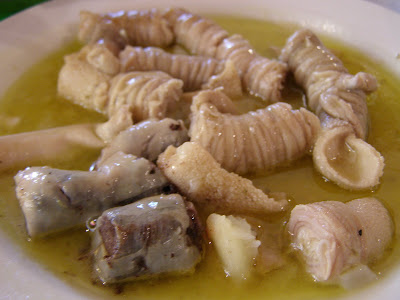
The combination of the spleen and intestine produced the splinogardoumo - spleen sausage. This was added to a red or white stew (depending on whether you used tomato or lemon), together with the small intestines, but it could also be roasted.

Stewed splinogardoumo

When I came to Crete, this dish was still available on restaurant menus, and I remember having it a couple of times when we went out. But it has since disappeared, being available only when made to order, or perhaps to the special diner who specifically orders (and pays well for) it. The Greek relationship with intestines is now limited mainly to home-cooks and people who raise animals for their own eating. You can't even buy spleen at a butcher, possibly due to EC regulations which demand that it be disposed of hygienically and not eaten to avoid the risk of transmissible spongiform encephalopathies (TSE), despite the fact that Greeks have been using these parts of the animal as human food since ancient times. Even when I have been lucky enough to get my hands on an animal's innards, the spleen and large intestine were not passed onto me, for these very reasons.

Food politics play a major influence in what and how we eat. As I explained, I can't really make this dish because the ingredients are not readily accessible to me. Even through the photos, I can still taste the splinogardoumo that my mother used to make. She cooked it in a similar way to my cousin's as we are descended from the same family and region. The photos in this post were taken only just recently, by my cousin, who made the splinogardoumo with her father. Spleen sausage is also made in other parts of Greece, but in a different way, and it is more often called splinadero (σπληνάντερο).

©All Rights Reserved/Organically cooked. No part of this blog may be reproduced and/or copied by any means without prior consent from Maria Verivaki.

Tuesday, 20 August 2013

Ethical meat

Some friends invited us to their house for lunch a little while back. I knew what kind of food to expect there: in Crete, meat is the norm when preparing a meal for guests, our friends like barbecue, and they also like to prepare a lot of food, which often turns out to be too much and is left over and not eaten. I always feel sorry for the animals involved in such food preparation practices because I also know that our friends often tell us that they "don't do leftovers", which I suppose means that they end up chucking out food (usually by feeding it to their pets: they also give us doggy bags to take home, if that is any consolation).


Our latest meat purchase came on Sunday - 9.5kg of free-range lamb, sold to us at 5/kg. The meat pictured here is from half a sheep (ie one side); the animal weighed close to 20 kilos. The cost per kilo is very low compared to store prices. But there are many many reasons for buying meat in this way; it is not all about the price.

Well, I wasn't far wrong in terms of what I expected at the lunch party (there were 10 diners). There were barbecued pork steaks (one for each person, plus a couple of extras, for good measure) and  barbecued chicken (two hens), barbecued pork sausages, barbecued lamb chops and even a barbecued lamb's head. The lamb got in there because they had also cooked a lamb roast in the oven, together with roast potatoes; literally no one touched either, possibly because our host decided to fry some potatoes as well: 'για τα παιδιά,' she insisted (for the children) - her own ones are beefy teenagers. That meal could have served 20 guests, together with the green and tomato salads they served, which disappeared as fast as the bowl was set down on the table.

After removing as much fat as possible (you can see it in the pot), I divided it into portions, which I placed in plastic bags, ready to put it into the freezer. Some portions are bigger than others - some will make one family meal, while others will make enough for two meals (hence, no need to cook the next day.)

Our hosts were only trying to please their guests, presenting the best of the best that they could possibly afford, and it seems that they could afford a lot: meat is not a cheap commodity these days. But the whole idea of excess during a crisis simply fuels my belief that it is not an economic one - it is an identity crisis, or as my husband put it the other day when we were discussing it, a crisis of values.

I personally abhor this kind of cooking to excess; we only cook what we know we are going to eat, particularly when it comes to meat - I have made it a firm habit never to cook too much, because when there are too many meat leftovers, it simply means that we will end up eating many portions of meat over the week. We limit our meat consumption for health reasons, but I also like to keep in mind the ethical issues involved in eating meat. 

Ribs are a good choice for barbecuing - but not if they are as free-range as this meat (you are better off slow-cooking this as an oven roast with potatoes).

In Greece, I think it is true to say that ethics are not an issue at all in Greek people's minds. Greeks don't view the eating of meat as an ethical issue, and neither do they understand the concept of ethical meat. To their credit though, I can say that Greeks do have some understanding of the different kinds of meat available on the market, and what meals they are used for; that is a good foundation for their (eventual) understanding of the issue of ethical meat (when the issue eventually becomes one in Greece).   

From what I know, my hosts do not buy non-Greek meat, even though it's cheaper. The belief that Greek food is better than non-Greek food is still quite prevalent. This is of course a good thing for the economy, with added benefits for Greek identity; but it remains a subconscious belief - Greeks have not quite grasped the idea of building confidence through their own home-grown values, despite the foreign market's great interest in Greek food. (It seems to me that they are still looking at the outside world to shape their identity, identifying who they want to be rather than understanding who they really are. Greece has the potential to be great - it's all about the confidence shown in her by the Greeks themselves.)  

Tail - after the horse meat scandal broke out, I have a politically incorrect sense of superiority when I cook with meat whose body part I can immediately recognise on sight.

The meat we ate at my friends' place was not necessarily grown under ethical conditions: for a start, the chickens were from their own coop, a small, rather restricted caged area. But they were three or so months old whereas most mass-produced chicken on the market is slaughtered at 6 weeks old, so one could say that they had a reasonably long life before they became food. Pork is always a sore issue in terms of the ethics involved in raising it in Greece - pork is one of the most popular (and cheap) meats all over the country, and there is such over-consumption of it (at least in Hania), that we even import great quantities of it (a lot of supermarket pork these days comes from Holland and Belgium - it is cheaper than Greek pork). 

Lamb sold in Crete is, most of the time, Greek. The taste of Greek lamb is unique, because it is nearly always free-range, not necessarily organic, but definitely fed on a lot of natural food. Sheep and goats are often seen grazing on roadsides, so it's not hard to understand why the taste is so good. But lamb (and even more so goat) is more expensive than pork, which is why it is not as popular as pork. (Beef is the most expensive meat in Crete and it mainly comes from mainland Greece.)

Lamb's legs - if you can tell which one is the front leg, and which one the hind, you're doing well.

We had a bit of a discussion about lamb while we were eating. One host asked us where we buy it from. We explained that these days, we always buy it straight from the producer. It is of course cheaper to buy meat in this way, but we have a totally different reason for buying straight from the producer (which will become apparent as you read along). My husband mentioned the person he bought meat from the last time we purchased it. Our host said that he had also bought lamb from the same producer, but he didn't like it: "It was rather tough and sinewy," he said. That is a sign of free-range meat, I thought. The animal hasn't been cooped up in a restricted area; it's been allowed to roam freely in an open space, making the meat tougher. The more natural food that it eats also makes the meat taste better, having been scented by the wild herbs and foliage of the Cretan (and generally the Greek) countryside. Just as importantly, the animal had a reasonably long life (about 12 months) before it became someone's dinner, and it was slaughtered in the way that animals have been slaughtered for many centuries - it died in the area where it was born, away from the eyes and ears of other members of its species. It was led to its death without having experienced the concept before it eventually died.

"How did you cook it?" I asked him. It was immediately obvious to me what the problem was that my host found with the meat he bought from the farmer. When we buy this kind of meat, we cook it for a long time. Often, I boil it (to remove fat - the stock makes an excellent pilafi, so even that liquid is re-used), and then I place it in the pot or the oven (according to the chosen recipe), and it continues to cook till it falls off the bone, having soaked up the herbs and spices I added to it.  


Every part of an animal is useful. This time, we only got one kidney (which came with the half-side that we bought); the other innards (including the head, guts and stomach) were not sold to us because another customer wanted them. As I was cutting the meat into portions, some of it came off in shreds - I will use these bits to make things like spring rolls, etc where only a little meat is needed.

"On the barbecue, lamb chops, just like these ones" he replied, pointing to the rather charcoaled meat in the serving platter (they often burn it accidentally; the pork chops were cooked better because - if I may say so - my husband cooked them). How long do barbecued lamb chops need to cook? About 15-20 minutes in total, I suppose. It's been a long time since I barbecued lamb chops (we do mainly pork chops, and just lately, even that has felt like a hassle to me because you end up feeling rather hot, tired, smelly and sweaty). So our host was trying to cook meat in a quarter of an hour, from an animal that had had a year of life in rumination. He was right in saying that the meat didn't taste good - when meat is cooked in the wrong way, when the cook does not take into account the method that was used to raise the animal, then for sure, the meat will not taste good. The only way to cook such meat is slowly

I didn't enjoy my meal on that day at my hosts' home for this reason. It isn't at all the case that I think too much - my husband didn't enjoy the meal much either, but for different reasons to mine. Whereas I was thinking about all the wrong choices my hosts were making, he was thinking "I've eaten better barbecued meat than this." (See what I mean about the subconsciousness factor involved in Greek identity? He's taking for granted what I regard as a marketable aspect.)

Mind you, we didn't need another lamb's head - I have one sitting in the freezer at the moment. What gets up my nose about the Western civilised world's abhorrence to images such as this one is the price they are prepared to pay to eat this at a high class restaurant: top-to-tail restaurant food is very expensive in Western countries, whereas in Greece, it is the norm for taverna food. A lamb's head costs just 1 euro these days at the supermarket.

Maybe I shouldn't think too much. But I'm still glad that I cook the way I do, and I prefer the food choices that I make, and that I choose slow-cook taverna meals when we go out for dinner. It's so much healthier and so much more sustainable than anything I eat elsewhere.

©All Rights Reserved/Organically cooked. No part of this blog may be reproduced and/or copied by any means without prior consent from Maria Verivaki.

Monday, 13 July 2009

Gardoumia - Koilidakia (Γαρδούμια - Κοιλιδάκια)

This story is a continuation of Bootcamp. You don't need to read the first one in order to understand the sequel (just like J.K. Rowling said about the Harry Potter series), but it might help.

After three years of rigorous, structured tasks in the army where I completed my military duty to my country, I finally came back home, back to the farmer's slow-paced no-hurry routine I had been used to before I left my family. It felt good to be able to wake up any time I liked, help out my parents and brother on the farm, wash in a clean bathroom without the wimpy city boys' clothes lying around the shower box (as if they expected a maid to come and pick up after them), eat my mother's home cooked meals meals and sleep in my own warm bed with clean white sheets, my days of smelly grey bedspreads being well and truly over. It felt good, all right, but it did not pay. After spending three years becoming an andra, I had also lost three years of my working life. As a high school graduate with no specific skills, I was unemployed and unemployable. A year after returning home, I decided to further my knowledge by studying tourism management - in London.

In the last week before I left the village, all my aunts, uncles and cousins invited me to their house for lunch or dinner. Every single day, I ate two feasts, one at midday and one in the evening, and no dish resembled any other that I had eaten on another day. Everyone cooked with my tastes in mind, and all my relatives conjured up sumptuous meals, often killing one of their animals especially for the occasion.

"You've seen them when they come here, Nikita," my Aunt Marika said to me, "all skin and bone, but no meat. Make sure you eat well before you leave the village, they might not have any food in Agglia," she joked.

"They probably cook a lot of lahanorizo," my brother replied, and we both burst out laughing at our private joke.

"Lahanorizo? Who cooks that these days?" she asked. Aunt Marika had no idea what it meant to be force-fed lahanorizo twice a day twice a week.

On Monday, I had avgolemono stew for lunch at her house, and stifado for dinner at her son's house, my cousin and best friend, if you can call your cousin your best friend. Upon finishing junior high school, Manolis had stayed with his parents helping them out on the farm and the olive trees. When he turned eighteen, he began his military duty in the navy. He preferred his own island to his base at Poros, he hated the petroleum-smelling cabins that the cadets slept in, he hated everything about his time there. When he finally came back to the village, he vowed never to leave the place, marrying a girl from a neighbouring village and setting up home here for good. He lived in a house which he had built himself, room by room, over his parents' stone-built rustic dwelling. He was only thirty years old, and had three children under five; his wife was expecting again.

"The hardest work is over," he said to me over dinner. "We might as well go for the jackpot and become politekni."

"But what if they're twins, Manolis?"

"They are," he replied. "What's the problem? I've got 200 stremmata - there's plenty there for all of them."

The menu for the rest of the week continued pretty much on the same meaty basis that it had started. I had never eaten so much meat before in that week alone, not to mention my mother's traditional Sunday roast prior to that. And no one dared to bring out a plate of horta or olives to the table. They were reserved for 'poorer', more 'sombre' days, while I had become an overnight cause celebre. What I particularly craved was a simple plate of stamnagathi, but when I asked my hosts once if they had any left over from one of their own meals, they looked at me as if I had no sense of taste.

"Horta? Mipos nisteveis? It's not the time to be fasting, Nikita," my Aunt Kriti scolded me. Her godfather had been a Venizelos supporter, who believed in the dream of a free independent Cretan republic. Custom dictated that the godparent choose the name of the child, and not the parents. No one could override the choice of name when the godparent chose it. He could choose it right at the last moment, before the child was being dipped into the baptismal font. And when the priest said:


everyone waited expectantly to hear what name my aunt's godfather had chosen.

"Κρήτη!" cried the godfather triumphantly.

"Κρήτη," repeated the priest, "εις το όνομα του Πατρός και του Υιού και του Αγίου Πνεύματος, Αμήν."

And Kriti she was, taking the name of the island where she would live her whole life. Her sister completed the picture when her godfather named her Laokratia.

*** *** ***

The Saturday before my departure was to be a special one. It would be spent at home in the company of my closest relatives. My father was going to kill a lamb and my mother would make one of my favorite meals, usually reserved for Easter. It was still warm in the middle of September, warm enough to sit outdoors under a verandah to keep away the chill of the evening as autumn approached the Mediterranean. Christmas was only a few months away, but the distance between London and Crete made it feel longer. Since I was embarking on a strange journey into unknown territory, Easter would have to come twice this year.

gardoumia gardoumia
This is the second time in my life that I have made these on my own; I used the cleaning method my own mother used (having committed it to memory) when she made the same food in New Zealand, except that the size of each part of the animal there was twice the size of the spring goat I was using.

Just after the lamb was killed, my father brought a foul-smelling bucket into the kitchen and my mother set to work on it. Gardoumia could only be made freshly. She began to meticulously clean every item in the bucket: the stomach, the spleen, the intestines and the fat, taking care not to break them up too much. She let a running tap of water flow through the guts, which swelled up like a sausage balloon, the kind gypsies sell in the shape of a dog.

She then went out into the garden and brought back a thin twig from an olive tree. This was the tool she used to turn the intestines inside out to clean them thoroughly, so that all traces of scum had been cleared. As she cleaned all the inner parts of the animal, she washed her hands with plain water, so as not to taint the meat with the smell of soap. Then she smelled her hands; when she was satisfied that she couldn't smell dung, she knew that the guts were clean.

gardoumia gardoumia
Cleaning the intestines is of utmost importance before they are wound round the animal's stomach to make gardoumia (also called 'kilidakia'). Compare the colour of the intestines in the left hand photo with those in the previous photos.

Then she called me over to help her cut the round spleen into one long thin strip of blood red meat. This she used to stuff the large intestine, so that it looked like a thin warped stiff sausage. She cut off uniform sizes of the tripe and fat. Tucking a little bit of fat into the tripe, she carefully rolled the intestines very tightly round it, fastening them off with a knot at the end, and snipping them off to repeat the process for the next gardoumi. When she had finished making them, she gave everything one last wash and placed them on a clean plate in the fridge.

gardoumia
The large intestine which holds the spleen is called the 'splinogardoumo'; unfortunately, it was either destroyed or not passed on to us when we ordered the kid at Easter, possibly due to EC regulations which demand that it be disposed of hygienically and not eaten to avoid the risk of transmissible spongiform encephalopathies (TSE), despite the fact that Greeks have been using these parts of the animal as human food since ancient times.

As it was the tail-end of summer, she picked the last zucchini crop from the garden and chopped them lengthwise into thick rods. These were fried in olive oil, strained on absorbent paper and set aside. Then she got the potatoes ready, chopping them in a similar way without cooking them. Tomatoes are still in plentiful supply at the beginning of autumn; she grated the reddest softest fruit into a bowl. Everything was ready for the gardoumia, which she knew I preferred to eat in a red sauce rather than the traditional way we ate them at Easter, in avgolemono sauce.

gardoumia
I had prepared the koilidakia just before Easter, but didn't want to cook them at that time, so I plunged them in boiling water for five minutes to kill off any contaminants. After letting them drain well, I froze them and cooked them in the summer with the new zucchini crop.
gardoumia
"Mmm, tastes rather like snails, doesn't it, Mum," exclaimed my 'good' eater, who has developed a refined sense of taste, recognising the same ingredients used in my summer snails recipe. My son turned down his portion. I know I'm spoiling them - how will they survive when they leave the family nest?

And that meal constituted the last one I was to eat in Crete for a long time. It was one of the biggest family celebrations I had ever been a part of in my life. I was the first person in my family to go to university, and to set foot in a foreign land. No one, not even myself, knew what to expect in the place I was setting out for...

Let's hope it won't be like what happened to that poor chap in North London...

*** *** ***
Although it's highly unlikely that you will make gardoumia yourself, here's the recipe for it.

You need:
the intestines of a lamb or goat, along with the animal's stomach and some fat lining the stomach, cleaned meticulously and prepared in the manner described in the story (these sausage-like rolls are called gardoumia)
1/2 cup to 1 cup of olive oil (this depends on how oily you like your food; this kind of meal tastes better in a lot of olive oil)
1-2 large onions chopped roughly
2 cloves of garlic minced finely
a cup of water
half a wineglass of red wine
4 zucchini cut into thick slices lengthwise, fried till golden, and drained on absorbent paper
3-4 potatoes cut into thick slices lengthwise
4 ripened tomatoes, pureed
1 tablespoon of tomato paste
salt and pepper

Heat the oil and saute the onion and garlic in it till translucent (do not let it burn). Add the gardoumia and coat them well in the oil. Add the tomato puree and tomato paste, along with the water, and mix well. Cover the pot with a lid and let the gardoumia cook for an hour. Then add the wine and cover the pot again, cooking for another 30 minutes. Add the potatoes and seasonings, cover the pot again and let the potatoes cook till nearly soft. Add more water if necessary (eg if you think there is not enough liquid in the pot and the food looks as though it is about to stick to the pan). Add the fried courgettes and let everything cook together for the last 15-20 minutes for the flavours to blend.

gardoumia constantinople gardoumia constantinople

The gardoumia can be made with an avgolemono sauce instead of a red sauce. This dish is also cooked with lamb's legs - the intestines are wound round them instead of the tripe. Although it's made all over the country with regional differences, gardoumia is especially associated with Crete and island cultures. It is one of the culinary customs that Ibrahim's grandparents took with them when they left Crete in the 1920s and settled in Turkey, and taught their children (you can see Ibrahim's mother in Constantinople making them with trotters in the photo) to make them too, so that their grandchildren (like Ibrahim) could enjoy them nearly a century later.

©All Rights Reserved/Organically cooked. No part of this blog may be reproduced and/or copied by any means without prior consent from Maria Verivaki.

Saturday, 18 April 2009

Spring lamb (Αρνάκι)

Last chance to buy, before the most important religious festival in Greece takes place tomorrow...

easter lamb 2009

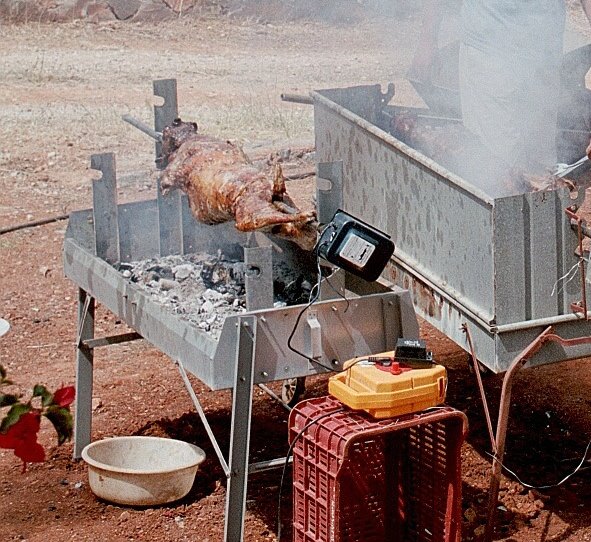
Spring lamb is the order of the day for Easter. Roasting the whole lamb on the spit is the most popular choice of meal, but small family groups (like ours) will cook a roast instead, served alongside a range of traditional Easter favorites like kalitsounia and Easter meat pie. Beware of over-indulgence! This often happens after a fasting period, which is probably practiced for health reasons these days just as much for its purely religious significance (which, in any case, ritualised the health aspect of fasting in older times).

There is no shyness when it comes to selling meat in Greece. This photo was taken a few days ago at one of the biggest supermarkets in Hania. The local butcher in a village will display his wares in a similar fashion.

This photograph highlights the fact that all parts of the lamb are used; nothing is wasted. A traditional Easter recipe is associated with each part of the animal, even the intestines. Some of them are quite laborious but these days, with easier storage facilities, it is not a difficult task to partly prepare each of these delicacies in advance (so important for the busy household in which both spouses are working) and freeze them for cooking at a more convenient time.

©All Rights Reserved/Organically cooked. No part of this blog may be reproduced and/or copied by any means without prior consent from Maria Verivaki.

Monday, 25 August 2008

Okra - bamies (Μπάμιες στο φούρνο)

When he left the family nest, he didn't realise that he had just eaten his last cooked meal and had left home cooking behind for life. No more Sunday roasts, no more pastitsio, no more T-bone steaks marinated in those Cretan herbs his parents had carried in seed form in their coat pockets on the aeroplane, a reminder of their holidays back to the homeland, to make their way into the lawn of their Wellington garden. It took him a long time to recall those home-brewed smells and tastes because the food he was now eating in London was quite satisfactory: exotic tastes, covered in colourful gloopy sauces, nothing of which resembled his mother's home cooking, but at least it was cheap and edible.

He was now picturing her in the kitchen of the family home, opening the back door to go into the garden. He watched her in his mind, climbing the stairs to enter the raised garden bed. Her first stop would be the greenhouse, a roughly constructed shed made with the old doors and windows of their renovated house. She'd pokes in its undergrowth for any sign of a tomato, maybe a cucumber, or some parsley, being careful not to disturb the overgrown zucchini that was left to seed. Around the greenhouse grew all the horta - weeds to the average Joe Bloggs - which she used for spanakopita fillings and yemista herbs. How he missed those garden fresh salads oozing with the olive oil she drizzled over them from a metal canister.

harrods food hallsupermarket

He once tried to make a Greek salad in his flat at Clapham Junction. While shopping at the ASDA across the road, trying to decide if he should buy the 2-for-the-price-of-1 packaged beef mince or the heat-and-serve meat patties, he came across the fresh produce section and spotted some firm red tomatoes. They looked as though they had just been picked off the tree. He placed a 4-pack in his basket. Everything seemed to be packaged using this number, the magic number for the perfect family, the perfect number of flatmates sharing a house, the perfect number of meal portions: 'serves 4'.

clap junc

Back at home, as he began to prepare the salad, he noticed that the label on the tomato packet stated that they were grown in the Canary Islands; not that it made a difference to him if they were from Kenya or Spain, but he couldn't picture in his mind where the Canary Islands fell on the map, despite having travelled extensively. It annoyed him that he didn't know where his food came from any more.

The salad was a disaster. There was only sunflower oil in the house, so the dressing didn't even look right. Olive oil had a green tinge to it, not like the sunflower oil on his plate which resembled children's cough medicine. The tomatoes were overly-firm; despite their red exterior, their innards were still green and seedy, and they contained no juice, which is what gives a Greek salad its flavour. Worst of all, they were completely tasteless. He could have been eating unripe apples, such was the sensation in his mouth; the tomato felt like sandpaper. There was not a hint of sun-kissed flesh, the kind of smell a tomato emits as it is sliced. Only the feta cheese seemed to have any decent taste to it. His girlfriend had bought it at a gourmet cheese store at Notting Hill on one of their recent Sunday strolls there. He regretted crumbling it into the salad, and tried to fish out the chunkier pieces so that it would not go to waste. This was one of the reasons he had stopped cooking at home; the whole exercise seemed pointless when the fresh products lacked taste.

It was much more enjoyable to eat out, since he could savour a different culture's cuisine every night of the week at a reasonable price. He now had a list of a dozen of his favorite restaurants and would rotationally frequent each of them on a fortnightly basis. One day it was Chinese, the next Pakistani, the following gourmet hamburgers, and so on. He was spoiled for choice in his dining habits, never ordering the same meal twice.

Now that he was on vacation in Crete, his appetite had swelled. His uncles and aunts always asked him what he would like to eat, and cooked whatever took his fancy. He felt as though he was being doted on, but never said no to a second helping, whether it was oven-roasted meat or aubergine cooked in tomato sauce. Everything tasted like he remembered it in his mother's kitchen. As his aunt Antonia would say: "Eat it now that you've got it in front of you, because you never know when you'll get the chance to try this again."

As he entered his cousin's house (she had invited him for Sunday lunch), memories of his childhood home kept flashing in his mind. She was setting the kitchen table. "Hey, these plates look familiar. I think we had the same ones."

"They were Dad's," she replied, as she opened the oven to check the roast. He noticed that some of the plates were chipped, but he could sense the sentimentality that his cousin felt for them now that her own parents had passed away.

A familiar scent caught his nose. His cousin had lived across the street from him in Wellington, and both their mothers cooked roughly the same kind of food. He was sure of it, but could not see any pots simmering on the stove.

"Are you cooking bamies?"

okra freshokra sundried
(fresh okra - shaven sundried okra; click here for the recipe)
"Yeah, but don't worry," she began to explain, "I've made plenty of roast potatoes if you don't like them."

"No!!!" he shook his head wildly. "I love bamies! Mum cooks them with chicken."

"Oh, I remember," she said, like the expert cook her mother was. She was beginning to look like her now, short and bulky in a matronly way, busying her way deftly around her kitchen, bringing out the cutlery, glasses and paper napkins to lay the table. This was what eating was like in his family home, a ritual associated with the appropriate equipment, with every item taking its place ceremoniously on the dining room table. He could not recall the last time he saw a table in London high enough to sit at on a chair, or large enough to seat a family. Although he had been working for many years in London, he still could not afford to rent a flat of his own. He and most of his acquaintances lived in digs, tiny bedsits barely large enough to house a bed and chair, if a writing desk could be fitted in somewhere, then the room was considered 'large'. Apart from the usual arguments over the phone bill and the cleaning arrangements, cooking a meal in the communal kitchen also created feelings of distrust: should it be shared? if so, how much money should each flatter fork out to cover the meal? who cleans up afterwards? does the meal cater for everyone's taste, needs, idiosyncracies? low-calorie, carb-free, kosher, gluten-free, vegetarian, vegan, environmentally friendly, politically correct?

"Bamies from a tin, right?" she asked.

He looked at her somewhat confused. "Yeah... canned in tomato sauce."

She started laughing. "I couldn't understand how our parents even liked the stuff, it all came out like goo."

"But you used to eat it, too, didn't you?" She ate everything, and it showed.

"Yes, I did," she replied regretfully. "But now I know how much they missed the real thing. Now that we eat them here fresh. They grow on gigantic tree-like shrubs and they're covered in prickly fur, so they aren't easy to pick."

"You picked these yourself?"

"No, I bought them at a fresh produce market in the Agora. But I've seen the trees. Okra looks fresh when the pod is firm and bright green. You have to shave them a little on the top and let them dry in the sun for a couple of days so that they don't turn into goo..."

He had no idea what she was talking about now. The discussion about food was getting too technical. He couldn't remember if he had ever seen fresh okra on sale at the supermarket. He made a mental note of going to Brixton market when he got back to London to see if he could find them. Not that he was planning to buy them himself; for a start, where was he going to find any sunlight in London to let them dry? When he left Gatwick airport, it was pouring heavily and the temperature was 14 degrees Celsius: all this is mid-August.

roast okra bamies

"... we like them in a lamb roast with potatoes," she was still talking. "They go crispy, like french fries, but with a meaty taste, kind of like that jerky meat Australians like to eat. We never eat them mushy, and I don't think our parents ate them mushy when they cooked them here in Crete. They just weren't available fresh in New Zealand. They're kind of an acquired taste."

An acquired taste. What Londoners would say of potted shrimp pate, boar terrine layered with chestnuts, olive oil infused with black truffles, whisky-flavoured seville marmalade. When asked to give their opinion of okra, most wouldn't know what it was, let alone have tasted it. If they were shown what it was in a photo, they might think of it as a 'native's' choice of vegetable, associated with a community whose skin was dark. They probably couldn't place it in any of the mongrelised versions of international dishes in the average Londoner's repertoire.

roast okra bamies

Roast okra - made all the more delectable with garden fresh tomato pulp and virgin olive oil. He had one serving, with tender-cooked lamb and roast skin-blackened potatoes. The okra was firm, chewy and juicy. His cousin asked him if he would like a second helping, which he obliged to. Then she asked if anyone wanted the last scrapings off the tin. He took those too. Like his aunt, he wondered when he would get another chance to savour a meal like this one.

This is my entry for Weekend Herb Blogging, this week hosted by Katie from Thyme for Cooking.

(Dedicated to PH, who licked the tin clean)

©All Rights Reserved/Organically cooked. No part of this blog may be reproduced and/or copied by any means without prior consent from Maria Verivaki.

Friday, 27 June 2008

Sheep's head with orzo rice (Κεφαλάκι γιουβέτσι)

What's the most disgusting thing you've ever eaten? For me, it's Thai salted plums. I was 22 at the time, and my teaching career had landed me a position holding conversational classes with a group of six horny Chilean youths and three Thai teenagers including one girl in the whole group. It was the weirdest class I ever had to take, because I was practically a teenager myself. The Chileans were loud and raucous, and poked fun at the facial features of the Asians, while the Thais themselves maintained their silent smiles and servile postures. The young Thai girl in the group offered me something that looked like a caramel. I thanked her and popped it into my mouth without even conceiving the idea that it may be something I didn't like the taste of. I remember keeping it in my mouth long enough for the girl not to see me discarding it hastily in the bin, and rushing off to rinse my mouth.

When my mother cooked, I remember only one time when my father ever complained about a meal (the horta weren't well cleaned). All other times, he ate whatever came out of the pot as my mother cooked it. He himself never cooked, and I don't think my mother would have allowed him to do so, anyway, being the veritable Cretan woman that she was, despite living so far away from the island. When I first got married, I suddenly became aware that my life had taken a 180-degree turn on the aspect of food. I discovered that some people won't eat anything that's put in front of them, so I had to cook in such a way that what I cooked would be eaten, because I can't stand wasted effort.

I am fully sympathetic to anyone who doesn't want to eat something because they don't like it (even though not everyone is sympathetic to my desire to try everything), but I'm not too happy with my children when they are put off by sight rather than taste. I always ask them to taste something first before saying they don't like it, but it isn't always easy to get them to eat something that they dislike the appearance of in the first place. As it is not easy to cook for a family all with different tastes, I try to to cook meals that will have something in the saucepan or baking tray that everyone will eat from, usually in the form of pasta, potatoes, rice or beans, while always endeavouring to 'hide' vegetables in the sauces. It is simply not practical or ethical to have family members eating different food (unless there are leftovers), especially when one person is expected to cook for everyone. This is in line with the general idea that we should all respect other people's efforts.

There are other reasons why we 'have to' eat certain meals in this house:
  • they are good for your health
  • they are made with fresh garden produce
  • life is expensive and we can't afford to buy prepared meals or luxury food items
  • food should not be wasted
  • we can only have what we like when we are in a restaurant
And there are times for treats:
  • we try to go out about once a month for a meal as a family
  • when we eat out, the children are allowed to order whatever they like
  • we let our kids eat ice-cream in the summer, but not every day
  • occasionally eating junk food as a family every now and then provides memorable occasions and always brings on happy faces
Satisfying all the eaters in my house is not easy, but after nearly nine years of marriage and continually improving my techniques in the kitchen, I am overcoming this daily issue with which I am faced, and will be faced until the children are old enough to prepare a meal of their own or they leave the family home (for military duty and/or college).


Sheep's head is not something we have on an everyday basis, and it will send more intense shockwaves than my recent snail stew (which my daughter thought was finger-lickin' good - my son only ate the potatoes). In fact, sheep's head is only ever found in our deep freeze when we buy lamb (even though there were a pile of them in the supermarket where I bought some milk and fruit today). We buy our meat from the local butcher, but there are also times we buy straight from the farmer. In Cretan cuisine, the whole animal is eaten, each cut of meat cooked in a different way. The origins of this practice are easy to guess: economy, nothing goes to waste. Some people say that in Crete, we are leaders, not followers. Despite the peasant conditions prevailing outside the few urban centres of the island, the local people possessed the knowledge to ensure that they could hygienically cook all parts of an animal in a tasty way. A free-flowing supply of clean water is the key to hygiene; in Crete, we are blessed with it. This is a luxury in some parts of the world, and not just developing countries: in Iowa, it is unsafe to drink tap water on 'blue baby alert' days because of fertliser excess run-offs contaminating the water supply on particularly rainy days, as Michael Pollan explains in The Omnivore's Dilemma.

The sheep's head has been in the deep freeze since Greek Easter, much less time than most frozen supermarket food. It's time to use it. I'm cooking sheep's head for my son today. My son adores orzo rice pasta, called kritharaki (because it has a barley-grain shape) in Crete, or manestra in other parts of Greece. We never cooked this sort of thing in New Zealand; I'm afraid the societal norms prevalent in my country of birth just did not provide the setting for the sale of such cuts of meat; dead animals were treated euphemistically, as if they were not really animals but some kind of edible red plant, neatly packaged in cellophane wrappers with due-by, use-by and eat-by dates clearly labelled, particularly after the demise of the butchery and the takeover of this sector by the supermarket (as Joanna Blythman points out in Shopped).

One way of cooking sheep's head is as yiouvetsi - roasted in tomato sauce, with orzo rice pasta added towards the end of the cooking time. Some of us will eat the orzo, while others will lick the sheep's head dry. As long as everyone finds something to eat, I'm happy.

©All Rights Reserved/Organically cooked. No part of this blog may be reproduced and/or copied by any means without prior consent from Maria Verivaki.

Thursday, 5 June 2008

Offal (Τζιγέρι - Εντόσθια)

P6050006

It's a load of old waffle
that awful is OFFAL.
It may not look good
to treat it as food.

But once you have cut it
and floured it and fried it,
believe me, there's nothing
that tastes quite just like it.

Maybe it's hiding
in that little SAUSAGE
you ate as of late
in your wholemeal bread sandwich.

So next time you're buying
a small spring-born lamb,
you might think of eating
what you thought was spam.

It's liver and kidney
and sweetbreads and heart,
the kind of things chucked
in a steak-kidney tart.

Let it all cook until it is crunchy;
just think of it then as a squidgy BIFTEKI.
And when it's all done, it needs very little:
some lemon juice, salt and horta to fill you!

©All Rights Reserved/Organically cooked. No part of this blog may be reproduced and/or copied by any means without prior consent from Maria Verivaki.

Thursday, 1 May 2008

May Day 2008 (Πρωτομαγιά)


OH.

MY.

GOD.

We ate everything: dakos rusk, marathopita, gardoumia (sheep's intestines wound round tripe - the little dark pieces are the animal's spleen), stamnagathi, tzatziki, fried potatoes, local sausage and roast lamb and potatoes (1 beer, 2 lemonades; 45 euro).

The taverna was non-descript; it didn't even have a discernible name, suffice it to say that it was located in the historical village of Therisso, about 15 minutes away from our house, and it was the second taverna on the right-hand side as you enter the village. We didn't find any tables in the first one, which is why we ended up here, but later, when we went for a walk in the upper part of the village, we found all the tavernas doing a booming trade. At the end of the meal, we were treated to a very good tsikoudia and some ravani cake.


Labour Day (one of the zillions of public holidays in Greece; in combination with regular strikes, it's a wonder Greeks get any work done at all) is associated with spring weather, village walks and flowers; Therisso has got it all. The village itself is a popular place for hiking, despite the rubbish and rubble that is left in full view of the tourists and local visitors coming to this verdant village. I suppose the locals don't need to care because they know that the visitors will just keep on coming, whether the road is full of somebody else's household garbage or not, especially now that a construction company has bought some prime land at the very entrance to the village - the end of the long gorge that separates the moutainside village from the rest of Hania - and turned it into brick-built houses which are going to be sold to British retirees (the new 'neighbourhood' has been given the name "The Maples" of all things). During the Labour Day holiday, it's traditional to collect flowers and make them into a garland, but we let all the other Greeks who'd piled into the village (access to it is via a very narrow road) do this and left the countryside in the same state that we found it in.

Therisso's lush foliage makes it a suitable place for raising sheep and goats, which explains the animal dung found all over the road - shepherds and cattle obviously have the right of way here. There are also dairy stations, roughshod milking sheds and huts for wintering animals, so it can be safely assumed that the meat cooked in a taverna of the region will have been raised in the same area. The olive oil used in the dakos rusk and stamnagathi was clearly extra virgin, the same stuff used to fry the marathopita and the chips, the same one used to make the gardoumia stew. In fact, most of the farmers here own a taverna or butchery, and the locals who like to dine here come from all over Western Crete. Therisso is a popular winter resort. It can get snowed in, although the roads these days are cleared quite quickly by the councils. In the summer, it is less popular simply because it isn't located by the sea, but the food remains delicious right throughout the year.

The old village school has been turned into a museum worth visiting: the Museum of the National Resistance, 1941-1945. It contains mainly photographic material; sadly most of it is very gruesome, clearly illustrating the horrific torturous events of the Nazi Occupation of Crete. It is the kind of museum all Greeks should visit, whether they are Cretans or not, because what the Cretans suffered was pretty much what the rest of Greece suffered during WWII. I remember seeing similar atrocities in a museum at Kalavrita. I will not echo the senseless remark made by a woman who was also visiting the area at the same time as my family: "1 euro entrance fee? I've already been, so I won't bother." She was Greek. The picture shows the bravery of the Cretans who, during the Battle of Crete which was lost to the Germans, despite being ill-equipped for battle, fought with whatever means they could - their bare hands and the stones from their fields. There's a cemetery full of German paratroopers in Maleme, an air force base in Hania.

On our return journey back home, we passed a few picnickers, which was a delight to see. I don't know if it was the rising cost of living or the acquisition of Western customs that kept them away from the tavernas and frappe coffee bars.

©All Rights Reserved/Organically cooked. No part of this blog may be reproduced and/or copied by any means without prior consent from Maria Verivaki.

MORE RESTAURANTS:
AGORA
Therisso
London
Paleohora
Aroma

Saturday, 19 April 2008

Cheese from Crete (Κρητικά τυριά)

Easter is a time of indulgence, and who wouldn't want to indulge after a 50-day fast; those who say that the Greek Easter fast is 40 days old, are simply wrong; they have misinterpreted the meaning of the word "σαρακοστή" - sarakosti - which means '40 days'. Fasting actually starts with a one-week fast, abstaining from meat and fish only, what is traditionally known as Cheesefare Week. At the end of that week, Clean Monday signifies the beginning of the longer fast where abstinence from meat, fish and dairy products is observed (although shellfish are permissible). If you count Cheesefare Week, that's 58 fasting days before Easter Sunday. Cheesefare Week is not included in these days - that's an extra week of fun and festivities, including Rio-style carnival tomfoolery. There are 48 days from Clean Monday to Easter Sunday - a total of 7 weeks - so why do Greeks talk about fasting during sarakosti, and not penticosti (which means 50 days)?

Here's the answer: the Holy Week - starting from Palm Sunday to Easter Saturday - is not included in what is termed as the fasting period for Easter. After Clean Monday, there are 40 days (sarakosti) until Larazus Saturday (the day before Palm Sunday). The Holy Week is of course also a fasting week, but it is treated as a special case. Have you ever heard of Mrs Sarakosti who has 7 legs? All school children in Greece know about her. I found out about her from my own children, who've been drawing Mrs Sarakosti for the last three years. Despite the web link's inaccuracies - yet again - of the number of fasting days in Great Lent, the drawing of Mrs Sarakosti - the mouthless face and the praying hands - is correct. Each Saturday after Clean Monday, one of her legs was chopped off, and when the final leg remained, then the uneducated Greek villager knew that the Holy Week was starting the next day - Palm Sunday. Ans as an aisde, if you're still wondering what penticosti (πεντηκοστή) is, that's the 50 days AFTER Easter, before the Holy Spirit descended and enlightened the people who spread the word about Jesus Christ. It is a educational holiday in Greece (school and educational institutes, eg the Ministry of Education and Religious Affairs are closed, but shops are open).

So it's only natural that on Easter Sunday, people let rip when it comes to food. Traditions tend not to die out in insular areas, even in these globalised times (Starbucks is coming to our town only just this week). The people of Crete love their food. They'll mention the names of local produce and dishes as if they are common knowledge. They'll turn up their noses to anything that sounds distinctly foreign. It may sound narrow-minded of them, but at least one can give them credit for knowing what they are eating.

In the days when people actually observed the 50-day fast (people rarely fast for the whole 50 days now), Cretans devised ways to preserve their dairy products. Easter is the right time to get to know Haniotiko cheese. Great Lent starts at a time when lambs and goats are being born, so there were always many milk-fed animals before Easter - hence the lamb becoming the food associated with Greek Easter. Whatever milk was collected was turned into graviera (γραβιέρα) - the Cretan variety of the Swiss gruyere. There are ripened forms of graviera, as well as the more milky (fresher) variety. The holes are not usually as big as what is typically associated in the West as gruyere. Graviera is never missing from our house. We eat about half a kilo every month. I did buy some mature English cheddar once, a very good variety called Cornish Cruncher. Despite being an excellent mature piquant cheese - the kind of cheese we look for in our preferred variety of graviera - it never caught on in my family. It's graviera all the way for them.


Great Lent inspired other ways of creating cheese and preserving milk. As the fast wore on, too much maturing graviera started to accumulate in the cellars, since people weren't eating it. A variety of specially made soft cheeses were produced during this time, the most famous being tiromalama (τυρομάλαμα) - even though we hardly ever ask for it by this name. This is made from the first shaping of graviera, creating a very milky, soft, damp cheese, resembling mozzarella in taste and texture. It also creates those long stringy threads when cooked - and it's always cooked, never eaten fresh. It has a sweet taste, and is mainly used in pies (used as is) and kalitsounia (it needs to be salted and strained). Its soft texture gives it its local Haniotiko name - malaka (μαλάκα), with the stress on the second 'a'. I know what you're thinking: how do you ask for some malaka without offending the shop owner? Here's the conversation I had with my cheese-maker:
  • Kalimera, I want some of that fresh soft cheese which you make before Easter.
  • Look, lady, it's called maLAka, and there's nothing to be ashamed of.
This is why we call the Easter kalitsounia 'malakismena'. Don't get it? Ask a Greek to explain it to you - beware of the bewildered look they will give you. It reminds me of going into a toy shop at Christmastime and asking the shop owner for 'kerata' - reindeer horns - for my son's role in the Christmas pageant. Thankfully, the shop assistant was a woman. The best time to buy malaka is in the spring, when lambs start getting 'baggy' (σακκιάζουν) - filling with milk, while having fewer lambs to feed it to.

One of Crete's most famous cheeses is a soft white crumbly creamy cheese called mizithra (also known as pichtogalo - thickened milk), the same kind of cheese that is widely known as ricotta in the West. It's an extremely versatile cheese; it is ubiquitous in Cretan cuisine. It's found on the table instead of feta, used as a spread on bread or rusk, in savoury pie fillings, sweet pie fillings, mixed into baked vegetables, stuffed in rabbits - the list is endless. Although it does not have a very long shelf-life as fresh cheese, it freezes extremely well. It is never bought frozen, but those who have sheep and goats will make it in large quantities; what they don't eat or sell is frozen and used during times when sheep and goats produce less milk. It is not exported, as it is highly sought after by locals and mainland Cretans living away from the island. And that too, like graviera, is never missing from our fridge, either.


Another popular difficult-to-export highly sought after Cretan dairy product is our 100%-fat cream, called staka (στάκα). It comes in clotted form, and is often eaten warmed up as a kind of high-fat (and cholesterol-filled) dip. It is added to a variety of dishes for extra flavour, but it's not exactly healthy. It is also used in festive pies. One of the most popular recipes using staka is to place a small amount in a saucepan and cook fried eggs in it (sunny side up). It is also used to make the filling in stuffed roast lamb wrapped with vine leaves. Staka can also be heated so that the yellow oily liquid it contains is drained off and turned into butter. This is called stakovoutiro (στακοβούτηρο). Stakovoutiro is used in the same way as butter, although not many people prefer it these days because of its high fat content. In the days when the average farmer used to walk the same number of kilometers that the average farmer of today now drives, eating staka was a form of energy. Nowadays, most Haniotes still use staka in the festive season in traditional festive recipes.

Why do so many Cretan cheeses resemble other European cheeses, but are unknown by their Greek name in the West? Sadly, this has to do with our history. While France and Italy were living the Renaissance (1300-1600), Greece was being subjugated by the Ottoman Empire (1450-1850), who would have liked to annex Greece as a part of Turkey, whose yoke we managed to shake off only about 100 years ago. While the French and Italians were creating works of artistic importance, the Greeks were begging the Turks not to blow up the Parthenon (but they did it anyway), while Lord Elgin was siphoning off bits of it and shipping it to Britain. The same reasoning underlies other fallacies, like why it took so long for feta cheese to have protected-origin status (October 14, 2005).

The map in the photo comes from a larger map of Europe with an 1897 New York copyright. It was being sold as 'posh' wrapping paper in a shop on the King's Road in Chelsea, London. The assistant wouldn't have understood if I had told her that I was going to hang it up in my kitchen as a reminder of my cultural identity. What is now known as Turkey is labelled Asia Minor, the place where a lot of Greece's culinary heritage was born. Macedonia is not mentioned, but Saloniki is. No need to translate Uskup, is there? (For the uninitiated, it's Skopje.) Crete wasn't even part of Greece at the time (it was formally made a part of Greece on December 1st, 1911).

©All Rights Reserved/Organically cooked. No part of this blog may be reproduced and/or copied by any means without prior consent from Maria Verivaki.

CRETAN PRODUCE:
Xinohondro (hondro)
Stamnagathi
Marathopites
Avronies (wild asparagus)
Wedding pilafi
Orange juice
Lagos stifado
Sorrel
Silverbeet
Bougatsa Iordanis
Black mustard greens
Malotira
Sfakianes pites
Olives tsakistes - pastes
Olive oil

Friday, 18 April 2008

Cretan meat pie for Easter (Κρητική κρεατόπιτα - κρεατότουρτα του Πάσχα)

Celebrating Greek Easter in New Zealand wasn't easy; we had to celebrate Easter in two Easter instalments. First, we'd have the calendar holiday in March or April, when school would close early on Thursday and wouldn't open again until Wednesday. This was purely a mini-break for us; we were still in the middle of our fasting period, the Great Lent. Calendar Easter meant nothing to us. We were not moved when we saw the Pope on television announcing to the world that Christ had risen. In fact, we thought he was lying. Then, sometime between mid-April and early May, we'd experience the re-enactment of the crucifixion and resurrection of Jesus Christ, as the Greek Orthodox calendar dictated.

Calendar Easter and Greek Easter concurred every now and then, but it wasn't always guaranteed. This was the best case scenario, when I felt like a 'normal' New Zealander, and I didn't have to explain to anyone why I was still fasting after 'Easter Sunday'. One year in particular, I remember that calendar Easter fell at the end of March, while Greek Easter was scheduled for early May. That was the worst case scenario; the Kiwis were celebrating Easter Monday while we were just starting on the Great Lent with Clean Monday.

It had been instilled in us that we would not go to Paradise if we broke the fast, which we sometimes did, but only 'accidentally.' We never told our mother; we were more afraid of her wrath rather than the wrath of God. Even though we fasted quite strictly in our house for the whole of the Holy Week before Easter Sunday, we never felt as though we were 'suffering' while we were fasting. I hadn't read the Bible at that point, in which it states that a person who is fasting should never let anyone know they are fasting, but to keep a happy face and be in high spirits. In any case, the Great Lent was a good excuse to eat New Zealand crayfish, scallops and oysters. The only suffering you had to endure was knowing when to stop eating seafood before you got stomach cramps.

We went to church every night during the Holy Week. After closing the shop at 7pm, we'd rush to get home, wash and change into acceptable church attire, so that we would at least manage to hear the last part of the daily vespers service. On Palm Sunday, we patiently waited to be blessed with holy water, while on Holy Monday and Holy Tuesday night, there were mainly scripture excerpts. Holy Wednesday must have been an important service, given the significance placed by the Greek Orthodox church on fasting on that day, but I could only remember something about a prostitute and a barren fig tree.

My favorite night was Holy Thursday. In the morning, my mother would dye red eggs for Greek Easter, before going to the fish shop. In the evening, we'd attend the church service with the readings of the twelve Bible excerpts, a candle being lit after each reading was finished. I liked the mathematics of the show, the symmetry of the lit candles, the Cross being brought out in the middle of the readings, the reverent procession made by the congregation to kiss it. It was all part of the culture I had been brought up in, far removed from the culture I stepped into at the end of the service as I walked out the door of the church, across the road from Todd Motors, the KFC and the late evening pub revellers from the Cambridge Hotel, the patrons of which would always be intrigued by the procession of the Epitafio on Good Friday and the dark solemn faces that followed it holding plain yellow mourning candles, late in the evening in the cold wet drizzle of a New Zealand autumn. A happy face was a definite no-no on that evening; we were reprimanded for smiling.

On Good Friday, our uncle would go out to a friend's country house in Levin and pick a couple of sheep from his farm. The dirty business was done there, and he'd drive back to Wellington with the carcasses. The meat was shared out between our families, with all the sheep's innards going to our house. Since I was more willing to help with the preparation of the meat, it was my sister's duty to cart them over from his house (down the road from ours) in a bucket. They ponged; the smell of manure would follow her from our uncle's house to our own. It was a good thing Easter always fell in a cold season; no one was out on their porches or verandahs to see her doing this. Her greatest fear was to be seen by a neighbour (all middle-class Pakehas all living in renovated Victorian bungalows) carrying an animal's intestines in a bucket in the middle of an inner-city suburb, as if she had just been milking a cow and was returning home with dung for the garden. What would they be saying? "There go those Greek girls, smelling like dagos."

The sheep's guts were transformed into the most delectable sausage-like sweetbreads imaginable (called gardoumia: γαρδούμια): sheep's stomach (tripe) cut into strips, with a little stomach fat, tied together with the intestines of the lamb, which had to be thoroughly cleaned, inside and out. These were made into an egg-and-lemon soup for the midnight feast after the church service on Holy Saturday - we broke the fast with this soup - while the next day, we ate them stewed with zucchini in a red sauce for Easter Sunday. And it is these tripe and gut 'sausages' in egg-and-lemon soup that make a traditional Cretan Easter meal, not mayeiritsa - that's a mainland dish. Ditto the lamb on the spit - again a mainland tradition imported to Crete, probably around the time that Cretan soldiers were recruited to help fight in the Albanian war. When they returned to their hometown, they bought with them new forms of cuisine that they had been treated to from mainland Greece. They are all nice once-a-year traditions, nevertheless, and unify us in the same way that a traditional English roast with Yorkshire pudding unifies Britons.

Holy Saturday signalled the grand finale of the re-enactment. We were allowed to wear our new clothes for the season to the church service which started at 11pm. The grieving period over, we held white candles, and we could laugh and smile as much as we wanted, but only after midnight, when Christ was risen. "Christos Anesti!" shouts the priest. "Alithos Anesti!" the congregation answers back. After everyone had kissed and wished each other a happy Easter, we walked back home, being one of the few remaining families who actually still lived in the earliest Greek neighbourhood of Wellington City, while most Greeks had moved out to the suburbs with the large houses, huge gardens and double-garages. My parents had remained in Mt Victoria, in the same way that they would have remained in their respective villages, had they never left the island of their birth.

The Holy Week signified the climax of the preparations preceding Easter. We'd be working in the fish shop every day of the week, but the kalitsounia, the koulourakia, the Easter meat pie, the sheep's guts (gardoumia), the red eggs, the tea breads (tsoureki) and the avgolemono stew would all be prepared, cooked and ready for the grand feast after the church service on Easter Saturday, which ended in the early hours of Sunday morning. We pigged out at the midnight feast, felt no stomach pains afterwards, and still managed to eat another round of all this on Sunday at lunch, with the addition of barbecued lamb chops.

They say that spring lamb on the spit is the traditional meat dish for Greek Easter, but just consider the size of a New Zealand lamb - you'd need to re-landscape an inner-city garden to fit it; either that, or take the spit to a park. And as for the weather, April in Wellington was guaranteed to be cold, wet and windy. Barbecued lamb chops suited us just fine. I did try eating the Easter lunch on the balcony once; first I watched all the paper towels flying from our house in Mt Victoria all the way to Newtown, then I watched all the neighbours watching me litter their gardens.

On Easter Sunday, our appetite was whetted by the sights and smells of our traditional Greek mother's Easter meal. Our table was probably more laden with delicacies than the average Greek table in my parents' village. We were living in the land of plenty, unlike the land they themselves had emigrated from. The star attraction of the Easter meal was the traditional Cretan meat pie, something that my mother's Cretan family never made in the mountain village where she was raised, but was a staple of the Easter menu in my father's coastal village. My mother would make the pastry and mizithra (the local variety of ricotta cheese) herself to create this dish - neither of these products were available in the right form in New Zealand at the time, in order to make this pie authentically.

Celebrating Easter in traditional style is not the same as cooking a Sunday lunch. It needs special ingredients, special cooking methods, special recipes. We've planned our meal for that day, so we can shop accordingly. In Greece, it's better to shop early for the ingredients you will need. If you leave the shopping till the last two days before Easter, you will find that the best quality ingredients will have taken flight.

To make a 36cm-diameter Cretan meat pie for Easter, you need:
pizza dough
chunks of boiled spring lamb (about 1.5kg of cooked boned meat), with the bone taken out
500g mizithra (the local variety of soft curd cheese, similar to ricotta; a mixture of the local mizithra, malaka and staka can be used, if you can find these products - and you'll have to be living in Crete to do that!)
a sprig of fresh mint, finely chopped
a beaten egg yolk, for brushing the pastry
salt, pepper and oregano
sesame seeds

Pick the meatiest parts of the lamb to use in this pie. If you use only the meat, then you're making a kreatopita - κρεατόπιτα (meat pie); if you leave the meat on the bone (as we used to do in New Zealand), then you're making a kreatotourta - κρεατότουρτα (meat torte). I prefer the kreatopita because it serves (and freezes) more easily. Kreatotourta is classically made in a round pie tray.

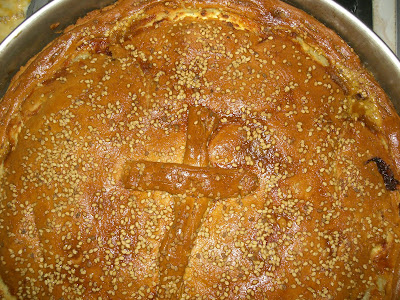
Make the dough as instructed in the recipe for ladenia. Roll out a piece to line a 36cm tin. Place it on the greased tapsi - ταψί (what the Greeks call a baking tray). Season it with salt, pepper and oregano, according to taste. Place the meat chunks on it evenly. Sprinkle the mizithra over the meat, so that it spreads evenly over the pie. Sprinkle the mint over the cheese. Roll out another piece of pastry, leaving a small ball of pastry aside (the size of a golf ball). Cover the pie with the dough and seal it around the edges. Make an small opening at the top and bottom of the top pastry sheet (to let out trapped air in the pie while cooking). Cut the remaining dough into two pieces. Roll them out in a long thin shape, and place them in the centre of the pie to make the sign of the cross. Brush the pie with the beaten egg and sprinkle sesame seed all over it. Cook the pie in a moderate oven for approximately 45 minutes - only the pastry needs to be cooked, while the meat and mizithra cheese will amalgamate inside the pie with the heat.

And if you can't eat everything in one day, this pie freezes well, both cooked, uncooked and in servings. In my opinion, the best time to make this pie is AFTER Easter, when there'll be plenty of leftover lamb from the spit, so you won't have to boil it, either.

©All Rights Reserved/Organically cooked. No part of this blog may be reproduced and/or copied by any means without prior consent from Maria Verivaki.

MORE EASTER TRADITIONS:
Tsoureki
Koulourakia
Red eggs
Seafood
Lent pies
Bakaliaros for Palm Sunday
Clean Monday
Fasting
Cretan Easter meat pie