Thursday, 14 August 2008

Bougatsa from Serres (Σερραϊκή μπουγάτσα)

Today I have to make sure that I get to do every single errand that involves going into Hania, as it's the last day my children are at day camp (ie being supervised by someone else). After parking the car a zillion miles away from the centre (as usual), and carrying a computer screen in my hands (it broke down while under guarantee), I started on the little tasks that make me walk from one end of Hania to the other every time I need I go into my hectic little town, with its erratic traffic problems which are always exacerbated in the summer.

Coupled with the congestion, there is the heat. Sweat poured down my back, my clothes were sticking to my skin, my head felt as if it were on fire. To make things worse, I had forgotten to fill my water bottle from my home, meaning that I was carrying extra useless weight in my bag aside from mizithra, okra, vine beans, children's books, among others. My mouth was dry, my body slowly dehydrating, and it was only half past nine. I needed a sit-down in the shade with something cool to drink.

My errands had taken up to the Agora, behind which there is a large square with cafes and bars surrounding it. I walked along the road and chose the first empty space offering ample shade; the name of the cafe and what it served did not interest me at that moment. In fact, whenever I'm eating out, the food and where it comes from never interests me, because I know that I can never be sure of the truth of anything the restaurateur claims about the menu. Luckily for those who live in Hania, when eating out, there is usually a choice of views, scenery and atmosphere to enjoy apart from the food: this is the motivating reason for me to eat out.

My view was not the most alluring: double parked cars, souvenir shops, tacky jewellery stores and other nondescript eyesores. Even the sight of the tourists who were milling about the area - a well-known tourist spot which may also be referred to as a trap by some - was not uplifting: after a certain point, one easily tires of seeing old-fashioned travel book images from a bygone era, young lasses clad in bikini tops and wraparound skirts and bare-chested men, their shoulders laden with a dusty backpack, in the middle of the town where we all conduct both our formal and informal business. As AA says, this is the image most people still have of Greece: a place where everyone lives by the sea beating octopuses on rocks and traveling by donkey. My tired feet and aching arms had not foiled my senses.

ano kato cafe hania chania

I looked up, spotting the name of the cafe: Ano kato: Serraiki Bougatsa, which could loosely be translated as "Topsy Turvy: Bougatsa from Serres." Bougatsa from Serres? Foreign food, food that our foreign tourists are aching for, the term foreigners including urbanite Greek travellers from Athens, the kind who buy bougatsa in Athens which bears no resemblance to the bougatsa served in Hania, the kind of place a non-Cretan Greek would look for if words like boureki, dakos and stamnagathi scare them, fearing the unknown as we all do to some extent, which is why many of us will search for a Casa di Pasta restaurant in Thailand, or a burger chain in China.

"Parakalo?" Just when I was thinking that this might be a self-service cafe, the waiter had arrived, carrying a serving tray with coffees and glasses of water with lots of ice cubes. He had been busy preparing orders to be served to the local shop-owners, another one of those traditions which gives Greece a picture-postcard image: a waiter crossing the street with a tray of refreshments, specially ordered by businesspeople. No messing around with the cafetiere for them; silver service that even the plebs can enjoy. He left one of the glasses of water on my table.

Being on a diet - always one that is broken - I had left the house without having breakfast, so I decided to order some bougatsa, in full knowledge that it would contain three times the number of claories that my home-made breakfast would contain. I noticed the food display case: croissants, rolls, pastries, but which of all of them was the Serraiki bougatsa?

"A plunger coffee and a serving of bougatsa, please."
"The bougatsa's going to be ready in about ten minutes," he replied very politely. I was beginning to like this place.
"No problem," I smiled, I'm in no hurry."
He smiled too. "And you know it's the cream-type of bougatsa." Oh, the joy of being treated like a local...

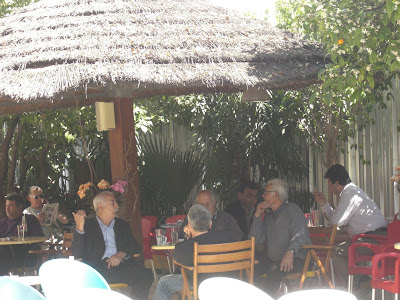
As it was still early morning for some, the cafe was empty. I was being kept company by three empty seats round my table. I laid all my bags on the seat opposite mine, when it occurred to me that those inanimate objects might just have a better view than I did. I got up and changed places with the bags.

ano kato cafe hania chania

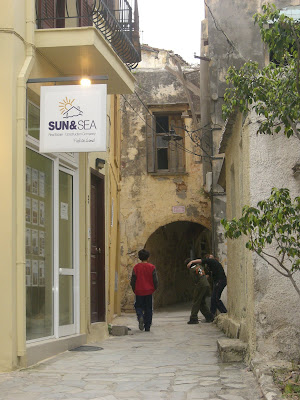
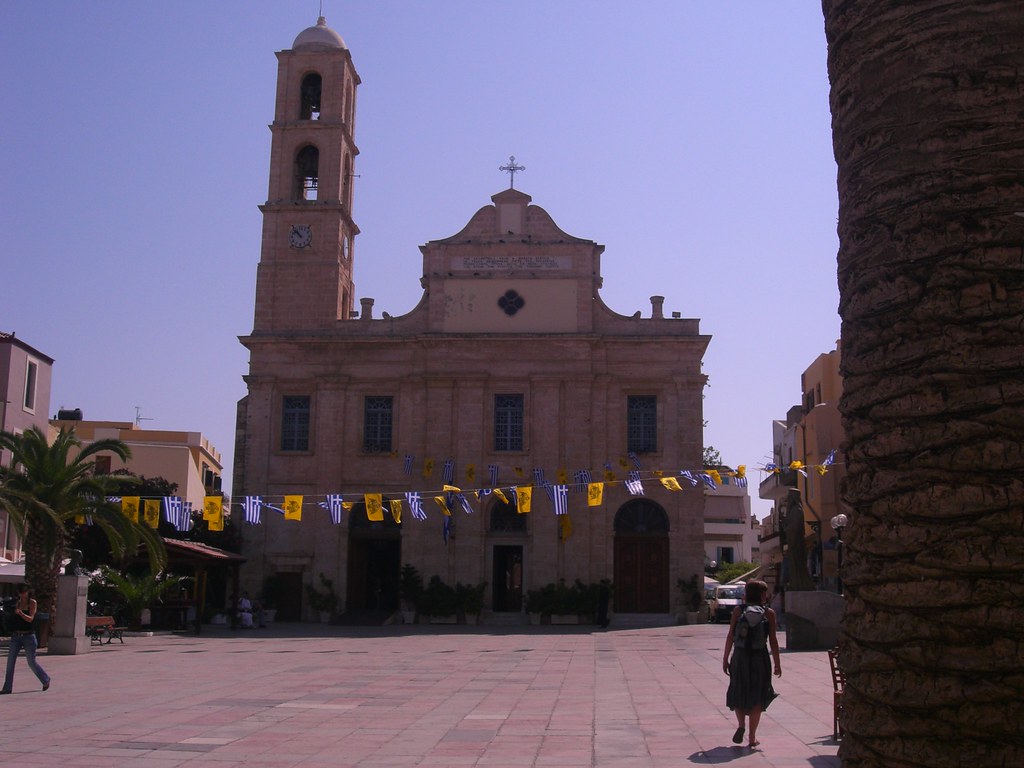
My whole world changed. No more cars and tacky souvenirs. I saw a different world: traditional handcrafts and woven textiles, a huge linden tree, the wall of the main square where the Cathedral of Hania is located. The most basic elements of the area had probably not changed since my parents' time before they left Crete to emigrate to New Zealand. I wondered whether they had walked in the same side street - probably it had not been pedestrianised in their time - before they left the country. It had the kind of look we are familiar with in those old Greek black and white movies which I used to see at the cinema in Wellington during a private screening for the Greek community.

ano kato cafe hania chaniaano kato cafe hania chania

The ten minutes it took for the bougatsa to arrive passed pleasantly watching the shop owners waiting for business, sweeping the outside of their shops and chatting to their neighbours. A hotel owner sat in the alley opposite with a bowl of uncleaned horta reading her newspaper, while a fresh load of white linen tablecloths had just been delivered to her neighbour's restaurant. Even the cobblestones on the street took on a new interest.

old port hania chaniaold port hania chania
bougatsa serraiki

Serraiki bougatsa was surely very different to the bougatsa traditionally served in Hania: custard instead of mizithra cheese, icing sugar and cinnamon instead of white granulated sugar. Even the filo pastry tasted different. If only the woman who's always serving at the counter in Bougatsa Iordanis could be as polite as the waiter at Ano Kato. After a second glass of water, I had come back down to room temperature, having sampled all the delights of retro Hania. Total cost: 4.10 euros.

©All Rights Reserved/Organically cooked. No part of this blog may be reproduced and/or copied by any means without prior consent from Maria Verivaki.

Tuesday, 12 August 2008

Kleftiko (Κλέφτικο)

Postcard from Hania
I spotted the sign while being a tourist in my town: ELA restaurant, Topanas - within the walls of the old town of Hania - in the Jewish quarter; could not detect the sunken pit for the kleftiko oven. Στην υγειά σου, Laurie!

To Sam

kleftiko

Love, Maria

Monday, 11 August 2008

The colours of Fournes: orange August (Τα χρώματα του Φουρνέ: πορτοκαλί τ'Αυγούστου)

(This is the first in a monthly series of colour and texture studies based on the village of Fournes, an orange and olive producing area in Hania. The idea is based on an inspiration from the work by Calliope in her Spectral Studies series.)
P8070019

Fournes is the second-to-last village that you will meet on your way to the famous Samaria Gorge, the longest ravine in Europe (the last village is Lakki). It sits below the Lefka Ori mountain range. Its location, on a flat fertile plain just before the long and winding road leading to the mountains, is its greatest asset. The message one receives on passing it on their way to the Omalos valley where the gorge is located is that it has seen better days. The neo-classical designs in the old houses on the main road attest to a certain grandeur that has now become all but lost. The fields of Fournes are covered in olive and orange trees, but they often have a neglected look to them, some of which have been turned into construction sites. The atmosphere hints at a sign of modern times: the demise of agriculture.

Fournes was once considered very wealthy because its location was easily accessible, and agricultural produce was an important source of wealth. Back in the days of wealth and prosperity, people showed off their money by decorating their homes ornately, indulging in the latest fashion and dining out on a regular basis in the town. It is said that a man would get a new suit sewn every month, even if he didn't get a chance to wear the suit he had bought in the previous month. Those days are over. Olives are found strewn uncollected under the trees, oranges remain on the tree even when it is producing new crops, wild thorny blackberry vines strangle olive and orange trees. The decay is obvious: rural decline in favour of urban progress.

orange fournes

Despite its drawbacks, Fournes still manages to lure locals and foreigners alike. The number of residents has grown slightly over the years since foreigners and wealthier citizens started building new houses in the area. This is all due to its proximity to the main town, and the stunning views in amongst the peace and quiet of a village location. It also offers plentiful opportunities in agricultural occupations. In the appropriate season, there is olive picking and orange packing, and if one is not averse to the sweaty toil of fieldwork, there are plenty of seasonal jobs available in the way of cleaning up fields by getting rid of thorny bushes and weeds under the trees, and generally maintaining the land, enticing in this way the many economic migrants who have taken up residence in the old derelict houses.


In August, the colour orange is strongly represented in Fournes, which is located in a wider area well-known in Greece for orange production. The summer sun anoints everything animate and inanimate, encasing it all in a shade akin to the golden globes found hanging on the dusty trees. Orange shades emerge in the terracotta urns that lie abandoned in the gardens of the old brick-orange houses, the chickens under the orange trees, the fallen citrus crop that nobody bothered to pick, the weeds that dry up in the scorching heat. Even the pick up trucks, the packing crates and irrigation pipes cannot evade the hue that Fournes is most well-known for for. The sun parches the ground, scorches the trees and burns the life out of the fallen crops. Yet without it, there would be no crops and rural life would cease.

©All Rights Reserved/Organically cooked. No part of this blog may be reproduced and/or copied by any means without prior consent from Maria Verivaki.

Friday, 8 August 2008

A tourist in my town (Τουρίστας στο σπίτι μου)

When I first came to Greece, I stayed with some friends in Kolonaki, an inner-city Athenian suburb whose name rings of the undertones of the elite and upper-class. Their apartment was a 'garsoniera': a studio apartment which had a separate albeit tiny hallway (the front door opened into this room) leading to the three rooms of the apartment: the bathroom, the kitchen and the bedroom. I slept in the hallway on the floor for three weeks until I found my own garsoniera. It was a happy and hilarous time in my life, learning the ways of the Greeks (despite being one) and discovering just what is and what is not acceptable in modern Athenian society. It was also the first time I ever experienced snow in an urban centre. To this day, I have never seen so much snow as the time it snowed in 1992 in Kolonaki.

kolonaki in the snow

Not being a driver when I first came out to Greece, I was used to walking everywhere I went. As a woman, I was wary of where I walked alone and what time I was walking. I always kept the street-wise rules in my mind, picked up in a self-defence class I took in Wellington: walk at a steady rate, as if you have somewhere to go; never loiter or act as if you are walking without a purpose. The roads in Wellington were much wider than those of Kolonaki. After work one evening, I saw a man approaching me in the opposite direction as I was walking up to the apartment. I quickened my pace (on the pretext, I suppose, that every male human being is a potential rapist), and started charging ahead on autopilot, like the evzones that push anything in their way aside when they march outside the Greek Parliament. As the man passed me, or as I passed the man, depending on one's point of view, he turned round to face me, and in a disgusted tone of voice, called out to me: 'What's the rush?"


The apartment was too small for three people to stay put in for a long period of time. To beat the boredom, if we were all at the apartment at the same time, we would sometimes go to the local kafeneio. For the price of a Greek coffee (or, as is still often heard in Hania, a Tourkiko), which at the time cost only 100 drachmas, making it the cheapest coffee available, we could stay in a cosy (if not exactly feminine) environment away from our own cage. One time, I remember going to the kafeneio during siesta time, which remained open for throughout the whole day. We ordered our coffees and picked up a tavli (backgammon) set.

"Not allowed," warned the kafetzis (the owner of the kafeneio).
"We can't play tavli" we asked with bewildered looks on our faces.
"No," the kafetzis repeated, giving no explanation, because that's part of the Greek way: you don't explain anything to anyone until the eleventh hour.
"Why?" we asked, in our foreign accents (Amerikanoi, the kafetzis probably thought).
"The sound of the pawns makes too much clatter," replied the kafetzis apologetically. The kafeneion was located in an area surrounded by apartment blocks. The other customers in the cafe (not everyone feels like napping, even if siesta is still a Greek tradition in many parts of the country) watched us as we silently made our exit, going to a noisier upbeat young people's cafe-bar (youth never sleeps), which had a lively atmosphere, but no backgammon sets.

And that was my introduction to the midday Greek siesta.

*** *** ***

During the midday siesta, it is forbidden by law to make any kind of noise whatsoever. Creating a disturbance is a punishable offence, and citizens are allowed to call the police to intervene if anyone or anything is disturbing the peace between the holy siesta hours of 3.00pm and 5.30pm. Being comfortably imbued in the Greek customs, I find that the midday siesta is an absolute must to recover from the searing heat of a summer's day: the weather at this time of year is usually very hot and uncomfortable; last year, temperatures reached over 45 degrees Celsius in some parts of the country.

The midday siesta is perfect for avoiding the hottest part of the day. Without a midday siesta, it is impossible to fully enjoy a hot summer's night in Greece. Without partaking of the midday nap, life on a hot summer's day in the middle of the Mediterranean is simply stifling. You cannot enjoy your afternoon and you won't last into the evening. After spending a couple of hours lying down, we were refreshed enough to get a few jobs done in town in the afternoon, the time of which varies, with a general agreement by the masses that it starts at about 5.30pm (after the midday siesta) and finishes at about 8.00pm, depending on when the sun goes down. We had to:
  • return some tiles for our latest home renovation project
  • buy some more powder glue for the tiles (from the same store)
  • pick up some wire scrub to clean the laid tiles (not from the same store -?!?)
  • do some supermarket shopping, and
  • drop off some old clothes and toys at St Nicholas Church in Splantzia, who distributes them to families in need.

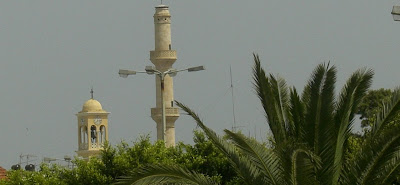
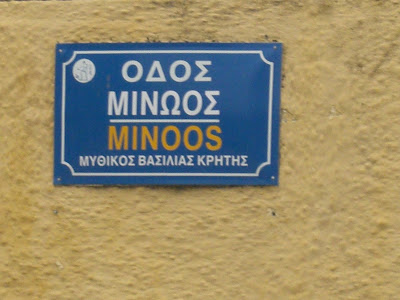
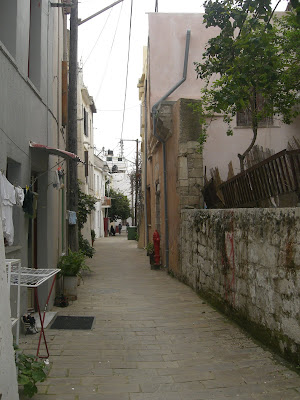
When you come to Splantzia, you'll be overcome by an urge to explore. Splantzia is not your every-day inner-city suburb. St Nicholas church has a minaret attached to its side. You will want to find out why. An untidy-looking, seedy neighbourhood - it still houses Hania's red-light district, nicknamed Minoos due its proximity to the main street bearing that name - Splantzia is now the area of choice for economic migrants, with its cheap rents and international atmosphere; the sound of Greek is almost a rarity in amongst its alleyways and tiny houses, all sharing a wall with their neighbour.


houses splantzia

The minaret is a reminder of what the town of Hania once was, and what it is slowly turning back into: a multi-ethnic town where many different cultures must learn to live beside each other and respect one another. Splantzia has always been the centre of multicultural activity in Hania. During the 400-year rule of the Ottomans, it was resided mainly by Turks. Now it's the place which tourists seek out if they want to see Hania town 'off the beaten track'. There is also another minaret in Splantzia, behind the area of the Agora.


Splantzia neighbours another inner-city suburb, the area known as Koum Kapi. As the name suggests, it was inhabited mainly by citizens with Turkish affiliations, until the time of the population exchanges precipitated by the Asia Minor crisis in 1922. The Turkish residents left many decades ago, but the names they had been using in Hania for four centuries still remain. Koum Kapi is still called Koum Kapi, and it doesn't look like it will change. Since we were in the district, we decided to enjoy our once-a-month family meal out at one of the dozens of al fresco eateries found there.

hania chania st lucia gate bulwark

Koum Kapi, a coastal area located eastwards of the main town of Hania, takes is name from the Turkish language, meaning 'gate of sand', which refers to the eastern gate (still standing) built into the wall that surrounded the town to guard it and its citizens in older times. Before Ottoman rule, the Venetians had already named it Sabbionara, again meaning 'sand gate'. The bulwark is now covered with trees, and there used to be a cafe operating under their shade. I was lucky enough to enjoy the view from this spot; it has closed down now.

One hundred years ago, Koum Kapi's sandy shores were once covered in straw huts, homes to the 'χαλικούτιδες' (halikoutides), the moslem servant tinkerers of Arab-African descent, who left the town during the last major population exchange in 1922 after the burning of Smyrna. The photo shows their dwellings: a rather unusual structure inhabited by unusual people. This photo has been taken from the book Chania outside the Wall, by Aimilia Kladou-Bletsa.

halikoutides

Koum Kapi gradually turned into another quick-build shoddy-construction ghetto: rows of workers' houses, crammed beside each other like sardines in a can, one room tacked onto the other with no town planning taken into consideration. The area resembled a slum and was considered a 'bad' neighbourhood, the kind where illicit activities take place. The area underwent major re-imaging in the mid-90s; as soon as the slum housing disappeared and the coastal road was turned into a promenade suitable for the evening volta (stroll), along came the developers, turning it into a glitzy cafe-bar neighbourhood. Before this happened, this is what it looked like (again taken from Aimilia Kladou-Bletsa's fascinating book), a little as I remember it when I first came to Greece:

koum kapi pre-1990s

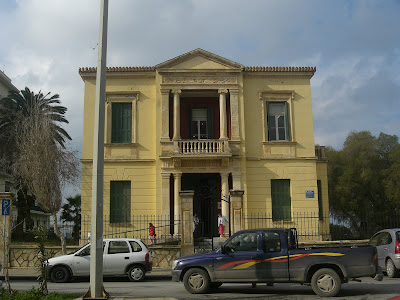
It is now the most vibrant part of town, and there is never an empty seat at the eateries in good weather. It stretches along the coast starting at the right of the touristy old port, the eastern side of the Venetian city wall which is still standing; an open-air theatre operates below it, in the area of a former moat, throughout the summer. Passing St Lucia's gate, Koum Kapi ends just behind the stately Villa Koundourou, a 100-year old house, used in former times by its owner as a country house getaway, subsequently bequeathed to the state by the owner, and presently used as an arts centre.


It seems that Koum Kapi is a well kept secret among the locals, as few foreign tourists are seen strolling along the promenade; while the locals walk slowly along the road enjoying the view and the misty breeze, the Northern European tourists jostle against each other for walking space at the old port in the high summer season.

koum kapi

It was a hot night, the theater in the moat was staging a children's play, the car park next to the theater - again housed in the moat - was choked with cars to full capacity. We were lucky to find a space near the entrance just as we were getting ready to leave it after driving right through it! This was the scariest part of the evening: getting through choking traffic with two youngsters in tow. But they weren't the only children being dragged to their parents' favorite hangout: my children met up with some of their friends from the day camp they have been attending. But the strollers were primarily young Greeks: smiling faces with bursts of laughter, all dressed in the latest fashion.

koum kapi kazimi hania chania

We took a walk along the promenade. The music coming from the bars, coupled with the style of the older houses, most of which have been renovated, will make you think you are on a backstreet in Havana. The food places were located closer to St Lucia's gate, while the open-air bars and cafes were found by Villa Koundourou. We walked back to find a seat in one of the little bistro-style tavernas, settling on the first place we found with empty seats. The sign above the indoor area gave its name as Kazimi. The seats were positioned next to the promenade, so that we had a direct view of the ocean, with the occassional spray of sea as the waves hit the breakwater. It felt fabulous to sit so close to the sea, but spare a thought for the locals: the music got louder and louder as the night wore on, and apparently no one goes home until well into the early hours of the morning...

koum kapi hania chania

We decided to order something simple: a mixed grill, more popularly known in Greek as a 'poikilia' (variety). There was a choice of small, medium and large: we chose medium for our family of two adults and two children.

'Anything to drink?' asked the not-very-talkative owner-waiter-cook.
'Two 'gazozes' for the children (locally produced cream soda), and a couple of ice-cold beers from the tap for us,' my husband replied.
'Sorry, I haven't yet bought the equipment for beer off the tap. We're new in the business, you see.' My husband was most disappointed. I wasn't too fussed; even if the food didn't come up to our expectations from this newly-opened eatery and its inexperienced owner, you have to see Koum Kapi for what it is: a good place to chill out. I wouldn't go to Koum Kapi otherwise. If all I wanted was good food, I'd stay at home. In any case, what we got for 31 euro, drinks included, was not just the food. There was also the intoxicating view and the lively atmosphere.

mixed grill poikilia

Admittedly, the food wasn't all home-made, judging by the chicken nuggets and uniform-sized schnitzel, but the meatballs were delicious, and the chicken souvlaki was the most succulent I had had in ages. The potato chips were crisp, but the sausages were the cheerio type, which would have gone down well at a children's party. As an added bonus, there was plenty to take home with us for the next day's lunch (2 kids count for 1 adult). It went well with the leftover boureki.

leftovers mixed grill poikilia

Funnily enough, I found myself at the same spot the next night with a friend. The bistro didn't fill up, while all the others around it were packed. Is this the effect I have on places?!

©All Rights Reserved/Organically cooked. No part of this blog may be reproduced and/or copied by any means without prior consent from Maria Verivaki.

Tuesday, 5 August 2008

Lenten kalitsounia for The Forefeast of the Transfiguration (Νηστίσιμα καλιτσούνια)

Across the road from the gate of our house stands an iconostasis - a small low brick-built shrine dedicated to the Transfiguration of Christ, celebrated every year on the 6th of August. The shrine is typical of such structures all over Crete and the rest of Greece. It may be built for a number of reasons: the owner of the land wants (or wanted) to build a church on it at some time, the dedication may have been made to honour a saint or a special moment in the time of the owner of the land, or for a sadder reason, as is more often the case these days with so many road accidents: a person may have died somewhere close by and the family of the deceased asked for permission to build a shrine in this place.


(Can you see the rainbow in the photo? This photo of the shrine was taken in May, 2008)

The shrine in my neighbourhood has been there since thw second world war. It was built by the frantic mother of a man taken away by the Nazis because he was involved in the resistance. He came back alive (and is still going!), so his mother must have been pleased about her decision to erect the shrine. The women of the area faithfully come to keep it clean and tidy, and keep the flame of the kandili (lamp) lit, which is placed before the icon depicting the Transfiguration of Christ; this makes it more likely that the shrine was built as the first step in a church being erected on the site eventually (which is now highly unlikely).

iconostasi kalithea vamvakolpouloiconostasis kalithea vamvakolpoulo

On the eve of the celebration day of a saint or event in Christianity, the forefeast (paniyiri) is always held in the evening: a liturgy performed by the local parish priest (the congregation - all wearing their 'Sunday best' - stands in the yard of our house!), with a food festival to follow. 'Loaves and fishes' were once distributed to feed the masses; this tradition is carried on by the loaves (pictured in front of the shrine) and the feast that takes place afterwards. No celebration in Greece can go by without food. As life has become more structured in our epoch, the Ladies' Auxiliary Society of the community of Vamvakopoulo decided to take on the organisation of the paniyiri this year, asking members of the community to contribute the food for the festival, which will be spread out for all to partake in, in a little park a stone's throw away from the shrine.

Can you imagine what delicacies the ladies in the area (myself included) might prepare? Word of caution: think lenten. The Feast of the Transfiguration occurs during the fasting period before the Dormition of the Virgin Mary: the first fourteen days of August are fasting days with the same rules applying as for Great Lent before the Greek Orthodox Easter Sunday. Although people don't fast as rigorously as might have been the case in past times, the fast is observed in front of the clergy and for official purposes. So the food being offered must be food that is permissible during a fasting period: no meat, no cheese, no milk, no eggs, no fish (except shellfish and snails).

vlita amaranth for kalitsounialenten kalitsounia

Because the meal is not going to be eaten in sit-down-at-the-table style, but more as impromptu free-for-all with people wandering around the street holding a plate, it's very important that the food can be eaten without too much cutlery or getting your hands dirty. Therefore, my offering is going to be lenten kalitsounia, traditional Cretan pies. (The finger-food rule wasn't actually followed by most of the other cooks, but everyone had a good time, and there was plenty of wine and orange juice for refreshments.)

paniyiripaniyiripaniyiri lenten foods

Normally, kalitsounia are made with a cheese a mixture, but for the purposes of the feast, the mixture used today is completely vegan: vlita, mint, parsley, onion and seasonings, with some breadcrumbs mixed in to create a stronger mixture that will not break the pastry open due to excess liquids in the leafy greens. Vlita (amaranth) is a bit like spinach, but does not retain as much water. It grows in abundance in the summer - it is never grown in the winter, not even in a greenhouse.

vlita amaranth

This is probably the best way to use up the vlita in the garden, which has been thriving right throughout the summer incessantly. I normally bake kalitsounia, but lenten kalitsounia cannot be baked: they do not contain any oil or fat, so they won't be tasty if they aren't fried. Hence, another marathon cooking run for me on the eve of the eve of the celebration, as kalitsounia can be prepared ahead and I can join in the fun of the paniyiri on the day.

This is my entry for Weekend Herb Blogging, hosted this week by Divya from Dil Se.

©All Rights Reserved/Organically cooked. No part of this blog may be reproduced and/or copied by any means without prior consent from Maria Verivaki.

Saturday, 2 August 2008

This is not lasagne (Αυτό δεν είναι λαζάνια)

Today I cooked lasagne. Or did I?

lasagne

Just in case you've missed it, there's recently been a great debate raging over the blogosphere about traditional food, and what can be named as such. All it took to spark it off was Laurie's use of the word 'kleftiko', a word in Greek cuisine usually used to denote a particular cooking style: a dug-out pit in which meat (lamb or goat, the traditional meat at the time 'kleftiko' cooking was invented) is cooked (and clearly, Laurie didn't go to such lengths). The pit is sealed so that the flavours and aromas are all sealed in with it. Only when the seal is cut away is the cooked meal revealed. So how controversial can the name of the cooking process be?

The meaning of a word takes on great significance when the word becomes a name. Names are the be-all and end-all of understanding, and when it comes to food, the name of a dish evokes the earliest of childhood memories in traditional culinary culture all over the world. Say 'boureki' in Fournes, and there's no doubt about what that denotes. But say 'boureki' in Kambi, and there may be quite a different version of it floating around in people's minds. Then go to Macedonia and say 'boureki' there: you'll get a different image conjuring up in the minds of the locals. Say 'malaka' in Hania, and your host will bring out the kalitsounia. Say 'malaka' in Athens, and you'll get a black eye. Say 'Zambia' in Hania; no one will even think of Africa.


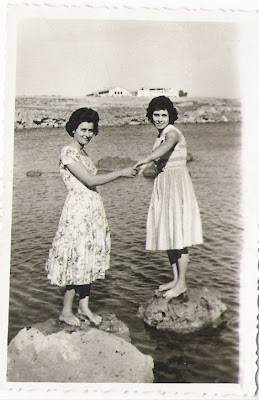
(The photograph of my mother was taken in the early 1960s. Phivos Nicolaides featured this post on his blog.)

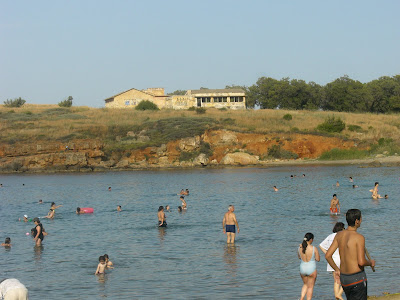
Zambia (on the left) was the name of my mother. My mother left Crete when she was 30 years of age. As an olive picker from a poor family, the island offered no prospects for her in the 1960s, so she emigrated to New Zealand, where she lived the next 30 years of her life. It was a very prosperous life, albeit a very short one. She's standing here with a friend at Agious Apostolous beach, where her grandchildren (unfortunately, she didn't get to meet them) now go for swimming lessons. The buildings in the background were once used as a military training centre, but are now disused, left in a state of ruin.


Zambia is an unusual name. It's common in the villages around where she was born (Kambi, Keramia, Hania, Crete), and in a few other pockets of the island, but is hardly known in other parts of Greece.
There is another similar woman's name in Rhodes (Tzambika, where churches are dedicated to St Tzambika), but I'm not sure if it is of the same origin. An archaeologist friend of mine told me that the name has pre-Venetian origins, possibly relating to the name Isabella; this means that my mother's ancestors have been living in this town since before it was occupied by the Ottoman army, ie before 1500. My mother's history is an integral part of the history of the region where she was born.

It's the custom to name children after their grandparents, but I clearly remember my mother telling me that she didn't like her own name (because it was so reminiscent of Greek peasantry), so I gave my daughter her other grandmother's name (Christine). I didn't want my children suffering from the repercussions over their names that Talula Does the Hula from Hawaii in New Zealand did for a long time, until her 9th birthday when a judge intervened and let her change her name; but spare a thought for Superman (again in New Zealand): I wonder what happens whenever he walks into the room: "Is it a bird? Is it a plane? No, it's Superman!" I suppose it's better than the original name his parents had planned for him: imagine if Superman did eventually get called 4Real: "Are you for real?" everyone would be asking him. Some parents have no foresight; they are oblivious to the fact that they have
screwed up their child's life before the child can have a chance to do it for himself.

My mother's name caused me some strife when I first came to live in Greece. I needed to get my university transcripts translated by the official translation office in Voukourestiou St in Athens, in order to be granted an official teaching license by the state to teach in the private sector. Armed with the originals and copies of various bit and pieces of paper that an information officer had told me I would need – passport, birth certificate, health certificate, school leaver’s certificate, another certificate, and another, and another – in order for my New Zealand education to be legally recognised by the Greek state, I entered the building, and joined the queue. Finally, after what seemed like hours, it was my turn.

“Your papers?”

“Ah, which one do you want fi---?”

“Your papers! Just give them all to me!” Don’t I keep the originals? I wondered, feeling the usual dread one has of passing over important one-copy-only documents to a stranger.

“Name?”

“Maria.”

“I meant your SURname!”

“Verivaki.”

Verivaki? Are you related to the voulefti (Member of the Greek Parliament)?” The clerk was being polite now.

verivaki MP

“I don’t think so”, I lied; having been snubbed once on account of this fact, I decided to keep the information to myself.

“Oh.” I could see the novelty had worn off immediately. She'd already lost interest in me.

“Address?... Telephone number?... Father’s name?... Mother’s name?... Zambia?... You're not Greek?... That’s not a Greek name! Where was she from?... She WAS Greek?...”

It was at this point that I got irate. No stranger has the right to talk about my mother like that. “It’s a perfectly good Greek name in the village where she was born, there are about half a dozen other women who share the same name as hers, you just haven’t heard of it before.” I decided to get smart. “Have you ever been to Crete?”

The woman behind the counter looked at me, slightly embarrassed. Her face had visibly toned down to a softer hue. “I haven’t come across this name before… It’s unusual, isn’t it?”

*** *** ***

And so it was with Sam and Ivy who saw the word 'kleftiko' beside the word 'salmon', with a photograph of an aluminium-wrapped baking tray, all of which stirred great emotions in them, resulting in a heated debate, due to the use of the word 'kleftiko' by Laurie (an American barbarian, with the blood of an alien running through her body) to denote the method that she had used to cook the salmon (which certainly wasn't lamb or goat meat in the first place), branding her a fraud - but only in the eyes of some: Dimitris Rousounellos thinks she has the heart of a Greek, which again, some Greeks do not possess themselves.

Well, let me tell you, I'm not going down that lightless tunnel. I'm going to admit that what I cooked today is something that looks like lasagne and smells like lasagne; it even feels like lasagne - but it's not lasagne.

lasagne sauce

The pasta packet (Barilla) did in fact state that its contents are known as lasagne. It even contained a recipe. But I didn't follow it. For a start, there was no meat in it (I used soya mince), it had green and brown bits sticking out (the aubergines and peppers have created traffic problems in the refrigerator; it's like a jigsaw puzzle trying to remove, let alone find anything in it), there was no basil in the sauce (sorry, we don't 'do' fresh basil in our food here in Hania), and the cheese sauce had no cheese in it. So I won't mislead any of you into thinking that I made lasagne today - it's just not lasagne. Is it?

lasagne construction

If you want to cook the real thing, the lasagne that the whole of Italy cooks when they cook lasagne, I recommend that you ask Anna Maria Volpi to point you in the right direction, which she will probably do using all her fingers and toes in the process.

lasagne cooked

So what do I call my lasagne that isn't lasagne? Vegetable-medley baked with pasta layers? Lasagnesque summer vegetable bake? Tourlou tourlou? When we were ready to eat, I simply hollered: 'The lasagne's ready!' No one noticed it wasn't lasagne, and to this hour, no one knows about the soya mince.

©All Rights Reserved/Organically cooked. No part of this blog may be reproduced and/or copied by any means without prior consent from Maria Verivaki.

Friday, 1 August 2008

Staycation dining (Το σπιτοδιακοπίστικο μαγειρίο)

It's August (καλό μήνα - have a good month, as the Greeks say), and it's about time I went on vacation, which traditionally means something like getting away from one's familiar surroundings - in my case, clear blue sunny skies, sandy shady beaches, foreign food (if that's what Cretan food is to you) and nightlife at the old port - with a break away in some exotic place in the world - which means Crete for many Northern Europeans - which offers - you guessed it - sunny skies, sandy shady beaches, foreign food and nightlife by the water's edge, all of which supposedly stresses you out in its planning stages and burns holes in your pockets, with a bout of jet lag each way.

staycation balcony lunch vamvakopoulo hania chania

Vacation or staycation, it's all the same to me...

(exotic food: Greek salad, boureki, yemista, all offered under a sunny sky in Hania, three kilometres away from the water's edge - the ferry port would be visible if we chopped down the tree)