Sunday, 17 February 2013

Economiyaki (Oικονομιγιάκι)

Japanese cuisine for me till now was all about sushi and wasabi paste, until a friend introduced me to the okonomiyaki. The word sounds very Greek and very Cretan at the same time: '-okonomi' reads like 'economy', while the '-yaki' part sounds like the suffix attached to many Greek nouns and adjectives, to change their meaning into 'small'. So a Greek could easily confuse 'okonomiyaki' as 'economiyaki', with the thought running around in their head of a 'small economy'.


Tasty looking street food: we need one of these in Hania to compete with souvlaki.

The okonomiyaki resembles my own little economy. The ingredients and flavours used in the dish could easily be adapted for Mediterranean kitchens. Some ingredients are standard in both cuisines, eg spring onions, cabbage, octopus, shrimp and eggs. The highly specific Japanese mountain yam, tempura batter and dried shrimp can be replaced by local available items or omitted altogether.   

Hence, I present you with my own version of a Mediterranean-based economiyaki, based on the Japanese-style filled pancake, made with cheap easily sourced ingredients, and a basic pancake batter. The chopping and preparation will take some time for the novice; in our house, that's a routine associated with growing your own produce. This meal uses a lot more ingredients than I would normally use in my cooking - that's probably why it is so so so tasty.

For three filling economaki, you need:
a pancake batter (I used the one suggested in this video, without the dashi soup and grated yam)
three small cups of shredded cabbage
some leek, finely sliced
some ginger, finely grated
1 carrot, finely grated
1/2 cup frozen mixed seafood, boiled five minutes and chopped small (a cheap packet of frozen mixed seafood costs €3.50 for 350g; a little goes a long way and you can keep the rest in the freezer for later use - this is cheaper than buying octopus and shrimp/squid separately)
a handful of rice noodles, pan-fried for 1-2 minutes (this replaces the deep-fried tempura batter)
3 eggs
3 thin strips of bacon or prosciutto, sut into large pieces
some finely sliced spring onion tops
HP sauce (this replaces the okonomiyaki sauce that we can't get here: a mixture of ketchup, barbecue and worcestershire sauce also works, apparently)
mayonnaise
olive oil


Mix the flour, baking powder, salt and water in a bowl to make a runny batter. Pile the cabbage, leek, carrot, ginger, seafood and noodles onto the batter without mixing. Now break the eggs on top of this. Mix everything very lightly, so that some of the batter remains at the bottom of the bowl. Heat some olive oil to a very high heat in a frying pan. Then pile a third of the mixture onto it, patting it down as the bottom layer begins to cook and the cabbage wilts.

Place 1/3 of the prosciutto slices on top of the pancake, continuing to cook it. With a spoon, pour some batter over the prosciutto strips. With a spatula, turn the pancake over carefully, to break it as little as possible. Then pat it down so that any uncooked batter seeps out over the top. Allow the economiyaki to cook 2-3 minutes before turning over again; repeat this once more. Make two more economiyaki in the same way.


Lift the cooked economiyaki onto individual plates. Spread some HP sauce over it, with a sprinkling of spring onion and a squirt of mayonnaise. Enjoy it warm.


Food allows you to travel to places you never thought you could see. My economiyaki looks at home in both Japan and Greece. What a fantastic way to hide vegetables in a pancake! In case you didn't know this, Okinawa in Japan and Ikaria in Greece share the highest longevity rates in the world. This is despite their cuisines being quite differently, both visually and taste-wise from each other. I doubt Okinawans use as much olive oil as Ikarians do. There must be something else connecting them.

©All Rights Reserved/Organically cooked. No part of this blog may be reproduced and/or copied by any means without prior consent from Maria Verivaki.

Saturday, 16 February 2013

Hamburger

A picture post today, which says it all.

From the freezer... 
... to the oven...
... to the burger bun, and all very well cooked, not a 7-minute job on a fast-food restaurant grill.
First, there was meat, and then there was mince. 
People made burgers until machines made them and people laughed at those who still made them (or simply looked down on them). Soon they'll be walking on four legs. 

©All Rights Reserved/Organically cooked. No part of this blog may be reproduced and/or copied by any means without prior consent from Maria Verivaki.

Friday, 15 February 2013

School trip


I attended a school meeting yesterday to discuss an upcoming school trip to Athens, where we were told about the itinerary, which is as follows:


- overnight ferry boat to Athens,
- guided tour of the archaeological site of Acropolis
- guided tour of the Acropolis Museum
- lunch at Goody's
- guided tour of the Greek Parliament
- trip to Attica Park (a zoo)
- overnight ferry boat back to Hania.

Lunch at Goody's?! On a Greek educational school trip?! I made my objection known to the headmaster. He challenged me by saying that places like Goody's have ISO certification. He also added:

"I could have chosen McDonalds because it's across the road from Parliament, but I preferred Goody's because it's Greek."

Not a single mention was made about the quality of the food, the edcuational aspect of the trip, the cultural or the moral aspects of taking kids to a fast food restaurant when there are campaigns these days to make people aware of the nutritional content of their meals, and never mind the statistics which state that the fattest Greek kids are the Cretan ones.

I told him that this is not really trustworthy in light of the recent horse meat scandals. And he said:

"Horse meat scandals? Pardon me, but I don't know what you're talking about."

He had no idea about the horse meat scandals (yes, really truly - there are many people in the world who do not give a fuckadoodle about first-world-problems!), but this is not solely his fault. There is a journalists' strike in Greece at the moment; but even the journos who aren't striking do not mention this subject at all in the Greek papers/channels I read/hear (we clearly have far more serious concerns to discuss in this country). In fact, I was astounded that no one in the room (15 mums and 2 dads) showed any sign of recognition of the issue. (And one person simpy chided me: "Have you been to a souvlatzidiko lately?") In my opinion, this shows how much rural and socially isolated Greeks know or are interested in 'foreign matters', and maybe just how detached they are also becoming from their own food chain at a time when others elsewhere are questioning it.

There is nothing wrong with a Goody's meal. A junk food treat every now and then is a great way to boost morale in a very depressed restrictive environment like ours can be at times (it's not all sun, sea and sand in Crete, especially in winter). It is fun to eat such a meal every now and then, adhering to the principle of  'everything in moderation', as my ancestors used to preach. My objections are NOT based on the fact that this is a Greek educational school trip which combines elements of Greek society that are internationally renowned, which stand as a testament to Greece's contribution to the world's heritage. My objections derive from the great effort I have made to teach my children good eating habits. (This was thankfully voiced by one - only one - other mother in the room.) At any rate, we have a Goody's in Hania. Why do we need to go to Goody's in Athens, when there are plenty of other different places in the same central area that we can choose from?

As an aside, the headmaster did explain to the parents that they are welcome to go to any other place they want, but the unaccompanied ones will go to Goody's - because it's ISO certified, and if you don't know anything about horse meat in burger mince, then it isn't an issue is it? Ignorance is bliss.

As I mull over today's events and I prepare myself for tomorrow's showdown (where I believe that the person backing down will not be me), I bake a lot - it is a solitary activity which allows me to talk to myself as I prepare my case.

My problems could have stopped at the Goody's episode, if I were simply a complacent person. I was saddened by the parents' response to the itinerary: "The children will get so tired of listening to tour guides!", "Why so many archaeological visits?", "Are we obliged to enter the Acropolis with the kids?", and a whole host of other mutterings that will highlight mainly the low level of social education that exists in my society. The mothers actually had the audacity to ask the headmaster to tell the tour guide in the Acropolis museum to keep details to the lowest level and to get the tour over and done with quickly (!!). And the headmaster agreed with them (!!!!!!!!).

I was particularly distressed when I heard that it was likely that only the children would be allowed to enter Parliament (due to the current Greek political scene), while the parents had to wait outside the meeting chambers. I had wanted to accompany my children on the school visit for this sole reason. You see, I never learnt about modern Greek history when I was at school, only the very rudimentary elements of ancient Greek history commonly taught in Western societies. If I can't enter Parliament with them, then what I would be doing accompanying them on this not-so-cheap trip? At ~€100 per child, and €125 per adult (including ferryboat tickets, but not all meals, but we pay entrance fees at archaeological sites, whereas the kids don't)? If it's for the hedonistic value of having an expensive coffee under the shadow of the Acropolis, then I can find a cheaper way to do this.

In the afternoon, I called the teacher and told her that I have decided to send the kids unaccompanied, as  a few (a grand minority, compared to the accompanied children - υπάρχουν λεφτά!) other parents are doing.

"But we've already stated the numbers in the tender" she said, meaning that they are advertising the trip in the state gazettes. "This is putting us in a difficult situation (naughty Mrs Verivaki, it's all your fault), and besides I don't really want to take the responsibility for two extra children (what about the other five unaccompanied kids, who will be accompanied by THREE teachers!), and we've already sorted out the accomodation in the ferry boat cabins..."

You've got to be kidding me! The trip isn't until MAY of this year and that's three months away! So what is she suggesting? That I send one child and not the other? That I send them both and accompany them? I'm in for more hammering tomorrow when I see the headmaster to explain to him why I will NOT come on the trip, and I don't think it's going to be me backing down.

©All Rights Reserved/Organically cooked. No part of this blog may be reproduced and/or copied by any means without prior consent from Maria Verivaki.

Thursday, 14 February 2013

Valentine's nameday

FISIKA, Hania, Crete
I've already had the chance to be seduced by their aroma, I liked their latest design and I do so much love the box (also available in red) with Cavafy's poetry. All I needed was a good excuse to buy it. 


We'll share it - he gets the soap, I get the box. It's the thought that counts!


©All Rights Reserved/Organically cooked. No part of this blog may be reproduced and/or copied by any means without prior consent from Maria Verivaki.

Wednesday, 13 February 2013

Bifteki - Hamburger patties (Μπιφτέκια)

The day after making my regular monthly batch of bifteki (hamburger patties), I opened the freezer tray where I had laid them close to each other side by side to save space, placing a few meatballs in the spaces in between, made with a ball of mixed mince that wasn't quite large enough to turn into a meat pattie. I tapped the tray to unstick the frozen patties from it, and was expecting to see a few patties break off. But this didn't happen: the whole tray of patties came unstuck, creating a stained glass window effect as I held up them up over the kitchen sink.

It takes a certain kind of person to appreciate meat when used as an art form. Some people are open-minded enough to label the use of a dead animal as a medium in art work as a form of expression. We have seen meat in its raw form used in fashion - remember Lady Gaga's dress? - and as a decoration on a building (does anyone remember that one? I have searched the internet in various ways for a link, but it seems to be well hidden in cybersphere), both of which caused a global outcry and utter outrage at all levels.  

The revulsion was sparked mainly by the ethics and morality issues involved in the killing of animals that were not used to feed people, while at the same time people die of hunger, starvation and malnourishment in various parts of the world.  

I'd always wanted to post my own raw meat art work, but could never think of a good reason why I should do this. The only reason I took the photo of the frozen biftekia was because i thought it looked nice. I wasn't sure if anyone else would agree. With the present outcry and outrage that the horse meat scandal has caused, I'm sure there will be many people that will appreciate this photo, together with the recipe.

In Greece, pork mince is much cheaper than beef mince: the former costs half the price of the latter, whether imported or local meat is used. I never buy frozen mince to make biftekia because of the dangers of refreezing a frozen product. I always buy non-fat meat which is minced before us after we choose the piece that we want. Lean meat is used not just for the health aspect, but also because I believe I am getting more value for money: if there is no fat in the meat, the bifteki are very lean and they do not retain juices when cooked. A little olive oil, some tomato paste or wine usually make the bifteki a little more tender. By adding olive oil, I am adding some kind of fat to the meat, and this is now being done by sausage/ham/cured meat producers (MAICh has tested this in our laboratories and our M.Sc. students have written theses about it - they are healthier according to the tests done on them.


For about 25-30 hamburger patties, you need: 
1500g or ground pork or beef (I always use a mixture of the two)
half a loaf of stale bread pieces soaked in wine or water, then strained by hand (you can use 1 cup dry breadcrumbs if you don't have any stale bread)
1 large onion, minced
2-4 cloves of garlic, minced
a few sprigs of mint and parsley, finely chopped
1 carrot, grated (this is optional - it toughens the patties a little)
1 finely minced green bell pepper

1/2 cup olive oil 
salt, pepper, oregano and/or cumin

Mix everything together really really well. You can only do this with your hands. Shape into patties. Place in the freezer in separate layers. That's it. 

If I want to pan-fry the patties, I need to defrost them. If I want to cook them in the oven (with potatoes, vegetables and/or tomato sauce), I don't defrost them. You cannot cook them in the microwave (at any rate, I NEVER microwave raw food for immediate eating - the microwave oven is used only for re-heating food). 

At various times in the past, I have tried ready-made fresh and frozen hamburger patties, and have never been satisfied with them. I once grilled them till they were nicely dark on the outside and was absolutely shocked to see how pink they remained inside (I did not give them to the family - I was revolted by the pink and black uneven look of the final product). Another time, I was put off by the amount of fat that congealed around them as they lay in the pan after they had completely cooled down. 

I never question the food I buy because I have to believe what I'm told, which may be a lie anyway. For all I know, the beef I buy could actually be horse, in the same way that pork traces were recently found in the halal meat of a UK prison. If you don't grow/raise/produce it yourself, you will never really know what you are eating. If you don't have any other choice, you rely on lying, cheating profit-oriented, market-driven suppliers. It's a fact of life that you can never get away from. 

©All Rights Reserved/Organically cooked. No part of this blog may be reproduced and/or copied by any means without prior consent from Maria Verivaki.

Tuesday, 12 February 2013

Food transparency

How transparent is your food chain? With all those horse tales flying around the web these days, I scrutinise my food much more than I did before, which was quite a lot anyway. The evening meal constituted the weekend's leftovers: chickpea stew, avocado dip, cabbage salad and bread. Here's my food chain for that meal:


Ρύζι, Λάρισα,ryzi, larisa
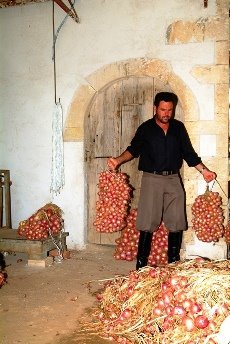
ΡΕΒΥΘΙΑ ΧΟΝΔΡΑ ΘΕΣΣΑΛΙΑΣ 3Α 500 gΚαταστράφηκε η παραγωγή σκόρδουChickpea stew: I bought the Greek-labelled chickpeas in bulk at a grocery, filling the bag myself with the help of a scoop. It's slightly cheaper to buy them that way, instead of buying the same product form the supermarket, ready-packed. The Greek-labelled rice from AB Vasilopoulos supermarket (at one time, apparently the only supplier of rice and pulses whose Greek labels were found to be genuine when they were tested) was grown in Larissa. The onions are from the onion braid hanging under the staircase; they were bought in the summer when the producer from Kissamos drove round the villages with his truck loaded with nothing but onion braids. The Greek-labelled garlic was bought at the supermarket; it came from Evros which produces half Greece's garlic supplies (the other half come mainly from China). The olives used to produce our own supplies of olive oil are pressed before us; in fact, we have to be present when they are pressed so that we pick up the oil immediately so that we don't hold up other people's pressing. The salt and pepper I added to the stew - good Lord, I have never questioned where that came from! Guess I'd better work on this...

Cabbage salad: The white cabbage came from my uncles' garden, while the red cabbage came from our own - I picked both heads myself. I added a grated Greek-grown carrot (from Thiva) to the salad, bought from the supermarket. The olive oil is from our supplies (see chickpea stew). I dressed the salad with some vinegar made from the grapes we pressed at my cousin's vineyard, which we transported to barrels at our house (one barrel turned into vinegar, while the other became wine). As for that salt, after checking the plastic container, I find out that it came from the sea, it was produced in Greece (which I guess means Greek waters), and it was packed in a plant in Athens - I hope it came from Sounio rather than Skaramangas...

Avocado dip: My husband picked the avocado from the tree and I pureed it with some garlic (see chickpea stew) and lemon juice which came from a lemon I picked from my uncles' garden. Salt (see cabbage salad),  olive oil (see chickpea stew) and sweet paprika pepper - I have no idea where that was produced (only where it was packaged).

Bread: Only the baker knows what goes into that - well, I can only hope that he knows the food chain that he uses well enough. I can't bake my own bread ...

For dessert, I'm going to have some quince spoon sweet which I made myself - quince from my colleague's tree, sugar from Greece's sugar manufacturer (which is now going to be sold to a Polish, Bulgarian, Serbian or French company), and lemon juice (see avocado dip).

How do you really know what you're eating if you're eating, say, sausage, or hamburger, where the meat is so finely processed that you can't really tell what you are eating?
In Dickens' Hard Times, published in 1854, Mr Bounderby regales his dinner guests with talk of consuming horses in his youth, in the guise of "polonies and saveloys". Sneaking horsemeat into processed foods is nothing new. Secretive signals and midnight handovers of horseflesh to dodgy butchers formed an established part of the lurid storytelling of the gutter press. Horsemeat was as unacceptable then as it seems today.
Why are Westerners astounded to hear that they are eating horse meat? How much honesty do they expect in their market-oriented, profit-driven world, where a typical food chain in Northern Europe reads something like this:
A Swedish brand Findus supplying British supermarkets employed a French company Comigel to make its ready meals, our correspondent says. To get meat for its factory in Luxembourg, Comigel called on the services of another French firm Spanghero. This company in turn used an agent in Cyprus, who in turn used an agent in the Netherlands, who placed the order at an abattoir in Romania, our correspondent says.

How on earth did horse meat suddenly become cheaper than beef? The answer to that lies in more bureaucracy:
Horsemeat in France is not noticeably cheaper than beef, but according to the Green MEP Jose Bove the price of horsemeat has recently fallen dramatically in Romania following a new law there banning horses and carts on the highway.
If you really do insist on buying ready-produced food that simply needs to be heated before being consumed, because perhaps you do not have the luxury of being able to produce/pcik your own food straight from the soil, then try buying something whose appearance is recognisable. If it's highly processed, like a meat sauce, hamburger patties or sausages, you can't really expect to know what's in your food. Of course, you can demand that the state impose legislation to provide greater food transparency, but you can't really blame the state for the mistakes it makes - you are also to blame because you didn't take the time to prepare yourself a decent meal. The poorest people in the world survive on food they prepare themselves, with little variety in their meals. It's only Westerners who don't devote time to food preparation because they have too many diversions, too many better things to do than cook a meal from scratch. You can hardly perform a check on what you're eating when your first contact with a meal is on opening a tin/packet. Even if you can afford a laboratory test for your meal, it's simply not practical to do this every time you eat. In other words, you eat processed food at your own risk. If you don't want to take such a risk, well, you're gonna have to cook from scratch, like I did. If this sounds too challenging, just think about what people used to do before Findus lasagne came along: 
"Chicken soup was ready as a remedy for Gerry's flu, and it seemed to do Sylvia good too. We followed it with steaks from a great French butcher in Soho, and mashed potato and salad. Sylvia ate heartily, and said how good it all was... the next day she joined us at the table for our usual ample Sunday lunch of soup, roast meat with the usual trimmings, and cheese, dessert, and wine." (Sylvia Plath: Jillian Becker on the poet's last days, 10 Feb 2013, BBC)
You don't have to cook every day. I certainly don't do that myself. The chickpea stew and avocado dip were made on Saturday (I had to soak the beans from Friday night), while the cabbage salad was made on Sunday. I cooked nothing on Monday, except for tomorrow's meal - boureki - which is in the wood-fired oven as I write; that was prepared in late summer, ready to be eaten in winter, a bit like the Findus lasagne which was in the freezer section of the supermarket. But there is a vast difference between a Findus freezer meal and my boureki. The real problem with the Findus food is not its cost, its taste or flavour, its packaging or appearance. It's the food chain that is to blame, a food chain characterised by an impersonal flow of suppliers who have no contact with each other except by telephone or email, or even with the consumers except perhaps through anonymous surveys, a food chain whose sole aim is to make a profit.

©All Rights Reserved/Organically cooked. No part of this blog may be reproduced and/or copied by any means without prior consent from Maria Verivaki.

Monday, 11 February 2013

The German lady (Η Γερμανίδα)

Just another story in the life of a day in Crete...

I had a big shopping list to get through this morning before I went to work: leeks, carrots, garlic, all fresh produce we could but don't grow ourselves, which are vital in small amounts in much of my daily cooking; apples and bananas, 'easy-food for children's lunchboxes; chocolate (I heard someone moaning over the weekend about the lack of chocolate in the house); flour, sugar and baking powder - I'm sure my mother never went through as much as I did!

 
I spotted this cat at the supermarket this morning - it wasn't a golden tabby or a silver tabby, but something in between: is there such a thing as a white tabby? or is it simply sun-bleached?

As I stocked up, a lady who was sifting through the range of stock cubes next to the flour shelves asked me if I spoke English. She pointed to the Greek words on the packets: λαχανικά (vegetables), κοτόπουλο (chicken), βοδινό (beef)...

"Which could of course be horsemeat," I added, and we both cracked up laughing. 

After the customary exchange about my 'very good English' and the where-are-we-froms (she was from Germany), I asked her about why she was living here.

"I came here on holiday, and I really liked it. I've been here two years now. In Germany, life is highly regulated, so much to the point that you feel that your movements are constantly being monitored. Greek people often joke to me about the weather in Germany - we had just 22 hours of sunshine last month in my hometown - but that's nothing compared to the hassles we go through just to prove our existence. I had to fill in a zillion forms just last week to re-open my bank account there! My internet connection wasn't working and I had lost time catching up with my emails and my account was closed, and all for nothing! Here, I just make a phone call, and talk to a human being, not a machine!...

Photo: Όσοι βρεθήκαμε νωρίτερα το απόγευμα στο λιμάνι μαγευτήκαμε από μια μοναδική εικόνα.... Την κράτησα για σας...This is what you would have seen on Saturday if you had been in Hania - the double rainbow connected Crete with the Peloponese! You can see the rainbow as I saw it from my house in yesterday's post. Photo borrowed from Chania Crete.

"I can't believe how disconnected my people have become. It's not just the weather that's cold, it's the people that have become used to using a cold approach to most aspects of life. I like the human connections here in Crete. Greek people's craziness is a different kind of craziness from the senseless logic and blind adherence to the state in Germany. Here, at least people can still use their common sense! The way the EU is trying to change their politics is simply not working. They think they can change the South, but it's simply not working, and they can see that now, but they are not admitting it. I don't know where this will lead, but I know I can only continue to live in Germany if I pretend I am happy. Here, I don't have to pretend I am happy. I am sure I am happy. Here, I am free to live freely..."

There are cracks in the plinth everywhere.

©All Rights Reserved/Organically cooked. No part of this blog may be reproduced and/or copied by any means without prior consent from Maria Verivaki.

Sunday, 10 February 2013

The City by Constantine Cavafy (Η Πόλις - Κωνσταντίνος Καβάφη)

The city beckons, the city haunts us; in the end, we cannot run away from it.


"... I just thought I'd call you and say hello," my aunt in Athens was saying on the other side of the phone line. "Are you all well? ... Your husband? ... Your children? ... Your mother-in-law? ... She cooks for herself? God bless her... Yes, I know you visited your uncles, they always tell me when they see you, God bless you... Oh, we're all well here too, just the usual routine... Well, we're all fine, but most people have problems. If I just look around in my neighbourhood, I see so many unhappy people, and it's difficult to understand what is wrong, or it's impossible to know who to believe and what you hear... I think everyone is relying on their parents' pension these days, because few people are working, and those who are aren't being paid regularly... Well, he gets paid regularly in arrears, but he never gets paid the full amount... They say they will never lose their pay, but they don't get it paid, so those words are not much use to them... That's the thing, even a sprig of parsley costs you something if you live in the city. but if you were living in the village, you'd have your parsley, your herbs, your lettuce, an egg, some meat, all your fruit and vegetables, like we did in the village... I remember the firewood we collected to keep ourselves wam, and to cook with, our grapes, our wine, our figs, our sheep, our milk, our cheese, we never had electricity, we just lit our lichnaraki, we had a well, and we never felt in need of anything... People died in the war, and that was that, but we're all still alive, although I don't now how... You're so much better off in the village, until this thing passes... Yes, it will pass, like all things pass, but we don't know when its time will come... Until then, we're just plodding on and making do, trying to cope with as much patience as is left in us..."


You said, "I will go to another land, I will go to another sea.
Another city will be found, better than this.
Every effort of mine is condemned by fate;
and my heart is -- like a corpse -- buried.
How long in this wasteland will my mind remain.
Wherever I turn my eyes, wherever I may look
I see the black ruins of my life here,
where I spent so many years, and ruined and wasted."


New lands you will not find, you will not find other seas.
The city will follow you. You will roam the same
streets. And you will age in the same neighborhoods;
in these same houses you will grow gray.
Always you will arrive in this city. To another land -- do not hope --
there is no ship for you, there is no road.
As you have ruined your life here
in this little corner, you have destroyed it in the whole world.
Constantine P. Cavafy (1910)


"So what are you cooking today? ... Pork chops... Sounds lovely... And salad from your garden... You're so much better off in the country... Living in the city isn't easy... it never was."

©All Rights Reserved/Organically cooked. No part of this blog may be reproduced and/or copied by any means without prior consent from Maria Verivaki.

Saturday, 9 February 2013

Continental Mediterranean

I've just finished the highly regarded (and highly politically correct) Penguin History of New Zealand by Michael King. It's a book I wanted to read for a while now, and was simply waiting for a reasonably priced print version to come out, as the book was difficult to get hold of cheaply with direct shipping to Greece. The Maori and Pakeha (which, in the book, clearly implies 'British') histories are dealt with in depth, with only a very small fraction of the book dedicated to the immigration of the non-British.

The book talks about the creation of a mini-Europe on the other side of the world, which is interesting in light of the present problems in Europe, especially those pertaining to way Britain regards the Continent, and the referendum issue (in our out?). But the masses of non-British white people (ie Continental Europeans) who emigrated to New Zealand arrived after World War II (before that, there was only a trickle). They were clearly different from the British whites, as this telling writing informs us, written by a certain Dr Reuel Lochore, a highly educated arts and languages graduate, and a senior immigration officer in New Zealand in 1951, in reference to 'Continental immigrants':
'They lack discretion and tact. They revel in displays of emotionalism and self-pity, and fail to realise how we despise suck lack of self-control. On social occasions... they talk loudly and untiringly about their own affairs. Being bad listeners they cannot take a hint, nor sense an attitude, from what we leave unsaid.' 
In his role as an immgration officer, he also believed that:
'We must make new Britishers: by procreation, and by assimilation; by making suitable aliens into vectors of the British way of life.'
Of course, more than six decades have passed since these statements were issued, and New Zealand immigration policies are anything but racist. But how much has changed in the attitude of those 'Continentals'? Do they still lack discretion and tact? Do they still revel in emotionalism and self-pity? Do they lack self-control and talk loudly?

I think I've answered this in many ways though my blog. I will add a personal example that occurred as recently as a year ago. During a visit to London, we stayed at a Kiwi friend's home who's married to an Italian. When we arrived, it was quite late in the afternoon (more like early in the evening in the London way of dividing the day). My friend asked me if we wanted to get the kids ready for going to sleep (ie tea, bath, bed). Her husband was absolutely mortified.

"Ready for bed at 7pm? They're Mediterraneans! They go to bed at midnight!"

©All Rights Reserved/Organically cooked. No part of this blog may be reproduced and/or copied by any means without prior consent from Maria Verivaki

Thursday, 7 February 2013

Busy

Normally on my birthday, I like to prepare a special post by writing a short story based on a fictionalised account of a moment in my past life. But it's been a while since I've written even just a short story. Spare time for the selfish art of creating just for the sake of creating seems to be severely lacking these days. In the times of the gloabl financial crisis, everything we do has to have a more functional purpose.  


In lieu of a short story, please accept some of my baking instead - chocolate muffins and cranberry and white chocolate cookies. They'll be at the office tomorrow, sitting pretty next to the coffee machine.

In the meantime, I think I'll take a blogging break and perhaps try and work on that short story...

©All Rights Reserved/Organically cooked. No part of this blog may be reproduced and/or copied by any means without prior consent from Maria Verivaki

Wednesday, 6 February 2013

Waitangi Day

Waitangi Day is like Boxing Day for me, a remnant from my New Zealand days, something that means nothing to me now, except that I still remember the day as a formal public holiday in New Zealand. But even when I was living there, I recall the feelings that the day brought out on me with a slight tinge of embarrassment. The funny thing is that Waitangi Day was also the start of my New Zealand life, as my parents were married on this day, seven days after my father arrived in the country to join my mother who had already been living and working in New Zealand for two years.

I was born and raised in a country that celebrated the formal conquering of a new land by the white man, with the full knowledge that the sentences in the paper being signed by the non-white man (who had already been living there for over a thousand years before the white man's arrival) were never translated appropriately in the non-white man's language. Thus he had no idea what he was signing (basically, all claims to his land), or why this had to happen in the first place. To a person like myself who never really felt part of the white or non-white man's world in New Zealand, I felt like I was living in a borrowed country.

When I googled 'Waitangi Day' on the web today, the top three words/phrases associated with it were 'commemorates', 'fun day' and 'Obama sends congratulations'. Coupled with the reasonably good weather that New Zealand experienced on this public holiday, one could easily be fooled into believing that Waitangi Day was of great national importance to New Zealand. In order to find out how the controversy of Waitangi Day was played out this year, I had to google 'Waitangi Day protests', which gave me 'Key slams protesters' (in reference to John Key, NZ PM), 'protesters short-sighted' (more John Key propaganda) and 'What Waitangi Day means to me', which offered two insightful pieces written by a teenager:

There's no real national celebrations for the day we became a united country, nothing significant we do as a nation. It has now almost become commercialised, with one of our major national retailers having a week-long Waitangi Day sale. As a young New Zealander, I find myself disappointed in our lack of national pride. We have no sense of nationalism, very little honour for anything we've achieved, except for sport.

and a NZ-born part-Samoan:
The drama and divisiveness of Waitangi Day tugs at the prejudices I have in my heart so that I pray to God for strength to believe the best about my people, my people being Māori, non-Māori and those being New Zealanders all at the same time. 
I've been living in Greece for less time than I lived in New Zealand, and I've been in Crete for 17 years. Even though I wasn't born and raised here, I feel quite secure about my belief that I belong here, something I could never feel in New Zealand, not while I was living there, or even when I moved. I can trace my roots here over many generations, both family- and land-wise. In New Zealand, all that remains is my mother's grave; my few relatives there can be counted with my fingers.

If I try to put any meaning into Waitangi Day now, it serves to remind me that I don't like cheating others or being cheated by others myself, something I could only feel by being born and raised Greek outside Greece.

©All Rights Reserved/Organically cooked. No part of this blog may be reproduced and/or copied by any means without prior consent from Maria Verivaki.

Tuesday, 5 February 2013

LIDL prices

My husband picked up a slab of Grana Padano cheese yesterday from LIDL. He says that the LIDL variety of Grana Padano tastes better than any other Grana Padano variety I've bought. How Grana Padano got into out house, I can't really remember. But it was definitely LIDL that started it all. he must have bought it to try it one day, and then he got hooked. Whenever we run out, he says:

"Don't forget to add some grande poutana to your shopping list!"

Since I rarely go to LIDL to do my shopping, I simply pick up some of the same cheese from another supermarket. But he can always tell the difference (which isn't very hard anyway, because LIDL sells theirs packaged, while all the other supermarkets sell theirs by cutting off a piece (the customer dictates how much) from a large wheel.

When I buy Grana Padano from non-LIDL supermarkets, I can have it freshly grated at the cheese counter (instead of buying Parmesan which is more expensive).

Every week, LIDL distributes their promotional pamphlets all over the town, including in our rural suburb; there is a LIDL located close by. I used to try to get to them first before the family got their hands on them because they are full of temptations, even for myself. LIDL pamphlets are, admittedly, a form of shopping therapy, kind of like window shopping. A lot of weird and wonderful unusual - and to us Mediterranean islanders, exotic - stuff is brought in by the German-owned supermarket. But I like to impose some limits: if you insist on buying food, make sure it's something you really can't buy anywhere else for the quality/price; and most importantly, don't buy stuff from the specials-this-week because they are always sold more expensively than the same stuff in the same supermarket chain in other eurozone countries.

Husband eventually caught wind of what I was doing when he found the new pamphlets in the box of fire starter paper. So he issued an order to the children:

"Make sure you get to those pamphlets before your mother does."

I've given up now in hiding them, and I generally don't accompany him on his LIDL excursions. I know LIDL packaging when I see it. (The garden shed is full of LIDL stuff.)

The other day, I came across those pamphlets first. I stuffed them in my bag and took them to work to chuck them in the bins there. But before I did, I went window-shopping myself: drills, water guns, air compressors - very much a man's world there! And there was also the usual exotic food - this time, it was the whole Vitasia range of Asian food products.


I've been down this track before - remember my Bami Goreng noodles post? I know I pay almost twice as much for the same packet as Northern Europeans do. I suppose it's something to do with shipping costs. All this stuff is shipped into Holland, or it's packaged somewhere around there. Then it gets transported to other parts of Europe. By the time it reaches Europe's backwaters, it's always priced about 40% more than what it costs in other European countries. We're talking about stuff that gets produced and transported in gynormous amounts, with no added value from their original packaging.

Compare the product prices below. They are exactly the same product (all belonging to the VITASIA brand, LIDL's label for Asian food), being sold at exactly the same supermarket in various parts of Europe. The only difference is the time period that they are being sold - the Greek prices are the first one given for each product, current for February 2013, but the non-Greek prices (the second price) are what the same product was being sold for in another eurozone country (ie I have not included UK prices) within the last 12 months (through an internet search today):
* a packet of spring rolls: €2.99 - €1.99 (Slovenia)
* fried noodles: €1.29 - €0.79 (Holland)
* Thai sauce: €1.39 - €1.29 (Belgium)
* bamboo shoots: €0.99 - €0.59 (Ireland)
* chow mein noodles: €0.99 - €0.79 (Germany and Belgium)
* Asian wok sauce: €1.79 - €0.89 (Germany, based on kg price equivalent given as €2.64)
* prawn chips: €1.29 - €0.99 (Slovenia)
The only price I found to be the same in another eurozone country was curry paste (€1.79 in Slovenia).

My husband went to LIDL last night to look for some of those drills and water guns and air compressors, but he came back home with just a packet of Grana Padano. The continuing ferry workers' strike this week has meant no transportation of anything from the mainland, which reminds me: time to stock up on rice, beans and pasta. LIDL's prices are, generally speaking, unbeatable at this end. You don't really need drills and prawn crackers to keep you going, but you do need a lot of carbs. Good thing we have plenty of fresh fruit and vegetables to supplement so we don't end up with scurvy.

PS: LIDL sponsors a cooking program on Greek TV with Diane Kochilas as the chef. From the snippets I've caught of it, it's really quite good. All the food products are from the LIDL range, but the recipes remain quite Greek at heart. 

©All Rights Reserved/Organically cooked. No part of this blog may be reproduced and/or copied by any means without prior consent from Maria Verivaki. 

Monday, 4 February 2013

Closed for lunch

One of Greece's traditional quirky sides is the closed-at-lunchtime custom. Between 2(-ish) and 6(-ish), most small businesses are closed. I suppose it's still a habit all over the country, even though the hours have been deregulated and anyone can keep their business open any time between 8am and 9pm. So when supermarkets and chain stores, as market-driven capitalistic ventures, remain open throughout the day, all other privately-owned and often family-operated businesses are closed.

Shop hours in Greece have always operated according to a very unique timetable: Mondays and Wednesdays until 2.30-3pm; Tuesdays, Thursdays and Fridays from 8-9am until 2pm at which point they close and re-open at 5.30-6pm (or 6.30pm in the summer) until 8.30-9pm; Saturdays 8-9am until 2pm; and never never on a Sunday.

I work regular office hours, starting as soon as I get into the office after taking the kids to school, until 4pm. When I leave work, the only food stores open (apart from places to eat and drink prepared food, eg cafes, zaharoplasteia) are the supermarkets. We often hear about how people hate going to supermarkets because they are expensive, or they don't sell that special product you really want, or they are capitalists and drive small businesses out of business - but if they aren't open after I finish work, I can't go to them to buy what I need.

Even my students from the Mediterranean and Europe often exclaim shock when they see an empty town at times they would have thought the commercial area would be buzzing. "Is it because of the crisis?" a Lebanese student once asked me. "Because we've been through crsises of our own, but we don't let that stop us from getting on with life." Another out-of-towner was surprised that she couldn't buy any cigarettes at the kiosk because even that was closed down at lunchtime.

If someone came to Hania in the middle of a European winter and took a walk in the middle of town at about 5pm on a Thursday (which is when this photo was taken), they would easily be convinced that the economic crisis has gripped the country, unless they knew that in and hour or so, this street would be buzzing with life and dazzling with lights.

Just because the shops are closed, don't imagine long leisurely lunches and snoozey siestas. The problem isn't that the proprietors are eating and sleeping when they close down their shops. They simply haven't acclimatised to the present conditions. No one is forcing them to in this respect, even though the conditions and notions of the concept of work have changed drastically as of late. And if they don't need to work long hours, then they won't bother; in other words, they are making enough to keep afloat, even during times when supposedly it is hard to keep a business open.

If I really want to buy that sweet tasting mizithra from the Agora market in the town or some locally raised pork from a small butcher, I have to go home first and come back into town when the shops open in the afternoon (which is actually evening to most people in Western countries), thereby spending more time and money on the road. I could also hang around doing nothing, or spending money on cafes, until the shops open. Or I can just buy a substitute product from the supermarket which is open all hours of the day on my way home from work. And that's what I usually do, of course, and I end up buying all sorts of other stuff from the supermarket while I'm there, so small shops usually miss out on getting their  fair share of my money, since I can get stationery, underwear, slippers and even crockery at the supermarket.

I've noticed that some small businesses are now starting to operate all day, eg many chemists, some large fashion outlets, a few butchers, among others (while the κινέζοι and the gypsies have always done so). Whenever I see such businesses open, I make a mental note to remember to support them. They're embracing the new world, however harsh it may seem, and I'd rather have them succeed instead of the businesses that close down at lunchtime and re-open in the afternoon. But when I hang around in town after work, waiting for my kids to finish their after-school activities, I generally don't see many businesses open, so there's absolutely nowhere for me to shop at, except at the supermarkets or the souvenir shops, and I definitely don't need the services of the latter.

©All Rights Reserved/Organically cooked. No part of this blog may be reproduced and/or copied by any means without prior consent from Maria Verivaki. 

Sunday, 3 February 2013

Mediterranean landscape (Μεσογειακό τοπίο)

What does it mean to live in a Mediterranean landscape? Wikipedia sums it up nicely:
To the peoples of Northern Europe the Mediterranean landscape represented an ideal that has to be admired, sketched, painted and visited. From the beginning of the nineteenth century on, the Mediterranean landscape functioned as a promotional objective of the nascent tourist industry. The presence of celebrities and highly effective publicity campaigns in combination with the work of many artists turned the regional geographical landscape into a tourist landscape, a dream space for the twentieth century. Luginbühl (1992) suggests that tourist publicity posters that appeared toward the end of the nineteenth century were used to represent the Mediterranean landscape and to reinforce the selective view of that landscape held by an elite stratum of society. Characteristic of these posters is the emphasis on the ‘exotic’ in the Mediterranean landscape. Plant life especially is used to symbolise the ideal tourist scenery whilst constructing a landscape that retreats from reality:
The Mediterranean landscape is replaced with a landscape in which the only thing that is Mediterranean is the stuff of the tourist promotion: a beach, a palm-tree, and a couple browning their skin in the sun or letting their hair blow in the wind. The Mediterranean landscape no longer exists, because it has been made palatable to all (Luginbühl, 1992, 227).
Living slap-bang in the middle of the Mediterranean,I can vouch for the beaches (they were clearly intended for tourists when they were first 'invented'), the palm trees (they were nearly all introduced, as a way of creating the effect that tourists wanted) and the couples browning their skin (pre-WW2 Crete, only men swam but never sunbathed). Coincidentally, living near the sea was never highly regarded until the post-1950s because the coastal soils were not fertile and the climate was too humid/damp with increased flooding. People lived in towns and inland villages, but the coast was seen as the place where a hazardous unpredictability began: the sea has never been taken lightly since ancient Greek times.
The sea of trees on the hills looks quite different to the shrubby landscape of the taller mountains.  The different shades of green denote different tree species, which can now be identified using GIS technology. Note the latest 'species' to sprout from the ground: photovoltaic boards (they aren't swimming pools).

World geographic distribution of olive tree
(Luchetti 2002)
The Cretan landscape  these days is looking more than ever like a green patchwork blanket. The different green shades and hues are clearly delineated by unnatural oblong arrangements, some of which have straight lines, while others are curved, forming the areas planted by trees. But the sea of olive (and to a lesser extent, orange and vineyard) fields that we are used to seeing in Crete is misleading. Crete was never so heavily cultivated by olives until the Venetians began planting orchards around the 15th century. The rapid - almost uncontrolled - growth in olive groves only came in relatively more recnt times, driven by the very high CAP subsidies that farmers received: a high number of trees, and therefore yield of crop, all subsidised by the EU, created an 'olive-rush' period in Cretan agriculture:
The Mediterranean Basin was settled by humans very early. Consequently, Mediterranean-type landscapes have long ago experienced human impact (Naveh, 1998). Until 1980, the dynamic equilibium between humans and the Mediterranean environment resulted in a remarkably rich landscape. However land abandonment, tourism development, population concentration along the coast and the extended transportation networks have characterised the last two decades of the 20th century (Arianoutsou, 2001)... In Greece, the area of olive groves has increased constantly during the last quarter century. Groves for olive oil have expanded in many semi-mountainous and coastal areas (mainly in Crete and the Peloponnese) (Beaufoy 2000). [Text from MSc thesis by Youmna Achkar, "Distribution and patterns of olive groves across an altitudinal gradient", MAICh, 2012]
An example of the rocky nature of Cretan mountainside - olives and aromatic shrubs grow here.

If we take a look at the Cretan landscape where I live, we find a great diversity of extreme features in a very restricted area, making up a highly complex landscape covered in highlands and lowlands, coastal lands and inlands, intensively and extensively cultivated agricultural lands, very old and very modern settlements, abandoned and overpopulated areas (as described by Papanastasis et al., 2004 in Achkar 2012). A typical  geological feature of the area is the appearance of displaced rocky landscape caused by faults, and massifs caused by uplifting through plate movements (aka earthquakes). The rocky parts of Hania are characterised by phyllite and quartzite. This all forms the rocky hilly landscape of the villages where my parents were born. Although one village was located in a mountain, and the other inland with close proximity to the coast, both areas share many features, steep hilly rocky paths being one of them.

The shrubland in the photo lies directly above our olive grove. From this point on the hill (approximately 200m above sea level), no more olive trees have been planted (although they grow at higher altitudes). This kinf of land is called μαδάρα (ma-THA-ra). It is sectioned off here, which tells us that it's being used for animal grazing. In the past when there was no fencing, goats would come into our grove, scrape the bark off the olives and eat the lower lying leaves.

The Cretan hills and mountains have always been covered in some form of vegetation, mainly low shrubs and  short trees, collectively known as macquis. The higher the altitude, the more diverse the varieties of macquis; various species grow at different heights. This kind of landscape has largely been displaced in modern times by the ease of access of landscape machinery, changing the function and nature of the land, usually from a natural wild area to a tamer cultivated landscape. Agricultural practices have changed the area drastically over the years, especially in recent times. This is not necessarily a negative aspect of modern life: more areas are protected these days, leading to the rise in forested areas.

"Hunting is forbidden within the fenced-off area." 
Apart from the road, the area has a more natural look to it than the area planted by trees.

The main problem with modern agriculture in Crete is the sharp increase in the need for water resources which have always been limited on the island. Although Crete doesn't import water supplies, like many other Greek islands, Crete is subject to a desertification process due to water pressures from tourist needs and home-gardening/landscaping. Lawns for example are a ridiculous waste of both water and money resources. The best way to maintain a pretty garden in Crete is to incorporate the idea of xeriscape, which means using local species of plants that do not require a great deal of water needs.

Arbute (also known as the strawberry tree), carob and fig - all varieties of Cretan xeriscape.
Below: a close-up of the arbute - the red berries are ripe enough to eat; we ate them, which is why they are missing!; a fig tree. Fig and carob grow large, but they can be trimmed for landscaping purposes.

The changes in the Cretan landscape are nowadays constatnly being tracked with the use of GIS technology. Aerial photographs over a period of time tell us that more and more trees are being planted than there ever were in the past, while GIS technology is now close to the point of being able to correctly guess the tree species, even from photos taken so far away from the air, where the tree trunk is not visible. Black and white as well as colour photography can be used in conjunction with GIS technology, which separates the different shades and hues of grey or green, being able to pinpoint very closely what tree species is found in each patch of that blanket. This has helped in curbing false claims by farmers about how many and what kind of trees they planted in the fields, which used to get them subsidies (although these subsidies are now due to stop). The eventual aim is to do this for all plants, including seasonal crops like tomatos and cauliflowers. Although we will have to wait a while for that to happen, technology has developed at such a rapid pace, that we can guarantee it will be in our lifetime.

All photos taken on Boxing Day, 2012, in and around our olive grove.

©All Rights Reserved/Organically cooked. No part of this blog may be reproduced and/or copied by any means without prior consent from Maria Verivaki.

Saturday, 2 February 2013

The real Greek...


... just keeps on walking.

Nearchou St, Hania, this morning.

©All Rights Reserved/Organically cooked. No part of this blog may be reproduced and/or copied by any means without prior consent from Maria Verivaki.

Friday, 1 February 2013

Seizing the day

I didn't feel well this morning: runny nose, sore throat, sore back, all signs of something like a cold starting. So I took the day off, and decided to get back into bed after I took the children to school. 

Winter in Crete: fine, sunny, no wind, and low temperatures (14C).

But the temptation to make something out of the day when everyone else's legs are away from the house is too great. 

Tidying the bookcase took me most of the morning.  Some things were thrown out (they became fire starter). My food/travel books surround my mum's Royal Albert and other heirlooms.

Today's lunch is always prepared yesterday (I cooked makaronada last night). But being alone on my own gave me the chance to cook the kind of meal that only I would eat: no matter how often I cook them, stir-fries are still not popular in my house.

Heat some olive oil, saute some minced garlic, sliced onion and grated ginger; add some garden greens (boiled broccoli florets and blanched pak choi leaves in my case). Flavour with soya sauce; cook by stirring over high heat till done to your liking. For protein, I added the leftovers of a chickpea stew.

I get a lot done when other people's legs are not in my way.

©All Rights Reserved/Organically cooked. No part of this blog may be reproduced and/or copied by any means without prior consent from Maria Verivaki.