Monday, 29 June 2015

Travel advice for Greece

On opening my 'regular' news websites today, I cannot believe the CRAP I am coming across about Greece. This post is intended to inform travellers to Greece about what is happening right this minute as I write: this 'advice' comes from a real Greek who lives and work here, and not an automated western-world governmental response to an unknown situation.

In Hania, I saw three things over the last two days - a bank run on the ATMs (that;s now over becos capital controls have been put in place - 60 euro per card), a petrol run (people are topping up out of panic) and a supermarket run, because people are topping up on staples. By staples, I mean real food that you can cook with - flour, rice, beans, sugar, pasta: stuff like that, not junk and ready to eats. (Greeks still know how to cook real food. Not all people do).

I only use credit cards at the supermarket and when I buy petrol. I never ever use cash for these purposes. Today I went to two supermarkets: they both accepted my credit cards (a different one was used for each supermarket) without any problem. 

I only use two petrol stations in my town: the ECO on the road out of Hania going onto the motorway, and the big BP (Kapetanakis) in Souda, as you leave Souda to get onto the motorway. I never use any other places - I know that these two places reputable. (Because I always get the petrol I expect to get.) On Saturday night, I was able to top up the car at the ECO station with my credit card. But  I heard that Kapetanakis is not accepting a debit card. A debit card is seen as withdrawing money from the bank straight from the account, but if banks aren't open, they will not be able to process the transaction. A credit card is like making a purchase, which will be paid later. Interest will not be charged on overdue payments while the banks are closed, ie while you will not be able to make a payment; this applies to Greek bank holders, not foreign bank accounts. (i read this in a report this morning - i need to find the link and will post it here once i find it - some information can be found here in Greek: http://www.tovima.gr/finance/article/?aid=717627 , and there is a bit about it in the Guardian live updates here http://www.theguardian.com/business/live/2015/jun/29/greek-crisis-stock-markets-slide-capital-controls-banks-closed-live#block-5590e9cfe4b024248ae9a664 ). 

Tourists with cards linked to foreign banks do not have capital controls forced on them while they are visiting the country. This advice comes from the news reports I am reading this morning: http://www.ekathimerini.com/4dcgi/_w_articles_wsite2_1_29/06/2015_551651 The capital controls on ATMs are only for Greek banks. 

I think that the problems for tourists are mainly in the places they choose to spend money on - small tavernas in small places may not do credit cards. I think this is their problem and not the tourists'. If in doubt, just ask, and if they say they don't accept credit cards, go elsewhere. Anyone who allows you to use a credit card is not ripping off the tax department (cash-only businesses are definitely not showing all their income).

I think that small out-of-town petrol stations are asking for cash only, so that they can force your cash out of you, so that they can hoard it. There is no other real explanation not to accept a credit card. You really need to look for places that will always allow you to use a credit card - they are most likely to be found in the urban areas rather than the rural areas. Reputable businesses do not hoard cash.

When I travel out of Greece, I always use my credit cards to make transactions. I do not actually use much cash at all. This is very unlike most of my compatriots who are cash hoarders. I don't like carrying a heap of cash on me. If you feel comfortable with that, then do it. I wouldn't. If you absolutely need to pay in cash, then have some cash on you. But that's the difference between a reputable business and a fly-by-nighter. I rarely need to pay by cash, but then again, I rarely go out for a meal. 

By the way, public transport is free up until the day after the referendum (ie July 6). See http://www.ekathimerini.com/4dcgi/_w_articles_wsite1_1_29/06/2015_551653

On the issue of Grexit: Greece will never ever ask to leave the euro (€) or the EU. I can guarantee that. The only way for Greece to not be part of the euro (€) or the EU is for someone to deny her access to it. In other words, someone else will make her leave. If you ask Greece to leave, she won't. You will have to force her out. (So what Cameron is saying here http://www.ekathimerini.com/4dcgi/_w_articles_wsite1_1_29/06/2015_551663 is effectively BS.) If you wake up to hear that Greece is out of the euro (€) or the EU, then you can guarantee that someone threw her out - she didn't leave of her own accord.

On the day of the referendum (July 5), there will be no hint of panic or chaos. I can guarantee that. Most people will go about their normal Sunday duties (sleep in, have lunch with family/friends, go to the beach if they live on the coast). There will be a hieghtened sense of security, so don't be surprised to see more police in the area - see http://www.ekathimerini.com/4dcgi/_w_articles_wsite1_1_28/06/2015_551641 This is to be expected.

I can guarantee that if you are planning to come to Greece soon on holiday, you will probably have a really good time. As a Greek, I wouldn't travel out of the country now. I haven't made any travel plans at all. Why miss out on a Greek summer? 

UPDATE 30-6-2015: just popped into the INKA supermarket for my MiL's food needs - the supermarket accepts both debit and credit cards - it's a heap of shite what we are being told, that some companies can only operate on a cash basis: quite simply, they are evading taxes and hoarding cash.

©All Rights Reserved/Organically cooked. No part of this blog may be reproduced and/or copied by any means without prior consent from Maria Verivaki.

Sunday, 28 June 2015

Referendum (Δημοψήφισμα)

It looks like we are going to get a referendum next Sunday after all, as it was just voted on in the Βουλή. I don't think my fellow compatriots are in a position to make this kind of decision, which is of a political-economic nature, but since we have been given the chance to vote, we can either take it up and be part of the action, or deny the chance to take a pro-active approach to deciding our future. So here is my reasoning about how I will vote:

I think the whole Greek issue is one of misunderstanding. The Greek side are passionate, the non-Greek side are astute. The Greek side accuse the other side of blackmail, but any person with an Anglo-Saxon education (like myself) should be able to clearly see that the non-Greek side is simply using literal meanings and facts and figures to get their point across. One side is playing with a WORD file while the other side prefers EXCEL. (Not my metaphorical phrasing - I heard it a while back.) This is why a political level agreement was needed on the Greek problem. But who will sacrifice their politics to find a compromise that will make everyone unhappy to some extent? No one. Both sides have something to lose in this issue: one side is worried about a lack of funding, while the other side is worried about setting a precedent. I guess this is part of the compromise. We're all going to be unhappy to a certain extent.

Apparently we are going to be asked something like:
Should Greece accept the loan/bailout package as outlined by the creditors?
I think I know what a YES vote would mean to that: not much will change in my life as I know it up to now. Greece has been a bailout addict for a number of decades now. But I don't know what a NO vote will really mean, because we haven't had it explained to us. There is no Plan B (except for wait and see). We are all hypothesising about what might happen in the event of a NO vote - we don't actually have any real idea what it will mean. But I don't even want to hear of Greece taking out a new loan that will not be repayable. I don't believe in loans. I've never taken one out, and I hope the same goes for my kids, that they will never ask for a loan. More importantly, I don't want any potential grandchildren to still be paying this loan off when/if they are parents themselves. That's why I'm voting όχι.

I'm not voting NO to Europe or the eurozone - I'm just voting NO to a new loan, or bailout, package, program, memorandum, and any other way it is also known. I hope NO means that Greece gets no more money from strangers, and she can learn to live within her means, and she learns to use her resources wisely in order to ensure this. If the referendum question was:
Should Greece remain in the European Union?
I'd immediately know what I'd answer to that: ναι!

If the question was:
Should Greece remain in the eurozone?
I know the answer to that one too: ναι!

I will leave it up to Europe and the eurozone to decide if they want non-Anglo-Saxon Greece in their Anglo-Saxon club. Let's face it: while Greece is a lovely country, she can look like she is veering right off course concerning many aspects of western-world life as we know it.
The issue of filling up your petrol tank, emptying supermarket shelves and flocking to ATMs to withdraw money reeks of an urban crisis. People who live in apartment blocks in Crete don't have gardens and may not have access to their fields. If you come up to my house, you would not even suspect what was happening. 

I live on the island of Crete, where things are really "not that bad". For those that have been following my blog over the years, they will understand what that means. For those who haven't, if I were to explain this in one sentence, I'd say that we will never go hungry on this island. I don't want to kick the can don the road with a NO vote which will eventually catch up with us again: better to go bankrupt now in the summer, before the cold weather sets in - we can start to clean up our act under more favorable conditions. As I write, the ATMs are empty, people began hoarding basic items by clearing shelves in the supermarket, and petrol stations are drying up. This is the knee-jerk reaction to any major event that could cause turmoil: people panic. I watched people last night trying to withdraw money from empty ATMs: what made them decide that they needed to withdraw 800€ (I watched them as discreetly as possible as they pushed the buttons on the machine) on a Saturday night? It is sheer panic and nothing else. I have to hand it to the 10-year-old that I overheard in my loud noisy boisterous Greek neighbourhood last night:
Daddy says that if we go to an ATM now, it'll give us drachmas.
Panic brings out the worst in us.

Even if the YES vote wins, I will still be happy with that because it's all I've ever known of Greece - that she is an indebted country. Whatever happens, I think Greece is still going to be a great country, and people will always be guaranteed of having the time of their life when they visit Greece.

The Greek Collection - work in progress: "All eyes on Greece".
The outcome of the Greek referendum will have far-reaching consequences; it is not just about Greeks continuing to fool the rest of the world about their virtuousness in implementing sound fiscal policies (my opinion, of course); it is also about the rest of the greedy world who may eventually have to deal with the real possibility of other countries following suit: saying NO when they usually said ALRIGHT. Tsipras was brave to make this move; it's something that Papandreou mentioned he would do back in 2010 but decided against it after being pressurised by the EU, which in turn was worried about the stability of the euro at the time. The EU feared that the euro would fall and the EU would break apart if one of its members were 'allowed' to be bold enough to escape its noose. The EU now says that they have a stability mechanism in place so that an GREXIT will not have serious consequences on the global economy. (Yeah, right.)

I feel sorry for the Greek people because they have been aided and abetted all their lives into making bad voting choices, and now they are being forced to make a crucial political decision themselves, after having elected a government only five months ago to make important decisions like these ones. The average Greek citizen is neither knowledgeable or experienced enough to make such a decision. That's why we choose politicians to represent us in parliament. So even our politicians are useless. And who do politicians come from? The people themselves.

I think there is only ONE way out of the crisis - Greece needs to go cold turkey: stop accepting other countries' money, see where your country stands financially on its own, and then find ways to make money in your country for your country. I can only deem this solution to be the right one. It's from that 80s era that did Greece in. Before that, Greece was poor. Then Greece became a member of the EU in 1981, and suddenly, unprecedented personal wealth became the norm. Now we are seeing what this wealth entailed: bad choices that looked good only on the surface.

As a final word, I am reminded of the words of Nikos Kazantzakis (1883-1957), the greatest Greek writer of modern times (writer of the classic Zorba the Greek), who was born in Crete, died in Germany, and was laid to rest in the old city walls of Iraklion on the island of his birth:
I hope for nothing. I fear nothing. I am free.
UPDATE: "In the interest of transparency and for the information of the Greek people, the European Commission is publishing the latest proposals agreed among the three institutions (European Commission, European Central Bank and International Monetary Fund), which take into account the proposals of the Greek authorities of 8, 14, 22 and 25 June 2015 as well as the talks at political and technical level throughout the week." (click on the PDF at the bottom of the page)

©All Rights Reserved/Organically cooked. No part of this blog may be reproduced and/or copied by any means without prior consent from Maria Verivaki.

Tuesday, 23 June 2015

On being European

It might just be the case that Greece and not Britain will be the first country to hold a referendum about staying in or leaving the EU, if Grexit became a reality. If Greece were to leave not just the eurozone, but also the EU, this would have repercussions on identity. Greeks have a very ambivalent relationship with the EU, not helped by their constant reference to Europe which does not include Greece. "Europe wants this," 'that's what Europeans do/say", etc.

Judging by the recent photos being spewed across the internet, the Greek people seem to have overwhelmingly supported staying in the Eurozone, and judging by the recent pro-Europe demonstrations, the message these gave was that this is where they want to stay.

Pro-Europe demonstration outside the Greek Parliament, at Syntagma Square, with the Grande Bretagne Hotel in the top right hand corner.
I came across an interesting discussion on the page of a Greek facebook friend, who ridiculed those who took part in the pro-Europe demonstrations because, as he argues, Greeks do not understand what being a European means:
"Europe is all those things that are hated by those who want her just for her money." (Vasilis Sotiropoulos)
He goes on to explain:

"... we never wanted to help shape Europe. We only wanted to participate and to 'benefit', that's all. When did we ever make a serious proposal about an issue that concerned the whole of Europe? When I was an intern in Brussels [the author is a lawyer], all the countries, even the new ones at the time, drew up proposals on issues that concerned Europe as a whole. All we were doing at the same time that this was happening was appointing senior officials to various positions. And we were also asking for solutions to issues that did not concern them as well. We are one of the most isolated and 'umbilically-tied' countries of all the 28 EU countries. And that's diachronically. Europe for us was just a little holiday, somewhere to have a cappuccino. We never ever took the reform process that was going on over there seriously. Yet other countries much smaller than us with smaller geopolitical strength put forward proposals and followed directives. And now we want to support Europe, to save ourselves, and for no other purpose." (Vasilis Sotiropoulos)

It's a rather damning indictment of the way Greeks view Europe. From my own experiences, I tend to agree with the author. I also liked my pensioner uncle's analysis of how Greeks think, as he explained to me yesterday:
"Rules are only for some people. When we take out loans, we are told we have to pay them back. But we see people not paying them back all the time. So what if the government took out a loan? It can't repay it, so it shouldn't bother repaying it. We Greeks don't care for rules. We care only about having lots of money. We don't like ANY rules. Look at the smoking ban: who really abides by it? Go into the kafeneion at the plateia and tell me if no one smokes in it."
But we do know that in other countries of Europe, the smoking ban is kept! So what does that tell us about Greeks? We seem to be a very unruly bunch. So to be European kind of means that we are more law-abiding. But is it truly possible for the average Greek to not support Europe? Are we the cultural outsiders of a concept that we (in the form of Ancient Greeks) invented?

I think Greeks need to get a grip of themselves. They overwhelmingly support staying in Europe, but they don't realise what exactly that entails, apart from monetary benefits. That will only help them in the very short-term. Being a part of the EU is not just about the money. Again, Vasilis Sotiropoulos has a good analysis of what it means to be part of the EU:
"Those that do not want Europe, let alone to stay in it [ie the EU], are those who say that the Lisbon Treaty is the "Protocol for the Zion elders" [ie they are racists], who declared to the UN Commission for Discrimination in 2009 that in Greece there are no Nazi organizations who were opposed to integrating the decision on combating racism through criminal law [Golden Dawn is a member of the opposition in the Greek Parliament], the politicians who revile other states and citizens for their family life [see what MP Nikos Nikolopoulos said about the PM of Luxembourg], those who are in favor of discrimination in family law rights, those who deny the right of ethnic self-identification [Greece has a bad track record concerning immigrants and minority groups], those who were in favor of the confiscation of the former royal property without compensation [the ruling to compensate the former royal family of Greece for property confiscation was sanctified by the European Parliament], those who have adopted the slot machine laws, those who led Greece to fines on landfills and other environmental violations (my own home town is a classic case], those seeking arrests and imprisonments for satirical or fictional reasons that aim at religion [eg theatrical performances being cancelled in just the last 3 years due to fanaticism by those opposed tot he ideas that the performance represented], those who are opposed to electronic voting [many Greeks are still against electronic transactions], those who disagree with the protection of personal data, those who are opposed to generic medications [ditto as for electronic voting], those who are in favor of imprisonment of people without their having been indicted. Such kinds of people want something else.(Vasilis Sotiropoulos)
It's farcical to think that a member of the European Union would not espouse the above values. If they don't, there must be something wrong with them.

©All Rights Reserved/Organically cooked. No part of this blog may be reproduced and/or copied by any means without prior consent from Maria Verivaki.

Thursday, 4 June 2015

Book quilt

Dear ______,

How are you? We hope you and You-know-who are both well and happy. At the moment, we are in the middle of our school exams. We know that this is a poor excuse to talk to you less often and we feel terrible about this, but we hope this letter makes up for the lost time(s). So far, we have been tested on Maths, Physics, Biology, Modern Greek, Composition, Ancient Greek, Religion, the Odyssey, the Iliad, English (we didn't have to study for that) and German. (Mum helped us to study for that, but she thinks it's not the most useful foreign language to learn. She wants us to learn Chinese during the summer.)

We also think it's time we presented you with a gift. You've given us so many, and all we say is 'Thank you.' It's time we gave you something more tangible, as a keepsake. Actually, Mum made this gift for you, and not for You-know-who, because she says that if she gave it to You-know-who, then You-know-who would probably flog it on e-Bay. That's why Mum made this quilt just for you, to settle the ownership issue. (If she made a bigger quilt for both of you, You-know-who might divide it into two, take one piece and flog that on e-Bay).

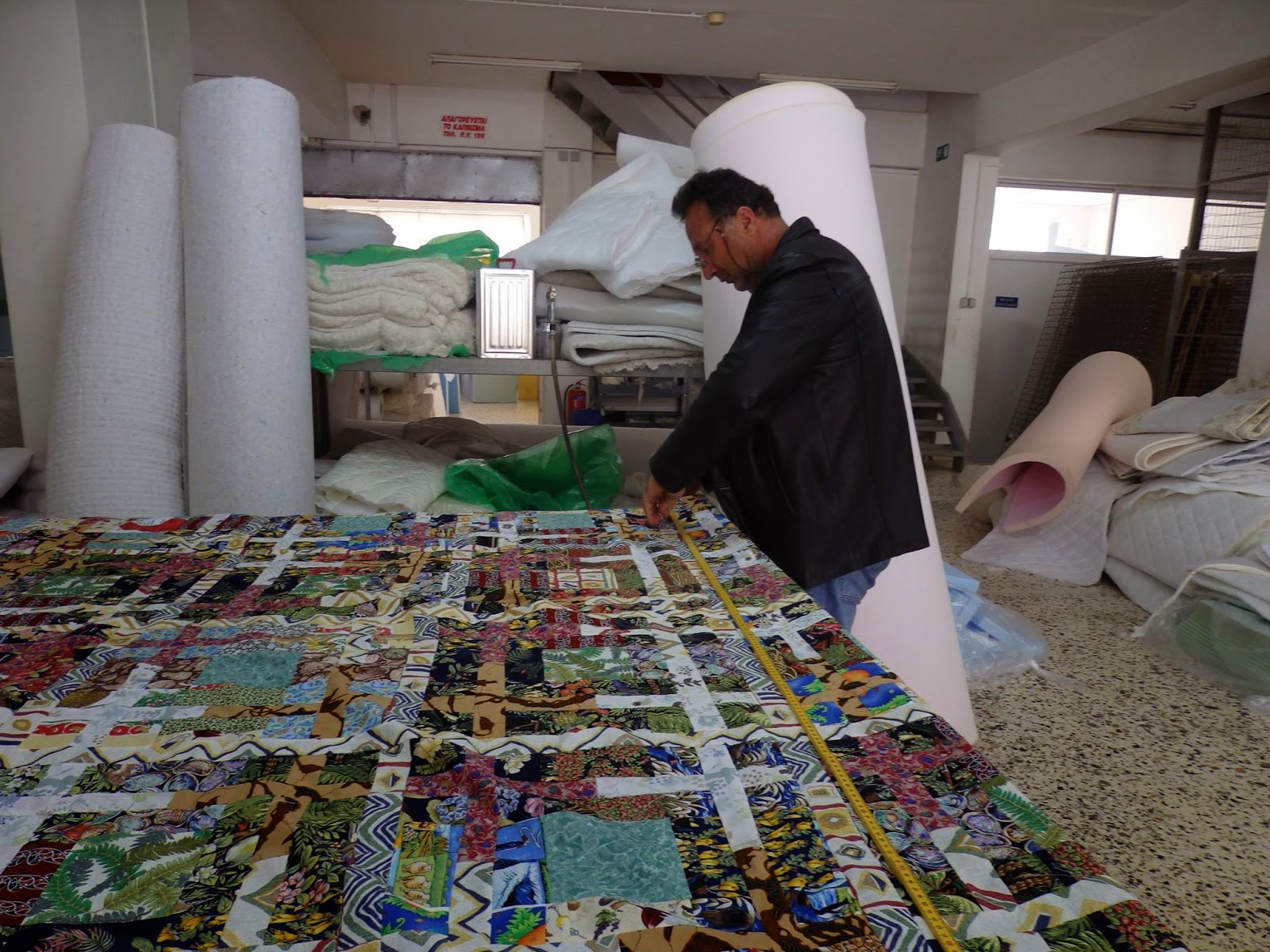
My fourth quilt - a book quilt for a friend

We watched Mum making this quilt over the last three weeks. She was working in the living room, while Dad was watching TV and we were studying. (We like studying in the living room, each of us taking up one sofa. Mum says she now wished she had bought us a desk for our rooms from a second hand shop, like her parents did, because it would have been cheaper, since we don't use our desks. But she remembers that when the bedrooms were being renovated, Hania didn't have second-hand shops. There are lots now.) The noise from the sewing machine drove Dad nuts, so she'd take her sewing machine into the kitchen and do her sewing there. We really didn't know what she was sewing at first. It simply looked to us as if she was cutting up fabric and sewing it back together, with totally unmatched colours. We didn't worry so much because we'd seen her doing this before. She's made quilts for all of us. When she started making them, it looked like she was going crazy, cutting up large pieces of material into smaller pieces and then putting them back together again. We could never really see the patterns in the fabric which she could see.


But as the quilts all grew, we began to see what she was making, and we all really liked them. Even the cat liked them. Since there isn't enough space anywhere to lay out a quilt, as she was making each one, she would spread it out on the floor in the living room. The cat would walk around the room slowly and then take a last step on one of the corners of the quilt and sit there. Then we'd go and pick it up off the quilt and put it on the rug, but the cat would go back to the same spot on the quilt. Eventually, it would get the message and leave the quilt alone. But it really did prefer the quilt. (Don't worry about the cat sitting on your quilt: Mum put the quilt in the washing machine when she finished it - it's fully washable. It won't smell of Mum's cooking, either, when she was working in the kitchen on it. Mum always laughs when she reads crafts sites selling 'pet-free, smoke-free' products. "The Western world thinks it can be so sterile," she says.)

We would really like to present you with the quilt ourselves, but travelling is getting a little difficult for us now. We don't want to leave yiayia alone at home. She's in her nineties now, and looks like she's on course to celebrate her 100th birthday. Now that it's not cold, she goes out into the garden and does some weeding, or she looks after her rose bushes. She always cooks for herself, and she washes and irons her own clothes too (by hand). She doesn't take any medications. She says that if she has to take medicines to keep her alive, she'd rather die. But even though she feels so strong for such an old person, we don't feel we can leave her alone on her own while we go away on holiday to see you. So that's why you'll have to come and pick up the quilt yourself. It's time you took a Cretan holiday yourself, come to think of it.

We told Mum that she can go on holiday by herself and take the quilt to you, but she said that the political and economic instability that Greece is going through right now doesn't give us the luxury of making holiday plans. We told her that if she books flights early, she will get a better price, but she said: "Booking flight tickets for a future date just might mean that our holiday plans may coincide with national elections, or the closing down of banks, or even the airports, if things get that bad." We know what an election is, and we heard about the banks in Cyprus not letting you take money out, but we don't know what she means by the airports closing down. She says it has happened before in Greece, in 1974, while she was holidaying in Greece with her parents (and Cyprus was involved in that episode too):
"After three and a half months, our holiday had finally come to an end: our return tickets to New Zealand stated 21 July 1974 as the departure date. On the eve of our departure, we woke up on a hot summer's day in Pireas. It was a local holiday in the neighbourhood, as the district church was celebrating its patron saint, the Prophet Elias. Our bags were packed and ready for our departure the next day. Peace and quiet is expected on holidays, and the neighbourhood was silent. My father's sister told us to get ready to go to church. She was about to prepare a picnic to eat near a park in the churchyard's garden. We turned on the radio to listen to some music. Every single radio station we tuned in to was playing the same pre-recorded message: "... state of war..., ... emergency... γενική επιστράτευση (mobilisation of military forces into combat)..." Now my aunt was worried. Turkey had invaded Northern Cyprus and the Greek airports closed down to all international flights. Overnight, from holidaymakers, we had officially become overstayers." (http://haniadailyphoto.blogspot.gr/2008/07/bad-timing.html)
It's difficult to believe that things like this have happened in our country. We don't feel this fear at all, but our parents tell us these stories about our country's past, and we try to relate these details to the present, but it doesn't always seem to fit in well. We think we have a lot of freedom here, and we can live pretty much how we want, just like you. Mum agrees with that. She says Greece is one of the most democratic countries in the world, and it is little wonder that democracy was invented in Greece. But she also says that too much democracy is not good. Even Dad agrees with her on that one.

Mum says that you should not think of this quilt as a big present, because she made it entirely from scrap material (even the batting) that would have ended up in the wood-fired heater (ready to be used next winter) if she didn't look up the internet for ideas on how to use fabric scraps. "I could make a hundred book quilts if I wanted to, it won't cost me much at all," she said. She says the same things about the food she cooks, too.

We hope you enjoy the book quilt. Till you come to visit us, we will enjoy looking at it.

©All Rights Reserved/Organically cooked. No part of this blog may be reproduced and/or copied by any means without prior consent from Maria Verivaki.

Wednesday, 27 May 2015

Austerity cuisine: Life of Pie

My proofreading and translation work often takes me through culinary journeys - here is what I've been working on for a little while now.

The culinary concept of πίτα (PI-ta = 'pie') is an ancient one, and there is no culture in the world that does not have some kind of pie in its culinary repertoire: some kind of filling stuck together or enclosed in a flour-and-water mixture which can be as dry as pastry, or as sludgy as batter. Pie fascinates us because an uncut pie is mysterious, as it does not reveal its contents, so that we have only its aroma to estimate its inner secrets. Like bread, pie is a portable meal, with the added luxury - unlike that of bread - of being a complete meal that does not need assembly. Pie is also one of the most creative culinary offerings of the primitive kitchen. The basic rule in making pie is that there are no rules, hence the pie each person creates can be as original as s/he wants it to be. It is this basic rule that makes the Greek pita so versatile, and so important in culinary history: pie can be as rich - or as poor - as you can afford to make it. And for this reason, pie embodies all the facets of austerity, as it makes use of anything and everything: unlike soup which is an equally austere meal, pie can be carried anywhere and everywhere, so that it can be eaten by the very poorest people working far away from their homes.

The oldest forms of Greek pita may contain just flour and water, with some honey and nuts sprinkled over them, as in saragli from Northern Greece, and xerotigana from Crete:
"The ancient history of the pie in Thrace starts from the sludge created by the mixing of water and flour, i.e. the milled grain. This trophic symbol is to this day in Thrace still called ‘genima’ (birth). This sludge, which was baked in the shields of the warriors of antiquity and in Thrace still continues to be baked on a heated stone or iron surface, to be offered as a ritualistic dish, then became a round dough that is flattened and baked on flat stones. The various ‘palakountia’ and the ‘koptoplakountio’ of the Byzantines, with a pastry sheet on the top and bottom, and a filling of hazelnuts, almonds and honey in between, or the ‘tetyromenoi plakountes', are the first forms of pie, and they are the memories that keep the taste of the spiral-shaped or ‘curly’ pies of Thrace." (cf. Angeliki Giannakidou, Thracian pita)
Most pita ingredients originate from small-scale cultivations of garden vegetables, eggs and milk. Meat pies (kreatopita) have always been considered an extravagance - even today, a meat pita in Greece is usually made for Easter or a special occasion:
"The animals needed to produce the dairy products, usually chicken, sheep and goats, were reared in the household for the purposes of consumption, and it was almost unthinkable that a household would not produce whatever was required in order to feed its members." (cf Maria Fakiola, Corfiot pita)
But producing so much food for the daily needs of the - often large, in past times - family household was very hard work and on a very regular basis, the food supply would be supplemented by nature's offerings, hence the abundance of wild greens in the Greek pita which are used to make hortopita:
"The greens used vary depending on what thrives in every area, and it mainly constituted sorrel, kafkalithres, fennel, sowthistle, chard, galatsides, poppies, myronia, and nettles. These pies are primarily called ‘hortopites’ (Imvros, Molyvos in Lesvos, Chania in Crete, Mykonos and Evia), or ‘lachanopites’ (cabbage pies), ‘marathopites’ (fennel pies) and ‘tsouknidopites’ (nettle pies) according to the filling, while they are referred to as ‘gemostopites’ in Karkinagri of Ikaria." (cf Ourania Rapti, Aegean pita)
Given the nature of the Greek pita - a frugal meal that can be made from virtually anything - pita epitomises austerity:
"... as the economic and cultural activity of a society is heavily influenced by the natural environment, it is only natural that primary ingredients for food meet the circumstances which they define." (cf Eleni Bintsi, Vlach pita)
Yet, despite its economical basis, pita can be dressed up for any occasion. It can take on religious significance and be prepared ritualistically, as in the fanouropita, made in honour of St Fanourios, finder of lost things:
"Fanouropita ... is made with seven ingredients: oil, flour, sugar, cinnamon, nutmeg, baking soda, water. ... From oral accounts we also know that fanouropita can be made with seven or nine ingredients (oil, flour, sugar, cinnamon, nutmeg, baking soda, water, dried fruit, and orange)." (cf Rodoula Stathakis-Koumaris and Chrysafa Tsonou, Gaslaxidi pita) 
Where a paucity of basic ingredients was experienced, both the sweet and savoury could be combined; with the addition of rice and using an intricate manner of rolling the pastry, a 'richer' offering could be produced, as in the case of bubari:
"... bubari is a sweet Lenten pie with a spinach base ... Bubari is a very oily pie, since, in Megara, there has always been an abundant production of olive oil (an ancient variety from Central Greece, local subspecies of ‘Megaritiki’ of Olea europaea  var. Media oblonga, both an oil and table olive). The spinach was grown in local orchards and home vegetable gardens, and the (seeded) raisins used came from a local grape variety with small berries that locals dried in their homes. Traditionally, they did not purchase any of the basic materials, since every family produced its own products, even the flour. In order to both provide a main meal (for lunch) and also prepare enough pie in an economical way for the needs of the family, sometimes rice was added. The most common form of the pie is ‘bubari’, ie rolls in the shape of candy." (cf Maria Kalozoumi, Megara pita)
In line with the concept of austerity, nothing was wasted. Even an ingredient regarded as 'useless', like the unused squash that was left over from the previous autumn and had made it through to the spring, would be treated like royalty, and a special feastday would be assigned to use it all up, as in the kolokithopita (pumpkin pie):
"Kolokithopita in the Messinian town of Thouria is prepared by housewives and consumed only during the first Saturday of Lent, on the feast of Sts. Theodore... The main basis for the preparation is dry yellow squash (pumpkin)." (cf Elli Prasinou-Favvata, Messinia pita)
These days, I myself rarely make a galaktoboureko without adding pumpkin: pumpkin bougatsa and pumpkin galaktoboureko are now standard dishes in our house when I have pumpkin.

When we think of the Greek pita, we usually think of pastry, thick or thin, wrapped round a tasty filling. But making filo pastry is not an easy task, and certainly not an everyday one, so that, and in many cases, there was not enough time to make the filo pastry for a pita, which, in contrast to the pastry, had to be made with some urgency, in order to feed the family and guests. Thus, in many cases, we see recipes for self-crusting pita:
"The Peloponnesian mountainous hinterland is a place with a long tradition in sheep and goat breeding, both transitional and permanent. In the mountainous area of Olympia, namely in a small village just outside Andritsena, the Alifeira (Rogkozio), I tried two milk-based pies. Both summarize the most characteristic element of the food traditions of Morea - and in general, of Greece: austerity. This was manifested in the korkofigki, made during the period when lambs and goats are born, at the beginning of winter; and galopita, prepared with special care, mainly on Holy Saturday, to be eaten as a dessert at the festive table on Easter Sunday. Its flavor reminds one of galaktoboureko (Greek custard pie), but without containing pastry or syrup. (cf Yiannis N. Drinis, Peloponnesian pita)
"The types of pie are many and various: pies with home-made pastry, the leading role played by the hortopita (with wild greens collected from the region and spinach), as well as cheese pie, spiral pie known as ‘strifti’ (with cheese and sugar), milk pie and porridge pies such as mamaligka and bambanetsa. The name mamaligka is known in the Balkans and refers to a sludgy porridge mixture made with cornmeal. Mamaligka is a custom of Fthiotida, made with a kind of porridge originating from wheat flour to which cheese and zucchini or pumpkin are added. It is not covered with pastry, but egg is brushed over it, mixed with oil and sugar. It is thin, so as to cook quickly, and it is always cooked till the top is crusty." (cf Fotini Tsonou, Lamia pita)
The pies described above remind me of zimaropita, which a friend taught me how to make.

Often, pita is made with the poorest of ingredients - wild greens, foraged from the countryside, a sign in older times that one did not have enough food of one's own for the nutritional needs of one's family.  Identifying greens in the countryside is almost a dying art, but now with the crisis, it has had a revival. Wild greens make the most aromatic, the most redolent, and the most highly prized pita:
"Most pies in the Cyclades are made in the spring, since the nature of the area in the spring generously offers a wide variety of wild and domesticated leafy greens. (cf Nikoleta Delatola Foskolou, Cycladic pita)
Where wood is scarce, as in the Cycladic islands, pita is not baked, but fried in individual portion-size pieces, which requires less cooking time:
"The ‘seskoulopita’ or ‘seskoulopitaki’, a sweet pie, is made in Tinos at Christmas. Seskoulopitaki is based on chard, but also contains walnuts and raisins. It is flavored with ground cinnamon and cloves, and chopped mandarin, and is sweetened with molasses and a little sugar. The filling is wrapped in handmade pastry kneaded with orange juice, egg and oil. If the recipe is made as a larger pie, it is usually baked in the oven, whereas when individual serving-sized seskoulopitakia are made, they are fried, and then sprinkled with powdered sugar." (cf Nikoleta Delatola Foskolou, Cycladic pita)
These smaller pies require a lot of work, which is often done collectively:
"Such a task becomes monumental because the preparation of these desserts is time-consuming; since most women on the island have to prepare several dishes for the festive Easter table, they tend to make them in groups to help each other. Hence, they go together in groups of 2-3, maybe more, depending on the number of pies they have to make. Every woman assumes a role, depending on her skills. Some deal with the rolling out of the pastry, others with the preparation of the filling, another with the "pinching" of the pastry into a thin pleat." (cf Nikoleta Delatola Foskolou, Cycladic pita)
Small pita, and self-crusting pita, are the traditional pita offerings from the island of Crete, and they are all fried in olive oil which is found in abundance all over the island:
"With a focus on the local ingredients and cooking methods, the most widespread pies in the countryside and the urban centres of Crete are the pies cooked in a pan, like the ‘hortopites’ (wild greens), marathopites (dominated by fennel), cheese pies (sour, sweet or savoury with mint), ‘nerates mizithropites’ (the dough is fried while still wet), ‘sarikopites’, ‘agn(i)opites’,  ‘kreatotourtes’ (meat pies), the pies of Sfakia, etc. A second category is the baked pies, like ‘tzoulamas’ (dominated by rice), ‘mizithrompoureko’, the light pies that remind one of cake, with the most popular one being raisin pie, etc." (cf Angeliki Baltatzi, Cretan pita)
My favorite kind of pastry pita is one that uses filo pastry in between the filling. It is a favorite all over mainland Greece:
"In Zagori, pies with pastry contain 5-6 thin sheets. Two-three are laid on the baking sheet and brushed with a little oil, one is tucked between the ‘anademi’ (filling), baked dry in the oven to hold the excess liquids, and another two to cover the pie." (cf Calliope Stara, Zagori pita)
This is the kind of pita that I make the most often for my household. These days, we rarely cook pita in the electric oven - the austerity lifestyle forced on us bought back the wood-fired heater into our home and our one comes with an oven compartment. I also make pita in the cooler seasons - heating up the home in summer is unthinkable!

We often think of pita as mainly a gender-oriented task, a woman's job. The solitary life of the Aegean fishermen proves this not to be the case. Their fish pie was probably fresher than the pita their wives served them when they came back home:
"The ‘atherinopita’ (smelt pie) of Kimolos is a dish that is found in several islands of the Cyclades... It started as a recipe made by fishermen who, when they got a good catch, held onto a part of it to make this ‘instant’ pie. The fish mainly used for the preparation of the pie is mostly the thin grey-blue 'sea spray’, called ‘atherina’ (Atherina hepsetus). Its length varies between 8 and 15 cm. They also prepared the same pie to take with them when they went out fishing. They would often make it in their boat. It's a pie that is very simple, easy and quick to make, with small fish, flour and onion, which, as they are mixed together and fried over a hot fire with plenty of olive oil, form a kind of pie." (cf Nikoleta Delatola Foskolou, Cycladic pita)
The importance of having the appropriate pie-making skills is also exemplified in the many proverbs and sayings that abound in the regional dialects of Greece:
«πίτα έχεις; έννοια έχεις» "You got pie? You have passion" meaning the daily care and constant attention needed for the preparation of a meal,
«πότε πίτα και φλασκί, πότε πίτα μοναχή» "Sometimes pie and flask, sometimes pie alone" concerning the adequacy or otherwise of provisions (sometimes, we have wine to drink with our pie, but other times, we will have just the pie),
«πίτα ’κεί που μέλλεσαι και όχι εκεί που ψένεσαι» "Pie for where you will go, and not where you want to go" when something ends up at another recipient other than the one it was intended for,
«όπου πεινά, πίτες θωρεί, κι όπου διψά, πηγάδια» "Whenever hungry, he sees pies, and whenever thirsty, wells", 
«από πίτα που δεν τρως, τι σε μέλλει κι αν καεί;»"Of the pie that you will not eat, why do you care if it burns?", 
«πόσες βουκιές είν’ η πίτα; κατά το δαγκανιάρη» "How many mouthfuls is that pie? It depends on the biter" in reference to the truth or the result of a project),
«ο καθείς την πίτα του για αφεντιά την έχει» "Each one to his own pie", with the a similar meaning to the 'an Englishman's home is his castle', 
«η πίτα που θα μ’ ευφράνει αφ’ το φούρνο φαίνεται» "The pie that I will indulge in can be seen from the oven", meaning that we usually know how something will turn out,
«ζεστή είναι η πίτα νόστιμη» "The pie is delicious when it’s warm" for the importance of timely action. (cf Ourania Rapti, Aegean pita)
Indeed, where would be without pita? 

I have not included any photos in this post, but if you would like to look up some of the recipes mentioned, many are given in my blog. Choose the underlined words in the above text, paste them in the search box on the top left-hand side, and you will find photos and recipes of similar pies as those being discussed here. Click here for a set of photos showing the many different kinds of pita I make

©All Rights Reserved/Organically cooked. No part of this blog may be reproduced and/or copied by any means without prior consent from Maria Verivaki.

Monday, 11 May 2015

Lovely view

Last Sunday saw me driving to Rethimno where I took a walk through the old town, before picking up my daughter from her basketball meet. There were a lot of tourists walking in the same places where I went. Here are some of my photos.

The tourist: Beautiful view! 
Me: Where's that sewer smell coming from? 

The tourist: A lovely quiet taverna overlooking the sea!
Me: How legal is the location of that restaurant?

The tourist: Graffiti! Ugh!
Me: Hm. I do indeed smell a rat. 

The tourist: This is so romantic!
Me: This is bound to be over-priced.

The tourist: So close to the water's edge! 
Me: Too close to the water's edge.

The tourist: Looks so fresh!
Me: How long has it been sitting there?

The tourist: The perfect spot!
Me: Paying for the view.

The tourist: Souvenirs!
Me: Kitsch.

The tourist: Nice vintage stuff!
Me: No price tags, ie I probably can't afford it.

The tourist: That sounds cheap!
Me: The dolmadakia are probably canned.

The tourist: Coffee in the shade...
Me: ... right next to the roar of the roadside.

The tourist: Oh... can't they replace it?
Me: The most perfectly designed flag ever. It will never need replacing.   

Greece can be lovely to look at, but these days, it is very challenging living here.

©All Rights Reserved/Organically cooked. No part of this blog may be reproduced and/or copied by any means without prior consent from Maria Verivaki.

Friday, 8 May 2015

Quilting

About mid-March, I decided that it really was about time I started using my fabric stashes, mainly made up of cheap remnants and used clothing whose fabric I liked. A number of items could not be used for The Greek Collection, as they did not feel very Greek to me, even though most of my fabric stash has been collected here. This past winter, I started making things out of my fabric collection, with the internet as my guide, and I still can't believe how fast I am - in just 8 weeks' time, I have made 3 large quilts, and completed a number of smaller patchwork projects in between, recycling and upcycling various items lying around the house.

The arts of quilting and patchwork are not at all well known in modern-day Crete, although there are now quilting groups all over the country (mostly headed by non-Greeks!). Since I've never quilted before, I didn't expect my fabric projects to go so well and get finished so quickly. We usually procrastinate over such tasks. In the past, all I did was small patchwork projects, without any quilting. I've now discovered that quilting using a simple made-for-home-use sewing machine is not at all easy because it involves pushing very thick (and often wide) fabric through a limited amount of space between the machine motor and the needle. This made my arms and back ache. But it was worth it!

My first project was a small mat, as a way to get back into patchwork, after a long break from it. I had made a patchwork armchair cover many years ago, using cheap fabric remnants bought in Athens back in the drachma days from a store that sold sheet and curtain fabric. (Such stores are long gone now.) The cover was all hand-stitched. It had gotten rather tired looking, and was eventually replaced by a store-bought cover. But I didn't want to discard my old patchwork given the amount of time I had put into making it. So I cut a piece and used it as backing material for a quick patchwork denim mat, made from my kids' old jeans. The light padding all came from remnants I had picked up from a mattress maker in Hania when we bought new mattresses for our kids' beds. This whole project took me just one afternoon, thanks to the sewing machine stitching.
Cost: just the electricity I needed to machine-sew it.


I decided to get craftier and tried a more advanced patchwork pattern, again using fabric remnants. I made another small mat for the bathroom based on a design called 'fake cathedral windows', as it is known among patchwork circles. More old denim was recycled, and the 'windows' were made using fabric scraps that were very small and practically useless and would otherwise have been thrown out. Again, the cost was virtually zilch.

My children had been watching me working on my patchwork projects throughout the winter, and they liked the idea of a quilt of their own, made by their mother. They have never had a quilt, mainly because my own mother left me a lot of blankets (we use what we have!). Quilts feel almost like a luxury to us. Having never quilted before, I decided to do a sample quilt using plain fabric which was not patchworked. The first quilt I made was for my son. The whole family loved it!

The designer fabric is called Tournament by Jane Churchill, acquired at a garage sale in Brockley, London, on a balmy September day as I walked through the area last year. My son is a fencer, so I immediately imagined these knights gracing his bedroom in some way. The red fabric has a medieval look to it - it was bought at a fabric store in Athens (more drachma days) and I used to use it as a sofa cover while I lived in Athens. The blue-white floral fabric used for the binding came from an upholstery remnants store in Hania.
Cost: designer fabric - £5; red fabric 1000 drachma; binding €1.50; €20 euro for the batting, from a local mattress maker. 

Before moving to Greece, I had bought a cheap king size quilt made of Indian cotton at a Wellington shop called Narnia. (I don't know if it's still trading - it was one of my favorite stores.) I have been using this quilt since I bought it, but it's now feeling rather old and needs repairing/replacing. During our New Zealand holiday 11 years ago, I bought some NZ-based fabric designs which were found in the remnants stash at the well-known Nancy's Embroidery store. I remember Nancy from her time in James Smiths (mention of this name does age me - James Smiths closed just before I left NZ). I embarked on a rather ambitious project using the 'disappearing nine-patch' patchwork technique. I needed 25 square blocks for the finished quilt top.
 Close ups of the main fabric used in the NZ based quilt. I didn't let any material go wasted by making squares from off cuts. 
Since the NZ designs were not enough to make a king size quilt, I bought some more fabric which had a NZ look to it from ebay sellers, eg shells, pebbles, (green coloured) sea, among others. I also cut up a NZ tea towel with a map of NZ on it. The sashing and binding were made using remnants from the local upholstery store, some cheap fabric bought in Athens during the drachma days, a used clothing item from the street market in Hania, and a batik design gifted to me by an Indonesian student while I was studying in NZ. The mattress maker sold me some more ready-lined padding, which meant that I didn't have to do most of the quilting myself. This was a very big project, so that was quite helpful. Most quilters leave the quilting part to professionals who use long-arm sewing machines, while others have computerised machines which are programmed to create intricate designs. (Maybe my next model!)
Cost: 3 metres of ready to use wadding - €35; NZ fabric designs from NZ - approx. NZ$22; ebay fabrics - £20; remnants/used clothing - approx. €10, plus a thousand (or so) drachma; the batik was bought in Indonesian rupiah. This really was quite an international project. 

The reverse side of the quilts did not need any fabric, thanks to the mattress maker. I took my quilt tops to him so that he could measure them and advise me on what I can use to pad them. In Hania, we have quite a few mattress makers, thanks to the tourist industry. A quick check on ebay confirmed that I would have paid roughly the same price for this wadding. (I'm not sure about how the quality compares - what I bought seems quite good).
The reverse side of the two quilts looks like this - the white cotton fabric was already sewn onto the wadding and I simply quilted the top side onto the ready-lined fabric.

My latest quilt project was for my daughter. It was made using fabrics I had bought on a whim while visiting Brighton on New Year's Day, walking through the Lanes (a bit like Hania's old town), where my eye caught a glimpse of some nifty floral fabric made into pyjamas which were displayed on clothes hangers. I decided to check out the store just because I liked the fabric, which turned out to be none other than a Cath Kidston fabric designer outlet. Rather overpriced of course (8 fat quarters for 25 pounds/30 euro), but I couldn't help myself.
On returning home, I decided that the fabrics looked a little too kitsch for my tastes. but my daughter loved them. I've used some of the CKs in my daughter's quilt - she chose the 'raggedy quilt' design. The CK fabrics were not enough for the quilt, so I had to add fabric obtained from all sorts of places: some skirts my daughter had grown out of, clothes bought from local second hand stores, 'old ladies' dresses (we call them 'robes') bought at the laiki, some fabric remnants that I had since my NZ days (off cuts from a dollmaker), as well as some cheap fabrics from my local suppliers. Some of the fabric that went into this quilt is over forty years old. With the use of so many different fabrics which can be traced to the very beginnings of my interest in patchwork, this quilt quite unexpectedly became a memory quilt.
Although the raggedy quilt design looked rather easy, it proved quite a challenge. It requires a lot of cutting and sewing, and trimming of threads. It becomes quite a heavy quilt to work with piece by piece, and gives you sore arms and backache. But I guess the end result was well worth it. I bound the quilt with fabric from a pink linen skirt in my wardrobe, last worn a decade ago.
When I buy clothes for patchwork, I always buy XL sizes and never pay more than 1-3 euro per item, at the street market and second hand stores (sometimes, the clothes are new, from previous seasons or store clearances). Upholstery remnants sell for all sorts of prices, but again, I go for the larger pieces, selling at 1.50-3.50 euros a piece. The bonus of the raggedy quilt design is that the padding for it could all be made from off-cuts from the mattress maker, so I didn't need to buy any. When I bought the padding for the other quilts, I was allowed to take all the off cuts that I could carry which were strewn around the workshop. Everything on the floor in the photo below went into the boot of my car.

Cost: second-hand clothes - 10 euro; upholstery remnants - 10 euro; Cath Kidston fabrics - 20 pounds; padding - free. 

During a recent window-shopping experience, I checked out the prices of  store-bought quilts. At the supermarket, you can get a simple king size quilt for 35-40€; similar prices can be found in the home stores. These quilts are padded, with one fabric on one side, another on the other side, simple binding and an elaborate machine-sewn design.  I can quite easily keep my quilt costs very low, but the real cost of home quilting is not based on the cost of the fabrics alone. Thank goodness for the invention of the sewing machine, which means that I can sew as fast as I can collect fabric that I like to work with. There are more quilt projects scheduled for the summer when I can work outdoors. These quilts will all be specially designed with certain people in mind. Watch this space.

©All Rights Reserved/Organically cooked. No part of this blog may be reproduced and/or copied by any means without prior consent from Maria Verivaki.

Friday, 24 April 2015

"EMERGENCY EXITS: Migration-Art-Identity" by Persefoni Myrtsou

The original publication of this text appeared in Greek in the journal Faros Alexandroupolis as part of Persefoni Myrtsou's graduate work, entitled "Contemporary migration biographies. Life and work styles of Greek female and male artists”. For reference to the original text, please contact Persefoni Myrtsou: myrtsou@hu-berlin.de. This was written as part of the graduate program "Art in Context", Berlin University of the Arts (Institut für Kunst im Kontext - Universität der Künste Berlin, supervised by Professor Wolfgang Knap). It was translated from German to Greek by Persefoni, and from Greek to English by me. Persefoni notes: "As I waded through [the German text], I felt the need to make some additional comments, in appreciation of the [Greek] readers of Faros Alexandroupolis, with which I wish to share some extra personal thoughts that did not fit within an academic work". 

I got to know Persefoni from another art installation of hers - you can read about it in this link. Her recent work struck me as a very insightful contemplation on the concept of homeland, whose importance cannot be underestimated among diaspora communities around the world. Greek heritage may be shared in global terms among Hellenes, but their concept of Hellenism is more often than not influenced by locality. What follows is the journey Persefoni took to formulate her own concept of 'homeland'. 

In Greek, the terms "migration" and "migrant" are connected mainly with the experiences of Greeks in terms of labor migration, thus the experiences are mainly perceived as negative ones. In the context of this study I intend to use the term freed from its negative connotation and to use it for any more permanent than temporary human movement, though without overlooking the weight it often carries in the collective memory of Greek society.

When my grandfather Constantine Mirtzos (our name would later morph into Myrtsos due to state negligence in transcription) and my grandmother Persefoni Christodoulou, both born in Ainos in Eastern Thrace, were expelled as refugees in Turkey and sent to Greece in 1923, they were given - according to the Treaty of Lausanne that regulated the population and property exchanges between Greeks and Turks - a piece of land in the village of Agioneri (also known as Vourlantza), located near Thessaloniki. Before the population exchange, my grandparents had never even heard of this place, nor did they know anyone there. So they decided to live in Thessaloniki, where they had some relatives. They still had to travel to Agioneri where my grandfather had set up a small grain mill in the fields, and a dairy products business with his brother, Anastasios.

From the beginning Agioneri was a cursed place for my grandfather and grandmother. According to the population exchange, this village was defined as their new home. This place had to replace their idea of “homeland” which they had for their own village in Turkey. Clearly it was impossible to replace Ainos, a place that they were forced to abandon. Neither in their memory nor in their heart, nor in their bodies. My grandfather Constantine was able to work for a few years. Later, the work situation at Agioneri went awry, his body gave up, he left and remained constantly sick until his death. Although I did not meet him, because he had already died before I was born, I do not think anyone knew exactly what disease he was suffering from - to a certain extent his diseases were exaggerated by my grandmother, who adored him tremendously - but I think deep down inside, the pain of leaving his homeland ate him away. I did not get to know him, but I got to know to my father and my aunt, his children, who inherited the same disease: they hated Agioneri, and  its people. They believed that the village was the source of all the family’s ills and there is still silence about the family’s past, much of which is probably ignored by them all.

The refugee culture of the Greeks from Asia Minor and Eastern Thrace significantly changed the composition of Greek society, mainly because the concepts of migration and “prosfigia” (which roughly means “being expelled from your home” - in modern Greek, it means 'the state of being a refugee') were introduced into the collective subconscious of the people. After 1923, the feeling of homesickness and nostalgia for the so-called “lost homelands” became two central motifs in the Greek language. As I stated above, in my family there is a mystical tendency to avoid making clear references to the past. In this way, I too neglected our family’s past. For me Turkey, namely Eastern Thrace, where Ainos is located, represented an eerie place. For my grandparents, their place of origin was something whose memory was very painful. So they decided not to talk about it. In this way they tried to live a normal life in Greece without mourning what was left behind. My personal perception of migration has been influenced very much by the story of my grandparents. Sometimes I feel an inexplicable desire for homing, as well as the need to redefine my roots. I think this is something I inherited from my family.

For me the fact that I made an effort to learn Turkish, which was somehow the key language in which my grandparents were born into and raised by, as well as my constant visits to Turkey, were an indirect means of a personal effort to understand this remote past. My experiences in Istanbul, where I stayed for three months, were for me a forced landing in reality. Today’s Turkey is connected with my family’s past only in an imagined way. In fact, rationally speaking, Turkey is now simply a neighboring country of Greece. In present-day Istanbul, whose population composition has changed fundamentally due to the internal migration of the last 20 years, mainly from Eastern Turkey and areas of the Black Sea, I was nothing more than a stranger, coming from a country located more west than Turkey on the global map composed from a western perspective. So my experience as a migrant artist in Turkey canceled a romantic and naive side of my personality, which was almost bordering on orientalism. 

The road to the roots: a journey into the de-mystified past
According to Nicolas Bourriaud, plants which are radicant, such as some types of ivy, continue to grow and create new roots in the new soil they are transplanted, although the original root has already been cut. The trunk of the plant remains the same, but it morphs through the transplanting process in the new soil. If one understands this idea metaphorically in the context of human migration, it seems purposeful for someone to be able to transplant their culture to a set of new geographical, cultural and social situations. However, at the new point where it has taken root, there is always the risk of a violent degeneration of the root of the plant (and respectively, of the personal culture of the individual), perhaps because if the transplant does not assimilate, it might throw its root out of the soil and it will thus wither (and respectively the person may drop out and/or be evicted directly or indirectly from the community). In the migrant model of life, the personal culture of each immigrant tries to root in a new place, and is always influenced by this migratory transplanting process.

My personal reservation concerning this process was the family’s silenced past. In this way somehow, I decided to make a real journey back to my “roots”: a trip to Ainos.

Thracian land, en route to Ainos, 29.10.2011, photo: Persefoni Myrtsou

In October 2011 I traveled with my mother by car from Thessaloniki to Ainos in Eastern Thrace. This trip was exactly the reverse of what my grandfather and grandmother did 89 years ago. My father could not come with us because of work, or so he claimed. I decided to record our trip with a camcorder and a photo-camera. As an artist I thought such a record would be excellent material for a future artwork. In my mind I constantly had two questions: is this trip an allegorical return to the “homeland” or an attempt towards a symbolic appropriation of space (in the sense of a personal colonial exploitation of the space) as a greedy artist, who wants to use the history and her relationship with this place for the purposes of her work? What is the real significance of this journey to the village of my grandparents’ origin? Am I travelling as a visitor? As a tourist? As an heir?

The day we traveled to Ainos was a national holiday in Turkey. We found out later that the 29th of October was the day of the proclamation of the Turkish Republic by Mustafa Kemal Atatürk in the year 1923 (in Turkish: Cumhuriyet Bayramı). In the same year, the population exchange took place, the one in which my grandparents left Ainos. In the central square of Ainos, a big celebration had been organised  - much like our own ones in Greece - with flags, grandstands, and children from schools reciting poems about Mustafa Kemal and Turkey, and all these in the predominant presence of military forces, which probably had to do with the location of Ainos at the border of the political map of Turkey.

The central square of Ainos, 29.10.2011, photo: Persefoni Myrtsou

At the end of the feast we walked around for a bit. There were a lot of people in the village, mostly from Istanbul and Edirne, who were probably originally from Ainos and had travelled especially for the holiday. After a while, we sat down in a restaurant to eat. We ordered meatballs, rice and shepherd’s salad, my mother asked for Ayran, and I had a Coke. The well-dressed waiter asked us where we were from and what we were doing on a day like this in Ainos. I replied in Turkish that we were from Thessaloniki, but my grandfather and grandmother were from Ainos, and we had come to see their place of origin. The fact that we had come on the day of the holiday was coincidental. He stared at us silently for a while. Then he sat down next to us and began to chronicle his own story: his own father came from Thessaloniki, or from a village near there, during the population exchange - I didn’t understand him very well as he was speaking rather fast and my Turkish was quite rusty at this point. He himself had never travelled to Thessaloniki: “It is that damn hard to get the EU Schengen visa thing”... On my cellphone, I happened to have a background photo of the promenade in Thessaloniki. I showed him the photo. He asked me to send it to him by MMS, and I did so.

Central road of Ainos, 29.10.2011, photo: Persefoni Myrtsou

The oldest remaining houses of Ainos, 29.10.2011, photo: Persefoni Myrtsou

The (happy?) coincidence of the national celebration and the conversation with the waiter could make a beautiful scenario for a nostalgic film, similar to "Politiki Kouzina" [“A touch of spice”, directed by Tassos Boulmetis in 2003]. However these events revealed a very obvious truth: Ainos is not a “home” for me, like Thessaloniki is not a “home” for the waiter. Ainos is nothing more than the imaginary topography of my family’s past, whose visible signs are gone. This trip was for me a solution to my very personal concerns regarding this invisible past. This trip helped me to clarify my personal and artistic position and responsibility towards this village, which had taken on mythical proportions in my childhood and later in my adult mind.

Ainos is located on the political border between Turkey and Greece, which divides the river Evros (in Turkish: Meriç). Ainos is one of the entry points for many undocumented immigrants into Greece and at the same time the European Union. Recently I traveled to Alexandroupolis with a German delegation as a translator and I had the opportunity to talk to the guards, who describe in gruesome detail the efforts of immigrants to cross the river. In their attempts to enter, many drown, as their means of transport is extremely dangerous. Sometimes they are perceived by thermal cameras installed on the Greek side and they are sent back. Once they cross half the river and manage to get out alive, they are on “European” soil. If they get caught, they are identified by FRONTEX, the European border police - this identification is relative, since most come without any official documents - and they are then kept for some time in the notorious detention centers for immigrants, known in Greek as centers of “hospitality”. Once the lengthy identification process is finished, they are released on the condition that they return within one month to the country of their origin. (Bear in mind that the text was composed in 2012, so regulations concerning the EU migration and asylum policies may have been revised.]. Why would anyone return?. Most travel to Athens in order to find a way to get into another European country, and their tracks are usually lost. Thus, this place, which my grandparents yearned for, is today a tomb for many people with basically the same story to tell as my grandparents: people who were forced to leave their homeland or were expelled from it. These modern migration stories relativised the story of my grandparents. On this very real basis, it felt right to act artistically.

Panorama of Ainos, photo: Persefoni Myrtsou

The highest point of Ainos is dominated by the ruins of a Byzantine castle. From the castle one has a panoramic view of the natural border created by the river Evros. Next to the castle ruins I set up a camping tent and shot some black and white analogue photography. I chose the castle for this artistic action. Through the Byzantine aesthetic of the ruins, I wanted to situate the photograph in space and time.

The Byzantine castle of Ainos, photo: Persefoni Myrtsou

Panorama of modern-day Ainos from the castle, photo: Persefoni Myrtsou

The operation of setting up a tent in Ainos is invoking an ostensible and simultaneously naive contemporary repatriation. Black and white film photography was deliberately chosen, since such aesthetics allude to the one and only photograph of Ainos that I found in the family archive - I found the very same picture on the Internet later. This photo was probably distributed among many of the residents of Ainos at the time before or after the exchange. In my own photograph the item that confuses the romantic landscape of the old is the modern camping tent. The tent is the simplest and cheapest that can be found in its category on the market. Moreover it is a one-person tent. By selecting this particular kind of tent, I wanted to give a personal and collective interpretation of this work. On a personal level, the tent is a temporary form of accommodation in the space: just like an archaeologist who is trying to leave no trace at the place she was studying, I try to discover signs of my family’s past in modern-day Ainos. The choice of a cheap tent as the key item of the picutre is an act of self-sarcasm referring to my personal need for “repatriation” - an idea inspired by a nationalistic rhetoric, which has been the scourge of modern Greek identity - and to the discovery of my now-proven bogus roots.

The black and white photo that I took while in the castle, photo: Persefoni Myrtsou

On a collective level, the tent, installed on the border of this area between Greece and Turkey, becomes a report on the living conditions of refugees, living a precarious life forced on them, and the undesired uprooting many of them experience. Some months ago, a journalist in Berlin told me that this action alludes to the global "Occupy" movement, which also symbolically incorporated camping tents in their actions. How would it be to “decentralise” such actions and organise them in places like Ainos, exactly on the Greek-Turkish border, instead of Wall Street in New York, the Bundestag in Berlin or Syntagma in Athens?

In conclusion, the fundamental objective of this project was to create a bridge between the two stories of refugee phenomena that have occurred in this very same area: one story from 1923, and the other from the present day. The river Evros appears on the right-hand side of the picture. Greece is discernible beyond the river. The country, which was regarded as a place of exile, while it became home for my grandparents and for many other refugees after 1923, has been transformed today into a graveyard and, in the best case scenario, into a transit station for another prosperous country in “Europe” and at the same time into the first station of hope for a better life.

Selected  Bibliography
Anderson, Benedict, 1983, Imagined Communities, Verso, London 2006
Auge, Marc, 1992, NonPlaces. An introduction to supermodernity, Verso, London‐New York 2008
Bourriaud, Nicolas, 2009, The Radicant, Lukas and Sternberg, New York 2010
Brewer, David, 2010, Greece. The Hidden Centuries. Turkish Rule from the Fall of Constantinople to
Greek Independence, I.B. Tauris, London‐New York
Chambers, Iain, 1994, Migrancy, culture, identity, Routhledge, New York und Oxon 2005
Charim, Isolde, Auer Borea, Gertraud (Εκ.), 2012, Lebensmodell Diaspora. Uber moderne Nomaden,
Transcript Verlag, Bielefeld
Hikmet, Nazım, 1925, Die Luft ist schwer wie Blei, Dagyeli Verlag, Berlin 2000
Hirschhorn, Renee (Hg.), 2003, Crossing the Aegean. An Appraisal of the 1923 compulsory
population exchange between Greece and Turkey, Berghan Books, New York und Oxford
Kristeva, Julia, 1991, Stangers to ourselves, Columbia University Press, New York
Mahn, Churnjeet Kaur, 2009 “Romance in Ruins, Ethnography and the problem with Modern
Greeks, in Victorian Studies, Vol., 51, No. 1
Özkirimli, Umut; Sofos, Spyros, 2008, Tormented by History. Nationalism in Greece and Turkey, Kataniotis, Athens [Edition in Greek]
Said, Edward, 1979, Orientalism, Vintage Books, New York 
Todorova, Maria, 1997, Imagining the Balkans, Epikentro, Thessaloniki [Editon in Greek]
Ζαφείρης, Χρίστος [Zafiris, Christos], 2008, Μνήμης Οδοιπορία, Ανατολική Θράκη [A wayfaring of memory, Eastern Thrace], Epikentro, Thessaloniki [title translated by Persefoni Myrtsou]

Just as Ainos is not a home for Persefoni, Wellington is not my home either. Waxing lyrical about Wellington will not make is any more part of the topography of own family. But not all the visible signs of my family's past are gone. Apart from my mother's grave, our former family home (below) is still in the same state that it was when we sold it. 

©All Rights Reserved/Organically cooked. No part of this blog may be reproduced and/or copied by any means without prior consent from Maria Verivaki