Monday, 21 May 2012

The way we were: the 70s (Η δεκαετία του 70)

Sun, seasons and souvlaki: A glimpse of modern Greece You never know who you will meet on the internet these days because the internet is so all-encompassing. Remember my review of Sun, Seasons and Souvlaki: A Glimpse of Modern Greece (Athens: Hadjinikoli, 1974)? Betty Blair, the author of that book came across my blog post and gave me more information about how she conceived the idea for it:
"Back in the 1970s, it was very hard to find any books about contemporary Greece. So many books were available in English related to "the glory that was" - telling about the "Golden Age" of Pericles and period when the Acropolis was built- 2000 years earlier. But my idea was to encourage foreigners to look around and appreciate the Greece of contemporary life. And that's where I got the idea to create the book about modern Greece. As expressed in the title - it was a "glimpse," it was not intended to be a deep analysis. It was written to encourage tourists and foreigners to be open and curious and dig further to learn and love the country themselves... Also, it was written under the influence of one of Greece's most distinguished political scientists Dr. Pantazis Terlexis. The book was quite successful and went through three reprints between 1974 and 1976. I left the country in 1977 (after living in Athens six years)."
I was thrilled to be in touch with Betty, who had direct experiences of Greece in turmoil in the recent past. She was also in Greece in the same year that I visited the country for the first time. Betty and I were simply at a different point in our lives: I was an eight-year-old child holidaying in Greece with her parents, while Betty was a university graduate on a long-term working holiday. Sun, Seasons and Souvlaki was Betty's first book. Her second book was also about Greece, entitled Color it Greek, essentially a children's coloring book for in four languages - Greek, English, French and German, again, with an emphasis on contemporary Greek life. Since then, she has edited Azerbaijan International magazine http://AZER.com and been involved in publishing another eight books on other topics.

After initial email contact with Betty, I was dying to ask her some questions about the Greece she remembered nearly four decades ago: what brought her here? what kept her here for so long? has Greece changed in her mind? does she come back to Greece for a holiday? Betty kindly obliged to divulge the answers, and our newly-formed friendship was forged.  

What brought you to Greece in the first place?
Old story. The stuff of ancient dramas. Boy meets girl. Girl follows boy to exotic country. The rest is history.

You lived in Greece for six years (1971-1977). While in Athens, you wrote your first book: Sun, Seasons, Souvlaki: A Glimpse of Modern Greece. That’s nearly 40 years ago.
What is time? I felt like a kid when I first came to Greece. I still feel like a kid now – years later. Greece was a land of adventure for me - so much to see and explore and learn. So full of passion and intensity. I can’t believe so much time has passed since then. It seems so strange to me to consider some of the entries and sketches in my book as history – as “the way things were”. But, of course, you’re right. The mid-1970s were some of the most prosperous days for Greece. Tourism was booming.

Tell me more about your little book Sun, Seasons, and Souvlaki. Why did you write it?
The best books, they say, are the ones that you as a writer would like to read. I got so tired of reading books about “the glory that was Greece”! I wanted something contemporary. I wanted to understand the color, the texture and nuance of life that was going on around me. Back in the mid-1970s, I don’t remember a single book in English about Greece that didn’t focus on the Acropolis, Pericles, the "Golden Age". I wanted something about everyday life. So I decided to write such a book myself. I had been in Greece for several years and could get around quite well with the language. It took me about a year to try to find topics that I thought were typical and representative – not sensational, weird stuff, just everyday things that I was convinced were meaningful to the average Greek. 

ΤΟ ΧΩΡΙΟ: In the wake of the crisis, the 'village' is where urban dwellers are now heading. The reasons are obvious: the village provides cheap or rent-free accommodation, a source of food and the security of family ties.
Even today when I page through the book, I find the sketches and observations amusing. They bring back wonderful memories of Greece. Even though there is humor and liberty and even exaggeration in the depiction of characters, there is a lot of authenticity in the context of the sketches. I tried to make the details in the sketches reflect reality – like the exact number of strings on a bouzouki, or the number of board pieces in backgammon, or the exact wording on signs.

ΤΟ ΚΑΦΕΝΕΙΟ: You will still see backgammon being played in the 'kafeneio' by all age groups. It is still alive today, having taken over the village square, where people can still be heard arguing politics in it, just like in ancient times. In the latest edition of his book The Greeks, James Pettifer argues that the Greek rhetoric has not changed much since ancient times; the strong argumentative stance of Greek rhetoric is not well understood by the troika, hence the misunderstandings in the relationships between the troika and Greece. 
What was your experience like in Greece?
Well, there were lots of firsts. Let me talk about a few related to food. Greece was the first time I had ever bought produce at a local neighborhood street market. What a wonderful institution! And even today, where I live in Los Angeles, I still try to buy my produce at a farmers’ market. I like the colors, the freshness and I enjoy how the sellers take pride in their produce. We’re so used to agro-businesses these days. It’s wonderful when you can connect with farmers who really feel part of the miracle of growth


For me, there were a lot of new tastes in Greece - like octopus and squid. It was the first time I had ever seen a baked lamb’s head, eyeballs and all staring up at me on a plate. Greeks tried to convince me that it was a delicacy. I’m still not sure! Snails. Another first. I’ll never forget the first time I went “snail collecting”. It was after a spring rain and people were wandering over a hillside with plastic bags, collecting snails. Me and my friends decided to do the same. We gathered the snails, took them home and put them in a box for a couple of days. I remember asking Why?, and then we cooked them up in a tomato-onion stew. Incredibly delicious! Artichokes were new to me. I still like how the Greeks stew them with carrots and potatoes

artichokes and peas in lemon sauce

Oh yes, and camomile flowers. Another first. What a delight to go to the hillsides in spring and pop those tiny daisies through your fingers and then spread them out to dry on newspapers for your own supply of camomile tea for the whole year. Wonderful fragrance. I still drink camomile tea.
camomile
Camomile is sprouting up all over the place now in the spring.

And Greece was first where I learned to love yoghurt. Plain yoghurt. Not the manufactured kind that is so popular now in the States with all that sugary fruit in the bottom. Just plain fresh yoghurt made from sheep’s milk. There used to be a little old man who had a tiny shop around the corner from where I lived in Athens – you couldn’t even call it a store front. Just a little door to a tiny hall-like passage, lit by a single naked light bulb where he sold small plastic containers of yoghurt. He prepared them fresh each day, we bought them early evening every night. They didn’t even have any lids on them. The yoghurt, with its wrinkled skin, was exposed. If I remember correctly, we paid 3 drachmas for each container

Add a teaspoon of bulk-buy yoghurt to a glass of homogenised milk, leave it in a warm dry corner of your kitchen, and the next day (or sooner, depending on how hot it is) you will got a thick creamy smooth yoghurt, with no milky water liquid residue.
And you learned Greek?
You miss so much local flavor if you don’t. And I was living there. I didn’t consider myself a tourist. So yes, I learned Greek and could get around quite well after a while. Of course, I would never have dared to give a university lecture in Greek – but I managed everyday life. At the time, I remember there were four or five grammar books for the native English speaker. I bought all of them. And then generally tried to “catch as catch can” – using every opportunity to learn. Besides, there are many words in English that are derived from Greek. I remember one summer going through the thick American Heritage Dictionary and putting a dot next to every word that had roots in Greek. I was amazed, there are so many!

Where did you work in Greece those six years?
At first, I taught English at Dina Yannakapoulou’s frontistirio. And I tutored students privately. I would ride the trolleys and buses and teach kids in their own homes. There was a big urge to learn English back then. Most of my students were younger than 10 years old. After a few years, I began teaching at the Middle School at American Community School (ACS) in Ano Halandri. Most of the diplomatic and international business community sent their kids to ACS. There were a lot of military kids, too, from the American naval base.
It's a rare Greek child who has not studied in a frontistirio at some point in life..
You mentioned a special course that you had taught about the Acropolis.
Middle school students sitting on the classroom floor at the
American Community School, Athens, enjoying the Acropolis Unit
Emily (now Dr.) Stewart and I were approached by the Middle School principal Dr. Pimenides: “Why don’t you two get together and create a course?” Emily had had just arrived in Greece that year (1975) and was assigned to teach 7th graders in Social Studies. I taught the same students in Language Arts. But we thought about it and decided to do something different. We were convinced that kids had a lot of “different kinds of smarts”. We created what we called “The Acropolis Unit” with about 160 activities for students. The desks and chairs in the classroom were moved out of the way. The students could sit on the carpeted floor and work together with their friends. Talking was encouraged. The activities included anything from memorizing some of Pericles’ speeches, to writing plays, wearing chitons, designing jewelry based on ancient Greek designs, drawing Doric columns with their 20 flutes with a compass. Word games. Really so many fun things. 

Me and my family holidaying in Greece, 1974, inside the Parthenon
Students wearing chitons, 1975
And then we took a field trip to the Acropolis. Actually, that year, 1975, was the last year that the public was allowed to walk up into the Parthenon. Students were able to step off distances between the columns and measure the circumference of columns with yarn. Corner columns are thicker and built closer together; otherwise they would appear thinner as they get more exposure to the sunlight. Students actually measured these architectural details so the genius of the architect’s plans became more tangible to them. Students searched the Parthenon for games that had been chiseled out on the marble floor, and for remnants of Christian icons painted on the walls. 

Worksheets from The Acropolis Unit
It was a great unit. And I would say the highlight of my entire teaching career. We wanted to create an atmosphere where students would love what they were studying and where they could be creative in pursuing their own interests and in asking questions and seeking answers. The Acropolis just happened to be the content. I hope some of the students have returned to visit Greece because of the happy memories of that class.

Last year, Emily and I met up with each other again in Los Angeles and mused about the fun we had had in Greece years earlier. We concluded that the things we had done in that class would be forbidden today in American classrooms because of the constant pressure for standardized testing. Teachers have to teach to these tests or the school loses funding. It was sad for us to realize that 30-40 years earlier, far away in the land of Greece, we had more freedom in what we could teach than what is possible today.

Did you ever visit Crete?
Yes. It’s a strange story. While living in Greece, I visited many of the islands but never managed to get to Crete. In 1977, I accepted a teaching assignment in Iran. The following October as Library Media specialist, I attended a conference in Frankfurt. I planned to be away from school for only a week. After the conference, I stopped overnight in Athens to say hello to some friends on my way back to Tehran. But then the unthinkable happened: Iran Air went on strike! It would have been possible to take another international carrier to Tehran, but within the country, only Iran Air operated. I was working 17 hours by bus south of Tehran, not a smart move for a single foreign girl when the political situation was becoming more and more volatile.
         Well, I stayed in Athens for a few days, thinking that the strike would soon be over. But no. The strike continued. Soon I got worried that I would wear out my welcome staying with my friends so long. What to do especially since I was running out of money? Keep in mind that there were no such things as credit cards back then, or bank transfers via the internet. One carried Travelers’ Checks and I was running out of money in any form. That’s when I decided to stop by the publisher of my book “Sun, Seasons, Souvlaki.” Could she help me out? Sure enough, she did. With $250 in my pocket, and not knowing when the airline strike would end, I took a ferry boat to Crete. Back in those days, one could travel economy class for about the equivalent of $1 per hour. As I recall the voyage was overnight but cost only about $12 or so.
          By the time Iran Air got back into operation, nearly a month had passed since I had left school. I began to sense that life was starting to become quite unpredictable in Iran. Little did I know that this chapter of my life would come to an abrupt end and we would soon be evacuated.

What was it like in Iran back in the 1970s?
The school where I taught was located in the remote mountains of southern Iran, at a copper mine — Sar Cheshmeh. This was the second year of the school’s existence (Kindergarten through Grade 8). Classes were small: most had fewer than 10 students. The children came from many countries — Scotland, England, South Africa, Chile, Philippines. Their dads were helping to set up the copper mine. I might add that the mine seems to be quite productive today. It’s considered to be the second largest copper deposit in the world. 
Although Betty had never ridden a dirt bike before, it became her only transportation for 15 months while she was in Iran. On weekends, she would get together with other teachers and head up into the desert mountains to villages. They always wore a helmet and the bikes were heavy. When Betty was evacuated, she was one of the lucky few who got to sell her bike for $500 - half what she had paid to buy it. At Christmas, all the couples left and not a single woman got back into the country. The men flew to Pakistan and took buses back in; their wives ever saw Iran again.

So many things were exactly opposite to what my life had been in Athens. What a stark contrast. A few months earlier, I had been driving around cosmopolitan Athens in heavy traffic in a Mini Morris. In Iran, we rode “dirt bikes”— those Yamaha motorcycles with the nubby tires. On weekends, the teachers would head out on the barren dusty roads to villages. I had never ridden a motorcycle in my life. In Sar Cheshmeh, skies were blue. Somehow, I’ve always had difficulty thinking there is trouble in the world when skies are so bright and clear. Bright stars — like brilliant diamonds — filled the vast dark sky at night. I had never seen such a vast Milky Way — zillions of stars.

But those years were difficult in Iran, weren’t they?
You’re right. The oppressiveness of the Shah’s regime soon led to protests in Tehran. Soon unrest started to affect the copper mine as well. We foreigners were evacuated two days before the Shah left the country in January 1979. We left on January 14th; the Shah left, January 16th. And Ayatollah Khomeini arrived a few weeks later. Iran has never been the same. Back in the States, it was a very unsettling time for me. Being evacuated had been like death to me. I liked Iran. Leaving must have been incredibly painful for those who had to leave their Homeland and who have never been able to return. 

 Betty Blair, 1976, standing outside a periptero (kiosk) at the Corinth Canal, proudly showing off her colouring-book being sold. The Corinth Canal is now no longer touristy; since the building of a road over the isthmus, the canal lost all its tourist value. Note the kiosk's advertising: English, international and highly European.

What did you do since leaving Greece and Iran?
More travel! Lots of travel to remote locations in South American jungles with linguists who were studying tribal languages. Then graduate study at UCLA in folklore after I realized that folklore was not just about folk tales – but was really the deep study of how beliefs are transmitted through history and how these beliefs were spread geographically. Actually, it was really what my first book was about – studying traditions and practices in Greece.
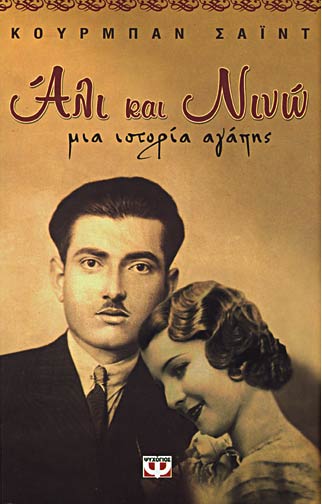
Ali kai Ninu Greek 2002You’re still involved with writing professionally, aren’t you?
Yes, I was the Founding Editor of Azerbaijan International magazine, which we established in 1993. Next year marks 20 years that we’ve been publishing this magazine. We have one of the world’s largest websites in the world about Azerbaijan, http://AZER.com. The website archives the articles from the magazine and mostly focuses on cultural topics – literature, music, history, etc. Lately, we have done a lot of research about Azerbaijan’s most famous novel Ali and Nino, which has been published in more than 30 languages including Greek.
Would you say that your early days in Greece influenced your present work?
I think yes. Greeks were always so generous and hospitable. And they were quite impressed when I would speak with them. "She’s one of us," they would say. They were so open to share their traditions and explain things to me. And I think the confidence they gave me – to dare to talk with strangers and to try to learn about new people and new cultures – originated in Greece.

You returned to Greece in July 2011. What were your impressions after being away since 1977?
Frankly speaking, returning to Greece was a disappointing experience. I had lived in Greece for six years when it was booming! The weakened economy has affected everything. But so many things have changed since then. Even the airport was located far away from where I remembered it! Hotels were very expensive. I can remember when you could get a room for about $10 on the islands. Athens used to be so crowded with tourists primarily from Europe. But this past summer, most tourists seemed to be American and Chinese. Where were the Germans and the French? Europeans seem to be heading to Turkey, which is much less expensive for tourists.
       
acropolis athens
 Although the view of Acropolis is not obscured, it's lost that old-time glamour...

Of course, there were many familiar landmarks – starting with the Acropolis. I have to admit that I loved the new Acropolis Museum with the see-through glass floors and the architecture plan that puts the statues on display so that you can study them from any angle. I’m not one who usually cares much about museums but the new Acropolis Museum is worth a visit to Greece just to see it. 
       And I was so pleased that the buildings in the city have remained relatively low – no high rise buildings which are so characteristic of metropolitan centers today. I was so glad that views of the Acropolis have not been blocked by skyscrapers. But the day that my husband and I climbed the hill to see the Acropolis, we arrived only to be told that this ancient monument was closed. How could the Acropolis be closed?! There was a strike taking place in Athens. We were so disappointed. We had come all the way to Greece , expressly to see the Acropolis.
       We left in complete dismay. But at the same time, it was “deja-vu” all over again for me because back in 1973, I had had a similar experience. I had arrived at the entrance of the Acropolis only to be told that curfew had been announced for 4pm for the entire city and everybody had to return back home by then. This was a crackdown by the government in response to an uprising by students at Athens Polytechnic Institute - the day the tanks rolled in. I remember heading down the hill from the Acropolis and walking home the five miles - joining hundreds of people in the streets. The public transportation was not working .
 

But evidence of economic decline was everywhere. Talented people were doing jobs far beneath their capability. You could see that people were struggling. So many stores were shuttered and empty on the main streets in the most prestigious parts of town. The main bookstore on Syntagma Square that had sold Sun, Seasons and Souvlaki and other English-language books had closed down. There were demonstrations in the streets, and gatherings and speeches at Syntagma Square each night. It brought to mind protests and demonstrations in the streets in the 1970s. Actually, it was exciting to see how people were gathering and trying to protest at the conditions. But clearly, the problems are not going to be resolved for a long time and Greece is going to face even darker days. Somehow, we grew up with the belief – perhaps “myth” would be a better word – that life gets better and better. But my visit to Greece made me realize that this is not necessarily so. And if it isn’t true for Greece, it means that it likely isn’t true for many of the rest of us in the world as well. 

*** *** ***
Greece is changing in a direction that was once thought impossible. Remembering Greece as she was is of pressing urgency now, even if at times it seems that Greece's future is heading in the direction of her past. But knowing your past makes you wiser, by giving you the chance to plan ahead.

I acknowledge the internet for bringing me together with Betty, thereby forging a new friendship. 

©All Rights Reserved/Organically cooked. No part of this blog may be reproduced and/or copied by any means without prior consent from Maria Verivaki.

Sunday, 20 May 2012

Crete, not Athens (Κρήτη, όχι Αθήνα)

Today marks the commemoration of the Battle of Crete.

During our one-night stopover in Brussels (which I toured through two decades ago), half the family had a bad cough, a result of the snap change in climate as we travelled from south to north. Instead of becoming acquainted with the food, we tried to get acquainted with the northern European climate. On our arrival at Brussels Midi (from London via Eurostar), it was raining steadily, leaving us feeling quite despondent. Although I'd booked a hotel reasonably close to the station, walking in the rain with luggage and children was out of the question: there were no extra hands for holding an umbrella upright. The streets beyond the station looked like an untidy muddled cluster; the taxis parked right outside the train station looked much more tempting.

As we neared the rank, a slim well-dressed young black man nodded to us as he opened the boot of his cab. I gave him the address of the hotel.

"Fifteen euro," he said. The price didn't sound exorbitant. In Greece, we are led to believe that taxi fares in northern Europe are expensive. But Greece has recently caught up to their prices - since the crisis broke out, laws regulating the Greek cab business have made them quite expensive here too, not to mention the rising fuel costs. (But our tourists are still slow to catch on to this fact.)

Once the cabbie had placed the luggage into the boot, we all got in, and off we went.The taxi meter wasn't turned on, which didn't concern me, as I thought perhaps this was legal in Belgium, which of course it probably isn't; likewise in Greece. EU countries all have their own laws and countries still debate within their own national borders because there is no European public space.

"Where are you from?" he asked us in French. He spoke French most of the time, but when I didn't understand, he did his best to speak in English and make himself understood.

"Greece."

"Athens?"

"No." We all laughed, and so did he. "We're from Crete." We had had exactly the same experience with a Nigerian taxi driver in London only the same morning, and another Nigerian Eurostar official who was thrilled to hear we were from Greece. He narrated the story (in broken Greek) of his arrival in Greece, which is where he had entered Europe from before ending up in London at the suitcase security check-in of St Pancras International.

"Crete?"

"It's an island in the Mediterranean, located north of the Libyan Sea." (I stopped myself from saying "located between Greece and Libya." It's easy to confuse other people about Crete's status that way.) He looked puzzled. We were now driving along wet narrow roads and one-way streets. It all felt very disorienting. This isn't what I imagined as meaning 'close' to the hotel.

"And where are you from?" I asked him.

"Nigeria."

While we were being driven to the hotel, I took the opportunity to find out whatever I could from the driver about the city.

"What's that?" We were driving along what looked like a castle, although I could only see its spire.

The cabbie looked in the direction that I was pointing to. Very politely, he explained that he didn't really know what it was, but it must be some kind of historical monument, and it's very old. Again, we all laughed. We take things for granted when we see them on a daily basis; tourists are often better informed than ourselves.

We had left the avenues and were now driving along very narrow roads full of cars parked in strange positions, resembling the maze of Athens streets, but without the dust, grime and sunshine. The roads were busy with vans being loaded or unloaded... but many shops also looked closed, as if out of business. It wasn't quite clear to us what was happening in Brussels. We would only realise later that we were seeing the most obvious signs of the European economic crisis in Northern Europe.

The drive seemed to take a much longer time than I thought it would. The narrow busy one-way streets, half of whose store fronts were unlit from disuse, continued until we came to a very large square where some kind of activity was taking place, despite the pouring rain.

Place du Jeu de Balle, Brussels' flea market, as seen from the hotel window

"Place du Jeu de Balle," our driver pointed to the right. "Hotel Galia is down here." He was worried that the flea market had closed off the streets, but he drove us round the square, straight to the hotel, which directly faced it. The shop fronts on the square looked in a dismal state - the premises directly next to the hotel were boarded up, while a building on the corner had been demolished. While the raindrops were falling on their heads, people were selling all sorts of what looked like household bric-a-brac at partly covered stalls. Some goods were laid out on tables, while others were in buckets, and others were strewn over a piece of plastic over the ground. They could not be called antiques. We'd call it junk, and it was difficult for us to understand who would be desperate to come out here on a cold wet dull grey day to buy this stuff.

We paid and thanked the very sweet driver, our first introduction to Belgians, and entered the hotel with our luggage, where we were met by a beautiful slim young lady, humming to a tune that was being played on the radio. She looked as if she were expecting us.

"Have you just come from Athens?" she asked us with an excited look on her face.

"No, Crete!" Again we laughed. Thanks to the Greek mass media, the whole world now equates Greece with Athens. This time, the woman showed some recognition of the place name.

 
Our hotel room was actually two rooms, with one double bed and a bunk bed. The wallpaper gave the room an art deco look.

"Was it sunny in Greece when you left?" she asked us. This opened up a discussion about the climate, an obvious choice of subject in Brussels."Here, it rains nine months a year," she said gloomily, handing us a set of keys. We were given a choice of appropriate rooms (finally selecting one on the first instead of the third floor). The rooms had recently been renovated, the bathroom was large and clean and the beds were comfortable. We took a short rest for the sick members of the family to revive their energies.

*** *** ***
From a Brussels tourist brochure found in the hotel: "City tourism isn't just about big monuments and museums: excursions off the beaten track create the true emotions of a visit. Meeting real life and seeing the real city creates those unforgettable memories, because you can't find it anywhere else!" VisitBrussels Week-end Bienvenue/Welkom Weekend

On the hotel map, I found the locations of Manneken Pis and Grand Place, being the two places that we thought would take us to the most touristy sites in the city on such a short visit. On a one-day stopover, you can't do much more than take a walk and have a bite to eat. Along the way, we would also pass various other sites of interest according to the map, which also held one surprise: in the vicinity of the hotel was a Greek Orthodox church. We aren't church goers, but it means a lot to Greeks to bump into familiar cultural sights when away from home. Armed with umbrellas, we set off.

 We stayed in the Marollen neighbourhood - the Greek church is pointed out by the blue arrow. It's the first time I've seen a Greek Orthodox church specifically mentioned on a non-Greek tourist map. While respected as a minority group, Greeks usually keep a low profile in Europe. Greek communities in Belgium have a long history spanning four centuries, but a large number of Greeks settled there during the post-war years, working in minefields.

The Greek Orthodox church in Brussels;
it's built along the lines of local
architecture rather than the Greek way.
To see the church, we had to take a detour off the main road that led to our chosen sightseeing route. We found the church closed; its offices were open every weekday except Friday (which is was that day). The detour was not wasted; by walking down this side street, we got acquainted with the Marolles neighbourhood of Brussels, well known for its street art and comic strip tour, some of which we saw during our walk. The art work contrasted starkly to the rather grim looking buildings in some parts of the area. A number of walls were covered with graffiti.

Our detour led us into the "comic strip" roads, as well as through lesser known area covered in graffiti; note the Greek - ΠΡΑΣΙΝΗ ΘΥΕΛΛΑ (green wave).

Continuing our walk, we came across all sorts of weird and wonderful street scenes: sandy sectioned off areas for dogs to poo in (?!?), highly visible public urinals on main roads (!?!) and recycling centres separating all glass colours (which explains the need for urinals, I suppose). Activities such as these seemed strange to us because, in all fairness, we don't see people drinking alcohol straight on the road in Hania - this activity is reserved for our Northern European tourists. Looking after select breeds of small dogs, however, is on the rise, even in the crisis. We often see young people - both male and female - walking their dogs both in the city and around the villages.

At one point, we came across what looked like a grand old Gothic-style church, across the road from a funky art dealer, all neighbouring a skating park which was covered in the graffiti style often associated with skateboarding. We found the contrasts too confusing. The church had lost its significance amidst its incongruous surroundings; its cavernous emptiness made a glum impression on our minds, dampened by the rainy weather that we were once again about to subject ourselves to. The art dealer's shop was the only lively looking store we had seen so far - there were no customers, but the outdoor decorations made an impact against the general greyness. The whole scene looked culturally incoherent.


The church led to what looked like a promising side-street. It was pedestrianised and lined with cute buildings, cute cafes and cute artists' galleries. We had entered the area famed for its Belgian chocolate. The elegant displays in the chocolateries had matching prices: something like €32 for a box of 25 hand-crafted tiny balls of chocolates. I was disappointed. Clearly I could not buy chocolate at this price, but somebody else probably is: Brussels has a constant flow of grey-suited men coming and going, and they don't make ordinary wages. A few people were sitting outdoors in the dank sky. What could have been a moment of joy at the Place du Sablon in better climatic conditions suddenly took on a morbid miserable appearance in the bad weather.


Presentation: it's everything in places like this - maybe too much.

Back on the main road, the ruins of a wall with a Rapunzel-like tower caught our interest. This was the 'castle' that we had seen from the taxi. No wonder the driver had no idea what it was - there was no sign on it to indicate its significance to the city (it turned out to be a surviving part of the old city walls).

During this time, the sky was changing colours - one minute it was blue, the next it was dark. At this point, our luck started to run out. On our way to Manneken Pis, we got caught in a downpour. No matter how much we kept our umbrellas hugged around us, we could not keep dry. As the only sane person among my company (two were sick and one was under-age - no one was in the best of moods), I led them into the first eaterie I could find. Neither the name of the non-descript cafe nor the range of food it offered was of any importance to me at that moment. I just needed to salvage my family's sanity.

*** *** ***
The casual diner was run by an Asian woman with impeccable English skills and polite manners. Her husband was just as welcoming. The last customers (schoolchildren) were on their way out. We had the place to ourselves. The display case contained an interesting mix of dishes - spaghetti and mince, noodles with vegetables, chicken breast slices, rice-paper spring rolls, and various sandwich fillings. We had last eaten on the train (Sainsbury sandwiches). Anything edible looked tasty at that moment.

The man showed us to a table and laid some placemats in front of us. "Where are you from?" he asked us in very broken English.

"Greece."

"Ah, Grecia! Io, Italia! Una fatsa, una ratsa!" We were just as excited to hear this as he was to say it.

"Where from in Italy?" my husband asked him.

"Sicilia."

"Ah, isola!" my husband spoke to him in the broken Italian that he remembered from his study years. The man responded in Italian; we caught the words "Magna Grecia".

"Noi, Kriti," my husband continued.

"Atene?" The Italian did not seem to understand. Like most non-Greeks, he seemed to know only of Athens.

"We are from Crete, not Athens."

"Why Brussels?" he asked us, speaking more with his hands than in words.

"Holidays," I said.

"Vacanze," my husband translated.

"Vacanze?" the man exclaimed. "In Brussels?" He made the sign of the Roman Catholic cross as we all laughed. "Vacanze in Brussels?!" He was now shaking his head in disbelief. His wife was busy in the background heating up our order, with a smile on her face, acknowledging her husband's joke.


Sometimes the food is not important - my conversations with the owners of this cafe were priceless.

We found an opportunity to ask the couple about the closed shops. The woman explained that Brussels was in the midst of an economic crisis, where 40% of the commercial area had closed due to the bad economy and the number of people living on welfare had risen quite sharply. It came as quite a shock for us to hear this. We'd been brainwashed into believing that southern Europe was facing a crisis, not the prosperous north. In places like Brussels, it's easier to see the crisis seeping through the threads, unlike in London where we had stayed close to one of the most deprived areas of England - despite its social problems, it had what seemed like a bustling local economy.

A young girl entered the cafe. She went to the back of the diner that was not so visible from the shop front. She took out a small laptop from her bag, together with earphones, and began tapping away as her order was taken. The woman returned behind the counter, taking a teabag out of a box. Then she heated up some water in the microwave and took the tea to the girl's table. At that point, the man left and got into his car which was parked outside the shop. The woman followed him, placing two chairs from the shop on the road to keep other cars from parking there. At this point, I had the feeling of deja vu. Although this is a common procedure in the south, hogging parking spaces in this way wasn't what I expected to see in the north.

The rain continued to fall steadily until the end of our meal, when it stopped pouring - now, it was only drizzling. As we paid for the meal, I asked the woman where she was from.

"I am from Bali in Indonesia," she spoke softly. "Do you know Bali?"

"Yes, of course, it's an island, just like Kriti," I told her. "Most people in Europe know about Bali, it's a popular place for holidays." She looked so happy to hear this; her eyes brightened as she smiled. But what was she doing in Brussels, so far away from home?

"I came here because of my husband, we live and work here now."

"So you're here to stay?" I asked.  She hesitated before answering.

"I suppose I'd like to go back one day to see my family, but it's not easy. Life brought us here to Brussels," she said, with a tone in her voice that I recognised. We thanked her for her hospitality and continued on our way.

*** *** ***

Belgian icons: waffles, chocolate and Manneken Pis
Our destination - Manneken Pis - would take us through more empty roads, although the stores looked slightly busier in this area than they did in the Moralles neighbourhood. The first sign of tourist-centred activity was pictures of Jacques Brel on the window. I'm a big fan of Jacques Brel, having been introduced to his music in my school French lessons, and the first CD I ever bought was in Brussels: a Jacques Brel collection. But that was twenty years ago - and he's been dead for more than a decade already. It's a lack of modern icons and heroes that causes this attachment to the past - Greece suffers a lot from this imagery attachment herself.
 
Oh, look, waffles for €1!
The streets from this point on were getting busier, with shops clustered closer together and more people milling about. A few people were obviously tourists like ourselves, judging from the maps they were holding in their hands. We came across a few eerie sights: a couple of shop windows were broken, and boarded with cardboard stuck over the hole in the glass. Whether this was caused by vandalism or burglary is not significant - these were the first signs of direct parallels with the demonstrations that have been taking place in Athens in the last three years. Less than a week before we arrived, Brussels was the scene of more crisis-related street rage by state sector workers (among previous cases of social unrest).

Before entering the side street leading to Manneken Pis, the hullaballoo was already evident. The main road was vacant in comparison to what was going on in the narrow road. The souvenir shops made a garish impact, in the same way as in the centre of Hania, once a tourist starts walking along Halidon St. The area clearly becomes a tourist magnet, an enclave disassociated with the remaining area that the locals probably avoid unless they want to buy cheap seashell chocolates, waffles and ceramics in the shape of traditional Belgian architecture.

Although the signs all clearly said €1 (at two different shops), this is totally misleading (it should have stated: 'v.a. €1' which means 'starting from €1'.  I ordered two waffles for the children (below) - I was charged €6. It was raining and we were lucky to find cover under the balcony of a disused building sandwiched between two souvenir shops so that we could eat the waffles without getting wet. Maybe each topping was another euro or so - who cares at this point, right? All I'm sure of is that I was purposely misled.
 

As for Manneken Pis, no one had bothered to dress him on that day. He looked so much happier twenty years ago when I last saw him, wearing a medieval suit in the middle of summer under a blue sky, when the European Union was celebrating her comeuppance rather than her demise. But that is not the general image of Brussels in the media. Brussels, together with Berlin, is where all the decisions regarding Greece's future are made. Brussels is where the Eurozone finance ministers meet to decide Greece's fate. The Belgian central bank governor recently broke the taboo of Greece leaving the euro by describing the situation as an 'amicable divorce', while Brussels policy documents are littered with the word 'growth'. On the other hand, Athens is Greece, and Greece is Athens. Maybe it's time they all looked into the mirror themselves. 

After tasting our first (rather overpriced) waffle (nice and sweet), and making a decision not to buy the 6-boxes-for-€10 chocolates that were selling at the souvenir shops (on the pretext that we are probably better off saving our money to buy better quality ION chocolate when we get back home), we wandered into La Grande Place for a quick look at the main square in Brussels. We could not stay long enough to admire the interesting architecture, because our stroll was spoiled by more heavy rain.

At moments like these, I like to remember Cavafy's words:
"And if you find her poor, Ithaka won’t have fooled you.
Wise as you will have become, so full of experience,
you will have understood by then what these Ithakas mean."
(Ιθάκη - Ithaka)
 *** *** ***
After La Grand Place, we walked back to the hotel, taking a slightly different route, constantly ducking under the awnings of the large buildings to protect ourselves from the rain, taking care not to disturb the homeless who were sheltering in these protected parts of the streets. The evening was spent at the hotel, so that my flu-ridden family members could recuperate. The brasserie's tempting aromas wafted up to our room, with free entertainment provided by the sounds of a jazz concert taking place there that night. A meal out in food-loving Brussels (as I was told by a colleague) was not to be for us that night. Instead, we downed the last of our Kettles crisps, bought from Sainsbury's.

 
Hotel breakfast room by day, brasserie by night: the Chez Nous restaurant attached to Hotel Galia was decorated with items bought at the flea market. 

Maybe I was more open-minded when I first came to Brussels. My mind has been shaded by my experiences of living in Europe for two decades, and is now clouded by the problems Greece is facing. Even in my own country, I cannot see the problems so clearly, because I live in Crete, not Athens. But from what I saw in Brussels, it was obvious that the feared contagion had already begun.


Breakfast contained a rich variety of cold meats and cheese, good coffee and delicious bread.

I had ordered a taxi in the morning to take us to Midi for the next leg of our journey. After a very filling delicious breakfast (included in the price of our booking), we noticed a very gruff stocky white man standing outside the hotel, who did not even bother to announce his arrival to his paying customers, or even to the hotel staff that had made the booking. When we emerged with our luggage and children, he opened the boot. No Bonjour (or Goedemorgen), no assistance in placing our luggage into the car, not even an acknowledgement of our existence as his precious customers. But the drive to Midi station took half the time that it had taken the previous morning and the meter was turned ON. When we arrived at the station, he parked the car and opened the door of the driver's seat without even looking at us.


Breakfast at Hotel Galia

"How much?" I asked on purpose, just to see if I could get a spoken response from his tight-lipped mouth. He pointed to the meter without speaking: €7.20, half of what we were charged by the very sweet polite Nigerian the previous morning. It seems that being helpful and cheery comes at a price!

©All Rights Reserved/Organically cooked. No part of this blog may be reproduced and/or copied by any means without prior consent from Maria Verivaki.

Saturday, 19 May 2012

500 words: Snails on Royal Albert

Flash fiction: 500 words (or thereabouts) 

The doorbell was ringing. It was almost four, siesta hour. Nothing moved at this hour, except children on bikes in the empty πλατεία. The only καφενείο and μπακάλι in the village were both closed; they hadn't opened their doors for two years now.

Evanthia had picked up the village routine very soon after moving to the island, on her husband's insistence, since they weren't making ends meet in the city. The daughter of a Greek Australian businessman, she had come to Greece at the age of twenty on her first unaccompanied holiday to the mother country. She met an electrician, giving up her university degree half-way through to get married. The children came soon after. Most Christmases were spent in Australia, while Easter was always at her husband's village – and her own parents’birth. After twenty years of living the life of a cosmopolitan middle-class housewife in a coastal Athenian suburb in an apartment bought by her parents, she suddenly found herself in an old εξοχικό, surrounded by grazing fields, olive groves and hilly countryside.

Before their move, they sent the children to their grandparents in Australia. The twins were due to start university; they may as well study where they would probably end up living. Evanthia’s family were surprised that she wouldn't go with them. Her family pleaded with her: “You’ll have a better life here" where Vaggelis could work in the family business (window cleaning high-rise buildings).

Her siblings could not understand what was holding her back. Evanthia wasn’t happy leaving an urban area with all its creature comforts. But she loved her husband too much to give him up, something she couldn't easily discuss with her divorced brother or unmarried sister. No matter how close they were as a family, Evanthia felt the taboo of discussing her paersonal happiness, lest she sounded condescending. To them, life was about moving up the employment ladder and into the property market, which their parents had already helped them to do anyway.

Vaggelis adamantly refused to hear anything of moving to the ξενιτειά. “I’m not leaving the country I was born and raised in at the age of 50 to die in a foreign country!” He’d been out of work for a year before making the decision to move away. “You don’t have to come with me,” he reminded her, “but don’t expect me to stay here when all around us people are leaving.”

What Evanthia found most difficult to cope with was the very basic way people approached life in the country. She knew nearly everyone, being related to most people, but they had very little in common. Their world as housewives was on a different tangent to her former life. Instead of the supermarket or the λαϊκή, they’d go to their fields for ingredients to cook with. Nothing was simply heated up in a microwave – everything required preparation from scratch.

“No wonder you’re bored,” her neighbour Keti told her. “Gather some snails and by the time you clean and cook them, the morning is over.”

Evanthia got off the sofa to open the door, where she found her neighbor holding a plate of some strange-looking dish.

“I bought you something!” Keti laughed sweetly, with a radiant smile on her face.  “You know Vaggelis loves this, don’t you?” On seeing the snail shells, Evanthia was seized with revulsion, but managed to keep a straight face as she didn’t want to disturb the peace. Vaggelis was sleeping, after working in the olive grove grafting wild trees with domesticated species. She took the plate from Keti’s hand and was just about to thank her when something caught her eye. She looked intently at the plate.

Snails on Royal Albert:my mother's crockery sits in my china cabinet, neavily unused.
“It’s freshly cooked, if that's what you're worried about,” Keti assured her, noticing her scrutinizing countenance.

“I know that,” Evanthia replied. “I just never expected to see χοχλιούς on Royal Albert.”

Ρού-α τί?” Keti had always found Evanthia difficult to understand herself.

©All Rights Reserved/Organically cooked. No part of this blog may be reproduced and/or copied by any means without prior consent from Maria Verivaki.

Friday, 18 May 2012

Cheap 'n' greek 'n' frugal: Potato mash (Πατάτα πουρέ)

Prices are in euro (valid in Hania). All ingredients are Greek or locally sourced; those marked with * are considered frugal here because they are cheap and/or people have their own supplies.

At the supermarket in a small town in Holland, I was astounded to see so many packets of potatoes in the fridge section. The potatoes were all ready to be cooked. No dirt, no skin, no eyes, just pure white raw potato gleaming in the packet, cut in all shapes and sizes. Similarly, in the home of my London friends, the only potatoes to be found were the bagged ready to heat and eat type.

If you peel potatoes and don't place them in water, they lose their white colour. The surface will turn a dirty grey and the potatoes will look rotten and wholly unappetising. Something must have been placed in those packagings (or the potatoes will have undergone some kind of treatment) that allows them to remain lily white.

As yet, I haven't got myself round to picking up bags of ready to cook potatoes. It doesn't sound natural or even cost-efficient. Since the Potato Movement started in Greece, the potato has dropped in price considerably. Nevertheless, Cretan supermarkets stock mainly ready to cook potatoes, some in the form of fresh boil-in-the-bag (cleaned, with their jackets, from France), as well as frozen potatoes cut as chips that are ready to fry or seasoned potato chunks that go into the oven as is. Potato mash powder is also widely available, even though potato mash is very easy to make.

I had a delicious mash flavoured with spicy horseradish mustard at the Ladywell Tavern in London, with leek and onion slivers incorporated into the mash, which I wanted to recreate in my own kitchen.
Gravy is not a Greek culinary phenomenon. My rudimentary gravy was made with a piece of leftover lamb roast, mashed into a water-and-oil mix. The sausages  
You need:
600g of potatoes (~ 0.30 cents)
1 teaspoon of mustard (optional - you can buy really good cheap Greek ones now)*
1-2 glugs of olive oil*
salt and pepper*
a few slices of crisp-fried onion*

Mustard made in GR, NL and F (left to right)
Peel the potatoes (for a cleaner whiter look to your mash; if you boil them with the jackets on, the potatoes will discolour slightly on the surface). Cut into even medium-sized chunks and place in a pot with plenty of water. Make sure there are at least 5cm of water above the top of the potatoes. Boil till tender.

When the potatoes are cooked, drain them well and place them in a bowl. Add the oil, mustard and seasonings, and blend all the ingredients with a fork till the mixture is smooth and lump-free. Finally, mix in the onion.

Bread isn't really necessary with this meal, but bread is never missing from the traditional Greek home. While in Germany, we bought some Krakow sausages (the packet contained 5 for €5.95). 

Mash can be eaten on its own, drizzled with some lemon juice and olive oil. It makes a good evening meal. My kids especially like it after they come home from their basketball sessions. As a lunch meal, it's perfect with sausages (LIDL sells good quality cheap Greek-made German-style sausages). And some more crispy fried onion (slice them in thin rounds and cook them in a frying pan with very very little olive oil, stirring constantly until they become crispy).   

Total cost of the meal for four people: about €3, together with the sausages; about 75 cents per serving.

©All Rights Reserved/Organically cooked. No part of this blog may be reproduced and/or copied by any means without prior consent from Maria Verivaki.

Thursday, 17 May 2012

Dutch cuisine (Ολλανδέζικη κουζίνα)

Although it is rare to hear of a restaurant specialising in Dutch cuisine, there is a range of meals that are very representative of Dutch cuisine, despite Hollands' many culinary influences since the 16th century. While we were staying at a friend's place in the Netherlands, we got a brief introduction to home-cooked Dutch food and local pantry/fridge staples.


My friend's fondness for cooking is how we met. For our introduction to Dutch cuisine, she made a vegetable soup with tiny meatballs. What made it particularly Dutch was that it was heavily scented with finely chopped paper-thin herbs. The Dutch use these herbs a lot in their food, including in their ham and cheese products.


The soup was served with a spicy garlic Dutch butter, a product of Holland's famous dairy industry. The Dutch cheese market in Alkmaar close to where I was staying is well known internationally (it opens once a week during the warm months - alas, I was not there on that day). And the idea of the Dutch adding spices to their food is also a typical feature of Holland's cuisine,. Since the 16th century, the Netherlands was the main trader of spices throughout Europe, via the formation of the Dutch East India Trading Company in 1602, which actually controlled the spice trade between Asia and Europe for two centuries (like all empires, it eventually went bankrupt).


With so much butter and cheese, the Dutch are naturally keen on their bread too. The shape of the loaves reflects the Dutch culture of being very neat and tidy, with a uniform shape. Our friend spread us a large table full of the best of Dutch breakfast food every morning, with a range of sweet spreads for bread (like applesauce and rosehip jam) and hot drinks like cocoa and coffee (also very important Dutch trade items). She also showed us something the Dutch do with chocolate snow - they sprinkle it on buttered bread!


"I know it sounds crazy!" my friend laughed. "But when we see what other people do with chocolate sprinkles, like spreading them on cakes and muffins, we think they are crazy!"


I also got the chance to taste a quintessential Dutch semi-sweet custard with a yoghurt consistency called vla. It is available in tetrapaks in the fridge section of a supermarket. I had expressed my wish to eat rhubarb; this chard-like vegetable is not grown in Greece, and few people would understand its use here, since the leaf part isn't actually eaten, and the stem becomes a sweet. My good friends made a rhubarb crumble especially for me, and served it with vla. Apparently, vla is eaten as a pudding or afternoon snack, and over fruit. And it's very very Dutch.

While touring around Holland, always in the company of our friend who acted as a personal guide and an ambassador of her country, I had the chance to ask about the different kinds of Dutch street food, and eating in the the Dutch way. Some things we tried, while others, we just got a glimpse of, as our stomachs couldn't fit it all in. 


I like making poffertjes because it's a 'happy' kind of food - it's also a good way to introduce children to cooking; the special pan makes it much easier.

Pancakes, small and large, are popular all over Holland, and generally in Northern Europe (Britain excluded). A particular specialty of Holland is mini-pancakes called poffertje, epsecially popular as a birthday party treat and in the summer. Out of curiosity, I asked to see my friend's poffertje pan (something every Dutch person has in their home), which in her case was a very heavy cast-iron pan with moulds ready for making mini-pancakes. I bought one of them too (a more modern much lighter version!), because pancakes are popular in my own home and the poffertje tin makes them more fun to make.


Olliebollen are deep fried donuts, which I've also made at home, according to a reicpe my friend gave me; I could say my Cretan olliebollen are a very healthy version since I use only olive oil.  As you can see by the way the children are dressed, the cold was quite intense in late April. My friend kept telling me that we are very lucky not to have been caught in the rain while we were walking.
 

Doughy sweet treats are very much a part of Dutch cuisine. Special Dutch donuts, olliebollen, are made for New Year's, but they can also be bought at major Dutch tourist attractions throughout the year which also sell waffles.


qutomated dutch fast food outletProcessed meat products in a bread bun are as popular in Holland as they are in most Northern European cities, but the specialty in Holland is frikandel with or without various toppings. A typical Dutch way to sell them is from an automated dispenser which we found more amusing than the frikandel itself! Our stomachs were always too full when we passed one of those, so we didn't taste the 'real' thing (we managed to scoff down a regular hot dog at a stand with the typical frikandel toppings).

Another very Dutch street food item is the fresh raw herring sold at stands that specialise in fish-based street food. Apparently, this delicacy is very good for when you are suffering from a cold with a sore throat, which are common ailments in Holland, as the weather is very cold most of the year round. The fresh raw herring is served simply as it is, with some chopped onion, which sticks to it. The eater takes the herring by the tail and eats it from the head-end first (the head is removed during the cleaning/preparation process), making sure to re-stick it with onion after each bite. I personally liked it vry much - it reminds me of own marinated sardines at home.


My friends also presented us with some food items before we left, which left us with some happy memories as we continued our trip: coffee, chocolate, biscuits, applesauce, sweets, along with some Dutch smoked and herbed cheese varieties that I picked up are all being enjoyed back home in my Mediterranean kitchen. But one of the treats didn't make it that far.


The Westfriese Broeder sweet bread - kind of like a filled flat tsoureki - kept up our strength while we were walking around Berlin. Spicy currant-fruit filled breads are a personal favorite of mine, but not so popular in Crete. This bread is going to be a bit tricky to reporoduce back in my kitchen - all the recipes are in Dutch!

I found only one aspect of food shopping a little shocking: vegetables at the supermarket are often individually vacuum-packed (remembering the golden Dutch rule of being neat, clean and tidy), and with a price per item, not by the kilo (again to do with rules of hygiene presumably). In mid-April, aubergines cost €1.29 each. It's cheaper to eat ready-prepared food than it is to cook...

©All Rights Reserved/Organically cooked. No part of this blog may be reproduced and/or copied by any means without prior consent from Maria Verivaki.