Sunday, 15 July 2012

Inheritance (Κληρονομιά)

Δηλώστε και σώστε περιουσία και καταθέσεις - Τελευταίος συμβιβασμός με την Εφορία για "μάυρα" εισδήματα, so reads today's front page headline on ToVima's Sunday paper edition today; for good or for bad, Greece is changing, forever... 

I once inherited some money after the death of one of my mother's uncles. He had no children, his wife had a child from a previous marriage, and when he died, he left behind a very old dilapidated house (he lived in it till his death) to be divided among his next of kin. His wife had died before him, so when he died, her son (from a previous marriage) inherited her 50% share of the property, while his immediate next of kin was awarded the remaining 50%. As he was my mother's uncle, and the last of his brothers and sisters to pass away, the children of his siblings inherited this share of the house. Each one had between two and four children, so that the money was further subdivided. My mother's sister and brothers were all given their share, but since my mother had passed away, her share was divided among her children I received the princely sum of 50,000 drachmas (~€150). I had recently moved into my own home, and needed some furniture, which is where that money went. other than that, all my inheritance is tied up with unregistered land.
 
 Our orange grove at Ahladolakko ('pear hole'): an uneven strip of land with small trees bordered by a road and surrounded by olive groves, in the middle of a growing neighbourhood; despite the fact that the area has been built up recently (even swimming pools have sprouted on the foothills of the Lefka Ori), building regulations do not permit us to build on it because our field is smaller than 2 hectares. 

In the past, the trading of land parcels (with no buildings on them) in Crete (and most of rural Greece, I presume) was conducted orally, sometimes accompanied by a written note that stated where a piece of land was situated and who it neighboured. This is still done today on an informal basis concerning small land parcels that have still not been reigistered with the state. The agreement was deemed the 'contract'. For the most part, written contracts did not exist. To formalise ownership of property and land, the Greek government created the Enthniko Ktimatologio (the Hellenic Cadastre), the Greek Property Registry. Dates have been established for each area or alphabetically according to the owner's name (where there is a high population) for owners to register their land and property. If a property isn't registered, the owner runs the risk of not being able to sell it legally, and it may even be confiscated by the state.

 Our orange grove at Xiloporta ('wooden door'): the small dense-looking patch of land located across from the building with the white-bordered concrete roof (a fruit packing station), on the left-hand side of the dirt road (which it borders), running into the groves. Although it is within the building zone, the total land area is smaller than where we live now; the view we would have from the entrance to a potential home there (see photograph below) is not exactly enticing. 

Most rural land ownership has been handed down from one generation to another, by the common system of sharing a piece of land among one's offspring, so that patches of land in one agricultural stretch of land are owned by different members of the same family. As my husband is an only child, his parents gave him all the pieces of land they owned, and they too all border another relative's property. When there is no will, Greek inheritance laws still favour the children of the owner, with a certain part allotted to the spouse. If there are no children, the property is divided among next of kin. This land forms one of the many hidden economies of Greek people, which allow them to survive through harsh socio-economic conditions. This land is often handed down to later generations with no strings attached or money exchanged.

Our olive grove at Mesomouri ('middle face'): the oblong shape that forms the field (outlined in black) starts from the road on top of a hill and runs down a steep incline to a stream. The forested area in the filed is actually overgrown olive tress that began growing after they were burnt in a fire. The cultivated part has been heavily re-landscaped after the fire to allow easier harvesting of the crops. The housing settlement of the village can be seen on the left at the bottom of the photo. The area affords spectacular views; we are currently in the process of legalising it for building purposes.

My husband's parents were both from the same village, which carries both advantages and disadvantages. The various patches of land that they each owned are spread all over the village, which means that we can't park our car in one area, water all our fields and then leave. We have to go to each individual field to work the land. Eventually, it becomes too much for all of us as we also have our day jobs, so some fields are now neglected. At least they are all found in the same general area, so we don't need to travel far from one field to another to get jobs done. It also means that we can swap similar-sized land parcels to neighbouring land owners, who may have another piece of land neighbouring our other properties; in this way, a small piece of land becomes bigger and more manageable. Land parcels can be all sorts of sizes: On one plot, we own just 15 olive trees. A neighbour has his eye on the land parcel, but isn't offering enough money or a decent swap for it. Hence, we have to be on our guard that it doesn't get tresspassed (he may plant trees right on the border, or move the boundaries - often denoted by a stake - without our knowing).

If we did not live close to our land parcels, some of them would no longer be there for us - they would now be in another person's hands. Καταπάτηση (ka-ta-PA-ti-si, treepassing on another person's land) was especially common in the past when people emigrated. The remaining relatives would find ways to divide up properties according to the descendants that lived in Greece, not including those who had left. This is understandable in some ways, but it is often the cause of bitter resentment among the family who was left out. One of the primary reasons for family feuds in Greece is property division, even amongst siblings who may even live in the same neighbourhood. My husband has a very funny example of this kind of feuding: he happened to be a bystander when his two uncles who were not on speaking terms attempted to pass a narrow concrete overbridge with a 20m drop (pictured above) that was wide enough for a single person to walk over at a time. They could see each other as they each started trekking across it from opposite sides, but they refused to acknowledge each other. Apparently, they both crossed the bridge by standing on its veryedge, without touching each other. My husband was tempted to shout out a greeting to them (they had not noticed them), but he didn't want to break their concentration...

Our uncultivated field at Koukouliana ('hooded neighbourhood'): The area marked in the round circle was once a patch of undulating hills, planted with orange and olive trees, like the surrounding area. It was not one land parcel, but rather a number of unconnected patches, due to the different heights of each field. In terms of function, however, they were difficult pieces of land to maintain: before the landscaping, there was no public road to access them, so my husband harvested any crops from the fields there, he had to carry all the produce on his back and walk to the nearest public access - a narrow concrete overbridge wide enough for a single person to walk over at one time (the long strip labeled in the photo) with a 20-metre drop (the neighbouring landowners - most of whom are related to him - would refuse access to him from the public roads that bordered their properties. To create access to the fields, we had to buy bits of land from various relatives, which meant that we sometimes had to haggle over the price of a lemon tree that had to be cut down, or a 10mx2m strip of land that had to be bought. The whole area was then relandscaped by moving earth to raise or lower the hills accordingly. The bottom left hand corner shows photovoltaic panels, a possible use for our own field in the future. In the photo below, the panels and the bridge are both visible.

If you do not take care of your land, you risk having boundary trespassers abusing it (known as καταπατητές, katapa-ti-TES, in Greece); this is a problem when owners don't live close to their ancestral land. When you can't care for your own land, you can hire help to tend it and keep it weed-free, as a number of our field neighbours do who live in Australia and the US. Whatever you do, you need to know where its borders are (there is no law yet stating that all land must be fenced), and what's happening on it, otherwise it may be trespassed, and you just might find cannabis plants growing on it on your once-in-a-blue-moon visit. On the one piece of land I inhertied from my father, a cousin informed me that someone was growing hashish on it (so we cut off the water supply); on one of my husband's lesser used fields, he found 'leaning stakes', very young olive trees planted right beside them, and someone had even sown beans on the land!

We've gone two steps further by registering all our land parcels legally and devising ways of fencing each property. This has involved digging up old paperwork, getting affidavits and signing testimonials, thankfully all with a positive outcome; at the same time, it is not a cheap process - lawyers, land assessors, builders and government officials have all been involved. Now this land can be passed on to our children fairly without the worry of family feuds breaking out. It's easy to let things slip by as they did before, but the world catches up with you eventually, and when you realise that you don't have the energy to catch up with the world, it's too late to do anything about it.

©All Rights Reserved/Organically cooked. No part of this blog may be reproduced and/or copied by any means without prior consent from Maria Verivaki.

Saturday, 14 July 2012

Thursday, 12 July 2012

Then and now (Πριν και τώρα)

For those who know the town well and like to see then-and-now shots of Hania, here is a post showing the area at the northern end of Daskaloyianni Street, which leads to the old port. It once had an arched entrance to it, which is no longer there; it was demolished to open the road to provide vehicular access. Neither are the water mains (the men in the photo are filling pails), but the general area doesn't seem to have changed much since the black and white photo was taken.

The building on the left has the same ground level, but the top floors have been stuccoed to strengthen them. The building on the right is part of the remaining neoria, a series of ship yeards built during the Venetian rule in Hania, completed four centuries ago (before 1600). Hania is a seismic region, but earthquakes don't seem to have affected these buildings.


Τhe photos are approximately a century apart. The white building with the blue shutters is the former customs house (built after the demolition of the gate), where charity and cultural events used to take place. It is due to be renovated this year.


©All Rights Reserved/Organically cooked. No part of this blog may be reproduced and/or copied by any means without prior consent from Maria Verivaki.

Wednesday, 11 July 2012

Greek holiday?

"Rained off", the article began, describing Britons' desire, or more aptly phrased, 'need' to go abroad for a summer holiday this year, due to the devastating climatic conditions that have prevailed in the UK. Despite being a rain-o-phile myself, I would probably not appreciate wintery weather conditions during the summer. But at the moment in Greece, we are not much better off in terms of weather extremes: it's too bloody hot where I am.


The extreme heat that Greece is experiencing at the moment is just one reason why people not planning a holiday here this year (especially those who cancelled or dismissed the idea of a Greek holiday due to the unstable political, economic and social conditions) should feel thankful not to be here right now. Another 10 reasons are listed below:
  1. If you have a garden, you won't need to water it - the rain will be doing a good job on its own (what's more, rainwater comes free of charge - in Greece, we pay for water use by the m3).
  2. You will still be able to enjoy an English cuppa tea - in Greece, you would more likely forsake this habit, preferring ice-cold frappe instead.
  3. You will not need to clean your car - you will find it automatically washed (inside) out for you. 
  4. You can still go jogging to keep fit without worrying about getting sunstroke or dripping with sweat. (Foreigners are often seen adamnatly continuing with their strenuous self-imposed jogging routine when they are on holiday in Greece - only mad dogs and Englishmen...)
  5. If you are a lady, you will not need a pedicure this year (because you will not need to wear sandals or any other kind of 'open' footwear) - you will probably find yourself wearing socks, trainers or gumboots most of the time.
  6. You will not run the risk of finding sand in your clothing (nor will you smell of chlorine if you are the pool- and not the beach type).
  7. You won't need to worry about the outdoor dining area - I find it a nuisance to have to clean up both the kitchen and the balconies (I usually give up and wait till September to do the inside, when the outside 'closes down' for the season). 
  8. You will not need to shower three times a day (as soon as you wake up, in the middle of the day, and in the evening).
  9. You will still be able to cover yourself with sheets and blankets in bed at night - in Crete, you would only be able to do this if you use air-conditioning while you sleep, which is unhealthy and costly (although I must add that we are at an advantage here, as we don't have to change and wash sheets so regularly).
  10. If you really are desperate for a summer holiday, you can still take one close to home: - try Scotland: "Parts of the north of Scotland over the last couple of months have been really, really lovely. There are some pockets of the UK that are really not too bad." 
bbq kalamaki hania chania

Finally, if your home was flooded during the recent downpours, at least you will have been there to clean up the mess. And don't worry about that Greek holiday you cancelled/postponed/dismissed: Greece will be here next year too, most likely in a better position to serve your needs.

But if you decide that you simply need to get away from the dull grey weather conditions in your country, I think you should know that Crete is a safe, cheap and very welcoming place to holiday in, and you will probably regret not coming after all.

OPINION: It's not true what the media writes about fewer tourists coming to Greece this year - Hania is teeming with visitors at the moment: they are still coming, but they are not spending in the same way as they used to. Economic problems are not limited to Greece - most Europeans are finding it difficult to spend as much as they used to.

©All Rights Reserved/Organically cooked. No part of this blog may be reproduced and/or copied by any means without prior consent from Maria Verivaki.

Monday, 9 July 2012

Daucus carota (Άγριο καρότο)

It's almost at the end of its growing season now that the weather is overly hot. 

One of my favorite wildflowers is the wild carrot plant, Daucus carota L., also known as Queen Anne's lace. which produces large.  A characteristically Mediterranean plant, it doesn't actually produce carrots in the modern sense, but it still has culinary uses as a herb. When it first appears in the earth in early spring, its tender leaves are used in pies and stews. The leaves look rather like the leaves of its descendant. Wild carrot is the ancestor of the cultivated carrot, but its roots are much thinner. It starts off life with a small bushy tail like the green leaves on a carrot top, similar to parsley, which isn't surprising: carrot and parsley are derived from the same family, the Umbelliferae.


The wild carrot plant is a bi-annual plant with a tuberous rhizome (the Greek word for 'root'). It's found all over the Mediterranean, growing wild in most fields and on the roadsides. The flower has a characteristic dark purple, almost black spot in its centre. The blossom is large, consisting of little white umbels (umbrella shapes) of many white flowers with uneven petals. The stem of each flower can reach 1m in height. They grow very tall, almost as tall as a small orange tree; our orange groves are full of them.

The wild carrot has an interesting history since ancient times in Greece. Its stem was considered edible, although now it isn't used. Later, it was discovered by Dioscorides, a Greek physician and botanist who was alive about 2000 years ago, that the leaves of the plant have therapeutic properties, especially against carcinomas. These leaves are still being used in Cretan cuisine, in various dishes such as mixed braised greens and kalitsounia (small Cretan vegetarian pies), where it lends a pleasant aroma and taste.

Daucus carota is often sold in a mixture of wild horta. It's easy to pick it out once you know it.

During the Minoan period, women used to eat wild carrots, which was believed to act against obesity. In Cretan folk medicine it was recommended to drink a brew of seeds or the whole umbel against kidney infections. The juice from the root was used by pregnant women against chapping of the breast. The roots were also used as anthelmintic medication.

Dry Daucus carota
Brews made from wild carrot were used to treat cough and icterus. The seeds were used in tisanes to appease the stomach and as a milk-producing stimulant for nursing mothers. Mothers let their babies lick the roots to prevent or cure ulcers, to purify the blood and to avoid breaking out in rashes. The plant was also used to predict rain: during March and April the plant was removed from the soil, hung, and its leaves left to wilt. Before the rain, the leaves revived again.

At the end of their flowering season, the flower closes up and takes a round shape. The petals fall off and all that remains are the dry stems of the umbels. These dry stems are used as toothpicks in some places in North Africa, which shows how a single plant can be used in its entirety in a sustainable manner, with no waste. The topic of finding value in waste is a significant one now, with growing concern among scientists; onion waste (peel and offcuts) is a popular topic for scientific experiemnts these days.

Daucus carota at various stages of growth

As long as you know the area where you are picking them - that it isn't contaminated or polluted in any way - you can use them in this way too, although it can be confused with poison hemlock (Conium maculatum).

©All Rights Reserved/Organically cooked. No part of this blog may be reproduced and/or copied by any means without prior consent from Maria Verivaki.
Friday, 6 July 2012

Cheap 'n' Greek' n' frugal: The summer garden (Το μποστάνι)

Summertime Crete is a love affair with frugal food. Not only that, but everything tastes so good because it is so fresh. There is an abundance of good food at this time, which always translates to an excess. My cooking is very simple, but the quality of the food is very high. The recipes involved in summertime cooking are created on the spot, using whatever is available in the garden, sometimes combined with a simple form of protein like cheese, and always served with bread. Admittedly, we all work hard to procure them: processing food is time-consuming and it often means that we don't go to the beach as often as we would like to go during the summer, because we spend a lot of our time after work tending fields and gardens, and preparing/processing food.
 The Ant and the Grasshopper
Æsop. (Sixth century B.C.)  Fables (The Harvard Classics.  1909–14.)
IN a field one summer’s day a Grasshopper was hopping about, chirping and singing to its heart’s content. An Ant passed by, bearing along with great toil an ear of corn he was taking to the nest. 
  “Why not come and chat with me,” said the Grasshopper, “instead of toiling and moiling in that way?” 
  “I am helping to lay up food for the winter,” said the Ant, “and recommend you to do the same.” 
  “Why bother about winter?” said the Grasshopper; “we have got plenty of food at present.” But the Ant went on its way and continued its toil. When the winter came the Grasshopper had no food, and found itself dying of hunger, while it saw the ants distributing every day corn and grain from the stores they had collected in the summer. Then the Grasshopper knew:
        IT IS BEST TO PREPARE FOR THE DAYS OF NECESSITY.
Frugal food is very satisfying: you have usually grown some of the produce yourself, saving a respectful amount of money, and you savour it in a different way from processed or bought food, because you processed/grew it yourself. In Crete, frugal food comes in a variety of forms, which most of the time are not considered frugal in other places. Wild greens can be foraged in the countryside, as can snails, olive oil is often from one's own supplies, fruit trees are found in abundance all over the area, most people have a vegetable garden. Most rural dwellers keep chickens, so they have eggs on a regular basis and their own meat every now and then. Those with more space may also keep 1-2 goats, for their milk (which is turned into mizithra cheese) and meat (again, on a less regular basis). Other frugal staples like rice, beans, bread and pasta can be bought cheaply from discount supermarkets; this goes for both Greek and imported products. Consumers have clearly embraced the concept of preferring Greek food over imports.

Here is a selection of meals that I've made over the last fortnight, most requiring just a stroll through the garden attached to our house and some kitchen staples:


Stir fry a la Cretan summr vegetables - zucchini, pepper, spring onion, lettuce and garlic, cooked in a little olive oil (understatement: you need at least half a wineglass to cope with the subergine) with soya sauce and fermented black beans on a bed of basmati.


Fried banana peppers - the pepper plants are the first row behind the iron fencework.


Remembering the events at Πεδίον του Άρεως - if we didn't have a garden, our evening meal would have been minus four of the dishes pictured here.


Picnicking by the beach - dolmadakia, pasta purslane salad, aubergine dip, tzatziki and carrots, baked beans and mizithra spread on bread and topped with a slice of cecina leon (a Spanish ham presented to us as a gift), finished off with some apricots from our tree.


Vegan's delight - fried aubergine slices topped with cooked grated zucchini, served with fried potatoes on the side (this could be vegetarian's delight when served with tzatziki).


Leftovers never looked better when presented with a fresh garden salad.
 

Fried vegetable layers with mince, topped with bechamel, more well-known to us all as moussaka - the first for the season. 

 
Garden greens, served with cheap fish - little fish (gavros, maritha, atherina) are available very cheaply in the summer.


Cupcakes are in vogue these days... but they don't really pair well with our natural food colours!

CIMG4459
Fasolakia yiahni - string beans cooked with tomato and zucchini


Stir-fry garden vegetables, flavoured with just a little soya sauce, with marinated gavros and pita bread. Asian-style cooking shows a preference for firm and crunchy vegetables, whereas Greeks are used to eating them more well-cooked.

Sfouggato (also called kayiana): zucchini, sliced onions and chopped tomatoes softened in olive oil, with eggs scrambled into the mixture.


I am not baking much ('at all' is probably more correct); however, I was tempted to make apricot clafoutis because it is not only a good way to use up a surplus of apricots, but it is also delicious.

It is not far off the mark to say that our meals these days are made with similar ingredients day in, day out - but if you look at the colour and texture of each of the above dishes, I'm not cooking the same meals every day.


©All Rights Reserved/Organically cooked. No part of this blog may be reproduced and/or copied by any means without prior consent from Maria Verivaki.

Thursday, 5 July 2012

Looking in the mirror (Κοιτάζοντας τον καθρέπτη)

On the facebook profile of a friend, I recently came across some kind of cyber-meme which floated by me while I was wading through cyberspere. It did not have a title, but I presume that it if it did, it would be something like "I love being Greek because ...", as it contained a list of supposedly uniquely Greek elements that boost Greek people's pride. Some of the statements in the list did not make my humble self feel very proud; this is probably because I don't often look in the mirror, so to speak, preferring to look out to the view from the window:
Ο Έλληνας, όταν βλέπει τον εαυτό του στον καθρέπτη, αντικρίζει είτε τον Μεγαλέξανδρο είτε τον Κολοκοτρώνη, είτε τουλάχιστον τον Ωνάση. Ποτέ τον Καραγκιόζη. (When a Greek sees himself in the mirror, he sees either Alexander the Great or Kolokotronis, or at the very least Onassis. Never Karaghiozis - Nikos Dimou)
Nor was I very sure of their uniqueness to Greek people - possibly, if any group of people from the same country were asked to sit down and write a flattering list of what they think are their compatriots' chief virtues, they'd come up with a list containing similarly flattering statements. My friend Stephen pointed out that he could raise an objection to pretty much everything in that list but he didn't want to be a spoilsport, so I have decided to do the honours instead (the blue statements were in the original statment that I came across, while the remaining part of the same point forms part of my addenda):

I LOVE BEING GREEK BECAUSE:
* flirting is our national hobby (that partly explains why most Greeks don't know how to swim well, despite the country being surrounded by sea)
* we always moan about the public sector and everyone seeks to get a job in it (only because we love the security it offers - a forever salary and a guaranteed old-age pension which is usually taken before old age; we're only in it for the perks) 
* we cheat openly, without trying to hide it (but when we are caught, we complain bitterly, insisting that we are not to blame, refusing to take responsibility for our actions)
* we never visit others empty handed (which explains the clutter we sometimes keep in our homes, due to never-ending gift-exchange flows - with the subsequent gift always being more expensive than the last one - usually of useless unattractive over-priced items, often accompanied by the classic box of creamy fatty expensive industrially-produced zaharoplasteio deserts) 
zaharoplasteo egaleo athens 
* there is no way to explain to foreigners what is 'kapsoura' (burning desire for someone) (as usual, Greks love exccess: kapsoura inevitably means excess sweat, excess nicotine, liver disease due to excess alcohol and crass lovesongs, preferably by Remos and Ploutarhos)
* in Greece family is still something valuable (the family's bank accounts often look empty on paper, but the coffers are always full for its members)
* we always make it, albeit in the last moment (in other words, only when we are being chased otherwise, the rest of the time is spent in λούφα)
* we were slaves for 400 years yet never bring that up as an excuse for our current state (that's a blatant lie - this was still being raised at the onset of the economic crisis)
* for the sake of a woman, the Trojan war lasted a decade (thereby defying the norm of 'make love, not war'; we preferred the opposite, showing that we went - and still go, and will probably always go - against the tide)
* we are everywhere around the planet (most countries are represented all over the place these days)
* we love and hate with passion (the word 'normal' often eludes us)
* the concept of φιλότιμο (helping someone because it is a shame not to) does not exist in any other language (it's called 'politically correct business practices' in other cultures)
* whenever foreigners cannot find a word, they use one of ours (when a concept is lacking in the Greek culture, the English word in transliteration is used)
* we spend our bad and low times with our friends and family (we are forced to, since there is no such thing as privacy in Greece)
* Socrates, Plato and Aristotle were Greek (so was Καραγκιόζης)
KARAGIOZIS-ASPASIA-KOLLHTHRIA
* we invented theatre (we also invented cynicism)
* we gave birth to Democracy (we also invented the concept of Chaos - to date, there is not other word to better describe this idea)
* we discovered logic (and we have recently proved to the whole world what excess means)
* we jumpstarted science (whereas other cultures surpass us in this field now, to the point that we will never be able to catch up)
* we are proud of our culture, not of our wars (which explains why we hush-hush them, and cannot provide neutral answers to the questions of subsequent generations)
* when we were building the Parthenon, the others were still sleeping in trees (that doesn't explain why we have so many homeless people now sleeping on the streets)
* we gave the light to all these leaders who are "striving" for peace by making wars (while we ourselves often live in darkness, looking out for the light at the end of the tunnel; we forgot to keep some of that light for our own use)
* we can give anything up just to make love (must we be so impulsive?)
* we distinguish between Eros (sexual love) and Agape (innocent love) while feeling both passionately (the Greek word for marriage - γάμος (GA-mo) - often gets confused with γαμώ (ga-MO), as in ρε γαμώτο)
* Eros was a Greek god (so was Hades)
* when others used to be clothed with wolf skin, we were weaving see-through linen (if you've ever travelled up north, you'd understand why they were wearing wolf skin - there was little use for see-through linen until air-conditioning was invented)
* 'Greeks do not fight as heroes, heroes fight like Greeks', as Winston Churchill said in 1941 (our fighting hardly ever won us anything - most of the time, we ended up losing something)
* we don't use ketchup with our food - it tastes good anyway (no, we don't use ketchup - instead, we douse everything with olive oil: sometimes, you have to fish out the tomato and cucumber slices in a Greek salad)
* we gave our ancient alphabet to the Romans and our Medieval alphabet to the Slavs (imagine the money we could be making on everything we gave away instead of patenting it)
* we converted all of eastern Europe into Christians (if only we had the foresight to convert the western part too - maybe we just didn't like the cold)
* we get angry quickly but we forget all about it even quicker (making our tempers constantly fray over spilt milk)
* we are not ashamed to cry (we know there will always be someone to feel sorry for us)
* we dance when we are sad (that's when the bouzouki really goes berzerk)
* we work to live, we do not live to work (and if we can get someone else to work in our place, we would just live)
* 97% of the stars' names are Greek (only in the sky - most Greek stars at ground level are practically unheard of outside Greece, for all intents and purposes)
* although we know danger well, we dare (our problems are often self-created)
* when you shout 'brother' or 'friend' or 'koumbaro' in the streets everyone turns around (they also do the same thing when 'malaka' is called out; although there is a severe lack of privacy in Greece, I can safely say that you can now read a book in a public space - beach, metro - without feeling like unique)
* we speak loudly and laugh even louder (the word κακαρίσματα comes to mind)
* the insides of all our churches are not dark, but full of light (we don't visit them any longer for spiritual reasons - and we only get married in them if we can afford it)
* we are direct (as in μονοδρομικοί - being narrow-minded often deems you a patriot in this country)
* we always have a solution to problems, even if usually indirect or illegal (that explains why Greece is one of the only countries in the EU27 which cannot claim that only a few spoil it for the most - ' a few' and 'the most' need to be placed in reverse positions)
* our parents do not forget that we exist when we reach 18 (they even pay for their kids' cigarettes right throughout their university years)
* we confront every difficulty with humor (often laughing at others, rather than with them)
* the Olympic games were born here (look where they got us in 2004)
* with our Olympic light, we unite the world and pass the message of peace (there go those Olympic games again - they are to very much to blame for our present plight)
* we live permanently in the country that foreigners dream to visit for a week (while we dream of visiting London for a week to stock up on branded clothing)
* our sky is blue, not gray (some people simply like to ignore minor details: Greece does go through winter, and it can be a heavy one, like last year)
* we have the cleanest seas on the planet (you can still find litter in them)
* 40% of Oxford dictionary is made up with Greek words (the transliterated English words in the Greek language are simply left out of Greek dictionaries - there is no need to include them because we are more likely to write them in English)
* we are a poor country with very rich citizens (does the EU/ECB/IMF know this?)
* we know the meaning of 'kefi' (propensity to fun) (we also know how to ruin other people's kefi to maintain our own one)
* we like to spend money and eat fish when it's still fresh (some fishmongers are still waiting to be paid by their 'best' customers)
* Homer wrote the Iliad 3500 years ago and Hollywood turned it into a movie just recently (we didn't even enquire about the copyright)
* we speak foreign languages - who learns Greek? (yeah, we speak English, French and German - in that order - while we don't generally speak Turkish, even though most shop owners in coastal Turkey speak almost fluent Greek: they fear less than we do)
* our 'model for life' has many curves (which explains why we generally seem slower on the uptake)
* we gave the oath 'freedom or death' (Greece seems to be destined to the latter these days)
* we have a small country full of people with big hearts (and big egos)

Most of my aunts and uncles lived (and some are still living) in village environments, off their own land, with no state handouts, except the most basic pension through ΟΓΑ . When they look(ed) at themselves in the mirror, it was only to check that their face was clean, or to ensure that they did not cut themselves when shaving. In the eyes of the tourists who passed their houses, trekking through their olive groves and orange orchards, they were an oddity to be photographed.

Despite not having a Greek word for the concept of 'image' (as in image-conscious), Greeks embraced it as soon as they learnt it: comrade Alex, a Greek working class kid of the 1980s, is seen here wearing a NIKE t-shirt and an 'electronic' watch. Note the map in the background - Europe can be divided any way she wants.

Most people are conscious of what the outside world thinks of them; in other words, their image: that's just one of many concepts that Greeks didn't invent (in Greek, we simply say 'ίματζ'), but embraced in a big way, thereby forsaking a part of their own identity.

©All Rights Reserved/Organically cooked. No part of this blog may be reproduced and/or copied by any means without prior consent from Maria Verivaki.

Wednesday, 4 July 2012

Όρνιθες (Birds by Aristophanes)

Last night, I went to see Όρνιθες (Birds) by Αριστοφάνη (Aristophanes), which made its debut summer performance in Hania. The travelling theatre is playing here four nights, before moving on to other parts of Greece, culminating in performances at Epidavros and Herodes Atticus, the first time a play produced by the Municipal Regional Theatre of Crete has ever been staged to these heights. Όρνιθες (pronounced 'OR-ni-thess') was originally staged 2,500 years ago during the City Dionysia, a festival that took place in ancient Athens every year.  


Ὄρνιθες is supposedly not based on Athenian politics, but it makes direct references to the gods of Olympus and Athenian society. This was directly translated as allusions to Greek politicians, the public sector, and speculators in the Ornithes 2012. To read more about the history of this ancient comedy, you can check Wikipedia's site. The plot summary it provides shows how timely the play is in the modern times we live in:
"The play begins with two middle-aged men stumbling across a hillside wilderness, guided by a pet crow and a pet jackdaw. One of them advises the audience that they are fed up with life in Athens, where people do nothing all day but argue over laws,..."
In a true democracy, people are free to express themselves and in ancient Greece, despite the fear of incurring the wrath of the gods, they still made fun of them. We see the continuation of this in modern times - but it doesn't always work like this...

 Ornithes 2012, performed at Θέατρο Ανατολικής Τάφρου, the Theatre of the Eastern Moat, in Hania - the theatre is located right beside the remaining Venetian walls that used to border the old town of Hania which are still standing. For more photos of the performance, click here.

The English Wikipedia link does not tell its impoverished readers anything about the significance of this play in the modern Greek theatre world, and the modern European world of theatre, for that matter. For that, you must read the Greek Wikipedia link - I provide you with a rough translation:

"In 1959, Ornithes had its legendary performance at the Theatre of the Arts (Athens). The composer Manos Hadjidakis met with other top artists artists: the painter Tsarouchis, who made the sets and costumes, and Karolos Koon, director of the show and artistic director of the Theatre of the Arts. The show, however, had quite an opposite effect on the audience from what was desired. The public reacted badly at the premiere (August 29), so the play was banned, following representations from the Ministry of the Presidency. However, while the public censure only concerned the scene with the priest (who was represented as a Greek Orthodox priest) and not all the work, the show was interrupted abruptly. The course of the musical work, however, was not interrupted. Manos Hadjidakis decided to deal with its details and to orchestrate it. The project got its final form (as a cantata) in 1964 . A year later, Maurice Béjart directs and choreographs "Birds" in the same musical direction of Hadjidakis, and presents the work at the Brussels Opera. In "Birds", the multi-faceted talent of Manos Hadjidakis, enriched with new elements, made another great turning point, not only in his own way, but in that of modern Greek music. The performance of the Theatre of the Arts, after stopping in 1959, was repeated in 1960 in its final form, with choreography by Zouzou Nikoloudi. It continued to be performed in subsequent years in Greece and abroad, where in 1965 it got first prize at the Festival of Nations."

Ornithes, performed at Epidavros theatre, in 1975 (the two-hour performance can be seen here).

The original musical score by Manos Hadjidakis' was also used in last night's performance. The original play ends on a positive and optimistic note, as did the 2012 version: that the world can be a better place to live in.


Coincidentally, όρνιθες means 'chickens' - in Crete, older people still refer to the chickens in their coop as όρθες (as I remember my grandmother saying). The word for 'birds' in ancient Greek is 'πτηνά' (pti-NA), while the word 'όρνις' (OR-nis) in ancient Greek (which gives us όρνιθα - OR-ni-tha, pl. όρνιθες - OR-ni-thess, in modern Greek) means 'chickens'. We generally all know the rather derogatory 'bird brain' phrase, but it seems that there is some element of truth in the saying, when one considers David Cameron's recent outburst...

If you live in Hania, you can catch this show tonight and tomorrow night: reduced-price tickets available online at Viva, or the Kosta Boda outlet in Hania. Door prices are only slightly more expensive (we paid €50 for two children and one adult). Otherwise, you can catch the show somewhere else in Greece - it's playing until 19th September, and it features some of Greece's most popular actors, people who have made us laugh a lot this year, in their way helping to alleviate Greek people's sorrows.

©All Rights Reserved/Organically cooked. No part of this blog may be reproduced and/or copied by any means without prior consent from Maria Verivaki.

Tuesday, 3 July 2012

The village house (Το σπίτι στο χωριό)

Two posts in one day: count yourself lucky.

A picture tells a thousand words, in the same way that the village home also tells us a lot about the resourcefulness of Greek people.

 
For more photos of the village, click here.

This series of rooms was originally built by the father of the present owners (he was in the building trade), from left to right: store room, main house (the top floor is a recent addition) and kafeneion (which the father ran). His sons were all born in the middle room (all rooms in the past were called σπίτι 'spiti' = house) - they are also in the building trade themsevlves now.

When their father died, their mother moved to the town to be with her boys, where they all worked - with no jobs or activities in their tiny village, it was only a natural outcome to leave and find their fortune elsewhere. Their mother was the third-to-last permanent resident of this tiny difficult-to-access village near the south coast of Crete, in the prefecture of Hania. She didn't want to be alone, fearing illness, a fall, etc. Today, there are only two permanent residents left (and possibly they still feel safe because they have each other -they are a couple - and a telephone to dial for help).

The three boys then divided the property in such a way that each one got something useful - each room was turned into a self-operating home, used primarily as a village retreat or summer house, Since they were all in the building trade, they were able to do up the houses on their own, helping each other out at the same time. Each home has access to the same verandah, which means that they can all share the same view of the hills that they had when they were young.

Village homes are difficult to maintain if you don't have much money. An Athenian-born cousin of the home owners was visiting them while we were there, and he told me how much he was itching to get out of Athens: he has a job there, but he believes that the company will go under soon and he hopes that he will be fired so that he can take the plunge and leave. The pittance of a salary that he receives is his only motivation for staying in the city where he was born. His mother (an only child) also has her own πατρικό (= paternal home) in the same village, but it's been locked up for years, and was never used during that time. It needs to be renovated in the same way as what was done with the property in the photo, making it more comfortable to stay in on a long-term basis.

If you can't build/renovate your own home by yourself, you need to spend money on doing this, and these days, money reserves are difficult to come by. But most people in fact used to do a lot of the bulding work on their own properties in rural Crete, and most of rural Greece - they have spent money and invested time in their homes (I have female friends my own age who have helped mix the cement used to build their homes).

Naturally there is a garden with fruit trees and olive trees surrounding all the little houses in the village; the three boys also share the care of a chicken coop, so they have eggs, meat, fruit and veges to use while there, and they buy things like rice, sugar, flour, coffee, etc in bulk, while their wives bake bread every now and then if they stay there on a more permanent basis.

A village home looks like a luxury, especially when foreigners realise that the Greek owners of such homes also have another home in the town where they live and work - but these village homes do not look like villas, nor do they look luxurious: they are simple homes, built by expending a huge amount of labour by the owners themselves.

The present owners also have children who will one day inherit their village home, to be used in the same way that their fathers used it - provided of course that they agree on how the properties will be split up, and hopefully they will find a fair way to do this, like their fathers. Wherever they are (the town of Hania, another city in Greece, somewhere in Europe, wherever), they will think of that village home as a retreat, just like their dads do, even now.

This is the crucial point where Greeks differ from those Northern Europeans who are trying to tell Greek people how to run their lives
: not in the way the Greeks divide up property, but in the way that family plays a crucial role in Greek people's lives. Good on those Europeans for trying to tell us a few things about how to run a country, I'm not against it (!), but clearly, those people have a lot to learn from the Greeks themselves. Independence plays a much bigger role than family in Nothern Europeans' lives and it also plays a big role in the ethically corrupt behaviour of people who think only of how to make it in a world that aspires to make easy money, with little idea of where their primary food sources come from.  

No wonder Greeks feel very un-European, despite being Europe's creators. But more money being pumped into the Greek economy by foreigners (who pretend to threaten us with bankruptcy, who pretend not to like us, even though they keep giving us money all the time, despite delays, in the same way that Greece delays executing her own promises to repay these loans) to top up our coffers will not change Greek people's behaviour. Family is all they are left with to cope with the real danger Greece faces, which lies not in hunger and poverty in the literal sense, but in ostracisation and prejudice, due to Greek people's refusal to conform with the executive corporate image of globalisation.

1000 words, or 1003 to be precise, if you come from one of those countries who thinks in terms of exactitude - I didn't count the preface, captions and afterword, but I believe I am still within my ethical word-counting limits to do this.

©All Rights Reserved/Organically cooked. No part of this blog may be reproduced and/or copied by any means without prior consent from Maria Verivaki.
Sougia (Σούγια)

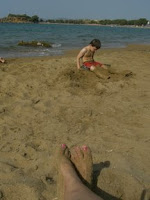
While visiting a friend in a village located near the south coast, we also got a chance to dip our feet into the very clean crisp waters of Sougia beach.


For more photos of souther Crete, click here.